October 25 – November 1, 2006
These restored messages come from the Quilt History List, an online forum where quilt historians, collectors, researchers, appraisers, and enthusiasts discussed antique quilts and related textiles. The archive dates from 1996 through approximately 2016 and is being restored gradually. Sign up in the form at the bottom of the page if you want to know when a new page is added. Original spelling, opinions, formatting, and inactive links may remain unchanged.
Primary topics of this QHL Digest:
- Quilt History After 1970 — Newbie Richardson asks for help teaching the second half of the 20th century, and members cite the Bicentennial, the rotary cutter, paper piecing, cotton mill regulations, and a film on the quilt revival.
- Cheater Cloth Finds — Julie Silber posts rare double-sided cheater cloth pieces and asks who collects them, and Marilyn Withrow describes her own hunt. (see the article on cheater cloth)
- The Underground Railroad Fact Sheet — Alice Kinsler sends Barbara Brackman’s summary to 28 requesters, members plan talks and letters, and others compare the story to other invented histories. (see the article on Underground Railroad quilts)
- Crazy Quilt Embroidery Subjects — Unusual images turn up on crazy quilts, from Cuban patriots to musical instruments, and an idle question about a jaw harp fills the list. (see the article on Victorian crazy quilts)
- Conservation Standards and Cleaning — A researcher asks about restoration practices from the 1930s to the 1960s, and Shelly Zegart seeks someone to freshen a stuffed whitework Centennial quilt. (see the article on cleaning antique quilts)
- A Medieval Patchwork Cushion — Karen Evans shares a striking cushion found by a medieval quilting group and asks if anyone has seen anything like it.
- Study Group and Exhibit News — Members announce the first meeting of a Western Washington study group, quilt contacts in Prague, a Centennial and Bicentennial quilt exhibit, and an embellished quilt show. (see the article on quilt study groups)
Date: Wed, 25 Oct 2006 01:29:07 -0600 | From: gingham
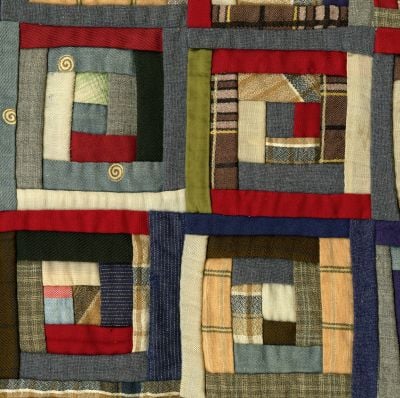
It depends on how the block is actually pieced and I can’t tell from the pictures. So look at how many pieces each block has and compare
Brackman 2813c Friendship chain or album (13 squares & 4 rectangles) to 3266 chimney sweep (4 squares & 9 rectangles)
There is another variation (name?) 5 squares & 10 rectangles oriented like 2813c except the center is a rectangle and 2 squares instead of 5 squares.
This design was often used as a signature block for friendship quilts, popular during the 1840’s to 1875. I have one c. 1845 that is unsigned and I call it my friend-less album quilt.
For more information on friendship quilts see the book: Remember Me by Linda Lipsett
Sandra in Utah Sandra Starley quilt appraiser, teacher, artist ~~~~~~~~~~~~~~~~~~~~~~~~~~~~~~~~~~~~~~~~
what pattern it is, and as must information on as I can. This is the quilt on Ebay I have: Item:180035816928 I believe it might be a chimney sweep pattern, but I’m sure. Could anyone give me their opinion on this. Sandra in Illinois
Date: Wed, 25 Oct 2006 05:18:02 -0700 (PDT) | From: Anita Loscalzo (aloscalz)
ON THE SURFACE: EMBELLISHED QUILTS OCTOBER 26, 2006 – JANUARY 7, 2007
“On the Surface: Embellished Quilts” features 35 works by embellishment artists Nedra Bonds, Gretchen Clements, Jane Burch Cochran, Rhoda Cohen, Michele David, Terrie Mangat, Therese May, Sherry Whetstone McCall, Elizabeth Cherry Owen, Amy Ropple, Susan Shie & James Acord, Ethel Shulam, and Linda Taylor & Cheri Meineke-Johnson. The exhibition, curated by Anita B. Loscalzo, will be on display at the New England Quilt Museum from October 26, 2006 to January 7, 2007.
According to the Merriam-Webster dictionary, to embellish is to “make beautiful with ornamentation” or “to heighten the attractiveness of by adding decorative or fanciful details.” It can be argued the earliest American embellished quilts were the mid-nineteenth-century Baltimore album quilts to which quiltmakers added inked details and embroidery to enhance the impact of their elaborate pictorial creations. Most quilt historians cite late nineteenth-century crazy quilts as the precursors of the modern embellished art quilts, with their surfaces covered with a profusion of embroidered and painted motifs and lace embellishments meant to dazzle the viewer. In the late twentieth century, quilt artists Jane Burch Cochran, Terrie Hancock Mangat, Therese May, Elizabeth Cherry Owen, and Susan Shie again broke the boundary of the surface plane to enhance the beauty and meaning of their quilts with the addition of embroidery, painting, buttons, beads, ribbons, clothing items, kitchen items, and other found objects. The example of their quilts freed the quilting community to use almost any material to adorn their own works.
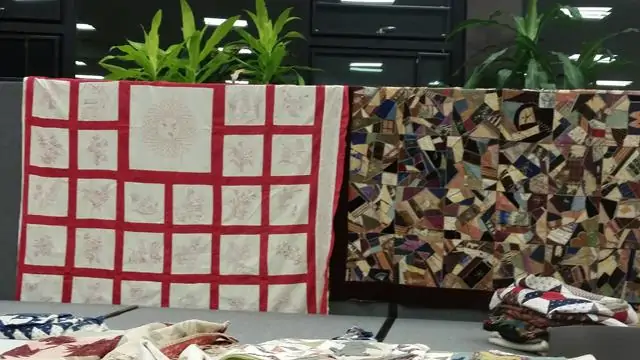
The New England Quilt Museum has gathered an outstanding collection of 35 works for the exhibition. Among the works included are Nedra Bonds’ “A Kiss from the Ancestors,” Jane Burch Cochran’s “Shroud for a Colorful Soul,” Terrie Mangat’s “American Heritage Flea Market,” Therese May’s “Contemplating the 9-Patch,” Sherry Whetstone McCall’s “Crossroads,” Cheri Meineke Johnson’s & Linda V. Taylor’s “Quilt TV,” Elizabeth Cherry Owen’s The Year of the Tiger,” Susan Shie & James Acord’s “IZE’s Trailer Court,” and recent works by Massachusetts quilt artists Rhoda Cohen (“Jewelry Pieces”), Gretchen Clements (“Happily Ever After”), Michele David (“New Orleans on My Mind”), Amy Ropple (“Ashes”), and Ethel Shulam (“Birthday Greetings Around the World”).
On Saturday, December 9, at 1 p.m. Jane Burch Cochran will speak about her work in her lecture, “Embellished: the Art Quilts of Jane Burch Cochran.” Her art quilts are best known for their sparkling embellishments, vibrant colors and potent depictions of everyday life. She never cuts or measures, but simply begins sewing and allows the story to evolve on its own. Admission to the lecture is $5 for Museum members and $8 for non-members.
This exhibition is funded in part by Fairfield Processing and the Narragansett Bay Quilters’ Association.
Anita B. Loscalzo, Curator New England Quilt Museum 18 Shattuck Street Lowell, MA 01852 ——– email: Curator telephone: 978-452-4207 Ext. 11 www.nequiltmuseum.org
Date: Wed, 25 Oct 2006 08:18:53 EDT | From: ZegrtQuilt
Shelly Zegart here.
I am in need of someone to wash a spectacular stuffed whitework Centennial document quilt-sentences all over it and more.It is in excellent condition but needs freshening. It has foldline yellowing and some random dark spots in specific locations. My client is entrusting it to me for preparation for sale. Can you recommend some excellent people for this task to me ? I am familiar with and have contact information for the major people in New York and in Indianapolis , so no need to forward those again. I look forward to hearing from you. Thanks Shelly Zegart
Shelly Zegart zegrtquilt 502-897-7566 http://www.shellyquilts.com/ http://www.centerforthequilt.org/
Date: Wed, 25 Oct 2006 08:24:47 EDT | From: Mitzioakes
Thank you, thank you, thank you, How I needed this short summary of the UGRR/Quilts Questions. I am delivering a short lecture on Quilt History at our upcoming show here in VT and I want to bring this topic up as there are so many stories going around regarding the topic of quilts and codes and the UGRR. I will most certainly use this summary in my lecture. (Has anyone seen the poster put out by the authors of Hidden in Plain View AND endorsed by the US Forest Service? It is MOST distressing that these posters are in schools now and children are using this poster as pure fact…………………) Mitzi Oakes Vermont
Date: Wed, 25 Oct 2006 11:05:07 -0700 | From: Julie Silber (quiltcomplex)
Hi, I am posting a few photos of a late 19th century CHEATER cloth quilt on the eBoard. Has anyone seen this one – I don’t think I have. Thanks, Julie Silber
From: Julie Silber (quiltcomplex)
Hi All,
I just found ANOTHER rare cheater cloth on eBay! I have heard from a few QHL-ers on mine — posted on the eBoard and also currently listed for sale on eBay. So far, no QHL-er has seen mine before.
Now I see another double sided late Victorian faux patchwork on eBay (Stars on one side, Tumbling Blocks on the other.) It is listed as a BUY IT NOW so it may not be there too long. The eBay number is 230043534077. I do not remember seeing the Stars design before. Check them out!
Does anyone know of a collector of cheater cloth? I’m almost tempted to start one myself now!
Julie Silber
Date: Thu, 26 Oct 2006 20:30:20 -0700 | From: Alice Kinsler (alicek)
Hello, All: I’ve received 28 requests for Barbara’s UGRR Fact Sheet. If you have sent me an e-mail requesting her MS Word-formatted document and haven’t received it, please e-mail me again off-list and I promise to send it. Interestingly enough, I found that my computer thought a few of you were junk mail! Alice
Date: Fri, 27 Oct 2006 04:00:17 -0700 | From: Marilyn Withrow (marilynquilts)
As a matter of fact, Julie, I am trying to be a cheater cloth collector and have been for years………there just aren’t that many out there. Every time I see one, I get it. My collection is quite small, but I’m working on it! Marilyn Maddalena Withrow Professional Quilt Appraiser, Judge, Historian, Designer and Speaker Oregon State Co- Coordinator, Home of the Brave Project www.marilynquilts.com www.footscreekfarms.com
Date: Fri, 27 Oct 2006 11:25:05 -0400 | From: Barb Garrett (bgarrett421)
While it isn’t strictly quilts, it is textiles, and thus related to quilts. I just received notice of this exhibit, and wanted to let others know about it, in case Allentown is in or near your fall travels. I have not seen the exhibit, but it sounds interesting.
http://www.allentownartmuseum.org/gallery/exhibits/propaganda.html
Barb in southeastern PA
Date: Fri, 27 Oct 2006 08:38:27 -0700 (PDT) | From: Dana Balsamo (danabalsamo)
Hi Barb, I saw the exhibit and attended a lecture and tour when it was at the Bard Center in NYC…it is a fantastic exhibit. I don’t remember quilts, but lots of kimono, fabrics, scarves, handkerhciefs, dresses, and tablelcloths. I recommend it. My best, Dana
Barb Garrett bgarrett421 wrote: While it isn’t strictly quilts, it is textiles, and thus related to quilts. I just received notice of this exhibit, and wanted to let others know about it, in case Allentown is in or near your fall travels. I have not seen the exhibit, but it sounds interesting.
http://www.allentownartmuseum.org/gallery/exhibits/propaganda.html
Barb in southeastern PA
Material Pleasures Antique and Vintage Textiles – Wrap Yourself in History www.materialpleasures.com
Date: Sat, 28 Oct 2006 13:15:34 -0700 | From: Karen Alexander (karenquilt)
Once more quilters and the Internet come through! Thanks to QHL and BQHL members, I now have two leads to quilters in Prague. Thought you all might enjoy these links, one a quilt shop with classes and the other the International women’s Association in Prague that also has a quilt group.
http://www.bellus-gallery.com/index1.php
international women’s association in Prague http://www.volny.cz/iwap/
Karen Alexander
Date: Mon, 30 Oct 2006 15:57:41 -0800 | From: Julie Silber (quiltcomplex)
Hello All,
I am looking for a copy of The Quilt Engagement Calendar 1999 (E.P Dutton). Does anyone have one for sale?
Thanks, Julie Silber
Date: Wed, 31 Oct 2001 13:32:21 +1100 | From: Janet O’Dell (janet)
G’day from Melbourne Australia. I wish I had had the info wrt patchwork in Prague in June when I was there!
I am looking for a copy of an OOP book published by IQSC in 1998: ‘Masterpiece Quilts from the James Collection’ I have done a web search but no copies come up for sale and I missed out on a recent ebay auction. If anyone knows of a spare copy please contact me off list and I will love you for ever.
Cheers Janet O’Dell
From: Karen Evans
This amazing patchwork cushion was found by a member of the Medieval Quilting Yahoo group. Is anyone else familiar with it, or is this as new to everyone else as it is to me? I’m torn between delight at finding evidence of patchwork prior to Henry VIII’s “paned” quilts of orange and purple sarcenet, and skepticism as to how something this complex could have been created in a vacuum, as it were.
Karen Evans Easthampton, MA20i
Date: Mon, 30 Oct 2006 21:53:17 -0800 (PST) | From: karenquilt
The Western Washington Quilt Study Group had its first meeting in LaConner, WA, on Sunday Oct 15. We had 14 in attendance and were very pleased with the turnout. AQSG member Georgia Chiarella came from as far as Sequim (3 1/2 hours) and a husband and wife team (quilt shop owner and quilt historian Rachel Greco) came from Dallas, Oregon! (That was an overnight each way for them.) We weren92t able to give folks a lot of notice so there may be even more next time. AQSG member Joy Neal lead us in our topic, quilts of the 20s and 30s, and we saw a wide variety of fabric that day. Lots of scrap quilts and several lovely Double Wedding Rings. We had enough quilts brought in that edged into the 40s that we were able to take a good look at some of the subtle as well as distinctiv e differences. Several quilts had flower sacks, insignias and all, on the backs. One lovely scrap top was done on a very bold yellow background. Some were surprised at the boldness of the yellow. Always good to have ou r unconscious assumptions challenged. Everything was not pastel in that era . Sally Ambose shared a delightful quilt made up of preprinted blocks of nursery rhymes that were outlined in embroidery floss with the background fabrics being a pale pink or yellow or blue or tan or peach with the off-setting blocks in a bubble gum pink. The only part of the border that my camera caught was large scrapp sections of pieced greens but don92t recall if it was the same around the whole quilt. (I am not one of those that can take photos, listen and take notes at the same time!) However, I would like to post photos of this quilt at some point for I have never seen one exactly like this particular preprinted nursery rhythm series. (Maybe Sally can chime in with more info as well as descriptions of additional quilts.)
We were also treated to a four-block (pulsating) star quilt ca 1870s with bubble gum pink in the large squares set on point (or half-squares as the case may be) between the stars. A lot of chedder orange and green in each star as well as in the border. (The border design being large green diamonds interspersed with cheddar triangles.) The stars also contained three browns with small prints in them, at least two different striped madders similar to those on page 76 & 77 of Eliieen Trestain92s first 93Dating Fabrics94 book, and a variety of pinks (stripes and double pin ks) in the center portion of each large star (with the next outer radiating set of diamonds being a dark chocolate with a segmented white stripe through it). This quilt immediately said PA to me. Unfortunately, I did not jot down the provenance on it. (Anyone else reading this list who was present that would like to chime in?)
Our next meeting will be in January 21 on doll & crib quilts. We will als o meet on March 18 (topic to be sewing and quilting tools) and May 19 (topi c to be Redwork). Then we won92t meet again until Sept 16. We will meet at the LaConner Regional Library for as long as we don92t out grow it 97 w hich could happen pretty quickly. We had planned a time frame of 10:30 96 12: 30 with a break for sack lunch and then on to the LaConner Museum to see the two exhibits hanging. Well, uhhh, we ran over a little. I think w may nee d a minimum of 3 hours in the future just to see the quilts. Forget the lunch. <g> But DO plan to spend some time at the museum. Four quilters ar e featured until Dec 31 — Kathy McNeil, Sandra Leichner, Casandra Williams and Judy Farrow. Google any one of them and enjoy their stunning quilts.
Karen Alexander (Heading for a rendevous with quilters in Prague, thanks to help from otehr qulters on the Internet!)
Date: Tue, 31 Oct 2006 09:12:13 EST | From: Mitzioakes
Welcome back from cold Vermont where our big quilt show is a happening this weekend. ‘wish you could attend. Mitzi Champlain Valley Quilters Guild and the Green Mtn. Quilters Guild (http://www.smileycentral.com/?partnerZSzeb001_ZS) (http://www.smileycentral.com/?partnerZSzeb001_ZS)
Date: Tue, 31 Oct 2006 08:22:03 -0800 | From: Laura Robins-Morris (lrobins)
http://www.chiantimusei.it/cgi-bin/en/pub_cerca.cgi
If you couldn’t see the pathwork pillow, try this link. Laura
Date: Tue, 31 Oct 2006 19:23:02 -0500 | From: seater
Dear friends,
20
We are not alone in our frustration at fabrications being passed off as newly discovered facts, as HIPV has distressed us. For another textile example, see The Goddess from Anatolia: An Updated View of the C7atal HFCyFCk Controversy at20
http://www.marlamallett.com/chupdate.htm
to see how the myth of a Neolithic origin for kilim designs in Anatolia is still believed by newcomers to rug history.
20
Susan Seater
Raleigh NC
20
Date: Tue, 31 Oct 2006 21:44:27 -0500 | From: Lucinda Cawley (lrcawley)
At the Kent Co., MD documentation on Saturday I saw a badly deteriorated Crazy quilt with the MOST unusual embroideries: a block focusing on the history of Cuba with the names of patriots embroidered along with an inaccurate, but beautiful, image of the Maine. It was portrayed as a full rigged sailing ship (think Baltimore Clipper). But the most unusual image on the quilt was an embroidered Santa Claus with reindeer and sleigh. I have never seen Santa on a Crazy before. What is the strangest thing you’ve ever seen on a Crazy? Cinda on the Eastern Shore
Date: Wed, 1 Nov 2006 07:04:49 -0500 | From: Karen Evans
There’s a similar controversy in the feminist spirituality community over Catal Huyuk, due largely to Marija Gimbutas’s *very* speculative interpretations. Most religious and archaeological professionals find her work problematic at best, but that hasn’t prevented Gimbutas’s supporters (like Willow Lamont and Starhawk) from claiming that her speculations are fact, not theory, and there was a universal mother goddess cult in “Old Europe” that was destroyed by monotheist nomads from Central Asia.
Argh…..
Karen Evans
Date: Wed, 01 Nov 2006 09:53:32 -0500 | From: Newbie Richardson (pastcrafts)
Dear List, As many of you who know me are aware, I have really not focused on keeping track of quilt history from the second half of the 20th c. Well, it is coming to back to bite me! I will be team teaching a class this coming winter/spring in the Masters of Dec Arts which is offered through a collaboration of the Smithsonian Institution and the Corcoran School of Art here in DC. The course is on the history of textiles used in the bedroom – including – of course QUILTS!
One of the subjects I have been asked to lecture on is the history of quilts for the whole of the 20th c. ( This will be done in two two hour presentations) I have plenty of information up through WWII – but after that – very little on my library shelves. I do have some very good books on Art Quilts – but I would love more suggestions on that particular genre – especially as to how the art quilt movement relates to what went before. One of the things we are stressing in this class is that nothing in the decorative arts was conceived in a vacuum – that there is always a common thread where you can see where the influence came from.
So, I need to find suitable reading recommendations for the students – and see that it is available in the school library. I have ample access to a good copier, so making copies is not a problem. I am hoping some of you may be able to point me in the direction of relevant “overview” articles, books, etc. on what has happened in the quilting world since the Bicentennial. There are so many sub groups within the greater quilt making community- I would like to try and make sense of it for the students ( and for me?). Please, let’s not review HIPV – that I have down cold!
I had the great good fun of spending half a day with Bobbi Aug when I was in Colorado last week -and she gave me some very good advice, as did Toni at her fabulous quilt shop: Fabric Expressions in Littleton, CO. Toni had a very insightful analysis of the revolution created by the rotary cutter – it’s impact on quilt design. As a textile historian, I immediately saw what she meant – but had not thought about it until she mentioned it.
This should prove to be a very lively thread – so please do post any thoughts to the list.
Oh, yes, my other faculty members are: Colleen Callahan, curator Emeritus of the Valentine History Center in Richmond, VA . Alden O’Brien, curator of costumes and textiles at the DAR Museum ( who is, not so co-incidentally, doing an exhibit entitled “And so, To Bed!” opening in May of 2007), and Mary Doering, professor of textile history at the Smithsonian/Corcoran Schools.
Thanks in advance Best to all
A.Newbold “Newbie” Richardson The Costume and Textile Specialists Appraisals, Conservation, & Exhibition Alexandria and Richmond, VA 703-684-0863/804-261-4998 www.costumeandtextile.net
Date: Wed, 1 Nov 2006 10:26:19 -0500 | From: Tracy Jamar (tjamar)
I am looking for information on textile restoration/ conservation practices and standards that were used in the 1930s-1960s. If anyone has any leads as to where I might find such things I’ll be your new best friend.
Thanks, Tracy Jamar
Jamar Textile Restoration Studio New York, New York 212 866.6426
Date: Wed, 01 Nov 2006 09:42:34 -0600 | From: sadierose
Newbie, Here are a few thoughts off the top of my head 🙂 The US Bicentennial in 1976, which really put a spotlight on “American” handcrafts. From my point of view, quilting really “came out of the 20 closet” then… there were a few quilting publications & classes 20 before 1976, but things really snowballed after that. Publications 20 are another factor: Quilter’s Newsletter started in 1969, QUILT WORLD 20 and a few other publications were available back then, and gave us 20 mail order access to quilting supplies, that were not found locally. 20 Quilt shops really started appearing after the Bicentennial, too. 20 Fabrics specifically designed & intended for quiltmaking… Jinny 20 Beyer was one of the first “quilt fabric designers”, I believe her 20 border stripe collections started in 1982. Georgia Bonesteele, with 20 her “Lap Quilting” techniques and the public broadcasting shows made 20 quilting sound ‘doable’ for the average person, and PBS shows brought 20 instructions right into your living room. Penny McMorris also hosted 20 2 quilting shows for PBS, long before the Electric Quilt company 20 started us using our computers for design and pattern making. 20 Quilting guilds sprung up around the country, and then the traveling teachers/authors. I can remember having ‘every’ quilt bo ok in print about 1974, when Beth & Jeffrey Gutcheon published “The 20 Perfect Patchwork Primer” 🙂 Rotary cutters really kept quiltmaking rolling, though. Cutting 20 cardboard patterns, and cutting pieces out with scissors is slow and 20 tedious, no matter how enthralled you were with quilts 🙂 For me, 20 Barbara Johannah, with her book “Quick Quilting: Make a Quilt This 20 Weekend” started the idea of quick piecing techniques, which were also 20 shared through Quilter’s Newsletter magazine. Carla Hassel, with her 20 “You Can Be A Super Quilter” and “Super Quilter II” books, gave 20 mathmatical detail & precision to quiltmaking. Marianne Fons & Liz Porter met at a quilting class, which they took as young mothers for some personal time away from their young families… their quilting influence has expanded into every media now 🙂 Diana Leone’s “Sampler Quilts” book helped us learn, one block at a time. Quilting became an ‘industry’ with publishers (That Patchwork Place, Marti Michell’s “Yours Truly” company, Oxmoor House, C & T Publishing are early ones that I recall), fabric companies specializing in quiltmaking fabrics (with the next step of producing ‘reproduction’ fabrics) & markets. 20 Communication has also continued to enhance quilting… from letters 20 with scraps, and signatures on blocks… to newspaper patterns and 20 periodicals, to glossy magazines & books, to computer technology with 20 e-mail correspondence, websites and computer aided design. Quilt 20 documentation, and studying quilt history as well as collecting old 20 quilts, has added another facet to quiltmaking for many of us. I still think the real ‘thread that runs through it’, though, is 20 the soothing tactile experience of working with the fabric… the 20 creative process that feeds our souls… and the ‘remember me’ 20 connection with past and future generations. I always tell children 20 that I give a quilt, that a ‘quilt is a hug’… you can wrap yourself 20 in it, and often the smell and feel takes you right back to a special 20 person, place or time. Sorry, didn’t mean for this to get so long 🙂 A really awesome resource for you would be the “GREAT AMERICAN QUILT 20 REVIVAL DOCUMENTARY” http://www.quiltershalloffame.org/GAMQDVD.htm 20 which interviews many of the quilters who played a roll in the rebirth of quilting circa 1976 . As someone who has ‘been around’ quilting through all these 20 developments, it is a fascinating to watch!! Will be interested to see what others share on this topic 🙂 Karan from sunny Iowa
Date: Wed, 1 Nov 2006 07:50:04 -0800 (PST) | From: Jackie Joy (joysbees)
I would think that an analysis of Quilter’s Newsletter Magazine over the years would be a good place to start.
Jackie Joy
Newbie Richardson pastcrafts wrote: Dear List, As many of you who know me are aware, I have really not focused on keeping track of quilt history from the second half of the 20th c. Well, it is coming to back to bite me! I will be team teaching a class this coming winter/spring in the Masters of Dec Arts which is offered through a collaboration of the Smithsonian Institution and the Corcoran School of Art here in DC. The course is on the history of textiles used in the bedroom – including – of course QUILTS!
One of the subjects I have been asked to lecture on is the history of quilts for the whole of the 20th c. ( This will be done in two two hour presentations) I have plenty of information up through WWII – but after that – very little on my library shelves. I do have some very good books on Art Quilts – but I would love more suggestions on that particular genre – especially as to how the art quilt movement relates to what went before. One of the things we are stressing in this class is that nothing in the decorative arts was conceived in a vacuum – that there is always a common thread where you can see where the influence came from.
So, I need to find suitable reading recommendations for the students – and see that it is available in the school library. I have ample access to a good copier, so making copies is not a problem. I am hoping some of you may be able to point me in the direction of relevant “overview” articles, books, etc. on what has happened in the quilting world since the Bicentennial. There are so many sub groups within the greater quilt making community- I would like to try and make sense of it for the students ( and for me?). Please, let’s not review HIPV – that I have down cold!
I had the great good fun of spending half a day with Bobbi Aug when I was in Colorado last week -and she gave me some very good advice, as did Toni at her fabulous quilt shop: Fabric Expressions in Littleton, CO. Toni had a very insightful analysis of the revolution created by the rotary cutter – it’s impact on quilt design. As a textile historian, I immediately saw what she meant – but had not thought about it until she mentioned it.
This should prove to be a very lively thread – so please do post any thoughts to the list.
Oh, yes, my other faculty members are: Colleen Callahan, curator Emeritus of the Valentine History Center in Richmond, VA . Alden O’Brien, curator of costumes and textiles at the DAR Museum ( who is, not so co-incidentally, doing an exhibit entitled “And so, To Bed!” opening in May of 2007), and Mary Doering, professor of textile history at the Smithsonian/Corcoran Schools.
Thanks in advance Best to all
Date: Wed, 01 Nov 2006 08:11:03 -0800 | From: Julia Zgliniec (rzglini1)
Dear QHL, In regards to Cinda’s question, I saw an unusual image ( to me ) on a crazy quilt just two weeks ago. I have seem many musical instruments embroidered on these quilts over the years – most commonly harps or violins but two weeks ago, in addition to a musical cleff, there was a Jew’s harp. It was perfectly rendered and there was no mistake as to what it was. It was a group made quilt, block style, with many different initials and various levels of workmanship, 2 blocks were dated 1890.
Regards to all, Julia Zgliniec, Powya CA
Date: Wed, 01 Nov 2006 08:51:55 -0800 | From: Carroll (rl.carroll)
> This should prove to be a very lively thread – so please do post any > thoughts to the list.
The one thought that comes to mind is that there is still a lot of documentation to do on quilting practices after the war. Judging by the great numbers of quilts we are now seeing from the 50’s, 60’s and 70’s, women continued to quilt in great numbers. Many of these quilts are just now coming out of storage and we will probably be seeing many more in the future. This is very exciting, and so interesting to see quilts made in fabrics from these years.
Laurette Carroll Southern California
Look to the Future with Hope
Date: Wed, 1 Nov 2006 12:52:42 -0500 | From: J. G. Row (judygrow)
Back in the early 1970’s and before, we were doing needlepoint, (expensive but relatively small projects), cross stitch (inexpensive, small projects) and, Lord help us, macrame, (also small and inexpensive projects). Most of us, those of us of a certain age now, were between 25 and 35, and had left our first jobs to start our families. There was no time, space, or money for large long term projects.
We needed something that we could pick up and carry with us to play group, or PTA meetings, or little league games. Before quilt guilds we had “sewing club” — when we could leave the house on a Wednesday night and meet with other women at each other’s homes and bring any handwork we were working on at the moment. Some brought knitting, which fell out of favor and is in a resurgence now. One woman even brought her ironing! The group that I belonged to in 1971 (it still meets with many of the original members) eventually decided to make a BiCentennial quilt for our community. That meant that we began to meet women of the previous two generations, retired farm wives who had a history of quilt-making. For many of us our devotion to quilting began there.
Few of us knew of or went to see the big NYC quilt show which started the interest in quilts as objects of graphic art until years later.
When I moved away, having worked on two such community quilts, I founded a BiCentennial quilt group underwritten by the township committee in my new community, as a way to meet women (and some men) through that activity.
As our children grew and demands on our childrearing time were reduced, our desire to work something with our hands that would prove meaningful and would be more fulfilling grew. Ergo, our dedication to quiltmaking.
I’ve done it all, all those crafts that kept us sane as young mothers, and even had two books published on reproducing antique needlework; but nothing ever approached the satisfaction I got and still get when I put the last stitch in the last side of the binding on a new quilt!
J. G. Row Flemington NJ
Date: Wed, 1 Nov 2006 12:26:41 EST | From: Quiltsappraised
Growing up in the Florida Panhandle during the 50’s and 60’s I saw lots of quilting being done. I was shocked when, in the 1980’s, I read that “quilting nearly ceased after WWII”! I thought, what world did this person live in? I lived in a rural area and quilting Bees were a weekly occurrence. I remember as a toddler playing under the quilt as it was being quilted by my Granny and 11 of her friends from church…every Thursday. She passed away when I was 10. My aunt quilted until she was unable to in the 1990’s. There was always a quilt in the frame. I only wish I could have learned from these dear women. I did get to watch and the memories are fresh and wonderful to refer back to!
Alma Moates Pensacola, Florida quiltsappraised Best Wishes
Date: Tue, 31 Oct 2006 10:07:19 -0800 (PST) | From: ikwlt
i’ve been away for awhile so this might have already been posted, but i was recently made aware of a rest stop in cedar county, iowa. it was written up in the newest fons and porter magazine (july/august 2006) and if one is aware of the controversy, you can see that it is mentioned. the average quilter tho, will be encouraged to visit this “shrine” to HIPV.
a lady i know took several pictures, including the two plaques placed at the rest stop. i’ve re-typed the text to be able to include it in my post to you. i also have the pictures if anyone would like me to e-mail them to you privately. here ya go!
“Traveler’s Rest: The Underground Railroad in Cedar County, Iowa
Few people realize the significant role Iowa played in the Underground Railroad. Cedar County, Iowa is the site of an extensive network or system of stops that provided shelter, protection, and transportation of fugitive slaves attempting to make their way to freedom. It is only recently that the amazing accounts of African Americans and the many people who helped them to freedom in the Underground Railroad have been recorded. This incredible history has been handed down for generations in a long shared oral tradition. One of the most fascinating elements to “come-to-light” is the story of the “Underground Railroad Quilt Code.” Hidden in Plain View, by Jacqueline L. Tobin and Raymond G. Dobard, PhD., documents the secret messages contained in the geometric patterns of common quilt designs. A sequence of knots and stitches “mapped” the path to follow. Safe routes were displayed and signals sent in the everyday custom of hanging a quilt out to dry. The Quakers were active abolitionists in Cedar County, Iowa. They believed it their moral obligation to help slaves escape. Although few tunnels actually existed, secret hiding places were made in homes, barns, inns, and offices. Many sites related to the Underground Railroad can be found in the vicinity of West Branch and along the Cedar River. Moving at night, fugitive slaves “escaped to Canada as easily as if they traveled on a railroad beneath the ground,” one southern slave owner stated. The railroad was more than just a symbol for the path to freedom. In the Cedar County, Iowa town of Mechanicsville, the Chicago Northwestern station agent smuggled slaves on trains headed for Chicago. Many stories tell of “shipping” slaves disguised as sacks of potatoes or other kinds of freight. John Brown, the fiery abolitionist who led the famous raid at Harper’s Ferry, trained his devout band of followers in Cedar County. Barclay and Edwin Coppoc, two Quaker brothers from West Branch, fought with John Brown despite their religion. According to Richard, Lord Acton and Patricia Nassif Acton, who wrote Go to Free: A Treasury of Iowa’s Legal Heritage: “Iowa’s role in supporting the Union Cause is well known. … Less well known is the role played by Iowa in provoking South Carolina’s secession from the Union in 1860, a move that led inexorably to civil war.” Barclay returned to Iowa where then Governor Samuel Kirkwood prevented extradition to Virginia. The Actons note that these “were key ingredients cited by the South Carolina convention among its justifications for secession.”
second plaque… The Underground Railroad in Cedar County is depicted in images made of terra cotta and colorful ceramic tile, recalling the rich and meaningful patterns of historic slave and Quaker quilts. These patterns and symbols have been shared across many cultures and remain a lasting artistic tradition. It must be noted, however, that the code evolved from both literal and symbolic language; one shared through faith, spiritualism, and experience. The following guide is offered as a key to their translation and understanding.
Monkey Wrench – Get ready. Gather the tools you’ll need for your journey and the necessary skills. A person or group, beyond suspicion, that would help organize the trip.
Wagon Wheel/Carpenter’s wheel – Pack provisions to begin as in packing a wagon. The wheel – By the Grace of God
Bear’s Paw – Follow the trail of a bear through the mountains where food is available. A real trail.
Crossroads – A safe terminal, often the destination of Cleveland, Ohio.
Log Cabin – An arrival. Stay where you are, dig in.
Shoofly – A liaison. A person who might aid in the flight.
Bowtie (Hourglass) – To form a relationship with someone who would help. The time to meet someone. Time to change one’s clothes to “fancy ware.”
Flying Geese – Depart with the spring migration of geese to the north. Follow the geese along waterways.
Drunkard’s Path – Zig zag. Don’t move in a straight line.
Star/Evening Star/North Star – Let the North Star and other constellations be your compass. The North Star hung above Canada.
Nine Patch – The colors of different crops, a plantation map.
Jacob’s Ladder – The route north (up) to freedom, transcendence.
This public-artwork installation was designed by artist, David B. Dahlquist, as part of the multi-disciplinary design team of French Reneker Associates (Engineers), and Yaggy Colby Associates (Architecture and Landscape Architecture). It was fabricated by the artisans of Dahlquist Clayworks’ studio including: Marcy Lloyd, Rick Stewart, Brian Frederiksen, Jim Edelen, Christee Lesch, Kate Fisher, Larry Bredeson, Jennifer Erickson, Marci Witmer, Meredeth Nelson, Travis Rice, and Jim Dawson (Iowa Metal Fabrications).
Date: Wed, 01 Nov 2006 12:25:56 -0600 | From: Gail Ingram (gingram)
Julia,
Until I was a grown woman (really grown!), I thought the term was “juice harp.” Are you talking about a harmonica? And how would that get such a name, I wonder.
Gail
Date: Wed, 1 Nov 2006 13:52:04 EST | From: Mitzioakes
Let us not forget Carol Doak and ‘paper piecing’ – this method has made quilters out of sewers and I think it should take its rightful place in 20th C. quilts and methods and makers. I know I would not be quilting today if I hadn’t discovered the use of paper. Mitzi from Vermont
Date: Wed, 1 Nov 2006 14:06:22 EST | From: Mitzioakes
Thanks a million for the reprint of the UGRR/Quilt info you posted. I am doing a series of lectures this weekend at our annual quilt show in Shelburne, VT. One subject I will be covering is this widely mis-used myth about the secret codes etc. and always quoting HIPV as a reference. I will make copies of these plaques (I already have the colored copy from the F&P Magazine as part of my display). Hopefully I won’t be escorted out the back door of our show’s location when I burst some quilters bubbles who believe the UGRR and the Codes was really an actual happening. I have been calling it ‘revisionist history’ for lack of a better title. Mitzi from Vermont
Date: Wed, 1 Nov 2006 19:41:33 +0000 | From: Sally Ward (sallytatters)
Not a harmonica, is a gizmo which looks like a miniature lyre, with one string. You rest it half in and half against your mouth so that the jawbone and mouth cave (can’t think what else to call it) provide resonance, and you twang the string while changing the shape of the mouth and sort of making a groaning noise to change the note. Well, roughly speaking that’s how it works <G>. As a musical instrument its in the same league as comb and paper .
The name may have pejorative origins referring to the very small size of the ‘harp’, but more likely is a corruption of ‘jaws harp’.
We had a couple when | was small and we gathered round the piano (with comb and paper as well) to singalonga Dad (‘on top of old smokey’ I particularly remember).
Sally Ward In a very cold and wuthering Yorkshire, at last.
Date: Wed, 1 Nov 2006 14:43:28 -0500 | From: pepcory
Hi Newbie-Order the film The Great American Quilt Revival from www.georgiab onesteel.com on DVD. It’s a great overview of what quilting means to us wh o joined the movement after 1970. More insights in that film than a one-tim e viewing can comprehend–watch it with a quilting friend-surefire conversa tion starter!Cheers,Pepper from NC
Date: Wed, 01 Nov 2006 13:39:41 -0600 | From: Gail Ingram (gingram)
Dear Newbie and All,
While the second half of the twentieth century has encompassed my lifetime, I am more a traditional quiltmaker than many–probably most–on this list. Have never taken a class. Didn’t learn to quilt the way J. G. Row did, as part of a regional or national trend. And even though I have a room of bookshelves loaded with books on quiltmaking techniques and quilt history, I still prefer the show-me, one-on-one method. It’s simply the way I think about quiltmaking.
I believe there are many more quiltmakers like me than is recognized, and many of them, particularly in the rural southern communities, white and black, and perhaps in midwestern communities, still find their inspiration in the quilts they see being made or which have been passed down to them (or, sometimes, like me, were NOT passed down to them). Many in the region of North Louisiana are still within this tradition. Quilt magazines have the same effects the quilt patterns that newspapers still ran here in the sixties. These people were the ones who kept the tradition alive while everyone else was doing needlepoint and cross-stitch.
Home Demonstration agents and county fairs renewed their repertoires. When it came time to get my first quilt top quilted, I followed a time-honored tradition in my region and sought out a quilter, a woman who quilted tops for others. I called the local home demonstration agent, who put the on the trail of the local quilting underground, from whom I learned a lot. I was teaching 4 upper-division courses/semester and after quilting about 1/3 of a quilt, just gave up. I wanted to see it completed in my lifetime.
Like many, I saved remnants from dressmaking from the time I was in my teens for a Double Wedding Ring quilt and other scrap quilts. That was a tradition–commemorative but also motivated by frugality—in which I worked. When I finally worked out a pattern for that first quilt, I did it by referring to the photo in the front part of Hall and Kretsinger, the only book available in Athens, Georgia, and one I kept on perpetual check-out for three years. An engineer friend helped me draft the pattern, based on my memory and that picture, and a woman demonstrating quilting at the Mountain Fair in Hiawasee, Georgia (that year the liquor still won first prize for the quality of its output) gave me some tips for managing the bias seams. I worked in a world of Kretsinger and Hall and memories of quilts etched in my mind since childhood as practical and also revered objects. I could not imagine entering adult life and homemaking without quilts. One of my college roommates rec’d a quilt from each grandmother for her wedding–Double Wedding Ring and Dresden Plate. Living in a more “citified” world, I had no such luck. I rec’d silver and china and linens—and a teapot that played “Indian Love Song.”
I think that tradition was not the tail end of the Depression Revival, but part of a continuum from earliest homemaking practices.
I was nourished by about three books and a magazine called “American Home,” from which I still have a lavishly illustrated article about Florence Peto, and by older women and family quilts. I cherished the odd quilt magazine on which I could lay hands.
The sudden burst of information that the Bi-Centennial created was my idea of heaven. It changed everything for me—made available to me other examples of older quilts. A “book person,” I used these as inspirations. For many older quilters in these backwaters, however, the Bi-Centennial simply validated, honored the tradition in which they had been working and the objects in which they had found a very local pride. Once again they saw their efforts recognized, and one could see the differences it made in their perceptions of themselves and their craft.
An exhibition of traditional quilts which was my gift to myself for having served as president of a faculty wives organiztion was, I think, the first public statement about the important artistic and cultural importance of quilts in our community. Out of it grew the first non-church quilting group here. It was an odd assortment of women, with perhaps only three of us having come from a tradition of quilts, but in it I found mentors for childrearing, learned the rest of the “facts of life,” and remained focused on quiltmaking and materials. These small groups were important, and their very existence speaks to a popular current.
The renewed interest in the study of folklife, with its emphasis on oral traditions and history and collecting information on these, also boosted interest in quilting in our region. I wonder if it were that which led to something we call quilt history.
It certainly led me there, before I had access to AQSG and before there was AQSG. I have notes and sketches an patterns collected from quilts from the time I was 20 years old.
Both folklife studies or what became quilt history study have had a deep influence on quiltmaking in the last part of the 20th century. They progressed, educating a certain group of quilters, right alongside the art quilting and more innovative lines of quiltmaking. Whether it was Jennie Beyer or someone else, you see both the tradition and the innovation interacting repeatedly.
I think you see this common thread in all needlearts in our era. As an avid needlepointer (there, I took classes), I’ve seen ever-elaborated techniques and effects.
What seems to hold all these together–and this might be my perspective, which is clearly traditional and historical in orientation—is the interaction of tradition with new materials and techniques and visible examples. But always there seems to be history (NB Erica Wilson’s important book on historical embroidery techniques, pub’d in late 70’s or 80’s)—the “rediscovery” of metallic threads in embroidery, e.g., the Eastern embroideries, the medieval embroideries, etc.
I wonder how many fundamentally “traditional” quilters remain today. I own lots of rotary cutters and often use them. Yet, my work is seldom assembly-line in fashion. I’m happy with a good pair of scissors. I still like to hand piece when possible. I’ve not quite developed a solid taste for machine quilting.
Newbie, I’m sure you know T.S. Eliot’s essay “Tradition and the Individual Talent,” but it too might prove helpful in understanding the last half of the American Century.
My own view is that quilting might be fading today as a vital and communal art form were it not for the vitality of interest and activity of quilt history groups that have become increasingly knowledgeable and increasingly focused on history and culture. The very act of reproducing a quilt or a historic sampler is a conservative act.
I’d say, have your students take a gander at Mesdames Kretsinger and Hall and Peto and company as well as those contemporary to the post WW II era. And at the continued vital tradition at the grassroots level, information available through folklife/cultural anthropology/oral history studies.
Gail Ingram
Date: Wed, 01 Nov 2006 13:52:09 -0600 | From: Gail Ingram (gingram)
> > Not a harmonica, is a gizmo which looks like a miniature lyre, with > one string. You rest it half in and half against your mouth so that > the jawbone and mouth cave provide resonance, and you twang the string
Aha! Have seen that too.
I doubt “Jew’s harp” was pejorative. I am descended from a line of country fiddlers on my father’s side and a line of folks who loved more complex violin music on my mother’s. As an example of how God brought good out of bad, my mother often remarked were it not for the many troubles the Jewish people had experienced, the world might not have had so many fine violinists. The violin was portable, she said, and always ended with “Try taking a grand piano with you when you are slipping away in the dead of night.”
Gail
Date: Wed, 1 Nov 2006 12:09:31 -0800 | From: Karen Evans
Suggestions:
1. Write to the state, county, and local historical societies about how the quilt code has been thoroughly debunked. Include every scrap of information you have, including Giles Wright and Pat Cummings’s articles on same.
2. Write to James W. Lowen, author of “Lies Across America: What America’s Historical Markers Get Wrong.” The book is a magnificent debunking of some of the worst and most distorted historical markers in the country, and the author has a bully pulpit that most of the rest of us get wrong.
3. Mobilize other Iowa quilters to do the same.
If we don’t start stomping this out *now*, it’s going to get worse. Much worse. Much, much, much worse…..
Karen Evans
Date: Wed, 1 Nov 2006 13:43:21 -0800 | From: suereich
Over the past 18 months, I have been researching, writing, and exhibiting for the “Happy Birthday, America! Centennial and Bicentennial Quilts” exhibit. It just closed at the New England Quilt Museum, and is about to open at the Museum of the American Quilter’s Society in Paducah. In studying quilts made around 1876 and throughout the remainder of the nineteenth century, and the quilts made for the Bicentennial to the year 2000; there are some amazing parallels. I urge you to look back those one hundred years for added insight into the quilts of the second half of the twentieth century. Incorporated in my research for “Happy Birthday, America!” are newspaper articles about quiltmaking during both time periods. In the absence of journals and notebooks on quiltmaking; they are the closest to primary source accounts that we have to base our assumptions on. We do have the quilts, of course, but… We’ve all had the desire to pick the brain of a quiltmaker from the past to ask her “Just what were you thinking?” Just as the Centennial set into motion many new genre of quiltmaking, so did the Bicentennial. The Art quilts are just one category. I believe that the sampler, pictorial quilts made by the legions women of every level of needlework skill had an enormous impact on the Art quilt world. The pictorial quilts used painting, embroidery, applique, and embellishments to capture towns and activities in 1976 as true to form as possible. Making these quilts expanded the imagination and interpretation about how different a quilt could look. This may sound simplistic in analysis but in our state alone, just about every town was involved in a community effort to make a Bicentennial sampler, pictorial quilt. Other parallels to the late nineteenth century include an abundance of fabrics for quiltmaking, embellishment quilts, quilts with thousands of pieces, such as color wash quilts, and innovations in machine quilting and applique work. Best of luck to you and this endeavor. Someday, quilt historians will be studying us to quiltmakers of today. sue reich
Date: Wed, 1 Nov 2006 19:04:23 -0500 | From: Sharon in NC (patchworksecrets2)
We still refer to them as “juice harps” (known both ways in the mountains) but one correction.. They don’t have a string on them. They have a stiff flat piece of metal that you twang as you play. Some call it a reed. I have one around here somewhere I used to play when I was a kid during the local fiddlers convention with some friends.
Sharon in NC http://community.webshots.com/user/sharonsews
Date: Wed, 01 Nov 2006 19:23:17 -0500 | From: Newbie Richardson (pastcrafts)
Tracy, I have a note book full of stuff I Xeroxed when I was first learning the discipline – taken from all kinds of literature on the shelves of the Textile Museum Library. I know that Dr. James Rice, conservator at the Textile Museum – and something of the father of the field – wrote many papers in the late 1950’s 1960’s and I have an article by the Japanese textile conservator at the Met in the 1960’s. I will look through those note books and see what else has those kinds of dates and get back to you. Also, in those days the dry cleaning industry was involved through the -excellent- Fabri-Care Institute in Silver Spring maryland – sadly no longer. But one of their instructors still does museum specialist dry cleaning here in Silver Spring. I know she would be delighted to be interviewed.
I was told that the discipline came out of the death of Home Economics. There were many PhD’s in the field with no where to go. The gals ‘got together” and created the “new’ discipline – mostly at the agricultural colleges – like Kent State, U. of Maryland, U.R.I., Cornell, etc. Story has it that the male powers that be were not paying attention to what “the girls” were up to – until it was a full fledged degreed program!Dr. Maragaret ordonez was the “baby” of the group and still teaches at U.R.I. Margaret has some great stories! I have always thought that this topic would make a great dissertation. Best newbie
A.Newbold “Newbie” Richardson The Costume and Textile Specialists Appraisals, Conservation, & Exhibition Alexandria and Richmond, VA 703-684-0863/804-261-4998 www.costumeandtextile.net
Date: Wed, 01 Nov 2006 19:32:23 -0500 | From: Newbie Richardson (pastcrafts)
One thing that Bobbi pointed out – that I had been unaware of – was that in the early 1970’s the EPA really came down hard on the amount of water that was being used to process cotton in this country. The resulting regulations really put the fabric mills in a financial bind so that the cost of cotton increased from $0.39 a yard to $3.00 a yard almost over night. This lead to a need for “cheap” fibers and voila! Polyester and poly cotton blends. I remember that I made an applique quilt as a wedding preasent for my best friend in 1978 and paid well over $100 for the 100% cotton fabrics I used – I guess I was always a fabric snob – even back then! Can anyone elaborate – Joan?
A.Newbold “Newbie” Richardson
Date: Wed, 01 Nov 2006 19:43:43 -0500 | From: Newbie Richardson (pastcrafts)
I know that this list serve won’t let you just hit replay when the previous post has been lengthy – but this is a reply to J. G. Row’s post on the rise of quilting.
My theory – born out of anecdotal observations in the industrial Northeast ( I am 53 years old BTW) is that quilting and quilt shops/groups also grew out of the swelling of women as middle management professionals. These gals were the first women in many of their offices and thus felt that they could not socialize with the guys. As the first -or token- woman execs they also could not socialize with the secretarial staff, so they needed an outlet. These gals found interesting projects and compatible pals in the various classes offered at the quilt shops – and ipso facto – a hobby industry was born.
Now there is a serious “graying” of those same aficionados – and their daughters are not following in their footsteps. I think we will be seeing the closing of many quilt shops in the next five years.
A.Newbold “Newbie” Richardson
From: Newbie Richardson
Ok you guys, I am now going to have to go to -shudder- Staples – to get more paper and another ink cartridge. What a great list you all are!
A.Newbold “Newbie” Richardson
Date: Wed, 01 Nov 2006 19:51:54 -0500 | From: joan kiplinger (jkip)
Newbie — there were problems beginning in the late 60s. I have someregulation information but will have to haul out my notes There were quite a few textile industry leaders vehement about overproduction and tariffs whicht also put a bind on cotton. Stay tuned.
Date: Wed, 1 Nov 2006 20:26:28 EST | From: Maggmalone
I grew up in Columbus, Ohio during the 1950’s. The only quilt I ever saw growing up, was in McCall’s Needlework and Crafts Magazine. As soon as I saw it, I wanted to make it. I had been interested in crafts ever since I could remember, teaching myself each one I came across. After flunking sewing in school, I even taught myself to sew my own clothes. I think I was about 15 at the time and this looked doable. The pattern was a Lone Star, a five point star set inside a circle. I cut the pieces and struggled on the sewing machine to complete one block. Boy, it sure took a long time. Then I read the fine print that told me I was supposed to do all this by hand. Not in this life time. I’d never finish a quilt at this rate.
I kind of played off and on with quilt making over the next 10 years, but it wasn’t until I stumbled across Barbara Johannah’s book on machine quilt making (darn, I can’t remember the name of it now) but it was like she gave me permission to use the sewing machine. I just took off from there.
I prefer traditional patterns but love the fact that you can make a dozen of the same pattern and no two will look the same. And I truly admire the women who have come up with all the gadgets that make quilting so much easier and faster. Since I love playing with the patterns, I truly appreciate being able to finish a quilt a week, rather than one taking a lifetime. I think all of the innovators who thought outside the box. Maggie Malone
Date: Wed, 01 Nov 2006 20:28:38 -0500 | From: Barb Garrett (bgarrett421)
Newbie Richardson wrote:
Toni had a very insightful analysis of the revolution created by the rotary cutter – it’s impact on quilt design.
Hi Newbie –
Since I’m one of those people who made the transition from templates and rulers to rotary cutter when it came out, I would enjoy hearing what Toni said. I made my first quilt in 1968 by tracing around a masonite template (made by my husband because cardboard would change size). I used a ball point pen (pencil didn’t show well on the 1950s fabric scraps, plus pencils get dull but a pen doesn’t). This was the process I continued to use until the rotary cutter was introduced. So to me, the rotary cutter has always meant saving time and better accuracy, and no more ink in my seam allowances <grin>. It hasn’t changed the designs of my quilts, except maybe to make them smaller — which I might not have done using templates. It definitely makes cutting out the pieces more fun and less tedious. And the speed allows for more production.
The main thing I remember about my quilting during that early time was the difficulty in finding “how to” information. I am the first (and only) in my family to make quilts, so no help from relatives. So I looked at pictures and the few quilts that crossed my path (antique shows and flea markets), and just did it “my way”, making sketches of blocks and layouts I liked. Much learning was trial and error, like my method of sewing all the seams for a block, and then laying the block on my ironing board and smashing it flat — letting the seams fall where they may. Who knew they should lay flat <grin>.
There were no quilt shops, but there were fabric stores, and I could get lots of poly-cotton calico prints, solids and ginghams. There were no classes, but I had found my favorite craft, and as Judy G said, all the others I’d experimented with just vanished from sight. But unlike Judy, I was quilting in a vacuum. I didn’t know anyone else who was quilting. It was not a social activity for me. There were no classes or guilds or bee, no women’s groups doing quilting. It was, and continues to be, what I do for my inner self, and thankfully it no longer is a solitary activity. I discovered Quilter’s Newsletter in 1977 and realized there were others making quilts also, and there were actually printed directions to go along with the pictures of quilts. But old habits die hard — I still draw out my quilts on 1/4″ graph paper, just like my very first one — Trip Around The World..
Thanks for sharing, Barb in southeastern PA
Newbie Richardson wrote:
Toni had a very insightful analysis of the revolution created by the rotary cutter – it’s impact on quilt design.