January 2, 1997 – January 4, 1997
These restored messages come from the Quilt History List, an online forum where quilt historians, collectors, researchers, appraisers, and enthusiasts discussed antique quilts and related textiles. The archive dates from 1996 through approximately 2016 and is being restored gradually. Sign up in the form at the bottom of the page if you want to know when a new page is added. Original spelling, opinions, formatting, and inactive links may remain unchanged.
Primary topics of this QHL Digest:
- Comparative quilt history: US vs. Australia — a substantial discussion on why American quilting traditions (Amish quilts, church-based skill-sharing) didn’t take the same shape in Australia, tying it to settlement timing, economic policy, and social structures.
- DAR Museum program schedule — a detailed January–March lineup of quilt exhibits, lectures, textile ID clinics, and workshops in Washington, DC.
- Quilt storage and pest prevention — cedar chest acidity concerns, herbal repellents (pennyroyal, wormwood, artemisia), and safe storage methods (muslin bags, avoiding plastic and unfinished wood).
- Feedsack sample exchange — an ongoing offer to mail feedsack fabric samples to interested members for identification purposes.
- Political campaign quilt patterns — identifying the “Giddap” donkey and “Ararat” elephant patterns from the Kansas City Star pattern series, tied to 1930s election-era quiltmaking.
- Book recommendations and reviews — several state and regional quilt history titles, plus an emotional review of a biography centered on a 19th-century quiltmaker’s life.
- Quilt provenance and maker research — members sharing stories of owning multiple quilts by the same maker, and how tracking down that history can happen by chance.
- Technical textile dating methods — a discussion of thread counts, ply, and other measurable fabric characteristics used to date and authenticate textiles, plus a question about identifying old vs. new rayon.
- Fabric pre-washing practices — members debating methods and reasoning for pre-washing quilting fabric before use.
Date: Thu, 2 Jan 1997 11:33:07 +0800
From: Susan Nixon <Desertsky worldnet.att.net>
Bev,
I was interested in the things you had to say about Australian history. I
think the difference may lie in the kinds of settlements and the places
being settled.
The earliest settlers came to the US because they wanted to. When they got
here, things were rough, but this was a rich land – rich in food, minerals,
furs, lucky in weather. I think your early settlers, though 100 years or
more later than ours, faced much worse problems. Jamestown, Virginia, was
settled in 1620, and many of the earliest settlers died, but more kept coming.
There are virtually no quilts from that time, for the same reason as
Australia. Any there were got used right up. There are more from the 1700s.
By Revolutionary days, around the last quarter of the 1700s, life was not so
harsh on the seaboard. Big cities had risen, like New York and Boston. Not
big like London, but big enough to provide a lot of the things besides
necessities.
In the south, there were slaves to do the worst of the farm work and white
women of means had plenty of time for quilting. Some of their house slaves
also quilted.
For a long time, northern quilts were pieced from smaller scraps and bed
linens, and southern quilts were more likely to be appliqued because the
white women had more time there. As industrialists developed in the north,
and a wealthier class grew there, in the 1800s, women there also began to do
applique.
Throughout the 1800s, quilts of all kinds were made. Lots of them were used
up, but there were more leisure class women, even in these “pioneer” days.
Many of the quilts hanging in museums from this time period are not from the
pioneer states, or if they are, were made back east or in California, before
pioneer treks began.
Our country was developed in stages, pretty much east to west, though
California was earlier than the rest of the west because of Spanish
exploration and shipping around South America. One generation would move to
the frontier and settle it, the next would move on again.
I don’t think Australia was settled in quite that “orderly” a fashion, so
Australian pioneers had no time to stop and catch their breath, or to
develop the kind of leisure society we did. There’s not a doubt in my mind
that Australian pioneers had a tougher time of it than ours did. Because of
the vast farm lands, good weather, and rainy seasons, our pioneers seldom
went hungry, even if they didn’t have money. It sounds as though yours did.
I think a lot of our pioneers knew what to do, as well. As I understand it,
a lot of convicts were political prisoners, as well as criminals. Neither
knew how to be farmers, did they? I think that probably kept things from
starting off with quite as big a bang as they might have.
I had a quilting pen pal in Australia about 15-16 years ago. From all that
I’m hearing now, things are a lot easier for quilters these days than they
were then.
Thanks again for posting about Australia’s pioneer times. I enjoyed reading it.
Susan in Sunny Phoenix, Arizona, USA
——————————
Date: Wed, 1 Jan 97 22:36:02 EST
From: “Bob Mills” <decision tigger.jvnc.net
I’ll be in Washington, DC later this month and will go to the
Smithsonian-American History Musuem, based on the good reviews here.
Regretfully, I won’t be there on a DAR tour day.
Is there another museum in DC where I can see some quilts? Or maybe even an
area shop that sells antique quilts. My birthday is this month, and I might
just buy myself a present!
While driving thru the N. Carolina mountains last week, we saw a sign by the
roadside that read ‘Appalachian Quilts.’ My husband asked me how to tell an
Appalachian quilt from another regional quilt. Besides the obvious Amish
and old Baltimore quilts, I was stumped to explain, other than it was
probably patchwork. Is there a historically typical Appalachian quilt?
I hope that this is an appropriate question.
Jan (not Bob)
——————————
Date: Wed, 1 Jan 1997 22:45:33 +0000
From: “The Garretts” <bgarrett po.fast.net>
To:
Jan –
The DAR has quilts in their museum, which I assume is open normal nuseum type
hours. There also are a few quilts in some of their Period Rooms, which are
rooms named for a state and set up as a room of a house typical of that state.
I don’t know if you must make special arrangements for these rooms or not, but
it might be worth a phone call at (202) 879-3241. I think our docent said we
would be seeing about 20 – 25 quilts in the museum and period rooms. These
quilts were really nice, also, and worth a visit I think. Hope this helps.
Barb in southeastern PA
<bgarrett fast.net>
——————————
Date: Wed, 1 Jan 1997 23:14:07 -0500
From: Baglady111 aol.com
Ann, I have put a mesg on the board at a garden site on the net..they are to
email me or QHL..we’ll see if we can find out about the herb repellent..and
the boric acid is a fine idea..had forgotten that..Jane
————————————————————
Date: Thu, 2 Jan 1997 06:50:25 -0500
From: Baglady111 aol.com
I would like to add to books for fascinating reading from my small
collection:
TREASURES in the TRUNK by Mary Bywater Cross. Quilts of the Oregon Trail Rutledge Hill Pr
TO LOVE & TO CHERISH, Brides Remembered by Linda Otto Lipsett (she wrote REMEMBER ME, already listed)
LEGACY The Story of Talula Gilbert Bottoms and Her Quilts by Nancillu B.Burdick (her g.daughter)
Texas has LONE STARS a legacy of Texas Quilts, 1836-1936, by Karoline Patterson Bresenhan and Nancy O’Bryant Puentes
also Nebraska has NEBRASKA QUILTS & QUILTMAKERS by Pat Cox Crews & Ronald Naugle
——————————
Date: Fri, 3 Jan 1997 00:07:04 +1100 (EST)
From: Li Joo Ng <lng bf.rmit.edu.au
Thanks, Jane & Ann, for sharing information, tips and thoughts on
preventing silverfish and moths. I worry about anything that attack
quilts, so I appreciate your input.
Also, Jane, thanks for giving me Merikay Waldvogel’s e-mail address. I
heard a lot about that great book of hers and plan to order a copy of it
for myself as soon as possible. It is very difficult to find such books in
Australia and the quickest way is actually to order through the internet
from USA. Do you think that Merikay could actually find out more about my
quilts? I am so excited about the prospect, though I am not raising my
hopes too high, as I can imagine how virtually impossible the task can be.
Does anyone own two quilts or more made by the same person? I am not
referring to those that you have inherited, but rather, those that you
purchased. It would be interesting to find out.
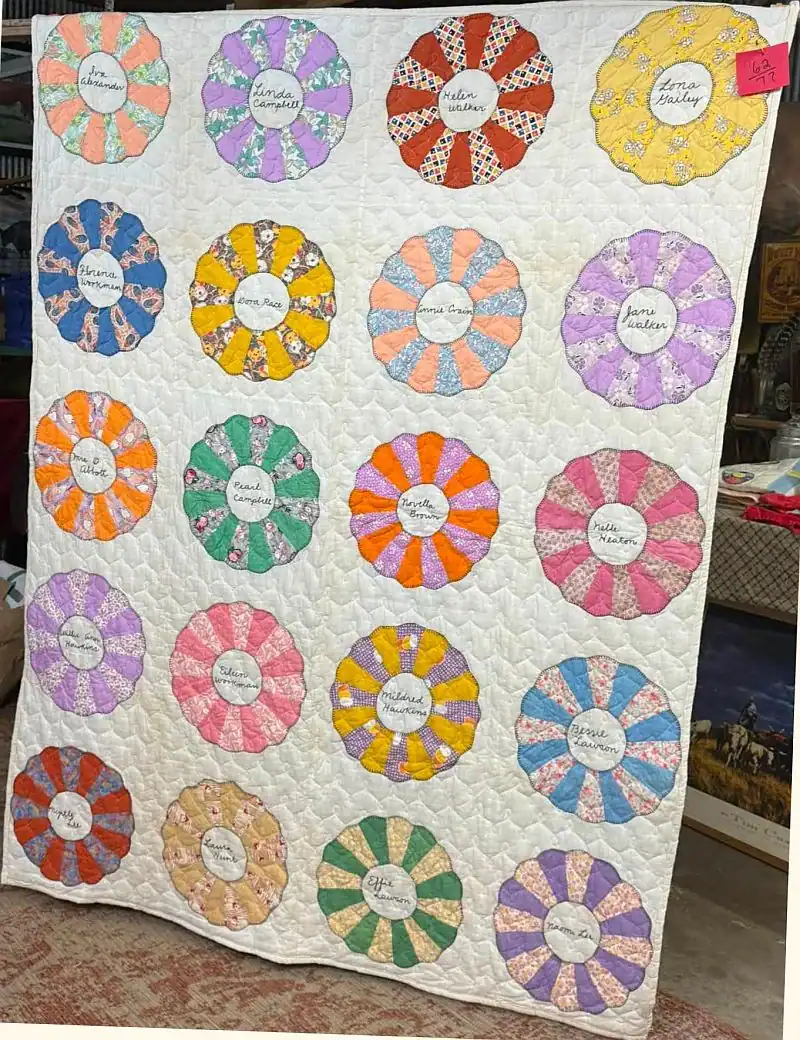
Jane, your Dresden Plate with Snow White sounds beautiful. I would love to
see a photo of it!
LiJoo – from sunny Australia
——————————
Date: 02 Jan 97 09:36:02 EST
From: Rabbit Goody <75444.1037 CompuServe.COM>
Think about this for a moment. Anything that has more than one layer and is
rolled, even over a large diameter roller will make the inside layer and
outside layer roll up slightly differently yes? so rolling quilts is not my
favorite idea. Also rolling is a more difficult task than folding. It takes
several people to roll and put paper in layers and is really unweldy if you need
to see the quilt quite often. Folding into as large a piece as possible allows
easier access with less problems. Storing a quilt flat on a supported tray is
the best but none of us can do that with out many dollars. I have done quite a
bit of mounting of coverlets and developed mounts for quilts which need to be
exhibited. But we all know that I am a radical and wait five minutes and
everything will change.
——————————
Date: 02 Jan 97 09:36:06 EST
From: Rabbit Goody
Dont store quilts in the attic is the best and easiest solution. Newspaper is
not a great idea even removed from a quilt because of the acidity. Store things
where there arent many mice life house closets where things get opened and viewd
more often. Mice will nest in anything that appeals to them and a place where
things are disturbed on a regular basis is probably also better climate
controled
Rabbit
——————————
Date: 02 Jan 97 09:36:05 EST
From: Rabbit Goody <75444.1037 CompuServe.COM>
Fiberglass screening of today is completely different from fiberglass drapery
fabric of the 1950’s and 1960’s It is interesting that while you accept the
technology of the computer some of us are unwilling to look at how the textile
industry has made changes over time for the better. Not that every change is but
look at Nitrocellulose rayon and todays rayon .
the fiberglass screen for vacummin is really ok around textiles it is not spun
fiberglass but drawn fiberglass
Rabbit
——————————
Date: 02 Jan 97 09:36:03 EST
From: Rabbit Goody <75444.1037 CompuServe.COM>
To: “INTERNET: ” < >
Subject: QHL: Re: End and PIck counts
Message-ID: <970102143603_75444.1037_FHQ37-3 CompuServe.COM>
When we look at cloth we look at the yarns that were used in weaving in the
warp and in the filling. We want to know how many plies there are in the yarn ie
singles, 2 ply, 3 ply etc. We also want to know how dense the fabric is. how
many warp threads are in one inch called ends and how many filling threads are
in an inch called picks and then whether that varies throughout the piece or is
consistant. You see, when someone says it is hand made or machine made or home
spun or what ever we have real definate ways of figuring that out so that we can
say yes or no. We also can compare cloth woven at certain times and in certain
places. We also look at fiber content with the microscope and surface decoration
such as different printing techniques we know when certain technologies are
available and certain dyes so when we date things we have a real basis to do it.
Rabbit
——————————
Date: Thu, 2 Jan 1997 12:09:49 -0500
From: Baglady111 aol.com
If there is anyway Merikay can help you, she will. I’d be happy to send you
a photo..keep reminding me..I mean well, then I get busy..I’m not sure if my
Polaroid will pick up that petal or not..might be better to use 35mm..dont’
hesitate in reminding me..Jane
——————————
Date: Thu, 2 Jan 1997 15:39:17 -0500
From: SadieRose aol.com
Just received the Spring Program flyer from the DAR Museum. It all sounds
wonderful, which is very depressing as I am half way across the country from
there! So, if some of you closer by are able to attend these events, please
post and share with those of us who can’t!! Date and time as given in
brochure, fee noted where given, resv req means you must call ahead and
reserve a spot.
Current Exhibit: Bound For the West: Women and Their Families on the Western
Trails
January
2nd (yes, today and we have already missed it….boo hoo) Winter Whites
A special quilt study tour of apprx. 25 all white quilts and embroidered
bed coverings.
26th 1:30 pm Women’s Triumphs and Travails on the Oregon Trails (free;
resv req)
Jeanne Watson, scholar of the Westward movement, author and editor of “To
The Land of Gold and Wickedness- the 1848-1859 Diary of Lorena L. Hays” will
give a lecture on the experiences of women going West.
29th 12 noon Gallery Talk Curator’s tour of the Bound for the West
exhibit with q&a
29th 1-2:30 pm Textile ID Clinic ($10 per item, resv req)
Bring in a quilt, coverlet or other pre-20th century textile item for
identification
February
6th 10:30 Quilt Study $15 resv req (no special theme given)
23rd 1:30-3:30pm Inspiration from 19th Century Brides $15, 2nd person
$10 resv req
Slide lecture and workshop by Alden O’Brien, curator of costumes, on the
evolution of 19th century wedding apparel. Also an up-close look at wedding
items from the DAR collection.
25th 10:30- 12 noon A DAR Museum Sampler: Schoolgirl Samplers & Silk
Embroideries from the Collection $15 resv req
View selected 18th and 19th century needleworks with Olive Graffam, curator
of collections, preview to an exhibit opening in Dec. 1997
26th Gallery Tour and Textile ID, see Jan 29 listing for info
March
2nd 1:30-3:00pm Treasures in the Trunk: Quilts of Westward Bound Women
(free, resv req) Lecture by Mary Bywater Cross, discussing quilts from her
book (of the amse title) which are included in the DAR exhibit “Bound for the
West”. Book signing, following lecture.
16th 2-4pm Quilts of Provence (free, resv req)
Kathryn Berenson, author of a new book titled “Quilts of Provende” will
discuss French
needlework, and how it influenced European and American quilting traditions.
Book signing following lecture.
26th Gallery Tour and Textile ID (see Jan 29 for info)
There were also some programs listed for children, which I have not described
here. To make reservations (or maybe to request your own copy of the
brochure) call:
202-879-3241
——————————
Date: Thu, 2 Jan 97 14:09:30 PST
From: Sharon Harleman Tandy <harleman micron.net
Dear SadieRose, Thank you so much for the posting of shows at the DAR.
Problem: I’m almost tempted to ask you not to because I certainly can’t get
there for the current displays, probably not ever! Boo Hoo, indeed! Sharon
in (warming but dreary Boise, ID)
——————————
Date: Thu, 2 Jan 1997 16:13:53 -0500
From: Baglady111 aol.com
Thyme is a good basic herbal pest repellant. It contains thymol, which
is one of the classic ingredients in repellants. If you can possibly get
your hands on back copies of “The Herb Companion” (a great magazine, by the
way), they’ve done a couple of articles on herbal repellants over the last
three or four years. If you can’t get them, e-mail me, and I’ll go back
through my copies and see if I can find something to copy and send to you.
Lee >>
———————
Forwarded message:
Subj: Re: Herbal pest repellants
Date: 97-01-02 15:07:37 EST
From: LMorgan923
To: Baglady111
Thyme is a good basic herbal pest repellant. It contains thymol, which
is one of the classic ingredients in repellants. If you can possibly get
your hands on back copies of “The Herb Companion” (a great magazine, by the
way), they’ve done a couple of articles on herbal repellants over the last
three or four years. If you can’t get them, e-mail me, and I’ll go back
through my copies and see if I can find something to copy and send to you.
Lee
——————————
Date: Thu, 02 Jan 1997 18:41:59 EST
From: woodnspl rma.edu
Li Joo.
I have two quilts by same person that I bought at auction. They were
both the pattern call Philadelphia Pavement. One was larger and the other
somewhat smaller with brighter colors. One was dated 1929 and a name
signed. I
don’t remember the name at the moment but it is written down.
Funny thing happened. I took these quilts to a groups’ quilt retreat
when one of the women at the retreat recognized the name. They had been
made in
West Virginia and I now also have the name of the town. The maker had been a
beautician and had taught the woman’s mother to quilt. Sometimes its a small
world.
I am an antique dealer and I had intended to sell the quilts but because
I paid too much I still have them and I really am glad. Funny thing I never
did make money on quilts because I bought with my heart instead of my head.
Ann in Virginia
woodnspl rma.edu
——————————
Date: Thu, 2 Jan 1997 18:10:04 -0700
From: ayjones tacoma.nwrain.net (Yvonne Jones)Yes, Yvonne did write:
they did not have anything you could purchase in the gift shop with pictures.
But the subject was about the Chintz and Calico quilts owned by Patricia S.
Smith, and I wanted to have pictures of them. There were no pictures for
sale of the quilts shown in this collection. But Yes! the Renwick has a
lovely gift shop with many quilt books, and quilt related items.
One of my favorite books is The Knopf Collectors’ Guides to American
Antiques, QUILTS With Coverlets, Rugs & Samplers.Copywright 1982..I tell
you the date because some could consider the price guide to be “off”, but
the pictures are great.The price on this paperback book is very reasonable
at $13.95 In this book they show a Donkey Quilt (didn’t someone just ask about a
donkey quilt?)This is what it says: Although many collcetors consider quils
made from kits less interesting or imaginative than those with original
desigs, many women created unique pieces by making changes in the pattern
or by adding some touch of their own. The donkeys in the example
illustrated–possibly made in an election year by a product of a kit, Ect.
Ect.Dated 1930 Price range $1500 to 1800.
Yvonne
——————————
Date: Thu, 2 Jan 1997 23:40:42 -0500
There is an herb repellent that works great for keeping bugs off of quilts.
It is called Artemisia. Place it in a cloth sack and keep it with your
quilts.
However, along with this, the best way to keep rodents, bugs, etc away from
your quilts is keep them in an area where they can be inspected frequently.
Rodent damage occurs when the little guy wants to make a nest. They tend to
make nests in dark areas where there is little to disturb them, like an
unused basement or attic. Try keeping the quilts inside a pillowcase, and in
an inside cupboard where they can be rotated. Keep your herb sack in there
as well. Inspect no less frequently than every other month while you
re-fold. (I know that rolling is better, but I don’t have the room.) I have
kept quilts this way for years and years, and not had any damage, (yet). It
works for me! Also, inspect your quilts well when you buy them. Some of
them come in with bugs already. This will pass the little critters on to the
others in your collection. Look for small egg sacs or worse yet empty egg
sacs along folds and under the binding edge. Be careful where you buy your
quilts, they may look like a great deal in the bottom of that old cardboard
box at the garage sale, but beware! something could have been sharing the
box with that quilt for awhile. Look for signs of bugs before you buy.
Again Artemisia (the herb) is a wonderful bug repellent.
Debbie
——————————
Date: Fri, 3 Jan 1997 08:59:33 -0500
From: SadieRose aol.com
To:
Subject: QHL: Re: Donkey Quilt
A quick scroll through my Incoming Mail file did not identify a message
about the donkey quilt blocks….but I know I read someone’s post about them.
Found a picture of a Donkey quilt in “Twentieth Century Quilts 1900-1950”
by Thomas K. Woodward and Blanch Greenstein, (copyright 1988), pg. 100. Next
to it is an elephant quilt, both are pieced with 6 blocks in each quilt.
Here is the text below the photos:
” “Donkey” and “Elephant” Leavenworth, KS 1931, 1932. Made by Mrs.
Jameson, the Kansas Cirty Star, a popular pattern source for midwestern
quilters, published these patterns: Giddap, the Donkey, and Ararat, the
Elephant. SInce the maker was a Democrat, it is said that she made Giddap
slightly larger than Ararat, which she made for her Republican husband.”
On page 101, there is an applique quilt with a donkey motif. The text
about this quilt states: “FDR’s Election” 1936. In honor of FDR’s
landslide victory against Al Landon, this quilt features the Democrat’s
donkey…” (This quilt is from the collection of the FDR Library).
“Twentieth Century Quilts” is a very interesting book, focusing on more
recent quilt history…but as with much history…it needs to be recorded
now, as by the time you realize you need some information…it will be too
late to ask those who were living then.
“The Great Quilt Revival” of the 20’s and 30’s is one of the chapters, and
looking through the photos of quilts, it is easy to see the new directions
that quiltmaking took during this time period. (Just as it will probably be
said about the quilt revival we are taking part in today). Also, the change
in the fabrics, from the sober “mourning prints” of the turn of the century,
to the brighter florals we dub “’30’s prints” which now are being reproduced
by companies such as Marcus Brothers.
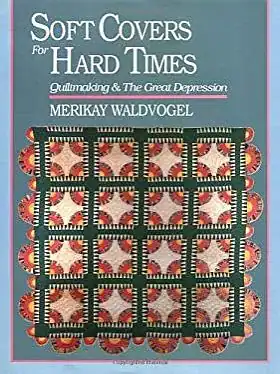
“Soft Covers for Hard Times” which was also recently mentioned, is
another good book focusing on the century quilts.
TTFN, Karan from Iowa where we are having a melt down
——————————
Date: Fri, 3 Jan 1997 09:05:00 -0500
Ann in Virginia said:
> I am an antique dealer and I had intended to sell the quilts but
>because
> I paid too much I still have them and I really am glad. Funny thing I never
>did make money on quilts because I bought with my heart instead of my head.
Funny you should mention that… I’ve often kicked myself after paying too
much for a quilt, but then later I almost ALWAYS kick myself for selling
it! 🙂
And on the topic of having 2 quilts by the same person (other than family)
– several years ago I bought a pair of matching quilts from a dealer, who
said they came from Lancaster County. They’re appliqued red & green Tulips
on a muslin ground – four large blocks on each quilt. The interesting
thing is, the appliques are pretty much identical, but the quilting is very
different when you compare the two pieces. One is quilted much more
heavily than the other, although the “other” one does copy the
medallion-type quilting motif that’s in the empty spaces between blocks on
the first one (does this make sense?). My guess is that both TOPS may were
probably made by the same person, but the “other” one was quilted later by
someone else. The one with the heavier quilting (which I usually refer to
as the earlier quilt) has a few stains on it (not major), which to me adds
to its “personality.” (Would I look that good if I were over 100 years
old? I DON’T THINK SO!!) 🙂
Happy New Year, and happy hunting for that one perfect quilt….at the
perfect price!
Merry
gridgees algorithms.com
——————————
Date: Fri, 3 Jan 1997 09:10:14 -0500
From: Baglady111 aol.com
DEBBIE, THANK YOU SO VERY MUCH..sound advise when buying and storing.I came
across several addresses for herbs for anyone interested in checking to see
if they carry anything such as the producet Debbie mentions..or you can go to
“fin” and tyupe in GARDEN SPOT..LOADS of avenues to explore..thanx again,
Debbie..Jane
——————————
Date: Fri, 3 Jan 1997 09:12:38 -0500
From: Baglady111 aol.com
I use a mixture of pennyroyal, wormwood and cedar shavings in my boxes of
old books. Silverfish LOVE old books. I’m sure the mixture would repel
moths also. What I’m NOT sure about is how you would protect the quilts from
the repellant. I don’t think you’d want to just sprinkle it among the folds,
but I know nothing about storing fine fabrics. Cedar shavings are available
in small quantities from pet stores. Pennyroyal is Mentha pulegium, and
wormwood can be any of a number of Artemesias with strongly scented foliage.
Susan >>
———————
Forwarded message:
Subj: herb repellant
I use a mixture of pennyroyal, wormwood and cedar shavings in my boxes of old
books. Silverfish LOVE old books. I’m sure the mixture would repel moths
also. What I’m NOT sure about is how you would protect the quilts from the
repellant. I don’t think you’d want to just sprinkle it among the folds, but
I know nothing about storing fine fabrics. Cedar shavings are available in
small quantities from pet stores. Pennyroyal is Mentha pulegium, and
wormwood can be any of a number of Artemesias with strongly scented foliage.
Susan
——————————
Date: Fri, 3 Jan 1997 11:18:43 -0500
From: JQuilt aol.com
Last night, I lay in my bed reading “Legacy, The Story of Talula Gilbert
Bottoms and Her Quilts”…I finished it at 2:00 A.M…
This morning, after a half hour reverie, about Talula’s life and quilts,… I
just couldn’t bear to leave her life and enter mine…
I went into the kitchen and turned on the coffee maker… then spent 10
minutes luxuriating under the stream of hot water from the shower head in my
bath….I dressed…turned on the computer…went back to the kitchen and
drank an aromatic cup of coffee(hazelnut) and thought some more about Talula.
What had taken me 20 minutes, would have taken Talula the better part of an
hour..Cranking up the fire in the stove…hauling the water from an outside
well or pump…ginding coffee beans and then boiling the coffee, never mind
cooking cereal of some kind….And as far as a hot luxurious shower…Talula
didn’t have electricity or water indoors until the 1930s…She was married in
1883 …and had the first of her twelve children in 1886…
This haunting book tells us the life and times of the small cotton farmer in
Georgia and Alabama. What it was like to live in the wake of Sherman’s
march..the devastation and starvation that occurred in the last days, and
then in the aftermath of the Civil War…
Talula lived a “God Centered”, patriachial life….Still, she was able to
enjoy the separate economics or egg and chicken/duck money… which she used
buy the cotton calico fabric..The only fabric that she did not pick, card,
spin and weave into cloth.
Talula was neither poor neither nor rich. She and her family always owned
land (between 100 and 200 acres)..which they all worked together…..Most
women of those times buried one or more of their children, alongside many
other family members…..Death was not removed from daily living….People
lived and died at home….Most women were married young and had children from
the time they could until the time they couldn’t…
Talula made 100s of quilts,none of them for a competiton or exhibit, some
for church raffles ..The blocks sewn by hand ..the binding stitched on by
machine….then turned and “sewn down” by hand.
Quilting, was what allowed Talula to live through the small joys and great
sorrows of her life.
All High School students should read one history of any “times” by an
historian… and one by a woman who lived through those same times…
Borrow, take out on loan, or buy this book, and I think you, too, will find
it as difficult as I did, to leave Talula and her families behind.
Bye, Bye Talula..I’ll tell my granddaughter about you and pass your story on
to her..
Jean Laino
Jquilt aol.com
P.S. The colored photos of some of her many quilts are both beautiful and
inspiring..
——————————
Date: Fri, 3 Jan 1997 11:22:10 -0500
From: RBCochran aol.com
Wanted to let everyone know that there is an excellent exhibition of approx
36 quilts from the Newark Museum’s collection. It’s on now through February
23, 1997. The museum hasn’t had an exhibit of their quilts in about 8 years,
so it’s a long time between glimpses. In addition, several of the quilts
(like the Emmeline Deane quilt, for instance) are in such fragile condition
that they can’t be exhibited again.
I’ve gone to the museum only once for a quick visit, but since it’s nearby
I’m sure I’ll go again. Plus, a friend and fellow Garden State Quilters
guild member is the quilt artist in residence for the month of January. If
you’re planning a trip to the New York metropolitan area, a side trip to
Newark would be worth it.
Rachel in NJ
——————————
Date: Fri, 3 Jan 1997 11:37:49 -0500
From: RFKerr aol.com
In a message dated 97-01-02 21:44:37 EST, you write:
<< Does anyone own two quilts or more made by the same person? I am not
referring to those that you have inherited, but rather, those that you
purchased. It would be interesting to find out.
>>
I have two quilts made by Abelonia Klein in 1924 and 1927. One is a pink and
white Hearts and Gizzards with exquisite quilting. The other is a beautiful
Grandmother’s Flower Garden —– lots of period scraps with a peach
scalloped border and again, perfect stitches. I purchased these in St Mary’s,
Kansas a number of years ago from her neice who liked “diamonds on her
fingers far better than old quilts” (her words, not mine).
Mary Kerr
Pieced of Olde
——————————
Date: Fri, 3 Jan 1997 13:17:59 -0500
From: RLHlink3 aol.com
To:
Subject: Re: QHL: Re: QHL-Digest Digest V97 #1
Message-ID: <970103131757_577475861 emout07.mail.aol.com>
Good advice! I had never thought of inspecting old quilts etc “brought in”
for bugs, etc. The artemisia sounds like a good thing too. I can’t use moth
balls because of extreme allergy to them, but also fell that they are not a
safe thing to use anyway.
Question for anyone: I have always kept by special textiles in a cedar chest,
never even considering that contact with the wood might not be a good idea.
After the conversations here, I am wondering about it. Should everything be
wrapped? I keep a special baby outfit from each of my kiddos, quilts and etc
in it. Probably need to be wrapped, huh?
Thanks.
Linda
————————————————————
Date: Sat, 4 Jan 1997 06:23:06 +0800
From: balfourk echidna.id.au (Kath Balfour)
To: QHL cuenet.com
Subject: QHL: Aussie Quilt History
Message-Id: <v01540b05aef1fda30ebb [203.59.20.110]>
Content-Type: text/plain; charset=”us-ascii”
I heard part of a broadcast by a Sydney social historian specialising in
textiles on Radio National a few weeks ago (I wish I’d written down her
name!). She was discussing how the development of textile technology can
explain quite a lot about the history of any society.
She commented, ‘People ask, for example, why are there no Amish quilts in
Australia. The answer is simple: there were no Amish.’ She went on to
explain that it was all a matter of which skills were imported and by whom.
The 17th and 18th century American settlers brought agrarian skills which
included weaving and sewing. The people who settled the Australian colonies
much later, in the 19th century, were predominantly urban dwellers who did
not need these skills.
I hadn’t heard that explanation before, but it does fit in with economic &
social explanations I have heard, such as
1) By the mid-19th century, America already had a flourishing completely
home-grown textile industry complete with slaves, cotton gin, weaving
mills, sewing machines, railroads. Australia was just being settled.
2) The US had a free enterprise system with a textile and steel
manufacturing base using internal natural resources. Australia’s colonial
policy was not to develop local industry, but to sell raw materials to
Britain to support british manufacture. It took a long time for anything to
get here, and money was scarce.
3) In the US the local church was the social centre — they held
communities together and were numerous and diverse. Quilting skills were
shared amongst women and passed on to girls through this conduit.
Australia was largely secular and this method for socialising was not
developed.
Was there a textile industry, who made the textiles and what did they make
also raises other questions. Were those American and immigrant girls and
women ‘sweating’ in the textile mills making quilts? Or was quilt making an
agrarian, or homesteaders enterprise? What about the ‘genteel’ Australian
settler and her needlework skills?
Anyway — the history of women and women’s endeavours has been too long
overlooked, and I love discussions like this!
Happy new year.
Cheers,
Kath Balfour
Yesteryear Quilts
37 Gibson St
Hilton WA 6163
AUSTRALIA
phone +619-335-6401; fax +619-336-4230
e-mail: balfourk echidna.id.au
——————————
Date: Fri, 3 Jan 1997 17:31:07 -0500
From: Baglady111 aol.com
To:
Subject: Re: QHL: Fwd: herb repellant
Message-ID: <970103172204_1123081898 emout05.mail.aol.com>
My guess, Susan is a cloth bag of some kind to house the herbs. If I recall,
my friend made one and then put the bag in the storage box she used..I’m sure
that NOTHING is safe enough to actually come in contact with the fabric..or
even if it was..why take the chance..Thank you so much for your info..Jane
————————————————————
Date: Fri, 3 Jan 1997 18:09:07 -0500
From: Baglady111 aol.comWHAT A MAGNIFICENT REVIEW..As soon as I finish my “treasures in the trunk”,
I’m going to re=read Talula’s life again..Would you permit me to re-print
your review in my newsletter for THE FEEDSACK CLUB members? They would LOVE
IT!! JANE
——————————
Date: Fri, 3 Jan 97 18:13:58 EST
From: “Bob Mills” <decision tigger.jvnc.net>
To:
Subject: QHL: Re: QHL-Digest Digest V97 #1
Message-Id: <decision.1202720878D tigger.jvnc.net>
RABBIT WRITES:
look at how the textile
industry has made changes over time for the better. Not that every change is but
look at Nitrocellulose rayon and todays rayon.
I’ll bite. I just read in ‘Clues in the Calico’ that rayon has been around
for about 100 years-(which surprised me) but what are the differences? All
I know is it still shrinks. How can I identify old rayon from new rayon?
And thanks Jane for the book list. I’ll be busy tomorrow at the library’s
reserve computer.
Jan Drechsler in warm NJ where I just spent two hours outside in the
glorious warm 60 degree sun ripping out a caned back and seated rocker to
refinish and recane.
——————————
Date: Fri, 3 Jan 1997 18:55:59 -0500 (EST)
From: Quilting Heritage ListServ <QRS mail.albany.net>
To: QHL cuenet.com
Subject: Re: QHL: Quilt History book list
Message-Id: <2.2.16.19970103185337.1d0f6520 mail.albany.net>
Content-Type: text/plain; charset=”us-ascii”
This sounds like a wonderful idea! A lending library! I wouldn’t mind
lending mine, either, I will put together a list. Perhaps I could post a
list a books the owners are willing to lend to the web page, along with a
the E-mail address of the owner, and the lendee’s could contact the lendor’s
directly. Does that sound good? We should probably come up with some
shipping rules, too – reimbursing the lendor, insurance, etc.
Kris
——————————
Date: Fri, 3 Jan 1997 18:56:01 -0500 (EST)
From: “Connie Pollard (614) 593-1920” <POLLARD ouvaxa.cats.ohiou.edu>
This is my first post to this list. By way of introduction, my name is Connie
Pollard, and I’ve been quilting for about six years. I have a historical
background so this list has been quite stimulating for me. I’ve been wondering
for some time if there was a more scholarly approach to quilts and quiltmaking
than I see in the popular quilt magazines and I’m glad to have finally found
it.
I prefer traditional quilts but also appreciate modern art quilts.
The reason I am posting is because I’m looking for a particular quilt/block
design that I’ve not seen anywhere. I’m not sure if it is a block, or a large
pieced medallion. It is called “Starkey Star”. Oral tradition has it that a
woman in eastern Canada had such a quilt and that it was pieced in blue and
white. Starkey is one of our family names (my paternal grandmother was
Canadian) and I would love to make a quilt in this pattern for a favorite aunt
who has done a great deal of genealogical research into this branch of our
family.
If this is too vague I can try to get more information from my aunt about this
quilt.
Thanks in advance for any help. Please post to me privately at
cpollard1 ohiou.edu.
——————————
Date: Fri, 3 Jan 1997 23:52:43 -0500
From: QuiltLine aol.com
Linda,
Although cedar is well known for it’s repellant properties, it is wood, and
the acids in any type of wood after time will have a reaction with your
textiles. What works well is using old pillow cases (100%cotton) as storage
bags. You can put your textiles into the pillow case, and then put it into
the chest, OR you can make storage bags of any size out of muslin, stitch
up the sides and bottom, put a drawstring around the top if you like and
voila – a bag. A small bag of this type can hold your herbs as well!
The same thing goes for displaying quilts on a qulit rack or shelf. If you
are not absolutely sure that the wooden item that the quilt (or other
textile) is on, has been thoroughly coated with polyurethane, then protect
the quilt from the wood by placing muslin or some safe barrier between the
wood and the quilt.
Debbie
——————————
Date: Fri, 3 Jan 1997 23:44:31 -0500 (EST)
From: “Carol L. O’Neill” <coneill CapAccess.org>
To: John & Cinda Cawley <cawley epix.net>
Since seeing the 1830s quilt at the Renwick exhibit with Baptist Fan
quilting, which surprised me, I’ve learned from a friend who docents at
the DAR that they believe this quilting design was not used in the
Carolinas until the late 1800s. … Neither of us can remember where that
quilt came from. Anyone going to the exhibit before it closes next week
(I think)? If so, could you get that info and send it to me? Thanks muchly!
–Carol in VA
(coneill capaccess.org)
——————————
Date: Sat, 4 Jan 1997 00:53:08 -0500 (EST)
From: Rob Holland <rholland atlanta.com> (by way of “Kris Driessen, Hickory
Hill Antique Quilts” <oldquilt albany.net>)
To: QHL cuenet.com
Subject: QHL: No Two Alike Telecast –
Message-Id: <2.2.16.19970104005041.191f7500 mail.albany.net>
Content-Type: text/plain; charset=”us-ascii”
Watch for a TBS broacast on the “No Two Alike” quilt exhibit. It is on a
program called “Interact America,” and will be broadcast tomorrow, January 4.
Here in Atlanta it will be at 6:30 a.m., other times in other places, so
check your listings.
Happy New Year to everybody!
Rob
——————————
Date: Sat, 4 Jan 1997 01:31:05 -0500
From: RLHlink3 aol.com
To:
Subject: Re: QHL: storing textiles in cedar chest
Message-ID: <970104013105_1123151864 emout03.mail.aol.com>
Debbie, thank you for your good advice. I can see that I will be into bag
making for awhile.
——————————
Date: Sat, 4 Jan 1997 05:45:56 -0500
From: quiltmag mindspring.com (Jean Ann)
To:
I was recently one of many quilters featured in a National Public Radio
interview. The program is called Quilts – Art with Heart. Two of my family
intergenerational quilt stories were used on the program and i was one of
four quilters who were given credit at the end of the program. If you can
get your NPR schedule from the internet you can see when this program will
be aired in your area.
My two stories are: the family coming together on vacation to make a quilt
in NC on vacation for my first grandchild who is now eight.
My great-grandmother in Michigan making a quilt from the blue chambray
shirts and pink pinafores that was finished for her youngest son to keep
him warm over half a century later when he was dying of congestive heart
failure.
Pat Cox and Helen Kelly are also interviewed on the program. Pat tells a
story of when her daughter was sick for two years and she gave up gardening
to quilt, and Helen talks about teacher her daughter to quilt again after
she lost her sight.
There are many other wonderful stories.
Jean Ann Eitel
——————————
Date: Sat, 4 Jan 1997 23:00:37 +1100 (EST)
From: Li Joo Ng <lng bf.rmit.edu.auSusan, Ann, Debbie, Jane, Lee, Rabbit Goody (and if I missed out anyone,
sorry!) – I want to say a big THANK YOU for sharing so many tips on
repelling silverfish, moths, and other nasty little creatures, and also
information on how and where to store quilts. I don’t know if I mentioned
this before, but I am going overseas for 7 weeks in a couple days and this
is the first time I am leaving my quilts! I can’t help worrying for them –
I only just purchased them about 4 to 6 weeks ago. I am doing the best I
can for them before I leave.
Thanks to those who shared about owning 2 or more quilts made by the same
person. It was interesting to read about everyone’s story on the purchase.
I absolutely love this list and everyone on it. My friend, Kath, told me
about this list about 2 weeks ago and I am so hooked to it! How can I
survive being away for 7 weeks without you guys!!
Before I sign off, I would like to find out if everyone pre-wash their
fabrics, before making a quilt? For those who pre-wash, how do you do it?
With cold or hot water, in detergent or salt & vinegar, by hand or
machine, etc, etc? And what are your personal reasons & opinions for
pre-washing the fabrics?
For those who do not pre-wash before use, what are your reasons? And do
you wash the completed eventually? And how can you be sure if the fabrics
are colourfast or not?
Personally, I always pre-wash in my machine with salt & vinegar. My
reasons are: Pre-washing pre-shrinks any fabrics that will shrink, so I
figured it stabilises all the different fabrics to be used. I use salt &
vinegar because the lady who first taught me how to make a quilt told me
that it sets the colours in the fabrics. And I use the machine simply
because I am too lazy to do it by hand.
I would love to hear what everyone has to say.
LiJoo – from a hot & sunny Australia, where temperatures range from about
30 to 45 degrees Celsius (don’t know how to convert to Fahrenheit – sorry)
around the country at the moment
——————————
Date: Sat, 4 Jan 1997 07:16:30 -0500
From: Baglady111 aol.com
To:
Subject: Re: QHL: No more bugs!
Message-ID: <970104071629_37000595 emout03.mail.aol.com>
LiJoo, you are most welcome.I learn alot to from the others..and now I have a
request. I have a friend who told me his wife is the proud owner of two
quilts when he saw my acid free quilt box and inquired as to ‘what is it?’
he said they store their quitls in off season in a plastic bag..I was
appalled of course..I told him about plastic, etc. and he said, “well, it
CAME in plastic!!” he was amazed at the info I offered him but felt he’d
never remember all I told him..is there an printed page, leaflet, could
anyone post something on our forum we would be able to zerox for people who
inquiire about this? hand it to people who are amazed about this..as long as
we aren’t mentioning any product by name, I can’;e see where we would be
infringing..suggestions? offers?? Jane
——————————
Date: Sat, 4 Jan 1997 07:26:52 -0500
From: Baglady111 aol.com
To: QHL cuenet.com
Subject: QHL: feedsack samples
Message-ID: <970104072651_70553117 emout15.mail.aol.com>
would all who have requested sample squares of feedsacks please post to me
again with your names/addresses..painters came in yesterday and papers got
tossed helter skelter.going by memory (ha!) I have DRECHSLER, KASAITIS.going
out today..did I miss anyone? Jane
——————————
Date: Sat, 4 Jan 1997 08:13:24 -0500
From: AJSNGS aol.com
To:
Subject: Re: QHL: Quilt History book list
Message-ID: <970104081322_577598031 emout19.mail.aol.com>
Hi All,
Jane is right! She is currently lending me “Soft Covers for Hard Times” and
it is wonderful! It’s also a book I would not have known existed if you all
had not mentioned it here. So thank you to all of you on this list (and of
course thanks to you Jane!).
Nancy in Virginia
——————————
Rose Marie
——————————
Date: Sat, 04 Jan 1997 09:33:14 -0500
From: “James M. Welch” <hawk csionline.com>
To:
Subject: QHL: new email address
Message-ID: <32CE6A2A.4833 csionline.com>
Content-Type: text/plain; charset=us-ascii
Content-Transfer-Encoding: 7bit
As of this afternoon, I will have a new email address
debatqps juno.com
Hope I am sending this to the right place! My boys will have the old
one so if it still goes there because I am not sending it to the right
place, I can still get it tomorrow.
Thanks,
Debbie
——————————
Date: Sat, 4 Jan 1997 08:59:47 -0600 (CST)
From: celmore ksu.edu
The donkey quilt patttern that several of you have been discussing might
be Kansas City Star Pattern no. 148. It’s titled “Giddap”, was first
published in 1931, and has a block measuring 19 1/2″ x 22 1/2″. This
information is in The Ultimate Illustrated Index to the Kansas City Star
Quilt Pattern Collection: Volume V Ilustrations of 1,068 Patterns. This
set of patterns was collected by the Central Oklahoma Quilters Guild,
Inc., P. O. Box 23916, Oklahoma City OK 73123. The copyright date is
1990. I only have Vol. 5 which is the index. Vol. 1-4 have copies of
the actural patterns. It is an excellent source for identifying quilt
patterns from states in the middle of the country because this was
a readily available pattern source for women in these states especially
during the 1920’s – 1940’s+. I have no idea if the set is still in
print, but I would assume the address of the Oklahoma guild which
produced it is still valid.
Carol Elmore
Manhattan, Kansas
——————————
Date: Sat, 4 Jan 1997 10:58:55 -0500
From: Baglady111 aol.com
To: QHL cuenet.com
Subject: QHL: samples
Message-ID: <970104105854_1324502391 emout08.mail.aol.com>
I am so pleased at the interest in feedsacks and it is our pleasure to send
you samples so that you can learn how to identify them..there have been
private email requests as well. If there are others who would like to
receive some sample squares, please send me a sase and they will be on their
way.
THE FEEDSACK CLUB
25 S STARR AVE #16
PITTSBURGH, PA 15202
DELIGHTED TO SEND THEM. Jane
——————————
Date: Sat, 04 Jan 1997 17:52:19 +0100
From: Hougs <hougs worldnet.net>
To: QHL cuenet.com
Subject: QHL: Introduction
Message-Id: <3.0.32.19970104171259.00728bc0 worldnet.net>
Content-Type: text/plain; charset=”us-ascii”
Hello everyone,
We’re all supposed to introduce ourselves when joining this list, and I
guess that it’s time that I get it done.
I’m living in France, more precisely in Saint-Germain-en-Laye which is a
suburb 16 km (10 miles) west of the Eiffel tower in the heart of Paris –
so, for short, I usually refer to Paris as my town.
Living in Paris is, however, not synonymous with being French. Actually,
I’m a Dane and have been living in France for the last 8 – 9 years.
I’ve joined this list in particular for learning more about old quilts and
the history of quilts, which I find interesting. At this point in time, I
should be considered a greenhorn in these matters;-)
I am so fortunate to have a small quilt museum in a small village,
Barneville, 1.5 hours drive further to the west. The museum is called
“Musee du Patchwork et de la Courtepointe” and is situated next to a
quilting shop run by one of the finest quilters in France, Nadine Rogeret.
In the early 80’ies I visited family in the US, who were 3rd and 4th
generations of immigrants from Denmark, which triggered me to read about
the history of emigration in general, and from Denmark (and Europe) in
particular. I regrettably do not remember the source of information (book,
I guess) which told me that traditionally women were given fabrics as
departure gifts to keep them occupied during the long voyages to the New
World and/or Australia. Often these women made quilts.
I wonder if any of you can confirm this.
In a French book on quilting “Le patchwork – ou la desobeissance” from
SYROS 1993 I found the following citation, which I’d like to share with you
(in my own translation):
“In a French poem of the 13th century ‘Les lais del Desire’ (~ Desire’s
brief poem’) the heroine, protected by the fairies, lies outstretched on a
bed, where the courtepointe (kind of quilt) is made of two pieces of rich
silk with a border which shows the new flowers…”
I found it nice.
If any of you would like to know which kind of quilts I make, you are most
welcome to visit our home page.
Inge.
hougs worldnet.net
http://www.worldnet.net/~hougs
——————————
Date: Sat, 4 Jan 1997 13:35:17 -0500
From: AJSNGS aol.com
I’m currently reading “Soft Covers for Hard Times” and loving it. Next I’d
like to read about women going west and the quilts they made enroute.
Someone mentioned such a book, but I couldn’t remember if it was the book
about the Oregon Trail, or another one. If anyone happens to know a title
that is about women going west, please e-mail the list, or you can e-mail me
privately.
Many thanks,
Nancy in Virginia where it is sunny and 75 degrees!
AJSNGS aol.com
——————————
Date: Sat, 4 Jan 1997 19:03:11 -0500
From: Baglady111 aol.com
To:
Subject: Re: QHL: Quilt History books
Message-ID: <970104190310_944472546 emout13.mail.aol.com>
It is TREASURES in the TRUNK and is about quilting on the Oregon
Trail..wonderful book..and teh NE book is the state book with
history/bios/quilt pictures..the typical state book.both came from my list.