March 19 – March 23 1997
These restored messages come from the Quilt History List, an online forum where quilt historians, collectors, researchers, appraisers, and enthusiasts discussed antique quilts and related textiles. The archive dates from 1996 through approximately 2016 and is being restored gradually. Sign up in the form at the bottom of the page if you want to know when a new page is added. Original spelling, opinions, formatting, and inactive links may remain unchanged.
Primary topics of this QHL Digest:
- Ancient and historic quilting origins — a deep dive into the earliest known quilted objects, tracing possible origins back to China and the Far East.
- Civil War and colonial-era quilt stories — members share firsthand accounts of Civil War crazy quilts and earlier colonial quiltmaking traditions.
- Very old block patterns still in use — a rundown of a dozen traditional block patterns that have stayed in circulation for well over a century.
- Continuous line quilting debate — members compare continuous-line machine quilting to traditional hand and machine methods.
- Feedsack Club convention plans and finds — excitement builds for the Feedsack Club’s Lancaster, PA gathering, alongside member finds like a “Drifted Snow” print.
- One block, two names: Lemoyne Star vs. Star of Bethlehem — a classic example of the same pattern going by different names depending on region.
- ABC Quilts and children’s quilting education — a new children’s book on quiltmaking is tied to the ABC Quilts charity for at-risk infants.
- Introducing the Canadian Quilt Study Group — a first contact and introduction for members interested in Canadian quilt research.
Date: Wed, 19 Mar 1997 08:11:44 -0800 | From: ayjones [at] tacoma [dot] nwrain [dot] net (Yvonne Jones)
Dear Quilt friends, I just wanted to share with you a quilt book that I like.QUILTS Their Story and How To Make Them, by Marie D. Webster.”This book not only tells the history of quilts with all the pleasant sentiment connected with them, but shows clearly and with interest in historical details how quilts can be made to-day. There are a great many illustrations showing both old and modern designs, sixteen pages in full colors, and large number of outline drawings of individual patterns”. This book was published in 1915.
The reason I am so excited is I have been looking for this book for about 5 years. I have been on several book searches and I just received in the mail yesterday the first printing edition of the book. This book has a number of reprints and is available today. Marie Webster designed beautiful applique patterns and had her own pattern company several years after publishing this first of its kind quilt book. One of my first quilts in my antique quilt collection is French Baskets designed by Marie Webster.The quilt is in blue, with white baskets and pink flowers.The lady I purchased it from said her grandmother made it for her for a wedding gift and she never did like it.The quilt is very well done! I had a rule in our house that if there was a fire grab the French Baskets first. I now have several other very nice quilts so I would try to grab them all. Yvonne QUILT-R ayjones [at] tacoma [dot] nwrain [dot] net The QUILT-R 🙂
Date: Wed, 19 Mar 1997 10:00:13 -0500 (EST) | From: MHerron4 [at] aol [dot] com
Hey folks, I love this digest and save each issue as a word processing digest as they are so rich with information! I feel guilty I don’t have much to contribute on textile history so I thought I’d write you about some quilting fiction books you all might enjoy….I was excited to find a book available as an unabridged book on tape at my library, the beauty of a book on tape is one can quilt and enjoy a good mystery at the same time!
It’s called Stitches in Time by Barbara Michaels and is available through Recorded Books Inc. 1-800-638-1304. They do rentals through the mail and it’s 13.5 hours of good listening. I’m on cassette 3 out of 10 and love it. The narrator is excellent and that is very important to listening to a book on tape. Here’s the blurb from the back: “Rachel Grant has never been able to resist the allure of finely crafted quilts and clothes from times gone by. So when an antique bridal quilt mysteriously appears at the vintage clothing store where she works, Rachel is instantly drawn to it. The quilt is exquisite, mesmerizing … and dangerously powerful.
Hidden in the bridal quilt’s stitches is a sinister curse from the past, a legacy of revenge and deception that threatens to destroy Rachel’s hard-won happiness. At first Rachel refuses to believe that such a beautiful heirloom can contain black magic. But day by day, she feels the quilt’s power growing, forcing her to re-enact a shattering tragedy from another century-a tragedy that noone knows how to stop.” This blurb doesn’t touch upon the fact that the author has a genuine knowledge of quilts reflected in her loving descriptions. All in all I give it 5 thimbles on a one to 5 scale as a good read (listen)!! Til my next review ..this is Mary in South Central CT where the first crocuses are making a timid appearance and risking leaf and stem to freeze and frost!
Date: Wed, 19 Mar 1997 11:04:21 -0000 | From: “Sue McClure”
I hope some of you knowledgeable people out there can help me find a book that will help with identifying antique fabric. Is there one that has color photos of them? Any help would be greatly appreciated. Thanks. Sue McClure (suzy [at] albany [dot] net)
Date: Wed, 19 Mar 1997 11:45:53 -0500 (EST) | From: JZgliniec [at] aol [dot] com
Dear Sue and all, The best book for photographs AND text for all periods is : Textile Designs. by Susan Meller and Joost Elffers . c.1991. Harry.N. Abrams Inc., Publishers. New York. ISBN 0-8109-3853-7 This is a pretty hefty book….both is size and price. I has 1000 + ilustrations in color and costs 65 – 75 depending. Regards, Julia….Poway, CA…..heat wave today…80+ inland whre I live.
Date: Wed, 19 Mar 1997 16:59:41 -0500 (EST) | From: AJSNGS [at] aol [dot] com
Hi, Awhile back one of our QHL members told the story about finding a civil war crazy quilt made from Union and Confederate uniforms in a Georgia antique store. I was fascinated by this story and Diane (forgive me if I’ve given the wrong name) sent me her information about this quilt. Now there is a person on the AOL Quilt Forum who is looking for information about this quilt. I don’t know if she belongs to QHL or not. If you see this, Diane, would you be kind enough to e-mail MENISAM [at] aol [dot] com about your quilt? Her real name is Merissa. Thanks, Nancy in VA AJSNGS [at] aol [dot] com
Date: Wed, 19 Mar 1997 17:39:03 -0500 (EST) | From: Quiltfix [at] aol [dot] com
This must be my own personal quilt month. I nearly wet my pants, I was so excited last night over a box I received from my maternal aunt, Sara (no “h”). Her eldest son, my cousin, came for a visit the first of the month. He must’ve gone and told my secret, because I had an e-mail from Aunt Sara. Last time I heard from her was Christmas 1995. Anyway, she asked if I’d look at some quilts she had – two were made by Gremom Decker (PA Dutch family term I guess – this is my great grandmother) and one came from my Great Aunt Bertha (don’t know yet if she made it).
Of course, I said yes. She started to back off on one – “too far gone” – but I told her to send it on anyway. My skills are really good, and besides, I had an ulterior motive. I wanted to see it! Well, they came last night. All three. The first I opened was a quilt composed of nine embroidered blocks, c.1930. Variegated blue thread was used. There are a couple of those 30’s style baskets, a peacock, etc. Wonderful embroidery, not faded. Sashed with a country blue and bordered in white. Lots of quilting, but the top has hand wear. The fabric is disintegrating. Someone had already trimmed down the top border once. Bound in nasty blue of another vintage. My guess is that it was bindingless originally. Y’know, turn the edges in. My gremom and grandma liked that finish.
I think gremom made this one, cause Mom remembers a redwork quilt that she mad for Aunt Sara as a child. The next was a 30’s applique. Vines. A center medallion of leaves and embroidered green stems. Two vine borders. On white and bound with green. Some leaves are gone and the embroidery is thin in spots. One part of the stem is white (guess she used another thread!). A beauty. This one I’d guess came from Aunt Bertha, since I don’t know that Gremom did any real applique. The last is the real kicker for me. A plain basket quilt, c.1940. White background. Edges turned under to finish. Good quilting. Unfortunately, some color loss in the baskets from bleacing (aargh!). Yellowed.
Nothing exciting until you understand that I have the twin to this quilt! My quilt was pieced by Gremom and quilted by Grandma and her church bee. Except for a few of the baskets, dimensions and fabric placement are exact. I have to assume that this one was made at the same time. Maybe it was made for the cousin who visited, being the first-born like me. I had no idea the other quilt existed. I’ve e-mailed Aunt Sara about this – did she know? I’m going to wash it and take lots of pictures of them together. Also have to find out if Mom knows about this other quilt. Will inquire, too, about the whereabouts of the redwork quilt. Finally, I have no morals whatsoever. I’m going to let her know that if she can’t give them to her kids, to please send them to me. I’m not greedy – huh? Actually, they’re too nice to go to someone who doesn’t care. Maybe I’ll get lucky and she’ll just give me the basket quilt! Alan, rolling in quilts on a warm sunny day.
Date: Wed, 19 Mar 1997 18:05:25 -0500 (EST) | From: LISA108 [at] delphi [dot] com
Okay, you asked for it :)…there are no fewer than twelve patterns still in use that I can document prior to the English colonization of America: One patch/Nine Patch – used in the 6th century in China, in Europe by the 12th century. Triangles – 6th century in China (both of these were discovered in Tan Huang by Sir Aurel STein in the 1920’s). Split Rail – in Europe by the 15th century (Luca Signorelli’s painting of the Crucifixion in the National Gallery in Washington). Baby Blocks – ditto (Vittore Carpaccio’s painting =The Healing of the Possessed Man=, and possibly a German wedding dress of 1512). Crazy Patchwork – called yosegire, this goes back in Japan at least to the 16th century and probably much earlier. Snowball, Roman Stripe, Lemoyne Star, Forgotten Star – all of these appear in an English chasuble believed to have been made in the 1540’s (both of these references can be found in books by Jill Liddell, =the Patchwork Pilgrimage= and =Japanese Quilts= [with Yuko Watanabe]). Around the Twist – appeared in a Spanish vestment of the 1280’s (again, =the Patchwork Pilgrimage=). These are all definites – there are actual objects using these blocks in existence.
The following are possibly period: Log Cabin – there’s a reference in Janet Rae’s =Quilts of the British Isles= to a mid-17th century sweet bag using this block. I personally haven’t seen a picture of it, and Rae is quoting a very questionable 1920’s needlework book. Pinwheel – a 14th century Madonna and child from Siena, in the National Gallery in Washington, depicts what might be a cloth backdrop appliqued with this block. I’d have to see the original painting. Irish Chain – this appears, believe it or not, in several Serbian icons dating from the 13th to 17th centuries. One of them is so carefully drawn that the individual sewing lines are delineated…but again, I’d have to see a better reproduction than what I have. The same pattern shows up in modern Eastern Orthodox vestments, and if anyone out there is Orthodox, I’d love to know if these are pieced or not. If anyone’s interested in further information, please e-mail me – I’m glad to share!
Date: Wed, 19 Mar 1997 18:34:52 -0500 (EST) | From: “Jim Twigg” (by way of Quilting Heritage ListServ
I have begun collecting blocks and quilts whose main design element is a letter of the alphabet. The letters T and H are the easiest to find ( due to the Temperance Union and the 4-H clubs, I’ve been told). I’ve seen pictures of V quilts ( V for victory in the war). Recently at the Mid-Atlantic Quilt Show in Williamsburg, I purchased a small set of P blocks made from feed sacks in Kansas City, Missouri. I would love to hear about other letters in quilts. I would imagine most letters have been used at some point, especially by quilters desiring to use their first or last initial as the prominent quilt design. Maybe that’s why I bought those P blocks so quickly ! Phyllis Twigg jtwigg [at] radix [dot] net
Date: Wed, 19 Mar 1997 19:25:20 -0500 (EST) | From: Baglady111 [at] aol [dot] com
In a message dated 97-03-19 14:41:27 EST, AQSG writes: << Subj: Sack dying Date: 97-03-19 14:41:27 EST From: AQSG To: Baglady111 Dear Jane, I’m sorry, but I could not find any information on methods/recipes for home dying of sacking. All the materials we have don’t go into that kind of detail; and you no doubt already know of the articles in Uncoverings and other key books. Ruth Rhoades of Georgia will have an article on feed sacks in Uncoverings 1998; other articles of interest would be Nora Pickens’ “Scrap Quilts of New Mexico” in Uncoverings 1986 (goes into some detail about feed sacks) and Bets Ramsey’s “Design Invention in Country Quilts of Tennessee and Georgia”
in Uncoverings 1980, which does describe some methods of dying sacking but doesn’t have actual recipes. I have a question for you–we sent a set of press releases to Deborah Kodish of the Philadelphia Folklore Project in Philly and it was returned to us–do you happen to know where she/they are located? She’s been on our database for quite a while and her forwarding address is expired. I know you’re in Pittsburgh, but I thought you might have an idea. Thanks, Julia Bloch >> This is what I received in my search for dying feedsacks..also, note the request for the whereabouts of this lady..can anyone help? Also, I have a friend who does small quilt projects and is looking for a source for miniature dried roses..please let me know if you know of a source..she wants to buy directly from the supplier..many thanx..Jane ———————
Forwarded message: Subj: Sack dying Date: 97-03-19 14:41:27 EST From: AQSG To: Baglady111 Dear Jane, I’m sorry, but I could not find any information on methods/recipes for home dying of sacking. All the materials we have don’t go into that kind of detail; and you no doubt already know of the articles in Uncoverings and other key books. Ruth Rhoades of Georgia will have an article on feed sacks in Uncoverings 1998; other articles of interest would be Nora Pickens’ “Scrap Quilts of New Mexico” in Uncoverings 1986 (goes into some detail about feed sacks) and Bets Ramsey’s “Design Invention in Country Quilts of Tennessee and Georgia” in Uncoverings 1980, which does describe some methods of dying sacking but doesn’t have actual recipes. I have a question for you–we sent a set of press releases to Deborah Kodish of the Philadelphia Folklore Project in Philly and it was returned to us–do you happen to know where she/they are located? She’s been on our database for quite a while and her forwarding address is expired. I know you’re in Pittsburgh, but I thought you might have an idea. Thanks, Julia Bloch
Date: Wed, 19 Mar 1997 19:45:23 -0500 (EST) | From: Baglady111 [at] aol [dot] com
I think she’ll see it, nancy..I just sent her an email but didn’t keep her address..I’ll see if I have it in my notebook if youd don’t find her..she and hubby both have ill parents..rough going right now..she’ll probably enjoy getting another subject to think on..Jane
Date: Wed, 19 Mar 1997 23:23:13 -0800 | From: bwblack [at] sprynet [dot] com (Barbara Black)
Re: QHL: dating fabrics >>I hope some of you knowledgeable people out there can help me find a book >that will help with identifying antique fabric. Is there one that has color >photos of them? Any help would be greatly appreciated. Thanks. Sue McClure >(suzy [at] albany [dot] net) What about Barbara Brackman’s Clues in the Calico? Not all the photos are color, but many are. My quilt study group uses this book quite a bit as a reference. Barbara Wunder Black bwblack [at] sprynet [dot] com
Date: Thu, 20 Mar 1997 04:53:31 -0700 | From: Jim/Candy Goff
Hoping you will find time to visit my new web site @ Any and all replies will be appreciated…..Candy Goff
Date: Thu, 20 Mar 1997 06:49:30 -0500 | From: quiltmag [at] mindspring [dot] com (Jean Ann)
Taymor….did I share the story of the Marietta Civil War quilt with this group? (being dragged in the mud by the yankees)? I almost got a picture of it but the owner changed her mind. She is granddaughter of the maker and very, very elderly. I have just finished an article about Victorian Crazy quilts for Country Collectibles magazine. As for Colonial History quilts….one good source is an old one but a good one. It is The Romance Of The Patchwork Quilt by Kresinger and Carrie Hall. A reprint of their book was done by the American Quilter’s Society a few years back. I have the original book. otherwise, anything by Carter Houck would be very helpful. Her books are historically correct and have some very early quilts with photos, etc. Jean Ann Eitel Editor, QUILT magazine Let’s Talk Quilting: dal.net IRC – /join #quilttalk
Date: Thu, 20 Mar 1997 08:09:28 -0500 | From: gridgees [at] algorithms [dot] com (Merry May)
So, Lisa, are you telling us that it’s likely that quilting originated in the Far East? I’ve suspected that for quite some time, but haven’t seen any documentation of it until now. Thanks for sharing with us! Merry in southern N.J. gridgees [at] algorithms [dot] com
Date: Thu, 20 Mar 1997 09:12:42 -0500 (EST) | From: JZgliniec [at] aol [dot] com
In a message dated 97-03-19 18:42:53 EST, you write: << LISA108 [at] delphi [dot] com >> Dear Lisa, Thank you for the excellent post. I have several questions before I try to look up some of these designs in my books. Are these quilted Items or are they pieced clothing? Would some of these designs be considered “Allover” patterns as opposed to the block format used by quilters? Have you seen the pictures of the wrapped mummified cats ? They were popular in Great Brittian after the discovery of the Tombs in Egypt last century….I have only a terrible photocopy of a picture someone sent me and no documentation to go with it, the photo has a cat. no 50…..but no other reference. The cat is wrapped with strips of linen in a “courthouse steps ” configuration, repeat block. Thank you, Julia
Date: Thu, 20 Mar 1997 09:52:27 -0800 | From: Jody Bordner
Candy, Your web page is fantastic!! BRAVO! I rushed to open “Jewel Box”, thinking it to be the old pattern Jewel Box and was blown away when I saw your design! WOW! Also, wish I could see more of the detail of the quilting on that Whig quilt–though Paul Pilgrim may have wanted more visual impact, I bet the impact of the stitches on another quilter would be dynamic–sure as heck would impress me anyway! But then I love whole cloth quilts too, so maybe that is why! Piece, Jody
Date: Thu, 20 Mar 1997 10:09:12 -0500 (EST) | From: KBoxmeyer [at] aol [dot] com
I have a product in its final stages of development. Its targeted purchasers are quilters and those that love them. Is there an appropriate way to sell this through QHL? Hint: It is very sweet. –Kimberly in dreary looking Bristol
Date: Thu, 20 Mar 1997 10:14:14 -0500 (EST) | From: Baglady111 [at] aol [dot] com
there was a terrific article in the PITTSBURGH POST GAZETTE yesterday..QUILT of many COLORS..Black quilt-makers offer new hues and patterns while preserving family lore.. does anyone know if this is public domain that I can share some of it with you? And i wonder if any of the quilters are on line?? jane
Date: Thu, 20 Mar 1997 14:14:01 -0500 (EST) | From: KBoxmeyer [at] aol [dot] com
In the QHL message: >Subject: QHL: Fwd: Sack dying >Sent: 3/20/97 1:33 AM Julia Bloch asks: >> I have a question for you–we sent a set of press releases to Deborah Kodish >of the Philadelphia Folklore Project in Philly and it was returned to us–do >you happen to know where she/they are located? She’s been on our database >for quite a while and her forwarding address is expired. I know you’re in >Pittsburgh, but I thought you might have an idea. >>
Here’s the information she’s looking for and a description of Philadelphia Folklore Project for the rest of us. Philadelphia Folklore Project 1304 Wharton Street Philadelphia, PA 19147 phone: 215-468-7871 fax: 215-468-7874 The Philadelphia Folklore Project exsists to: (1) assist local artists and grass root cultural groups in finding and getting applications together for grants; (2) document and archive via video, audio, slides and photography local artists’ work; (3) prepare publications based on the feild work they’ve done (mainly children’s books and a magazine based on their research); and (4) prepare periodic exhibitons and a concert of local artists. The artists they work with are most often those who have been traditionally trained, i.e. from family, self-taught, etc. as opposed to school-taught. Most of their textile work centers on that of Sout East Asian description. They have worked with some guilds but find they are mostly self-sufficient, needing little outside assitance. Respectfully submitted by Kimberly in dreary Bristol, PA
Date: Thu, 20 Mar 1997 17:56:08 -0500 (EST) | From: Quiltfix [at] aol [dot] com
I have declared this month to be Red and Green Quilt Month, at least what’s left of it. I just saw a quilt that put my applique to shame. That was quite a trick. I was previewing an auction at lunch today – was sent to check out a table. Instead, I saw the most magnificent red and green applique. I’m talking major coffee table book material. To start, the thing was 8.5 – 9ft square! Seriously. In red and green calicoes, another variation on the rose wreath. The white has aged to a caramel color. The quilting is what takes the cake – 12+ stitches to the inch! The border is a series of diagonals, open space separated by four rows of quilting 1/16″ apart. Crosshatched quilting at 1/4″. Baskets. Stuffed work, even if most of it has been beaten down to nothing over decades. Very thin battiing.
If you will be in the Massacussetts area in August 97, let me know, and I’ll keep track of the quilt. The auction house owner is having a major sale (we’re talking color catalog and all) and this will be one of the items. Since I know that all restoration people are rich, I’m certain one of you can scarf it up! But seriously, I will be sure to follow up and let you know where it’ll be. It’d be worth the drive, ’cause he’ll let you fondle it. Alan, who has yet to figure out where all these great quilts are coming from in the south. He’s not complaining, just curious.
Date: Thu, 20 Mar 1997 18:03:20 -0500 (EST) | From: Quiltfix [at] aol [dot] com
One other thing – this quilt is 1840-1860, easy!
Alan
Date: Thu, 20 Mar 1997 22:51:39 -0500 (EST) | From: Quilting Heritage ListServ
Cassie Neumann (cneumann [at] verinet [dot] com) E-mailed me and asked me if I had ever heard of a book that gives step-by-step sewing/quilting instructions for children. I can’t think of any, can anyone else?
Date: Thu, 20 Mar 1997 23:11:18 -0500 (EST) | From: QuiltLine [at] aol [dot] com
In a message dated 97-03-20 22:04:19 EST, you write: << Re: QHL: dating fabrics >>I hope some of you knowledgeable people out there can help me find a book >that will help with identifying antique fabric. Is there one that has color >photos of them? Any help would be greatly appreciated. Thanks. Sue McClure >(suzy [at] albany [dot] net) >> AQS is publishing a book by Eileen Trestain sometime this year (later rather than earlier, that from what I understand is full color and a wonderful fabric dating tool. Eileen has been collecting fabrics for years and years. I have many a fabric dating book, all mentioned here, yet not one that I am really happy with. There is definately a need for a good one – hopefully the AQS one will be it. Debbie Roberts
Date: Fri, 21 Mar 1997 00:05:47 +1100 | From: Li Joo Ng
Hi, everybody, does anyone vaguely remember me? The last time I posted was early January, and after that I was away overseas for 7 weeks. I came back late February, but had severe problems with my e-mail, so in the end I had to apply for this new one – long story. But it’s great to be back!! If anyone e-mailed me since early January, my apologies for lack of reply. Computer and e-mail problems – very frustrating – I’m so sorry. Merikay Waldvogel, if you are reading this, could you e-mail me, please. I would like to get in touch with you again, regarding your book and also information on the maker of my quilts, Fannie Ellen Wilcox Michael.
This is my new e-mail address, everyone, so don’t send me stuff to the old one anymore. Guess what? I just purchased a few things!! I bought a Rob Peter To Pay Paul quilt top, a Rail Fence quilt and a number of Grandmother’s Flower Garden blocks. They are supposed to arrive in the mail by next week. Will share further details then. In the meantime, waiting for them is agony!! Love from Melbourne, Australia. (It’s the first month of autumn over here.) LiJoo
Date: Fri, 21 Mar 1997 01:12:02 +1100 | From: Li Joo Ng
I would like to know what everybody thinks of continuous line quilting. You know, the kind that is done on one of those big industrial machines (Gammill is the brand, I think). I just sent a couple of my quilt tops away to be continously quilted on those machines. They should be back in about 3 to 4 weeks’ time. It’s my first time doing this, so in the meantime, I am sitting here, chewing out my nails with worry. I would like to hear from anybody, especially those who have had experience with this, whether your experience was a good or bad one. Thanks, everyone. LiJoo Melbourne, Australia – where autumn feels like winter already! ——————————
DDate: Thu, 20 Mar 1997 09:42:19 -0500 (EST) From: Baglady111 [at] aol [dot] com To: QHL [at] cuenet [dot] com Subject: Re: QHL: Re: Ancient quilt history Message-ID: <970320094216_-902280176 [at] emout12 [dot] mail [dot] aol [dot] com> THANX FOR ASKING THAT MERRY..I would enjoy seeing any photos/or a source for photos..of those mentioned, Lisa..and I need your email too..or can anyone share it? I got knocked off line last night, in the midst of posting back to her..and I look forward to in depth dicussion/info..Jane
Date: Fri, 21 Mar 1997 06:24:17 -0500 (EST) | From: LISA108 [at] delphi [dot] com
As far as anyone can tell, the oldest quilted objects found to date are from China and the Far East. The oldest patchwork is the stuff from Tan Huang (several votive hangings and a relic bag – there’s a picture in Averil Colby’s =Patchwork=), the oldest quilt is a Scythian tomb rug from about the first century C.E. (picture in Colby’s =Quilting= – her stuff is marvelous and not nearly as well known as it should be), and the oldest applique some fascinating things like horse blankets and herb bags found in a frozen tomb in Siberian, dated about 500 B.C.E. One of the bags still hd some traces of its contents, which turned out to be marijuana!
National Geographic had a whole special about the frozen tombs a couple of years ago, which is still broadcast on The Learning Channel, plus an article. So yes, it does look like quilting originated in Asia. It’s tough to get more information because a lot hasn’t been translated yet (same with getting information from eastern Europe). Jane – quick and dirty pattern list (remind me to e-mail details privately): crazy patchwork, one patch/nine patch, triangles, Split Rail, Star of Lemoyne, Snowball, Around the Twist, Forgotten Star, Roman Stripe, Baby Blocks, possibly Log Cabin. It’s too !%#$@#^# early in the morning to remember ! 🙂
Date: Fri, 21 Mar 1997 06:33:14 -0500 (EST) | From: LISA108 [at] delphi [dot] com
I’ve received so many requests for more information that I’m going to do a couple of fairly long posts (not this morning, I have to get to work! 🙂 ). But I have plenty of information, with documentation, on pre-1600 quilting, patchwork and applique. I’m in a medieval re-enactment group and decided to see what would be appropriate to do at events, and seven years later….:) BTW, if anyone went to the Hands Across the Valley show last weekend, one of quilts in it was my 14th century style linen quilt. It will also be in CraftAdventure at the Big E in August (I wasn’t going to enter, but the person who runs CraftAdventure basically ordered me to do so!) and at some other area shows. I’ll also be there to answer questions….
Date: Fri, 21 Mar 1997 06:37:32 -0500 (EST) | From: AJSNGS [at] aol [dot] com
Hi all, Actually there is a book out for teaching children to quilt. It’s new, because I just saw it in a magazine. I’ll look for the ad and find out what the name is and post it here. Nancy in VA
Date: Fri, 21 Mar 1997 10:22:27 -0500 (EST) | From: SarahOz [at] aol [dot] com
There is a set of books that give children step by step directions to make a quilt. I can’t think of the name off the top of my head, I will look when I get to work today…if no one else knows. All I can remember about them is that they are mostly black cover, spiral binding and there are 3-4 of them. Maybe this will jog someone else’s memory…if not I’ll post later today. Rose Tempe, AZ
Date: Fri, 21 Mar 1997 10:22:39 -0500 (EST) | From: SarahOz [at] aol [dot] com
There is a business here run by two ladies that do continuous line machine quilting. It is beautiful. I’ve always been hesitant on having a quilt machine quilted, but I would gladly give them a quilt to machine quilt for me. The patterns I’ve seen them use to enhance a quilt are wonderful. Rose Tempe AZ
Date: Fri, 21 Mar 1997 10:39:27 -0500 (EST) | From: KBoxmeyer [at] aol [dot] com
My sis-in-law is Philadelphia area co-ordinator for ABCQuilts: At risk Baby Crib Quilts. ABCQuilts makes and distributes quilts for babies born “at-risk”: HIV+, AIDS, Drug addicted, Fetal Alcohol Syndrome, etc. They have a book: Kids Making Quilts for Kids; by ABC Quilts; published by Quilt Digest Press; ISBN 0913327360 or ISBN 084422636X (it has 2 numbers). The book is available in bookstores, fabric stores, and libraries. You can see more about this book and ABC Quilts at <> . Theye also have a page of links to other quilting sites. This is truely a great project for children to participate in. –Kimberly, who expects to put together a top soon on her new Baby Lock serger! ——————————
Date: Fri, 21 Mar 1997 22:58:55 -0800 From: “Arlene G. Goldberg” To: QUILTING HERITAGE LISTSERVE Subject: QHL: oldest quilts Message-ID: <3333832F.47D [at] icanect [dot] net> Content-Type: text/plain; charset=us-ascii Content-Transfer-Encoding: 7bit > …the oldest applique some fascinating things like horse blankets and > herb bags found in a frozen tomb in Siberian, dated about 500 B.C.E. Are you sure about this date? I would have thought that applique went back long before then. Anxious to read more. Arlene arlenegg [at] icanect [dot] net
Date: Sat, 22 Mar 1997 03:57:41 -0500 (EST) | From: NYeaton [at] aol [dot] com
I would love to see this quilt. Can you post an address/phone number? I
return to MA occasionally.
Date: Sat, 22 Mar 97 19:34:50 -0800 | From: beth_novak [at] om [dot] cv [dot] hp [dot] com
Item Subject: cc:Mail Text I recently found a “plain” feedsack with a logo for “Drifted Snow” flour. The graphic showed a rather “buff” blond farmer holding two stacks of grain. It’s a really nice graphic! Can anyone date the time frame? I think it said San Francisco. Beth_Novak [at] om [dot] cv [dot] hp [dot] com
Date: Sat, 22 Mar 1997 19:48:21 -0500 (EST) | From: Baglady111 [at] aol [dot] com
WOW!! Great post Lisa..!! Kris, do you have the Averil Colby book that Lisa mentions? And is Averil on line??Would be wonderful to ahe her and YOU, Lisa..join together with info..as you seem to have the same interest..I just find it fascinating to have revelations,such as yours.Lisa..tell us something totally opposite of whate we thought to be th basis of our history..thanks, Lisa..a great thread..Jane
Date: Sat, 22 Mar 1997 19:51:58 -0500 (EST) | From: Baglady111 [at] aol [dot] com
Many thanx for the info on the ‘blue’ address to click on..I have teh hearts..wioll have to see if i hve the hot-link..I appreicate the answer..Jane
Date: Sat, 22 Mar 1997 19:58:10 -0500 (EST) | From: Baglady111 [at] aol [dot] com
There was a mesg on my machine from a lady who started the ABC group..I took it to mean the ORIGINAL LADY??? Or maybe is was a chapter lady..I’m guessing she saw my post that we will accept you rtool/product to demo at convention..she said she would call back but..no call..if anyone knows who it is or if she is reading this psot..tell me how i can help..Jane
Date: Sat, 22 Mar 1997 21:23:24 -0600 | From: R D
In the latest issue of the Clotilde sewing catalog — on page 81– are several book that help children learn to sew. A few have the basic title “I’ll teach myself” and then different subtitles such as Sewing Machine Fun. I think that these are the books that you are talking about. You can get the books alone, or the books with kits to make the projects. Prices range from $12.80 to $28.00 (kit). To obtain a catalog, call 800-545-4002 (no affil.) I recieved my latest catalog just last week. Also, I know my girlfriend used one or two of these books to get her 8 year old daughter sewing, and they both loved it. Donna in Wisconsin
Date: Sat, 22 Mar 1997 21:24:23 -0500 (EST) | From: AJSNGS [at] aol [dot] com
Hi all, I’ve been antiquing in the past few days, and as I shared with Jane from THE FEEDSACK CLUB, thanks to her sending me some feedsack charms, I’m finding that I’m able to identify the feedsacks in various quilts that I’ve seen. Six months ago this would not have been possible. In fact, six months ago I remember seeing two quilts in an antique store that were labeled “feedsack” quilts. I had no idea what they were talking about because the fabrics were all prints! I had no idea that feedsacks could be printed in various colors and patterns. I was also sharing with Jane that I’ve found a number of feedsacks with logos on them, but didn’t know their value since I had no idea which companies were considered “more valuable”. This is such an interesting learning process! I’d be interested in hearing from others who have an interest in feedsacks, about the various “finds” they have come across. I’ve heard about Wizard of Oz bags, Disney bags, etc. but have yet to find one! Nancy in VA (where we’ve been looking at the comet!)
Date: Sun, 23 Mar 1997 00:12:22 -0500 (EST) | From: KBoxmeyer [at] aol [dot] com
Greeting all! I need to tell you how much I appreciate this list! I feel as though I am going to classes right here at my computer desk. I enjoy history in general, but really appreciate learning history more when it is about a topic that is close to my heart. Just in the couple of months I have been reading this list, I have learned more about quilts &c than I could have dreamed of. Thanks to all who post and share info and suggestions! Today my mom, TweetyBabe, and I went to “The Pride of Bethlehem” quilt show in Bethlehem, Pa. We got there later than I wanted to, but enjoyed the time we had. So many beautiful quilts; it was very hard to choose just one as “Viewer’s Choice.”
After veiwing the quilts, I got to meet “Debbie in NJ” at her “store.” She has a real shop in Bayville, NJ but brought some very nice items to sell at the show. (Thanks Debbie for the ‘Finger Cots’. My mom got the biggest kick when I showed them to her. She also loved the stationery. Thanks for your assistance!) Sadly, I didn’t get to see the vendors upstairs. The hotel’s fire alarm went off 15 minutes before the end of the show. I NEEDED that 15 minutes to SHOP! Guess I have to e-shop and snail shop. Not as was lost as TweetyBabe got to see the fire engines and had her thrill for the day. (She didn’t like the quilts ’cause she couldn’t eat cookies in that room!) There was no problem that the firefighters could find. Just a strange way to end a quilt show!
If anyone knows of any shows/exhibits happening in the Phila region, please let me know. I’m hooked! Finally, I have decided that I definately want to find an antique quilt. If anyone knows of a quilt made in 1920’s in Pennsylvania, preferably made in Lycoming County or the Allentown area, and preferably from feedsacks, I’d like to hear/see/read of it. It would make a nice additon to our antique collection. Enough said for tonight. Happy Quilting! –Kimberly, at home in Bristol, after another wonderful day enjoying the art of quilts.
Date: Sun, 23 Mar 97 05:30:38 -0800 | From: beth_novak [at] om [dot] cv [dot] hp [dot] com
Item Subject: cc:Mail Text I just wanted to mention that there is a feedsack with a doll printed on the back of it for auction on the ebay webpage. It’s in the antiques, 100 yrs or less catagory. There is a photo. I expect the bidding to go higher than its worth but some members may want to see it anyway.
Date: Sun, 23 Mar 1997 06:16:20 -0500 (EST) | From: Baglady111 [at] aol [dot] com
For Nancy in VA..we have our convention/quilt show in Lancaster Pa.. (I’ll post this info later? and our vendors will have collectables..if you are interested in one let me know and I cn acquire one for you..you’ll have to tell me a limit on your $$$$..you can expect to pay anywhere from $20.00 up for a HIGHLY collectable..lst year one of our members had a ‘GONE WITH THE WIND’ and I think it was $45.00..let me know..and I am so happy you were able to put the samples to use..that offer has produced a wonderful response..Jane
Date: Sun, 23 Mar 1997 07:34:44 -0500 (EST) | From: AJSNGS [at] aol [dot] com
Hi Jane and all, I can’t make it THIS year to the Feedsack convention but I’ll surely try for next year! I think part of the fun of this collecting thing is finding the “precious treasure” yourself! My DH is always telling me he’ll find me things but I have to tell him the same thing! I want to find it myself! Quilts have to “speak” to me before I buy them, and feedsacks need to catch my eye. This may change as time goes on, but for now part of the pleasure comes from the “hunt” for wonderful collectibles. Nancy in VA
Date: Sun, 23 Mar 1997 07:39:27 -0500 (EST) | From: AJSNGS [at] aol [dot] com
Hi, For those of you who know about feedsacks, when did print feedsacks come into existence? I’m talking about the pretty prints that you often see in quilts–not the logo printed bags. I’ve found numerous logo bags in antique stores, but have yet to find ONE print bag! Are they considered more rare? And is the reason I’m not finding them because they all got used in clothing, quilts, etc? Interested and learning alot, Nancy in VA
Date: Sun, 23 Mar 1997 09:23:57 +0400 | From: xecord [at] netusa1 [dot] net (Xenia Cord)
Hi, all! To review events in the Lancaster (PA) area in the next couple of weeks, the Quilters Heritage Celebration will be held at the Lancaster Host (Holiday Inn) April 3-6, with hundreds of quilts, vendors in 2 large halls in the hotel building itself, and also at the indoor tennis courts building. This is a major show. (As a vendor of antique quilts, tops, blocks, fabric etc., I will have feedsacks and Singer Featherweights.) See for show listings; also see for show information. At the same time The Feedsack Club is having its convention (see posts from Jane, aka BagLady), and Featherweight Fanatics are planning a meet across the street from the Host (all on Lincoln Hwy East). To contact Featherweight Fanatics go to FWFanatics [at] ttsw [dot] com [dot] Also going on is an exhibit called The Quilts of Adams County 1830-1840 (Gettysburg) in Schmucker Hall of Gettysburg College gallery (M-F 10-3, Sat-Sun 1-4). This exhibit shows the quilts presented in the 1993 book The Hands That Made Them (still available). Sorry if this is a rehash of previously submitted stuff, but it ought to be enough to keep us all busy! Xenia, in Indiana
Date: Sun, 23 Mar 1997 09:30:35 -0500 (EST) | From: AMDOODAH [at] aol [dot] com
When is an old quilt ready to rejoin it’s maker ? As a textile obsessive and dealer, I take apart lots of old tied comforters to reclaim the fabrics for further use by my customers – some of these fabrics will ultimately have been admired and used by more generations than we can imagine. Inside some of these comforters are layers of history – other old quilts and comforters that were so tattered they were used as filler for the newest reincarnation of a warmth-producing bed cover. The process was repeated over and over until the thing got so heavy it was almost bone-crushing. (Then it “became” a mattress.) My filler record so far is five layers – it is a real treasure hunt!! (Beware – this kind of expedition often leaves you with swollen eyes, runny nose, hives, etc. – can you even imagine what history these fillers have observed ? Some X-rated, I’ll bet!)
Anyway – many of the filler quilts are is such bad shape that nothing can be reclaimed and I don’t have the time or energy to take out the quilting stitches and turn them into the ninteenth century rag balls that are in bowls all over my house. Yet, they have recognizable fabrics, patterns, etc. and I’m having a hard time just throwing them away. Any suggestions that will eliminate my guilt feelings about putting someone’s much-loved family member into a big trash bag and tossing it out?
Date: Sun, 23 Mar 1997 09:31:01 -0500 (EST) | From: Baglady111 [at] aol [dot] com
Just the opposite, nancy..your prints are more plentifull..you’ll find them at auctions/yard/estate sales.they’re out there..keep looking..the prints came into eing in the 20’s/30’s..I’ll post on it soon..jane
Date: Sun, 23 Mar 1997 09:38:51 -0500 (EST) | From: Baglady111 [at] aol [dot] com
Absolutely..something will catch your eye..and the next thing you know..you are collecting..if he is a collector, I doubt he would want you doing HIS shopping..I had a friend whose hubby did that to her..problem being, he was a control freak and never so much as looked for anything for her..he controlled what she wanted to do and what she would spend..all he’d say was, ‘no they didn’t hav anything,or what they had you wouldnt’ want, I didn’t ahve enough money with me, by the time I went back they had closed”..he was a genious.,.til her friends clued her in..luckily she had friends smarter than her and HIM too.. It makes me wonder how many collections begin with a casual buy..Jane
Date: Sun, 23 Mar 1997 09:42:59 -0500 (EST) | From: Baglady111 [at] aol [dot] com
In a message dated 97-03-23 09:06:24 EST, MAILER-DAEMON [at] aol [dot] com (Mail Delivery Subsystem) writes: << I have a question for a person just starting up a business..she needs to know..if she has her product, let’s say it is a pattern, and you have placed them in shops..someone comes up to you and wants to buy one or some..is it ok to sell to her or do yu refer her to the shop (s).. 2nd if the shop is in CA and the buyer is in TN..do you sell to her or advise contacting the shop? I’d appreciate your input for the lady..Jane >> this bounced back to me so trying it again..jane
Date: Sun, 23 Mar 1997 09:59:55 -0500 (EST) | From: Baglady111 [at] aol [dot] com
Beth, I have the site up..where do I go to see that doll?? If i can’t find
it please keep me posted on the price..jane
Date: Sun, 23 Mar 1997 10:01:02 -0500 (EST) | From: KBoxmeyer [at] aol [dot] com
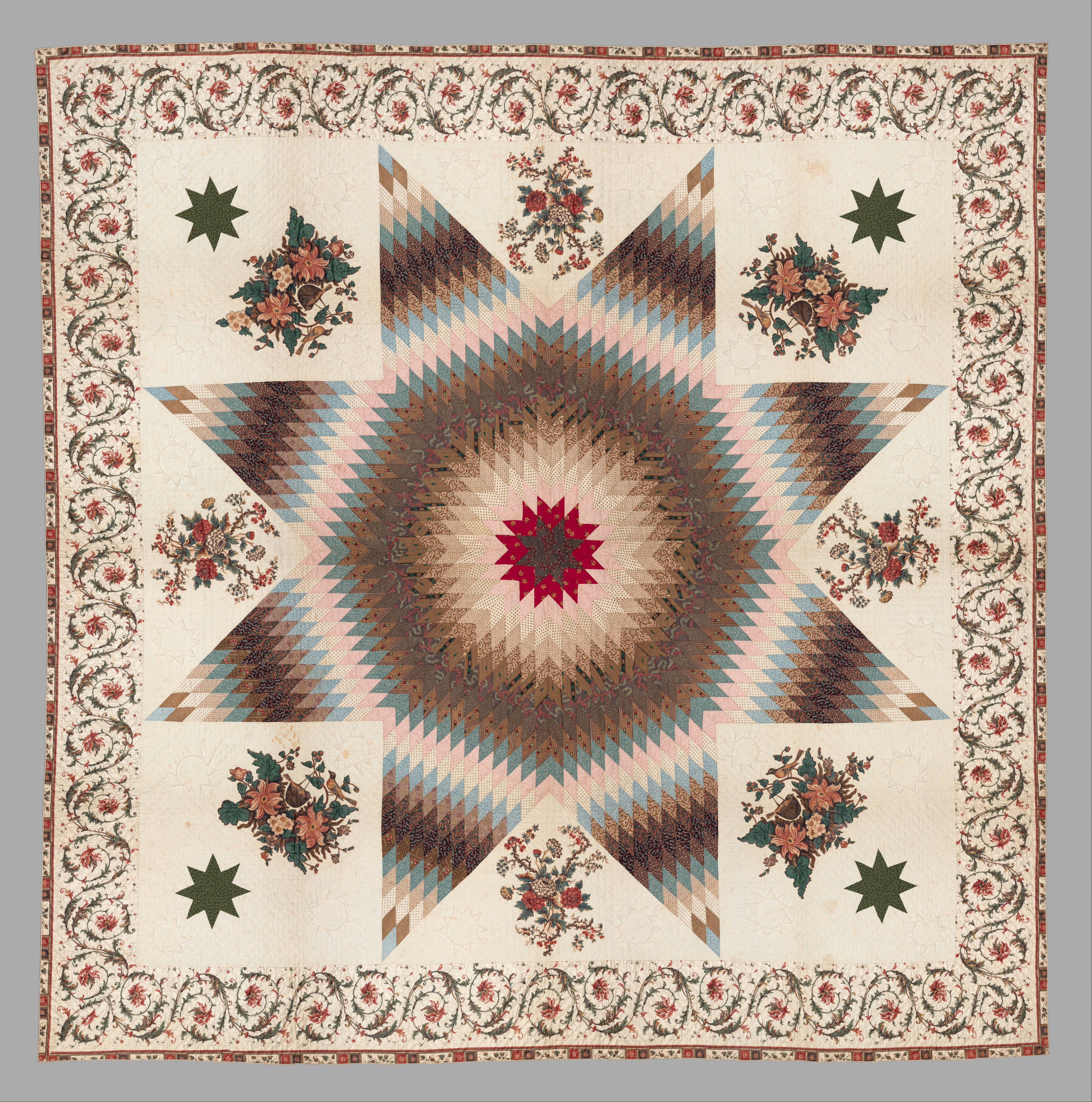
I am puzzled and seeing stars. In the postcard books, “Anitque Quilts Postcards from the Newark Museum,” and “Amish Quilt Cards in Full Color from the Collection of the Museum of American Folk Art” (produced by Dover Publicatons), there are 4 quilts and 3 quilts respectively that are based on the same multi-diamond star pattern but have different names. What is the difference between: (1) the Lemoyne Star or Star of Lemoyne pattern, (2) the Star of Bethlehem pattern, (3) the Lone Star pattern, (4) the Broken Star pattern, and (5) the Ship’s Wheel pattern? They all seem very similar to me. Are they the same pattern with certain variences? What distinguishes one from another? Are there other names for this type of star? This is a beautiful pattern type and probably my favorite. I would like to learn more about it. Thanks for your response in advance! 🙂 –Kimberly
Date: Sun, 23 Mar 1997 10:11:22 -0500 (EST) | From: Baglady111 [at] aol [dot] com
Maybe this will help..I had an 1800’s top..lots of browns/blues/blacks//and ti was pretty far gone..it was a wonderful teaching tool..so it went to a friend who was about to take a ‘dating’ course from BARBARA BRACKMAN..if nothing more, it is a visual tool.there might be someone out there that would like it simply as a guide wo show what they fabrics looked like, for identification, etc..the normal type feedsack is easy to identify..but the ones that are like percale can be a problem..sometimes, unless I recognize the pattern I have no idea..(CLUES IN THE CALICO??) hope this helps..Jane
Date: Sun, 23 Mar 1997 11:58:20 -0600 (CST) | From: Nancy Evans
At 12:38 PM 3/23/97 -0500, you wrote: > >Reguarding Jane’s post: > >>I have a question for a person just starting up a business..she needs to >>know..if she has her product, let’s say it is a pattern, and you have placed >>them in shops..someone comes up to you and wants to buy one or some..is it >ok >>to sell to her or do yu refer her to the shop (s).. >>2nd if the shop is in CA and the buyer is in TN..do you sell to her or >>advise contacting the shop? I’d appreciate your input for
Date: Sun, 23 Mar 1997 12:12:40 -0800 (PST) | From: Diane Lockwood
Hi Nancy, Yes, I saw your post (been out of town for a while) and will send a copy today to Merissa. I am so glad the old quilt is generating so much interest! Diane Diane Lockwood in Pollock Pines, Calif dcl [at] innercite [dot] com “What I do today is important because I am exchanging a day of my life for it.”
Date: Sun, 23 Mar 1997 12:38:00 -0500 (EST) | From: KBoxmeyer [at] aol [dot] com
Reguarding Jane’s post: >I have a question for a person just starting up a business..she needs to >know..if she has her product, let’s say it is a pattern, and you have placed >them in shops..someone comes up to you and wants to buy one or some..is it ok >to sell to her or do yu refer her to the shop (s).. >2nd if the shop is in CA and the buyer is in TN..do you sell to her or >advise contacting the shop? I’d appreciate your input for the lady..
Jane I too encounter this delema. In my confectionery business, I wholesale and retail the same items. I believe that is ok. The key is that you don’t want to undersell your retailers. If you retail sell an item to a lone customer, they need to pay a similar price to what they would have paid in the store. example: My DH wanted to buy a new receiver for his RC Plane transmitter. When he called Tower Hobbies for the appropriate model, he was told that he would have to pay list price if he got it from them. It was not an item that they carried in their regular sale catalog; actually it was a discontinued model. The reason they gave was that too sell it cheaper than list (as a policy) was that it would not be fair to the stores that wholesale purchased it from Tower to resell to public at list price. My conclusion based on the information I have so far is thus: Don’t undersell your retailers on small quantities. Many products are available both from the producer and a retailer. In the case sited above, (my opinion is) what is important is telling the customer where to get the pattern. Either way is ok. However, it is to the sellers benefit to sell the pattern directly to the customer at the retail price. She gets a bigger profit, which is what our free enterprising society is all about. I would be interested to see other’s veiw on this topic, too.
Date: Sun, 23 Mar 1997 12:47:30 -0500 (EST) | From: Baglady111 [at] aol [dot] com
Thank so ver much for your input..I’ll forward the info..and if others post I’ll gather them all for her..and that sounds reasonable..I know that I was right there with the designer but had to mail tio CA..Id’ not buy..glad you mentioned that..Jane
Date: Sun, 23 Mar 1997 13:05:47 -0500 | From: quiltmag [at] mindspring [dot] com (Jean Ann)
Kboxmeyer writes…. >What is the difference between: > (1) the Lemoyne Star or Star of Lemoyne pattern, > (2) the Star of Bethlehem pattern, > (3) the Lone Star pattern, > (4) the Broken Star pattern, and > (5) the Ship’s Wheel pattern? > >They all seem very similar to me. Are they the same pattern with certain >variences? What distinguishes one from another? Are there other names >for this type of star? >
Kimberly, the definitive book on quilt block names is Encyclopedia of Pieced Quilt Patterns by Barbara Brackman In this book there are over 4,000 quilt patterns. Almost every one of them has more than one name. some of them have a dozen names! makes naming our quilt blocks a little bit challenging. I usually look up the block and pick the one that appeals to me the most at the moment. Not very historic maybe, but what else to do? the Star of Lemoyne and Lemoyne star are the same pattern. This pattern is pretty well constant with eight diamonds making the points of the star and set in squares and triangles to square off the block. Bethlehem Star and Lone Star, aka Texas Star are pretty much the same pattern. This is sort of an expanded Lemoyne Star with rows of diamonds used for the Lemoyne Star radiating out…at least three rows are needed to make the pattern. Broken Star is another variation of the Lone Star,etc. It has pieced star point diamonds surrounding the center star to make a big quilt. As far as I can see the Ship’s wheel has nothing to do with any of the above star patterns….at least not the one I am looking at. BUT…. just as some blocks have more than one name, some names are assigned to more than one block….so it could be another variation of the Lemoyne Star …. hope this clears it up, but figure it will confuse you more. 🙂
Date: Sun, 23 Mar 1997 14:25:30 +0000 | From: “Hester Butler-Ehle”
Hi, all! Last night I was talking to DH (yes, he’s interested in quilt history, at least to the extent that he’s interested in what I tell him about it :)) and mentioned that according to superstition it was bad luck to make a Lone Star quilt unless you incorporated some other design element, but I couldn’t remember just why it was supposed to be unlucky. Now of course I can’t rest until I find out! Can someone fill me in? Hester hjbe [at] portup [dot] com
Date: Sun, 23 Mar 1997 14:48:32 -0500 (EST) | From: CTislander [at] aol [dot] com
Last night my cousin gave me a soft package wrapped in tissue paper. She said it wasn’t really a present, but she thought I ought to have it. Inside the paper was a doll size quilt top (30″x26″) made up of little handstitched nine patches. The individual pieces are one inch squares. The fabric is old, but I don’t know how old. There are some double pinks, some mourning prints, some shirtings, ginghams, and a chambray. There are two dark blue fabrics with different small (resist?) white designs. The other miscellaneous prints and stripes all look pre-1930. The entire top appears to be a young person’s first effort at piecing. It is so sweet. My cousin told me she got the little top in 1982 when we were clearing out my mother’s house. I have no recollection of ever seeing it before. I am so grateful that my cousin saved the top. I know my mother never quilted, but two other family quilt tops were handed down to me. Such a puzzle. A message from the past that I cannot figure out. My mother was an only child and there is no one I can ask. I would like to border the little top with something appropriate and finish it as a doll quilt (affixing a label with all the information, of course). It would be perfect to keep my Raggedy Ann and Andy and Beloved Belinda warm on cold days. The dolls were handmade for me in the 1940s. Christine T. in the California Delta
Date: Sun, 23 Mar 1997 15:34:46 -0500 (EST) | From: JOCELYNM [at] delphi [dot] com
On 21-MAR-1997 23:17:43.1 arlenegg said to JOCELYNM > > …the oldest applique some fascinating things like horse blankets >and > herb bags found in a frozen tomb in Siberian, dated about 500 >B.C.E. > Are you sure about this date? I would have thought that applique went > back long before then. Anxious to read more. Arlene, The problem with dating textiles is twofold: 1. they tend to deteriorate with age 2. the more ancient the object, the more likely it was that it was made for everyday use, and that it would simply be worn out. Surviving textiles tend to be in tombs (which means they were probably the Sunday best of the owner, and not at all what was used every day) or church donations (again, especially ornate). Only occasionally do you get a situation where a person died suddenly, dressed in everyday gear, and the textiles were somehow preserved. Think about how many old quilts are lost because they were used as batting for newer quilts….. Jocelyn
Date: Sun, 23 Mar 1997 15:35:04 -0500 (EST) | From: JOCELYNM [at] delphi [dot] com
On 23-MAR-1997 07:45:52.4 AJSNGS said to JOCELYNM > For those of you who know about feedsacks, when did print feedsacks >come into existence? I’m talking about the pretty prints that you >often see in quilts–not the logo printed bags. I’ve found numerous >logo bags in antique stores, but have yet to find ONE print bag! Are >they considered more rare? And is the reason I’m not finding them >because they all got used in clothing, quilts, etc? Nancy, My mom (born 1921) says that they ‘started’ in the Depression, when poor families needed every scrap of fabric they could get for making clothing and quilts. The feed sack and flour sack people would make THEIR brand more competitive by printing them with pretty designs, rather than just muslin with the brand name.
Some even printed their brand name in water-soluable ink, so that the logo would disappear and leave a plain piece of printed fabric, for making children’s clothes or quilting! (in theory, Mom said…in practice, you often got a ‘ghost’ of the logo left behind). Hmmm…I remember seeing a big stack of feed sacks down at the flea market that bought out the Overbrook Quilt Factory. Would anyone be interested in taking a feed sack, sight unseen, if I went back and got some? There were pretty patterns, but I’m not terribly into feedsacks, and I thought, hey, with all these here, I can always come and get one later… Jocelyn
Date: Sun, 23 Mar 1997 15:35:22 -0500 (EST) | From: JOCELYNM [at] delphi [dot] com
On 23-MAR-1997 09:43:48.0 Baglady111 said to JOCELYNM > I have a question for a person just starting up a business..she needs >to know..if she has her product, let’s say it is a pattern, and you >have placed them in shops..someone comes up to you and wants to buy >one or some..is it ok > to sell to her or do yu refer her to the shop (s).. > 2nd if the shop is in CA and the buyer is in TN..do you sell to her or > advise contacting the shop? I’d appreciate your input for the >lady..Jane >> Jane, Depends on if it is one shop or many. If it’s ONE, I would say she needs to talk to the shop owner and work out an arrangement where neither of them will feel ripped off. If it’s many shops, then each shop took the patterns knowing other people were going to be selling them. So I think she should refer to a local shop if there is one, or to a shop that ships nationwide, if there is one, before she sells personally. Jocelyn
Date: Sun, 23 Mar 1997 17:06:40 -0500 (EST) | From: AJSNGS [at] aol [dot] com
Jocelyn, I’ll bet if you went back and bought those feedsacks you would certainly find buyers! Cut them up into various sizes; 5″ or 6″ charms, or something like fat quarters. Depends on how much they want for them to begin with. Let us know what you decide to do! Nancy
Date: Sun, 23 Mar 1997 17:22:30 -0500 (EST) | From: Quilting Heritage ListServ
Hi, gang! This post bounced for some reason so I am reposting it for Nancy. Her E-mail address is narmstr [at] ibm [dot] net [dot] I E-mailed her and asked her to post with more information on CQSG, and I will update our home page. Kris At 09:37 PM 3/19/97 -0800, you wrote: >Hi … “be brave, and jump in.” I’m Nancy Cameron Armstrong, Chairperson >of the Canadian Quilt Study Group and also Editor of the CQSG Newsletter >COVER STORIES. We have over 300 members in 10 countries (about 1/3 in >the USA). > >Noticed reference to Yuko Watanbe on today’s messages, and thought >it might not be widely know yet and of interest that tragically she has >died quite suddenly. Only heard last Sunday morning (March 9)that she >had died of cerebral apoplexy. > >I also noticed many references to book titles both old and new. As a >VERY NEW subscriber, I hesitate to say anything until I get a better >feel for the service; however … I asked Cuesta Benberry, Barbara >Brackman, Dorothy Cozart, Katy Christopherson, Virginia Gunn, Ruth >McKendry, and Merikay Waldvogel each to provide “a list of the first 10 >titles you would buy (or if out-of-print, try to locate somewhere) if >you were trying to build a collection for the study of quilts.” Guide #1 >from CQSG is … BUILDING A QUILT LIBRARY: TOP TEN TITLES FOR THE STUDY >OF QUILTS FROM SEVEN QUILT HISTORIANS. Fascinating lists, mostly >annotated. > >NCA (two miles north of the US border) >British Columbia, Canada >narmstr [at] ibm [dot] net > > > >
Date: Sun, 23 Mar 1997 18:40:13 -0500 (EST) | From: Quilting Heritage ListServ
At a house call today, I bought a bunch of feedsacks. A couple still have their strings…is anyone interested in these? I paid $5 each and would be happy to sell at that price to listmembers. Just so you can see what they were like. What surprised me is that these feedsacks – maybe not all of them, but definitely these – have selvages. I suppose that is pretty obvious, but I wonder how many feedsacks I have passed by over the years because I didn’t think feedsacks had selvages. Interesting. Kris Driessen oldquilt [at] albany [dot] net Proud owner of 15 new Roens!
Date: Sun, 23 Mar 1997 19:25:07 -0500 | From: quiltmag [at] mindspring [dot] com (Jean Ann)
Christine..in regards to your little nine patch doll quilt… I think your little quilt was probably made between 1890 and 1920. I have a quilt made in that time with much the same fabrics as you describe. My aunt who was born in 1905 remembers one of the quilts being made from those type fabrics. She said that in northern Michigan the pink prints were used to make little pinafores to go over little girl’s dresses and the blue chambray was used for everyday shirts for men and boys. the shirting stripes were for sunday shirts. She gave me the quilt (for a double bed) and I treasure it, but won’t use it. I only display it as the fabrics are somewhat fragile. Fortunately my aunt is still alive and very mentally alert so she has shared a lot of family history that goes with that quilt! Jean Ann Eitel Editor, QUILT magazine
Date: Sun, 23 Mar 1997 20:34:13 -0500 (EST) | From: LISA108 [at] delphi [dot] com
Jocelyn’s right – and even when something’s preserved in a tomb, it can deteriorate, even while other objects buried on or with the same body survive. Case in point: Eleanora of Toledo, wife of one of the Medici grand dukes, was buried in her elaborate cut velvet wedding dress, linen undergarments, corset, and stockings. The tomb was opened in the last few years and it was found that the dress and stockings had survived, most of the corset and chemise were gone, and the underdrawers were largely intact. There were also several tombs of the princes of Saxony that were opened in the 19th century, and the occupants’ outer garments were by and large in good condition and the underwear had disintegrated (some of the suits and gowns were sturdy enough to be cleaned, worn and photographed on models! Carl Kovel’s =Historic Costume in Pictures= reprints the pictures). It’s why I assume that patchwork quilts were made in the 16th and early 17th century; the patterns existed, there’s a surviving religious vestment made to resemble bedclothes, and there are written references to patchwork at both the beginning and the end of the century (a letter in 1507 from a French tailor describing a patchwork banner he’d made, and a paragraph in =Gulliver’s Travels= about English patchwork). But until an actual quilt surfaces from an English country house attic, I can’t be certain that patchwork quilts as opposed to patchwork garments or heraldric pieces were made.
Date: Sun, 23 Mar 1997 20:39:11 -0500 (EST) | From: LISA108 [at] delphi [dot] com
I’d find some compatible reproduction fabrics, put on a very simple border, and use 100% cotton thread and a cotton batt to finish your little treasure. Poly-core thread can cut through fabric but cotton should be fine. What a lovely story. No one in family to my knowledge quilted, but I can definitely relate to finding wonderful things while going through family effects – last winter I found some pictures of my father as a teenager and my mother as a high school senior. It really brought back the memories. Enjoy the doll quilt – I think using it to cover your dolls is perfect. Lisa Evans