January 23 – January 31, 1997
These restored messages come from the Quilt History List, an online forum where quilt historians, collectors, researchers, appraisers, and enthusiasts discussed antique quilts and related textiles. The archive dates from 1996 through approximately 2016 and is being restored gradually. Sign up in the form at the bottom of the page if you want to know when a new page is added. Original spelling, opinions, formatting, and inactive links may remain unchanged.
Primary topics of this QHL Digest (January 23–31, 1997):
- New quilt find in the news — a local newspaper story about a quilt tied to an “Honest Abe” Lincoln anecdote, donated to a state collection.
- Museum exhibit reports — a firsthand account of the Red and Green Applique exhibit, including meeting a well-known quilt historian, a “show and tell” workshop with 83 local quilts, and a visit to a restoration expert’s studio.
- Historical fabric terminology and dating — an extended, multi-day thread identifying and defining obscure historical fabric names (Henrietta, dimity, pongee, shantung, Tusseh silk), with members tracing word origins and cross-referencing textile dictionaries.
- Old quilt tops: preserve vs. finish, revisited — a follow-up clarification and broader philosophical discussion about custodianship versus ownership of antique textiles, with an archaeology analogy about minimally invasive preservation.
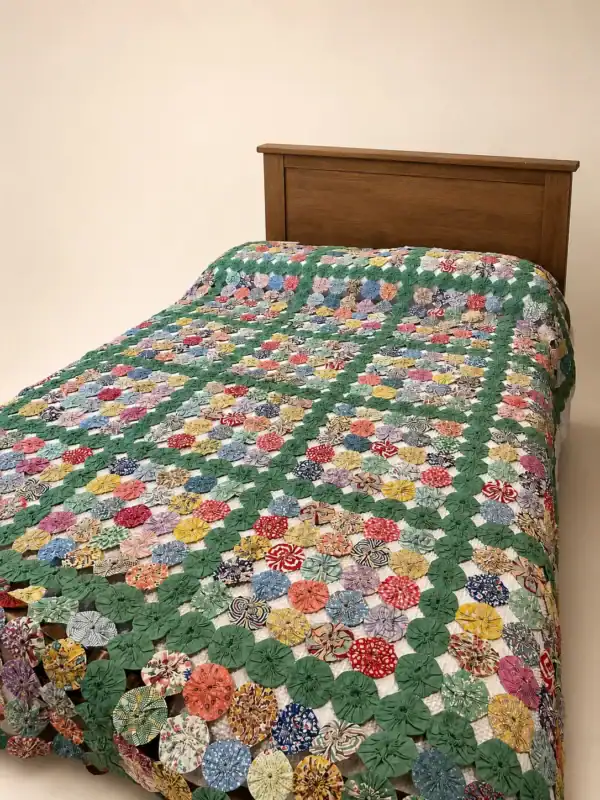
- Feedsack, target, and yo-yo quilt identification — a recurring identification thread on the “Target” quilt technique, and a detailed sourced history of yo-yo quilts (their origin, peak popularity, and name derivation).
- Book recommendations and sourcing — an active bulk-buy and lending-library effort, with multiple detailed bibliography lists (general American quilt history, pattern/textile identification) and hard-to-find title tracking.
- Quilt provenance and authentication case studies — a detailed account of authenticating a Civil War-era crazy quilt containing actual uniform fabric, plus a signature quilt research method using the Soundex census index.
- Historical color and dye names — inquiries into the origin of terms like “Eli Green” and “Madder,” tying back to the historical dye chemistry thread from earlier digests.
- State museum quilt documentation project — an update on a multi-year quilt collection documentation and upcoming book at a state museum, including a conservation fund established from the project.
- Crazy quilt symbolism — a sourced discussion of spider and spiderweb embroidery motifs on Victorian crazy quilts and their association with good luck.
Well, I did go to the Red and Green Exhibit at the Museum of our National
Heritage this weekend. I got to meet Merikay Walvogel and she was
wonderful! Very nice person. I took her picture & will post it to the web
page as soon as it is developed. As far as the exhibit goes – I was a bit
overwhelmed. So many perfect quilts! Including an exceptional broderie
perse. The Museum seems to maintain a permanent quilt exhibit. They had a
display area just for quilts. The quilts were hung (on a hanging sleeve, I
think) in a little niche, with plastic covering the niche so you couldn’t
touch it:-((
The part I liked the best was the workshop. 83 local residents brought in
their quilts and Marikay did a “show and tell” for each one. My husband
promptly volunteered to help hold up the quilts, so he got to see them all
first hand, and sometimes talk to the owner. Most of the quilts were family
owned, and the owners were more than happy to share their story. There were
two or three perfect Red and Green Quilts, two early 1800’s chintz quilts,
one extremely nice crazy quilt, and one that defied description. It was
made of folded pieces of fabric, almost like rows of prairie points facing
in. It had a name, but I can’t think of it at the moment. Anyone know what
that technique is called? Naturally, it was the heaviest quilt there!
The next day, we stopped and saw Camille Cognac on the way home. She sold
me all she had of “Quilt Restoration, a Practical Guide”, but will order
more for me. (If anyone wants one, they are $24 each, and I will ask her to
sign it for you.) She had this really beautiful wool challis bathrobe out
on a table, dating from the Civil War. I have to admit, it did amaze me. I
had not seen anything like it before, and I didn’t realize how much wool
challis felt like polyester. The colors were exceptionally vivid, and the
buttons were upside down yo-yo’s!
I did ask her about the book she is working on now, Victorian Beauties. The
official reason for the delay is that the book is “under production”. The
REAL reason is that she simply wrote too much & is now paring it down. She
has lots of other irons in the fire, too. The woman is a dynamo.
While we were there, we talked to a fabric designer who is coming out with a
new line of reproduction fabrics in early February. I asked if I could have
a discount for my list members & she agreed to sign me up and send me a
brochure. I’ll post to the web page if and when it becomes a reality.
Meanwhile, I am still looking into bulk buys on the more popular books. I
am trying to find “Just New from the Mills” – does anyone know who publishes
this? I called the Museum of American Textile History, and they didn’t have
any copies left, and couldn’t refer me to anyone who did. I did find two
childrens books, “Quilting Then and Now” and “Cotton Then and Now” for $6.50
each, and I will be ordering them for anyone who wants one.
I also called the American Quilt Study Group, and they had heard of us!
They agreed to a discount for us on “Uncoverings”, which is their
professional journal, but I don’t have any details yet. I have had a couple
of suggestions from y’all, and I will keep looking into the books you want.
I’ll post to the web pages as I find them.
Kris
Date: Thu, 23 Jan 1997 10:11:32 -0800
From: nomad1 [at] ibm [dot] net
To: QHL [at] cue [dot] com
Subject: QHL:Books
Just remembered, for those who are interested in world quilt history like
me,a great book thet I do not think has been menrtioned yet.
It’s called ” Quilt Treasures-The Quilters Guild Heritage Search” First
Published in 1995 in Australia & New Zealand by Kangaroo Press Pty Ltd.
ISBN 0 86417 7135.
This book is the result of a three year study by the British Guild-it’s
first national index of quilts made prior to 1960 . 4000 + items emerged,
from traditional British mosaic patterns, wholecloth quilts from Wales
and North Englland,eighteenth century pieced framed quilt
,Bible,signature,friendship,military,political quilts etc. The earliest
quilt dates from the early 1600’s. There are Red Cross quilts from
Canada sent as war relief ,American 1930’s kit quilts,Egyptian applique
panels and Chinese embroidery. There are more than 170 colour
illustrations and enlightening chapters written by U.K.’s leading
authorities on subjects ranging from textiles to quilt care. Basically
it’s a superb book.
Bye Again! Hiranya from Parramatta, Sydney Australia
e-mail nomad1 [at] ibm [dot] net
Date: Thu, 23 Jan 1997 10:22:10 -0800
From: nomad1 [at] ibm [dot] net
To: QHL [at] cue [dot] com
Subject: QHL:Historical names of colours
Hi All!
Still roasting here in sunny Sydney—-I would love to get some snow from
you guys!!!
I would like to excite my brain cells a tad and get some information re
how colour names were derived?
I have learned a bit about Madder, but how about Eli Green? Who was Eli
Green? What other unusual names are there?
Has anyone had any luck locating the “Rising Sun” collection.? I managed
to get some from Vintage & Vogue,but there are still gaps in my
collection. Even if I get samples of the full collection I will be happy,
just as examples of it.Would appreciate some feedback.
Thanks Hiranya
Date: Thu, 23 Jan 1997 07:50:30 -0800
From: lrobins [at] cclink [dot] fhcrc [dot] org (laurarm)
To: QHL [at] cue [dot] com
Subject: QHL: more on shoulds/quilting old tops
Message-ID: <2e78a980 [at] cclink [dot] fhcrc [dot] org>
Content-Type: text/plain; charset=US-ASCII
Content-Transfer-Encoding: 7bit
Content-Description: cc:Mail note part
I am feeling quite embarassed because I think that a posting I made
earlier was misinterpreted. It wasn’t meant to be a list of shoulds
and shouldn’ts — on the contrary I was trying to debunk some commonly
held shoulds and offer alternatives. And I’m sorry if anyone was
offended. May I try once more?
First — old quilt tops don’t have to be quilted. There seems to be
a belief that it is incomplete and without value until its a useful
quilt. But perhaps it’s OK to just leave it alone. Even if it’s not
a Dior, of museum quality, it has value because it is a completed
piece of needlework, and it’s old, and there is not an endless supply.
This is NOT saying “don’t” quilt it. It’s just to say that the top
still has value unquilted and will have even more as time goes on.
And its color and design can still be enjoyed and displayed even if it
isn’t a quilt we can wrap up in.
Second – not all restorations are good restorations, and maybe some
are not desirable. This list has many restoration professionals, but
not everyone has that expertise. And there are differing opinions
even among the experts. Caution is the operative word.
Victoria said that owners should be given information and choices and
I completely agree. That information must include the fact that an
old piece that has been modified might lose some of it’s monetary or
historical value. Those choices must include the alternative of doing
nothing, or only what is essential to preserve the piece.
Third, and this is perhaps more incendiary – yes an owner can do
whatever they want with a piece. But perhaps it would be nice if
rather than using it up just because we can, that we consider using it
less so that we can pass it along.
Example – a friend had some lovely Chinese embroideries brought from
China in 1923. There was a small eyeglass case and a small sort of
purse, made of silk and beautifully embroidered including gold thread
and sections of Seed Stitch (Forbidden Stitch). They weren’t museum
pieces, but still very lovely and unusual. She displayed them on a
wide window sill and in just a couple years they were terribly faded
and starting to deteriorate badly. She had been told that sun was bad
for them but her attitude was that they were hers and she would
display them the way she wanted, and that she had pleasure while they
were there. I personally wish that she had seen herself as custodian
rather than user. Yes, it was her right, but I think it was a sad
loss.
So, again, I’m sorry if I offended anyone. The only “should” is that
we should consider all the possibilities, and I just wanted to bring
up these particular ones.
Laura Robins-Morris, Seattle
Date: Thu, 23 Jan 1997 11:21:58 -0500 (EST)
From: Laurajbr [at] aol [dot] com
To: QHL [at] cue [dot] com
Subject: Re: QHL: Museum/books
Message-ID: <970123100644_681212606 [at] emout13 [dot] mail [dot] aol [dot] com>
Kris
The quilt you mentioned made up of the prairie points is called a Target
quilt. When my friend from Black Mountain, NC, came to do an antique quilt
talk/sale, she had one with her that was originally from the RJ Reynolds
estate and it sold for $6,000! (and there were two ladies each bidding on
it!) It was extremely heavy, as you mentioned, and was one of the most
unusual quilts I’ve ever seen. I wonder if this was the same quilt. It was
purchased by a lady named Connie from lakeland, FL, but it may have moved to
another home. As I recall, it was in browns and beiges.
Laura in Tampa
Date: Thu, 23 Jan 1997 10:24:58 -0600
From: “herbilady”
To:
Subject: QHL: Newbie to list
Message-Id: <199701231632.IAA21221 [at] orbital [dot] cue [dot] com>
Content-Type: text/plain; charset=ISO-8859-1
Content-Transfer-Encoding: 7bit
I’m very excited to have found this list and want to thank all of you for
the wonderful information you share….this is the mail I love to sit with
first thing in the morning with a cup of coffee. Its also prompted me to
drag out my VERY small collection and wonder about these tops and
blocks….
I’m a novice at this and the first question I’d like to ask is what books
you would recommend to someone like myself for studying and identifying
fabrics in order to date the few pieces that I’ve collected. I’d also be
grateful if I could send a photograph or two to someone for the purpose of
perhaps dating one piece I have – and adore -, in particular. Its a
bow-tie coverlet with alternating squares of a pale green. Parts of the
top have rust-colored stains and within some of these stains the fabric
appears to have been eaten away. The bow ties are sewn from what I would
venture to guess are shirting fabrics, those tiny prints on white, but
there are also plaids and a few dark fabrics as well. The range of colors
are the light shirtings, browns, grays, black and dark blue. The coverlet
is backed with a light colored, very faded fabric which appears to have
been a rather large floral print. I’ve never washed it.
A few of the bow ties haven’t held up, although the majority of them are in
wonderful shape, especially the shirting fabrics. A few of the fabrics
have completely deteriorated and some of them simply need to be re-sewn in
several places. The blocks were sewn by hand then put together with a
machine.
I’d like to preserve this piece and although there is a section where those
stains have tattered the pale green fabric, I wonder what I can do to
preserve the blocks and coverlet in general. It was never quilted.
Thank you for any help or suggestions and for providing such a wonderful
list!
Leah in Sallisaw, Oklahoma
Date: Thu, 23 Jan 1997 15:07:38 -0500 (EST)
From: Quiltfix [at] aol [dot] com
To: QHL [at] cue [dot] com
Subject: QHL: Re: Black Cotton
Message-ID: <970123134823_1658752409 [at] emout19 [dot] mail [dot] aol [dot] com>
Ricki, regarding the dark cotton – I don’t remember where I read it, but I
know that there are cottons that grow in colors. Someone was even trying to
market clothing in the last couple of years using these cottons and not dying
the resulting fabric. Not a lot of help, but it is possibly an old variant
on the new colored cottons.
Alan
Date: Thu, 23 Jan 97 15:10:52 PST
From: John & Cinda Cawley
Content-Type: TEXT/PLAIN; charset=US-ASCII
I don’t know about Karen Buckley’s book (try getting it through
inter-library loan before deciding whether to buy it) but her quilts are
gorgeous. She’s from Carlyle, PA and is coming to teach at my guild,
Pennsylvania Quilters, in May. I’ve heard that she’s a very good teacher.
She’s won awards at the Fort Washington show the last two years.
Cinda in Scranton
Date: Thu, 23 Jan 97 15:26:20 PST
From: John & Cinda Cawley
To: JFavia [at] aol [dot] com, QHL [at] cue [dot] com
Subject: QHL: RE: Advice on Fabrics
Message-ID:
Content-Type: TEXT/PLAIN; charset=US-ASCII
Sue Rogers of Mountain Lakes, NJ who does the gorgeous stuffed work uses
upholstry cottons in lots of her pieces. I don’t know what happens to the
glaze when the piece is washed–it probably loses its shine. See if you
can find pictures of Sue’s work.
Cinda in Scranton
Name: John & Cinda Cawley
E-mail: cawley [at] epix [dot] net
Date: 1/23/97
Time: 3:26:20 PM
This message was sent by Chameleon
Date: Thu, 23 Jan 1997 19:28:16 -0500 (EST)
From: SadieRose [at] aol [dot] com
To: QHL [at] cue [dot] com
Subject: Re: QHL:Rising Sun fabrics
Message-ID: <970123172655_-2113447293 [at] emout15 [dot] mail [dot] aol [dot] com>
Hiranya:
You might try Patchworks in Montana, USA for the Rising Sun fabrics:
[link removed]
Margo (who is on QHL, but haven’t seen her post) did carry the RS fabrics,
don’t know if she still has them available or not. There is a place on her
web site, where you can send her e-mail messages, too. Good Luck!! Karan
Date: Thu, 23 Jan 1997 20:59:26 -0500
From: Bobbi Penniman
To: QHL [at] cuenet [dot] com
Subject: QHL: Dimity definition
Message-Id: <3.0.32.19970123205913.006f4750 [at] voicenet [dot] com>
Content-Type: text/plain; charset=”us-ascii”
My Dan River textile dictionary, to which I often refer, defines Dimity:
“A thin, sheer cotton cloth in which stripes or cords may or may not be in
the pattern. Usually made of combed yarns, its quality depends on the
yarns used and the pick count in weaving. Used for dress and sportswear,
aprons, pinafores, art needlework, bedspreads and many types of dress goods.”
I had always thought of it as a pretty, delicate fabric.
BobbaLoo in PA
Date: Thu, 23 Jan 1997 21:38:16 -0500 (EST)
From: Baglady111 [at] aol [dot] com
To: QHL [at] cue [dot] com
Subject: Re: QHL: Museum/books
Message-ID: <970123213803_980950964 [at] emout01 [dot] mail [dot] aol [dot] com>
there is a TARGET quilt in LONE STARS, A lEGACY OF tEXAS qUILTS, 1836-1936,
also known as a ‘quill’ quilt..these quilts were not known as a quilt, per
say, because there is no quilting holding three layers together but more as a
novelty quilt, according ot the story. It reminds me of a rag rug..Jane
Date: Thu, 23 Jan 1997 21:47:50 -0500 (EST)
From: shelley [at] winthrop [dot] slic [dot] com (Shelley Fracalossi) (by way of “Kris
Driessen, Hickory Hill Antique Quilts” )
To: QHL [at] cuenet [dot] com
Subject: QHL: Old quilts
Message-Id: <2.2.16.19970123214551.19f72760 [at] mail [dot] albany [dot] net>
Content-Type: text/plain; charset=”us-ascii”
Hello everyone,
I haven’t posted at all since my bio, but am catching up on the digest and
wish to comment on several items.
First of all, I am going to France in April for two weeks with two side
trips, one to Northern Italy (Trento) and one to Dusseldorf Germany. We
will be staying in Paris 3 1/2 days and would welcome info on quilt shops
etc in Paris. We will also visit LaRochelle, Toulouse, Narbonne, Marseille
and Nice.
On the subject of quilting stitches, on another list I am on, there was a
discussion on how to count the number of stitches per inch. It was put
forth that one should could BOTH the top and the bottom stitches, but I
feel that this is incorrect. In looking at antique quilts I have always
counted only the stitches that show on the top. I believe this is correct
since the stitch that shows on the top is essentially the SAME stitch as
shows on the bottom. What do you quilt historians out there think about
this?
Regarding crazy quilts, most of the ones I have seen have no batting but
were foundation pieced to muslin or some other fabric. I recently picked
up a later crazy quilt which was unusual in that it was both foundation
pieced to muslin and line with a cotton batt. It has a red sateen backing.
There is some damage to some of the silks and since it is foundation
pieced, I am thinking of tracing the shapes of the pieces that are missing
and using that as a template to create an applique piece to cover the
damage. I will be using old tie material since that is primarily what the
quilt is constructed off. If any one can think of a better way to do this,
please let me know.
A friend of mine purchased a box full of quilt tops at an auction in Canada
and sold them to me. There are 5 log cabins, one daddy long legs and one
spool pattern top. They look to be from the 40″s and 50’s The log cabins
are all out of white muslin for the light, and decorator style fabrics for
the darks. Some of these fabrics are quite lucious, with gold overlay and
such. Some look like African fabrics. The piecing is not the greatest.
(What might be called improvisational or “crooked” quilts) I washed them
all and started to iron them but found they were laid out so poorly that
the best thing to do with them would be to undo all the blocks and square
them all up and then restitch the rows together. It is interesting that
each log cabin is in a different layout and that there were old papers
pinned to the end of each row with the row number written in pencil. I
sometimes wish these things could talk and tell us where they have been. I
almost think these were done in a school or by a class of some kind. I am
trying to add some more photos to my web page soon as these tops are for
sale and sooner or later will get the photos loaded.
I also picked up a box which included 29 embroidered state flower blocks.
The original pattern layout sheet is there showing that there should have
been 48 blocks to start with, although the actual patterns for the missing
blocks are not there. It would be nice to assemble a complete set. If any
one has any strays of this type, please email me privately and I can tell
you what I am missing.
So far this list has been informative and I look forward to seeing your
input in the future
Shelley in Sunny, 10 degree F, Plattsburgh NY
Date: Fri, 24 Jan 1997 04:22:48 +0000
From: Susan Nixon
To: QHL [at] cue [dot] com
Subject: QHL: Passing it along
Message-ID: <19970124042237.AAD2497 [at] LOCALNAME>
Content-Type: text/plain; charset=”us-ascii”
Laura R. Morris wrote on 1/23/97:
Third, and this is perhaps more incendiary – yes an owner can do
whatever they want with a piece. But perhaps it would be nice if
rather than using it up just because we can, that we consider using it
less so that we can pass it along.
Archaeologists are beginning to think this way. Here in Phoenix we have an
ancient ruin near the airport, Pueblo Grande. Part of it has been dug out.
It is from the people who first used canals in the city, and some of their
old canals are still visible, as well as the foundations and lower walls of
this particular site.
The site is being preserved as it is. No further digging and restoration is
being done. The new line of thought is that old methods are very intrusive
and destroy as much as they preserve. Already archaeology is being done
with instruments which can look though the dirt and rock to what is lying
below, and this is the wave of the future.
For those of us who like to walk and touch, it is disheartening, but it does
mean that more is preserved to pass on to future generations. Perhaps we
can do a little of both – some preserving for the future and some enjoyment
for ourselves.
A slight addendum to Alan’s comment. There is a lovely shade of dark tan
cotton which grows here, and a lighter, almost yellow/cream color. They are
at the state fair every year. I understand there is a widow who has
experimented with hybrids and natural cotton colors to produce a light blue
and a lavender, but these two I haven’t seen.
Susan Nixon
Phoenix, AZ, USA
Date: Fri, 24 Jan 1997 06:50:27 -0500 (EST)
a listing of fabric desscription, like you posted on dimity, might be of
interest for us..I’m sure there are lots of young people who aren’ familar
with different ones. I’ve seen eyebrows go up on ‘seersucker’ and ‘waffle
pique’..Jane
Date: Fri, 24 Jan 1997 07:37:13 EST
From: marleneb [at] juno [dot] com (marlene a bush)
To: QHL [at] cuenet [dot] com
Subject: QHL: DAR Museum
Message-ID: <19970124.064715.2991.0.marleneb [at] juno [dot] com>
I’ve been lurking for a couple of months now and learning much from all
the conversations. I’m a counselor at a residential high school for
academically talented high school juniors and seniors and am on call 24
hours so my leisure time is limited, to say the least. The recent
information on the special tour/workshop at the DAR Museum in Washington
really caught my eye. However, thinking I wouldn’t get back to D.C. in
the next several years, if ever, I deleted it. Now my husband has
invited me to accompany him on a business trip to guess where – wouldn’t
you know it! If anyone kept that information about the content of the
tour, the telephone number, etc. and would kind enough to share it I’d be
really grateful. Marlene Bush in Hot Springs, Arkansas where these warm
temperatures in January are fooling the spring flowers.
marleneb [at] juno [dot] com
Date: Fri, 24 Jan 1997 09:20:19 -0500 (EST)
From: PElkovitch [at] aol [dot] com
To: QHL [at] cue [dot] com
Subject: QHL: Re: QHL-Digest Digest V97 #21
Message-ID: <970124092018_1013064733 [at] emout04 [dot] mail [dot] aol [dot] com>
Content-Type: text/plain; charset=unknown-8bit
Content-Transfer-Encoding: 8bit
<< Has anyone had any luck locating the “Rising Sun” collection.? I managed
to get some from Vintage & Vogue,but there are still gaps in my
collection. Even if I get samples of the full collection I will be happy,
just as examples of it.Would appreciate some feedback.
Thanks Hiranya
>
If you have tried Margo at Patchworks (she is wonderful!) but no luck,
there was a company in Oakton, VA that offered packets of the entire
Smithsonian line in 6″ x 6″ samples. Since this was from a fabric line
produced in 1994, so I’m not sure if they would have any left (39 pieces and
the cost was $10) The number for Merryvale, Ltd is 1-703-264-8959. There
were also patches that go with the fabric to put with your quilt label and
they were different for each of the Smithsonian lines (Groom and Little
Sister fabric) I do have fabric from this collection. . . . . let me know
if I can be of help to you.
Patty in Skaneateles, NY
pelkovitch [at] aol [dot] com
Date: Fri, 24 Jan 97 10:08:34 PST
From: John & Cinda Cawley
To: marlene a bush , QHL [at] cue [dot] com
Date: Fri, 24 Jan 1997 10:36:44 -0500 (EST)
From: QuiltAlive [at] aol [dot] com
Merikay Waldvogel here. . .I am just back from the opening festivities in
Lexington, MA for the exhibit “The Art and Artistry of Applique: Quilts from
the James Collection.” The collectors Robert and Ardis James were there
along with a lot of quilt enthusiasts from New England. I especially enjoyed
meeting Kris face to face. Her husband helped hold quilts during the Quilt
Dating session. I love doing quilt days in New England because of the very
early fabrics you often see in the quilts there.
Kris commented on the Museum of Our National Heritage’s permanent area for
quilt displays. That particular gallery is not always filled with quilts,
but two years ago their staff developed a set of temporary display cases for
quilts. The system worked so well–and they had such great response to
antique quilt exhibits, the museum decided to mount other quilt exhibits.
When they have had the exhibits, they had a series of two exhibits that
lasted a total of six months. This exhibit series started with Star Quilts
and now Red and Green Applique Quilts–a total of sixty quilts from the James
collection.
I think the most important James quilt on display there is a Baltimore Album
Quilt that appeared in Dr. Wm Rush Dunton’s book Old Quilts (pg 207) and in
Ellie Sienkiewicz’s book Baltimore Beauties and Beyond (pg 35). They have it
displayed on a four-poster bed in a corner display area behind glass and
under controlled light conditions. The broderie perse and applique examples
are exceptional.
Museum of Our National Heritage, 617-861-6559, located at 2A and Mass Ave in
Lexington, MA just off I-95 (Hwy 128) outside of Boston. Admission is free.
Hours are Mon-Sat 10-5 and Sun Noon to 5. If you go, please thank the
staff, write your comments in the comment book, and encourage them to have
more quilt exhibits.
Kris, the book Just New From the Mills: Printed Cottons in America by Diane
Fagan Affleck (1987) is a hard-to-find book. I’ve asked the Museum of
American Textile History to republish it, but they say it’s not possible at
this time.
Re: the large heavy quilt with prairie points facing the center–Laura and
Jane have already commented on it. The one we saw Sunday in Lexington, MA
was not a $6000 version–I’m assuming the one that sold for such a high price
in Florida was a late 1800s version in brown calicos. The one we saw Sunday
was in 1950s fabrics. Jane mentioned an example in the Lone Stars of Texas
book (pg 126-27) where it is labelled The Target. The Safford & Bishop book
America’s Quilts and Coverlets has one made of smaller blocks of the same
pattern on pg 156-57). I’ve seen other examples in the South–people have
called them Target, Cockleburr, and Pine Burr. I own a chair seat cover made
in the same pattern in pastel colors of 1920s-30s. I’ve been trying to find
a printed source, but haven’t found one yet. I keep a file of photos of
these quilts. My notes say there was an article pertaining to these quilts
in the Feb 1933 issue of Antiques Magazine, but I don’t have a photocopy of
the article.
Re: Quilt Treasures of Great Britain mentioned by Hiranya of Australia. The
American publishing rights to that British book were bought by Rutledge Hill
Press. It costs $30. Call 800-234-4234 or maybe Kris can get copies to
sell. It is an exceptional buy–170 color photos and excellent information.
–Merikay Waldvogel
Date: Fri, 24 Jan 1997 12:43:14 -0500
From: “Judy Grow”
The safest way to store quilts, in my opinion, is flat, like on a bed,
with a light barrier on top of the top most quilt. I store my biggest
quilts that way in the guest bedroom, and only remove them when company
comes.
Second best, and the way I do with my smaller quilts is: folded as large
as possible, with acid free tissue paper stuffed in the folds, and then
placed in a (washed) muslin bag made specifically for that particular
quilt. I store these in a bureau whose drawer insides have been sealed
with shellac. The bags I make have velcro closures, and I write all sorts
of information about the quilt on the outside of the bag with a Pigma pen
(permanent).
Hope this helps
Judy in NJ
judygrow [at] blast [dot] net
From: Suepurrrr [at] aol [dot] com
Subject: Quilts touching wood…
Hi Judy – I read with interest your note on QHL about
wood and quilts. My mother has quite a few old quilts
so I showed yur note to her. She wanted me to ask
you what you recommend for storing quilts. What is
the safest way.
Date: Fri, 24 Jan 1997 12:54:54 -0500 (EST)
From: DReyno3650 [at] aol [dot] com
To: QHL [at] cue [dot] com
Subject: Re: QHL: Dimity definition
Message-ID: <970124121913_1511361797 [at] emout16 [dot] mail [dot] aol [dot] com>
I think that an on-going chat about certain fabrics of the past could be very
illuminating. For my Friends of the Library job, I’m in a group that indexes
old local newspapers (from 1850 in this locality of Santa Cruz, CA). In
1890, we were all puzzled by what the ladies were wearing: “She was married
in a dark brown Henrietta….wore black Henietta to the ball…etc, while the
men wore “nobby suits”, I could picture the suits being in a slubbed wool,
and the Henrietta’s being a style of reddingote. Was I ever wrong! Later
reading proved the suits of the men to be stylish and when we looked in the
library’s big dictionary, the Henrietta was a type of slubbed silk similar to
shantung. This was so common, it would undoubtedly be put in the crazy
quilts of the eighteen nineties. When did Bemberg appear and was it always
rayon? And what exactly is the “pongee” my Sunday School dresses were made
from. These were strong fabrics and could be and probably were silk, but
were they too thin/fragile to appear in quilts? When did the word “shantung”
appear? I remember rayon shantung from the thirties, which my mother put in
quilts. (Rayon rots.) It was a heavy, slubbed fabric suitable for spring
coats and light suits came in colors light and dark. Could Henrietta cloth
also come in colors both light and dark? As you might guess, I’m preparing
to tackle my newly acquired 1890 crazy quilt, but more on that later.
Willa Dean Reynolds, Soquel CA.
Date: Fri, 24 Jan 1997 15:09:51 -0500
From: Baglady111 [at] aol [dot] com
To: QHL [at] cue [dot] com
Subject: Re: QHL: Dimity definition
Message-ID: <970124150950_782850226 [at] emout02 [dot] mail [dot] aol [dot] com>
EXCELLENT subject, Willa. You have already mentioned fabrics I am unfamilar
with. In most cases if you don’t have a sewing background, you’re lost..I’m
looking forward to this..and will start it off with “WHAT was a henietta??
Or am I getting the cart before the horse? Jane
Date: Fri, 24 Jan 1997 14:16:29 -0800
From: harleman [at] micron [dot] net
To: QHL [at] cuenet [dot] com
Subject: QHL: glossary of textiles
Message-ID: <32E934BC.4797 [at] micron [dot] net>
Content-Type: text/plain; charset=us-ascii
Content-Transfer-Encoding: 7bit
Fellow QHL’ers, In the course of two semesters of Textile History I
compiled a fairly good list of terminology. At the moment, my papers
have been loaned out and I only have my original notes. However, when I
get them back I’d be willing to post the glossary and the books they
came from. In Encyclopedia of Textiles. American Fabrics and Fashions
Magazine, editors, 3rd. edition, Englewood Cliffs, N.J. : Prentice-Hall,
c1980, (check university libes), dimity is described as “sheer fabric
with lengthwise cords or checks formed by bunching two, three, or more
warp and filling threads together, usually of combed cotton.” In an
example of an older dimity, it probably was cotton, it is what was
available then. Just last summer I made a dimity shirt (of course they
don’t call it that anymore) from 100% polyester. The checks are
windowpane type, something like a tic-tac-toe diagram. Any postings on
description of old name textiles would be a welcome addition to my own
files. What is the general feeling on this? Sharon in lovely sunny
Boise (for now!)
Date: Fri, 24 Jan 1997 14:27:05
From: “MARY PERSYN”
Somewhat off topic. My apologies.
If you’re not a member of the Indiana State Quilt Guild, you might
want to hit delete or cursor down now .
ISQG Members – We are finishing up the new membership directory and
as a last minute thing have decided to include e-mail addresses for
any members who would like to have them published in the directory.
If you have an e-mail address and would like to have it in the
membership directory, please send a message to DLYNBID [at] AOL [dot] COM. This
is the e-mail address for Diana Biddle, the Vice-President for
Membership who is putting together the directory.
If you know other ISQG members who have e-mail addresses but aren’t
on Quiltnet or QHL, please pass this message on to them.
I am posting this message to Quiltnet and Quilt Heritage List only.
If you are on another list, please forward this message.
Thanks.
Mary Persyn
ISQG President
Mary G. Persyn mpersyn [at] wesemann [dot] valpo [dot] edu
Law Librarian (219) 465-7838
School of Law Library FAX: (219) 465-7917
Valparaiso University
Valparaiso, IN 46383
Date: Fri, 24 Jan 1997 15:05:54 -0800
From: harleman [at] micron [dot] net
To: QHL [at] cuenet [dot] com
CC: EKTupper [at] garden [dot] net
Subject: QHL: Quilt History Book List: Startup note.
Message-ID: <32E94052.5868 [at] micron [dot] net>
Content-Type: text/plain; charset=us-ascii
Content-Transfer-Encoding: 7bit
Here we go again, after a week of being off-line (which happened in the
middle of a list of 22 books), everything seems to be working fine, so
far. Also, I have an uninterrupted block of time this afternoon: how
unusual! I’ll repeat some information here that I started with before.
“In the interest of saving your downloading time, I have divided them
into 13 categories. Smaller groups may get ganged together, but the
largest and, IMHO more significant, will go out as one unit. The
categories will be on the subject line so that you can choose which
lists to copy/save. I will not be recommending nor dis-recommending
individual books since everyone has different interests, tastes, and
specialties. Information will be standardized (Turabian) on all lists
except the state books, which will be alphabetized by state.” I welcome
queries and additions. First category, Pattern and Textile
Identification, coming right up. Appreciate your interest, Sharon.
Date: Fri, 24 Jan 1997 19:37:15 -0500 (EST)
From: Quilting Heritage ListServ
In reference to Merikays post – she is being so modest! No mention of the
fact that she wrote the book Soft Covers for Hard Times and autographed
Jane’s copy which I just happened to have with me from the lending
library:-)) Speaking of which, Mimi Dietrich made a donation to the library
of her two books; Quilts, An American Legacy and Quilts from the Smithsonian. These are both excellent books, IMHO, but I will do a formal
review later.
I did call the Museum of American Textile History about Just New from the Mills, and they referred me to someone who was on vacation, so no news on
that front. The good news is that the woman I talked to seemed to think
they might reprint the book, because there has been so much interest in it.
(Probably me, calling every other day )
Re: Quilt Treasures of Great Britain mentioned by Hiranya of Australia. The
American publishing rights to that British book were bought by Rutledge Hill
Press. It costs $30. Call 800-234-4234 or maybe Kris can get copies to
sell. It is an exceptional buy–170 color photos and excellent information.
I’ll call. I did get a call back from AQSG today on their prices – they are
willing to sell Uncoverings as part of a bulk buy for $12 each, and their
little technical guides for $2 each. I didn’t realize Uncoverings went back
to 1980! I’ll post all this to the web page, so we can get back to
discussing quilts. The web page has Hickory Hill’s prices – y’all are
getting wholesale, so take the prices from my posts, not from the prices on
the page. I also thought it might be an idea to list used books for sale,
so if anyone has any they would like to list, feel free to let me know.
Any other requests? I’m on a roll here.
Kris
Date: Fri, 24 Jan 1997 17:24:15 -0800
From: harleman [at] micron [dot] net
To: QHL [at] cuenet [dot] com
CC: EKTupper [at] garden [dot] net
Subject: QHL: Q H bk lst, #2: General American Quilt History
Message-ID: <32E960BF.3193 [at] micron [dot] net>
Content-Type: text/plain; charset=us-ascii
Content-Transfer-Encoding: 7bit
Start/list: 7 items
Kirakofe, Roderick. The American Quilt: A History of Cloth and Comfort: 1750-1950 New York: Clarkston N. Potter, Inc., 1993. ISBN
0-517-57535-3.
Martin, Nancy J. Pieces of the Past Bothell, Washington: That
Patchwork Place, Inc., 1986. ISBN 0-943574-38-2.
Martin, Nancy J. Threads of Time Bothell, Washington: That Patchwork
Place, Inc., 1990. ISBN 0-943574-66-8.
Orlofsky, Patsy and Myron. Quilts in America New York: McGraw-Hill,
- Reprinted, New York/London/Paris: Abbeville Press, Inc., 1992.
ISBN 1-55859-334-9.
Safford, Carleton and Robert Bishop. America’s Quilts and Coverlets
New York: Bonanza Books/E. P. Dutton, Inc., 1980. ISBN 0-517-143917.
Sullivan, Kathlyn F. Gatherings: America’s Quilt Heritage Paducah,
Kentucky: American Quilter’s Society, 1995. ISBN 0-89145-860-3.
Wilens, Patricia, ed. America’s Heritage Quilts Des Moines, Iowa:
Meredith Corporation, 1991. ISBN 0-696-01905-1.
End/list 7 items
Date: Fri, 24 Jan 1997 23:40:38 -0800
From: Sharon Harleman Tandy
Content-Transfer-Encoding: 7bit
start/list: 5 items
Brackman, Barbara. Clues in the Calico: A Guide to Identifying and Dating Antique Quilts McLean, virginia: EPM Publications, Inc., 1989.
ISBN 0-939009-27-7
Brackman, Barbara. Encyclopedia of Applique: An Illustrated, Numerical Index to Traditional and Modern Patterns McLean, Virginia: EPM
Publications, Inc., 1993.
ISBN 0-939009-75-7
Brackman, Barbara. Encyclopedia of Pieced Quilt Patterns Paducah,
Kentucky: American Quilter’s society, 1993. ISBN 0-89145-815-8
Note: those first three get so much use I’ve had my local (large chain)
copy store strip the covers, slice off the spine, and drill the pages
for looseleaf binders. They’ll last much longer.
Khin, Yvonne M. The Collector’s Dictionary of Quilt Names and Patterns
New York: Portland House/dilithium Press, Ltd./Crown Publishers, Inc.,
- ISBN 0-517-66914-5
(no author/editor) Photographs of Fabrics in 19th & 20th Century Quilts: 26 Accurate color Plates Identified by quarter century Paducah,
Kentucky: American Quilter’s society, n.d. ISBN (none given)
end/list: 5 items
Date: Sat, 25 Jan 1997 10:13:04 -0800
From: nomad1 [at] ibm [dot] net
Thanks Merikay for supplying the info. re U.S. Publishers for Quilt
Treasures. I was wondering what on earth to do if our List pals wanted
loads. Yes, it is a superb book. There are such wonderful books to
read—I do wish we did’nt need to sleep! Merikay, I wish I could be
there for your Quilt Dating Sessions. I am sure you could do with a
holiday in Australia. By the way,
Dear All if you all ever come to Oz please give me a call (02) 9630-5839
and I will try my hardest to make your stay very special.You could even
stay with me –check dates etc in advance.If you can handle a Labrapoodle
who thinks he is human and children(9 & 21 months),you are more than
welcome.
Thanks also everyone who helped me locate Rising Sun. I have to wait for
replies etc. re availability.
Hiranya from Sydney Australia
Date: Sat, 25 Jan 1997 07:04:17 -0800 (PST)
From: Michele Weise
Hi all, I asked this question last week and nobody responded so here goes
again. Any info would be helpful. Can anyone give me information on yo yo
quilts? What time frame were they made in and what was the height of their
popularity. How were yo yo quilts used? I wonder about that because they
are so fragile and have such a decorative nature–but they catch on things
and obviously it wouldn’t work for for warmth. Were they designed for use
in any special way? Who “invented” the design? anonymous maybe? Any and
all info would be greatly appreciated. Michele in MoorparkCA
Date: Sat, 25 Jan 1997 10:18:18 -0800
From: The Waites
Content-Type: text/plain; charset=us-ascii
Content-Transfer-Encoding: 7bit
I have ordered several out of print books from Peddler’s Wagon, P. O. Box
109, Lamar, MO 64759-0109, telephone: (417) 682-3734. They have been in
business 11 years and are very helpful if you are looking for a specific
quilting book. They also stock children’s books and some sewing notions.
I enjoy getting their lists and usually find something wonderful to buy.
Quilting is sharing and it is ever so evident on this digest. Thanks
all.
Audrey Waite, Sedona, AZ
Date: Sat, 25 Jan 1997 14:46:02 -0500
From: mgoodman [at] albany [dot] net (Mary Beth Goodman)
To: QHL [at] cue [dot] com
Subject: QHL: I’m still here, just busy
Message-Id:
Content-Type: text/plain; charset=”us-ascii”
I’ve been reading when I can, but I’ve been busy getting show stuff
together and out and my own quilt for the show back in progress…..
This past week one of my guild members brought a lovely quilt to show and
tell. She’s going to put it in our show, which made me VERY happy!
Made by her mother around 1940, supposed to be her first quilt….. it’s a
snowflake type applique design. White snowflakes, all different, on a
light-medium grey background. The daughter said it was very similar to a
pattern offered more recently by Better Homes and Gardens. She believed her
mother had bought a pattern for this quilt, but she no longer remembered
where or other details.
When we looked closely at it, there were blue markings along the edges of
the applique. This made us wonder if the pattern had been sold as iron on
transfers?
Anyone have knowledge of this sort of pattern?
On a note of possible interest to readers. Camille D. Cognac will be
teaching and lecturing at our show in June. Registration opens Feb. 1st.
All info is available at our web site.
Mary Beth Goodman, Coordinator
NYQuilts!
Quilts, Fairfield Fashion Show, vendors, lectures, classes!
June 7 & 8, 1997
Russell Sage College, Troy NY
[link removed]
Date: Sat, 25 Jan 97 16:40:29 PST
From: John & Cinda Cawley
Hi Michele,
Yo-yos were popular in the twenties and thirties. Technically
they aren’t quilts since they are only one layer (tho sometimes there’s a
backing). I have a yo-yo made of a variety of depression era fabrics with
a very gauzy Nile-green backing–pretty; it’s about 50 inces square and I
don’t think it was ever intended to serve a practical purpose. A basting
stitch is run around the edge of a fabric circle and pulled tight. The
fabric doubles up, one side smooth and the other gathered with a little
hole in the middle. The indiviual yo-yos are whipped stitched together.
They’re not very practical. I don’t think there’s anyway to know where,
when or by whom the technique was first used. A friend of mine made a yo-
yo garland for her Christmas tree. In the Untouchables Kevin Kostner’s
little girl had a yo-yo quilt on her bed.
Cinda in Scranton
Cinda in Scranton
Name: John & Cinda Cawley
E-mail: cawley [at] epix [dot] net
Date: 1/25/97
Time: 4:40:29 PM
This message was sent by Chameleon
Date: Sat, 25 Jan 1997 17:22:40 -0500 (EST)
From: QuiltAlive [at] aol [dot] com
To: qhl [at] cuenet [dot] com
Subject: QHL: Henrietta fabric
Message-ID: <970125172240_1545108875 [at] emout08 [dot] mail [dot] aol [dot] com>
I checked my copy of Fairchild’s Dictionary of Textiles for a definition of
Henrietta. It says: Henrietta–a fine, soft and lustrous dress fabric made
with a silk warp and fine worsted filling in a two up, one down, filling-face
twill weave. Generally the effect was of a twilled face and relatively
smooth back. Made in imitation of cashmere fabric. Produced as early as the
middle of the 17th century, and formerly a popular fabric. Named in honor of
Henrietta Maria of England, Queen of Charles I.” –Merikay Waldvogel
Date: Sat, 25 Jan 97 17:03:59 PST
From: John & Cinda Cawley
To: QHL [at] cue [dot] com
Subject: QHL: fabric with canon and flags
Message-ID:
Content-Type: TEXT/PLAIN; charset=US-ASCII
I’ve been working with the quilts in the collection of The State
Museum of Pennsylvania in Harrisburg. One of the quilts, a flying geese
in a strippy set made of red, green and yellow-gold calicoes, is backed
with a fabric printed with red canon and American flags on a black staff.
I think that this is a Centennial-type fabric. The family information
that came with the quilt says that it was made during the Civil War. Is
anyone aware of such a fabric being available as early as 1861-1865? TIA
Cinda in Scranton
Cinda in Scranton
Name: John & Cinda Cawley
E-mail: cawley [at] epix [dot] net
Date: 1/25/97
Time: 5:03:59 PM
This message was sent by Chameleon
Date: Sat, 25 Jan 1997 17:48:19 -0500 (EST)
From: AJSNGS [at] aol [dot] com
To: QHL [at] cue [dot] com
Subject: Re: QHL: Dimity definition
Message-ID: <970125174817_1826027977 [at] emout20 [dot] mail [dot] aol [dot] com>
I would like to know more about the history of fabrics also. Not having much
of a sewing background I don’t know too much about fabrics. I find this
thread really interesting.
Date: Sat, 25 Jan 1997 17:51:14 -0500 (EST)
From: Baglady111 [at] aol [dot] com
To: QHL [at] cue [dot] com
Subject: Re: QHL: Yo Yos
Message-ID: <970125175112_1826031422 [at] emout01 [dot] mail [dot] aol [dot] com>
You should see them done in red or green on a white table cloth for
Christmas..and I have a ‘collar’ from a pattern I found in TX in regualr
cotton but knew full well it would adapt to FEEDSACKS..and you can be it did.
i contacted the lady who designed the pattern, carry the collar and pattern
with me to my lectures and sell out everythime..YO YO’s are HOT!!..ALSO, all
in white over ANY color..Jane
Date: Sat, 25 Jan 1997 15:06:38 -0800 (PST)
From: Michele Weise
To: QHL [at] cuenet [dot] com
Subject: QHL: Yo Yos
Message-Id: <199701252306.PAA06701 [at] acme [dot] sb [dot] west [dot] net>
Content-Type: text/plain; charset=”us-ascii”
Hi all, I asked this question last week and nobody responded so here goes
again. Any info would be helpful. Can anyone give me information on yo yo
quilts? What time frame were they made in and what was the height of their
popularity. How were yo yo quilts used? I wonder about that because they
are so fragile and have such a decorative nature–but they catch on things
and obviously it wouldn’t work for for warmth. Were they designed for use
in any special way? Who “invented” the design? anonymous maybe? Any and
all info would be greatly appreciated. Michele in MoorparkCA
Date: Sun, 26 Jan 1997 01:34:13 -0800
From: nomad1 [at] ibm [dot] net
To: QHL [at] cue [dot] com
Subject: QHL: RE: Historic Colour Names
Message-ID: <32EB2515.770D [at] ibm [dot] net>
Content-Type: text/plain; charset=us-ascii
Content-Transfer-Encoding: 7bit
Okay Guys, Is anyone going to tell me Who Eli Walker of the Eli Walker
Green is?? I know he cannot be a Martian! Also was the person who
discovered the Madder plant madder than the rest or was that his
Surname?. Also Dimity-I know what it is but where did the name come from?
These names seem to have all originated in the U.S.A. so hopefully there
must be some documentation somewhere? Here in Oz ,our colours seem to be
the same as that of the U.K.
So, please share your knowledge with an ignoramus ( but not for long(!)
) from Down Under!
O>K Who stole our sunshine? Its raining like mad now
Bye for now
Hiranya from Sydney Australia
Date: Sun, 26 Jan 1997 09:53:05 -0500 (EST)
From: Michele Weise
Hi All, reading over Willa’s post on 1890 dark brown Henrietta clothing
Willa states, “when we looked in the library’s big dictionary, the Henrietta
was a type of slubbed silk similar to shantung.” I checked w/The Story of
Silk by Feltwell and shantung was very similar to Tusseh silk. The Tusseh silkmoth
is a large Indian moth with a wingspan of 5.9 in. “Some authorities include 2 other
closely-related
silkmoth species as producers of Tusseh silk. These are the Chinese oak
silk moth and the Japanese oak silkmoth….The Chinese silkmoth occurs
throughout the province of Shantung where “Shantunk silk” is produced. and
Tusseh silk may be obtained from a hybrid between the Chinese oak silkmoth
and the Himalayan oak silkmoth. The cocoons produced from these silkmoths
are at least twice as large and are greyish brown in color. The silk is
difficult to reel without prolonged boiling in potash. This variet of silk
is called Tusseh (spelled at least 10 different ways btw)….Tusseh silk is
durable, coarse, dark colored and worn by the Brahmins and other Hindu sects.”
…Goes on to say how these moths cannot be domesticated and people have
to find them in the jungle, watch over and guard them from crows and bats.
Also says in 1877 Tusseh silk from all the Indian villages produced a
considerable amount of silk for export..London using 238 bales and 3 times
that much to Paris in 1879 for theParis Exhibition. The time frame is
exactly right and I sure much of the silk found its way here and I would
safely guess this was the dark
Henrietta.
Last comment…. silk with the nubbles in it, is because of it being
either this Shantung (Tusseh) and a mix of different types of silk moths
and the larger nubs not being able to be broken down further, or as for
domesticated silk moths, the nubs are a combination of raw silk and spun
silk. But the dark Tusseh silk must be something special indeed.
Willa asks, “And what exactly is the “pongee” my Sunday School dresses were made
from. These were strong fabrics and could be and probably were silk, but
were they too thin/fragile to appear in quilts? When did the word “shantung”
appear?:”
I’ll research pongee another day. Michele from Moorpark,CA
Date: Sun, 26 Jan 97 11:43:03 PST
From: John & Cinda Cawley
To: QHL [at] cue [dot] com
Subject: QHL: Dimity
Message-ID:
Content-Type: TEXT/PLAIN; charset=US-ASCII
Textiles in America: 1650-1870 by Florence M. Mongomery, W.W. Norton,
N.Y., 1984 (A Winterthur Book) ISBN 0 393 01703 6, pp. 218-222 defines
dimity, gives historical background and has several pictures in black and
white which are worth a thousand words.
Cinda in Scranton
Name: John & Cinda Cawley
E-mail: cawley [at] epix [dot] net
Date: 1/26/97
Time: 11:43:04 AM
This message was sent by Chameleon
Date: Sun, 26 Jan 1997 16:25:44 -0800 (PST)
From: Diane Lockwood
To: QHL [at] cuenet [dot] com
Subject: QHL: Intro
Message-Id: <3.0.16.19970126161022.21c73260 [at] innercite [dot] com>
Content-Type: text/plain; charset=”us-ascii”
Hello,
My name is Diane Lockwood and I live in the Sierra Nevada mountains in
northern California. I’ve been lurking for several weeks now. The antique
quilt discussions have been very interesting.
I fell into collecting antique quilts quite by accident. Dsh and I lived in
a small town in northwest Georgia for two years. I passed by a local junk
store and saw an old wool crazy quilt in the window. After two weeks of
passing by, I went in to ask the store owner to take it out of the window
as the sun was shining directly on it. Well, it was love at first sight! I
had to have that old thing.
The store owner gave me an abrieviated history of the quilt which I
shrugged off as just a story to sell the quilt. After examining it at home
for several weeks, dsh and I started the long, but very exciting, process
of authenticating it. Turns out it has both Federal and Confederate uniform
pieces in it, as well as many pieces from a man’s wardrobe dated in the
late 1800s. The backing is very rough woven fertilizer bags dated in the
late 1800s. The stitching in the quilt is very crude though there are
efforts of the maker to be decorative. There is no batting.
As we went through the process of authenticating the old quilt, we kept a
journal of every encounter we had. It is our intention to return the quilt
to the South and donate it to the Atlanta History Museum along with all the
documentation. We have hopes, but no firm date, to do so this spring. The
old quilt really belongs in the South and sometimes I feel as though I have
quiltnapped it!
I have six pages of notes which I will be happy to copy to anyone who may
be interested in reading about this old quilt and our authentication
adventures.
The second accident in collecting antique quilts was discovering 8 quilts
in my DMILs attic while we were living in Georgia. But that’s another
story……
Diane
Date: Sun, 26 Jan 1997 20:11:38 -0500 (EST)
From: Quilting Heritage ListServ
Diane,
I would be very interested in hearing how you documented your quilt! I
just bought a signature quilt that is in rough condition, but each block is
signed by a different (family?) The signatures are embroidered in red on
muslin, and put together with red. One block has the date 12/25/22, several
are signed by Reverends – this leads to obvious conclusions, so I was going
to write to the churches in the area where it was found and see if I could
find any informations. I suppose I could look up the unusual names in the
phone book, but somehow that seems too easy.
I would be interested in anything others have done to research their quilts,
too.
Kris
Date: Sun, 26 Jan 97 20:06:53 PST
From: John & Cinda Cawley
To: QHL [at] cue [dot] com
Subject: QHL: Ely & Walker
Message-ID:
Content-Type: TEXT/PLAIN; charset=US-ASCII
Ely & Walker printed cottons starting in 1878. They kept many of the same
prints (sold under the name Quadriga Cloth) in production for years and
years. They went out of business in the early 1990’s. I found some of their
fabric in a hardware store in the Pocono’s a couple of years ago and I
bought it all. The prints are identical to those found in quilts from the
1880’s. I kept the cardboard core from one bolt; it is printed with an
address in Memphis TN, but I don’t know if that was their original location.
Cinda in Scranton
Name: John & Cinda Cawley
E-mail: cawley [at] epix [dot] net
Date: 1/26/97
Time: 8:06:53 PM
This message was sent by Chameleon
Date: Sun, 26 Jan 97 20:30:57 PST
From: John & Cinda Cawley
To: Quilting Heritage ListServ , QHL [at] cue [dot] com
Subject: Re: QHL: Intro
Message-ID:
Content-Type: TEXT/PLAIN; CHARSET=us-ascii
Kris,
Could you please post instructions for the List, sign up etc?. I”ve
lost my copy and I want to tell a friend about the List. Thanks.
Re. signature quilts: I bought a beautifully appliqed and embroidered quilt
with 250 signatures. Each of 25 blocks contains 10 signatures embroidered
in purple, an appliqued keystone and an embroidered bunch of goldenrod. The
borders are a beautiful butter yellow. Obviously (the keystone) it’s a
Pennsylvania quilt. Since the mountain laurel became our state flower in
1934 I assume it was made before that date, otherwise the maker would have
chosen the state flower rather than the goldenrod.
Pennsylvania is a big state and I wasn’t sure how to try to pinpoint
the area where it was made until I talked to a professional geneaologist.
She told me to consult the Soundex. In the PA State Library in Harrisburg
there is a file which allows you to search for names by reducing the letters
to a number code which then turns up clusters of people with the same name
as listed in the 1920 census. Census information is not made public for 70
years so 1920 is the most recent available and may, in fact, be the only
census for which there is a Soundex. This is not as complicated as it sounds
and it’s really interesting. Several names appear quite a few times on my
quilt (family groups) so I looked for those. In a very short time I found a
number of the people who’s names are on my quilt. They lived in Indiana
County in western PA between Altoona and Pittsburgh. I still have a lot more
work to do, this quilt-detective stuff is such fun.
Cinda in Scranton
Date: Sun, 26 Jan 1997 22:28:21 -0500
From: Baglady111 [at] aol [dot] com
Welcome, Diane,,I would love to read your story on the southern quilt. Altho
I am born and reared in Pittsburgh, I moved to Virginia 20 yrs ago and am a
legal resident there..I spend alot of time in Pittsburgh but my enjoy my farm
as well..and being a very rural mountain town, the Civil War is a big topic
as is quilting..they have been quilting there since the 1700’s when Floyd was
settled..hence the beginning of me collecting feedsacks..Yes, I would like to
read your story..Jane
Date: Mon, 27 Jan 1997 05:09:43 +0000
From: Susan Nixon
To: QHL [at] cue [dot] com
Subject: QHL: Soundex
Message-ID: <19970127050918.AAC20330 [at] LOCALNAME>
Content-Type: text/plain; charset=”us-ascii”
consult the Soundex. In the PA State Library in Harrisburg
there is a file which allows you to search for names by reducing the letters
to a number code which then turns up clusters of people with the same name
as listed in the 1920 census. Census information is not made public for 70
years so 1920 is the most recent available and may, in fact, be the only
census for which there is a Soundex.
I have used Soundex at the LDS genealogical libraries. It is, I believe,
for every census. I know I used it for the 1900 and 1910. In many places
there are branch LDS libraries, so you might try looking for one in your
neighborhood. They don’t mind other people using the facilities. If you
can’t find it listed as a library in the phone book, try calling one of the
local churches and asking where the closest one is available to the public.
Susan in Sunny Phoenix, Arizona, USA
Date: Sun, 26 Jan 1997 21:34:01 -0800 (PST)
From: Michele Weise
To: QHL [at] cue [dot] com
Subject: QHL: yo yo answers
Message-Id: <199701270534.VAA21893 [at] acme [dot] sb [dot] west [dot] net>
Content-Type: text/plain; charset=”us-ascii”
Thanks for the answers on yo yos. I think they are so pretty, to me they
look like flowers with a real old fashioned look. michele
Date: Mon, 27 Jan 1997 09:09:23 -0500 (EST)
From: HKnight453 [at] aol [dot] com
To: QHL [at] cue [dot] com
Subject: Re: QHL: Re: Black Cotton
Message-ID: <970127090922_1859790906 [at] emout13 [dot] mail [dot] aol [dot] com>
I have seen garments made of a special fibre known as Foxfiber which are
deep russet and medium leaf gren made from undyed cotton. The cotton is
naturally inthese colors, and is grown in Texas. Such strains have been
grown on and off for many years, according to the hang tags. i didn’t buy
any, but saw the display at Bread and Circus. That’s just an add-on to
Ricki’s comment.
Best wishes, Heather
Date: Mon, 27 Jan 1997 09:54:18 -0500 (EST)
From: QuiltAlive [at] aol [dot] com
To: QHL [at] cue [dot] com
Subject: QHL: Re: Yo Yo Quilts
Message-ID: <970127095324_715327728 [at] emout18 [dot] mail [dot] aol [dot] com>
The history of Yo Yo’s goes back a long way. Read: “Yo Yo or Bed of Roses
Quilts: 19th Century Origins” by Virginia Gunn in the book 1987 Uncoverings
published by American Quilt Study Group. Originally, yo yo’s were decorative
additions to dresses, tablecloths, curtains, etc. Virginia Gunn’s article
includes an engraved illustration of “the best way to form fabric disks” from
December 1885 issue of Peterson’s Magazine. They weren’t called “yo yo’s”
then. In the late 1920s and 30s, the technique was revived. Several
magazine and needlework companies sold patterns and directions for the
spreads. They were also made into pillows, seat covers, etc. I own a small
kit for making yo yo’s–inside were a plastic circular disk, lots of pre-cut
fabric circles, and the instructions for making a pillow. I also have a
cutting diagram published by Grandmother Clark’s in St. Louis in 1932 for a
“Yo-Yo, Puff or Bed of Roses Quilt.”
The derivation of the name “yo yo” is interesting.. Virginia Gunn says “by
the end of the 1930s, the term ‘yo yo,’ the trademark for a popular
disk-shaped toy manipulated by a cord became the favorite name for this
circular pattern.”
I have an undated newspaper article about making a silk “yo-ho” quilt–note
the spelling and the use of silk. The last sentence says “These quilts are
often called Yo-Ho quilts as the circles resemble the Yo-Ho toys so popular
with children.” Does anyone know about Yo-Ho toys? –Merikay Waldvogel
Date: Mon, 27 Jan 1997 10:09:03 -0500 (EST)
From: QuiltAlive [at] aol [dot] com
To: mgoodman [at] albany [dot] net
cc: qhl [at] cuenet [dot] com
Subject: QHL: Snowflake Quilt Kit
Message-ID: <970127100902_847305986 [at] emout13 [dot] mail [dot] aol [dot] com>
You asked about a Snowflake quilt on a grey background recently. I have
information on two such quilts. Paragon published two versions–one in 1937
and another in 1949. The one in 1937 has one snowflake pattern used
throughout. The pattern in 1949 had four variations on the same snowflake
pattern–for example, one snowflake has small hearts radiating from the
center and another has small stars radiating from the center. The four
variant blocks are used throughout the quilt.
The Version II appeared on the inside back cover of McCall Needlework Fall
Winter 1949-50 and in 100 Best Designs from McCall’s Needlework & Crafts Vol
2 1976, pg. 139. If you want photocopies of the two versions to authenticate
your quilt, e-mail me with your snail mail address. –Merikay Waldvogel
quiltalive [at] aol [dot] com
Date: Mon, 27 Jan 1997 10:35:42 -0500 (EST)
From: QuiltAlive [at] aol [dot] com
To: qhl [at] cuenet [dot] com
Subject: QHL: Averil Colby & Amy Emms
Message-ID: <970127103414_1659309727 [at] emout11 [dot] mail [dot] aol [dot] com>
I know there are some British quilt historians receiving this list. Would
anyone be willing to write a short synopsis of the lives and accomplishments
of Averil Colby and Amy Emms for a book to be published by the Quilter’s Hall
of Fame? If so, please e-mail me for guidelines and information. –Merikay
Waldvogel quiltalive [at] aol [dot] com
Date: Mon, 27 Jan 1997 10:57:19 -0500 (EST)
From: RLHlink3 [at] aol [dot] com
To: QHL [at] cue [dot] com
Subject: Re: QHL: Intro
Message-ID: <970127105108_1826241758 [at] emout14 [dot] mail [dot] aol [dot] com>
Hello Diane
What an interesting quilt! Thank you for sharing the story. How neat that you
are considering returning the quilt to it’s “home”.
BTW, where in the Sierras do you live?
Linda/Redding
Date: Mon, 27 Jan 1997 16:09:05 -0500 (EST)
From: QRestore [at] aol [dot] com
To: QHL [at] cue [dot] com
Subject: Re: QHL: Intro
Message-ID: <970127160903_1245609358 [at] emout06 [dot] mail [dot] aol [dot] com>
Diane;
Just wanted to say what a commendable act your doing by donating your “love
at first sight” quilt to the Atlanta History Museum. It would be difficult
for any of us to do. . .so glad you shared it with us here.
Victoria Montgomery
QRestore [at] aol [dot] com
Boise, ID
Date: Mon, 27 Jan 1997 16:43:14 -0500 (EST)
From: AJSNGS [at] aol [dot] com
To: QHL [at] cue [dot] com
Subject: QHL: Wool Crazy quilt
Message-ID: <970127163854_1511805759 [at] emout17 [dot] mail [dot] aol [dot] com>
Hi,
I for one would love to hear more about the wool crazy quilt that was
purchased in a junk shop in Georgia! I would be very interested in how it
was determined that there was fabric from Union and Confederate uniforms in
it. What a fascinating find!
Please share this with the whole group because this is really a wonderful
piece of quilt history.
Thanks,
Nancy in VA
Date: Mon, 27 Jan 97 22:46:00 GMT
From: l.evans5 [at] genie [dot] com
To: qhl [at] cue [dot] com
Subject: QHL: Averil Colby
Message-Id: <199701280032.AAA16451 [at] relay1 [dot] geis [dot] com>
Content-Transfer-Encoding: 7bit
Content-Type: text/plain; charset=”us-ascii”
I don’t know enough about her to write a biography, but Averil Colby’s
contribution to quilt history is inestimable. I’d love to know more
about her.
Date: Tue, 28 Jan 1997 08:27:46 -0500 (EST)
From: RBCochran [at] aol [dot] com
To: QHL [at] cue [dot] com
Subject: Re: QHL: Dimity
Message-ID: <970128082745_1178546124 [at] emout11 [dot] mail [dot] aol [dot] com>
Cinda’s reference to the Florence Montgomery book reminded me how informative
that book is, but–unfortunately–how difficult to find. It is now out of
print, available only in some libraries. Anyone know where a copy might be
found to buy? Kris, what do you suppose the chances are of someone
reprinting this one?
–Rachel
Date: Tue, 28 Jan 1997 07:35:42 -0800 (PST)
From: Diane Lockwood
Date: Tue, 28 Jan 1997 15:27:19 -0600
From: Billie Corgan
laurarm wrote:
First — old quilt tops don’t have to be quilted.
Laura:
I just wanted to tell you that I for one, and I’ll bet there are more
like me, was glad to read your recent posting. My mother handed down
some unfinished quilt tops from family members to me as my quilting
progressed. These just added to my UFOs and the associated guilt that I
could never get everything completed. After reading your post, I
relaxed. I could finally just enjoy the quilt tops for what they are.
Completed quilt tops not unfinished quilts.
Thank you, thank you, thank you.
Billie Corgan
Choctaw OK
Date: Tue, 28 Jan 1997 18:26:33 -0500 (EST)
From: PAMIAM6 [at] aol [dot] com
To: QHL [at] cue [dot] com
Subject: Re: QHL: New history find
Message-ID: <970128181601_1446527468 [at] emout19 [dot] mail [dot] aol [dot] com>
From here in the cold Land of Lincoln the front page of our paper has
announced a new quilt find. As the story goes, Abe, as a young boy worked in
a dry goods store and one day sold the fabric for a quilt to a Clarissa
Hornbuckle. He did not give her enough change back and thus walked the 3
miles to her home to return several cents. Thus the name “Honest Abe. Well
the relatives of Mrs Hornbuckle have found and donated the quilt to the state
of Illinois. The pattern is Orange Peel and the picture in the paper showed
it to be blue and white. It is considered to be too fragile to display and
so the local quilt group is going to make the twin for display. Someone dated
the quilt as 1830. It is so interesting how some things dont change…the
quilt looks as if it could have been made yesterday. I thought some of you
might be interested in this little new piece of quilt history. Pam
Tjelmeland Springfield Illinois.
Date: Wed, 29 Jan 1997 10:51:01 -0800
From: nomad1 [at] ibm [dot] net
To: QHL [at] cue [dot] com
Subject: QHL: RE:Memory Quilt
Message-ID: <32EF9C15.77EA [at] ibm [dot] net>
Content-Type: text/plain; charset=us-ascii
Content-Transfer-Encoding: 7bit
Hi All,
Where has everyone gone? I guess we have all realised we cannot sit too
long the computer !!
Remember my Memory quilt I am working on ? Well, I was thinking I would
like to represent my babies that I lost. I have 6 in heaven ( yes, I do
not give up too easy!) and 2 on earth. I know there must be other
mothers elsewhere who have thought & perhaps done this. How were babies
represented ? I will use applique , but as my little ones never made it
to full term I do not know quite how to represent them except as angels.
With the current fad of angelmania I do not want my quilt misrepresented
as a fad of the day in the future!
Any feedback will be appreciated.
It is pouring here, I adore rain but not this much! Will have to build
an Ark if it does not stop shortly!
Hiranya -Sydney Australia
Quilting Treasures of Old
email-nomad1 [at] ibm [dot] net
Date: Wed, 29 Jan 1997 09:06:00 -0500
From: “Sue McClure”
I’ve been hearing so much about the Dear Jane quilt that I recently made
the trip to the Bennington Museum (only about an hour from here) to see it
- only to discover that it was on loan to some international quilt show and
even when back home, it isn’t often on display. I should have realized how
fragile it must be and therefore not always out where it can be admired
(they say they have to let it “rest” between showings) – maybe someday I’ll
get to see it! Fortunately, I’m also a big fan of old sewing machines, and
they had quite a few of them on display, along with the Grandma Moses
paintings I always enjoy visiting. Sue McClure (suzy [at] albany [dot] net)
Date: Wed, 29 Jan 1997 10:23:29 -0500
From: Gail Wagner
I recently changed from AOL to a new carrier and had my computer up-graded
so I am thrilled with faster better service. I have just started getting
this digest and LOVE it!! My collection of antique quilts started when my
husband’s grandmother died. She was estranged from the family by her own
choice so we did not know she was gone until a few weeks after her death.
Through the lawyer, I contacted the man who inherited her estate and asked,
if there was something that Margie had made that he didn’t want, would he
please allow us to buy it. Well, in a few weeks, I received a huge box
(uninsured from UPS) containing, among other things, a white and rust
Burrogyne Surrounded(aka Homespun), a 1930’s Grandmother’s Flower Garden,
and an early 1900 calico Cakeplate. I was immediately hooked on quilts!!!
Since then, I have acquired about 20 more antiques with my latest great find
being an early 1900 string star quilt which was inside a tied Lone Star quilt.
Sorry, got carried away with the antique quilts. What I set out to say is
what is the name of the Florence Montgomery book that is out of print?
There is going to be a huge used book sale here (Atlanta) next week put on
by Goodwill. I have gotten some real treasures there and will be glad to
look for books for someone else if I have the author and title.
Also, I am very interested in the Southern Crazy Quilt. I was born in
Atlanta and have always lived here – southern through and through. Please
put me one the list to receive more info. Thanks.
Thanks for this wonderful forum. Gail.
Date: Wed, 29 Jan 1997 13:16:01 -0500
From: Ricki Maietta
To: QHL [at] cuenet [dot] com
Subject: QHL: yankee & rebel uniforms
Message-Id: <199701291809.KAA16901 [at] orbital [dot] cue [dot] com>
Content-Type: text/plain; charset=”us-ascii”
Was fascinated by Diane’s crazy quilt with fabric from yankee & rebel
uniforms. I had heard of this, but was beginning to think it just a rumor,
as I never saw (or knew anyone who saw) an actual quilt like this. But,
then, would I recognize those fabrics???
I was told that fabric from Civil War uniforms were used in early log cabin
quilts, log cabin design having some significance to the south. (Anyone
know why?) This info was given to me by a woman named Jane Ingersoll, the
volunteer textile curator at the Lycoming County Historical Museum (PA).
Jane is in her 70s, & claims this info came to her from her mother (getting
back there in time), who was a seamstress & owned a costume shop in
Williamsport, PA. Jane, BTW, has a textile/costume degree from Penn State &
also ran the costume shop for years. I consider this woman very
knowledgable, & would tend to believe it if she said so.
Would love to hear of any actual, for sure,
this-is-Civil-War-uniform-fabric-in-this-quilt documentation. . .
Ricki – lovin’ this list!
Date: Wed, 29 Jan 1997 12:53:24 -0500 (EST)
From: QuiltLine [at] aol [dot] com
Hi all,
I saw this post on Quiltbiz, (Heidi, hope you don’t mind). I know we had a
thread going about this awhile ago, but thought that another source for these
products might come in handy.
Debbie
In a message dated 97-01-28 00:33:15 EST, ozzg [at] nmia [dot] com (Ozz Graham) writes:
<< Subject: QBD-acid free tissue paper
One specialty company for archival storage needs (including acid free
tissue and textile storage boxes w/ 20 sheets of acid free tissue included)
is:
The Hollinger Corporation
9401 Northeast Drive
P.O. Box 8360
Fredericksburg, VA 22404
540-898-7791
800-634-0491
They also have textile storage tubes (3″ diameter x .125″ thick high
density, inert polyethylene, cut to size up to 120″) in case you don’t want
to fold quilts. Hollinger also sells Tyvek by the roll, which is chemically
inert, resists mold, mildew, and moisture, but it breathes, so it is great
for quilt storage, or lining shelves.
Ann Russell is their conservation consultant and you can reach her on
Wednesday or Thursday at their toll free number. It is my understanding
that she has done consulting for The Smithsonian. She knows her business!
You can also request a free catalog and samples.
Heidi Wurst
End Digest 1.27.97
Ozz Graham
Date: Wed, 29 Jan 97 14:21:07 PST
From: John & Cinda Cawley
To: Gail Wagner , QHL [at] cue [dot] com
Subject: QHL: books on textiles
Message-ID:
Content-Type: TEXT/PLAIN; CHARSET=us-ascii
Gail asked about the Montgomery book. Textiles in America 1650-1870 by
Florence M. Montgomery, W.W. Norton and Co. (A Winterthur Book) 1984. ISBN
0-393-01703-6. This book is a dictionary based on original documents,
prints and paintings. I also reccommend Textile Designs by Susan Meller
and Joost Elffers, Harry N. Abrams, Inc. New York. 1991 ISBN
0-8109-3853-7. 200 years of European and American patterns for printed
fabrics organized by motif, style, color, layout and period. 1,823 color
illustrations–this is a super book; expensive and worth every penny.
Cinda in Scranton
Name: John & Cinda Cawley
E-mail: cawley [at] epix [dot] net
Date: 1/29/97
Time: 2:21:08 PM
This message was sent by Chameleon
Date: Wed, 29 Jan 97 14:41:23 PST
From: John & Cinda Cawley
To: quiltart [at] quilt [dot] net, QHL [at] cue [dot] com
Subject: QHL: PA State Museum
Message-ID:
Content-Type: TEXT/PLAIN; charset=US-ASCII
Ricki Maietta sent me a message about my work at The State Museum. I must
have deleted it, sorry Ricki. I have been working with two friends/
colleagues on a documentation of the quilt collection at The State Museum of
PA in Harrisburg for the last two years. Denise Nordberg and Lorraine
Ezbiansky and I have written a book on the collection which will be
published by the State Historical and Musem Commission in May of this year.
The book will have color pictures of 41 quilts and black and white details
of twenty more. The museum is planning “a quilt event” on June 7 to
celebrate the publication. As a result of this project the Friends of the
State Museum have set up a fund dedicated to the conservation and
preservation of the collection. I would really like to put together a list
of quilt guilds in PA so that they could receive information about the
collection and perhaps consider making a donation to the fund. The museum
owns about 200 quilts and related textiles (we documented 193 items, but
some pieces are on loan to other sites and were not available to us).
Another result of our work is that every quilt has been photographed and
these pictures are available for study at the museum (or will be soon) along
with the documentation information. It’s a fine collection; almost every
quilt of which the origin is known was made in Pennsylvania. We are hoping
that in the not too distant future the museum will have a major quilt
exhibit. Perhaps you should all write letters urging them to do so.
Cinda in Scranton
Name: John & Cinda Cawley
E-mail: cawley [at] epix [dot] net
Date: 1/29/97
Time: 2:41:23 PM
This message was sent by Chameleon
Date: Wed, 29 Jan 1997 17:12:15 -0500 (EST)
From: Baglady111 [at] aol [dot] com
To: QHL [at] cue [dot] com
Subject: Re: QHL: PA State Museum
Message-ID: <970129164843_647774754 [at] emout03 [dot] mail [dot] aol [dot] com>
May?? I would love to have had a copy for THE FEEDSACK CLUB’S
CONVENTION/QUILT SHOW in April..drats..will put your request in our
newsletter for members in Pa that belong to a guild and would like to donate.
Are their forms or do they just send a check?? Jane
Date: Wed, 29 Jan 1997 18:05:18 -0500
From: Diane McGuire
To: antique quilts line
According to my American Heritage Dictionary, dimity comes from Greek
for “di” (two) + “mitos” (threads), and madder comes from Old English
“maedere” meaning color, in this case red.
When I am not quilting, I teach high school English, investigate word
origins, and do historical research for fun.
Diane
in dry(for now), cooold Massachusetts
——————————
Date: Wed, 29 Jan 1997 20:50:21 -0500 (EST)
From: Baglady111 [at] aol [dot] com
To: QHL [at] cue [dot] com
Subject: Re: QHL: PA State Museum
Message-ID: <970129164918_1245911715 [at] emout09 [dot] mail [dot] aol [dot] com>
ooopps! I would also like info to put in our n/l for your June event..Jane
Date: Wed, 29 Jan 1997 21:08:40 -0500 (EST)
From: DReyno3650 [at] aol [dot] com
This quilt may have more of a history than you might think. My other love is
genealogy, and while I was poring over the history of my ancestors in Bibb
County, Alabama (in the History of Bibb County) I ran across a section that
had me spellbound. Each community had to furnish so many recruits
(volunteers at first, a draft later) to the “cause”, in this case,
Confederate Army. They also had to furnish the men with the required uniform
and other gear (gun, blanket, etc.) The fascination started when I realized
that First, They Had to Catch the Sheep. Then, the shearing, carding,
spinning, and weaving started. Since they had no dye in Bibb County other
than black, the gray cloth was achieved by the weavers being inventive using
black thread and white intermittantly to make it look gray. As the fabric
was woven, the ladies gathered at the churches to cut and sew, and all the
sewing was done by hand. The ladies worked non stop, night and day, until
they had made each recruit a uniform and furnished him with a blanket to keep
him warm. And they continued to do this throughout the war. My
great-grandfather fought for Bibb County and died of measles just before
Shiloh. Maybe Georgia people had dye, but it would be interesting to look
carefully at that cloth, especially the gray. I presume the Union soldiers
had the might of the mill towns of the north to cloth their soldiers. This
is from memory. If anybody wants portions of the original, I’ll be glad to
look it up and send it to their mailbox.
Willa.
Date: Wed, 29 Jan 1997 22:00:45 -0800
From: iteach [at] slip [dot] net (Elizabeth Pruyn)
Hi there,
I have been lurking for several weeks and afer a question was raised in my
“Quilting 101” class, I thought it was time to introduce myself.
I have always been interested in quilting and even made a few simple, tied
quilts with my second graders. I also have been doing living history
re-enactment for twenty years as a hobby and have made many costumes for
myself and my family. I started going into quilt shops a few years ago
looking at the reproduction fabric to use for 19th century clothing.
Somehow I started buying fat quaters and 1/2 yards and some books, and
attended a few shows and now I’m hooked.
Being someone who sews, I can appriciate the work that goes into modern,
art quilt, but my love is the traditional designs and fabrics. I really
enjoy the discussions on this list and have learned quite abit about fabric
and quilts.
My question concerns muslin. In the early 19th century muslin was an
imported, fancy fabric used for both day and evening wear. Now though when
we think about it, it is a “cheap” fabric with lots of brown in it. Yet it
is used alot in quilting. Was it used as a quick “extender” fabric or due
to the availablility, etc. Any answers would be appricaiated and I’ll
share them with my group.
Yours,
Elizabeth
Elizabeth Pruyn iteach [at] slip [dot] net Oakland, CA
“If I had been around when Rubens was painting, I would have been revered
as a fabulous model. Kate Moss? Well, she would have been the paint
brush…” – Dawn French
Date: Thu, 30 Jan 1997 06:37:35 -0500 (EST)
From: AJSNGS [at] aol [dot] com
To: QHL [at] cue [dot] com
Subject: Re: QHL: yankee & rebel uniforms
Message-ID: <970130063735_948373873 [at] emout05 [dot] mail [dot] aol [dot] com>
Willa, I for one would love more information about the rebel and yankee
uniforms. This is very interesting to me as I love Civil War history anyway!
Nancy in Fredericksburg, Virginia
Date: Thu, 30 Jan 1997 09:02:43 -0500 (EST)
From: RBCochran [at] aol [dot] com
To: QHL [at] cue [dot] com, quiltart [at] quilt [dot] net
Subject: Re: QHL: PA State Museum
Message-ID: <970130090243_472801382 [at] emout13 [dot] mail [dot] aol [dot] com>
Cinda–
Congratulations! You’ve done a lot of work we all appreciate in preserving
our quilt heritage. I would be interested in a copy of your book when it
comes out. Any chance I could get an autographed one (or four)?
–Rachel
Date: Thu, 30 Jan 1997 09:22:48 -0500 (EST)
From: RBCochran [at] aol [dot] com
To: QHL [at] cue [dot] com, dpw13 [at] mindspring [dot] com
Subject: Re: QHL: books on textiles
Message-ID: <970130092239_1313039102 [at] emout18 [dot] mail [dot] aol [dot] com>
Gail, et al.
The Florence Montgomery book I have used is Printed Textiles, English and
American Cottons and Linens 1700-1850. A Winterthur Book. New York: The
Viking Press, 1970. I would, however, be delighted to find a copy of either
book. (And several others–but that’s another story.)
It’s unfortunate that a lot of the older books on quilt history are out of
print, generally unavailable, or difficult to locate. There is a lot of
information in these books (authors Montgomery, Pettit, Peto come to mind)
that is useful to current researchers, and it’s always good to go back to the
original source. It’s great when these books can be reprinted (Webster) or
revised and reprinted (Orlofsky). Sometimes books are the only way we can
see those quilts which are rarely exhibited due to either their fragility or
the availability of quilt exhibit venues. (Or limited travel expenses.)
Enough sharing. Thanks for the soapbox.
–Rachel
in NJ
——————————
Date: Fri, 31 Jan 1997 12:47:19 -0800
From: nomad1 [at] ibm [dot] net
To: QHL [at] cue [dot] com
Subject: RE:QHL:Memory Quilt
Message-ID: <32F25A57.25D2 [at] ibm [dot] net>
Content-Type: text/plain; charset=iso-8859-1
Content-Transfer-Encoding: 8bit
Thanks Karan for your idea of a bouquet wih blooms & 6 unopen blooms and
Susan for the baby animal idea , I can definitely use these ideas. I
wanted to check out if there were similar quilts historically as surely
others had the same idea. Well I came across a wonderful book & wanted to
share it with U guys.
The Maria Hanks Quilt dated 1857 (Charleston, Coles County, Illinois) is
found on pg. 88 of ” Wrapped In Glory: Figurative Quilts & Bedcovers
1700-1900 by Sandi Fox, Thames & Hudson , Los Angeles County Museum
Of Art.
This breathtaking quilt has appliqued & embroidered birds, berries &
currents ; with lots of blooms , buds, leaves etc all in red, green and
pumpkin orange in places on white. There is a little figure on the lower
right corner of the piece, worked in “exquisite detail. ” There’s lots
of wonderful details , but basically this quilt is supposed to represent
Maria Hank’s daughter as she would perhaps have grown up to be. The
author Sandi Fox believes this quilt to be a unique example of
America’s mourning arts . I do not want to make anyone morbid with lots
of details , but am happy to pass on info. of quilt details if any are
interested.
Thanks again to those who made the time to respond.
Hiranya from wet Sydney Australia ( 8 ^ )
P.S. All the quilts in this book are really fabulouse and text very
interesting. I bought this last year a quilt show for AUD $29 , so am
not sure of US prices. Perhaps someone else can advise here. Sandi Fox is
associate curator and heads the American Quilt Research Centre at LA
County Museum of Art.
Date: Fri, 31 Jan 1997 08:59:47 -0800
From: deb roby
I have been reading this list almost since it’s inception. Haven’t given
a bio, because I can’t really add a whole lot to the list. I read it to
learn more…
I have an idea that I would like to develop. I own an industrial
quilting machine, and often advise people on quilting patterns to use on
their quilts. I would like to develop a talk about the history of
quilting patterns that I could offer to a number of the regional quilds.
I miss teaching (taught HS English for 10 years), and this might come
close to a substitute. It would be a way to help people think more about
the quilting patterns that they use, and (I admit it) may be a useful
marketing tool for my business.
I am having trouble finding a lot of documentation about the history of
quilting patterns (dont’ really know where to look).
Can anyone supply some bibliographical information that might help me?
Also, I saw that AQS has just published an Encyclopedia of quilting
patterns. Has anyone seen this book? Would it be worthwhile for me to
order?
Any help is appreciated. TIA
Deb Roby
Date: Fri, 31 Jan 1997 06:56:35 -0800 (PST)
From: Michele Weise
To: QHL [at] cue [dot] com
Subject: QHL: quilting patterns
Message-Id: <199701311456.GAA08291 [at] acme [dot] sb [dot] west [dot] net>
Content-Type: text/plain; charset=”us-ascii”
To Deb Roby’s bio on the history of quilting patterns –you have a really
great idea there. The very first quilt I ever made…oh no that was 1982
and it’s still not finished….was, is. a turkey red and white bears paw.
Somewhere but I don’t know where, I got the information to make old quilt
designs that were traditional. Alternating blank squares are of a spider’s
web and an eagle with outstretched wings (view is face forward). Since
drawing is what I love, I hand drew these in pencil. It is very heavily
hand quilted and this is still my most favorite quilt. I hope I finish it
before I die.
I remember taking a class on rendering Amish quilt patterns by hand with
Cunningham and Marsh in 1984 and they knew lots about old patterns. My
memory fails me but they also talked about spider’s webs–I think it has
something to do with friendship but am not sure. Does anyone know what that
signifies? Also eagles are a symbol in quiltmaking. Experts????? Michele
in Moorpark,CA
Date: Fri, 31 Jan 1997 10:05:48 -0500 (EST)
From: RBCochran [at] aol [dot] com
To: QHL [at] cue [dot] com
Subject: Re: QHL: Re: QHL-Digest Digest V97 #28
Message-ID: <970131100520_242158581 [at] emout07 [dot] mail [dot] aol [dot] com>
Debbie–
Might be interested. Where is symposium? I’ll keep my eye out for mail on
this.
Rachel, also in NJ
Date: Fri, 31 Jan 1997 11:00:06 -0500 (EST)
From: JZgliniec [at] aol [dot] com
To: QHL [at] cue [dot] com
Subject: Re: QHL: Any Help with History of Quilting Patterns
Message-ID: <970131105741_1313198869 [at] emout01 [dot] mail [dot] aol [dot] com>
Dear Deb and QHL,
I am new to this list, having only just discovered it this past week , being
relatively new to the web. I am not new to quilting however. My card says,
Quiltmaker, Instructor, Appraiser, certified by AQS.
The best place to start for the history of quilting patterns is:
Quilting. by Averil Colby. c. 1971. reprinted 1982. Scribner’s.
SBN 684-16058-7
This text covers quilting, mainly in England from the 16 th cen to 20th cen.
It will get you started with the origins of quilting and the heritage
brought to this country.
Regards,
Julia Zgliniec, Poway, CA
Date: Fri, 31 Jan 1997 10:06:54 -0600
From: “herbilady”
To:
Michele….I’m certainly not an expert but I believe that spiderwebs were
used as symbols of luck, at least this is my understanding of their
significance in crazy quilts. I could be wrong…..but this is why I’ve
tried to incorporate them into some of my hand-quilted projects….I’ve got
a great stencil for it!
Leah
Date: Fri, 31 Jan 1997 12:37:11 -0500 (EST)
From: DReyno3650 [at] aol [dot] com
To: QHL [at] cue [dot] com
Subject: Re: QHL: yankee & rebel uniforms
Message-ID: <970131123710_204548191 [at] emout19 [dot] mail [dot] aol [dot] com>
Sorry, my memory played me false, so I will let email the bulk of the message
to those who asked, and tell the rest of the net that this is the mistake I
made:
“After shearing the sheep and lacking gray dye, the ladies dyed some wool
black, left some white, and CARDED the two colors together to make gray….”
for the uniforms of the rebels.
Date: Fri, 31 Jan 1997 17:13:36 -0500 (EST)
From: Quiltfix [at] aol [dot] com
To: QHL [at] cue [dot] com
Subject: QHL: Re: some of everything
Message-ID: <970131171316_682434565 [at] emout06 [dot] mail [dot] aol [dot] com>
Well, I was crawling on the floor under my bed looking for articles to back
up my thoughts on some of the input here. If you don’t read Piecework
magazine, you ought to. It may not always have things you’re interested in,
but the breadth and scope of the information is really good. This and QNM
are the only needlework magazines I read every issue of.
I’m the culprit who wrote about Hobbs Heirloom. It wasn’t a warning, just a
comment that I was having problems with it in a quilt and wondered if anyone
else had experienced the same thing. Everyone who’s given me input loves the
stuff. I hate it. It made my quilting more difficult. I’m a purist – I use
all-natural fibers at any cost, but for some reason decided to try Heirloom.
The needle you use will definitely affect how easlly it quilts, so have two
or three brands on hand.
I think my silk baby-block is Henrietta fabric. Anyone know where I can
purchase some yardage of either vintage fabric or a good facsimile? I’m
looking for black silk.
MBGoodman asked about the blue markings on the edges of the appliqued
snowflakes on her quilt. I couldn’t find the article, but there was a
depression-era marking kit that utilized a blue marking ink and stamps. The
article, which I believe may have been in QNM, stated that it was nearly
impossible to remove, which would explain why it would still be there after
so long.
Regarding the question about the change in fabric names (muslin), well,
remember that names are always fashionable. They change with the times.
Originally, chintz described the quality of the fabric in question, not the
pattern. The same goes for muslin, which wasn’t what it is today. The same
for calico, etc. Color names also experience this problem, especially now
that instead of basic green colors, we have so many shade names, and then
they never seem to match from manufacturer to manufacturer.
I’m also interested in how to identify civil war era wools. It’s an
interesting idea. I have a wool crazy and live below the Mason-Dixon, hence
the interest.
I have a question regarding the use of the Lone star pattern. I bought a
retoration project that has nine stars set in circles which are then set in
the block squares. All the diamonds are 3/4″ . It’s really neat bed sized
quilt, but I’ve never seen mulltiple lone stars like this. Is there maybe a
regional thing going on, or is it one-of-a-kind?
Log cabin quilts had a special purpose in the South during the Civil War.
It’s my understanding that people who had “stations” for the Underground
Railroad would hang a log cabin quilt out front. These quilts had black
block centers instead of the traditional red. This would send the message
that if you were an escaping slave, safe refuge could be found.
Well, I’ve written quite a bit. Haven’t had easy access to the internet the
last couple of days. I did finish the Frank Lloyd Wright quilt and don’t
have to fuss with the batting again!
Have a good weekend.
Alan
Date: Fri, 31 Jan 97 16:58:35 PST
From: John & Cinda Cawley
Doesn’t the spider symbolize industry (I mean hard work not making steel
or cars)?
Cinda in Scranton
Date: Fri, 31 Jan 1997 18:32:23 -0500
From: Diane McGuire
To:
In answer to Debby Roby’s inquiry:
We have a lot in common. I have taught high school English for 27 years
(I can’t believe it has been that long!) and I love history and
quilting. In fact I run a sort of quilting open house for my friends
every Monday after school. We eat and gossip, and sometimes sew a
little. I used to teach quilting, but most ladies want to take it at
night, and since I get up at 5am. it makes it hard. Instead I just teach
my friends for fun.
I have one antique quilt that you might be interested in. My Maternal
Grandmother came from near Quebec and settled in Pawtucket RI. I brought
a red and white quilt that I suspect she made (she was 70 when I was
born in 1946 and did not speak much English) to a documentation day
sponsored by URI. As a result of the fact that I knew so much about that
generation and had pictures of her and her four sisters, her parents,
and her mother’s parents, and the fact that it is very graphic and in in
excellent condition, the quilt became the centerpiece for their book on
Rhode Island quilts [still to be published] and for a special museum
exhibit which is displayed at its second museum now. The first one was
in Quebec and contained about fifteen quilts made by former residents of
Canada who had moved to RI. I learned by reading the booklet written for
the exhibit that my quilt had the typical quilting pattern of the time
(probably the 1930ties) and location. It is like a series of overlapping
half-rainbows. The piecing itself is very geometric and the quilting has
no relation to the piecing. If I could figure out how to send
attachments to email I would send you an electronic photo of it [and my
cat who loves quilts]. If you send me your snail mail address I could
send you a hard copy. I don’t know if this would be of interest to your
customers, but it is authentic. I also don’t know how well it would
translate to a machine design.
The exhibit is supposed to be shown at the Slater Mill in Pawtucket
sometime this summer. I will keep you informed.
Diane in snow flurries in southeastern Massachusetts
Date: Fri, 31 Jan 1997 19:08:35 -0500 (EST)
From: SadieRose [at] aol [dot] com
To: QHL [at] cue [dot] com
Subject: Re: QHL: spiderwebs
Message-ID: <970131190739_-1610594765 [at] emout18 [dot] mail [dot] aol [dot] com>
Here is information on Spiders, Butterflies & Insects, quoted from Penny
McMorris’s book “Crazy Quilts” pub by EP Dutton, 1984, pg. 58 :
“Spiders, moths, butterflies and insects of all kinds were used to
decorate patches on crazy quilts. They were not a new subject for
embroidery: inventories of Queen Elizabeth’s wardrobe, for instance, taken
about 1600, mention dresses covered with embroidered spiders, flies, and
webs. Nor was the interest in these creatures limited to their use in
embroidery. Butterflies were worn during the second half of the 19th century
on hats and hair, and jewels in the form of beetles, dragonflies, and other
insects were popular. Pins were often designed witha somewhat pranksterish
desire to fool the eye. GODEY’s (Sept 1879) told readers, “A fly is the
fancy ornament of the day, a pretty little fly, so skillfully and perfectly
imitiated that it looks like life…It deceives everyone.”
“Late Victorians seem to have held a special fondness for spiders and
their beautiful webs. The Ohio Historical Society has a wonderful hat
covered with gold-embroidered spiderwebs, and HARPER’S BAZAAR tells readers
of a spider pin “with its body of pearls and legs of silver…crawling in
among the latest novelties.”
This book does not go into the symbolism of spiders, butterflies, etc.,
but I have also heard that the spider/web was supposed to be a symbol of good
luck, and the butterfly is the symbol of eternal life. Hope some of the rest
of you have more to add! Karan from Iowa, with suddenly spring like
temperatures!!
Date: Fri, 31 Jan 1997 19:32:54 -0500 (EST)
From: Baglady111 [at] aol [dot] com
To: QHL [at] cue [dot] com
Subject: Re: QHL: Any Help with History of Quilting Patterns
Message-ID: <970131193253_-2045383082 [at] emout16 [dot] mail [dot] aol [dot] com>
Julia in Poway (where I have friends) does the book tell the origin of the
quilt patterns, such as the Spider Web mentioned previously? Or like
feathered wreaths, cables, etc?? Jane in Pittsburgh
Date: Fri, 31 Jan 1997 18:01:37 -0800
From: Bev Jordan
To:
There will be a quilting party on March 22 and 23 in Coloma State Park,
California.
Those interested in attending and wanting more information can contact Carol
Verbeeck,
event coordinator at (408) 779-4844 (evenings until 8:00 p.m. Pacific
Standard Time),
or you can write her and request the information packet/invitation at P.O.
Box 1731,
Morgan Hill, CA 95038. To attend, you must register before March 1 and get your
block done (they have a pattern and specific instructions for the block) and
send it
in before that date.
The plans are for an old-fashioned quilting bee. Participants can make and
send a
block (need to contact Carol for the invite and instructions for the block)
and can
then spend all or part of the 22nd and 23rd putting the blocks received
together and
getting a quilt quilted during the two day event. On Sunday, those
participating,
including those who sent blocks, are entered in the drawing for the quilt, in
whatever stage of completion and any completed tops made from the blocks or
packets
of blocks.
As an added attempt to recreate the atmosphere of an original quilting in 1846,
participants are requested to attend in clothing appropriate for the mid-1800’s,
for example: a long, full skirt & simple blouse and shawl would be fine.
If you are in the No. California area or will be and are interested in
attending
this event or want more information, contact Carol.
No affiliation, just an interested potential participant. I’d be happy to
share more
information if you want it. Oh yes, there’s also going to be a Victorian Tea
Luncheon for participants on Saturday, March 22, and as far as I can tell, other
than a possible parking fee ($5) if you aren’t participating in the
quilting, the
cost of the Tea Luncheon is $12.50.
Bev