October 2 – 5, 2005
These restored messages come from the Quilt History List, an online forum where quilt historians, collectors, researchers, appraisers, and enthusiasts discussed antique quilts and related textiles. The archive dates from 1996 through approximately 2016 and is being restored gradually. Sign up in the form at the bottom of the page if you want to know when a new page is added. Original spelling, opinions, formatting, and inactive links may remain unchanged.
Primary topics of this QHL Digest:
- Should Quilt History Books Include Patterns? — A long-running debate over whether serious quilt history books should include reproduction patterns, weighing sales appeal against scholarly credibility.
- Advice for a First-Time Quilt History Author — A member planning a small book about his grandmother’s quilting bee gets pointed toward self-publishing resources and writing guides.
- The Meaning of Seven-Pointed Stars — Members speculate on why a signed, dated star quilt might use seven points, floating explanations from military branches to folk numerology.
- Frustration Over Quilt History in Schools — Members trade views on whether today’s history curriculum shortchanges quilting and textile history, sparked by a museum’s own funding pressures.
- AQSG Seminar Carpooling — Members heading to the AQSG seminar in Denver coordinate rides to the Rocky Mountain Quilt Museum.
From: “Alan”
I have a question for the authors on the list. I was laying in bed the other morning, when an idea for a book crossed my mind. How do I start? and how do I find a publisher? Iguess this probably out to be answered privately.
Alan
Alan R. Kelchner Fiber Artist
From: “Judy Anne”
Teddy,
Go to http://www.native-american-star-quilts.com/gallerypg3.htm and scroll down to the Cherokee Seven Point Star quilt with information. She also sells a kit.
The Cherokee flag has a central seven pointed star on it circled by 7 more seven points stars. Seven represents the 7 clans of the Cherokee along with the their seven holidays and seven sacred ceremonies. (this from http://users.aol.com/donh523/navapage/cherokok.htm)
Judy Anne
Date: Sun, 2 Oct 2005 22:35:45 -0700 | From: “Judy Anne” <anne_j@>
Gail,
It bugs me too. I’d rather have more history. It would be interesting to know if this practice really helps sell more books. Hopefully they get more quilters interested in quilt history.
Judy Anne
Date: Mon, 3 Oct 2005 06:30:12 -0500 | From: “Jeff & Sheri Lesh” <jefflesh@>
Don, thanks for the suggestion. I did send her an email, but by your description, I don’t think that hers is the one. This was a quilt pattern that I saw, not a wallhanging size either. I absolutely can not remember where it was I saw this. Any one else have any suggestions?
Thanks for your help. Sheri in Iowa
Date: Mon, 3 Oct 2005 08:10:11 -0400 | From: Debby Kratovil <kratovil@>
Alan asked a very good question that shouldn’t be left to be answered privately. He asked about the best way to approach writing a book. I think there are several on this list who’ve had the same “Walter Mitty” fantasies. I’ve been publishing for 12 years (in quilt magazines) and have had a book published by AQS (Amerian Quilter’s Society). I’ve been asked this question and the best advice I can give (and give all the time) is this:
Visit the websites of various publishers. I assume that Alan wants his book to be quilt related. I suggest you visit AQS, C & T, Martingale/That Patchwork Place, Quilt Digest Press, Breckling Press – for a starter. Search for the Writer’s Guidelines. Most, if not all, publishers have them online. Print them out and then follow them! There are certain criteria that must be met. You DO NOT need to write the book first! Just a proposal (and the guidelines give a clear path to what should be contained in the proposal). Then send it in. Include a good number of pictures. And if you get a “pink slip” rejection letter, don’t despair. I’ve had many. In fact, one major publisher rejected my book only to be picked up by another!
But be forewarned! If you go to any quilt shop, book store’s quilt/craft section or see the recent AQS book catalog, there is a glut in the quilt book market. The major publishers put out between 10 and 20 books EACH annually. The key is to find a niche that hasn’t been filled or a new twist on an old theme. I enjoyed writing my book and will probably do another sometime. The earnings aren’t all that great (the publisher gets the lion’s share of the $$), but it is quite gratifying to say that you’ve got a book in Border’s or Barnes & Noble and you didn’t self-publish it! Hope that helps. Debby
PS – I know there are several authors on this list and if there’s anything I’ve left out, please let us all hear it. — Debby (with a “y” and not “ie”) Kratovil Quilt Workshops & Programs http://www.quilterbydesign.com
Date: Mon, 3 Oct 2005 8:19:11 -0400 | From: Karen Evans
I can only add that Alan should look at a few issues of Writer’s Digest or The Writer for tips on writing a good query letter, proofreading, format, markets, and so on. A friend of mine was in publishing for nearly twenty years and said that more books were shot down because of bad formatting, proofreading, and so on, than almost anything else.
Good luck!
Karen Evans
From: Debby Kratovil
Sorry to post twice in one day about writing! But this interests me. Gail posed a question about quilt history books including patterns and whether or not this dilutes the substance of the subject matter. Or if this is done just to lure in more buyers. First off, a publisher won’t touch a book proposal if they think it will sell less than 5,000 copies, which is their imaginary number for breaking even (I was told this by the senior editor of a major quilt book publisher). I’ve also fielded questions from various quilters, pattern designers and other quilt related subjects as to why certain publishers won’t pick up their wonderful ideas. It’s those darn numbers again! I buy a LOT of quilt books in any given year. I own about 35 quilt history books (I know that’s not much compared to a lot of folks on this list) and I’m not considered a quilt historian. I buy books with patterns in them. I love to recreate some of the blocks and patterns, etc. I honestly believe that there can be a happy marriage of the two and if you lure in a casual quilter by offering patterns, he/she will become more educated about the historic content by reading all that surrounds the particular pattern or quilt. They CAN co-exist. If the difference between picking up a quilt history book proposal comes down to whether or not there can be patterns in the book – would you rather have your book published and in book stores or just sitting on your computer’s hard drive for your eyes only?
And what’s my own Walter Mitty dream when it comes to quilt history? To draft a lot of the patterns I see in the old applique samplers! I am a pattern designer first and foremost and I have come to be pretty good with the pen tool in Adobe Illustrator (it’s what enables me to draw the curves and flowers and wreaths, etc on my computer using my mouse). As I’ve redrafted several of the old pattern sets from the 1930s, I would love to get ahold of the wonderful quilts in museums and recreate those patterns for ALL quilters. A picture is not good enough for me in a book. I want to see the patterns. I think most quilters want to be able to make some of those patterns.
So, I think that’s the take on this from a publisher’s viewpoint. They don’t believe there would be enough of a book sold if it didn’t contain a few patterns. Debby — Debby (with a “y” and not “ie”) Kratovil Quilt Workshops & Programs http://www.quilterbydesign.com
—
At the same time, there are the serious history books, like Kiracofe, Orlofsky, Colby, and so on, that don’t contain a single pattern. However, those are very much a niche market, and the authors and publishers know it before they start.
I know that 5,000 copies is the break-even point for fiction in hardcover (it’s higher in paper)…is it really that high for non-fiction? I’m surprised, since most non-fiction doesn’t sell nearly as well as fiction.
Karen Evans
From: Anita Loscalzo <aloscalz@>
In our World War II exhibit, there is a quilt called the “Gold Star Mothers’ Quilt” with a 7-arm central medallion from the Pioneer & Historical Society of Muskingham, Zanesville, Ohio made around 1945 by Mrs. Earl E. Schaeffer and others of Zanesville, Ohio in tribute to their sons and other soldiers from their area who died in World War II. It’s a puzzle also to us as to why the 7 arms.
Anita
Anita B. Loscalzo, Curator New England Quilt Museum 18 Shattuck Street Lowell, MA 01852
From: Anita Loscalzo
Funny that should come up — on display now in our Permanent collection Room drawer display case is a “Diamond in a Square” silk patchwork quilt made around 1850 that was based on a pattern in Godey’s Lady’s Book. The quilt appears in Lenice Ingram Bacon’s AMERICAN PATCHWORK QUILTS in plate 17 opposite page 69. Our records state:
“The central square is said to be a piece of the gown worn by Sally Crowinshield when she danced with President George Washington at a ball in Salem given in his honor in October, 1789. Research done by the Essex Institute verifies that she was at that ball.”
Other squares have scraps of fabric that appear to have come from the same era, and possibly the same dress, but we have to research it further.
Anita
Anita B. Loscalzo, Curator New England Quilt Museum 18 Shattuck Street Lowell, MA 01852
From: Pat Kyser
I’ve gone back through recent messages and do not find a model number for the “little blue Kenmore.” Are you talking about the Steam Fast ZZ-401 Mechanical Sewing Machine? It is all I can find with a Google search. I want a simple machine for a grand daughter, and this may be it. Would appreciate any in put and opinions. Thanks, Pat in Alabama
From: “Sharon in NC”
Gail I am of the persuasion I had rather not see the patterns with the book of history. I think a much more viable option to the writer, lover of history and buyer of quilt patterns is to produce a small supplemental to the book of the patterns or for the writer to reference places where the patterns can be found. This allows the writer to have an income from both groups of purchasers. Allows the historian to not be inundated with duplicate patterns ( this happens more and more frequently it seems) and allows someone who is a quilting novice or just simply prefers not to take the time to draft their own version to obtain the patterns. All have their chosen media in hand. I also find those who purchase books for patterns prefer a slightly different format than someone who is reading a book for pure pleasure. I would love to have a plastic comb bound book of patterns for some of the history books but hate this type of binding in my research and reading books. They don’t hold pages for the extreme long term well and they don’t seem to travel as well and a regular glued binding. They do however work great for quilting because they stay open and if I need to reproduce a template they are much easier to lay on my copier.
JMO Sharon in NC
From: “Lucinda Cawley”
Is anyone who will have a car at AQSG planning a visit to the Quilt Museum on Thursday morning? I’d love to get there, but the shuttle from the hotel doesn’t start till 11 (altho the Museum opens at 10) and I’m worried about getting back for the WWII study center at 1 p.m. Cinda shamelessly begging on the Eastern Shore
From: “Charlotte Bull” <charlou@>
Comments Re 2 Topics 1. Patterns being included in Quilt History Books That does NOT sell a book to me. I want just research & history. I would accept a small sketch of a block as added info, but I do not need patterns for quilts. There are too many pattern books already. And, yes, I can draft my own. But I’ll bet their inclusion is to attract all possible buyers. The only real advantage is that a pattern buyer might then become hooked on pattern history! Didn’t some of us get hooked in that way?
2. Writing Books Doesn’t AQS still offer a guide for possible authors? They used to. You might check their website. Some magazines also offer guidelines for articles. 30 years ago, in another lifetime, I was asked by publishers to write a book after they read a magazine article or listened to a speech. I messed a possible career up by declining after several books because the writing took away much too much of my time from my new passion.: Quilting, of course! I did keep writing magazines articles, but switched topics. Much easier and quicker and a good way to discover IF you’ve got it!
I do know 2 excellent quilt book authors who told me NOT to get back into writing as their writing had negated the creation of more quilts since each book took over 1 year to complete & get published and then they had to travel & teach in order to sell the printed book. A professional wilderness photographer told me the same thing. Another discovered they hated being “edited”.
I believe that writing must come because that creative urge overwhelms you until you simply MUST write – just as some of us must sew or design or teach or buy fabric or attend shows. OR Read Quilt History Books! So get up, get a pad of paper & a pen and scribble down some ideas. Discover your Inner Needs! It’s okay if it is just a Day Dream or a Night Mare! (Very Big Smile!)
But I’ll be eager to see what the REAL Quilt authors on this list have to say! I rather think that the best NEW solution might be to write, self publish & sell via your own website! One or two authors I know are happy doing it that way. But I do suggest getting started by writing an article for an appropriate quality magazine or a Letter to the Editor of a magazine or even a guild newsletter! So Try It! cb
From: “Sharon in NC”
I may be reaching here but the military is considered to have 7 reserve branches : Army National Guard Army Reserve Marine Corps Reserve Navy Reserve Air National Guard Air Force Reserve Coast Guard Reserve
There are 7 stars in the big dipper
7 has always been considered a “magical number” so the reference could be a large variety of things..
I am pretty sure there is a direct link to the military during that time period of the 7 branches but I will have to ask hubby and that maybe a few days. We are in the middle of fair week here and keep acting like ships passing in the night..lol..
Sharon in NC
From: Karen Evans
Well, seven is considered a lucky number in many folk and magical traditions (the seventh child of a family is supposed to be unusually lucky or have psychic powers, for instance). It’s the number of the Seven Heavenly Virtues and the Seven Deadly Sins. And it combines the number of the Patriarchs (Abraham, Isaac and Jacob) and the Matriarchs (Sarah, Rebecca, Rachel and Leah) in Jewish folklore, and the Trinity and the Four Archangels in Christian folklore.
And that’s just European folklore. I’m sure there are tons of other associations for the number outside of Europe…
Karen Evans
Date: Mon, 3 Oct 2005 13:50:15 -0400 | From: “Sharon in NC” <patchworksecrets2@>
You might want to do a little checking on some of these references.It might be a simple recognition of the local unit they all served with.. http://www.vetshome.com/military_corps_patches_history_1.htm VII Corps2 Worn from: 28 April 1944 – 15 April 1992. Red, white, and blue are the national colors. The seven-pointed star and the roman numeral seven indicate the corps’ designation.
Campaigns: World War I, World War II (Normandy, Northern France, Rhineland, Ardennes-Alsace, Central Europe), Armed Forces Expeditions (Saudi Arabia, Kuwait).
http://www.archives.gov/research/ww2/sound-recordings.html 1942, April 28. President Roosevelt, fireside chat on the Seven-Point Economic Stabilization Program: “The price for civilization must be paid in hard work and sorrow and blood.” 34 min. at 3.75 I.P.S. 48-329
You might want to check to see if they served with an Australian group or in Australia since they developed a 7 point star on their flag during that time I believe (someone will correct me here if I am wrong).
I would definitely look into their service history in the area as a beginning point.
Were there 7 countries that formed the alliance against Hitler?
Like I said I will ask hubby next time I see him. Being a retired military guy and history buff he can be a wealth of military knowledge…. ..lol.. Sharon in NC
Date: Mon, 3 Oct 2005 14:01:54 -0400 | From: Karen Evans
The main countries allied against the Axis were Britain, France, Russia, and the United States. About forty other countries eventually joined the Allies. I don’t it was ever exactly seven, alas.
Karen Evans
Date: Tue, 4 Oct 2005 07:58:09 +1000 | From: “Janet O’Dell” <janet@>
Sharon in NC wrtoe: >>>You might want to check to see if they served with an Australian group or in Australia since they developed a 7 point star on their flag during that time I believe (someone will correct me here if I am wrong).<<<
The 7-pointed star represents the Australian Federation, formed in 1901 with the federation of former British colonies. Here is a link (scroll about halfway down the page) to a quilt made by my local guild in 2001 (the Centenary of Federation in Australia): http://www.notyq.com/2001Exhibition.htm
Here is another link to our national flag featuring the 7-pointed star: http://www.crwflags.com/fotw/flags/au.html
HTH Regards Janet O’Dell Melbourne, Australia
Date: Mon, 3 Oct 2005 22:22:08 -0400 | From: “Alan” <alan@>
—– Original Message —– From: “Alan” <alanalanrkelchner.com> To: “Quilt History List” <qhl@> Sent: Monday, October 03, 2005 10:20 PM Subject: Re: [qhl] book writing
Well, it’s starting to look like a lot of work <g>. This will be a strictly historical story, small volume, about the quilting bee my grandmother belonged to, and the ladies who belonged.I’m going to have to search out the ladies, check with the church they met in. But I plan that it will be a series of small stories – much like that book about Tennessee quilters.
Alan >
Date: Mon, 3 Oct 2005 01:20:30 EDT | From: Mendofleur@
Coincidentally before reading this entry, I purchased a used book at an antique mall today that focused on quilts from the Smithsonian. Twelve of the quilts were duplicated from the collection, an edition that was published in 1995. I am not sure of earlier publications that have followed a similar trend, but I suppose ten years is enough time to allow for similar formats. I am also uncertain how the evolution of historical information and interpretation of antique quilts has grown over the years, but I think increasingly it has been on research and findings combined with duplicate or inspired patterns. I honestly think that the people interested in quilt/textile history would rather purchase these books without the extra patterns, and the book would still reach a strong and viable market. I personally do not find the inspired patterns all that appealing, but then an antique quilt is just what it is…a gem by itself.
Phyllis de Vries
Date: Mon, 3 Oct 2005 21:02:38 -0700 (PDT) | From: Sandra Millett <smillett@>
Dear Alan:
I’ve read most of the replies to your question. As a quilt book author (3 published and one I’m marketing, plus a children’s book and historical novel in the works and I freelance to newspapers and national magazines and teach and lecture about writing), I surmise from your questions that you know nothing about writing or submitting. First, get the publisher’s guidelines, and go on-line to see the list of topics covered. With an historical story, you should also look at other publishers–check out Writer’s Marketplace.
As far as locating a publisher–it’s much too early. Write the proposal, chapter outline and a key chapter. Adding relevant photos and a pattern or two will expand and enhance the story. Then put everything into proper format (books are available on this). Write a query (cover letter) that is a major marketing tool to hook an editor. If the editor asks for it, send the proposal and always include an SASE for its return. Then gird your loins for rejection. Your book has to fit into a niche that is not covered by a publisher(s). To write is to learn to accept rejection. It’s all part of the business.
If I can be of further help, contact me direct. Will be glad to help. Sandra Millett Quilting the Savory Garden smillett@
Alan <alanalanrkelchner.com> wrote: I have a question for the authors on the list. I was laying in bed the other morning, when an idea for a book crossed my mind. How do I start? and how do I find a publisher? Iguess this probably out to be answered privately.
Alan
Alan R. Kelchner Fiber Artist Http://www.alanrkelchner.com
From: “Virginia Berger”
> 1. Patterns being included in Quilt History Books > That does NOT sell a book to me. I want just research & history. I would accept a small sketch of a block as added info, but I do not need patterns for quilts. There are too many pattern books already. And, yes, I can draft my own.
I have a friend that owns a shop and she always says that while she can draft the pattern, she hates trying to calculate the yardage so she’d rather buy a simple pattern then draft it herself. I rather like calculating the yardage and often change the size of a quilt even when I’m using a pattern.
Virginia in Iowa who is looking forward to putting faces with names at AQSG in Denver this week!
Date: Tue, 04 Oct 2005 12:22:50 +0200 | From: adi hirsh <adamroninetvision.net.il>
Hi all, I, for one, am all for it. The mix is not all that new – The Quilt Engagement Calendar Treasury, by Nelson and Houck, dates to 1982, while Jenkins and Seward’s The American Quilt Story is from 1991. Other examples for patterns in quilt history books include Marilyn Walker’s Ontario’s Heritage Quits (1992) and Woodard and Greenstein’s marvelous Crib Quilts and Other Small Wonders (1981). Even the revered Colby included in her Quilting 5 appendices on quiltng techniques, and detailed drawings of quilting patterns, that need only be enlarged. I do not think ready-to-use patterns detract from the academic value of a book. They certainly do not make a good book out of a badly written one. Personally, as a quilter, a quilt-lover and a collector fof quilt history books, I buy whatever is published on quilt history, with or without patterns. I also draft my own patterns – but if a published pattern in a book draws someone enough to buy the book, and discover an up-to-now dormant t aste for antique quilts and their history – all I can say is, Bravo. Just my 2 cents’ worth Ady in Israel
Date: Tue, 04 Oct 2005 11:59:51 +0100 | From: Sally Ward <sallytatters@>
It is a question of balance.
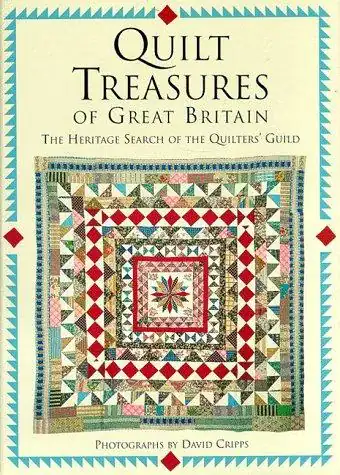
The Quilters Guild of the British Isles have a new publication, their first since Quilt Treasures in 1995. It is called ‘Contemporary Quilts, Heritage Inspiration’ (http://tinyurl.com/a23kb)
When I first heard about it I didn’t quite know what to make of the proposition. I’ve long looked for a publication about their heritage collection (over 300 items and counting) so while this was a welcome step I sighed when I heard it was to include new quilts, and possibly patterns. But I was told (authoritatively) that this was the only way to get the publishers interested.
In the end the author/editor Bridget Long was pretty wily <G>. She managed to get in a lot of information on and excellent photographs of items from the heritage collection, and text on the history of quilting in the UK. The new quilts pictured are not direct patterns, but modern (dare I say ‘art’) quilts by a variety of quilters who have drawn on the heritage quilts for inspiration. The creators do not give verbatim instructions, but describe how they worked up their ideas from the old quilts, mostly using modern techniques. Interspersed with the text on the new quilts are boxes of information in different quilting styles.
Of course I’d have liked a book that thick *just* on the heritage collection, but since a deal had to be struck I think they did pretty well.
NAYY (not even a guild member <G>)
Sally W
Date: Tue, 4 Oct 2005 07:24:58 -0500 | From: “Andi” <andi0613@>
Re: “I know that 5,000 copies is the break-even point for fiction in hardcover (it’s higher in paper)…is it really that high for non-fiction? I’m surprised, since most non-fiction doesn’t sell nearly as well as fiction.”
In his book, “Damn! Why Didn’t I Write That: How Ordinary People are Raking in $100,000 or More Writing Nonfiction Books & How You Can Too!,” Marc McCutcheon reports on Publisher’s Weekly figures about the differences between selling fiction and non-fiction. “Of the 50,000-plus books published every year, only about 3,500 are novels.” Then he says, “Because publishers spend over $30,000 to launch even a small book into print, they must be assured they can sell from 5,000 to 10,000 copies to recoup their investment and make a small profit. Most large publishers, in fact, won’t even touch a book unless they think they can sell at least 15,000 copies, preferably in the first year.” His focus is nonfiction and he consistently makes the point that publishers wouldn’t bother with 46,500 nonfiction titles a year vs. 3,500 fiction titles if there wasn’t profit in it for them. Fiction best sellers may get glamorous press, but non-fiction authors make the lion’s share of the money in the writing biz.
Everything Debby covered about finding writer’s guidelines and good writing resources I echo and teach my writing students. Be aware, however, that books about how to sell your writing, write a non-fiction proposal, etc. are in themselves huge profit-makers <g>.
Self- and web-publishing are no longer the venues only of those who couldn’t sell their proposals to the big boys. There are strong market indications that big publishers are happy to troll those waters and save themselves the trouble of initial marketing efforts (and wading through proposals). If they like the way a self- or web-published book is doing, they’re happy to make a purchase offer. Savvy writers may decide to take this route first to save lots of time waiting for agent, editor or publisher reactions to an idea and get on with the business of selling their work directly.
As for whether writing a book is a lot of work, of course it is, but for those of us who write for a living, well, plumbers think plumbing is work, too!
Andi in Keota, Iowa
Date: Tue, 4 Oct 2005 10:01:59 -0400 | From: “Beth Davis” <bethdan533@>
I have a couple comments regarding quilt books vs. historic books. When I was asked to write a catalog for the exhibit in the museum that I volunteer at, it was an awesome responsibility. I was given a very limited time frame (about 2 months). There was a very limited budget involved and so although I wrote over 100 pages, it was edited down to 20 pages (not including the pictures). I can say that I found the editing process slightly (!!) painful-but as long as I didn’t take it personal, it was interesting to see what the editor decided to keep and what she thought was pertinent to the target audience (museum goers, rather than quilters or quilt historians). The actual printing job was down by a local printing company-although the museum did check out the possibility of going with the ‘print on demand’ services available.
We did not include patterns with the book, but there was already a pattern available for purchase of the most unique quilt in the collection, the “logo quilt” as it was described. The curator asked me about a follow up of patterns for the other quilts, but as many are based on traditional patterns, I didn’t pursue it-although it might be done later. The question is asked though by people who come to the exhibit, check out the book, about why patterns aren’t included with some people turning down the purchase because there are no patterns. But I don’t know what the percentage is of this happening. Could also be that the person wouldn’t have bought the book anyway?
Because the book was funded by a grant-the money made on the book is profit to the museum, so there is no break-even point and so the pressure of meeting any minimum quantity is negated. Not to say that I haven’t felt pressure to do what I can to get the book recognized (thanks to such wonderful people as Lorie Stubbs and Kim Wulfert!!)
I can say that this has been a really exciting time and I am so honored to have been offered this opportunity, but as Charlotte mentions that authors that she knows says that it does affect the time you have for doing the thing that got most of us to this point-quilting! I have to agree with this. But that said-I wouldn’t traded this past year for anything! What a ride it has been!
Regards, Beth Davis
—
In order to self-publish, I think you have to know your market.
John Flynn publishes his own books. His John Flynn’s Step-by-Step Feathered Sun doesn’t at first seem like a history book. Then you find 5 pictures of painted buffalo robes and a nineteenth century Mennonite star quilt, 6 profiles of Native American quilters, information on the giveaway ceremony, a brief history of the Native American star quilt , and an essay on Native American quilting from an historical perspective by Roger Clawson. (And John’s books are spiral bound which I like.) Granted, this book is primarily a how-to book, chock-full of digrams, templates, students’ quilts and instructions. But the history is there also.
John teaches, and sells his book to his students, that’s his primary market. Apparently his approach works because he makes a good living at what he does.
So the combination of history and how-to can work.
Date: Tue, 04 Oct 2005 13:27:26 -0400 | From: Judy Knorr <jknorr@>
Cinda, If you don’t find someone with a car to get to the RMQM, you might want to check the bus schedules. I was at the museum this past July and met three women from PA who had taken a train cross country to Denver for their vacation. They heard about the museum and also QNM with their quilt gallery. They took a bus to Golden so they could visit both. We were on our way to Utah so had our car and I didn’t ask for details as to which bus or buses they took, but they seemed pleased with themselves that they got to see the quilts without much difficulty! Judy Knorr
Date: Tue, 04 Oct 2005 13:20:52 -0500 | From: Sheryl Till <sctill@>
I think it’s a trade-off these days. Consumer dollars are in high demand so publishers look for ways to make new books desirable. The fact that I can imitate in my own way some of the designs is an inspiration for me. Therefore, I consider the patterns to be a plus. If including patterns is what it takes to draw someone into learning more about quilt history, is that a bad trade-off?
My favorite quilts are from the 1930’s-1940’s which I realize are probably not considered to be of historical importance…but….I did buy a quilt from the 1800’s last year. I also find myself being drawn to civil war quilts so the circle of interest widens.
For many quilters, myself included, the love of quilt history didn’t begin without first learning how to quilt. I was not the least bit interested in history when I was a new quilter. The journey has been an evolution and I find myself becoming more and more interested in older quilts and their provenance. Quilt history books with patterns give me the best of both sides. I can learn “about” quilt history and at the same time learn “how” to make them.
I’d like to say thanks for all the knowledge freely given on this list. I don’t know enough about any of this to be of help but I do appreciate the opportunity to learn.
— Sheryl in south Louisiana where clean-up after the hurricanes continues. Love feedsacks? Join me at: http://groups.yahoo.com/group/Feedsack_Memories
From: Laura Fisher
When books on antique quilts include patterns for making your own, publishers do so to increase sales to two separate audiences–history buffs, and quilters. While quilt history people probably wouldn’t be in the market for books with patterns, quilt makers might buy history books that include patterns they can use or modify. That’s why I asked QHL people who might draft patterns for future books when we are ready for them; I’ve kept the names of those who replied, and will be in touch once we choose the examples. Nowadays, the market for quilt pattern books is muich larger than the market for quilt history books alone.
And,book buyers will get some historic information in the bargain, whether they want it or not!. Hate to make such a blanket statement but…….. when I set up a booth at some of those Great American Quilt Festival Shows in NYC and thousands of quiltmakers came through, it was surprising how few visitors had knowwledge of, or seemed interested in learning more about, what preceded their own efforts. Visitors were craftspeople or artisans or needleworkers only, interested in seeing a pattern usually to copy or modify, and few seemed to want to learn more about antique quilts. Sorry.
Laura
Date: Tue, 4 Oct 2005 12:18:48 -0700 | From: <chrisa@>
<<If including patterns is what it takes to draw someone into learning more about quilt history, is that a bad trade-off?>>
It seems most of the responses are agreeing with that, and I am no exception.
Perhaps what isn’t being said is that those who are mainly interested in quilt history do NOT want to trade off the number of pages devoted to quilt history, the number or quality of photos devoted to antique quilts, or the cost of the book, being higher if more time, effort and materials are needed to cover the patterns.
If all else were equal, then it really doesn’t matter much, but is it equal?
I have two walls of books shelves devoted to quilting. One wall is history and the other wall is patterns, and the other aspects of quiltmaking. So space is important to me and I would rather a history book skip the patterns if more books can fit on my history shelf wall. I forget about those that are slowly being pushed over to the other side of the room!
Kim Wulfert www.antiquequiltdating.com
From: Charles Woodford <haq@>
Hi Cinda and others,
I am planning to go early to the Quilt Museum on Friday morning. I am a vendor so need to get back by 1:00 and was wondering if I could pick up some passengers to join me in going to the Quilt Museum on Friday morning (not Thursday because I won’t be lurching in with my two humongous suitcases until Thursday afternoon).
Anyway, please contact me tomorrow, or at the seminar if interested.
Barbara Woodford
Date: Tue, 04 Oct 2005 00:34:04 -0500 | From: Gail Ingram <gingram@>
Reading responses to Alan’s and my very different queries regarding quilt history publications/publication prompts yet another question on my part: Has the study of quilt history reached the stage where an independent journal of serious scholarship is needed?
AQSG certainly addresses the need with “Uncoverings,” and publications in the older academic fields of cultural geography/material history/folklife often include studies that are relevant to quilt history.
But would another journal, one with high standards of scholarship, be desirable?
That question does not address the issue of practicability, of course, just desirability.
In Ecclesiastes Solomon said ‘of the making of many books, there is no end,’ and I know scholarly journals cannot do the work of booklength studies.
Yet, they can add considerably to the extant knowledge in a field. They can provide venues for more tentative or in-progress studies, which often generate productive discussions within the community of scholars, for instance. And it is no secret they provide the means and encouragement to those wishing to embark on the study of a large body of information, one piece at a time. And sometimes they afford a place where seemingly “small” discoveries may be presented, discoveries that might be precisely what another student has been seeking.
I know everybody is heading to Denver in the morning, but maybe someone will note on his or her calendar this subject and take it up next week.
Gail Ingram
From: Gail Ingram
Hate to make such a blanket statement but…….. when I > set up a booth at some of those Great American Quilt Festival Shows in NYC and > thousands of quiltmakers came through, it was surprising how few visitors had > knowwledge of, or seemed interested in learning more about, what preceded > their own efforts.
I’ve come to believe this is true, though I still find it difficult to imagine such folks.
Yet, isn’t this so very American now, this lack of interest in history–period? I’ve said it on this list many, many times: somebody somewhere needs to get irate about the failure of our school systems 1) to offer and to require enough history courses in high schools so that students will understand the context within which their lives occur and 2) to staff those courses with professional history teachers, not coaches who also pick up a class. Even the best students are ignorant of their national or civilization’s past.
In a classic essay, “Tradition and the Individual Talent,” T.S. Eliot suggests that all real creativity results when the individual experience cross-polinates with the communal experience. While Eliot focused on literature, his point is applicable to any art. The quilter or painter who does not know and understand the history of his or her art form courts faddism. Yes, one can paint portraits without a knowledge of anatomy and the great portraits of the past. But what depth do they have? What complexity? What universality and, yes, originality? It is no mystery why the Renaissance happened where it did: that is where old texts and arts and new men mingled for a moment in time that created an explosion called Western Civilization.
Is that what happened with the Quilt Revivals—women working with new colors and materials and steeped in old designs produced something genuinely new and original?
From Louisiana, where some creativity is badly needed, Gail
Date: Tue, 04 Oct 2005 16:19:03 -0600 | From: Xenia Cord <xenia@>
Gail said:
<Yet, isn’t this so very American now, this lack of interest in history–period?>
To which I can only give anecdotal evidence. At a recent quilt event a woman asked me the age of an antique quilt. “It’s from the Centennial,” I answered. “Oh!” she said, “…when was that?”
Xenia (also heading to Denver)
Date: Tue, 4 Oct 2005 18:23:26 -0400 | From: <suereich@>
It also saddens me, when I hear about the lack of history taught to our young people. Over these past three months, I have found the study of quilt history actually healing. About two years ago, I began to research WWII era quilts in a serious way. The WWII Memorial dedication, and the 60th Anniversary of the ending of the War peaked my curiosity about quilts made from 1941 to 1945. Over the past year, I have written and lectured about wives and mothers of WWII, and their wartime quiltmaking. I have been struck by the similarities and differences between WWII and our current War on Terror (of which I am tragically intimate.) Blue Star mothers, Silver Star Mothers and Gold Star Mothers are part of that lecture. Never did I believe that someday my fate was to be all three! It may sound strange, but, studying about the mothers of WWII gives me solace and comfort. The knowledge that women of another generation gave up their children for freedom and still prevailed, helps me to face each day. Yes, history is a powerful teacher. As quilt history researchers, we are helping to preserve a small part of the past. Carry on. sue reich
Date: Tue, 4 Oct 2005 20:02:19 -0400 | From: “Lucinda Cawley” <lrcawley@>
Thanks Barbara, but I have to go on Thursday because I’m on the downtown Denver tour Friday. Cinda
Date: Tue, 04 Oct 2005 17:31:56 -0800 | From: Gloria hanrahan <gloria@>
I can’t see that the history curriculum offered is lacking. What I know from my own personal experience is that I think you need some age before you can appreciate a historical perspective. This isn’t just my opinion, but that also of my cousin (who has a Ph.D. in US History.)
We have an Alaskan Native history curriculum here which starts in third grade and continues through high school. The history of the First Nations peoples have long been ignored, so the perspective of history being better taught to previous generations is flawed if you are among the ignored groups of people. Let’s remember that everyone doesn’t come from the same place, from a historical standpoint.
At ages 14-18, I just could not get a grasp of time. I was well into my 20’s before I could begin to put the pieces together. I know as a parent and teacher, I am satisfied with the curriculum in the classes offered to my kids. I don’t really expect them to have much understanding until they are older and have more life experiences.
While quilt history is certainly of interest to me, my mom and grandmothers were quilters and had no interest in the subject. I really don’t see this as a character defect.
Gloria
Date: Tue, 4 Oct 2005 22:38:43 -0600 | From: “JESSICA VAUGHN” <vaughn8047@>
For those of you heading to Denver, safe travel and look forward to meeting some of you at seminar. I will be assisting manning the book sales room. Please stop by and introduce yourselves……..
Jessica M. Vaughn Rocky Mtn Quilt Museum Golden, CO vaughn8047@
Make yourself familiar with the angels, and behold them frequently in spirit; for without being seen, they are present with you. – St Francis de Sales – ——_NextPart_001_0AB3_01C5C934.600F3960–
Date: Wed, 05 Oct 2005 00:05:50 -0500 | From: Gail Ingram <gingram@>
Gloria wrote
> While quilt history is certainly of interest to me, my mom and grandmothers > were quilters and had no interest in the subject. I really don’t see this > as a character defect.
Not knowing history is not a character defect. It is, however, a decided disadvantage in a republic, where a knowledge of history protects one and enables her to make more fully informed decisions. Back to Lord Acton: he who forgets the past is doomed to repeat the past.
Numerous professional surveys have shown a steady and generally alarming decline in the knowledge of history on the part of American high school and college students. Any review of the professional literature will turn these up. Moreover, many popular studies (not to mention the activities of Jay Leno and David Letterman) support these.
Having been married to a history professor for forty years, I saw for myself how drastic that decline was. It is not at all uncommon today for a college sophomore to believe that Shakespeare and Abraham Lincoln were contemporaries.
There are no grounds of which I am aware in developmental psychology or cognitive studies to suggest average students at or above the fourth-grade level lack the capacity for understanding time relationships. In fact, it is at that time precisely that they begin to grow most curious about the world beyond them, both in terms of space and time.
A review of national curricula, which are based in a knowledge of cognitive development, will show this is the grade level at which historical understanding is assumed to be available to average students.
As with many areas of learning (e.g., music, language), I suspect there is a critical window of opportunity for activating this ability. If students are not introduced to historical thinking and a basic sense of historical chronology at that time, they will never be as able to master the discipline as they would, had that window of opportunity been used. This is not a matter of anecdote or speculation, but a matter that has been carefully explored and the results published even in such popular magazines as TIME and NEWSWEEK.
Nor is it merely rote learning of which I speak. It is understanding that must be initiated at that time.
In most American public school systems and, I would bet, most private school systems, only one history course is required in high school. The ‘social sciences,’ a beloved misnomer in America may supply the other social studies requirements. That includes psychology, economics, and a variety of other non-historical or governmental studies.
Thus, most American students graduate from high school so woefully unprepared with facts and historical thinking skills that the university basic history courses have become thoroughly diluted and grade inflation routine.
I do not deny pockets of enlightment exist. I only say they are pockets and that the national ignorance of history is a matter of repeated record.
Not to have a shared knowledge and understanding of our national past is particularly dangerous in a nation of immigrants. I find it no accident that the current ugly contentiousness in the civic and political bodies coincides with the rage for diversity alone, not e pluribus unum—the unity that joins the diverse, the common denominator–but only ‘pluribus,’ our differences.
As a Southerner, I know what it means to be left out of written history studied in school. The legitimacy of studying the past of my own region was not something I encountered until graduate school, and the discovery literally changed my life and vision. Yet, how could I have really understood regional politics and culture outside the context of national and international politics and culture. To focus only on our local histories makes us provincial and less able to function productively outside the range of our localities.
What if John Adams, one of our nation’s most devoted and informed historians, had studied only the history of New England and, perchance, England? Or Thomas Jefferson, only the history of Virginia and England or France? Those men’s assimiliation of the history of Greece and Rome and Europe provided them materials for crafting a system of government suited to a new nation that declared itself united. It permitted creativity.
So far as quilt history goes–and I believe it is a legitimate academic discipline, allied both with the study of political and cultural history—I did not suggest the quilter who was uninformed about it and uninterested in it was either unusual or lacking in virtue. Yet,for many of our foremothers, quilts were a means of recording history and establishing a family’s identity. They were also living history books. Earlier generations of quilters might not have been academicians, but many were historians.
Long way of saying, I’ll stand by my concern for the general lack of historical knowledge in America today.
Gail Ingram
From: “Newbie Richardson”
Good evening all, I had the pleasure of evaluating a previously unknown BAQ (dated 1847) this afternoon. I went with Alden O’Brien and Virginia Vis of the DAR Museum to catalogue the names and where the design elements fit in the known groupings of BAQ. It will go up for sale at Weschlers Auction House, here in DC, on October 22. It is on their website – though I have not pulled up the pix. It was being used as a moving pad when Gentleman A was helping Gentleman B clear out a house. Gentleman A noticed it and was told by Gentleman B to take it if he wanted. So he did – not having a clue either! So then Gent A consigned a bunch of things ( I think he may be something of a picker) including the quilt. The auction house took a quick peek, saw a nice album style quilt but had to get the catalogue out to the printer so did not really LOOK at it. Consequently it has an estimate of $6 -$8,000. When the auction house really looked at it, bells and whistles went off – as they should have! It is in excellent condition – not dirty or stained. It has many blocks that look like both Designer 3 and Designer 4 – but no “Mary Simon” blocks. It could surely keep my feet warm at night! This is the third ” unknown” BAQ that I have come in contact with in the last 4 months…..”Textiles: The Last Frontier”! The auction will be live on Ebay and the quilt is scheduled to go up around 5:30 pm E.D.T. on the 22nd. Sorry, I don’t have the web site – but if you Google Weschlers it should pop up. They have been in business since 1880 – and are a very reputable firm. I know the owners well. Have fun all of you going to AQSG – I blew my wad in France! Best Newbie Richardson in dusty, dry Northern Virginia.