April 27 – 30, 2004
These restored messages come from the Quilt History List, an online forum where quilt historians, collectors, researchers, appraisers, and enthusiasts discussed antique quilts and related textiles. The archive dates from 1996 through approximately 2016 and is being restored gradually. Sign up in the form at the bottom of the page if you want to know when a new page is added. Original spelling, opinions, formatting, and inactive links may remain unchanged.
Primary topics of this QHL Digest:
- “Rare Black Figurative Baby Quilt” Debate Continues — Members continue weighing fabric era, dye types, and construction evidence on the disputed eBay quilt.
- New Book on Quiltmakers, 1970-2000 — Members discuss an upcoming book covering the recent history of American quiltmaking and quiltmakers.
- Signature and Fundraising Log Cabin Quilts — A thread on embroidered-signature Log Cabin quilts made for fundraising purposes.
Date: Tue, 27 Apr 2004 18:03:07 -0500 | From: “Jocelyn Martin” <jocelynm@>
>>>specifically, the quilt was made. She replied that with doubts as serious as mine, she would be happy if I passed on bidding on the auction. Since the auction had already ended, I found this remark to be a little bit odd.
Which brings up another point: feedback is only so good. Remember, a seller can get their feedback by BUYING things from other sellers, as well as from satisfactory sales. And they could have sold a bunch of things other than quilts. Having promptly paid for the things they bought, and having sold 2000 Pez dispensers, are not useful feedback about whether this person knows quilts. 🙂
The above comment matches with my experience- many sellers just don’t care if they’re misrepresenting merchandise, so long as the buyer is happy. That’s why it’s important to keep a list of sellers who’ve made questionable sales, and avoid them in our own bidding.
Date: Tue, 27 Apr 2004 18:12:57 -0500 | From: “Jocelyn Martin” <jocelynm@>
>>My question is why is it near impossible to get out of a new quilt what went into it? Why is the value of the whole not worth the sumof it’s parts?
I think the answer is that so few people truly want a work of art; they’re wanting a bedspread. So of course they are not willing to pay for the costs of materials and $10+ per hour for labor.
If all you want is a bedcovering, and you can get one for $40 or less, then paying $500 or more doesn’t make sense. The market for quilts- collectors who appreciate the work that went into them- is quite small compared to the market for bedspreads.
OTOH, I don’t want to pay haute coiture prices for my everyday clothes, nor do I want to wear haute coiture for everyday! I don’t want to use linen tablecloths and napkins for everyday. I’m sure the people who make these things lament that they can’t get the costs of materials and labor out of them, too. And think about all the amateur painters who can’t sell their paintings for anything close to the materials and labor. Or the street musicians, who get a few bucks tossed into their instrument cases for hours of practice and performance.
It’s just a fact of life: the vast majority of people in any creative field aren’t going to be able to sell their work for what they value it.
Date: Tue, 27 Apr 2004 21:29:15 -0400 | From: “Patchwork Secrets” <patchworksecrets2@>
I have 5 of the fabrics used in that quilt still in my stash all from 1980’s-1990’s. I have my doubts about it’s authenticity. All were very popular prints with crafters and were all produced around the same time. I believe they are Marcus brothers but I will pull some of it tomorrow and see what the selvedges say. I purchased it by the bolt so still have plenty. I think I even have the block in a pattern book somewhere if I can find time to hunt this week. Too bad we can’t examine the batting that would probably tell the true story.
I have purchased several vintage quilt tops, blocks and even a couple of finished vintage quilts off of ebay and been extremely happy. Especially with a jewel made of dyed tobacco pouches..lol.. But it takes investigation and a seller willing to go the extra mile with pictures and detailed info.
Sharon in NC Final Sue in Kitty Hawk blocks now available http://home.@/~patchworksecrets/patchworksecretsquiltpatterns/index.html
Date: Tue, 27 Apr 2004 22:49:06 -0400 | From: “Pam Weeks Worthen” <pamworthen@>
In reference to the debate concerning the small quilt that recently sold on eBay–
I have to chime in on the side of the “I don’t think it’s that old” crowd. While visiting Barb Wright in Sturbridge about 4 years ago on an antique quilt quest, we were shown a small quilt with black-faced figures in dresses and aprons, as described by another list member. We studied it carefully, and were shown a photo from a book (I think it was Bishop, and will run upstairs to look in a minute) of the same pattern, c. 1930.
BUT, on close examination, we could tell that the “aged” fabrics on the top surface of the quilt were not tea-dyed, but rubbed with a waxy/oily substance to make them darker. If you look carefully at the photos in this listing, it appears that the same process was used. I have purchased and made one of Gail Wilson’s doll kits, and she provides paint and wax for “aging” the fabrics and carefully describes the process in her amazing directions.
I also have the navy “star and cresent” print in my c. 1980’s stash, as well as the navy print with the little pear shaped ditties.
For what my two cents are worth tonight, having just returned from a deliberate, wandering, 3 day drive from Paducah, where I was delighted to meet and see so many of you from this list!
Pam Weeks Worthen
FREE pop-up blocking with the new MSN Toolbar – get it now! http://toolbar.@/go/onm00200415ave/direct/01/
Date: Tue, 27 Apr 2004 22:27:30 -0400 | From: “J. G. Row” <JudyGrow@>
This was on a web site which I have saved to my favorites but is unavailable now. I just tried to get there so I could copy the URL for y’all. It was copyrighted to 2 S.A Broads in 1998. Luckily I had copied it to Word Perfect.
Remember that the following cost estimates are 6 years old. There are only a few quilters in this country who can ask and get in 5 figures for their quilts, but that is what a well made American quilt could cost if priced as skilled labor.
What it Costs to Make a Quilt
QUEEN-SIZED, PIECED & HAND QUILTED Material
Fabric $170 to $200
Batting $25 to $40
Thread, etc. $10 to $20
…Total $ Invested $205 to $260
Hours
Piecing 10 to 40
“Setting” 2 to 10
Quilting 500 to 950
…Total Hours Invested 512 to 950
TOTAL COST Paying $1.00/hour (Would you do this type of work for $1.00/hour?)
Materials: $205 to $260 Labor: $512 to $950 $717 to $1,210
Paying minimum wage ($5.15/hour)
Materials: $205 to $260 Labor: $3692 to $4892
$3897 to $5152
Paying $20/hour (skilled labor)
Materials: $205 to $260 Labor: $10,340 to $19,000
$10,545 to $19,260
© 2 S.A. Broads
Date: Tue, 27 Apr 2004 22:11:01 -0500 | From: “Karen Erlandson”
Previously, we’ve had discussions about Egyptian panels here – but, I can’t find any of the posts – can someone refresh my memory about these – the one I am looking at is about 36 inches wide and 66 inches long – appliquéd Egyptian figures on it – could be from pre-1900. Thanks for any help! Karen
Date: Wed, 28 Apr 2004 00:18:34 -0400 | From: “Pam Weeks Worthen” <pamworthen@>
Just checked, and the quilt I saw a few years ago was similar to the quilt on page 55 of Robert Bishop’s “new Discoveries in American Quilts”. I was remembering aprons, and the bodies of the figures are apron shaped.
Pam Weeks Worthen
“The trouble with the world is that the stupid are cocksure and the intelligent are full of doubt.” Bertrand Russell
MSN Toolbar provides one-click access to Hotmail from any Web page – FREE download! http://toolbar.@/go/onm00200413ave/direct/01/
Date: Wed, 28 Apr 2004 06:38:49 -0400 | From: Debby Kratovil <kratovil@>
coming out of lurkdom … launched my own business recently and left my other job with a [very small] salary – not the one at the magazine. It’s all about quilting. Uninformed people ask if I’ll be selling my quilts now. I tell them “no.” It’s not worth it. If I sell a quilt, it’s gone. (And I’ve sold several quilts at one time or another). What I do is write about them, design them, pattern them, teach others how to make them. If I sell a quilt after I make it, then I lose an opportunity to use it as a class sample. If I make a quilt and get it into a magazine, it pays. Then I own the rights and I can pattern it in a pack – it pays. I can archive it on a CD, it pays. I can use it as a class sample or part of a trunk show, it pays. Then when it has served its purpose over and over again, then I can sell it or give it away. So, even my husband understands! It’s in education and marketing, etc that brings value to my quilts. So I work smarter now and I can multiply what that quilt can bring. It has changed my whole outlook, because I say “no” to making any quilt for anyone (graduation, wedding, etc) unless I see it as a way to also publish, show, teach from it first. And yes, I do make quilts for people and GIVE them away (baby quilts, weddings, etc). I just figured out a way to get back what I put into them in another way. And I think clever women through the years have figured out their own ways to do this very thing with whatever their handwork produces. Just my 2 cents – back to lurkdom … — Debby (with a “y” and not “ie”) Kratovil http://www.quilterbydesign.com Visit my workshops page for guild programs!
Date: Wed, 28 Apr 2004 06:56:20 EDT | From: JBQUILTOK@
Old enough to have fabric from the ’80s???
That was 20 years ago & it should be considered collectable by now, if not vintage! (I have some fabrics from my early quilting years that I almost morn when I use the last scrap.)
Along those same lines, a quilt made in the late 20th century quilting revival should be recognized as a valuable part of quilt history in its own right – as much as a 1930’s. Those were the years when there were far fewer ‘expert’ teachers and the ‘quilt police’ were out in full force dictating what was & wasn’t the ‘right’ way to make quilts. Turning a quilt instead of binding it was revolutionary at a time when new quilters were trying to decipher directions for making the required bias binding.
Janet Bronston
Date: Wed, 28 Apr 2004 12:12:28 +0100 | From: “Sally Ward” <sallytatters@>
Does anyone have experience of/comments about the Grace EZ3 (folding) quilting frame? Comments off-list, please.
Sally W Sallytatters@
Date: Wed, 28 Apr 2004 06:31:08 -0600 | From: Xenia Cord <xenia@>
Blaire O’Gagnon wrote an article in Uncoverings 2003, Volume 24 of the Research Papers of the American Quilt Study Group, on Egyptian Appliqués (131-162). The article covers the history of the textiles from the Pharaonic period to the present (briefly), and also provides a textile analysis and a number of images.
Xenia
Date: Wed, 28 Apr 2004 07:44:28 -0400 | From: Patricia L Cummings <quiltersmuse@>
Many of you have said that you have repro fabrics in the same design patterns as are in the little quilt in question. It seems like a gigantic leap to go from that statement to the conclusion that the little quilt is not of the time period the seller says it is. “Repro” means a reproduction, i.e. fabrics that were reproduced based on other fabrics from an earlier time. Isn’t it logical to assume that the fabrics are original, until proven to be otherwise? Having similar ones in your stash means that you liked these repros so much, you bought them, too.
I’ll state again that I don’t know how anyone can come to sweeping conclusions about the muslin. Low resolution jpegs distort color. This whole situation reminds me of a time that someone asked me to appraise a crazy quilt from an internet picture. Number one, I am not an appraiser and have no interest in becoming one. Number two, the person in question then told me that she had paid someone else to appraise her quilt and she just wanted to see if I was in agreement. This is a bogus practice (making determinations from a digital image). One should really see the item, up close and personal, and in ways that can’t be done via an internet photo.
I don’t know if the little quilt is authentic or not (to the 1920s) and at this point, I don’t really care. It will be fun to go through all of my quilt history books, looking for other examples. Now that someone mentioned it, seems that I did see a quilt of this type in one of the calendars. More recently, the design was recreated by Lucy Fazeley and was published in The Quilter magazine. 🙂
Thanks again to Judy K. for bringing this topic to our attention. It has made for a lively discussion.
Hoping that you all have a good day. 🙂
Patricia Cummings
Date: Wed, 28 Apr 2004 05:36:42 -0700 (PDT) | From: Ark Quilts <quiltarkmv@>
Hello everyone on this frosty morning in NW Ohio. It snowed yesterday and was 31 degrees this am….Mother Nature has forgotten it is supposed to warm up as spring progresses…..
I keep going back to the Little Quilt on Ebay that has been discussed on the list this week. I went back & looked at the photos and each time I get stuck on the way the edges were finished. If you look at the imported quilts, that “envelope ” style of finishing the egde of a quilt is the most frequently used technique on the imported quilts. I have been collecting ads for the imports for years and probably have 1,000+ ads. Separate binding is rare for imports. Just like I think it is rare for antique quilts to be finished in the “envelope” style.
It seems to me that somewhere in my collection of clippings (some of which many kind members on this list sent to me-thanks), there was a catalog from a mail order company that advertised “Americana” quilts that were imports. I will try to find the listing sometime in the next week if possible & maybe I can get a photo of it posted for all to see.
The other detail which sticks in my mind about this Little Quilt on Ebay is the frayed seam in one of the photos. That is the most common complaint that I have heard from people who wash the imports, that the seam allowances are not consistent & fray when they are washed.
This is just my opinion and I guess this item’s authenticity remains “questionable” in my mind until some concrete evidence pops up. And, always, with any purchase….buyer beware…on Ebay, the flea market, or your favorite department store! I still think that ALL imported quilts (and other reproduction items of antiques) need to have a permanent label identifying them as imports. I think the confusion is only about to begin over the authenticity of quilts & imports….that’s why I am compelled to collect ads on imported quilts.
Connie Ark
Date: Wed, 28 Apr 2004 10:11:18 -0400 | From: The Lesters
As an “old timer” I vote that it’s a newer quilt. I still have some of the prints used and they were from the early 80″s. It was made later than that because of the reproductions, though. They never said in the description that it was old–only that it was from their collection and sewn with treadle machine. A “little” evasive?? As a machine collector, the needle and bobbin never knew whether it was run by foot or motor, the mechanism was the same.
Jean
Date: Wed, 28 Apr 2004 10:53:15 -0400 | From: “mgmooney” <mgmooney@>
Throwing in my two cents here: what caught me attention right away was the statement about aniline dyes. I don’t think so! As you all know, just because aniline dyes may (or more likely NOT) be present, doesn’t make it old necessarily. hmmm… think they did dye analysis?! Seems to be another “if it’s sewn with a treadle machine” and/or “if it’s dyed with aniline dyes” “it must be old” Use those buzz words in your product description! 🙂 Regards, Margaret (Meg) Geiss-Mooney Textile/Costume Conservator Professional Associate, AIC mgmooney@
Date: Wed, 28 Apr 2004 08:07:29 -0700 | From: Anne Copeland <anneappraiser1@>
I had never seen that information, Judy, but I wrote an article on the subject that was published in the SAQA newsletter a year or so ago. I made a table of what you are earning based on number of hours you spent on the quilt. However, I also noted that design time, picking out fabric, cost of classes and books to give you enough experience to do what you do, cost of tools and electricity (and any other utilities that may be required) all need to be taken into account if you want to get more than McDonald’s wages for your work.
When I started appraising quilts in the 80s (I was formally certified in 1993), women who made them were very modest about the value of their work. In fact, many of them were even shocked to realize they had monetary value. They had been totally content to just show them in various quilt shows and receive ribbons for them, and an occasional prize of money. Thank heavens that has all changed, but even today, when I talk at guilds and I suggest that women put their own photos on the back of their quilts with a short bio, hardly anyone “gets” that it is not egotistical to do this–it is simply helping quilt historians and students to be able to know something about the quiltmaker. So we have come a long way technically and knowledge-wise for our quilt work, but we still have a long way to go in learning to value and document our own work. I fear that much of the wonderful work being done today will not be adequately documented because there are many quiltmakers out there who exhibit only in small, local shows even though their work is exceptional, and those kinds of shows are rarely documented in any way at all. It is too bad, because there is so much good information that could be gleaned from the present history. Only the major quilters are fairly well documented, but even then, there is often no chronological development documented in a single piece of work.
Thank you for bringing this up, Judy. It is an important subject that needs more constant attention and action. Peace and blessings, Annie
Date: Wed, 28 Apr 2004 11:13:09 -0700 (PDT) | From: Kris Driessen <krisdriessen@>
I’m on the road again, but I wanted to throw my two cents in. Years ago (98? 99?) I saw that identical quilt in a booth at a quilt show in Liverpool NY. I dithered over buying it because it looked fake to me. Fabric I didn’t recognize, big stitches, knife edge finish – I didn’t want to gamble the $50 cost. Glad I didn’t now. The fact there is another one out there virtually identical tells me this is a foreign quilt.
I wish we could warn the buyer – the seller obviously doesn’t want to hear it. He just made a $550 profit!
Kris
— mgmooney <mgmooney@> wrote: > Throwing in my two cents here: what caught me attention right away > was the statement about aniline dyes. I don’t think so! As you all > know, just because aniline dyes may (or more likely NOT) be > present, doesn’t make it old necessarily. hmmm… think they did > dye analysis?! Seems to be another “if it’s sewn with a treadle > machine” and/or “if it’s dyed with aniline dyes” “it must be old” > Use those buzz words in your product description! 🙂 > Regards, > Margaret (Meg) Geiss-Mooney > Textile/Costume Conservator > Professional Associate, AIC > mgmooney@ > > > — >
Date: Wed, 28 Apr 2004 17:55:17 -0400 | From: “Karen”
That’s a silly statement anyway, since aniline dyes (or something similar) are still being used today. I’d be more impressed if the quilt was allegedly made from indigo dyed cottons (which it probably isn’t)…..
Karen Evans
—– Original Message —– From: “mgmooney” <mgmooney@> To: “Quilt History List” <qhl@> Sent: Wednesday, April 28, 2004 10:53 AM Subject: [qhl] Re: Crib quilt on eBay
> Throwing in my two cents here: what caught me attention right away was the statement about aniline dyes. I don’t think so! As you all know, just because aniline dyes may (or more likely NOT) be present, doesn’t make it old necessarily. hmmm… think they did dye analysis?! Seems to be another “if it’s sewn with a treadle machine” and/or “if it’s dyed with aniline dyes” “it must be old” Use those buzz words in your product description! 🙂 > Regards, > Margaret (Meg) Geiss-Mooney > Textile/Costume Conservator > Professional Associate, AIC > mgmooney@ > > > — >
Date: Wed, 28 Apr 2004 18:00:21 -0400 | From: Barb Garrett <bgarrett421@>
While I don’t want to needlessly continue a discussion, I do need to respond to Pat’s email of this morning. She wrote —
>Many of you have said that you have repro fabrics in the same design patterns…
I at no time said that I had repro fabrics like the ones in the quilt. I never used the word repro fabrics, nor do I remember anyone else using that phrase. We were not saying we had repros of fabric — we were saying we had those fabrics, and they were printed in the 1980s. I do not believe they are repros — but new printed designs circa 1980s. The phrase/concept of repro fabrics didn’t exist in the 1980s — it’s a 1990s marketing invention. I remember looking for 1890s style fabrics during that time — they were few and far between — and very hard to find. I would be very excited when I found a piece that “read” the way I wanted it to — and you found pieces “one at a time” — not entire repro lines.
Pat said — Isn’t it logical to assume that the fabrics are original….
Yes, I do believe the fabrics are original — to the 1980s — so I decided to do some “go to the source” research today. Judie Rothermel is the designer of “historic style fabrics” for Marcus Brothers, the printers of the crescent and stars fabric, so I wrote to her. She said she has been designing for Marcus since 1987, so I sent her the following emails — describing my quest, and she very graciously responded. I am cut and pasting them at the end of this note.
Barb in southeastern PA
My 1st note to her – I’ve been using Marcus fabrics for “years” and have a question about a print from the 80s. If you were designing for them then, I’d appreciate discussing the fabric with you. Thanks, Barb Garrett
Her response – barbara, I started designing for marcus in 1987 and my firsyt collection was centennial prints in brown, blue, navy, green, red. their were 62 pieces in the line. the fabrics I did this past year called bread and butter were of the same era and color. thank you and keep using my fabrics and I will keep designing, judie
So I wrote a more detailed note – Hi Judie –
Thank you for writing back so quickly. The fabric I’m hoping to get information about is a Marcus fabric — selvage says so — and contains moon crescents done in dots and stars. It came in several colors — soldier blue, navy, rust — the country colors of that time period. I can scan a picture of it if you think you can help me. What I’m curious about is whether it is your original design — assuming you are the designer — or if you adapted the design from an earlier design as is being done with many repros today. It sounds like it could be from your first line — the timing seems right and Centennial line sounds like the right name. I’m in a discussion with some people about the invention of “repro fabrics”, and I think your early line predates the repro craze, and wasn’t repro but rather your design “in the style” of the circa 1890s fabrics. That’s why I loved it so much and bought bunches. Thanks for your help, Barb Garrett
Her response – Barb, you are correct it was from my first line. it was my oiginal design and again you are right about the repros. I actually did the first and now others are doing the same. I have always loved the fabrics forn the late 1800s. 1840 to 1890s. my first aunt grace line was a thank you to my great aunt grace who tought me to quilt. all my lines are retros. thank you for your intrest judie
Date: Wed, 28 Apr 2004 19:15:25 -0400 | From: Patricia L Cummings <quiltersmuse@>
In the discussion about the “Rare Black Figurative Baby Quilt, circa 1920”, ebay auction 3717682142, which closed at $676.66, it has been said:
1) the geometry is not right for it to be an exact match to the Oklahomer Boomer pattern, found in the Encyclopedia of Pieced Patterns by Brackman. Not only is the hat a different shape, but the configuration is substantially different.
2) the background fabric appears to have been falsely aged, either through tea-dyeing or by having had a substance rubbed onto its surface
3) the one ragged edge may be present because of faulty construction and this may be a clue to its having been a foreign import
4) the envelope method of finishing may indicate a later date, or an imported quilt, as it is a simpler means of construction.
5) the crescent and stars fabric is an original design by Judy Rothermel and dates from the 1970s (?)
6) the seller’s claims to the quilt’s fabric having been made by aniline dyes is not proveable without a chemical dye analysis, and also inconsequential, even it were true, as aniline dyes continue to be used today.
7) upon being contacted, the seller did not offer any additional information to support any of her claims
8) the auction was kept private, perhaps because she was misrepresenting something??
9) Kris saw a similar one for sale that was an import and priced at only $50.00.
10) the seller claims that the quilt was made on a treadle sewing machine. However, experts on this list who own and collect treadle machines, say that it is now possible to tell the difference by just looking at something sewn.
That just about summarizes this discussion and I think that you have all made a very strong case for this auction not living up to its title, whether intentionally misrepresented to the public, or not.
Pat in NH who is having a grand day, having had a mama bear and two newly born cubs walk right in front of the car on a back road. Love those backroads. 🙂 Unfortunately, the camera sat at home.
Date: Wed, 28 Apr 2004 19:59:45 -0700 (PDT) | From: Donald Beld <donbeld@>
Hi everyone, I am back from my sojourn in the UK. Didn’t find any old quilts, but, of course, enjoyed my visit.
Sorry, I went through my e-mails quickly and didn’t save the info on where to send info on Log Cabin dated quilts.–In our show May 8, we will have a signed and dated 1868 Courthouse Steps and my great-great grandmothers Garfield’s Monument is signed and dated 1891. I know that isn’t the same as signed and date Log Cabins.
The American Museum of Folk Art in NYC have a Barn Raising Log Cabin by a mother/daughter team that was started in (I think–1861 and finished in 1865–and both the mother and daughter died almost immediately afterwards. However, I think they called it Barn Raising and not Log Cabin–the Musuem refers to it as Log Cabin.
Finally–I looked at the Spider Web, Log Cabin quilt on the auction? antique store? site and sure enough–hexagon Log Cabin–so more speculation–and yes it was me that speculated on Hexagon evolving into Log Cabin. Our British chat line folks NEED to do some research in this area–a fascinating subject for a dissertation perhaps? Don Beld
Date: Wed, 28 Apr 2004 22:20:33 -0700 | From: “Judy Anne” <anne_j@>
>>Along those same lines, a quilt made in the late 20th century quilting revival should be recognized as a valuable part of quilt history in its own right – as much as a 1930’s. <<
I’ve been thinking about this too. Has there been a book out yet on this period? I haven’t seen one. What about all those quilts made for centennial celebrations?
While I’ve always considered the quilts my grandmother and great grandmother made as something really special it’s dawning on me that those doubleknit quilts my mother in law made with her church group are a part of history as well. I have a quilt that was made for her by her church group when she had a stroke that was simple squares and tied. Nothing fancy but a part of history none the less. My kids each have a pillow she made for them that is a doubleknit crazy quilt with fancy stitches done in yarn.
I am beginning to rethink those lowly doubleknits.
Judy Anne
Date: Thu, 29 Apr 2004 02:21:03 -0400 | From: “J. G. Row” <JudyGrow@>
The block directly above the central initialed and dated block in a redwork quilt I own is a redwork portrait of a woman in profile about 8 inches square.
Is the redwork block a portrait of Caroline Lavinia Scott Harrison?
I found a photo of Mrs. Harrison on-line and it sure looks to me as though the quilter copied the pose, the hairdo, and even the ruffled high neckline from this photo. The quilt is dated big as life in the block below this portrait “1891” and Harrison was president then.
Caroline died in 1892, so it makes sense that she might have been memorialized in a quilt block. My thought is that the maker probably made the date block before Mrs. Harrison died, and then did the portrait as a memorial after she died.
I’d like to know if this was a published design or if my maker did the drawing herself. Have any of you also seen a profile redwork portrait of a woman with bags under her eyes, frizzy bangs and a chignon, little earrings, and a high ruffled neckline? She is facing to the right.
thanks.
Judy ” Ringo” in Ringoes, NJ judygrow@
Date: Thu, 29 Apr 2004 10:01:53 +0100 | From: “Sally Ward” <sallytatters@>
< Our British chat line folks NEED to do some research in this area–a fascinating subject for a dissertation perhaps? Don Beld
I didn’t really understand what you were getting at with this ‘hexagons into log cabins’ idea. Could you explain it again? What time period are you considering, what fabrics, and what type of construction? The first stumbling block to me is that our hexagons were pieced over papers, our log cabins on fabric foundation, and I don’t quite see how the one might have crossed over into the other. I don’t recall seeing anything like log cabin incorporated in early hexagon quilts, or frame quilts. We don’t have any very early log cabins that I have been able to track down (people have asked before), and the vast majority of those we do have from the turn of the century seem to be heavy fabrics – wools, velvets etc – whose use was made possible by the foundation piecing method, whereas hexagons over papers require a lightweight fabric (unless you are working with huge hexagons as people did in the ‘funky’ 60s <G>).
Was it something you saw in a quilt that gave you this idea?
Sally W
Date: Thu, 29 Apr 2004 05:00:32 -0500 | From: “Marcia Kaylakie” <marciark@>
Yes, there is a book coming out about quilting and quiltmakers from 1970-2000 (dates may be slightly off). the woman was on faculty with me at AQS this year. Marcia —– Original Message —– From: “Judy Anne” <anne_j@> To: “Quilt History List” <qhl@> Sent: Thursday, April 29, 2004 12:20 AM Subject: [qhl] late 20th century quilting & double knits
> >>Along those same lines, a quilt made in the late 20th century quilting > revival should be recognized as a valuable part of quilt history in its own > right – > as much as a 1930’s. << > > I’ve been thinking about this too. Has there been a book out yet on this > period? I haven’t seen one. What about all those quilts made for > centennial celebrations? > > While I’ve always considered the quilts my grandmother and great grandmother > made as something really special it’s dawning on me that those doubleknit > quilts my mother in law made with her church group are a part of history as > well. I have a quilt that was made for her by her church group when she had > a stroke that was simple squares and tied. Nothing fancy but a part of > history none the less. My kids each have a pillow she made for them that is > a doubleknit crazy quilt with fancy stitches done in yarn. > > I am beginning to rethink those lowly doubleknits. > > Judy Anne > > > — >
Date: Thu, 29 Apr 2004 08:05:46 -0500 | From: “Wanda” <fattyoldkid@>
I have to comment…I HAVE LEARNED SO MUCH from this conversation on this little quilt! PLEASE keep us learning. Thanks to all who had some information on it….I hope someone sends this email to the seller….It’s a shame that she (the seller) is going to make quilters look bad by her misrep (if that is the case)…Or maybe someone should just contact ebay…I know they would like to hear all this. Wanda in Sunny warm Texas
Date: Thu, 29 Apr 2004 08:19:14 -0500 | From: “Barbara Vlack” <cptvdeo@>
I recently viewed an eBay site where the seller was selling pirated software. I know the high bidder was warned by another source that this software he/she was about to win was illegally copied software. Suddenly the auctions by the seller (he was running several with the same item) had the statement for the high bidder: “User ID kept private.”
I strongly suspect this is not for privacy reasons to protect the bidder but rather to protect the scam of the seller so the bidder does not get alerted by outside sources.
It may sound good “on paper” but the reality is not altruism toward the bidder.
Quite a coincidence how this “User ID kept private” showed up for this crib quilt auction.
I don’t know if alerting eBay about misinformation will bring forth any effort to protect the bidders. I would hope so, since I also hope that eBay would want to protect a reputation. They can’t possibly police all the sellers, but if there is an alert about one, would they take some action????
For this crib quilt in question, I, too, recognize some of the 80s vintage fabrics and have some (or I did). I also know about the knife edge finish for an imported quilt that quickly distinguishes it from a traditional American quilt, even if it is supposed to look like an Afro-American quilt. The seller puts himself into great question with a few statements, such as dating the quilt to be c 1920s; declaring aniline dyes were used (a cute phrase that tends to lend some authority, albeit questionable) and that it was made with a treadle machine (how does he know that, too?).
The next thing is, buyer beware. Any authoritative collector of this type of quilt would know that it’s a fake. I’m sorry that anyone else who thought this was a “rare find” (another seller statement), was taken.
Barb Vlack cptvdeo@
Date: Thu, 29 Apr 2004 10:01:44 -0400 | From: “Judy Kelius (judysue)” <judysue@>
>I don’t know if alerting eBay about misinformation will bring forth >any effort to protect the bidders. I would hope so, since I also >hope that eBay would want to protect a reputation. They can’t >possibly police all the sellers, but if there is an alert about one, >would they take some action????
eBay will not usually take any action unless the complaint comes from the auction buyer. One of the worst examples I ever saw was someone buying a new “Amish” Double Wedding Ring crib quilt on eBay for less than $50 – it was advertised as such with a dated label with the maker’s signature. Someone bought it and relisted it using the same eBay ID they bought it with, removed the label and advertised it as a vintage Lancaster CountyAmish DWR crib quilt, where it brought $500+! (Anyone familiar with Amish quilts would also know that the DWR pattern was not one used by Lancaster County Amish.) It was easy to look up the old auction, compare the two, and see what had happened. I and several other people wrote eBay about this obvious case of deception, but they would not do anything unless the buyer complained, and of course in that case I believe the buyers’ IDs were hidden too. And if you do write a note to a buyer warning them about something like this, eBay might censure YOU for “auction interference”! So “buyer beware” is the best advice for buying on eBay, especially if you are buying something expensive. Ask questions, check feedback, and look at the seller’s other auctions (including those which have ended) to see if they have sold similar items. Don’t be afraid to ask a seller for his/her credentials and source of information in the description. And ask about return policies before you bid . . . a creditable seller will guarantee his/her items as described.
Date: Thu, 29 Apr 2004 08:15:46 -0700 | From: “Rachel Greco” <grandmasattic@>
I have thoroughly enjoyed the discussion about the “Rare Black Figurative Baby Quilt, circa 1920”, ebay auction 3717682142, that was held on the list recently.
What impressed me the most was the way all of you shared your ideas and opinions about various aspects of this quilt and nobody went crazy and started beating others over the head about their opinions. (Big Grin!)
This could truly have been a great show on television. Imagine it: a group of quilt detectives take on a project, various members analyze the quilt from different standpoints (dyes, stitches, bindings, fabrics, etc.), and a final conclusion is determined and made. Viewers get to learn about dyes, treadles, bindings, when the term “reproduction fabric” came into use, and more. It would educate the public and perhaps even save a few historic quilts from destruction. Call me nuts but this is exciting stuff!
I for one loved this. Thanks Pat for summing it all up afterwards. This was wonderful.
Rachel Greco Grandma’s Attic Sewing Emporium, Inc. Dallas, Oregon
Date: Thu, 29 Apr 2004 13:46:37 -0400 | From: Bob Shaw <shaw.bob@>
I am pleased to let you know that The Alliance for American Quilts has
just launched streaming video from three of the most important documentary films about quilts ever made:
=95 The Quilts of Gee’s Bend, created to accompany the current traveling
exhibition of the same name =95 Two influential films by Pat Ferrero: Hearts and Hands and Quilts in
Women’s Lives
The films can be accessed at www.centerforthequilt.org/specialfeatures.html
The Alliance for American Quilts is dedicated to making high quality quilt research and information available to everyone. As part of that effort, The Alliance is working with scholars, curators, film makers, collectors, and institutions to bring important contributions to quilt
study to the internet. The Alliance’s Special Features pages present a
variety of resources that significantly enhance understanding of the quilt’s central place in American history, art, and society.
The Quilts of Gee’s Bend The Gee’s Bend film takes viewers inside the isolated African-American
community of Gee’s Bend, Alabama, and introduces them to a remarkable group of quiltmakers whose work is taking the museum world by storm. Viewers see the women quilting together, and hear them singing gospel songs and talking about what quiltmaking means to them. What they say cuts to the heart of what quilts are all about=97family, community, beauty, creativity, and artistic expression.
The Alliance is grateful to the Tinwood Alliance, organizers of the Quilts of Gee’s Bend exhibition, for permitting use of their video on
the Web.
Films by Pat Ferrero Pat Ferrero’s two classic quilt films, made in the 1980s, are still relevant today, and should be seen by everyone who cares about quilts.
Hearts and Hands describes the roles women and quilts played in the great movements and events of the 19th-century=97from the Civil War and
the abolition of slavery to Temperance and Suffrage.
Quilts in Women’s Lives was the first film to document living quiltmakers and what quilts mean to them.
The Alliance thanks Pat Ferrero for sharing clips from her award-winning films, and BERNINA=AE of America for sponsoring Quilts in
Women’s Lives.
The Alliance for American Quilts, a 501(c)(3) non-profit organization since 1993, brings together scholars, teachers, and collectors; quilt makers and designers; and the quilt industry in the cause of documenting, preserving and sharing our great American quilt heritage.
The Alliance is committed to collecting the rich stories that historic
and contemporary quilts tell about our nation’s diverse people and communities.
I hope you will enjoy the films. Please tell your friends!,
Bob Shaw
Robert Shaw Executive Director The Alliance for American Quilts Tel//fax: 802/985-0737 shaw.bob@ www.centerforthequilt.org
<fontfamily><param>Palatino</param> I am pleased to let you know that The Alliance for American Quilts has just launched streaming video from three of the most important documentary films about quilts ever made:
</fontfamily><fontfamily><param>Palatino</param><bigger>
=95 </bigger><italic> The Quilts of Gee’s Bend </italic> , created to accompany the current traveling exhibition of the same name
= </fontfamily><fontfamily><param>Palatino</param><bigger>=95=
</bigger> Two influential films by Pat Ferrero: <italic> Hearts and Hands </italic> and <italic> Quilts in Women’s Lives </italic>
<bold>
</bold> The films can be accessed at www.centerforthequilt.org/specialfeatures.html
The Alliance for American Quilts is dedicated to making high quality quilt research and information available to everyone. As part of that effort, The Alliance is working with scholars, curators, film makers, collectors, and institutions to bring important contributions to quilt study to the internet. The Alliance’s Special Features pages present a variety of resources that significantly enhance understanding of the quilt’s central place in American history, art, and society. </fontfamily><fontfamily><param>Palatino</param><bigger>
</bigger><bold> The Quilts of Gee’s Bend </bold></fontfamily><fontfamily><param>Palatino</param><bigger>
</bigger> The Gee’s Bend film takes viewers inside the isolated African-American community of Gee’s Bend, Alabama, and introduces them to a remarkable group of quiltmakers whose work is taking the museum world by storm. Viewers see the women quilting together, and hear them singing gospel songs and talking about what quiltmaking means to them. What they say cuts to the heart of what quilts are all about=97family, community, beauty, creativity, and artistic expression. </fontfamily><fontfamily><param>Palatino</param><bigger>
</bigger> The Alliance is grateful to the Tinwood Alliance, organizers of the Quilts of Gee’s Bend exhibition, for permitting use of their video on the Web.
<bold> Films by Pat Ferrero
</bold> Pat Ferrero’s two classic quilt films, made in the 1980s, are still relevant today, and should be seen by everyone who cares about quilts.
<bold><italic> Hearts and Hands </italic></bold> describes the roles women and quilts played in the great movements and events of the 19th-century=97from the Civil War and the abolition of slavery to Temperance and Suffrage.
<bold><italic> Quilts in Women’s Lives </italic></bold> was the first film to document living quiltmakers and what quilts mean to them.
The Alliance thanks Pat Ferrero for sharing clips from her award-winning films, and BERNINA=AE of America for sponsoring <italic> Quilts in Women’s Lives </italic> .
The Alliance for American Quilts, a 501(c)(3) non-profit organization since 1993, brings together scholars, teachers, and collectors; quilt makers and designers; and the quilt industry in the cause of documenting, preserving and sharing our great American quilt heritage. The Alliance is committed to collecting the rich stories that historic and contemporary quilts tell about our nation’s diverse people and communities.
I hope you will enjoy the films. Please tell your friends!,
Bob Shaw
Robert Shaw
Executive Director
The Alliance for American Quilts
Tel//fax: 802/985-0737
shaw.bob@
www.centerforthequilt.org
</fontfamily>=
Date: Thu, 29 Apr 2004 15:09:36 -0400 | From: Bob Shaw <shaw.bob@>
My apologies. The correct link to our new Special Features page is
http://www.centerforthequilt.org/specialfeatures/index.html
All best wishes,
Bob
Robert Shaw Executive Director The Alliance for American Quilts Tel//fax: 802/985-0737 shaw.bob@ www.centerforthequilt.org
Date: Thu, 29 Apr 2004 10:32:09 -0700 | From: “Laura Fisher” <laurafisher@>
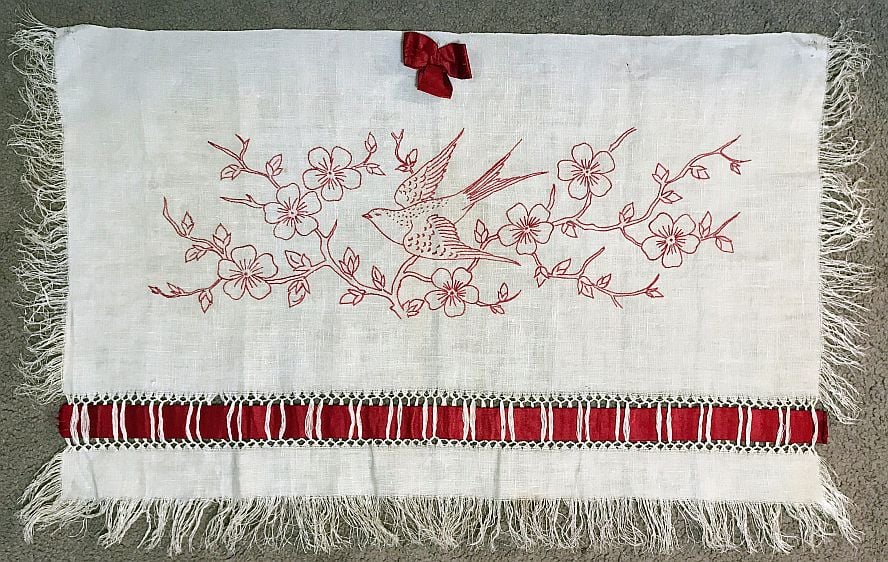
I have a most interesting one that served as a fund raising quilt. It is fashioned to look like a Log Cabin quilt, with mini Barn Raising sections EMBROIDERED in red thread on a white linen cloth to indicate the seams of the “strips” on which the names of donors were written in ink. In addition to the many names are the amounts they contributed from 5 cents to several dollars, which I have not seen before on a fundraising quilt. Every so often there is a central element indicating the total amount of donations gathered by a particular signer.
A couple of years ago, I had an actual Log Cabin quilt done in red and white in which each strip had a name embroidered on it. Probably this was made for the same purpose.
In both cases, there was no town, state or any organization indicated, so what we history minded folk are left with are hundreds of names, but no other clues as to where or why they were made.
Is it possible to send pictures to this site, or do we have to do that link thing, which I have yet to learn on the computer!
Laura Fisher
<!DOCTYPE HTML PUBLIC “-//W3C//DTD HTML 4.0 Transitional//EN”> <HTML><HEAD> <META http-equiv=3DContent-Type content=3D”text/html; charset=3Diso-8859-1″> <META content=3D”MSHTML 6.00.2800.1400″ name=3DGENERATOR> <STYLE></STYLE> </HEAD> <BODY bgColor=3D#ffffff> <DIV><FONT face=3DArial size=3D2>I have a most interesting one that served as a fund raising quilt. It is fashioned to look like a Log Cabin quilt, with mini Barn Raising sections EMBROIDERED in red thread on a white linen cloth to indicate the seams of the “strips” on which the names of donors were written in ink. In addition to the many names are the amounts they contributed from 5 cents to several dollars, which I have not seen before on a fundraising quilt. Every so often there is a central element indicating the total amount of donations gathered by a
particular signer.</FONT></DIV> <DIV><FONT face=3DArial size=3D2></FONT> </DIV> <DIV><FONT face=3DArial size=3D2>A couple of years ago, I had an actual Log Cabin quilt done in red and white in which each strip had a name embroidered on it. Probably this was made for the same purpose.</FONT></DIV> <DIV><FONT face=3DArial size=3D2></FONT> </DIV> <DIV><FONT face=3DArial size=3D2>In both cases, there was no town, state or any organization indicated, so what we history minded folk are left with are
hundreds of names, but no other clues as to where or why they were made.</FONT></DIV> <DIV><FONT face=3DArial size=3D2></FONT> </DIV> <DIV><FONT face=3DArial size=3D2>Is it possible to send pictures to this site, or do we have to do that link thing, which I have yet to learn on the computer!</FONT></DIV> <DIV><FONT face=3DArial size=3D2></FONT> </DIV> <DIV><FONT face=3DArial size=3D2>Laura Fisher</FONT></DIV> <DIV><FONT face=3DArial size=3D2></FONT> </DIV> <DIV><FONT face=3DArial size=3D2></FONT> </DIV></BODY></HTML>
Date: Thu, 29 Apr 2004 23:08:49 -0400 | From: Barb Garrett <bgarrett421@>
Oh, Laura, I love the concept of embroidering the logs on a log cabin block for signatures — conjures up a wonderful image.
As to amounts donated being on the quilt — I know of 2 examples down here in southeastern PA.
1. In the York Documentation we had a crazy style quilt, made to raise funds to put a fence around a cemetary — that fact is embroidered around the border. The name and amount of donation are embroidered in each of the pieces in the crazy blocks. I think it’s pictured in the York Documentation book (Quilts The Fabric of Friendship), but I’m not positive.
2. Today I saw a red and white fundraising quilt at the Adams County Historical Society in Gettysburg — each block is 2 isosceles right triangles — one red, one white — joined along their hypotenuse edges, forming a square. Row after row of triangles. Inked in each white triangle is a name and amount. I think the signage said 900 names with amounts from 5 cents to $5. All the inking that showed — it was not displayed full open — appeared to be done by the same hand. The signage said it was sponsored by a United Brethren Church, but didn’t say for what purpose.
Barb in sunny southeastern PA Where I’m blessed with wonderful quilt exhibits to see.
Date: Fri, 30 Apr 2004 05:48:11 -0400 | From: “Beth Davis” <bethdan533@>
Regarding the new book mentioned by Marcia responding to Judy Anne: “Yes, there is a book coming out about quilting and quiltmakers from 1970-2000 (dates may be slightly off). the woman was on faculty with me at AQS this year. Marcia”
The book’s title is” American Quiltmaking 1970-200” and the author is Eleanor Levie.
I bought a book from her while waiting in line at the airport in Paducah on Sunday!!! Eleanor was happy to sell one more book-but it was HARD to fit even one more item in the luggage!
Beth
Date: Fri, 30 Apr 2004 06:53:53 -0400 | From: “Judy Kelius (judysue)” <judysue@>
Just calling to your attention an important quilt on eBay – http://cgi.ebay.com/ws/eBayISAPI.dll?ViewItem&item=3720820812.
I remember that this was on eBay some time ago as well and we had an interesting discussion about the block with the cross, deciding that the unusual design shows the scourges used to beat Christ.
A someone later quilt by the same maker is in the Smithsonian, and the seller suggests that someone might want to buy this one and donate it to the Smithsonian as well. Any takers?
Tip: if you want to save this to your computer for future reference, right click anywhere on the photo and choose “Save As” – then select a location and give it a name. Internet Explorer will create a folder for the images and a HTML (*.htm) for the description. I do this with anything I see on eBay that I want to save for future reference.
Date: Fri, 30 Apr 2004 07:11:29 -0400 | From: Joan Kiplinger <jkip@>
Judy — good idea about saving for future reference. I do the same but save to my scanner’s desktop; those who have scanners with Paperport or similar software have this capability and might want to consider your good suggestion.
Judy Kelius (judysue) wrote:
> Tip: if you want to save this to your computer for future reference, > right click anywhere on the photo and choose “Save As” – then select a > location and give it a name. Internet Explorer will create a folder > for the images and a HTML (*.htm) for the description. I do this with > anything I see on eBay that I want to save for future reference. > > >