March 11 – 15, 2004 (Part 1)
These restored messages come from the Quilt History List, an online forum where quilt historians, collectors, researchers, appraisers, and enthusiasts discussed antique quilts and related textiles. The archive dates from 1996 through approximately 2016 and is being restored gradually. Sign up in the form at the bottom of the page if you want to know when a new page is added. Original spelling, opinions, formatting, and inactive links may remain unchanged.
Primary topics of this QHL Digest:
- Vintage Washing Tools (“Possers”) — A thread on old wooden and copper laundry dollies used for hand-washing before machines. (see the article on cleaning antique quilts)
- 1970s Double-Knit Fabric Quilts — Members reminisce about polyester double-knit “Grandmother’s Garden” quilts and predict their future collectibility.
- Movie & TV Quilt Spotting Continues — More sightings of quilts, and quilt-adjacent costuming, in film — including the Robin Hood movie era setting.
- Vinegar for Cleaning & Color-Setting — Household uses of vinegar in quilt and fabric care open a debate that carries into the next digest.
From: “Sally Ward” <sallytatters@>
Did your grandmothers (or like me mothers <G>) use the small washing dollys known here in Yorkshire as ‘possers’? Traditionally made of copper or brass with wooden handles, a UK kitchen shop has revived them in a modern stainless steel version. When I saw them I bore one home triumphantly and after some mocking, my DD was so taken with it that I had to get her one to take away to college so that she could use it to hand wash in her sink. The head of the dolly is double skinned, domed, and has ventilation holes. Pressed down on the goods in a bowl of water it forces the water up through the two skins, moving it fast but without agitation of the fabric. Thus it washes efficiently but gently. For me its now ‘the only way’ to pre-wash fat quarters (in plain water, natch).
The url is too long to paste here, but if you go to http://www.lakelandlimited.com and put posser in the search box you can see what they look like.
And at the moment they are half-price!
Sally W
From: “Barb Durtche” <barbdclarityconnect.com>
I sorta have one of these! Well, it’s got a 24″ wood handle, and it’s metal without holes and old old, but it’s still the same thing. Wonder if I drilled holes into it if I could use it again instead of just having it “decorate” my laundry room wall? lolol Barb D —– Original Message —– From: “Sally Ward” <sallytatters@> To: “Quilt History List” <qhl@> Sent: Thursday, March 11, 2004 4:18 AM Subject: [qhl] Washing
From: “Judy Kelius
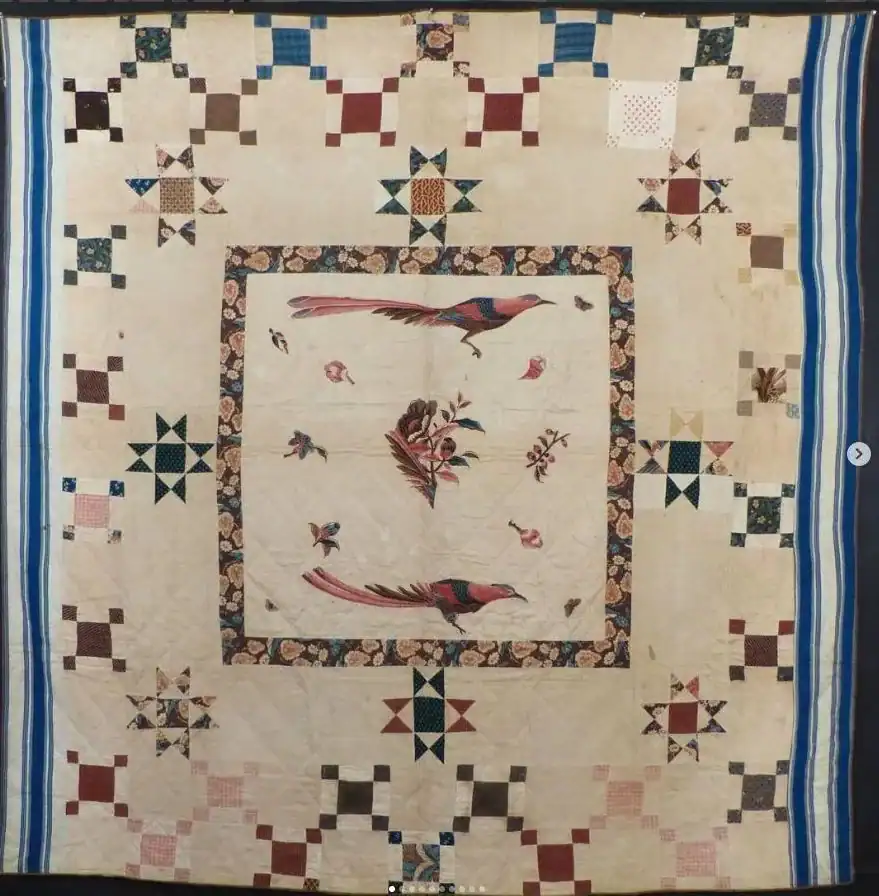
It looks like it has an Egyptian motif . . . I know there was a big exhibit at the Columbian Exposition in 1893 . . . maybe that inspired it? (Just a guess.)
As far as the weight goes, I have seen upholstery/drapery fabrics used as the backs of quilts, especially where quilting was not an issue. Log cabins were often tied or tacked rather than quilted . . . how is yours finished?
From: “Charlotte Bull” <charloumo-net.com>
1. Hey, Don, I love the log cabin. Thanks for posting. Some neat fabrics in the top and that back is the most amazing design! Looks rather 1920s Art Deco. Makes me wonder what I am seeing! Is it Egyptian face or a Bird? And the Celtic portion! Absolutely boggles my ancient mind! Thanks. I look forward to expert opinions! You keep topping my list of experts! I saw a seam, so how wide are the sections of backing?
2. Re using the Double Knits. I live in MO OZ – that’s the Missouri Ozarks! Many old DKs are popping up here in stashes of departed sewers. Local quilters can’t bear to waste the big yardages! One woman recently made over 20 DK nap quilts (Well, she called them quilts) for a Head Start program. Some were simply big sections – a top and a back! Some machine quilting.
When I moved here 20 years ago a group of locals were known to use the DKs for charity quilts that were tied. Just large 10″ squares. They often did not use batting. Just 2 layers. Backing brought to front. Another lady recently made a more nicely designed one for a grown son to carry in his car – a real USER of a car quilt. For oil changing she said but we suspected he’d also use them for picnics while fishing! Nice for camping with kids too. Some ladies used the DK as backing only as they said when it was wrapped around a toddler it was warm and cuddly! Oh yes, some used DK as inside batting too! But all really thought of these as USERS, not heirlooms!
But the very best use of DK that I know of was when a theater group begged for yardages so they could sew authentic garments!
3. And then there are the old blue jean quilts! : )
From: Barbara Woodford <haqgalenalink.net>
I was just about to write a note saying what a great find I found. I bought five quilts at auction that all had moth ball odor BIG TIME. Could barely be in the same room with them. Anyway, since they all needed washing anyway, I washed as usual and put about 6oz vinegar in the rinse water as usual, and LO, the odor went away.Well, I’m sure it will appear again in a diminished way if the quilt ever gets wet, but I was delighted.
A happy nose,
Barbara Woodford
From: Laura Robins-Morris <lrobinsfhcrc.org>
I agree with Jocelyn that the 70’s quilts will be prized in the future. Don’t laugh, those of you who remember those heady days of high fashion! A few years ago I bought a wonderful double knit quilt at Goodwill. They have an annual auction of donated quilts but someone told them this wasn’t worth anything so it went into the junk bin and I snagged it for $9.98. It is made in vibrant 70’s lime, yellow, and orange sherbet colors. The design is an expertly pieced Broken Star, hand-quilted with perfectly even sashiko-size stitiches. King size no less. It just makes you smile to see those bright colors (though some quilters have said it gives them the creeps!). It couldn’t have been easy to make and she/he must have been a truly dedicated quilter <g>. It washed up like a dream, looks like new, and will still look like new 5000 years from now when most of those prissy cotton quilts have disintegrated to dust!!! Now if only I could be here to collect on this valuable quilt 5000 years from now… Laura in Seattle
Date: Thu, 11 Mar 2004 10:19:58 -0500 | From: “Velia Lauerman” <velialive@>
Barbara, A question was hashed over about the smell of white or apple cider vinegar to which I replied , “Either white or apple cider vinegar leaves a very sweet appley smell and will repel invisible pests that feast on our precious fabrics such as wool and natural fibers. The residue in soap will attract those tiny critters if the fabric is not treated with a natural solution such as vinegar. Not all the fabrics purchased get a treatment when I bring them to my stash which seems as though it may save time because the remaining sizing does have value. Whatever the chemicals are keep the fabrics in tact until we need them. I try to label on the salvage with date of treatment and keep the stacks seperated but the feel and edge should be very obvious. Using soap on new fabric for me is a no no and the heat of the iron distortes somewhat. Try pressing with distilled water and air drying. The results keep my work neat and the vinegar treatment is pure for any natural fibers. I also drink a lexeir of honey, apple cider vinegar and water to keep my pipes clean. Windows shine if cleaned with vinegar. Try it on your pets. Give them a vinegar drink and their coats will shine and bad breath will vanish.Vinegar is the old ecomomic way but today someone is profiting by telling us to use chemicals in our systems and garments. Drains are cleaner if vinegar is used in them too. Didn’t mean to get lengthy. Velia
From: “Marcia Kaylakie” <marciark@>
Reading all the wonderful things with vinegar reminded me of how my Mom and Nannie used vinegar, baking soda, and other household items to clean, wash, polish, and scrub their homes. Always sparkling clean and so environmentally friendly! What else might we be using that we could talk about? Marcia Kaylakie in Austin, TX
Marcia Kaylakie, AQS Certified Appraiser Austin, TX www.texasquiltappraiser.com
Date: Thu, 11 Mar 2004 | From: “Velia Lauerman” <velialive@>
Thanks Laura for your remarks about double knit fabric. I too have a six inch pieces hexagon grandmothers garden like creation . My friend boutht 5 complete tops for 5 dollars. I bougt one from her for 5 dollars sew Patricia made a profit and we both are better for it. Wouldn’t be nice to be here when those KNOT quilted pieces are around ? Velia
Date: Thu, 11 Mar 2004 11:21:54 -0500 | From: “Velia Lauerman” <velialive@>
Jocelyn, what a find to get a double knit top. When I purchased my grandmothers garden creation from 5 other pieces Patricia had for 5 dollars for the bunch I couldn’t pick the prettist one. I got one for 5 dollars and love to look and think of whoever hand pieced it must have had good color coordination. It looks great and any other sewing on it will ruin the piece sew i just leave it as is as knot to take away from the original maker. I did lable it for future study in 7004. Velia
Date: Thu, 11 Mar 2004 13:05:24 EST | From: Jccullencrew@
Hi ladies, are you referring to double knit polyester fabric or is it cotton double knit you’re talking about? Just curious as usual. Carol Grace
From: “jocelynm@” <jocelynm@>
> Hi ladies, are you referring to double knit polyester fabric or is it cot ton > double knit you’re talking about? Carol, No, this is real, honest to Pete, double knit polyester, like we wore in th e 1970s. My quilt has a pale yellow background, with pinwheels of different colors. I forget the ‘real’ name of the pattern, it’s the one with trapezoidal blad es (a square and a HST). Very pretty and graphic, if you don’t look too clo sely at the fabrics. <G> Of course the blades are those knit ‘prints’, some of which are in a neon red color. The backing fabric I bought is 2 yards of pale blue and 2 yards of pink, wh ich I figured would do well with a yellow quilt. <G>
Date: Thu, 11 Mar 2004 | From: “Laura Fisher” <laurafishernetlink1.net>
You think it’s fun spotting quilts used in movies to see if they are appropriate to the period, imagine what fun (and profit!) it is to RENT them to movie companies!! I adore it when set decorators come in looking for quilt props (and other things) to make those movie sets home-like.
For example, for Legal Eagles, with Robert Redford and Debra Winger, they rented quilts for his bed. I thought it would be great to have a big close-up picture of Redford under one of my quilts to hang in my window, but — guess what — whatever scene(s) the quilts were in wound up on the cutting room floor!
For the funny movie Big Business with Lily Tomlin and Bette Midler as sisters separated at birth, they rented scads of quilts from me to hang on clotheslines for scenes at a festival in their birthplace. When the film came out (and of course I told everyone to see it) what appeared on the lines were the most rustic, lumpy, worn, boring quilts they must have picked up locally, not the 1930s beauties I had rented them!
For the Thomas Jefferson movie with Nick Nolte, they wanted homespun, linsey woolsey, real period stuff, which I had and would have loved to rent. Never heard from them again – after educating them about what would have been used at the time — but saw the film and saw new woven stuff passing for old in most scenes.
Only for the Barbra Streisand film with Jeff Bridges — The Mirror Has Two Faces — do you really see good quilts, hooked rugs and other vintage textiles that I was happy to rent them. She loves the material, and it shows in how she has her sets decorated. For the really romantic scene (finally) between the two of them, there’s a great close-up of them interacting on my floral hooked rug.
If I have the nice “extra” business of renting props for any forthcoming movies, I’ll try and post news on my website so you all can be on the lookout.
Laura Fisher
Date: Thu, 11 Mar 2004 17:09:52 -0500 | From: aol.com
In a message dated 3/11/2004 7:37:41 AM Eastern Standard Time, laurafishernetlink1.net writes:
> > Only for the Barbra Streisand film with Jeff Bridges — The Mirror Has Two Faces — do you really see good quilts, hooked rugs and other vintage textiles that I was happy to rent them. She loves the material, and it shows in how she has her sets decorated. For the really romantic scene (finally) between the two of them, there’s a great close-up of them > interacting on my floral hooked rug.
Streisand is supposedly a serious, serious antiques collector who knows her stuff cold. No wonder she took the trouble to see that things were done correctly.
One of the favorite things my buddies in the medieval re-enactment group and I like to do is watch an allegedly period movie and play Hunt the Zipper in the gowns. The worst big-screen one of the last decade or so was that terrible Kevin Costner Robin Hood movie, where Mary Elizabeth Mastrantonio covered the zippers in her gowns by wearing a scarf tucked in her belt. Another horror was this terrible Guinevere movie on Lifetime where Guinevere, 6th century British princess, wears a peasant style white wedding dress with chiffon sleeves, and then changes into a 14th century sideless surcoat when she’s queen. Add in Noah Wyle (yes, him) as Lancelot (!) and Sherilyn Fenn as Guinevere, and you have a movie that practically defines Cosmic Horror for re-enactors.
*sigh* Am now crossing my fingers over the costumes in the upcoming Charles II movie on A&E….
Karen Evans
From: “Pepper Cory” <pepcorymail.clis.com>
Hello all-I agree the Robin Hood movie with Kevin Costner was (almost) totally forgettable but Alan Rickman as the meanest ever Sherrif of Nottingham got my vote for favorite bad guy…and then there’s that timeless moment when Robin (Costner) plunges buck-naked into the water–excuse me–just another middle-aged woman having a hot flash! Pepper PS-my spelcheck ain’t working–not my fault!
From: “Velia Lauerman” <velialive@>
Carol Grace, I named my pillow and quilt Polly Esther. Cotton double knit would be something to sew too but Polly Esther , that seventies stuff we loved is what my top is made of. Velia
Date: Fri, 12 Mar 2004 10:23:07 | From: “Sally Ward” <sallytatters@>
> areas of Yorkshire where there is not a tree for > miles
Before I get my wrist slapped, reading my post in the cold light of day, I should correct that statement. Of course Yorkshire has trees (very nice, sturdy ones <G>) but not the great thick tall beechy forests of the south, which was the mis-match.
Sally W
From: patkyser <patkyser@>
Re: polyester double knit Around the US bicentennial I worked with a cooperative of elderly black quilters in north Alabama. In the same period, Burger King changed their uniforms and colors and donated boxes of double kit polyester uniforms to us: brown, red/orange and mustard. The women grabbed them, made, to me, grotesque quilts from them, tying most of them. I should have saved one for posterity, but was so turned off by them that I didn’t. I bet they NEVER wore out! And I guess I missed out on being “a collector!” Pat Kyser
Date: Fri, 12 Mar 2004 08:50:42 EST | From: DDBSTUFF@
Hi,
I was recently asked to help find a fabric described like this, “It is like a whole bunch of little teddy bears on it. It also has the alphabet on it. On the back there is just a whole bunch of little teddy bears.”
This is out of my area of expertise but thought some of you might be able to help. Apparently this person had a quilt that was made 16 years ago and that was made with this fabric. He wants to reproduce it. I am assuming it is cotton but don’t know for sure. Anybody have any ideas???
Thanks,
Darwin
Date: Fri, 12 Mar 2004 08:58:56 EST | From: DDBSTUFF@
I use vinegar for tons of stuff. It is quite economical and environmentally friendly. Sam’s Club is a great source. Here is a site with lots of ideas using vinegar. http://www.@/caringibbs/cleaning/vinegar.html
Enjoy.
Darwin
Date: Fri, 12 Mar 2004 09:04:09 -0700 | From: “Judy Anne” <anne_j@>
We are making progress on getting well researched information about the underground railroad out on the Internet. I just searched ‘underground railroad quilts’ on Google and articles by Kris, Leigh and Xenia are all in the top ten search results. Since most people use Google and many never look past the top ten results this is great news. Kim’s article is in the top 10 when searching ‘UGRR quilts’ and ‘underground railroad quilt’. Pat’s article is getting close to being placed in the top 10 on some UGRR searches. Resuslts vary from time to time as Google is always updating. Remember the more links there are to these sites the higher they will appear in search results so any of you who have a website, no matter how small, just put a little list of UGRR links on it. I’ve listed the sites I know of below. Let me know if I’ve missed any.
http://www.quilthistory.com/ugrrquilts.htm
http://www.antiquequiltdating.com/ugrr.html http://www.historyofquilts.com/underground-railroad.html http://www.quiltersmuse.com/symbolism_in_quilts_as_part_of_t.htm http://www.hartcottagequilts.com/railroad.htm
http://www.culver.org/news/quilts.asp
I find it most amusing that a short article I have on underground railroad and abolitionist quilts is number two for the search ‘free underground quilt patterns’. Of course I’m not giving away free UGRR patterns but the page mentions ‘free’ black women in the abolitionist movement and on the side is a link to my ‘pattern’ history page. So instead of finding a free patterns they read about the lack of evidence that there ever were such quilts. A happy accident I’d say. : ) When I look at my stats to see what searches people use to find pages on my site search phrases for underground railroad quilts are the most frequent after those for quilting and quilt history. So a lot of people are out there searching for UGRR information.
Judy Anne
From: Judy Schwender <sister3603@>
You should include this link to Giles Wright: http://historiccamdencounty.com/ccnews11.shtml
From: Kris Driessen
Just a reminder:
Shelly Zegart will speak on March 16 at 6 p.m. in the auditorium of the Art Institute. Her topic is “American Quilts: A Patchwork of Meanings, Purposes and Origins.” The lecture is open to the public. The opening of the exhibit (see press release, below), following the lecture, is by invitation only.
FOR IMMEDIATE RELEASE January 14, 2004 MEDIA CONTACTS: Eileen Harakal <eharakalartic.edu Chai Lee <clee4artic.edu (312) 443-3625
ART INSTITUTE EXPLORES THE ART, HISTORY, AND CRAFTSMANSHIP OF QUILTS IN NEW EXHIBITION Remarkable Pieces from the Museum’s Shelly Zegart Collection, and Other New Additions to the Permanent Collection to be Shown
A collection of beautiful, fascinating 19th- and 20th-century American handmade quilts from the permanent collection of The Art Institute Of Chicago are featured in a new exhibition, Exploring Quilts: Art, History, and Craftsmanship. With approximately 35 bedcoverings, ranging over more than 150 years, the exhibition, on view March 17– September 12, 2004, in the Elizabeth F. Cheney and Agnes Allerton Textile Galleries (G. 57–59), features some of the prime examples of this American folk art that the Art Institute has recently acquired. Exploring Quilts includes the museum’s important Shelly Zegart Collection; quilts purchased from the Dr. and Mrs. Fred Epstein Collection through a bequest from the Margaret Cavigga Trust; gifts from Margaret McCurry, Mr. and Mrs. John W. Power, Mr. and Mrs. Joseph W. Fell; and quilts from an anonymous donor.
The Shelly Zegart Collection The Art Institute of Chicago acquired a group of splendid 19th- and 20th-century American quilts from Kentucky collector Shelly Zegart in late 2001. This acquisition—partially as gifts and partially as purchases––fills a major place in the museum’s renowned textile collection, not only enhancing the present collection of 155 such pieces, but decisively moving the Art Institute into the front ranks of American museums with similar holdings.
The Zegart pieces represent some of the best examples of this classic tradition made between 1820 and 1982. Among the outstanding quilts in the acquisition are: Celebrity Ties (1980-1982) by Mrs. Grace C. Wagner, a crazy quilt made of 44 pieces of neckties from well-known public figures, ranging from Johnny Carson to Kermit the Frog to former Illinois Governor Jim Thompson; Album of Inventors (1933), a piece that features a pictorial narrative of American history from the presidencies of Andrew Jackson to Franklin Roosevelt, and images of roads leading to the modern world as represented by the Sears Roebuck Pavilion at the 1933 Century of Progress Chicago World’s Fair; and Sunday School Picnic (1932) by Jennie C. Trein, an award-winning piece created to represent the quilter’s admiration of her friends and family.
Shelly Zegart is a well-known expert on American quilts. She co-founded The Kentucky Quilt Project—the first state quilt documentation process—that culminated in a publication and an exhibition that traveled with the Smithsonian Institution Traveling Exhibition Service (SITES). She has since gone on to collect, curate, lecture, and write about quilts over the past 25 years. Most recently, Zegart co-founded The Alliance for American Quilts, a national nonprofit organization, in which she currently serves as the President of the Board. Articles by and about Shelly Zegart have appeared in major newspapers and magazines. The Shelly Zegart quilt collection was acquired through the Robert Allerton and the Christa C. Mayer Thurman Endowments.
Gee’s Bend Quilts Three quilts by the women of Gee’s Bend, Alabama were acquired by the Department of Textiles of The Art Institute of Chicago in the spring of 2003. These pieces suggest both the diversity and continuing importance of traditional, vernacular craft, one associated with the domestic realm of women. Gee’s Bend quilts have become well-known in the past few years due to critically acclaimed exhibitions. A poor and geographically isolated African American community in rural Alabama, Gee’s Bend is renowned for producing generation after generation of extraordinary quilters. This tradition in Gee’s Bend is firmly rooted in utility: poor families need quilts—layers of them—to stay warm while sleeping in drafty houses. Often making use of worn work clothes, for both economic and personal reasons, Gee’s Bend quilters refrain from the intricately patterned, overall stitching displayed in the album quilt. Instead, their work is characterized by boldly patterned, speedily completed designs, sharing the Modernist’s penchant for abstraction.
The Dr. and Mrs. Fred Epstein Collection In 2003, the Cavigga Trust, set up by the late Margaret Cavigga, was identified for the Art Institute and its Department of Textiles.
Part of the trust was allocated for acquisition of quilts—which resulted in the purchase of three outstanding quilts from the Dr. and Mrs. Fred Epstein Collection: The John L. Sullivan Quilt (1888), depicting the rise and fall of the heavyweight boxing champion John L. Sullivan; Crazy Quilt with Animals (1886) by Florence Elizabeth Marvin, a whimsical piece that features more than 40 different kinds of creatures; and Figurative Crazy Quilt (c. 1929/41), an embroidered silk album quilt that includes Santa Claus, Joan of Arc, Pope Pius XII, Aunt Jemima, the Clermont (the first Steamboat), the Liberty Bell from 1753, and the text of a Western Union telegram sent on Valentine’s Day.
Finally, a number of pieces from the Margaret McCurry collection were recently accepted as gifts and added to the textile collection, and the generosity of Mr. and Mrs. Joseph W. Fell, and Mr. and Mrs. John W. Power, resulted in yet more pieces included in the exhibition.
The Art Institute of Chicago houses the most comprehensive textile collection in the Midwest, and one of the most important assemblages of textiles in the world. The holdings span 20 centuries and include woven, embroidered, and printed fabrics; a fine lace collection; and rapidly growing contemporary holdings. At present, the Department of Textiles houses around 13,000 items, as well as some 66,000 swatch-size pieces. Mrs. Christa Thurman, who occupies the Christa C. Mayer Thurman Curator of Textiles, joined the museum in 1967. Since that time, the department’s holdings have been significantly strengthened and expanded. Mrs. Thurman’s many publications and more than 70 exhibitions for the Art Institute have established the importance of the collection nationally and internationally. ####
The Art Institute of Chicago is a museum in Chicago’s Grant Park. Museum Hours: 10:30 a.m.-4:30 p.m. Monday, Wednesday, Thursday, Friday; 10:30 a.m.-8:00 p.m. Tuesday; 10:00 a.m.-5:00 p.m. Saturday, Sunday. Closed Thanksgiving Day and Christmas Day. Regular suggested admission: Adults, $10.00; children, students, and seniors, $6.00; members always free. Visitors may pay what they wish, but they must pay something. Ford Free Tuesdays free to all, except for certain special exhibitions which may require full or extra admission fee. City of Chicago residents with Chicago Public Library cards can borrow a “Check Us Out” card from any branch library for free general admission to the nine members of Museums in the Park, including The Art Institute of Chicago. To reach the Art Institute on the World Wide Web, contact us at: <http://www.artic.edu>
Date: Fri, 12 Mar 2004 16:28:38 -0800 (PST) | From: Kris Driessen <krisdriessen@>
A nice LOL called me from Williamsville NY wondering if I would be interested in any of her quilting books. I said, yes, of course, and she sent me a list of over 500 books she has for sale! Unfortunately, none have anything to do with quilting.
I did take the time to look some of them up on Abebooks and while some are in the $2 range, others are in the $125 and up range. (She didn’t price her books, just wants what’s fair) So if anyone is interested, please send me an SASE. I will copy the list and send it to you.
Kris Driessen 3256 State Rte 30 Esperance NY 12066
From: Anne Copeland <anneappraiser1@>
I have had so many opportunities to get doubleknit tops and quilts at thrift stores. I guess if you are lucky enough to live in a town that has some good thrift stores, you could go hog wild with such a collection. I have not taken them because usually there is something else I would love to have, but I think that someday down the line, they ARE a good representation of the quilts made in the late 60s and probably through to the present. Perhaps someone would be able to do a good study on rural or ??? quilts, using interviews with women who made such quilts. There are bound to be some of them still living. Yes, interestingly enough, the ones I have seen have not always been simple one patch. I have seen them with stars, yo yo’s, daisy patterns, and I cannot even remember other designs I have seen right now, but I know I have seen more than just the 1-patches. I have also seen a lot of polyester baby quilts. People probably DID believe they would wear well under constant washing (something so many seem to be obsessed with) and even keep them warm well since polyester can make you sweat.
It would be interesting to know if in another 50 or 100 years, people are valuing these polyester quilts as we now value the cotton, silk, and other fabric quilts. Peace and blessings, Annie
Date: Fri, 12 Mar 2004 | From: Anne Copeland <anneappraiser1@>
I have never heard of washing quilts in vinegar, but I do remember that if you dyed anything with ye goode olde Rit dye, everyone I knew believed you would set it the dye with vinegar or table salt. I can’t remember the Rit dye having any instructions about setting the dye at all. Peace and blessings, Annie