February 5 – 15, 1997
This page contains affiliate links. If you buy through them, I may earn a small commission at no extra cost to you. As an Amazon Associate I earn from qualifying purchases. Learn more
These restored messages come from the Quilt History List, an online forum where quilt historians, collectors, researchers, appraisers, and enthusiasts discussed antique quilts and related textiles. The archive dates from 1996 through approximately 2016 and is being restored gradually. Sign up in the form at the bottom of the page if you want to know when a new page is added. Original spelling, opinions, formatting, and inactive links may remain unchanged.
Primary topics of this QHL Digest:
- The Graveyard Quilt book and an 1813 “Quilting Frolic” painting mystery
- more on the wave quilting pattern and Quaker use of silk
- formal quilt documentation methodology (Iowa Quilts Research Project forms)
- quilt show labeling/judging etiquette
- restoring an 1879 wedding dress.
Date: Wed, 05 Feb 1997 11:25:43 -0800 | From: nomad1 [at] ibm [dot] net
Hi Diane & All, My dog quilt as I call it is a double axe quilt which has many florals in blue,green,pink,red,purple etc.etc.Also solids,stripes,polka dots etc A real scrap quilt. One of the most interesting prints is a double chinned lamb with a garland around the neck gamboling amongst flowers. Its very 1930’s as you must have gathered & Diane , its a rag quilt as you say. I think its a good idea using the original fabric,thanks for the tip–it all helps! The prints really appeal to me, so I will keep it as a ” mad” quilt to try my hand @ restoring it. Hi to Kath too—your quilt sounds very interesting , hope you guys manage to save it. Let us know how it goes o.k.
Also Barb in snowy Minnesota , do not despair re your daughter’s lack of interest re your gifts. I failed Home Economics,sewing etc. Could not even get into the skirt I made due to something I did to the seams blah! blah! I felt any idiot who could read can cook using a cookery book etc when required. So, basically I was a nightmare to my poor Home Econ. mistress & my mother who is a great cook etc. This all changed however when I had my own children. I started to learn sewing @ 30—-better late than never I think–the main thing is I was interested in learning now, not then. My dear Mother is still recovering from shock! Great your son is already into it–maybe you could make a quilt FOR your daughter of a few of HER favourite things—then watch her!!! Pat that lovely snow for me! Hiranya-Sydney Australia
Date: 05 Feb 97 11:04:39 EST | From: “Patricia L. Lyons” <72134.3643 [at] CompuServe [dot] COM>
Gail Wagner mentioned Elizabeth Roseberry Mitchell’s graveyard quilt. I am in the midst of reading a book by Linda Otto Lipsett called Elizabeth Roseberry Mitchell’s Graveyard Quilt: an American pioneer saga. Published by Halstead & Meadows Publishing of Dayton, OH, in 1995. Price is $18.95 and ISBN is 0-9629399-2-7. It is well researched (14 pp. of footnotes, and 16 pp. of Sources), and still a FASCINATING read. Turns out there was a practice graveyard quilt top before the quilt that we know today. Definitely a title to add to your TBR (to be read) list, if not to a Buy List!
And now a query to the wisdom of the group. Over New Year’s we visited Jefferson’s Monticello. In the archeology exhibit in the basement (“downstairs” as the docents called it – but definitely a basement!) there is a reproduction of a painting by the German artist John Lewis Krimnel (don’t you suspect the name has been anglicized?) called “The Quilting Frolic” and dated 1813. It depicts a finished quilt being cut out of the quilting frame while preparations are obviously being made for a celebration. Nothing else in the exhibit had to do with quilting. The placard described the painting as illustrative of the types of entertainment that would have been held at Monticello during Jefferson’s time. It did NOT say that the artist had depicted an event at Monticello.
Now my question: the quilt pattern depicted in the pattern was Garden Maze, a pattern that I think of as dating from later in the 19th Century (but that’s why I call myself a student of quilt history, and not a quilt historian or researcher!). Does anyone know of this painting or painter? What about the history of the Garden Maze pattern? It struck me that the painter depicted not only what was being quilted (if he was depicting an actual event), but also a pattern that must have been somewhat familiar to his eyes, and one that made a particularly attractive (read visual) image. And no, in early VERY COLD January, there were no docents around to ask! All ruminations, speculations, and even answers welcome!
Pat Lyons in blah (but not snowing or bitter cold!) South Bend Indiana
Date: Wed, 5 Feb 1997 12:48:41 -0500 (EST) | From: QuiltFixer [at] aol [dot] com
In a message dated 97-01-29 19:15:00 EST, you write:
<< I saw this post on Quiltbiz, >>
Date: Wed, 05 Feb 1997 13:30:12 -0500 | From: Ricki Maietta
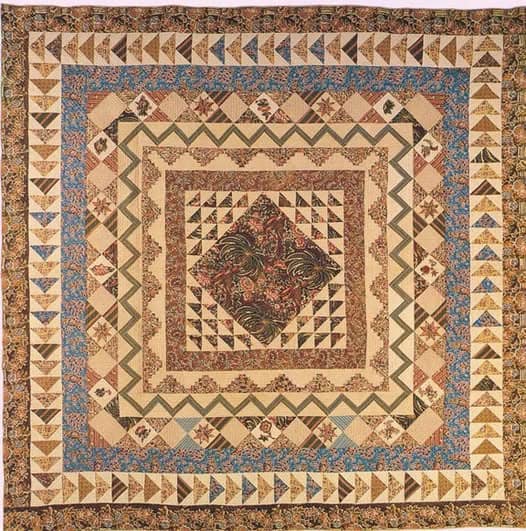
Cinda asked about the wave quilting pattern. I heard about it from Hazel Carter, who did some appraisal work on our museum’s Quaker quilt last year. When I did the antique quilt exhibit last summer, Hazel came. One of the quilts on loan was an early 1800s chintz broderie perse – really a special quilt – like the ones at the DAR. Hazel was quite impressed, & started telling me about this wave quilting pattern. It wasn’t until after she left that I realized that this quilt apparantly has the wave quilting pattern. (Duh! I never said I was smart!)
There is mention of it, & poor pictures, in the British Quilt book by Janet Roe.
It’s basically just a zig zag of quilting lines, about 1/2 inch apart, over the entire background of the quilt. But seems to be a pattern attributable to Irish women.
On another subject, Quakers using silks, they did. Same museum has 2 Quaker petticoats, beautifully quilted, in silk. Also a couple of bonnets with quilted brims, and one quilt that we think came from the same family, all silk. All this stuff came from a local Quaker family that donated a ton of stuff. You’ll never see better quilting. Unfortunately, we’re not sure of a time frame. Would love to see the Brandywine’s exhibit as possible help in dating others. Thanks for the info on that exhibit.
Ricki in PA – about 3/4 hours from Brandywine, but not out of reach
Date: Thu, 06 Feb 1997 00:23:42 -0800 | From: nomad1 [at] ibm [dot] net
Hi Diane & All, My dog quilt as I call it is a double axe quilt which has many florals in blue,green,pink,red,purple etc.etc.Also solids,stripes,polka dots etc A real scrap quilt. One of the most interesting prints is a double chinned lamb with a garland around the neck gamboling amongst flowers. Its very 1930’s as you must have gathered & Diane , its a rag quilt as you say. I think its a good idea using the original fabric,thanks for the tip–it all helps! The prints really appeal to me, so I will keep it as a ” mad” quilt to try my hand @ restoring it. Hi to Kath too—your quilt sounds very interesting , hope you guys manage to save it. Let us know how it goes o.k.
Also Barb in snowy Minnesota , do not despair re your daughter’s lack of interest re your gifts. I failed Home Economics,sewing etc. Could not even get into the skirt I made due to something I did to the seams blah! blah! I felt any idiot who could read can cook using a cookery book etc when required. So, basically I was a nightmare to my poor Home Econ. mistress & my mother who is a great cook etc. This all changed however when I had my own children. I started to learn sewing @ 30—-better late than never I think–the main thing is I was interested in learning now, not then. My dear Mother is still recovering from shock! Great your son is already into it–maybe you could make a quilt FOR your daughter of a few of HER favourite things—then watch her!!! Pat that lovely snow for me! Hiranya-Sydney Australia
Date: Fri, 14 Feb 1997 22:22:30 -0500 (EST) | From: Baglady111 [at] aol [dot] com
There will be a retreat at Hastings, MI Sept 26/27/28 at Camp Michawana..we are inviting vendors to participate at this time. please email me privately..we’ would also like suggestions on a dinner speaker for Sat night..more info for guests later..jane
——————————
Date: Sat, 15 Feb 1997 11:12:33 -0500 (EST) | From: JZgliniec [at] aol [dot] com
Hello, Who are you?…..I did not rcognize your screen name?
What discussion group are you leading?
I am an AQS appraiser and your’e right, we have been having discussion on this and just recently.
We also have formed an e-mail “List”…..those of us on-line…..we can communicate instantly..sort of..
Tell me who you are, if you are certified and on-line…if so ….JOIN us Regards, Julia Zgliniec
——————————
Date: Sat, 15 Feb 1997 11:34:29 -0500 (EST) | From: JZgliniec [at] aol [dot] com
My apologies to ALL, I am sorry for the personal post……my previous post was to go to the person who is leading the discussion group in Paducah….who did not give a name.
I am not used to the way this list handles “reply”..I thought the reply button sent a response to the sender and “reply to all ” went to the list.
Anyway, I shall be sure to check twice next time. I did not realize there was also RESENT FROM.
Anyway….If you are an appraiser, certified by AQS, we have this -mail group. If you are not on it and would like to join, let me know. We have been discussiing the “rating” questions proposed here. Deb, will post “conclusions” if any are reached.
Sorry again, Julia
——————————
Date: Sat, 15 Feb 1997 20:05:37 -0500 (EST) | From: Baglady111 [at] aol [dot] com
ABSOLUTELY GREAT!! I know for a fact that folks have NO idea what goes into a state search..I can recall reading about one of the first ones done..babysitting alone was a challenge..folks that came with kids/entire families..and they had a staff that did nothing but keep them occupied and ‘out of the way’.. and do you remember when there were antique dealers (infact, they don’t deserve that title) waiting outside to buy the quits, they’d talk them out of their heirloom? It happende at many..anyway..that would do VERY NICELY..NOW!! I THOUGHT that I hd pre-mentioned when I requested you writing the letter that Kris had thought it a good idea and that she would proof it..by proofing I mean..see if it would be OK to put out on the digests..I was so afraid of it looking like “begging’ for gifts..I didnt’ want to ofend..if I DID NOT TELLYOU THAT..if I didn’;t make that clear and it was a private favor between you nd I I APOLOGIZE SINCERELY and hope I didn’;t embarrass or offend you in anyway..never meant..I know that Steve is very particular aobut what goes on on his digest..and I try to keep a low profile..
When you do the article it can be emailed to ANN EELMAN, MY PUBLISHER/PARTNER..at leelman [at] ix [dot] netcom [dot] com..I too would like a copy to enjoy as well. Jane
Date: Sat, 15 Feb 1997 09:02:53 -0500 (EST) | From: Tmauvlus [at] aol [dot] com
I’ve just received an entry form stating that a quilt could not be shown in their show “If it has won in any other show in Florida”. That was a first for me, but I can understand that they would like to give someone else a chance other than the artisits who win everything they enter.
Date: Sat, 15 Feb 1997 09:13:10 -0500 (EST) | From: Tmauvlus [at] aol [dot] com
Good for you for holding out to identify names of makers. I attended a show last fall, that due to inefficiency had not gotten lables on – we had no idea what we were seeing, and it made it impossible to enjoy the show, or comment to the makerss. I think it is generally agreed that if we spend a year – or two – or three – making a quilt, we are proud and excited and want to be recognized for it. And if someone wins or not, it shoouldn’t be that big of a deal – after all, it’s usually just a local show, it isn’t the end of the world.
Date: Sat, 15 Feb 1997 09:08:13 -0500 (EST) | From: Tmauvlus [at] aol [dot] com
The AQS appraisers have been kicking this around a bit – we agreed there is a need for common descriptors, to a degree. Unfortunately, we are so widespread, contact enabling us to really discuss things is difficult. We meet only once as a large group, in Paducah each April. I’m leading a discussion group, and will put that on my list of things to discuss. Who knows what will happen?
Date: Sat, 15 Feb 1997 14:16:17 -0800 | From: nomad1 [at] ibm [dot] net
Hey Kris, I like your children–what a great sense of humour–red coloured milk! Fortunately my microbes have not comprehended Valentines Day yet! Give them time! Enjoyed reading QHL while savouring Bacci chocolates—-yummy—-never mind the hips!! : ^ >
My vote definitely goes for ; The Quiltmakers Legacy–Our Quilt & Textile Heritage . It encompasses all our interests I feel. Thanks to all of you who are trying so hard to make All Quilters worldwide feel a part of this group. Kris, thanks for all your hard work——are you sure there isnt something else you couldnt find to do? Hey, I am not complaing , I think you are amazing trying to please us all , either you are a masochist or bonkers!! Where do you get the time to do all this-??
I think a Rating System for Quilts is great— all the terms except soft , makes sense, thelatter however……leaves me puzzled….. afterall , I feel all quilts are soft to the touch in a way!! I can hear you saying Duhh!! Also, I have found that some dealers definition of Very Good does not necessarily mean the same as I do. Remember that quilt I told you all on QHL about , that looked as if it had been in a tug-o-war between dogs ? Right around it is in shreds–a 1930s quilt–supposed to be in very good condition!! One lesson I have learned the hard way is to find dealers that have a passion for preserving quilts & their history , and to avoid sharks out to make a quick buck. This way you are safe with whatever you buy from them.
Have a Great weekend all,as we head off to Sunday, here in Down Under.
Hiranya—from toasty Sydney, Australia e-mail : nomad1 [at] ibm [dot] net
Date: Sat, 15 Feb 1997 12:52:38 -0500 (EST) | From: SadieRose [at] aol [dot] com
When we did the Iowa Quilts Research Project in 1988, we had 2 forms to fill out for each quilt documented. Barbara Brackman was brought in as our “technical advisor” so I assume she helped with the development of these 2 forms.
The INTERVIEW form obtained as much information as possible about the maker/s of the quilt – their personal history, as well as any information about the quilt itself….what the maker called it, how it descended to the current owner, special stories about the quilt or its fabrics, et cetera.
The TECHNICAL form was used for the examination of the quilt. Size, colors, techniques, approximate age (here are the categories: prior to 1800; 1800-1840; 1860-1890; 1875-1900; 1890-1925; 1925-1940; newer) fabric type, backing & binding info, quilting (design…# stitches per inch, hand -machine), et cetera. The TECHNICAL form is pretty detailed, but most were set up so we could circle the choice(s) that applied to this quilt. This helped keep things moving when we sometimes documented 200 quilts in a day! Ideally, the documentor’s had scribes, so we would just say what to circle on the form.
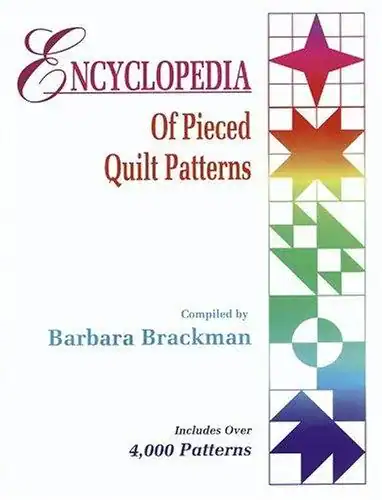
We also used BB’s Encyclopedia of Pieced Quilt Block Patterns as our official reference for names. We had volunteers whose only job was to look up the block patterns in the book. We used the number assigned to the block in the book, along with the most common name for a pattern UNLESS the family gave us a name for the quilt/block. Most of the time, they wanted us to tell them the name.
One section of the TECHNICAL form was for Condition. Our choices included: Unused Unwashed Light Wear Moderate Wear Heavy Wear Soiled Stained Faded Fragile Repaired Restored Other_______
Other observation or comments regarding quilt construction, design, condition, inscription, or dating: ________________
Many of the quilts had more than one of these circled. You could have a quilt with Light Wear, that had a stain, or had been repaired. You could have a Vict. Crazy Quilt that was Unused, Unwashed, but still Fragile. So, while I think Kris’s comments about a numbered rating system are valuable, I can also see that it might be difficult. We tried to be objective about this, but had to be careful if the quilt owner was standing right there while you documented. (We tried to set it up so they had other things to see/do, but found that most wanted to follow along with their quilt, asking questions of us). Some requested photocopies of the TECHNICAL and INTERVIEW forms to keep for their own records. Many brought cameras, and took photos while the quilt was hung for its ID photo.
One of the important aspects of a Quilt Documentation Day is the educating of the public. We had hoped to have many quilts with a wonderful family history. We found many current quilt owners know little or nothing about the quilt, its maker, or how to care for it. (However, they were very receptive to our information). Some of these were “family quilts” and some were purchased at auctions. Very few had any name or date inscribed on the quilt. We basted a label on each quilt with the ID# from the Documentation Day, and encouraged the owners to write down all they could about the quilt & its maker, and to put this information on a label if possible. We also handed out a one page sheet on basic quilt care.
Some of those who brought quilts in, were fascinated with the process, and have become volunteers for subsequent Documentation Days. Our official state research project was completed in 1988. We have continued to receive requests from quilt owners who want their quilts documented. When one of my quilting friends started working at a small local museum, we began doing an annual Quilt Identification Day – first on National Quilting Day (the 3rd Sat. in March)- now later, as that falls in Spring Break here.
The museum agreed to be the caretaker of the data & photos. We have continued the policy of the state project, where each quilt is given an ID number…the name and address of the owner is kept separate from the rest of the data. (This way, unscrupulous buyers aren’t given a guide to the best quilts.) Information is stored as “hard copy” in notebooks….maybe some day the $$ or volunteer time will get this data in a computer database. The information is available for the museum, with the possibility of using the quilts in future exhibits, or to researchers by appointment. There is an effort to get this type of information into a national database, which would be fabulous for researchers.
Hope this information is useful… if you haven’t helped with an ID Day…you are missing out on some great quilts!! Even if you aren’t an expert in fabric dating, you can measure or be a scribe, and still get to handle the quilts and help get their story down for posterity. This may inspire you to start studying textile history, too. Or just to be sure that every one of YOUR quilts has a label with pertinent information attached to it! Happy Quilting!! Karan from cold but sunny Iowa
Date: Sat, 15 Feb 1997 14:28:23 -0500 (EST) | From: MiamiQuilt [at] aol [dot] com
Kris at old albany
Found wool challis Flower Garden. Beautifully quilted, rare design layout. How much would these sell for if available? I think it is Mennonite. Pam MiamiQuilt
Date: Sat, 15 Feb 1997 15:16:36 -0500 (EST) | From: BFquilter [at] aol [dot] com
Hello to Everyone,
I know this listing deals with antique quilts but I need help finding information for the restoration of an 1879 wedding dress. I believe it is silk or silk/cotton but the skirt portion is badly damaged with shattering or diagonal seperations. Would the Smitionsion Help? Does anyone know who I can contact? Any help will be greatly appreciated.
Barb in MN (where it is snowing again!)