September 11 – 13, 2005
These restored messages come from the Quilt History List, an online forum where quilt historians, collectors, researchers, appraisers, and enthusiasts discussed antique quilts and related textiles. The archive dates from 1996 through approximately 2016 and is being restored gradually. Sign up in the form at the bottom of the page if you want to know when a new page is added. Original spelling, opinions, formatting, and inactive links may remain unchanged.
Primary topics of this QHL Digest:
- Favorite Quilt Block Patterns, Continued — The block-pattern survey continues with talk of sampler quilts and researching a signature quilt’s origins by census records.
- Choosing the Right Batting — Members compare cotton, wool, and blended battings for hand and machine quilting. (see the article on quilt batting)
- Caring for Antique Silk Quilts — A conservator warns against using silk in new work at all, given how poorly Victorian-era silk has survived.
- Hurricane Katrina, Closer to Home — A member shares that her son, a FEMA worker, may be deployed to the disaster zone.
Date: Sun, 11 Sep 2005 11:30:35 -0500 | From: Gail Ingram <gingram@>
> enough to want to make provision for it ‘in case’. (Its label declares > it to come from Kitchener, Canada – if there’s anyone who knows the > place I’d love to hear from you).
Sally,
Kitchener is located in Ontario province, just north of Lake Erie, and is named for the famous (infamous?) Lord Kitchener, British commander in the Boer Wars. Most famous abroad for his ruthless military tactics and for the famous poster (“Your country wants YOU) on which I’ve always assumed U.S. Uncle Sam poster with similar title was based. K. had a really forbidding look: Germanic tough and determined.
You should write the municiple authorities and inquire about the quilt effort from there in WW II. Would be interesting. There is a nice library and historical society, I think. I should guess the town would have been quite small in WW II. Wouldn’t it be interesting to learn whether a local effort produced your quilt? I was last there probably five years ago, but at the time, there were signs posted along the highways leading into town advertising for skilled immigrants to work in (computer?) firms.
I’m glad you decided to “upgrade” your group’s quilting efforts. I think we always underestimate the ultimate effect of the individual effort. When I was in lower elementary school, I had a Japanese-American penpal in California and a Viennese penpal. I learned so much about the Japanese interment in WW II, though my penpal never mentioned it (we wrote about movie stars and such, I think), that to this day I understand the complexity of that situation and have a sympathy with the people everywhere who suffer from stereotypes. From the correspondence with my Austrian penpal, I acquired an abiding sense of what life in a totalitarian state must be like and an appreciation for my own freedom. She lived in the sector of Vienna that was under Soviet rule for a time. Every letter that came to my mailbox had been opened and stamped with a censor’s approval. I became sensitive of every word I used. When I was in my teens, I came in from a date one night and my mother told me this girl had telephoned me from the hotel in our town: her choir was touring the U.S. By then, Vienna was free, of course. But what a coincidence—what were the chances?! We sat in the hotel lobby and talked nearly all night.
So sign those quilts with a message. They are like messages in bottles. You cannot imagine what knowing someone abroad cares about an American living in Louisiana will mean. It will get one person past stereotypes, if nothing else. But it will do much more to buoy the spirit of the receiver, I assure you.
Gail
Date: Sun, 11 Sep 2005 10:11:02 -0700 (PDT) | From: Becky Gockel <majormaam@>
I love sampler quilts. I have two tops… well kind of. One I found burried deep in a fabric stash that my husband bought at an estate auction. The Borders were pieced but not on it yet. The other is made of blocks that my mom hand pieced in the 1970’s, I sashed them together once and have since taken apart.
It will take a while to make my own sampler quilt, but I have been saving my sample blocks from the classes that I have been taking. Even though the blocks are all different sizes, I know there is a way to arrange them to make a quilt (once I have enough to put them together). I also have a few Baltimore Album type blocks completed and am working on more.
The show and share portion at my quilt guilds inspire me. Maybe if we (meaning this Quilt History List) had a web site of free patterns and samples of “Sampler Quilts”, that may get some quilters interested. Unfortunately, I have no clue how to organize us or even build a website and I know it would take an investment of time and money.
Becky In the High Desert of California
From: <chrisa@>
also how the blocks traveled and changed while migrating westward might be fun as well. Sounds like a future National Quilting Day project for some guilds. What do you think? . Marcia
This sounds like a fun challenge! I would add that as the name changed with the migration, time passed, so perhaps the reproduction fabrics used could reflect that time difference too, when it’s appropriate.
To answer a couple of your other questions Marcia- I adore antique sampler quilts but have rarely seen one anywhere other than a book or in a museum. When I have seen one for sale, it’s 20th century vintage, but not 19th century.
Fabric affects my choice of classic patterns to remake. If the pieces are too small to appreciate the reproduction fabrics I like best, medium to large scale, then I usually don’t reproduce them, although I admire others reproduction very much. I choose patterns like elongated nine patches, pinwheels and Ohio star patterns or styles like strippey or medallion or alternate plain blocks so that the fabrics of the time I am reproducing will show up.
I think that paper piecing has contributed greatly to the reoccurance of complex older patterns, like rising suns and rocky mtn. road and other curved and pointed type of piecing patterns. It seems that the feathered star is the least likely to be seen in today’s quilts- gee, I wonder why!! Even with all Marsha McCloskey’s help and techniques, that pattern is still too difficult to be made very often. It is one of my all time favoirte pattrns though, as is the multiple balzing star quilt with many different fabrics, of course!
Kim Wulfert www.antiquequiltdating.com
From: <chrisa@>
(Its label declares it to come from Kitchener, Canada – if there’s anyone who knows the place I’d love to hear from you).
Sally-
Kitchener is located close to Niagara Falls or Buffalo NY, over the border and about an hour away. They are part of a huge Canadian Quilt show that takes place there in May. It encompasses many towns in that part of Canada. I am pulling from my memory here- so that’s all I can tell you at the moment. I had planned tour for may of 2002, but Sept. 11, 2001 (4 years ago today in fact) effected the enrollment and the trip was cancelled, unfortunately. It seems like a grand and wonderful quilt event with both new and old quilts.
Diane Shink , a Canadian in Montreal, taught me when we were there on another tour, that Canadian’s often made their quilts with lots of white fabrics because their winters are long and dark. I have since looked at their quilts from this perspective and yes, it does seem to be a common trend, more than in the US anyway. They mostly made pieced quilts, not appliqu, so I am comparing that style. TI seems in the 20th century more pieced quilts were made with white in the US than in the 19th century.
What’s amazing is that the quilt you refer to was still so white. Perhaps it was used in a hospital setting for much of its donated life until this woman’s mother got it.
In addition to putting more thought and perhaps effort into your Katrina Quilt, a label seems like a very good idea too. I had even considered putting a way of contacting each other on there, email or phone or address, not sure which would be best, to a penpal situation to develop if the recipient felt so inclined. This may not be a good idea, I know, but then again, it might be just what the recipient needs- someone who cares and that they can know is personally behind them. I haven’t decided what I will do about that exactly.
Have fun at your Katrina party!
Kim Wulfert www.antiquequiltdating.com
From: <chrisa@>
QHL –
In an effort to get more information about a 1910-1916 signature quilt top I am researching I wanted to ask for help from the list. This top is unique in that it has typewriter names placed among the embroidered, inked, and stamped names. The primary date is Nov. 12, 1913. There is no indication of who it was made for or why.
I have placed the names, city and dates in a list, along with photos. Most of the names are from Mass, and a few from VT. If you know any of these families, perhaps I can figure out the significance of the typewriter to that particular family- more than one last name, but Olsen E. Sherman Jr. is one of them, from West Springfield, Mass.
Thanks, Kim Wulfert http://www.antiquequiltdating.com/FriendshipSigQuiltTop1910-1916.html
Date: Sun, 11 Sep 2005 14:25:53 -0400 | From: “Karen Evans” <charter.net>
Kim –
I can tell you that “Ainsworth” is an old name here in western Massachusetts (ditto “Eaton” – they made their money in paper mills). One of the gyms at Smith is named for Dorothy Ainsworth, a professor emerita, but I don’t know if she was related to your Carrie. It seems likely, though, given that Westfield and Northampton are only about 15 miles apart.
Wish I could help more…
Karen Evans
From: “Susan Wildemuth”
Do you suppose they all worked for the same company or university? Have you checked the census to see where the majority of them worked?
Sue in Illinois
From: <chrisa@>
Thanks Karen- that is very helpful news. Certainly seems possible there is a relation.
I thought paper when I saw the typewriter signing, but by 1913 they were very common, so it’s not a significant link. I thought perhaps the Sherman’s and Ainsworths had owned a typewriter dealership or manuf., but after checking that out I came up empty handed.
I had a nice discussion with online typewriter collectors and they hadn’t seen anything like this before either. Turns out a few of them were also passionate about quilts. They said it was likely the paper was put behind the fabric, just as it is today.
Kim Wulfert www.antiquequiltdating.com
Date: Mon, 12 Sep 2005 05:26:07 -0500 | From: Barbara Vlack
It is because of information posted here recently about the WWII quilts that I have told others who are making Katrina relief quilts to be sure to sign them. Their interest in making these quilts was perked when I told them how some of the WWII quilts have survived and are surfacing now. While survival of the quilts is not nearly as high on the priority list as the survival of the receivers of these quilts, it is still encouraging to know that some of these quilts may survive to help tell the story of Katrina many years from now.
Thank you, Gail, for your journaling about your experiences now. And Sheryl, I’m saddened yet heartened by what you have written. Thank you. We can never fully appreciate what you’re going through because we’re not there. “Been there and know some people there” helps to personalize the tragedy that is otherwise touching us all in many ways.
Pat, it’s not a surprise that there would be rumors about the Houston show being cancelled going around at events such as Martha’s Quilting Academy. That probably came because the Houston mayor announced, when they were starting to accept evacuees to the Astrodome and the Convention Center, that all events would be cancelled for several months. Karey Bresenhan, the director of Market and IQF, must have done some pretty powerful lobbying in order to come back and say that the Houston show WILL GO ON. That is not a rumor. That is not a supposition. It is an official announcement that can be verified at www.quilts.com I don’t know how she did this, but Karey has promises from the mayor and the Convention Center that our event will happen. It might help greatly that they depend on the financial support these two events offer to Houston, which now more than ever could use it. Today I have to make my airline reservation for Houston. Last week was still a little iffy.
Barb Vlack cptvdeo@
Date: Mon, 12 Sep 2005 06:55:10 -0500 | From: “Virginia Berger” <cifba@>
I have a Dresden Plate top that I am sending to my mother’s church group to be hand quilted. I want to use a cotton batt and am looking for comments about which brand is easiest to needle.
Thankd in advance.
Virginia in Iowa
Date: Mon, 12 Sep 2005 08:14:31 -0400 | From: Judy Kelius <quilts@>
I like Quilter’s Dream Select (the thinnest). – Judy
Date: Mon, 12 Sep 2005 09:07:48 -0400 | From: “deb” <debquiltingposs.com>
I agree with Judy about the Quilter’s Dream but Request is the thinnest batting they sell. I also like Hobb’s Organic cotton.
Debbie in NJ
Date: Mon, 12 Sep 2005 09:11:52 -0400 | From: “Lloyd E. Miller” <lemillernycap.@>
I must add my thanks to Gail and the others who have provided insight beyond the media. Just as our little weekly quilt group discusses quilts and quilt-related subject AND anything else that anyone wishes to bring up in a safe venue where differing opinions are accepted, so also do I think that in the larger arena we as quilters do not exist in a vacuum. We are living tomorrow’s history, and what we do now as quilters will someday be viewed in that context.
And yes. We can go out and buy fleece blankets, which are certainly cheap enough and will keep one warm, or we can add that extra bit of effort that says we really care enough to make a quilt that says ‘this is personal’.
Linda Miller
Date: Mon, 12 Sep 2005 9:57:32 -0500 | From: <gingram@>
While I know most of us are making quilts for people displaced from New Orleans after Hurricane Katrina, it occurred to me that some group might be interested in acknowledging the efforts of those who distinguished themselves for courage and action while the agencies of local, state, and federal government dithered.
One of those is the owner of an ambulance service active throughout Southwest Louisiana. Immediately after the sorm passed, he marshalled all his company’s ambulances, EMT personnel, and MedEvac helicopters to a point just outside the city. City and state authorities had refused to give him permission to bring his people and machinery into the city, even though they were desperately needed. No permit, it seems.
Being of sound mind and grasping the enormity of the situation, he chose simply to ignore authorities. His helicopters dropped bags of ice; rescued those they could. He used all he had at his disposal to save as many people as he could—all while officialdom quibbled over power and responsibilities. He ran a great risk, of course, since our state is highly litigous, and many attorneys and individuals thrive off what in many states would be thrown out of courts as frivolous. He simply acted on behalf of those in need.
Perhaps someone on our list is in a quilting group that has members who are among emergency responders and would be interested in acknowledging the courage and disinterested service this man and his firm offered and the example his actions offer. If so, please contact me
Date: Mon, 12 Sep 2005 13:17:22 -0400 | From: “Nancy Roberts” <aquilter@>
Thanks for inviting our thoughts on this topic. It’s been most interesting to read the replies.
1. What old quilt block pattern is your favorite? Picking just one is a challenge, but I have a particular fondness for the Dresden Plate. Curved designs in general appeal to me.
2. How often do you see new quilts that are made from old classics? More are than aren’t, at least at the quilt shows and guild show-and-tell times that I see. Even in recent books such as Becky Goldsmith’s and Linda Jenkins’ “Quilts with a Spin”, the quilts are updated versions of classic pattersn like Pickel Dish, Princess Feather, and Whig’s Defeat. And, oh yes, there’s a wonderful quilt called Dresden Dots that is on my to-do list.
3. If you make quilts, do you ever make a quilt from an old favorite? Pretty consistently. My love for vintage quilts keeps me tied to them. The only departures I can think of is when I make folk-art designs or “story quilts” as taught by teacher Mary Lou Weidman. And many of these are often based on or incorporate old favorite blocks. And I’ve not yet made an entire quilt in my favorite Dresden Plate design, only a few blocks (enough to know how much I enjoy it).
4. Do you think that the intricacy of some of these old patterns are proving too challenging for quilters? I’d say that the skill level is not too challenging and would say that most quilters are up to the task of completing them technically. My guess is that the time factor is what drives the popularity of large pieces, simple yet effective designs, fusible applique, and other quick/easy techniques.
Nancy Roberts
Date: Mon, 12 Sep 2005 13:54:53 -0500 | From: “Andi” <andi0613@>
This is a mu
I whole heartedly agree with those who have observed that good work seems to last and that comprehensive labels will be invaluable to recipients and historians. I’m taking longer than I thought to put together a simple Rail Fence crib quilt in the Mardi Gras colors of purple (justice), green (faith) and gold (power), but I’m happy knowing the seams will withstand lots of love and the quilt will be straight. My tiny town of 1,000 is fortunate to have a nursing home, which my dog, Elsa, and I have visited many times. They called the other day to offer to tie any tops I make. It’s overwhelming to think that people with enormous problems of their own want to help any way they can. I no longer see these Katrina quilts as an immediate project, but one that will continue for a couple of years. Those who enjoy the History Channel probably already know that there is a special on Katrina tonight at 8 pm EST. I happened upon footage and interviews from Camille on this channel just an hour ago. The parallels of damage at Pass Christian are unnerving (only the hairstyles have changed), but so were the determination and spirit of the survivors, and that invokes tears, too. All of us who have suggested that doing something helps the makers as well as the recipients are spot on. My thanks to all who have contributed to an inside view of what’s going on along the Gulf coast.
Andi in Keota, Iowa, who lived 14 years in Tallahassee, FL and went through the “No Name” storm that was, in fact, a hurricane in March
Date: Mon, 12 Sep 2005 17:35:26 -0400 | From: “Velia Lauerman” <velialive@>
Try QUILTER’S DREAM 100% pure cotton batting Kelsul,Inc. 2700 avenger Dr. #109, Virginia Beach, Va., 23452, 757-463-3264 and tell them I sent you. Velia Lauerman Heirloom Pieces 313 605 2171. You may also get samples for their wide selection of synthetic batts. Our group uses it for hand and machine quilting. Can’t say enough about it you must try it. Why don’t you quilt it? Are you a quilter? Velia
Date: Mon, 12 Sep 2005 16:13:13 -0600 | From: Jennifer Hill <jennifer.hill@>
> > enough to want to make provision for it ‘in case’. (Its label declares >> it to come from Kitchener, Canada – if there’s anyone who knows the >> place I’d love to hear from you). > >Kitchener is located in Ontario province, just north of Lake Erie, and is >named for the famous (infamous?) Lord Kitchener, British commander in the Boer Wars.
Gail is indeed correct about this town’s namesake. However, up until the outbreak of WW1, its name was Berlin. With Canada being then at war with Germany, it just wouldn’t do to have a major town named after the enemy’s capital, so the name was changed to honour Lord Kitchener, who had yet to prove his incompetance in prosecuting this war.
Jennifer Hill Calgary, AB
Date: Mon, 12 Sep 2005 20:40:51 -0500 | From: Gail Ingram <gingram@>
How interesting, Jennifer. Did the original name suggest a German settlement, or was it just honorific, which would not be unusual, given the Royal Family’s connections?
Are there many other Canadian towns like this one?
Like Battenberg/Mountbatten and similar changes, I guess.
I’ve read of changes like that in the U.S. As well.
Thanks for the enlightenment.
Gail
Date: Mon, 12 Sep 2005 05:22:12 -0700 (PDT) | From: CAROL GODREAU <imaquilter2@>
Quilters Dream Select is my most favorite to handquilt with but wool is a nice batt too. Carol in CT
Date: Sat, 10 Sep 2005 20:26:48 -0600 | From: Kay Fair <Kaytreestump.com>
I have to agree with Barb. I have been reading Gail’s posts along with a woman named Rachel who belongs to a bookgroup listserv that I keep up with. Between those two, I feel that I have a far better understanding of what’s happening to actual people, rather than communities. The news gives such a broad overview of what they perceive is real, newsworthy, and that they think viewers will find compelling in the short time that they have to present the “story.” Gail has been able to put a human face on it and for me, it is far more real than just watching it on the news from here in Denver. I have seen far more political diatribes in postings from other groups over the last week.
Kay in Littleton, CO
From: Palampore@
I just received a letter from AIC (The American Institute for Conservation of Historic and Artistic Works) detailing the efforts that the organization is taking to assist the people affected by Hurricane Katrina. The site below gives a great deal of links, and articles. This is a wonderful detailed site. Please pass it on if you know people in the area who might need this information.
_http://aic.stanford.edu/library/online/disaster/index.html_ (http://aic.stanford.edu/library/online/disaster/index.html)
I am sure that the conservation/restoration efforts will go on for a very long time. They are also looking for volunteers to help out down there. Off to prepare for Hurricane Ophelia. Looks like we will begin to get rain tomorrow, and maybe some flooding on Wed. We have property on Atlantic Beach which might get extra wind and water. My son has been surfing all afternoon, and says the waves are incredible. I have to hand him over to God when he does this stuff……… Good night, Lynn Lancaster Gorges New Bern, NC
Date: Mon, 12 Sep 2005 11:09:19 -0500 | From: “Steve and Jean Loken” <sandjloken@>
Hi all, It’s fun to read everyone’s responce to Marcia’s question. I have always admired the Lady of the Lake quilt. The one that sucked me in is on page 84 of Kiracofe’s American Quilt. I have a question about my attempt to reproduce that, that I direct at anyone who has the book and knowlede of repro fabrics. I’d like to do it as close to each fabric as I can get. The quilt itself is in the Los Angeles Co. museum, and the web-site shows a photo of the quilt but unfortunately the resolution of that screen is about the same as in the book. That is, if you try to enlarge it, all you get is a break-up into dots that doesn’t actually show more detail. My question today is about the fabric the quilter used at the center of each block and in the corners. In some blocks it looks pink and in others yellow, and in yet a few others, both. Was there ever a pink to yellow ombre fabric? She took such care to be consistent in that center, it makes me wonder. I think other fabrics will also be hard to find – that wavy pink stripe, that navy and brown plaid with brown plaid in a smaller scale within it, that fabric with reddish stripes that appears to be a “cheater” print surrounding the center block. On the reproductionfabri@ site I frequent there are no repro plaids. Anyone know a source for them? Thanks for any help. Marcia, your questions got everyone thinking. Jean in MN who did some stash reduction making a Trip around the World for Katrina relief.
From: “Nancy Smith” <stptquiltnut@>
I’m new to quilt research and am awed by the knowledge of all of you regarding quilts.
I found a pamphlet that has swatches of fabrics in it and am trying to date the pamphlet/fabric.
The pamphlet is from Marshall Field & Company, Printed Batiste, No. 1302, Assortment “B”, Department 45. It says 30-35 Yard Pieces, Doubled and Rolled, 20 Piece Carton Assortment, 38/9 Inch.
Can you please get me in the right direction as to where I begin looking to date this?
Thank you. 🙂
Nancy Smith 3725 Simonis Street Stevens Point, WI 54481 715-341-9115 stptquiltnut@
From: “Lucinda Cawley” <lrcawley@>
My plan was to protest gas prices by not going to Sully (or any where else while prices were above $3.00 per gallon) and then I woke up Sunday morning thinking “fifty springs are little room” and I have far less time than that to be looking at quilts. At some point in the not too distant future I may not feel able to drive 300 miles in a day to look at quilts so I’d better do it now. I’m so glad I did. I even found gas for $2.95. It was a beautiful day, not too hot, no humidity, great quilts. Almost the first one I saw captured my heart, an 1840 Album Block from PA (I’d guess Chester or Delaware County, maybe Philadelphia) with smallish blocks set without sashing or borders, every block signed, way too expensive for me. The Album block is my favorite! The same dealer had an orange and green 4-Patch in a 9-Patch set with a pair of matching pillow cases (very rare). The back of both quilt and cases was a great brown seaweed print. I loved a scrappy Sunburst with fabulous quilting and an amazing medallion with a Lone Star as the center, a chintz appliqué border and an outer border of Delectable Mountains blocks (obviously this lady could do it all). All of the above were in just one dealer’s booth!
I’m very aware of Farmer’s Fancy quilts since I reread the West VA book last fall and there was a great one hanging close to three super Album Block quilts. A double pink and green one was set on point with purple sashing (from PA, of course). The second was pieced of chrome orange and green set on double pink with a delicate green and white stripe for the sashing and borders. The one that really inspired me was totally scrappy within the individual blocks. There was a sweet Album quilt with appliquéd sashing (delicate vines and flowers with a slightly different motif in each border and sashing). The binding had a tiny red piping. I loved the quilt, but had to shake my head when the dealer tried to tell me it dated from 1830! Another delightful album dated 1849 had lots of decorated signatures (one said Harrisburg). The blocks were small, as the PA Albums tend to be, with charming small scale designs.
My favorite was a wreath of pears with a wreath of tiny strawberries a close second. I’ve never seen a pear wreath before so it had to be my favorite. Another block had stuffed grapes that were less than a quarter inch in diameter. Another block I like a lot is Mariner’s Compass and I saw the ultimate yesterday: nine very large (maybe 24″) Compass blocks with at least 32 points (I should have counted them) in turkey reds, soft pinks, butterscotch yellows, Lafayette blues, rich browns with sashing and border of a riotous red and gold chintz. We spread that quilt out on the grass and nobody could walk by without stopping to stare. In the “you don’t see that often” category was a Whig’s Defeat top which the dealer had found in Meriden, CT (the price was $395), a 7 Sisters inside a Sunburst and a Garfield’s Monument with a curved appliqué that made a sort of Capitol dome shape in the alternating plane block. I didn’t buy a thing except a couple of pieces of fabric and a set of zany butterfly potholders. I even found a great place for fried chicken, corn bread and fried green tomatoes on the way home. Cinda on the Eastern Shore
From: Gloria hanrahan <gloria@>
I dislike most classic quilt patterns. I’m going to keep quiet on that or the DH will want to know why we have container after container of them taking up space.
The quilts which draw my eye are quirky in colors or create a secondary pattern such as with a log cabin or tumbling blocks which create a 3-D effect. The colors are what interest me. I dislike repeating blocks, or quilts like Irish chains.
I do seem very drawn to the depression era quilts like Grandmother’s Flower Garden or Double Wedding Ring, but only in the tradition prints. Newer versions leave me cold. But then, I collect polyester double knit in those very patterns. Go figure.
I can appreciate good workmanship, but I value imagination more. So that’s what I buy. As far as what I have made, my first bed quilt was a Monkey Wrench for a friend’s wedding and that was enough for me. I was ready to do something else after the second block. I’m much more a process quilter and am happier to end up with a pot holder and learn something new than an entire quilt of the same old, same old.
I can see how many women were more prolific before the days of rotary cutters. By the time I spread out all of that STUFF in a busy household with four kids, it’s time to put it all back up. I haven’t finished anything in several years and the few quilts I have completed, I’m not inclined to use them on the beds. I’d much rather have comforters which I can just throw in the wash. To fill my yen for quilts around the house, I buy tops on ebay and have them quilted. I don’t feel guilty using those like I would the family quilts.
Now that I finally have my own space to putz around I’m making braided wool rugs. I see many women learning to knit while sitting on the sidelines of those soccer games. It won’t be long before some hand piecing is picked up by those of us who can’t handle two sharp pointed sticks at the same time.
Gloria
From: “Marilyn Maddalena Withrow”
Marcia, I think you’ve hit on something that would be fascinating to present to guilds. I do presentations on antique quilts, but don’t go into the pattern meanings much, just normally dating the fabrics, naming the blocks and talking about care of the quilts. Any resources for quilt names that you can come up with, other than the standard reference books? Marilyn Maddalena Withrow Professional Quilt Appraiser, Judge, Historian, Designer and Lecturer “The Quilted Rooster” at Foots Creek Farms www.marilynquilts.com and www.footscreekfarms.com
From: “J. G. Row”
> 1. What old quilt block pattern is your favorite? I’d have to say that Log Cabin is my favorite really old-time pattern. Of all the LC sets and variations, I really adore the 5-color sets. I also like Storm At Sea, which I don’t think is that old — perhaps less than 100 years — but it is made up of elements seen in many older blocks?
> 2. How often do you see new quilts that are made from old classics? All the time, at every quilt show I go to. More of those than anything else. I think most of the quilts we see today are variations on old-time patterns. It takes a huge amount of imagination to put together any kind of design that no one else in the history of the world has ever done, but with just a change in scale, or a few colors, or a setting switcheroo, an old time design that has been made thousands upon thousands of times can become something entirely original and new. Even those who call themselves “art quilters” often use our classic block patterns in new ways.
> 3. If you make quilts, do you ever make a quilt from an old favorite? Haven’t ever made any other kind — but I don’t think they look anything like the originals. Again, color choices, scale and set can make old patterns very contemporary, and our new cutting and sewing techniques permit taking those old standby patterns “outside the box.” Just think of what Emiko Toda Loeb did with the Log Cabin block 10 or so years ago, and how some new 3-dimensional fabric folding techinques for blocks such as for the bow-tie block make them new and exciting again, and visually entirely different from quilts made 75 years ago in the same patterns.
> 4. Do you think that the intricacy of some of these old patterns are > proving too challenging for quilters? I don’t think it is the challenge so much as the contemporary need for instant gratification that keeps many contemporary quilters from attempting the more intricate patterns. But, if folks today are supposed to be staying away from intricacy, how do we explain the popularity of the Dear Jane quilts? Those beginners who get through the first cutting and pieceing lessons often go on to more complicated patterns, even those with (arrrrgh) set-in seams.
About sampler quilts — I don’t think there is one quilt shop that doesn’t have a sampler quilt class aimed at beginners at least once a year.
Judy, now in Flemington NJ aka The Ringoes Kid judygrow@
From: Gaelle Troude <gaelle.troude@>
I joined this list about a month ago and am amazed at the knowledge that is passed around. I am not a quilt collector by any means (or lack of financia l means, actually), I am mainly a self-taught, novice quilter whose projects have faded in the background of a busy life… instead of quilting, I mostl y read about it, and collect fabrics so that I may start quilting again some day. I have always been interested in the history of quilts and am eager to learn more. I was wondering about those silk quilts that were made during the Victoria n period. I have been unable to find out what kinds of thread and batting (if any) were used. Were they cotton? If so, wouldn’t the cotton damage the quilt top over time — either by causing the fabric to fray at the sewing lines, or by abrading the blocks from underneath? I was told that it was best to match thread type with fabric type so that the stronger type would not end up damaging the weaker type over time. Was there such a thing as silk batting? Those Victorian quilts inspired me to try my hands at all-silk quilting, and I would very much like my work to stand the test of time. For the time being I am merely collecting silk scraps (mostly out of thrift store clothing) and would appreciate any input on that question. Thanks for sharing your expertise, Gaelle in Quebec, Canada
Date: Mon, 12 Sep 2005 22:29:18 -0700 | From: “Margaret Geiss-Mooney” <mgmooney@>
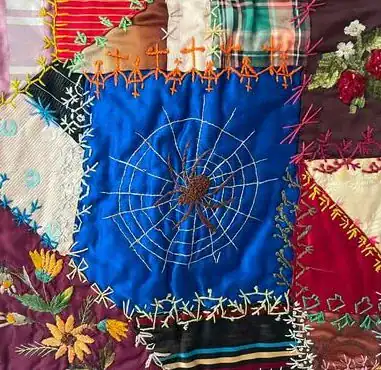
Good evening, QHLers – If you want your work to “stand the test of time”, do NOT use silk at all. I am speaking from my experience as a textile conservator (over 25 years) with a specialty in quilts. The most damaged and “shattered to bits” quilts have been the Victorian silk “crazy quilts”. Although called quilts, these really aren’t: they usually don’t have any interlining/batting; the pieced top and lining are usually tied with yarn/floss and aren’t quilted in the traditional definition of the word; they are either hand or machine sewn usually with cotton thread (the cotton thread is in great condition physically but the pieces are usually shattering!); usually a large amount of decorative silk embroidery over the seams.
>>I was wondering about those silk quilts that were made during the Victorian period. I have been unable to find out what kinds of thread and batting (if any) were used. Were they cotton? If so, wouldn’t the cotton damage the quilt top over time — either by causing the fabric to fray at the sewing lines, or by abrading the blocks from underneath? I was told that it was best to match thread type with fabric type so that the stronger type would not end up damaging the weaker type over time. Was there such a thing as silk batting? Those Victorian quilts inspired me to try my hands at all-silk quilting, and I would very much like my work to stand the test of time. >>
Regards, Margaret (Meg) Geiss-Mooney Textile/Costume Conservator Professional Associate, AIC mgmooney@
From: Judy Kelius
I can find woven plaids that don’t look that different from antique ones in many stores, not sold as repros but they will work. But it seems that there have been few reproductions of antique printed plaids and checks, polka dots, simple stripes, and other geometric prints – they may not be the ones that “pop out” at you when you look at a quilt but are definitely essential when you want to reproduce an antique quilt. I suggest you look more at the fabrics not marketed as reproductions . . . you may find what you are looking for there. Go for the “look,” not an exact match to the old fabric. Good luck! I too love the Lady of the Lake. – Judy –_3436421.ALT–
From: “Virginia Berger” <cifba@>
I am a quilter but I’m pretty slow about getting things done and have a serious backlog of my own projects. This top is just isn’t a priority for me to quilt myself and I know these church ladies do a good job. However, they have had bad experiences with some cotton batts and I haven’t tried some of the newer products out there so figured this group would be a good source for info!
Thanks to all for your advice about cotton batting.
Virginia in Iowa
Date: Tue, 13 Sep 2005 06:43:04 -0500 | From: “Barbara Vlack” <cptvdeo@>
1. What old quilt block pattern is your favorite? My all time favorite: Pickle Dish. I seem to have a magnetic pull or radar for quilts made with this pattern. I think that the attraction has something to do with triangles on a curve, because I have an equal pull of my attention for New York Beauty (and all its aliases).
2. How often do you see new quilts from old classics? More often now. I’m thinking “new quilts” meaning “new ideas” from old classics.
I credit Karen Stone for bringing New York Beauty into renewed popularity. Before she showed us how to piece the intricately pieced arcs on a foundation, there were very few NYBs in quilt shows. But NOW, there is hardly any show, local or national, that doesn’t include at least one NYB! Karen also showed us how to plan a scrapbag quilt so it coordinated with a better/pleasing/artistic look than the “just any ol’ scrap will do” look.
I think foundation piecing has taken us into the territory of piecing the complex blocks with a great deal more ease and accuracy.
I am biased about designing with a computer, because I do think that the computer is helping us make possible more innovative designing with traditional blocks. I call this “innovative traditional,” which I define as using old classic blocks and setting them in new ways. I greatly advocate setting blocks ANY WAY BUT straight with sashing. The only way those quilts grab me now is if they are colored with smashing palettes or unusual fabrics or the sashing is very different. Highlighting secondary designs when setting the traditional blocks is very attractive to me. Skewing a square block into a rectangle or elongated diamond is a GREAT way to take the classic block into new territory. For example, I demonstrate this idea with EQ5 software by taking a Bear’s Paw block through its paces. The biggest wow comes when I set, with just a few clicks, the Bear’s Paw into a Baby Blocks setting without any regard for 3D coloring. Skewing the block to 60-degree diamonds set as Baby Blocks creates a whole new look. The Bear’s Paw block is lost and snowflakes that look rather like a Scandinavian ski sweater appear.
The annual contest offered by MAQS (New Quilts from Old Favorites) has helped a lot to get many quilters to think outside the “old classic” box. I love it.
3. If you make quilts, do you ever make a quilt from an old favorite? Yep. I hand pieced a queen size Grandmother’s Flower Garden (without paper foundations — I did it without any marking of seams, just like they did it in the 30s) as my memorial for 9/11. My innovative part is an inside border of a different hexagon flower configuration that suggests Forget-Me-Nots and an outside border of a straight pieced white picket fence that was inspired by traditional mourning quilts – the fence around the graveyard. My “graveyard” is full of beautiful flowers and it’s called, “Where Have All The Flowers Gone?” (So far, though, I’ve continued with a great tradition of the 30s and GFG quilts — it’s still unfinished! — only three more sides of the outside border and the quilting to go).
I have a personal campaign to complete quilt tops and pieces from the 30s that I’ve collected. I am mixing and matching blocks into collages or medallion quilts with several borders. I am mixing vintage with reproduction fabrics reminiscent of the 30s. I am true to mixing the lovely and cute calico reproductions with some of the vintage “uglies,” which I think offer a wonderful value and textural contrast next to each other that is lacking if only reproduction 30s fabrics are used. However, I think that some of the newer repro fabric lines are starting to offer more than just a medium value cute print and a few of what I (fondly) call uglies are coming around.
I’m machine quilting some of these quilts. One Double Irish Chain quilt I have from the 30s started as just a top with 3/4″ squares hand pieced! I used my embroidery machine and embroidered lines from “Prosperity Is Just Around the Corner,” – a 30s song I found on the Internet! – in each of the open squares. I have a Trip Around the World top from the 30s that I machine quilted using the Benartex quilting design fabric on the back. That looks fabulous! I took the old stuff and finished it with new technology — and I don’t feel guilty.
I am also hand appliquéing a kit quilt from the 30s. It has poppies with centers of an awful yellow raggy fabric that I am replacing with black. Just changing to the black centers is taking that quilt from ho-hum to smashing.
4. Do you think that the intricacy of some of these old patterns [is] proving too challenging for quilters? No, I don’t. I think Jinny Beyer first took us into the realm of Mariner’s Compasses. Hers were hand pieced and we followed. Now Judy Mathieson is showing us how to use foundations to piece these patterns more accurately, and we’re with her. I already mentioned what Karen Stone has offered. Judy Niemeyer is doing more of this as well. Foundation piecing has made many of the intricate old patterns more approachable and doable.
Elly Sienkiewicz has made some of the intricate traditional appliqué patterns more accessible. Look what she has done for Baltimore Album quilts!
And look at what Diane Gaudynski has done for intricate feather quilting by machine!
The old classics are still around but wearing new clothes, yet they continue to hold their own next to the contemporary designs.
Barb Vlack cptvdeo@
Date: Tue, 13 Sep 2005 06:43:09 -0500 | From: “Barbara Vlack” <cptvdeo@>
I’ve just learned that my older son, who used to work in the Chicago office of FEMA, is expecting to be deployed into one of the hurricane areas, though he doesn’t know yet whether he will be in Katrina or Ophelia territory. He doesn’t work for FEMA any more but was working on paperwork for eligibility for temporary deployment when FEMA needed backup, especially in the northwest region, where my son now lives. This was before Katrina. Now he has been told he will probably be deployed as soon as next week and details are in process. He’s excited and hoping to be involved with the “Big One.”
In the wake of all this, I think it’s sad that there is an order from FEMA that their employees NOT wear any identifying clothing that connects them with that agency. It’s the leaders that have taken down the entire agency at a time when people should be celebrating their involvement. Their mantra should echo Mighty Mouse with, “Here I come to save the day!” and the wind has been knocked out of their sails by inefficient management. This isn’t just a mother speaking.
Gail, I think that ambulance service guy you wrote about should be up for the Congressional Medal of Honor. What’s his name and why isn’t he highlighted on TV (maybe because he’s too busy helping people)? Before I got to the end of your account, I was thinking about how that story could have blown up if he had been arrested for violating police orders. Yikes. Wasn’t Jesus arrested for something similar – helping people when no one else would and breaking the Sabbath law in order to do it? And we’re still talking about that!
Barb Vlack cptvdeo@
From: Kaytriplet@
In a message dated 9/12/05 11:12:19 PM Central Daylight Time, qhl@ writes:
> Pat, it’s not a surprise that there would be rumors about the > Houston show being canceled going around at events such as Martha’s > Quilting Academy. That probably came because the Houston mayor > announced, when they were starting to accept evacuees to the > Astrodome and the Convention Center, that all events would be > canceled for several months. Karey Bresenhan, the director of > Market and IQF, must have done some pretty powerful lobbying in > order to come back and say that the Houston show WILL GO ON.
While it is true Karey is known politically (she was literally a politician prior to getting involved in the quilt world) it is probably more true that Houston needs the $ that conventions bring in. It is my understanding that both the Astrodome and GRB Convention Center (where the quilt show always is) will have completed their duties to the evacuees this week. There certainly wouldn’t be any reason to cancel a convention 6 weeks from now.
Only about 4000 people were left late last week, as most have found apartments or places to stay with relatives. The city of Houston has not received any money for the contributions that they have made last I heard. At the beginning, I believe that the mayor thought FEMA might pay them to house the folks who came here rather than set up FEMA’s own tent cities and trailers like they have done with previous serious storms. Folks could have stayed in the Astrodome longer if it had been needed, as the building is seldom used. Evacuees from the convention center could have been moved to the Astrodome, as there is plenty of space now. The downtown hotels, restaurants, etc. are certainly hoping for a return to normalcy as quickly as possible, and now the city has an even bigger need for the tax revenue a convention generates. And, while it is a minor element, the folks who were still left after 2 weeks were not always ideal visitors to our city. They are being given housing in Houston where they can start a normal life if they wish to. They have enough money from FEMA to live for 3 months. There are help wanted signs all over, mostly minimum wage or heavy lifting jobs, but those who are able can work if they chose to.
So, no worries about the quilt show. See you there!
Kay Triplett in hot, humid Houston
From: Ginny Crosthwait <ginnymarie@>
Has anyone ever seen a quilt like this? I thought it was made from a kit, but I wonder if anyone knows the designer or anything about it. Would you say 1930s?
http://home.earthlink.net/~ginnymarie/
Thanks–
Ginny
From: Barb Garrett
Gail Ingram wrote:
>How interesting, Jennifer. Did the original name suggest a German >settlement, or was it just honorific, > Hi Gail –
Historically, there is a large PA German Mennonite settling of the area around Kitchener. Below are 2 short bits of information that tell the story better than I could. Beware, it may be more information than you wanted <grin>.
Barb in Southeastern PA
# 1 — Attracted by available, inexpensive land, as well as the prospect of living under British rule, the first few Swiss Mennonite (German speaking) families left Pennsylvania shortly after the U.S. War for Independence in 1776. Following what came to be known as the “Trail of the Conestoga”, they trekked in covered wagons to settle in the Niagara Peninsula and along the Grand River of what is now Ontario. From 1785- 1825 more Mennonites from Pennsylvania crossed the Niagara River. Many settled in Waterloo County, where Benjamin Eby founded Ebytown (present-day Kitchener) in 1807. During this 40-year period about 2,000 people came to Ontario from the United States.
# 2 — What’s In A Name? Berlin to Kitchener —
Those who live in, or have the chance to visit, Kitchener, Ontario will be very familiar with the area’s rich German culture and heritage. The original settlers of the region were of an agrarian, pacificist Mennonite background. By the eve of the First World War, Berlin, Ontario — dubbed “the German Capital of Canada” — boasted myriad German-language societies, German language instruction in schools, and a German-language newspaper. As the Great War continued, the loyalty of German-Canadians became more and more suspect. In August 1914, the bronze bust of Kaiser Wilhelm, proudly displayed in Victoria Park, was removed and thrown into the lake. Open mistrust of enemy aliens in the city led to the suspension of German-language instruction in schools.
In 1916, the Berlin Board of Trade made a suggestion that polarized the citizens of the city. The Board of Trade argued that the name Berlin hurt business and gave the impression that its citizens were sympathizers of the enemy cause in Europe. It was suggested that the act of changing the name of the city would be a tangible symbol of its citizens’ patriotism and would boost the city’s profile across the Dominion. Many Berliners supported maintaining the name of the city, as it reflected a proud tradition of growth and prosperity for German, and non-German, Canadians alike. Those citizens who supported the status quo were immediately perceived, by those who wanted change, as being unpatriotic and sympathizers with the enemy. Violence, riots and intimidation, often instigated by imperialistic members of the 118th Battalion, were not uncommon in the months leading up to the May 1916 referendum on the issue.
A majority of Berliners did chose to opt for a new name and by early summer the search for a new city moniker was on. A special committee was set-up by the city council with the express purpose to suggest possible names. On September 1, 1916, the name of Kitchener was officially adopted after the late Lord Kitchener.
Horatio Kitchener was appointed Secretary for War by the British Prime Minister, Herbert Asquith, at the beginning of the Great War. His image, beckoning recruits with an outward stare and finger pointed, was immortalized on Alfred Leete’s dramatic poster “Britons Want You!” Kitchener had drowned earlier in 1916, when the ship he was travelling on hit a mine near the Orkney Islands. It would be next to impossible for citizens of the new Kitchener to be considered unpatriotic.
Nonetheless, some Canadians did not readily adopt the new name for Berlin. The Post Office had to issue memoranda, reminding correspondents that there was no city in Ontario named Berlin. The issue was so contentious that several Canadian municipalities petitioned the Dominion Government to force those who did not comply to use the name Kitchener. Although ludicrous to modern eyes, the whole issue of a name for Berlin highlights the effects that fear, hatred and nationalism can have upon a society in the face of war.
From: <chrisa@>
Are you also recommending that we do not use modern day silk fabrics in quilts? I completely agree with your assessment of weighted silks in the Victorian times and I recently heard that weighting is back!! Also that it is not possible to tell by looking at the bolt, so buyer beware. Are you referring to this? Was it China that was doing the weighting today?
Erika Carter spoke at our guild last week and she is working exclusively in silk organza now. She dyes the fabrics first and appliquE9s them onto silk organza. Would this version of the silk also be prone to deterioration?
Thanks,
Kim Wulfert www.antiquequiltdating.com
Good evening, QHLers – If you want your work to “stand the test of time”, do NOT use silk at all. I am speaking from my experience as a textile conservator (over 25 years) with a specialty in quilts. The most damaged and “shattered to bits” quilts have been the Victorian silk “crazy quilts”.
From: Kim Wulfert
Harriet Hargrave made some great polka dots in her collections over time. More recently Pat Nichol’s newest line included printed plaids that were tiny. I just used the pink one in a 30 quilt made with the super large flour sack prints from Darlene H ?? and it looked great even though Pat’s are made to represent the 1840s. Polka dots have some back big time in other than reproductions lines, so I’ m not sure about the colorways, but if you look in Hancock’s of Paducah’s newest catalogue or online you’ll see this is so.
I think Judy K.’s suggestion is right on. I have seen glorious printed plaids in fondue style and otherwise made by Marcus Bros.,not Judy R., but another designer on staff, but this was awhile ago. Fabrics from the Calico and Chintz book of Patricia Smith’s collection, were great ones in there too, with a good variety of printed plaids in large scale with some other types of motifs on them as well.
I don’t think you will find many or any large scale, wavy as you say, pink plaids, as pink wasn’t the color they were made in using the steam process and mineral dyes that were used to make shaded (ombre, fondue)prints, which also facilitated making these particular printed plaids easily and affordably in the second quarter of the 19th century.
Some of these old lines are still on bolts in shops. you might even check with the online sources like vintage&vogue and reproductionfabrics. This is the only good thing about reproduction fabrics not being that popular with quilters- you an often find old ones when you need them.
Have fun looking!
Kim Wulfert www.antiquequiltdating.com
From: <chrisa@>
To give credit to the designers that give us these great early 19th century reproduction fabrics- here are the names of those I mentioned in the earlier email-
Marcus Bros. – 2000ish printed plaid and pillar print line by Karen Jarrar
Calico & Chintz- Bonnie Benn Stratton, Timeless Treasures printed plaid with flowers and a less plaid-like look
Marcus Bros. – Laura Wagner, printed ombre with madder print as thinner lines
Rose, a very dark version of pink, was made in that era, which might work for you.
I assure you there are others, but these are especially good reproductions and they were handy to reach in my stacks! Many printed plaids have been made from the post CW era too. They are smaller in scale and not as likely to be wavy or shaded in their appearance.
Hope this info helps you find the old lines.
Kim Wulfert www.antiquequiltdating.com
From: “Lucinda Cawley”
I saw a quilt just like that a year or so ago in an antique shop here on the Eastern Shore. I thought that one was 1930s. Cinda on the Eastern Shore