May 24 – 28, 1997
This page contains affiliate links. If you buy through them, I may earn a small commission at no extra cost to you. As an Amazon Associate I earn from qualifying purchases. Learn more
These restored messages come from the Quilt History List, an online forum where quilt historians, collectors, researchers, appraisers, and enthusiasts discussed antique quilts and related textiles. The archive dates from 1996 through approximately 2016 and is being restored gradually. Sign up in the form at the bottom of the page if you want to know when a new page is added. Original spelling, opinions, formatting, and inactive links may remain unchanged.
Primary topics of this QHL Digest:
Grab Bag: Fabric Finds & Book Recommendations — Members share recent fabric and quilt-top finds along with recommended reading, including a novel referencing quilt history.
Underground Railroad Quilt Codes, Continued — The Log Cabin/Underground Railroad debate continues, with members citing sources on both sides and questioning how patterns could have been reliably transmitted.
Penny Squares & Kit Quilts — Members trade knowledge on Penny Square embroidery patterns and who the recognized experts on 1930s kit quilts are.
Quilt Preservation Techniques — A conservator shares professional tips on stabilizing fragile quilts, prompting a wider swap of hands-on preservation tricks.
Date: Sat, 24 May 1997 09:31:51 -0400 (EDT) | From: Marion G Ingram <mgingram [at] Nancy Evans had a great idea on preserving markings when things have to
be washed before working on them(trace the pattern before washing)~~I
would like to add to that: use regular tracing paper the size of your
blocks this can even be done by machine without thread in the needle
and then just make as many copies as you need to use the traced design
like paper piecing when you are ready to put the design back on the
blocks. Does this sound feasible?
—
Marion In Jacksonville
Date: Sat, 24 May 1997 08:53:04 -0500 | From: gridgees [at] algorithms [dot] com (Merry May)
Although she’s probably up to her eyebrows in stuff right now, I believe
that Xenia Cord has done some research on Kit Quilts. I’m sure she can
give you more direction on where you can start looking for more details on
that topic.
Merry in southern N.J.
gridgees [at] algorithms [dot] com
Date: Sat, 24 May 97 11:07:06 PDT | From: John & Cinda Cawley <cawley [at] epix [dot] net>
I think that if the Log Cabin quilt or any other sign had been used
consistently as a symbol of a safe house the slave catchers would have
caught on very quickly.
Cinda in Scranton
Date: Sat, 24 May 1997 10:02:30 -0500 | From: ShirleySpencer <ShirleySpencer [at] prodigy [dot] net>
Beverly Dunivent is an authority on 30’s quilt kits. She is an
accredited quilt appraiser and a member of the Quilt Restoration
Society. I’m sure she could help you with your questions about the kits
you have acquired. I do not have an email address for her, but possibly
Kris or Nancy Kirk would know if she had one. I have a postal address,
but hesitate to put it here without her permission.
ShirleySpencer [at] Prodigy [dot] com
Date: Sat, 24 May 1997 15:19:27 -0500 | From: cabhoney [at] juno [dot] com (Cindy A Honeycutt)
I would like to know more about the history of Penny Square patterns. I
have seen some squares done in all red embroidery and some done in all
blue. How do you know the difference between a Penny Square Pattern and
any other older embroidery pattern that may have been on the market? Is
there any book out on Penny Squares?
To change the subject, I bought two
quilt tops at garage sales this weekend. One is predominately pale yellow
and purple, the pattern I’m unsure of, so I’ll be cracking the quilt
pattern books tonight. It was made between 1930-1950 by a 81 year old
lady (her current age). She begged me to come in her house to see an
embroidered top of the 48 state flowers. I told her I only quilted for
myself, not for hire as I wouldn’t have time or didn’t think I could do
it justice. I just recently started to work after 14 years as a stay at
home mom, so I’ve been a little overwhelmed.
The other top I bought at
another sale is a lilac sashed Sunbonnet Sue, made from feedsacks. I
thought the white squares Sue was appliqued onto were a little stained,
but the closer I looked, I could read “Gold Medal Flour” on the white
squares! How charming! Another find from last weekend after being in my
Grandmother’s attic was a blue striped flannel quilt that had been tied.
It was hanging on the rafters with dust and insulation all over it. I
plan to restore it to a little better shape. It needs a few minor
repairs, but I love the feel of it. Thanks for letting me share as I have
had not had time recently to respond to this wonderful board.
Cindy Honeycutt, Norman, Oklahoma
Date: Sat, 24 May 1997 18:10:22 -0400 (EDT) | From: SASHIFRIN [at] aol [dot] com
Apologies if Nancy in Virginia’s question about the Log Cabin Quilt pattern’s
use in the Underground Railroad days has already been answered.
I have heard that the Log Cabin quilt was indeed used as a symbol of a safe
haven for the slaves. The log cabin blocks were crafted with a center square
of black fabric (instead of the more usual red or yellow centers) and hung
outside the home as a sign that it was a waystation on the Underground
Railroad.
Now my question – Can someone on this list provide a source or a verbal or
visual description of the honeybee block? Barbara Brackman’s Encyclopedia of
Quilt Blocks is on my wish list. Is this block included?
Thanks,
Sari Shifrin
sashifrin [at] aol [dot] com
==================================================
Jane and others,
Is it true that the Log Cabin pattern quilt was used in the Underground
Railroad as a symbol of a “safe” haven for escaping slaves? I’ve heard
this..
Nancy in Virginia
Date: Sat, 24 May 1997 20:14:57 -0400 (EDT) | From: NancyR394 [at] aol [dot] com
Hello all–
I have been lurking, I guess–just enjoying reading what everyone has to
say. But on the subject of the potholder or stuffed trinagle quilts, I think
I saw one at the Burlington,KY flea market last weekend.
Burlington market is at the Boone Co. KY, Fairgrounds the third Sunday
of every month and I saw this quilt there in April and again in May. I
remember this, because the vendor pointed it out to me as unusual because it
was double sided, or reversable. This was triangles, too–Broken Dishes is
what I call the pattern. The triangles were whipped together, and I’d never
seen anything like it. Just goes to show what I can learn when we all share
things.
Thanks to all who post here; I enjoy this board very much.
Nancy Ray in Lexington KY, where it was finally warm enough to wear shorts
today!
Date: Sat, 24 May 1997 20:12:17 -0400 (EDT) | From: JOCELYNM [at] delphi [dot] com
On 22-MAY-1997 21:23:42.3 oldquilt said to JOCELYNM
> From my own knowledge, I know that this pattern did not come into
>existence until the 1920’s – but where did it get its name, I wonder?
Kris,
There is an older pattern called ‘wedding ring’. If you look at the
double wedding ring quilt, it appears to be the older pattern, but with
twice the rings interlocking!
Also, I would guess that the increasing preference in this century for
double wedding ring ceremonies, may have had something to do with it (in the
19th century, rings were optional for men.)_
Jocelyn
Date: Sat, 24 May 1997 20:12:30 -0400 (EDT) | From: JOCELYNM [at] delphi [dot] com
On 23-MAY-1997 06:29:36.1 Baglady111 said to JOCELYNM
>Hill of England (who posts here now and then) in Paestrum, near
>Salerno, Italy, and it is the DOUBLE WEDDING RING on a tile floor in
>ruins she was visiting..it is a pattern that has wonderful stories
>connected to it..AND THAT’S ALL THEY ARE..STORIES..This is one of the
>patterns I discuss in my lecture ‘HOW QUILT PATTERNS WERE
>NAMED”..Fascinating..
Is there evidence that it was used in quilts in Italy?
FWIW, painted pictures often ‘lie’. Particularly if there’s a Madonna
nearby…….because the artists wanted an ‘other-worldly’ look to the
setting, so they would make up objects and designs. Also, painters of the
Middle Ages had colors that dyers could not replicate, so clothes are often
painted in ‘the colors they WOULD have worn, if they could have’. <G>
Jocelyn
Date: Sat, 24 May 1997 20:06:18 -0500 (CDT) | From: Nancy Evans <nevans [at] nebnet [dot] net>
>I agree with what Cinda says, except that I can remember reading the same
thing as the original poster mentioned. The separating indicator for the
quilt at the safe house was that the center of the Log Cabin was black
instead of the traditional red.
>
>As to why that was not caught, it could be that they never added it up –
just a color difference like that. Or maybe it was such a common quilt
pattern back then that they couldn’t check all the block centers! Dunno –
just wish I could rember where I read it. I know I read it recently, but
that doesn’t mean much – I do a lot of reading & about 97.5% of it is about
quilts!!!
>
>
Nancy Evans – Nebraska Quilter
Date: Sat, 24 May 1997 20:15:57 -0500 (CDT) | From: Nancy Evans <nevans [at] nebnet [dot] net>
Well, my finds may not be REALLY spectacular, but I thought I would share
them anyway.
1. Just a feedsack, floral print on white ground; not special, but in good shape
2. Great piece of fabric, probably from the ’70’s. it is blue print on white
ground. The print is modern cartoons with a Shakesperean quote beneath. Very
comical, some of them!
3. Old quilt top, c. 1910. Mostly shirting fabrics in fair shape. This is a
one-patch with the patches as rectangles about 4X6″.
4. Another one-patch quilt top. This one is all ’30’s prints in really great
shape. The colors are bright & pretty & not too frayed & frazzled.
Like I said nothing special, but I figure I have a nice bunch of fabrics in
the tops to use in restoration projects. I have no hesitation about taking
them apart for that purpose, since they are just plain squares & rectangles
and not a block pattern. Any comments on this? I do not feel there is any
historical value to them, other than they are in the same quilt. I guess I
figure I will do what it takes to save another quilt’s life!!! Just call me
Dr. Nancy!!! I assume others use these types of old quilt tops for this
purpose, right?
Nancy Evans – Nebraska Quilter
Date: Mon, 26 May 1997 21:03:19 +0000
From: Mark Mashaw <mtm [at] snet [dot] net
Hey folks, I haven’t posted in a while but here is a review of a book I thoroughly enjoyed, a quick read and available on book on tape to quilt by! I posted this review at Amazon books. You can purchase it there if you want.
The Persian Pickle Club Written by Sandra Dallas
What is a Persian pickle? Why a paisley printed material of course.
In this particular case a whole bolt of an especially striking Persian
Pickle was purchased by a loving husband for his quilting wife who
treasured it like gold and shared scraps of it with her quilting friends
through the years.
Written with the flavor of good southern home cooking this tasty little
novel flies by in the blink of an eye. Queenie Bean draws you into the
Pickles, where you, as a privileged member, share in their joys,sorrows
and secrets. With such characters as Opalina Deux and Agnes T. Ritter,
this yarn can�t help but make your eyes twinkle, your steps skip and
of course, your fingers itch to stitch. A thread of small town mystery
is woven into this fabric and gives it added sparkle and appealing
spice. In the tradition of Fannie Flagg�s Fried Green Tomatos at the
Whistlestop Cafe Sandra Dallas writes with warmth and humor and shares
the enjoyment and friendship of her characters with us.
I had fun writing this review and wanted to share it and this great
book with all of you as a thankyou for all your knowledge and postings
that I so enjoy reading daily! From Mary in Beautiful CT (where Spring
has finally sprung!)
Date: Tue, 27 May 1997 21:58:12 -0400 (EDT)
From: JOCELYNM [at] delphi [dot] com
On 25-MAY-1997 15:37:20.9 Baglady111 said to JOCELYNM
> in reply to laundry and quilts..from my home in VA, which is a very
>rural mountain area..I can tell you EXACTLY how often quilts was
>washing..POSSIBLY twice a year and in most cases once..spring/summer
>time..then packed away til winter..if kids had an accident of any
>kind..the quilt was tosse over the upstairs porch rail..which alot of
Jane,
Ah, I rest my case! So to see a quilt hanging on a line, the neighbors
might just think that you had a bedwetting child! <G>
Jocelyn
Date: Tue, 27 May 1997 21:58:03 -0400 (EDT) | From: JOCELYNM [at] delphi [dot] com
On 25-MAY-1997 15:22:09.9 Baglady111 said to JOCELYNM
> as to patterns being used to signify safety and others catching on to
>that signal..I wouldn’t know..but they PROBABLY wouldn’t use the same
>pattern, the same house, the same people repeatedly..WOULD YOU??
Jane,
I was reading something on the Underground Railroad today– but not
about quilts. The directions were put together in rhymes, so that the
escaping slaves could more easily remember them.
This sounds to me as if the directions had to remain constant over
time.
We may be reading too much into this….such as, our awareness of quilt
patterns. If a woman had a custom of airing her quilts often, then I suspect
the slavecatchers wouldn’t find anything noteworthy about seeing a quilt
hanging on her clothesline….if there were quilts of all sorts of patterns
hanging there 2-3 times a week, whenever the weather was good. I doubt most
slavecatchers, being men, gave quilts a second glance, let alone remembered
that a particular pattern was always out whenever there were missing slaves!
Jocelyn
Date: Tue, 27 May 1997 21:59:03 -0400 (EDT) | From: JOCELYNM [at] delphi [dot] com
> Hi, everyone.
> Pardon my ignorance, but I was just wondering with all this talk
>about the Log Cabin pattern – What’s the Underground Railroad?
LiJoo,
The Underground Railroad was an informal network of anti-slavery
Americans who would help and hide escaped slaves in the years before the
Civil War. Perhaps you’ve heard of Harriet Tubbman? At any rate, families
would either have a hidden room in their homes, or would use a cellar or
barn, to hide escaped slaves from the ‘patterollers’ (patrolers) or
slavecatchers. Slaves could get a few meals and a safe night’s sleep, and
then be directed on to the next safe house. Quakers were very commonly
involved in the Underground Railroad, because their beliefs about the
equality of all people took precedence over their beliefs about obeying
laws.
The Civil War (1861-65) pretty much disrupted it, as it was hard to
escape through army lines, and of course at the end of the war, all slaves
were freed.
Jocelyn
Date: Tue, 27 May 1997 21:59:12 -0400 (EDT) | From: JOCELYNM [at] delphi [dot] com
On 26-MAY-1997 14:07:01.1 AJSNGS said to JOCELYNM
> I have two questions. What exactly is shirting? Is this any
>different in feel, texture, etc. than regular 100% cotton? Or is it
>heavier? Also, what exactly is double pink? I’ve heard both of these
>terms many times but need some clarification.
Nancy,
Shirting is fabric suitable for making a man’s shirt…both weight-wise
and print and color-wise.
Double pink? I saw this on PBS on Saturday! It’s a fabric that’s
printed twice with pink. There’s a crosshatching of background pink, and
then it’s overprinted with a design. Sort of a pink-on-pink print.
Jocelyn
Date: Tue, 27 May 1997 21:58:43 -0400 (EDT) | From: JOCELYNM [at] delphi [dot] com
On 26-MAY-1997 09:06:22.4 LISA108 said to JOCELYNM
> Actually, the great majority of colors used in Renaissance paintings on
> clothes *were* used on actual cloth – I can think of only one exception
> off hand, the ultramarine blue used by the Limbourg brothers in their
>work for the Duc de Berry. But the medieval/Renaissance dye palate
Lisa,
Yes, that was exactly the one I was thinking of. To look at the Book of
Hours, you could assume that that color was very common…but instead, it
was used solely because it was impossible to achieve.
> The convention until very, very late (almost to the Baroque era) was
>that Biblical scenes would be painted in contemporary dress and
>settings, with only the main characters wearing what the artists
>thought were Biblical clothes. This is why Luca Signorelli’s
Right….so that whatever the Madonna is wearing cannot be used as
documentation of women’s clothing…and I’d be suspicious of the items
immediately in her vicinity, such as draperies, upholstery, rugs, etc….
because the painter MIGHT be painting an accurate depiction of a home of the
era, but he might be imagining what a Biblical or heavenly home would look
like. The common people in the paintings do tend to be very historically
accurate.
> What this all leads to is that I’d be inclined to trust a picture
>painted after, say, 1400 when it came to a “patchwork” floor. Realism
>was increasing by then, and there was patchwork clothing and some
>patchwork quilts. Plus, didn’t Ami Simms see several such patterns in
>the floor tiles in Florence’s cathedral, which was built in the 15th
>century?
Still, I wouldn’t assume that a motif that existed for ornamenting
floors was also reproduced in fabric. For example, the Moors used a lot of
mosaicwork, but I don’t know of any source that says they ever reproduced
those designs in fabric, either as furnishings or clothing. If you do, I’d
love to know about it.
Jocelyn
Date: Tue, 27 May 1997 20:14:06 -0600 | From: Elizabeth Richards <elizabeth.richards [at] ualberta [dot] ca>
When I was preparing for my workshops on quilt preservation/conservation two
weeks ago I was complaining to our conservator, Shirley Ellis, that the acid
free tissue in my folded quilts and tops was very crushed and that it wasn’t
doing much good (but I supposed it was better than nothing). Shirley
suggested that I buy nylon netting, wash it, and use it instead of the acid
free tissue. Her reasons were that the resiliency in the netting would
cushion better and that in the long run it was cheaper than acid free
tissue. I think it’s a good idea but I wouldn’t use it with silk quilts or
really fragile cotton ones because it is a bit scratchy.
I think washed cotton muslin, or old cotton sheets, would be good too. The
important thing is that the quilts get refolded and the folds cushioned (and
that some dear family member doesn’t pile thier camping stuff on top!).
–
Date: Tue, 27 May 1997 22:08:06 -0700 | From: Sharon Harleman Tandy <harleman [at] micron [dot] net>
Dear QHLers, I am tempted to believe that a point is being missed in
this discussion of palette, painting, and patterns. It wouldn’t matter
what colors were used to depict any subject matter; if a recognizable
quilt pattern were found in a very old painting as the design on a
floor, in parquetry, or in any other form, of course it wouldn’t have to
be in a quilt: the pattern would be there for anyone who viewed the
painting to interpret into any item they wished to make, devise, or
sew. It doesn’t have to have been a quilt pattern then; it was
available then to be used in anything.
The current QNM has an excellent
article on the Egyptian mummy/cats and the wrapping on them. Looking at
the photograph, it is easy to see how that multiple layered wrapping
could be interpreted into a flat, two-dimensional representation,
whether in wood, ceramics, fabric, or in ink on papyrus. Interlocking
circles (what we call Double Wedding Ring) have been used for centuries
and centuries; what is hard to pin down is just when the circles (or the
strips around a center, Log Cabin) might have been used the first time
in quilting. Don’t forget the book about using architectural details to
design quilts; that may have been going on for a very long time. Sharon
in Boise, where it can’t make up its mind to really be spring again.
Date: Wed, 28 May 1997 05:31:58 -0400 (EDT) | From: Baglady111 [at] aol [dot] com
I thought I was th only one who, while driving up the highway, passes a car
and sees a quilt goin’n camping..and YOU KNOW!!! they aren’t cover’n with
it..how I want to stop that vehicle, make a citizen’s arrest and confiscate
the evidence..
never thught about the netting..good idea..nothing in it to harm the
fabric??? Jane
Date: Wed, 28 May 1997 05:55:36 -0400 (EDT) | From: Baglady111 [at] aol [dot] com
in remembering back, when I would be at an aunt’s house for a week..the
bedding was aired everyday..so yes, it would be customary to see quilts
hanging..and WOULD IT NOT BE POSSIBLE, knowing a particular house was a
‘safety hosue’ that a certain pattern would signify DANGER..NOT TONIGHT???
That would be perfectly logical..I must do some asking of friends in Floyd,
Va..where my farm is..
Also, look how many patterns are popping up thru this thread..it is quite
possible that just a quilt was the signal..or a certain color..
I wanted to mention also about the L/C I discussed..does anyone know if the
COURTHOUSE STEPS the mummified cat in CA is wrapped in has the black center?
I had mentioned this story online (and I THOUGHT) on QHL previously, that a
lady came back and said what museum in CA it was in and that it was a cat..I
onlyu knew it to be a ‘mummy’..but how old the isle of MANX ???..but this
patterns date back to 500 bc..the mummy is over 2000 yrs old.. Jane
Date: Wed, 28 May 1997 06:00:31 -0400 | From: Marion G Ingram <mgingram [at] ix3 [dot] ix [dot] netcom [dot] com>
There is a softer net out there somewhere it is a smaller
netting, do not know content, but it can be checked. What
good ideas people come up with
—
Marion in Jacksonville
Date: Wed, 28 May 1997 12:24:50 +0100 | From: “Audrey Cameron” <audrey.cameron [at] virgin [dot] net>
I hope its not too late to introduce these comments on last week’s
discussion about labelling groups of quilters by religion as came out in
discussion of the new book about Morman quilts.
Religion is only one way of grouping a people – In fact anything will do &
we do not have to look far to find wonderful quilts books with groupings
such as 1930’s Quilts, Michigan or Vermont or Oregon Trail or New Jersey
Quilts or Hawaiian Quilts or 20th Century Quilts or Amish Quilts or
Children’s Quilts & so on forever. Every group that has some common
denominator be it sex, age, religion, ethnic, time or such will have
certain characteristics that can be seen when looking at the group as a
whole. Many of these characteristics can be transcribed into craft & art
work and so I mean quilts.
One of the ways of dating quilts is by fabrics & then these same fabrics
used in frontier quilts were able to be located by area as peddlers who
brought the fabrics to out of the way locations sold to a limited area. The
quilts of these area showed the same fabrics & when the quilts travelled
(being given to family members or such & being carried to new areas &
locations) often they could be traced back to their origins by similarity
of fabric not only by style.
Religion can be one great distinquisting factor as we all know especially
by the Amish interpretations of quiltmaking which they learned from their
“English” neighbours & then made their own. Morman women were cut off from
the general population at the time of their trek, by the trek itself & by
their religion. Of course, they merit a study & we are the richer by being
able to benefit from that study. And what a wonderful book it is.
Are there other groups that we accept as obvious & so they are invisible?
The last few years have brought a stunning range of books as a result of
quilt studies of all kinds. Ours (British) was published in 1995.
Lets enjoy any study of quilts. We love them, we make them, & we want to
see them & read about them & this group of all enjoy the history of them.
By the way & not completely irrelevant: did the Shakers make quilts?
Audrey in sunny cool England
audrey.cameron [at] virgin [dot] net
Date: Wed, 28 May 1997 07:33:28 -0500 (CDT) | From: [from unknown]
Another good idea I heard at the AQS show was to stuff old pantyhose with
batting and lay at the fold areas of a quilt. Haven’t tried it yet, but it
sounds worthy of investigation.
Date: Wed, 28 May 1997 08:01:20 -0500 (CDT) | From: [from unknown]
Saw an odd quilt top in an antique mall. It was about one
yard square. It was made of 3 inch squares. On top of each
square was another square, folding in half diagonally,wrong
sides together. The triangle made a pocket with the
base square. There was a definite “up” to the pockets, but some
were turned right, some left on the base squares.
It was all hand sewn, pretty large stitches. Price marked was
$25, which I thought was a bit high. Fabrics appeared to be 40s
or so. Has anyone seen this before? Does the unusuallness of
it make it worth $25?
Alice Cruz
The Quilted Chile
akcruz [at] ix [dot] netcom [dot] com
Date: Wed, 28 May 1997 09:22:35 -0500 (CDT) | From: Nancy Evans <nevans [at] nebnet [dot] net>
At 08:01 AM 5/28/97 -0500, you wrote:
>Saw an odd quilt top in an antique mall. It was about one
>yard square. It was made of 3 inch squares. On top of each
>square was another square, folding in half diagonally,wrong
>sides together. The triangle made a pocket with the
>base square. There was a definite “up” to the pockets, but some
>were turned right, some left on the base squares.
>
>It was all hand sewn, pretty large stitches. Price marked was
>$25, which I thought was a bit high. Fabrics appeared to be 40s
>or so. Has anyone seen this before? Does the unusuallness of
>it make it worth $25?
>
>Alice Cruz
>The Quilted Chile
>akcruz [at] ix [dot] netcom [dot] com
>
>
>
Alice, the $25 seems high to me, if the top is only 36″X36″. That is a
little pricey. However, if you are involved in resoration, there is probably
a lot of useable fabric in that piece (providing the fabric is in good
condition). Also, I look at the price on any item I find in such a setting
as the STARTING price for negotiation. And I have been told by many dealers
that the price they put on an item is just that – start of discussion! One
said to me once “No price on my items is final price!”
FWIW!
Nancy Evans – Nebraska Quilter
Date: Wed, 28 May 1997 12:15:49 -0400 (EDT) | From: JZgliniec [at] aol [dot] com
In a message dated 97-05-28 09:05:17 EDT, you write:
<< Does the unusuallness of
it make it worth $25? >>
Dear QHL,
Yes, rarity can make a difference ! Just as limited editions cost more than
mass produced items, a rarely seen pattern can cost more than a common one.
Rarity is one of the factors an appraiser takes into account when
determining the value of an item.
Regards,
Julia
Date: Wed, 28 May 1997 11:23:31 -0600 | From: rcsmeyer [at] umslvma [dot] umsl [dot] edu (Suellen Meyer)
Merry asked if anyone has seen Log Cabins with black centers. I have two
in my collection — both the Barn Raising variation. Both were made well
after the Civil War and would not have been used on the Underground
Railroad.
One was made about 1900 by a tailor’s wife in Fulton, MO, from fabric
samples supplied by the manufacturers and remnants from suits and ties that
the tailor had made. She used many kinds of black wools for the dark side
and bright reds, blues and so forth for the light side. All the centers
are of black velvet.
The other one, a top only, was made by an unknown maker in Shelby County,
MO, about 1880. Pinks, greens, and browns predominate in the logs, but all
the centers are black, though of various textiles.
I’ve also heard that black centers were used in the Log Cabin variation
called Courthouse Steps, where the black signifies the judge’s robes.
My guess is that any quilt could be used as a signal for a safe house and
that the signals were changed frequently.
Suellen Meyer
Date: Wed, 28 May 1997 16:56:45 -0400 (EDT) | From: KBoxmeyer [at] aol [dot] com
I just finished reading a very enjoyable book I got from the library to
read to TweetyBabe. Based on its topic, I thought I’d share it here. It
fits in quite well with the discussion on the Underground Railroad and
quilts.
It is called:
“Sweet Clara and the Freedom Quilt”
by Deborah Hopkinson
paintings by James Ransome
published by Alfred A. Knopf, Inc., New York
and simultaneously in Canada by Random House of Canada Limited,
Toronto
copyright (C)1993
The summary on the back of the book reads:
“As a seamstress in the Big House, Clara knows she’s better off than
the slaves who work the fields. But slavery has separated Clara from her
mother, and she can never be happy without her. She dreams that they’ll
be reunited one day, and even that they will run away together — north
to freedom.
“Then Clara hears two slaves talking about how they could find the
Underground Railroad if only they had a map. In a flash of inspiration,
she sees how to use the cloth in ther scrap bag to sew a map of the land
— a freedon quilt — that no master will ever suspect. And someday,
when her quilt is complete, she will follow its path to freedom.
“Based on a true, little-known chapter in African-American history,
Debroah Hopkinson’s first picture book is an involving story of a young
girl’s resourcefulness and courage.”
Is anyone aware of the validity of this story or where/how I could track
down its validity?
Eagerly anticipating your replies,
Kimberly
Date: Wed, 28 May 1997 17:07:48 -0400 | From: “Phyllis Twigg” <ptwigg [at] radix [dot] net>
Hi Kimberly,
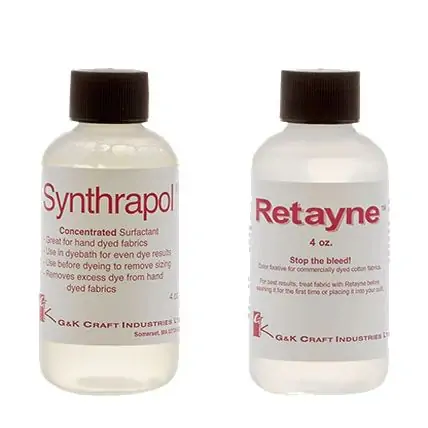
Synthrapol is used a lot with hand dyed fabrics. Around here (Annapolis)
you can get it in Art supply stores. I’ve found it at quilt stores or quilt
vendors at shows and in mail order catalogs dealing with quilts. Basically,
it removes excess dye from hand dyed fabrics. I’ve seen it used
successfully in some very nice quilts where one color has run (bled) into
another.My 4 oz. jar costs $ 1.30.You add one teaspoon to a gallon of
water. I don’t know how it would work on embroidery floss or other fibers (
such as in your feedsack tablecloth), but it won’t hurt anything. The late
Jan Tucker, of Daffodil Dyeworks, suggested it to me.
The maker is Craft Industries Limited, Somerset, MA 02726-0038.
Good luck !
Phyllis
———-
Date: Wed, 28 May 1997 18:04:02 -0400 | From: Diane McGuire <dianemcg [at] ici [dot] net>
Thanks to Lisa for the detailed comment on Renaissance Art. My college
roommate and I avoided taking the Intro. to Art course as part of our
English major requirements until last term senior year so we “had” to
take Art History instead. I have been hooked ever since, and see
overlaps in all media.
Before I knew a lot about historic quilts I visited a small museum in
Portsmouth NH (I think) and saw a huge and fabulous “modern art”
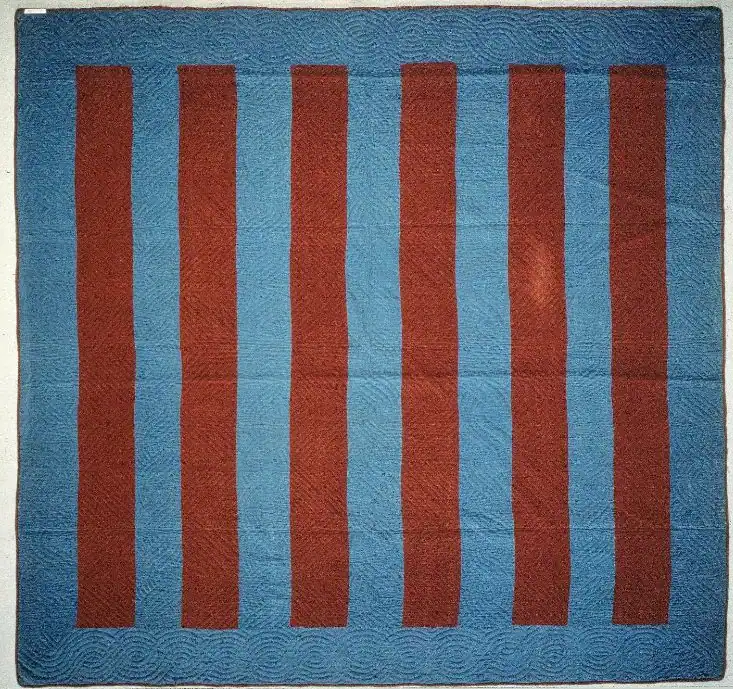
painting in dark colors of a square within a square within a square. I
photographed it and thought what a great design. Suddenly it showed up
as, you guessed it, an Amish quilt! I think the quilt was there first.
I greatly admire the Renaissance Flemish painters. I have seen some
paintings at the Museum of Fine Arts in Boston where I could count the
bricks used to built the building, and where the lace on netting is so
transparent I was sure it was 3-D.
I love Hieronymous Bosch because when I show my Senior high school
students his “garden of delights” where he uses people as vases they
understand that “wierd” is not new.
I remember reading that a key ingredient as a dye fixative was
ammonia. The handiest source is stale human urine. People saved it up
for dye day. It was also used on whale ships to disolve the whale oil
on the sailors clothes. They then rinsed the clothes in sea water
(plenty of that around) and, if it had rained recently, in fresh
water.
It might seem distasteful to us, but I am grateful to our foremothers
that some of their dyes held so well.
It seems like the more we research, the more we realize we owe to
those who came before us.
Diane in Massachusetts where I value even my adopted history.
Date: Wed, 28 May 1997 19:40:15 -0400 (EDT) | From: Quilting Heritage ListServ <qrs [at] mail [dot] albany [dot] net>
The author, Deborah Hopkinson has a web page at
http://whitman.edu/~hopkinda, and her E-mail address is
hopkinda [at] whitman [dot] edu. Looking around her web page, I would guess she wrote
this book as a teaching tool – she apparently offers lessons around the class.
She has some fascinating links! And there is a lot of information on exactly
what we have been discussing. On one of her pages, she says:
>Quilts were also used as markers in the underground
>railroad. Those with the color black, when hung on a
>clothesline, designated a safe house. A drinking gourd
>was also used to symbolize the Big Dipper which points
>to the North Star. Runaway slaves followed the North
>star to find freedom. This quilt block with an oak leaf
>motif was made by a slave.
She links that paragraph to a page on the Underground Railroad, OK, all you
Ozzies may now turn to: http://www.sos.state.mi.us/history/museum/explore/museums/hismus/prehist/civ
ilwar/undergro.html) and also links to
http://www.sos.state.mi.us/history/museum/techstuf/civilwar/quiltslb.html
Definitely a site worth wandering around.
Kris
Date: Wed, 28 May 97 19:56:39 -0500 | From: “Marya Lowe” <mlowe [at] ibm [dot] net>
Hello everyone, This weekend I purchased a twin-bed sized top created
by hand-sewing strips of solid fabs together. The strips are actually
the 3-4″ next the selvedges; several chunks of one color are sewn to-
gether to get a strip the length of the top, then it in turn is sewn to
a length of another color, etc. My question for fabric detectives is
this: the fabs are the pale yellows, aqua’s, pinks, etc. of the Depression
Era but not the CLEAR colors of that time. As I examined the fabs
more closely, I discovered that all of the weft threads are white, and
the warp threads are the color. Thus the effect is a sort of “clouded”
color. Can anyone advise me about this fab…is it more 40’s or even
50’s? I bought it to use for restoration work but want to be sure to
use it appropriately. Thanks for any advice you can provide.
Marya
Date: Wed, 28 May 1997 18:12:28 -0400 (EDT) | From: LISA108 [at] delphi [dot] com
I’d be shocked if the Shakers *didn’t* make quilts, as they were very practical
and adopted modern conveniences like electricity when the Old Order Amish still
used kerosene lamps. I’ve never seen anything actually identified as a
Shaker quilt – anyone know anything about this? Now I’m curious!
Other groups that haven’t been investigated certainly include most religions –
America has such a tradition of tolerance (and such a horror of bigotry) that
anything with an overtly religious theme has been lumped together under the
heading of “church quilts.” I’m sure there are subtle differences between,
say, quilts made by Pentecostals in Appalachia and Universalists in Maine,or
Roman Catholics and Jews. There’s also been very little done in America on
regimental quilts, although I know it was a tradition in England.
Finally, I’d like to see something on how European design traditions were
influenced by settlement houses. The avowed aim of places like Hull House was
to prepare women and girls for life in America, including cooking, dressing
and keeping house like Americans. This must have included quilting! Help?
Lisa
Date: Wed, 28 May 1997 19:32:58 -0400 (EDT) | From: JOCELYNM [at] delphi [dot] com
On 27-MAY-1997 10:18:07.8 erroof said to JOCELYNM
> Bear’s Paw – The quilt of 75 years. 1858-1933
> Double Wedding Ring – The quilt of 50 years. 1883-1933
> Did the people at Sears know what they were talking about? If they
Sue,
I’m skeptical….for one thing, I thought Bear’s Paw was older than
that. For another, doesn’t it sort of strain coincidence that all of those
patterns were invented 25 years apart, just in time for the World’s Fair?
<G>
Jocelyn
Date: Wed, 28 May 1997 19:33:14 -0400 (EDT) | From: JOCELYNM [at] delphi [dot] com
On 27-MAY-1997 13:21:05.7 ShirleySpencer said to JOCELYNM
>Lincoln was elected President. (True. Brackman.) Is it possible that
>it was brought here by Manx immigrants?
Shirley,
It is equally possible that the design originated in several different
cultures. Perhaps it was already in modest use in the US, but the Manx
quilters put it into more widespread use.
Jocelyn
Date: Wed, 28 May 1997 21:29:50 -0400 (EDT) | From: Deborah Hopkinson <HOPKINDA [at] WPOFFICE [dot] WHITMAN [dot] EDU>
Hi and thanks, whoever forwarded the message about Sweet Clara to me, but
thanks for your interest in my book and my new web page, which isn’t fancy
— yet. And though I didn’t write Sweet Clara with teachers in mind, there
are lots of great uses of the book. If I can’t send this to the whole
list, maybe it can be forwarded back the other way!
Re: the origins of Sweet Clara, I heard a story on NPR several years ago on
an exhibition of African American quilts at Williams College, and one of
the quilters interviewed mentioned “escape routes sewn into quilts.”
I am actually trying to research the exact use of quilts to indicate safe
houses now, and have spoken Cuesta Benberry who says she still doesn’t have
any hard evidence about the use of black in log cabin quilts, but that this
legend seems to have persisted for awhile. I would be interested in
anything anyone finds out!
Deborah Hopkinson