June 6 – 9, 1997
These restored messages come from the Quilt History List, an online forum where quilt historians, collectors, researchers, appraisers, and enthusiasts discussed antique quilts and related textiles. The archive dates from 1996 through approximately 2016 and is being restored gradually. Sign up in the form at the bottom of the page if you want to know when a new page is added. Original spelling, opinions, formatting, and inactive links may remain unchanged.
Primary topics of this QHL Digest:
- Gifts for an Ill Quilter — A member’s request for gift ideas for a friend with breast cancer draws a wave of heartfelt, practical suggestions from the list.
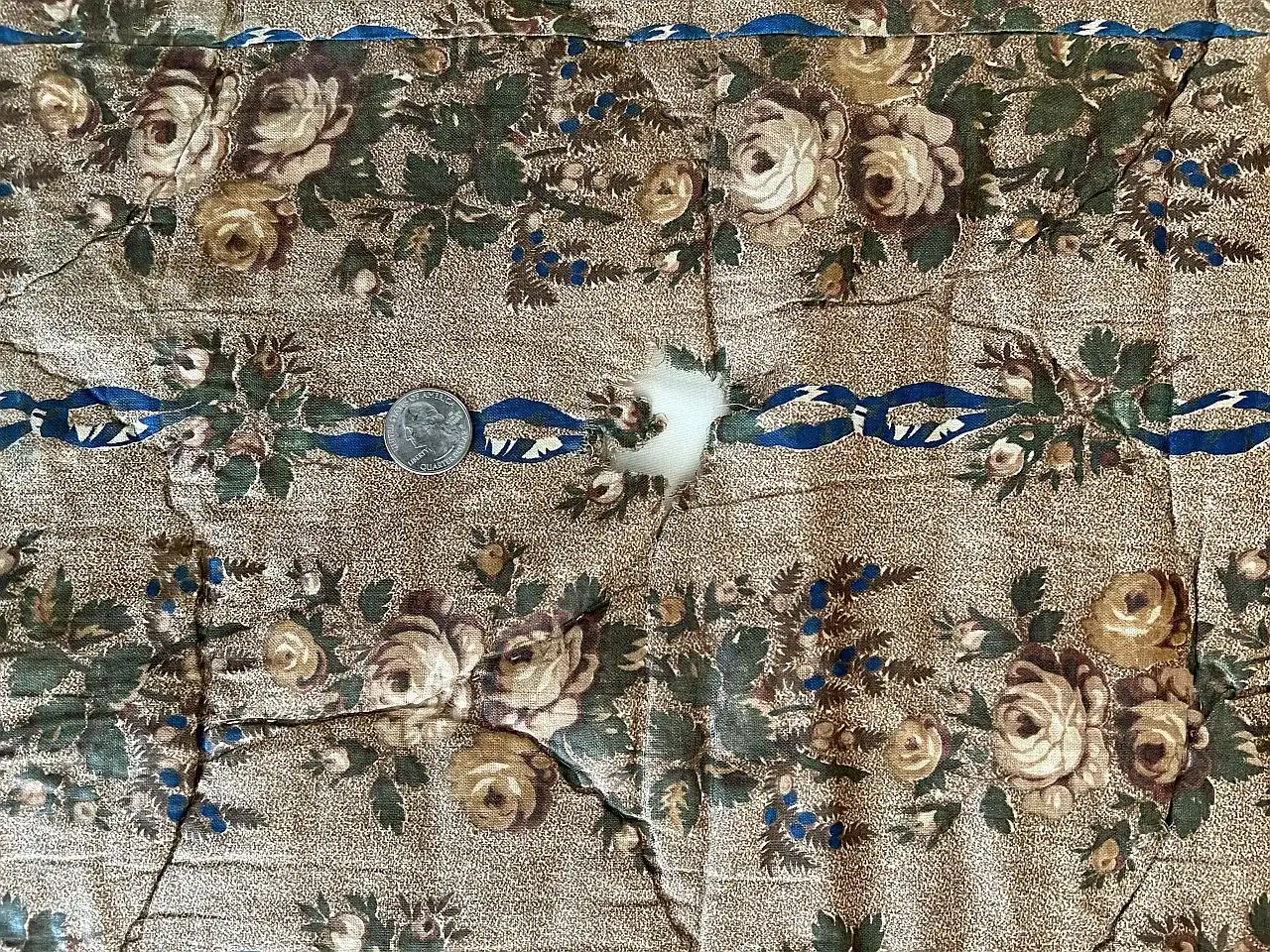
- Quilt Restoration: Tears & Repairs — Members discuss techniques for repairing small tears in antique quilts without compromising their historical value. (see the article on quilt restoration)
- Virginia Reel Block Origins — A member compiles responses from his own inquiry into the true origin of the Virginia Reel quilt block design.
- Flood Relief Fabric Donations — A call for fabric donations to flood victims prompts a member to re-request shipping details for the list.
Date: Fri, 6 Jun 1997 11:29:50 -0500 (EST) | From: Diane Krall <dkrall.inmu [at] incolsa [dot] palni [dot] edu>
On Fri, 6 Jun 1997 AJSNGS [at] aol [dot] com wrote:
> Hi all,
>
> I have a request and I hope you don’t mind my asking. Yesterday I found out
> that my dear friend Mary has breast cancer. She is the friend who introduced
> me to my love of quilts–antique, and the art of quilting. Needless to say,
> she is very devastated by this news, as are all her family and friends.
>
> My request is this. I want to give her a gift that will bring her comfort,
> and perhaps take her mind off her troubles just a tiny bit. I’m such a
> novice quilter–and I can’t emphasize enough the word NOVICE–that the
> obvious gift of a quilt isn’t my first choice. Any suggestions would be most
> welcome, and you can e-mail me privately at AJSNGS [at] aol [dot] com.
>
> Mary is 40 years old, a wife and mother of two young children. She is a
> quilter, and is interested in antique quilts also.
>
> Thanks for indulging me here. And when you send up your prayers today,
> please send one up for a fellow quilter named Mary.
>
> Sincerely,
>
> Nancy Sentipal in Virginia
> AJSNGS [at] aol [dot] com
>
>
Dear Nancy,
My sympathies and prayers are with Mary, her family and friends. One
suggestion that worked for me is magazines. When I was in the hospital, I
was so drugged and weak, I could hardly sit up. My sister sent me about a
dozen quilting magazines. I could read, fall asleep, look at pictures,
and it didnt matter. with my lack of concentration, those magazines
lasted me months. There was not much of an investment, so if I lost one
at phys. therapy, it did not matter much and if I really wanted it I could
ususally get a replacementt.
diane
Date: Fri, 6 Jun 1997 13:02:54 -0400 (EDT) | From: AJSNGS [at] aol [dot] com
Dear Friends,
Many thanks to those of you who e-mailed me with lovely gift ideas for my
friend, Mary, who has breast cancer. I was so warmed by your concern….I’ve
always known quilters were a wonderful bunch, and you’ve proved it once
again.
Thanks again,
Nancy in Virginia
AJSNGS [at] aol [dot] com
Date: Sat, 7 Jun 1997 07:38:51 -0400 (EDT) | From: AJSNGS [at] aol [dot] com
Several members of QHL requested that these suggestions for gifts for a sick
friend be posted to the list. Hope nobody minds!
They are wonderful and thoughtful suggestions! Nancy
Forwarded message:
Subj:
Gifts
97-06-06 14:24:46 EDT
SadieRose
AJSNGS
Nancy,
I know just how you feel, a friend in my quilt guild was diagnosed with
breast cancer just 1 week after her daughter was born last Oct….and she has
a 2 yo little boy, too. She is 36. I wrote to my friend Mimi Dietrich, who
had a mastectomy several years ago, for ideas. She suggested a quilt block
shower, which is what we did. I set things up, but haven’t told Cathy, the
recipient. She just thinks it is the “Quilt Angel”.
I chose a 6″ Simple Star pattern (sometimes called Variable Star).
Cathy loves scrappy, antique looking quilts, so I wrote the instructions to
reflect that: background to be muslin or shirting prints, star points to be
“country colors” such as navy, gray-blues, dark red, dark green, chocolate
brown, etc. The centers could be a brighter accent color, gold for example.
We asked quilters to stitch a block, and then mail it to Cathy with a note
or card. Last I heard, she had received over 40 blocks, and she had told
many of us how it lifted her spirits to find a block in the mail. They just
come whenever someone sends one…very random. We did not sign the blocks,
decided Cathy could ask us to do that later, if she wanted to. One option
would be to have people sign on a seam allowance on the back.
Cathy is doing well….she has had 2 rounds of chemo, and a
“lumpectomy”. She is the most positive person I know, and has stayed that
way. She is also an RN, so is probably TOO aware of what is going on.
She
is back to work now, in the newborn nursery at a local hospital. We all keep
her in our prayers!
If you have Mimi Dietrich’s books on the Smithsonian quilts….I
<think> is in the first book…there are 2 quilts made with “Peony” blocks
(pieced like a LeMoyne Star, but the bottom 2 diamonds are replaced with an
applique stem & leaf). These were made from blocks given to Mimi when she
was ill. Well, hope this helps. Cathy also mentioned that when she was in the
hospital, the nurses would come in to see her blocks, and what new ones she
had gotten.. which created positive attention for Cathy, as well as a project
to “look forward” to doing. TTYL…..Karan in Iowa, where the sun is trying to peak out from the
clouds!
Date: Sat, 7 Jun 1997 07:39:37 -0400 (EDT) | From: AJSNGS [at] aol [dot] com
Another lovely suggestion for a gift for a sick friend.
Hi! I’m very sorry to hear of your friend’s breast cancer. I wouldn’t
discount your talents as a quilter. Why not make a simple flannel top,
get friends to help you tie the quilt, and give that to her? Or…find
out if there is something she is working on and is now worried about
finishing. Maybe you can bring her some comfort that way. A friend
here has terminal cancer. She had never finished quilting her sampler
quilt that was to be a gift for her husband. Friends got together,
finished the quilt in record time, and when they gave it to her, there
seemed to be a great load lifted from her shoulders.
Norma Herbold in sunny Sequim,Wa
Date: Sat, 7 Jun 1997 07:40:53 -0400 (EDT) | From: AJSNGS [at] aol [dot] com
This is a program many quilters may find very interesting and useful. Nancy
Forwarded message:
Hi, Nancy,
The news about your friend is sad for both of you, but the situation is
not hopeless; thousands of women are successfully treated for breast
cancer every year. My mother at 82 has had it twice, had a lumpectomy
the first time and a mastectomy (other breast) the second time, and
looks like she will live into her 90s, as her parents did. I think she
is in the majority of breast cancer survivors.
I would like to make you aware of a national quilters’ program that lets
quilters do something about breast cancer. This was begun in 1990 by me
and my partners at Quilt America – it is the “Yes Mam!”(r) Mammogram
Challenge. The project challenges quiltmakers to make a fundraising
quilt, using special “Yes Mam!” fabric, and to dedicate the funds raised
to a facility in their community. We hope the funds go for free/low
cost mammograms for uninsured or underinsured women who can’t easily
afford to have a mammogram, but we don’t insist. The resulting quilts
are also sent to Quilt America for competition, and the one each year
raising the most money gets a challenge grant of up to $2000 from
American Patchwork & Quilting magazine. This year’s winner was from
Grosse Point, Michigan, and the quilt was made to honor a teacher
undergoing her second round of breast cancer – it was made by her
teacher friends and is called “Bright Moments Along the Way.” Funds
were raised through a raffle (over $4500), and the winner was from
California! Truly we are a global network of caring quilters! If you
want more information email me your land address and I can send you some
stuff. And take heart…
Xenia, in Indiana
Date: Sat, 7 Jun 1997 07:45:19 -0400 (EDT) | From: AJSNGS [at] aol [dot] com
Hi Friends,
As you will see, there were many wonderful suggestions for good gifts for a
sick friend with an extended illness. I posted many of them to the list at
the request of a number of our members.
Some other gifts suggestions were quilt magazines to drool over and plan new
quilts with…books on quilt history….books on quilting….a book called
“Twelve Golden Threads”…
So you see there were many great ideas!
What I found really wonderful were the number of you who wrote and told about
friends (or about yourselves) that were breast cancer survivors. That is
very uplifting to here.
Many thanks,
Nancy in VA
Date: Sat, 7 Jun 1997 10:37:42 -0400 (EDT) | From: Gail Wagner <dpw13 [at] mindspring [dot] com>
This is a question to those who do quilt restoration. If you have a quilt
that has a small tear on one or two patches (not a whole block, just an
individual piece), do you applique a exactly shaped patch over it and quilt
it or do you try to remove the patch and insert a new piece in it’s place
and then quilt it? I usually just live with the tatters (I really like the
character, sometimes), but this quilt is from the 30’s and it has a polyster
double knit “quick fix” sewn over the worn spot. The worn spot/tear is just
through the top.
Thanks for your help and suggestions. Gail.
Date: Sat, 07 Jun 1997 10:06:39 -0500 | From: LAURA SYLER <texas_quilt.co [at] airmail [dot] net>
Gail Wagner wrote:
>
> This is a question to those who do quilt restoration. If you have a quilt
> that has a small tear on one or two patches (not a whole block, just an
> individual piece), do you applique a exactly shaped patch over it and quilt
> it or do you try to remove the patch and insert a new piece in it’s place
> and then quilt it? I usually just live with the tatters (I really like the
> character, sometimes), but this quilt is from the 30’s and it has a polyster
> double knit “quick fix” sewn over the worn spot. The worn spot/tear is just
> through the top.
>
> Thanks for your help and suggestions. Gail.
Gail:
I just gave a lecture to a local guild here in N. Texas and we talked in
length about this subject. I think it really depends on how much of a
“purist” and how “conservationaly minded” you are. When I worked on the
Texas Sesquecentennial Quilt Project back in the 80’s the museum
conservators stressed “add nothing, take nothing away.” So crepeline was
the order of the day. BUT…for those of us attempting to “restore” our
quilts to a useable condition, the crepeline rule is not practical or
often even feesable. As a quilt & textile historian what I try to do is
leave the old fabric in place whenever possible so that if for some
crazy reason, someone, someday wants to see what the original fabric was
underneath they can.(Can you imagine anyone EVER wanting to do that??)
The Muesuem people stressed that if we did do any “repairs” that they
needed to be removable, and easily spotted.<?> I always try to use of
like & kind when doing a repair, vintage if possible, same print if
possible(or at least same color family) and then repros when nothing
else works. If as you say your tatters are not really big you might
contact Nancy Kirk at the Kirk Collection and get some “Fine Fuse”, make
what Nancy calls an “upside down bandaid”, slip it in under the tear and
gently press the fusible into place. I’ve used it many times in
restoration jobs when replacing the piece is not practical. Just a few
ideas to further confuse you (?).
Hope this helps
Laura
texas_quilt.co [at] airmail [dot] net
Date: Sat, 07 Jun 1997 11:49:58 0000 | From: Mark Mashaw <mtm [at] snet [dot] net>
I recieved many wonderful answers to my Virgina Reel question and since
not everyone CC’d the digest I wanted to share some of the other
responces with my fellow digest readers and contributors as I found
these notes very interesting…
Virginia reel (“J,K,S&A Baird” , Thu 2:18 PM)
Mary–
You’re about to discover that there is no “real” Virginia reel.
Somehow, women never got around to setting up an official Quilt Block
Naming Authority Board.
Before block designs were published, they passed from hand to hand. Not
everyone had a name for a block–or perhaps they
did, but someone else saw the quilt, copied it, and gave it her own
name.
Even after patterns began to be published in papers and magazines and
books, names changed. Sometimes the same
newspaper column would give a design two different names over time.
The current “standard” in the quilt world, although it is not complete
and I find it badly organized, is Barbara Brackman’s Encyclopedia. She
lists, for each block included, the earliest name published, as well as
later variations.
After all that, I will say that the block usually thought of as Virginia
reel is the one also known as snail’s trail. There’s also a
Virginia Star–a nice version of the 8-point star.
Kim
I think the block shown at that website must be the Virginia star
although in point of fact it looks more like a cross. (Me)
Virginia Reel (Peg Gilson , Fri 1:05 PM)
Just looked at the URL listed. Never in all my years of quilt study have
I seen that block listed as Virginia Reel. The block commonly called
that is also the Snail’s Trail as you noted. I’ve seen an 1850s era
quilt at a big plantation (forget the name) near Richmond and it is
marked as a Virginia Reel.The pattern is the one we commonly know.
Peg Gilson, Documentation Editor Phone: 609-727-4600, x1190
Bluestone Software, Inc. Fax: 609-234-2877
1000 Briggs Road peg [at] bluestone [dot] com
Mt. Laurel, NJ 08054 http://www.bluestone.com
Thank you Peg for actually checking out the URL. I wish there were an
email address at that Url that I could forward your comment to because I
am convinced that block is a complete error and I hate the fact that it
is showing up at the Virginia state site as the Virgina Reel block.
Mary (again)
E
Subject: QHL: RE: QHL-Digest Digest V97 #146
Message-ID: <01BC738F.7C0485C0 [at] indy [dot] us1 [dot] net>
[>] Karen Issacson, the designer of the quilt square you are referring to
does not claim to be an authority on quilting. She even mentions on the
art page Http://www.rootsweb.com/roots-l/artquilt.htm that she was relieved
that her mother (a quilter) did not run from the room screaming when Karen
showed her the designs. Her reference was “Maggie Malone’s 1,001 Patchwork
Designs”
You can write Karen at: Karen [at] rand [dot] org.
Jo Fox not much of a quilter but love it anyway…
Date: Sat, 07 Jun 1997 11:49:58 0000
From: Mark Mashaw <mtm [at] snet [dot] net>
To: QHL [at] cuenet [dot] com
Subject: QHL: Virginia Reel
I recieved many wonderful answers to my Virgina Reel question and since
not everyone CC’d the digest I wanted to share some of the other
responces with my fellow digest readers and contributors as I found
these notes very interesting…
Virginia reel (“J,K,S&A Baird” , Thu 2:18 PM)
Mary–
You’re about to discover that there is no “real” Virginia reel.
Somehow, women never got around to setting up an official Quilt Block
Naming Authority Board.
Before block designs were published, they passed from hand to hand. Not
everyone had a name for a block–or perhaps they
did, but someone else saw the quilt, copied it, and gave it her own
name.
Even after patterns began to be published in papers and magazines and
books, names changed. Sometimes the same
newspaper column would give a design two different names over time.
The current “standard” in the quilt world, although it is not complete
and I find it badly organized, is Barbara Brackman’s Encyclopedia. She
lists, for each block included, the earliest name published, as well as
later variations.
After all that, I will say that the block usually thought of as Virginia
reel is the one also known as snail’s trail. There’s also a
Virginia Star–a nice version of the 8-point star.
Kim
I think the block shown at that website must be the Virginia star
although in point of fact it looks more like a cross. (Me)
Virginia Reel (Peg Gilson , Fri 1:05 PM)
Just looked at the URL listed. Never in all my years of quilt study have
I seen that block listed as Virginia Reel. The block commonly called
that is also the Snail’s Trail as you noted. I’ve seen an 1850s era
quilt at a big plantation (forget the name) near Richmond and it is
marked as a Virginia Reel.The pattern is the one we commonly know.
Peg Gilson, Documentation Editor Phone: 609-727-4600, x1190
Bluestone Software, Inc. Fax: 609-234-2877
1000 Briggs Road peg [at] bluestone [dot] com
Mt. Laurel, NJ 08054 http://www.bluestone.com
Thank you Peg for actually checking out the URL. I wish there were an
email address at that Url that I could forward your comment to because I
am convinced that block is a complete error and I hate the fact that it
is showing up at the Virginia state site as the Virgina Reel block.
Mary (again)
–
Forwarded message:
holmr [at] execpc [dot] com (R D)
holmr [at] execpc [dot] com
AJSNGS [at] aol [dot] com
Hi Nancy,
I am so sorry to hear about your friend, Mary. I will include her and
her family in my prayers!
I’d like to suggest that maybe you ask people on line to send you a
quilt block for her. You could pick a simple pattern and size. People
could sign their name and location. You could give her the blocks and
tell her that other quilters care, and are praying for her. She could
put the blocks into a quilt herself — she might enjoy some busywork to
keep her mind off of problems. Online we’ve just been talking about
signature quilts and how wonderful they are.
Another thought, could be to ask people to use reproduction fabric –
like the prints from the 1930’s. You had mentioned that she liked the
antique look. I would also suggest keeping the block simple. Something
like a 9 patch. You’ll get more people to participate if the block
isn’t too hard.
Couldn’t you just picture a pretty nine patch quilt made from the 1930’s
reproduction prints???!!! That would be easy for her to work on too.
If you decide to do something like this, I would be glad to donate a
block!!
Hugs,
Donna in Wisconsin
Feel free to post this to the board. Quilters are warm people and I
think that you would get a good response.
Date: Sun, 8 Jun 1997 23:56:06 -0400
From: Jean & Steve Loken <sjloken [at] compuserve [dot] com>
To:
Hi again, Angel,
I’ve been slowly reading through my older stored digests, so this may be =
a
bit late and duplicated by others. I found that wearing rubber gloves
gives a better grip on the quilt to move it around under the machine. Of=
course, each time the thread or needle breaks (often for me) I have to pe=
el
them off. Also, I borrowed a raised platform that surrounds my portable
machine, to create a larger flat surface.
They’re made for this purpose=
,
I guess, but I didn’t have to buy it <G>. =
Jean in Minnesota
Date: Mon, 9 Jun 1997 12:07:03 -0400 | From: “Judy Grow” <Judygrow [at] blast [dot] net>
In my quest for old quilt tops I have also bough odd sets of blocks. A
set I want to tackle soon is from the turn of the century, I believe.
There are only 19 Double T blocks. Three or four madder brown fabrics are
used for the T’s, but only one fabric is used for the the background in all
the blocks. That background fabric is a bright chrome orange with little
dark blue pin dots, with smaller lighter dots in the background. I will
not have trouble getting old or repro fabric for the T’s for the 20th block
I need to do a quilt, but I have despaired of finding enough of the chrome
orange pin dot. A ten inch square will do.
If I can’t find it, what do you think of using a closely matching new
solid, and putting the pin dots on myself with a Pigma pen? DH is nixing
that idea, but I think it would work. Of course I would document the new
fabric on the back of the quilt.
I am currently in the final stages of hand quilting another quilt top that
I bought that cried out for a completing border matching the interior
sashing. There was none on the outer edge, and it looked unfinished. The
quilt is of plaids, checks, and stripes arranged in 4 patches, with medium
blue sashes and pink setting squares. I was able to match the pink and
blue almost exactly, and added the sashing to the outside of the quilt.
For backing I made a giant 4 patch of plaids, with the outer edges of the
blue sashing and pink setting squares in the corners.
I did all the straight line quilting on my q-snap, and have now put the
quilt on my Jasmine 18″ hoop on stand to quilt the individual blocks. It
is so wonderful to have the proper tool for the proper job.
When I am finished quilting I will have to go back in and fix some of the
seams where the seam stitching has broken from old weak thread. I’ll do
that by using an applique method — ladderstitching the higher seam to the
lower seam. I’ve done that before and it works very well.
Judy in NJ
judygrow [at] blast [dot] net
Date: Mon, 9 Jun 1997 12:05:10 -0500 (CDT) | From: Nancy Evans <nevans [at] nebnet [dot] net>
12:07 PM 6/9/97 -0400, you wrote:
>
In my quest for old quilt tops I have also bough odd sets of blocks. A
>set I want to tackle soon is from the turn of the century, I believe.
>There are only 19 Double T blocks. Three or four madder brown fabrics are
>used for the T’s, but only one fabric is used for the the background in all
>the blocks. That background fabric is a bright chrome orange with little
>dark blue pin dots, with smaller lighter dots in the background. I will
>not have trouble getting old or repro fabric for the T’s for the 20th block
>I need to do a quilt, but I have despaired of finding enough of the chrome
>orange pin dot. A ten inch square will do.
>
If I can’t find it, what do you think of using a closely matching new
>solid, and putting the pin dots on myself with a Pigma pen? DH is nixing
>that idea, but I think it would work. Of course I would document the new
>fabric on the back of the quilt.
>
Judy, for my 2 cents worth, I think I would go for a solid chrome orange in
a vintage piece, and forget the Pigma pindots. During the era these blocks
were made, it would not have been unusual to find the last block or two from
a different fabric. Another alternative would be to use the last space for a
“label” block to put the history of the piece, or maybe some other special
feature. This is suggested in at least one restoration book I have read
(Maybe Camille Cognac’s, I’m not sure?).
Like I said, it’s just my suggestion. I am definitely no expert, but perhaps
one of the bonafide experts on the list will have a better one! Good luck
with your project!
Nancy Evans – Nebraska Quilter
Date: Mon, 9 Jun 1997 15:18:55 -0400 (EDT) | From: QRestore [at] aol [dot] com
Dear Judy;
Regarding the 19 blocks . . .you said ;
<<That background fabric is a bright chrome orange with little
dark blue pin dots, with smaller lighter dots in the background.>>
This may be a good example to use a fairly new (at least little talked about)
technique that restorers are now using. In cases when you need small amounts
of fabric and are unable to locate good reproduction and/or vintage fabrics,
try experimenting with a good color copier and muslin . . .wished I could
remember where I recently read a very good article about this (?) . . . but
what I can remember is people where having good results copying vintage
fabric onto muslin via the color copier. Don’t you just love technology?
<vbg>
I have not had an occasion to try this technique myself, but with so many new
things developing in our world, can’t think of why this wouldn’t work for
you. The article I read also stated a *neat* thing about using the copier is
that you get the same faded value (as in the original fabrics), so you don’t
have to spend additional time trying to match color values, etc.
I would be very interested if you should try this and what results you have
. . .hope you share them with the list. Also, there are probably some on the
list who have already tried this technique and would be willing to share
their experiences. . .
Best of Luck!
Victoria Montgomery
QRestore [at] aol [dot] com
Boise, ID
. . .beautiful weather here!
Date: Mon, 9 Jun 1997 15:55:49 -0400 (EDT) | From: LindsErin [at] aol [dot] com
Please remove me from list at this time. Thanks Mimi@lindserin [at] aol [dot] com
Date: Mon, 9 Jun 1997 16:09:14 -0400 (EDT) | From: QRestore [at] aol [dot] com
Apologize for posting to the group . . .however, lost the specific post and
Nancy’s e-mail address . . .
To Nancy;
A few weeks ago as I sat quilting, I was listening to a program (Home &
Family Show) and they had two women quests who started an idea that has
apparently really caught on . . . they also had news of a very close friend
who (I believe?) had terminal cancer.
Anyway, there is a book out describing their concept:
*Share the Care* by Sheila Warnock and Cappy Capossela
The idea is this . . .get together a large group of the ill person’s closest
friends and family (anyone willing to participate), have a meeting, set up a
schedule, assign each person (in groups of two) a task and a time. The
larger the group, obviously the less time committment by each group of two.
Some examples of things they did for the ill person were:
– everyday tasks; cleaning, cooking, laundry, gardening, shopping, etc . .
– walking the dog, feeding and care of pets, etc . .
– assigning times to sit with the ill person at home or hospital, reading,
whatever . .
– tending to children and spouse needs (they even help planned all the
wedding details of this womans daughter!), taxing kids to and from school,
sports, etc. . .
The idea was to take care of the little things in their life that needed to
get done . . .*complete relief* for the ill person, and more time to spend on
recovery.
Hope this may give you some further ideas to consider . . . I know sometimes
I tend to think of what one, big thing I could do to help out, forgetting the
smaller (and sometimes more important) things.
Best Wishes for you and your friend!
Victoria Montgomery
QRestore [at] aol [dot] com
Boise, ID
Date: Mon, 9 Jun 1997 17:30:26 -0400 (EDT) | From: Mary Cross <mbcquilt [at] web-ster [dot] com> (by way of Quilting Heritage ListServ
<qrs [at] mail [dot] albany [dot] net>)
Last Friday, I got a call from a Discovery Channel producer in Washington,
DC asking about an appropriate quilt to represent the undergound railroad
for display in a production being done on Stephen Douglas. I immediately
responded that this very topic of just been discussed here. The quickest
reponse I could make to this “cold” call was to check with Kris for who was
particularly interested in the subject. HOpe it worked.
Also, just finishing a quick mystery read by Jill Paton Walsh – A
Piece of Justice, an Imogen Quy Mystery. It’s from England and was a Booker
Prize Nominee. Has a quilt and was well-written.
Date: Mon, 09 Jun 1997 15:36:20 -0800 | From: Deborah Hopkinson <HOPKINDA [at] WPOFFICE [dot] WHITMAN [dot] EDU>
Content-Disposition: inline
One other thought, tho it’s not authentic, but might be fun, is that a
quilters guild in California made replicas of the illustrations of James
Ransome’s artwork for my story Sweet Clara and the Freedom Quilt. They
donated the quilts to elementary schools in California. Somewhere I still
have the person’s email who told me about it and sent me some pictures.
By the way, I spoke with quilt historian Cuesta Benberry last week and
asked her about these log cabin quilts with black centers that were
supposedly used to mark safe houses for the UGRR. She said she hasn’t been
able to actually document it but that the legend continues to persist
strongly.
Deborah Hopkinson
(author, Sweet Clara)
hopkinda [at] whitman [dot] edu
>>> Mary Cross by way of Quilting Heritage ListServ <qrs [at] mail [dot] albany [dot] net>
<mbcquilt [at] web-ster [dot] com> 06/09/97 01:31pm >>>
Last Friday, I got a call from a Discovery Channel producer in Washington,
DC asking about an appropriate quilt to represent the undergound railroad
for display in a production being done on Stephen Douglas. I immediately
responded that this very topic of just been discussed here. The quickest
reponse I could make to this “cold” call was to check with Kris for who was
particularly interested in the subject. HOpe it worked.
Also, just finishing a quick mystery read by Jill Paton Walsh – A
Piece of Justice, an Imogen Quy Mystery. It’s from England and was a Booker
Prize Nominee. Has a quilt and was well-written.
Date: Mon, 9 Jun 1997 17:14:37 -0500 | From: cabhoney [at] juno [dot] com (Cindy A Honeycutt)
Dear friends,
Forgot to copy down the address to mail the boxes of fabric to the flood
victims. Does someone still have it and do you know if they have been
receiving a lot of fabric? On another note, I bought another quilt at an
estate sale this past weekend. It was labeled a cutter quilt, but was far
from what I would ever consider cutting! It was a Grandmother’s Fan
quilt. Most of the fans are loose, but they just need to be appliqued
back down. Also most of the button hole stitching has come off. They have
bubble gum pink centers, that green color popular back in the 30’s, and
are mostly feedsack prints. I will also need to put on a new binding and
get out a stain or two, but that’s do able. When I am finished I will
have saved a wonderful old quilt that was destined for who knows what.
REally, I know we all have our own opinions on cutters (or never to cut),
but this was definitely not one. I am so excited and can’t wait to finish
it! Thanks for letting me share my excitement. My family just said, Oh,
no, mom, not another quilt!
Cindy Honeycutt, Norman, Ok
Date: Mon, 09 Jun 1997 17:37:34 0000 | From: Mark Mashaw <mtm [at] snet [dot] net>
Dear Jo,
Thanks for giving me the email address for Karen. I knew she was using
a reference, (the Maggie Malone book). I have not seen that book but
since Karen mentioned being up late and punchy I thought perhaps she
misread it. My comment was not intended to give offense. I will
forward the Virginia reel correspondence to her. Thank you. As for her
mother, the quilter, running from the room I believe she said it was
because of her color choices rather than inaccuracies. Mary
Date: Mon, 9 Jun 1997 20:17:20 -0400 (EDT) | From: Baglady111 [at] aol [dot] com
I had a reply from AQSG apparently no papers have been written on SHAKER
quilts..they are aware of th Beverly Gordon book..but that’s it..jane
Date: Mon, 09 Jun 1997 21:50:59 -0400 (EDT) | From: LISA108 [at] delphi [dot] com
I’d use a matching chrome orange and either quilt it in blue thread, or
use that block as the signature block, saying something like “Begun @18 whatever
by an unknown quilter, finished by [me] in 1997,” or something like that.
Under no circumstances would I put in the pindots with a marker or a paint pen.
There simply hasn’t been enough time to determine the effects of these inks
on fabric, and it would be a terrible shame if the ink caused the fabric to
disintegrate. I work almost exclusively with modern fabrics, but I’ve heard
enough horror stories about disappearing inks that came back, strange reactions
between pens and fabric, and so on, that I stick to using masking tape for
marking straight lines and pencil for anything curved. At least I know the
graphite in a pencil is chemically inert…..
Lisa