July 10 – 17, 2003
This page contains affiliate links. If you buy through them, I may earn a small commission at no extra cost to you. As an Amazon Associate I earn from qualifying purchases. Learn more
These restored messages come from the Quilt History List, an online forum where quilt historians, collectors, researchers, appraisers, and enthusiasts discussed antique quilts and related textiles. The archive dates from 1996 through approximately 2016 and is being restored gradually. Sign up in the form at the bottom of the page if you want to know when a new page is added. Original spelling, opinions, formatting, and inactive links may remain unchanged.
Primary topics of this QHL Digest:
- The Lincoln Quilt and Nancy Hanks Lincoln — A detailed historical dig into whether Abraham Lincoln’s mother could plausibly have made the quilt attributed to her, weighing her documented life circumstances against the claim.
- Springmaid’s Racy Vintage Advertising — A nostalgic thread revisits Springs Mills’ famously risque “Springmaid” print ads, tracks down the illustrator (identified as Fritz Willis), and discusses how the ads got past censors.
- Provenance Research: The Gorsuch Quilt — A member’s research question about a quilt pictured in Better Homes and Gardens draws a response from the former curator of the Esprit Quilt Collection, now part of the Susie Tompkins Buell collection.
- Museum Volunteers and Curatorial Expertise — The ongoing Shelburne Museum labeling discussion continues, joined by a volunteer at a small Iowa quilt museum weighing in on what volunteers can realistically contribute. (see the article on quilt museums)
- Fabric History and Terminology — Members trace the meanings of “factory cloth” and early sewing-machine history, and discuss quilts stained by stubborn blue printing ink that resisted Orvus and Synthrapol. (see the article on cotton and textile terms)
- Reading Recommendations — The ongoing Foster Diaries discussion continues alongside a new find, Loom and Spindle, about life among early mill girls.
- New Publications and Community News — A new online quilting magazine, an AQSG newsletter, and a new quilt engagement calendar are announced, alongside a new member’s introduction and research request on whole-cloth wool quilts.
Date: Thu, 10 | From: “Jean Carlton”
Karen and all, I have made many ‘utility’ quilts for picnics etc over the years. I still have one of ‘tarpoon’ pieces from my old skirt and culottes (!) that my Aunt made long ago and it’s used constantly – it’s been thrown over a not-to-clean picnic table on the roadside while traveling, on the ground for fireworks or picnics, in the trunk in case of emergencys (In fact it will be in the MN Documentation book coming out in 2005 in the utility quilts category) These quilts are machine washed and dried as needed and I have yet to wear one out. This past 4th we were in a small MN town for fireworks and my husband took the string quilt I made him out of the truck (happened to have lots of blue in it and obvious diagonal red bands) and my son had the one I made him out of his old jeans and I think we had the best looking sit-upons at the show if I do say so myself! As we were leaving, however, I did see someone carrying a navy and white Irish Chain – sure looked like a quilt meant for a bed – INSIDE – and I wanted to jump out of the car……I choose to believe it was a cheater print!…..I believe in using quilts but you do see some abuse of quilts obviously not made to be used outdoors. ps I posted them on eboard under quilts.(couldn’t find photo of the other son’s quilt) And pps – I LOVE the string quilt Judy posted. Might need to reproduce that for my next one. Jean
Date: [date unknown] | From: “Lynn Davidson”
Hi,
I’ve been lurking on the list for about 6 months. I’m learning a lot. Thank you all.
I’m trying to locate information on the Gorsuch Quilt. I found this quilt in Better Homes and Gardens American Patchwork & Quilting, (c) 1985, Meredith Corporation.
It is a beautiful 25 Block Baltimore Quilt set on point, ca. 1850 that was “handed down from generation to generation through the ‘Eleanors’ in the family”.
An internet search has yielded nothing.
Lynn
Date: [date unknown] | From: “Julie Silber”
Hello All,
Julie Silber here. The “Gorsuch” quilt is in the former Esprit Quilt Collection of which I am still curator. It belongs now to Susie Tompkins Buell and, like the rest of her quilt collection, is for sale.
I have some information on the quilt which I would be happy to share; contact me privately at quiltcomplex@. Ricky Clark, our wonderful quitl historian form Oberlin, Ohio, did a research project on the quilt, and wrote a terrific short piece about it.
Best, Julie Silber
Date: [date unknown] | From: Kris Driessen
I am forwarding this from another list in case someone is interested.
Kris
— Maria <maria.h@ wrote:
Advice please, on Old Blocks Looking for a Home Date: Wed, 9 Jul 2003 21:46:34 -0400
I’m hoping that you have advice and suggestions for me, please.
A friend was at an estate auction in North or South Carolina (memory blank, but do have that information recorded somewhere) a few months ago. A large back of quilt blocks was up for sale and since no one had bid on them she did, and paid only a couple of dollars for them thinking that some quilter could make use of them. She brought them to me when she was here for our high school reunion last month.
They are quite interesting. The fabrics appear to be from the 1950s and include some from men’s ties. Many of the blocks are paper pieced with paper from school exercise books (some with pencilled in answers) and shipping copies.
One of the patterns is Bow Tie and the other is a combination of solid and pieced squares. By pieced I mean an irregular assortment using every scrap available to put together a full square. Very frugal indeed. They are not well done which leads me to believe they might have been a cooperative effort of young people learning to quilt. I could, of course, remove the paper and make a quilt from these, but first I’d like to find out if these should be in someone’s collection somewhere. I have contacted the Textile Museum in Toronto, Canada and although they found this interesting, they have enough samples of fabrics from that era. I also contacted Boxes Under the Bed part of the Alliance for American Quilts. Unfortunately, they are not adding to their collection at the moment, but I was advised to document everything by taking photos of all the paper used and of the blocks themselves which I will do.
Do you think that I should go ahead and make a quilt from these, or do you think that they should be preserved somewhere?
If the latter, do you know of anyone who might be interested in them? I can email photos to anyone interested.
Thank you,
Maria
Maria Michaels Designs
Date: [date unknown] | From: Debbie Long
Attn. Quilters –
I’ve just discovered an online design magazine that contains a smattering of fun stuff on sewing and quilting. The magazine is called “eVO” and it can be read online @:
http://www.pco2go.com/evo
Also, I noticed that they are currently running an advertisement for an antique quilt price guide/how-to book.
Enjoy!
Debbie Long “Leave ’em in Stitches”
Date: [date unknown] | From: “Joe MacDonald”
I am reading a fascinating book – The Diaries of Sarah Jane and Emma Ann Foster: A Year in Maine During the Civil War. (edited by Wayne E. Reilly, Picton Press) The two sisters each kept journals during 1864 and they are tremendously interesting reading. I have had a few questions as I read and perhaps someone here will have some answers. There are several sewing references (their lives seemed to be one long stream of washing, ironing, mending and sewing of clothes – ugh!) and there are a few that I don’t understand:
On April 13, Emma bought some “factory cloth” for 40 cents a yard to make her sister some drawers. What exactly was meant by factory cloth? I’m especially curious because on April 30, Emma spent 20 cents a yard on brown calico for a dress – the fabric for the drawers was twice the cost of the dress fabric.
On April 15, Emma said “I commenced some patch work to cover Hannahs chair. It is cut in small half squares.” Since Hannah was sickly, I guessed that Emma was making some sort of lap quilt for her but then the next day she says, “A.M. I cut and sewed patchwork, also in afternoon same. I have got enough done for the back and part enough for the seat.” Would she have been making some sort of patchwork to upholster a chair with?
Also, with all the sewing references, there is no mention of a sewing machine. Her family was by no means wealthy but they did not seem to be in dire straits. How available and affordable were sewing machines during the Civil War? Might the family have been thinking about getting one? Would many of their neighbors have had a sewing machine yet?
I would highly recommend this book to anyone! It looks like there are only a couple of copies on Amazon (for 50% off!) but I’m sure it’s available through the publisher www.pictonpress.com (No affiliation, etc, etc)
Monica MacDonald in Maine (where the sun is trying very hard to shine!)
Date: Sat, 12 | From: Joan Kiplinger
Monica — factory cloth could have several meanings: [1] grey goods which had not been converted or [2] anyone of the muslins or osnaburgs either bleached or unbleached that were staple underwear fabrics — in fact in the 1890s-Edwardian age any undergarment regardless of quality was called an undermuslin or [3] seconds, flawed in some way or [4] mill overflow or manufacturer’s overflow and therefore not purchases which would create surplus at the mill or mill store. Normally these fabrics came in wider widths, often called sheeting widths, than street or dress fabrics. There could also be other meanings which someone on this list may be aware of and hopefully share. Also calico by the time of the 1860s had become really tawdry, tacky cloth; it was about that time that manufacturers began introducing on a wide scale a Eurpoean printed fabric which the French called percale to start replacing calico prints so that there could be better quality dress goods ala the calico print style. I know someone is going to ask me my source for this last graph and it came from several sources which I can’t remember off hand. I think the 1911 encyclopedia might have been one. Be patient while I think which is not an easy job anymore 🙁
Date: [date unknown] | From: “Laurette Carroll”
Hello, Monica, the early sewing machine has a long and complicated history. According to one sewing machine historian I have corresponded with, sewing machines here, in America in the 1850’s were commercial machines, not very practical and considered curiosities, and not in general use in the home.
It wasn’t until 1856 that the Singer company produced their first machine for general use in the home, the Turtle Back. This was a very small machine. In 1859 Singer produced the Letter A machine, which was a little larger and was their first machine to gain popular acceptance.
A sewing machine would have been a luxury in the early 1860’s. Also they would have been hard to come by, because machines were needed to make uniforms for soldiers, and at least one company was taken over for this use. It was only later in the 1860’s that sewing machines were found in the middle class home.
See the International Sewing Machine Collectors Society site for more information. http://www.ismacs.net/
Laurette Carroll Southern California
Date: Sat, | From: Xenia Cord
Raising my head from hanging over the washer, carefully washing some kit quilt tops, I beg to report that the blue marks printed on the background have defied Orvus and Synthrapol. I do not recommend a flooded basement as the reason for doing this experiment, but the results are worth reporting.
Xenia
Date: [date unknown] | From: Barb Garrett
I’ve been in Boise Idaho this last week so am way behind in reading emails, but wanted to respond to Candace’s comments about curators — I’m enjoying the entire discussion of the Shelbourne labels — can’t wait to go see the quilts (and the labels <grin>). I also wanted to ask anybody who has me in their address book to please update the address to my new one — bgarrett421@ Thanks.
My personal definition of an excellent museum curator of a small museum is that they are a generalist with a very large roll-a-dex (or email address book <grin>) with the names of specialists in every area — and the willingness and self confidence to call those people when doing specific topical shows. Nobody can be an expert on all the areas covered by a museum, but they can know where to look for the answers to questions — that’s where a network of consultants comes in.
I’m sorry Candace is bothered by the term “generalist” as I mean it as a compliment — and in her case a very large one. Through working with her I’ve learned she perfectly fits the above description. Every person has particular areas of interest — but a good curator is willing to draw on the specialized knowledge of others to supplement their extensive knowledge. Having worked with Candace, I’ve learned she loves Queen Stitch embroidery, but understands and respects the other needle arts — and wants help when describing them — thus learning more to make her an even more well rounded generalist <grin>.
Small local museums can only afford 1 curator — and that person is probably going to be passionate about something — guns, metal or wood items, furniture, fracturs, samplers, quilts — the list goes on — how could one person in a small museum know it all — but they can do an excellent job with the help of that address book. I’ve seen it happen in several museums. And I don’t think we are costing anyone a job by being one of those contact persons — the museum will go with what information is currently in their files and not be concerned about accurate updating if left to their own devices. They literally can’t afford several curators. A small museum has either a nominal fee or accepts donations, and does not often have a large attendance. But their work is good and necessary, and they need to be supported.
When discussing a larger museum — like Winterthur or Shelburne — yes, those should have several curators — one for each broad category — textiles would be the one quilts fall under. But textiles is very broad, so when mounting an exhibit I’d think even they might find it helpful to confer with someone who specializes in a particular subcategory of textiles, like 17th century hand woven checks.
So, Candace, I hope you can be content being a generalist with a large and well used roll-a-dex. As to Shelbourne, I would first talk to the curator in charge of textiles — and go from there based on the response — since he would be the one responsible for the quilts and their descriptions. But offer help, not criticism. Use the concept of documentation as a “new” way to look at their records — an offer to document the quilts would pay large dividends to the persons doing the documentation — you get to study the quilts very closely, and touch them <grin>. That’s terrific pay for doing a good deed.
As to Boise — while I was in the midst of 2800 people at an Annual Conference held at Boise State — not quilters — I actually found a quilt connection. My husband shakes his head and says he’s not surprised I found the only picture of a quilt on the campus outside of the library <grin>. In one of the books on display about the history of one of the Idaho churches there was a picture of 12 ladies behind a crazy quilt — circa 1895-1915 based on dress and quilt style — and it was labeled Ladies Aid — and listed the names of the ladies as Grandma ___, Aunt ___, and so forth. I’m hoping to contact the church to learn more — specifically, was the quilt made by the Ladies Aid, or was it considered an appropriate prop to be used in the picture.
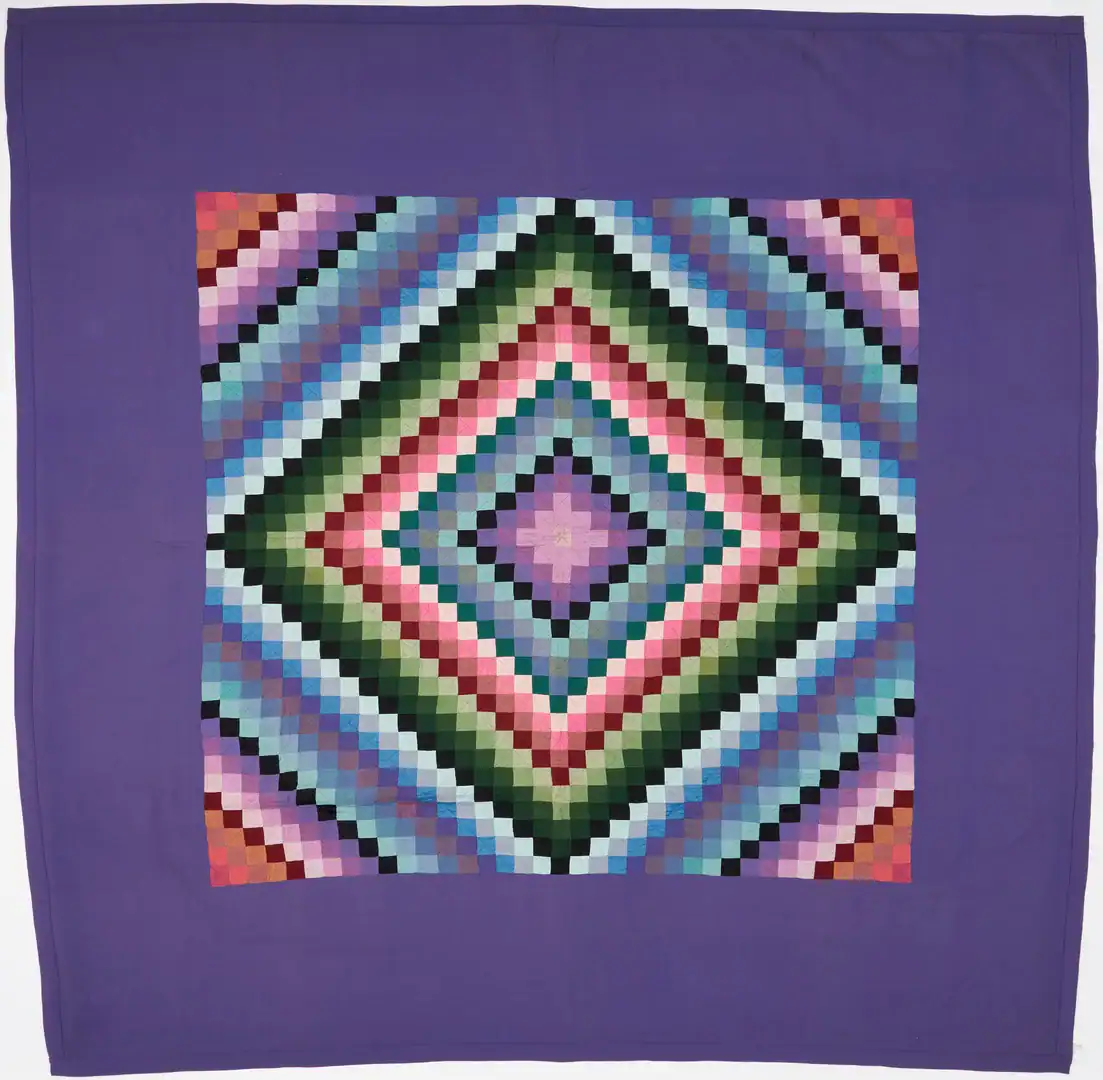
I also spent some time with former QHL member Sharon Harlman Tandy, who lives in Boise and has been off list for a while — she sends hellos to those who were on when she was a member. She took me to her home to see some quilts she is working on for customers — she does cleaning and repair — and the first quilt I spotted was a well worn PA quilt. Several quilts were hanging on a railing and I picked one up and said — This is a PA quilt. Sharon said — You can’t take that back to PA. I said — No, I mean it came from PA, and it probably has a brown back. She flipped it over to reveal the brown cotton print and said — How did you do that? I told her I was playing statistics — the majority have brown backs — and I was hoping to get lucky <grin>. It was a well worn Rainbow quilt (4 colors – red, yellow, blue, green – with 4 prints of each color) in Trip Around the World layout — found primarily east of the Susquehanna River. There was no border, and some of the rows of blocks had substitutions of fabric — which I’ve not seen in the “pristine” quilts we have here. The 1800s quilts appeared to be immigrants from eastern and midwestern states, which stands to reason considering the dates of settlement and statehood.
It was not as precisely made as the ones I’m used to seeing, and was well worn, but surely looked like it had PA heritage. She will be asking the owner if there’s any information about it. So exciting, and just proves what Cinda and I always say — PA has the best quilts — they show up everywhere <grin>.
Barb in southeastern PA suffering from a full emailbox and jet lag
Date: Sun, 13 Jul | From: Midnitelaptop@
my appetite was whetted.. and i ordered this book from amazon…now i “cain’t hardly” wait for it’s arrival…i love diaries/journals…i am presently reading The Journal of Mrs. Pepys..the fictionalized version of samuel pepys wife… would any of you quilt history aficionados…please list other journals/diaries of women, who mention quilting, sewing, needlework.. thanks jeanL
Date: Sun, 13 | From: Joan Kiplinger
Jean — this is mill related; some sewing is mentioned but it is free — Loom and Spindle or Life Among the Early Mill Girls by Harriet H. Robinson who recounts her early sewing experience and days at the Lowell Mills. It also includes a sketch of the Lowell Offering and some of the mill employees’ contributions. Read or download to read/print from the Center for Lowell History http://libweb.uml.edu./clh/links.html I printed out at 31 pages but made it rather fancy with wider margins and page borders so it could be less pages for those who are more conservative with their formatting.
Date: Mon, 14 Jul 2003 10:16:23 | From: dp30832@
I just checked the site again and they’ve rectified all of the those ugly technical glitches. 🙂
Now you can goto:
http://www.pco2go.com/evo
And read all about it!
Debbie Long “Leave ’em in Stitches”
P.S. Also, I’ve learned that the book, “Auction Blocks” that they are selling is actually one that was going to be published by two other leading quilt “how-to” book publishers, but the author cancelled the contracts. Now the folks at eVO: the Online Design Magazine have purchased the rights and, in fact, the current selling price is 1/4 LESS than what these other publishers were going to sell it for.
Date: [date unknown] | From: “Cinda Cawley”
I missed the original reference to the 1864 diaries (I seem to be missing a lot lately), Will somebody please fill me in. Thanks. Cinda on the Eastern Shore
Date: Mon, | From: jocelynm@
On Wed, 9 Jul 2003 10:22:56 -0500 “Carla Toczek” wrote:
> The U.S. Army has moved us again….. to Ft. Leavenworth, KS, about 30
Carla, Please accept my invitation to come to the Kaw Valley Quilters’ Guild meetings, in Lawrence! There is a Monday night meeting and a Tuesday morning meeting, with workshops on Tuesday afternoons.
Too bad July’s meeting is tonight, and it is also our annual banquet. August’s meeting will be Emily Senuda. Jocelyn
Date: Mon, 14 | From: jocelynm@
On Sat, 12 Jul 2003 17:08:44 -0700 “Laurette Carroll” wrote: > Look to the Future With Hope
I guess I’m under stress because the first time I read this, I thought it said, ‘Look to the Future with Hops’, and that it was suggesting I go have a beer. <G>
Jocelyn
Date: Mon, | From: jocelynm@
On Thu, 10 Jul 2003 00:03:15 -0400 KareQuilt@ wrote:
> I once felt the way Pam described about the “abuse” of quilts as > beach wear until my beloved MIL shocked me into another way of > thinking by making String quilts SPECIFICALLY for her picnic table
I remember lots of summer days in which we used quilts to drape over lawn furniture to make ‘caves’ and ‘tunnels’. We used quilts outside all the time, and I suspect that it was that constant interaction with quilts, and making up games to fit the patchwork, that turned me into a quilter. You see things in a different way, when you’re 8 years old and lying on your back with a quilt suspended over you, and the sunlight filtering through…
Jocelyn
Date: Mon, 14 | From: jocelynm@
On Tue, 8 Jul 2003 16:02:23 -0400 “Anita G. Solomon” wrote:
> My husband, who was a vice director at NYC museum, has a longstanding > contrary philosophy regarding ‘volunteers.’ That’s probably true for NYC museums
. But a lot of us live in parts of the country where there simply isn’t budget to hire even one full-time staff member. Even if they’re paid, the staff are basically volunteering because they aren’t in the competitive job market, not working for $8000 a year! The problem for little museums is you can’t charge much admission, because too many people don’t see it as a good value. Jocelyn
Date: [date unknown] | From: Marilyn Woodin
As a volunteer of a small museum–Kalona Quilt and Textile Museum in Kalona Iowa, I hope this message on small museums in the country, acknowledges the worth of the volunteers. We most certainly, could not afford paid curatorial staff. Marilyn Woodin
Date: Mon, 14 Jul | From: Donald Beld
Okay, so I have another question regarding the Lincoln Quilt. Anne Orr identified the Lincoln Quilt as “belonging” to Abraham Lincoln’s mother, Nancy Lincoln. While I have no reason to doubt that, I do. Nancy Lincoln died when Lincoln was a young boy–in the early 1800’s. I am curious whether on not anyone can give me more information on the quilt. Does it still exist? Belonging to sounds like it might have been a wedding gift as opposed to a quilt she made before her marriage. Is the story another myth?
Any info or opinions would be greatly appreciated, Thanks, Don Beld
Date: Tue, | From: Xenia Cord
Nancy Hanks Lincoln died in Indiana in 1818, in a backwoods setting that would suggest that quilts were not a priority. She and her family had moved from Kentucky 2 years before, from another setting that appears to have been somewhat marginal. If the quilt exists/existed, it might have been a gift rather than from her own hands, although she may have been a competent seamstress. There is a story that she was a traveling dressmaker. The style of the quilt, if the “copy” is accurate, is somewhat atypical for the first quarter of the 19th century, particularly in the “west,” which is what the Indiana frontier was considered.
Xenia
Date: [date unknown] | From: “Joe MacDonald”
Thank you everyone for all of the good information. I have finished the book and am very sorry it only covered the one year. I did find a reference to a sewing machine. On December 26 Jane wrote, “…and a letter from Phi (Sophia) Haskell. She has had a present from the masons of a sewing machine. Oh I am glad for her.” Sophia was a dear friend of Jane’s who lost her husband earlier in the year. And jeanL, there are a few books that aren’t just specifically journals but also collections of letters that I have really enjoyed reading. Pieced from Ellen’s Quilt by Linda Otto Lipsett is a collection of Ellen Spaulding Reed’s letters and her story. Civil War Nurse: The Diary and Letters of Hannah Ropes edited by John R. Brumgardt is another fascinating story. No specific quilting references in the book but Hannah was a remarkable women. I became interested in her story since she is from the little town I live in (New Gloucester) and she is buried just a few miles down the road from me. I made a quilt in her honor last year, hoping that it would help more people learn about this great woman. Monica in Maine (happy that I don’t have to water the garden today!)
—– Original Message —– From: “Joan Kiplinger” <jkip@> To: “Quilt History List” <qhl@> Sent: Saturday, July 12, 2003 11:46 AM
> Monica — factory cloth could have several meanings: [1] grey > goods which had not been converted or > [2] anyone of the muslins or osnaburgs either bleached or unbleached > that were staple underwear fabrics — in fact in the 1890s-Edwardian age > any undergarment regardless of quality was called an undermuslin or > [3] seconds, flawed in some way or [4] mill overflow or manufacturer’s > overflow and therefore not purchases which would create surplus at the > mill or mill store.
Date: Wed, 16 Jul | From: Midnitelaptop@
a knock on the door and there was the ups delivery person with my book,Foster Diaries from amazon.com….can’t wait to start it… thanks so much for the other diary, journal recommendations ttyl jeanL
Date: [date unknown] | From: “Stella Rubin”
Let’s be sure to include Blanket Statements, the newsletter from AQSG. I tried getting a website for Quilter’s Newsletter but wasn’t able to. I’ll have to ask around in the new quilt world. S
Date: Wed, 16 Jul | From: Gail Hurn
Along the lines of the Lincoln quilt…
I am seeing new whole cloth quilts made in Lancaster County, PA in a design called Heirloom or Hershey. Supposedly the center design of this quilt is based on one made for Mr. Hershey of Hershey Candy fame for his wife. At the least, it has been modified to fit modern beds.
Has anyone heard of a quilt from the Hershey family? Any information would be appreciated.
Thanks.
Gail Hurn
Date: Thu, 17 | From: Joan Kiplinger
To continue with the Foster Diaries thread, I thought this book might be of interest to some. It’s been posted to vintage fabric list so I apologize for duplication. I was recently given a copy of The Springs Story, Our First 100 Years1887-1987. Although published by the company, it is no puff piece, but rather an honest approach citing both achievements and glaring mistakes throughout Springs Mills [Industries] history. The book is filled with personal recollections of mill workers, some who started working at 10; southern mill interrlationships and interworkings; leaders in the textile industry and how a company manages to survive though acquisition and ad campaigns — anyone remember the “naughty” Springmaid ads of the late 1940s-50s which are now collectors items? I’ll post some to the eboard later today. As of today, there has only been one outsider to head Springs; the present CEO being a great great granddaughter of the founder and plant operations are still in this country. I have no idea as to the book’s availability. A search on addall.com or contacting Springs.com might produce results. It’s definitely a book to be aware of and to buy if it ever comes your way..
>
Date: [date unknown] | From: Joan Kiplinger
Hope you enjoy these Springmaid ads, especially if you are old enough to remember and giggling over the double entendres, hoping your parents didn’t think you were old enough to catch on. http://vintagepictures.eboard.com See first tab.
Date: [date unknown] | From: “Marcia Kaylakie”
Joan, what fun these were, how did they ever get past the censors of the day!!! Marcia!
Date: [date unknown] | From: “Audrey Cameron”
I tried to find the new quilt engagement calendar of the Barnes & Noble site but they didn’t recognize it. Please let us know when it is on the site so we “foreigners” can order one! Audrey Cameron in Lincolnshire, England audreycameron@
Date: Thu, 17 Jul | From: Joan Kiplinger
Fortunately many magazines were more broadminded and receptive to comic relief, and censorship was limited to the Hays Office for movies. America had changed drastically after after the rigors of WWII and need humor and smiles. And this is just what the public needed and wanted.
BTW, Laurette has posted 2 more ads to eboard.
Date: Thu, 17 Jul 2003 | From: Midnitelaptop@
to begin with all of the ads are drawings not photos (very important),…so there was more leeway…the springmaiden ads look like “varga” girls….. the photo of the young woman in front of the spinning machines…was what photo ads (sears and montgomery ward catalog) were like…… i remember an old old old swedish movie “my life as a dog” ..in the film, there’s a scene when the young boy reads his grandfather the catalog ads for women’s underwear…which was the grandpa’s playboy type fantasies…… thanks for the memories jeanL
Date: Thu, 17 Jul | From: Joan Kiplinger
Jean — yes, I thought immediately that artist was either Varga or Petty but it is neither. Can’t make out the name; looks something like Willis or Williams. Re ads — some were photos; there was one I didn’t post as it didn’t scan well. As you say, there’s nothing like art in all its many forms to bring back memories.
Date: Thu, 17 Jul 2003 | From: Joan Kiplinger
Jean — FYI — the Springmaid illustrator was Fritz Willis on signed ads; don’t know those which have no signature.
Date: [date unknown] | From: “Lynne Z. Bassett”
Dear Friends on the Quilt History List,
I have finally joined the QHL! I am sorry that I have missed so many = interesting discussions, which I hear about occasionally second-hand. = But no more! I very much look forward to reading about the research = that you all are conducting and I hope that occasionally I may be of = assistance.
I was very fortunate to receive grants this year from the Quilter’s = Guild of Dallas and the Meredith Scholarship of the AQSG. These grants = are allowing me to continue my research on regionalism in whole cloth = quilt design. I would very much appreciate hearing from anyone who = knows of a documented 18th- or 19th-century American whole cloth wool = quilt in a public or private collection. I am especially in need of = quilts documented to the mid-Atlantic region (New York, New Jersey, = Delaware, Pennsylvania, Maryland).
Many thanks!
Lynne Bassett —
Date: Thu, 17 Jul | From: Joan Kiplinger
A limited supply of the Springs book is available by making out check to Springs Industries for $25 [includes s/h], noting “history book” on For line of your check and mailing
Molly Laster Corporate Communications Springs Industries Box 70 Fort Mill SC 29716