February 10 – 12, 2004
These restored messages come from the Quilt History List, an online forum where quilt historians, collectors, researchers, appraisers, and enthusiasts discussed antique quilts and related textiles. The archive dates from 1996 through approximately 2016 and is being restored gradually. Sign up in the form at the bottom of the page if you want to know when a new page is added. Original spelling, opinions, formatting, and inactive links may remain unchanged.
Primary topics of this QHL Digest:
- Underground Railroad Schools Project Takes Shape — A curriculum plan and website resource list comes together. (see the article on Underground Railroad quilts)
- When Family Stories and Dates Don’t Quite Match — Members discuss reconciling family oral history against documented timelines.
- Silk Organza for Conservation Mounting — A conservator asks about sourcing archival organza. (see the article on repair, restore, or conserve)
- The Fantasy Quilt Research Trip Wishlist — Members dream up an ideal multi-week U.S. museum tour.
Date: February 10, 2004 | From: “Jocelyn” <jocelynm@>
> Not everyone in the US met progress at the same pace. My grandfather was > killed in a horse & wagon accident in the 1940’s.
And my father had a contract with the US Postal Service to break the roads using draft horses, so the postmen could drive through in automobiles, after he came back from the war. But he didn’t use a ‘covered wagon’. 🙂 >
I think the news report below that posted earlier is one of the funniest things I have ever read. the mental pictures of a woman being overcome with joy and shooting herself are funny enough. But the fact that the shot cured her of paralysis?? And she finally got to talk??
Well, you wouldn’t read about it…. ( another aussie saying)
Suzy
> The Indiana Messenger > Indiana, Pennsylvania > September 17, 1890 > > The statement that a woman in West Virginia was so joyfully surprised at > receiving a piece for her crazy quilt and an autograph letter from Grover > Cleveland that she knocked a revolver onto the floor, discharging it, shot > herself in the leg and was cured of long standing paralysis, at the same > time recovering her speech, is worth remembering. > >
Date: February 10, 2004 | From: “Jean Carlton” <jeancarlton@>
Thanks for the report on the Iowa study group meeting …..I marked my calendar for your August date….I may have to drive down from Minneapolis you made it sound so intriguing. I hope you will be posting photos on the QHL study group site soon. Your post served as a remiinder for me to say that the MN quilt study group (LLQSG) met in December for a showing of red and green quilts and also met in March for a block study. Those photos were recently posted on the QHL quilt study site. If anyone has not visited this site I think you’ll enjoy it: http://www.quilthistory.com/study/Default.htm
Jean Carlton
Date: February 10, 2004 | From: “crossland_n_j Crossland” <crossland_n_j@>
Conservators, I have been looking into silk organza to offer at NH Quilt Documentation Days for people wanting to do their own repairs/stabilization. I’ve noticed there is silk gauze organza that is much cheaper. I found that the silk at Dharma was pretty reasonable. It is of course, prepared for dying. Is this acceptable for conservation? Does anyone have a better source for what we need? Is the silk gauze acceptable? Thank you, Julie Crossland, Chairman, NH Quilt Doc Project
Date: February 10, 2004 | From: “Margaret E. Geiss-Mooney”
Good morning, QHL’ers – The short answer is yup! And usually much better colour selection too if you buy it at a retail source. Thai Silks in California (www.thaisilks.com) has 54″ wide 100% silk organza for $5.00/yard in 14 colours.
But remember to rinse any fabric that will be in close intimate contact with the original surface, even if it’s pfd. To rinse, I use my washing machine (excellent water quality) on the gentle cycle, usually two times and then air dry. You can also use the weft/warp pulled out as your sewing thread (usually 2 strands in fragile areas).
Regards, Margaret (Meg) Geiss-Mooney Textile/Costume Conservator in sunny and getting warm Sonoma County mgmooneymoonware.net
Date: February 10, 2004 | From: “Sally Ward” <sallytatters@>
If a quilter had the opportunity to visit the US, virtually any part of and for the once only, where would she ‘have’ to go and when? Suggestions privately please.
Sally W
Date: February 10, 2004 | From: Joan Kiplinger <jkip@>
I just posted this to VF list so excuse the crossover if you are on that list. In today’s mail was the second copy of Vintage Fashion magazine — this is the second and third issues combined. Lots of great reading here but I notice the photo quality with new printer still hasn’t been resolved. I felt honored to have an article in this on the batiste family — batiste, jaconet, lawn, nainsook. Two informative articles are Thistle Hill reproduction cloth and Switzerland’s Abegg Foundation Museum’s workshop on Dyes in History and Archaeology featuring textiles dating back 2,000 years. Is anyone familiar with Red Lion Mill in Red Lion PA?? Firm had a full page back cover ad. Sounds like an interesting place to visit as there is a museum. Specialty appears to be historical costumes and fabrics, with yardage available for shirtings, broadcloths, kersey, jean cloths, satinets, blankets, linsey woolsey, Holland and trim tapes. Has anyone else received their copy??
Date: February 10, 2004 | From: Gail Ingram
I’ve had a number of private inquiries from list members regarding the report of Deep South Quilt Study Group, which met last weekend.
This is just to assure all that we will indeed post a report. We’re just a little less organized on the report front than we were on the meeting front.
But the Texans are at work on the details, and I will put it all together and post as soon as they have dotted their last “i.”
I will say this right now, however: we had a fine time and saw some wonderful quilts and probably most of us are still seeing red-and-green, in consequence of Carolyn Miller’s stunning presentation on Red and Green Quilts, illustrated from her collection. We’re also seeing fan quilting, I imagine.
We will have some new AQSG and QHL members as a result of the weekend.
On behalf of all present, I want to acknowledge and thank the people on this list from whose example and generosity this new study group grew—- especially Cinda Cawley, whose reports from the Dating Club first made me aware of what a study group could be; Kris Driessen, whose list made those reports possible and created a community of friends and students whose generosity still humbles me; J. G. Row, whose remarkable presentation at LA Tech brought Martha Gilbert, Ladye Harveston, and me together as a local “team” and who spurred us on by sending an animated, singing, lasso-wielding stuffed cowboy Hamster to cheer us on when times were confused; Xenia Cord, whose suggestions for organization provided our model and who sent neatly cut pieces of vintage fabric for insertion in plastic name tags; Teddy Pruett, Judysue Kelius, Sue Reich, and Judy G who sent us “door prizes,” an essential of every southern meeting.
Finally, I personally owe Sally Ambrose, who gave me the metaphor that made light work of occasional frustration.: Sally noted that pulling the group together sounded like “herding cats.” Every time organizing the weekend became onerous, I thought of that metaphor and laughed. A lifesaver.
Now that the cats have gathered and bonded, they will tell you about what they saw——asap, which sometimes is a little slower down here than in colder climes.
From rainy, dark North Louisiana where visions of bright quilts brighten the day, Gail
A final tribute to our Presidents. This article describes a quilt made by a veteran of the Civil War so well that we could probably reproduce it today. sue reich
New Oxford Item Gettysburg, Pennsylvania April 11, 1902
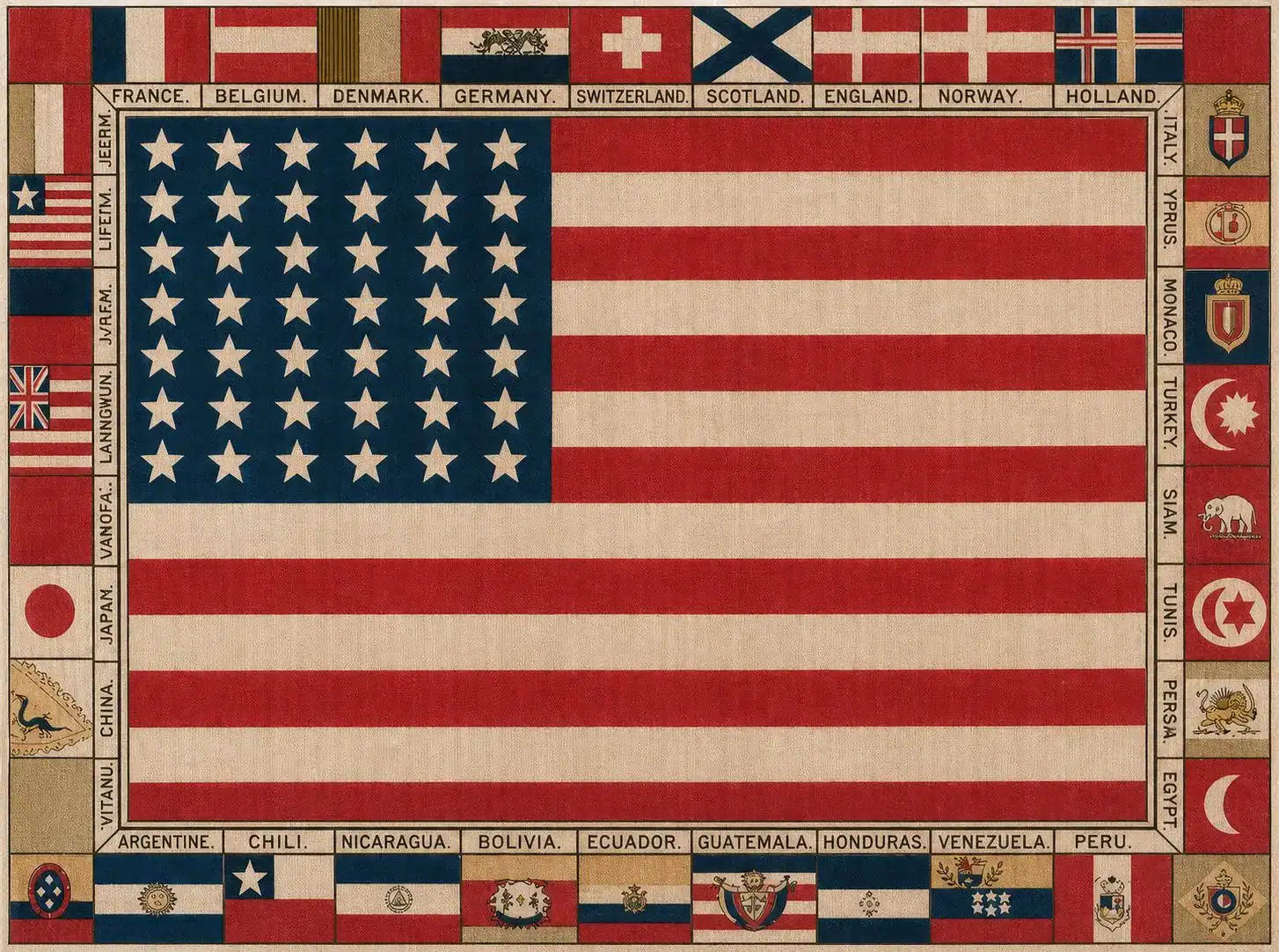
Novel Piece of Patchwork John Billingsley, an inmate of the Soldier’s Home has completed a unique patchwork quilt, upon which he has been working for the two years past. The quilt is made entirely of satin and sateen, and is designed to depict the glories of the Union as they appear to an old soldier. There are 984 distinct pieces and 1,132,755 stitches in the article. The spread is a little over five feet square. In the centre is a large star, made up of small diamond-shaped pieces. In this star are set portraits of Washington, Lincoln, Grant, Garfield and McKinley photographed upon silk. The star is surrounded by 24 badges of the army corps of the civil war and by 45 national flags, representing each state. Then there are the flags of eight foreign nations with which the United States at some time or other has been engaged in war. The quilt is bordered with parallel stripes of red, white and blue and edged with a fine gold fringe. The whole is artistically put together and reflects credit upon the workmanship of the maker. Billingsley was a member of the Eighty-first Pennsylvania when the civil war began, but later entered the service of the regular army. Washington Post.
Date: February 11, 2004 | From: <chrisa@>
Of course Jan- I’m happy to put any information for teachers on my website. I just didn’t want to steal your thunder or anything like that. Send everything- it has a home here. This goes to anyone out there. I have several links for teachers of K-12 on my site. In searching for web-based UGRR teacher’s information I was struck by how many sites included the misinformation as part of their recommended curriculum. It is such a shame to have to throw the baby out with the bathwater, but I opted to not link to those sites.
On the other side of the coin is this dilemma. I received an email from a quilter who commented on the children’s book list that is on my K-12 Teacher’s pages shortly after is was put up in 2001. She felt strongly that I should take out the two books that talk about quilts used on the UGRR. I completely understood her stance, but at the same time, my policy is not to police free speech if I accept an article on to my website. it was presented as a whole program, with good ideas and information and many other book suggestions on children, quilts and reading. However, it still haunts me to this day, that these books are on the list, on my website! What should I do? It’s the “Clara” book and “Freedom Quilt” if I recall right.
Kim
Date: February 11, 2004 | From: <chrisa@>
Regarding what I asked in the last post – I have taken “Sweet Clara” off my “Storybook Quilts” website article. Fortunately there were no other offenders on the list.
Kim Wulfert
Date: February 11, 2004 | From: “Jan Drechsler” <quiltdoc@>
Carol Grace, Sally Ward, J. G. Row and everyone who is interested in helping the local schools do a little research in their history classes: this is what I am able to do.
I’ll gather and post a list of relevant & well written web-sites that I’ve saved. First I need to make sure they still exist. Then I’ll do some Google searches for newer sites, newspaper reviews or quilt magazine articles.
After I post it to QHL, if you have other web-sites to add to the list, send it to me directly, not the entire list, so we don’t jam up QHL. I’ll update the list and re-post it after a week. Let’s assume that all the web-sites listed in Pat Cumming’s recent article will be on that list. (Thanks Pat.)
For magazine articles or references that are not on the web, such as Brackman’s in QNL, I’ll need special help. Be sure and send complete reference to any excellent articles you have read.
Carol Grace, today’s school schedules seem very tight and I think a presentation and a Q & A session is great. If one has a collection of Civil War quilts to bring in to a classroom, that is fun, but proves nothing except these are the quilts you found and bought. Is it representative of all quilts of that era? Pictures in a book are also fine.
With school time crunches, having kids make a Civil War quilt is probably impractical. And what is a Civil War quilt? I don’t even want to go there. Depends where and with what means you lived, I guess.
Finally, is it sensitive? You bet, but a good teacher will help make this a thoughtful research project, creating interactive learning opportunities and always respectful of others.
After the websites and article lists are posted, I can help keep it updated and I’ll also talk to Kris about this. Still searching for one or two teachers to write a generic cover letter to principals or teachers introducing the website and article list…
Jan — Jan Drechsler in Vermont Quilt Restoration; Quilting teacher www.@/~bobmills
Date: February 11, 2004 | From: Jccullencrew@
Hi Jan, This is quite an endeavor and I’ll be glad to follow through on whatever the “experts” put together. I know that the kids in 4th grade have art classes, and it’s not unusual for the teachers to incorporate history with art classes. They already made a quilt following 9-11 which was quite impressive. I’ll wait to see what you put together and then present it to the teachers to see what kind of response we get. I may have to get involved again with the school, but my kids went there and now my grandkids go there. The principal was a HS teacher that we know so that’s an “in” to start with. I’ll wait to hear from you about your progress. Best wishes. Carol Grace
Date: February 12, 2004 | From: Laura Syler <texas_quilt.co@>
> With school time crunches, having kids make a Civil War quilt is probably > impractical. And what is a Civil War quilt? I don’t even want to go there. > Depends where and with what means you lived, I guess.
Hi Jan, As far as having the kids make a quilt, why not do like the Sanitary Commission did? The SC quilt that I had for study for a while, and was at the Dallas show the year The Quilt Rescue Squad made an appearance is done “quilt as you go”…each individual block pieced, quilted, bound, then carefully whip stitched together, looks like big pot holders!! . These were intended for the hospitals, so they were long and narrow…10 or 12” blocks, this one was 5 x 7 – . “my quilt” <VBG> was the block that Brackman attributes to Nancy Cabot, # 2881 in her Encyclopedia, but this quilt is signed and documented Circa 1875, so we know it was way before Nancy’s time. The center of each block is signed and many have sentiments…..My favorite, which is appropriate even today… ” God bless you soldier, scarred and worn, Harried with marchings, walkings, pairs; All battle stained and battle torn, Bravely have all your tasks been borne; You have not fought in vain”. Emma C. Baker Norridgewalk Maine
I will be using this theme for a presentation to the education staff of the Plano Arts Center for a month long session they will be doing this summer.
If you are sending any of your compulations regarding this issue privately, please include me.
Laura Syler Richardson, Texas Certified Appraiser of Quilted Textiles
Date: February 12, 2004 | From: Gail Ingram <gingram@>
For those who are organizing presentations on HIPV issue to schools, may I offer the curricular buzz word of the day—-critical thinking skills/higher order thinking skills?
Every discipline in the curriculum has standards geared to foster criticial thinking skills. So this subject as it presents itself with quilts can as easily be adapted to a language arts unit as to a social studies unit.
Think “thinking skills.”
I say the next with this caveat: there are many, many well-informed, hard-working teachers in classrooms across America. However, you can’t count on one being in the classroom you approach. Plan your approach carefully, tactfully, and above all, simply. Be prepared to define “fact” “inference” and any other term fundamental to understanding what you have to say. Take Brackman with you: seeing something in print lends it credibility in some quarters.
I also believe that linking this issue with similar issues that do not involve race or ethnicity will be politic as well as even-handed. Include in your presentation some activity in which the student is asked to discriminate between fact and generalization/conclusion/opinion in a variety of circumstances. This skill is fairly difficult to teach in the elementary grades and even later, though youngsters are capable of making the distinction by the 4th grade at least.
Stress that empirical fact is usually evidenced by specific and verifiable proper names, places, dates, sources, etc.
Also include the tests of evidence (Is it relevant? Is it sufficient to prove the generalization it supports?).
Suggest how difficult Barbara Brackman’s job must have been—since she was limited to empirical fact.
And for older students, raise the question of what prompts cultural myths, if myths they be. Peoples are always looking for symbols to embody their dreams, wishes, visions. Which one is being embodied in this? Do other, more empirically provable facts better embody it?
And don’t forget that oral history has a proper role in historical documentation. Just make sure what it is.
May I also suggest some group assure that every state social studies supervisor has a copy of Brackman’s article with a short explanatory cover letter and list of relevant www sites?
Finally, good luck! It will be interesting to see the results of these forays. I myself believe they will have effect. Not this year, perhaps, but evenutally.
Gail Ingram
Date: February 12, 2004 | From: Margareta.Faust@
Hi Joan, could you tell me more about this magazine? Do they have a website? Margareta
Date: February 12, 2004 | From: Patricia L Cummings <quiltersmuse@>
Jan Dreschler wrote:
After I post it to QHL, if you have other web-sites to add to the list, send it to me directly, not the entire list, so we don’t jam up QHL. I’ll update the list and re-post it after a week. Let’s assume that all the web-sites listed in Pat Cumming’s recent article will be on that list. (Thanks Pat.)
Hi Jan:
Thank you for volunteering to coordinate teacher resources via your website. To provide a list of web resources for teachers is a terrific idea! As I discover more information, as I have already, I will add it to the end of my article. People have been kind enough to have been sending me links as they find them. Thank you! I will also be adding tidbits of information about upcoming lectures related to the overall black experience with quilting, including one by Kyra Hicks that will be given soon.
I am so happy that my article has generated a renewed interest in quilts made by women of color. Everyone seems to have new energy in wanting to examine the issues at hand. I am equally delighted that the focus of study is now shifting to the very important and real contributions that black quilters have made to our collective American quilt history.
All of the quilt historians on this list have gone out of their way to update their websites and to provide quality information. I appreciate your efforts. However, even if you do not have a website, all of us here can help spread the word by asking friends, neighbors, and acquaintances to visit our sites on the web. Whether anyone agrees with particular stances on the matter at hand, the idea is to facilitate critical thinking of the subject.
So, in advance, I thank each of you, not only for your personal role of leadership in validating that quilt history and research is important, but also in interpreting that history for others who are less familiar with quilting and who may still think of quilting as a “granny craft”.
Peace,
Patricia Cummings
Date: February 12, 2004 | From: Patricia L Cummings
/Sweet Clara and the Freedom Quilt /book, a tale written for children, should be included in any Bibliography about the Underground Railroad. While some may not agree that the story is based on fact, it would be completely unjust to purposefully delete this reference. As historians, it is important to allow everyone a voice, and to report events accurately and completely, as they are unfolding, and that includes books written on a given subject. In the interest of providing the reading public a full overview, not just history as we interpret it, we should allow readers to locate many resources, read them, and then draw their own conclusions. We also have to accept the fact that not everyone will be in agreement with us (any of us, that is).
In the interest of clear thinking,
Patricia Cummings www.quiltersmuse.com
Date: February 12, 2004 | From: Kris Driessen <krisdriessen@>
Could I suggest that maybe we come up with a teacher program on history blocks? Something like what the 54-40 block looks like and what it represents and how it is made. I can think of a couple of blocks that would fit into this category: the Lincoln Log Cabin, the Goblet, The Drunkards Path, etc. If we lay this out right, it will work for both Math teachers and History teachers.
Kris
Date: February 12, 2004 | From: seater@
IA/IL QSG report:
> Belle and Ann Hinkhouse wowed the group with their family treasures … > … The what a quilt of the day went > to the Hinkhouse’s 1957 quilt that was copied from a quilt purchased at > the Merchandise Mart in Chicago. Triangle biscuits were whipped > stitched together. The edge is completed with green piping from which > falls a double ruffle of the same polished fabric.
Dear List, I documented a triangle biscuit quilt last summer on Deer Isle ME. That is the name I chose to use for it, but couldn’t find a reference to cite for the name, the technique, or its origin. Can anyone help?
The quilt I examined was made by Charlotte Maud (Thurlow) Sawyer of Stonington, Deer Isle ME, (1873-1947) for the birth of her grandson in 1937. The grandson thought she’d made one or two other quilts but didn’t think she’d made any others of that pattern/technique. Anyone who’d like photos or more documentation info can email me privately.
Here’s an excerpt from what I wrote: I’d appreciate comments or corrections. __________
Triangle Biscuit Quilt K03-01 72″ wide x 96″ long
Name of most similar block in Brackman: Blocks #191, 193, 194 are made in this novelty technique but in squares, diamonds, and hexagons, respectively, and are all called “Raised or Swiss Patchwork” in Caulfeild & Saward’s 1882 book The Dictionary of Needlework, L. Upcott Gill, London. This quilt uses triangles instead.
Description of block: The design unit, the block, is here the square made of two half square triangles of the same print. Each novelty block is made from two squares of the same printed cotton. Each square was folded on the diagonal, sewn in running stitch on a short side, turned right sides out, stuffed with fluffy wool, and the remaining side sewn shut. The result was two triangular “biscuit” pillows which were then whipstitched together at the diagonals to make a square. The block looks the same on front and back. See Colette Wolff’s book, The Art of Manipulating Fabric, Chilton, 1996, p. 254.
“Biscuit” specifically refers to a slightly different novelty technique in which the individually stuffed pillow is made from one flat and one curved or pleated piece of cloth, but the term is also used commonly in a more general way for the whole set of techniques in which individually stuffed blocks are used.
Description and measurement of quilt design: Random, mostly light, floral, print squares set on point with, originally, solid pink triangle border; original quilt was identical on front & back. The individually stuffed blocks were whip- stitched together by hand. The half-block triangles to complete the sides are colored differently to form a visual border.
Number of design blocks: 12-13 wide x 16-17 long. Also half blocks, triangular, to complete the edges. Measurements of block: 4″ x 4″ Borders: 2.5″ wide at apex of triangle. The border was made by coloring the half-block triangles differently from the full blocks. Construction–Piecing: Hand, with occasional pieced pieces. Running stitch & whip stitch. Thread: White Cotton _______
Thanks for any information
Susan Seater in Raleigh NC <seater@>
Date: February 12, 2004 | From: Denise
I’m curious what method was used to put photographs on silk in 1902.
mreich@ wrote:
Date: February 12, 2004 | From: <chrisa@>
When attempting to impart the alternative perspective, I always include this excellent written and academic source about the ways stories can be developed through retelling and time, which is also about the UGRR and quilts story. Marsha MacDowell wrote it and gave it as the keynote address at the 1999 AQSG conference in Michigan. It is in the 2000 Uncoverings. It is not on-line, but I will place it onto my website if Marsha and AQSG would like to give permission, and a disk or Word Doc! 🙂 It is titled “Quilts and Their Stories: Revealing a Hidden History.” It will be accessed more often if it is on-line and linkable.
Taking the “Sweet Sarah” book off of my website does not take it off the book shelves or out of the public’s hands in any way. My website is mine and I chose to take it off yesterday, as I said. This eliminates any double message on my website since I do not believe that quilts were used on the UGRR or hung on lines as messengers for slaves thinking about escaping. I think stories of this sort could have, and likely were, made up and passed along starting in the early 20th century, as the women gathered to make quilts and talked about the days of slavery. I can see women doing this to pass the story of escaping slaves down to their grandchildren and so on. I don’t think any harm or misinformation was intended if the stories were told then. I think they were meant to instill a sense of strength and courage and pride in young Black children facing racial tension and discrimination every day.
<</Sweet Clara and the Freedom Quilt /book, a tale written for children, should be included in any Bibliography about the Underground Railroad. >> from Pat
This children’s book list had nothing to do with the UGRR. It was a program put on in elementary schools in northern CA with the help of a quilt guild there, in order to interest children in reading. The quilter’s made quilts based on children’s books and then had an exhibit of them with the books. The books and quilts then were made available on school loan to any interested classes. it is a wonderful idea and was very successful.
Kim Wulfert www.antiquequiltdating.com/tours.html
Date: February 12, 2004 | From: Palampore@
If you had 3-4 weeks and could go on the fantasy trip of a life-time learning about antique quilts in the US, where would you go, and what would you do? (Give museums, workshops, studios, and teachers.) I had someone ask me how to best learn about antique quilts, and it prompted me to throw out this questions. I think this will be a great exercise for us. Thanks, Lynn Lancaster Gorges, New Bern, NC
Date: February 12, 2004 | From: Kris Driessen
Oh, boy, oh, boy, oh boy!
Our first meeting will be March 13 at the Guilderland Public Library. E-mail me for details…
Kris
Date: February 12, 2004 | From: Gloria Hanrahan <gloria@>
Due to the academic atmosphere in our state, if it isn’t going to be part of the benchmark testing, CAT tests or the high school exit exam, no one is interested in anything right now. All of the state standards were set up several years ago, and it would be career suicide to deviate from those areas.
Standardized testing is the only current buzz word here…I think we lost thinking skills around 3 years back. We are currently having 3-11 grades spending a great deal of time on practice tests, all for the great cause of the “No Child Left Behind Act.’
My children are staying home the week of the tests, so maybe we will have time to actually learn something that week.
There are already several quilt block books commercially available for elementary math and history. I would have to look them up. Our history curriculum in the elementary grades is also focused on Alaska Native history, so I would doubt if many teachers up here could incorporate quilts blocks in a meaningful way.
While I love any quilt history and factual information, it isn’t relevant to all people. Many American immigrants have no history of quilts, so I would also hope that the emphasis on quilts wouldn’t create a stereotype of what women were doing in certain time periods.
Gloria (in Alaska)
Date: February 12, 2004 | From: “Leah Zeiber” <leah.zieber@>
Hi all, Our Southern California Quilt History Group met in Escondido yesterday. Our topic was baskets. A question was posed – When is the earliest pieced basket block/quilt? Several members quoted a variety of books (“Clues in the Calico, etc.) with dates of 1850’s. Was wondering if the knowledge base of this list had any earlier dates (please provide sources) – and perhaps do the British quilt history group members have the earliest date for “Pieced Basket” quilts or blocks in the UK? Appreciate your time with these questions.
Leah Zieber
Date: February 12, 2004 | From: “Susan Wildemuth”
Kris has posted The Iowa-Illinois Quilt Study photos from our February 7, 2004 meeting to the QHL Study Group webpage. (Thanks a million Kris)
Click on this link:
http://www.quilthistory.com/study/IAIL.htm
Our next meeting is scheduled for Saturday, August 7, 2004 in Kalona, Iowa and we’d like to invite anyone from the list who is going to be in “our neighborhood” around that time to come join us for a day of fun, fellowship, and quilt study.
Date: February 12, 2004 | From: “Cinda Cawley” <lrcawley@>
When did the zigzag stitch become available? Thanks. Cinda on the Eastern Shore
Date: February 12, 2004 | From: Xenia Cord <xenia@>
Cinda, Singer had a zigzag attachment for Featherweights and other Singers, at least sometime after WW II. The machines were straight stitch; the attachment wig-wagged the fabric.
Xenia
Date: February 12, 2004 | From: Kris Driessen <krisdriessen@>
Xenia,
Wasn’t there a zig zag attachment for treadles? I used to have a ton of treadle attachments, but I have no idea what they did.
Kris
Date: February 12, 2004 | From: Jennifer Hill <jennifer.hill@>
> When did the zigzag stitch become available? Thanks. >Cinda on the Eastern Shore
Doing a VERY quick search, the earliest household sewing machine model I could find that did zz was a Husqvarna, in 1947. As Xenia noted, zz attachments were available for straight stitch machines before then. BTW, you could use the same attachments on treadle as well as electric machines – the attachment didn’t care how the machine was powered, only whether the attachment point on the presser bar was compatible. I have several of these gadgets, and generally, they don’t work so well.
Zig-zag capability in industrial machines dates to the 19th century. Here’s where my search skills have deserted me. I do recall seeing somewhere that the original patent taken out for a zz machine was by a women, whose name escapes me, and it was not her only sewing invention.
Jennifer Hill Calgary, AB
Date: February 12, 2004 | From: “ChrisA”
Thanks for sharing these wonderful quilt pictures. I was especially taken with the cut-out chintz medallion quilt. It had more matching printed panels then I have ever seen on one quilt. Is this uncommon?
How did someone come to buy a quilt at the Chicago Merchandise Mart? And when?
Kimberly Wulfert, PhD www.antiquequiltdating.com Email: quiltdating@
Kris has posted The Iowa-Illinois Quilt Study photos from our February 7, 2004 meeting to the QHL Study Group webpage. (Thanks a million Kris)
Click on this link:
http://www.quilthistory.com/study/IAIL.htm
Date: February 12, 2004 | From: “Judy Kelius (judysue)” <judysue@>
At 09:53 PM 2/12/04, you wrote: > When did the zigzag stitch become available? Thanks. >Cinda on the Eastern Shore
Hi Cinda! I don’t remember the source, but I recall reading somewhere that some treadles did have zig-zag attachments. I know that the zig-zag was available a lot earlier than I thought it was. Could it have been in Brackman’s Quilts in the Machine Age?
Date: February 12, 2004 | From: Barb Garrett <bgarrett421@>
Hi Cinda –
I don’t know the earliest date, but I have physical proof of a 1930s date —
I have a SINGER Adjustable ZigZag Attachment #121056, with instruction booklet. The instructions booklet says it’s for Singer Lock Stitch Family Sewing Machines and the copyright dates are 1933 and 1934. This booklet says Form 18694 Revised June, 1934. A picture in the booklet shows 7 different widths of zigzag stitches.
Hope this helps, Barb in southeastern PA
Date: February 12, 2004 | From: Patricia L Cummings <quiltersmuse@>
Gail Ingram wrote:
May I also suggest some group assure that every state social studies supervisor has a copy of Brackman’s article with a short explanatory cover letter and list of relevant www sites?
Dear Gail:
Did I miss something? Where may I find the Brackman article?
Thank you for the wonderful suggestions about approaching schools, all really good points to keep in mind. Critical thinking skills are not addressed often enough with school children, except perhaps in classes for gifted children, an area familiar to both of us.
* * * * * To address someone else’s input, most any book can provide a “take off” for classroom discussion. On the subject of the Underground Railroad, I will continue to include a list of all pertinent written materials about the UGRR topic, on the Bibliography at the end of my extensive article which addresses the reported oral history that quilt blocks were possibly used to communicate hidden messages between slaves. If educators are not aware of what has been written, they will have no clue as to what we, as historians, are trying to contraindicate and/or place into an overall framework of understanding.
Intelligent people can make their own decisions. They do not need us to brainwash them. In thinking about the exclusion of a certain book(s) from a list, somehow, the banning of Portnoy’s Complaint comes to mind. Not that there is too much of a parallel here, other than the fact that the book was banned in schools. Aside from the fact that it was lewd and offensive and discussed a subject that most people would just as soon forget about, there was much discussion about (the banning of it) at the time (1960s). Nonetheless, knowing that it was not “allowed” reading, high school kids tried hard to find a copy.
If we get into censoring books, even by just their exclusion of a theme-based UGRR list, (the kind of list I was referring to in a previous QHL post), we are no better than countries that have burned books or not allowed books to be written in the language of certain ethnic minorities. One example of this is the books that were written in the languages of two provinces of Spain, those languages being gallego and catalan. The books were prohibited and then burned during the Spanish Civil War of 1936, the homogenity of language being a predisposed assumption of a more unified country.
However, all of this is a side-track and a non-essential discussion to the issue at hand, which is how to share information about quilts and quilt history with schools. If anyone would like further discourse about my opinions related to Bibliographies, let me suggest that you contact me privately, so as not to interrupt the flow of discussion with the matter of more importance here.
Let’s move forward.
Patricia Cummings www.quiltersmuse.com
Date: February 12, 2004 | From: Kris Driessen <krisdriessen@>
I sent the question of zig zag abilities of treadles to “the treadle lady” Donna Kohler, (http://www.donnakohler.com) and this is part of her reply:
“Hi Kris,
The first zig zag machines were made in Germany, much earlier than I ever would have thought but don’t remember exactly when, before 1900.
There don’t seem to be early zig-zag treadles for home use. By the time Singer decided to make zz machines it was early 1950s, they didn’t think they would catch on for home use and by then the majority of machines were electric.”
“Zig zag attachments would work on treadles with the right presser foot type and on electric straight stitch machines, they also seem later, maybe late 40s and on. The attachment has a wide foot with scored metal bottom that grips the fabric and moves it side to side. The machine’s needle never moves and the needleplate has just a tiny hole, all the work is done by the attachment except the stitch length which is still adjusted on the machine. Some of the zz attachments have several styles of stitches, they are fun to play with, I have several types.”
Now, I am wondering, does anyone have any old quilts with zig zag stitiching on them? The earliest I can remember seeing is 1960.
Kris
From: Sue Reich
A final tribute to our Presidents. This article describes a quilt made by a veteran of the Civil War so well that we could probably reproduce it today. sue reich
New Oxford Item Gettysburg, Pennsylvania April 11, 1902
Novel Piece of Patchwork John Billingsley, an inmate of the Soldier’s Home has completed a unique patchwork quilt, upon which he has been working for the two years past. The quilt is made entirely of satin and sateen, and is designed to depict the glories of the Union as they appear to an old soldier. There are 984 distinct pieces and 1,132,755 stitches in the article. The spread is a little over five feet square. In the centre is a large star, made up of small diamond-shaped pieces. In this star are set portraits of Washington, Lincoln, Grant, Garfield and McKinley photographed upon silk. The star is surrounded by 24 badges of the army corps of the civil war and by 45 national flags, representing each state. Then there are the flags of eight foreign nations with which the United States at some time or other has been engaged in war. The quilt is bordered with parallel stripes of red, white and blue and edged with a fine gold fringe. The whole is artistically put together and reflects credit upon the workmanship of the maker. Billingsley was a member of the Eighty-first Pennsylvania when the civil war began, but later entered the service of the regular army. Washington Post.
Date: Thu, | From: Margareta.Faust@
Hi Joan, could you tell me more about this magazine? Do they have a website? Margareta
From: Denise
I’m curious what method was used to put photographs on silk in 1902.
mreich@ wrote:
Date: Thu, 12 Feb 2004 | From: “Cinda Cawley” <lrcawley@>
When did the zigzag stitch become available? Thanks. Cinda on the Eastern Shore
Date: Fri, 13 Feb | From: Donald Beld <donbeld@>
Hi everyone–last night I gave my talk on history and 19th Century quilt blocks to a guild here in Southern California and one of the members during Show and Share had two 1920-30’s tops that she showed in my honor. One of which was a 4 inch bow tie pattern set as the center square in a 9 patch–very typical 1920-30’s solids and fabrics.
The other was a 9 patch pattern set in curved sashing. The owner did not know the pattern name. One of the older quilt guild members said she thought it was called 9 Patch Windows. Does this sound right? Does anyone know the correct name?
20th Century patters are not my thing, but it was an interesting effect–something like a large Cathedral Windows blocks, without the overlap. Thanks, Don Beld
From: “Judy Kelius (judysue)” <judysue@>
The “nine-patch in curved sashing” is probably the “Improved 9-Patch,” Brackman 306 or 2689. This was very popular in the 30s and was also known as Four Leaf Clover & Circle Upon Circle.
Date: Fri, 13 Feb | From: “Jean Carlton” <jeancarlton@>
Hi everyone, I am trying to update my information about the use of the fan, baptist or methodist fan, or elbow quilting design. Brackman, in Clues in the Calico, has only a small sampling but states that it is most likely post 1875. I do not have access to my full research library but feel that I’ve seen earlier dated examples. If you have any documented information I’d be interested in what the earliest might be….I searched the database of IQSG but cannot specify ‘design’ of quilting. The example I am studying is quilted one quarter (sometimes less) of an inch apart! The rest of the piece seems mid century. Jean Carlton
From: “Patchwork Secrets” <patchworksecrets2@>
I just joined the list recently and already am amazed at the wonderful info you all have. Thanks for letting me in. I asked around about the zig zag and found the first zig zag was manufactured around 1890. As soon as I can find out more info I will be glad to pass it on. I do have a question. Is there a place to view archives from this list of past digests?
Sharon in NC