August 15 – 16, 2004
These restored messages come from the Quilt History List, an online forum where quilt historians, collectors, researchers, appraisers, and enthusiasts discussed antique quilts and related textiles. The archive dates from 1996 through approximately 2016 and is being restored gradually. Sign up in the form at the bottom of the page if you want to know when a new page is added. Original spelling, opinions, formatting, and inactive links may remain unchanged.
Primary topics of this QHL Digest:
- Vacuuming Antique Quilts — A detailed thread on the correct vacuum speed and technique for safely cleaning antique quilts, including practice at the International Quilt Study Center.
- Rolling Stone / Friendship Quilt Patterns — Members discuss Pennsylvania German Rolling Stone friendship quilts inscribed in fraktur lettering and their pattern history.
- M.O.K.A. Quilt Study Group Meeting Recap — A report from the August M.O.K.A. quilt study session in Wichita, Kansas, is shared with the list. (see the article on quilt study groups)
- Dating a Mystery Fabric Sample — Members help date a submitted fabric sample by its color and style, estimating a late-19th-century origin. (see the article on dating quilts)
From: “Andi Reynolds” <andi0613@>
The thread on cleaning quilts has been most informative. I, too, have kept track of the suggestions and pros/cons, and plan to add any new information to what I already know when I speak about quilt restoration to a local guild next month. Talk about great timing!
Question 1: If the vacuum cleaner has but one speed (high), is there a change in technique such as holding the brush a further distance from the quilt? Holding it for less time over a given area?
Question 2: Should the vacuuming start on the back, so as to pull most of the particles out that way instead of through the front?
Question 3: Has anyone posted something she considers proprietary to whom I should give credit? I plan to offer my audience on-line suggestions for more information and have kept track of the various websites and their owners mentioned thus far.
Question 4: I’m compiling sources for archival storage materials but would appreciate any mention of favorites y’all might have.
And a note from experience: I have had good success laying musty quilts on a sheet on dewy grass (and covering it with another sheet) to remove a lot of odor. Have also briefly tumbled new quilts or tops in the dryer with a very used Dryel sheet (minimal chemical contact) and pouch to remove tobacco smoke and neutralize cat dander in group quilting pieces.
Andi in Keota, Iowa
From: Donald Beld <donbeld@> Hi, I have been going through some back issues of the Quilt History archives and noted a note from Xenia Cord that she has an 1853 Rolling Stone Album Quilt. I would LOVE to see a photo of it–either privately or on the vintage pictures line. PLEASE XENIA!!!
I am wondering if that pattern could have been popular as a signature block in the Sanitary Commission quilts–By the way, I heard last weekend of another Sanitary Commission quilt up in the San Francisco Bay area in PRIVATE HANDS that the owner found in a thrift show–we don’t even want to know how much she paid for it. I asked my source to have her contact me regarding the pattern, but so far no contact. Don Beld
From: Joan Kiplinger <jkip@>
Andi — www.gaylord and www.hollingercorp.com have the most extensive archival supply selections;. everything you could possibly need. Gaylord is a library supply company and has much more variety; Hollinger is supposedly less expensive from what I’ve heard from others. Both firms offer archival catalogs gratis. Joanne’s carries acid-free tissue in its quilt section.
Andi Reynolds wrote:
From: “Newbie Richardson” <pastcrafts@>
Margareta, and list The black dye used in the yarns in most pre 1860’s samplers was mordanted with iron oxides – which cause the fibers to disintegrate. That is why you see so many early 19th c samplers with missing words. Water only accelerates the problem. Sorry you learned the hard way. I ALWAYS test each color with a Q-Tip dipped in plan water to see if there is any bleeding. I also blot well with a cotton ball, or old, soft, piece of cotton flannel. You will see if the color is fast. Sometimes these kinds of samplers can be cleaned using a suction table to quickly pull the water away before the fibers have a chance to get “wet”. Newbie
From: AG32040@
There is a company that makes variable speed vacum cleaners . I have ordered twq2
From: AG32040@
Sorry about my incomplete post ,my cat walked on my computer and sent it. The vacum company is Nilfisk . They make a variable speed museum cleaner with many attachments . I have ordered two for the Baracle State Historic Site ,but not for myself ,because they cost $1500. The state of florida uses them in all its museums. AMY GOODHART in hot and humid Miami
From: “Lucinda Cawley” <lrcawley@>
I own two Pennsylvania German Rolling Stone friendship quilts inscribed in fraktur letters. One is dated 1856, the other 1862. The 1862 quilt got me started on the research that resulted in my paper Ihr Teppich: Quilts and Fraktur which will be published in Uncoverings 2004. At last count I had some information on 27 fraktur inscribed Rolling Stone quilts. Rolling Stone seems to have been the most popular block for such quilts. Cinda on the Eastern Shore
From: Gail Ingram <gingram@>
Don,
Xenia herself is at this moment a rolling stone. I rec’d a jpeg from Sally Ward that included a photograph of our Xenia looking very much like Dame Edna. She is in England, making all the costume and quilt museums. I just hope she bought that mask affair from the photo and brings it to Portland. A whole new side of the staunch Norwegian X.
Gail
From: danabalsamo@
…not quilt related, but with all the talk of textile care recently, I thought someone here might have an answer. I have 8 beautiful Victorian Night Gowns and robes, lots of pintucks, eyelets, heavily embroidered, a couple are linen, most are cotton…workmanship is STUNNING…and they fit me, too! The collars and cuffs on these pieces are extraordiary. They used to be white, have the antique patina to them and LOTS of age discolorations, which I can live with…I do not intend on washing them (I’ve done the laying on the couch thing)…but they are wrinkled…is it safe to press them, should I steam them, hang them in the bathroom with the hot water on? Or will that ‘set’ those discolorations. Thanks in advance, Dana Material Pleasures http://www.material-pleasures.com
From: “Candace Perry” <candace@>
Guess I’m thinking…why not wash them? These sorts of garments were intended to be washed…not like quilts or (ruh-roh) samplers. Someone else, however, may have another opinion! Candace Perry
From: “sue reich” <suereich@>
The Sunday Waterbury Republican in the Arts and Entertainment section featured a new exhibit about to open at the British Museum on Sudanese artifacts. Beginning on September 9, “Sudan: Ancient Treasures” the exhibit Sudanese antiquity ranging from a 200,000-year-old stone ax to 18th century swords. What was very interesting is the photo accompanying the article. A Cavalryman’s quilted coat and what looks like a quilted helmet are shown along with a wool Flying Geese design quilt. The quilt looks to be very thick and the quilting is in about 1 inch parallel lines. The stitching looks to be 1-2 stitches to the inch from the photograph. I will be curious to see if there will be any images on the Museum’s web site as the exhibit gets closer. Just an fyi. sue reich
From: “Bonnie Dwyer” <bonniedwyer@>
Andi,
I recommend reducing the suction on the vacuum cleaner wand, which would achieve gentler treatment for textiles. Also, I recommend vacuuming from the back to avoid pulling dirt and dust through the front of a quilt.
Bonnie Dwyer in Maine
From: “Andi Reynolds” <andi0613@>
Question 1: If the vacuum cleaner has but one speed (high), is there a change in technique such as holding the brush a further distance from the quilt? Holding it for less time over a given area?
Question 2: Should the vacuuming start on the back, so as to pull most of the particles out that way instead of through the front?
From: “Kathy Moore” <KathyMooreneb.@>
At the International Quilt Study Center we vacuum all the quilts. We now use the Nilfisk mentioned by one of our members, but when the IQSC first opened and we didn’t have the funds, we used portable vacuums plugged
into one of those dimmer switch do-hickies. The dimmer switch was plugged into the outlet and you could use the dial on the dimmer switch to turn the suction down really low. Don’t forget to use a vinyl screen on top of the quilt to further protect it.
Regarding the following questions:
Question 1: If the vacuum cleaner has but one speed (high), is there a change in technique such as holding the brush a further distance from
the quilt? Holding it for less time over a given area?
I have seen a technique demonstrated where you put the vacuum hose with it’s little attachment in you cupped hand with fingers spread open, then lower your hand so that the knuckles are just above the quilt surface
and then slowly move the hose over the surface of the quilt without touching the quilt. This puts enough space between the hose and the quilt to protect it, yet allows enough suction to get the job done. It’s hard on the shoulders, though, so take your time and take breaks often.
Question 2: Should the vacuuming start on the back, so as to pull most of the particles out that way instead of through the front?
This is a good idea. It may not make much difference, but it can’t do
any harm either.
Good luck, Kathy Moore Lincoln, NE-
From: Sheryl Till <sctill@>
Hello,
I’m learning about vintage quilts and don’t have much knowledge to share so I just absorb like a sponge. 🙂 I just won an auction on ebay and I’m hoping this quilt is legit. I couldn’t resist the pattern and not knowing anything at all about fabrics from the 1800’s, I bid based on the owner’s feedback rating and her assurance of full guarantee if I’m not satisfied. Does anyone know what the name of this pattern is and do you have any thoughts about the quilt itself? Thanks so much for taking a look. Hopefully, one day I’ll know enough to venture an opinion. 🙂
ebay auction #3741826762
Sheryl Till sctill@ http://www.berrypatchproductions.com Producers of Louisiana’s largest outdoor quilt event http://www.laquiltworks.com http://www.thequiltingpost.com
From: Judy Kelius <quilts@>
At 12:50 AM 8/19/2004, you wrote: >Hello, > >I’m learning about vintage quilts and don’t have much knowledge to share >so I just absorb like a sponge. 🙂 I just won an auction on ebay and >I’m hoping this quilt is legit. I couldn’t resist the pattern and not >knowing anything at all about fabrics from the 1800’s, I bid based on the >owner’s feedback rating and her assurance of full guarantee if I’m not >satisfied. Does anyone know what the name of this pattern is and do you >have any thoughts about the quilt itself? Thanks so much for taking a >look. Hopefully, one day I’ll know enough to venture an opinion. 🙂 > >ebay auction #3741826762 > >Sheryl Till sctill@
Congratulations Sheryl – I think you got a very good buy and I have no doubt the quilt is old! It looks beautiful.
The pattern is a common one, called Goose Tracks by Ladies Art Company in the 1880s and known by many other names, including Dove in the Window. What makes this look different is the red corners (which look like flowers) and the diagonal set. –_681343.ALT–
From: “Monica MacDonald” <jmacdon6@>
My thoughtful sister gave me a copy of Old Nova Scotian Quilts by Scott Robson and Sharon MacDonald to thank me for cat-sitting while she was on vacation in the province. After all the recent vaccuuming/cleaning discussion on this list, I was delighted to find on page 34 a section on quilts and washdays while I was reading it last night. The authors quote a helpful (!) hint from the Presbyterian Witness on Sept. 21, 1889: “If quilts are folded or rolled tightly after washing, then beaten with a rolling-pin or potato-masher, it lightens up the cotton and makes them soft and new.” There is also a picture of a 1927 ad for a “vacuum clothes washer” also referred to as a “quilt stomper” and a journal entry that refers to putting blankets and quilts out on bushes and fences to dry. This book is full of wonderful photos and pictures – I may have to forgive my sister for a few childhood incidents! Monica in Maine
From: Ivory22986@
I think that is the Bear Paw http://cgi.ebay.com/ws/eBayISAPI.dll?ViewItem
Ivory
Hello,
I’m learning about vintage quilts and don’t have much knowledge to share so I just absorb like a sponge. 🙂 I just won an auction on ebay and I’m hoping this quilt is legit. I couldn’t resist the pattern and not knowing anything at all about fabrics from the 1800’s, I bid based on the owner’s feedback rating and her assurance of full guarantee if I’m not satisfied. Does anyone know what the name of this pattern is and do you have any thoughts about the quilt itself? Thanks so much for taking a look. Hopefully, one day I’ll know enough to venture an opinion. 🙂
ebay auction #3741826762
From: “Newbie Richardson” <pastcrafts@>
Dana, and List Victorian whites are very sturdy and as there are more of them than Grand Mother’s Flower Garden and Crazy quilts combined, I have no problem washing and using them! Use Orvus, and use a press cloth with a not too hot iron. Sleeping in the nightgowns will cause lots of stress, but lounging in them should be just fine – and fun! I have also removed the trim and made new bodies from new bleached muslin and re-attached the embroidery for clients who wanted to really wear them. Newbie Richardson
From: “Newbie Richardson” <pastcrafts@>
Dear List, Can anyone tell me when we first start to see machine quilted yardage? You know the kind, the diamond grid honeycomb pattern used on solids and prints. I know I have seen it in (reliably dated) c 1890’s quilts ( used as both a border treatment and as a backing) – but can it appear in earlier pieces? Also, about vacuuming. The most important thing is to vacuum well so that as much as the grit is removed as possible: vacuuming from the front and the back, on the straight, the cross and the bias of the fabric is important. Dust is like a magnet, and can really cling. You do need to work to get it all out. It helps to have a friend help you manipulate the quilt. VACUUMING IS THE SINGLE MOST EFFECTIVE CONSERVATION TECHNIQUE THERE IS! If you use a vac with a cord, be careful of the abrasion the cord can exert on the surface of the quilt. I do use a “regular” small vac made for people with allergies – it has 3 filters to prevent any dust from re-depositing on the textile. I bought it at the Sew and Vac store at my local shopping center. The owner was very helpful when I told him what I wanted to use it for. It has 2 speeds and cost $60 last year. I do not use it for house cleaning, only for textiles. I put a clean knee hi stocking over the nozzle. I find that to be easier than having to manoever a screen over the quilt. I also got one of those mini-vacuum attachment sets for it -( you see them in several of the “making life easier” type of catalogues) I find the attachments very useful when vacuuming costumes and anything with raised embroidery. I also use a soft artists paint brush to encourage dust pussies away from seams, and out from under ties, buttons, or tassels, etc. My husband installed an over the head electrical outlet for me in my work room. My table is in the middle of the room. It has a long extension cord on a pulley (it looks like a big, retractable leash) and I can lower the plug to the height I need and retract it when I do not need a plug. Great for irons, too. It was inexpensive at the building supply store, and took him no time to install. Newbie
From: Dana at Material Pleasures <danabalsamo@>
Hi Newbie, Thanks, maybe I will give it a try…one nightdress and matching robe actually fit me…I tried the robe on in front of my husband and he freaked out…he’s not into old things…Lord help me when I start to wrinkle! I’ve washed old collars with similar embroidery and needlework and it was so hard to get them to lay flat after that. I had used Restoration and if it not completely rinsed out and the iron is too hot, it leaves brown marked…they soak right out…but so much extra work. I’ll try to post pics. My best, Dana
From: “Jean Carlton” <jeancarlton@>
Sheryl The quilt block is identified in Brackman’s Encyclopedia of Pieced Quilt Patterns as Cross and Crown # 1864. Most blocks have multiple names…..The corner square being dark does give a different and interesting look. Jean
From: “Suzanne Cawley” <quiltdigest@>
Hi All!
Monica’s post about the beating and stomping of quilts mentioned in Old Nova Scotian Quilts reminds me of a quirky custom that I just read about in Keeping House: Women’s Lives in Western Pennsylvania 1790-1850 (Virginia Bartlett, 1994). In a section devoted to cooperative activities such as quilting bees, barn raisings, and cornhuskings, the author talks about “kicking bees”. And I quote:
“After cloth had been woven, the material had to be “fulled” or softened. This was men’s work and took the form of what were known as “kicking bees”. Barefoot men sat in a circle on benches surrounding the cloth. Hot soap suds were poured over the cloth and the men then kicked at it for several hours-with appropriate rest periods and drinking intermissions-until the homespun was soft and shrunken. And, unsurprisingly, they ate a huge supper and walked home with clean feet.”
This was the first time I had ever heard of this practice. Does anyone out there know more about this? How common was it? Who, where, and when was it practiced? What cloth was involved? How was the cloth handled if a pioneer could not set up a “bee”? And finally, could this just be a “myth” of sorts that has been passed down orally?
I briefly searched the net and found two other references written in early books on local history…..in a 19th century book called History of Richland County, Ohio and a 1909 publication called The History of Simcoe County. This second reference states that it was a practice brought to Upper Canada by Highland families from Islay, Argyleshire.
I thought this was really interesting. Wouldn’t it be nice to sponsor an all-female “kicking bee” today to work out our aggressions! Any comments?
Suzanne Cawley In wild, wonderful Keyser, WV
From: Donald Beld <donbeld@>
In just two months, the women in my guild have made all 20 quilts based upon the U.S. Sanitary Commission quilt at the Lincoln Shrine in Redlands, Ca for our local Iraqi War Dead–and we are working on another 10 to move the project out into other parts of Cal. We have a guild in Bakersfield making them for Central Cal. And two guilds in Los Angeles that are thinking about making them for L.A. County.
It is very rewarding.
Therefore, I am appealing to all of you who belong to quilting guilds to see if your guild might like to take this project on for your area. We would like to see it move out into other parts of the country.
I know many guilds have made lap quilts, etc., but this is different in that we are tying the history of quilts via the Civil War Sanitary Commission quilts into recognizing the War Dead.
Basically, we give the families a 48 x 84 inch reproduction quilt–not necessarily made by hand–of the block in the Lincoln Shrine, a certificate that explains the U.S. Sanitary Commission quilt history, their loved ones name, and an article that details quilters contribution to war efforts over the years. We also put the name of someone who died in a previous U.S. war on the back. The local V.A. is 10000% behind this effort.
Finally we are preparing a permanent book with pictures of the quilt, a copy of the certificate and the obit of the war dead for placement in the Lincoln Shrine.
If you are interesting in helping with this effort, please contact me privately for more details. Thanks, Don Beld
From: “gb-best” <vitale@>
Hello,
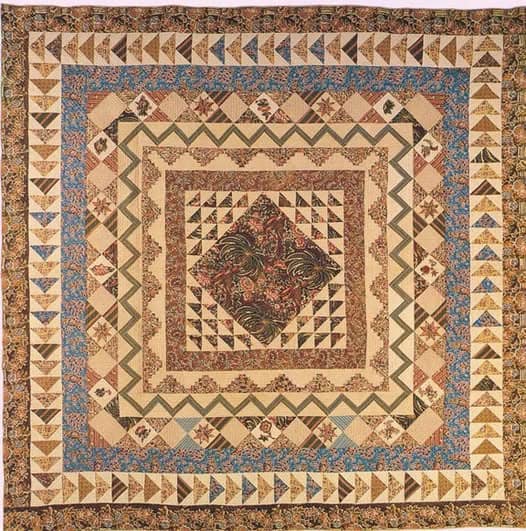
I found a very interesting quilt. I think it might be American Indian made. It looks like an Indian blanket design to me. So many small pieces with a medallion center. All handpieced too. The quilt was found in South Dakota.
Does anyone know more about this type of quilt. Any information would be greatly appreciated.
Take a look at the quilt:
http://cgi.ebay.com/ws/eBayISAPI.dll?
Thanks!
Donna
From: “jocelynm@” <jocelynm@>
Donna, I wondered about the dating of the quilt, as the description doesn’t explai n why ‘1800s’ was selected. I know that quiltmaking wasn’t all that common until the tribes were incarcerated on reservations, fairly late in the 1800s.
I’ve not seen a genuine Native American quilt with either those colors or with a similar pattern. Most I’ve seen are star quilts of some sort (Lone Star being very popular) in bright colors, particular red-white-blue, as many are made to honor the military service of a warrior.
From: Jccullencrew@
In a message dated 8/20/2004 10:02:32 AM Eastern Standard Time, quiltdigest@ writes:
I thought this was really interesting. Wouldn’t it be nice to sponsor an all-female “kicking bee” today to work out our aggressions! Any comments? Hi Suzanne,
Let me know where it is and I’ll be there. We can do a kicking bee and a drumming circle at the same time.
Drumming circles are big here. They are said to work out your frustrations, aggressions, and after a while you laugh until your jaws hurt (or you wet your pants).
So, think about this…
We could bang and stomp, bang and stomp, bang and stomp.
Or we could stomp stomp, bang. Stomp, stomp bang.
Or bang, bang, stomp. Bang bang, stomp.
OMG, the variety is endless.
What a delicious thought! I wonder if we could whoop and holler like the guys do at football games? What a blast.
With this happy picture, I am wishing you all a bang-up day.
Carol Grace
From: “Jennifer Van Haaften” <jasvanhaaften@>
What time period do you think this fabric is from?
I’m pretty sure it’s not 1880s, but I’m not sure if it is 1920s or 1930s, or maybe even later.
It is a very pretty bonnet nevertheless.
Thanks,
Jennifer Van Haaften Education Coordinator Elmhurst, IL
From: mswaller <mswaller@>
Donna,
Native American women in South Dakota and surrounding areas were taught to quilt by white women in the late 1800s, as whites permanently settled here and reservations were established. Native women certainly had sewing and needlework skills to make all their clothing and goods and decorate them with dyes, quillwork, beads, etc.
A lot of the white women came here with religious organizations, sothere are written statements like, “Presbyterian women taught the native women to quilt”, Episcopalian women taught the native women to sew, Methodist women taught…”. Reservations were actually assigned to different denominations, mostly Protestant, as federal policy.
There’s a lot more to be known about the quilting traditions here, but what I’ve seen so far is that Native American quilters in South Dakota started doing many different quilt designs as they started quilting, including familiar repeated block designs and crazy quilts, as well as Lone Star.
I haven’t seen many antique quilts made by Native American women here. I suspect their quilts were used up for survival. I bet the same thing happened to a lot of quilts made by white women here, too. Life here was/is physically demanding and resources are/were sometimes scarce. Often the poorest place in the U.S.of the year is here on one of the reservations. Laura Ingalls Wilder’s “The Long Winter” were they almost froze and starved to death happened here, too.
The quilt you cite doesn’t “say” it’s from South Dakota or made by a South Dakota Native American quilter to me but there’s really no way to tell that unless the quilt’s own history says so.
I’d be very interested to know any history you have on this quilt. I am a quilter and non-trad student at the University of South Dakota, applying for a Master’s of Interdisciplinary Studies combining art, art history, history and Native American studies, so this quilt’s history of coming from South Dakota really interests me.
Mary Waller Vermillion, South Dakota, USA
From: Gail Ingram <gingram@>
I know Lynn Gorgas has raised this question before, and I have also (though to no avail in my case), but I’m hoping for more information this time.
From the Carolinas through Texas, one encounters a number of quilts using the teal-orange/gold-cordavan brown combination, usually made in the period from 1875-1900.
Does anyone have information on the history of teal color (probably was not called “teal” at the time) and this combination?
Lynn theorizes these colors—or at least the teal color—were popular in home interior design and/or possibly with the dress of the era.
One sees colors in photographs of Victorian interiors with which this combination would be compatible. Also some exterior paints used as trim appear to be similar in color.
And yet it appears that the popularity of these quilts seems to be primarily in the southern states.
Help? Resources?
Gail
From: “Newbie Richardson” <pastcrafts@>
The fabric and the style could very well be late 19th c. That color combination is very last quarter 19th. It is a rural style, so the bonnet could have been worn in the “back country” for farm chores ( but not to go to town in) until after the Depression. Newbie
From: NewmanQuiltShop@
Hello, This is Sharon Newman again. The Aqua color and shades thereof, includeing teal are found on black with pink in Quilts 1820-1830, then again in 1865-1875, then not much until the late 30s early 1940s.
When I come to your study group next Feb. How many quilts do you want me to bring? Sharon
From: Crm793@
Hi Gail,
Do you have the book ‘Florida Quilts’ by Charlotte Williams? On pages 60 and 63 are pictures of quilts with this ‘teal, orange’ combination. One of these is dated 1871 in the quilting and the other is said to be made in 1869. Both said the fabric was home dyed with tree barks. What tree would have produced this teal color? I have a stacked bricks quilt in the 2 colors of teal and orange. It is from a family in West Texas.
If these were made with home dyed fabrics then what were the furnishing fabrics made from that showed up in magazines. Also if we knew what tree or plant was used maybe it was something that was just grown in the south.
Just questions, Carolyn
From: “ELEANOR MALONE” <emalone@>
Kansas hosted the August 6-7, 2004, study session of M.O.K.A., the quilt study group for Missouri, Oklahoma, Kansas, and Arkansas. Fifty-two quilt enthusiasts enjoyed a variety of presentations and quilt sharing in Wichita, Kansas.
On Friday, Aug, 6, we met at the home of Shellee Morrison
and enjoyed a delicious meal provided by Kansas members. Vintage tablecloths draped the tables on the patios and porches as we took advantage of unseasonably cool weather. Following dessert, we gathered in Shellee’s living and dining rooms to feast on quilt delights as Terry Clothier Thompson gave a trunk show. Among the quilts she shared was
the quilt she made for the 125th birthday of Kansas in 1986, a quilt
which included some antique signature blocks as well as a pictorial tribute to her grandmothers.
On Saturday morning we met at the Wichita-Sedgwick County Historical Museum. M.O.K.A. members had the opportunity to tour the museum before we gathered for a presentation of quilts from the museum’s collection. Nonie England, Eleanor Malone, Nancy Hornback, and Sara Farley provided historical background on the quilts featured. Of the fourteen quilts shown, three were of special interest because they were signature quilts, including a 1934 Aster quilt top made by 6th grade students of Alcott School (Wichita, KS), a 1915-16 fundraising quilt of the First Methodist, Episcopal Church (Wichita, KS), and a mid-19th century album quilt (New York and Massachusetts). This last quilt was, in part, the inspiration for the theme chosen for this weekend of quilt study. Nancy Hornback shared her research on the community represented by the signatures. The quilt with alternating signature blocks in the Chimney Sweep pattern and appliquE9 blocks of flowers and wreaths may be a Quaker quilt. With the permission of the museum, Eleanor Malone
prepared a booklet with the appliquE9 patterns drawn by Anne Bailey, a summary of Nancy Hornback’s research, and photographs provided by Jami Frazier Tracy; the booklet was presented to all in attendance.
Lunch and the afternoon session took place at the meeting
room in the Maude Carpenter Children’s Home. We had a brief meeting,
followed by two formal presentations and then an opportunity for show
and share. Sara Reimer Farley opened the afternoon presentations with a reflection on the definition of a signature quilt, proposing that a signature quilt be defined both by its physical characteristics (two or more signatures) and by its function (to make visible and tangible a
community, which is otherwise abstract). Included in this discussion
were four quilts. The first was an album quilt made in 1845-46 in Concord, New Hampshire, by the friends of Mary Pollard Tolford. This
quilt has been featured in two articles by Ricky Clark and resides now in Kansas with the great-granddaughter of the original owner. The next two quilts were made to commemorate the 1927 catechism and baptism of
young adults in the Eden Mennonite Church of rural Moundridge, Kansas. Though these quilts are not dated nor is the event specifically inscribed on either quilt, both quilts have been handed down as “catechism” quilts. Sara has been able to verify through family records, reminiscences of one of class members still living, and a signed Bible presented by the officiating minister, the date and membership of the class. The final quilt in Sara’s presentation was a summer spread made as a farewell gift in 1977 for John and Frieda Wall, missionaries to the Asuncion Mennonite Church in Paraguay. The blocks feature many different scenes and objects typical of Paraguay as well as representations of the Wall home, the church, and the school where John Wall taught.
Libby Wallis then presented her research, “Who Was Maggie
Randall? Researching Names on a Post-Civil War Quilt” and the quilt
that inspired her search. Libby’s story of finding the quilt in an antique mall and her efforts to connect the names was intriguing. Libby calls this the Vinland Quilt because the block with the name “Maggie
Randall” has the name of this small Kansas town as well as her age (10) and the year 1893. Maggie Randall’s great-grandmother, maternal grandmother, mother, and aunt are also represented on the blocks.
The last portion of the afternoon was devoted to show and
share. Most of the quilts were 20th century quilts. The occasions that sparked each quilt varied and included retirements, recognition of years of service, family, friendship, travel, and weddings.
Oklahoma will host the November 13, 2004, meeting in Tulsa, OK. The theme will be feed sacks.
From: Jccullencrew@
Hi, It was enjoyable to read your description of the study group meeting. What interested me most was the signature quilt topic. Last weekend I went to an estate sale and found a signature quilt top with half the names embroidered. The needle and thread was still in the material by one signature almost finished. The woman was a decon in our church and I asked her daughter if she knew anything about the top. It had the date 1931 embroidered on it with the initials H T C inside a rectangle. She said she thought it was a group involved in Citizens Conservation Corp., but I thought that was a bit later. I wondered if the initials had any religious significance since Nancy was involved religiously all her life. I really bought the top to give to the historical society we have in town. My only connection to it would be knowing the wonderful woman who owned it. I really thought the town should have it to keep since she was a prominent woman here, and some of the other signatures are of people with headstones in the local church cemeteries.
I had a few questions. Should the names that are not embroidered be finished before turning the quilt over to the historical society? How do you go about doing research on its origin? I can contact her daughter again to see if she knows anything more. Where would you begin doing this research? An article in the paper? Historical Society Meeting? I was never really involved in digging around for information about old quilts; I just enjoyed reading what others had found. Now I am very curious about this top and this would be my first “research” project to speak. I think it could be fun but need some direction on how to do it properly. Your help would be very much appreciated. Thanks. Carol Grace (future historian??? lol)