December 11 – 16, 2004
These restored messages come from the Quilt History List, an online forum where quilt historians, collectors, researchers, appraisers, and enthusiasts discussed antique quilts and related textiles. The archive dates from 1996 through approximately 2016 and is being restored gradually. Sign up in the form at the bottom of the page if you want to know when a new page is added. Original spelling, opinions, formatting, and inactive links may remain unchanged.
Primary topics of this QHL Digest:
- Treadle & Free-Motion Machine Quilting — Members discuss long-bobbin treadle machines and free-motion quilting techniques on vintage equipment.
- Boye Needlecases & Sewing Notions — A store display prompts reminiscing about vintage Boye sewing machine needlecases and bobbin cases.
- Multi-Thousand-Piece Quilt Research — A member seeks help researching an exhibition pattern involving an unusually high piece count.
- Quilters Hall of Fame Honorees — Announcement of the year’s Quilters Hall of Fame honorees from Quilters Newsletter Magazine and Fons & Porter.
- Kit Quilts & Beginner Kits — Members begin comparing notes on kit quilts, including a dated 1960s Paragon beginner’s applique kit.
From: Sylvia Adair
I’m also on treadle-on (hi, fellow onions!) and I do all my machine quilting on long-bobbin treadles. My favorite for straight-line work is the Davis Vertical Feed, which has a built in walking foot. My Davis was made around 1920, but this machine was produced from the 1890s. The Davis Sewing Machine Company went out of business in 1924. I’m doing some beginning free motion quilting on my Singer model 27, dated 1892. I find it lots easier than using electrics, partly because of the cabinet making a large flat surface and partly because I can so easily vary the speed. At Paducah last year there was a wonderful exhibit of machine made quilts at the museum, which included antique quilts. Several of the antique quilts had machine quilting, some of it free motion. Just my two cents on this topic. Have a great day. Sylvia Adair, Germantown, Wisconsin
> > > >
From: “Laurette Carroll”
When researching/studying machine made quilts it’s a good idea to also study the history of the sewing machine. Things begin to fall into place, and we can see the pattern or popularity of the machine (and therefore the evidence of machine work on quilts) as time goes on.
One of the best informed sewing machine historians has told me that “It’s pretty safe to say that sewing machines were a curiosity in the 1850s, a luxury in the early 1860s and only found in middle class homes later in that decade. By the early 1870s/1880s they were getting commonplace.”
The Singer history site states that the first machine designed for home use was introduced in 1856. Before that machines were generally considered to be for commercial use. The same historian tells me that there were machines before this,” but few were what one would call practical and it was later than this before machines were really considered more than curiosities.”
Some information on the Howe sewing machine. According to the Charles Law “Encyclopedia of Antique Sewing Machines” and Carter Bays “Encyclopedia of Early American Sewing Machines”, (the two authoritive books on the subject of antique sewing machines,) the Howe Sewing Machine Company was not founded until 1853, and at that time…..” the sewing machine would not sew….” Though some machines were made after 1855, the company did not begin large scale production until after the Civil War.
From: “Candace Perry”
Hi Margareta! I’ll check out the book! Candace
From: “Newbie Richardson”
Dear list, Am only just catching up on 3 weeks of posts. I remember that a small but significant percentage ( like maybe 15%?) of the reliably dated late 1840’s quilts in the collection of the International Quilt Study Center at Univ. Nebraska Lincoln were found to be machine quilted. I also posted to this list about an absolutely reliable 1847 dress I was working on which was entirely sewn on a sewing machine. I think we need to say that machine sewing in the late 1840’s and 50’s was not common place – but neither was it rare. Much like the microwave oven in the mid 20th century – it did not take very long to catch on! And, yes, Anita has a point when she mentions how bulky and awkward it is/was to quilt on a machine. You also needed very good light – before the onset of bright electric light. It was probably more practical to quilt by hand, in the evening when the kids were all in bed. Anyone who has replicated hand sewing domestic items ( linens, diapers, sheets, men’s shirts, etc) knows how terribly boring that kind of plain sewing is. It is almost like a party when you get to work on a piece of decorative stitching after toiling away at the plain sewing tasks – it is a treat! Following that mind set, I can see where the sewing machine really took off for the utility sewing – but might have been slower to take off for decorative work. Newbie Richardson
From: Babette Moorleghen
I don’t remember where I saw a picture of a woman whose husband/sons (?) had set up a quilting frame on an overhead trolley of sorts and she was machine quilting on her treadle sewing machine. Has anyone else ever seen this picture? Interesting topic. I have two treadles, one of which was my husband’s grandmother. Haven’t checked to see when it dates to. I’m not too good at machine quilting but think it would be fun to try on these machines. Thanks for the interesting topic. Babette in Illinois
From: Barb Garrett
In my area we “wash up for supper (dinner)” — meaning hands and lower arms, and possibly face and neck in the summer, especially if having been working out side.
And after the meal, we “do the dishes” — no specific mention of what we “do” with/to them <grin>, but everyone knows the dishes will end up clean.
Barb in southeastern PA
From: “Cristina”
Hello everybody, Although I´m a member of this group, I´ve never sent a message since I have nothing to say but today. I have a 1920 Singer machine from my grandmother and it´s a treadle (I suppose that it´s how you call it) and I must say that I´ve been sewing and machine quilting with it for 5 years. I have no quilting frame but I can perfectly machine quilt on it. Please forgive me for my broken English since I´m Spanish and it´s not my mother tongue. Best wishes, Cris
Date: Mon, 13 Dec 2004 09:49:10 -0500 | From: Palampore@
Recently I saw a store display made by Boye. It was a big round thing with a roulette wheel type set up that you would “dial” the wheel by selecting the model of sewing machine you had. It would then spin around to the proper needle package and bobbin. The bobbins are those bullet looking ones. (As you can tell I am not expert with this lingo…) Were bobbins loaded with the colors of thread they needed like the small bobbins we now have? I really need to go and look closer at my antique machines, of which I have several. What time period would this have fallen into? Just a quirky little sewing thing I was interested in! Thanks, Lynn Lancaster Gorges, New Bern, NC
From: Xenia Cord
I have a couple of those Boye Needlecases for sewing machine needles and bobbincases, with slightly different listings of machines on them. Lynn is correct that one dialed the center arrow (like one hand on a clock face) to the correct make and model of machine, and then opened a sliding door in the top to find the correct size needles and bobbincase. The bobbincase was bullet-shaped or shuttle shaped, and the bobbins themselves, sold separately, looked like the wheels from a tiny train, sort of bronze-colored. They came without thread.
My cases are full, BTW – if you know the make/model number of your machine and are desperate, maybe I can help.
Xenia
From: Barb Garrett
Hi Cinda –
After being away all weekend — at least during waking hours <grin> — I’m spending some time today catching up on things.
First — the 30s quilt — I do hope the winner knew what he was buying — I would have thought $755 was high for it — I would have expected more like $500-$600 for 20th century. The other bidder is a mystery to me — equilt seems to know what he’s doing usually. It’s too bad it was poorly listed — but definitely 20th century.
The machine quilted quilt — it has an interesting history. I recognized it immediately. Or it’s identical twin. It sold twice at Bunch auctions this year, and the listing does say found in Chester County.
Go to Bunch Auctions – http://www.williambunchauctions.com/content/highlights.asp
Click on Fine Americana and Folk Art On-line Catalog, underneath April 20th Auction Prices Realized
Then go to item 127 — I went to the Sunday preview of this auction and saw this quilt hanging over a chair. Given little respect, I guessed because of the machine quilting. I check price realized — $650.
Now back up to the list of auctions page – http://www.williambunchauctions.com/content/highlights.asp
This time click on Multi-estate Catalog Auction, June 8
Then go to quilts category — you will see lots of quilts, and this one is 819. Unfortunately, there are no prices listed for this auction.
The other thing interesting about this auction — some of the pieces are from the Lititz Museum — and this was before we learned he was closing. Oh, I wish there were prices. Also #815 was in that first auction also — as #208.
You can see many of the quilts Lititz tried to sell at the September auction by going back to the first page and then going to September auction, then Tuesday catalog. The prices realized list is interesting — many sold for $.00 — which I assume means his reserve wasn’t meant. Judy Kelius had told me he had reserves on them — and we assumed they would be high.
I was intrigued with the machine done quilt you sent to QHL, so I just started wandering. Amazing the things one finds when following a trail.
Hope you have a good week, and safe travel when you go to NY for Christmas. Barb
From: “sue reich”
I was visiting The Silo, a cooking store/cooking school about a mile from here owned by Ruth Henderson, the wife of Skitch Henderson. They are affiliated with the Museum of American History for the sale of Americana recognized by the Smithsonian. On display and for purchase were reproductions of Presidential China of 12 Presidents. I have seen the official china on display in Washington but I never really made a quilt connection before. Go take a look at this site http://www.woodmerechina.com/whitehouse/default.htm . Zachary Taylor’s pattern with its “E Pluribus Unum” eagle sets this design earlier than we usually attribute it. He was president from 1849-1850. The border is a quilty type design. There are other official pattern designs with eagles that are shown. It is just something of interest. sue reich
From: Gail Ingram
The site I saw set” E pluribus unum” as 1844 with Polk.
Was it not enough that you went off to the dream of every Christmas collector on the list and regaled us with trips over the Swiss Alps while some of us (me) are getting ready to grade final exams? Did you have to introduce another collecting possibility? Oh Glory!
Imagine having a dinner with china from representative presidents.
Isn’t the Madison china unusual—not at all what one would expect from Dolly?
I did note, however, that the Andrew Jackson roughness/crudeness/etc story was put forward on the www site with a caveat—that nevertheless, Jackson liked fine things. Well, yes! The truth is Jackson had never been poor, his family had never been poor. One does not purchase the land for Memphis if he is poverty stricken. He just lived beyond VA and the East Coast. And his election brought out a lot of voters who either had not been in country in preceding elections or who had not felt enfranchised. At least one of my ancestors was among them. Jackson was a ruthless Indian fighter and he lived in a new frontier, but he was highly intelligent and like many of his class, could play it both ways—frontiersman or statesman. But he was not a David Crockett.
So much for the Scots-Irish, who have taken over my life, it seems.
I do not envy you the German foods, but the trip, yes I do envy that. And now I wish I owned some of this china! Maybe I could sell one of my six sets and reinvest. I’m told that’s what ebay is for.
With an almost completely decorated tree and only college 15 recommendation forms forms (for 1 student!) plus 3 rec letters to go before Wednesday, Gail
From: “Laura Fisher”
Hi all – I’m looking for help with researching this pattern. My exhibition on multi-thousand pieced quilts will open at the New England Quilt Museum on January 24. At this last minute I got a Boston Commons quilt, which I thought would be nice to include in the exhibit here since Lowell is quite close to Boston! I would love a precise caption documenting the history of this pattern. Any advice about how I can find it? thanks
Laura Fisher
From: “Brenda & Roger Applegate”
Since you bought a quilt, could you please share with us the size of the square that was used to make it? We see a lot of modern day patterns, that are time savers, but I am curious to know original sizes of the pieces. Also what do you think the date of your quilt is? Thanks.
Brenda Applegate
From: Jackie Joy <joysbees@>
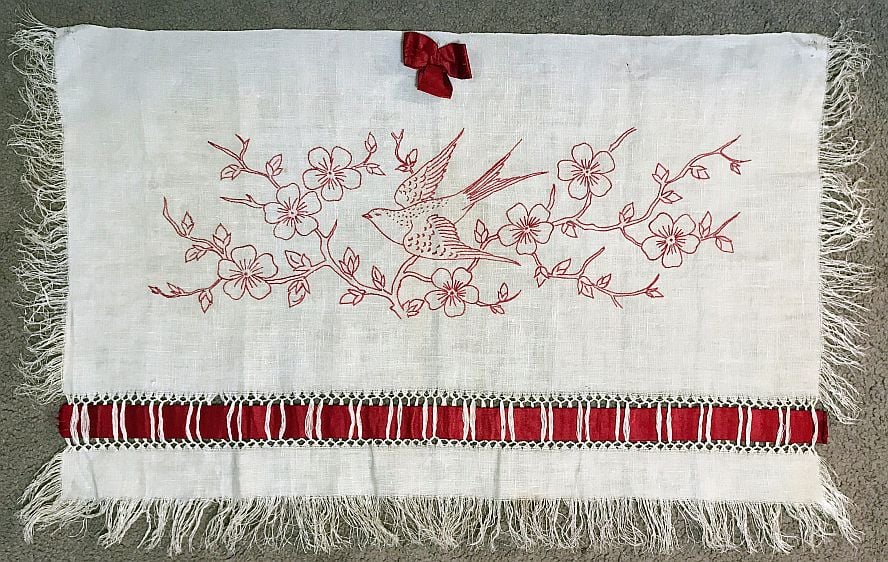
I have a new grandson named Jack and I would like to make him a quilt with all the “Jacks” of nursery rhymes and fairy tales in redwork. So far, I have not found patterns for more than a couple. If anyone knows of where to find a pattern for applique or redwork for the following, please let me know.
Jack Be Nimble, Little Jack Horner, Jack and Jill, This is the House that Jack Built, Jack the Giant Killer, Jack and the Beanstalk, Jack Spratt, etc.
TIA
Jackie Joy
From: “Sharon in NC”
Jackie you can do a search on them all but add coloring. Here are some to get your started. http://images.google.com/images?qjack%20coloring&hlen&lr&saN&tabwi
From: “Nancy Roberts”
A couple in this area of Ocala, FL, have a shop in which they offer lessons on sewing and quilting with treadle machines. The husband repairs, restores, collects old machines. The wife makes quilts and soft sculpture dolls. Several women in the area have taken the class and love using their treadle machines. The power outtages of the recent hurricane season won’t slow them down! Nancy Roberts
From: “Rosie Werner”
Ruby Short McKim designed a Rhymeland Quilt in the 30s (not to be confused with her Nursery Rhyme Quilt from 1922. ) The Rhymeland Quilt has Jack Fell Down (Jack and Jill),Block #28, and Jack Be Nimble, Block #21. This was a series printed in newspapers in the 30s. If you have access to the Dutch Girl Quilting Scrapbooks, Jack Fell Down is in #21 and Jack Be Nimble is in #17. Some reprints of McKim’s patterns are still being sold today, but I don’t know if this one is available. Rosie ——_NextPart_000_00D5_01C4E1E0.12D0BC50–
From: KareQuilt@
The Quilters Hall of Fame is pleased this year to have Quilters Newsletter Magazine AND FreeSpirit fabric as sponsors of our 2005 Juried Quilt Contest. Our theme is again gardens: CTime Began In A Garden. Entries for the contest may contain any theme or pattern (traditional or innovative) pertaining to a garden but the top must contain at least 50 percent of Bannister Hall Summer House, a newly released chintz fabric collection by Xenia Cord for FreeSpiri t. This fabric will be available in quilt shops by late January 2005 so contact your local Quilt Shop and ask for it ahead of time. This will NOT be a full- size quilt 3 the exterior edges of the quilt must measure no larger than a total of 225 inches — but it can be smaller than 225 inches. I just know this gan g can come up with some great entries! There is no limit on the number of entries, but only one prize per person will be awarded. For further inform ation and a contest form, visit our website at www.quiltershalloffame.org. Or, send a self-addressed #10 (long) envelope to QHF Contest, P.O. Box 681, Marion, IN 46952-0681. Other contact points: 765-664-9333; email: quilterscomteck.com. Please share this information with your Guilds. Hope several of you on the l ist will make something! I9ll post the 7 exhibits that will be hanging in Marion July 5-17, tomorrow.
Karen Alexander
From: “Maureen”
Hi all:
The documentary program Quiltmakers of Gee’s Bend, produced by Alabama Public Television will be aired on PBS Thursday Feb 3, 2005 at 10pm Eastern. Because local PBS affiliates can choose to broadcast this program or not, you need to contact your local PBS station now to ask that it be aired in your viewing area. Scheduling for February 2005 is now being constructed, so don’t delay and phone today. Spread the word!
The Quiltmakers of Gee’s Bend will also be simulcast in high definition television, which is a magnificent use of the technology as HDTV shows incredible depth of field and detail — twice that of regular, analog tv. You do need an HDTV television to view HDTV programs. I believe there is also a DVD available of the program — contact Alabama Public Television at www.aptv.org
Here in Southern Oregon, our local PBS affiliate is Southern Oregon Public Television. We’ll be having a High Def Quilting Party in the station’s studios for local quilters with a quilt show on Tuesday Feb 8th, 2005. Refreshments will be provided by Country Quilts and Crafts of Jacksonville, Oregon. Thanks to Mountain Stars and Monday Quilters for organizing this event and to Alabama Public Television for making this excellent program. What fun !!
In Southern Oregon, you can watch The Quiltmakers of Gee’s Bend on Sunday Febrary 13th at noon on Channel 8 (KSYS) or Channel 22 (KFTS).
Maureen Battistella Ashland, Oregon 541-552-0743 Who is proud to work For Southern Oregon Public Television
From: Sally Ward
A couple of days ago, in a museum collection, I saw a pair of curious ‘wire snippers’. I couldn’t examine them closely, they were quite small, in their original box, and American in origin (price $1). The box said they were for snipping the ends of sewing needles to give a sharp point.
Anyone come across these before?
Sally W
From: danabalsamo
Hello all, It’s hit my little town of Dayton, NJ… As I was waiting for my daughters to finish their gymnastics class, I decided to walk around the school. This is not the school my girls go to, but it is in town. I found a bulletin board with lovely paper quilt blocks sewn together with yarn made by Mrs Yost’s class. They were very creative, well done…except for the theme…Signals in Quilts for the Underground Railroad! Ug!! I emailed a friend whose daughter attends the school to have the teacher contact me and briefly why. Now I need information…I have Pat’s site and Kim’s site and am armed with some information. Is there info anywhere else? I plan on offering to come in and talk about the myth at the children’s level. What else can I do? My best, Dana
Material Pleasures
From: Anita Loscalzo
* NEW FABRIC LINE FROM NEW ENGLAND QUILT MUSEUM Reproduction of 1895 Boston Pavement Quilt Brings an Historical Fabric into the Present
LOWELL, MA — The New England Quilt Museum and In the Beginning Fabrics are pleased to announce the release of a new fabric line inspired by a collection piece from the Museum entitled Boston Pavement Quilt dated from 1895. The Collage Collection, which contains a total of 41 pieces in two volumes, will be available in stores in March 2005 and can be viewed now at http://www.inthebeginningfabri@. A portion of the proceeds from fabric sales will go to benefit the Museum.
A cotton variation of the Victorian crazy-quilt technique that was popular in the 1800s, the spread contains many colorful small-scale calico prints, shirtings, and plaids ideal for applique cut-outs, decoupage and clothing. Larger floral fabrics from an earlier era are evident as well as furnishing textiles from the end of the 19th century.
* “THRILLED TO PIECES” EXHIBIT Showcases the Intricacy of 1,000-Piece Quilts
JANUARY 20 – APRIL 2, 2005
The sculptural and architectural aspects of antique quilts will be featured in a special exhibition entitled “THRILLED TO PIECES: The Awesome Intricacy of Multi-Pieced Quilts” at New England Quilt Museum In Lowell, MA. Running from January 20th – April 2, 2005 this exhibition showcases quilts made up of 1,000 to as many as 25,000 pieces.
Curated by New York City antiques dealer and quilt author Laura Fisher, the exhibition features a less commonly known – but extraordinarily remarkable – part of quilting heritage when quilters cut, accumulated, and then united thousands of fabric pieces into larger intricate designs. Painstakingly arranged with postage-stamp sized pieces placed in complex interplays of light and dark tones, these quilts reveal a larger geometric design. Fisher remarks that the patient artistry of the tenacious women who made these quilts resembles that “of the sculptor or the collage maker rather than the needleworker. They compose by adding on and maneuvering bits until a design takes form..I am in awe at the commitment these pieced quilts express.”
Laura Fisher will be at the New England Quilt Museum for a lecture and the exhibit opening reception on January 29, 2005 at 1:00 PM, free with admission to the gallery.
Anita B. Loscalzo, Curator New England Quilt Museum 18 Shattuck Street Lowell, MA 01852 ——– email: CuratorNEQuiltMuseum.org telephone: 978-452-4207 Ext. 11
Our Lancaster, Pennsylvania Quilt and Textile Museum, home of the Esprit Amish quilt collection and a large collection of Southeastern Pennsylvania quilts and textiles, has embarked on an ambitious program to connect quilters and quilt organizations with the public. The following is a request from the new Public Programs Coordinator, Helen Tingle, a talented and enthusiastic member of the staff at the Heritage Center.
Heritage Center of Lancaster County is seeking volunteer quilting and needleworking demonstrators (and entire guilds) to demonstrate at the Lancaster Quilt and Textile Museum (QTM). Demonstrators may work on their own project, whatever that may be. You can take anything quilt or needlework related, handwork or machine. It would be a great spot for one of the mini groups to meet. Many demonstrators find the demonstration days to be good opportunities to socialize and network.
In addition to the free publicity for your guild, some of the benefits of volunteering include invitations to Heritage Center special volunteer events, free parking downtown during the volunteer shift, 10% discount in the museum stores and after 82 hours of volunteering, QTM demonstrators receive a coupon for a denim shirt at the QTM store.
Currently the Heritage Center is scheduling regular (mixed-guild) demonstration days on the 1st and 2nd Saturdays of the month. In addition the Heritage Center is scheduling days to feature guilds throughout the year. This is a great opportunity to highlight the activities of your Guild. If you are interested in being a volunteer demonstrator or have any questions please contact Helene Tingle at 717-299-6440 or htinglelancasterheritage.com.
Trish Herr
From: “Jan Drechsler” <quiltdoc@>
Dana,
The story has already been planted in their minds by their teacher. Teachers are always right. So you need to have them think about how information spreads.
Talk about myths, how they start, why myths are important, why we need myths. Why slaves might need myths.
There is a terrific new book on the underground RR, which I just took back to the library yesterday. I don’t know the exact title. It has many quotes from history, including Frederick Douglas, the famous orator and runaway slave. If you search the archives, I believe J. G. Row gave the title of this book within the last 6 months. Kids love pictures and drawings and you could read a few quotes and show a picture.
Ask them to think about how dark it is with no lights in the woods. Explain how almost all the slaves would have escaped at night and flashlights and electricity were not invented yet. Ask them could they see whether a color was red or black or even differentiate a quilt pattern in the pitch black. Have them think about slipping up to examine a quilt on the front porch without waking up the dogs sleeping under the porch. Why wouldn’t one want the dogs to bark or attack?
Finally talk about how this myth grew wildly today. For example, the money made on popularizing the book, T.V. shows popularizing the concept (Opray), the lecture circuit, the fabric store of the relatives, the other books. The ease of integrating history, art, geometry and African-American themes in schools makes it popular to teach.
Be prepared to be questioned. Arm yourself with the phrase ‘Is this a question or a story?’ Kids love to tell stories.
Most important, don’t point the finger at any one person (especially the school system!!), but explain how all of this can snowball with media attention.
Bring a quilt, an old one if you can.
I am sure you will do fine. You have more information from reading QHL than you can use. Just organize it for your age of audience. Ask some friends and their kids over to give a practice lecture to first, if it would help to hone your discussion.
Please keep your notes, share what you did, the snags you ran into if any, and what you would do differently after you give your presentation/talk. Maybe this is the beginning of an online lesson plan. Good luck.
Jan — Jan Drechsler NEW E-MAIL ADDRESS: quiltdoc@
Quilt Restoration; Quilting teacher www.sover.net/~bobmills
From: “Jan Drechsler” <quiltdoc@>
Dana, I just re-read your qhl post and realized that you are in Dayton, NJ which is right around the corner from where I used to live in Belle Mead and Princeton.
Historian Giles R. Wright is Director of the Afro-American History Program, New Jersey Historical Commission, and is cited at historicamdencounty.com as ‘New Jersey’s Underground Railroad Myth-Buster.’ He also co-authored an excellent booklet called ‘Steal Away, Steal Away…: A Guide to the Underground Railroad in New Jersey,’ published by the New Jersey Historical Commission. Wright claims that the book (HIPV) presents a very appealing idea, but it is based on ‘sheer conjecture and speculation.’
>http://historiccamdencounty.com/ccnews11.shtml<
Get in touch with Wright and ask for his booklet. Afro-American Education is his business and perhaps he can offer teaching or lecture assistance. I believe his office is in Trenton or Camden. You can find his phone or e-mail on the web. Do that first so he could send you his booklet.
Regards,
Jan
— Jan Drechsler NEW E-MAIL ADDRESS: quiltdoc@
Quilt Restoration; Quilting teacher www.sover.net/~bobmills
From: Patricia L Cummings
Jan:
I was told some time ago by Giles Wright that his booklet is out of print, and there are no immediate plans to reprint. Just so you know….
Pat
From: Patricia L Cummings
An outstanding book, mentioned by Joan Kiplinger a few weeks ago, is Passages to Freedom: The Underground Railroad in History and Memory. This book is high in content, and is lavishly illustrated with drawings and photos. Edited by David W. Blight, the book was published by Smithsonian Books, 2004.
A second great book, recommended by Monica MacDonald, is entitled, Founding Myths: Stories that Hide our Patriotic Past by Ray Raphael (New York, London: The New Press, 2004). This book focuses on the Revolutionary Era and in the words of one reviewer is a “wake up call”.
Both books will aid in your understanding of how myths can get started and continue to flourish. These are great reading and are good books to put on your holiday “wish list”.
Pat
hi everyone
just asking for some help.
recently i gave a small talk about my favourite commemorative quilts and miniatures. one of the ladies in the audience came up and offered me her florence peto book called americana quilts and coverlets. i am such a florence peto fan and i still cant believe she gave me this precious book. made even more precious because her husband gave it to her as a gift and he has since passed away.
where am i going with this,
does anybody know the value of this book?
as a matter of interest the inside cover has the original price of $1.00.
many thanks kerry in sydney.
This message was sent through MyMail http://www.mymail.com.au
From: “JG Kane”
I’ve been catching up on mail after a few days away. Here in Yorkshire, N. England, we “wash (‘wosh’) up” the dishes too, but if a person or a business is “all washed up” he/it has failed, or collapsed……. I wonder why? Then there’s being “washed out” – pale and peeky looking. Jill, Leeds, U.K.
From: “JG Kane”
I acquired a crazy rug in a boxed lot I got at auction, here in Yorkshire. Initially (when I was rummaging in the boxes at the auction room and trying to be discreet!) I thought it was a quilt, but it was definitely made as a rug. It is pieced with heavy woollens, mainly tartans, with a wool fringe, and pieced cotton backing.Its the sort of utility, make-do-with-what-you-have item that I equate with our rag and proddy rugs. Is there a history of such crazy rugs in the U.S.please ? Jill
From: Kathie Holland
checked on bookfinder.com starting at $34.95
From: Barbara Burnham
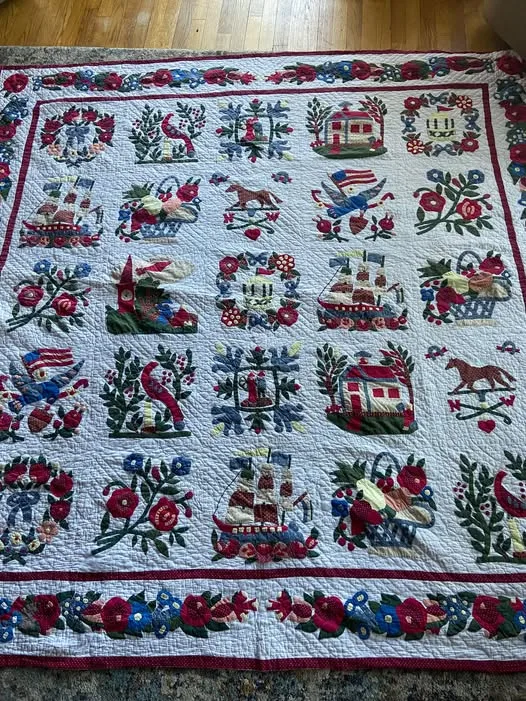
I would be very interested to hear experiences from anyone who has ever stitched one of the vintage kit quilts that were marketed in the 60’s and 70’s by Paragon, Bucilla, etc. Email privately if you like. Thanks, Barbara Burnham Ellicott City, MD
thank you, i have a very good idea of the cost now. cheers kerryx
From: Dana at Material Pleasures
Thank you Jan, We should get together for lunch one day, you are not far at all! I will try to contact Giles Wright. My friend who I emailed is going to forward to email to the teacher…I hope she is receptive. I can imagine not many teachers would want someone coming into their classroom to prove something they taught with such zest as wrong. Either way, I plan on putting something together for the area schools so this does not happen in the future (yeah, right), and also writing an editorial to the local paper… I want to thank Pat and everyone else who has contacted me privately and on the list. It gives me so much more confidence having you behind me on this. My best, Dana
Jan Drechsler <quiltdoc@> wrote: Dana, I just re-read your qhl post and realized that you are in Dayton, NJ which is right around the corner from where I used to live in Belle Mead and Princeton.
Historian Giles R. Wright is Director of the Afro-American History Program, New Jersey Historical Commission, and is cited at historicamdencounty.com as ‘New Jersey’s Underground Railroad Myth-Buster.’ He also co-authored an excellent booklet called ‘Steal Away, Steal Away…: A Guide to the Underground Railroad in New Jersey,’ published by the New Jersey Historical Commission. Wright claims that the book (HIPV) presents a very appealing idea, but it is based on ‘sheer conjecture and speculation.’
>http://historiccamdencounty.com/ccnews11.shtml<
Get in touch with Wright and ask for his booklet. Afro-American Education is his business and perhaps he can offer teaching or lecture assistance. I believe his office is in Trenton or Camden. You can find his phone or e-mail on the web. Do that first so he could send you his booklet.
Regards,
Jan
From: Joe Cunningham
<img align=”right” alt=”click on the thumbnail to see this up close” border=”2″ height=”72″ src=”images/trapuntolilydet2_small.jpg” width=”100″/><img align=”left” alt=”click on the thumbnail to see this up close” border=”2″ height=”90″ src=”images/trapuntolily_small.jpg” width=”100″/> just saw a trapunto quilt on ebay that is being sold by my friend Julie Silber. It is so great, if you like beautiful quilting, that I thought you all might like to see the pictures. Each trapunto block is different, and Julie has posted pics of many of them. You can see this and some of her other quilts, including a sort of bronze color linsey woolsey, if you go to this link:
http://cgi.ebay.com/ws/eBayISAPI.dll?ViewItem&item3770100707
She has four really rare ones on a three day auctioon, so they won’t be up long, but you can see them all if you click on the “see my other quilts” link. The trapunto photos by Jean Demeter are truly worth seeing if you want to see the best of 19th century quilting designs. Joe Cunningham in sunny San Francisco
From: Louise Bequette
I have a friend who recently presented to the guild her mother’s quilts made from kits in the 50s-60s- and possibly the 70s. What she would like to know is who made the kits? Is there a website that shows these kit quilts, or somewhere we could send pictures? It was a wonderful selection.
Louise Bequette
This style of sampler quilting motifs in alternate blocks of appliqué quilts is a regional characteristic that might be traced to Ohio. Two years ago when I was preparing a Study Center for AQSG on Regional Characteristics of Quiltmaking, Ricky Clark told me about this same characteristic that had was found in the Ohio Documentation Project. They did not have time to further investigate the trend but I have found some other examples in documentation books. On pages 27 and 147 of “Quilts in Community: Ohio Traditions” you will find examples of quilts similar to the Ebay quilt below. They were made in Belmont and Guernsey Counties which are along the National Road, Rt 40. You can find another quilt with sampler quilting patterns on page 123 in “Treasures In The Trunk” by Mary Bywater Cross. This quiltmaker is also from Belmont County. I have also found examples in the Illinois or Indiana books, also along the National Road. Just an fyi. sue reich
From: Xenia Cord
In a rare convergence of interests, my husband pointed out to me an article in his current Science News (11 December 2004, Vol. 166, No. 24) on microscopic examination of archaeological textiles. This will not be new to some of you, but among the findings discussed is evidence that ancient silk found in archaeological sites in western Europe and parts of Asia came not from Chinese sericulture, but from wild silk moths resident in the areas where the fragments were found. The fragments examined were from woven goods, suggesting earlier dates than previously supposed for this activity.
Among Hopewell Native American cultures in central and eastern North America, researcher Kathryn Jakes of Ohio State has examined fibers from crematory sites that show evidence of dyes in their textiles (100BC to European encroachment). She also determined that spinning and weaving were imbedded in these cultures. Using analytical chemistry and powerful microscopy, scientists are recreating the material culture of ancient civilizations through organic fragments such as textiles.
Fascinating reading…
Xenia
From: Judy Schwender
This is very exciting! I am developing a fiber analysis study center for AQSG 2005, and this points out how important it is to accurately identify fibers. Thank you Xenia! Judy Schwender
Xenia Cord <xenia@> wrote: In a rare convergence of interests, my husband pointed out to me an article in his current Science News (11 December 2004, Vol. 166, No. 24) on microscopic examination of archaeological textiles. This will not be new to some of you, but among the findings discussed is evidence that ancient silk found in archaeological sites in western Europe and parts of Asia came not from Chinese sericulture, but from wild silk moths resident in the areas where the fragments were found. The fragments examined were from woven goods, suggesting earlier dates than previously supposed for this activity.
Among Hopewell Native American cultures in central and eastern North America, researcher Kathryn Jakes of Ohio State has examined fibers from crematory sites that show evidence of dyes in their textiles (100BC to European encroachment). She also determined that spinning and weaving were imbedded in these cultures. Using analytical chemistry and powerful microscopy, scientists are recreating the material culture of ancient civilizations through organic fragments such as textiles.
Fascinating reading…
Xenia
From: “sue reich”
Picking up on an exchange from a few days ago. I have a Boyd Needles and Shuttles tin holder. Unfortunately, it is not filled but there are patent dates on it in the center. They are June 12, 1906, Dec. 18, 1906 and July 9, 1907. It is so extraordinary to see just how many sewing machines were on the market at that time! There are 196 sewing machines named around the circular tin. Amazing! sue reich —
From: “Charlotte Bull”
Hi … in regards to an older thread – Sanitary Commission Quilts
My sister in VT just sent me a page from a magazine about a quilt displayed in the Freedom & Unity: One Ideal, Many Stories exhibit – no details re the exhibit but evidently a major history exhibit. Large numbers of children toured and many volunteers were recruited as tour guides, or History Helpers. It must have been impressive!
The page she sent me was about a quilt made in 1864 by a young bride whose new husband was in the 3rd VT Regiment. A very simple design, it featured Bible passages inscribed on big blocks. It is stamped “Sanitary Commission, Brandon Soldier’s Aid Society, Made by Mrs. L. B. Fairbanks of Brandon, Vermont” She was 18. They’d married while he was home recuperating from wounds, but he returned to duty and did eventually return to her in 1865.
The article says “This quilt is a rare survivor of the estimated 250,000 such pieces that were made by women and sent to soldiers on the front.” Photos of the couple and soldiers were in the exhibit as well.
I just thought you’d all be interested in another example. I thought some VT members might know more about the exhibit but all would be interested in the story. Charlotte in Cold but Sunny Ozarks
From: “Steve and Jean Loken”
Barb and group, I bought a kit recently. An expert on kits dated it to the 60s due to the packaging. It’s a Progress kit, and I’m in the process of appliqueing it. It’s all cotton, which some from that decade were not. It’s stitching beautifully. It’s a 2-color design, gold on white. The pieces had been cut out, but no applique started. The register of the design areas is not perfect, but I’m hoping the blue lines will wash out, but perhaps not after all these years. I’m trying my best to hide them. I plan to hand quilt it along the lines provided. It also calls for some minor embroidery. The bias for vines and edges was included in the package, but the package had been opened, so I decided that the value finished was better than a kit that had been opened and started, at least to me. If you have a more specific question, fire away. Jean in MN