December 16 – 21, 2004
This page contains affiliate links. If you buy through them, I may earn a small commission at no extra cost to you. As an Amazon Associate I earn from qualifying purchases. Learn more
These restored messages come from the Quilt History List, an online forum where quilt historians, collectors, researchers, appraisers, and enthusiasts discussed antique quilts and related textiles. The archive dates from 1996 through approximately 2016 and is being restored gradually. Sign up in the form at the bottom of the page if you want to know when a new page is added. Original spelling, opinions, formatting, and inactive links may remain unchanged.
Primary topics of this QHL Digest:
- Kit Quilt Companies & History — An extended thread identifying kit quilt manufacturers, blue-line removal questions, and a call for a central kit-quilt history resource.
- Sanitary Commission Quilt Research — Continued research into Civil War-era Sanitary Commission quilts, including new leads found via Google.
- Anne Copeland & Beverly Dunivent’s Kit Quilt Book — The authors of a 1994 book on kit quilts discuss its research history and publishing options for a follow-up.
- Silk Identification & Dye History — Members help identify a type of silk fabric and discuss historical silk weighting practices. (see the article on natural dyes)
From: Barbara Burnham
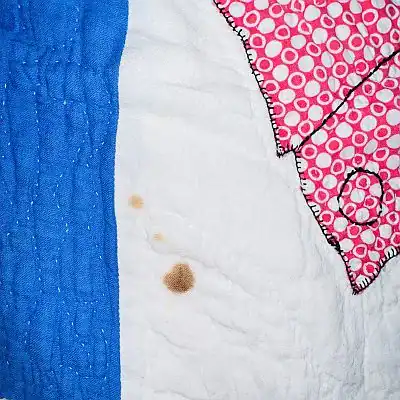
Jean, Recently, I completed a Paragon “Beginner’s” applique pillow kit (c)1967. It turned out great, but the instructions provided were awful! Fortunately I have enough experience to ignore them. The original owner had begun the kit, following the instructions–no wonder she quit after one flower! I just wondered how the instructions were on other vintage kits, and what experiences people have had trying to make them. Did you use their instructions? Did all the motifs “line up” with the designs? Were all the motifs provided? Do the blue lines ever come out? Any other problems? Barbara
Steve and Jean Loken <sandjloken@> wrote:
Barb and group, I bought a kit recently … in the process of appliqueing it … The register of the design areas is not perfect, but I’m hoping the blue lines will wash out, but perhaps not … trying my best to hide them… Jean in MN
From: Carolyn K Ducey
For those interested in machine quilting,
Newbie mentioned in a recent email that there were a number of machine-quilted quilts in the International Quilt Study Center’s Collection. Anita Loscalzo’s research project prompted us to look at these quilts again, and re–evaluate whether or not they were actually machine quilted. We did make a few preliminary changes after much discussion and careful analysis. Please take a look at the IQSC database for the current information. We’re looking forward to an in-depth examination of the quilts when Anita is in Lincoln to complete her master’s program this spring. We’ll keep you updated.
Carolyn Ducey Curator International Quilt Study Center HE 234, University of Nebraska Lincoln, NE 68583-0838 402/472-6301
From: “Suzanne Cawley”
Hi Jill and All!
First, let me thank everyone who helped provide a translation for my redwork piece. This group is so knowledgeable and generous! It seems we can ask one question and learn a lot more than just that one answer!
Second, I am not familiar with a specific “crazy rug” history in the U.S…..unless we consider the heavy, wool utility “rugs” that served as bedquilts and may also have done duty on the floor. (Just guessing here!) A good site that I refer to often is http://www.netw.com/~rafter4/index.html . It has a lot of info on traditional rug styles as well as some interesting links.
Suzanne Cawley In wild, wonderful Keyser, WV
From: “Charlotte Bull”
I have already gotten some questions re the page about a Sanitary Commission Quilt. As best I can figure out, the Freedom & Unity exhibit was in Montpelier VT at the VT Historical Museum. I did a Google search. There is a book on the overall topic. I did not search long enough to find a mention of the Quilt. But if you are sincerely interested I’m sure you can get a contact address or phone or email address if you go to “google”. Sorry, but my sister did not include any info regarding the source of the clipping. She simply sends me any clippings about quilts that she notices in the papers. This was different as it was a glossy page from a brochure or magazine — just not a quilt magazine. Also, the story was really about “history of a VT soldier” and the quilt was not a major point, simply a part of a story! I shall write and ask her but it will take time. cb
From: “Charlotte Bull”
I went back & did more on Google & this time I put in: Sanitary Commission Quilt in Freedom & Unity Exhibit in Vermont The first item brought up was specific. It is included in the 2004 Annual Report and all pages are available in a pdf — page 7 out of 24! Some other pages are also fascinating!
From: Kaytriplet@
> Recently I gave a small talk about my favourite commemorative quilts and > miniatures. One of the ladies in the audience came up and offered me her > Florence Peto book called Americana quilts and coverlets. I am such a Florence > Peto fan and I still cant believe she gave me this precious book. Made even > more precious because her husband gave it to her as a gift and he has since > passed away. > > where am i going with this, > > Does anybody know the value of this book? > > > As a matter of interest the inside cover has the original price of $1.00. > > Many thanks Kerry in Sydney. >
I just happen to have purchased this book. Mine is missing the dust cover and the pages are pretty brown from age. It was “First published by Chanticleer Press in 1949” according to the inside page. I would say it is in average shape for a book that age and I paid less than $20 US, but can’t remember exactly. If you go to www.bookfinder.com you will see many dealers listing their books. It saves you from having to check lots of dealers’ web sites. I have found that these tend to be the upper end of the prices and sometimes way upper end, as when a book is listed cheaply, it goes quickly. However, the site does give the market prices for hard to find books and I use it often for purchases. www.half.com is the equivalent of ebay for books, records, etc. and is owned by ebay. I use it even more, but tends to be the popular books, not “rare” books. They will show the original list price for lots of books, even fairly old ones, and quilters often list their books there for sale. The advantage (and disadvantage, too) is that this is person to person rather than through a dealer.
Kay Triplett
From: Donald Beld
Thanks for your notes Charlotte–the quilt you are talking about is posted at www.vintagepictures.eboard.com It is one of only five surviving Sanitary Commission quilts that I have been able to track down. There is the one at the Lincoln Shrine in Redlands, Ca, and can be seen in the article I wrote in the Winter 2002 issue of the American Quilters Society magazine; one up in Berkley that is a simple 9 patch that can be seen in Virginia Gunn’s article on the Sanitary Commission quilts; the one in Vt.; another one that used the Album Block like the Lincoln Shrine’s but has a center appliqued block of an American Eagle with the first verse of the Star Spangled Banner stitched on it with the words The Union Forever; and one that is basically the forerunner design of the Amish diamond in a square block.
I consider them all to be national treasures and the second most important historical textiles because they represent the beginnings of the great movement by America’s quilters to make quilts for national causes, drives, and charities–one that has been going on now for over 140 years.
Sure would love to find more!! Best, Don Beld
From: “Steve and Jean Loken”
Barbara, I have to admit I ignored the instructions. They said to baste back the seam allowance and then applique. No needle turn. Of course the inside points ravel and the outside points are lumpy. You’re right, no wonder she quit! So far, all the pieces are there. The registration of shapes isn’t perfect, but fabric is so flexible, I mostly make them fit. I too, wonder whether the blue lines will come out. Guesses, anyone? Or better, experience? Jean
From: “Rosie Werner”
Louise, I have been collecting pictures of kits and sorting them by the companies that made them. I have a 4 in. wide 3-ring binder full of them. If you send me the pictures, I will see if I can identify any of them. There are thousands of kits, so my album is by no means complete. E-mail me privately for my address or send the pics by e-mail. Rosie Werner
From: Pat Kyser
Re: blue lines on kit quilts > I too, wonder whether the blue lines will come out. > Guesses, anyone? Or better, experience? > Jean
I received an already finished kit quilt as a wedding gift in 1955, morning glory design. I never saw the kit so have no idea what company produced it. But the blue lines came out and it was white and beautiful. In the mid-sixties a daughter, angry at me, took a red ball point pen and scribbled all over it. MIracle of miracle, that also came out.(Have no idea what detergent I used…in panic, I just tossed it in the washing machine with whatever was on hand. Previously I had always had it dry cleaned, per instructions from the maker who gave me the quilt. It was MUCH prettier after the washing. This was all before I even knew the word “conservation.”) The quilt has been on a bed continuously and now has holes in the white back ground fabric but I love and enjoy it still. I once thought to repair it and soon realized it would be easier to make a duplicate. But I never have. Pat Kyser in Alabama
Good Morning, There is so much interest in kit quilts. I have some and know Shirley Mc Elderry has lots many + ephemera. Deb Rake hung a kit quilt show for one of her finals at U of NE, Lincoln. I know Merikay has volumes. Plus years ago at Paducah, Bettymae Groves hung a kit quilt exhibit.
So my questions are: Is there any one place to put all this information together? How do we start a depository? Where would it be (Marion, IN Marie Webster sold kit quilt + the Quilter’s Hall of Fame is there)? I’m willing to share anything I have (Which most of the who made its came from Merikay) We need a General and I’m only a private. Catherine Noll Litwinow
Date: Sun, 19 Dec 2004 20:38:36 -0500 | From: “Lucinda Cawley” <lrcawley@>
I finally got to the DAR for the exhibit of quilts and samplers. I’m afraid that I short changed the samplers as I am wont to do when there are quilts nearby. I know they were delightful (especially on with a border of very assertive sunflowers–most unsampler-like) and next time I’ll look at them first. There are about a dozen quilts hanging, all pre-1850. As you enter the gallery there’s a Baltimore Album top set without sashing. The blocks are absolutely crammed with applique. It’s so busy it makes you dizzy.
One block is the US Capitol (before the dome); there’s an unknown (to me anyway) building in another block and the word’s best appliqued watermelon. You could spend hours looking at this one. Next is the glorious framed center chintz applique that’s on the cover of First Flowerings. This quilt is so brilliant it might have been made yesterday. The icing on the cake are the large bright blue triangles that form the frames. It was disconcerting to see a gorgeous first quarter chintz applique from South Carolina which was quilted about fifty years later with Baptist Fans. This was definitely not a good idea. The center is a large fruit basket medallion.
My favorite was a never before exhibited framed medallion with dogtooth and Delectable Mountains border (perfectly executed to turn corners). The center is a rather primitive, sinuous oval of vines and leaves in a variety of indigoes–just wonderful. Another medallion had a flower basket center with concentric floral vines. This one is initialed and dated 1836 in applique and has wonderful quilting. It looks so much like the various leaf quilts popular at the time of the Sears contest one might, at first glance, think 20th century. But the maker left no doubt.
The much published “Aunt Eliza Moore” friendship quilt from New Jersey (1842-44) is a feast for chintz lovers. The blocks are small and contain motifs from a variety of fabrics. While Emma Fish was making this quilt her mother was working on one almost identical (lovely thought). Anna Markey Garnhart is one of my heroines. She made an applique quilt for each of her eleven grandchildren. Reverse applique seems to have been her favorite technique. Her 1815-1830 Eagle Medallion has the eagle and an urn of flowers surrounded by a leaf and vine of a single blue-green fabrics and more chintz appliques in the border. This quilt is very fragile. You’d better see it now; it may not be exhibited again.
There are five or six fabulous whitework quilts and a second Maryland Album (1857). The blocks in this one are nothing extraordinary. What is exceptional about this quilt is that the original maker quilted it herself fifty years later. One of the many good things about the DAR is that they were always interested in getting every possible scrap of information about the quilts they acquired and their makers. T
here’s a very nice wall calendar featuring quilts from the collection for sale in the gift shop for $10.00 (this makes the fourth 2005 quilt calendar I’ve bought). There is going to be a in-house-produced, spiral bound catalogue of the exhibit available, probably by the end of January.
Don’t miss this if you’re going to be in DC in the next few months. Cinda on the Eastern Shore hoping that you all have a lovely Christmas and Happy New Year
From: Karen Alexander
Catherine, IB9m with you as to wishing there was a central place where kit quilt histor y ephemeral could be housed. QHF, for the time being, is limited to accepting only material directly related to Honorees. For example, we would be more than happy to receive Marie Webster kits and other materials she produced! In fact there are a couple institutions that already house some Honoree collections: American Folk Art Museum/NYC now has QHF Honoree Cuesta BenberryB9s ephemeral; AQSG/Univ. of NE Library has QHF Honoree Sally GaroutteB9s collection; and I believe the bulk of Mary BartonB9s collection, another QHF Honoree, is still being cataloged at the Iowa State Historical Museum. There are several current researchers, including Merikay Waldvogel, who have incredible ephemera on kit quilt history. Only time will tell wher e these current researchers will decide to donate their collections. Meanwhile, I guess weB9ll just have to continue to take advantage of their workshops and lectures. On that happy note, IB9ll let you all know now that Merikay will be doing a kit quilt workshop for us at the Quilters Hall of Fame in Marion, IN, during Celebration 2005, July 14-17. (Other speakers/teachers will be Laurel Horton, Patricia Cox, Pat Nickols and of course, Bets Ramsey of Nashville, TN, (our next Honoree) will be giving a lecture. If you are not on our mailing list and would like to receive a registration form in March, please email your snailmail address now to quilterscomteck.com and ask to be added to the mailing list.
From: “sue reich”
For this Christmas of 2004, I would like to share a special Christmas story with the members of this list. You all have given so much to me over the years. This is my holiday thank you. Overnight, a nor’easter blew in and blanketed Connecticut with a few inches of snow, promising a White Christmas. I should be finishing my cleaning and preparing for the arrival of all my children and their significant others. We are a military family and this is our first Christmas together since 9-11. In the midst of my cleaning, I came across this story this morning. It is more important that I share it with you.
“The Christmas Quilt” by Blanche Tanner Dillion Herald-Times Delta, PA December 24, 1936
The snow was beautiful but made one feel somewhat lonely, Nancy Atwell thought as she stood at the window watching the falling snow. For an instant she regretted refusing the urgent invitations of her two brothers and two sisters to spend the holidays with them. Each of them had been so insistent, but were all so far away it was out of the question, financially, and she didn’t want them to furnish the money – and then for years she had spent Christmas here in the Connecticut hills with her grandmother and she couldn’t imagine it seeming like Christmas any place else. Peggy North, her old and dear friend, had written that she could not get away for the holidays, so hoped that Nancy could be with her. Nancy had done little toward any sort of festivities and had left putting up the decorations until the last minute. In fact she hadn’t bought anything new – the old ones would do well enough. Perhaps she might just as well go up to the attic now and see what there was. It might seem more like Christmas with some decorations around. As she opened a drawer in an old chest her hand touched grandmother’s old quilt — “Grandmother’s happiness quilt,” as she always called it. It was just such a day as this so long ago, when sitting at grandmother’s feet down in the “setting” room she had heard the history of the pieces in the quilt. There was no place here in the attic to look at it, so together with wreaths and garlands of tinsel she carried the quilt down to the room where she had heard its history for the first time, and spread it out on the bed. Here was a piece from the dress grandmother had worn when grandfather proposed. Here was the piece of grandmother’s wedding dress — others from Christening robes, party dresses, wedding dresses and dresses worn on other happy occasions – some almost in shreds, but still enough left to recall the stories to Nancy as grandmother had loved telling them and how she had laughed at some memory. Nancy had commented on what a happy life grandmother had had. No one ever had a happier one, grandmother assured her. How cheerful, unselfish, grandmother had been, never dwelling on her troubles, but ready to help others in theirs.
Nancy recalled the times grandmother had been the means of making the path a little smoother, the pain less keen, by the gift of something Nancy especially wanted or the fulfilling of some cherished plan of Nancy’s. And when Nancy was left alone in the old home and grandmother sent for her she must have guessed just how much Nancy wanted the rest and quiet the hills would give her. Nancy never forgot the smile and embrace with which grandmother greeted her — no rehearsing of painful experiences, but plans immediately made for happy days in the future. Nancy’s loss had been grandmother’s as well, but grandmother had never let others know the shadows that crossed her path. What a satisfaction it must be to be able to help others as grandmother had. Then Nancy saw how she could do the same, in a measure at least. First she could give Anna a vacation over the holidays. Next she would wire Peggy she would be with her over Christmas. As she laid the quilt away after carrying out her plans, deep gratitude filled her heart for if she hadn’t found the quilt she would never have known the happiness she felt. The End
May you all have a very, Merry Christmas and may your quilting days be long. sue reich
From: Judy Schwender
Deb Rake did her Master’s project on kit quilts. You can read about the resulting exhibition at: http://www.quiltstudy.org/exhibitions/past.html?past_item891&db_itemlistitem Her full report should be in the UNL library, “Modern Marvels: Quilts Made from Kits, 1915-1950.” Judy Schwender
From: “Bobbi Finley”
Cinda,
Thanks for the great report on the DAR Exhibit. I plan to be there on Wednesday and now I know exactly what to look for!
From: “Lucinda Cawley”
I’ve been in touch with the curator of the DAR exhibit. As soon as she has the details on ordering the catalogue she’ll let me know and I’ll pass the info along. Cinda on the Eastern Shore where there was about 1/16th of an inch of snow last night so, of course, they cancelled school.
From: Anne Copeland
Beverly Dunivent and I wrote a book on kit quilts in 1994 and also had a paper published in Uncoverings 1994. I believe a lot of people have used our information now, but I guess that is what people do. Our book was not published although we sent it to a lot of publishers for at the time, the publishers told us they thought the book was too specialized and would not sell well unless we published patterns. Beverly was willing to add the patterns but I really didn’t want to do that. We gave a talk on kit quilts at Paducah that year. Cuesta Benberry, Shirley McElderly, and others helped us a lot with our research, which was very difficult then because we had no Internet and there was very little written on the subject at the time. When you mention the names of people who have the information, please don’t forget us as we were the first to actually put together an entire book on the subject.
Beverly has a lot of kit quilts. I used to but a number of my quilts were stolen in 1998.
I haven’t been online much because I had viral meningitis and have been very sick for the past couple of months. I have been in ER 5 X in the past two months. I was thinking there isn’t much I haven’t had happen in the way of illness the past couple of years.
I am busy completing the nonprofit status for my organization, Fiberarts Connection of Southern California this year. I have already been assigned nonprofit status and just have to complete some additional paperwork. The paperwork for creating a nonprofit is endless, but it will be worth it. My web site is http://www.fiberartsconnsocal.org. I have held a major fiberarts online competition every year and then arranged a lot of traveling exhibits so it takes a lot of my time.
In 1995 I cofounded Repiecers of the past, a quilt history/quilt restoration study group. The group is still going today down near Temecula, CA, and the group has changed its name.
From: “virginia”
If you stop by the Gift shop [actually you have to pass through it to get to the Museum] you can pick up a copy of the catalog to use while you are visting the exhibit. There is more information about the quilts than was possible to put on the wall notes. VA
From: Patricia L Cummings
Dear friends:
In light of today’s horrendous news about more casualties and injuries in Iraq, I want to share an article that I wrote yesterday. The story centers on one mother’s idea to reach out to veterans in long term care by making them quilts. This is a way of honoring her only son to keep his memory alive. Evan O’Neill was killed in Afghanistan. The terrific quilt project that she has instituted has become a way of transcending her own grief while reaching out to others. I hope that you will read this sad but heartwarming story. This is an example of a quilter today participating in tomorrow’s history.
I have posted yet another article which is related to history but minimally related to quilts. The topic is “A Victorian Christmas at the Remick Museum in Tamworth, NH”. We very much enjoyed our visit there, and if you like the Victorian Era, you will surely appreciate the photos.
I hope that are all experiencing the joy of the season and none of the stress. Have a wonderful time, and may you all get new quilt history books!!
Pat Cummings
From: “Maureen”
Marvelous work Anne! With almost insurmountable obstacles. Thank you for sharing your website. Maureen in Ashland, Oregon
Date: Tue, 21 Dec 2004 | From: Litwinow@
Thank you for all that have responded. Anne and Bev, perhaps it’s time to talk to publishers again?! Xenia did a presentation on kit quilts in KS-my 1st AQSG meeting and that hooked me for good! One of the joys of quilters is the willingness on most quilters is to share and preserve the history of quilts. Catherine in Iowa where the thought of appliqued flowers and warmth would be appreciated.
Have you visited the website: www.nimbleneedletreasures.com? There is a great amount of information for quilt historians at this site. For those who have been interested in “splashers”, there are patterns so that you can make your own. More importantly is the fact the magazine Nimble Needle Treasures is available on CD. This would be a great gift to those of you who want to know early quilt history that was reported within the pages of that magazine from 1969-1975.
Hazel Carter No. VA
From: Edwaquilt@
There is a quilter on another list looking for information about a pattern called “WWII Bomb Quilt” Does anyone have any information or hint that I can pass on.
Holice
From: Palampore@
There is a quilt/coverlet on ebay that is called a story quilt. It is more like a white on white signature quilt (1894). I had never seen a white on white signature quilt, nor have I ever heard one called a story quilt. I have no interest in buying this quilt, nor do I know the owner. Just curious….. Was it maybe a red on white that got bleached out? Merry Christmas to all, Lynn in New Bern We got 3 inches of snow early Monday and the kids have missed 2 days of school. Very icy roads, and it is silly to buy snow plows down here to use once a year or less. So we just sat back and enjoyed the white stuff…..
From: catzrockisland.
I was going to ask about a catalogue too – so will look forward to the information. Marie Johansen
From: DDBSTUFF
Seasons Greetings Everyone;
I have a question about a quilt I have that is made of a very thin and very, very soft silk. The silk is not like the silks generally found in crazy quilts or other silk quilts of that period. It is much softer and pliable.
I know this doesn’t tell you much but does it sound familiar to anyone and if so, can anyone date it or give me any kind of info on origin? (China?)
The quilt itself is a Masonic Quilt, full of all the Masonic symbols, all appliqued. Definitely old.
Any info will be appreciated.
Thanks,
Darwin
From: Joan Kiplinger
Darwin — your silks might possibly be habutai, smooth pongee or what was called China silk, very similar to habutai and which was replaced by the cheap modern China silk around the 1920s. Several of my friends have small quilts, turn of the century, using habutai.
From: Judy Knorr
Pat, Thanks so much for sharing the information that included your article about the “To the Top Quilt Project”. I had not heard about this undertaking and am very much interested as my nephew is one of the badly injured soldiers from this war. I am going to ask my guild to help me make a quilt for my nephew and I will let Barbara O’Neill know about it so she can count one more quilt finished for a soldier. Meanwhile, we should all keep these many young men in our prayers at all times. They have sacrificed so much for our country! Judy Knorr
From: “Karen Evans”
Oo, it sounds beautiful. Any chance of a picture? I know that a lot of the very English patchworks included fine silks – *mmmm*
From: Anne Copeland
I forgot to mention it took Beverly Dunivent and me about 2 years to complete our book, and also I spent about $3,000 out of my own pocket for professional photography so we could have transparencies of all the quilts people sent us to photograph from all over the U.S.
I guess if we were to try again to get it published (and the quilt publishing business is pretty political really) again, we would need to update it since so much has become available in the way of knowledge about the kits since we wrote our book.
The best thing that happened during the writing of the book was that we met a lot of really nice people along the way–people who were willing to lend us their quilts to photograph for the book, and some people who sent theirs never even heard of us before. And it was fun to see the quilts too. We had other kit items as well as the kits–we had a whole section on pretinted items. I did considerable research on those items and wrote a section which Beverly later added to and published as an article herself.
I always thought about the die-cut kits and wondered whatever happened to all those dyes that were used to cut them. I know some might have been melted down for the war effort in the 1940s, but I bet there are still some out there somewhere that are hidden away in some little tool and die company. I have been in many a tool and die company when I was a quality systems consultant and I can remember looking at many of the dies tucked away on the shelves and being surprised at how old they were. I often asked if they were still being used and they hadn’t been used for many years, but they kept them anyway. I have always hoped to come in contact with some of those dyes.
I loved the kits because what I realized when I had collected a number of them in various stages of completion was that hardly any of them were easy to complete. There were often hundreds of pieces and if you cut them all out at once and didn’t organize them, you could really end up with a big confusing mess. Also, sometimes it wasn’t easy to match the top pieces with the areas marked for their placement below. I had a kit called The Sunflower that was a replica of a German summer spread from a museum. It was so complicated, the previous owner of the kit had apparently given up in disgust, and I gave up very quickly too. It had many points required a huge amount of needle turning. The pieces also didn’t fit well the markings on the ground fabric.
I had some humorous kits too. On one I think the maker just didn’t quite get the concept, and the pieces were placed randomly on the top. Either she didn’t understand how to place the pieces to the matching areas on the quilt, or she just gave up and put them “wherever.” Or perhaps she was in her cups when she was working on it. I am not sure, but it sure is the oddest looking piece.
Peace and blessings and happy holidays, Annie
From: Dana at Material Pleasures
Hi Anne, You mentioned ‘quilt publishing’…did you try Schiffer or Collector Books or Chilton Wallace-Homestead? They publish collecting type books. Most have price guides, but not all of them. I would love to see this book published. My best, Dana
From: DDBSTUFF@
I have posted several pictures of my Masonic Quilt on the eboards.
I also just discovered this textile web site: http://www.bharattextile.com
Very interesting…
Darwin
From: Midnitelaptop
the moment my thimble fell into the collection plate during the Christmas eve service at the neighborhood church…i knew that i had gone too far with last minute sewing…
just minutes before i had slipped into the last row of seats.. i looked for an outlet on the back wall of the building so that i maybe i could plug in my hot glue gun to finish whatever i could, without benefit of needle and thread.. but the lights shining on all the walls had found the outlets before me…and i didn’t know which one of the plugs was the one connected to the shining star over the manger …so i didn’t take the chance of unplugging anything…. the topic of the sermon was, “lists of love”….so immediately i did a mental check of all of the names on my lists of holiday cards to be sent and presents to give..i don’t think that’s what the sermon was really about….but i just bent my head and hoped that the ever watching angels were all busy trying to find food and shelter for the homeless families of the world…. as the last carol, “deck the halls”, was being sung…i tried to remember if i hung all of the quitted stockings on the mantel..so that when we got home…everyone would have some wee presents to open… just before getting up to leave…i gave one last loving look at the manger and when i saw the lambs….i remembered that i had to defrost the goose for tomorrow’s dinner when i got home… next year i’m going to have a sumptuous picnic dinner on july 4th and give everyone gifts on labor day weekend…..and i’m going on a quilting cruise that leaves in november and returns in january…. jean laino
From: SSQuilt@
I’ve enjoyed reading the recent posts on kit quilts. For those keeping track of all this information, I wanted to let you know that in addition to the collection of applique and embroidery master patterns I have the collection of dies used to cut the pieced quilt kits that the F.A. Wurzburg company manufactured. Sadly the machine used to cut the fabric with the dies long ago hit the scrap pile. If I dig around deep enough there is probably a picture of it. My father cut a Grandmother’s Fan quilt kit for me when I was a teenager. We called the machine “The Clicker”. It was a huge thing with a large swing arm. The dies look like cookie sheets with the raised dies on there. They were sized to match the bed of the machine and you cut and stacked the fabric pieces according to what was needed for the kit. You could cut a stack of fabric at least 3/4″ thick. The die was laid face down on the fabric stack, the arm of the machine was brought around, the handle released and with the “click, click” sound of the arm hitting the die, the fabric was cut. You lifted off the die, discarded the excess fabric and stacked the pieces. Really quite fun but I do remember how hot and dirty it was standing in my grandfather’s furniture factory where we stored the machine at the time. Just going from memory, we have dies for Grandmother’s Fan, Dresden Plate, Cactus Basket, Lone Star, Pieced baskets, Blazing Star, and a basic set of triangles and squares that could be made in different designs.
Happy Holidays,
From: Anne Copeland
Thank you for the names of those publishers. I have thought that the book should be published perhaps more under women’s history instead of quilt books and no, we haven’t tried any of those publishers. I guess the next step would be to update the book. We have plenty of good photos and could probably get more now. I hope everyone has a wonderful holiday and I wish for each and every one of you the very best life has to offer for the New Year and all the years to follow. Love and light always, Annie
From: Anne Copeland
Wow, Gay, what a neat description of the dies you remember! I have seen metal dies in action, and I always tried to imagine how those types of dies could have been adapted to cut fabric. or how they must have functioned. Now I can envision it. I wonder how they managed to keep them sharpened. Boy, now I really appreciate the dye cut fabrics knowing they could cut only 3/4″ thick. Considering the number of pieces in some of the kits, this sounds pretty labor intensive! Thank you so much for sharing your memories of those dies. I figured the machines probably got melted down for war machinery, but wasn’t sure about the dies. Now you have me wondering about a number of things. How did you come across the dies and how did you know what they were? And then I wonder if perhaps one company with a set of dies cut pieces for other companies by contract, or whether each company had its own. It would seem to me that if each company had its own set of dies, they would all be slightly different unless they were somehow all made to the same die dimensions, and if that were the case, it might suggest that there was one diemaker who sold the designs to different die companies. Nowhere on the dies do a diemaker’s name usually show up, so we probably will never know whether the individual who was the diemaker was someone who worked for one kit company or went around to other kit companies and sold his diemaking skills.
I would love to know more of your story, Gay. It seems like I have written to you privately some long time ago, but my memory gets so bad at times I honestly can’t remember specifics. I am interested in knowing more about the master patterns too, for I know that a number of kit designs were made by more than one company and are very similar if not identical. I have always puzzled over whether a kit company simply got hold of another company’s kit and copied it or whether master patterns again were shared, or how the similar or identical patterns were created. So many mysteries. I know that a lot of kit quilts were copied from museum designs, so copying was not looked at the way it is today apparently, at least not in many circles.
Thank you again for sharing all your information. You are renewing my interest in the kits tremendously. Maybe all of us who have different kit information should create a compilation in a book with credits for everyone. Each person seems to have a wealth of knowledge, photos, etc. It would be smart to take advantage of the things that all of us have taken so long to put together. Peace and blessings, Annie
hi all
my aunt has passed on to me some old fabric books patterns and thread, which i am thrilled to receive. it has sadly a strong musty mildew smell. is there anyway of removing this smell? i dont want to wash the fabric or threads.
cheers kerry in sydney
From: Debby Kratovil
I have some incomplete information about a series of patterns titled the ABC Crib Quilt. There is a notation on the bottom of the first page (written recently by the person who sent me the patterns, whom I’ve lost the name of!) which reads: Mary McElwain, romance of the Village Quilt, copyright 1936. These patterns have simple children’s motifs accompanied by letters of the alphabet. The pattern set also came with stencils for heart and plume quilting. Each pattern has some chatty text with it (Nancy Page style). Anyone on this list have some more supporting documentation? Thanks! Debby Kratovil — Debby (with a “y” and not “ie”) Kratovil http://www.quilterbydesign.com Visit my workshops page for guild programs!
From: charles woodford
Has no one bumped into the book, Silk Quilts, From the Silk Road to the Quilter’s Studio by Hanne Vibeke de Koning-Stapel?
I’m not sure where I found this, Amazon, I guess. It has beautiful quilt pictures, made by the author and others and pretty much covers the subject, including WASHING suggestions.
I bought it when I had found myself with a pair of Chinese appliqued quilts made before WWII. I’m not sure what is meant by “habutai versus cheap China silk of the 20’s”, but the silk in my quilts is wonderfully soft and sheeny.
So thought this book might help you out, Darwin.
Barbara Woodford
From: Dana at Material Pleasures
Hi Kerry, A trick I use for books with a musty odor is to put the open book in a closed container with kitty litter for a few days…you can use baking soda, too…that might help with the thread and patterns, too. Leaving them out in the fresh air might just do the trick, too. My best, Dana
thank you dana kitty litter!
yes tried airing it, lessened the smell marginaly.
off to try kitty litter. kerryx
This message was sent through MyMail http://www.mymail.com.au