July 5 – July 16, 1998
These restored messages come from the Quilt History List, an online forum where quilt historians, collectors, researchers, appraisers, and enthusiasts discussed antique quilts and related textiles. The archive dates from 1996 through approximately 2016 and is being restored gradually. Sign up in the form at the bottom of the page if you want to know when a new page is added. Original spelling, opinions, formatting, and inactive links may remain unchanged.
Primary topics of this QHL Digest:
- Chicago Quilt Exhibition Preview — A member shares excitement about an upcoming quilt exhibition in Chicago featuring remarkable pieces.
- Cigar Flannels and Tobacco Premiums — Discussion of cigar ribbon flannels and silk tobacco premiums, their dating to 1900–1917, and care considerations.
- Buttermilk Cleaning Recipe — The buttermilk recipe for cleaning antique textiles is shared and discussed. (see the article on cleaning antique quilts)
- Quilt Appraisals and Ethics — An extended thread on appraiser ethics, qualifications, the business of appraising, and potential conflicts of interest between dealing and appraising. (see the article on quilt appraisers)
- Stenciled Quilts Research — A quilter researching stenciled quilts gets help with references, including the Heritage Quilt Project of New Jersey’s documentation of a rare example.
- Chair Pincushions — Members trace the history of novelty chair-shaped pincushions through vintage catalogs and family memories.
- Department Store Histories — Memories of old family-run department stores and their connections to textile and sewing culture.
Date: Sun, 5 Jul 1998 01:25:28 EDT | From: [from unknown, signed “Sharon Cheng”]
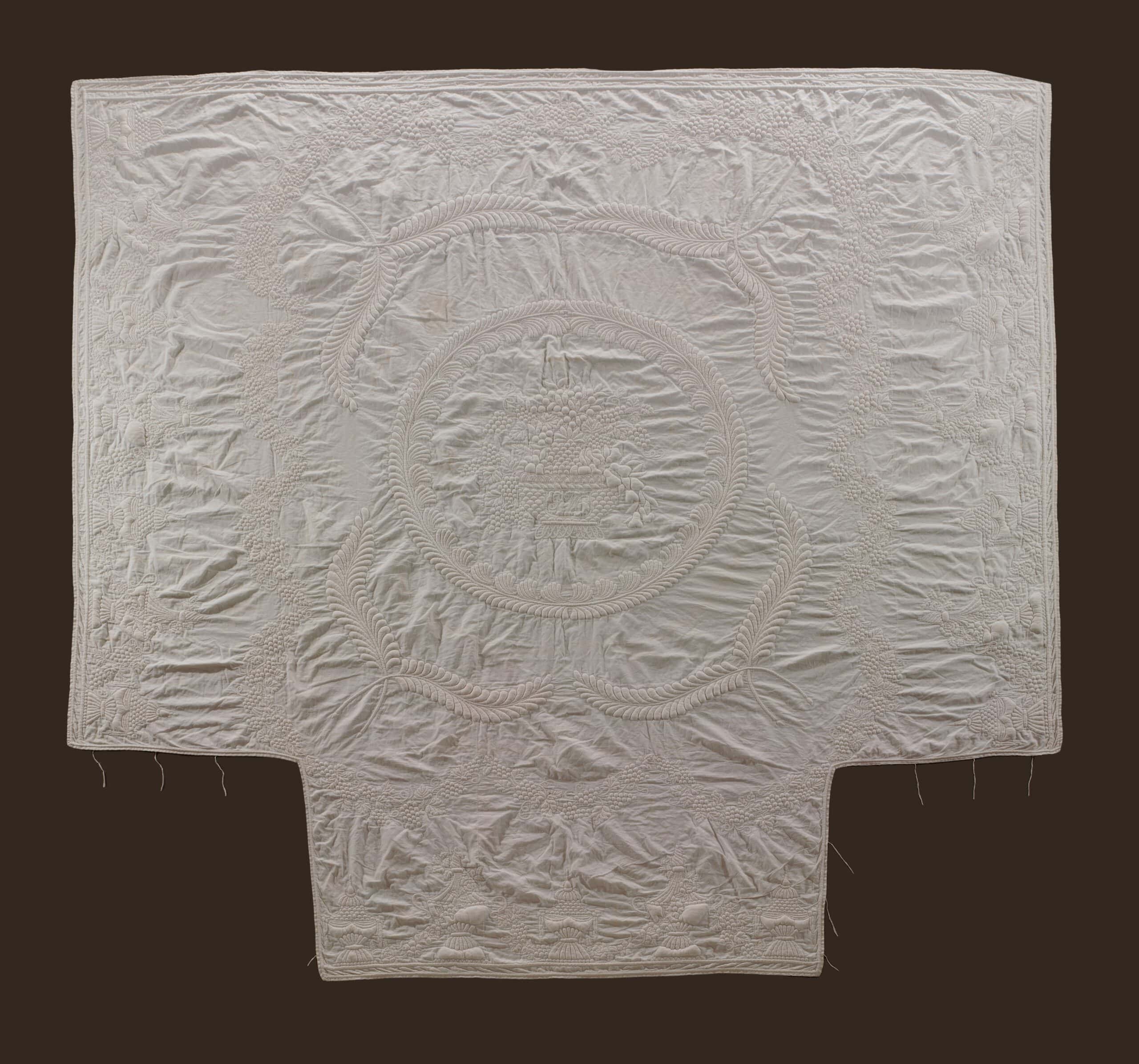
Regarding Maury’s announcement about the upcoming Chicago exhibition: I’ve seen some of these quilts — and they are incredible. If you are in the Chicago area, do make time to view them yourself. Included are the Industry Quilt, which was featured in the summer 98 issue of the NQA Quilting Quarterly. The 1820 trapunto is also extraordinary. I recently bought some tobacco flannels that came from cigar boxes. They’re flags from different countries. Do they come from the same time frame as the cigarette silks? In the same package as the flannels were two maps. They’re printed on silk. They’re old enough to show Germany as one country. One of the pieces is printed on both sides. Has anyone seen anything like this before? And the best part was that the package with the 16 tobacco flannels and the two maps was $2 at an estate sale . Sharon Cheng Ft. Worth, TX
Date: Sun, 05 Jul 1998 12:16:24 -0400 | From: Jake and Annette
A native American friend has her burial quilt hanging above her bed. She will enjoy it for some years to come and will be buried in a cloth she picked out and loves.I like this idea. Annette in SC the flannels were two maps. They’re printed on silk. >They’re old enough to show Germany as one country. One of the pieces is >printed on both sides. Has anyone seen anything like this before? > >Sharon Cheng > Yes – at the museum of Cumberland Pencil Co (I think – it was some years ago) in Keswick, Cumbria, UK. During the war they made hollow pencils which were stuffed with silk maps and sent in Red Cross parcels to prisoners of war who were hoping to escape. Sally in UK
Date: Sun, 05 Jul 1998 13:31:31 +0000 | From: Xenia Cord
Hi Sharon: Cozart (Quilt Digest) said the cigar flannels were “used concurrently with silks as inserts in packaging.” So the time frame would be 1900-1917. I do know that one does not dare wash the cigar flannels; as they are not colorfast. I have a tied comforter that is made from these flannel flags, and I just air it out every 6 months or so. (And keep it covered!) As for the silk map of Germany: could it possibly be a map distributed by the US government to pilots flying over Germany, in case they had to parachute in enemy territory? I have heard of these, but have never seen one. Shirley Mc Grow”<judygrow [at] blast [dot] net> my flea market find this past saturday is turning me into a record keeper. i bought 3 smallish bags of colorful scraps for $20.00. when got them home, spilled out and started looking through realized had quite treasure. very quickly that no duplicates among the fabrics, biggest piece was approximately 10 x 26. many pieces paper attached to with pins, these papers were either shipping labels or sales slips. what able together fabric stash one margaret adair 4311-15?????, paterson, nj. most likely sent away scrap because finished sorting putting all info on spread sheet came up names 28 different stores in 37 states. virtually dated sometime march 1941, (i 11 months old) from 3rd 29th. she might have been trying collect cut 4″ 6″ samples every slid sleeves photo album had( filled it then some), repinned store name, state, date, sample, where there one. wound 212 samples, different, florals except 13 which solids. small sample two fabrics carries information could be at 36″ wide 18 cents yard. some almost voile, sheer muslin (one called powder puff selvedge), wonderful feel liberty lawn, just felt like regular cottons.
along 4 badly sewn ocean waves type blocks three tall pieced flowers stems pots, ready appliqued background, more finish projects. guess margaret’s hand sewing skills not good (intuited included), after starting projects, set collected aside turned pleasant occupation her. so now documented-as-to-date collection over 200 definitely placed as new 1941! if only something 1860, 1870, 1880, 1890, etc., etc. question is, would written mailed 40 letters get single clearing house farmed her letters? stores– burdines miami, younkers des moines, a. harris co. dallas, paris salt lake city, marshall field chicago, ads magazines answered? seems are department stores, clothing factories. they kind offer? school home ec/clothing class, tasked with writing all those places for samples? In a similar class in the 1950s I had to write to every airline hostess school for brochures on their requirements and training for stewardesses (in the days when this was a prime occupation for a girl to aspire to! Travel!! Variety!! Glamour!!) Xenia, in Indiana
Date: Sun, 5 Jul 1998 22:40:49 -0400 | From: “Judy Grow”
In the same package as the flannels were two maps. They’re printed on silk. >They’re old enough to show Germany as one country. One of the pieces is >printed on both sides. Has anyone seen anything like this before? >And the best part was that the package with the 16 tobacco flannels and the >two maps was $2 at an estate sale . >Sharon Cheng >Ft. Worth, TX Sharon, I’ve framed 2 of those map silks in the past couple of weeks, and I’ve seen them for years. They are escape maps for aviators during World War II. They were extremely light, and wouldn’t get destroyed if your plane came down in water as paper would, didn’t rustle or make noise if you were hiding in a barn, and you could tie them around your neck for extra warmth. They have been closely held by the men who flew in WW II, but just recently they are being let go by families who have no idea what they are when the men who used them have died. What a pity. The ones I have seen are absolutely beautiful, and incredibly well printed. I have never seen one that was printed on only one side, so my framing has always been 2-sided. Judy in Ringoes, NJ judygrow [at] blast [dot] net
Date: Sun, 05 Jul 1998 21:54:04 -0500 | From: Laura Hobby Syler
Would all these stores– Burdines In Miami, Younkers in Des Moines, A. >Harris Co. in Dallas, The Paris Co. in Salt Lake City, Marshall Field in >Chicago, etc. — have placed ads in magazines which Margaret would have >answered? It seems to me that these are all department stores, not clothing >factories. Would they have cut fabric for this kind of offer? > >Judy in Ringoes, NJ >judygrow [at] blast [dot] net Judy, I think I’ve got this right… The A. Harris Co. was one of the predesessors of the Sanger-Harris Department store that then bought Titche-Goettenger ( of just plain Titche’s) and was then bought up by Dillards of Houston ( who is still around!). I remember the Titche’s in Northpark back in the mid ’60’s had a fabric department and I would imagine that with their attention to customer service that they would have been happy to cut samples of their fabircs, or maybe even had a mail order department. They were (as was Harris) doing battle on a daily basis with Neiman-Marcus and their “superior customer service”! Laura
Date: Mon, 6 Jul 1998 08:40:59 EDT | From: MimaMoa [at] aol [dot] com
shared — the first four lines of that are used as part of a song in “The Quilters” — a play based on the book, “The Quilters: Women and Domestic Art.” The play has been making the rounds for the past 10 or 12 years — I produced and directed it in 1988 in No. CA. and will be doing it again in Roseville in the Fall of ’99. It’s a great play — if you haven’t seen it, watch for it. It’s funny, moving, serious, depressing, touching, and full of laughter and dance. Such fun! Marilyn in Sacramento
Date: Mon, 6 Jul 1998 08:32:36 -0600 | From: “Kathrine Walker Schlageck”
The Beach Museum of Art at Kansas State University will be hosting “Kansas Quilts, Past and Present” during the summer of 1999. At this point I am looking for information on historic Kansas quilts. While most quilts will be borrowed from public collections, we will consider outstanding examples that are privately held. In addition, we look to private holders to help round out the story of Kansas quilts for the accompanying catalogue. Quilts will be considered on the basis of their condition (for display), their provenance/history, and their aesthetic quality. An additional piece of the exhibition will be contemporary quilts by local (Manhattan, KS area) quilters – we hope to have the local quilt guilds assist us in the jurying – and will feature Thursday night presentations by local guilds and teachers. Please contact me if you have information that you feel would be valuable for this exhibition. Kathrine Walker Schlageck, guest curator klwalk [at] iso [dot] ksu [dot] edu Kathrine Walker Schlageck, Education Coordinator Beach Museum of Art, Kansas State University 701 Beach Lane, Manhattan, KS 66506 (785) 532-7718 klwalk [at] iso [dot] ksu [dot] edu www.ksu.edu/bma (museum web page)
Date: Mon, 6 Jul 1998 11:00:11 -0400 | From: “Judy Grow”
Xenia, I remember an old family run department store in Atlantic City, where I grew up, “Blatt’s”. It was a beautiful building that had a fabric section on the 4th or 5th floor. Everything was wood, including the cutting tables and the racks for the bolts of fabric, where they were stacked one on top of the other, not standing upright as in all today’s stores. The clerk would get the bolt you requested and put it on the counter. You didn’t have to do all the carrying work yourself, but you couldn’t really handle every fabric either. Blatt’s is long gone. Judy in Ringoes, NJ judygrow [at] blast [dot] net —–Original Message—– Cord <xecord [at] netusa1 [dot] net> Indianapolis-based Wasson’s was a great department store, >along with L. S. Ayres and Wm. H. Block. All were family-owned. >Wassons’s went out about 25 years ago, I think, Block’s was bought by >Federated and became Lazarus, and Ayres was also bought but still exists >and carries the original name. > >Xenia >
23:24:24 EDT (July 10), please come see me at the exhibit of 20 quilts of the famous Chicago quiltmaker Bertha Stenge (1891-1957). Place: Illinois Art Gallery James R. Thompson Building 100 W. Randolph, Suite 2-100 Chicago, IL Tele: 312-814-5322 Regular hours: 9:00am – 5:30 pm. On Friday there is a Reception: 5:30 – 7:30 pm Admission is Free. Come and enjoy the quilts and hear Jan Wass and I give a gallery talk about Bertha Stenge’s life and quilts. The exhibit runs through August 14. Hours are M-F 9 am-5:30 pm What kind of quilts did she make? Better question–what kind of quilts didn’t she make and what quilt prize didn’t she win? She won prizes for her trapunto quilts. She also made applique album quilts documenting her life and times. I think you’ll be surprised to see the number of scrap hexagon quilts. Her masterpiece quilt “The Quilting Party” is included in this exhibit, too. For photos of her quilts, look in Rod Kiracofe’s The American Quilt pp. 239-240 and Quilts in America by Orlofsky p. 45. Better yet–come see them with your own eyes!! Thank you Kris and everyone for keeping QHL a lively place to check out each and every day. –Merikay Waldvogel
Date: Tue, 7 Jul 1998 01:20:35 -0400 | From: “Judy Grow”
>Hi Judy- what a great find you made at the flea market and I admire all >the sorting and documentation you did. Could some of the fabrics have >been salesman’s samples or did all have purchase receipts attached? Do >you have plans for the remaining pieces once you cut the 4″ x 6″ swatches >from them? Keep us posted! Nancy Nancy, No, they were not salesman’s samples, for sure. I am sure they were purchased pieces, and many, but not all had the receipts pinned to them. That is how I got the list of stores across the country where they were purchased. There is enough fabric left after cutting all my samples to fill just one of the 4 plastic bags the stash originally came in. Of course, since they are all pressed and folded, they take up far less room. I don’t have any immediate plans for the fabric, except letting a friend cut a sample book for herself. I just won’t spend another day and a half doing it. I guess I’ll just put them away with the rest of my antique fabrics waiting to repair old hurt quilts and tops. Judy in Ringoes, NJ judygrow [at] blast [dot] net
Date: Tue, 07 Jul 1998 16:46:36 -0400 | From: The Ledoux Clan
buttermilk recipe you are interested in. BUTTERMILK RECIPE 1 Gallon Water 1 Quart Buttermilk 1 Tablespoon Lemon Juice Let quilt soak in mixture and then wash in mild detergent. Because all of these ingredients are natural elements, it is in the combining of the 3 ingredients that works. Winnie in Maryland
Date: Tue, 7 Jul 1998 17:10:50 -0400 | From: “Kelchner, Alan”
Lord, please save me from the well-intentioned next-door quilting neighbor! I met with a new client for the first time last week. Had a really tired, poor-baby depression quilt (hexagonal dresden plates put together like a GFG – looked up the pattern name – Endless Time {?}). Bright, happy quilt that’s had a well-loved life. But it’s supposed to go to the next granddaughter of the paternal side of the family, and Mom – God bless her – wants it in relatively decent condition, so it’s not lost (at the moment it appears to be the only old quilt in the family – her grandfather’s estate was sold after his death and we can only guess at what went out the door). But the minute I showed up at the door, the Lady Next Door (LND) who quilts showed up. Turns out the LND had directed the Quilt Owner (QO) to go to the Quilting Connection, where she got my name. The LND was nearly excited as the QO that I was there. But she showed up with a bundle under her arm. (Guess what …..). Well, we discussed many things, but I let QO know what I had in terms of a workload, and also that the repair would take many, MANY hours, which is where the expense will come in.
But we had a nice conversation, even though I had this desire to strangle to LND when she made the statement “I’d just fold it up and display it as is”. ARGH. Anyway, the LND showed me the problem she had (seams coming apart in a quilt she made at Xmas last year – happened in the wash). I told her to replace the blocks whose edges had frayed (loose weave) and showed her the looseness. Also suggested that maybe the seams shifted a bit when it was put together (oops – mistake – shouldn’t have said that – “I have a new machine and it WAS a quarter inch allowance – sniff”) Ah well, can’t impugn another’s craftsmanship I guess. But she has extra blocks, so she went home to pull them out. Then I was able to discuss the nitty gritty with the client. Extensive damage and wear. She asked for a guesstimate and I hemmed and hawed – the damage is too bad to wing a guess – and then she named a price that stunned me, ’cause it was a very realistic starting point.
So we decided that, due to cost, I would get it stabilized and rebound, and go from there. I was really glad the LND had left, because I had this feeling she wouldn’t have made keeping the job easier. I felt as if she’d try to talk her friend out of it if she could, which is aggravating (I’m okay with a client’s decision to NOT restore -there are times I refuse a job for varied reasons myself), but I don’t like being worked against. Or am I untrusting? As I was getting ready to leave, she pulled out another quilt (she remembered she had it ). One-patch from the early 1970’s, in those typical fabrics and colors, embroidered with acrylic yarn up the seams. But what was best was the batting hanging out of the tears – NYLONS ! The girls in the family saved their old nylons for mom to stuff the quilt. Too funny/neat. I came home with the quilt, and now will have to work on it. Rather daunting job, but I like the reason for doing it. Alan
Date: Tue, 7 Jul 1998 17:34:03 -0400 | From: “Kelchner, Alan”
A friend called me up over the weekend and asked me to come look at some quilts she brought from her parent’s place (Mom is really doing poorly, and they were cleaning out her bedroom to make room to get around in). Well, try keeping me away from unseen quilts, even if they’ll never be mine! There were five of them and, from the backs that showed, they all appeared to have been treated decently. The first one was opened – Ohio Stars with blue setting blocks, somewhat faded, c.1920. Quite nice, but not a real “talker”. The next was a white wholecloth quilt, done as if it were a pieced quilt (in blocks), that I think is c. 1900-1920. Then there was a scrappy (mainly blues, reds, half-mournings) Ocean Waves on a white background, excellent execution in piecing and quilting, excellent condition. This was a real talker – yelled “Take me home” quite loudly. Then there was a Four Patch in solid brick red and white w/ black polkadots, against setting blocks of a gold-on-white shirting. Nice, but nothing to write long letters home about.
Then came the last one. Now if you know me, you’ll know I’m not much for Depression-era quilts. They don’t do much to make my heart pulse. When Cathy described this as a fan with lots of purple, I had a picture in my mind of a quilt made of 12″ blocks, set on that lavender-purple from the 30’s. Kinda garish. This is Cathy’s style (she’s a good country-girl, not real uptown). I was unprepared for the quilt they laid out. Oh my god – it is stunning in it’s simplicity! 8″-9″ fans, multi-colored, on white. The fans blocks are set against each other, but there is white all around each fan, which saves it from being gaudy. The fan “handles” are quarter-circles of Nile green, that purple, gum pink, and yellow. The “handles run in diagonal stripes of color across the quilt. There have to be over 100 blocks. Piecing and quilting are gorgeous. Best of all, it appears to be unwashed. The colors are so vibrant it looks as if it could have been made from new Aunt Gracie’s – but it sure wasn’t. Aunt Gracie doesn’t use some of those colors. This takes the cake, that I’m more excited over a 1930’s fan quilt than the c.1900 ocean waves !But I had fun, and I get to visit the quilts over and over again. I’m going to photograph it, so as soon as I create it, I’ll put it on the web (one of too many projects I have going). Alan
Date: Tue, 07 Jul 1998 20:20:35 -0400 | From: Sally Eagar
for a few months, and now I need the benefit of your collective wisdom……. I have purchased several old quilts, and quilt tops, and am looking for some really good reference books to help date, and care for the quilts appropriately…….. History and quilting are my two greatest loves so I want to make sure that the quilts time with me is beneficial to them……….. Thanks in advance, Sal not have seen your last quilt with pantyhose batting. I bet there are more out there. It was quite the thing to chop up ruined pantyhose or stockings (and what nylons aren’t just moments from ruin?) for stuffing pillows and crafts in the 70’s. You know, Save the Earth, recycle, it’s not nice to fool Mother Nature, etc. Personally, I thinks that’s one of they’re better uses, as they are pretty worthless as articles of clothing. Talk about planned obselencence! A friend who weaves tells me they make pretty nice rag rugs, too, when used in the weft. Mary Waller in SD
Date: Tue, 7 Jul 1998 22:52:58 -0400 | From: “John and Cinda Cawley”
Sharon, You are so lucky to have the sewing books from the Womens’ Institute. I only know one other person who has a complete set (she’s a former president of my quilt guild). Years ago Elly Sienkievich came to do a workshop and Clara shared some of the info on ruched flowers (I think it was) with her and there’s an acknowledgement of this in Elly’s second book. Anyhow, The Womens’ Institute was the forerunner of the International Correspondence Schools (you’ve seen their ads on TV) which is still based here in Scranton. A woman I know who’s specialty is distanced learning has writen her dissertation on The Womens Institute. I gave her two sets of books (one on home cooking, the other on running a restaurant) which I had found. I’ve been looking for a set of the sewing books for years–no luck. I have no idea of their value. The courses offered by The Womens Institute were serious educational undertakings. During their heyday in the 1920’s they had hundreds of thousands of students in all sorts of subjects. The numbers declined radically with the outbreak of World War II when women engaged in war work. By the late forties the Institute had metamorphosed into the present ICS. Cinda in Scranton
—–Original Message—– -0400 Antique Quilts of Chester County Exhibit at the Chester County Historical Society. The quilts are lovely, dating from 1800 to 1900 and include several signature quilts, some red and green applique, some crazy quilts, and 3 pieced silk quilts from circa 1840 – baby blocks, starburst, and star within a star. Also included were a red and muslin fund raising quilt dated 1896 — pieced — and a chintz strippie style circa 1825. Several exquisite pieced quilts are also included, with wonderful pre-Civil War fabrics. The star of the show is a pieced top, where each block is a different design, all English paper pieced, with the papers still there. It is in a laying showcase, and was partially displayed for the first half of the exhibit, and a different portion is showing now. I definitely recommend going to the exhibit which lasts until August 29. Chester County Historical Society 225 North High St. West Chester, PA 19380-2691 610-692-4800 9:30 am to 5 pm Mon to Sat Admission $5 I will provide directions (very easy to get to) if you need them. Also, while in the area I can personally recommend the Antique Amish Quilts exhibit in Intercourse, PA, and the Amish Arts exhibit in Lancaster, PA, both of which I mentioned earlier. I haven’t been to the 4th local exhibit — mentioned by member Patricia Keller — because it is in Phila and I try to avoid big cities, but it is undoubtedly a good exhibit, since the book it is based on is very good. So if you need a summer trip, come to southeastern PA for a dose of antique quilts. Barb in southeastern PA <bgarrett [at] fast [dot] net>
Date: Fri, 10 Jul 1998 19:35:57 -0700 | From: “August, Rachel”
History List” <qhl [at] cuenet [dot] com> still a curious matter to me. A discussion ensued on another list (info-EQ I think) regarding black fabric. Some quilters responded that they have had bad experiences with black fabric, mostly that it just fell apart. That got me to thinking… I wear pantyhose to work everyday…switching between colors to coordinate with my clothes. The “brown” shades last for days and days. The “blue” shades not quite as long. But the “black” shades invariably run during the first or second wearing. So…I’m wondering whether the problems with black fabric and black pantyhose are related. Is the problem in the dye? I’m also wondering whether any of you have had unfortunate experiences as well with black fabric and black pantyhose. To make these message QHL related, I always wash and chop pantyhose when they are no longer useable and use them for stuffing toys and throw pillows. Never used them for quilts though…seems the chunks would shift and bunch. Rachel P.S.–In case anyone wants to know, I quit wearing black pantyhose…turns out to be some pretty expensive stuffing.
Date: Fri, 10 Jul 1998 14:32:01 +0100 | From: “Audrey Cameron”
Elizabeth & all, My favorite quilt quote is the following: (the book I took the quote from is wonderful but not all on fabric crafts) “I’ve been a hard worker all my live but ‘most all my work has been the kind that “perishes with the usin’,” as the Bible says. That’s the discouraging thing about a woman’s work…if a woman was to see all the dishes that she had to wash before she died, piled up before her in one pile, she’d lie down and die right the and there. I’ve always had the name o’ bein’ a good housekeeper, but when I’m dead and gone there ain’t anybody goin’ to think o’ the floors I’ve swept, and the tables I’ve scrubbed, and the old clothes I’ve patched, and the stockin’s I’ve darned… But when one of my gradchildren or great-grandchildren sees one o’ these quilts, they’ll think about Aunt Jane, and, wherever I am then, I’ll know I ain’t forgotten. Aunt Jane of Kentucky, ca. 1900 p. 121, Bank, Myra, Anonymous Was a Woman, New York: St. Martin’s Press,1979 Audrey Cameron in England audrey.cameron [at] virgin [dot] net
Date: Sat, 11 Jul 1998 09:33:42 EDT | From: BPack55294 [at] aol [dot] com
In a message dated 98-07-11 00:42:02 EDT, papillon [at] alaskalife [dot] net writes: << So…I’m wondering whether the problems with black fabric and black pantyhose are related. Is the problem in the dye? I’m also wondering whether any of you have had unfortunate experiences as well with black fabric and black pantyhose.>> Ever notice in working with black thread how it is more likely to fray? Also, on vintage quilts, the blacks are the first to decay. (I picked up what appears to be a 1930s quilt for $5 at the local thrift store, and all the blacks used in it were in shreads.) Yes, apparently the black dyes, even today, are very damaging to the fabrics. In the Victorian era, this was even more pronounced. To get the intense black and to also get the “scroup” (the rustling sound of silk) which was so fashionable, the silks were permeated with metal salts, and the blacks were invested with the most saturated solutions thereof. Thus, in working with vintage quilts or clothing, you will find that the black silks deteriorate before anything else. (One of MY questions has long been: In sweating, how much of the metal salt was ABSORBED by the wearer through their skin, and how would this have affected their health?!? Maury B. — do you have any information on this, or has it ever occurred to anyone else?) I strongly suspect that this would account for darker hose being weaker. (Now a quick “off subject” comment — someone told me years ago, that if you put your packages of pantyhose in the FREEZER when you get home, and then wash them one time before you wear them, they will last longer. I’ve done this for years, and I get incredibly long wearing out of mine, regardless of the color!
Of course, it is a joke with my friends that you never know WHAT you will find in my freezers. Aside from panty hose, I keep many of my flour products and the wild bird seed in the big chest freezer in the garage, to keep grain moths at bay. Also, whenever I have a “find” which I suspect might need to be “de- bugged”, I put it in a plastic garbage bag, and pop it into the freezer. I learned this trick from The J. Peterman Company. When their buyers send in nifty items they have found overseas, the received shipments go straight to the deep freeze to deal with any potential “passengers”. I don’t know why this had not occurred to me, as this is a trick we spinners use if we think we have fiber, especially wool, which might have live things in it!) I did have some splendid sequined velvet which got placed in a box in the garage in moving, and some mud dauber wasps got into it. I popped it into the freezer for a few days, then took it out and shook and brushed it. The fabric is fine, and I didn’t need to use any dangerous or smelly toxins. Now, if you’re dealing with Oriental carpets, very large quilts which have come out of some one’s hay loft or other such very large items, you are going to need a pretty big freezer! 😎 (I wonder if the local meat house which deals with the hunters in deer season would be up for me stashing an occasional carpet in their walk-in?!?) And now that I have given you all new things to ponder– I wish you each many blessings! bets Betsy Packard An Uncommon Thread Shelbyville, KY
Date: Mon, 29 Jun 1998 22:34:21 EDT | From: ZegrtQuilt [at] aol [dot] com
re Appraisals Please refer to the article I wrote for the IQA Journal last
fall. It is poested on my website www.shellyquilts.com for information about
all of the appraisal organizations available to you for quilt aopraisals. In
addition there is a conference on the subject of quilt appraisals in Houston
this fall sponsored by The Alliance, SAQA, an IQA. The major national
appraisal organizations ISA ,ASA, and AAA are part of the Appraisal Foundation
and adhere to USPAP Standards of Appraisals. These organizations are not for
profit organizations. These and others such as AQS are described more fully in
the article I have mentioned. All are doing excellent work, but there are
differences you should be aware of when making decisions regarding appraisals
of your quilts.Unfortunately, none of this is simple at this point in the
development of the appreciation of quilts . The more information people are
given, the better the decisions they can make.I urge all of you to attend the
seminar in Houston.
On another subject, I just returned from lecturing at World Quilt 98 in Tokyo.
104000 people attended this four day event ,all interested quilt folks. This
is a world record for a quilt event. The exhibits, including 90 of the James
quilts now at U on Neb, and many outstanding contemporary quilts from around
the world were beautifuuly hung. It was a thrill to be a part of this
incredible event. I hope more will be written about it soon.
Shelly Zegart
Date: Mon, 29 Jun 1998 21:04:33 -0600 | From: Bonnie Hunter
Is there a website for the Sister’s Quilt show?
Bonnie
Date: Mon, 29 Jun 1998 13:19:01 -0400 | From: “SUSANLK”
Two comments in reply to recent digest: with respect to taking
ibuprofen…I’m no medical Doc and I use the stuff myself. I recently read
that it along with other antiinflammatories has numerous side effects we
need to be careful of. So I would avoid aggravating whatever needs it! (Is
stippling in your quilting worth health impacts? Maybe, but be aware!)
Next: does anyone know where to get chicken wire fabric? (Fabric with the
print of hexagonal wire fencing/netting on it? I’m slow and by the time I
figure out I want some fabric, it’s GONE! And like the book business, thanks
to changes in IRS rules, books which don’t sell well get dumped (instead of
sitting in a warehouse for a while) and become impossible to find in a very
short time after introduction.
SusanLK outside boston
Date: Tue, 30 Jun 1998 11:27:01 -0500 | From: Karen Bush
I want to thank everybody for sending me the ins and outs of the
Appraisal world and what it involves. I wasn’t asking for myself, I
don’t think I’d have the patience or the brain juice to go through all
that it requires, but, was wanting to know to have ‘ammunition’ for all
the “appraisers’ out there who “Profess” to know and its obvious they
Don’t, nor do they have any training in the area of quilts. the ones I’m
talking about are usually auctioneers, out for the buck, and
‘fabricating’ (pardon the pun) the histories of the quilts going up for
bid, and in their advertising. The information you gave me just
re-enforced that theory!
And, you also made me realize that my membership to AQS had expired and
needed to resub! haha….Again, THANK YOU! And, I have even MORE respect
for the Qualified appraisers/dealers out there. I had NO idea the
training/education was so intense! 🙂 kb
—
*
http://idahoquilt.com
NOW AVAILABLE- “QUILT AS DESIRED”
The “TELL ALL” book of hand quilting
KAREN BUSH- PROFESSIONAL HANDQUILTER, AUTHOR
Date: Tue, 30 Jun 1998 14:01:06 EDT | From: Baglady111 [at] aol [dot] com
<<
Quilter’s Newsletter and Lady’s Circle Patchwork want a copy of my book
to ‘review’ it in their mags!!!!! LCPQ saw YOUR post, and replied to
me….THANK YOU, THANK YOU…..and I’d sent flyers to all of the quilt
mags I could think of, and the Newsletter answered!!! Any pointers from
the Pro on this??? I sent my write up, cover letter and book,….well, I
haven’t sent it, it’s still sitting here, I keep thinking, there’s
probably something else I should do, or typos, or Something! hahaha…kb
— >>
Quilter’s Newsletter and Lady’s Circle Patchwork want a copy of my book
to ‘review’ it in their mags!!!!! LCPQ saw YOUR post, and replied to
me….THANK YOU, THANK YOU…..and I’d sent flyers to all of the quilt
mags I could think of, and the Newsletter answered!!! Any pointers from
the Pro on this??? I sent my write up, cover letter and book,….well, I
haven’t sent it, it’s still sitting here, I keep thinking, there’s
probably something else I should do, or typos, or Something! hahaha…kb
Date: Sat, 11 Jul 1998 10:26:12 +0400 | From: Xenia Cord
What a wonderful word- derivation, please? I found “scroop” in the dictionary, meaning a harsh, grating sound. Is this the same word? Also, while I agree that iron salts in some silks, especially at the end of the last quarter of the 19th century, caused shattering over time, not all silk during the “Victorian” era (1837-1901) did so. I have a wonderful ca. 1865 black silk dress, 1 piece with waist enhancer, that is soft and pliable. A friend brought it to a show where she knew I would be, to give to me. She carried it in a knapsack on her back, and retrieved it by reaching over her shoulder, unzipping the pack, and pulling the dress from the backpack. I was horrified, but it wasn’t harmed at all. Xenia, in Indiana
Date: Mon, 13 Jul 1998 08:39:02 EDT | From: [from unknown, signed “Karan”]
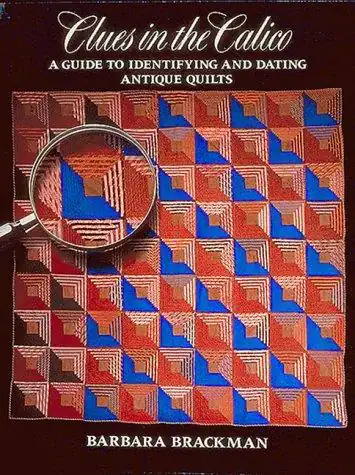
Vicki, Here is a little more info I found for you: First, the book “Quilts In America” is a classic, if you are interested in quilt history, you would definitely want a copy in your personal library. I ordered mine through the American Quilters Society, where if you order 6 books, you get a discount, as it is a little expensive (hardcover, some color pages, 368 pgs.) You might also check with Kris Driessen at http://www.HickoryHillQuilts.com as she carries quite a few quilt history books, and sells them at a discount. I also checked my “Clues in the Calico” by Barbara Brackman, another excellent resource, which I have heard may be going out of print….buy one if you can find one!! She has one paragraph on stenciled quilts, on page 111: “Stenciling was a popular decorative art in the first half of the 19th century when would-be artists made use of precut paper templates to decorate floors, walls and furnishings as well as to compose pictures. Young ladies learned what was called “theorem painting”, using stencils to paint on fabrics. Some used stencils to dye fabrics for spreads and quilts. Diana Church, in a 1983 research paper, noted that 30 stencil spreads have been recorded, made between 1825 and 1850, primarily in New England and the mid- Atlantic states, with the decade of 1825-1835 as the prime time. I have seen an example dated 1867, made in New York, which expands the possible time period for stenciled spreads to between 1800 and 1870. The artists used both the medallion and the block style formats for their designs and probably followed applique fashions; the medallion format would probably indicate a date before 1860, the block format a date after 1840.” The “research paper by Diana Church” that Barbara Brackman refers to, was published in the American Quilt Study Group annual, UNCOVERINGS in 1983. The title of her paper is “Bayless Stenciled Quilt”. This book is still available through either the AQSG (aqsg [at] juno [dot] com or http://catsis.weber.edu/aqsg ) or through Kris at Hickory Hill (address above). A message to AQSG might put you in touch with others who are also interested in stenciled quilts. There are also listings in my Index to Quilter’s Newsletter Magazine (but this only goes up to about 1983, so these would be in old issues). I will try to look these up later for you & see if they would be of interest. Must run, or will be late for work! Happy searching!! Karan
Date: Mon, 13 Jul 1998 08:38:51 EDT | From: SadieRose [at] aol [dot] com
& other interested quilters: I found quite a bit of information on stenciled quilts in the book “Quilts In America” by Myron and Patsy Orlofsky. This book was originally published in 1974, then reprinted in 1992, by Abbeville Press, ISBN # 1-55859-334-9 Chapter 5 is titled “Stenciled, All-White and Embroidered Quilt Tops” and has a number of pages with information on the technique, how & when it was done. There are also a number of photos of antique quilts with stenciling. To quote a little from the book: “The stenciled quilt is rare. In fact, museum visits and considerable research have turned up fewer than 25 spreads, of which a small percentage are actually quilted. They were all made in the early nineteenth century; most probably date between 1825 and 1835, although educated estimates have placed some as late as 1850 and as early as 1800. All spreads are said to come from New York, Vermont, Massachusetts, and Connecticut, and one from New Hampshire. All have floral and more or less related designs. ” “There is plenty of evidence that a craze for stenciling existed throughout the second quarter of the nineteenth century in the decoration of various types of furniture, floor coverings, walls, and textiles. Stenciling on textiles was the least common of all these, but it would appear that there was a fashion in rural communities for stenciled bedcovers either as substitutes for the more elaborate embroidered spreads, or possibly as a means of approximating the effect of block printed decoration.” “Stenciled spreads were a product of thte home and were not made commercially. Presumably, the household knowledge of stenciling was born of theorem paintings or stencil painting on velvet, which was a fad in the young ladies’ seminaries that lasted for about 25 years in the first half of the 19th century…..The stencil was thought of as a means of guiding the hand of the less talented artist or of achieving results quickly.” Hope others who have more information on this topic will post to the list so we can all benefit! Happy Quilting!! Karan from hot & sunny Iowa
Date: Mon, 13 Jul 1998 09:02:52 EDT | From: [from unknown, signed “Rachel”]
The Heritage Quilt Project of New Jersey documented only one stenciled quilt out of approximately 2300. It is pictured in our book, New Jersey Quilts. No firmly attributed date, but probably c. 1820. Red and blue stencil on tan linen: medallion center surrounded with paisley shapes, circles, half-circles, and pots of flowers. Heavy quilting follows the stencil designs. Owned by the Hopewell Museum in Mercer County, NJ. There are stencil quilts in the collections of the Shelburne Museum in Vermont and Historic Deerfield in Massachusetts, but I don’t think published photos are available. –Rachel in NJ
Date: Mon, 13 Jul 1998 07:59:24 -0500 | From: Merry May
Vicki wrote: > I am a quilt teacher/lecturer from California. I am currently doing stenciled > quilts and am interested in the antique stenciled quilts made in New England > during the 1820-50’s time period. Have you any references, or do you have any > of these types of quilts? There are not very many surviving early stenciled quilts. However, there is at least one pictured in the book “55 Famous Quilts from the Shelburne Museum” (published by Dover). Another one dated 1826 is in “The Abby Aldrich Rockefeller Folk Art Collection” booklet, published by the Colonial Williamsburg Foundation. Brackman’s “Clues…” refers to a research paper by Diana Church which was published in 1983 “Uncoverings” by the American Quilt Study Group. Brackman summarizes “…30 stencil spreads have been recorded, made between 1800 and 1850, primarily in New England and the Mid-Atlantic states, with the decade 1825 to 1835 as the prime time.” Ms. Church’s paper is entitled, “The Baylis Stenciled Quilt.” Just last year I designed a small, central-medallion stenciled quilt based on a couple of antique quilts (the stenciled one in Abby’s collection, plus another central medallion appliqued one from the Shelburne), which I use as a class sample. Eventually (after my workshop runs for the second time on July 27!), I’ll incorporate it into my quilt history lecture, so people can see what these quilts might have looked like. Hope this helps! Take care. 🙂 — Merry May (a.k.a Inspector Cluesew & Jessica Four-Patch) Shelly Zegart=0A
Date: Mon, 13 Jul 1998 12:49:09 +0000 | From: [from unknown]
Re: Chair pincushions. Darwin: The Frederick Herrschner catalog of Fall/Winter 1932-33 advertised a “novelty work box.” The description is as follows: “Grandmother’s chair work box of rose or blue sateen. Has pockets for sewing supplies. Size about 8×12 inches. Each postpaid 30�.” (The embroidery thread was extra) The seat had a little tassel attached, so obviously it lifted up. I have seen various smaller padded chairs similar to this one in the years past, but I have never seen a pattern for them. Shirley Mc
Date: Mon, 13 Jul 98 22:22:55 PDT From: “Maxine” <maxquilts [at] worldnet [dot] att [dot] net> I was given a pin cushion rocking chair a few years ago, made of wood. . . there is a drawer under the seat for thimbles, the seat and back are padded for pins, each arm has a couple of spindles for thread. The chair stands about 10 inches high. Is this an overachievers version of the Pincushion Chair? Maxine < Shelly, I ordered your book last month through AQS through my guild, and got the big discount you are graciously giving list members. However, I GOT the book last night at the guild meeting, and devoured it all last night and today. There is nothing we like better than lots of full page color pictures of antique quilts, and you sure delivered. Nice job! It is nice that most of them have not been published over, and over, and over again. It is good to see new stuff. Judy in Ringoes, NJ
Date: Tue, 14 Jul 1998 05:11:19 +0000 From: Steve and Jean Loken <sandjloken [at] worldnet [dot] att [dot] net> Darwin et al. During the June Minnesota Quilter’s conference and show in St. Cloud, MN, I did a little exploring in an antique shop. They had one of those rocking chair pincushions. Looked to be about from the 40s, judging from the colors in the “harlequin” upholstery – orange, turquoise, etc, I recall. It had 2 dowels on each side for spools, and perhaps some other storage as well. Was made of thin plywood, probably home or shop class made. I recall they wanted $16 for it or so, so I left it there. Jean in sultry Minnesota – 93 today!
Date: Tue, 14 Jul 1998 13:22:46 EDT | From: KareQuilt [at] aol [dot] com
and try to go to go to estate auctions in Page County in the Shenandoah Valley when quilts are listed and I am in town. My family roots are in Page and Shenandoah Counties and I do genealogy research down there frequently. I have been to 6 auctions in three years. Found my first fabulous Valley quilt just two weeks ago and am busy documenting the quilt. Two years ago I saw 4 of those rocking chair pin cushion/sewing caddy gizmos at an auction. I bought one. Had never seen one before….nor had I seen a chicken pin cushion for that matter. Mine is cut from plywood and stained; stands about 9″ high and 7 ” from tip of rocker front to back. Has 3 dowel posts on each side for spools and a hole in the side of the chair by each spool holder/dowel. Also three holes in the side of the chair under the spool holders. Don’t know the purpose for the holes. Maybe to hold crochet hooks? At least they could slide in under the seat of the chair through the 3 sets of holes hunder the chair. Just a thought. Front and back cushions are held in place by a thumb tack. The cushion does not lift up. Looks to me like somone bought or made a pattern and then made a bunch to sell locally. Karen Biedler Alexander Reston, VA
Date: Mon, 13 Jul 1998 14:53:06 -0400 | From: “susanlk”
overdying blacks.. Further to black fabrics being overdyed something else…I’ve heard the same is true of chocolate ice cream! They use leftover other flavors and add chocolate to it. Apparently the chocolate is such a strong flavor it dominates and so they can reuse excess other flavors. I would expect this would NOT be done at the local hand made “boutique” type places, but rather the big manufaturers. And Not ALL flavors could be used as bases: several years ago Mad Martha’s in Martha’s Vineyard wasn’t doing too well with Wide Mouth Bass Ice cream. Sorry folks, this is not a joke. They had the flavor listed on a sign, and replied when I asked, that they weren’t doing too well!!! Go figure! SusanLK who used to freeze nylons Oh, P.S. don’t write off the butcher for freezer space for a rug or quilt; if you ask to RENT space for a week or so, he’ll listen!!! I’m not sure I’d want my delicate in among dead animal material however!!!But I bet there exist ice houses or some other walk-in freezer somewhere that would rent the space…
Date: Tue, 14 Jul 1998 14:56:26 -0400 | From: “susanlk”
reference books: “From Fiber to Fabric” by Harriet Hargrave. YOu all know the book!! $12 plus postage. SusanLK
Date: Tue, 14 Jul 1998 22:17:59 EDT | From: DDBSTUFF [at] aol [dot] com
apparent confusion about the Pincushion Chairs I enquired about. \Please note, I am NOT talking about the little wooden rockers. What i’m interested inare NONROCKING chairs made of cardboard nd covered with fabric. These remind me of a Wing Back Chair. the backs and seat are used as the pincushion and the seat lifts up for storage. They are usually around 8=10 inches tall and I’ve seen some very little ones about 3-4 inches tall. They seem to date from the teens and twenties. The wood rockers are much later. I believe they are from the fifties and later. Hope this helps. Thanks, Darwin
Date: Wed, 15 Jul 1998 08:02:10 -0400 | From: The Lesters
removal and odor removal products–that really work. Of course, they work on washables, rugs and upholstery. I don’t think I would try them on a crazy quilt. Then too, you can do what I did and find a really good home for the cat that could not control herself. Jean
Date: Wed, 15 Jul 1998 16:06:50 EDT | From: EGinebaugh [at] aol [dot] com
my first quilt, I learned in a big hurry that I did not want to keep flipping this bed size quilt back & forth across my lap, so I could keep quilting in one direction. I found a Thumble, a yellow plastic thimble for your thumb, and learned to quilt away from me. With practice (and it didn’t take too long), I could quilt more even and faster with my thumb than my finger! My biggest problem was the plastic thimble got worn out with the needle. I went through three Thumbles! I looked for a better solution, and found a tailor’s thimble (like a regular steel thimble minus the flat tip). I got one big enough for my thumb, one each for summer & winter quilting, and have only gotten better. l love to quilt on my floor frames, and only change to my lap frame for miniatures! Hope this helps! Liz in hot, sticky Michigan
Date: Wed, 15 Jul 1998 00:45:47 -0400 | From: Quilt97 [at] aol [dot] com
really nice old 2 color quilt top — bubblegum pink with a white/black shirting. The sub-blocks that make up the larger design are 3″ square. Since the last turn-of-the-century top I quilted I did in the Baptist fan, I decided to alleviate boredom by quilting this one with a diagonal grid going through the corners of the 3″ blocks. So I set it up on my floor Q-Snap, and then realized that I wouldn’t be able to quilt long lines unless I put it in the frame on the diagonal. I did one short row this way and realized that this had to be a definite no-no. You don’t stretch a quilt on the bias! So, I went through all my books looking for the correct method of quilting this pattern, but found nothing except the description or a printed pattern anywhere in my extensive library. You know, they all said, “Quilt as desired.” I realized that most older quilts were quilted on large floor frames, and those quilters had to have a method for quilting long lines on the diagonal. Nowhere is it mentioned in any of the literature. And then the great “AHA” light bulb went on in my head, and I figured out how to do it! I don’t know if it is how the older quilts were done, but this is how I am doing it, without having to quilt long lines in the wrong direction, or having to quilt short lines with a lot of starting and stopping. First, I had to stop seeing long diagonal lines. What I had to see were the diamonds formed by those long lines. Once I marked the quilt top I saw that I could work my way completely across the top by doing short zig zags — \/\/\/\/\/\/\/\/. It takes two passes to complete one row, and if I am very careful it is not detectable on either the front or the rear of the quilt. You restorers out there — have I rediscovered the wheel? Is this the way old quilts were done in all-over diagonal grids? If you had to pull a quilting thread from an old quilt, would it pull in a straight line, or would you be pulling up/down/up/down etc.? And why in the world have no quilting books actually given the working method for doing these old patterns. Anyone want to collaborate on a book or article with me? I had to figure out how to do Fan quilting on my own — and 2 months after I finished the quilt a magazine (forget which) came out with MY method (which I am sure is epochs old). What other old timey quilting patterns have an easy way of working — if only you knew how? I’ve put off doing feathers because I couldn’t figure out how to do them in a frame. Sure I can do them in a Jasmine spinner hoop, but how do you do a feather pattern in a frame? The Amish only used frames, right? I just can’t see doing that much quilting AWAY from me, or going from left to right, and that’s what feathers would ultimately require. Anybody else out there find quilting the most satisfying part of being a quilter? “Quilt as desired” my foot! It should be “Quilt the pattern the following way, for comfort, speed, and the smallest most even stitches.” Judy in Ringoes, NJ
Date: Thu, 16 Jul 1998 18:29:53 +1000 | From: nomad1
am back home after having some marvellous adventures through LA, Denver, Maysville in the Rockies, Salida, Houston, San Antonio, Ohio, SF, Lake Tahoe and Carmel. Time was so limited that I did not get to meet everyone. My apologies especially go to Cindy and Darwin and Jane a la Baglady, who I had made plans to meet.. After an adventure in a cornfield I ended up looking like Godzilla, so felt a tad self-conscious to be sociable! Though I did make some friends in ER! It was a fabulous treat to meet my wonderful QHL pals. I flew to visit Tiffany in Denver, then to Melissa in Houston and Elisabeth drove up from Corpus Christie to visit Then it was off to see Susanne in Ohio. They are all wonderful ladies full of fun and we had an absolute ball. Their Dh’s are just as fab and were most patient as we nattered on at 100 miles per hour! .Folk were amazed that we had met on the net and then become such great friends. I took 25 rolls of film and managed to use them all plus bought more!! All wonderful memories and freinds that I will always treasure. I am already planning hols for whn my pals visit Oz. :> I did buy some wonderful quilts that I will share with all of you later when I have a bit more energy to stay awake! Quite strange being so dopey as usually I am a night owl. Choofing off with many thanks to my dear pals, Hiranya Loder, Parramatta, Sydney, Australia where it is freezing�that’s Summer to you in Parker Tiff!!:>
Date: Thu, 16 Jul 1998 06:57:00 EDT | From: QLTmaven [at] aol [dot] com
Everyone. It’s time for me to come out of lurkdom and contribute two things. Regarding the HGTV Simply Quilts episode on Necktie quilts…. My Mom taped the episode for me because I don’t get the show in my area of Pennsylvania. The Author featured on the show was Shirley Botsford. Her book is called Daddy’s Ties. I believe she used cotton foundation squares to stabilize the bias tie fabric. then she even machine stitched aroud the edges of the finished blocks before sewing them together. She had a cute way of making a kind of Prairie Point around the edge of the quilt using the ready made tie points. Maybe you ought to purchase her book to get more detail. Next, regarding quilting of long diagonal lines….. I was told by members of my quilt guilt that you should never quilt more than 4 inches in one straight line without switching directions. This ensures that if the quilt is ever pulled in that direction (such as a person rolling in bed) , the quilting threads won’t snap. A zigzag pattern will stretch and strengthen the quilt, but long lines are weak. By the Way…I have never seen this in a book or article. So pass the word to all you know who might be making their quilts this way. Eileen in PA
Date: Thu, 16 Jul 1998 11:00:07 EDT | From: ThreadDog [at] aol [dot] com Regarding cat spray. Cats
develop urinary tract problems because of the amount of ash in cat food. There are cat food products designed to avoid this. Read the nutritional analysis on the package. Of course, they cost more. It’s a hard call to understand whether your cat is marking territory, trying to discipline you, or has a medical problem, but changing food products might help, in addition to more than adequate fresh water, and a nice litter box might prevent a lot of angst. Ever have a bladder infection? L. Claussen
Date: Thu, 16 Jul 1998 11:58:40 -0500 | From: Swede
for months as I have not had anything to contribute – until now. I’m no expert on quilts, but do know quite a bit abouts cats, having been owned by them for 30 years. :~) Some cats just pick out a spot and keep going back to it. As someone pointed out, it’s important for a vet to determine whether kitty has an infection of the bladder or kidneys first, before assuming the cat is marking its territory. Male cats are notorious for marking (spraying) their territory and I’ve had to deal with the problem many times. Here’s what I’ve learned: 1. For males, biggest tip is to have them neutered. If you can do it before 6 months of age when they just begin to reach sexual maturity, so much the better. If you never allow that nasty ol’ testosterone to coarse thru their bloodstream (and it even shortens their lives – neutered cats live longer) you may never have to deal with this problem. 2. When and if kitty does whiz in an area, use a commercial neutralizer to clean it up. This is VERY important. You can use bleach, soap, perfume, whatever have you; but unless you neutralize the scent with an enzyme cleaner, kitty can still smell it even tho you can’t – and he/she keeps going back.
Neutralizer is available at most pet shops like Pets Plus, industrial cleaning supply houses, and anywhere Rug Doctor products are sold/rented. It costs about $5 a bottle. Don’t cheap out and buy a bargain brand. It DOES make a difference. Some of the cheap stuff smells worse than cat whiz. The better stuff has a pleasant smell and totally eradicates the cat odor. This stuff is magic for cleaning up human odors too…vomit, cig smoke, perspiration, etc. 3. Keep the kitty [litter] box clean. Change at least once a week depending on how many cats you have. Currently, I have a funny little kitty that was whizzing outside the box. He’s neutered so shouldn’t be doing this. He would kick some litter out on the floor and whiz in that (it’s in the cellar so it wasn’t a big deal, just hated cleaning it up everyday), or would rip up the newspaper under the cat box and go in that. DS who fancies himself a Dr. Doolittle, kept telling me that he thought Blackie didn’t like whizzing in the same place he pooped. So DS bought an extra (smaller) box and placed it alongside the main one. Guess what? It worked! Blackie whizes only in that box and everyone is happy. Finally, assuming your cat is healthy, neutered, not picking up old odors in the area from himself or other cats, and has a clean box, one other thing to try is this…Clean up the area with neutralizer and then place his food NEAR the area where he whizzed. NOT ON IT. Cats are pretty clean animals and won’t mess where they eat or sleep. (That’s why he’s whizzing on YOUR quilt instead of in his own bed!) Hope this helps. Annastina — Today’s Animal Trivia* Cats will not walk on aluminum foil. This is good to know when you are trying to protect something that your cat would tend to walk on such as a part-done jigsaw puzzle.
Date: Thu, 16 Jul 1998 13:02:12 -0400 | From: D Bourgoyne
book has a reprint of the pattern for three sizes of these chairs. The author states that her grandmother used to sell the chairs forty years ago for 35 cents! Scrap Saver’s Christmas Stitchery by Sandra Lounsbury Foose (copyright 1986 by Oxmoor House) I have no idea if this book is still in print. It believe I bought it at a used bookstore somewhere. Hope this helps, Denise > > Hi again everyone. Just want to straighten out some apparent confusion about > the Pincushion Chairs I enquired about. \Please note, I am NOT talking about > the little wooden rockers. What i’m interested inare NONROCKING chairs made > of cardboard nd covered with fabric. These remind me of a Wing Back Chair. > the backs and seat are used as the pincushion and the seat lifts up for > storage. They are usually around 8=10 inches tall and I’ve seen some very > little ones about 3-4 inches tall. They seem to date from the teens and > twenties. > The wood rockers are much later. I believe they are from the fifties and > later. > > Hope this helps. > > Thanks, > > Darwin > ***