January 5 – 7, 2004
These restored messages come from the Quilt History List, an online forum where quilt historians, collectors, researchers, appraisers, and enthusiasts discussed antique quilts and related textiles. The archive dates from 1996 through approximately 2016 and is being restored gradually. Sign up in the form at the bottom of the page if you want to know when a new page is added. Original spelling, opinions, formatting, and inactive links may remain unchanged.
Primary topics of this QHL Digest:
- Continuing the Klan-Quilt Discussion — The thread on Klan-related fabric and imagery continues, including a specific inquiry about a quilt held at the MSU Museum.
- A Reported Stolen Quilt — A member alerts the list to a quilt theft, asking others to watch for the piece.
- Telltale Textiles Exhibition Catalogue — Members discuss a museum exhibition catalogue documenting textile evidence used to date and place quilts.
- Study Group News — Updates from the Studio Quilt Study Group and a note on an 1848-dated quilt and its closure/binding method. (see the article on quilt study groups)
From: quiltstuff@
I was just wondering something non quilt related about this. How do Americans feel about a Aussie and Englishman playing the lead roles of Southerners. . I know the brits were upset when Renee Zwellegger played Bridget Jones.. Just wondering. Suzy An aussie who is very proud of our Nicole.
Subject: [qhl] “Cold Mountain”
> I saw the movie “Cold Mountain” over the weekend. Enjoyed the historical > aspect, clothing and the fine acting. The realism of war is awful. I did, > however, love the so called “Apron” or did I miss the subject completely. I > would have called it the skirt. My question, is this what was called a > “mourning” dress. > > Carol
Date: Mon, 5 Jan 2004 | From: “Jocelyn” <jocelynm@>
The same happened in Missouri, because Missouri law lacked a provision for rejecting groups based on their purpose/ideology. Missouri named the highway the Rosa Parks Memorial Highway (or some such name). The KKK didn’t renew its committment to pick up litter.
> > It wasn’t many years ago that traveling thru one of the southern > states, I saw signs that the section of road was kept litter free by the > KKK. It was a > major road if not interstate. >
Date: Tue, 6 Jan 2004 07:17:30 EST | From: Litwinow@
I’ll add two cents worth on the KKK comments. My mother remembers in the 20’s going to a cross burning in Pochontas County, Iowa. Her fahter put her in the car and took her, he never said a thing. My first trip to Kalona, IA was over 20 years ago, there I heard my first lecture on Amish quilts by Amish Sara Miller. I was horified that she kept referring to the KKK! Only to find out later that her shop was the Kalona Kountry Dreations! Iowa and Illinois will be having their Quilt Study group Feb 7th. Those of you that can go to the deep south session–come to Iowa! Catherine Litwinow
Date: Tue, 6 | From: Ark Quilts <quiltarkmv@>
I have been following the discussion about the KKK. It was a shock to me when I moved 4 years ago to discover that a young man of 18 was the state president of the Ohio KKK and lived in the next town! I did not realize that Ohio’s KKK was still active. My grandmother used to tell me about KKK activities that occurred in the Springfield, Ohio area during the early 1900’s and most of them were memorable for their vile nature. When the county historical museum opened I followed the debate with interest because the display of the KKK uniform from the 1920’s was dropped because it was felt that it was “too controversial”. I was disappointed that the display was dropped. I wanted to see what it looked like and examine the fabrics. Some people made their own uniforms and probably used varying types of fabric. But it would have been interesting to see those sold in stores in the south. I think the historical display would have encouraged some positive dialogue in a the community even though there might have been some negative comments too (they missed an excellent teaching opportunity there!).
The real point of my posting is that my grandmother made a comment to me one time that there was a lot of nice white fabric in one of those KKK uniforms……that coming from a quilter and embroiderer. I always wondered if there were any documented quilts out there which were made from KKK uniforms….it seems that very few survived or are still tucked away in trunks somewhere. Does anyone know if there are quilts documented as being made from KKK uniforms? I’ve only see photos of them in books & would like to see the “real thing” sometime.
Connie Ark in Ohio where the wind dropped the temperature to -10 today!
From: barbara s <indiana_babs@>
i had a book from the library called “lets quilt indiana” in it there were pics of quilts made from kkk uniforms. it was repulsive. i live in indiana, and indiana has a big history on kkk. on the history channel i watched a show on it and it said indiana had the largest klan group around. i just turned 28 so i never had to deal with it. but i notice the treatment i get when i go to the little cities surrounding me. there is still alot of racisim here. not just against blacks. im black and hispanic. i have many friends who are hispanic or afghan or black and they say when they go to the towns on the outskirts they get stared at and treated like garbage. i agree. i had to leave a job in huntington because all i heard repeatedly was , you dont see many or any blacks around here, how does it feel to be the only one?
i cant deal with that kind of ignorance.
barbara
Date: Tue, 06 Jan 2004 | From: Joan Kiplinger <jkip@>
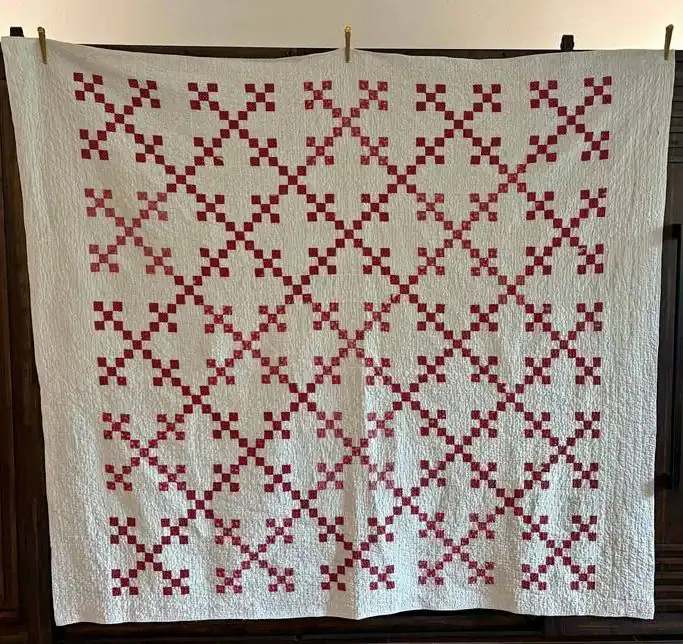
J. G. Row asked me to post to the eboard a lovely 1848 Mount Holly NJ Antrim quilt from the Burlington County Historical Society. http://vintagepictures.eboard.com or http://www.eboard.com/vintagepictures See quilt tab.
Closure — I called my brother, now back from vacation, to pick his brain on the KKK neighborhood society. It was not ever a KKK affiliate. It started out as a protection society after WWI to help the newly located Italian immigrants and which was called the Black Hand. Sometime in the 20s there was common ground with another benevolent group comprised mostly of Quakers and other nationality groups for community property and they merged. KKK was chosen as a name for scare purposes and although there was a better name selected later on, KKK stuck. Anybody could join. It disbanded right before WWII due to a dramatic decline in membership as much of the population had moved to large cities to find work during the Depression. This pretty much tallies with what I posted earlier, not out of ignorance to the true KKK as some have claimed. Now the labels or practices of these groups may not tally with many of your perceptions, but that is what those persons chose to call them and how they wished to observe them. It serves to point out that even the smallest boundaries greatly affect how humankind views surroundings and shapes its practices. This reminds me of a great discussion on Amish quilts on the vintage fabric list last year in which we all learned about the vast differences of Amish practices, observances and terminology from region to region and state to state. Now, I make it clear here I’m not equating KKK with Amish, heaven forbid, just pointing out that regional differences can and of do create group individuality, all under the same umbrella name. I agree with Kris that this whole discussion has been a learning one and I appreciate hearing about the experiences of others like Rissa and Candace.
Date: Tue, 6 Jan 2004 | From: Kris Driessen <krisdriessen@>
This isn’t strictly about quilt history, but I am posting this link just in case anyone runs into this stolen quilt.
http://www.lostquilt.com/PinwheelsAndPopsicles.html
The thief had to walk right past the father of the quilter as he lay in his hospital bed to steal it off the wall. Can you imagine!
While you are there, check out the other lost and found quilts. One of the found quilts is a crazy, with some motifs pictured. It’s an interesting site.
Kris
Date: Tue, 06 Jan 2004
Quilts made from KKK uniforms? *shudder* I can see not wanting to let the fabric go to waste, but I’m not sure I could bring myself to do anything to one of those uniforms but burn it as quickly as possible…
Karen Evans Easthampton, MA
From: Patricia L Cummings
Good morning:
A quick check again with the museum store at Historic Deerfield reveals that the exhibition catalogue is now available. The price is $10.95 plus $6.95 shipping. A 10% discount is given for members. To order, call:
> 413-775-7170 between 10:00 a.m. to 4:00 p.m. est.
Not trying to be a busybody here, but after having seen the exhibition (twice), I think that it is one that you won’t want to “miss”, if only in print.
Pat Cummings
Date: Tue, 6 Jan 2004 | From: macdowel@
Dear QHL susbscribers,
Given the discussion about KKK I though you would like to be aware of a KKK quilt the MSU Museum acquired by donation. http://www.museum.@/glqc/collections_2000.71.1.html. It was a subscription fundraising quilt for clan activities so it is signed by many individuals. One block contains an embroidered image of a hooded KKK member on a horse. We (and the donor) believe it is a powerful tool to use to educate others about this dark side of our nation’s history AND the sometimes dark side of quilting history. Believe me, when we have shared this quilt with university students it has provoked much discussion and the Long Island Arts Council once developed a diversity training and tolerance educational unit based partially on the quilt.
There was a quilt made of KKK clothing that was documented in another state quilt project, possibly Indiana.
I would be interested in knowing if there are other examples out there of quilts being made for not only KKK activities but other societally-deconstructive or repressive activities.
Marsha MacDowell Great Lakes Quilt Center Michigan State University Museum
Date: Tue, 6 | From: “J. G. Row” <JudyGrow@>
Dear friends,
I hope your holidays were filled with food (not too much) and family (not too much) and travel (not to much) and gifts (piled on high and wide)! At the Grow household having a 6-year old with us for a week made the time very special. Shopping for a 6-year old girl was interesting, to say the least. Clothing was fun to buy, but toys another matter entirely. ” Barbie” is not in this year, but “Bratz” dolls are (think of Barbie as a slut — don’t know how else to describe these dolls) . I found a lovely book, “Suki’s Kimono” and we read that together. I tried to teach Sophia to knit, but after one perfectly formed stitch she gave up. Perhaps next year.
I got an old book on the history of the Pennsylvania Germans, and that is just about all with quilting connections. I hope you all fared better in that regard and will share your new goodies with all of us.
Studio Quilt Study Group will be meeting at my place in Ringoes, NJ, on January 20th. As always, those coming from a distance can find a place to stay with me, or with Nancy Kerns. We need to know beforehand however.
Asking around for a suggested theme for this meeting, Barb thought of “stars”. I think that is a wonderful theme, especially for this time of year. I can’t get out of the car after dark without gazing up at the sky, which seems especially twinkly in the cold winter. So, stars it is, pieced and appliquéd; Christmas Star, Nativity Star, Bethlehem Star, Compass Star, Lemoyne Star, Union Star, Enigma Star, Hexagonal Star, Star and Stripe, Washington Star, Exploding Star, Royal Star, Starry Path, Nine-Patch Star, Feathered Star, Circle Star, Lonely Star, Sun Moon and Star — you get the picture. Any kind of star quilt. So, bring your most twinkly star quilt, but bring other interesting things as well.
Our meeting starts at 10 AM, we break for lunch for an hour, and then continue until 3PM or until folks drift off towards home.
Let me know if you can come, and if you will be bringing any food — either for yourself or to share. We can always order pizza as we have done in the past. Salad and dessert for the group is always welcome. I’ll take care of the soda, juice, coffee, tea, etc., and the tableware.
Anyone needing driving directions, get in touch privately.
I would like to have all your RSVP’s at least by Sunday the 18th so I can plan how many chairs I have to clean off. We store them outside.
I can’t wait to hear from all of you , and see you again.
If we have to postpone or cancel I’ll be in touch, either by phoone or e-mail. Pray for no snow!
Judy in Ringoes, NJ judygrow@
From: Vivien Sayre
Marsha, When you mentioned the Long Island Arts Council, were you speaking of Long Island, New York? Thanks, Vivien Sayre
From: “Steve and Jean Loken”
Here in MN we documented a whig’s defeat quilt, made in red and white in Illinois in the 1860s (est.). Does that qualify as western enough? I suppose those on the East coast will say yea, but those farther west will vote nay. I’d be with the latter, even though I was born in NY.
We saw a new version of Antiques Roadshow last night. They had a really interesting quilt with images of Route 66 and sights. It was raved over. It seemed to be appliqued by satin stitch. It was colorful and fun. I couldn’t see any quilting on it, but that might be my miss. I think the appraisal was for $5000 plus. Keep your eyes open for it in your area. Antiques Roadshow seems to be suffering from a “dumbing down” and has a new very perky female host. Dan Elias was OK, but I think they put him in to appeal to younger audiences. In this newest host they seem to be appealing to kindergarden. The appraisers also suffer from over gushing, and repeat themselves, stretching out each appraisal. Maybe the Children’s Television Network gave them pointers? Jean in MN
Date: Tue, 6 Jan | From: “Cinda Cawley” <lrcawley@>
What fun we had Sunday at the Baltimore Museum of Art! The turnout for Elly’s lecture was additional proof that if museum’s show quilts, quilt people will come. I don’t know what the capacity of the BMA auditorium is (350-400) but it was almost full. I think the title was “What Is This Fascination with Baltimore Album Quilts” and she talked about why we are drawn to them. FYI: the Museum is celebrating its 90th birthday by offering free admission until Jan. 21. It’s open Wed. through Sun. from 11 a.m. to 5 p.m (6 on Sat. and Sun.). The regular admission is $7.00, so getting in free is a “good thing,” as you-know-who would say. Elly told of attending the Dena Katzenberg exhibit at the BMA in the early eighties and finding herself in tears before one of the quilts because it seemed that the maker was speaking to her across the years. I think many of us have had the experience of being stunned, frozen by a quilt.
The first Baltimore Album I saw in real life (around 1987) was the Mary Everist Quilt (the one with the border of a red, reverse applique, running feather. It was hanging at the top of the main staircase at the BMA and I’m surprised that I didn’t fall backwards down the steps. As we know from her books, Elly is fascinated by the symbolism of the Baltimore quilts and the hunt for the original sources of the motifs. I know that I’m not quoting her exactly, but she spoke of the ladies of Baltimore singing with their needles. The museum hosted a lovely reception after the lecture and it was like old home week: AQSG, QHL, FVF, The Dating Club, most of the people who had been at the BAS Retreat, women who had documented at the Maryland Historical Society exhibit in 2001. My thrill of the day was meeting the daughter and granddaughter of the lady who donated the Samuel Williams Quilt to the BMA. That is the quilt that the Baltimore Applique Society has reproduced (with excruciating exactness) to be raffled to benefit the Museum. The quilt remained in the family of Williams’ stepdaughter until it was given to the Museum. The younger woman remembered playing on the quilt as a child and being captivated by the incredible appliqued images. She participated in the BAS project (if I don’t win the quilt, I hope she does).
This was my third visit to the exhibit (and not my last). This time I looked at the quilts with Susan McKelvey and we concentrated on the inking (Susan did all the inkings for the BAS reroduction of the Williams quilt). Katzenberg, in her essay for the first exhibit, talks at some length about the inkings. She felt that there were two inscribers whose work appears on many of the quilts (often both did inscriptions on the same quilt). I find this as intriguing as the question of kitted-blocks. Was the inking of beautiful details (e.g.. the Williams quilt) a commercial proposition like the fraktur inscriptions on some PA German quilts? Katzenberg notes that inscriptions appear in a number of other hands, but that those she designates #1 and #2 appear over and over again on many different quilts. Dr. Dunton writes about the quilt presented to Dr. Mackenzie in 1850 (I think that the whereabouts of this quilt are unknown, but Dunton shows a picture of it, p. 35 and describes each block in great detail including a pansy wreath label on the back). It has a running vine border like the Williams quilt.Duntons says, “When the quilt was given to Dr. Mackenzie it was in a case of glazed chintz (Plates 6a & 6b), chiefly in blue tones. This was bound with a red, white and blue braid in dull tones, and the ties were the same. This case, about 20″ by 40″, still is used to house the quilt…Like the other needlework, the quilting is beautifully fine and is largely in close short lines which give the effect of crepe and makes an effective background for the colors.” Do we know of other such presentation cases? Cinda on the Eastern Shore
From: “Candace Perry”
I saw the Route 66 quilt on the Roadshow and was really quite shocked at the appraisal ($5000-10,000, I think). I know precious little about quilt appraisal, and even less about contemporary quilt appraisal…I couldn’t tell actually, and didn’t hear them say, what the date of the piece was. Candace Perry
Date: Tue, 06 Jan | From: “Carol’s Quilt Closet” <imaquilter2@>
I saw the movie “Cold Mountain” over the weekend. Enjoyed the historical aspect, clothing and the fine acting. The realism of war is awful. I did, however, love the so called “Apron” or did I miss the subject completely. I would have called it the skirt. My question, is this what was called a “mourning” dress.
Carol
Date: Tue, 6 | From: candace@
Do you mean “morning dress” which would have been the sort of costume a woman would wear prior to receiving visitors (I haven’t seen Cold Mountain so I don’t know if they would receive visitors)…it has a French name and I can’t think of it — aha, “en deshabille”…in other words, sort of a house dress, though not a dressing gown… Candace Perry
This is not to meant to make light of a quilt theft. This theft at a dry goods store occurred in 1826. People have lusted after beautiful textiles for centuries. The list of fabrics is most interesting. sue reich
Adams Centinel Gettysburg, Pennsylvania October 11, 1826
Stop the Villains!
$50 REWARD.
The Store of the Subscriber was broken open on Saturday night last, and robbed of the following Goods: 1 piece superfine Blue Cloth, 5 black Crape Robes, 2 colored do. One pale blue and one grey, 1 piece black Laventine Silk, 2 half pieces black India lutestring do. 1 piece sarsinette black do. Black and white satin do. Green, white, blue, brown, and leaf-colored Florence, A part piece of yellow & purple cross-barr’d, 3 remnants of Gross denap, colored, &c. Black Silk Vestings, 1 Washington do. silk and cotton, 1 piece black Italian Crape, 2 pieces of white do. 1 piece green do. 2 pieces figured patinette do. 1 piece plain do. 2 small pieces Bobbinetts 2 pieces Iris Gauze, 3 pieces Grecian stripe Gingham, 1 piece Carlisle barr’d do. 1 piece blue and purple Barege do. 1 piece barr’d blue do. 1 piece yellow stripe do. 1 piece Crom. Yellow Chintz, 1 piece yellow, white, tallow and purple Battien, Plain and figured black silk Handkerchiefs, Brown, red and yellow Bandana and Flag do. Yellow and white, yellow and blue, and blue and white Spittlefield, 1 Bobbinett worked with Cape and Swiss Caps, White Cravats, Madrass do. White and brown spotted do. Two or three 8-4 brown shawls (cotton with border), Cotton handkerchiefs, 2 pieces Plain and Mull Muslins, Jaconette do. And about 30 Dollars, in small change. The above Reward will be given for the apprehension of the Villains, and the recovery of the Goods, or Thirty Dollars for either. William Gardiner
From: kerrybrack@
boohoo too far away to attendthere is a book on this right? I am su re i saw something at houston this year on this topic??? if anybody attends ca n they brief ustiakerry in sydney
From: “Cinda Cawley” <lrcawley@>
Do you think the person who designed the blue jay on that chintz had ever seen the real bird? Cinda on the Eastern Shore
From: Joan
Sue — thanx so much for this article. I love the names of old, obsolete fabrics, wondering in some cases what their names may be today if they are still alive. In reading through the names, do. puzzled me; at one time I knew its meaning but couldn’t for the life of me remember what it was. An expert in 17th and 18thC terminology came to my rescue. The abbreviation stands for ditto. But at best, what wonders what might have followed some of the fabrics shown below to earn a ditto. I always enjoy your news items from the past. Thank you for sharing them.
Date: Tue, 6 Jan | From: “Cindy Brick” <brickworks@>
Just a footnote: the Colorado Historical Society had an exhibit on post-WWII into (I think) the Sixties…and one of Denver’s mayors during that period had strong ties with the KKK. I was surprised at that…but DH, who grew up in North Carolina, and experienced firsthand ‘Negro-only’ water fountains and bathrooms and high schools — until his junior year, when the ‘black’ school burned down — wasn’t surprised at all. (He’s 48, by the way.) Cindy
BRICKWORKS http://www.cindybrick.com >
From: “Judy Kelius (judysue)” <judysue@>
At 11:48 AM 1/7/04, you wrote: >Dear list, > > FYI, Colleen Callahan, Curator Emeritus of the Valentine Richmond History >Center, and I >have joined forces to create “The Costume and Textile Specialists”. We >offer a full menu of services to the historic clothing and textile >community. Colleen is a long time quilt booster, having curated many quilt >shows at the Valentine. Our web site: www.costumeandtextilespecialists.com >is under construction. If anyone would like a copy of our brochure, please >email me privately. >Newbie Richardson
Hi Newbie – please send me a brochure. Send it to my home as the museum where I work is closed for the winter – thanks! We have quite a bit of clothing that has never been catalogued or appraised.
Judy Kelius 94 Hawk Valley Lane Denver, PA 17517
Date: Wed, 7 Jan 2004 | From: “Pilar Donoso” <quiltpdmi.cl>
I was talking with my friend who visit farms of Cochinilla in the North of Chile, and he told me that the mother worm gets attach to the “baby” to be, and when the baby is born, the mother die. They use then the mother. In the farms, they put a little envelope between the mother and baby, and when the mother worm die, she fall down into the envelope, and that is collected by the farmers. So nature is not violated. Very interesting.
Pilar Santiago, Chile
Date: Wed, 07 Jan
Ah, yes. The good folk at Elohim City. *shudder* A lot of those “Christian patriot” groups are indeed offshoots of the Klan, and thanks to the Internet, they’re putting up snazzy little web sites with children’s activities. And it wouldn’t shock me at all to find that once again there are fund raising quilts being made for such groups….:(
Karen Evans
From: Kris Driessen <krisdriessen@>
As a 50 year resident of Schenectady County, let me assure this group that there is **NO** KKK here! Schenectady was founded in 1661 by immigrants <G> and remains populated by a diverse immigration population to this day. We don’t have time for prejudice, we are too busy trying to find a common language…
Funny story having nothing to do with quilts: my Danish immigrant grandmother used to choose her grocery items based on the picture on the can or box. One time she bought a can of Sauerkraut and was horrified by what she found in the can. She brought it back, explaining in Danish to a storekeeper that spoke only Italian that she wanted her money back. It took four people relaying from Danish to English to English to Italian to get the message across, but it worked. And she never bought sauerkraut again.
Kris
From: pepcory@
My feeling is that Brits (broadly including aussies here-)often get the southern accent ‘right’ while Americans mangle it. American actors often confuse Tennessee with Texas with West Virginia–and they’re all different! Anyone seeing the movie Used Lions with Robert Duvall and Michael Caine? They played brothers and their accents were impeccable. Duvall comes by it naturally but the wonderful surprise was Caine who nailed the role. Loved the movie by the way. Cheers from the Carolina coast- Pepper
Date: Wed, | From: “Newbie Richardson” <pastcrafts@>
Dear list,
FYI, Colleen Callahan, Curator Emeritus of the Valentine Richmond History Center, and I have joined forces to create “The Costume and Textile Specialists”. We offer a full menu of services to the historic clothing and textile community. Colleen is a long time quilt booster, having curated many quilt shows at the Valentine. Our web site: www.costumeandtextilespecialists.com is under construction. If anyone would like a copy of our brochure, please email me privately. Newbie Richardson
From: “Newbie Richardson” <pastcrafts@>
Candace, and list I saw the Roadshow a few days ago with that “quilt”. It is a piece of mid-20th century folk art using fabric, thread, and quilting techniques as the artist’s medium. It transcends the world of domestic textiles (no matter how well executed) and goes into the world of folk art. With that in mind, the $5,000 plus auction estimate was not out of line. The subject matter is very appealing to “boomers” with money to spend. Just look at the prices for Elvis related memorabilia, Hollywood stuff, Beatles stuff. Yet it appraised far less than the Beatles album jacket with the dismemberd dolls on the cover….Textiles remain the step child of the dec arts – even in the high end world of folk art. Sheesh! I did an appraisal of a family collection of historic clothing. In it was a fabulous waling dress of 1878 – pristine, with Paris label, and the “off the rack” Halston tee shirt style poly chiffon dress w/ self tie belt, which great grandma wore to a family wedding in 1978….The Halston appraised out higher – by 30% – than the walking suit. It made me sick. But the marketplace does not always have a sense of taste, proportion or style! A good appraiser throws out her/his own preconceived notions and reports what is happening in the market place. Boy, can that be a hard pill to swallow! Newbie Richardson The Costume and Textile Specialists (no longer Past Crafts) Appraisals, Conservation, & Exhibition Alexandria and Richmond, VA
Date: Wed, | From: “Jan Drechsler” <quiltdoc@>
I’d like to invite all of you to the Western Massachusetts Sacred Harp Convention on March 12th and 13th, in Northampton. As Housing and Hospitality Coordinator, I’ll find a host or hostess to put you up for the weekend. A Singing School will be held on Saturday at 9 A.M. You can expect to sing, eat, sing, make new friends, eat, laugh a lot and totally lose your voice for 3-4 days afterwards. Our dear friends from “the Alabama Church” of Cold Mountain fame will attend as usual, but not the Rumanians who were filmed lip-syncing singing the words. (It was filmed in Rumania due to costs as many films are.) No special invitation has been issued to Nicole.
Catching up on QHL reading after a 2,500 mile Holiday family tour, when I read Pat Kysers Dec 27th note I had to respond. Pat wrote:
>a small church at Henager, Alabama provided background singing in shape note >or sacred harp singing style. I found it incredible that one of the singers >is project manager at the super computer for NASA here in Huntsville. >Remarkable and lovely that people very much “into” the 21st century at the >same time are maintaining a very old religious singing style.
Replace the word singers, in the above paragraph, with the word quilters. i.e. incredible that one of the quilters…..is project manager at NASA… Or … very much into the 21st c at the same time are maintaining a very old quilting style. As I use my keyboard and QuiltPro and websites…
I had to laugh that one old tradition should be seen so differently from another! And to me it isn’t strange that any hi-tech or hi-stress person would gravitate to sacred harp. The 4-part music is challenging, fast, un-accompanied (think no help to stay on pitch) and usually had no set group leader. Not much room to think about work problems while you are singing this stuff.
So e-mail me for hospitality! And I’ll introduce you to singers who are also quilters!
Date: Wed, | From: <gingram@>
Karen, I should have been more precise. I was thinking not of T. McVeigh, but of his accomplice and associate, T. Nichols, who seemed to be part of a rather sizable group of disaffected folks.
From: yellowhousequilter@
Hello, My name is Peggy Gelbrich and I’m new to the list. I am a quilt maker and teacher and very interested in the history of quilts. When teaching I like to include quilt history especially about the particular pattern. Currently I’m teaching Winding Ways or Wheel of Mystery, Trip Around the World and Hunter’s Star. I’ve search through books and on the internet and can’t seem to find much information on these patterns. Can you recommend books or share knowledge of those patterns. Thanks, Peggy Yellow House Quilter Vader, Washington Lots of snow and ice.