January 12 – 15, 1999
These restored messages come from the Quilt History List, an online forum where quilt historians, collectors, researchers, appraisers, and enthusiasts discussed antique quilts and related textiles. The archive dates from 1996 through approximately 2016 and is being restored gradually. Sign up in the form at the bottom of the page if you want to know when a new page is added. Original spelling, opinions, formatting, and inactive links may remain unchanged.
Primary topics of this QHL Digest:
- Calico, Muslin, Cambric, and Cheesecloth Terminology — The ongoing transatlantic fabric-name debate expands to include cambric, cheesecloth, and hessian/burlap, with members citing Fairchild’s Dictionary of Textiles for definitive answers. (see the article on cotton and textile terms)
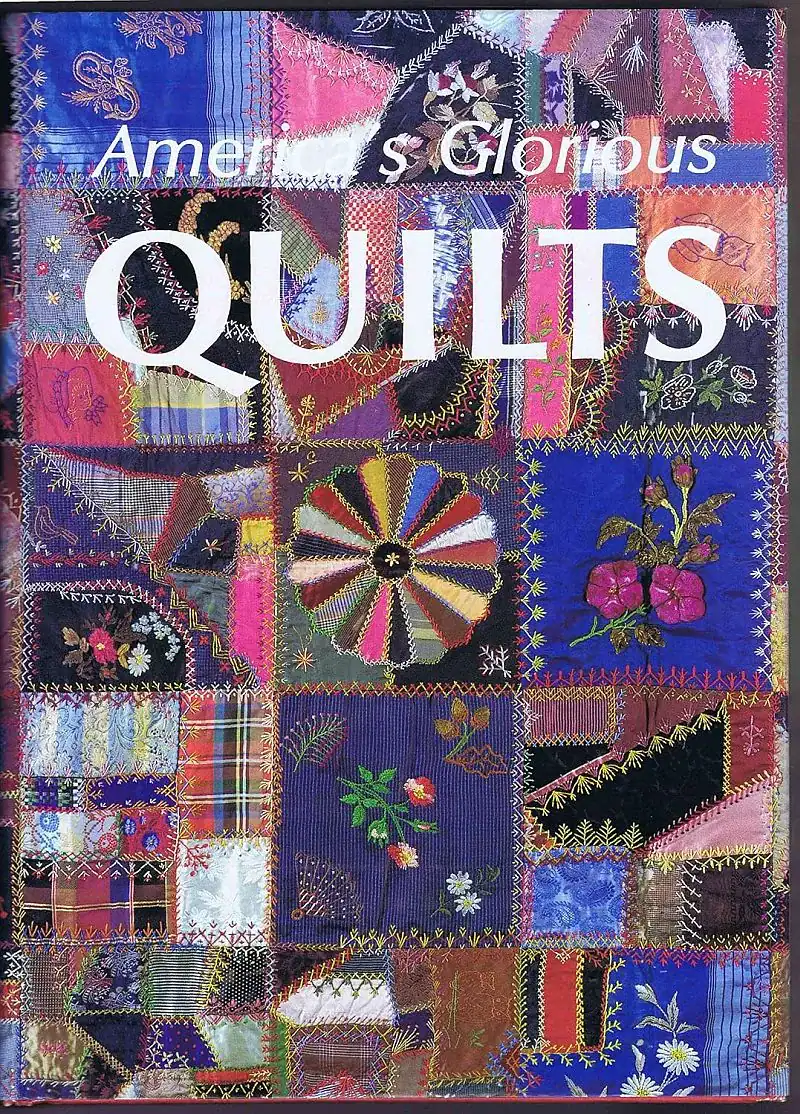
- Crazy Quilt Books and a Muslin Crazy Quilt — Members identify recent crazy quilt titles by Christine Dabbs and others, while one conservator shares an 1885 crazy quilt made entirely of muslin with Turkey red embroidery. (see the article on Victorian crazy quilts)
- Quilting in Russia — Follow-Up — International members respond to Maryjo Ordway’s Russia report, with messages from France, Australia, and the UK, and news of a possible magazine article on Russian quilting.
- The Practice of Naming Quilts — Maryjo Ordway asks when quilters began giving individual titles to finished quilts rather than just using pattern names, sparking a discussion that distinguishes generic names from personal titles.
- Quilt Documentation at the Journey Museum — Mary Waller reports on the first quilt documentation project at the Journey Museum in Rapid City, South Dakota, with a display planned for spring 1999. (see the article on quilt museums)
- Paducah Quilt Show Planning — Several members share tips and excitement about attending the annual AQS show in Paducah, Kentucky.
- Quilt Appraisal Resources — A member asks for book recommendations on appraising quilts for an elderly friend’s collection. (see the article on quilt appraisers)
- US/UK Language Differences — An entertaining side thread on cross-cultural vocabulary confusion — scallions vs. spring onions, knickers, ‘knock you up’ — grows out of the fabric-terminology discussion.
- Wool Batting Covered in Cheesecloth — Shirley McElderry shares a 1930s mail-order catalog listing for lambs wool batting wrapped in cheesecloth, prompting excited responses about identifying similar battings in antique quilts. (see the article on quilt batting)
- Maryland/Virginia Quilt Guild Survey — June Brandon compiles a list of quilt guilds across Maryland, Virginia, Delaware, and Pennsylvania for a regional documentation effort.
Date: Tue, 12 Jan 1999 17:45:05 -0500 | From: Libby Magnello <libbym [at] ccia [dot] com>
I asked my friend who sells books and this is what she said- Libby let me know someone was asking about the new crazy quilt books.. Sorry I don’t know what list it was forwarded from..buy anyhoo here is the info: Learn to Make a Crazy Quilt by Linda Causee Teaches the fundamentals of this foundation-pieced quilt style, and five sensational crazy quilts are presented with complete patterns to launch the imagination. Several basic beautiful embroidery stitches Instructions in English, French Spanish and German. retail 16.95 my price 14.95 Crazy Quilting by Christine Dabbs
Through examination of several vintage crazy quilts with illustrated scenes , souvenir ribbons and mementos. Large how-to section shows how to combine
Victorian embroidery designs and motifs with new inspiring ideas to create a beautiful crazy quilt. retail 19.95 my price 17.95
Date: Wed, 13 Jan 1999 09:45:35 -0700 | From: Sven Olsson <sven [at] pnc [dot] com [dot] au>
As an Aussie, this is my experience with the Calico/Muslin story.
As a child brought up in the country, I always knew of Muslin as a coarse loosely woven cotton, very unsuitable for sewing with. In the sixties we had skirts and blouses made from it, but as a tomboy, I could ruin it in 10 minutes.
Cheesecloth was the fabric that came wrapped around the side of bacon and the leg of ham. I seem to remember that it was knitted.(I left home
27 yrs ago). It made great car cleaning rags.
Calico is the unbleached, stiff, plain cotton fabric that usually comes from India. I used to have a toy making business in the 80s and I would buy it by the bale. This was a large hessian bag of Calico that was layered into the bag so that it was in a cube. A bale would hold about 200 Metres. This was directly imported from India. Before I could do a thing with it I had to send it to an industrial cleaner, who would wash the calico to remove the incredible amount of sizing from the fabric. This process also served to preshrink the fabric. They would then roll it into 20 metre lengths and I would work on it from there. But it came out so nicely that it was almost as soft as what I know as quilters muslin. I sold this business years before I started quilting, but I wish I had kept some of the fabric.
Quilters Muslin is a fine soft unbleached cotton, great for quilting. It looks a lot like the calico, but is very pliable and soft on the hand.
As I said, this is purely my experience and others might have something to say. Any other Aussies with thoughts on the matter?
Lorraine in OZ
Date: Mon, 11 Jan 1999 21:40:16 -0500 | From: Meg Manderson <megm [at] MIT [dot] EDU>
Just got it! It has *pictures!* This should make for some lively conversation! Meg, returning after months of silence spent catching up on post-thesis life!
Date: Tue, 12 Jan 1999 19:52:17 EST | From: QuiltFixer [at] aol [dot] com
I have a 1885 crazy quilt (yes, a crazy quilt) made out of muslin and embroidered with Turkey red thread and red yarn. The calico is much more heavier than what I have seen on today’s market, but it is not stiff. It has been washed at some time. I wonder if this could have come from India. It is not like the calico I have seen and felt on other early vintage quilts. Toni Baumgard QuiltFixer [at] aol [dot] com
Date: Tue, 12 Jan 1999 20:38:04 -0600 | From: Laura Hobby Syler <texas_quilt.co [at] mail [dot] airmail [dot] net>
Toni, what are the predominant colors of your calico crazy. I just did some restoration on one dated 1884 with some wonderful commemorative silks of the Statue of Liberty and the US Eagle and Shield Crest….there are several pieces of cotton in it also, but it has started to detoriate and has become stiff. Could this be what you have in yours? or is it more of a decorating weight fabric?
Laura At 07:52 PM 1/12/99 EST, QuiltFixer [at] aol [dot] com wrote:
>I have a 1885 crazy quilt (yes, a crazy quilt) made out of muslin and >embroidered with Turkey red thread and red yarn. The calico is much more >heavier than what I have seen on today’s market, but it is not stiff. It has >been washed at some time. I wonder if this could have come from India.
It is >not like the calico I have seen and felt on other early vintage quilts. Toni
>Baumgard
>QuiltFixer [at] aol [dot] com
Date: Tue, 12 Jan 1999 21:38:58 -0600 | From: “Gail Richter” <richter2 [at] frontiernet [dot] net
Hi, This topic came up on another list I’m on regarding a block exchange.
Someone responded that at one time what we call muslin was called ‘calico’ and the prints were called ‘printed calico’. Somewhere along the line the usage of the words changed.
Gail R in snowy NE Wis.
Date: Wed, 13 Jan 1999 07:24:27 +0300 | From: “John Ordway” <ordway [at] glas [dot] apc [dot] org>
Thanks for all the nice notes on my term paper <g> — a few more answers.
Jean — I do think one of the Russian guilds has a “sister city”, so that’s good news.
Melissa — the internet is wonderful, but most Russians don’t even have a credit card yet. As you correctly mentioned, overseas shipping costs are way too much, and then they would have to pay customs duties on whatever they receive. It is humbling to see “how they make do” and how frugal sewers here are with everything!
Maryjo
Date: Wed, 13 Jan 1999 07:24:25 +0300 | From: “John Ordway” <ordway [at] glas [dot] apc [dot] org>
In reference to Karen’s question about calico and muslin, I’ll throw another question in the ring:
what exactly is chambric? Is that an old-fashioned term for muslin, or is it a specific muslin or calico- like fabric that was only from a certain period in the mid 1800’s?
Maryjo
Date: Wed, 13 Jan 1999 01:12:11 EST | From: Kathi2174 [at] aol [dot] com
Maryjo, Fairchild’ s Dictionary of Textiles defines Cambric as “a plain weave, soft cotton or linen calendered with a slight luster on the face, Similar to muslin and batiste.”
A bit more fuel for the discussion.
Kathi in Calif.
Date: Wed, 13 Jan 1999 01:44:00 -0500 | From: Judy Grow <judygrow [at] blast [dot] net>
I have heard of cheesecloth being used in quilting. From what I understand a layer of cheesecloth over polyester batting and under the quilt top will help to stop bearding. This is hearsay. I’ve never known anyone who did it, and I have no idea if the results would be as advertised.
Judy in Ringoes NJ judygrow [at] blast [dot] net
Date: Tue, 12 Jan 1999 22:06:22 -0000 | From: “Sally Ward” <sward [at] t-ward [dot] demon [dot] co [dot] uk
The sort of jelly I would strain would be made out of fresh fruit (or herbs) cooked with sugar and lemon juice then strained into a bowl, pulping and mashing as you go so that you are left with something clear but coloured, set and wobbly . I suppose it is halfway between a dessert jelly (your jello) and jam as it can be either incorporated in a dessert (especially for vegetarians who don’t want anything set with gelatine) or a side dish for meat (e.g. mint jelly with lamb) or used on scones etc.
I suspect if I researched it I would find that muslin was involved in straining the boiled bones when extracting gelatine for ‘jelly’, but since I am a veggie I don’t really want to go into that!<G>
Sally
Date: Wed, 13 Jan 1999 08:00:58 -0800 | From: Kathy Tavares <kmtavare [at] uci [dot] edu>
Thank you Book Lady for the info regarding the Crazy Quilt book. I believe the one I’m thinking of is the one by Christine Dabbs.
Also, to the lady who gave the history on Russian quilting. THANK YOU so much. I was never interested in history as a kid, but of late I’ve taken on a new appreciation of history and how things have evolved to where they are today. Thank you, again.
Kathy T.
Kathy Tavares kmtavare [at] uci [dot] edu (949)824-6047 (949)824-2261 FAX University of California, Irvine
Physical Sciences Purchasing 172 Rowland Hall Irvine, CA 92697-4675
Date: Wed, 13 Jan 1999 08:15:21 -0800 (PST) | From: Jackie Joy <jjoy [at] med [dot] unr [dot] edu>
On Wed, 13 Jan 1999, Sven Olsson wrote:
> This was a large hessian bag of Calico that was layered into the bag so that it was in a cube.
Okay, besides German mercenaries who fought for the British in the Revolutionary War, what’s “hessian”?
Burlap?
Jackie Joy jjoy [at] med [dot] unr [dot] edu
Date: Wed, 13 Jan 1999 11:58:24 EST | From: Kathi2174 [at] aol [dot] com
Jackie, Good guess! Fairchild’s Dictionary, 1974 ed., pg. 281 “Hessian A name used in the British Commonwealth, India and parts of Europe for burlap. Uses: bags, packing, carpet backing, etc., “
Kathi in Calif.
Date: Wed, 13 Jan 1999 18:13:49 +0100 | From: “Jean Baumgarten” <jean.baumgarten [at] wanadoo [dot] fr>
>Who else on this list is in a different country other than the US?
>Maryjo Ordway
Hi Marijo
Thank you so much for this wonderful description of Russian quilting . I am from France and love Russian culture (studied the language for 10 yrs in school and university ) I enjoyed what you wrote a lot !
Daniele
Date: Thu, 14 Jan 1999 09:07:51 -0700 | From: Sven Olsson <sven [at] pnc [dot] com [dot] au>
Jackie, It seem there are more “differences” than just calico and muslin.
Yes I do believe Hessian and Burlap are the same thing.
Lorraine in Oz Jackie Joy wrote:
> On Wed, 13 Jan 1999, Sven Olsson wrote:
> > This was a large hessian bag of Calico that was layered into the bag so that it was in a cube.
> Okay, besides German mercenaries who fought for the British in the > Revolutionary War, what’s “hessian”?
Burlap?
> Jackie Joy jjoy [at] med [dot] unr [dot] edu Date: Wed, 13 Jan 1999 07:43:12 -0600 From: “Gail Richter” <richter2 [at] frontiernet [dot] net>
Hi, I don’t know about the bearding, but I do know that a local wool carder encloses wool bats in cheesecloth. I thought that it was for ease in handling, but I may be wrong about that. I do know that it makes it easier to take the cover off of comforter and wash it & then put the batt back in.
Gail R in snowy NE Wis.
> I have heard of cheesecloth being used in quilting. From what I understand a layer of cheesecloth over polyester batting and under the > quilt top will help to stop bearding. This is hearsay. I’ve never > known anyone who did it, and I have no idea if the results would be as > advertised. Judy in Ringoes NJ judygrow [at] blast [dot] net
Date: Thu, 14 Jan 1999 07:42:46 +0300 | From: “John Ordway” <ordway [at] glas [dot] apc [dot] org>
Hi All – I spoke to my friend who used to be here with me yesterday; I hope she’ll be writing an article in a leading quilting association magazine about quilting in Russia. She was the one who was the driving force between American and Russian quilters when she was here before, and made me aware of at least 2 or 3 errors in my “report” to you.
The town is Ivanova, not Ivanovna. The American art quilter is Marilyn Henrion, not Marion, and she’s been to Russia twice.
Anyway, I hope my friend will get the article done – she was great, traveled to people’s homes (easier said than done), taught Russian quilters while barely speaking any Russian – you know, a perfect person just like the rest of us!! <g> Seriously, we are wonderful people. I told her about this list and hope that she’ll join in.
Maryjo Moscow, Russia
Date: Thu, 14 Jan 1999 16:12:34 +0800 | From: Kath Balfour <balfourk [at] echidna [dot] id [dot] au>
Forgive me, I know this is not about quilting heritage, but it might keep you all amused for awhile.
From “An American Sampler”, a cookbook published by the American Women’s Club of Perth, Australia, 1986.
______________ American Australian biscuit scone cookie biscuit scallion, green onion spring onion eggplant auberine, eggfruit beet beetroot corn sweetcorn endive chicory rutabaga swede swiss chard silverbeet, spinach spinich english spinach all purpose flour plain flour whole wheat flour wholemeal flour cornstarch cornflour cornmeal polenta, maize meal powdered sugar icing sugar granola meusli candies lollies gelatin, jello jelly dessert sweets ground meat, hamburger mince potato chips crisps french fries chips popsicles icy poles fruit with a pit, peach -apricot, plum stone fruit broil grill cheesecloth muslin cookie cutters pastry cutters bowl basin to which I will add:
muslin calico burlap hessian eraser rubber _________________ Americans (and Spanish speakers) are sometimes taken aback when on hearing words and names pronounced literally: Like the guy on national radio named John Juan (pr. Joo-ahn), Aussie women called Juanita (pr. Joo-ah-NEED-a) and Jacinta (pr.Ja-SIN-ta); we often have lunch on the patio (pr.
PAY-show); and, of course, there is the Chihuahua dog (pr. Cha-HOO-a-HOO-a).
That’s all folks, back to quilting! Byeee!
Kath Balfour, Yankee, transplanted & totally Aussified.
Date: Thu, 14 Jan 1999 11:13:22 -0000 | From: “Sally Ward” <sward [at] t-ward [dot] demon [dot] co [dot] uk
Do you really call spring onions scallions? My ‘broad accented’ Geordie grandmother, raised near turn of the century Newcastle amongst coal miners, always called them scallions. When I use the word amongst non-geordies they don’t know what I mean.
When a teenager I had an American pen-friend stay. We took her all over London sight-seeing, and whenever we asked ‘what next’ she said ‘I don’t care’ – which we found very rude. Much later I realised she was being polite and meant ‘I don’t mind in the least, whatever suits you’ – what we were hearing was ‘I really don’t give a d**m, this is very boring.
Sally, UK
Date: Thu, 14 Jan 1999 11:15:25 -0600 | From: Russell-Hill <russhill [at] ctesc [dot] net
Hi Sally, Well I have always called the spring onion scallions. I have never know the difference and I do believe that a lot of us do the same. I know that scallions are sold in the food markets here all year. They are the very first little onions and if you let them grow they will turn into onions. These are the seeds not the sets.
Now I have to tell you I think that is an American teenage thing. My Granddaughter who is now just 10 has picked up “I don’t know and I don’t care” I could scream when I ask her if she wants something or wants to do something and I get that for an answer. It is just easier to say that instead of making a decision. It isn’t being rude it is being lazy. In the case of your friend I don’t know what it was. I remember it being a lazy teenager thing. A stage and I will be glad when DGD gets out of it, then it will be DGS turn. I am glad there are only two.
Debbie, who grow up in New England and had a father who was from London.
Date: Thu, 14 Jan 1999 13:02:26 +0000 | From: Shirley McElderry <tigersoup [at] lisco [dot] net>
In a 1930’s M.W. Savage mail order catalog, lambs wool battings were covered with cheesecloth. The advertisement read: “Full comforter size pure lambs wool batts covered qith cheesecloth and tufted throughout.
Our best comforter filling. Can be removed from covering, laundered and replaced without injury to the batting.” The price:$3.98.
Cotton battings were sometimes covered with cheesecloth, too, and either stitched or “tufted.” These were the big heavy battings used for woolen or flannel comforters. The idea for this cheesecloth covering was to hold the cotton or wool batt securely in place; and not for keeping it from “bearding.” And yes, I remember helping my Grandmother undo the ties and “unsewing” one end to wash the batting and the covers of comforters. Most of the time after this procedure, though, she replaced the covers. (And then tacked a “whisker sheet” at the top.)
Shirley Mc in still snowy Iowa.
Date: Thu, 14 Jan 1999 15:01:00 -0500 | From: June and Lyle Brandon <lbrandon [at] bellatlantic [dot] net>
Sorry for the duplication but I didn’t want to leave anyone out. I am compiling a list of quilt guilds in Maryland, Virginia, Delaware, and Pennsylvania. The purpose of my compiling this list is to exchange information about mutually interesting quilt shows, quilting events, bus tours and possible meetings. If you belong to a quilt guild I would appreciate receiving the following information:
Name of Guild Contact Person (i.e. President, Secretary etc..etc..) Postal Address web page address if you have one email address meeting day and time meeting place
Thank you for your help. When I have the list compiled I would be more than happy to share it with anyone who is interested. Thank you.
June Brandon —
Date: Fri, 15 Jan 1999 11:46:43 -0700 | From: Sven Olsson <sven [at] pnc [dot] com [dot] au>
AAAHHHH!!!
I have an Amish tied quilt with one of these comforter batts inside!
How exciting!!! I am pretty sure it is a cotton batt. There is an unstitched section about 4 inches long along one edge of the quilt where I have been able to look in.
I really should describe the rest of the quilt now too.
It is made up of clothing fabrics in wools and some rayon. The fabrics are dark green, black, navy, and deep red wools in nine patch strips, with the same dark wools mixed with a deep watermelon(almost terracotta) and a red voille(sp) in four patch strips. The nine patches run down the centre with the four patches on either side. They are separated by plain strips of wool suiling. The fine red voille squares give the impression of being a worn fabric, until close inspection, because the batt is quilte visible through the top.It is not in perfect condition, and there have been a couple of recent mends, but it is a fabulous example of fabrics and gives a little insight into the 30s. The backing is stripped in a mixture of brown, navy, black, and tan fabrics. The only patterned piece of fabric in the whole quilt is on the backing and it is a strip of deep blue with a fine white overprint. The quilt is tied with red tufts. I bought this quilt about 2 years ago for almost nothing, and when it arrived here I just fell in love with it. It is the sort of quilt that “speaks” to me.
Thanks for the information Lorraine in Oz Shirley McElderry wrote:
> In a 1930’s M.W. Savage mail order catalog, lambs wool battings were > covered with cheesecloth. The advertisement read: “Full comforter size pure lambs wool batts covered qith cheesecloth and tufted throughout.
> Our best comforter filling. Can be removed from covering, laundered and > replaced without injury to the batting.” The price:$3.98. Cotton battings were sometimes covered with cheesecloth, too, and either stitched or “tufted.” These were the big heavy battings used for woolen or flannel comforters. The idea for this cheesecloth covering was to > hold the cotton or wool batt securely in place; and not for keeping it from “bearding.”
> And yes, I remember helping my Grandmother undo the ties and “unsewing”
> one end to wash the batting and the covers of comforters. Most of the > time after this procedure, though, she replaced the covers. (And then tacked a “whisker sheet” at the top.)
> Shirley Mc in still snowy Iowa.
Date: Thu, 14 Jan 1999 21:24:28 -0600 From: “Gail Richter” <richter2 [at] frontiernet [dot] net>
To: <russhill [at] ctesc [dot] net>
Cc: <QHL [at] cuenet [dot] com>
Subject: Re: QHL: Scallions and ‘the space between words’ – NQR Message-Id: <199901150329.WAA75336 [at] node21 [dot] frontiernet [dot] net>
Content-Type: text/plain; charsetISO-8859-1 Content-Transfer-Encoding: 7bit
> Now I have to tell you I think that is an American teenage thing….
It is just easier to say
> that instead of making a decision. It isn’t being rude it is being > lazy.
Hi I wouldn’t say that it’s laziness, necessarily; sometimes it’s deferring to someone else’s preferences. When I was a teen my girlfriend’s mother would say “if you don’t care, I don’t care either” so if you really wanted something you had to definately say so.
Gail R
Date: Thu, 14 Jan 1999 22:36:55 -0600 | From: Mary Waller <mswaller [at] iw [dot] net>
The Journey museum in Rapid City, SD, did its first quilt documentation project last fall. Thirty-two quilts included in the documentation will be on display March 6 until sometime in May. There may be one or more Saturday lectures or panel discussions scheduled. A friend is in charge of preparing a brochure for the exhibit, and asked for help finding an old photo of women quilting that could be used in their brochure. An on-line source would be optimum, but suitable photos from any source would be welcome; I think she’s getting pretty desparate. E-me and I’ll pass on the info. Thanks!
Mary Waller, Vermillion, SD
Date: Thu, 14 Jan 1999 23:39:53 -0500 | From: Miklos Lukacs <mlukacs [at] webbernet [dot] net>
When my children were growing up, I used to answer this remark with I don’t care either and it is easier if I do nothing, so I guess you do not get anything. When I would offer a pop to their friends and the child would say I don’t care, my children would say- No you have to care with my mom or you don’t get anything. The recent thread made me laugh as I am now saying the same thing to grandchildren. Connie L.
Date: Fri, 15 Jan 1999 07:24:19 +0300 | From: “John Ordway” <ordway [at] glas [dot] apc [dot] org>
More food for thought: does anyone have any ideas about how/when the practice of naming quilts came about? I mean giving a finished quilt a “title” rather than just “nine-patch” or whatever. That’s what I was thinking about last night before I went to bed – a friend of mine is trying to send me an attachment on the computer that I couldn’t open. The name of her quilt is “Hot Tamale” which I love!
Maryjo
Date: Fri, 15 Jan 1999 07:24:35 EST | From: Kittencat3 [at] aol [dot] com
A friend of mine horrified her English host family during a college visit when she said she’d just wear her “knickers” downtown on a Saturday museum tour.
She meant “knee pants.” Her hosts thought she meant underwear.
Another difference that caused problems was when her host father, who had to be at work early, asked if he could “knock her up” before he left for work. He meant knocking on the door of her room, never knowing that “knock up” is American slang for “get pregnant.”
We should all be glad that the basic grammar and vocabulary is still the same, or we’d be at war again….:)
Lisa Evans Easthampton, MA
Date: Fri, 15 Jan 1999 09:09:20 EST | From: Tmauvlus [at] aol [dot] com
In a message dated 1/14/99 11:38:46 PM Eastern Standard Time, mswaller [at] iw [dot] net writes:
<< A friend is in charge of preparing a brochure for the exhibit, and asked for help finding an old photo of women quilting that could be used in >>
Most of you are probably aware of this, but for those who are not, actually finding early photographs with quilts in them is fairly difficult to do.
Many quilts were used as backdrops in family photos when photographers travelled around to do business, occasionally a baby was propped up on one, or a quilt might be on the grass for ladies to sit on – the same type of thing we do today.
My friend and fellow AQSG member, Vista Mahan, has spent years tracking these down, and as far as recent info in the AQSG newsletter, still has just at 100 photos catalogued. I send her photocopies of all those that I find. LOL – in 7 or 8 years of digging thru literally thousands of old photos, I have found two and a friend has sent me one. I have one stereoscope card also.
Just FYI – and to let you know that if you run across some, there are those of us who are desperately searching for same. Teddy in Florida
Date: Fri, 15 Jan 1999 09:20:14 EST | From: Tmauvlus [at] aol [dot] com
In a message dated 1/14/99 11:26:23 PM Eastern Standard Time, ordway [at] glas [dot] apc [dot] org writes:
<< does anyone have any ideas about how/when the practice of naming quilts came about? I mean giving a finished quilt a >>
What a great question! There are so many experts on this list, that I try not to answer too often and embarrass myself, but my first thought – and it is just that, a thought, no documentation or knowledge at all behind it — is that it probably became necessary with the advent of lots ‘n lots of publishing.
In other words, the ladies who ran cottage industries needed a way to distinguish one pattern from another. And Marie Websters quilts in Ladies
Home Journal were named – not only as a way to distinguish them for publication, but also because she sold patterns/kits/etc. I think many of the very early American quilts were named later on in time for the same reason. Even the Smithsonian needs an identifier for publication of photos, even tho the Museum accession numbers are adequate for their own pruposes. The newspaper pattern designers who were so prolific in the 20’s and 30’s put a name with the patterns they published.
Many of us today can’t wait to name our quilts — I love it! Many times the name comes to me before the quilt — sometimes during the making.
Occasionally, I have difficulty in naming a piece , but not often.
Coincidentally, I am really codgitating over the name of the one I am working on now. Even after they are officially titled, they always have a “nickname” that we use here at home.
Okay, TiGerSoup and Xenia – put me to shame here!
Teddy in Florida
Date: Fri, 15 Jan 1999 10:05:50 +0400 | From: Xenia Cord <xecord [at] netusa1 [dot] net>
Hi, Teddy and QHLers – What a challenge! If I may be allowed some disorganized thoughts, let me say that first – the question from Maryjo distinguished between “generic” names and what I see as “titles” for quilts. I think we started giving our babies titles when we started entering competitions and seeing our works published by magazines etc.;
we even see quilters designating a C in a circle, for copyright, after their titles.
On the generic names, however, I think women have always had to have some way of naming the patterns they were using, so they could communicate about them. While “my red and blue quilt” would work as an identifier among friends who had seen it during construction, or on a bed, that would not work well to describe it for someone who wanted to copy it.
Godey’s and other ladies’ needlework magazines were naming patterns by their geometric attributes (9 Patch) or by common identifiers (Mariner’s
Compass) in the 1850s. The Ladies Art Co. (St. Louis) had a pattern catalog in 1898 with over 400 patterns identified by name and by number. The number system worked well because the buyer could look at the design and recognize it visually, even if the published name was not what the pattern was called in her area.
And that brings up the folkloric nature of pattern names – the idea that women named patterns locally or regionally, and for familiar objects.
Look at the pattern that has 4 kite-shaped pieces meeting at their top points, set with contrasting octagons. That pattern is called
Hummingbird, Slave Chain, Texas Tears, Snowball, and probably has other names as well. Log Cabin, Straight Furrow, is obviously named for the view out the kitchen window at freshly plowed fields in the spring, and Log Cabin, Barn Raising, resembles a newly framed barn. The examples are legion.
Well, that’s something to chew on!
Xenia
Date: Fri, 15 Jan 1999 10:47:49 -0600 | From: “Dee Stark” <dee [at] nf2g [dot] com>
<< does anyone have any ideas about how/when the > practice of naming quilts came about? I mean giving a finished quilt a >>
That is a great question! I have no documentable proof in front of me, but my instincts tell me that it is a fairly recent development. It would seem to be whenever textile work started to become recognized as *art*, and that is still a battle being fought today.
BTW, most of my work seems to name itself, too. It is usually about 1/2 or 2/3 of the way through, and then it starts to display its own personality.
Purpose seems to help too. I had a commission that was delivered right after Thanksgiving, a crazy quilt piano scarf that was going to take up residence on a Grand Piano in a formal living room, done with lots of vintage materials. That came to be called “Victorian Rhapsody”. A fireplace mantle cover done in cool blues, whites, and silver that was “Fire and Ice”.
I hope someone has some actual facts about this. If not, maybe it is a call for research?????
dee dee [at] nf2g [dot] com Victorian Handcrafts http://www.nf2g.com/vh
Date: Fri, 15 Jan 1999 15:52:04 -0000 | From: “Sally Ward” <sward [at] t-ward [dot] demon [dot] co [dot] uk
Thought you might be interested in the origin of ‘knock you up’ meaning to wake you.
In the days of the mill towns when all the workers had to be at their looms early and clocks were an expensive luxury, the ‘knocker-up’ would walk the streets at the appropriate hour with a long stick to knock on windows and wake everyone for work.
Honest!
Sally PS. I am disappointed to find out that my American ‘I don’t care’ penfriends may indeed have been being rude after all!!!! All this time
I thought I was misjudging her….<G>
Date: Fri, 15 Jan 1999 15:46:36 -0600 | From: “Northern Onondaga Public Library – John Walter”
<noplnsyr [at] dreamscape [dot] com> (by way of “Kris Driessen, Hickory Hill Quilts” <oldquilt [at] albany [dot] net>)
Dear Kris My name is Dusty Gage, I’m here in CNY trying to design a crib quilt for a dear friend from church for her future grandson. I saw a tiny segment on TV recently about a Prof Raymond Dobard/member of the Daughters of Dorcas and Sons/who believes that there was a quilt code of 10 patterns used during the days of the Underground RR. If you would have any friends or associates who would have any information on what these patterns were or if you now have a catalog of patterns and templates and fabric that you could send to me I would really appreciate it. I was thinking of doing the patterns on 16ct Aida and using them in the corners and edges and perhaps one pattern for the main body. I hope that someone will recognize this interesting little bit of history that doesn’t seem to be documented in the books that I’ve researched through our local library. I think it would be wonderful to create a queen or king size quilt with these patterns on it but I don’t know what 10 patterns were used. Any information you have would be sincerely appreciated. Mia and I aren’t getting any younger and I’d like to make this before I need a REALLY big magnifying glass to work with. God bless and many thanks Desta Gage 202 North Main St # 7] North Syracuse NY 13212
Date: Fri, 15 Jan 1999 15:15:37 -0600 (CST) | From: Marcia Kaylakie <marciak [at] eden [dot] com>
Hi All, I just had to write and say how excited I am because I got confirmation for all of my classes for Paducah! This will be my first time to go. I also do have my lodging set due to the kindness of some of our members, thanks so much!!
Since I will have a limited time to view the exhibits area, can anyone tell me what would be the best method for doing this? Now I know that this is like saying, “what shall I view at the Louvre?” but I have only a little while. Plese reply privately and I will summarize for the group , if necessary. I may be the only *novice* in the bunch, though. Hope I will be able to meet and see some of you that I only know by the list. Marcia Kaylakie, Austin, TX
Date: Fri, 15 Jan 1999 17:31:16 +0400 | From: Xenia Cord <xecord [at] netusa1 [dot] net>
To Marcia and anyone else going to Paducah, 2 words: MAKE TIME! This is just a great show, and there is no way you can go and NOT try to see it all.
There are 3 main quilt venues, with 3 vendor areas, in the Executive Inn – the main ballroom, downstairs below it off the bus lobby, and clear at the other end of the building, in the rec area next to the pool. Quilts/garments in all 3 areas, with vendors around the perimeter. (I am poolside, under the trees – Legacy Quilts). Blatant plug!
In addition, there have been at least two AQS-sponsored vendor areas away from the hotel – the Kentucky Oaks Mall (fortunately open later than the main show) and a mall area downtown (walking distance – 5 minutes from hotel). Then there is the MAQS museum – a “can’t miss” area. Then there is the Rotary building show, 10 min. by shuttle, which also runs to all these other places. Then there are all the antique shops and auxiliary quilt shows and vendor areas downtown, open late. Then there is the great Farmers’ Market and Food Stands area in the parking area adjacent to the MAQS museum. How could you consciously choose to skip any of these?! – And I probably missed listing something, too. Seriously, try to find time to see it all, even if it’s a 20 mile an hour tour! You can always sleep on the bus, or plane, or whatever.
Xenia
Date: Fri, 15 Jan 1999 20:13:03 -0500 | From: “Dee Stark” <dee [at] nf2g [dot] com>
Maury commented:
>We have always named things! How else can we communicate??
True, but I think this is a bit different. Like the difference between naming a quilt pattern and naming a piece of art. Which is what I thought I was talking about, although that might not be so 🙂 For example: Oil painting by Picasso conveys generically what he did. But saying “Self Portrait” by Picasso is a particular piece of art.
So although I do lots of crazy quilting, not all my pieces are named.
Does that make sense?
dee dee [at] nf2g [dot] com Victorian Handcrafts http://www.nf2g.com/vh
Date: Fri, 15 Jan 1999 21:20:35 EST | From: JBQUILTOK [at] aol [dot] com
I’m going to try to drive to Paducah this year – I’ll be staying as far out of town as I can & still drive in. (I’m a VERY early riser when I’m on the road!)
My question is: how’s parking? Is it possible to find anything downtown?
Does the shuttle run out to the mall? And is it safe to leave a vehicle out there?
Anyone with some experience got any advice? I went to the museum there once the weekend AFTER the show and heard all kinds of stories about the crowds.
Janet
Date: Fri, 15 Jan 1999 20:33:39 -0600 | From: Valerie Davis <vpse [at] globaldialog [dot] com>
Could some members of the discussion list please give their recommendations on good appraisal books, (or chapters in books) on appraising quilts? I have a dear friend (80yrs.+) who wants to sell about 12-15 of her mother’s hand stitched quilts and wants to know what to sell them for.(c.1960-1980’s) I know something about appraising and I do quilt but don’t feel knowledgeable enough to advise her without some expert help.
Thanks, Valerie