December 5 – 16, 2000
These restored messages come from the Quilt History List, an online forum where quilt historians, collectors, researchers, appraisers, and enthusiasts discussed antique quilts and related textiles. The archive dates from 1996 through approximately 2016 and is being restored gradually. Sign up in the form at the bottom of the page if you want to know when a new page is added. Original spelling, opinions, formatting, and inactive links may remain unchanged.
Primary topics of this QHL Digest:
- Quilt Labels and Fabric Printing — Members compare laser printer labels, Bubble Jet Set 2000, and Pigma pen tracing over light boxes, debating durability and aesthetics for permanent quilt identification.
- Baltimore Album Quilt Exhibit Announced — Cinda Cawley previews the Maryland Historical Society’s June 2001 exhibit of 40+ Maryland quilts tracing the Baltimore Album style from broderie perse origins through the late 19th century.
- Harp of Columbia Quilt Pattern — Nancy Brenan Daniel seeks information on a “Harp of Columbia” quilt mentioned in a novel, and Pepper Cory suggests a connection to the patriotic Columbia motif popular in late Victorian times.
- Copyright Lawsuits in the Quilt World — Karen Alexander flags a Forbes article on quilt copyright cases, including Judi Boisson’s lawsuits over pattern arrangements, and Audrey Waite adds details on related verdicts involving Barbara Brown and Faith Ringgold.
- Nancyann Twelker Remembered — Melissa Devin shares the obituary of Pacific Northwest quilting authority Nancyann Twelker, author of Women and Their Quilts and past president of Quilters Anonymous.
- Rochester Museum Quilt Documentation Project — Beth Brandkamp reports on the Genesee Valley Quilt Club’s ongoing effort to document, vacuum, and rehouse 250-300 quilts in the Rochester Museum and Science Center collection. (see the article on state quilt documentation books)
Date: Tue, 5 Dec 2000 22:16:36 EST | From: PJones7625 [at] aol [dot] com
I recently acquired a white crocheted bedspread that is in good shape other than having a few stains. I know I have seen something mentioned on this list for washing quilts with stains, and although I thought I saved it, I can’t locate it. Can anyone recommend something – I believe its 100 cotton.
Pam Jones
Date: Wed, 6 Dec 2000 09:57:56 -0500 | From: “bonnie wilbur” <bonnie.wilbur [at] oracle [dot] com>
A friend wants to heat set color printouts from a laser printer on fabric as quilt labels. She purchased some June Tailor fabric with paper backing to run through the printer, but it has warnings about laser ink being water soluble and that the finished product can only be dry cleaned. What have your experiences been, and how confident are people that laser printing will last for years? (My paper with laser printing sticks together after 10+ years.)
If you’ve discussed this in previous postings ad nauseum, I apologize for bringing it up again, but I would certainly appreciate being able to help her get 3 quilts completed for the holidays. Thanks,
Bonnie Wilbur
Date: Wed, 6 Dec 2000 23:25:02 -0500 | From: “J. G. Row” <Judygrow [at] rcn [dot] com>
OK. I’ve already bought it. Now I need to know 1, if it works, and 2, will it destroy the fabrics in antique quilts.
I’m speaking about PERK! and BOOOST, from Twin Pines of Maine.
www.twinpines.com
PERK! is sold as a doll and Action Figure cold water clothes cleaner, stain remover and wig wash. It will remove blood, iodine, food stains, asphalt and most other difficult stains from just about any fabric. Their words, not mine. BOOOST (yes, 3 O’s) is to be used ONLY with PERK! It aids in the removal of stubborn stains like brown and yellow age stains as well as most other fabric stains, including those from ink, coffee, wine, fruit and fungi. It does not contain chlorides or perborates, but whitens whites and actually brightens colors.
I’d love to hear from any of you who have tried these products, both pro and con.
Judy in Ringoes, NJ judygrow [at] rcn [dot] com
Date: Thu, 7 Dec 2000 00:33:25 -0500 | From: “Mary Voss” <voss [at] macatawa [dot] org>
I have made quilt labels and printed photos on fabric via computer quite successfully. I iron fine percale type fabric, white or off-white to freezer paper, rotary cut to page size, place in printer and print. I have found that the black ink holds up fine with washing but the colored washes off. There is a product called Bubble Jet Set 2000 that you can use to soak the fabric before printing and the color should stay in.
Carol Ballard demonstrated it in Paducah. I have it but haven’t tried it yet. Jean Ray Laury has an excellent book on all types of transfers including laser printers titled: Imagery on Fabric. Fascinating book. 20
Date: Thu, 7 Dec 2000 22:09:03 +1100 | From: “Ruth in the Blue Mountains” <
rathgarr [at] ozemail [dot] com [dot] au>
I’m interested in hearing people’s opinions of this book, if you have it/have read it:
Patterns of Progress : Quilts in the Machine Age, by Barbara Brackman.
http://www.press.uchicago.edu/cgi-bin/hfs.cgi/800/BRAPAT.ctl is the publisher’s blurb.
It would be interesting to know which quilt history books people rate most highly – say a top three? Preferably ones in print… Also, any word on the Florence Peto book that was mentioned a while back?
And many thanks to all the helpful, knowledgeable people who have posted to this list this year – I’ve learned so much.
*C*h*e*e*r*s* (with fairy lights)
Ruth in the Blue Mountains (World Heritage Area), NSW, Australia about to hoist the Christmas tree and bung on all those lovely decorations, ready for another summer Christmas. Icy cold lemonade, Christmas beetles buzzing the lights at night, cicada music, the Christmas Day waterpistol fight….aaaaaaah!
Date: Thu, 07 Dec 2000 03:29:59 -0800 | From: Diane Eardley <eardley [at] lifesci [dot] ucsb [dot] edu>
I have some quilts with laser labels that I made at least 4 years ago and have washed from a few to a number of times. The labels are definitely fading but are still legible–barely in the case of the quilt that is used and washed most frequently. I used untreated fabric that I attached to a piece of regular printer paper by glue stick and ran the paper through the laser printer with the back envelop flap of the printer open so the paper and fabric had a linear path. I then heat set the label and sprayed it with an acrylic coating to help preserve the text. So, yes, the laser ink does wash out but not immediately. Now, I still make labels on the laser printer, but I go over the graphic (flowers or some design) with a fine pointed pen with permanent ink, fill in the flowers with color, and I hand-letter the text. This is definitely more permanent.
Date: Fri, 8 Dec 2000 00:33:41 -0500 | From: “J. G. Row” <Judygrow [at] rcn [dot] com>
I’ve never seen a photo transfer or printed label that I like. I think the photo quilts, though perhaps quite sentimental as keepsakes, never look quite “right” to me. The colors are always just off somewhat, and the reproduction is too soft and fuzzy for my tastes.
I do my labels by experimenting with fonts in my word processing program, then printing on paper. I iron my label fabric to freezer paper and then make a stack of printed paper label, freezer paper with fabric on top, all pinned together around the edges. Then I go to my light box and use Pigma pens to trace everything from the paper onto the fabric. I wait a day, and then iron to heat set the lettering.
Especially if you use handwriting fonts it can look beautifuly hand-written.
People will wonder how you can write that way when your everyday handwriting is so illegible!
I can use pens in many colors and widths to make fancy borders around the lettering, and I can trace those too. In two or three washings those labels will be just as bright and clear as they were when I finished them. I’ve personally tested this method and these pens by washing, and I believe that in 100 years my signature and all information I’ve put on the label will be quite legible! I got my lightbox 30 years ago at a yard sale! It has served me faithfully all these years, and is one of my most valued quilting tools. The light box and my Brooklyn Revolver would be in the second tier of necessary quilting tools, after my cutters, rulers and flat cutting mats.
I know many of you will ask, so I’ll anticipate. A Brooklyn Revolver is a cutting mat on a lazy susan. They come in two smallish sizes, and I think the one I have used to death is a 9 inch. For trimming blocks it is a timesaver non pareil!
I made a lazy susan for my 18 x 24 inch mat using a television revolver base and a piece of white covered shelving. It does tend to tilt over when you are working at the outer edges, but I am close to a solution to that little problem. I know what I need, I just have to find it.
Judy in Ringoes, NJ judygrow [at] rcn [dot] com
Date: Fri, 08 Dec 2000 18:54:29 +1100 | From: Lorraine Olsson <sven [at] pnc [dot] com [dot] au>
What a good idea Judy!
I have a light box and I also have the appropriately bad hand writing. What better things to get me on the right track with labels.
I am going to give it a try tonight.
Lorraine in Oz
Judy wrote:
I do my labels by experimenting with fonts in my word processing program, then printing on paper. I iron my label fabric to freezer paper and then make a stack of printed paper label, freezer paper with fabric on top, all pinned together around the edges. Then I go to my light box and use Pigma pens to trace everything from the paper onto the fabric. I wait a day, and then iron to heat set the lettering.
Especially if you use handwriting fonts it can look beautifully hand-written.
People will wonder how you can write that way when your everyday handwriting is so illegible!
I can use pens in many colors and widths to make fancy borders around the lettering, and I can trace those too. In two or three washings those labels will be just as bright and clear as they were when I finished them. I’ve personally tested this method and these pens by washing, and I believe that in 100 years my signature and all information I’ve put on the label will be quite legible!
Date: Fri, 8 Dec 2000 08:06:28 -0500 | From: “John Cawley” <cawley [at] goeaston [dot] net>
Mark your calendars! From June 16 to Sept. 9, 2001 the Maryland
Historical Society will present “The Baltimore Album Quilt
Tradition,” an exhibit of more than 40 Maryland quilts from the collections of the
Historical Society and the Lovely Lane (isn’t that a wonderful name?)
Museum collection. If you think you’ve seen it all where Baltimore quilts are concerned keep in mind that this exhibit will explore the origins of the style in the broderie perse quilts of the early nineteenth century and follow the development through the late 19th century. Paintings and decorative arts will highlight the motifs and patterns seen in the quilts. I attended a meeting at the Society on Wed. They are forming an advisory committee of “quilt people” to help organize activities to compliment the exhibit. The catalogue was written to accompany the exhibit to Japan two years ago. It’s called The Baltimore Album Quilt Tradition and it’s available on amazon.com or from the Society (410) 685-3750. It is beautiful!
Plan a trip to Baltimore next summer. It’s a great town: baseball, the National Aquarium, the Inner Harbor, lots of museums and fabulous quilts. I’ll keep you posted.
Cinda on the Eastern Shore
Date: Fri, 8 Dec 2000 08:42:53 -0500 | From: maria [at] lostquilt [dot] com (Maria Elkins)
Hi Ruth, I purchased and actually read Barbara Brackman’s Patterns of Progress about four months ago. I particularly enjoyed it because so many still have the idea that “real” quilts are hand quilted and hand made. This book elevates quilts which are machine pieced and machine quilted. The photos were wonderful and quilts ranged from antique to current, if I remember correctly. Also has good info on the history of the sewing machine.
Maria maria [at] lostquilt [dot] com
> ——————————
>
Date: Fri, 08 Dec 2000 09:43:44 -0500 | From: Judy White <jawhite [at] infi [dot] net>
Judy, I totally agree with you. That is the way I do my labels also. I like using colored pens and interesting fonts to make my labels. I used to make my labels on the typewriter (remember those?) when I first began quilting years ago, and those lables are still very readable, and I didn’t even ink over the letters.
Judy White in beautiful, snowy Connecticut
Date: Fri, 08 Dec 2000 18:30:19 EST | From: [from unknown, signed “Karen Evans”]
A friend of mine just had an interesting question: what’s the best way to remove dye from fabric? I thought in terms of bleach but I know that this weakens the fibers. Anyone with ideas should e-mail them to privately so as not to clutter the list. This is modern fabric, BTW, not vintage.
Thanks in advance.
Karen Evans
Date: Sun, 10 Dec 2000 12:22:57 -0500 | From: Merry May <Inspectr [at] delanet [dot] com>
I bought this book (Patterns of Progress : Quilts in the Machine Age)
several years ago, and absolutely love it. It’s one of my all-time favorites. Only about 25 pages of text, but each quilt enjoys its own
2-page spread; photo on one side, and description on the other. It’s inspiring for those of us who do machine work on our quilts; some of the quilts with machine-applique and machine quilting go back to 1862! Just gorgeous. One caveat, however, is that the book is somewhat oversized. Its 9″ x 12″ size won’t fit on my regular-height bookshelves. Other than that, I would recommend it to anyone who does machine work on their quilts and/or wants a different point of view on antique quilts (and new ones, too!).
Just my 2 cents’ worth! Happy Holidays to everyone.
Take care.
Merry 🙂
— Merry May (a.k.a. Inspector Cluesew)
Schoolhouse Enterprises
Date: Sun, 10 Dec 2000 14:26:51 EST | From: QultFrFn [at] aol [dot] com
I’ve a friend,of a friend, who is reading a novel that mentions a “Harp of Columbia” quilt. It plays a significant part in the novel…and their interest is piqued. Does anyone know about a block or quilt of this title?
I’m stumped — ‘tho it doesn’t take much at this time of year!
Nancy Brenan Daniel qultfrfn [at] aol [dot] com
Date: Sun, 10 Dec 2000 15:59:07 EST | From: EllynLK [at] aol [dot] com
I haven’t posted here in the longest time… just haven’t had anything to say but, as ever, have learned a great deal from the collective wisdom that is so abundant on this list! I’m always learning something!
I haven’t been quilting much this year… been spinning my guts out and
I’ve begun to weave! I began a quilt for my mom about three years back and couldn’t work on it because of some dreadful job stress that overtook my life. The job/stress is gone, thank goodness, but it’s been hard to get back up to speed. When I look at the quilt, I think of the time in which I began it. Not to mention, it’s been my own version of “the misery quilt,” in that I’ve fully pulled out as many stitches as I’ve put in, have had fabric problems, have put pieces in backward and had to take them out… I’m so thoroughly sick of the whole thing that it isn’t funny. I had hoped to have a top for my mom for Christmas but unless lightning strikes, that ain’t gonna happen! She’ll just have to be happy with a mohair shawl I spun and wove for her! I just got back from a fabulous trip in Mexico… a Fiber Arts Journey where we saw spinners, backstrap loom weavers, rug makers, basket weavers, a mask carver, a cochineal growing test facility, a small plant where they are making art paper by hand, dyers and, perhaps the most remarkable of all, saw a man who collects sea snails and dyes the “royal purple” of time immemorial. It’s something few people have seen and I feel honored to have witnessed him practicing his craft before it is gone from the world forever. We were on a steamy, coral-strewn deserted beach, crystal clear water of the Pacific rolling up on the sands– while back here in North America, people were shivering! Our guide speaks fluent Spanish and is well-liked by the locals.
Our co-guide for this particular trip was Deborah Chandler of “Learning to
Weave” fame. She is leading intensive weaving workshops with master weavers in Guatemala, promoting the indigenous art of the region. Her perspective was quite helpful and valuable.
I have begun to write a lengthy report about my trip but didn’t want to clutter the list. If anyone would like to read about what was, in essence, a time travel trip, e-me and I”ll be happy to send you what I’ve written.
I’m scanning photos right now and will put the trip up on a webpage before long.
Or, if anyone is interested in such a trip (the leader does pottery trips, too; he’s an American living in Oaxaca state, Mexico), go to:
http://www.manos-de-oaxaca.com If you write him, tell I’m I sent you.
I was utterly, thoroughly impressed with this trip, with the “up front and personal” meetings with the artisans in their homes in steep, mountain villages… not a five-star trip but as the leader notes on his webpage, it’s “much more” than that. The work we saw was spectacular and we were able to buy some lovely goods from the creators. We were literally able to step back in time….
Anyway, just wanted to check in… I’m still flying on the trip (got home
Wednesday) and am still sorting out all of what I saw!
Hope everyone has a fruitful Yuletide season.
Best, Lauri Klobas
Southern California
Date: Sun, 10 Dec 2000 21:15:17 -0500 | From: Alan Kelchner <quiltfix [at] mail [dot] jax [dot] bellsouth [dot] net>
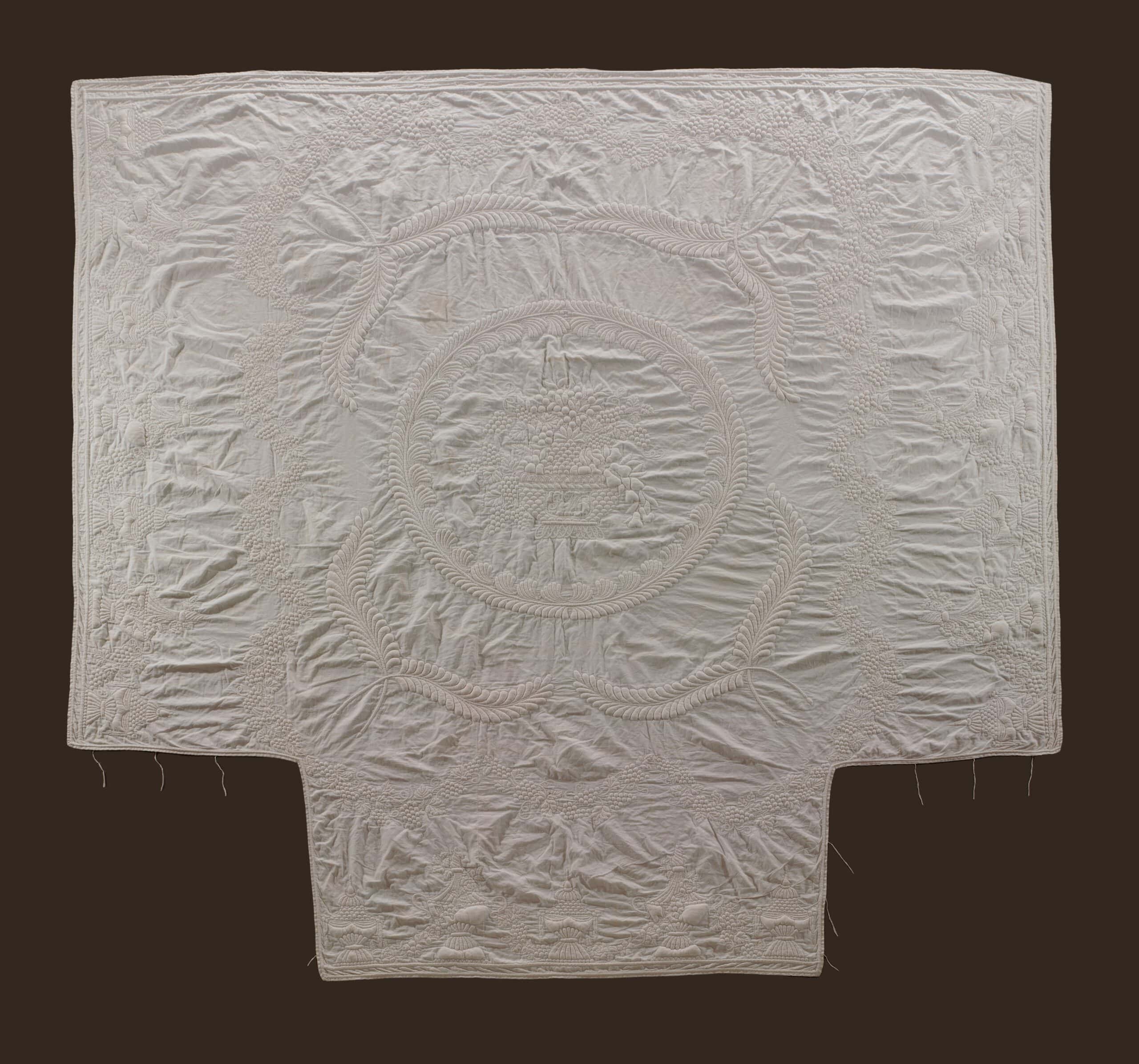
I purchased a whitework quilt today, heavy fine quilting, in A-1 condition. But I’m having a hell of a time trying to give it a circa date. Has there ever been a book or article written about the pattern styles used, or maybe an overview of pre-printed patterns available before 1950? I’m fairly comfortable with a c.1900 date, but the motifs are so classic. Great quilt tho’. Design is composed of a large feathered wreath in the center, with 6 floral shapes around it. The ground is crosshatching. One row of stitching defines the border from the ground. The border is a feathered garland, with a set of two concentric circles wear the garland meets at the corners. There is also a small feathered wreath in each corner. The ground of the border is rolls of double parallel lines.
Ideas? Thanks.
Alan
— Alan Kelchner
Skitzofrenya Quiltworks http://skitzofrenya.artistnation.com
Date: Sun, 10 Dec 2000 22:42:29 EST | From: KareQuilt [at] aol [dot] com
This just appeared in our local Guilds online electronic newsletter update. No affiliation. First time I have ever heard about it myself, but sure sounds interesting.
Karen A.
QUILT SONGS CD WEBSITE – This CD by Canadian songwriter Cathy Miller entitled “One Stitch At A Time” has something unique–all the songs are about quilting! Cathy has researched many facets of old (and new) quilting traditions in order to write the songs included in this collection. She has had help from quilt historians and avid quilt-makers from North America and Australia. The CD covers a wide range of quilt-lore.The web site for ordering the CD is www.nucleus.com/~cmiller/ . The songs are delightful, especially “One Hundred Ways to Hide Your Stash.” Just click to hear samples! (Great Christmas idea!)
Date: Mon, 11 Dec 2000 08:39:41 EST | From: Ctoczek [at] aol [dot] com
You can spot one of our own QHL members in the Jan. issue of Country Living
Magazine. There’s a two page spread on “quilting alive and well across the country” with one photo of Sue Reich (Conn.) and her quilting group. Of the six years I’ve subscribed to that magazine, I’m now noticing a considerable trend towards quilt articles and related photos—in the collecting vein and not just as decorating props.
Hurray for Sue!
Carla Toczek
West Point
Date: Mon, 11 Dec 2000 10:23:16 -0500 | From: “pepper cory” <pepcory [at] mail [dot] clis [dot] com>
In late Victorian times, Columbia (symbol of peace often portrayed as a lady in flowing robes-) was a popular motif. I have seen a Columbia with a harp embroidered on a crazy quilt but wonder if the pieced quilt pattern might be “Star of Columbia.” That’s a six-pointed star, grouped similarly to the Seven Sisters pattern. Seems to me the Mountain Mist Blue Book has a blue and white Star of Columbia pattern listed. Happy holidays, y’all!
Pepper Cory
Date: Mon, 11 Dec 00 11:21:41 -0600 | From: woodford <haq [at] galenalink [dot] net>
In response to Alan,
The quilting on your whitework sounds a lot like on the one I have, which is definitely of UK type. Their wholecloth quilts are full of fabulous designs.
I purchased a book by Dorothy Osler while at the Bowes Museum exhibit—Quilting Design, which has many typical English quilt patterns in it ( I still haven’t found the exact medallion design on mine). Also Quilt Treasures of Great Britain has lots of quilting designs in it, and is my first reference when trying to name a quilting pattern.
English Purchase: Well, it’s really from Holland. I splurged on a sampler (I hate samplers), but this is a sampler made by a child, dated 1754, of weaving samples as used in darning to repair stockings. It is incredible. There are 20 different designs, all very intricate. We who throw away sox with holes should be mortified! Have any of you seen such a sampler?
On another subject, for fun, the book by Sandra Dallas, Alice’s Tulips, is a very good historical novel that intertwines a great deal of quilt-making. I was especially interested because it takes place during the Civil War in and around the Illinois/Iowa area of the Mississippi River.
About to be buried in snow,
Barbara Woodford
Date: Mon, 11 Dec 2000 15:25:23 EST | From: QultFrFn [at] aol [dot] com
It is very possible that the patriotic motif could be the design she is referring to.
What would I have to do to get a picture of that pattern and more history on it?
In the novel, THE HAWK’S DONE GONE by Mildred Haun – and in the chapter by the same name, the narrator is quitling a “Harp of Columbia” quilt when she meets a soldier man. Therefore there might be a link to that pattern. I also know she was very knowledgable of the Harp of COlumbia shaped note singings as well. The only clue in the novel is a reference to an actual harp in the pattern.
I thank you so much for your help in my search!!
KAren Travis
Date: Mon, 11 Dec 2000 21:14:04 -0700 | From: “Dale Potter” <dpquilts [at] telusplanet [dot] net>
Karen, and others
Cathy’s CD is great! My favorite is “100 ways to Hide Your Stash”
and “It Ain’t Done Yet”
Cathy is also a quilter!
She will be appearing here at the shop July 22nd 2001 and I look forward to hearing her LIVE!! Dale Anne Red Barn Inc., Quilting & Tea Room
P.O. Box 36 OYEN, Alberta T0J 2J0 Canada (403) 664 – 3274 dpquilts [at] telusplanet [dot] net
Date: Tue, 12 Dec 2000 09:50:11 -0500 | From: “anne” <datkoa [at] erols [dot] com>
Does anyone have info on shops in the area around Sierra Madre, outside
Los Angeles? Or adjoining areas? Or shops in the greater LA area that aren’t to be missed? Please reply privately to datkoa [at] erols [dot] com. Thanks very much. Anne D.
Date: Tue, 12 Dec 2000 13:08:03 EST | From: KANSIER1 [at] aol [dot] com
Alan:
I have found that Holice Turnbow of Sheperdstown, WV is a wealth of information when it comes to wholecloth quilts. He is an NQA judge and he designs wholecloth quilt patterns. I always see him at shows — he’s the one with the large booth of quilting designs stencils. I don’t have his email address but do have a telephone number for him (send me an email if you want it). Do you have any other date clues on your quilt (e.g., binding, batting, quality of fabric)?
Waiting for the Snow,
Kathy in Ozark
Date: Tue, 12 Dec 2000 13:47:37 EST | From: JQuilt [at] aol [dot] com
Mrs. D., wonderful lady i knew many years ago, had a treasure chest in her sewing room…
She was a superb seamstress, dressmaker and tailor…and every january she started with an empty chest…month by month she filled it with handmade items..aprons, pillow cases, table runners, placemats, tote bags, dolls and Christmas tree ornaments….
I remember visiting with her one day in june and…after tea and cakes..
she brought out her half-full chest…..opened it, and took out piece after piece of hand crafted delights…i oohed and ahhed and yearned for everyone of them…there was…a cloth doll, dressed in fabric she had used to make a pinafore, for her granddaughter..pillow cases with appliqued and embroidered edges…a Christmas apron for her daughter to wear at the family Christmas dinner …a Christmas stocking for the grandchild, to be born in September….. a teddy made from the softest flannel one could touch…..
An hour later, i started for home, my head, my eyes and my heart.. were filled with fabric visions …my fingers could still feel the flannel teddy…
A friend had called that day to ask me if i wanted to go to the mall, shopping with her…i declined in favor of my tea date with Mrs. D….
I traded a day of jostling amongst strangers, going from one chrome, color coordinated store to another.. for an afternoon of good company, good tea and cakes….and a visual, tactile, inspiring memory…
Often times,when someone mentions “going to the mall” i remember
Mrs. D’s treasure chest..
jean laino amherst, mass. where there’s a wild wind out there today…that brings echos of Cathy and Heathcliff on the Moors..
Date: Tue, 12 Dec 2000 13:07:21 -0800 | From: “Melissa Devin” <mldevin [at] aa [dot] net>
I just found out today that Nancyann Twelker passed away last week. She was a teacher and considered an expert in regards to quilt restoration and care.
Though predominately known in Washington state, she was known throughout the
US and Canada. I had taken a restoration class from her about a year and a half ago, and found her to be a personable teacher who enjoyed telling stories about her family. Her obituary is below:
Nancyann Johanson TWELKER 67, went to heaven unexpectedly December 8, 2000.
Nancyann was considered one of the foremost quilting authorities in the
Pacific Northwest. She received the Washington State Governors Writing
Award in 1989 for her book “Women and their Quilts”. Which combined her love of quilting with her extensive knowledge of Washington State history. She was also author of “A Quilters Christmas”. She was a teacher of quilting for 25 years and inspired many. Nancyann is the past president of the Pacific Northwest Needle Arts Guild and Quilters Anonymous. Nancyann is survived by
Alois E. Twelker, her beloved husband of 44 years; Colleen R. Earp, daughter; David E. Twelker, son; Tina M. Johns, granddaughter; Petter M. Johanson, brother; Patricia G. Shaw, sister; her nieces: Kimberly Sandquist and Karen Johanson; and her nephews: Gevin Shaw and Timothy Shaw. Service to be held Saturday, December 16, 2000. At Beck’s Funeral Home, 405 5th Avenue South, Edmonds at 3:30 p.m. The family requests that in lieu of flowers, remembrances be made to the American Diabetes Association, NW Regional Office, 6315A Fleming, Everett, WA. 98203
Melissa
~~~~~~~~~~~~~~~~~~~~~~~~~ mldevin [at] gocougs [dot] wsu [dot] edu
WAshington State Internet Quilters http://www.wasiq.org
~~~~~~~~~~~~~~~~~~~~~~~~~
Date: Tue, 12 Dec 2000 20:01:37 EST | From: KareQuilt [at] aol [dot] com
My DH keeps an eye out for any mention of quilting as he reads his many magazines and newspapers. It is such a treat to come home after a trip to find a couple of articles on my desk. Today he came home from work proud as a peacock with a full-page article from the latest Forbes (dated Dec 25, 2000 pg. 90). The article is by Chana R. Schoenberger and is titled: “So Sew
Me.”
The bold heading right under the title is “Quilting, sewing and embroidery buffs are taking up another time-honored American pastime: lawsuits.”
The last three paragraphs of the article have to do with the Judi Boisson copyright lawsuit. (Judi is a Southampton, NY quilt entrepreneur according to the article.) Her argument was that as long as you change a color or add a distinctive border to one of the patterns in the public domain that you can copyright it. She has taken on a couple of large companies to court that have apparently “copied” some of her copyrighted versions of these so-called public domain patterns. According to the article she won a case February 2000 ($370,000) against her former Chinese manufacturer and a couple of U.S.
retailers (such as QVC, Dayton Hudson and Burlington Coat Factory).
Anyone on the list heard any new info on the case before the courts right now? Does anyone know if the present case is an appeal to this case or is it a whole different plaintiff?
Karen Alexander
Date: Wed, 13 Dec 2000 11:37:00 -0500 | From: quiltsnbears [at] webtv [dot] net (Textile Historian)
I just received Blockbase 2,the CD upgrade version of Barbara Brackman’s
BB1. What a huge difference between the two versions! This is much quicker and easier to use. As we all know,time is money in the appraisal and research fields and this morning the program paid for itself. I have not had time to find any faults,but that isn’t to say there aren’t any.
I’d like to hear other opinions. Keep in mind that I use it mainly as a research tool,not a quilting tool,so I’d like to hear from quilters also.
Roberta in 78 degree sunny FL (have to rub it in,we can read temps even if we can’t count!)
Date: Wed, 13 Dec 2000 19:54:11 -0800 | From: Audrey Waite <awquiltr [at] sedona [dot] net>
Hi Karen:
I received a FAX of a FAX so hard to read but evidently Judi Bosson is represented by Paul Levenson of a NY law firm. She has a multimillion dollar business and feels that her selection, combination and arrangement of elements is her original artistic creation. Don’t know how the lawsuits turned out but she was supposed to be in the Second Circuit Court on May 15th arguing that a quilt of hers with giant-sized letters of the alphabet is infringed on by a quilt called “ABC”
made by Banian (sp?) Ltd.
Then 5 days later a jury trial was to begin in NY against San
Francisco-based Pottery Barn Inc., over an allegedly infringing quilt that contains 8-pointed pastel “Missouri Star” blocks on a white background…like one of Boisson’s. The article states “home quilters are abuzz about Boisson’s copyright claims, but Levenson says her targets are commercial entities, not grandmothers making quilts for their own families”. Looks like different plaintiffs. But it does say one copyright case will be argued in November before the Second Circuit U.S. Court of
Appeals and another will be tried in NY federal court. One case, tried in May in NY, brought a $600,000 verdict to a Long Island quilt designer (I don’t know who that was). In August Barbara Brown was awarded $14,053 for the unauthorized use of one of her designs in connection with the film “How to Make an American Quilt”. Earlier Faith
Ringgold won an infringement case involving an unauthorized use of the image of one of her quilts in a television sitcom.
So the heading “So Sew Me” seems appropriate!
Audrey Waite in Sedona, AZ
Date: Thu, 14 Dec 2000 23:08:20 -0600 | From: “quilt97” <quilt97 [at] interconnect [dot] net>
Yesterday I was given a 9×14 inch cream-colored cloth. It has 13 blue embroidered stars around the outer edge, then four rows of red cross stitch. The center is a blue oval which surrounds a solid blue star. Above and below the oval are the words: “Serving our country.” I was told this is from WWII, and would have been hung in the window to show that a family member had gone to fight in the war. Can anyone tell me anything further about this piece, or direct me to a person or website which will?
Thank you.
EKarenbeth
Date: Fri, 15 Dec 2000 16:57:56 EST | From: Jquilt [at] aol [dot] com
the little flags hung in the windows during WWII..
were usually a red border a white center and a blue star in the middle.
the same red border and white center with a gold star in the center meant that the soldier, sailor, marine etc had been killed in action…
jean
Date: Fri, 15 Dec 2000 19:45:51 -0600 | From: “quilt97” <quilt97 [at] interconnect [dot] net>
For anyone interested, there is an Old Painted Wood Chicken ThreadScissor Holder Item #523443288 for sale on ebay. I have absolutely no affiliation with the seller, etc. http://cgi.ebay.com/aw-cgi/eBayISAPI.dll?ViewItem&item=523443288
Liz