March 1 – 4, 2002
These restored messages come from the Quilt History List, an online forum where quilt historians, collectors, researchers, appraisers, and enthusiasts discussed antique quilts and related textiles. The archive dates from 1996 through approximately 2016 and is being restored gradually. Sign up in the form at the bottom of the page if you want to know when a new page is added. Original spelling, opinions, formatting, and inactive links may remain unchanged.
Primary topics of this QHL Digest:
- Polyester Batting Bleed-Through — Members compare experiences with poly battings bleeding or discoloring cotton quilt tops made in the 1980s. (see the article on quilt batting)
- Pennsylvania Quilt Book Bibliography — A member starts a running list of books specifically about Pennsylvania quilt history, with others adding titles.
- Dating Quilts by Machine Stitching — Members discuss visible machine stitching as a dating clue, citing Barbara Brackman’s research on the machine-quilting era. (see the article on dating quilts)
- Red/Green Appliqué Quilt Identification — A member asks for help identifying and dating a four-block red/green appliqué quilt with a ‘boofy’ vine border.
- Antique Sewing Machine Parts — A member looks for a period-correct darning foot to fit a circa-1900 Singer machine.
- Regional Exhibit Announcement — Announcement of a new quilt exhibit opening at the Gordon-Roberts House in Cumberland, MD.
Date: Fri, 1 Mar 2002 22:58:51 -0500 | From: “Cinda Cawley” <lrcawley@>
Mindy, Treasures in the Trunk: Quilts of the Oregon Trail by Mary Bywater Cross is the place to start. Cinda on the Eastern Shore
Date: Fri, 1 Mar 2002 18:57:48 -0900 | From: “Gloria Hanrahan” <gloria@>
I am wondering about different brands of poly batting and how they are affecting the cotton quilt tops. I made several quilts in the mid 80’s, cotton tops, thin poly bats with cotton hand quilting stitches. I used sheets on the backs since that was what I had on hand. These quilts are still in continous use in my home with the only wear being on the bindings. I have not experienced any migration of the bat and the cotton top appears to be holding up fine. They get machine washed about twice a year since they are currently being used by the kids. I have not used the poly batting that can be purchased by the roll since I always thought it felt awful, but found the prepackaged thin batting to be soft. Is it just a matter of time before my quilts fall apart or have other had good luck using polyester batting? My favorite quilt was made in the 40’s and has wool batting. I love the drape of this quilt and would like to use wool in some future projects. I have only found 80% wool-20% polyester batting on the internet. I have not found anything locally. Does anyone have a source for purchasing wool batting and what have been the experience of using this type of batting? Gloria
Date: Fri, 1 Mar 2002 23:12:02 EST | From: Edwaquilt@
in 1978 when the first quilt stamp was issued in Charleston WV we arranged an exhibit of basket and postage stamp quilts. Many were double knit and some with navy tricot backing. Our initial reaction was one of dismay but when they were hanging they were wonderful visual art pieces. Colors vibrant and contributed to the theme of the exhibit and certainly reflected the style of quiltmaking in West Virginia. There had been many clothing manufacturers in the area so the poly knit was readily available and as quilters have done for many years – it was used for utilitarian purposes. They probably will become collectors items in the future. Holice
Date: Sat, 2 Mar 2002 01:21:09 -0500 | From: “judygrow” <judygrow@>
Really, and you thought you’d seen everything. Is this how they do things in Florida? I wonder if our own Teddy Pruett had a hand in this? Click on the thumbnail
Judy in Ringoes, NJ judygrow@
Date: Sat, 2 Mar 2002 03:27:38 EST | From: Mrgavio@
I have just purchased a quantity of vintage and feedsack fabrics in more than 50 patterns. The lengths run from about 24″ to 48″ and the width ranges from 24″ to 36.” Some are definitely feedsacks – it’s still in bag form and is stitched with string. The printed flour sacks are all identified at “Kent Bags.” In one fabric, I find one section (out of many) that has a seam sewn with string very much like the feedsack bags, however there is no evidence of a side or end seam. In several fabrics 2 ends are butted and stitched with string with no evidence of seams. I bought 2 pink flour bags; one is stamped with a note that reusing the bag is a “war effort” and is copywrited 1936. One bag of very coarse muslin is misprinted (part of the front printing is on the wrong side) and states that this flour is donated by the people of the United States. The fabric came from the estate sale of a couple who owned a dry goods store until 1970. I have some questions: This fabric was stored in a basement and garage so the dirt was thoroughly embedded and smelled just as bad as the house. I washed everything in Orvus with warm water and dried on permanent press. Have I altered the value of the fabrics? Is the presence of string stitching, either in a seam or butted ends, an indication that the fabric was for feedsacks? I am wondering if most of the fabric was flat fold–multiples of individual fabrics are all about the same length. Could the dry goods merchant purchase fabric cut for feedbags that had never been stitched? One piece of fabric still has the paper flour label stuck to it. I haven’t washed it. Is this piece of any significance? Does anyone know anything about Kent Feedsacks? Thanks! Mary Gall
Date: Sat, 2 Mar 2002 23:36:25 +1100 | From: “kate knight” <kateknight@>
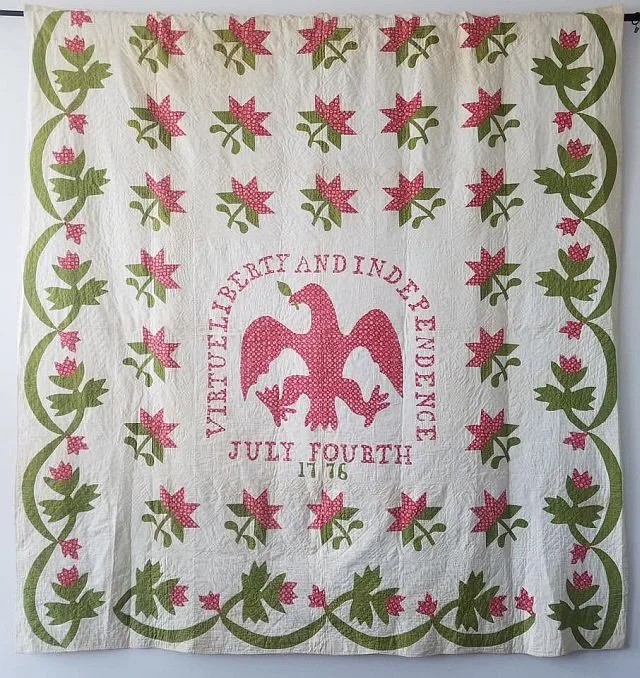
Hello to all, I recently acquired a four block red/green applique quilt complete with a wonderful “boofy” border of potted appliqued vines made possibly circa 1880-1870 (don’t really know, maybe earlier??) The curious thing about this beauty is the makers use of (what now appears to be) white/off white fabric on some of the applique pieces – the handled pots of the border, the uppermost layer of the roses and tulips. All other fabric is (generally) intact in colour and condition; true turkey red, double pink and overdyed green on the white background. My question – in the experience of the many members of this list – do you think this use of white was original ? I wonder whether it may have once been pale pink that has faded to white ? or possibly a home dyed colour ? yellow ? (but why would the maker do that if she purchased all the other fabrics) There appears to be no trace of any residual colour on any of the pieces. The pinkish shadow is the red fabric showing through the white. I wonder if I am applying my 20th/21st century colour and design sense to a 19th century quilt?? and in fact she actually chose to use white? I have uploaded some images onto the following site if you wish to have a look: http://www.nikon.co.uk/fotoshare/MySite/Home.asp you will be asked to log in…. user name is katek and password is fish Any comments or opinions would be of great interest. Thanks in advance !! Kate
Date: Sat, 02 Mar 2002 07:41:41 -0500 | From: “Judy Kelius (judysue)” <judysue@>
One of my recent finds is a book of “Fancy and Ornamental Work” by Miss Florence Hartley published in Philadelphia in 1859, before the Civil War. This is the earliest original document I have which refers to quilting. I thought you all might enjoy reading a couple of short excerpts. In either case, if I had been shown them without the reference, I would have thought them later. Only goes to show that the more things change, the more they remain the same! From the chapter on Patchwork: “We own to a liking for Patchwork, genuine old fashioned patchwork, such as our grandmothers made, and such as some dear old maiden aunt, with imperfect sight, is making for fairs and charities, and whiling away otherwise tedious hours. We love to see a bed spread with the pretty squares and rounds and curious shapes, which mingled with white look so clean and gay; and we even love the irregular, coarse, ill-matched pieces, put together by a perhaps over-worked mother, or a little child trying her first efforts at being useful. We think the real old patchwork of bits of calico infinitely prettier than the bits of silk sewed together for parlor ornaments.” From the chapter on Quilting: “This work, when neatly done, is very ornamental, either for articles of dress or for quilts. The number of patterns used to be very limited, but since the introduction of sewing machines, the work has become so popular, and is so beautifully done, that more attention has been paid to the designs. “It is hard work to do neatly on the old fashioned quilting frame, though we should be sorry to see that abolished, for the sake of the occasion of the old time quilting frolics, which, in country towns, was the occasion of such unbounded hospitality and merry-making. Quilting on a Grover & Baker’s sewing machine is no trouble at all, and the rapidity with which it is accomplished, enables us to apply it to many things which would cost too much time and labor for hand sewing.” “No trouble at all”???? I can’t imagine quilting a whole quilt on an old treadle or hand-turned machine! In a footnote, the author gives high praise to the Grover & Baker brand, sounds almost like a sponsorship.
Date: Sat, 2 Mar 2002 06:45:44 -0600 | From: “leigh/hcquilts” <hcquilts@>
> “No trouble at all”???? I can’t imagine quilting a whole quilt on an old > treadle or hand-turned machine! In a footnote, the author gives high praise > to the Grover & Baker brand, sounds almost like a sponsorship. Don’t let the members of Treadleonia hear you say that 🙂 I concur on the hand-cranking, but a number of folks actually prefer the treadle for machine-quilting, presumably because of the direct control they feel they have over the stitching (comparable, I’d guess, to driving through the Adirondacks on back roads with a standard transmission.) Anyway, I’m interested in this reference: >The number of patterns used to be very limited, but since the introduction of sewing >machines, the work has become so popular, and is so beautifully done, that more >attention has been paid to the designs. The “number of patterns” seems almost like a reference to free-motion work; I can’t imagine (well, actually I think I can) how many “patterns” you can get without a free-motion foot and with purely straight stitching (diagonal and horizontal grids, parallel lines), but it doesn’t seem to be worthy of note. So….what does the crowd think? And has any of you actually ever seen a period machine-quilted quilt with “patterns” in it?
> >
Date: Sat, 02 Mar 2002 09:04:33 -0500 | From: Paul and Nancy Hahn <phahn@>
Pat asked about poly batts. Here is my personal experience. I am slowly watching some of my favorite quilts made in the early-to-mid 80’s have the fabric on the “right side” split and deteriorate. Two quilts have been in use daily since they were made. Both are approximately 55″x72″ and were made specifically for curling up under while reading or watching TV. Almost every day since they were made, winter or summer, someone in our family is under them. Every morning they are refolded, wrong side together twice along their short side, and rearranged along the back of the couch and over the arm of my husband’s recliner. They are washed in the machine whenever needed. One is 100% cotton front and back, heavily quilted, an Amish Bars pattern. The fabric is deteriorating all across the center fold, across all fabrics. The backing, is undamaged along any of the fold lines. The 2nd quilt is a scrappy Ohio Star, the blocks made by one of my quilting bees, so I’m unsure of the fabric content. It is starting to split, not through the pieced block areas but through the solid block alternating blocks on the fold lines (but again, only the “outward” fold lines). The backing on this quilt, solid muslin, is undamaged. Two other quilts, made at the same time, with cotton fabrics and poly batting are wearing differently. One, made of Laura Ashley decorator fabrics (I didn’t know how difficult they would be to needle through, at the time) and stipple quilted by hand, is treated more as a Sunday Quilt, isn’t curled under (and refolded) as often, is only showing wear by the slightly fraying binding (yes, I do straight bindings). The stippling is done through areas of muslin, which are along the usual fold lines, but that area shows no damage. Of course, the decorator weight fabric is wearing like iron! The 4th, an oak and reel appliqué with 1/2″ cross hatch quilting, is hanging on a quilt rack as a display quilt, mostly. The first few years of its life it was my husband’s “nightly curl under to watch TV quilt” but as I made more quilts, that one was declared “special” and removed from daily service. That one is undamaged. What I have decided, right or wrong, is that it is the constant folding and unfolding, of the abrasive “pot scrubber” poly quilt batting that is doing in the quilts. And only at the “outward” folds. I know perhaps folding them differently would have helped, but at the time, I figured just getting the kids to pick them up off the floor and fold them anyway was a plus. I should make replacement quilts and retire these old favorites before its too late, but now vintage quilts and fabrics are my love and I don’t make the time to work so much with contemporary fabrics. And no one curls up under my vintage beauties, of course! Nancy Hahn, whose 1981 poly fabric/poly batt Log Cabin quilt, currently on her bed, though faded, is as undamaged as can be.
Date: Sat, 2 Mar 2002 13:44:50 -0500 | From: “Cinda Cawley” <lrcawley@>
I am trying to put together a list of books about quilts of Pennsylvania. I have defined this broadly and am including anything that devotes some attention to the subject (hence books about PA decorative arts). The following is the list of books I found on my shelves. Please add to it. Thanks. Cinda on the Eastern Shore
PA BOOK LIST Adams County Quilt Project, The Hands That Made Them (1993) Bishop Robert, Safanda Elizabeth, A Gallery of Amish Quilts (1976) Cawley, Exbiansky, Nordberg, Saved for the People of Pennsylvania (1997) Cunningham, Granick, Amish Quilts 1880 to 1940 (2000) Good, Phyllis Pellman, Quilts from the Two Valleys (1999) Granick, Eve Wheatcroft. The Amish Quilt (1989) Haders, Phyllis, Sunshine and Shadows: the Amish and Their Quilts (1976, 1984) Herr, Patricia T., Amish Arts of Lancaster County (1998) _______, The Ornamental Branches (1996) _______, Quilting Traditions (2000) Historical Society of Berks Co., “Historical Review of Berks Co.” Vol.LVIII, #1 (1993) Hughes, Robert, Amish: The Art of the Quilt (1990) Kraybill, Herr, Holstein, A Quiet Spirit (1996) Lasanksy, Jeanette, A Good Start (1990) ________, Bits and Pieces: Textile Traditions (1991) ________, In the Heart of Pennsylvania (1985) ________, In the Heart of Pennsylvania: Symposium Papers (1986) ________, On the Cutting Edge (1994) ________, Pieced by Mother (1987) ________, Pieced by Mother: Symposium Papers (1988) Keller, Patricia J., Of the Best Sort But Plain (1996) McCauley, Daniel and Kathryn, Decorative Arts of the Amish of Lancaster Co. (1988) Nicoll, Jessica F., Quilted for Friends (1986) Pellman, Rachel and Kenneth, The World of Amish Quilts (1984) ________, A Treasury of Mennonite Quilts (1992) ________, Amish Crib Quilts (1985) ________, Amish Doll Quilts, Doll and Other Playthings (1986) Philadelphia Museum of Art, “Bulletin” Vol. 85 (1989) Richman, Irwin, Pennsylvania German Arts (2001) Roan, Nancy and Donald, Lest I Shall Be Forgotten (1993) Roan, Nancy and Gehert, Ellen, Juscht en Deppich (1984) Schorsch, Anita, Plain and Fancy: Country Quilts of the PA Germans (1992) Silber, Julie, Amish Quilts of Lancaster County (1990) ________, The Esprit Quilt Collection (1985) Woods, Marianne, Threads of Tradition: Northwest PA Quilts (1997) York Co. Quilt Documentation Project, Quilts: The Fabric of Friendship (2000)
Date: Sat, 2 Mar 2002 13:16:24 -0800 | From: “Susan Wildemuth” <ksandbcw@>
I have some to add: Graeff, Marie Knorr, PENNSYLVANIA GERMAN QUILTS, Plymouth Meeting, PA: Mrs. C. Naaman Keyser, c1946 HOME CRAFT COURSE Volume 14 32 pages This is a small softcover book or booklet-similar to those from the home extension offices in those days. Powell, G. Julie. THE FABRIC OF PERSUASION TWO HUNDRED YEARS OF POLITICAL QUILTS. Brandywine, Pennsylvania: Brandywine River Museum, 2000. LCCN: 00-131767. Exhibition at Brandywine River Museum September 9 – November 19, 2000. This is actually an exhibition catalog/book. This might still be available through Rob Roberts-Quilting Books Unlimited,1309 Challenge Road, Batavia, Illinois 60510 phone: 630-406-8374 E-mail: qbu@inil Web page: qbu.com. I got my copy this past X-mas as a present.
I really like this idea. Most of us keep book lists like this about the state we reside in (I also keep a quilt book list for the state I grew up in.) Hope this helps. Sue
Date: Sat, 2 Mar 2002 13:58:29 -0800 | From: “Susan Wildemuth” <ksandbcw@> Let me
correct something in my earlier e-mail Fabric of Persuasion: Two Hundred Years of Political Quilts it is not a book about Pennsylvania quilts, but an exhibition book/catalog which was held at the Brandywine River Museum, Chadds Ford, Pennsylvania.The quilts in this book come from many areas throughout the United States. Sorry about that. Sue
Date: Sat, 02 Mar 2002 19:24:53 -0500 | From: Sandi or Mike Hardy <shardy@>
I am sending this for a friend who is not on the list. She was at the AQS show in Paducah last year and was able to reserve a room at the Executive Inn for this year and now can not go. She wondered if anyone was looking for a room. Her reservation is one room for up to three people at the Executive Inn with check in on April 22 (after 2 pm) through check out on April 28 (before 12 noon). If you have any questions about it please contact Nancy by email – norcutt@ Thanks, Sandi
Date: Sat, 2 Mar 2002 20:34:06 -0500 | From: “Teddy Pruett” <Aprayzer@>
<<Really, and you thought you’d seen everything. Is this how they do things in Florida? I wonder if our own Teddy Pruett had a hand in this?>> Ha Ha Ha!!! I am so glad my reputation for tacky precedes me, but I have to admit I am innocent – I did not upholster this car. Actually, it seems to be beautifully done. But, now that you mention it, it may, indeed, be a FLorida thing – as I have also seen a quilted car in the Eustis/Tavares area. Of course, I must point out that only the Yanks live there – you probably couldn’t find five native Floridians in that county. SO, it is most likely a “Northern” thing, no??? ANd, on the subject of Poly-dbl knit quilts – years ago, a friend brought me a Trip Around the World poly top that he dug up on the beach. It has been used as a drape across the balcony of our local historical museum to advertise the quilt shows – indestructible, you know. It hangs now as a glorious example of “Yard Art” – my studio is a little cottage under enormous oak trees, fronting a pond — and is decorated with cast-off kitchen goods from my aunt’s old farmhouse. (yes, the same farmhouse in which I discovered the Romaine Crepe dress). I have a little laundry vignette outside the cottage, complete with the old wringer washer and pots, paans, etc. The quilt hangs there on a line, 24/7 – never comes down. It is glorious. I know that the threads will eventually rot, and one day I expect to go out there and find ten thousand little poly squares blowing in the wind. Teddy Pruett–
Date: Sat, 2 Mar 2002 22:07:01 -0500 | From: “Suzanne Cawley” <ccawley@>
Hi Everyone! The quilt exhibit at the Gordon-Roberts House in Cumberland, MD officially opened today. This display in a beautiful victorian home features over 25 pre-1900 quilts from the collection of the Allegany County Historical Society. I would encourage anyone within driving distance to plan a trip to see this exhibit, tour the house, and enjoy a victorian tea for the mere cost of $5.00 per person. The display will be up through November 1st. Hours are Tues through Sat from 10am to 5pm. S If you really want to make a day of it; plan your trip for June 14 to 16 when our local guild will have their annual show. The show will include over 300 quilted items on display as well as several vendors. Feel free to contact me if you would like more information. Suzanne Cawley in Keyser, WV
Date: Sat, 02 Mar 2002 21:22:00 -0800 | From: Gaye Ingram <GIngram@>
Of a poly-doubleknit quilt that hangs outside her studio, Teddy Pruett wrote, The quilt hangs there on a line, 24/7 – never comes down. It is glorious.I know that the threads will eventually rot, and one day I expect to go out there and find ten thousand little poly squares blowing in the wind. My own guesses: 1) No, it will NEVER rot, even unto the seventh generation. That is what double knit is about. But should something supernatural or terroristical explode it, 2) It sounds to me you have a ’70’s revival ditty in the making: “ten thousand little poly squares ‘ablowing in the wind….” Then, all you will need is that quilted automobile Judy Grow located, a prairie skirt, a guitarist, and a stage name—-APrayzer, maybe.
Gaye
Date: Sat, 02 Mar 2002 20:47:41 -0700 | From: Jennifer Hill <jennifer.hill@>
> “No trouble at all”???? I can’t imagine quilting a whole quilt on an old > treadle or hand-turned machine! In a footnote, the author gives high praise > to the Grover & Baker brand, sounds almost like a sponsorship. I’m one of those “PPWs” (people-powered weirdos) that Leigh was mentioning who like to quilt with treadle machines. I’ll also admit to having quilted three bed-sized quilts on a handcrank machine (and I have the biceps to prove it!) but treadling is much less work. As far as I have been able to tell, the darning, or free-motion foot is a relatively recent innovation for machine sewing. I have one German handcrank machine dating from about 1902 that has a built-in darning feature, but that design never really caught on with the public, or other manufacturers. I suspect that it was used more for darning and mending than for quilting. I have a reprint of a Singer book from the 1920’s about decorative embroidery, but it doesn’t make any reference to darning feet. The free-motion work described is worked with no foot, and the work is hooped. I’m sure the “machine-queens” of the day could have tried similar techniques applied to quilting. I don’t think darning feet as we know them were introduced before the 3rd quarter 20th century. Jennifer Hill Calgary, AB
Date: Sat, 02 Mar 2002 22:36:36 -0800 | From: Audrey Waite <awquiltr@>
Hi Cinda: I have most of them – duplicates of a couple Pellman, Rachel T and Joanne Ranck, QUILTS AMONG THE PLAIN PEOPLE (1981), People’s Place Booklet No. 4, Good Books, Lancaster, PA Not about quilts but wonderful reference on woven coverlets and their weavers: Walker, Sandra Rambo, COUNTRY CLOTH TO COVERLETS, Textile Traditions in 19th Century Central Pennsylvania, An Oral Traditions Project, Keystone Books (1981), distributed by The PA State University Press, University Park, PA Audrey Waite
Date: Sun, 3 Mar 2002 00:40:50 EST | From: Kathlash@
Can anyone supply any kind of statistics on the use of the sewing machine in the 1860’s and beyond for piecing, applique and quilting? There is a whitework quilt on page 64 of the Smithsonian Treasury book, which was quilted entirely with a double-thread chain stitch sewing machine. I have only seen one quilt which was quilted by machine, and that was just channel quilted. Most quilts I have encountered were pieced by hand, and then maybe the borders were sewn on using a machine. We have a gorgeous 1870’s Ocean Waves quilt in the collection at the museum which was pieced by machine but quilted by hand. How prevalent was machine use for piecing? quilting? from the late 1850’s through the end of the 19th century? Did it really have an impact on quilting, or did the novelty wear off when women found they missed that intangible “thing” I feel when hand piecing and quilting? Most of the quilt books just give the old Elias Howe-Isaac Singer “song and dance” but don’t really answer the burning questions. Any suggested reading? Kathleen Lashley
Date: Sun, 3 Mar 2002 10:14:51 -0500 | From: “Alan Kelchner” <quiltfix@>
While we’re on this subject – does anyone know where I could find a darning foot that would fit a c1900 Singer? New would be fine. Alan
Date: Sun, 03 Mar 2002 16:35:00 +0000 | From: “Karen Bush” <karenbush11@>
I just wrote to the Quiltbee list, I’ve gotten so behind and Miss you all, but, things are going to get better for me…they ARE going to ,….positive thinking here. Sorry, I haven’t contributed to the list any more than I have this winter, I hope that changes soon. I just wanted to say ‘hi’ and I haven’t forgotten about you all. I try to read emails, but,…there’s just not enough time or energy right now. Long story, boring story, but,…I WILL get over this and things will get to a ‘normal’ state, whatever That is! Hope everybody is ok….have a great week 🙂 kb
ebay seller name- karenbush http://www.karenbushquilts.com Karen Bush It only takes me One day to get a month behind :/
Date: Sun, 03 Mar 2002 10:46:51 -0600 | From: Marcia Kaylakie <marciark@>
Recently, I was given an old 1978 Clarion, which was the American Museum of folk Art’s magazine. In it is an advertisement for 300 Years of Canada’s Quilts by Mary Conroy. Published by Griffin House, paperback division, Toronto I am intrigues by this book and wondered if anyone had one or knew of where I might find one. I haven’t tried either the publisher or ABE books, etc. yet. Marcia Kaylakie PS: in this same magazine is an article of three Centuries of Connecticut Folk Art, and several absolutely spectacular quilts, one of which I may have seen in another book recently.
Date: Sun, 3 Mar 2002 12:18:59 EST | From: SadieRose@
Kathleen, I would recommend “Patterns of Progress – Quilts in the Machine Age” by Barbara Brackman © 1997 Autry Museum of Western Heritage ISBN # 1-882880-03-X This book “accompanies an exhibition of the same title, which was organized by the Autry Museum of Western Heritage, Los Angelos, California”. I don’t know if this book is still available, but it is an excellent resource on the history of the sewing machine & the impact it had on women & sewing. There are approximately 50 quilts shown, from the 1850s to contemporary quilts. Part of the caption for Plate 21: Child’s Hands, a red and white baby quilt with baby hands appliqued to blocks, separated by flying geese sashing, reads “Many quilt lovers, however, express disappointment when they examine the quilt closely and realize it is machine-quilted; they feel that Amanda Garman (the quiltmaker) spoiled an otherwise great quilt with her sewing machine. Such an attitude regarding antique quilts is reflected in the monetary value as well as aesthetics: machine-quilted antiques are generally worth less than hand-quilted ones. Sometimes it is difficult to think of these machine-made quilts in the context of their time and through the eyes of the maker, who must have been quite pleased with her new machine.” pg. 36 I think this last point is exactly right: when we have a new tool or technique, we are excited to use it & show it off… if a woman got a treadle or hand-crank sewing machine, she would not look at it as “spoiling” her quilt, but rather would want to use it to show that she had/could afford a sewing machine. I have read that rather than ease a woman’s burden of sewing…some used the sewing machine to add multiple tucks or ruffles, etc. because they could be done faster by machine. In the Iowa Quilts Research Project (1988) and subsequent quilt documentation days, we did not see many machine-quilted quilts. But we did see many quilts (circa 1870-1900), with blocks that were pieced by hand, then set together by machine. The quilts were usually hand-quilted, but the binding was often put on by machine, or the top or backing turned over & machine stitched. A young girl learning to sew hand pieces her pile of quilt blocks…then mother sews them together into a top on the sewing machine?? We don’t have any way to know for sure… but we have seen hundreds of quilts with this combination of construction methods. This has been an interesting “thread”, hope we hear more!! Karan from snowy & cold Iowa
Date: Sun, 3 Mar 2002 13:42:32 EST | From: Cml791@
“Quiltmaking in America, Beyond the Myths” by AQSG has a section on Visible Machine Stitching on 19th century quilts by Suellen Meyer. It states that for a time in the late 1800’s the Iowa fairs gave a premium for machine quilting. Several examples are shown. In my collection is a blue & white quilt from Iowa, late 1800’s, that has excellent machine quilted feather wreaths, undulating feather swags, other free-form flowers, etc. To brag a little, 2 quilts in Brackman’s “Patterns of Progress” are mine. Carolyn Miller
Date: Sun, 03 Mar 2002 15:56:06 CST | From: jocelynm@
On Sat, 02 Mar 2002 07:41:41 -0500 “Judy Kelius \(judysue\)” wrote: > “We own to a liking for Patchwork, genuine old fashioned patchwork, > such as our grandmothers made, and such as some dear old maiden aunt, with imperfect sight, is making for fairs and charities, and whiling away otherwise tedious hours. Interesting how many sources describe patchwork as something Grandma did, or old maiden aunts. You’d think there’d HAVE to be a generation who remembered Mama or a young aunt piecing or quilting…but no, each generation remembers it as being what Grandma did. Do you think it was because these authors wanted to romanticize it, or because young mothers didn’t have time to quilt? Jocelyn
Date: Sun, 3 Mar 2002 18:31:42 -0500 | From: “judygrow” <judygrow@>
I have a new book to add to Cinda’s list, I think. “Antique Quilting Designs” by Roberta Benvin. AQS, Paducah, 2001. ISBN 1-57432-772-0. $21.95 from my local quilt shop or $15.36 from Amazon This is a book of the actual quilting designs mostly taken from quilts of the Pennsylvania Germans; the Lutherans and Reformed church members, not the plain people. I believe all of these designs came from York County. One nice thing is that the author pictures the quilts from which she has taken the designs. She also shows other items of the culture which use the same kind of designs. In particular I adore the Pieced Double Irish Chain quilt, circa 1840 which has different quilting designs in the 25 open blocks. Fourteen designs from this quilt are pictured, one to a page. Some are the usual circle with feathers, others show a great degree of ingenuity. This is the quilt design on the cover, in red and bright yellow on a paler yellow background. I love the book, and have used at least one design from it already. It fits on the bookshelf as opposed to the other quilting design books which have to be stored flat because they are so large. Highly recommended for hand quilters. Judy in Ringoes, NJ judygrow@
Date: Sun, 03 Mar 2002 17:35:55 -0800 | From: Gaye Ingram <GIngram@> Jocelyn, Do you think this particular
reference—and possibly many others—might be the consequence of the difference in experience between generations. The writer was not a stay-at-home mother, obviously, but a professional woman who was writing for a national publication. As such, she probably had little time for handwork herself. In her work she came into contact with the “art” end of the quilting tradition—-the “revivalist” not the “survivalist” part of the tradition. Her remarks and the tone of poignacy, therefore, might speak both of her attitude toward the gap that separates her from her past and of her memory as an active part of a “survivalist” tradition. Needlework is also one of the things that maiden aunts did to make themselves useful in an era when most were totally dependent upon their married sisters and brothers for maintenance. Many of these women spent their year moving from home to home of relatives. Even if they were not able to keep up with children or cooking, they could help out with sewing tasks in the household, especially piecing of quilts and similar handwork. American history came of age after the invention of the steam engine and in the midst of a rapidly industrializing age. Thus the experiences of succeeding generations has often varied considerably, making the yearning for a simpler past a constant theme in our literature and political thought. The vast expanses also made mobility appealing, thereby adding physical separation to cultural separation. One can read mid-17th century letters in which Americans are yearning for the past—and in a way that seems significantly different from the way our English cousins felt. Gaye
Date: Mon, 04 Mar 2002 02:05:22 +0000 | From: “Karen Bush” <karenbush11@>
are great. Of course, I’ve always thought that, but, after being rather ‘secluded’ lately (hey, I used a Real word)…I’ve gotten the BEST emails from you. I THANK YOU for that! I promise, I’ll try to keep up to date better. I REALLY miss it and you when I don’t, and learn SO much from you. I showed Kris a picture of a quilt that I have on my website, NOT for Ebay,but from my site. I thought you might be interested in a ‘show and tell’ since I don’t have too much else to contribute to the list just yet! haha…It IS for sale, but, that’s not the reason, I just wanted you to see 🙂 http://www.karenbushquilts.com/gatheringroom.htm And, again,…THANK YOU for all the kind words and thoughts. It WILL get better,…positive vibes…it WILL… 🙂 kb
ebay seller name- karenbush http://www.karenbushquilts.com Karen Bush It only takes me One day to get a month behind :/