March 30 – April 5, 2002
These restored messages come from the Quilt History List, an online forum where quilt historians, collectors, researchers, appraisers, and enthusiasts discussed antique quilts and related textiles. The archive dates from 1996 through approximately 2016 and is being restored gradually. Sign up in the form at the bottom of the page if you want to know when a new page is added. Original spelling, opinions, formatting, and inactive links may remain unchanged.
Primary topics of this QHL Digest:
- Old Swedish Quilts Book — Members help identify and describe Åsa Wettre’s Old Swedish Quilts, sharing publication details and where to find copies.
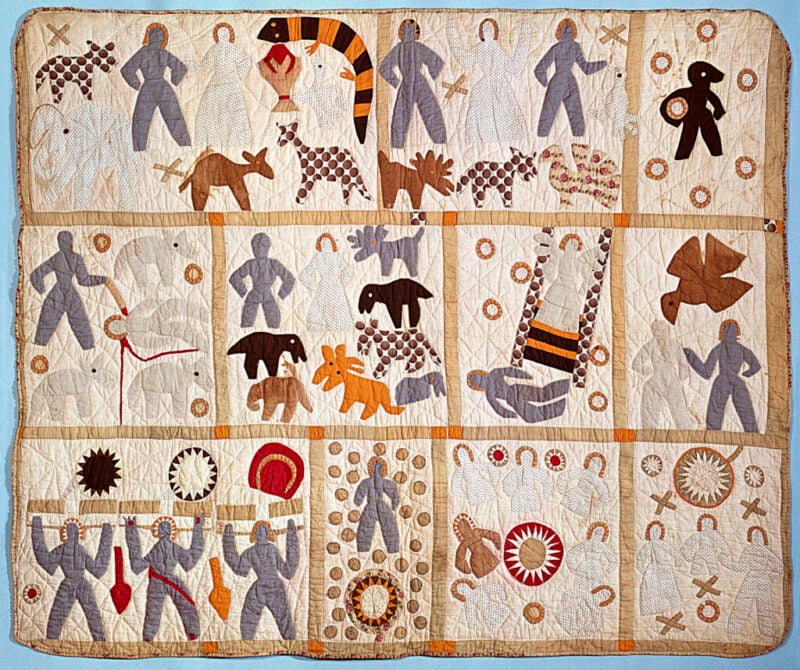
- Hidden in Plain View / Underground Railroad Debate — Discussion continues around the Tobin/Dobard quilt-code theory and Raymond Dobard’s televised Underground Railroad lecture, with members debating its historical basis. (see the article on Underground Railroad quilts)
- Identifying Kit Quilts — A member seeks help identifying whether a nosegay-and-tulip quilt was made from a commercial kit.
- Western Pennsylvania Quilt History — Members trace the earliest known quilts and settlement history of Crawford County and other western PA counties, including a signed 1801 Pittsburgh medallion quilt.
- Washing Antique Textiles — A request for advice on washing old cotton quilts and kimonos prompts cautions against washing delicate antique silk and cotton pieces. (see the article on cleaning antique quilts)
- Quilt History and Dating Course — A member announces enrollment in Dr. Virginia Gunn’s Quilt History and Dating class at the University of Akron. (see the article on dating quilts)
- Signing and Appraising Quilts — A textile appraiser shares how a maker’s signature affects a quilt’s appraised value. (see the article on quilt appraisers)
Date: Sat, 30 Mar 2002 22:54:16 -0500 | From: “Kalmia@” <kalmia@>
_Old Swedish Quilts_ [Gamla svenska lapptäcken], by Åsa Wettre. English translation published 1995 by Interweave Press.
Åsa put together an exhibition connected with this book. I saw it in Hjörring, Denmark, a year and a half ago, on a side trip during a quilt research trip in Sweden.
Laurel Horton
Date: Sun, 31 Mar 2002 09:27:53 -0500 | From: Pat & Jim <jimpat@>
Hi there!
The book you are looking for is called Old Swedish Quilts by Asa
Wettre,
Interweave Press, $24.95. ©1995, ISBN 1-883010-15-2. The one I have
is
hard cover. I believe that the book is now out of print and you may
have to do a search for it on the internet. Bette Feinstein who has
a
business (I think that it is called Hard-to-Find Needlework Books) in
MA, may be of help to you. The book is loaded with great color
photos
and excellent history information. Hope you can find a copy.
Patricia L. Cummings
EGA certified master craftsman in quilting/
historian/writer/designer.
http://www.quiltersmuse.com
Date: Sun, 31 Mar 2002 10:23:51 -0500 | From: Pat & Jim <jimpat@>
Dear Leigh and the list:
I read your post, Leigh, with great interest. You have opened up an
interesting discussion and I applaud you for thinking about the whole
process of quiltmaking, as it relates to you, and to others, now and
in
the future. I agree that a quilt should be able to hold its own
artistically, with or without the association of a person’s name to
it.
Some quilters have developed such a unique way of working their
designs
that those of us who know quilts would automatically be able to say,
“Oh, that is a Michael James, or a Nancy Crow or a Ruth McDowell
quilt”,
without even seeing a label.
I guess that not adding your name to a quilt is your personal choice
to
make. Dutifully, I try to document not only my own work with labels,
but also the antiques I buy. In addition, I photograph each one, and
write down the size of it, source of design (if not my own), or
published source of pattern for an antique quilt. I also note any
unusual features about the quilt, and if I write about it
professionally, where and when it was published. These notes may
prove
to be an invaluable source of provenance information for future quilt
historians. I would not like to think of cheating future generations
by
not sharing what I know.
Sad as it may be to think about it, someday I will not be here. I
don’t
want to leave my family or others who acquire my collection,
scratching
their heads in dismay. Certainly, my husband could share a lot of
information about my quilts, but what if we met an untimely death
simultaneously, say, in a car accident? No one in the family would
have
a clue as to where anything came from or why I had it in the house.
I smile to myself when I recall that there are some early quilts that
I
made which are buried deep within the closet. Those will probably
never
see a label. They are so poorly done, I would not want to admit to
having made them. (We are talking toe-nail catcher stitches here for
hand quilting!) In fact, if I get nerve enough, I will probably burn
them or throw them away long before I depart this earth.
The nicest thing about your letter, Leigh, is that it shows that you
can
think for yourself and you have made me think more about the
anonymity
surrounding quilts in the past. Perhaps, signing one’s name to a
quilt
seemed a bit pompous to some. Certainly, some religious sects like
the
Amish and the Shakers perhaps never signed their quilts? On the
other
side of the coin, Friendship Quilts abounded whereby folks would pay
to
have their name on the front of the quilt, or to be seen with a
message
wishing a departing minister well.
Teddy Pruett mentioned the “process” of quilting. For creative
people,
the process is what is most important. I don’t feel egotistical
enough
to think that adding my name to a quilt will increase its value. In
fact, generally, I don’t care about “values”. I don’t sell my
quilts,
so the idea of value only comes into the picture when I am purchasing
antique ones.
I am always happy when someone has a different opinion because it
makes
me think. Let’s continue to ponder the choices we make as quilters
and
how what we do will impact the future. Tomorrow, what we did today
will
be history and someone, somewhere might just like to study what we
did
as quilters in our lifetimes, and also other peripheral information
about our lives.
As far as art quilts v. traditional quilts, that seems to be an
ongoing
debate which I will leave to others who wish to spend their time
discussing it. My personal belief is that there is room for
traditionalists as well as more innovative quilters. As a quiltmaker
today, my advice is to just follow your dreams and do whatever makes
you
happiest. For me, that means making quilts by following the tried
and
true techniques of good design, informed use of color, and excellent
workmanship, and adding a label when the quilt is done.
Patricia L. Cummings
http://www.quiltersmuse.com
Date: Sun, 31 Mar 02 10:30:19 -0600 | From: woodford <haq@>
Hi,
Old Swedish Quilts by Asa Wettre, pub. interweave Press, Colo., 1995.
Lovely photos and stories of quilters. I bought it at a Barnes and
Noble
store in Phoenix.
Barbara Woodford
Date: Sun, 31 Mar 2002 13:05:31 EST | From: KareQuilt@
I just learned that Book TV (channel 24 in the DC area) will run the
talk
Raymond Dobard gave about quilts and the Underground Railroad some
weeks ago
at 10:10 pm Eastern Standard Time today (Sunday March 31) (7:10 pm
Pacific
Time). I don’t know if this is a recent lecture being re-run or the
same one
from last year.
I caught Dobard and his co-author Jackie Tobin on radio a little over
a week
ago, thanks to a call from my DH who heard the interview as he was
driving to
work and was aware of my interest in it. He called me as soon as he
got to
his office to alert me. It lasted at least 30 minutes, perhaps
longer. Tobin
stressed at one point that “this story is ONE woman’s story” and that
members
of the same extended family have slight variations of the
story…that this
code is “indigenous to one family within one community in South
Carolina”. I
thought it very interesting that Tobin also made the statement that
Ozella
Williams (the source of the code) had warned her (more than once I
believe)
to be prepared emotionally for the controversial storm that the
story/the
book would arouse, and that Ozella’s warning has sustained her
throughout.
(This is my best recollection of Tobin’s words for I was in the car
and could
not tape it or take notes.) Tobin says that other “stories” have
been
proffered by the public as they travel about the country offering the
lecture; that clues about other possible codes somehow attached to
the UGGR
continue to pop up as the African American community learns “this”
story and
sees it being spoken of publicly. Who knows, maybe we’ll eventually
get
another book from another source documenting and analyzing this whole
controversy, as well as cataloguing any new “codes” and oral family
traditions that have gone unrecorded until now. I certainly would
welcome
well researched and documented analysis of the controversy, as well
as well
documented additional oral family traditions in the African American
community concerning the UGGR.
By the way, anyone out there know the history of the folk song
“ShooFly,
Don’t Bother Me?” How many on this list heard that song as they were
growing
up? I know I learned it as a child growing up in Northern Ohio. One
of the
callers to the radio program tried to say that this song itself was
another
variation of a coded message when sung. It seems to be that I recall
reading
an article about how singing was used by the slaves to also
communicate in a
coded way.
I am not trying to address the veracity of the scholarship or the
premise of
the book in this statement. I am simply looking at “what IS
occurring” as a
result of the publication of this book and offering my own opinion as
to the
consequences. IMHO many more people are now aware of and curious
about
quilting and the history of the UGGR. Many have also been exposed to
a
smattering of African cultures for the first time in their lives.
This
stimulates more questioning, more digging, more research, and
hopefully, more
published research… least by a few.
I was taught a lot of “myths” as I was growing up that I had to
“re-vist” as
an adult and sort out for myself. I finally “got it” several years
ago that
this process will continue for as long as I draw breath in life. <g>
Shalom.
Karen B. Alexander
Date: Sun, 31 Mar 2002 13:18:30 -0800 | From: “Maureen Flanagan” <flanagan@>
Leigh:
I so much enjoyed your posting! Have you read Mirra Bank’s Anonymous
was a
Woman (St Martins Griffin, NY1995 0-312-13430-4)? I love the mystery
of
women’s arts, how the maker is so often lost in time and from memory.
“…this book is a glorious collection of American folk art by
“ordinary”
women of the eighteenth and nineteenth centuries. Filled with
beautiful
four-color reproductions of samplers, quilts, paintings, and
needle-pictures
along with excerpts from diaries and letters, sampler verse, books,
and
magazines of the period”
Maureen.
Ashland, Oregon
Date: Sun, 31 Mar 2002 15:18:55 -0600 | From: “Leigh Fellner” <hcquilts@>
Judy, the reasons you stated why “we” are members of this list is a
very
good example of how easy it is to ascribe erroneous motivations to
others.
However, unlike a mute quilt which can only recite what’s inscribed
on it, I
can respond and reinform 🙂
Personally, I’m a member of this list in order to educate myself
about
antique quilts *as quilts*. Knowing how to place Quilt A before
Quilt B on
the aesthetic timeline allows me-as-collector to appreciate the
development
of quilting styles and textiles, and also helps me-as-dealer more
accurately
value quilts based on their age. I’m sure you’ll agree that being
able to
discern between an 1860s Prince’s Feather and a late-20th-century
imported
repro can be helpful whether one is buying for personal use or
resale.
Neither, however, requires me to feel a “personal identification”
with the
makers of antique quilts (in fact, it seems rather odd that one would
somehow feel a closer kinship with the craftswoman simply by knowing
her
name). Instead, I need an accurate understanding of the materials,
technologies, and general cultural trends of a particular period.
OTOH, without extensive biographical data on the maker, a signature
provides
no information other than a time period during which the quilt was
*probably* made (“probably” since in some cases the name on the quilt
is
that of the recipient, potentially altering by decades the period
during
which the quilt could have been made). A date on a quilt can only
reinforce
what the educated eye already observes.
For example, if you were presented with a Sunbonnet Sue quilt
machine-appliqued in polyblend fabrics, but signed and dated “Mary
Todd
Lincoln, 1863″, I doubt you would then assert that Civil War-era
quilters
must have had access to synthetic fabrics and zigzag sewing machines.
In
other words, you too find signatures and dates secondary to, and
highly
dependent on, information from other sources.
I think we also need to distinguish between *personal* and
*historical*
significance. As a genealogist, I understand that knowing which
ancestor
made (or merely owned) certain heirlooms can add meaning to those
items *for
my family members*. This is entirely separate from provenance (or
attribution), which at least as I understand it attempts to
authenticate a
work as being from the period and region from which it is claimed or
appears
to be. As far as provenance/attribution is concerned, whether a
quilt was
made by my great-great aunt Minnie or her sister Bessie is immaterial
*unless* Minnie or Bessie are otherwise historically important
individuals
*and* if the piece is being displayed or marketed as a kind of
historic
relic. (Incidentally, the vast majority of other fine handicrafts
such as
furniture were *not* signed; those that are generally come from an
established, professional manufacturer whose name added cachet to his
product by authenticating it. The only regular exception is painting
and
sculpture.)
But signatures and dates aside, I’d suggest that we must be very
careful if
we try to draw any conclusions about the life of an object’s maker
based on
the object (particularly just one rather than an entire opus). For
example,
I suspect that the information about *my* life and times which you
could
accurately extract from my quilts (most of which are made with
antique and
vintage fabrics in historically-appropriate styles using period
techniques)
would be something along the lines of “not much” 🙂 Neither the
fabric,
nor the styles and techniques, nor my name and date nor, for that
matter, my
website tells you *anything* of significance concerning why I quilt,
why I
use old fabric, what life in 2002 is like for me or, as you seem to
imply
about “quilt history”, for quilters or women in general.
Although crafts can indeed be regarded as artifacts whose function is
to
inform about the historical period in which they were made, that
position
necessarily reduces to incidental the *type* of object being
examined. You
could just as easily substitute chairs or pottery or footwear as your
object
of study. If the primary purpose of QHL, as you seem to claim, is
to
understand life in a particular historical era, perhaps a more
appropriate
name for the group would be not “Quilt History” but “History As
Revealed
Through Quilts”.
Finally, I must decline your kind suggestion that I might be happier
elsewhere. Aside from the fact that the focus of the Art Quilt list
is the
study of *art quilts* (an entirely separate quilting genre, as you
must be
aware), the stated purpose of QHL is a forum for the study of “the
historical aspects of quilting…ALL aspects of antique quilts –
fabrics,
design, color, etc. – AS WELL AS the stories behind them….The list
[is]
open to EVERYONE with an interest in the documentation and study of
quilts,
quilters, and quilting history.” (emphasis mine). I see nothing that
limits
participation to persons who, like you, focus on quilts’ “historical
importance”, however one defines that extremely vague term.
Surely QHL
is not so exclusive.
Date: Sun, 31 Mar 2002 14:45:13 -0900 | From: “Gloria Hanrahan” <gloria@>
I have purchased a couple of quilts that are obviously made from
kits. A
nosegay pattern and tulips in pots. They are cotton blend
fabrics/thin poly
batting with hand quilting that looks much like my first attempts.
One
quilt is dated 1981.
I have been told that magazines like Good Housekeeping offered kits
in the
late 70’s and it seems like I vaguely remember them.
Does anyone know of a source for these newer kits?
thanks, Gloria
Date: Sun, 31 Mar 2002 19:46:37 -0500 | From: Monica A MacDonald <monicamacdonald@>
Judy, I feel very much like you do! I have been a quilter for many
years
now and have become completely fascinated with quilt history. For the
last few years I have been collecting and reading anything I can find
on
the subject. I have discovered that while I enjoy books about dating
quilts and more general histories of quilting, I can’t get enough of
the
books that show quilts with information about the women who made
them.
For example, I just recently finished reading Wisconsin Quilts and it
certainly wouldn’t have been the same without all the information
about
the women who made them and their stories. Like the story of Effie
Johnson, who pieced her Radiating Triangles quilt on a boat while her
husband rowed it so they could milk their cows which they kept
pastured
on an island. It’s a beautiful quilt but IMHO it is even more
interesting because of the story of how it came to be. I don’t know
if
she actually labelled the quilt but I’m glad we still have it’s
story.
Anway, I agree that labelling can help keep the stories of us and our
quilts alive. Effie might laugh today if she knew people were
interested
in how she made that quilt – to her mind, the way her quilt came
about
may have been very ordinary and unremarkable. But now it is a
beautiful
piece of history and the way things were for a farmer’s wife in
Crawford
County, Wisconsin in 1927.
Some of us who sign our quilts don’t just sign them. If there was a
special reason or it is for a gift, I also write why I made it (to
celebrate a birth, for a wedding, etc), who the recipient was and
where I
was when I made it. I have made labels that my children helped draw
or
write also. Making the label has become a really fun way for me to
“celebrate” finishing a project (which doesn’t happen nearly as often
as
I would like!)
Monica Mac in Maine where it feels like spring may really be on the
way!
Date: Sun, 31 Mar 2002 16:58:29 -0800 (PST) | From: Kris Driessen <krisdriessen@>
If you are ever looking for a quilt history book, feel free to check
out our website! (http://www.QuiltHistory.com) It is improving every
day, if I must say so myself. I do have “Anonymous was a woman”
listed, as well as Bobbie Augs new book, Vintage Quilts Collecting,
Dating, Preserving and Appraising. All at Amazon discounts, which
help support the site.
And now for the shameless plug (as if that wasn’t): by virtue of
being in the right place at the right time, I managed to buy six
signed and numbered first editions of Earlene Fowler’s new book,
Steps to the Altar. This is the 9th book in her Benni Harper mystery
series, and she gets better with every book. If you are interested
in ordering this book from me for $22.95, give me a call toll free at
888-817-6577 or E-mail me at this address.
Thanks!
Kris
Date: Sun, 31 Mar 2002 19:17:18 -0800 | From: donbeld <donbeld@>
I will not get involved in the controversy regarding HIPV again; but I did want to comment about Shoofly. I hold to the thought that many 19th Century patchwork quilting blocks can be seen through the eyes of cubist art.
I looked up the definition of “shoofly” in the dictionary some years ago as I know many people confuse shoofly with monkey wrench.
One of the definitions of shoofly is that it is a child’s rocker with an animal head, i.e., a rocking horse, etc. If one covers up one corner of a shoofly square you can see the rocking
horse as a cubist expression. Don Beld
Date: Sun, 31 Mar 2002 21:55:11 -0600 | From: Laura Hobby Syler <texas_quilt.co@>
If it weren’t for your shameless plugs <G> no one would know what a
wonderful group QHL has become and the wonderful website you have
compiled over the years. Many, MANY thanks for all your hard work
keeping “the kids” together!
Laura
Date: Mon, 1 Apr 2002 14:30:51 +1000 | From: “Archer” <Sherwood88@>
Well, I did start something with my question, didn’t I ?
I guess it goes to show there are as many reasons for what we do
as there are people. I, for example, joined this list because, in
my newish job as magazine editor and writer, I am regularly
writing on quilting history, especially block history, and though
the articles are not very in-depth, I feel I need to know more
about quilting history generally. And the conversations thus far
have been fascinating.
I guess my “take” on this topic has little to do with quilts and
more to do with history. Here in Sydney we have the Jessie Street
National Women’s Library, which focuses on women’s lives.
Although Jessie Street was a prominent activist on many issues,
the library is just as interested in the lives of ordinary women,
which largely go undocumented as being “not important”. The
library still has little documentation on women’s “leisure”
activities, like embroidery or sewing in its many forms, because
then, as now, women didn’t bother to record on paper the
embroidery they made for their niece or whatever. So that aspect
of human activity in Australia’s history might just as well not
have happened.
Things are starting to change, with the Pioneer Women’s Hut at
Tumbarumba and the newly established National Quilt Register,
which aims to record historic and contemporary quilts. But of
course there are still an incredible number of quilts being made
in Australia and not registered. Inevitable I guess but the
historian in me cries out against it!
Cheers
Nola in sunny Epping, Sydney
Date: Mon, 1 Apr 2002 07:32:50 -0600 | From: “Leigh Fellner” <hcquilts@>
My favorite part of Dobard’s lecture was when he recounted that
Williams
(who has since died) told Tobin that no matter what, when Tobin made
it onto
the Oprah Winfrey show, she’d be there by her side.
Date: Mon, 01 Apr 2002 08:55:17 EST | From: Kittencat3@
And has Tobin and/or Dobard actually made it onto Oprah? I’m
curious.
Lisa Evans
Date: Mon, 1 Apr 2002 09:00:38 EST | From: Hazelmacc@
There is often a little recalled article on a subject such as Swedish
quilts.
Recently l have re-read my copies of The Quilt Journal published in
1992-95.
In the 1993 issue Julie Silber wrote “Lapptacken en Kulturskatt”
(“The
Quilts: A Cultural Tresure”): An Exhibition Review…The exhibit must
have
been overwhelming with quilts from Sweden (of course), England,
Wales,
America, American Amish and AIDS panels.
Copies of The Quilt Journal can be obtained by contacting Shelly
Zegart at
zegrtquilt@. One can only buy the six issues and if you are
interested in quilt history — it is a great investment. I am not on
Shelly’s staff, but am always searching for articles about history of
quilts
especially those overseas. As founder of The Quilters Hall of Fame
in
Marion, Indiana, especially interested in the 20th century
quiltmakers and
quilt-authors, etc.
Hazel Carter, in No. VA and
Date: Mon, 1 Apr 2002 09:21:22 EST | From: Hazelmacc@
The subject of signing your quilts has been of interest to me, As a
textile
appraiser. l add value to a quilt if it is signed and dated. l can
give you
no specific amount but it is an additional consideration that is
factored in
when placing a value upon a quilt – antique, collectible or
contemporary.
One statement “value only comes into the picture when I am purchasing
antique
quilts” causes me concern. think about what l often am called upon
to do. A
quiltmaker or collector will come to me with stories of a fire or a
lost
quilt. If this happens to any quiltmaker or collector on this list,
it is
then that you will think differently about value.
l liked another person’s statement of making the label for her quilt
as a
celebration of a finished quilt. That is a great thought and l will
keep
that in mind as l complete my next quilt for all too often l overlook
this
step. There is yet another step — take a picture of the quilt.
Those
pictures are worth a thousand words when appraising a lost quilt.
That step
is documenting your quilt, hopefully for reasons other than for a
lost quilt.
Hazel in No. Va.
i am a shy person but here are my credentials:
Accredited Senior Appraiser
American Society of Appraisers,
headquartered in Herndon, Virginia
Date: Mon, 1 Apr 2002 15:57:10 -0500 | From: “Cinda Cawley” <lrcawley@>
I want to state clearly that I don’t make rules for anyone. We
should
each do as we choose.
Somebody mentioned that lovely little book Anonymous Was a Woman.
On p.
121 is a quote from Aunt Jane of Kentucky: “…when I’m dead and gone
there
ain’t anybody goin’ to think o’ the floors I’ve swept…and the
stockin’s
I’ve darned….But when one of my grandchildren or
great-grandchildren sees
one o’ these quilts, they’ll think about Aunt Jane, and, wherever I
am then,
I’ll know I ain’t forgotten.” I always read that when I speak to
quilt
guilds. None of us would have ever heard of Susan McCord if it
weren’t for
her quilts. I sign mine because I want my name to be found on
something
other than my gravestone in a hundred years.
It’s possible to learn a lot starting with a name on a quilt
(given
persistence and plenty of luck). I have enormous respect for the
power of
names on quilts. My interest in the names may be the first time
these
people have been thought about and spoken of in a hundred years (once
the
grandchildren have died the memories die too). I am not given to
mysticism,
I just like to find keys to “daily life in olden times” and quilts
serve
that purpose for me.
Cinda on the Eastern Shore where there are floods of daffodils and
the
beginnings of azaleas
Date: Mon, 01 Apr 2002 16:11:40 | From: “Ann-Louise Beaumont” <albeaumont@>
Many thanks to everyone who helped me with the title to “Old Swedish
Quilts”
by Asa Wettre. I appreciate the speedy help that I was able to send
on to my
friend looking for information on Swedish Quilts. Yet another reason
why I
love QHL.
Sincerely,
Ann-Louise Beaumont in Greeley, CO.
Date: Tue, 2 Apr 2002 15:38:43 +1000 | From: “Archer” <Sherwood88@>
Hazel wrote:
>There is yet another step — take a picture of the quilt. Those
>pictures are worth a thousand words when appraising a lost
quilt.
I agree totally! And I have started taking it one step further,
by photographing the quilt with its recipient when I can. I’m
doing this because I love seeing those old photos of Great Aunt
Edna with the heirloom quilt over her knees, but mostly because a
lot of the quilts on the Australian National Quilt Register have
been taken with their owners.
I would like my kids to look at my quilting photos when I’m gone
and say, “look, there’s Great Aunt Jean with the quilt Mum made
her over her knees and doesn’t she look happy! Gee, that was back
in 2002.” The quilt itself may be a washed-out wreck, been stolen
from the nursing home or gone into another part of the family,
but my kids and their kids will have a more significant memory of
that quilt. I wish now I had photographed my FIL with the quilt I
gave him before he died. Just didn’t think of it, though I
remember him using it.
Just another approach, I guess…
Cheers
Nola
Date: Tue, 02 Apr 2002 01:29:31 -0800 | From: Gaye Ingram <GIngram@>
Cinda’s statement brings together various responses to this issue,
which has
provided interesting insight into our membership’s raison d’etre.
I think first of all Cinda and Aunt Jane suggest something important
about
most quilts: historically they have differed significantly from other
works
of art–high art–in their purposed use and their personal
intentions.
The painters, sculptors, and writers I’ve known generally are making
a
public and ‘impersonal” statement to the world, from a specific
aesthetic
and point of view. Most part with their creations readily and depend
on the
compensation they receive as “salary.” Theirs is a commercial view.
The
value of their works lies chiefly in their approximation of certain
standards within the artistic field.
Historically, quilts have not been created for profit by an artist
whose
principal ocupation they were. They were created by women who had
many other
duties in their homes. And they had a generally historical and
commemorative
purpose, whether it was understood or not (and where I grew up it was
understood). Most were made by Aunt Janes. Even in the most
utilitarian
quilts were found scraps from sewing projects, dresses worn by family
members. And these were touched and looked at daily by those who used
them,
who were also familiar or familiarized with the sources of the
fabrics and
the stories associated with them. Those made from “bought” cloth
tended to
be no less personal (that bolt of red cloth a plains’ woman’s husband
bought, e.g.).They took on powerful personal and cultural meanings as
well
as historical roles. And as often as not they spoke of love—of
beauty, of
people, of a place or way of life. They embodied a family’s life and
most
were intended to stay within the family or friendship circle. These
were, as
everyone has observed, women’s voices. And voice is always personal.
No two
people speak exactly alike. And the voices were telling important
things
about the foundations of a culture and civilization—the home and
community. That the importance of those things was not always
recognized by
professional historians in earlier eras does not bear on their real
importance.
I am confident that every quilt I own, bought and inherited, was made
by a
woman who hoped to be recalled for something—her skill with a
needle, her
role in a family, her hopes for her progeny, her friendship, her love
of
beauty. Most do not have names because their names were passed from
woman
to woman through generations with considerable accuracy. I have a
great-grandmother’s scrap quilt in which I can identify the sources
of most
of he fabrics. With physical and social mobility and changes within
the home
created by television and other technology, there occurred a lapse in
the
storytelling that once was so common with quilts. Sunday afternoons
did not
find everybody at grandmother’s house, where someone would mention
Aunt
Mahitabel, which would lead grandmother to show the quilt that had a
scrap
of Aunt Mahitabel’s wedding dress in it. Or if you wanted to know
what poor
taste that much discussed in-law aunt had, take a look at this block
in the
quilt the women had made for Mother. But they did not destroy it.
All of these things have historical relevance—they tell of events
within
families, of families’ aspirations and aesthetics; they tell of
communities
and the relationships within communities; they tell of the era in
which they
were created; they tell of the spirit of a group; they tell of
cultural
evolution—-well, you get the idea. They are the history written by
women
and in most cases, I’m convinced, purposively.
So yes, names are important, dates are important.
And stories are important. In my twenties I read and clipped an
article in a
magazine on a quilter named Quirl Thompson Haverhill, later
documented by
Buferd and Cooper in their book. It was the story of a woman of
remarkable
courage and capability, to which I have turned many times in my life
when I
needed courage. That story is as important historically as any story
about a
more obvious political event. It affords insight into what American
women
were like in the 1960’s, even as Tacitus’ “Germania” told us about
the
robust independence of the Saxon women centuries earlier or the
recent
record of Todd Beamer’s “Let’s roll!” tells us about the supposedly
lost
courage of Americans in 2001.
Sharon McQuistion earlier noted:
>Neither [what a quilt tells about artistry or developments withing
the
genre], requires me to feel a “personal identification” with the
> makers of antique quilts (in fact, it seems rather odd that one
would
> somehow feel a closer kinship with the craftswoman simply by
knowing her
> name). Instead, I need an accurate understanding of the materials,
> technologies, and general cultural trends of a particular period.
>
Certainly this does not “require” a “peronal identification” but as
with any
art object, persoanal identification of the maker often enlarges
appreciation. Keats’ great “Ode to a Grecian Urn” can stand on its
own, but
how much more meaning it has when we know that it was written by a
young man
who had just fallen in deeply in love for the first time and who
almost at
the same time realized he had contracted the consumption that had
just
killed his brother. Or what insight it gives into Emily Dickinson’s
mind
to know that her work had been utterly dismissed by the “authorities”
towhom
she had submitted it—when Miss D. writes, “I’m nobody. Who are
you?/ Are
you nobody too?/ How awful to be someone/How Public like a frog?/to
call
one’s namethe livelong day/ to an admiring bog.”
Art is the product of human endeavor and it can tell us important
things
about our potential and dreams and traits as people. I think it’s
natural to
seek that connection, and a name helps. It was in the 20th century
that
maker and product became fragmented. And generally speaking that has
not
been good for art.
Now it bears note that all this has been written by a woman who has
never
inscribed her name on one of her quilts—-but she intends to. She
intends
to. Because her daughter will someday want to know what she wants to
know
about her ancestors—their dreams, their happinesses, their losses,
their
values. And who is just terrible about remembering names!
One last quibble: about that question, what will a name matter?
Well, names
are just interesting and revealing and shaping. I do not believe a
person
named Gaye would make the same kind of quilt made by a person named
Temperance. So there is a little psychological food for thought in
signed
quilts, too.
Having carried on this long, may I offer an anecdote that Judy Grow’s
“We
Are Historians. Quilt Historians” called to my mind?
There is a school in Montgomery, Alabama, named for the Alabama poet
Sidney
Lanier. The school teams are named “The Poets.” This is their cheer
(I
swear this is true):
>>
We are the Poets!
What Kind of Poets?
Fighting Poets!
Now, just consider that: having a brigade of poets coming at you on a
playing field!
Only slightly less frightening than the prospect of having a bunch of
quilt
historians descending on you, I suspect.
This list always makes me think, and THAT’s one of the reasons I love
it.
From North Louisiana where God means everyone to be this time of
year—so
come!
Gaye
Date: Tue, 2 Apr 2002 07:36:45 -0500 | From: “Brenda & Roger Applegate” <rbappleg1@>
I have been questioned about the appropriateness of quilt
demonstrations
at a 1754-1761 Western Pa event. Unfortunately we have a pieced
variable star in the frame at the moment and not a “tree of life” or
whole cloth. The variable star was reproduced after an early 1800’s
quilt. I do take along a white quilted petticoat in progress. When
people sit down to quilt with us, we explain the time period of the
quilts that were brought along.
Does anyone have personal inventories of the time that have included
quilts in western Pa. during this time? The individual who
questioned
me, does not believe that there was a lot of quilting in western Pa
and
we should not focus on quilting at this event.
Thanks so much.20
Western Pa Brenda
Date: Tue, 02 Apr 2002 07:47:17 -0600 | From: Eleanor Malone <emalone@>
I have been reading this list for a long time. At the 1998 AQSG
seminar
in Charleston, WV, I purchased two miniature quilts at the live
auction. I then took pictures of the two women holding their quilts
and have put them on the back of the quilts made by Hazel Carter and
Bets Ramsey. With the labels and photos I have proof positive that I
do
indeed have quilts made by these two fabulous women.
Eleanor Malone
If you are not a member of the American Quilt Study Group you are
really
missing out. Do join us. Contact the AQSG office at AQSG2@.
Date: Tue, 02 Apr 2002 15:13:34 +0000 | From: Bobbie Aug <qwltpro@>
With permission from Kris, I have a small commercial:
I will be teaching a two-day class called “Detecting the Date” aboard
the Grand Princess to the Carribean leaving Ft. Lauderdale on October
6,
2002 for 7 days. I’ll be teaching methods for determining the date
of
antique quilts. Price is as low as $900. If you are interested,
call
1-800-455-1819, code 844 or email Rmneff@.
Also, I will be teaching courses such as this and preservation and
restoration classes with and at the home of Gerald E. Roy in Warner,
NH. We are excited about teaming up once again and conducting these
workshops in his 13,000 sq ft Pilgrim/Roy Quilt Conservatory. We are
compiling a mailing list and a waiting list so please email me
privately
if you are interested in receiving information.
Anyone who is not familiar with me or wishes to know more about my
qualifications or those of Mr. Roy, please feel free to contact me
directly. Look for our new book in April or May called Vintage
Quilts
which is a price guide to collecting antique quilts, tops and blocks.
The authors are Aug, Newman & Roy.
Thanks, Kris, for allowing me to share this information.
Bobbie A. Aug
Date: Tue, 2 Apr 2002 11:10:30 -0500 | From: “Teddy Pruett” <Aprayzer@>
There is also a magazine, Rikstacket, but my copy is written in
Swedish,
so I don’t know how often it comes out.
(My chance to toot my horn – I have a quilt in one of the magazines,
and
they were kind enough to send me a copy) You might find some help
there.
Also, to defend my personal honor about signing quilts, I keep a
notebook of all my work. I take photos, include swatches of fabric,
list the size, date made, batting, and even write the story of the
quilt
in this notebook. As the quilts are exhibited or published, or
whatever
course they may take, I include all that with the notebook, placed in
sleeves. It also makes it very easy to retrieve information when
someone requests it. I have been amazed, at going through the older
notebooks, at the thoughts I had, or the inspirations concerning the
quilts. We do forget rapidly. 20
As a matter of fact, I will share one of the stories with you – a
story
that would have been totally forgotten had it not been in the
notebook.20
My daughter was expecting her second child, and I just had the
definite
thought that the baby would come on this particular day – but I was
on
my way to some fancy banquet down at Disney World or somewhere a few
hours from where I live. I called her, and she assured me that she
was
fine, and the baby would not come today, so I dressed in my finest
and
went on to the banquet.
Upon my arrival home, midnight or so, I had the urgent message on the
answering machine that she was in labor and on her way to
Gainesville,
an hour south of our home. SO, I jumped back in the car, and headed
for
the hospital. I had taken a bunch of quilt blocks on the day’s trip
so
that I could work in the car. I was putting together a flip-and-
sew-quilt-as-you-go Ohio Star (a la Marti Michell) and was doing the
hand work to join the completed squares.
Anyway, I stayed in the waiting room for hours – it was freezing
cold,
bone-chilling cold. September, which is hot, hot in Florida, so they
were over-compensating with sub-zero A/C. As the evening wore on, I
was
so exhausted, that I wanted to lie down – the chairs were bolted
together, and I coudln’t hike my legs over the arms, so I crawled on
the
floor and tried to get comfortable. Right!!! Remember, I had been to
a
banquet, and was dressed in silk dress, heels, nylons, jewels, all
the
frou-frou. I was so cold, I laid the little quilt blocks all over me
to
help stop the blast of the a/c. The floor was hard, and I was in
such
pain, and needed to change positions, but couldn’t move because all
my
little quiltlets kept falling off. Can’t you just get a mental
picture
of that? Oh, my goodness. And all this fun would have been
forgotten
had it not been for the notebook. I know, more than you wanted to
know,
right? Teddy Pruett in Lake City, FL
Date: Tue, 2 Apr 2002 13:57:53 EST | From: Chyral@
I just rec’d this announcment on another listserv, and thought it
might be of
interest, after the recent discussion of Mr. Wright’s work.
-Cheryl
THE UNDERGROUND RAILROAD IN NEW JERSEY ON NJN PUBLIC TELEVISION
“Another View,” NJNs public affairs program, explores the Underground
Railroad in New Jersey during a half-hour episode on Tuesday, April 2
at
6:30 p.m. with a rebroadcast on Sunday, April 7 at 7:30 a.m. News
veteran
Candace Kelley Matlock interviews Giles Wright, Director of the
Afro-American History Program at the New Jersey Historical Commission
and
author of the recently published GUIDE TO THE UNDERGROUND RAILROAD IN
NEW
JERSEY. The episode takes a look at the guide, which identifies
specific
locations and structures in New Jersey considered as Underground
Railroad
sites. The program also contains interviews with experts in the field
of
study on the Underground Railroad including Dr. Spencer Crew,
Executive
Director of the National Underground Railroad Freedom Center in
Cincinnati; and Dorothy Lipscomb, President and Founder of the
Macedonia
AME Church Historical Committee.
Date: Tue, 02 Apr 2002 20:49:18 -0800 | From: Audrey Waite <awquiltr@>
Hi Brenda:
I was born in Crawford County in Western PA and the county history says the first white settlers came there in 1787. Doubt they were making quilts then. Survival, clearing the land, planting crops, building a home probably took all their time. Prior to that time it was skirmishes between the Indians, French and English explorers and missionaries.
My
father’s ancestors moved there in 1801 from Mifflin County.
Audrey Waite in sunny
Sedona, AZ
Date: Wed, 3 Apr 2002 09:20:24 -0500 | From: “Cinda Cawley” <lrcawley@>
The earliest quilt that I know from western PA is a framed center medallion signed and dated Pittsburgh, 1801 made by Virginia Robinson Drum; it looks very English. In the last half of the 18th century western PA was the frontier. In 1755 General Braddock was buried under the wagon road by Geo. Washington to protect his body from the Indians.
The capture of Ft. Duquesne in 1758 gave the British control of the upper Ohio, but it wasn’t until 1768 that authorities lifted the restrictions on settlement west of the Allegheny mountains. When the Russian prince Dimitri Gallitzen was ordained by Bishop John Carroll of Baltimore in 1799 he was sent as a missionary to “the wilds of Pennsylvania.”
Most of the early settlers came north from VA, an easier route
than over the mountains. There was a Quaker settlement at Uniontown as early as 1767. Read “Keeping House: Women’s Lives in Western Pennsylvania 1790-1850” by Virginia K. Bartlett, 1994, Hist. Soc. of Western PA,
ISBN
0-8229-5538-5. It deals with a period a little later than what
you’re
interested in, but gives an interesting picture of pioneer life. I
get
the impression that life was particularly harsh in that area. The
best
fictional account is the trilogy by Conrad Richter, “The Tree, The
Fields and the Town.” IMHO the most realistic description of early
frontier life, makes me grateful to live in the 21st century.
Cinda on the Eastern Shore who spent yesterday among the cherry trees
at
the Tidal Basin and will go head to head with anybody in the best
Spring
in the US contest. Is this a great country or what? We accept a
gift
from another culture (cherry trees from the Emperor of Japan) and
adopt
it as our own cultural icon!
Date: Wed, 3 Apr 2002 09:59:20 -0500 | From: mreich@
OK, this is just too cool! I, also, have roots in Crawford County,
PA. My
grandmother had a 19th-century farmhouse in Woodcock Borough. This
is an
area just south of Cambridge Springs, east of Venango and north of
the dam.
The main road besides Rt. 86 and Gravel Run Road. We spent all of
our
summers growing up there and our winters in Pittsburgh.
It was there that I learned to piece quilts as a child. My
grandmother
did not quilt but she sewed. I got all the scraps and spent hours
cutting
them into squares. Most of the fabrics were from a 5+10 cent store
in
Cambridge Springs, so we are not talking about quality here. The
farm only
had a radio, no television. There were many hours to amuse one’s
self after
swimming in the creek (pronounced crick). All of my grandmother’s
friends
sewed but I don’t remember quilts being made.
My grandmother frequented tag sales in the area and she brought
home many
quilts. I have a few of those quilts but all are from the 20-30’s.
I have
fond memories sleeping under layers of quilts at the farm. There was
a
coal/wood furnace that was fired up at night and in the morning.
Layers of
quilts were needed when the fires died down. Have any of you had
the
experience of sleeping under the weight of many quilts? It makes for
the
best night’s sleep!
The quilt documentation book from Crawford County is one of my
favorite.
I purchased it at the Farmer’s Market in Meadville a few years ago.
Meadville, by the way, was founded by a Mead from Connecticut. If
your 19th
century quilts looked suspiciously like they were made in New
England, this
might be the answer.
Sue Reich, Connecticut
Date: Wed, 03 Apr 2002 10:36:28 -0500 | From: Newbie Richardson <pastcrafts@>
Brenda, and list,
Coming from a strictly material cultures/social history point of
view,
it seems to me that Western Pennsylvania in the 1760’s was still on
the
edge of the frontier ( please correct me if I am wrong). As such, the
quilting which would have been done would most probably have been on
clothing,(petticoats, jumps, etc) not bed covers. A great many of the
whole cloth quilts that were intricately quilted were either
professionally done (there are lots of ads for such in the Boston
papers
in the mid-18thc) or were done by ladies of the leisure class.
Neither
would have yet been that far West in the 1760’s, I think.
When you read the diaries of the frontier in the 18th c., one of
the
the activities that stands out is textile production: spinning and
weaving.
What you have to look at are the trade routes: who was shipping what
to
whom and when? One of the reasons for the American Colonies was as a
ready market for English textiles. We have to be very careful not to
fall into the trap of romantizing the past – there were gobs of
manufactured goods coming over here as early as 1640! They were
desperate for the American furs – most especially beaver and our old
growth lumber – and cloth was one of the prime commodities. However,
all
trade was dictated by the water ways. So if your community in
Western
PA was not on a direct water route to one of the ports -to both
deliver
the raw materials and receive the manufactured items – it remained a
subsistance economy for much longer than any towns on rivers. So,
yes,
there were bed quilts in the early 18th c. – but were were they
likely
to be? In the wealthy, urban, ports.
You can almost sum up social history/material cultures in one
phrase:
it was about the trade routes, dummy!
Newbie
Date: Wed, 3 Apr 2002 11:16:18 -0500 | From: Candace Perry
And to add my two cents, I worked for a small but wonderful
historical
society in Waynesburg PA (this is really western PA) and though I
never had
the chance to do any research. My overall feeling was that the area
had
very, very old roots, but they were quite primitive. The Native
presence
was still strong there after they’d been pushed out of eastern PA.
It’s a
neat area, and though there’s not a whole lot to do, it’s interesting
to
soak up the “oldness.” Can’t do that everywhere — northeastern North
Carolina is another place where I’ve had the same feeling.
Patterns of PA: Quilts from the Heritage Ctr. Collection is up and
running
at my place of employ, the Schwenkfelder Library and Heritage Center,
and
we’ve had good early reports. Patricia Keller will be speaking
Sunday at
2:00 pm on SE PA Quilt hisotry.
Thanks great listers!
Candace Perry
—–Original Message—–
Date: Wed, 03 Apr 2002 15:28:27 -0600 | From: Gary Parrett <gparret1@>
1. As many of you are experienced in the world of quilt history,
what
book in your library has been the most valuable to you? I know that
the
answer may depend on many different variables, but is there one that
you
pull off of your shelf and refer to more than others?
2. It seems that most books on fabric in quilts center around cotton.
In
our museum, we have many that are made of wool. Is there a
publication
which talks about the use of wools in the nineteenth century quilts
and
into the early 1900’s ?
3. There is much verbiage flying around concerning the underground
railroad. In fact, another museum in our area, a working museum of
historic buildings from the Genessee Valley region, has a house in
which a team of quilters talk and quilt in front of those who pass
through. They have started going around to schools in this area
teaching
Hidden in Plain View as fact. PLEASE, I need concrete facts that I
may
present to these women, to show them the inaccuracy of this book.
With
this, I pose another question: Why don’t you experts who know the
truth,
work together to refute the myth that is permeating our quilting
society
and is being taught as fact to our children and grandchildren?
Corroborate and create a document with your professional expertise,
outlining why this cannot be true from the quilt historians
perspective.
With the credentials behind many of your names, a paper of this
nature
could have much good effect on the outcome of this issue.
This is another perspective on the signing of quilts. My thinking has
changed much in these last few years of working in a museum with
their
collection, as to value of quilts. We may have a unique advantage in
that most of the quilts here were made or used by people who lived in
this area. The oldest quilts migrated into the area with the pioneers
who settled here. Through time and industry, this area became fairly
affluent. Most of the quilts and other items that have been donated
to
this institution were brought in by those who believed that their
items
had a story to tell and hopefully their story would be told to
generations to come. These stories are pertinent to our regional
interpretation of our history. Unfortunately, the quilts in the
collection were taken in at a time when their documentation was not
taken seriously. Now we open up a quilt and hope to find more than
the
donors name, address, and date of the gift but too often there is
nothing else. We still hope that when we are through opening every
quilt
here and organizing (major on the need for organizing) the
information
that we have acquired, we will be able to assign most of the quilts
to a
particular accession and at least be able to identify and research
the
families that these quilts came from. A quilt with no known history,
unless it has provenance on its face, becomes an object that loses
personal identity. We can only say what colors are in it, what
fabrics
were used, number of stitches per inch – very impersonal qualities.
But
when a quilt has a name to identify with, it breaths with a story of
a
woman who helped to make this community what it has become. As
people,
we may not feel that anyone will wonder who we are, but if quilting
goes
on, our quilts will one day be those in a book, in a collection, or
on
someone else’s bed. If we label our quilts, a little of its history
and
identity may remain with it for those who want to know a little of
who
we were.
Karen in Rochester
Date: Thu, 04 Apr 2002 15:45:56 -0600 | From: Gary Parrett <gparret1@>
Please forgive me for implicating an institution in my question about
the UGRR. I do not know that they sanction HIPV, but that some of the
quilters do. I did not mean that this particular museum has placed
their
stamp of approval on this book.. I will be more careful with my
wording
in future.
Karen
Date: Fri, 5 Apr 2002 08:51:18 +1000 | From: “Gary and Virginia Juster” <justers@>
Hello from Australia,
I am a “silent” member of the list who enjoys reading the wealth of
information you all provide. I have a modest collection of vintage
quilts and have learnt a great deal from your postings and want to
learn
more. Thankyou all. I am in the fortunate position of being able to
visit the US this September for two weeks. My sister and I will be
flying into New York and hiring a car to travel through the New
England
states through Conn. Mass. New Hampshire and Vermont then down to
Lancaster County PA. I would like to ask if any of you have the time
to
respond privately, for information on” Must see and do” quilt related
activities and visits. I am researching the internet for information
but
it is the out of the way places and the places that only those”in the
know” can share which really make a holiday. We are totally flexible
with our itinerary and would like to take in as many quilt related
shops/ shows/ places of interest as possible. My sister is also an
avid
teddy bear collector so bear shops are on the list. Also, unique
places
to stay. Will we see the true fall and changing of colours at that
time?( around Sept 13 arrival): A sad time of remembrance for all of
us
. Any suggestions would be really helpful in sorting out our
itinerary
and overnight stops. Thankyou all.
Virginia
Date: Thu, 4 Apr 2002 21:38:36 -0500 | From: seater@
Hi. I’m forwarding this request from my daughter. I’m
afraid my experience of washing old cotton quilts with Orvus
won’t extend to the following problem at her museum. I’m
flattered that she asked me, though.
Susan in Raleigh NC
>We have about 12 kimonos to wash. Some are
children-sized, but some are adult-sized, and they are going
to be quite heavy when wet, as well as large. What is the
best way to dry them?
Elizabeth Seater
Coordinator of Interpretive Programs
Peabody Essex Museum
East India Square
Salem, MA 01970
email: elizabeth_seater@
PHONE: (978) 745-9500 x3024 or 1-800-745-4054
FAX: (978) 740-3636
Date: Fri, 5 Apr 2002 12:28:50 +0900 | From: “Burford Louise” <louisejburford@>
Further to the query on washing kimonos – kimonos whether new or old
shou
ld NEVER be washed, even by hand.
Treatment will depend on both the fabric – whether cotton or silk or
othe
r, and age, and the weave should also be considered. Given that the
kimo
nos mentioned are held in a museum one would assume that they are of
cons
iderable historic value.
There are two methods, one of which is known as hari-arai wherein the
kim
onos are ‘un-sewn’ and the lengths are pinned to very thin bamboo
reeds t
o keep the shape while being ‘dry’ cleaned. This method is done by
speci
alists here in Japan. The kimono is then re-sewn upon completion.
Kimon
os are usually sewn on the main hems with a running stitch however
there
are some seams which require more strength and these are usually
reinforc
ed with a second row of running stitch. Another method is to have
them d
ry-cleaned at a dry-cleaner who has experience or who has the ability
to
outsource the cleaning once again to a specialist. Drycleaning
should al
so be possible in the US but once again the state of the fabric
should be
given a lot of attention first.
Should the fabric be in a delicate state or worn, particulalry around
the
collar area it should be re-inforced with thread prior to cleaning.
Kimonos are usually hung to be refreshed after wear using a
horizontal ba
r ‘hanger’ or stand stretching from sleeve end to sleeve end and thus
sup
porting the shoulder seams.
I would be happy to arrange any further information from my
father-in-law
who is a kimono artisan, painting kimonos in the yuzen technique,
amongs
t others.
Louise Burford
Tokyo
Date: Fri, 05 Apr 2002 15:45:01 +0000 | From: deedadik@
Hi all, Just registered for a one week class, “Quilt
History and Dating”, at the University of Akron taught
by Dr. Virginia Gunn. It is being held June 10-14. If
any of you are also attending, please contact me
personally. We could possibly meet on Sunday for dinner
before the week starts. Thanks, Dee
—