May 31 – June 11, 2002
These restored messages come from the Quilt History List, an online forum where quilt historians, collectors, researchers, appraisers, and enthusiasts discussed antique quilts and related textiles. The archive dates from 1996 through approximately 2016 and is being restored gradually. Sign up in the form at the bottom of the page if you want to know when a new page is added. Original spelling, opinions, formatting, and inactive links may remain unchanged.
Primary topics of this QHL Digest:
- Amish Quilt Exhibits Roundup — A wave of messages about Amish quilt exhibitions and collections in Illinois, Virginia, Iowa, and Indiana, alongside a philosophical aside on quilt conservation versus restoration.
- New Bibliography Page & Signs and Symbols Edition — List owner Kris Driessen announces a new bibliography resource on the Quilt History website, and a member asks whether a 2001 reprint of Maude Wahlman’s Signs and Symbols contains new material.
- Why Do Quilts “Talk” to Collectors? — A prompt from Pat and Jim sparks reflections from several members on what draws them to buy a particular antique quilt.
- The Signature Quilt Goes Out of Print — Pepper Cory announces a discounted final-inventory sale of her and Susan McKelvey’s out-of-print book on signature quilts.
- Patriotic & State Flowers Quilts — Members compare notes on 1940s-era patriotic quilts and an unusual “State Flowers” quilt spotted on eBay.
- Winterthur Study Tour — Cinda Cawley recaps a behind-the-scenes decorative-arts tour, describing several notable quilts and textiles in the museum’s collection.
Date: Fri, 31 May 2002 20:30:09 -0700 (PDT) | From: Kris Driessen
One of my many hats is that of web mistress for http://www.quiltguilds.com . This announcement came into our show calendar, and I thought it was worthy of being brought to everyones attention: QUILTING AND OHIO’S BICENTENNIAL The Ohio Bicentennial Commission (OBC) has been working with its Quilting in Ohio Advisory Council to determine how best to celebrate quilting and Ohio’s 200th birthday. The OBC decided to assist the Council with its efforts by producing a PR piece, much like a Bicentennial pin or sticker, for quilters. This piece is a quilt square, a fat quarter (18″x 22″) of high quality muslin with a 12″x 12″ screen-print of the official Bicentennial Logo in the middle. These are available by contacting the OBC at 888.OHIO200 (in Columbus, 614.752.0578).
While there are many possibilities, the group has determined that there will be at least three large-scale projects: Ohio Bicentennial All-Ohio Quilt Challenge: This is a juried competition in which entrants create an Ohio-themed quilt. Contest Guidelines and information are available for this competition by sending a self-addressed, stamped envelope to: Ohio Quilts!!, c/o Ohio Bicentennial Quilt Challenge, 100 Williams Street, Cincinnati, Ohio 45215.
Ohio Bicentennial All-Ohio Quilt Showcase: We will issue a call for quilts from Ohio that speak about the history of quilting in Ohio. We hope to include heirloom quilts, 200+ year old quilts, and quilts which speak about significant happenings in the state and its cities and towns over the past 200 years. 2003 Ohio State Fair Quilt Show: Both the Challenge Quilts and the Showcase quilts will be displayed in the Buckeye Building at the Ohio State Fair in 2003 (tentative dates are August 1-17). This will be a show of up to 1,800 quilts, one of the largest on the North American continent. The Council is also working on an educational component of quilting in Ohio.
Our effort is to develop curriculum packets and teachers’ workshops in order to educate our young people about the art and importance of quilting. Look for us on the wold wide web at www.ohio200.com beginning in late June 2002 This will be a once-in-a-lifetime experience, so start planning now to be a part of it! Michael P. McMeans Program Coordinator, Ohio Bicentennial Commission Statehouse, Columbus, Ohio 43215 Direct Line: 614.995.7655 Toll Free: 888.644.6200 Fax: 614.752.0584 E-mail: mmcmeans@
Date: Mon, 3 Jun 2002 07:08:32 -0700 (PDT) | From: Kris Driessen <krisdriessen@>
Just a quick note for Pilar and others interested – I added a Bibliography page to the Quilt History website. This page has actually been there for a while, but the link to it was buried on the articles page. I just moved it up front. I added links to a couple more articles I have discovered while wandering the world wide web – constructive criticism always welcomed! The link is http://www.quilthistory.com/articles.htm. Be sure to check out our member links page, too. Our membership is really quite talented and very generous with their information. Kris
Date: Tue, 4 Jun 2002 07:51:55 -0400 | From: “Fawn Valentine”
Is the 2001 publication of Signs and Symbols by Maude Wahlman a new edition with new material, or is it a reprint of the original 1993 edition? Please advise. Thank you. Fawn Valentine Hinton, West Virginia
Date: Mon, 03 Jun 2002 18:04:26 -1000 | From: Laurie Woodard
If you happen to be planning a trip to Honolulu, there are two Hawaiian quilt exhibits by well-known Hawaiian quilting teachers and their students. These aren’t interpretive exhibits, but they provide an opportunity to view the work of local quilters. Carol Kamaile presents Hawaiian Quilting comes to Downtown Honolulu Bishop Square, Pauahi Tower, second floor May 20th to June14th, 2002 “These quilts on display are from my collection, and some of my student¹s work. A lot of them are designed by me, and a few are designed by the students. . . . I will be at the show from 9:00am-noon on May 20, 24, 31 & June 3, 7.” Poakalani Hawaiian Quilt Designs & Students Presents Uhane O Na Kapa Kuiki, “The Spirit of The Hawaiian Quilt Exhibition June 6, 7, 8 10:00am – 3:00pm At the Old Archives on the grounds of ‘Iolani Palace http://www.nvo.com/poakalani
“Come and see new as well as favorite quilts by the students of Poakalani and John Serrao. Call 808-524-0394 for more information.” Another upcoming (interpretive) exhibit opens at Mission Houses Museum June 29th. Hawaiian Mission Children’s Society Mission Houses Museum presents its 24th Annual Hawaiian Quilt Exhibition Kapa Awaiaulu, The Fabric of Our Community June 29 – August 10, 2002 Tuesdays – Saturdays, 9 am – 4 pm http://www.lava.net/~mhm/quilt.htm
“This exhibit features quilts of various community organizations in Hawai`i, including the armed services, churches, civic clubs, culture & arts groups, health organizations, municipal agencies, schools, and support groups.” — Laurie Woodard Hawaiian Quilt Research Project
Date: Tue, 04 Jun 2002 11:56:57 -0500 | From: Jan Wass
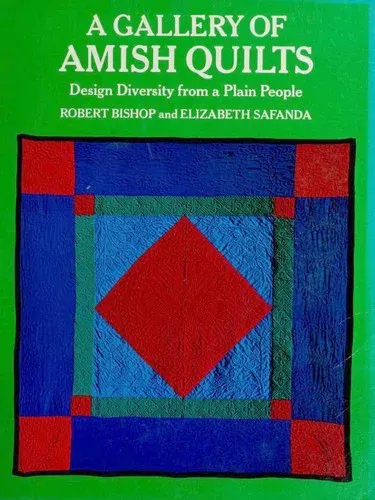
Have you ever seen in person an Amish quilt made in Illinois? Illinois has the fourth largest Amish community which is located in the area around Arthur in east central Illinois, yet few people know about their quilts. The Illinois State Museum has recently acquired about 150 Amish quilts from the community and will present about 32 Amish quilts in an exhibit in Chicago this summer. These quilts, made between 1850 and 1950, are made from fine fabrics (wools and cotton sateens), creatively pieced (much experimentation), expertly quilted, and display their makers’ superb ability to manipulate color.
Many quilters have been inspired by Amish quilts and these quilts will hopefully continue that tradition. In addition, these quilts are well documented and offer interesting insights into the sharing of traditions among families and neighbors. “Illinois Amish Quilts: Sharing Threads of Tradition” is scheduled to open on July 19, 2002 and close on September 20, 2002 at the Illinois State Museum–Chicago Gallery (previously titled the Illinois Art Gallery) at 100 West Randolph. Please note that the exhibition opening has been postponed from the previously published date of June 10. The Gallery is undergoing renovation and like most construction projects has run behind schedule. Please call 312-814-5321 to confirm that the exhibit is opening on schedule before you visit. This is the number for the Chicago Gallery and any one who answers the phone should be able to help you. The Gallery hours are 9 to 5 Monday through Friday.
Unfortunately the gallery is closed on weekends because it is in the State of Illinois office building. The exhibit has previously been shown at the Illinois State Museum–Springfield and the Southern Illinois Art Gallery; however, there will be new quilts added to the Chicago exhibit as well as additional information about the quilts. A catalog will be published, although it hasn’t gone to press yet. If you would like to send me your name and address, we will mail you notification of publication. If you have any questions, I would be happy to hear from you. I will be away from my office until June 10, so please don’t be alarmed if you don’t hear from me before next week. Jan Wass, Curator of Decorative Arts Illinois State Museum
Date: Wed, 5 Jun 2002 00:05:16 +1000 | From: “Archer”
I’ve found this discussion fascinating, not because I know anything at all about quilt conservation! These issues are terribly familiar from another area of interest, Egyptology. When does “restoration” become replacement? The tomb of Nerfertiti (yes that famous lady) was restored a few years back, by Italians of the “paint it back in” school of thought. Their argument was: We know what was there before, because it was well recorded by earlier generations of Egyptologists, why not paint it back in using fine parallel lines to indicate it’s been added? It caused a great furor in Egyptological circles. After it was done. 😉
And the huge issue for restorers is whether we are doing harm or not. If you have a tomb with beautiful paintings and the mud plaster is falling off the wall in chunks, sure we can inject the wall with complex chemicals and stabilise it, so no more bits of priceless painting and text fall into shards on the floor. Sure, we can paint over the holes so the edges don’t “fray”. But what the effect of these chemicals will be on those paintings in fifty or a hundred years time, nobody knows. Will twentieth century restoration methods be the cause of twenty-second century anguish?
All sounds terribly familiar, doesn’t it? Sometimes it seems that reburying the tombs (benign neglect) would be preferable. The bottom line is that material culture does not survive indefinitely. We can’t prove one way or the other the claims that Egyptians wore quilted clothing, because we only have wall paintings that might or might not show quilting on clothing, and most textiles don’t survive 3000 years, even in the desert. Though I’m always hopeful, since we found an almost intact pleated dress from the Old Kingdom a few years ago at a site near Sohag, in Middle Egypt. But not that hopeful…. Cheers Nola
Date: Tue, 04 Jun 2002 20:46:30 -0700 | From: donbeld
Hi, forgive my ignorance, but I noticed in your posting about the Amish quilt exhibit in Illinois, that you date the quilts from 1850 to 1950. Somewhere in the back of my mind, I thought there were not Amish quilts as early as 1850–my recollection is 1880’s? So, you experts out there, how about a little education on Amish quilt dates. Thanks Don Beld
Date: Wed, 05 Jun 2002 04:40:33 +0000 | From: “Anne Copeland”
That is a wonderful statement, Nola. You are so correct. A thing will not live forever, no matter what good care we take of it. It is true that some things live a very long time. I remember the caves in France that are famous for their paintings of sophisticated animals. The caves were opened for awhile, but then it was discovered that the breath of people visiting the caves was apparently causing the paintings to disintegrate. So the caves were closed to visitors. But these things, once discovered, should be able to enjoyed. They are the very things that transport us from the mundane to the very things that inspire us and live in our hearts and minds forever. So there may always be this rift between trying to preserve the things and allowing people to enjoy them. I don’t think there are any black and white answers, but I do know you brought up some great points. Love and light always, Annie
Date: Wed, 5 Jun 2002 09:01:53 EDT | From: KareQuilt@
Speaking of Amish Quilts, I just got a mailing from the Virginia Quilt Museum. Their next show (June 8 – Sept 9) is titled: Virginia Quilts: The Amish and Their Neighbors A selection of 27 quilts by Amish and Mennonite quilters from the collection of Dolores Bausum The museum is located at 301 S. Main Street, Harrisonburg, VA. Opening reception is 1-4 on June 8th. Call 540-433-3818 for further details. Karen Alexander
Date: Wed, 05 Jun 2002 15:52:52 -0500 | From: Marilyn Woodin
Kalona, Iowa is the largest Amish community West of the Mississippi and the Kalona Quilt and Textile Museum would like you to be aware of our newest display. We have 44 Amish quilts dating from 1900-1940. They are from 5 private collections and are being shown at this time until September 15th. Most of the show is composed of Amish Crib quilts however we do have 6 that are full size including 2 wonderful pictorial Amish quilts. The collections that are being shown are from Iowa and Georgia and represent Amish Midwestern quilts from Ohio, Iowa, Indiana, and Kansas. We invite you to visit. The museum is open 9:30-4:00 daily, closed Sunday. Admission is only $3.00. The museum is located in the new museum building at the Kalona Historical Village.
Date: Wed, 5 Jun 2002 21:02:57 -0500 | From: “Steve and Jean Loken”
Hi friends, I just returned home from a trip to VA, passing through Indianapolis. I enjoyed the exhibit of Indiana and Ohio Amish quilts in the very new state museum (open 1 week). The catalog was a reasonable $7.95 and had 2 quilts per page with quite good color reproduction. Quilts which may not go on exhibit any time soon, so if you’re interested, you might try to purchase a copy. I didn’t think to enquire on my way through, but perhaps Xenia could come up with the correct address? The web site was very informative as well. And if you’re in the area, the kids may love the dinosaur fossils from China show also on now. Jean back home in MN
Date: Thu, 6 Jun 2002 07:47:29 EDT | From: KareQuilt@
What other quilt related Boards do members of this group either actively participate in or at least “read.” I am not referring to H-Quilt (the AQSG) Board, the ArtQuilt Board or the British Quilt Study Group, but other Boards that may have a more “general” quilting interest. I am curious about how much “intramural” sharing is going on back and forth between all the Boards. <g>
Where are you finding “pockets” of information that you check regularly? Do you have other quilt-related Internet archives that you check regularly? Do you find yourself sharing with us what you find at these other sites? Do many here participate in or read the AOL quilt postings? etc. Another question somewhat along that same line: How many of you have a Quilt Guild related on-line newsletter that gives you more info than just what your next program is about like we have here in Northern Virginia via Quilters Unlimited? Karen Alexander
Date: Thu, 6 Jun 2002 10:28:44 -0500 | From: “Steve and Jean Loken”
Sorry, guys, I had the book (actually more of a catalog) deep in my unpacked box. It should have occured to me that the info was on the book itself. The title is Palette, Pieces and Patterns: A Comparison of Indiana and Ohio Amish Quilts. Kathleen McLary, forward by Henry Adams; Indiana State Museum, 650 W. Washington St. Indianapolis IN 46204. Phone: 317-232-1637. E-mail: www.indianamuseum.org I’m not sure if that is the new addy, but they surely kept their phone # and will probably forward mail. Jean in MN
Date: Fri, 7 Jun 2002 23:39:47 EDT | From: RPLQuilts@
I saw your question about what makes us buy a quilt. For me the quilt does seem to talk to me. Color and design strikes me first. I am drawn to the jewel tones, Then I am drawn to the fabric and I must touch it. I’m sure it goes without saying quilters are tactile people. I love the history of quiltmaking almost as much as I love the quilts.
So if I’ve been studing a certain time period I will notice those quilts first. One thing I’m sure that has happened to many quilters who are collectors is you purchase a quilt because the color or colors have made you do that spontaneous OOOhhhh. Soon you realize you’ve collected several quilts that have the same color or colors. It can be a bit surprizing to notice those quilts have colors in them that you would have sworn weren’t your favorites.
Colors I believe can really tell alot about a persons personality. I tell my friends when asked why i bought a certain quilt is that it sang to me. Singing is producing a vibration that feels good. That is exactly what seeing some quilts do to me. Kris this is a good question for a lot of contemplation. Paulette in Indy
Date: Fri, 07 Jun 2002 23:42:02 -0400 | From: Pat and Jim
So I thought I would pose the question to the group: do quilts talk to you? If so, what do they say? Do you buy a quilt because of the colors or the style, because it fits into your collection, because of its history (or mystery) or all of the above?
In response to Kris’ question, I would say that there are probably as many different reasons for buying a quilt, as there are buyers! What an interesting topic of conversation!
I can only speak for myself. I like to buy old quilts that have one or more unusual elements. I also enjoy buying quilts of the scrap bag variety in order to appreciate the assorted styles of fabrics, and sometimes, the way in which they were printed. When the quiltmaker has been innovative by giving a twist to a traditional pattern, my heart sings. Also, old quilts are clear evidence of what materials were available. Being a quilt detective in discovering all of these many facets of an old quilt can provide hours of entertainment.
When I was antique hunting recently, I came across a quilt that was a bit mysterious in several ways. The tied comforter is a Lone Star block configuration, repeated 8 times, no sashings, no borders. The quilt is square. It is also quite heavy. The reason for it feeling as though there is a ton of bricks inside, is that it has a wool batting. The short staples of the fleece have been contained within a cloth unit inside. The only reason I know this is that there was a small area along the edge which was not quite caught in by the topstitching of the self-binding, and I peeked! (I also carefully fixed the edge afterwards).
When I looked inside, I was also very surprised to see that all of those little diamonds had been hand pieced with black thread. That edge was the only area of the whole quilt that had come unsewn.
The colors are what really had me fascinated. Most of the fabrics are definitely 1880s/1890s. Some of the cloth is home woven at 48 epis (ends per inch). The two pieces that are definitely home loomed are a black and white striped fabric, and a solid orange. That orange fabric and also the pink and white gingham would roll the quilt over into the late 1920s, I suspect. All of the other colors and fabrics would indicate a late 19th century date. It is hard to imagine someone hanging onto fabric for 40 years and then cutting it up to make a quilt, but I have seen this in other quilts.
The most intriguing thing about the quilt is that while it was scrappy, it was a planned scrap quilt. The same fabric danced around in circles in the star formation, much like “Trip Around the World”. The quiltmaker did not miss a beat in her plan for color uniformity in each “run”.
This quilt photographs terrifically. One can really see the dynamic use of colors, even more so in a photo. Surprisingly, the quilter also used a lot of plaids. Every block has some plaid fabric and this gives the quilt a more contemporary or “country charm” look.
Bringing home a quilt and doing a thorough fabric analysis and documentation is what affords me the most joy in studying these old pieces. I would never think of using an old quilt for personal use (God forbid!).
Usually, I just know when I have to purchase one of these treasures, and if it is not beyond my pocketbook, I do. There is something to that idea of a quilt “singing”. That makes perfect sense to me. If you haven’t heard a quilt sing lately, tune up your ear and listen a little more closely.
Patricia L. Cummings www.thequiltersmuse.com
Date: Sat, 8 Jun 2002 14:11:31 -0400 | From: “pepper cory” <pepcory@>
Hello QHL friends-With Kris’ permission–this is a good news/bad news post. My friend Susan McKelvey and I wrote The Signature Quilt in 1995. The book is an opus, 144 full-color pages with everything we know about signature quilts: history, the how-to of tools and signing, and 50-count ’em-patterns for applique and pieced signature blocks. We put our hearts and souls into this book. But time passes and now The Signature Quilt is going out of print. If any QHL members want to purchase a copy, we’re offering it to you at a 30% discount ($21) plus $3.50 for Priority Mailing, or $24.50 total. Interested? Here’s Susan’s website: www.susanmckelvey.com.
Email her at susan@ and by the way, she takes MC and VISA. Or you can email me at pepcory@ . I’ll take a check or money order. It doesn’t matter which of us gets the order. As Susan and I purchase the remaining inventory of our beloved book, we’re grateful we had the experience of working together and we urge you all to continue signing and making signature quilts. Peace, Pepper Cory
–
Date: Sat, 08 Jun 2002 19:32:26 -0400 | From: Pilar Donoso <quiltpd@>
I know this question was asked a couple days ago, but just get to it. I am a member of the Info EQ Digest, a great support group for the people who use EQ 4, now EQ 5. People are very knowledgeable and a great group to belong if you use that program for quiltmaking.
I was thinking that in a few years, quilts design by a computer will be part of the history of quilts. Somethig to think about it.
Pilar Santiago, Chile
Date: Sat, 8 Jun 2002 19:08:34 -0500 | From: “Karan Flanscha” <sadierose@>
I helped with documenting some of the quilts from the private collection at our local museum today, what fun!! They wanted to have their records updated, as the information with some of the quilts was obviously wrong (a 30’s prints Dresden Plate dated 1850 for example.) There were 2 quilts that were very different from anything I have seen before. They were made by the same person. The pattern was half square triangles, in diagonal rows of colors. The fabric was silk, and much of it was deteriorating. The silk had been cut in a 4″ square, folded in half diagonally, and then wads of cotton were put in the triangle, which was then whipstitched to another triangle/puff to make a square. These were then whipstitched to another square, etc.
The whipstitching showed on the back of the quilt. The triangle puffs were more flat than poufy. The borders were made of black velvet, which was sewn around the edges, mitered at the corners, and then feather stitched along the seam with bright yellow/gold thread. The edge of the velvet was finished, so it must have been a velvet ribbon. We estimated the age of the 2 quilts as 1875 – 1890. Has anyone seen quilts like this before (sort of reminded us of the square “puff” quilts, but these did not have a pleat in them, and were reversible). Would this technique have been described in a lady’s magazine?? The museum might look into conservation of the smaller of the two (it was throw size, and in better condition) if this is “unique” enough. So we are hoping someone might have seen something like these quilts before.
Also saw a wonderful “Whig Rose” type 4 block applique quilt, which is really in poor condition. The solid red fabric in the applique flowers is almost gone…on some flowers the only red left is caught by the diagonal quilting lines!! But, the over-dyed green and chromium orange fabrics look great!! Our Vintage group is going to “adopt” this quilt, take the pattern off of it & reproduce at least one block, so they can show what it originally looked like. Always fun to spend a day with old quilts!! Thanks in advance for any help… Karan from sunny Iowa
Date: Mon, 10 Jun 2002 14:50:24 +1000 | From: “Gai Haines” <gaihaines@>
I am not an expert in the field of American patriotic quilts – I’m just an Aussie, but could it be that the quilt was made some time after the US joined in the war, as a gift for Jack, whose birth year was 1940. Am I drawing a long bow here? Gai from Wahroonga, where winter brought us a 24′ C day last Friday!
Date: Mon, 10 Jun 2002 14:20:30 -0700 (PDT) | From: Judy Schwender
The first ad in Quilter’s Newsletter for a computer quilt design program appeared in the September 1985 issue on page 6. Judy
Date: Tue, 11 Jun 2002 01:20:15 EDT | From: JBQUILTOK@
I have a booklet called Stuff ‘n’ Puff Quilts with a 1976 copyright from Graphic Publications that provides directions for making several traditional patterns by stuffing the pieces & then whip stitching them together. The technique had enough of a following in the late 1970’s that the one & only quilt class my mother ever attended was making a Grandmother’s Flower Garden using this technique with double knit dress scraps. The book suggests embroidering over the joining lines if desired. (Mom didn’t!)
It sounds like your museum pieces are much older than this book. Since so much of what was printed was a re-hash of earlier techniques, this early quilt-as-you-go method could well have appeared in print or have been taught in a girls school somewhere long before the anonomous author revived it for the Bi-Centenial.
Janet Bronston
Date: Tue, 11 Jun 2002 10:05:13 EDT | From: RBCochran@
> There were 2 quilts that were very different from anything I > have seen before. They were made by the same person. The > pattern was half square triangles, in diagonal rows of colors. > The fabric was silk, and much of it was deteriorating. The > silk had been cut in a 4″ square, folded in half diagonally, > and then wads of cotton were put in the triangle, which was > then whipstitched to another triangle/puff to make a square. > These were then whipstitched to another square, etc. The > whipstitching showed on the back of the quilt. The triangle > puffs were more flat than poufy. The borders were made of > black velvet, which was sewn around the edges, mitered at > the corners, and then feather stitched along the seam with > bright yellow/gold thread. The edge of the velvet was finished, > so it must have been a velvet ribbon. We estimated the age of > the 2 quilts as 1875 – 1890. Has anyone seen quilts like this > before (sort of reminded us of the square “puff” quilts, but > these did not have a pleat in them, and were reversible). Would > this technique have been described in a lady’s magazine?? The > museum might look into conservation of the smaller of the two > (it was throw size, and in better condition) if this is “unique” > enough. So we are hoping someone might have seen something like > these quilts before. >
Karen– Yes, I have seen one of these quilts before! In connection with our research on the life and quilts of Florence Peto, we documented a quilt made by her and members of her family in 1946 that she called her Silk Necktie Quilt. Apparently she got the idea when a neighbor of hers in New Jersey showed her one from Waco, Texas, made of necktie silks. Florence’s measures 57″ x 64 1/2″ and is made of 3 1/2″ squares of light colored lingerie silks and dark colored necktie silks, set together in a Log Cabin Barn Raising pattern. Unlike yours, it has no border. It was Florence’s thought that as the technique produced a finished, reversible quilt it would have great appeal to both quilters and non-quilters because after World War II it was almost impossible to get a quilt quilted. It was one of many quilts she showed at her lectures. It won ribbons at the 1949 Tennessee State Fair and the 1951 Kentucky State Fair. According to our research, Woman’s Day magazine was interested in the idea for this quilt, but an article was never published. We did find, however, a similar technique called Crazy Quilt in an undated booklet.
–Rachel Cochran for the Heritage Quilt Project of New Jersey
Date: Tue, 11 Jun 2002 13:16:17 -0400 | From: “laurafisher” <laurafisher@>
Hi all – this is the THIRD one I’ve seen. I sold one a few years ago — it has the same torch center and embroidered and patriotic details; I believe another one was published in one of the last Quilt Calendars, and now there is this one. Perhaps Cuesta can identify the company that produced the pattern? It’s definitely not an original design, but it’s great with that torch center. Laura Fisher
—– Original Message —– From: Julie Silber To: QHL@ Sent: Friday, June 07, 2002 5:59 PM Subject: QHL: Unusual? State Flowers quilt
Hi All, Julie Silber here. I saw a very interesting State Flowers quilt on eBay: Click here: eBay item 2110904921 (Ends Jun-16-02 17:00:54 PDT ) – Rare Patriotic State Quilt ~1940~ Wonderful20 I am wondering if the Patriotic themes and colors are unusual. I am so used to seeing the more delicate, pastel, “flower-y” types made from kits and patterns.
And I was also wondering about the 1940 date on it. Weren’t these Red-White-Blue quilts with flags, shields, Statue of Liberty, etc. done DURING World War II. Since the U.S. did not enter the War until Pearl Harbor (December, 1941 – almost 1942, really) I’m a bit surprised to see one made earlier.
But I’m here to learn from you wonderful people. Tell us all! Julie Silber
Date: Tue, 11 Jun 2002 16:41:00 -0400 | From: “Cinda Cawley”
Last week friends and I had a “special interest tour” at Winterthur, the premiere museum of American decorative arts near Wilmington, DE. Surely you can guess what our “special interest” was. For $25 each we had a docent of our own who took us to the textile storage area and through the period rooms on the 7th floor of the museum to look at quilts and other textiles. Since Henry Francis DuPont limited his collecting to mid-19 century and earlier we had a feast of early quilts to study.
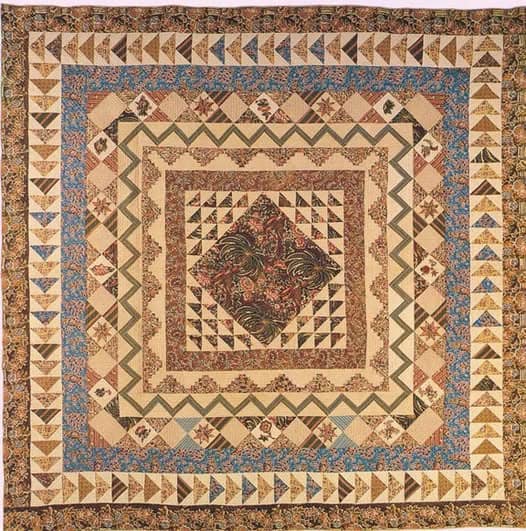
In the storage area we saw a chintz medallion featuring Prussian blue made in 1840. The quilting was phenomenal. A Baltimore Album dated 1845 made for a minister had fondue blue sashing, a double dog tooth border (one side red the other green) and one of the most intricate woven baskets we’d ever seen. A delightful four patch signed and dated 1835 had roses stenciled in the setting blocks. An unfinished top made of elongated hexagons by English paper piecing in the first decade of the 19th century. There was a quilted palampore, a glazed wood quilt from New England, indigo on one side bronze on the other, spectacular quilting and a wholecloth quilt made of my all-time favorite toile, The Apotheosis of Franklin and Washington (the museum has a complete set of matching bedhangings which were used with the quilt).
In the museum gallery we saw Rebecca Scattergood Savery’s mammoth Starburst (6,708 diamonds-cotton). In the same gallery is a silk strippy quilt in very muted tones of gray and olive marvelously quilted with cables and crosshatched diamonds, also with a Quaker provenance. Two Quaker ladies; two very different quilts. A Quaker quilt is a quilt made by a member of the Society of Friends, it is not a style!
There is a very large piece of indigo discharge fabric and a chair cover in a monochrome brown pillar print with alternating stripes of colorful flowers. The label said it dated to 1799 and was the oldest pillar print found in the US. The period bedrooms were fascinating. We hardly looked at the furniture; we were there for fabric. On a huge bed requiring a three step ??(what do you call those steps used to get into big beds?) was an appropriately enormous whitework quilt with stuffed grape leaves, Greek key border, wheat sheaves, on and on. One room was entirely decorated in various blue and white toiles featuring birds: roosters, pheasants, song birds.
There was an embroidered silk coverlet that looked like a medallion quilt. Th most amazing thing was a hallway completely papered in silk with silk appliques picturing a Chinese village. The scenes showed all aspects of daily life: children playing, women washing, farm animals, men working in the fields, merchants. Many of the people had western features; the applique may have been done in France where it was found. I’ve never seen anything like it.
We also went to Odessa to see “The Historic Houses,” also owned by Winterthur. That was rather a disappointment. The most exciting thing to me was a framed fragment of a quilt made from a fabric commemorating the death of Washington. I can’t say enough about the special interest tour of Winterthur. You do need to make a reservation a week ahead. The other exciting thing is that the library is open stack!! Hard to believe! Cinda on the Eastern Shore