June 18 – 26, 2002
These restored messages come from the Quilt History List, an online forum where quilt historians, collectors, researchers, appraisers, and enthusiasts discussed antique quilts and related textiles. The archive dates from 1996 through approximately 2016 and is being restored gradually. Sign up in the form at the bottom of the page if you want to know when a new page is added. Original spelling, opinions, formatting, and inactive links may remain unchanged.
Primary topics of this QHL Digest:
- Rural Industries Bureau Research — Members dig into Averil Colby’s and Mavis Fitz-Randolph’s research on Britain’s 1930s Rural Industries Bureau quilt-training schemes in Wales and the North Country.
- Ethics of Imported Quilts — A long, heated thread on imported quilts sold as handmade antiques, with an appraiser’s firsthand stories of clients unknowingly owning imports.
- Reproductions vs. “High Art” Quilting — Members debate whether quilting should be promoted in fine-art museums and how that intersects with the market for reproductions and imports.
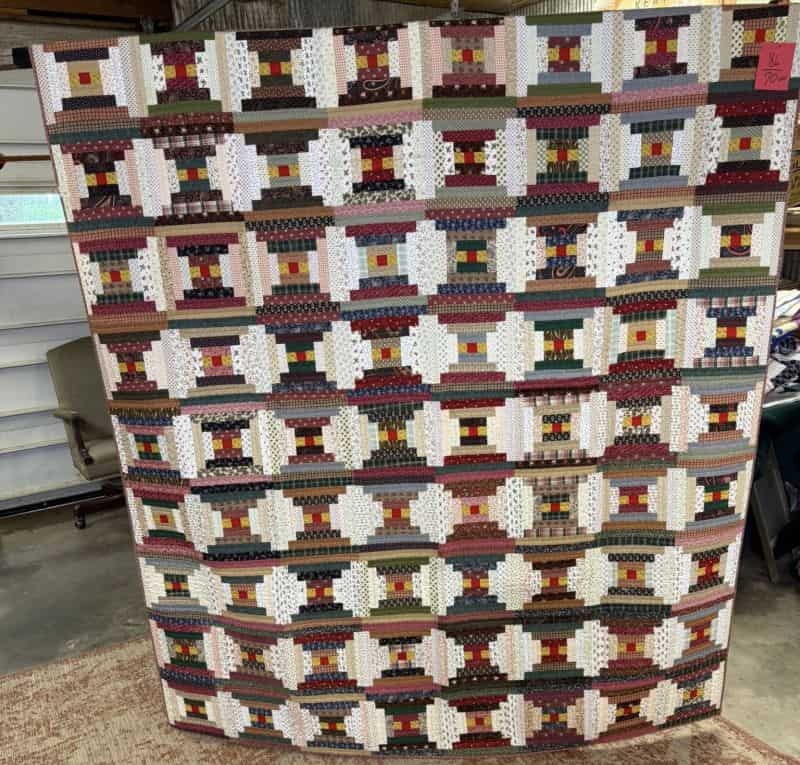
- Silk Log Cabin Construction — A member asks how a silk Log Cabin quilt would have been finished, and others weigh in on tying versus quilting for silk piecework.
- Victorian Quilt Restoration Technique — A restorer shares a step-by-step method for backing, battting, and tying 19th-century Victorian quilts without adding visible stitches. (see the article on quilt restoration)
- Textile History Forum — Members discuss attending the Textile History Forum at the American Textile History Museum in Lowell, MA, including a recap of the prior year’s event.
- Out-of-Print Book Searches — Members ask for help finding out-of-print references, including a book on buttons and Charlotte Warr Anderson’s “Faces and Places.”
- Quilt Show and Exhibit Announcements — Notices for the Great Pacific Northwest Quiltfest in Seattle and an Association of Northwest Quilters traveling exhibit.
Date: Tue, 18 Jun 2002 21:08:27 -0700 | From: [from unknown]
Kim said: <When the Rural Industries Bureau decided to help women
earn
money for their families through crafts they did a survey to
determine
which crafts would help them make the most money. Was it basket
weaving
or needlepoint or weaving etc. They determined, based on a survey
done
by Mavis Fitz-Randolph, that quilts would bring in the greatest
amount
of aid. The decision doesn’t appear to have been determined by their
ancestry of quilting, but by the end results being met. Also, the
quiltmaking trainings were for quilters and for women who had never
quilted before.>
Xenia- Thanks for the quoting from mavi’s book. The information I
found
as stated above is Averil Colby’s take on mavi’s findings in Averil’s
book “Quilting.” I also came across info on the findings in Janet
Rae’s
book on British Quilts. The training was paid for the Bureaus in both
Wales and the North Country areas. There were six classes arranged in
Wales alone. Averil states they trained both experienced and new
quilters to make quilts good enough to sell to retailers in London
and
to private parties. No one seems to suggest that a background in
quilting didn’t exist, buy simply that that was the industry that
could
provide them with money. If the current quilting community was
strong,
I doubt they would have had to do training. That likely explains why
it
took some convincing in Wales to do so. But why would they “forced
the
issue” if it didn’t appear to be a good way to aid the poor? Does
Mavis
address that?
Just to be clear- The book you quoted was written in 1954 based on a
survey Mavis was asked to do (by and for the Bureau) in the late
1940s
in order to summarize the quilting methods, styles and quilts made in
the later 1920s to the start of WWII, in Wales and North County areas
only. It actually started out just being Wales, but they expanded it.
The survey I was referring to took place in about 1924-6, some 30
years
before the book was written.
Lucky you to have the book!
Kim Wulfert
www.antiquequiltdating.com
Date: Wed, 19 Jun 2002 07:48:28 -0400 | From: Pilar Donoso <quiltpd@>
I was reading with great interest the last messages about starting
making Quilts in a central country of Africa, and I though about my
experience and the one from muy country.
I move from Chile to live in California when I was 21, and I started
quilting when I was 33. After I make the first Quilt I was addicted
and I was very productive. I participated in about 30 shows and I
did
about 5 expositions by myself. My quilts were (are now too) very
bright
and I used a lot of oranges, yellows purples, reds etc One newspaper
in
California wrote that my coloring was a reflection of my Chilean
background, and I believed then it was true. Fifteen years later, I
came back to Chile to live, and I realize that chileans donB4t use
any
bright colors in their grafts or clothes. All the way around they
use
greys and browns a lot. It was shocking to realize I didnB4t know
“where I belonged”.
I have been teaching Quiltmaking in Chile for the past 4 years, and
more
and more I believe that the use of the color reflects the people and
their culture. I think the lack of bright colors among Chileans it
is
becuse this country is very traditional, with great catholic
influence,
with many Englishman in our History (just to name a few influences) .
Without even notice, the use of colors in my Quilts started getting
less
and less vibrant, until I star finding a place in my country again,
after being out for 20 years. The bright colors want to come out
again,
and I realize now that those colors may be my “Californian” part.
Quilts in Africa will be different, and will reflect their country as
long as it is not just a production of making Quilts (like happened
in
China) but the Creation of Quilts .
Pilar Donoso I.
Santiago, CHILE
quiltpd@
Date: Wed, 19 Jun 2002 05:51:04 -0700 (PDT) | From: Judy Schwender <sister3603@>
In Jodie’s original post she wrote: “I was approached
with the idea of creating a business to have them make
quilts and home dec items for importation into the
U.S.”
We tend to forget that we have the biggest consumer
market in the world. If this group makes items in
order to make money, and they want to export them to
the U.S., why not make something that a U.S. consumer
is interested in already?? If you are after the
almighty dollar, you do just what the traders for the
British East India Company did way back when, and give
the consumers what they want. And it sounds like they
want cold, hard cash. The U.S. has that.
If “items [that] represented the cultural traditions
of the group” (Xenia’s words) were made, would U.S.
consumers even be interested? The only African
textile item I can think of off the top of my head is
a dashiki, and that doesn’t have the broad appeal of
quilts here in the U.S.; it is less marketable.
I see some of the distaste for “foreign” quilts as a
reflection of the idea that “quilting and patchwork
are AMERICAN!” It’s OUR craft, WE brought it to its
zenith, WE are the leaders! Well, quilting and
patchwork do not belong to us. ANYONE can become a
quilter or patchworker. I find it curious that South
America, where cotton has been grown and woven for
centuries, has no tradition of patchwork as we know
it. Maybe Africa, with the history of Egyptian
cotton, has a long-lost connection to the craft, and
WE are the latecomers.
I am guessing here, but I imagine that if this project
gets off the ground the women doing the sewing will
eventually bring their sensibilities to the designing.
I am also remembering that the idiosyncratic designs
that West Virginia quilters involved in a similar
project created declined after the quilters went more
and more after the dollar.
For the record, I would not like seeing imports of
Smithsonian quilts IF they are the quality of the sort
that sells in Penneys and WalMart and are not
identified as such.
Just some thoughts.
Date: Wed, 19 Jun 2002 09:17:20 -0400 | From: Pat and Jim <jimpat@>
Good morning!
Thanks for all the wonderful posts about the subject of marking
imported
quilts. As far as I can tell, there is no U.S. law that requires
the
permanent marking of provenance information. Solely as a
conciliatory
measure to appease quilters who were outraged at the time of the
Smithsonian controversy, a few companies have added easily removable
tags denoting content of filler, such as those that come on other
U.S.
sold linens and pillows.
It is my personal belief that imported quilts should be marked with a
permanent marker, not a label, right on the backing of the quilt. If
a
label is used, it should be attached before quilt assembly, by
appliqué,
and then the backing cut away. Thus, with nothing but batting
behind
the label, those who would attempt to remove the label would be
thwarted
in their desire to misrepresent.
Labels have a lot of potential for adding value to a quilt, and they
can
include all kinds of information. For antique quilts that I collect,
I
prepare a label that states the title of the pattern if known,
approximate date made, when the pattern was first published, size of
the
quilt or coverlet, where it was collected and when, and any other
pertinent information. It adds to the charm to know something
(anything) of a quilt’s provenance. The name of the quiltmaker is an
especially valuable piece of information.
Quilts that are made overseas for importation would add a lot more to
our cross-cultural understanding if they included design elements,
symbols, icons, traditions, and cloth of the nation’s where they are
being made. These quilts would be desirable to collectors, they
would
celebrate the heritage of the quiltmaker, and they would be unique
and
not just another spin-off of Grandmother’s Flower Garden.
Yet, I am getting ahead of myself, no doubt. Would-be quilters have
to
learn to quilt first, and just as a quilter here begins with simple
pieced patterns, so too, will they have to go through the same baby
steps before they can run. The challenge will be quality control.
If
the work of these quilters in Africa surpasses the poor workmanship
currently seen on the American market (I’m thinking of the $19.99
quilts
I’ve seen at major chain outlets), then they will have a very good
chance at competing in the marketplace.
It seems that by taking American designs and introducing them to be
made
in a nation that has no cultural background of quiltmaking, is to
superimpose our design ideas and to somehow, homogenize the whole
process. On the other hand, there are clear benefits to these
would-be
quiltmakers, particularly if it helps a village to rise from poverty.
There is much to be considered here.
Thanks to everyone who wrote in answer to my initial query. Good
luck
in your endeavors, Jodie.
Pat Cummings from sunny (yes!) New Hampshire where the strawberries
are
laying ripe in the fields, waiting to be picked
Date: Wed, 19 Jun 2002 10:06:53 -0400 | From: “Quilters Studio” <quilterstudio@>
I am thinking about attending the Textile History Forum in July held
at the
American Textile History Museum in Lowell, Ma. Last year it was in
New York
so it must rotate locations. Has anyone attended in past years? How
much
about quilting is there and not just textiles. Does everyone attend
each
presentation or are you able to pick and choose? Is it well
organized? It is
within driving distance from my home but am wondering if for $200 I
would
enjoy a different conference better ? Thanks so much, Robin
Date: Wed, 19 Jun 2002 08:09:19 -0700 (PDT) | From: Judy Schwender <sister3603@>
This part of Pat’s posting reminded me of how quilting
was “introduced” to the American Indians. Very
different circumstances: the purpose was to “civilize”
the Indian and drive out their own culture. Given the
status of star quilts at giveaways, for example, it is
clear that the Indians did an end run around the
project, turning a white craft into something uniquely
their own. (And don’t forget Hawaiian quilts.)
Jodie’s project is less invasive, and I have high
hopes that the African stitchers will do the same.
> It seems that by taking American designs and
> introducing them to be made
> in a nation that has no cultural background of
> quiltmaking, is to
> superimpose our design ideas and to somehow,
> homogenize the whole
> process. On the other hand, there are clear
> benefits to these would-be
> quiltmakers, particularly if it helps a village to
> rise from poverty.
> There is much to be considered here.
Date: Wed, 19 Jun 2002 13:52:39 -0400 | From: “judygrow” <judygrow@>
The wedding of our son, Justin, to his re-found high school love took place
on June 2nd. Many of you know that the wedding was held at our mini-farm,
and that I made the canopy for the chuppah under which the vows were said.
I started with a 19th century quilt top bought from judysue on e-bay
well
over a year before the wedding was announced. This was in the form
of a 6
pointed star made of equilateral triangles. The light triangles were
mostly
the 1776-1876 Centennial fabric. The star was on a dark green
background,
with double pink appliques to break up the large spaces.
I finished the quilt top simply, with 2 mitered borders, echoed on
the
backing (boy was that hard to line up). I left the miters open on
the inner
border and whipped front and back together there so that it would
easily
slip over a framework.
Now the quilt will go to the young couple, just as it is, with an
added
label to explain the corner slits.
Judy in Ringoes, NJ
judygrow@
Date: Wed, 19 Jun 2002 14:44:38 -0400 | From: mreich@
I’ve checked my email three times today for Cinda’s descriptive
account of
FVF’s meeting from the 18th. Speaking for those of us who could not
attend
the quarterly overdose on PA quilts and quilt history, please, share,
share,
share. From the northern reaches, Sue Reich, Connecticut
Date: Wed, 19 Jun 2002 14:30:09 -0400 | From: “Candace Perry” <candace@>
I was interested to see this because right now I’m trying valiantly
to make
a chuppah square — my sister converted when she married her husband,
and
their kids are Jewish, so my niece must endure all us gentiles
creating
squares for her chuppah. Mine is PA German so that part of her
ancestry
will be with her! By the way Judy, your son and d-in law are
gorgeous.
What a wonderful wedding and chuppah!
Candace Perry
Date: Wed, 19 Jun 2002 19:57:02 +0000 | From: deedadik@
Hi all, With all the talk of imported quilts, I am
still searching for a source of imported quilts from
India. Does anyone have this info. Thanks, Dee
—
Date: Wed, 19 Jun 2002 19:07:03 -0400 | From: “Jo Williams” <antiquilts@>
I’m looking for a copy of an out-of-print book, Big Book of Buttons
by
Elizabeth Hughes and Marion Lester, New Leaf Publishers, 1981, 1993.
New or used OK. Any help??? Thanks!
Jo Williams
—
Date: Wed, 19 Jun 2002 20:34:49 CST | From: jocelynm@
On Wed, 19 Jun 2002 05:51:04 -0700 (PDT) Judy Schwender wrote:
> If “items [that] represented the cultural traditions
> of the group” (Xenia’s words) were made, would U.S.
> consumers even be interested? The only African
> textile item I can think of off the top of my head is
> a dashiki, and that doesn’t have the broad appeal of
> quilts here in the U.S.; it is less marketable.
African trade cloth is popular in America; there are quilt fabrics
made
using African motifs. JC Penney has a specialty catalog featuring
African
motifs in women’s clothing.
Perhaps African textiles would not be universally popular, but there
are
already large numbers of consumers who want to buy African-style
decorative objects, clothing and linens.
I live in a city of 70,000 and we have TWO stores that are devoted to
Africana. Considering the overall paleness of the community, that
means
these stores’ merchandise must be appealing to a lot of white people.
As
a matter of fact, I don’t think I’ve ever seen an African-American or
African customer in either store. 🙂
Jocelyn
Date: Thu, 20 Jun 2002 05:37:22 +0000 | From: “Karen Bush” <karenbush11@>
I’m going to jump in, and maybe haven’t read enough of my digests to
know
what you all are talking about, but,..
This is a good comment on the imported quilts. Especially those
from the
East. I was thinking a lot over these posts and wondered, maybe these
people
DON’T know the difference in workmanship, or, can afford to care.
It’s their livlihood, made possible by demands from companies who
have
contracts and need them QUICK. Like the saying goes “do you want it
Right,
or want it fast”. That’s where the $$ are. In VOLUME for these
stores.
Doesn’t seem to have made too much difference in our protest over
non-quality.
I see it as the only way we can keep getting the message across is
to keep
putting the quality quilts OUT there in the world. Including the
difference
in Fabrics.
I’m amazed at the people who clammered over the two imports I had
at my
shop over the HAND QUILTED quilts by me,…I also put a disclaimer on
the
imported quilts that I wasn’t to be responsible for the wear on these
quilts, but DID give a guarantee on Mine. Didn’t seem to matter. It
was a
log cabin, the price was low, it was hand quilted (although 3 crooked
stitches to the inch) and VERY poor fabric.
KEEP up the good works in getting the message out with the
DIFFERENCE in
workmanship/fabric, etc. I’m trying to at this end, it’s an uphill
battle.
If I’ve spoken out of turn, or, about the wrong subject, please
forgive
me. I’ve been out of touch and haven’t caught up on my digest yet. kb
Quilts that are made overseas for importation would add a lot more to
our cross-cultural understanding if they included design elements,
symbols, icons, traditions, and cloth of the nation’s where they are
being made. These quilts would be desirable to collectors, they
would
celebrate the
http://www.karenbushquilts.com-Member of TAS-The Applique Society
http://www.karenbushquilts.com/HISTORY/index.htm
Karen Bush
MAKE PEACE WITH DUST BUNNIES
Date: Thu, 20 Jun 2002 10:41:18 +0100 | From: Dorothy Osler <do@>
Having just picked up on the correspondence relating to the British
Rural Industries Bureau (RIB) scheme in the 1930s, can I clarify one
or
two points based on my research in South Wales and the North of
England
in the 1980s (and published in ‘Traditional British Quilts’ – pp.
100-102 and 148-150).
Firstly, classes were only introduced in South Wales, not in County
Durham in the North of England. In Durham the RIB were able to find
enough experienced quilters because many of the quilters they used
had
run quilt ‘clubs’ in the mining villages of County Durham (see
Traditional British Quilts, pp.122-125). They therefore had competent
design and technical skills and only needed to be supplied with
suitable
materials for the London market. They worked as individuals, not in
groups.
In South Wales, the situation was rather different. Quilting as a
traditional craft appears to have declined to a greater extent before
the 1930s than in the North of England. There was therefore not a big
enough pool of experienced quilters on which to draw for the RIB
scheme.
So the RIB set up classes and trained young girls (who were not
otherwise engaged in employment). I myself interviewed two of these
‘young girls’ in the 1980s (by which time they were in their 70s),
one
of whom was the maker of the quilt that features as a design by Enid
Marx on the dust cover of Mavis FitzRandolph’s book (treasure it if
you
have it).
The South Wales quilters therefore worked in groups. Whether it was
because of this or the influence of Mavis FitRandolph who spent more
time in Wales I don’t know, but they were certainly better geared to
marketing than the Durham quilters.
To what extent the scheme alleviated poverty is debateable but it
certainly produced some stunning wholecloth quilts. Many survive and
more keep ‘appearing’ as makers and owners from that generation pass
on.
—
Dorothy Osler
Date: Thu, 20 Jun 02 09:54:28 -0600 | From: woodford <haq@>
Just to add a few comments about the presence of quilting outside of
the
US. My son brought back a patched wall hanging from Nepal. Covered
with
embroidery, not truly quilted, but patchwork nevertheless. Also, last
year I was fascinated by an exhibit at the Chicago Art Institute of
an
African costume that was exquisitely patched and quilted. I can’t
find my
notes right now so can’t tell you the age or the country.
Additional comment: The one time I was at the Quilt Festival in
Houston,
my booth was next to that of two fellows who were selling African
fabrics. They were sold out before the show was over, and I was
sitting
there twiddling my thumbs.
Robin. I went to the Forum last year. Then it was mostly about
coverlets
and very informative for me since that is an area about which I knew
nothing. Rabbit is a great teacher. The museum collection of quilts
was
fabulous. I would imagine at Lowell there will be more of an emphasis
on
quilts. I think it would be well worth the $200.
Barbara Woodford
Date: Thu, 20 Jun 2002 12:30:17 -0700 | From: Gaye Ingram <gingram@>
Re Karen’s and remainder of the discussion of reproductions,
adaptations,
etc.
I’ve been interested in the various points of view taken to this
issue—the
effect on the women making the cheaper (or not) foreign copies, the
effect
on American women actively involved in quilt making, the effect on
collectors and the market, etc.
It would be interesting to consider this issue alongside the question
raised
earlier: “Why do we buy quilts?”
And I think most people buy, save, preserve, or make quilts from a
motive
that is fundamentally artistic—the yearning for, the love of
beauty.
And artistic beauty is inextricably connected to an act of
imagination–first, in its maker whose act of imagination produced
the work
in question; second, within the viewer who is led by the work of art
into a
reflection of “truth” or “the nature of life.”
I know I’ve referred to Keats’ famous “Ode on a Grecian Urn” on this
list
before, but it is perhaps the best description we have of the way art
works.
So please bear with me just once more. In the poem, the speaker
comes upon
an urn from ancient Greece in a (British) museum. Looking at the
beautiful
object and the scenes depicted on it, he is led ask questions which
imply
factual answers—who specifically are these people? where are they
going?
is that boy in love with that girl? The urn is a “silent form” and
cannot
yield the answers the speaker seeks.
Yet, it does something better: it engages and ignites the faculty of
the
imagination. The young man begins to put himself in the scenes, to
empathize, and consequently to reflect on the meaning of what he is
seeing.
He sees the young lover who is pursuing a girl, his fingers almost
touching
her. And Keats the writer (and, we must admit) the speaker
understands in
that frozen moment the most perfect moment of love—he realizes the
boy
will never kiss his love, that their love is never consummated in the
story
the urn tells—-and yet he also understands that the two will be
“forever
young” and their love “forever panting.” The young man will not see
his
beloved’s beauty fade or their love change. Their blessing is to be
frozen
in the moment of greatest happiness. The reader who knows anything
about
Keats’ life understands the poignancy of this realization, for Keats
too had
just found his first true love—at the same time he realized he had
contracted the consumption that had just killed his brother. The
poem’s
famous conclusion—“Beauty is Truth, Truth Beauty”—simply means
that we
are led to Truth not by rational acts, but through imaginative acts,
which
are triggered by contacts with beauty.
What does this mean for quilts and why we buy them and the place of
repros
bad and good? Well, it seems to me that a theme running through our
discussion has been the personal connection with the maker and though
unspoken, the understanding that art is individual and essentially
imaginative. Even working with a conventional pattern, the person who
produces a work of art, however humble, is the one whose sense of
color is
somehow personal and whose skill in quilting and sewing individualize
her
work. Our imaginations are engaged by the beauty. We learn from our
contacts
with it and are drawn to wonder about its maker (or, in nature, its
Maker).
I recently purchased a Double Wedding Ring quilt top from the 70’s,
just to
have a representative double-knit fabrics of the era. But it is a
dead
object, no life. It could have been made in Bangladesh or Des Moines.
It did
not “speak” to me nor, I suspect, will speak to anyone else. The same
week,
I purchased an unfinished “Seven Sisters” top, with included a box
filled
with the tiny, carefully cut remaining pieces needed to finish the
quilt. In
its perfectly, precisely wrought seams I discovered its maker, a
woman given
to excellence in small things. I see the dresses she made, the aprons
she
created to elevate the domestic life of her home. I am reminded of
the
importance of excellence in small things, of beauty in the making of
a home
and life. In other words, the beauty of that piece led me to
important
reflections on life. I want to know the woman who started this quilt,
(I
just KNOW she is Germanic, Midwestern), and her precision has led me,
Southern and a little more given to the broad gesture than to
precision, to
take great care to duplicate her neat stitches as I complete her
quilt top.
In some ways, mine is an act of love or duty to her. That is what art
does.
And art is the product of the individual imagination.
Perhaps I am alone in this response, but so far, not one of those
Eddie
Bauer or Ebay repro store quilts has “spoken” to me. When I’ve seen
them on
beds, I’ve not been moved by them. A student gave me one to use when
we sat
outside our classroom for class discussions. We found it so dull, we
decided
to turn it design-side down. And still its cheap fabric scratches our
legs.
I think, therefore, there will always be a market for the quilts
which we in
this group cherish and produce. There are always levels of taste,
based on
experience, and one becomes more discriminating with experience.
Don’t you
think that the person who must make her bed with that foreign or
domestic
cheap repro every day will understand the superiority of the
well-wrought
Seven Sisters quilt she one day encounters? And if she can afford it,
she
will likely purchase it. That failing, maybe she will do what so many
of us
have done—learn to make her own quilt. And as we know too well, one
thing
does have a way of leading to another.
So we need to expose wider and wider audiences to the real art of
quilting—encourage “high art” museums to mount quilt shows that
include
quilts made for domestic use as well as pieces made as high art;
expose
children to the art of fine quilts in their history classes as well
as in
their art classes—well, you get the idea.
If cultural experience does create a national “personality” even in
the 21st
century—and I think it does—then American quilts made by
Americans will
almost inevitably have value as American voices, just as British
quilts made
by Brits or Aussies or Africans will have similar cultural value. And
they
will differ. And if they are creative, they will speak to us—in
different
voices, of different experiences.
Now, I am going to practice some Midwestern Germanic precision while
listening to Dolly Parton’s “Little Sparrow” cd in the extravagance
of
summer here in the North Louisiana hills.
Gaye
Date: Thu, 20 Jun 2002 11:14:10 -0700 (PDT) | From: Ark Quilts <quiltarkmv@>
In my humble opinion and inside the inner workings of
my
brain, Gaye Ingram’s comments motivated this question:
How creative is it to make 1,000’s of imported
quilts just alike?
Is it a product of individual creativity? No, mass
production, manufacture, and commercial endeavor.
Does it promote individual creativity? No.
Does it foster or promote the cultural art form and
talent ot the maker or is it representational of the
maker’s culture? No.
Does it impact the existence of domestic folk art and
quilt art? (from whatever country it exists in) Yes,
not always positively.
Final answer, imported quilts are a product of
commercial endeavor, not individual creativity. In
the future, those working to make imported quilts
today may or may not adapt it into their own form of
creativity. Has this happened in the last 15+ years
since imported quilts have hit the market? Right
now it is a cookie cutter process, not individually
creative and not on the same level as domestic folk
art and quilt art as we know it. Imported quilts do
not educate or enlighten the understanding or
appreciation for our domestic folk art and quilt art.
It is a free market and anyone can make and sell
anything they like–no problem with that. However, if
the items diminish,detract from , or misinfrom the
public about the original art form on which it is
based…….then it is skewing the general knowedge
about domestic folk art and quilt art and the
perspective on the art in history.
Date: Thu, 20 Jun 2002 13:55:17 -0600 | From: Xenia Cord <xenia@>
Gaye said: <So we need to expose wider and wider audiences to the
real
art of
quilting—encourage “high art” museums to mount quilt shows that
include
quilts made for domestic use as well as pieces made as high art;
expose
children to the art of fine quilts in their history classes as well
as
in
their art classes—well, you get the idea.>
…which is a perfect segue into an announcement I am very excited to
make. The wonderful, heartwrenching, uplifting “America from the
Heart: Quilters Remember September 11, 2001″ exhibit will be seen in
the Midwest, for the first time, at the Indiana University Kokomo Art
Gallery 23 February-30 March 2003.
Anyone lucky enough to see the full exhibit in Houston last fall
remembers the throngs of people, some of them in tears, moving along
the
walls of display of these inspiring, hopeful, patriotic quilts. From
among the 300 quilts made and sent between September 11 and the
middle
of October, about 125 were offered to the public in silent auction,
the
funds going to the Families of Freedom Scholarship Fund
(post-secondary
education for survivors of victims). It is these quilts that
comprise
the traveling exhibit.
The soft-cover book, America from the Heart, is now available and
shows
all of the original exhibit; C&T Publishing is donating the proceeds
of
its sale to the Families of Freedom Scholarship Fund. The book will
also be available at the exhibit.
As we draw closer to the exhibit dates I will be posting more
information regarding driving directions, gallery hours, and special
events. Watch this space…
Xenia
Kokomo, Indiana
Date: Thu, 20 Jun 2002 20:18:07 +0100 | From: “Sally Ward” <Sally.D.Ward@>
> It is a free market and anyone can make and sell
> anything they like–no problem with that. However, if
> the items diminish,detract from , or misinfrom the
> public about the original art form on which it is
> based…….then it is skewing the general knowedge
> about domestic folk art and quilt art and the
> perspective on the art in history.
Hmm.. which begs the question….do all those cheap and fuzzy poster
reproductions of Vincent’s chair or Monet’s water garden detract from
the
originals/misinform the public, or do they offer them an inexpensive
way of
enjoying the original and maybe whet their appetite for the real
thing? Is
intellectual snobbery at work here? I’m thinking of a friend here in
the UK
who has collected a number of beautiful vintage artisan quilts, but
whose
proudest possession is a cheap import Lone Star, which graces her
bed. I
was horrified and truly speechless when she showed it to me (‘I’ve
saved the
best for last’) but
afterwards wondered about my reaction. She would never get near the
‘real
thing’ (nor will I) and this cheap reproduction was giving her great
pleasure.
I’m not aligning myself with either possible answer to my question,
just
wondering….
Sally W in UK
Date: Thu, 20 Jun 2002 22:06:33 -0400 | From: “judygrow” <judygrow@>
Gaye wrote………
>Perhaps I am alone in this response, but so far, not one of those
>Eddie
Bauer or Ebay repro store quilts has “spoken” to me. When >I’ve seen
them on
beds, I’ve not been moved by them.
Nor am I moved by the quilts made these days by the lauded and
revered Amish
quiltmakers of Lancaster County. I’ve gone into a number of shopss
filled
with quilts that they make for the market, and have seen acres of
them on
e-bay as well. None of them have”spoken” to me. Yet, the earlier
quilts
that they made before they became aware that they could trade on the
name”Amish” are gorgeous.
I’d assume that any time a personal statement of art is translated
into a
commodity made for a market and gets repeated ad infinitum, it loses
all
that made it fresh and interesting.
Judy in Ringoes, NJ
judygrow@
Date: Thu, 20 Jun 2002 | From: Gaye Ingram <gingram@>
23:37:03 -0700
From: Gaye Ingram <gingram@>
I wonder if anyone has a photograph or knows the location of a
photograph of
a Kansas quilt.
In August, 1999, I encountered a remarkable quilt made by a Ms. Herr
of
Manhattan, KS. It was part of an exhibit at Beach Museum, Kansas
State
University, Manhattan, KS.
Ms. Herr, who had retired from work in textile design field, had
incorporated into a most original design some tiny Dresden Plate
blocks from
Depression era, made by her mother, who was Native American. The
blocks
themselves were typical of the time, but the maker’s daughter had
turned
them into windblown flowers on a quilt that incorporated her Native
American
heritage—rather pictorial in nature. It was an extraordinary quilt
and I
corresponded briefly with the maker about securing a photo. In a
computer
changeover, her address was lost.
There was a quirky story that went along with the quilt. When Ms.
Herr’s
mother had died, her sister, Ms. Herr’s aunt, had refused to let her
have
the little blocks because she was not a quilter. Auntie said she
would make
them into a quilt for her niece. In time, the aunt lost her sight.
Yet even
then, she refused to yield the blocks. Upon the aunt’s death, Ms.
Herr got
her mother’s blocks. By then she was retired and had become
interested in
quiltmaking. These little (maybe 3-4 inches in diameter) blocks
became the
genesis of a really extraordinary quilt.
Talk about a quilt that “spoke”—well this one had a voice so
entrancing I
have been unable to get it out of my mind.
Gaye
Date: Thu, 20 Jun 2002 23:51:43 -0700 | From: Gaye Ingram <gingram@>
The quilt mentioned in earlier posting was made by Charlotte B. Herr
and
titled “Thank you, Kiamitia Comel.”
Date: Fri, 21 Jun 2002 10:29:39 +0000 | From: “Karen Bush” <karenbush11@>
I do believe, you’ve hit the nail on the head.
WE have the luxury of the process. The ‘feelings’ and love for the
art of
quiltmaking and luxury of the appreciation of the difference.
My livliehood now depends on the craft. It always has from time to
time,
now, it’s the Only income I have.
there are times when I need to really ‘turbo’ quilt to get them out
timely, but, the lack of workmanship isn’t even an issue. I still put
the
time and trouble and love into them, just stay up all night to get it
done
instead of cutting corners. I don’t need to worry about a Humongeous
company
to ‘crack the whip’ so to speak to get ‘numbers’ out of the
merchandise.
That’s what it is to the retailers who import these quilts. Free
market,
merchandising and, yes, to the people who can’t afford our precious
works of
art. Can WE even afford them?? noooooo…not usually, but, we can
covet,
admire, droool (it’s legal), and still have a hope of ‘one of these
days’
having one, or, ten.
I think the issue initially started knowing these were sweat shops,
plain
and simple and it broke our hearts to know of the conditions of their
working establishments in certain countries,etc.
Quilts aren’t the Only products made under these conditions, it’s
just
that it was our focus, initially to know that’s how they were being
made,
the broo-ha-ha over the Smithsoian and ‘OUR’ designs. Well….3
cheers of
‘us’ and our compassion for these slave-like conditions for these
women/girls/elderlies , but, taking them off the market, or trying to
is
taking bread from their mouths. Allowing their income to disappear,
poverty
to continue. ??
the more I read, hear and myself, think, about what I’ve thought of
these
quilts, the ‘nose turned up’ position,…the more I wonder if it’s
snobbery.
Of Course it is. I’m speaking for MYSELF, now, I’m Not pointing a
finger at
Anyone but me.
My MOTHER owns 2 of these. When she refers to her quilts, she’ll
always
preface by saying “I know you don’t want to talk about them”,
but….gooooooood grief, have I gone THAT far in my attitude and
closed my
mind to the fact, this is FABRIC, it WAS a principal, turned into a
crusade,
turned into just plain ‘ole closed mind-edness (I just made up a word
for
the purpose, haha)…
It’s the same principal as the factory worker here. I’m SURE
people would
rather be in a Mercedes plant making the gorgeous, hand rubbed,
leather
seated, custom ordered beauties, than……an Edsel. but, that’s
their job,
that’s the job they could get, it paid the bills, fed the family and,
they
can hold their heads up, and say “we did the best that we could with
what
we had to work with” to raise and feed our families.
Same as when the machine quilted quilts started appearing at quilt
shows….should have seen MY NOSE then! In ‘up’ position, walking
away like
the devil was pursuing me. Now….I look at these gems and wonder
‘where’
head was. Because they were ‘allowed’ to machine quilt instead of
‘real’???
quilting, they’ve mastered the art from the MACHINE and I’ve seen
some of
the most GORGEOUS works of art!!!!!!!
I can’t Afford these, but, can admire, learn and, yes, Covet.
Don’t you think, the imports from China are the same? Some of these
people
have never seen a beautiful quilt, and, what if they did? It would
probably
make their circumstances/feelings even worse knowing what THEY had to
make
opposed to true beauties, just to make their living.
My Dad worked at the Ford plant…..he sure would have ‘rather had
a
Buick’. Same premise, I think.
From now on, I’ll focus on educating, and leaving MY opinions out
of it as
far as people asking me. As in:
Instead of telling them to NOT buy, save up for a ‘real’ quilt,
(which
might never happen)…to…..it’s nice colors, it’s what you wanted,
….it’s not that you don’t appreciate the difference but to Have one
at $35
instead of $350….then,…GO for it.” (just don’t ever wash it
might be on
my lips)
We’re talking Lincoln Continental, and, let’s face it, we could ALL
have
the dream and realize it at some point if we tried.
THEY’RE talking survival, plain and simple. It’s just a shame that
they’re sold so well and the sweat shops continue, the children are
still in
slave-labor conditions, but, let’s face it. That’s what they know,
right or
wrong. WE can berate, but, are WE willing to pay them what they
DESERVE/knock them out of their only jobs,….just to make a point of
‘artistic integrity’…?
Whew…I’ve used more than mono-sylabic (can’t spell it) words! Are
you
impressed??? haha…and, just went on and on, sorry. It’s 5:30 in the
morning. kb
Date: Fri, 21 Jun 2002 10:41:13 +0000 | From: “Karen Bush” <karenbush11@>
I have a question about silk quilts. I have a dealer who has a Log
Cabin, I
haven’t seen it yet. It’s entirely made of silk. He needs/wants it
hand
quilted. egads.
What would you put for the backing?? Cotton sounds a little,
uh…not in
keeping, but,…would you use a silk backing? Silk batting?
If you would…could I get your name and phone number for him to
call YOU
to quilt it!??? hahaha
It’s a vintage, but, don’t know how old, etc. He’s bringing it in
this
weekend. He ‘says’ it’s mint, no breaking, shattering,….but, I
warned him.
There might not be any visible shattering, the quilting needle and
thread
might ruin That. Am I right in assuming the fragility (there I go
again with
multi-syllable) and would cotton de-value?
Of course, there again, it’s a matter of opinion, I suppose. What
‘de-values’ for one collector, might not make a difference to
another. Just
trying to get some info before I see him. kb
Date: Fri, 21 Jun 2002 07:17:49 EDT | From: Kittencat3@
From what I’ve seen, silk Log Cabins weren’t quilted. They were tied
to a
backing. I’ve heard of velvet and cotton being used. Maybe a
velveteen
backing would be nice?
Lisa Evans
Date: Fri, 21 Jun 2002 12:54:35 -0500 | From: “Steve and Jean Loken” <sandjloken@>
>I recently purchased a Double Wedding Ring quilt top from the 70’s,
just to
>have a representative double-knit fabrics of the era. But it is a
dead
>object, no life>>>
Gaye, What that quilt would say to me is that a woman was so anxious
to
create something of beauty even though 100% cottons were not
available/not
affordable to her that she sat and made it with what she had on hand.
Not to say that I would buy or display it, but that’s just what I
thought.
> The wonderful, heartwrenching, uplifting “America from the
>Heart: Quilters Remember September 11, 2001″ exhibit will be seen
in
>the Midwest, for the first time, at the Indiana University Kokomo
Art
>Gallery 23 February-30 March 2003.
>
Xenia, I know Minnesota might seem like the far west to you, but we
just had
the traveling show you so movingly describe here for our show which
ran June
12-15. It was indeed a spell binder. But since I grew up in New York
City I
had a very hard time looking at them. The ones which showed hope and
universal love were OK, but the ones which represented the actual
events
forced me to turn away. I guess it’s just too soon for me. I also
turn away
from the many re-running of the videos on TV. I will make my own
quilt
honoring Sept. 11, but a bit later.
Jean in MN
Date: Sat, 22 Jun 2002 06:07:20 -0400 | From: Pat and Jim <jimpat@>
Karen Bush wrote:
I have a question about silk quilts. I have a dealer who has a Log
Cabin, I haven’t seen it yet. It’s entirely made of silk. He
needs/wants it hand
quilted. egads.
Egads is right. Old silks are very unpredictable. You are right in
thinking that they could shatter under the needle. Why does he want
this quilt “finished”? Is he planning to use it? If so, Yikes!
Tell him that old quilt tops are often more valuable to collectors in
their unaltered, pristine state. I have a collection of antique silk
log cabin blocks which I take out every now and then to admire and to
appreciate, but alas, they are already visibly shattering, so I will
not attempt to transform them into a quilt.
What would you put for the backing?? Cotton sounds a little,
uh…not in
keeping, but,…would you use a silk backing? Silk batting?
Have you priced silk lately or checked on its availability? The cost
would “break the bank”. I would suggest a cotton sateen backing, if
you can find a store that sells more than just fat quarters of the
fabric. The sateen weave makes it look like a luxury fabric, but it is
cotton and thus has more durability than other possible choices for a
backing.
Pat Cummings
Date: Sat, 22 Jun 2002 06:41:09 -0400 | From: Pat and Jim <jimpat@>
Good morning!
It is only 6:10 a.m. and probably too early to be relaying profound
messages. I just read Karen Bush’s long post re: the luxury that
Americans experience in the process of quiltmaking, and I wanted to
respond.
Karen said:
WE have the luxury of the process. The ‘feelings’ and love for the
art of
quiltmaking and luxury of the appreciation of the difference.
What seems to be lacking in imported quilts is a connection to the
nameless, faceless person who made the quilt. Not only is the pattern
a “knock off” of traditional American patterns, but we don’t even
have a clue as to who made the quilt, or under what conditions it was
created. There needs to be more accountability. If we were living in
a perfect world, there could be. I fear that most companies are
looking at profit margins. It would take too much time and too much
effort (and money) to do anything differently, even if they chose to do
so. It would be nice to dream that they could.
These would be American quilt look-alikes are like fake
diamonds.Their saving grace is that they may look good from a distance, as a
visitor ventures past a bedroom for example, but on closer inspection,
they reveal themselves as having left a lot to be desired. One wonders
how anyone could make quilting stitches that large, that crooked, or
that poorly done, on a consistent basis. Even a child with minimal
instruction could do better. Are the stitches a silent protest by low
paid or unpaid workers?
Recently, I visited a friend. Years ago, she had commissioned me to
make two quilts. She was showing me her new house and there on the
bed was a Grandmother’s Flower Garden with matching sham. She
apologetically said that they were there only because her mother (the
perennial shopper) had given them to her. They looked quite colorful, and
in this age of expendable textiles, they filled a need.
I chuckled when I saw Karen’s remark about not being able to afford
(our own) quilts. That is a good reason for becoming a quiltmaker.
We can have gorgeous quilts that otherwise we would just dream about,
or never have access to in our lifetimes. The one thing that the
import quilts has done is to bring quilts into many households that
otherwise would not have access to them. Surprisingly, I have had more
than one quilter tell me that he/she has purchased an import quilt for
household use, oftentimes to give to a child or teenager. Sometimes
that is a safer choice. Quilters do become emotionally attached to
their creations, and do not really want to see them used up or thrown
away.
The whole discussion of import quilts is very rich. I suppose it is
located under a larger umbrella of the production of quilts, in
general, for monetary gain.
I don’t see the issue as one of a snob factor. There is room for
everyone who loves quilts, old or new, hand made or machine quilted. I
would probably be more upset about imports if I sold quilts for a
living. The general public has come to expect an “heirloom, hand
quilted quilt” for $29.95, $49.95, tops. I could never make a living
trying to compete in that market. Most non-quilters do not have a clue as
to what goes into making a true heirloom quilt, time-wise,
skill-wise, or money-wise.
Well, I will get off of my soap box. Too early in the morning for me
to use REALLY large multi-syllabic words, Karen.
Y’all have a terrific day!
Pat Cummings
Date: Sat, 22 Jun 2002 09:38:24 EDT | From: Palampore@
My 91 yr. old mother-in-law has made a bedroom full of double knit
quilt tops
and crocheted rugs. At the same time she was also making cotton
quilts. So
it’s not always just what you can afford. She could afford tons of
fabric.
But, she loved double knit, especially in vibrant colors. She used
double
knit also because she loved to recycle things. She tore up many
pairs of
double knit pants to make these things. I’m not sure what we will do
with
these “treasures” when she passes….. I do know they do well nailed
to the
side of a building. There was one nailed to the side of a building
in
Swansboro, NC and it survived for years, and never lost it’s colors
.The quilt from NY that I keep talking about has had a new
revelation this
week. ( I still can’t get the time with 15 yr. old to post the
pictures, but
I will! ) While sitting at swim practice with my 11 yr. old I was
reading
the Rhode Island quilt documentation book and a picture jumped right
off the
page and hit me in the face. On page 8 there is a lovely picture of
a
quilted wool calimanco petticoat dated 1770. Well, lo and behold,
the center
of my quilt began it’s life as a quilted petticoat. It has the small
block
pattern and then the elaborate quilting along the edge. They
apparently cut
the petticoat on 2 sides. Then took the 2 rectangles they had and
made the
center seam by joining the 2 fancy stitched edges. This produced a
raw edge
seam. I never could figure out why they did such wonderful quilting
and then
did that. Now I know!!! When I came home and gave this hypothesis to
my
husband, he whole heartedly agreed with me. Now I am most anxious to
get
pictures to all of you to see if you agree.
If any of you have studied quilted petticoats I would like to know if
they
are stitched/quilted with wool thread. This one is.
Gotta run. Have to take my 11 yr. old to a soccer camp. My 17 yr.
old is in
TN at Bonnaroo, a Woodstock like event, and my 15 yr. old is at the
beach
surfing. I plan to finish up a very large conservation project while
they
are all away for a day or so.
Promise to get pictures to you by the end of the week of the quilt.
Lynn Lancaster Gorges, New Bern, NC
Date: Sat, 22 Jun 2002 10:47:49 EDT | From: KareQuilt@
Pat Cummins wrote: <<Surprisingly, I have had more than one quilter
tell me
that he/she has purchased an import quilt for household use,
oftentimes to
give to a child or teenager. Sometimes that is a safer choice.
Quilters do
become emotionally attached to their creations, and do not really
want to see
them used up or thrown away.>>
The implications of all these possible “non-used” quilts we have been
making
for the past 30 years brings up a lot of fun speculation. How many
quilts do
you suppose are being made each year in the USA now? What percentage
of those
quilts are “not” being used? If our quilts aren’t being used, they
aren’t
wearing out. Therefore, we are going to be passing on a treasure
trove to
someone eventually (or they will be sold in an estate sale and come
on the
secondary market.) Will the next owner use them or again “collect”
them? Are
you finding many post 1970 quilts coming on the market yet from these
late 20
century family stashes? Wonder how many “collectors” of post 1970
quilts are
out there now? Are they using them or stashing them away? I can just
see it.
Someday quilts are going to take over because so few are being used
up!!!
<vbg> I am just as guilty as the next person in “saving” rather than
“using.” Our family has about 25 bedsize quilts my MIL made and more
than
that many wall hangings and/or baby quilts (that are hung on the wall
instead
of placed over the baby – again an unused quilt). We actually have
used only
about 5 of the bed size quilts. If I make an equal amount and only
use an
equal amount gets used, we now have at least 40 unused quilts in the
family.
Two in the next generation are already making quilts or tops, and
let’s say
they each make the same number of quilts and use only the same
number, all
for the same reasons I did. Wow! <vbg>
I have to confess, I bought one imported Smithsonian quilt – the
Harriet
Powers Bible quilt – but not for use. (I have seen one well used and
clumsily repaired one in an antique mall in North Georgia but did not
buy <g>)
However, my quilt did get a bit “used,” but not with my permission. I
used to
store my quilts spread out on a king-sized bed in an unused room and
the cat
got up there and threw up, damaging three quilts because I did not
discover
it for some time. The Bible quilt was one of them. Remember the
Pickles
cartoon a couple of months ago:
Husband shaking his finger at the family cat: “You are a very bad
cat!”
Wife: “Earl! There are no bad cats! There are misunderstood cats and
troubled
cats. But there are no bad cats!”
Wife: “So what did she do?”
Husband: “She shredded your quilt.”
Wife – shaking her finger at the cat: “BAD CAT!!”
Karen Alexander
Date: Sat, 22 Jun 2002 12:00:47 EDT | From: Kittencat3@
I use most of the quilts I’ve made for my own household. The one
exception
is the 14th century style linen quilt. That hangs on the wall for
exactly
the reason Karen gave: I have three cats. Need I say more?
Lisa Evans
Date: Sat, 22 Jun 2002 16:11:31 -0400 | From: Kevin Champ <kchamp@>
Pat Cummins wrote: Quilters do become emotionally attached to their
creations, and do not really want to see them used up or thrown away.
This may be true for some, but of the quilts that I made for each of
my
family members..8 in all, at least Queen or King size…only 1 is
being
used. The rest are being kept for good…hmmm it seems a waste to
me.
My sister has bought one or more of the import quilts that you talk
about because she doesn’t want to mess up the one I gave her. She
thinks they are the same-value wise.
Its seems to me that I could have used all that fabric and made some
wonderful things for myself. It is the reason why I am not making
any
more..they were made to be used everyday…and to be loved.
Val
Date: Sun, 23 Jun 2002 17:42:18 +0000 | From: “Anne Copeland” <anneappraiser@>
I would say that traditionally the log cabins are not quilted–tied
perhaps,
but not quilted. He could get a backing on it to stabilize it, and a
binding to protect the edges, but then just have it tacked to keep
the
backing from pouching out. If the finishing is being done so he can
display
it, then when they put on a sleeve, have them put one on either end
so it
can be rotated. Use a full sleeve, not a half sleeve, and go through
to the
front about every 6th stitch in joining the sleeve to the front.
This will
help prevent the back from pulling away from the front when on
display.
Good luck with it. Love and light always, Annie
Date: Sun, 23 Jun 2002 17:10:49 -0700 (PDT) | From: Kris Driessen <krisdriessen@>
We often use the following technique to finish 19th century Victorian
quilts:
Cotton sateen is a nice backing — strong, yet silky to feel. Other
options are large scale vintage florals if they want to really invest
in the backing, or possibly a sensitive reproduction fabric.
Assuming the top is pieced to a foundation, you may want to add a
very
thin cotton batt — I prefer Quilters Dream by Kelsul in the Request
weight — for added strength. While many quilts from this period had
no batting, we have restored several that did use batting, do
stylistically you would not be out of period.
Then we tie from the back up through the foundation fabric only then
back out to the back and tie. This adds no new stitches to the front
to interrupt the visual presentation. If also avoids putting a
needle
through the silk.
Silk faille is often a really nice choice for binding — a little
visual interest, in period, and stronger and easier to work with than
velvet or a thinner silk. Sometimes you can even find a nice vintage
grosgrain ribbon — two woven edges to work with — binding doesn’t
get any easier than that.
Hope this helps.
Nancy Kirk
The Kirk Collection
www.kirkcollection.com
For information on the upcoming Quilt Restoration Workshop at the
Quilt Heritage Conference go to www.quiltheritage.com.
Date: Sun, 23 Jun 2002 17:19:31 -0700 (PDT) | From: [from unknown]
— Teddy Pruett <Aprayzer@> wrote:
Jumping into the import quilt discussion here. My
> husband reminds me, consistently, that the general
> population has no idea what they are looking at when
> they see quilts. When creating my own quilts, I go
> through phases of design euphoria, cut and sew
> delight, always followed by whining and complaining
> about everything I hate about what I am doing.
>
> “People won’t know.” He says. “People have no idea
> what they are looking at.” He repeats. And I have
> found that he is correct in most instances. One
> has only to listen to the comments from the
> attending public at any quilt show to realize the
> degree of ignorance/innocence regarding quilts.
> Typical example: I was standing near one of Libby
> Lehman’s great pieces one time, heavily thread
> painted on a basically black ground — a couple of
> ladies were studying it intently, and one said” I
> don’t like this one at all. It wouldn’t go on my
> bed.” I was absolutely stunned – I wanted to roll
> on the floor, but couldn’t decide whether to roll in
> hysterical laughter or agony. (Lady, this quilt
> ain’t about YOUR bed!!!)
>
> I say that to say this — one of my greatest
> frustrations is seeing the garbage imports being
> sold as antiques and/or heirloom quality. In my
> experience as an appraiser, I’ve had one lady bring
> two matching pineapple log cabin quilts that were
> “handmade by a lady in the North Carolina Mountains”
> – that were imports. Yet another couple lovingly
> unpacked their treasured quilt from the acid-free
> box and tissue papers – it was an import. I worked
> at a wonderful upscale planned community in the
> Panama City Beach area on Memorial Day weekend, and
> a local antique shop owner asked me to do a
> walk-through and advise her on sales prices. Her
> “centerpiece” quilt, hung in the spot of honor, was
> an import. Before the weekend was through, yet
> another lady brought me a denim and white Hunter’s
> Star – an import. The most heartbreaking thing was
> that she had paid SIX HUNDRED DOLLARS for that
> quilt. I was just sick over it. I’ve also had
> people bring in the no-longer-Amish AMish quilts for
> appraisal. Oh, my. Give me a good old beat up
> vintage quilt anyday. Keep these other things away.
> I have begun to carry a cross and a silver bullet
> in my appraisal bag to ward off these things.
>
> As long as the quilts are for sale, they will be
> sold. Period. Teddy Pruett, Lake City, FL.
Teddy Pruett <Aprayzer@>
Date: Mon, 24 Jun 2002 10:36:19 +0100 | From: “Sally Ward” <Sally.D.Ward@>
This question just cropped up on BQHL (yes, we talk about quilts
other than
British <G>) and I thought, well if anybody knows its someone on
QHL….
> Help, I have been all over the web and all the books I can find and
I
can’t
> find mention of a drunkards path quilt before 1870. Does anyone
know if
this
> is the best date for this block? Solomons puzzle seems to go back
further.
Sally W in Yorkshire
Date: Mon, 24 Jun 2002 06:55:55 -0400 | From: “KYRA E HICKS” <KHICKS1@>
Hello –
Wanted to ask about an exhibit in November 1885 at the Masonic Temple
(23rd Street and Sixth Avenue) in New York. It was an exhibit on
crazy work “curious handiwork executed by old and young men and women in
all parts of the country,” according to the headline from a Novemeber
1885 NY Times article.
One of the featured items was a silk autograph quilt by Mrs. Emma F.
Wright. Queen Victoria and the Prince of Wales, President Grover Cleveland, Rev. Henry Ward Beecher, Susan B. Anthony, and numerous
other well-known folks of the day signed the quilt.
Are there photographs of this quilt published? Is the quilt still in
existence? Where?
Thanks for any insights – the article made it seem as if the entire exhibit was a highlight of the season!
Kyra Hicks
Khicks1@
Date: Mon, 24 Jun 2002 07:00:29 -0400 | From: Pat and Jim <jimpat@>
Teddy Pruett wrote:
My
> husband reminds me, consistently, that the general
> population has no idea what they are looking at when
> they see quilts.
That statement cannot be more true. It is scary. Teddy, your entire
just confirmed my greatest fears that many import quilts are
currently being offered as vintage quilts. Who in the general public is to
know?
It is one thing if a consumer consciously buys an import because that
the price is right, or for any other reason. It is another issue
altogether when a secondary party or dealer is sold a “bill of goods” as
to a quilt’s origin.
I kick myself in the pants every time I think of the Harriet Powers
reproduction quilt that was offered at Sam’s Club. I passed it up
because of shotty workmanship, but later realized that an example of
this, in itself, would be a piece of history (as an example of the
Smithsonian controversy). When I went back to the store, they had no more
left.
To continue the discussion of the general public not knowing what
they are looking at when they see quilts, Teddy’s example of the quilt
show viewers rang a bell. The lady who said that an art quilt would
not go on her bed was absolutely clueless, but herein lies an answer.
The general public has not caught up to the fact that many quilters
are not making quilts for utilitarian purposes. Numerous quilts with
their ultrasuede, fancy gold trims, specialty threads, and
embellishments would not stand the rigors of even one washing and furthermore,
were never intended to be washed or to be used, other than visually
enjoyed.
I agree that it is sometimes comical to listen to the comments of
people at quilt shows. Many times I have heard someone loudly spout off
some negative remark, not realizing that the “white glove lady”
standing nearby, willing to turn a quilt for the pleasure of all, is the
one who actually made the quilt. Duh. In other instances, I have
heard someone trying to explain to their companion, either how to do a
certain technique, or the history of a style, and getting it all wrong.
I have to resist the urge to “educate”, and just move on.
The feeling of revulsion is overwhelming at times. For anyone seeing
an import to translate that information into any kind of a concept of
what I do and what I love, is so far off the mark, it’s
unbelieveable. Having chosen to be a full-time quilt professional, I am offended
by the trivializing of the art by some of these poorly done pieces of
trash, presented to the uninformed public as “heirlooms”.
Now that I’m fighting mad, it must be time for breakfast, and time to
figure out what other windmills I can assail today (shades of Don
Quijote).
Pat
Date: Mon, 24 Jun 2002 13:23:59 CST | From: jocelynm@
> > “People won’t know.” He says. “People have no idea
> > what they are looking at.” He repeats. And I have
> > found that he is correct in most instances. One
> > has only to listen to the comments from the
> > attending public at any quilt show to realize the
> > degree of ignorance/innocence regarding quilts.
> > Typical example: I was standing near one of Libby
> > Lehman’s great pieces one time, heavily thread
> > painted on a basically black ground — a couple of
> > ladies were studying it intently, and one said” I
> > don’t like this one at all. It wouldn’t go on my
> > bed.” I was absolutely stunned – I wanted to roll
> > on the floor, but couldn’t decide whether to roll in
> > hysterical laughter or agony. (Lady, this quilt
> > ain’t about YOUR bed!!!)
Teddy,
A member of my quilt guild made an all-yellow quilt that won a ribbon
at
the local fair. When I went to see it, I heard much the same
comments.
People always took a second look when I told them that it was yellow
because her husband was colorblind, and the only color he saw that
wasn’t
a dull shade of grey was yellow. Knowing the story behind a quilt
goes a
long way towards seeing it in its proper context.
As for your husband- he is right. By extrapolation, I’ve learned that
no
one really listens in church. No matter how bad the ‘special music’
is,
someone ALWAYS comes up to the musicians and tells them how wonderful
it
was! <EG>
Jocelyn
Date: Mon, 24 Jun 2002 13:27:22 CST | From: jocelynm@
> desired. One wonders how anyone could make quilting stitches that
> large, that crooked, or that poorly done, on a consistent basis.
> Even a child with minimal instruction could do better. Are the
> stitches a silent protest by low paid or unpaid workers?
Pat,
If I were being paid by the quilt (as I suspect they are) and knew
that
when I ‘finished’ one there’d be another, identical one to finish, I
figure I’d be quilting about 2 stitches to the inch, too. 🙂
Jocelyn
Date: Mon, 24 Jun 2002 23:54:21 -0400 | From: “Jodie” <jodie@>
The discussion resulting from my original post regarding the future
African
made quilts has been extremely interesting and has given me a lot to
think
about. Since I posted we have had great interest from a large
conservation
organization in partnering on this. This would also provide a
specialized
outlet for the quilts. It’s amazing how things work out!
Thanks so much for the input. I’ll keep you updated.
Jodie Davis
http://www.iejodie.com
Date: Tue, 25 Jun 2002 20:52:10 -0400 | From: “Cinda Cawley” <lrcawley@>
I can’t give a report on the FVF picnic (sob) because I wasn’t
there.
Can’t somebody else pick up the torch? Fran?
I wasn’t there because I was in Colorado having a splendid time
in spite
of the smoke. Pat Moore at the Rocky Mountain Quilt Museum was a
wonderful
guide to the quilt treasures of Golden. She not only showed me the
galleries
and storage area, she introduced me to the people who make the museum
go,
took me to visit Quilter’s Newsletter and let me linger in the
QuiltMarket
(the museum shop) long after closing time.
Janet Finley, the Museum’s director, showed me her eagle quilt
which is
included in Barbara Brackman’s Civil War Women book. Janet made the
quilt
as a tribute to her husband’s ancestor who died from wounds received
at
Gettysburg. check it out in the book; it’s wonderful!
One of the exhibits at the museum is called Eugenia’s Dream: A
Quilter’s
Obsession. It is composed of quilts made by or from the collection
of
Eugenia Mitchell who wanted a quilt museum. Now 99 years old and
living in
a nursing home, Eugenia was “The Queen of Quilts” in Golden for many
years.
She was a prolific quiltmaker and collector. Her dream was for her
collection to be seen and preserved. The Rocky Mountain Quilt Museum
which
opened in 1990 is the fulfillment of that dream.
Eugenia’s own quilts in the exhibit are charmingly original.
One,
called Domino, has large appliqued dominoes as the sole motif. A
quilt
called Hiwan Homestead has a pictorial representation of a log house
complete with weathervane surrounded by pieced pine trees, sampler
blocks
form the outer border; another pictorial quilt is a sampler called
Colorado
History depicting important events. Haleys Comet is a four-patch set
into a
starry tail (there had to be several easier ways of doing it.
Eugenia made
one of the more attractive Tobacco Flannel quilts I’ve seen. Pat
told me
that Eugenia bought fabric at thrift stores and yard sales and often
found
quilts at the same places. She owned hundreds of quilts, a few of
which are
included in the exhibit.
A traveling show of wall quilts from the Association of Pacific
Northwest Quilters is in the other gallery. The theme of the exhibit
is
“What is essential in your life?” The quilted answers to that
question are
amazing. I spent a long time trying to choose a favorite without
success.
One quilt shows the unmistakable spire of New York’s Chrysler
Building (my
choice for world’s most beautiful skyscraper) against a dark blue
background. A beige wholecloth with fabulous stuffed work is
minimalist
perfection. One quilt showed glorious blocks of color (traditional
innovative, I guess) that absolutely blew me away when I took my
glasses
off.
We then jumped into Pat’s car for the short trip to Prime Media
hqs. and
the Quilters’ Newsletter Gallery. A couple from California joined
us. The
wife is a quilter who had come to Colorado to see her husband who is
a pilot
of one of the planes that drop fire retardant on the wild fires. We
were
traveling with a hero!
At QNM the exhibit is of quilts made by members of the Colorado
Quilting
Council which have been recent winners at major shows. Another of
Janet
Finley’s quilts is included. She can really machine quilt! I was
overwhelmed by the quality and variety of what I saw. I’m afraid I
was
provincial enough to think that the East Coast has a lock of great
quilting.
It is certainly flourishing in Colorado. It’s great that QNM always
has a
quilt show going.
I got this wonderful treat because of my plea to QHL about what
to do
while I was in Denver!
What else did I do? I found an engagement calendar called Quilts
2003.
It’s not the Cyril Nelson calendar we know and love, but it has
lovely
pictures of antique quilts (only 26 in all, one for every two weeks,
but
beggars can’t be choosers!). I bought it at Barnes and Noble. The
publisher is teNeues in Germany. By the way, the quilt on the cover
of the
AQS engagement calendar 2003 was made by my friend Lorraine
Ezbiansky. I
bought some lovely toile and almost a full bolt of Brackman and
Thompson’s
pillar print.
I’m think hard about the pillar print. Judy has raised the bar
to
impossible height with the chuppa, but my youngest child just got
engaged
and I need to do something special.
I can’t tell you what else I did or bought because it is NQR, but
I had
fun.
Cinda back on the Eastern Shore
Date: Tue, 25 Jun 2002 21:40:55 -0400 | From: “Cinda Cawley” <lrcawley@>
In the first of four quilt shops I visited in Colorado (none of
them in
Denver) I found a copy of Australian Quilt Heritage by Margaret
Rolfe. On
sale!
Cinda on the Eastern Shore
Date: Wed, 26 Jun 2002 07:52:53 -0700 | From: Laura Robins-Morris <lrobins@>
It’s back! The biennial Great Pacific Northwest Quiltfest.
August 16-18 at the Seattle Center (Seattle, WA, of course)
This is a juried and judged show with 225+ quilts from quiltmakers in
the Pacific Northwest US and Canada. You’ll see:
Fabulous Quilts
Huge Merchant Mall
Lectures A La Carte
Special Exhibits: Basic Necessities
Hawaiian Quilts
Bed and Breakfast (quilted designer
bathrobes)
Gala Dinner and Auction
If you’re coming to the show – don’t miss the Gala dinner and
auction.
It’s a wonderful evening : elegant dinner, fabulous quilts and prizes
to
bid on. (The special discount price for the Gala has been extended
to
July 15. It sounds like a lot but it’s worth every penny!)
The Basic Necessities quilts and the Bed and Breakfast robes will be
auctioned at the Gala Dinner. But you can bid too from wherever you
are
— they accept sealed bids ahead of time (contact the APNQ office
listed
on the web site, or contact me).
(If you want to hostess, you get free admission, and more time up
close
and personal with the quilts. Contact the office.)
IT’S GOING TO BE A GREAT SHOW — DON’T MISS IT !
For further info, check out the web sites listed below or contact me.
Laura in Seattle
lrobins@
Check out the show website at:
http://www.apnq.org/Quiltfest2002/ShoBro2002.html
See the Basic Necessities quilts at:
http://www.apnq.org/BasicNecessities/BasicNecessities.html
Samples of the Bed and Breakfast robes at:
http://www.apnq.org/BedBreakfast/BedBreakfast.html
Date: Wed, 26 Jun 2002 08:10:42 -0700 | From: Laura Robins-Morris <lrobins@>
Cinda raved about a travelling exhibit from the Association of
Northwest
Quilters (well, “rave” is my word, but her review was certainly
enthusiastic <g>. Cinda’s comments are excerpted at the bottom.)
Those very same quilts will be shown and auctioned off in August at
the
Great Pacific Northwest Quiltfest in Seattle. Some of these have
been
made by nationally known quilt instructors, writers and
award-winners,
such as Lorraine Torrence, Joan Colvin, Erika Carter, Barbara
Olson,
Maureen Noble and more. And even if you haven’t heard all the
artists’
names before, the quilts are nonetheless spectacular.
You can see those gorgeous quilts at
http://www.apnq.org/BasicNecessities/BasicNecessities.html
Click the thumbnails for enlargements and info.
You can attend the show and the auction in person OR you can submit a
sealed bid before the auction. Check them out! Own one yourself!
Further details at www.apnq.org, or contact me.
Laura in Seattle
lrobins@
Cinda wrote:
> A traveling show of wall quilts from the Association of Pacific
>Northwest Quilters is in the other gallery. The theme of the
exhibit
is
>”What is essential in your life?” The quilted answers to that
question
are
>amazing. I spent a long time trying to choose a favorite without
success.
>One quilt shows the unmistakable spire of New York’s Chrysler
Building
(my
>choice for world’s most beautiful skyscraper) against a dark blue
>background. A beige wholecloth with fabulous stuffed work is
minimalist
>perfection. One quilt showed glorious blocks of color (traditional
>innovative, I guess) that absolutely blew me away when I took my
glasses
>off.
Date: Wed, 26 Jun 2002 11:35:05 -0400 | From: “Cinda Cawley” <lrcawley@>
“Rave” is certainly appropriate.
Cinda
Date: Wed, 26 Jun 2002 15:29:09 -0400 | From: mreich@
Sorry for this belated response to Robin’s inquiry about the Textile
History
Forum. I attended last year for the first time. For my money, it is
well
worth it. Granted not every presentation is about quilts, however,
all
textiles are so inter-related. I find that the knowledge shared was
most
helpful in my overall understanding of the whole material culture
scene.
One presentation was given by a young lady from the Metropolitan
Art
Museum in NY. She gave a presentation fabulous art deco scarves and
their
relationship to the latest NY architecture of the time. In my mind’s
eye,
they were quilt design’s.
Another presenter discussed research on spinning wheel makers.
One
famous maker from Stratford, CT. was the father of Sally Plant
Judson, a
quilter we documented in Connecticut.
There were fabulous presentation from representatives from the
Shelburne
Museum and Monticello and the collections and activities of those
time-honored institutions.
Virginia Gunn discussed her research on woven coverlets in Ohio,
their
makers and specific designs.
I would have to dig out my manuscript to list all of the
presentations
and to give a “Cinda” quality account. I am trying to pack for the
Vermont
Quilt Festival so if you all have any further questions, email me.
By the
way, I’ll be at the Vermont Quilt Festival table in Shapiro on
Thursday
night 6-8 and most of Friday working as a volunteer. Hope the all
you
QHLers stop to say HI! sue reich, Connecticut
Date: Wed, 26 Jun 2002 17:39:45 -0500 | From: Marcia Kaylakie <marciark@>
HI All, I would like to buy Charlotte Warr Anderson’s book Faces and
Places but it is out of print. I have tried the usual places, Amazon,
B&N,
abe, etc. but no luck. Is there anyone out there who would like to
sell me
this book or knows where I might find one? Thanks, Marcia
Marcia Kaylakie, AQS Certified Appraiser
www.TexasQuiltAppraiser.com