April 29 – May 3, 2004
These restored messages come from the Quilt History List, an online forum where quilt historians, collectors, researchers, appraisers, and enthusiasts discussed antique quilts and related textiles. The archive dates from 1996 through approximately 2016 and is being restored gradually. Sign up in the form at the bottom of the page if you want to know when a new page is added. Original spelling, opinions, formatting, and inactive links may remain unchanged.
Primary topics of this QHL Digest:
- Trenton Tape Identification — Members work to identify a distinctive woven binding tape found on antique quilts, debating its name and pronunciation.
- Simply Quilts Treadle Episode — Continued discussion of a televised segment featuring treadle sewing machine expert Donna Kohler.
- Early Log Cabin Quilt History — Members trace the earliest known examples of the Log Cabin pattern, including a possible 17th-century example.
- Quilt History Book and Video Leads — Members share leads on rare books, videos, and out-of-print quilt history titles.
Date: Fri, 30 Apr 2004 07:57:50 EDT | From: Palampore@
Hi, first of all, Sharon Newman would you please email me? Thanks, Lynn (palampore@)
Next thing is what does old thin woven tape used as a binding tell you about a quilt? I have only seen it on pre-Civil War quilts? Is it also seen on quilts after 1870. Is it considered a regional thing? I recently bought a quilt with a very thin batting, all silk squares, and a brown polished cotton backing on it. It has the thin woven tape as a binding. Was made in NJ. Silk is very hard for me to date when there is lots and lots of it. Any screaming at you hints with silk? I began to collect women’s clothing of the mid-1800’s period so that I could identify silk and cotton time periods better, but this one is stumping me. “The more we know the less we know” type of thing… Am working on our schedule for the trip to Australia/New Zealand. If there are things I just shouldn’t miss, please email me privately. Pepper and I are still talking about putting together a Southeast QHL Quilt Day/maybe weekend. She and I just need to stay put long enough to get it organized. Right now the fall is looking like the time. Off and running… Lynn Lancaster Gorges Historic Textiles Studio New Bern, NC
Date: Fri, 30 Apr 2004 11:25:21 -0400 | From: “Anne Datko” <datkoa@>
I have a friend who wishes to sell some older quilt books. They include how-to books as she began teaching quilting in the early days (certainly early 80s, maybe late 70s). Suggestions as to how to find out if any are of special value? Thanks and you can reply off-line to me at datkoa@. AnneD ——=_NextPart_000_00F7_01C42EA5.D319A010–
Date: Sat, 24 Apr 2004 17:51:00 +0100 | From: “Sally Ward” <sallytatters@>
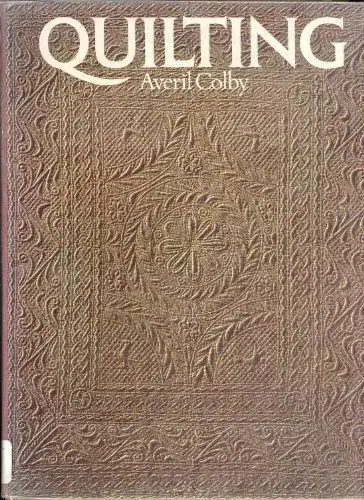
<“Quilting” by Averil Colby hardcover c 1971 printed in Great Britain hardcover $55.00
In the UK this is much harder to find than her ‘Patchwork’. Most textile book dealers would ask UK£ 20 – £30, but with diligence you might find a softback copy for less in a general secondhand bookshop.
It is a standard work of reference if you are interested in the UK quilting tradition.
Sally W
Date: Fri, 30 Apr 2004 18:00:25 -0700 (PDT) | From: Donald Beld <donbeld@>
Hi, I am fascinated by the evolution of 19th Century quilt patterns. Unfortunately, it often the the “which came first–the chicken or the egg” debate. Rarely do we have documented evidence of the line of thought that quilt pattern designers had when patterns evolved into one another.
For example–Pickle Dish–a 19th Century pattern, clearly became Double Wedding Rings–a 20th Century Pattern. Everyone agreeds that Log Cabin became Courthouse Steps which became Garfield’s Monument (although I don’t think there is any proof as to which came first, second and third).
As we know that Hexagon was an English pattern from either Devonshire or the Isle of Man from the mid to late 1700’s, and that Log Cabin–by another name developed during that same time period–but probably a little bit later–I found speculated that perhaps they were an evolution. Sure enough, if you look at a Hexagon (which, of course, evolved later in the 20th Century into Grandma’s Flower Garden) “block”, if there is such a thing and then look at a Log Cabin Block, I think you can see a “squaring off–actually a rectangling off–of the hexagon pieces into the Log Cabin Block–probably by someone with a lot of imagination, but limited sewing skills, as Log Cabin is a lot easier ot make than Hexagon.
I also think you can see it clearly if you look at a Barn Raising quilt–that has that basic Hexagon feel to it.
Can I prove any of this? Of course, not! But I bet I am right.
By the way, I also think Trip Around the World is another evoluation of Barn Raising!
The only way we will ever prove some of these theories to to find period letters, diaries, etc. that substantiate the ideas. Food for thought. Don Beld
Date: Fri, 30 Apr 2004 21:37:36 EDT | From: KareQuilt@
Dear QHL:
I took my computer in yesterday to a Mac specialist and had him check it because the Quilters Hall of Fame office told me that they had received three emails from me saying a file was attached, but I never sent them an email wi th an attachment this week. When they opened it, there was nothing there but I bet there was a virus attached.=A0 Now someone from this list has just written m e that they too have received an attachment from me and that their system warn ed them that it was infected with the Bagle virus. The specialist ran upgraded Virus Protection software on my system and said there was no virus on my Mac . He said that what had probably happened is that someone with a PC probably has my address in their Address Book, and a virus has infected that PC and is sendi ng emails from that Address Book to everyone on that person’s list. Since my name is in their address book, people think they are getting an email from m e but it is not actually coming from me. Since two people from the quilt world hav e now contacted me to say they have received an email from me saying there is an attachment, this virus must come from one of my quilt friend’s list. I wa nt to assure you, my computer is not sending a virus out. I can only hope that everyone keeps their Virus Protection software updated.
Karen Alexander
Date: Fri, 30 Apr 2004 21:47:10 -0400 | From: “Karen” <@charter.net>
I received one from someone else and deleted it when it turned out to be blank. I NEVER NEVER EVER open an attachment from someone I don’t know or that I wasn’t expecting.
Thanks for the warning. I’ve had one computer die on my this spring and I don’t fancy repeating the experience. Now, do any of you have any idea of how to get rid of the small black ants that have begun to infest my bathroom, kitchen, and computer desk????
[and yes, I’m serious. They don’t seem to be bothered by ant traps, and of course I don’t want to use poison in the kitchen or bathroom. Help???]
Karen Evans —– Original Message —– From: <KareQuilt@> To: “Quilt History List” <qhl@> Sent: Friday, April 30, 2004 9:37 PM Subject: [qhl] Virus alert
Dear QHL:
I took my computer in yesterday to a Mac specialist and had him check it because the Quilters Hall of Fame office told me that they had received three emails from me saying a file was attached, but I never sent them an email with an attachment this week. When they opened it, there was nothing there but I bet there was a virus attached. Now someone from this list has just written me that they too have received an attachment from me and that their system warned them that it was infected with the Bagle virus. The specialist ran upgraded Virus Protection software on my system and said there was no virus on my Mac. He said that what had probably happened is that someone with a PC probably has my address in their Address Book, and a virus has infected that PC and is sending emails from that Address Book to everyone on that person’s list. Since my name is in their address book, people think they are getting an email from me but it is not actually coming from me. Since two people from the quilt world have now contacted me to say they have received an email from me saying there is an attachment, this virus must come from one of my quilt friend’s list. I want to assure you, my computer is not sending a virus out. I can only hope that everyone keeps their Virus Protection software updated.
Karen Alexander
Date: Sat, 01 May 2004 02:20:20 -0400 | From: “Velia Lauerman” <velialive@>
well said JeanL teaching younger students on treadle is sew rewarding. learning to chew gum and sew isn’t as bad as it sounds. fun fun fun. try the treadle for piecing we can achieve the accuracy & control.velia
FREE pop-up blocking with the new MSN Toolbar – get it now! http://toolbar.@/go/onm00200415ave/direct/01/
Date: Sat, 01 May 2004 02:41:49 -0400 | From: “Velia Lauerman” <velialive@>
Alex Anderson’s Simply Quilts show about treadles was one of the best. Who is the lady who showed us her stuff on the treadle? Applause applause applause ! Velia
Check out the coupons and bargains on MSN Offers! http://youroffers.@
Date: Sat, 1 May 2004 10:37:22 +0100 | From: “Sally Ward” <sallytatters@>
> As we know that Hexagon was an English pattern from either Devonshire or the Isle of Man from the mid to late 1700’s,
It has been said that Log cabin has a strong Isle of Man tradition, but I haven’t heard English historians pin the hexagon pattern to a particular county. I always understood that the hexagon was found pretty well across the UK. You have to bear in mind what a small country this is…its only very rarely that you can sometimes locate strong and unusual traditions to an offshore island or very isolated community. Hexagons were everywhere….
< Hexagon (which, of course, evolved later in the 20th Century into Grandma’s Flower Garden)
Isn’t it the name that evolved, rather than the pattern? I’ve seen plenty of hexagon quilts pre-20th century that use what we now would call a Grandmother’s Flower Garden layout.
In Averil Colby’s ‘Patchwork Quilts‘,pub1965, she illustrates a cotton coverlet dated 1780 – 1790 where what she calls hexagons ‘rosettes’ appear to have been appliqued to larger plain hexagons which are separated by a honecomb lattice (I can’t quite make out whether these are hexagons or diamonds).
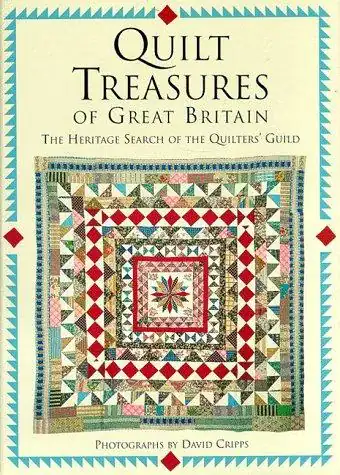
In ‘Quilt Treasures’, the book of the Quilters Guild of the British Isles heritage search, pub. 1995, they record seeing ‘a curious frame coverlet with …a large centre of hexagons laid out as white rosettes in a Grandmother’s Flower Garden pattern. Because of the date of the fabrics it is believed that the centre was perhaps pieced in about 1829 (although one fabric used dated back to 1790)
And EKarenbeth Hake (writing in 1937) illustrates a ‘Patchwork in coloured silks’ from Cornwall dated 1837 which is quite clearly a full-blown GFG construction. Even at that time she didn’t give it that name. Mostly we would just call them ‘honecomb patterns’.
A GFG by any other name…..
<Log Cabin is a lot easier ot make than Hexagon.
I’d debate that one with you <G>. I come back to the fact that we were making our hexagons over papers and our log cabins on a foundation. My experience of teaching beginners, some of whom are basic skills students, is that (assuming they have the correct paper pattern of course) using the over papers method anyone can make hexagons (and other geometric shapes) that match, and anyone can stitch and flip onto a foundation. I’d put them on a par. Using ‘your’ pieced method for hexagons is more tricky because of getting all the angles right, and piecing log cabin cab cause problems because its quite easy to end up with the ‘doiley’ effect (rippled edges) if you cut off your strips too long, or at an angle.
What might be a motivation for log cabin over hexagon, though, is speed of construction and economy of fabric. When we pieced hexagons over papers there was often as much fabric on the back in the seam allowance as there was on the front.
> The only way we will ever prove some of these theories to to find period letters, diaries, etc. that substantiate the ideas.
In our dreams <G>
Sally W
Date: Sat, 01 May 2004 07:19:54 -0400 | From: “Judy Kelius (judysue)” <judysue@>
It is called “spoofing” when someone uses your email address to send spam or virus emails to someone else. My email address is also being spoofed, and I frequently get “unsubscribe” messages from QHL as a result. It is difficult to prevent these . . . just make sure your virus program is up to date. But as Karen pointed out, the problem begins on someone else’s computer that has a virus (actually technically, a “worm”), and the worm uses addresses in that person’s address book and sends itself to other addresses – the subjects are usually general like “hey,” or “hi”. These worms are usually not destructive, but definitely annoying! Many internet service providers will suspect a problem when the “from” address is not the same as the address it is being sent from and will quarantine or tag the message even if they do not detect the contaminated attachment.
You can read more about spoofing at http://www.sarc.com/avcenter/venc/data/w32.klez.gen@
About the ant problem . . . here’s a web site with some nonpoisonous ways to attack them: http://pages.tipking.com/pests/tip_148.shtml. I was having lots of those tiny ants in my kitchen for a couple of years – I tried pepper and several sprays until I found one that actually worked . . . if you want to know the name, I can get it from my kitchen and let you know. I sprayed once in the spring two years ago along the baseboards and never had an ant problem after that. And so far this year, no ants either! (And I haven’t sprayed since.)
At 09:47 PM 4/30/2004, you wrote: >I received one from someone else and deleted it when it turned out to be >blank. I NEVER NEVER EVER open an attachment from someone I don’t know or >that I wasn’t expecting. > >Thanks for the warning. I’ve had one computer die on my this spring and I >don’t fancy repeating the experience. Now, do any of you have any idea of >how to get rid of the small black ants that have begun to infest my >bathroom, kitchen, and computer desk????
Date: Sat, 1 May 2004 08:32:34 EDT | From: DDBSTUFF@
In a message dated 5/1/2004 12:15:54 AM Eastern Standard Time, qhl@ writes: Baltimore Album Quilt on eBay I had an opportunity last October to see this quilt in person and it really is a wonderful quilt. I was doing a show in York, PA and it was exhibited there. Hard to believe but there were two Baltimore Album Quilts at the same show. I had one that I had had for some 20 years and this one. Fortunately, for me, I sold mine during set up but this one did not sell. Mine was more of a typical Album Quilt with a center eagle. I believe that was why it sold and not this one. It also sold again during the show and ended up ant a New York Show for $199,000. Ouch!
Darwin
Date: Sat, 1 May 2004 08:24:45 -0500 | From: “Wanda” <fattyoldkid@>
Judy, Thanks for sharing…I’ve been getting alot of these and didn’t know which group I was getting it from…sounds like I’m getting alot of the same ones ya’ll or getting …now I know which group it is…I feel better and know what to watch for. Wanda
Date: Sat, 01 May 2004 10:04:47 -0500 | From: Sylvia Adair <piecethepast@>
That would be Donna Kohler of Fresno, California. She’s also been featured in Quilt magazine in the last year or so. BTW, she does free motion quilting on her treadle, and has a quilt in Ricky Timms new book (Conversions?). I almost feel like I know her from reading her posts on the treadleon list. She actually takes her treadle to quilt classes! She’s such an inspiration, especially to those of us who love the old machines. Cheers, Sylvia Adair in Wisconsin
Velia Lauerman wrote:
> Alex Anderson’s Simply Quilts show about treadles was one of the best. > Who is the lady who showed us her stuff on the treadle? Applause > applause applause ! Velia > >
Date: Sat, 1 May 2004 16:06:19 +0100 | From: “Sally Ward” <sallytatters@>
We don’t have any > very early log cabins that I have been able to track down (people have asked > before),
I’m here to correct my own posting because I’ve been reminded (by one of those people who asked<G>) that the log cabin pattern ‘can’ be found in the UK very early, in particular the V&A has the remains of a silk purse from the 1600s which appears to be made in the log cabin style. And there is a quote in Averil Colby’s book about some scottish ones which the family claimed were made in the 1700s – but there’s no picture and no reference as to where to find them, so that’s really just hearsay. What I suppose I meant was that we don’t see early examples of full-blown common-or-garden log cabin quilts as you know them. They were so popular around the turn of the century that that is all we seem to find.
Of course, they may have been so popular/everyday that they were used to extinction, whereas the labour-intensive hexagons were kept for best, survived, and now seem ‘common’.
Sally W
Date: Sat, 1 May 2004 09:29:41 -0700 | From: “Maureen Flanagan” <flanagan@>
Beth was good enough to let us know the details of Eleanor’s new book and indeed it is available through Amazon www.amazon.com at $17.65, published in paper in April 2004. Barnes and Noble www.bn.com is not yet distributing the title, but I’m sure it will soon. There are no used copies available of the book when I check Advanced Book Exchange at www.abe.com
If you do buy this book, please note that it is possible for you to write a review of Eleanor’s book and post it to Amazon and to Barnes and Noble. Just go to the page for the book and click on Write Your Own Review. Reviews are anonymous.
Potential buyers, especially libraries and bookstores, look at the reviews to get more information about the title and positively reviewed books are more likely to sell more copies. Publishers watch these reviews to see if the author’s work is received favorably and so the review will influence their decision to publish future works by the author or to keep the current work in print. Authors need the reviews to help with revisions, future directions in research and just to get a small reward for all their efforts.
So, if you buy a new book on any subject, but especially quilting, do the community and the hardworking author a big favor and write an online review for Amazon and Barnes and Noble.
Maureen Battistella ********************** Books and Old Lace PO Box 1081 Ashland, OR 97520 541-552-0743
Subject: Re: late 20th century quilting & double knits From: “Beth Davis” <bethdan533@> Date: Fri, 30 Apr 2004 05:48:11 -0400 X-Message-Number: 1
Regarding the new book mentioned by Marcia responding to Judy Anne: “Yes, there is a book coming out about quilting and quiltmakers from 1970-2000 (dates may be slightly off). the woman was on faculty with me at AQS this year. Marcia”
The book’s title is” American Quiltmaking 1970-200″ and the author is Eleanor Levie.
I bought a book from her while waiting in line at the airport in Paducah on Sunday!!! Eleanor was happy to sell one more book-but it was HARD to fit even one more item in the luggage!
Beth
Date: Sat, 1 May 2004 10:33:47 -0700 | From: “Alan R. Kelchner” <alan@>
Kathy,
Every time I’ve gotten an unknown email with a four-digit password, it seems it was infected with a variation of the W32 virus. Delete it ! Further concerns should be brought up to Kris.
Alan
Alan R. Kelchner Textile Artist http://www.alankelchner.com
—– Original Message —– From: “Kathy Moore” <KathyMoore@> To: “Quilt History List” <qhl@> Sent: Friday, April 30, 2004 9:10 PM Subject: [qhl] leave qhl???
I’ve gotten a strange email with the subject line leave qhl and a password with numbers in it.
Is this legitimate?
Thanks, Kathy Moore
Date: Sat, 1 May 2004 15:29:19 -0400 | From: “Karen” <@charter.net>
I know that one of the so-called Log Cabin purses from the early 17th century looks more like wrapped silk thread than pieced fabric; it’s in Seligman and Hughes’s =Domestic Needlework,= published in 1926, and is referenced in Janet Rae’s =Quilts of the British Isles.= The Seligman & Hughes book is something of a mishmosh (it seems to have been based on their private collection, with little to no scholarly context), but I finally found it in the stacks at the Mount Holyoke College library in South Hadley, Massachusetts, way in the basement in a separate room for pre-Library of Congress acquisitions. Took me about ten years of searching, too. There’s a lot of interesting pictures, but I’d take the text with a grain of salt.
Sally – is there a picture of the one in the V&A? Sounds extremely interesting….
Karen Evans
—– Original Message —– From: “Sally Ward” <sallytatters@> To: “Quilt History List” <qhl@> Sent: Saturday, May 01, 2004 11:06 AM Subject: [qhl] Re: Hexagons into log cabins?
> We don’t have any > > very early log cabins that I have been able to track down (people have > asked > > before), > > I’m here to correct my own posting because I’ve been reminded (by one of > those people who asked<G>) that the log cabin pattern ‘can’ be found in the > UK very early, in particular the V&A has the remains of a silk purse from > the 1600s which appears to be made in the log cabin style. And there is a > quote in Averil Colby’s book about some scottish ones which the family > claimed were made in the 1700s – but there’s no picture and no reference as > to where to find them, so that’s really just hearsay. What I suppose I > meant was that we don’t see early examples of full-blown common-or-garden > log cabin quilts as you know them. They were so popular around the turn of > the century that that is all we seem to find. > > Of course, they may have been so popular/everyday that they were used to > extinction, whereas the labour-intensive hexagons were kept for best, > survived, and now seem ‘common’. > > Sally W > > > — >
Date: Sat, 1 May 2004 23:09:37 +0100 | From: “Sally Ward” <sallytatters@>
> Sally – is there a picture of the one in the V&A? Sounds extremely > interesting….
Alas, the reference is contained in notes I made many years ago when I first got interested in quilts, but didn’t know much about scholarship so I no longer know where it came from. We have a bank holiday on Monday, but later in the week I’ll contact them and see if I can track it down.
Sally W
Date: Sat, 01 May 2004 23:49:40 -0400 | From: “Jan Drechsler” <quiltdoc@>
Lynne, Are you referring to Trenton Tape on the silk quilt? It is possible, especially if the quilt was made in NJ. Trenton Tape usually had tan and green longitudinal stripes.
According to NJ quilts 1777 to 1950, pages 61 and 62, the tapes were often seen on quilts from 1830-1870. There is a photo of a quilt with Trenton Tape on page 62. Typically, the quilts using trenton Tape were from the central NJ area to southern NJ. Trenton is on the Delaware River, a 45 minute drive (today) north from Philadelphia, and about an hour and a half from NYC.
When I lived in central NJ, it was my fantasy that I would find a roll of Trenton tape at a flea market or antique store. And then I would causually call J. G. Row and tell her! <G> But it didn’t happen.
As a pronunciation guide, never, never say ‘ton’ in Trenton. It is more like Trent, with a quiet second ‘t’ and a mumbled ‘en’. If in doubt, mumble the whole name.
Jan — Jan Drechsler in Vermont Quilt Restoration; Quilting teacher www.@/~bobmills
Date: Sun, 2 May 2004 | From: “J. G. Row” <JudyGrow@>
> When I lived in central NJ, it was my fantasy that I would find a roll of > Trenton tape at a flea market or antique store. And then I would casually > call J. G. Row and tell her! <G> But it didn’t happen.
Yes, but you did find a gorgeous quilted petticoat to add to your collection, and that’s because I told you to meet me at the flea market that day.
> As a pronunciation guide, never, never say ‘ton’ in Trenton. It is more like > Trent, with a quiet second ‘t’ and a mumbled ‘en’. If in doubt, mumble the > whole name. > > Jan
We’ve always taken our cue about pronunciation from the conductors on the trains. One in particular always said, “Tre-non! Tre-non, next stop.”
As a native South Jerseyan I always snickered at how my NYC cousins pronounced the ocean that my home town was named after. They thought the word had two “t’s”, and pronounced both of them. It takes a whole lot of work to screw up your mouth to get that “t” followed by an “l” out. We natives knew the word didn’t have any “t’s” and didn’t even have an initial letter “a”. I grew up in Lanic Ciddy, of course.
Not a word from you, Gail of the Deep South! You heah?
Judy ” Ringo” judygrow@
Date: Sun, 2 May 2004 | From: ARabara15@
Being a TREN-TON resident. Many of us do pronounce the T. It goes along with the city’s improving image. Donald Brokate, The Carzy quilt Collector and TrenTon Real Estate developer.
Date: Sun, 2 May 2004 | From: Vivien Sayre
Jan, That’s the same language as “Lean offa da dours”, from NYC. Vivien
Date: Sun, 2 May 2004 | From: “Carol Berry”
Velia wrote: Alex Anderson’s Simply Quilts show about treadles was one of the best. Who is the lady who showed us her stuff on the treadle? Applause applause applause !
That was Donna Kohler, about whom I posted when the treadle thread started. Donna relates her experiences on Simply Quilts on her website, www.donnakohler.com.
Carol Berry Merced, CA
Date: Sun, 2 May 2004 | From: “Jean Carlton” <jeancarlton@>
Thanks, Jan, for the pronunciation guide on Trenton tape. One hates to sound ignorant if it comes to speaking out loud to someone who knows how it should sound! – It reminds me of when I was a young reader – a character in the book(Penelope) was PEN uh lope to me as I read….imagine my surprise to hear it pronounced Pen EL o pee at a later date. Then there’s Or gun instead of Or e gone and Lewsana instead of Lew ees ee ann ah.
Jean C
Date: Sun, 2 May 2004 | From: Laurajbr@
> I just checked out this auction again and there are still no bids on it. > Any thoughts as to why? > Laura in sunny Florida
From: “Major Maam” <majormaam@>
The ladies and gentlemen on this list are very infomational and knowledgeable. I have learned so much historic information and really admire your collective knowledge. I have a question that I hope someone can answer.
A little background: About 2 years ago my husband bid on the contents of a couple of storage cabinet’s at an estate auction. In those cabinets were a lot of quilting and sewing stuff; including about 23 years (1977 to 1990) of Quilters Newsletters and Quilt World magazines. (Some are missing.) I have been looking on Ebay and they do not seem to be worth much of anything.
Question: Would it be “ok” to cut out the patterns that I want to keep, then pass the magazines on to my quilt friendship circle?
I would imagine from a historic point of view that the companies that produced them have “historic” copies and there are a gazillion of copies out there, so I would not be destroying anything of value to the quilting community.
Opinions please?
Becky in the High Desert of California
MajorMaam@
From: “Judy Kelius (judysue)”
There is a very limited market for quilts at this price level. If the seller would have set a reserve and started the bidding lower (like $1,000), I’m sure there would be bids.
By the way, I tried to reply directly to Laura, but AOL is currently blocking all emails from my internet service provider! Their spam filters block many legitimate emails – if you are an AOL user, I suggest you complain to them about their overly zealous practices.
At 11:21 AM 5/2/2004, you wrote: >>I just checked out this auction again and there are still no bids on it. >>Any thoughts as to why? > >Laura in sunny Florida
From: “Alan R. Kelchner”
In the interest of keeping your friends happy (you know, the ones the magazines will be passed on to) you may want to scan or xerox the pages instead. With the kind of luck I have, I’d cut out the pages someone else wanted . . .
Alan
Alan R. Kelchner Textile Artist http://www.alankelchner.com
From: “Jocelyn Martin”
Question: Would it be “ok” to cut out the patterns that I want to keep, then pass the magazines on to my quilt friendship circle?
Becky, They’re your magazines! If you want to fold them into origami hats and wear them to church next Sunday, you can. <G>
I recently bought a passel of old quilt magazines at a guild auction. As ‘magazine exchange’ chair this year, I was already debating about whether it would be a good thing to donate the ones I don’t want to the guild’s exchange- or was I just donating things nobody wanted? I’m still going through them to see which ones I want. 🙂
To solve the missing article ‘problem’- use your computer to print up a sheet of labels that tell your guild members that they can get the missing article by contacting you, and slap a label on each magazine you clip. That way, you don’t waste time/money/trees by copying an article, if nobody else even wants to see it. 🙂
From: “Jocelyn Martin”
> I just checked out this auction again and there are still no bids on it. > Any thoughts as to why? > Laura in sunny Florida
Laura, Having spent the day at an auction with my best friend (also named Laura) and both of us having gotten burned bidding on things that looked great from a distance but which were NOT at ALL what we thought we were getting….I wouldn’t bid on anything of great value on Ebay. 🙂
Date: Mon, 3 May 2004 13:46:47 +0200 | From: Margareta.Faust@
I have just seen ‘Hearts and Hands‘ at the Quilt Expo in the Hague. It is VERY, VERY good. I wonder if it’s available for purchase – on DVD perhaps? By the way, the link doesn’t work….
Margareta
Hearts and Hands is a wonderful film. The video can be purchased through New Day Films. There is also a companion book to the film published by Rutledge Hill Press.
The correct link to The Alliance for American Quilts’ streaming video of the film is: www.centerforthequilt.org/specialfeatures
Links to information about purchasing the film and book are included on our site.
Thanks for your interest.
Bob
Robert Shaw Executive Director The Alliance for American Quilts Tel//fax: 802/985-0737 shaw.bob@ www.centerforthequilt.org
Date: Mon, 3 May 2004 08:23:06 -0400 | From: “Cheryl Wolf” <cwolf@>
I found the video streams at http://www.centerforthequilt.org/specialfeatures/index.html
HTH, Cheryl
From: Diane McGuire
EBay is a good source of checking the current value of magazines, etc. If you have some of the early issues, those would be of value, but not necessarily a lot of $$$. I don’t know when QNM started, but on their anniversary year they had a retrospective of the early years. You might try contacting them directly.
I would think, like National Geographic, the magazines are plentiful and not worth much. Not only were LOT S printed, but also they are both the type of magazines people tended to save.
I would say if you don’t care about trying to sell them, there is absolutely nothing wrong with cutting out the patterns you want to keep and passing the rest along for all to enjoy. You might want to get some of those plastic sleeves that fit into a looseleaf notebook. You can put all the pages for one pattern in one sleeve. You can even put tabs on them to label each pattern.
Enjoy.
Diane M in MA where my daffodils and weeping cherry are in full bloom
Date: Mon, 3 May 2004 | From: KareQuilt@
We have a “magazine giveaway” table at our guild meetings. I am forever picking up back issues of quilt magazines so that I can pull out and file the articles I want on a given subject while saving myself the complete set of my own subscription at the same time. IMHO, the ones that you wouldn’t want to tear apart would be any issue of those magazines from the 70s and 80s that had a much lower circulation, like Nimble Needle Treasures (Patricia Almy editor), Quilters’ Journal (Joyce Gross editor), Tumbling Alley, Aunt Kate’s Quilting Bee, etc. plus the earliest issues of QNM, LCPQ, etc.
Karen Alexander
From: “Maureen Flanagan”
I just received an exquisite book on hexagons from Shelly Zegart, Mosaiques d’etoffes: a la recherche de l’hexagone by Janine Janniere, published by the Musee des Traditions et Arts Normands, 2003, ISBN 2-902093-44-6. It is the catalog of an exhibition held at the museum May 16-Oct 26, 2003 xueRWS VY Alain Joubert. Incredible hexagon quilts from the US and Europe and many French hexagons, beautifully fussy-cut as early as 1801 and also a section on contemporary art hexagon quilts. Shelly worked with Janniere for several years to research hexagons on both sides of the Atlantic and to contribute to this work. I wish my high school French served me better!
Great job Shelly!
Maureen Battistella Ashland, Oregon
A note for those who do not have the book and are interested in a short, but beautifully illustrated article, on “American Fancy: Exuberance in the arts, 1790-1840,” by Sumpter Priddy. The most recent issue (May 2004 on the news stands now) of The Magazine Antiques has an exciting but cursory article written by Sumpter on the subject of his book and exhibit I mentioned before.
Although there is only one quilt illustrated in this article, Sumpter does briefly talk about the influence of the kaleidoscope and its effect on quilt design. The sumptuous photographs and well written essay will certain whet your taste for either seeing the exhibit or buying the book. Most significant in my mind is how Sumpter looks at the many forms of decorative arts in a scholarly, but lively and interesting way, and studies and melds them together so one can better understand how these objects relate to one another, the times in which they were created, and the people who created them.
Excuse me if I sound like I have an interest in the publishing company or am being paid to shout out about this. I am not. I am just an admirer of his scholarship and particularly in this endeavor he has spent a good part of his life investigating.
Good reading,
Trish Herr
From: Patricia L Cummings <quiltersmuse@>
Dear list members:
Anyone who knows me personally, also knows that I have perfectionistic tendencies. When I write anything, I strive for it to be 100% correct and letter perfect, and this is how I believe that I submit every article I write for publication.
Since Saturday, I have been feeling frustrated, full of anxiety, upset, and, in short, beside myself. On the advice of someone I trust, I will tell you what happened, and will take whatever flak I get for having spoken my mind.
Now that you are all wondering what I could possibly be talking about, I will tell you. I wrote an article about Willimantic (“Thread City”) and Sharon, Connecticut. I chose the two because these are located in quite different areas of the state. Willimantic is in Windham, and although a city charter had been sought, at one time, according to Tom Beardsley in his article in the Fall edition of the CT Journal (if memory serves), the charter was not granted. So, Willimantic was just the manufacturing center of Windham in the 19th c. and part of the 20th century.
Sharon is on the border of New York state. There are lovely open spaces traditionally used for farming. In my article, I mention that the area produced a lot of wool and flax. Well, in someone’s mind and I don’t know whose, that statement got translated into “Sharon was a mill town”. To the best of my knowledge, that is simply not true. I never said that, yet the information stands as part of a sub “headline”. We also went to Connecticut twice. Heavens, we spent all day photography the entire collection at Sharon, taking notes, and adding some info. to the documentation. We left at 7 a.m. and got home at 9 p.m., if I remember correctly. We had a similarly long day when we went to Willimantic. So, it is kind of misleading to represent the article as being the result of a “day trip”.
I have been stressing out over all of this, and the other typos that occurred in the article, (“valient”, “Mass-achusetts”), and some of the other editorial changes that do not reflect my intent. It is dangerous to take one part of a sentence and combine it with another when it results in a different concept altogether (which happened in one instance).
I am not trying to pick on anyone at the magazine. I have LOVED every minute of being a part of /The Quilter/. This is the “biggest issue ever” (a whopping 132 pages with great features and designs). However, in the midst of it all, the person responsible for layout resigned to be a full-time (new) mom. So, it was a scramble to meet the shipping deadline. I did not even see page proofs with the final layout of the article. If I had, I might have been able to catch some of these things.
The reason for writing this is to clear the air. For the record, I would like to simply say that I did my best. I cannot personally recall hundreds of thousands of magazines that have gone out. If I could, I would. This time, there were just extenuating circumstances that resulted in a less than perfect document. However, this is not uncommon in the industry. I have picked up books and seen glaring errors, too. I just have not been personally touched by this situation before.
I suppose that whenever a writer puts his/her work “out there”, it is subject to the changes inflicted upon it, intentionally or inadvertently. Everyone at the magazine works extremely hard. I appreciate the decision to include articles for those of us who love quilt history. For example, this issue (July) has photos of the Calico and Chintz quilts from the current traveling exhibit from the Smithsonian and a nice write-up provided by the museum.
For my part, I beg your understanding if/when you discover some of the glitches. I always try to be honest and that is what I am doing here. I just can’t go on thinking that anyone would say that I don’t know how to spell or that I am so blind as to think that Sharon is a “mill town”, particularly after having visited it. On the plus side, there are charming parts of the article, like the account of the “Frog Battle of 1754” and Jim’s photos which came out exceptionally well. Among other pictures, there are some of really nice, old quilts. I hope that those of you who read the article will enjoy it.
Thanks for listening.
Pat www.quiltersmuse
Date: Mon, 3 May 2004 | From: “Julie Silber” <quiltcomplex@>
“Hearts and Hands,” the book, is out of print and may be difficult to find new. We have the remaining unsold copies. If you can not find it elsewhere, feel free to e-mail me privately.
Julie Silber (quiltcomplex@
Date: Tue, 04 May 2004 04:49:33 -0400 | From: Patricia L Cummings <quiltersmuse@>
Kim Haynes said:
“You did not intend to deceive. Period.”
Thanks, Kim. That is exactly my point.
Another point to ponder is this: I had described a quilt as an ‘English style “strippy” quilt’. In my mind, a “strippy quilt” is a “strippy quilt”. It denotes a certain form of construction and is the name that is used. Well, that phrase was changed to ‘English style strip quilt’. Not the same.
These little things bug me. They really, really do. Now, I don’t know if that change can be blamed on a spell checker or on someone thinking they knew better. The other thing that was curious was the cropping of the picture to go along with the quilt. I said that the quilt has rounded corners, and it does….in person. The photo makes the quilt look like it has square corners. These are silly little things that probably only I would notice, knowing the difference. Yet, the lack of congruency between the written word and the photo brings my credibility into question That is what is most unsettling to me.
Kim states: “The editor does need to know of your concerns”.
Yes, I have shared some of those concerns.
“A note of correction can be printed in another issue”.
Eventually, I am going to post my article, sans some of these edits, on my website. I would not even think of asking for space in the magazine to revisit all of my little concerns. To most other people, they would be inconsequential. However, to the nitpickers of the world, they will constitute monumental ammunition to try to prove me deficient.
A love of quilts and quilt history is the driving force in my professional writings. I will continue to write in whatever venues I find to be most acceptable, and for all of the good people who appreciate my efforts.
Pat Cummings May 4, 2004