December 9 – 11, 2004
These restored messages come from the Quilt History List, an online forum where quilt historians, collectors, researchers, appraisers, and enthusiasts discussed antique quilts and related textiles. The archive dates from 1996 through approximately 2016 and is being restored gradually. Sign up in the form at the bottom of the page if you want to know when a new page is added. Original spelling, opinions, formatting, and inactive links may remain unchanged.
Primary topics of this QHL Digest:
- Kit Quilt Identification — A member’s eBay-won reversible hand-pieced quilt sparks discussion of dating scrap and kit quilts by fabric era.
- Kitchen Splashers — Members define and discuss “kitchen splashers” and their historical use beyond the kitchen.
- Redwork Translation & Regional Dialect — A Czech-language redwork pattern phrase leads into a wider, good-natured discussion of regional dialect words like “warsh” and “washing up.” (see the article on redwork and outline embroidery)
- Chimney Sweep Friendship Block Quilt — Update on the progress and completion of a Chimney Sweep Friendship Block community quilt.
From: “Barbara Vlack”
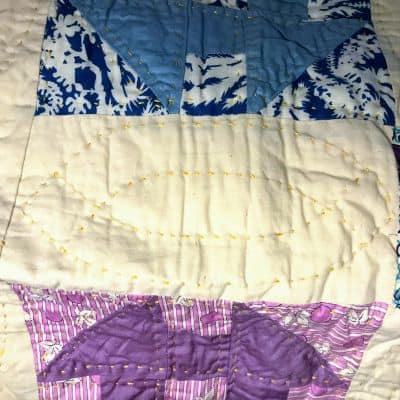
I just received a quilt I won on an eBay auction. It is a reversible quilt that is all hand pieced and hand quilted. One side is allover Diamond in Square blocks made from homespun plaids and chambrais fabrics. I would date that side to the early 1900s.
The other side is SCRAPPY. Lots of 30s fabrics here! Not the cutesy 30s fabrics, but a lot of the uglies and/or larger prints. Perhaps some of these prints are even 40s and maybe I can stretch into the 50s. This side looks kind of crazy quilt-ish. The seller of this quilt offered that the scraps were fabric sewn into strips. Well, they were sewn into strips all right, but first they were HAND sewn into diamonds, which were then sewn into strips and the strips were sewn together to form the piece. It was all hand sewn and hand quilted on the diagonal.
It’s a heavy quilt. Perhaps because the lining is not batting but rather a white twill cotton weave cloth. It may also be heavy because the diamonds were pieced, by hand mind you, onto a fabric foundation. The piecing of the fabric strips was willy nilly, no structured strata. Almost crazy pieced but with most of the fabric being in strips. Definitely a “use it up” approach.
There is one novelty fabric that pops up every now and then that intrigues me. It’s like an I Spy game. I’ve been using my copy machine to capture the pieces I find so I can jigsaw them together to see the fabric. It has a Chinese character and some other figures, and there’s a commentary about what “Confucius say …” These are a riot —- I’ve pieced together, “Confucius say: Girl who keep on toes stay away from heels.” And “Confucius say: Man who get in stew is small potato.” And “Confucius say: Tailor who love harem press plenty.” “Woman listen w… (?) … money talk.” “Worker always … (?)” This fabric is really funny. Has anyone ever seen this fabric? I’d love to know what a whole piece looks like.
I had no competition in the bidding for this item. It does need some minor repairs and a nice bath. It is not in pristine condition, but it is a fabric collector’s dream.
I don’t know the geographic origin of this quilt.
Barb Vlack cptvdeo@
From: “Candace Perry”
Thanks Barb and Cinda for your generous plugs! I know the Mennonites also appreciate it…we little guys need all the help we can get… Just as an aside, there are at least two teddy bears in our show who are dressed as quilters. Very cute! They are available on silent auction. If you’re anywhere near southeast PA, we’d love to see you and point you in the direction of more marvelous things to see. And good things to eat… Candace Perry Schwenkfelder Library & Heritage Center Pennsburg, PA www.@ P.S. Acquired a very ratty 1890s 9-patch yesterday…in its heyday I believe it was quite funky. We have essentially have no 9-patches at this time so it will be representative til a better one comes along.
From: “Suzanne Cawley”
Hi All!
I just purchased a redwork kitchen splasher which has a caption that I need translated. It shows a picture of a woman carrying a turkey on a platter to the dinner table where her husband is seated. It says “Kde se dobre dari tam se dobre vari”. Is this Italian? What does it mean? Thanks in advance for any help.
Also, I learned a new word while reading a 1920 home economics book titled “Clothing: Choice, Care, Cost”. The rustling noise made when wearing dresses of weighted silk is called “scroop”. Thought that might be an interesting word to incorporate into quilt history lectures…..and have since found several references to it on the internet.
Suzanne Cawley In wild, wonderful West Virginia
It’s not Italian – Polish, perhaps? It sounds Eastern European or Slavic.
Karen Evans
From: “Monica MacDonald”
Just did a google search on the phrase. It appears to be Czech. There is a phrase (apparently well-known, one site says “omnipresent”) that is close: “Kde se PIVO vari, tam se dobre dari” which means “Where beer is brewed, they have it good.” Another translation says “Where beer is brewed, there life is good.” Couldn’t find anything with your particular version of this phrase, though. Monica in Maine
> Hi All! > > I just purchased a redwork kitchen splasher which has a caption that I need > translated. It shows a picture of a woman carrying a turkey on a platter to > the dinner table where her husband is seated. It says “Kde se dobre dari > tam se dobre vari”. Is this Italian? What does it mean? Thanks in advance > for any help.
From: “Monica MacDonald”
I got curious and started searching around some more and found a very interesting website: http://www.websters-online-dictionary.org/ This is a Rosetta edition. If you enter a foreign word and select the “non-english” button, you can get translations for the word in any language it appears in. For example, “tam” means “there” in Czech, but it also gives the definition of “tam” in 8 other languages. Unfortunately, no definition is given in Czeck for “dobre”. Maybe it is slang or just isn’t in their scope of entries. Just for the heck of it, I entered “quilt” and selected “english” and wow, you get a huge amount of information. If you go down towards the end of the page, you can find how to say quilt in several different languages (including Pig Latin!). It even tells you obscure facts such as the word quilt is used about 175 times out of a sample of 100 million words written or spoken in English. Lots of pictures and quotes, too.
Monica in Maine
> Just did a google search on the phrase. It appears to be Czech. There is a > phrase (apparently well-known, one site says “omnipresent”) that is close: > “Kde se PIVO vari, tam se dobre dari” which means “Where beer is brewed, > they have it good.” Another translation says “Where beer is brewed, there > life is good.” Couldn’t find anything with your particular version of this > phrase, though. > Monica in Maine
From: Anne.Amerine
In the early days, owning a sewing machine was a status symbol. It was stated in the exhibit of machine quilting held a few years back at the Gene Autry Museum in California that woman sometimes machine quilted because the stitching would show – a status symbol!
Also, for those in the area, there is an enhibit at the Getty Museum now that has materials from the Orient, and western items that have oriental designs. There are a few textiles (English and French) dating to the 7th and 18th centuries, and a quilted skirt. I was struck that the stitching was all in the same (vertical) direction, not a running stitch. That meant that the stitches had to be placed one at a time! At first I couldn’t figure out why anyone would do such a thing, but then it struck me that they were in line with the grain – and the drape – and that it was likely done to minimize the distortion under the weight of the skirt and thus to make the stitching stronger.
Anne Amerine Los Angeles anne.amerinengc.co
From: Judy Schwender
>a few textiles (English and French) dating to the 7th and 18th centuries
Did you perhaps mean 17th century?
>the stitching was all in the same (vertical) direction, not a running stitch.
I am not following you here. A running stitch is all in the same direction. Were the stitches like this:
l l l l l l l l l
instead of like this:
_ _ _ _ _ _ _
???
From: Margareta.Faust
Hi, This is what I make of the Czech phrase: ‘Kde se dobre dari tam se dobre vari’
‘Where it is cozy There there is good cooking’
Maybe the embroideress got the order of the two verbs ‘darit feel comfortable’ ; ‘varit cook’ mixed up? The opposite order would be more logical! (dobrewell)
This kind of redwork or bluework splashers, as you call them, or wall hangings for the kitchen, were extremely popular in Europe up to the 1950s. They originated in Germany and then spread to Czechoslovakia and Poland, and also north to Sweden. A common feature is to incite the mistress of the house to cook well and keep her house tidy, then her husband will be pleased and happiness will reign. Not exactly feminist stuff!
There is an excellent German publication about these artefacts; I could come back with the reference next week! Margareta
From: “Amerine, Anne”
Judy, Yes, the late 17th and 18th centuries. Sorry. Not a running stitch. Your picture is correct. I I I I, too. Tiny, tiny stitches in brown on gold satin. Anne Amerine Los Angeles anne.amerinengc.co
a few textiles (English and French) dating to the 7th and 18th centuries Did you perhaps mean 17th century? the stitching was all in the same (vertical) direction, not a running stitch. I am not following you here. A running stitch is all in the same direction. Were the stitches like this: l l l l l l l l l instead of like this: _ _ _ _ _ _ _
???
From: EdithIdleman
Many months ago someone wrote wanting information about the quilting traditions of American Indians. Recently, I have received information concerning a project about quilting in the Chickasaw and Choctaw tribes. I would be happy to pass along the identity of the person involved if someone is interested. The contact information must be via private email. Just let me know of your interest.
Edie Idleman Bella Vista, AR
From: Laura Robins-Morris
What is a kitchen splasher? Laura
>I just purchased a redwork kitchen splasher which has a caption … > > >
From: Margareta.Faust
Hi again, It’s incredible how good a glass of champagne is for your memory! Now I remembered the title of the German book on wall hangings with texts (SprFCche in German)
Trautes Heim GlFCck allein. Gestickte SprFCche fFCr Haus und KFCche. von Eva Stille, Ursula Pfistermeister
published some years ago, wonderful illustrations, seems to be available here and there on the net, try amazon DE! Could perhaps be interesting for those of you who work with PA German heritage – hi, Candace! Margareta
From: “Charlotte Bull”
I picked up a bargain at my local flea market. A delightful c. 1890 top. Big squares of a delightful fabric alternating with a block that in 1884 was called New Four Patch by Farm & Fireside. Big simple squares of all those wonderful navy or indigo blues plus shirting lights etc. Machine pieced! But I bought it because someone had added much later (1930s-40s) a big wide strip of bright floral feedsack fabric. Basically just cut one bag in two lengthwise pieces and sewed them together and then sewed to one side only of the older top. And, the funny part, this was done by hand! I was so amused. The 1880s -1890s fabrics are in fantastically good condition. Just $15. Now, my decision: Do I subtract that feedsack border? Or do I leave it “as is” because it is a Funny Story?
I do collect Tops Only! I do not make quilts out of them. I found it easier to carry just tops when I was traveling & teaching fabric dating & quilt block ID-ing.
Oh yes, for $1 I got a zippie bag full of 1890s 3″ blue squares! Also a few shirting squares. It paid to dig through dozens of bags of fabric scraps from the 1980s-1990s! I ended up giving a fabric dating lesson to two ladies in the flea market. They were experts in dishes and dolls! We each do our “thing”! cb
From: “Beth Davis”
Laura, Pat Cummings addresses what “Splashers” are on her website:http://www.quiltersmuse.com/Splasherhistoryandorder.htm
Basically, they are towels that kept walls from being splashed with soap and water. They were generally hung between in back of the sink or wash basin and the wall. they were embrodiered along with “tidies” which were used to protect chair backs.
Beth
From: “Judy Lyons”
The CQSG does not exist anymore and has not been active for many years. Judy Lyons AQS Certified Canadian Quilt Appraiser judy.lyonscogeco.ca
From: Patricia L Cummings
Just a quick word: “Kitchen splashers” were not limited to use in that area.
Splashers, often embroidered with Redwork motifs, usually with some water scene or another, were probably most often found/used in bedrooms. That is where a good part of the “washing up” occurred, with the use of a pitcher of water and a wash basin. In fact, bedrooms are where I have seen most splashers displayed within the historic homes that I have visited in New England, including but not limited to, the Calvin Coolidge Historic Site, and the Franklin Pierce Manse, to name several.
Best of the season to you!
Pat Cummings www.quiltersmuse.com
From: “Christine Thresh”
I am sure everyone will be happy to know that the Chimney Sweep Friendship Block quilt for Kris and John is heading to New York. I mailed it today.
I revised the Chimney Sweep Block page: http://www.threshpublications.com/kris.html and added some (poor) pictures of the quilt. I hope Kris will take a good picture of it when it arrives at her place on Monday or Tuesday.
Thanks to all, Christine Thresh http://www.@
From: Jccullencrew
Laura, Pat Cummings addresses what “Splashers” are on her
Hi Pat, My, but you are a font of knowledge when it comes to fabrics and how they are used. I don’t think I ever heard of splashers, but forty years or so ago the woman who sold us our house gave us a large, heavy, white porcelain wash basin that was in her mother’s family. It had a lot of what looked like minerals adhered to the bottom, but after a lot of work, it came clean. I think it would look wonderful with a splasher behind it on the wall. Thanks for the idea. Hope all goes well with you and you have a wonderful holiday. Kind regards. Carol Grace
From: Midnitelaptop
there just aren’t enough thank yous in the world to tell you how wonderful you are Christine…..for pursuing this project to completion…. thanks too Karen Erlandson for putting the blocks together and to sally ann smith of new zealand for quilting it… jeanL
From: Julie Silber
From Julie Silber: Hi Everyone, I received this notice/information from my friend Pat Ferrero. I HIGHLY Recommend that you all take a look … This film is simply GREAT!
“Pat Ferrero’s classic film, “Quilts in Women’s Lives,” is being featured on www.folkstreams.net during the month of December. http://www.folkstreams.net/film,37
These portraits of American quilt makers provide insights into the inspirations for their work, family, tradition, the joy of the creative process, the challenge of design, and how it has become a part of their daily lives. The 15 minute excerpt on www.folkstreams.net includes the sections on artist/teacher Grace Earl, the artist and Bulgarian immigrant Radka Donnell, and the African American quilter Nora Lee Condra. Contextual materials for the site were developed by quilter Jan Gessin.
“Quilts” was a ground breaking film used by folklorists, anthropologists, and historians of art and womens history that presented the lives, art, work and philosophy of ordinary women. in the days when few documentaries came from women filmmakers. The film won most of the major awards for independent films during the years after its release in 1981, including Emily Grand Prize, American Film Festival; 1st Place Fine Arts, San Francisco International Film Festival; Best of Festival, National Educational Film and Video Festival, New York International Film Festival, Margaret Mead Film Festival.
www.folkstreams.net is a film and video archive at the South Folklife Collection of the University of North Carolina in Chapel Hill. The mission of Folkstreams.net is to build a national preserve of documentary films about American folk or roots culture. Produced by independent filmmakers, these hard-to-find films give voice to the arts and experience of diverse American groups. They are streamed on the website together with background materials that highlight the history and aesthetic importance of the traditions and the films. Folkstreams.net makes these films easy to find and to see by video-streaming them on the Internet, and also provides in-depth and reliable contextual materials about the subjects and the filmmaking. Folkstreams.net also encourages alternative forms of filmmaking about subjects neglected by mainstream corporate media.”
From: Kaytriplet
In a message dated 12/9/04 9:14:00 PM Pacific Standard Time, qhl@ writes:
> I just purchased a redwork kitchen splasher which has a caption that I need > translated. It shows a picture of a woman carrying a turkey on a platter to > the dinner table where her husband is seated. It says “Kde se dobre dari > tam se dobre vari”. Is this Italian? What does it mean? Thanks in advance > for any help. > >
For folks wanting translations of short phrases, the search engine www.altavista.com has a pretty good translator. You have a choice. You can go to the translator directly and enter the phrase and language, or you can type it in to the search and then ask it to translate the web site. There aren’t a lot of languages on the direct translation page, so you are often better if you type it in for the search. And, it the site is from a particular country indicated by the extension in the URL such as www.xxx.UK, then it knows what language to translate it from automatically. I did this for you for your phrase, and here is what turned up, translated into English.
Kay Triplett
From: “Rosie Werner”
Patricia is right about the splashers being used in the bedroom. I went to boarding school in the 50’s at Good Counsel Academy in Mankato, MN. We all had splashers on the dressers next to our beds in the dorms. The dressers had vertical posts on each side of them with a dowel connecting them for attaching the splasher. We carried a basin and a glass of water to our dresser, pulled a screen around us and washed up and brushed our teeth with the water. The splasher prevented water splashing on the wall. Ours, however, had no redwork embroidery on them. Those were the days! Rosie
From: Sally Ward
The expression ‘we washed up’. Do I take it this means personal washing? In the UK it would mean washing dishes, pots and pans. The personal version would be something like ‘we washed’, or ‘we had a wash’.
Sally W
From: “Karen Evans”
Hm. I tend to use “washing up” to mean “washing the dinner dishes,” but I picked up the expression from an English friend. “Get cleaned up” tends to mean personal washing, while dinner clean up is “washing the dishes.” I’m originally from western Pennsylvania and have spent my entire adult life in Massachusetts, so it’s quite possible different parts of the country have different expressions.
Karen Evans
From: “Monica MacDonald”
We use the expression ‘washing up’ here to mean either the dishes or ourselves. Monica (a Midwesterner living in Maine)
From: Joan Kiplinger
Ditto Monica in the Cleveland OH area although it’s more likely to sound like warsh.
From: “Lucinda Cawley”
What would be the most appropriate way to quilt an embroidered Flowers of the States quilt top? Cinda on the Eastern Shore
From: “Lucinda Cawley”
<img align=”left” alt=”earlymachinequilting.jpg (57021 bytes)” border=”2″ height=”75″ src=”images/earlymachinequilting_small.jpg” width=”100″/> return to the discussion of early machine quilting. Take a look at this. (click on the thumbnail)
Anybody think that this quilt (no picture available) might be 20th century?
Cinda on the Eastern Shore inside because of the rain
From: Judy Kelius
Definitely! The colors, not the pattern, date it. Plus although I have seen blanket stitching on mid 19th century pieces, it is usually very fine – this kind of blanket stitch is much more likely 1930s.
From: “Margaret Geiss-Mooney”
Good afternoon, fellow QHLers – I agree with 20th century being more likely – what came to my mind were all of those butterfly appliquE9s with black blanket stitching around their edges. Regards, Margaret (Meg) Geiss-Mooney Textile/Costume Conservator Professional Associate, AIC mgmooney@
From: “Sharon Stark”
Cinda,
Looks like the machine quilting on the first is quite intricate, if not exactly expert by today’s standards!
But the second one is definitely 1930’s. Nobody would say that because they’ve seen whole-cloth quilts from the 18th century, their 1930’s sateen quilt was of the same vintage. Almost every traditionally patterned quilt dates from somewhere AFTER it’s first known occurrence – such as some of those we’ve discussed in conjunction with HIPV. BUT almost every traditional pattern has been almost continuously in use since it’s original design, and as Judy said, the colors are the give-away. I challenge anyone to find that shade of Nile green pre 20th century!
From: charles woodford
i was lucky enough to have purchased at auction about eight or nine “splashers” although I didn’t know that’s what they were called. After a few shows, customers soon enlightened me about their use, and one lady said that the language was Bohemian; another lady said “We don’t like to say Bohemian; the language is Czech”.
There. My fact for the year.
Barbara Woodford Historic American Quilts
From: “Laurie Magee & Tom Blajeski”
In Wisconsin some of us might “warsh our hairs” as well. Laurie
From: Louise Bequette
I finally dug out the Sept 04 The Quilter issue that had pictures of two quilts on p78 of hand pieced, machine appliqued and machine quilted quilts, circa 1860, that are in the Genesee Country Village & Museum in Mumford, NY. They were on display through October 2004.
The earliest machine quilted quilt I have seen pictures of was one made in 1849 using an Howe SM bought out in a wagon to Colorado. Unfortunately I cannot find the picture again but I thought it was in the original Vintage Quilts issue (97?)from McCalls. I think it was a Drunkard’s Path as I was reading Pepper Cory’s book on DP at the time and that caught my eye first. This was long before I started collecting antique and vintage sewing machines, BTW. (Perhaps someone else recalls this; I would love to have the reference.)
Louise Bequette — in mid-Missouri
From: Louise Bequette
Looked at the posting that started this topic and want to add to the quilting discussion. Treadleon.net is a list devoted to use of treadle and hand crank SMs and several people are doing free-motion quilting on treadles now as well as straight rows. Takes practice but that is the same as with an ‘electric needle’, isn’t it? The consensus is that a model 15 is the best to use because of the way the bobbin sits but someone is quilting with the long bobbin SM also. I tried quilting using a modern (repro) 15 and was amazed at the ease of turning the fabric.
Louise Bequette — in mid-Missouri
From: “BOBBIE A AUG”
If you are planning on going to the AQSG Conference in October of 2005 in the Denver West/Golden, Colorado area, please email me privately. I would like to have a list of you folks that are coming so perhaps we could get together, etc.
Happy Holidays!
Bobbie A. Aug
From: Sally Ward
several people are doing free-motion quilting on > treadles ……………. was amazed at the ease of turning the fabric.
What I recall most from treadling days was the absolute control you could get over the speed of sewing, and the ability to stop ‘needle-down’ without the aid of electronics.
Sally W
From: Joan Kiplinger
Actually we Clevelanders consider warsh a bit of Pittsburgh-speak, and most of us try to remember our Connecticut heritage by carefully saying wosh. 😀
Laurie Magee & Tom Blajeski wrote:
From: laurel@
I’m going to the Collectors, Collecting, and Collections symposium at the International Quilt Study Center (http://quiltstudy.unl.edu) in Lincoln February 24-26, and I’m looking for someone with whom to share a hotel room. Anyone interested? Reply to my individual address, please.
Laurel Horton