April 2 – 6, 2005
This page contains affiliate links. If you buy through them, I may earn a small commission at no extra cost to you. As an Amazon Associate I earn from qualifying purchases. Learn more
These restored messages come from the Quilt History List, an online forum where quilt historians, collectors, researchers, appraisers, and enthusiasts discussed antique quilts and related textiles. The archive dates from 1996 through approximately 2016 and is being restored gradually. Sign up in the form at the bottom of the page if you want to know when a new page is added. Original spelling, opinions, formatting, and inactive links may remain unchanged.
Primary topics of this QHL Digest:
- Identifying a Mystery Medallion Quilt — Julie Silber shares a medallion-set quilt and asks the list to help pin down its origin and construction.
- Tracking Down the Davy Crockett Pattern — Several members search for the source of a vintage pattern picturing Davy Crockett scenes on an embroidered quilt.
- Furniture Terms, Continued — The closets-and-presses discussion carries over with new vocabulary, including “porte-monnaie” and further etymology.
- Locating a Discontinued Fabric Line — Members help a member track down “Bannister Hall Summer House,” a hard-to-find reproduction fabric line by Xenia Cord.
- A Star Quilt Cut Down to Size — Discussion of whether a puzzling quilt top was originally cut down from a larger star-pattern quilt.
From: Sally Ward <sallytatters@>
Andi wrote: > I have come across an ad block in a dated 1890 redwork album raffle quilt > for a drug store that included the word “Portmoniaos” or words “Port > Moniaos” in a block section that also mentions purses,
What about ‘porte-monnaie’, French for purse?
Sally W
— Sally (‘Tatters’) Ward
From: Sally Ward <sallytatters@>
> What about ‘porte-monnaie’, French for purse?
…bearing in mind, of course, that this would be a purse in the UK sense of a small money container.
Sally W
From: “Peter Leate”
Frances and I are invited to visit a supplier in France 3-9th September. We are considering adding to this itinerary to include other suppliers in Spain,Germany and England. Any advice of quilting diversions in these areas and times would be appreciate. If any good shows scheduled in US to correspond with outward or return journey would also be appreciated
Peter from OZ
Peter Leate Managing Director Cairns Craft Centre PO Box 434 BUNGALOW
From: ginghamfr
14
<img align=”left” alt=”click on the thumbnail to see this up close” border=”2″ height=”75″ src=”images/95_1_b_small.jpg” width=”100″/>A friend just bought this quilt (described as c. 1900 Amish) without consulting me and now I’m curious. I’m very new at quilt dating and so if I’m my guess is off, please let me know. It looks to me like the top is from the last quarter of the 19th but the backing fabric and the utility fan quilting seems like 1925 or 1930’s? Also I have no idea about the Amish claim either? Thanks for the help.
http://cgi.ebay.com/ws/eBayISAPI.dll?ViewItem&item6161625058
Any insight is appreciated.
Sandra in Utah
Peter, I would advise you to remain in France for the Carrefour du Patchwork in Alsace, 15-18 September. Here’s a link that will take you to the press release in English. http://www.patchwork-europe.com/
At the very bottom, there are tips about two museums in the area, the Mulhouse textile museum and the costume museum nearby.
Bon voyage, Margareta in Europe
— > > > > > >
From: Judy Kelius
Definitely not Amish – perhaps it is Mennonite. Many people confuse the two groups. An Amish woman at the time this was made would never have used prints, but a Mennonite could have, depending on the particular group she belonged to. I live in Lancaster County in an area of the county that has lots of Old Order Mennonites but no Amish – I am constantly correcting people when they identify someone in a black horse and buggy as “Amish” (often pronounced “ehmish” rather than “ahmish” <GR>)!
I think you are right on about the backing and quilting – it appears later than the quilt top. I rarely see fan quilting from any period in Pennsylvania quilts – it tended to be more of a Southern tradition (but this doesn’t rule out this being a PA quilt).
Even though not “Amish,” it looks like a nice Broken Dishes quilt, top probably from the late 19th century quilted sometime in the first half of the 20th century – I love the colors and the border, but not that backing and the quilting.
From: “sue
This news report may give you a chill but it leaves you wondering just what this lady did that was so bad to bring her to this end. I personally feel that her husband discovered her fabric stash and that was her unpardonable sin. Any thoughts? sue reich
The Athens Messenger Athens, Ohio January 21, 1875
Crissy Hacker, an “intelligent and beautiful young lady” who lived at White’s Valley, Pa., while under the in- fluence of fanaticism formed on Friday last, a funeral pyre or alter out of a set of quilting frames and other ma- terial about the home, upon which she deliberately burned herself to a crisp in order, as she had stated in a note, to ob- tain forgiveness for having committed the unpardonable sin.”
One wonders whether quilting frames and “other material about the home” could create an altar (alter?) fire hot enough to burn one “to a crisp.” Suttee is not a pleasant way to die, I would think.
Xenia
From: “sue reich”
Interestingly, it was printed as “alter.” sue-
From: “Charlotte Bull” <charlou@>
RE: Closets A very personal comment. When we bought our brand new log house in 1985 it had very limited closets. The young couple said that they preferred to keep it simple and they’d used only antique furniture (or copies) so they’d opted for “armoires” in the master bedroom. So there were only 2 tiny closets upstairs in smaller bedrooms, plus under the eaves storage areas. The first thing my husband did was cut off one third of the master bedroom and turn it into a walk-in closet, complete with a window, a cedar chest and a chair! : )))
Then he built a pantry under the stairs and added on my studio which has 2 big closets for fabric! Actually 11+ feet, floor to ceiling! Hey, I like closets! Oh yes, he added an attic over my studio. We could not believe the NO closets/no storage! We thought they were silly newly weds who had not yet collected anything that needed storing or keeping! I’ve appreciated learning more about this as I’d never thought that it was such an interesting universal historical topic.
My grandmother lived in a 3 story Victorian. She turned a bedroom into a bathroom in the 1940s and another bedroom became her closet. I wish I could recall the 13 bedrooms that were on the 2 upper floors, but they were part of her Boarding House!
oh yes. I’d grown up in the 1930s in a smaller Victorian house with a walkin closet complete with a Window and a Cedar Chest. I think my husband was gifting me with a part of my youthful memories. It was where I went to hide & cry or dream & read as a child. I can still sit on a chest and watch my wildlife in the back woods today. But I store my favorite old utility quilts there too – the faded & worn, tattered & torn ones that are my REAL quilts! The Keepers with Stories than no one wants!
Okay – enough tear jerking memories! cb in the Ozarks
From: Trishherr@
In Pennsylvania German households wardrobes were relatively common. Since they are large, sometimes built in, you don’t see as many surviving on the market in shows and antiques shops as the smaller pieces like blanket chests.
In German it is called a schrank, in Pa. German dialect the terms kleider schanck or glederschnang (kleider meaning clothes)shunk is often used. In German a noun’s first letter would have been capitalized.
Similar pieces are used by the Dutch immigrants in the Hudson Valley, NY. It is referred to as a kas. They are quilte similar to the Pa. German ones, many details vary though.
The French term is armoire.
The spellings vary a lot with the Pa. German dialect as it was not a written language. But I took this from the exhibit and microfiche catalogue published by the University of Chicago Press for the Pennsylvania German Art Exhibit sponsored by Winterthur and the Philadelphial Museum of Art back in 1983. I was one of the textile curators at the time, so I do not suggest I am an expert on furniture at all. But we do own two of these pieces one signed and one attributed to local makers. (They are great for storing old textiles too!) Most have shelves on one side and pegs to hang clothes and a shelf to hold hats on the other and drawers at the base. The majority that are free standing come apart, top off, base off, and sides board by board and the doors are often on easily removeable hinges so you can take them reduce them to a pile of wood and put them in a modern station wagon to move.
The bottom line is that in the Pa. German and Dutch cultures these were not at all uncommon.
Trish Herr
Poor Crissy Hacker. In 1875 I suspect that the “unpardonable sin” was sexual not fabric related (G). This must have been a big story to have made the news in Athens, OH. Whites Valley is in Wayne County in Northeastern PA (my home territory). DH John’s grandmother’s mother was Mary Ann White born (circa 1850) in Whites Valley which is between Carbondale and Honesdale. Even before the famine years many Irish settled in this area to work on the railroads, canals or in the mines. Cinda on the Eastern Shore
From: “sue reich”
I googled White’s Valley before putting this on QHL without success. If White’s Valley is the same area as all the unconventional quilts you show up with at Study Groups; then maybe there is a connection between her “unpardonable sin” and her quilts. Why would the article specify a quilting frame? sue ——_NextPart_000_0023_01C53601.5060DE40–
From: “Lucinda
The article specifies a quilting frame because people of the 1870s were just as (if not more) interested the macabre as we are. The Wayne Co. Hist. Soc. has very limited hours in winter (which is still going on in NEPA). I emailed the librarian to find out if they might have anything more on the subject of Crissy’s demise. Cinda
From: Gail Ingram
Has anyone considered the possibility that the Unpardonable Sin was not sexual?
Given the context, “fanaticism,” it might well have been something far different. Since the Unpardonable Sin is identified as ‘blasphemy against God,’ and this blasphemy was often thought of as a denunciation or cursing Go, poor Miss Hacker might have committed suicide for no reason at all.
Growing up in the Deep South and in families that took the presence of God for granted and zipped on to theology, I’ve listened to more Sunday afternoon porch-sitting discussions of the Unpardonable Sin than I could number. The question at the heart of all of them was the definition of blasphemy. I don’t think I ever heard adultery mentioned. This sin was THE BIG MYSTERY sin.
One of my more pragmatic Presbyterian cousins took great interest in these discussions and the subject of Election. He reasoned thus: what if we had already committed the Unpardonable Sin. There wasn’t a thing in the world we could do to redeem ourselves and so why not do whatever we wanted to do (usually the things our parents had forbidden us to do) and enjoy life on earth anyway. And, he added, if we were or were not in those elected for Heaven, we couldn’t change that either. So, again, carpe diem!
Isn’t that detail “to a crisp” interesting? And the mention of “religious fanaticism”—an announced bias, in other words. Far preferable to the politically correct jargon that disguises bias in today’s journalism in my view.
I’d be interested to know what particular group of fanatics led Crissy to such a terrible end. Then we would be more likely to identify her conception of the Unpardonable Sin?
Changing the subject, did anyone see Merikay Waldvogel on “Country Style” today? I suspect it was a rerun, but it made me want to take a look in Merikay’s studio! She also looked mighty good and sounded intelligent, something it is well nigh impossible to do with those short bites of time.
Gail Ingram
Here’s another article about Crissy. Herald And Torch Light, The (Hagerstown, Maryland) February 3, 1875 Religious Fanaticism A young girl makes a funeral pyre, and offers herself as a burnt sacrifice Honesdale, Penn., Jan 14, 1875 Crissy Hacker, an intelligent and beautiful young lady, living at White 8099s Valley, sixteen miles west of this place, deliberately burned herself to dea th yesterday while under the influence of extraordinary religious fanaticism. S he was the daughter of Mr. William Hacker, a wealthy and prominent farmer of th e county. For some five or six years past she has at times been subject to temporary insanity, during which lapses she imagined that she had committed sins against 809Cher Immanuel809D which could only be absolved by the m aking of burnt offerings. While laboring under this mental hallucination, she would erect a ltars in the fields of her father8099s farm and sacrifice lambs to appease th e wrath of her offended deity, and also burn clothing and household articles of differe nt kinds. Her father (a widower), fearing that she might, during one of the intervals, do herself bodily harm, kept a strict watch on her movements. Yesterday Mr. Hacker had occasion to go to a neighboring village, and, as hi s daughter manifested signs of the recurrence of one of her insane intervals, he charged his hired man to watch her during his absence. At noon the man we nt to his dinner, leaving the young lady in the kitchen reading the Bible. For some reason he did not return to the house until Mr. Hacker came back, which was about 2 o’clock. When the latter entered his kitchen he was paralyzed with horror at the sight that confronted him. On the coals and ashes of what had evidently been one of Miss Hacker’s altars, lay the body of his daughter, literally burned. Notwithstanding the intense agony that she must have endur ed, her features were not distorted in the least, but wore an expression calm and peaceful, her lips being parted in a smile, as if she died believing that th rough that fiery ordeal she was to pass into a joyful eternity. It appears that wh ile the hired man was absent Miss Hacker had formed out of a set of quilting frames a pyre or alter. On this she had spread some carpet, and made herself a pillow. When found she lay on her right side, with her cheek resting on her hand. Everything seemed to indicate that this was the position she had taken at first, and from which she had not moved. At one side of the altar she had pi led up a quantity of combustible wood, and when all was in readiness had fired it, from which the flames soon spread and enveloped the altar. In the family Bible, which was found opened at the Book of Job, the followin g note was found in the handwriting of the deceased: Dear Father 8093 my Immanuel appeared to me today. He reveals to me the fact that I have committed the unpardonable sin, which I can only obtain forgiven ess for by passing through the cleansing of fire. I will intercede for you, my d ear father. You will find my purified body in the northeast corner of the house. I wish to have my ashes buried in my Immanuel8099s ground at the northw est corner of the house. Good-bye. Meet me on the eternal ground. Crissy Mr. Hacker went to the corner of the house indicated in the note as the spot where the remains were to be buried and found that his daughter had staked o ut a space there for her grave. Martin Prentiss, Esq., summoned a jury and held an inquest on the remains. A verdict in accordance with the above facts was rendered. Balt. American–
From: Kris Driessen <krisdriessen@>
I received an E-mail from Pat Stringer, Pestringer@, who is looking for a Davy Crockett quilt pattern featuring squares embroidered with symbols of Davet Crockett. She would like to make this quilt. Does anyone have any nice 50’s reference material they can check?
Kris
From: Julie Silber
<img align=”left” alt=”click on the thumbnail to see this up close” border=”2″ height=”87″ src=”images/bj-smallmedallion_small.jpg” width=”100″/> All, We have a crib quilt that has us stumped. We can not get a fix on the date. We hope you experts out there will help us. Thanks, Julie Silber
quiltcomplexdirecway.com
We have them for viewing at (we HOPE): jdemeter.mystarband.net/bj-smallmedallion.jpg and
http://jdemeter.mystarband.net/bj-smallmedalliondet2.jpg and http://jdemeter.mystarband.net/bj-smallmedalliondet3.jpg and http://jdemeter.mystarband.net/bj-smallmedalliondet4.jpg
From: Judy Kelius <quilts@>
Wow! What a little beauty. What stumps you? The medallion set, the fabrics, the one-patch design all say first half of the 19th century to me – once you get to things that old, I have trouble estimating a more specific date. (I’m assuming the blue pieces are Prussian blue and not the later cadet blue – always hard to tell in photos.) I don’t know of anyone who has handled more of the early quilts than you, Julie! How specific are you trying to get? Could it even be 18th century?
From: “Lorraine Olsson”
Is this an English Quilt? I am not an expert :o)) but I can see similarities with English medallion quilts in this piece. Sally Ward, where are you on this piece?
Cheers, Lorraine in Oz
From: “J. G. Row”
Julie,
Was this cut down from a larger star quilt? I don’t think it is strictly a medallion, but I see it as the center of a much larger 8-pointed star. The way the outer diamonds are cut off suggests that to me — although, one would think the center would be a square and not a rectangle. Hmmmm…
Judy, aka the Ringoes Kid judygrow@
Just home from a heavenly concert of Bach, Schonberg and Brahms. Looking ahead to the rains.
From: Sally Ward
> Sally Ward, where are you on this piece?
Um…not quite sure. The rectangular centre is very, very familiar. I can’t find a picture reference for it, which means I must have seen it when handling items from the Guild collection. (I am sure I can ‘see’ it in the company of some early 1800s pillar prints) The shape, print style and colour palette of that centrepiece suggest late 1700s to early 1800s to me. I’ll email the Curator for advice, but as she works the end of the week won’t expect an early reply.
I’m finding it harder to place the other fabrics because of the limitations of my colour monitor, but I’m very at home with the pinks and blue, and is that some very typically English purple in the corner areas?
We can never know what was in the mind of another quilter <G> but I don’t see it as a natural thing to be trying to fit that centre rectangle into the star design? Its not like the sort of formal ‘English frame’ medallion quilt I’d expect to see that printed panel in, and although we did lots of triangles of various shapes pieced over papers, we didn’t really ‘do’ that blazing star setting.
Bit of a wild guess, not seeing it in the flesh, but it does have the feel of re-used pieces, or changed plans…
Sally W
On March 31, 2005, Lucinda Cawley wrote:
> The article specifies a quilting frame because people of the 1870s we re > just as (if not more) interested the macabre as we are.
It may be that Crissy had a quilting frame like my grandmother’s: on pulley s, that could be lowered down to work on and raised when the kitchen was ne eded for cooking.
Crissy might have lowered the frame over a pile of kindling and then got on to it to lie down and ignite the fire. It may have struck her as a suitable position for dying, sort of like how many suicides nowadays will take effo rts to make their bodies look attractive (without knowing that once they di e, their carefully chosen ‘last clothing’ is going to have to be changed, a nyway.
On March 31, 2005, Lucinda Cawley wrote:
> Poor Crissy Hacker. In 1875 I suspect that the “unpardonable sin” was > sexual not fabric related
The Unbound Bible website is down, so I can’t cite the precise reference, b ut Paul writes that there is only one unforgiveable sin, that of blasphemy against the Holy Spirit. Theologians have debated for centuries what he meant. I remember hearing ma ny a discussion in my youth; it felt particularly ominous, because you didn ‘t know exactly what it was, so you couldn’t really avoid it, but if you di dn’t, you were doomed. I suspect at Crissy’s time, teens were as obsessed a bout it as we were, and probably more frightened about a vengeful God. Coup le that with what appears to be a developing case of schizophrenia, and no wonder the poor child’s delusions focused on her having accidentally commit ted the unforgiveable sin. OTOH, incarceration in a state mental hospital would have been almost as ho rrific as the death she suffered. I wonder what happened to the hired man?
On March 31, 2005, Xenia Cord wrote:
> One wonders whether quilting frames and “other material about the home” > could create an altar (alter?) fire hot enough to burn one “to a crisp.” > Suttee is not a pleasant way to die, I would think. WARNING: GRAPHIC RESPONSE AHEAD NOT FOR THE FAINTHEARTED
Human skin ‘crips’ when burned at fairly low temps; the article may not hav e meant she was cremated to ashes, but that her skin was brittle and flakey when she was found.
With any luck, she was knocked unconscious by the smoke before the fire act ually took her. In the Middle Ages, executioners knew how to build fires at the stake so that the victim was overcome by smoke before the fire got to them…or how to build the fire so it instantly ignited the victim. Apparen tly, this service was available for what was, I’m sure, a well-spent fee. I t involved how tightly the wood was stacked, and whether the wood was green or somewhat damp (smokey) or perfectly seasoned.
The description of her calm and peaceful face would support both of the abo ve- if she were cremated, there’d be no face to describe, and it would be e asier to look peaceful if one just laid down and was stunned by smoke befor e dying.
From: “quiltstuff” <quiltstuff@>
Judy wrote> > Was this cut down from a larger star quilt? I don’t think it is strictly a > medallion, but I see it as the center of a much larger 8-pointed star. The > way the outer diamonds are cut off suggests that to me
perhaps not sp much one that was ‘cut down’ but rather the quilter had plans for it to be a big star but either got bored or needed a crib quilt quickly.. or someone using a previous quilters UFO..
However, I would a take more on that blue being a cadet type blue.. and the red first set of triangles being more 1880 as well……. but it would be easier to guess in real life.
Suzy Atkins
Date: Sat, 02 Apr 2005 21:30:05 +0000 | From: “jocelynm@” <jocelynm@>
On March 31, 2005, Lucinda Cawley wrote:
> The article specifies a quilting frame because people of the 1870s we re > just as (if not more) interested the macabre as we are.
It may be that Crissy had a quilting frame like my grandmother’s: on pulley s, that could be lowered down to work on and raised when the kitchen was ne eded for cooking.
Crissy might have lowered the frame over a pile of kindling and then got on to it to lie down and ignite the fire. It may have struck her as a suitable position for dying, sort of like how many suicides nowadays will take effo rts to make their bodies look attractive (without knowing that once they di e, their carefully chosen ‘last clothing’ is going to have to be changed, a nyway.
From: “jocelynm@”
On March 31, 2005, Lucinda Cawley wrote:
> Poor Crissy Hacker. In 1875 I suspect that the “unpardonable sin” was > sexual not fabric related
The Unbound Bible website is down, so I can’t cite the precise reference, b ut Paul writes that there is only one unforgiveable sin, that of blasphemy against the Holy Spirit. Theologians have debated for centuries what he meant. I remember hearing ma ny a discussion in my youth; it felt particularly ominous, because you didn ‘t know exactly what it was, so you couldn’t really avoid it, but if you didn’t, you were doomed. I suspect at Crissy’s time, teens were as obsessed a bout it as we were, and probably more frightened about a vengeful God. Coup le that with what appears to be a developing case of schizophrenia, and no wonder the poor child’s delusions focused on her having accidentally commit ted the unforgiveable sin. OTOH, incarceration in a state mental hospital would have been almost as horrific as the death she suffered. I wonder what happened to the hired man?
Date: Sat, 02 Apr 2005 21:41:13 +0000 | From: “jocelynm@” <jocelynm@>
On March 31, 2005, Xenia Cord wrote:
> One wonders whether quilting frames and “other material about the home”= > could create an altar (alter?) fire hot enough to burn one “to a crisp.”= > Suttee is not a pleasant way to die, I would think. WARNING: GRAPHIC RESPONSE AHEAD NOT FOR THE FAINTHEARTED
Human skin ‘crips’ when burned at fairly low temps; the article may not hav e meant she was cremated to ashes, but that her skin was brittle and flakey when she was found.
With any luck, she was knocked unconscious by the smoke before the fire act ually took her. In the Middle Ages, executioners knew how to build fires at the stake so that the victim was overcome by smoke before the fire got to them…or how to build the fire so it instantly ignited the victim. Apparen tly, this service was available for what was, I’m sure, a well-spent fee. I t involved how tightly the wood was stacked, and whether the wood was green or somewhat damp (smokey) or perfectly seasoned.
The description of her calm and peaceful face would support both of the abo ve- if she were cremated, there’d be no face to describe, and it would be e asier to look peaceful if one just laid down and was stunned by smoke befor e dying.
Subject: Great Web Site on Turkey Red & other colors From: Judy Kelius <quilts@> Date: Sun, 03 Apr 2005 06:48:04 -0400 X-Message-Number: 1
Surfing the internet, I found a wonderful “Colour Museum” that gives an excellent overview of the Turkey Red dyeing process, including some photos of the labels used by manufacturers: http://www.colour-experience.org/teknicolour/teknol_turkey_pandp/teknol_turkey_pandp_1.htm. (Be sure to click on the additional pages at the top – easy to miss!)
There is a “Turkey Red Gallery” at http://www.colour-experience.org/ (lots of colorful labels!).
& more history at http://www.colour-experience.org/
This web site also has lots more valuable information on color relating to textiles. It looks like a wonderful resource . . . hope you agree.
Enjoy!
Date: Sun, 3 Apr 2005 08:34:50 -0400 | From: “Linda Heminway” <ibquiltn@>
I saw the post regarding someone looking for the Davy Crocket quilt pattern and would also like a copy of it if someone has it, or knows where it could be found. My husband’s family are all descendants of Davy Crocket and my husband’s grandfather’s middle name was even Crocket! We have a really fun family history of both sides, my kids have true American blood running through their veins! My family is descended from John Alden and Miles Standish and my husband’s family is descended from Davy Crocket and Clark of the Lewis and Clark expedition. My mother in law has Cherokee blood as well. We certainly are a true example of what the “melting pot” is here in our country! At any rate, it would be so fun to see this quilt pattern and maybe I could make something for all the nieces and nephews as well as my own kids for next year’s holidays? Sure, and I have time for all of this? : ) Linda Heminway Plaistow NH
From: Cathy Holfinger <caholfinger@>
I have yet to find Xenia’s fabric line “Bannister Hall Summer House” anywhere. Is it just me? Has anyone found it?
Cathy Holfinger
Date: Sun, 3 Apr 2005 09:05:20 EDT | From: Midnitelaptop@
if you go to: http://www.freespiritfabric.com/core-pages/galleryindex.php you’ll find the fabric line jeanL
Date: Sun, 03 Apr 2005 10:01:32 -0600 | From: Xenia Cord <xenia@>
From “the horse’s mouth,” finding the Bannister Hall Summerhouse line is something of a treasure hunt. As jeanl said, you can see the entire line on the FreeSpirit website, but cannot purchase there. Check their links for shops near you carrying it.
An on-line source is reproductionfabri@ (no affiliation yadda yadda), which has most of the line (but not the gray ‘wheat’ ground clutch of violets design or its companion gray wheat alone, and not all of the stripes, I think). I have checked this morning and they seem to be off-line, which is very unusual.
Keep trying there if you need the fabric, or email me privately for several shops in Indiana that have some of the designs (but not all in any one place).
Xenia
Date: Sun, 3 Apr 2005 11:36:05 EDT | From: Crm793@
I’ve just returned from a long trip to Colorado visiting kids and grandkids and trying to catch up on mail. I don’t know where there are patterns but I do have a vintage quilt with embroidered scenes such as the Alamo, killing the bear, coonskin hat and rifle, etc. I’ve done a little research trying to find the source of the patterns but no luck. I assume the quilt was made in the 50’s after Disney’s Davy Crockett TV show became famous.
Can someone tell me if enough time has passed that I could legally make a pattern of this quilt (since I can’t find a source).
Carolyn in North Texa–
Date: Sun, 3 Apr 2005 19:28:35 EDT | From: Palampore@
Yes, I think too that this quilt was a cut down out of a star quilt or star top. Newbie, it reminds me of that quilt we wet cleaned. What do you think? I think the colors appear to be very mid-1800’s. I don’t see a cadet blue in the bunch. It does appear to have been washed a great deal. Lynn Lancaster Gorges New Bern, NC
From: “Louise” <ltiemann@>
Greetings, if anyone is in the Binghamton, NY area from April 21-23, there will be a Vintage Quilt Exhibit at the 23rd Annual Binghamton Sertoma $1M Antique Show. The event will be held at the Binghamton University’s Events Center. Approximately 40 quilts will be displayed: pieced, applique, whole cloth, crazy, cigar silks, embroidered (McKim designs),etc. ranging from the mid 1800’s to the present. The show booklet will have photos on many of the quilts on display. Hope to see some of you there.
With kndest regards, Louise
Date: Mon, 04 Apr 2005 10:04:42 -0400 | From: Joan Kiplinger <jkip@>
This might be of interest for those who have bought but not yet used or are thinking of buying the Egyptian cotton which was discussed several weeks ago. I’ve been given a doll to dress, duplicating the sailor boy uniform. The owner selected and bought the fabric, not knowing anything about textiles. I suspected it was the Egytpian cotton broadcloth from Joanne’s and she confirmed my guess. I’ve just started to sew on it and it lays and behaves so beautifully that I became suspicious that as it didn’t wrinkle that there might be some microfibers here and there. A burn test revealed no oil wells. 😀 So those who use this fabric, you are in for a treat. It has all the qualities of a pima-like broadcloth without the stubborness of that fabric, making it very flexible and with a nice hand. If you have ever sewn on Quadriga’s needleized fabrics, its’ the same experience.
From: “Lucinda Cawley”
When Carolyn Miller (from Texas) came to J. G. Row’s Studio Quilt Study Group last summer she joked that we East Coast-types left the house in the morning with a shopping list reading “milk, bread, eggs, 1840 chintz quilt.” How true! On my way to the library yesterday I stopped at a little antique shop up the road and bought a 2nd quarter 19th century quilt with random-patch diamonds (Prussian blue, ombres, idigos with chrome orange, blue and brown prints, overdyed greens, chrome yellow, all sorts of browns, tan and taupe) set in zigzag strips of a tan on brown print with a drab (no red) chintz swag and flower border (glaze intact). The back is on p. 50 of Eileen Trestain’s Dating Fabrics (1st swatch in the top row). A geometric in three shades of brown ,it’s turned over to form a tiny binding which looks like diagonal stripes. The quilt came out of an estate in Chadds Ford, PA. Cinda on the Eastern Shore
From: Gail Ingram
Cinda, I hope you know Carolyn Miller is over there in McKinney grinding her teeth as she reads this. What a heaven y’all live in!
Gail
From: “Anita G. Solomon”
I received an e-Newsletter from the museum today with this information:
The museum’s Shirley K. Schlafer Library has completed the conversion of its card catalog to an online database, now available for searching via our website.
http://www.folkartmuseum.org/default.asp?id=870 (The ‘click here’ is in faint chartreuse, mid-page.)
The catalog currently includes more than 9,000 records, representing all cataloged books, periodicals, pamphlets, and videotapes. We will soon begin to add records for other library materials, including auction catalogs, vertical files, and museum archives.
All records can be searched by author, title, and subject, with advanced features for combining multiple fields.
The library is open by appointment on weekdays, 10:00am-5:30pm. For more information, contact the librarian, James Mitchell, at 212. 265. 1040, ext. 110, or jmitchellfolkartmuseum.org
When I leave the house in the morning with a shopping list reading “milk, bagels, eggs, 1840 chintz quilt” my first stop would be the American Folk Art Musem. What a wonderful reading room. The center wall table hosts a revolving selection of books donated by Cuesta Benberry from her library.
April in New York.
btw, The current exhibition is: ANCESTRY AND INNOVATION: AFRICAN AMERICAN ART FROM THE COLLECTION February 8–September 4, 2005 Stacy C. Hollander and Brooke Davis Anderson, curators
“Ancestry and Innovation: African American Art from the Collection” highlights complex and vibrant quilts, paintings, works on paper, and sculpture by contemporary African American artists.
Anita Grossman Solomon/NYC http://www.MakeItSimpler.com
From: “gingham@”
I found this on ebay. The sale ended a few days ago but maybe the seller would sell another set since they are photocopies or maybe you could get a set from the buyer. Btw, I just googled “Davy Crockett quilt pattern”. -Sandra in Utah
“Offered for auction is a Vintage Davy Crockett Quilt Transfer Pattern. This is a photocopy of an original 1955 transfer pattern and contains patterns for 12 different quilt squares, the materials list and quilt layout instructions. Whether you use them to make pillows, quilts or scenes, this is a great transfer set for Davy Crockett! Perfect for the vintage child’s room or western décor!! Try them on burlap for a great western look!”
http://cgi.ebay.ca/ws/eBayISAPI.dll?ViewItem&category=3D83957&item=3D8180585115&rd=3D1
From: “Candace Perry”
Well, I’m finally wading out of my mess and can publicize this project. A full color catalog of the exhibition is available for $5.00 (a grant funded bargain) plus postage (Visa, MC, Discover, checks…215/679-3103 or email me)…there will also be an online exhibition at www.@ in the very near future! Directions and other incidentals are available there also. See below for lots of info — there are also related sewing programs thru our education dept. Candace Perry once curator, now lunatic Schwenkfelder Library & Heritage Center Pennsburg PA
Cotton in PA German Life March 20 – September 12, 2005
The exhibit Cotton in PA German Life will explore the transition from locally produced linen and cotton to mass produced cotton cloth for clothing and other household objects in the mid 19th century. A color catalog and online exhibition will be featured.
Supported by a grant from the Institute of Museum and Library Services (IMLS). Any views, findings, conclusions or recommendations expressed in this program do not necessarily represent those of the IMLS.
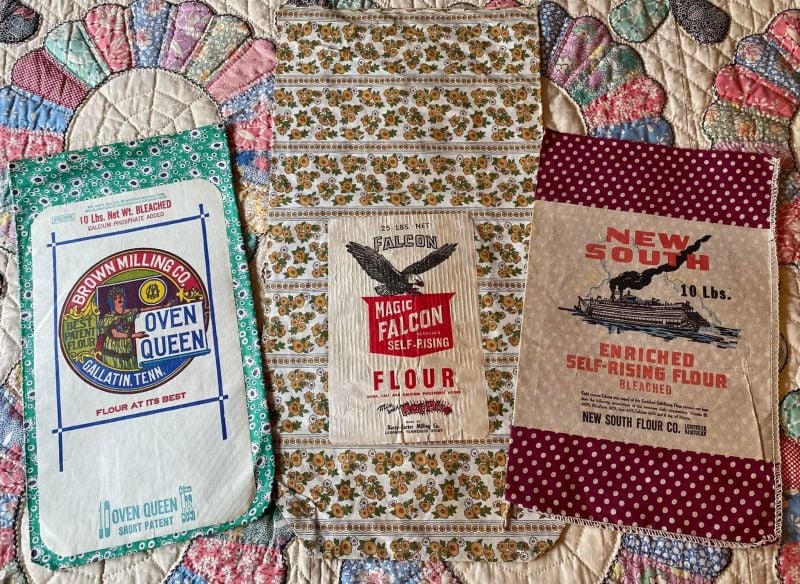
Those Fabulous Feedsacks with Jane Clark Stapel May 1, 2005, 2 pm
Cotton in PA German Life Symposium Saturday, June 25, 2005, 8:30 am-4:00 pm
* Nancy Roan, PA German Quilting Scholar: The Fabrics in Grandmother’s Quilt. Explores the use of cotton and other fabrics used in quilts in Southeastern PA.
* Patricia Keller, Textile Historian: The 18th & 19th Century Transition of Household Production to Industrial Textile Consumption. Findings from the study of more than 3000 Lancaster County 18th and 19th century inventories related to ownership of furnishing textiles, textile fiber, fiber processing tools, looms, etc.
* Susan Greene, Cornell Fellow & Costume Historian: The Use of Cotton in 19th Century Clothing. An examination with noted textile expert Susan Greene of printed dress fabrics used in the 19th century.
* Barbara Garrett: The Fabulous World of Feedsacks. Explore the history, development, popularity and decline of these marvelous fabrics and how they were used in both quiltmaking and everyday life. Feedsack memories will also be shared.
$30.00 Catalog, Luncheon and Breaktime snacks included Reserve your place early!
Date: Tue, 5 Apr 2005 10:20:42 | From: Crm793@
See! I was right! When can we see a picture? No, Gail, I wasn’t grinding my teeth, I was at the dentist getting a new crown fitted for the one that had broken off the root canal. This happened while I was in Colorado but of course I waited till I got home to get it repaired. I drove this time so of course I shopped along the way but no great quilts. I did get a featherweight sewing table in great shape, maybe I’ll try to quilt something on it just to see how the pioneers did it.
Trying to play catch-up after being gone for a long time, Carolyn Miller
From: Ark Quilts <quiltarkmv@>
This is in response to the posting from Kris Driessen krisdriessen@ who forwarded a request from Pat Stringer Pestringer@ about embroidered Davy Crockett quilt pattern blocks.
I have this pattern and a set of completed blocks. I purchased the pattern from Ebay, but not from the person who is noted below in links sent in by other QHL members. The 1955 copyright date is on the pattern but the seller does not list the publisher of the pattern (they could be emailed). I don’t have my copy handy right now but could locate it if you are interested. The computerized Davy Crockett embroidery pattern appears to be a copy of the original iron-on transfer pattern.
A list of Fess Parker’s movie credits, including the Davy Crockett movies and TV shows is available on the Internet Movie Database at http://www.imdb.com/find?qÚvy%20crockett%5C;tt=on;nm=on;mx This also includes movies made by other actors, too. That will give you the dates of the TV program
A DVD with the major TV programs released by Disney is available from Amazon.com http://www.amazon.com/exec/obidos/ASIN/B00005KARG/quiltweb/
Anyone besides me remember the cute little Fireking white glass cups with the Davy Crockett scenes painted on them? Wish I had mine now…..they go for a small fortune in auctions now.
Connie Ark in NW Ohio where spring has sprung (finally!) and the sheep are leaping around the yard
From: Crm793@
Okay, Okay, I know the pioneers didn’t have electricity so didn’t have a featherweight machine, got my centuries confused.
The Davy Crockett quilt that I have is only 9 blocks and the copies on ebay proved to me that part of the quilt is missing. I’m talking about the photocopies of the original patterns, not the ones for an embroidery machine. I would like to know the name of the company that published the patterns to use in documenting my quilt. I purchased it in Hillsboro, TX.
Carolyn Miller
From: “Lucinda Cawley”
My lurker friend Julie and I decided to go to the Quilters Heritage Show in Lancaster, PA last week. On Friday we drove first to York to see the exhibit at the Historical Society. It is a feast for the eyes (at least a dozen pre-1850 quilts and a nice sampling of later quilts as well). Some of the dates assigned seem rather too early to me; those I’ve noted are from the signage. Perhaps some of those who worked on the documentation would like to comment. A fair # of the quilts are in the York Co. book, Quilts: The Fabric of Friendship (page #s in parens). The most spectacular is probably the c. 1790 Medallion with the Hewson panel in the center (19). The label says it’s the only known Hewson with its own printed border. John Hewson was an English printer lured to PA by Benjamin Franklin.
My favorite was a Strippy, c. 1810, with squares on point set alternating with the most amazing block printed cotton chintz of white feather plumes on a swirly blue ground (40). A red and green Feathered Star, c. 1820, (45) also has a splendid chintz border (this quilt is the classic turkey red, green and chrome yellow of the mid-century which makes me wonder about the early date). A reverse applique masterpiece, c. 1830, (140) boasts amazing stuffed quilting. There’s a 6″ Variable Star with alternate muslin squares (includes lots of plaids and stripes) with a twisted ribbon chintz border. A scrappy chintz Nine-Patch with a variety of fabrics in the setting squares looks like something straight out of Calico and Chintz.
The strangest quilt (30) is made of circa 1850 Sunbursts and other circular designs put together (with some additions I think) in the 20th century. An Oak Leaf variation, c. 1860, (22) was adopted as the Quilt Doc. Project logo. A c. 1790 toile (37) and a marvelously graphic Pineapple, c. 1900, (134) are also in the book. Another highlight is a Maryland-style Album dated 1851 with four urns with “S” shaped handles each done in different color combinations (e.g. red, pink and green, pink, yellow and green) with soutache applied as decoration. Southern York County borders Maryland; the Baltimore influence was strong throughout the 19th century.
After a stop for antiquing in Columbia on the banks of the Susquehanna we went to the Lancaster Quilt and Textile Museum. The second round of quilts from the Esprit collection and a delightful collection of Mennonite and Amish stuffed animals are the current exhibit. The stuffed toys which were not the primary draw for me turned out to be enormously engaging. The classic Amish quilts are, of course, in a class by themselves. Trish Herr’s beautiful book Amish Quilts of Lancaster County has great photos of all of them complete with super close-ups of the quilting. One of my favorites is Plate 41 on p. 107, a c. 1935 Bars in green and purple.
Saturday morning we went to Sauder’s. If you’ve never been to Sauder’s you haven’t shopped for fabric. I bought an obscene amount of the Allentown Art Museum’s toiles. I’m thinking really elegant backs. An added bonus this year was an exhibit of antique quilts, all for sale. The best of the bunch was a Fleur de Lis in PA German colors: turkey red motifs with yellow centers on double pink with a Lancaster blue border–it brightened up a miserable rainy day.
Our next stop was supposed to be the show, but I’d been telling Julie about going antiquing with Barb Garrett after the FVF Seminar and we decided to check those spots out first. Julie grew up on the West Coast and she hasn’t gotten used to walking into antique shops and finding lots of really nice quilts (it happens in PA). Obviously it was her lucky day because at our first stop I was distracted by Weller pottery (of all things) and she found the best quilt of the day. It’s a scrappy kind of Jack in the Pulpit block (an amazing variety of 1870-80 fabric) with a very well executed zig-zag border.
By the time we got back to Lancaster it was after 3 p.m. Since neither of us wanted to spend $9.00 each plus $5.00 for parking at the show we went to what I call “The Renegade Mall” across the road (a whole bunch of vendors not part of the show). I consoled myself for not finding a quilt by buying some books from Dover Street: Quilted Memories of Schuylkill County which I’ve resisted buying for years because it’s only 80 pages and cost $35.00, but it was the only PA book I didn’t have and the first thing I saw paging through it was an inscribed Rolling Stone, and Patchwork Iowa Quilts and Quilters by Jacqueline Andre Schmeal which is not a documentation project but has lots of pictures from the author’s collection. Since I found my own chintz quilt the next day right here at home I don’t mind that I didn’t find a quilt in Lancaster or get to the show. Maybe next year.
Cinda on the Eastern Shore where we actually had spring today
Date: Wed, 6 Apr 2005 05:02:00 -0400 | From: “Linda Heminway” <ibquiltn@>
Thanks for the info on the DC pattern. I’m going to keep my eyes open to see if the original pattern comes up on e-bay or elsewhere. I don’t have an embroidery sewing machine and the one presently on e-bay is for that kind of machine, isn’t it? I work the old fashioned way, by hand, when it comes to embroidery.
And yes, I remember my Fireking cerial bowls with Davy Crocket on them, I still have one! I used to have my Kellogs corn flakes with milk and blueberries in them in the summertime, they tasted better when I used this bowl! Also have Fireking coffee mugs, the green colored ones and I swear my tea tastes better in those as well, not sure why. Linda Heminway Plaistow NH