April 7 – 11, 2005
These restored messages come from the Quilt History List, an online forum where quilt historians, collectors, researchers, appraisers, and enthusiasts discussed antique quilts and related textiles. The archive dates from 1996 through approximately 2016 and is being restored gradually. Sign up in the form at the bottom of the page if you want to know when a new page is added. Original spelling, opinions, formatting, and inactive links may remain unchanged.
Primary topics of this QHL Digest:
- Fabric and Textile Terminology — A deep dive into obscure historic fabric terms such as “henrietta,” “neat, natty and nobby,” and satines. (see the article on cotton and textile terms)
- The Origins of “Cloth of Gold” — Members trace the history and true meaning of the fabric term “cloth of gold” versus its imitations.
- To Glove or Not to Glove — A lively debate over whether white cotton gloves should be worn when handling and appraising antique quilts and textiles.
- Regional Quilt Study Group News — Updates on the Iowa-Illinois Quilt Study Group’s meeting photos and the Genesee Country Village Museum’s quilt collection. (see the article on quilt study groups)
- A Literary Quilt Tangent — A lighthearted thread connects Dorothy L. Sayers’ Lord Peter Wimsey novels to the ongoing quilt-history conversation.
From: Barbara Burnham
Carolyn, Perhaps the same ebay seller could tell you about the original patterns. If they are from a published pattern, hopefully she would have checked on copyright before she started selling copies the patterns. Barbara Burnham Ellicott City, MD
Crm793@ wrote: Okay, Okay, I know the pioneers didn’t have electricity so didn’t have a featherweight machine, got my centuries confused.
The Davy Crockett quilt that I have is only 9 blocks and the copies on ebay proved to me that part of the quilt is missing. I’m talking about the photocopies of the original patterns, not the ones for an embroidery machine. I would like to know the name of the company that published the patterns to use in documenting my quilt. I purchased it in Hillsboro, TX.
Carolyn Miller
Good Morning,
Here is a copy of Cathy Litwinow’s Iowa-Illinois Quilt Study Group April 2, 2005 meeting report which she asked me to post to QHL. Photographs will be coming to our webpage and I will post again when those are available for viewing. Enjoy Cathy’s report.
Iowa/Illinois Quilt Study Group April 2, 2005
The magnolia tree in front of the Kalona Quilt and Textile Museum was no match to the quilts presented inside the Grout Church located in the Kalona Historical Village. Last Saturday, 51 quilt historians from Iowa, Illinois, Wisconsin, Minnesota, and Missouri came to the beautiful Midwestern Amish community of Kalona, Iowa to study timeless quilt treasures with fellow quilt enthusiasts. The group was welcomed by The Kalona Historical Village President and Marilyn Woodin, the quilt curator of the Kalona Quilt and Textile Museum.
Cathy Litwinow opened up the morning Show and Share portion of the meeting and the group was treated to some eye candy.
Juanita started the show and share with a Hexagon and Triangle of navy blue, rose, muslin, and brown dating circa 1870’s — a similar quilt can be found on pages 38 & 39 of American Quilts from Michigan State University Museum, 2003. Marilyn G. showed a Log Cabin in the Straight Furrow set. The quilting was done diagonally. The indigo, burgundy, shirting, and pink log quilt came from an estate in Cambridge, Illinois. Barb showed a Single Irish Chain-9-patch, which doubled as an indigo study piece. Other colors were bronze, madder, chrome with feed sacks used as well. Janice found a lovely Log Cabin at a garage sale with Baptist fan quilting. With white and pink centers the logs were mostly browns. Connie brought Grandma Klynn’s family treasure. The pinwheel variation colors were arranged to make identification of the pattern difficult. The family has always called it the Scrappy Quilt. Susan discovered a basket quilt made by Carlie Sexton’s Aunt Raney. Ms. Raney used mail order patterns and magazine articles from the 1920’s that won her State Fair awards. Carlie gave the quilt to a neighbor who lived in Wheaton, IL. The quilt came back to IA. The unusual feature, for a quilt made in the 1930’s, was the small scale piecing and the 5 inch featured wreaths in the setting squares and 3/8th inch grid quilting. Babette wowed the group with a Bow Tie quilt with 2 and a half inch squares. A Trip Around the World setting was used. The quilt thought to be made in Iowa was finished with a now faded red tulip border. Purchased at an auction in Springfield, Illinois, Vyki’s 4-block Cherry Tree Top amazed the group. The historians in the group discovered the pattern was from a 1922 LADIES HOME JOURNAL. Similar quilts are in the Art Institute of Chicago and the Denver Art Institute. LHJ sold a transfer pattern for the quilt. There was a Bucilla kit with four simplified cherry trees and a few birds. The Tree of Life with birds in the branches and vases in between had the border vine just basted on. The number of cherries in the tree’s been not counted but close to 40+ per tree. Jacqueline’s sister-in-law’s father bought a Rose Cross with Oak leaf and Tulips – when the husband saw it he hated it so the quilt became Jacqueline’s. The four blocks were set together with the tiniest green piping between blocks and border. There was wreath quilting. This pattern was seen in the 1850’s-60’s. Another highlight was the bars and stars quilt brought by Carrie. It was thought to be handed down from the owner’s family. A similar quilt can also be found on p.31 of Barbara Brackman’s QUILTS FROM THE CIVIL WAR. Leona found a Tumbler quilt which was almost a charm quilt. There were only a few fabrics duplicated. One unusual conversation print was of a newspaper boy. The top was found in an Iowa antique mall and finished by quilting in the ditch.
Shirley displayed a Burgoyne Surrounded – some of the colors have faded. The quilt was made by a Great Aunt and given to the owner’s mother as a wedding present at her 1896 wedding. 4-H members might have made the Ruby Short McKim’s Flower Garden Quilt (published in 1930). Some of the flowers were colored rather embroidered. Signatures (Initials) were embroidered on each block. The light green alternating blocks were quilted with a four-leaf clover. Bev exhibited a red and tan baby quilt. This 9-patch set on point was dated as circa 1880. A quilt purchased in Des Moines, IA at the Marilyn Hines auction came with a history. Supposedly it was made by a Dr. Park’s wife and daughter Jennie for him to take to the Civil War. The red fabrics were for love of his wife, the pinks for Jennie, and the blue and whites for the Union. Jennie died in her 90’s and the quilt was given to Mrs. Hines. Jane is the fortunate owner. Shirley amazes us each meeting with her fabulous finds. This time it was printing blocks used to print fabric. The holders’ arms got tired holding the heavy wood and metal pieces. The blocks came from Scotland, the registration points were seen on each corner so the blocks would line up accurately. One was a flower pattern and the other could have used for a border. Barbara started a discussion on a tan and dark green quilt with a tape binding, which could possibly be Amish/Mennonite and from Lancaster, PA. It was dated circa 1880’s. Jenean’s Log cabin quilt did double duty as an antique in the am and an Indigo study in the afternoon. Purchased from a Cedar Rapids antique shop, this Barn Raising set top was a study in the many Indigo’s available in the 1870’s. Other colors were creams and yellows. The squares were stitched on a fabric foundation. Over 700 different fabrics were used to make Kim Cairns’ Herringbone/triangle quilt. Purchased at an antique shop in 2002, only 6 or 7 fabrics were duplicated. The rich madders and double pinks added to the movement of the piece. To top it off the back was an Eli Walker fabric. DeLaine brought a double 4-patch made in the 1880-90’s. This was only one of the few quilts that were machine quilted. Catherine Noll Litwinow ended the morning show and share by showing paternal twins Dogwood Blossom Applique Kit Quilts. One had a lime sherbet background and the other a light blue. The kits were “Progress #1392. It should be noted that the kit was also available with a peach background. Next on the IIQSG meeting agenda was a tour of the current quilt exhibit at the Kalona Quilt and Textile Museum entitled “Baltimore Beauties from Iowa.” The Baltimore Album Quilts were appliqués by Thuy Nguyen, these magnificent works of art awed the Study group. This must-see exhibit is a bit of Maryland in the Midwest.
After lunch the group was treated to an afternoon Indigo study. The Indigo program began with a dye kit demonstration, led by Cathy Litwinow and her assistant Babette Moorleghan, of the oxygenation needed to turn the yellow tape which was submerged in a mixture of activated indigo and sodium hydrosulfite solution. The dyeing kit can be purchased from the Universe of Science. Inc at www.universityofscience.com. The Indigo demonstrations items were swept away and an afternoon Indigo Show and Share began. 6 large tables were filled with examples of a large variety of Indigo items. The group got to see: 1 Kimono, 1 silk Sari (a sorry sari), 2 items from the Amana Print Works in the form of an apron and a pillow, 19 quilts, 11 tops, 4 set of indigo blocks, and a comforter. Sixteen pieces of new and old indigo fabrics were shown and Da Gama fabrics (some of these fabrics are available at www.reproductionfabri@).Karan Flanscha shared her Indigo Textile Study notebook with the group. Some Japanese Indigos were brought — To make Japanese Indigo, the cloth is fermented in Japanese Cypress vats. This technique is dying out. (See the 1994 Sept/Oct PIECE WORK MAGAZINE). With Indigo, a difficult to date fabric, it is only through discussion and comparing the fabrics used with the indigo, that some of the pieces were dated. A fabulous Redwork Album Fundraising Signature quilt made by the Ladies Social Circle, M.E. Church, Keota, Iowa was shown to the group by Rachel (from the Wilson Memorial Libary) and Andi Reynolds (IIQSG member). Made in 1890 as a church fundraiser the quilt contains business ads within blocks ($3.00) and signatures (10 cents). The quilt hung in the M.E. Church for years until the church closed. A member stored it in her home for a number of years until it was given to the Wilson Memorial Library, Keota, Iowa which houses Keota’s museum. As of March 2005, this quilt is being documented and researched. The quilt is approximately 60 x 70 and is tied at the block intersections. If you’d like to get a glimpse of some of the quilt blocks on this Redwork beauty, check out this web page: http://www.iowa-history.com/quiltindex.html
The group had time to visit the village with special attention given to the Weaving House. The next meeting of IIQSG is Saturday, August 6, 2005 and we welcome all of you to come.
Sue in Illinois
From: Julie Silber
Hi Everyone, I will make a summary of response about our “stumper” of last week — crib quilt with medallion and diamonds. I’ll post it soon.
Meanwhile, I am looking for Nancy Tuckhorn Gibson. Anyone have current contact info? (Not the DAR address.) Thanks, Julie Silber
–Boundary_(ID_6lW/hThPMNfwWxxmpso/6w)–
From: “Andi”
I’ve come across some other terms in this redwork Keota quilt I don’t know. We have not yet solved the “Port Maniaos” mystery, but IF the apparent “i” is a “t” that lost its cross-bar, as I have seen in one or two other places, then perhaps this is a phonetic spelling of “portmanteaus,” as I originally thought. I still like the suggestion of ‘porte monnaies,’ but can’t find anything to support the idea that this refers to a place of manufacture – although I liked that idea very much.
On to other mysteries: In a block describing a dry goods store that carries cashmeres and mohairs, is the word “Henriettas.” What are they?
In another dry goods block is this phrase, “Young Men’s Suits in Neat, Natty and Nobby Styles.” I’m sure this refers to something other than my current understanding of “neat” and “natty,” and I don’t understand “nobby” as a style, but as a texture.
There is reference to “Tie” and “Cravat” pins. What’s the difference?
At the Iowa Illinois Quilt Study Group, several people looked at this quilt – all too briefly, I’m sure – and were not as persuaded as I am, after mapping the entire thing, about misspellings. So in the same dry goods block that has “Henriettas,” does the term “Satines” mean something besides a misspelled “satins” or “sateens” or something else? And if it is a misspelling, do we have any way of knowing which way the error goes without a store inventor, i.e., a common (currently considered mistaken) spelling for 1890?
We will ultimately have a listing, if not glossary, of all of the advertising terms, so any and all help is most appreciated.
Andi in extremely smoky – wonder why – Keota, Iowa
From: Joan Kiplinger
Andi — henrietta was a fine twill dress goods fabric of wool, silk or blends and with cotton added sometimes.They were mostly used for mourning dresses, skirtings and street dresses. Fabric was classed the same as cashmere [a fine wool or silk/wool woven to resemble cashmere], often advertised together and the names interchanged. Fabric went off market somewhere around early WWI years, possibly late Edwardian. Satine is similar to sateen and satinette, usually of a firmer weave.
Andi wrote:
> >On to other mysteries: In a block describing a dry goods store that carries >cashmeres and mohairs, is the word “Henriettas.” What are they? > > > > >
From: Joan Kiplinger
Andi — I sent last message before adding this. Neat, natty and nobby refer to worsted, wools or wool blends. Neat is neat wool from the sides of Luster sheep which produces a certain type of worsted. Natty is probably the American spelling for natté, a basketweave effect. Nobby I have seen on old catalogs for wool suits having slubs and nubs but know little else about at the moment. A cravats and ties are tied or looped differently.
From: “Andi” <andi0613@>
QHL, this is a cobbled together post from a back-and-forth between very quiet (lurking) Marilyn Woodin and myself about Henriettas:
Hi Andi,
Henrietta was a fabric terminology and very hard to find samples of now. The Amish were very fond of Henrietta. It was not a company name as far as I know and I am stopping here because I long ago looked up Henrietta for some research on Amish fabrics and I shall tell you sometime of my luck of finding some—however—-Eve Granek in her book Amish Quilts gives a reference to Henrietta and I am stopping to find the book and reference——more to come—–marilyn (Woodin)
> aha—-I found it and the name of the book is “The Amish Quilt“. Eve
> and her husband David Wheatcroft bought their first Amish quilt from
> me—old—and she was kind enough to remember and place 2 of my
> quilts that were Kalona quilts and are now in the museum, in her book.
> They were kids at the U then. She has made quite a place for herself
> in information on Amish quilts and David became a “picker”.
>
> “Henrietta. Henrietta cloth was a popular American dress fabric in
> the late 19th and early 20th centuries. It was used widely to
> describe a variety of woolen fabrics. Traditionally, henrietta was a
> cloth of silk warp and woolen weft. By the late 19th century,
> however, the word had come to describe a number of lightweight , cashmere-like fabrics.
> It was made in both woolen and worsted woolen cloth. Some henriettas
> resembled cashmere with a high shiny finish; others had a more salt
> and pepper appearance due to the different colored warp and weft threads.
> The fabric most commonly described in Amish quilts as “henrietta” is
> the salt and pepper variety. This is a type of plain, solid colored
> fabric which actually had a slightly frosted and fancier appearance so
> popular with Amish women. This commonly used material disappeared
> from the market in the 1920’s.” – Marilyn
From Andi to Marilyn:
Fantastic information and fits right in with the dated quilt and the
> other items listed for that dry goods establishment. You hit the
> jackpot on the first try! Many thanks! Do you mind if I post all of
> this to QHL?
Marilyn to Andi:
no, but all the experts in the east will know all about it I am sure—
This is back to Andi’s voice:
Because “Henriettas” appears in not just the same block but the same quadrant of a block as the terms “mohair,” “cashmere” and “linens,” this makes sense to me.
Gracias encore, Marilyn.
Andi
>
More information about the Cherry Tree Quilt . I purchased a finished one several years ago. My quilt was published in a book about 1985 and a gentleman called me to tell me about his Cherry Tree quilt. It was published in 1940 in Good Housekeeping and the pattern is from a quilt in Art Institute of Chicago collection that dated from1820 . It was manufactured by / Bernhard Ulmann Co. 30-20 Thomson Ave. Long Island City, N.Y. 11101 for G.H. He sent me copies of the G.H. info he had obtained from them and it was very complete . Amy Goodhart in sunny Miami
From: Sandra Millett <smillett@>
Joan: So nice to know that others have confirmed that the Egyptian cotton from JoAnns is wonderful. Almost have my book proposal ready to go! If not for a writer’s conference this weekend, it would be in the mail. Sandra Millett
Date: Thu, 7 Apr 2005 06:44:00 EDT | From: Litwinow@
Good Morning, Please add a huge thank you to Denise Clausen! She gave the Iowa/Illinois Quilt Study Group permission to use “Indispensable Indigo-The Deepest of Blue” information found on her web site. http://www.oregoncoast.com/denisedesigns/indigo.htm It’s a wonderful article. Cathy Litwinow (Up to early to know what the weather is like)
From: “Lucinda Cawley” <lrcawley@>
I think we’ve had this discussion before, but now it’s my problem and I can’t remember the answer. I saw a “splasher” embroidered in dull, blue gray. A girl holding a basket of eggs is standing with a couple of geese in front of a stove. Above her are the words (I have no idea what language this is so I’m sure my transcription is full of errors) “Kybapuya Mara za pyrakje uehe wruyur Fycke gara.” What is the language and what does it mean? Thanks. Cinda on the Eastern Shore
Date: Thu, 7 Apr 2005 11:39:01 -0500 | From: “Susan Wildemuth” <ksandbcw@>
The Iowa-Illinois Quilt Study photographs from our April 2, 2005 meeting are up on our web page.
http://www.quilthistory.com/study/IAIL.htm
Thanks a million for all the work you do Kris for the regional quilt study group web pages. We appreciate it.
I’d like to second Cathy’s thank you to Denise Clausen — we appreciate your kindness in granting us permission to use your article for a handout in our Indigo Study.
We’d also like to thank Babette Moorleghan for helping with the Indigo Study Demonstration and for helping during our morning show and share. Thanks to Billie Nickolan and Andi Reynolds too.
Our next meeting is going to be Saturday August 6, 2005 — we are once again going to have an afternoon study with a theme and we will e-mail QHL with the details as the date draws near.
Enjoy the pictures– Sue in Illinois
From: “Susan Wildemuth” <ksandbcw@>
Some have e-mailed me with questions about how to enter our webpage to see the April 2, 2005 meeting pictures. http://www.quilthistory.com/study/IISQG.htm
Sue in Illinois
Dear list, I asked,Kris, our list Mom, if she could post two of the handouts that my partner, Colleen Callahan, and I use when we give our day long textile conservation workshop. She very graciously added it to the articles on the quilt history web site. You can find them at: http://www.quilthistory.com/articles.htm. One is ‘Dry Cleaning Historic Textiles’ and the other is: ‘Wet Cleaning Historic Textiles’. As we do tend to focus on costume collections, just substitute the word “quilt” for the word “costume” and you have a tailor made document! Hope this helps somebody somewhere. Our motto is: “take good care of the object and it will take care of you!” Newbie Richardson in 88 degree Northern VA – if this keeps up the tulips will die before they bloom!–
From: “Andi” <andi0613@>
Thanks for all y’all’s help on Henriettas; Neat, Natty and Nobby; and Satines. Not a day goes by that I don’t learn how much more I have to learn. Yowza.
On the Keota redwork quilt is a signature, “C D Pringle, Honolulu, HI.” It is the only signature followed by a place name (although there are entire blocks assigned to the town of Harper, IA). Pringle’s name is followed by two words: “Hoomanawanui.” And “Kalakapu.” Each written just that way – enclosed in quotation marks, followed by a period. We as yet have no connection between C D Pringle and Keota, but as this was an M.E. church-based quilt, we think he might have been visiting family (no other Pringles, though) or been a missionary traveling through at the time the quilt was being subscribed. Also, his name is in a block that is more of a mixed bag than most of the blocks, and it is the last one, bottom right corner. This suggests happenstance more than planning to us. Can our Hawaiian members help with the quotation words? Thanks in advance.
Andi in Keota, Iowa
From: “Beth Davis”
The Genesee Country Village & Museum in Mumford, NY (20 miles south of Rochester), a “living” museum is giving visitors a visual history lesson once again this year with the exhibit “Quilts Uncovered: Treasures from Genesee Country Village & Museum.” Three rooms of the John L. Wehle Art Gallery are devoted to the exhibition of pieces from the museum’s wide-ranging historic quilt collection highlighting virtually every style from the 19th century. This spectacular show features whole-cloth, pieced and crazy quilts, as well as quilted garments, children’s dresses, and pristine uncut yardage of 19th-century quilting fabrics. A new book based on the museum’s quilt collection will be coming out in May! Details regarding “In Praise of Quilts” will be available soon. In conjunction with the exhibit, the village celebrates the craftsmanship and art of quiltmaking through daily demonstrations of piecing and hand quilting in the Foster-Tufts House (c. 1836). On May 21 and 22, 2005 from 10:00 am to 5:00 pm each day, the museum will host “In Praise of Quilts,” an event featuring lecture by nationally known quilt historian and author Shelly Zegart from Louisville, KY on Saturday May 21 “Political Quilts: A Women’s View” and by Dee Stark, author of “A Spider Web for Luck: Symbols & Motifs used in Crazy Quilting” On Sunday May 22. A tearoom will offer light lunches and refreshments. There will be vendors, demonstrations raffle quilt, and quilt appraisals by appointment. The exhibit runs from May through October 2005. For more information or to make an appointment for an appraisal: Please call (585) 538-6822. Visit the museum on the Web at www.gcv.org.
If you have any questions regarding the show please let me know. Regards, Beth Davis
From: “Audrey Waite” <awquiltr@>
I searched the archives and couldn’t find the digest where we had discussed the origin of cloth of gold. As I recall it was a line of fine cottons in many solid colors available in the 30’s. I have a 30’s quilt with “cloth of gold” showing in the selvedge. Hopefully someone has a better memory or skills in searching than I.
Audrey Waite Sedona, AZ —
From: Joan Kiplinger <jkip@>
Audrey –Per 1984 and 1990 Ladies Circle Patchwork Quilts magazines, Cloth of Gold and Bluebird – Cloth of Gold were the names of a converter of piece goods specializing in a line of fine cottons—lawn, batiste, nainsook, dimity, muslin, and using the name of an old-time favorite fabric which was woven and dyed in different southern mills and distributed by various companies and which became synonymous with quality cotton piece goods. I have a 1920s Farmers Wife quilting booklet which recommended and sold pure white Cloth of Gold for quilt backing, guaranteed not to yellow. I also have CoG & Bluebird nainsook, longcloth and lawn yardage from the 1940s-early 50s. I understand that as late as the 1980s a fabric catalog was offering CoG though I don’t know name of catalog or if there were only one fabric or the whole line
From: Alice Kinsler
Dear List Members, I have to crow a little and share that not only has my exhibit, “From Dust Bowl to Salad Bowl: The Quilts and Quiltmakers of the 1930s Migration to the Salinas Valley” been accepted as an exhibit at the National Steinbeck Center in Salinas CA (Sept 30-Feb 28), but I just received notification of a $5,000 graduate research grant from the Craft Research Fund for projects and graduate research. A total of 57 applications from 25 states and 3 foreign countries were submitted for project grants and 12 applications for graduate research grants. The National Advisory Board of the Center for Craft, Creativity and Design met April 1 and 2 and recommended 10 grants totaling $95,000, Needless to say, I am honored and ecstatic!
Thanks to all of you who have given me encouragement, ideas, suggestions and feedsack items (you’re a peach, Xenia). And Merikay has agreed to do a lecture/workshop. I’m really excited!
Thanks, Alice Kinsler
From: RBCochran@
I would like to draw your attention to an article by Richard Preston in the April 11, 2005, issue of the New York. It is called “Capturing the Unicorn,” and relates how two mathematicians helped the Metropolitan Museum of New York when the Unicorn Tapestries (which hang in the Cloisters) were being conserved. The link is http://www.newyorker.com/fact/. You’ll learn about textile conservation and digital photography. –Rachel
From: “Lucinda Cawley”
Great news from Beth Davis that there’s a book coming about the Genessee Country Museum quilts. I saw the exhibit last fall (I’m now trying to figure out a time to see it again) and it is wonderful. The museum is not just a stop on the way to someplace else (e.g. Niagra Falls); it’s a destination, one of the largest outdoor museums in the country. You can easily spend an entire day exploring 19h century buildings with period furnishings moved to the site from all over western NY. It’s a village setting a la Old Sturbridge Village with costumed interpreters (storekeeper, blacksmith, printer, quilters, etc.). You can explore the Finger Lakes on the same visit. Cinda on the Eastern Shore
From: Mary Persyn
A piece of trivia – In the last of the Lord Peter Wimsey novels published during Dorothy L. Sayers lifetime (Busman’s Honeymoon), Lord Peter and Harriet Vane get married. Harrier wears a dress of cloth of gold. Peter’s catty sister-in-law writes to a friend “Harriet … had enough sense of propriety not to get herself up in white satin and orange-blossom; but I could not help thinking that a plain costume would have been more suitable than cloth of gold.” From that description I have always thought that cloth of gold was something more than cotton.
For the meaning behind the quote you have to be familiar with the whole Lord Peter series of novels. If anyone cares, let me know and I can send you an explanation.
Dorothy L. Sayers was one of the foremost mystery writers in the “golden years” of the British mystery and was a contemporary of Agatha Christie.
Saturday morning trivia from sunny Valparaiso IN
Mary
From: “Karen Evans” <charter.net>
True cloth of gold was silk warp and genuine gold weft. There were imitations and substitutes from early times, and I seriously doubt that Harriet would have worn genuine cloth of gold because of the cost (it was also nearly impossible to find by the 1930s).
However, gold cloth or silver colored cloth (probably a silk of some sort) was considered perfectly fine for a second wedding. Since Harriet had lived with a man before her marriage, and all of England knew it thanks to the events in =3DStrong Poison,=3D the comment about cloth of gold being more suitable than white in her case was a way of acknowledging that she had been in a relationship that approximated marriage.
I seriously doubt that Sayers meant American cotton. And wasn’t the Harriet’s gown made by Worth, which was a high-end couture house?
Karen Evans (who first read a Lord Peter Wimsey book in junior high)
And for those who wish see genuine cloth of gold, here’s a link to a reconstruction of the Golden Gown of Queen Margrethe I of Denmark http://www.virtue.to/articles/margaret.html ——=_NextPart_000_0018_01C53D00.38BECD50–
From: Joan Kiplinger
Mary — I have read all of Dorothy Sayers works and all of the Lord Wimsey whimsies. 😀 The cloth of gold referred to is the original cloth of gold from medieval times when silver, gold and other metalics filaments were actually woven into cloth, usually linen or sometimes silk or velvet. I would have enjoyed Dorothy if she sometimes were not so detailed and dragged out — the Nine Tailors for example.
From: “Lucinda Cawley”
Joan, The Nine Tailors is my absolute favorite of the Lord Peter Wimsey mysteries. Without it I’d know nothing at all about bell ringing (G). Dorothy Sayers was also a noted translator of Dante. Cinda, a big Dorothy L. fan, on the Eastern Shore
From: Joan Kiplinger
Lucinda — my hat off to you for bearing with all those descriptive pages. I felt as if I had been gonged out of my gourd by the time the dissertation ended — after nearly 40 years I still hear ringing in the little grey cells. 😀 My favorite UK mystery writer was Marjorie Allingham who had one character in the fashion business so that made her Campion series even more special. And I still say to this day “wotcher think”, a line made famous by the one and only world’s best valet Magersford [sp??] Lugg.
From: “Karen Evans”
Very cool! Any chance there will be links to the exhibit so that those of us in other states can get a look? It sounds fascinating.
Karen Evans
From: “gingham@”
Thank you to everyone who replied on and offlist to my question about the quilt my friend (my sister) bought on ebay and confirmed my guess that it was an older top that was quilted later and not Amish.
Now another question-what is a good/quick/reasonable place to buy white gloves? I need a pair soon for my appraising classes. I can do an internet search but it would be nice to narrow down the choices. Thanks in advance. Sandra Starley in Utah
From: “J. G. Row”
Sandra,
Go to your local drug store or “big box” store and look in the “beauty” section. Most stores sell very inexpensive, prepackaged, serviceable white gloves for nightime use with slathered on creams and lotions. That is where I found the ones I use. They wash very well too, as you would imagine, and one size fits most.
Judy, aka the Ringoes Kid judygrow@
Date: Sun, 10 Apr 2005 09:07:44 +0100 | From: Sally Ward <sallytatters@>
This may be a ‘cat amongst the pigeons’ question, but…
Is the general consensus on this list that white gloves Should Be Worn? I’ve just moved from a volunteer post where they were the first thing donned in the morning and the last thing removed at night, to one where there is not a pair in the house. The opinion in the new place is that gloves make you handle items with less care because you can’t feel them, and that clean and frequently washed hands are preferable.
Knowing how dirty the gloves used to get, how often we changed them during the day, I am now sometimes more concerned about what is getting on me than what is getting on the quilts!<G>
Sally W
From: Judy Kelius <quilts@>
HIf you need just one pair, call up a stamp collecting or sports card place near you . . . they will probably have a pair they will sell you. Or check a consignment shop . . . they may have a pair of wedding gloves or other old white gloves – if they are too long, just cut off the excess. You don’t need anything fancy, just clean and white. Does the person teaching the class have extras to sell?
For quantity, eBay can’t be beat – you will find a number of vendors selling white gloves (look under the business and stamps categories) – this is where I bought them when I worked at a quilt museum – paid less than $1.00 a pair and even washed them and they didn’t fall apart <GR>.
Date: Sun, 10 Apr 2005 11:05:46 -0400 | From: sewsewsarah@
<<Now another question-what is a good/quick/reasonable place to buy white gloves? I need a pair soon for my appraising classes.>>
Try a band supply store.
Sarah in WV
Date: Sun, 10 Apr 2005 10:50:31 -0500 | From: “Laura Syler” <texas_quilt.co@>
Also check at photography supply stores…that cater to professional photographers and developers… Used for handling negatives and prints. That is where we have found them for the Dallas guild. If you need just a pair for class…check out the antique malls. We found some great pairs with bows and flowers for class….quite a sight!!
Laura Hobby Syler Certified Appraiser of Quilted Textiles Richardson, Texas
Date: Sun, 10 Apr 2005 10:09:28 -0700 | From: “Margaret Geiss-Mooney” <mgmooney@>
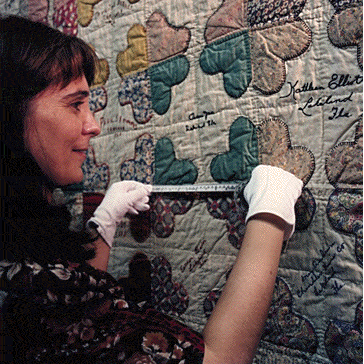
Good morning, QHLers – Let me put in my .02 here on the subject of “glove or not to glove” AND which glove to use. I would recommend wearing gloves – even though you wash and dry your hands frequently. Your skin (especially hands) give off constantly moisture, salt and oils/sebum. Plus if you have applied any kind of lotion/salves/etc. The gloves also protect the quilt (read: textile and/or costume and/or any other object) from jewelry you are wearing on your hands that could snag/rip/tear. Therefore you won’t have to remove your rings, with the possibility of misplacing them.
Now to which gloves to wear: my preference is to use nitrile gloves (in a bright purple colour!). The most important reason why I wear nitrile gloves is to protect me from what is on the quilt. I am not talking about just the usual dirt and smudges but the contamination possible if the quilt has been doused with mothball crystals (either naphthalene or paradichlorobenzene ones) or other chemicals (i.e. Febreeze, Lysol). Of course, this is usually a problem for “older” quilts rather than new ones but lots of folks have been brainwashed into thinking that if they start dousing even their new stuff with mothball crystals, there won’t be any insect activity/damage (and don’t get me started on THAT subject either!) The chemical contamination is not “stopped” with cotton gloves. If cotton gloves are not changed and/or washed between quilts, that contamination can get to your skin quickly especially if you have handled a really contaminated quilt.
The nitrile gloves are now readily available from hardware stores to automotive supply stores to grocery stores, at very cheap prices ($11.50 for a box of 100 gloves). You could even probably sweet-talk your medical professional out of a couple of pairs and/or ask to see which size works best for you (sizes range from very small to extra large). I haven’t bought them on eBay but I am sure that if you entered “nitrile gloves”, there would be a huge selection available. They do not have to be washed (a big chore for cloth gloves! now don’t get me started on the proper washing/cleaning technique! <g> by volunteers at home on their own time cuz there is no washer/dryer on site), are cheap enough to be disposable after just one wearing, won’t cause allergic reactions like latex, and you can get them a variety of colours besides purple (including beige and light blue). I always use the gloves just once. I do get the powderless variety so there is no possible contamination back on to the quilt from that. I find that the nitrile gloves still give me “excellent” feel during my examinations and can even sew in them (but I do a lot of hand sewing, both with a straight and a curved needle). Remember that adage “ounce of prevention is worth a pound of cure” also applies to our own health!
Regards, Margaret (Meg) Geiss-Mooney Textile/Costume Conservator Professional Associate, AIC mgmooney@
>>Is the general consensus on this list that white gloves should be worn?>>
— No virus found in this outgoing message. Checked by AVG Anti-Virus. Version: 7.0.308 / Virus Database: 266.9.5 – Release Date: 4/7/2005
Date: Sun, 10 Apr 2005 09:48:43 -0600 | From: Kay Fair <Kaytreestump.com>
Isn’t it amazing that so many quilters are also Lord Peter fans as well! I have been trying to read in vain (no pun intended) Jill Paton Walsh & Dorothy L. Sayers new book “A Presumption of Death.” Ms. Walsh uses previous writings of the late Sayers as a base for her story. I am just having a hard time with it. Has anyone else read it? Perhaps I’m just missing the interaction between Lord Peter and Harriet.
Another huge Dorothy Sayers fan, Kay
Kay Fair, MLIS Brogden Research FinderWare at www.finderware.com Small Business, Classroom and Home Library Software
From: “Nancy Gibbs”
Yes, I read it some time ago–I really liked it. Thought she did well with the carrying on of the Sayer style.
Nancy in PA
From: “Lynne Z. Bassett”
I found really good white cotton gloves for about $1 a pair at Golden’s Antiques Supply, on the web.
Best, Lynne
Date: Mon, 11 Apr 2005 01:00:44 -0400 | From: blackriverquilts@
I’ve read with interest the messages regarding glove use – and so happy to read that one person recommended *nitrile* gloves – instead of natural rubber latex gloves. Many, many people (ahem,such as me) are allergic to the natural rubber proteins in the latex gloves and could have an anaphalactic reaction. A recent local quilt show passed out latex gloves instead of white cotton gloves, and show personnel heard from many women, requesting use of something else, due to the allergy problem. (there’s quite a few of us out there) Nitrile is an excellent substitute. Off my soapbox, and back to reading and learning so much from all of you about quilt history. Thank you! In Stitches, Buckeye Bev
From: Gary Parrett
Last week, I needed a break, so went to an antique shop in our area and found a little treasure. It is a booklet, about the size of a thin paper-back book, titled, A Lady’s Book on Art Embroidery in Silk, with Engraved Patterns, published by M. Heminway & Sons Silk Co.,Manufacturers of Superior Silk for Decorative Needle Work, 1886. It was compiled by George C. Perkins.
Pasted inside the front cover is a pattern for a crazy square complete with embroidery stitches to be used in the block. The embroidery stitches shown in the book are not beginning stitches, some I had not heard before, such as the Skeleton stitch, Kensington stitch, Snow Ball Flower. Mainly there are patterns for items to be embroidered for the home. Does anyone know what Portieres are? The instructions say to use Sheila cloth in the making of the items. “It is heavy in texture, and being alike on both sides, renders the ordinary lining needless.” (something to do with windows)
This statement is made in the introduction: “Within the past year a very important discovery has been made by us (and is confined to us), in producing the Japan Wash Embroidery Silk and Japan Floss.” Apparently this silk was warranted for its color-fastness, “and will be found on sale by leading dealers in all the principal cities of the United States and Canada.”
As I have read further, there are a few pages on crazy work which discuss the use of various stitches and motifs. Then, at the bottom of the instructions for a table cover, this paragraph appears:
“It is a mystery where the idea of “crazy” patch-work originated. It would not be an unreasonable supposition that it opened its eyes of origin among the unfortunates in some of our asylums, for, although partially demented, the majority are neither idle nor lacking in sensible adaptation to various works of skill.”
This is followed by instructions on how to make a Lambrequin.
Another theory on the beginnings of “crazy” work, Karen
Date: Mon, 11 Apr 2005 14:53:57 -0400 | From: Joan Kiplinger <jkip@>
Karen — as the name implies, portieres are drapes for wide room entrances. Some were just a single panel at each side for decoration; others were full width and could be drawn to close of room. Many were floral cretonne or other sturdy cotton They were less expensive than installing double doors. Portieres were still in style through WWII but then seemed to disappear. Most movies featured them; next time you see some of those oldies, check them out.
Date: Mon, 11 Apr 2005 11:59:02 -0700 | From: “Margaret Geiss-Mooney” <mgmooney@>
Hi Candace – I’m putting my cheque into the snail mail to you today so save a copy for me! Did you write the catalogue too? Regards, Meg Geiss-Mooney 1124 Clelia Court Petaluma, CA 94954
—–Original Message—– From: Candace Perry Sent: Tuesday, April 05, 2005 6:54 AM To: Quilt History List Subject: [qhl] Cotton in PA German Life — info
Well, I’m finally wading out of my mess and can publicize this project. A full color catalog of the exhibition is available for $5.00 (a grant funded bargain) plus postage (Visa, MC, Discover, checks…215/679-3103 or email me)…there will also be an online exhibition at www.@ in the very near future! Directions and other incidentals are available there also. See below for lots of info — there are also related sewing programs thru our education dept. Candace Perry once curator, now lunatic Schwenkfelder Library & Heritage Center Pennsburg PA
— No virus found in this outgoing message. Checked by AVG Anti-Virus. Version: 7.0.308 / Virus Database: 266.9.5 – Release Date: 4/7/2005
Date: Mon, 11 Apr 2005 15:36:42 -0400 | From: “Candace Perry” <candace@>
Thanks Meg! Yes, I did write the catalog, which makes me very nervous…you know, putting yourself out there… Hope you enjoy, Candace
—–Original Message—– From: Margaret Geiss-Mooney Sent: Monday, April 11, 2005 2:59 PM To: Quilt History List Subject: [qhl] RE: Cotton in PA German Life catalogue
Hi Candace – I’m putting my cheque into the snail mail to you today so save a copy for me! Did you write the catalogue too? Regards, Meg Geiss-Mooney 1124 Clelia Court Petaluma, CA 94954
From: Dana Balsamo <danabalsamo@>
There is a copy of Peto’s Historic Quilts on eBay now:
http://cgi.ebay.com/ws/eBayISA
Right now the starting bid is low, but this could get up to $100 and would still be a good buy.
No affiliation.
My best, Dana
Material Pleasures Affordable Vintage Linens, Lace, Textiles, Buttons & More! www.material-pleasures.com
Date: Mon, 11 Apr 2005 15:55:45 -1000 | From: Loretta Woodard <Lwoodardhawaii.edu>
Aloha–I just discovered your request for information on the identity of CD Pringle, Honolulu Hawaii and his connection with Keota, Iowa. I found no mention of him in local history books in my collection but I’ve been having fun out on the web today and found several references to a C. D. Pringle in the islands. He is listed in the 1910 Hawaii census as a 44-year old bachelor. Pringle was born in Iowa (voila!), his father was born in Indiana and his mother, in Iowa. Unfortunately, I can’t make out his trade or profession (the census taker wrote the job code numbers directly over the words) but the “general nature of the business was “US Bonded <something abbreviated.” He owned his own home, free and clear.
A CD Pringle was postmaster in rural Hanapepe on the island of Kauai between 1894-1896. He’s mentioned on the Post office in Paradise web site at: http://www.hawaiianstamps.com/iskauai1.html.
And a C D Pringle is listed as a passenger traveling from Kauai to Oahu in the Hawaiian Gazette January 12 1897 at http://www.newspaperabstracts.com/link.php?id1600. He’s named with other notables in Hawaii’s social register, along with “54 on deck.”
It’s quite likely these tidbits all refer to the same man.
The phrase “Hoomanawanui” means Patience, steadfastness, fortitude, and to have patience, “etc,” according to the Pukui and Elbert Hawaiian Dictionary, p. 238. So far, I haven’t had any luck with “Kalakapu.” Unfortunately, the link to the enlarged image of the bottom right square is dead so I can’t see the embroidery myself.
> On the Keota redwork quilt is a signature, “C D Pringle, Honolulu, > HI.” It > is the only signature followed by a place name (although there are > entire > blocks assigned to the town of Harper, IA). Pringle’s name is followed > by > two words: “Hoomanawanui.” And “Kalakapu.” —– Laurie Woodard Project Director Hawaiian Quilt Research Project 558 Palawiki St. Kailua, HI 96734