May 14 – 17, 2004
These restored messages come from the Quilt History List, an online forum where quilt historians, collectors, researchers, appraisers, and enthusiasts discussed antique quilts and related textiles. The archive dates from 1996 through approximately 2016 and is being restored gradually. Sign up in the form at the bottom of the page if you want to know when a new page is added. Original spelling, opinions, formatting, and inactive links may remain unchanged.
Primary topics of this QHL Digest:
- Gee’s Bend Exhibit: Personal Reactions — Members share firsthand accounts of visiting the traveling Gee’s Bend quilt exhibition.
- Should You Wash an Antique Quilt? — A detailed how-to discussion on safely wet-cleaning a stained antique quilt, including bathtub technique and handling cautions.
- Vintage and Antique Sewing Machine Collecting — Members compare notes on upgrading and collecting vintage sewing machines.
From: “Julie Silber”
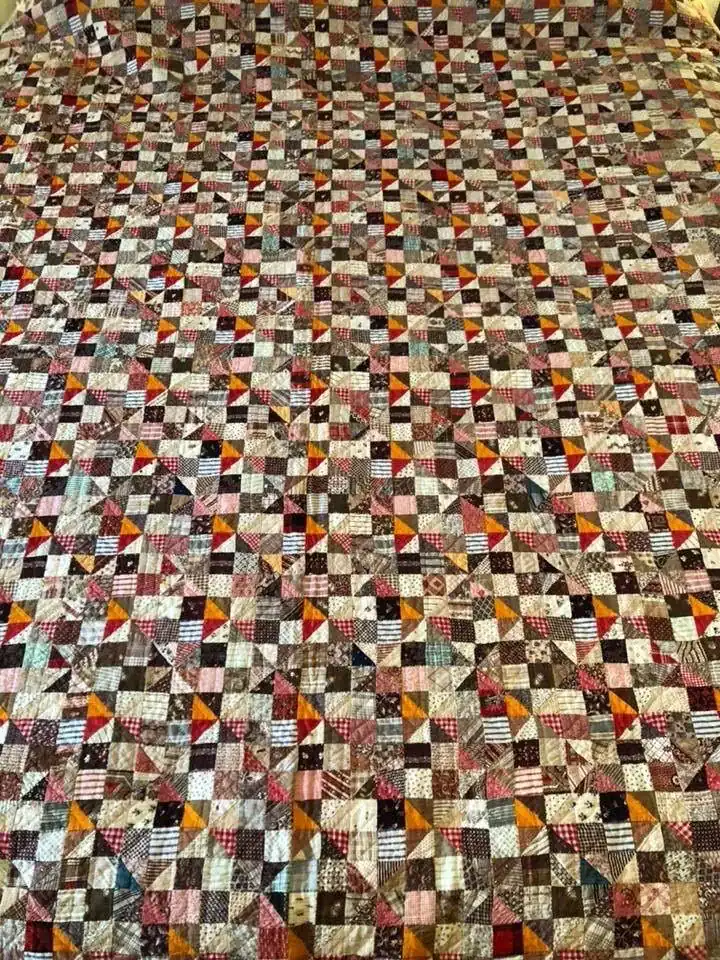
A quick question: Where do I put a photo I would like to show the list? Thanks, Julie Silber
From: “Lucinda Cawley” <lrcawley@>
Went to see the DAR (Daughters of the American Revolution) exhibit on brides. If you want a totally happy experience, this is it: wedding dresses from the 1790s to the present with fascinating social commentary and grooms and attendants in appropriate dress in some vignettes. Of course, the best thing about any visit to the DAR is that there are always 6 or 8 quilts to be seen in the gallery and others in the period rooms. This is the only museum in D.C. where you can count on seeing a number of quilts. In keeping with the wedding theme there are two backlit whitework quilts. One from Ridgefield, CT dated 1820 is referred to as a padded counterpane. It has a center flower basket, surrounded by concentric squares of stuffed and quilted grapes and leaves (most unusual and not, perhaps, the best design choice), cornucopias in the corners, a border of vines and flowers and fringe on three sides.
The second, dated 1850-1875, is surprisingly the more wonderful of the two. It is a sampler of stuffed quilted motifs and just about the most beautiful whitework quilt I’ve ever seen (and I’ve been to the whitework program that Nancy Gibson used to do in January at the DAR!). In the pullout cases were six other wedding related quilts: a not terribly successful attempt to mimic the Baltimore Album style made in Elkridge Landing, MD circa 1850; a quilt made in Manhattan,KS (1880-1895) by two mothers-in-law has blocks composed on six of the eight blades of a Lemoyne Star with a square in the space where the other two diamonds should be; a surprising applique in aqua blue and beige (sassafras leaves in the four corners of the block with a simple vine and leaf border) made in 1853 by Mary Ann Stickney for her wedding; a Garden Maze quilt made c. 1830-40 in Greensburg, PA from a bride’s “second day dress”;. a Rose variation with wonderful stuffed quilting and a fabulous border of swags, berries, flowers and leaves made in Missouri in 1852 (the names of the bride and groom are in the quilting and an 1842 indigo and white Sunburst with stuffed feathered circles and a stuffed running feather border with a dogtooth appliqued after the quilting so that it overlaps some of the feathers (it was made in Pittsburgh for the trousseau of Lydia Crosby and is just too beautiful for words!).
We had a true quilter’s experience while drooling over the whitework. A frantic looking woman rushed to the back of the gallery and said, “They told me there where eight quilts and I only see two. I’m from Vermont; my husband is circling the block in the car.” We showed her the pull-out cases; she didn’t have time for the period rooms. After about five minutes she rushed off; her parting words were, “Maybe I’ll see you at the Vermont Quilt Festival.” Cinda on the Eastern Shore
Date: Fri, 14 May 2004 21:35:58 -0500 | From: “Karen Quilts Texas” <karenquiltstexashouston.@>
Julie –
Go to the Quiltropolis.com home page (www.quiltropolis.com). Click on “Photo Albums” and follow the directions to set up and album and upload pictures to it. Let us know if you have any problems.
Karen A. Spring, TX
—–Original Message—– From: Julie Silber Sent: Friday, May 14, 2004 8:09 PM To: Quilt History List Subject: [qhl] Where do I put a photo?
A quick question: Where do I put a photo I would like to show the list? Thanks, Julie Silber
Date: Fri, 14 May 2004 19:32:45 -0700 | From: “Laurette Carroll” <rl.carroll@>
Julie, QHL and Vintage fabrics share an eboard. Go to www.vintagepictures.eboard.com/ then click on post/edit mode. the password is vintage.
Laurette
> A quick question: > Where do I put a photo I would like to show the list? > Thanks, > Julie Silber
Date: Fri, 14 May 2004 19:50:22 -0700 (PDT) | From: Joe Cunningham
I flew across the country to see the Gee’s Bend exhibition at the Corcoran Gallery, and liked it very much, although I had quibbles with the installation itself. To me, it does not seem odd that art critics liked the show so well, as the best quilts in it do indeed look much more like heroic abstract expressionist paintings than most people’s ideas of quilts. I thought the best ones were truly, profoundly great.
But the show itself, I thought, should be renamed, “One Guy’s Favorite Quilts from Gee’s Bend.” I mean, any of the quilts you see in the historical Gee’s Bend photos are mainstream American style.I think it is wonderful that the quilts and quiltmakers received this much attention, but we need to keep in mind that these quilts represent only one collector’s aesthetic preferences.Still, people will decide for themselves that these quilts represent something else, like “African American”, or “rural” or something. I don’t know how to prevent that.
Joe Cunningham in San Francisco
Date: Sat, 15 May 2004 09:19:20 -0400 | From: “sue reich” <mreich@>
Brimfield had one of its most beautiful weather weeks. If this event which occurs three times a year is any indication of a pick-up in the economy then we are all golden, as the kids would say. I went yesterday and I have never seen it as crowded. In addition, there was more furniture as opposed to smalls of years-past, and quilts in abundance. I don’t mean dealers of quilts but quilts were everywhere in booths with prices lower than I have seen in years. The quilt dealers still had their prices jacked up but those with a variety of antiques using quilts as a backdrop were selling quilts well below the $1000 range and more in the $300-$400 range and lower. I stole an eight-point star T quilt, 1830s-40s with only one square shattered for $135! I passed up a fantastic nine-patch on point with black and purple neon sashing with the 1880s for $150. That one will haunt me for awhile. sue reich
Date: Sat, 15 May 2004 09:22:15 -0400 | From: Kathie Holland <kathieholland@>
–Boundary_(ID_cECyW0HuuqUPRbRLEqi8yA)
When is the earliest bowtie pattern you have seen? thanks, Kathieholland@ if you could email me privately I would appreciate it as I am on digest and need an answer quickly!!!!
–Boundary_(ID_cECyW0HuuqUPRbRLEqi8yA)–
Date: Sat, 15 May 2004 14:23:14 -0400 | From: “Nancy Roberts” <aquilter@>
I’m recalling an exhibit and magazine articles on “Maverick Quilts” that included quilts made from unusual materials, designs, etc. Julie Silber, didn’t you organize the exhibit? How do these compare with the utilitarian quilts under discussion here? Nancy Roberts
PS-Aha! a little research before sending this and I found this link to some excellent photos and information. http://quilting.about.com/library/houston99/bl-maverick.htm
Date: Sat, 15 May 2004 16:28:06 -0700 (PDT) | From: Babette Moorleghen <happyquilterq@>
Sorry, but my delete finger was too quick so have to send through the list! However, I did want to reply that while I don’t know the “earliest” bowtie quilt around, I do have one that is definitely from the 30’s and has a darling applique border around it. It is hand pieced and hand appliqued and some of the fabrics are feedsack from that era. Don’t have a way to post a picture or I would. Hope this helps you out. Hugs, Babette
Date: Sat, 15 May 2004 20:10:37 EDT | From: Palampore@
Some of you have heard this story from me before, but thought I would share with you what I wrote to Sharon.
Sharon, my aunt had stories about using quilts to wrap tobacco with. ( I grew up on a tobacco farm.) My sister who is 56 remembers my daddy piling them up and burning them when they were in shreds. That is why there aren’t lots of OLD quilts in eastern NC. They were used to wrap tobacco to keep it moist in the pack houses, and to act as a tied sheet to hold the bundles together to take to market on the back of trucks. Old (turn of the century) quilts survived in my mother’s family, because my grandfather sold farm machinery, so the quilts weren’t sacrificed. I learned all of this on a day when I had gone home to take pictures of all of my relatives OLD quilts. They didn’t have any. There were a few from post depression, but most were from late 1950’s up. My aunt said they could always make a quilt, but they couldn’t always have a good crop. It was a matter of economics….not history. Where did you get your story from? Mine comes from Wayne County, NC. Thanks for sharing, Lynn Lancaster Gorges
Date: Sat, 15 May 2004 18:16:35 -0700 | From: “Julie Silber” <quiltcomplex@>
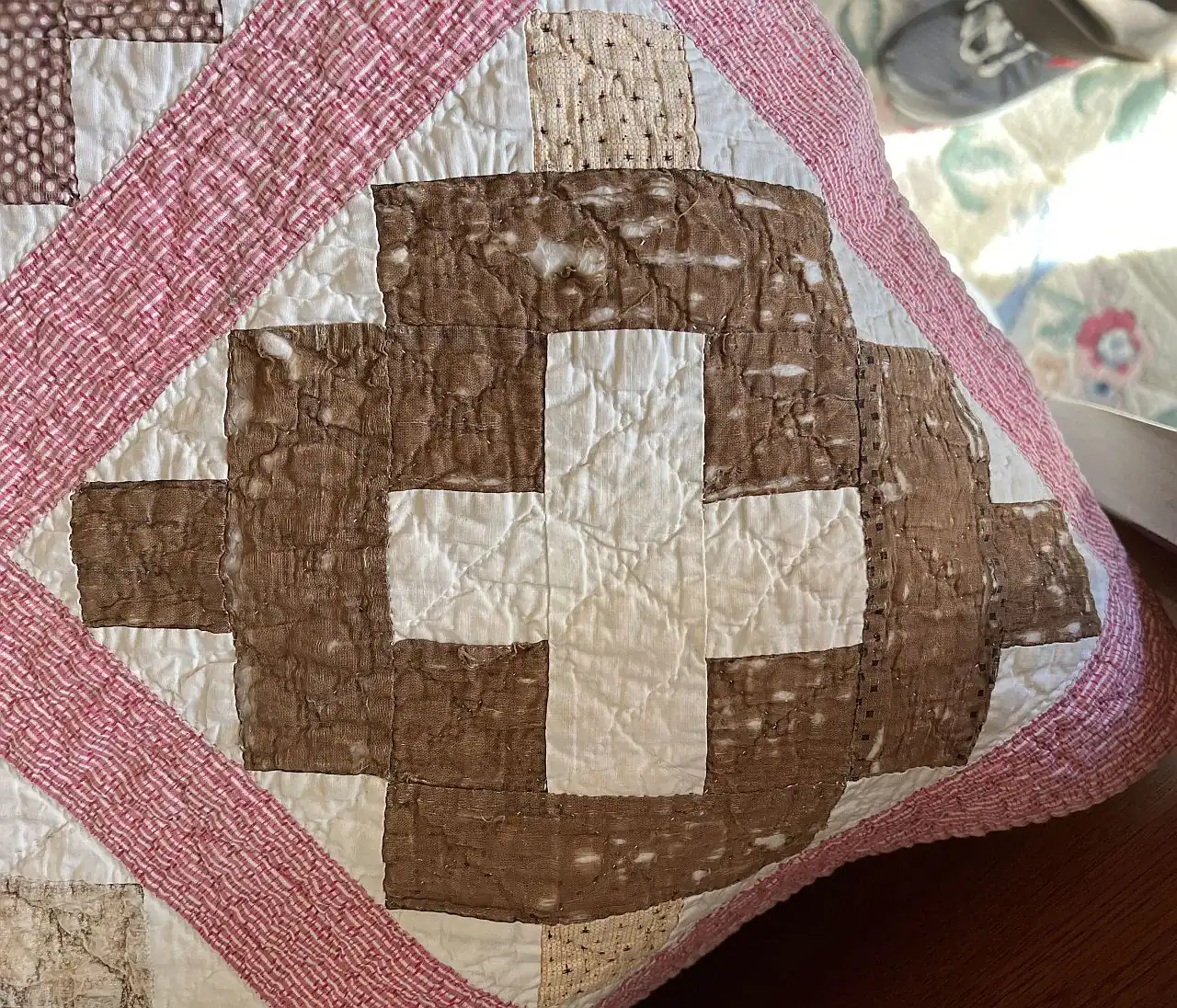
I have had an inquiry from a woman: “I have an old cotton quilt that has stains on it. (It’s not valuable, but it
was my grandmother’s.) I’ve found that hydrogen peroxide takes out the
stains. (Cleaning didn’t.) Could I gently wash it after pretreating with H2O2?”
I’m not sure what to tell her… Any ideas?
Thanks so much, Julie Silber
Date: Sun, 16 May 2004 00:08:51 -0500 | From: “Jean Carlton” <jeancarlton@>
I saw the Gee’s Bend quilts in Milwaukee last year. I drove 800+ miles round trip to do so. Anyone who has any interest in quilts and quilting should not miss the opportunity to see them in person. The book isn’t enough. I agree with much that has already been said about the visual appeal, emotion and awe of seeing the type of quilt not typically admired or honored in today’s quilt world — hanging in a wonderful art gallery. That is one reason the exhibit is so amazing. Though many of us own this utilitarian type of quilt made by our own grandmothers or aunts, do we bring them in to show and tell at our local guilds?? No. Not where I live. ( this has changed a bit already as some bring in things that remind them of the quilts of GB 🙂 We are very self-conscious about entering a beginners quilt in a show – what if the points don’t match? Someone may see how wavy and uneven the borders are. The level of competition in national shows is ever escalating. I do have concerns about defining” African American” quilts by this display, as some have mentioned. A good book to read is “Always There; The African American Presence in American Quilts” by Cuesta Benberry for excellent information on this subject. I have several quilts made by my white Aunt Agnes (Norwegian) especially one rail fence style in corduroy, that could have hung alongside the quilts from Gee’s Bend and fit right in. Utilitarian quilts have been made forever – by all women – all over the place. I am overjoyed that the Gee’s Bend flurry has opened eyes to the potential beauty of this type of quilt. The panel discussion held in Milwaukee included a presentation by Patricia Cox of Minnesota showing countless slides of quilts reminiscent of the exhibit quilts to demonstrate this fact. This does not take away from these specific quilts. In fact, it just broadens our understanding of their universality. I admit it was a little annoying to hear art critics tossing around artsy terms and dropping names I don’t even recognize (!) but I don’t deny the relation to ‘art’ styles etc.- the question is one of intent. Since the women who made the quilts of Gee’s Bend most likely did not have an art background, we are led to ponder their work – and to wonder about an innate sense to create a thing of beauty. Not every quilt in the exhibit awed me, but most had an effect on me unlike any quilts in the winner’s circle of any BIG SHOW. A different type of awe…..They can’t be compared….but there is room to appreciate and study all types of creative expression. I left the exhibit feeling ‘liberated’ (Gwen Marston got me started – this added a new spark!) and wanting to go home and just sit down with a pile of fabric and have some fun. No pattern, no measuring – freedom! I hope the attention to Gee’s Bend, the ladies and their quilts, has the effect of allowing us more ‘rigid’ quiltmakers to appreciate and honor a wider range of quilts….and dare to try to make them! I envy their lack of outside influences. For most of us – there is no going back. We’ve seen too many patterns, magazines and quilt shows to clear our brains and work from the heart. This exhibit is an eye opener – a wonderful education and a visual feast. And I learned a bit about the art world!
Jean Carlton Minnesota
Date: Sun, 16 May 2004 02:36:28 -0400 | From: “J. G. Row” <JudyGrow@>
> I left the exhibit feeling ‘liberated’ and wanting to go home and just sit down with a > pile of > fabric and have some fun. No pattern, no measuring – freedom! I hope the > attention to Gee’s Bend, the ladies and their quilts, has the effect of > allowing us more ‘rigid’ quiltmakers to appreciate and honor a wider range > of quilts….and dare to try to make them!
Jean,
If every one of us spent weeks, months, even years making “liberated” quilts, most of them, the great majority of them, would not have the balance of color and form, or the movement and flow, or the mastery of technique that makes us say of any art that it is “good.”
Don’t forget that curators picked and chose from a great number of quilts to put this show together and discarded those quilts that did not have the visual impact they were looking for. I am absolutely sure that like most of us, the quilters of Gees Bend made visually unsuccessful quilts and those didn’t get chosen for the show or the book. We’ll never see those quilts hanging in a gallery.
I am equally sure that now that the Gees Bend quilters are making quilts for a worldwide market the quilts they turn out will be repetitious and will lose the vigor and spontaneity of their early naive work.
How many years ago did a curator find another isolated people who made quilts and mount a show of their work to great national acclaim? Soon those people were copying their old designs for the market, and then they began making quilts in the “rigid” traditional designs that most of us use in our own quiltmaking. They made them because the market was bigger for them. You’ll find them all over E-Bay and in shops all around Lancaster County.
Judy ” Ringo” in Ringoes, NJ judygrow@
Date: Sun, 16 May 2004 07:55:38 -0700 (PDT) | From: Babette Moorleghen <happyquilterq@>
Julie, the answer to that question is “yes”! I would definitely tell the lady to wash the quilt. I use Orfus soap on all my old quilts, in a gentle cycle and then line dry. In answer to questions about colors running (in an earlier posting), I have used the dye-magnet and had great success. I know the original one doesn’t exist anymore and I have used the ones that look like fabric dryer sheets. These work well, also. Babette in Illinois
Julie Silber <quiltcomplex@> wrote:I have had an inquiry from a woman: “I have an old cotton quilt that has stains on it. (It’s not valuable, but it
was my grandmother’s.) I’ve found that hydrogen peroxide takes out the
stains. (Cleaning didn’t.) Could I gently wash it after pretreating with H2O2?”
I’m not sure what to tell her… Any ideas?
Thanks so much, Julie Silber
Date: Sun, 16 May 2004 10:56:23 -0500 | From: Gail Ingram <gingram@>
> Presence in American Quilts” by Cuesta Benberry for excellent information on > this subject. I have several quilts made by my white Aunt Agnes (Norwegia n) > especially one rail fence style in corduroy, that could have hung alongsi de > the quilts from Gee’s Bend and fit right in. Utilitarian quilts have been > made forever – by all women – all over the place. I am overjoyed that the > Gee’s Bend flurry has opened eyes to the potential beauty of this type of > quilt. The panel discussion held in Milwaukee included a presentation by > Patricia Cox of Minnesota showing countless slides of quilts reminiscent of > the exhibit quilts to demonstrate this fact. This does not take away from > these specific quilts. In fact, it just broadens our understanding of the ir > universality.
Come South, go to an AE Methodist Church (the African American branch that split off pre-Civil War Methodist Church), look in the nursery or, if there is a dinner(lunch to those who live north of us) that day. You will see at least one or two quilts that have all the spirit and vitality of some of those selected by Gee’s Bend.
Or simply visit your Aunt Henrietta or my Aunt Linnie or a thousand aunts who either preceded the quilt mags, classes, and books–or, as Robert Fros t says in “Birches,” “who live too far out for baseball”— and “made do.” Each of them had an aesthetic of her own, a sense of her own self, of what she liked to do with the limited range of materials to which she had access . These aunts did not go around copying old quilts the way many of us on this list do because THAT scrap bag was already empty.
A dear older friend of mine, Emma Russell, an African-American lady of 95, who died before Christmas(still quilting) eventually moved into the “pattern” quilts, but she could not restrain herself. Chatreuse and flaming pinks appeared where more restrained colors were “called for” by the patterns. What grieved me was that she had given up her original, story-telling applique style for what struck her as more pleasing to those to whom he sold and gave the quilts.
Or look at women today who are using saved fabric to purposes particularly their own=AD=ADto remember Cousin Sally, to tell the story of their or someone dear’s life, to commemorate an event, to recreate the way a spring or winte r day feels. My first quilt was a Double Wedding Ring quilt I had dreamt of making from childhood onward. It has piees of my high school dresses, my mother’s “house” dresses (no slacks then!), my sisters skirts, my bridesmaid’s dresses, my baccalaureate dress from high school, etc. There are a few donated pieces of fabric from non-family sources, not many. My quilt is “ordinary” to anyone but me, but in its use of color, the size of its rings, the effort to make each ring in a single color range—and in other ways as well, it is unique. It is mine.
The essence of any traditional (folk) culture is repetition, not innovation . Tradition and the individual talent (pardon to T.S. Eliot!) meet, and something recognizably part of a special tradition but also peculiar emerges. That is true is all art, isn’t it?
I have laughed on this list about a basket pattern quilt top from Bristol, TN which I am quilting. It is wild, probably both by design and necessity. I love it. Judysue Kelius, in Lancaster, PA, owns a top made from the same pattern, obviously from the PA Germanic tradition—very prim, matched and balanced flowers. Nobody who knew the U.S. would confuse the origin of thes e two quilts. And I think the maker of mine meant for her quilt to be seen, not hidden under some chenille bedspread. I’m going to make sure it is seen . She had problems appliqueing and piecing. I am having problems taking up quilting again. But this is going to be us—two southern gulls with problems.
And may I raise a question, based on my own experience with a rural culture ? Who says all these quilts were only “utilitarian” ? Is there evidence to prove that? I bet many were considered special enough to put away for special occasions and dark days and to pass on to another generation.
Another question: wasn’t Gee’s Bend among those 70’s efforts to help poor women market their original work—like Jay and Sharon’s Rockerfeller’s in West Virginia? Do these quilts come from the original collection?
Too long, I know, but ……, Gail
Date: Sun, 16 May 2004 14:29:04 -0500 | From: Gail Ingram <gingram@>
If anyone on this list has current email for Mary Elizabeth Johnson, I would appreciate her sending it to me.
I talked with M.E. and was supposed to send her some information.
The email address she gave me must be inaccurate, for my emails keep bounching.
Anyone out there who ccan help?
Gail Ingram
From: “J. G. Row”
Julie, I don’t think that telling a client to wash the quilt in a washing machine is a good idea. Wash the old quilt after treating the stains, yes, but especially not on the gentle cycle or any cycle. I know, I know, some have done it through a complete cycle in the washing machine and your quilts are none the worse for the treatment — they don’t look any worse for the washing — yet. The abrasian of the washer cycle has weakened the fibers and the seams, and that weakening will show up sooner than if they had been washed without that rough treatment. Even the gentle cycle is too rough for old textiles.
I used to wash my quilts by hand in the bathtub, but I got too old for getting down on my hands and knees to do that and I could never tromp or squeeze out (never wring out) enough water to carry the quilt, safely supported in a sheet, outside to dry. Now I too wash my old quilts in my washing machine (only if they absolutely, without question, need a washing) , but I never use any of the wash cycles. I just fill the washer, add washing agent and hand mix, and then add the quilt and soak. If I have to move the quilt it is with a gentle up and down motion of my hand, what I call “the potchkie, potchkie maneuver.” The idea is to move the water through the quilt, not the quilt through the water.
Then I drain the water from the tub. I stop the washer immediately after the water is out and carefully arrange the quilt evenly around the edges of the tub and then spin on the gentlest cycle to remove more water. Then you can do another wash, or start the rinse process, all done the same way as the original wash. I usually rinse at least 3 or 4 times, to make sure all the washing agent is out. Then I spread the quilt out on my back deck on top of a clean sheet and put another sheet on top of that. If I’ve chosen my day correctly — bright and dry with a nice breeze — it only takes a couple of hours to dry the quilt. I make sure the direct sunlight is on the other side of the house when I dry the quilt.
The sheet on top is especially important, not only to keep leaves and bird droppings off the quilt, but to absorb any residual dirt that would leave “tide lines” on the quilt. If the top sheet goes on damp the residual dirt or impurities in the water will rise to the top layer and stay there, and in this instance that top layer is the sheet.
Washing a quilt is a process of many hours. You can’t just turn on a machine and walk away.
Those of us who took the quilt conservation course in Omaha will forever envy the huge washing tub that I think the local fire department made for the Gerald Ford Conservation center. It is at table top height, so there are no broken backs to contend with. The tub is stainless steel, and large enough to lay out a large quilt folded over once, and only about 8 inches tall. There are hand held sprayers I think, and the entire tub tilts slightly to drain the water out! What heaven!
Lynn Gorges on this list has made her own washing tub, and Newbie Richardson, also of this list, has made one as well from heavy gauge plastic and two by fours. Jan Drechsler (of Vermont) has told me that she takes the old quilts down to the local stream bed and bangs them against the rocks (only kidding!).
Judy ” Ringo” in Ringoes, NJ judygrow@
From: Xenia Cord
Cord’s rule for washing antique quilts: Lie down until the urge goes away!
Xenia
From: “Patchwork Secrets”
I am in the piedmont/foothills of the mountains. About 30 miles west of Winston-Salem in Yadkin County. When my Grandparents married my Granddad was a school teacher and also worked his tobacco allotment. He couldn’t afford to build another barn and a new house for his bride so he borrowed enough money to build a house with a huge attic. They hung and cured tobacco in their attic for years until he saved enough money to purchase another farm that already had barns on it. My grandmother and great-grandmother would piece quilts out of old clothes and cast offs to wrap the tobacco in. My husband retired from the 82nd Airborne 2 years ago and we now own the farm and are remodeling the two barns into workshops for him and the pack house into a new larger studio for me….VBG. Next comes the house..lol.. Got to have our priorities straight right? We don’t grow tobacco anymore since my grandmother sold their allotment after my granddad passed on.
Sharon in NC Final Sue in Kitty Hawk blocks now available
From: “Suzanne Cawley”
Hi All!
Some time ago I wrote a “Quilt Care Handout” that I often give to those who need some basic information on quilt documentation, display, storage, cleaning, and repairs. Three websites that I include for further information are listed below. It is interesting to note that even the “experts” do not necessarily agree on how and when to wetwash a quilt. However, I think the information on each site is helpful in this area.
http://www.textilemuseum.org/care/brochures/guidelines.htm
http://museum.@/glqc/quiltcare.html
http://www.bishopmuseum.org/research/pdfs/cnsv-quilts.pdf
Suzanne Cawley Who just returned home to wild, wonderful Keyser ,WV after another great “Dating Club” meeting
From: Jean Lester
I agree with Judy about the method. Just one caution–put a towel or wash cloth on the quilt, where the water comes in. In other words, don’t let the force of the water hit the quilt.
Jean
From: patkyser
Reply to Gail, The last email I have for Mary Elizabeth Johnson is mejbooks@
As for Gee’s Bend and the 70’s… they were The freedom Quilters then, who made pillows and such for Sears, using the bright colored corduroy furnished by Sears which appears in some of the exhibit quilts. So their culture may have been “influenced” by the outside world for a quarter of a century. Pat in Alabama
Date: Mon, 17 May 2004 09:15:17 -0400 | From: Judy White <jawhite@>
Judy G’s advice is excellent about soaking old quilts in the washing machine. Sometimes you will acquire an old quilt that just has to be washed for whatever reason. I’m convinced that the dryer is a lot harder on fabric than the washer. I never washed a quilt in the bathtub because I always felt that the lifting of the water-laden quilt put a real strain on the threads of the quilt – more than a washing machine. Of course, I wouldn’t wash a museum quality quilt. If I had any of those, I would take them to a conservator, but I don’t have any of those. But Judy’s correct in that washing quilts or taking stains out of textiles is not a 5 minute job – it takes all day or maybe two or three days and also takes watching. And I love the “potchkie, potchkie maneuver”.
Judy White CT Quiltmaker & Restorer
From: Xenia Cord <xenia@>
if you are fixed on washing an antique quilt, and are using the bathtub, you can push the quilt up to the far end of the tub and press down to remove a lot of the water, then gather it gently into a plastic trash bag for removal to the place where you will spread it to dry.
Xenia
From: “Newbie Richardson”
Ok Guys, The caution about wet cleaning any textile with water is the weight of the water on the fibers. Think how heavy a bath towel gets when wetted. The weight of the water in the fibers causes enormous stress on the weave structure, add to that the aggitation and you have a potentially weakened/damaged object. It is exactly like cleaning aged skin – at 51 I no longer use soap or a “Buff-Puff” on my face. Old textiles should not be subjected to increased stress – unless the soils will do it even more more harm. That said, it is your object, you have the right to cut it into Teddy Bears if you so decide. However, if it is an object that you value and want to maintain for many more generations, then do not put an old quilt into the washing machine! Would anyone like to weigh in on the definition of “old”? Newbie Richardson The Costume and Textile Specialists Appraisals, Conservation & Exhibition Alexandria AndRichmond, VA
From: “Newbie Richardson” <pastcrafts@>
When wet cleaning an old artifact, NEVER actually pick up the object. Place it in a sling ( an old sheet will do) I use fiber glass screening ( from the hardware store). Or I let the object dry in the wash tank/ tub, draining out the water and blotting very well with towels. This works great with old baby clothes. DO NOT manipulate the wet fibers directly or you risk your fingernails going right through the fabric. Newbie
From: “Karen Quilts Texas”
Karen Alexander in (You don’t know steamy till you’ve been here) Spring, So. Texas – 11 inches of rain just last week!
Date: Mon, 17 May 2004 11:45:28 EDT | From: Palampore@
Sue is describing Burley Tobacco. It is air dried. That is what we on the coastal plain call “mountain tobacco”. (The entire stalk is cut, not just leaves broken off and they begin to turn yellow.) In our area the tobacco (Flue Cured) was put into tobacco barns that were tall and skinny, and the “plucked”/tied tobacco on sticks was hung on rafters in layers. The barn would be heated with a big heater in the middle. The heat would be about 125 degrees and then lowered over a period of several days until the leaves were dried to a golden color. I hated having to check the heat in the barns. You would run in as fast as you could, check the temperature and get out of there. It was a sweltering humid heat.
The first time a city friend of mine invited me to go to a suana I thought it was going to being something really special. After a few minutes in there I told her I didn’t mean to insult her, but I really had to get out. It just reminded me too much of a tobacco barn, and I had spent much of my life trying to get an education so I could leave the farm, and here people were paying good money to do that very same thing I had left….just didn’t make sense. Many of the “Gee Bend” type quilts (no fancy pattern quilt made of worn out clothing, etc.) in my area are filled with tobacco cloth (gauze of sorts) that was placed over tobacco beds as seedlings were being grown. ( Tobacco seeds are very expensive, so they were treated with great care when germinating. It is now a hot house business.) I have seen quilts filled with several layers of this cloth rather than cotton batting. I assume that the cloth might have had some hoIes in it, and rather than it being thrown away women would put it in their quilts. I own some of these. Some people also used tobacco twine (cotton twine) to quilt with in very large stitches, or to tie the quilts. This ol’ farm girl has got to go get to work in her flower garden…. Lynn Lancaster Gorges, New Bern, NC P.S. They also grow tobacco in Connecticut to use making cigars, and it is done in a very different manner. What was that old Sandra Dee and Tab Hunter movie about that??? Did I get the names right?
From: “Lori Hudlow” <lahudlow@>
Try your local music store…..very cheep and they have different sizes.
From: “Lori Hudlow” <lahudlow@>
I am looking to up grade my sewing machine and I am hoping to recieve some advice and comments between Bernina and Viking. Which models are the best and why you think so. Thank you in advance for this info…….
Lori in Maryland
From: “Karen Quilts Texas”
Well, I guess one of these days I’ll “modernize” my sewing “control center” (that’s what my son calls it)… but right now, It contains a Singer 15-91 for piecing and quilting (free motion mostly); an Elna SU 62 supermatic for Zig Zag and curves/arm holes and sleeves – it’s a free arm; and a White 4500 Serger for the occassional clothing or repair. I just bought a nice Singer 201 the other day for resale, but it’s so nice, I may “upgrade” my 15-91 to it!
By the way, the Singer sits in a treadle cabinet… it’s extremely comfortable… the treadle makes a perfect footrest, with the pedal sitting on the treadle. The little drawers are all handy for tools. All three sit in a corner with the serger on the left on a booktable, and the Elna on the right in a folding table that it came with. So, it is kinda of like a control center. As long as he doesn’t start calling me “Homer” (Simpson), I’ll be OK…
Every year at Quilt festival, I play around in classes with the Bernina’s, Janome’s and Vikings and for the prices these sell at, I just can’t justify what in my mind are only extremely modest improvements. And honestly, my Singer makes a straighter, tighter stitch than either machine. To me, (IMHO) the stitches look ever so slightly “slanted” compared to the stitches that old Singer makes. I probably have less than $500.00 in all my machines and cabinets… and other than the occassional bobbin rubber replacement (no belts on the Singer)virtually no maintenance costs. I can fix anything that breaks on these machines myself! I’m sure one of these days I’ll run into a used one that I have to have, but I’d rather put Two or Three Thousand dollars into a trip to Maui!! (Well – more likely into son’s college fund – if I had it!).
Karen Spring, TX
Date: Mon, 17 May 2004 14:34:03 EDT | From: LAHudlow@
Thanks for the info…..I have only been sewing for about 3 years and when I bought a machine I got the least expensive Kenmore on the market…..I didn’t even know if I would like sewing but I was bound and determined to make a quilt. Well, guess what I am hooked and you would never know that the only sewing lessons I had was what we were taught in 7th grade. Again thanks for the info.
Lori
From: Sandy7827@
Afternoon Everyone, I was just on ebay checking out the antique quilts,there had one there that was a baby quilts in a log cabin design done in mostly in satin. My question is how can you date a quilt with solids color satin in it? Do you go by what other fabric in it or the colors for the satin? Just ran thought my mind when I saw it. Thanks
Sandra in Illinois
From: “Judy Kelius (judysue)”
The backing might give a clue if it is a print. If it is a solid, especially just white or off-white, that makes it more difficult. You are right in that it is more difficult to date the satins or for that fact, any solid colored fabric.
Date: Mon, 17 May | From: “Alan”
Another transfer tool is one of those plastic laundry baskets. They usually have a short “wall” around the bottom to hold any drips from the quilt, and they’re much, much easier to maneuver than sheets and bags !
Alan
Date: Mon, 17 May 2004 14:36:23 -0500 (Central Daylight Time) | From: “Sandra Millett” <smillett@>
Dear Lori:
Also consider checking on the Pfaff. It is the only machine with a built= -in top feed dog, so that top and bottom seams end up the same length. I know instantly how much fabrics creep when I use another brand. Here is the advice I give students when machine shopping. Know your top price and compare only brands within that price range. Then you compare apples to apples not apples to oranges. Take your own fabric to test sew, including a hunk of denium and sew a crotch seam with at least four layers. Now you may never want to do this in real life, but you’ll find out the strength of the “engine” and how it ri des over thick seams. Take your time and practice without the sales person lurking over your shoulder. It helps to take some actual piecing and see how the machine a cts and if there is an attachable feed dog, use it. Does it hinder your vie w of the patches as they go under the presser foot? Try out the 1/4-inch foot–Does it really stitch a 1/4-inch? Negotiate the price–there is flexibility built in. Discuss what happens if you get a lemon–I did. Now, any salesperson is going to say that their machines are perfect, but I had a friend whose ne w machine (one you mentioned) caught on fire! And get something in writing–signed. Good luck in your quest and enjoy. Sandra
Sandra Millett Freelance Writer & Author Quilting the Savory Garden
Date: Mon, 17 May 2004 15:55:16 -0500 | From: Gail Ingram <gingram@>
Oh, Lynn Gorgeous, that would be Troy Donahue with Sandra Dee in the movie “Parrish.’ (sigh)
All this description of tobacco growing makes me want to go back and read Robert Penn Warren and other N.C. and KY writers whose fiction and memoirs include tobacco growing. I had never heard of wrapping toabcco in quilts.
And about the couple who is renovating her grandparents’ old home wth tobacco barn upstairs, isn’t it smokey and “fragrant”? The barns I’ve always seen were black
More info on this interesting subject.
gi
Sue is describing Burley Tobacco. It is air dried. That is what we on the > coastal plain call “mountain tobacco”. (The entire stalk is cut, not just > leaves broken off and they begin to turn yellow.) In our area the tobacco > (Flue > Cured) was put into tobacco barns that were tall and skinny, and the > “plucked”/tied tobacco on sticks was hung on rafters in layers. The barn > would be > heated with a big heater in the middle. The heat would be about 125 degrees > and………..
> Lynn Lancaster Gorges, New Bern, NC > P.S. They also grow tobacco in Connecticut to use making cigars, and it is > done in a very different manner. What was that old Sandra Dee and Tab Hunter > movie about that??? Did I get the names right?
Date: Mon, 17 May 2004 17:46:09 -0400 | From: “deb”
Lori,
Buy the best you can afford from a dealer who will give you lessons & in store service. You can have the best machine on the market but if it has stuff on it you don’t know how to use – what good is it? Any authorized dealer worth their salt will give you the warranty in writing & let you try the machines out with your own fabrics. If you are going to free motion machine quilt – make sure you try that at the store, all machines are not equal when it comes to free motion. Any good machine will give you a perfect straight stitch if you use the correct needle & a straight stitch plate. Not all 1/4″ feet are alike & it all depends upon what you get used to as to what you like.
I tell people that buying a sewing machine is like buying a car – TEST DRIVE!
Debbie Quilting Possibilities Baby locks, Berninas & Elnas