September 15 – 24, 2001
These restored messages come from the Quilt History List, an online forum where quilt historians, collectors, researchers, appraisers, and enthusiasts discussed antique quilts and related textiles. The archive dates from 1996 through approximately 2016 and is being restored gradually. Sign up in the form at the bottom of the page if you want to know when a new page is added. Original spelling, opinions, formatting, and inactive links may remain unchanged.
Primary topics of this QHL Digest:
- AQSG Conference in Williamsburg — Members coordinate travel plans and a group breakfast for the upcoming American Quilt Study Group conference in Williamsburg.
- 1930s Kit Quilts — Members discuss whether 1930s kit quilts were mostly appliqué, and the role of companies like Aunt Martha’s Studio in producing them.
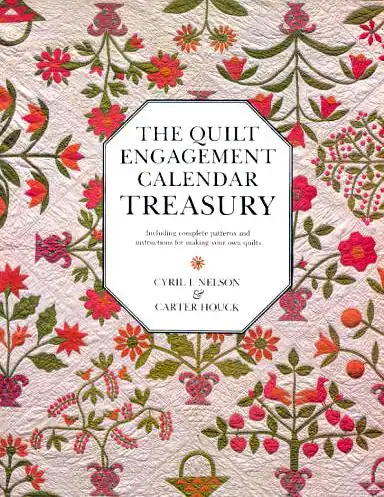
- Quilt Calendar Publishing — Discussion of Penguin/Putnam’s decision to stop publishing certain antique quilt calendars.
- Virginia Quilt Guild Resources — A member shares the Virginia Quilt Consortium website listing state quilt guilds.
- Fort Washington Quilt Show Recap — A member recounts an exhibit she curated at the Fort Washington quilt show near Philadelphia. (see the article on cleaning antique quilts)
- Embroidered Panel Sets — Members discuss sets of printed embroidery panel blocks, typically sold in groups of six, nine, or twelve.
- Mildew Removal from Antique Textiles — Continued discussion of whether mildew can be safely removed from silk and other antique fabrics. (see the article on stain removal)
- Kit Quilts and Henry Ford’s Assembly Line — A member connects the popularity of quilt kits to the efficiency of mass-production methods pioneered by Henry Ford.
Date: Sat, 15 Sep 2001 21:17:58 -0700 | From: “Penni Ryan” <penniquilts@
Dear Friends,
One of the beautiful things about living in the United States of America is
that we have religious freedom. That doesn’t mean that I agree with
everyone else and their opinions but I have a right to listen and agree and disagree. I don’t think the new member meant harm. I think in her
way she expressed herself. So far this week I’ve taken out my frustration
on a oxygen delivery person and my husband. I decided their must be a
better way. I’ve been sewing countless 1 inch strips of red, white and
blue fabric together, cutting them in 10 lengths, folding them in a loop and passing them out with a straight pin to everyone I know.
Sewing, Quilting and especially Praying
in
Cave Creek, Arizona
Penni Pitre
Date: Sun, 16 Sep 2001 10:10:10 -0400 | From: Lesters <jeanlester@
This is a little off subject but as historians and textile
historians, I’m sure some of you have some answers to some of my
questions.
What is a “flag”? Are flags those things that are meant to fly from
a pole? What do we call those fabrics that are printed with flags?
When is it correct etiquette to use these fabrics and when is it not
correct? How is it proper to use a quilt made like a flag? How
about clothing made with fabric that is “flag-like”?
These are questions that I have had for a long time and my mother
and
I have had numerous “discussions” on the subject.
I do hate to sound ignorant but I have looked on the sites for Flag
etiquette and not found these particular answers. Maybe after this,
I will no longer be ignorant.
Jean
Date: Sun, 16 Sep 2001 11:55:09 EDT | From: SaraLMcN@
Leukemia I have been content to follow the postings. I am urged to comment though on the concerns about recent postings.
Qhl is the quilting community of our list as a whole, for many
of us you are our only contact with other quilters. I think that we have to
allow ourselves to express appropriately our feelings and beliefs. If we
cannot express these concerns to our community, we have lost part of the
freedoms that we are now preparing to defend.
I don’t feel like handing the terrorists any more American
treasures, be they people or the freedom to express our beliefs.
I want to extend my sympathies to all who have lost loved ones
to this tragedy. To the many families that now worry about how this may
impact you, I feel that I can safely say that all our prayers and good wishes go out to you as we all gear up for the coming months.
In Love and Freedom,
Sara Lynn
Date: Mon, 17 Sep 2001 09:07:23 +1000 | From: Lorraine Olsson <sven@
Hello Jean and all
This was in my mail this morning (I am in Australia)
http://www.sar.org/colors/flagetti.htm
I think it answers lots of questions
Lorraine in Oz
Date: Mon, 17 Sep 2001 00:25:37 -0500 | From: Jennifer Perkins <qltrstore@
Has anyone found a nice 2002 calendar with pix of antique quilts??
I saw
one from the Shelburne when I was in Vermont last year, but don’t
know if
they have one this year. Anyone??
Jennifer in Iowa
Date: Mon, 17 Sep 2001 06:54:00 -0700 | From: “Penni Ryan” <penniquilts@
Dear Quilters:
I thought I would pass this on to you. I’m already planning a quilt
for
display.
Quilting & Praying
in Cave Creek, Arizona
Penni Ryan-Pitre
—– Original Message —–
From: <KirkColl@
To: <penniquilts@
Sent: Friday, September 14, 2001 7:15 PM
Subject: Re: American Spirit Quilts Project
Please copy and send this on to lists you belong to.
FOR IMMEDIATE RELEASE
SEPTEMBER 12, 2001
For more information contact:
Jan Fry (402) 498-5785 or (800) 599-0094
The Quilt Heritage Foundation
P.O. Box 461147, Papillion, NE 68046
AMERICAN SPIRIT QUILTS TO SHOW HOPE FOR THE FUTURE
The Quilt Heritage Foundation is calling on quilters around the
country and throughout the world to create American Spirit Quilts “which show our hope and belief in tomorrow in the aftermath of the tragedies of
September 11 . The American Spirit will triumph over tragedy,” says Nancy Kirk, President of the Foundation.
“Quilters have always responded to times of crisis by making
quilts to help the victims of disasters, to commemorate events that affect us and to bring comfort to survivors,” said Kirk. “We are helping to organize these efforts
and encourage local quilt guilds and other non-profit organizations join the project.”
The American Spirit Quilt Project has two components — making
quilts to
donate to local charities, and creating original design quilts to
commemorate the American Spirit in response to this challenge.
. “The Quilt Heritage Foundation will provide free patterns for
quilters
who want to make quilts for charity. The other half of the project
will be a quilt exhibit of original design quilts which will be selected to
honor the American Spirit in the face of tragedy and the healing process
that we have begun,” said Jan Fry, one of the project coordinators.
Quilters who would like to make American Spirit charity quilts
can find free patterns at the project’s website, www.americanspiritquilts.com.
“We are asking people to make quilts and give them to children’s
charities in their
home communities. Our children now live in a world where terrorism is a fact of life. We want to give them both comfort and share our determination that the American Spirit will prevail.” The Quilt Heritage Foundation will post lists of participating charities that can use children’s quilts.
Quilters are asked to send photos of the charity quilts,the quilt
groups working on them and the stories behind them to the Project for
posting on the website.
Details of the national quilt exhibit will be announced on the
website over the next few weeks. According to Ms. Fry, “Our plan is to select one representative quilt from each of the 50 states. These quilts
will be featured on the website, in an exhibit catalog and in an exhibit
honoring the victims of the September 11 attack on America.
“We hope to exhibit photos of all the entered quilts on this
website, and select one quilt from each state for a traveling or permanent
exhibit. “We are looking for quilts which give voice to our American Spirit.” Entries will be by photography and slides with an entry form available on the project’s website. These quilts must be completed by June 22, which is 9 months, 11 days from the date of the tragedy. The date was chosen because the 9/11 date will forever be seared into our collective consciousness as the date of the attacks on New York and Washington D. C. and the crash in Pennsylvania.
Quilt shops, quilt guilds and national organizations that want to
participate in the American Spirit Quilt Project can sign up on
the web at www.americanspiritquilts.com. They will receive a certificate of participation and a list of suggestions on how they and their
customers can participate.
The Quilt Heritage Foundation is a non-profit organization
dedicated to the promotion of the art of quilting and the study and appreciation of quilt making. Donations to the Foundation are tax-deductible under Section 501-c-3 of the Internal Revenue Service Code.
For more information, contact Jan Fry, Project Coordinator, at
402-498-5785 or 800-599-0094 or by writing American Spirit Quilt Project, P. O. Box 461147, Papillion, NE 68046, or send an e-mail to quilthf@.
Date: Mon, 17 Sep 2001 08:25:42 -1000 | From: Laurie Woodard <lwoodard@
Back on September 6th (QHL-Digest Digest Volume 01 : Issue 217) Barb
Garrett
called our attention to a “Sales Receipt” for sale on eBay which
listed
“Alhambra Quilt” and “Elmora Quilt.” I don’t know what the Elmora
quilt is
but I can speak to Alhambra quilts about which I was curious after I
saw a
ca. 1880-1890 advertisement by a Honolulu Dry Goods house offering
Alhambra
quilts for sale. J.T. Waterhouse of Honolulu had in common with
Lesher=Warner Dry Goods Co. of Philadelphia(?) the fact that both
were
importers. Alhambra quilts were made in England (don’t know about
the US).
The British Quilt Study Group’s first published journal, “Quilt
Studies”
(Issue 1 1999), focused on Strippy Quilts and Turkey Red Cloth.
Happily,
Turkey red dyes were used in Alhambra quilts. These aren’t actually
quilted,
but appear to be heavy woven damask-like blankets. There is a photo
of a
1905 catalog page titled,”Colored (sic) Counterpanes and Honeycomb
Quilts.”
The first item listed (with photo) is “Item G 26 Inexpensive
Alhambra Quilts
for Nursery and Maidservants’ use. Turkey Red, Indigo blue or Red
and Blue
in combination. Single Bed size, 2/11d; double bed size, 4/11d.”
The author, Tina Fenwick Smith, defines Alhambra as “a fabric woven
with a
coarse weft to produce a heavy foundation texture on which figuring
is
developed by freely floating threads of a coloured warp.”
—
Laurie Woodard
Hawaiian Quilt Research Project
http://openstudio.hawaii.edu/hqrp/default.html
Date: Mon, 17 Sep 2001 21:53:47 -0400 | From: Newbie Richardson <pastcrafts@>
Dear all,
Back to history! See, you can’t get this group down for too long!
Without cracking any books, I seem to remember that the modern
incarnation of flags lies in the heraldic traditions of midieval
Europe.
They probably elaborated on an idea from Bysantium who got the idea
from
the Roman Legions who did carry carved emblems into battle.
Flags are a “community’s” identification symbol. There were the
symbols the the early Christian Church which were woven into banners/
of
competing nations/ of guilds/ of families, etc. In this light the
clan
tartans of the highland Scots are also “flags”.
Like all symbols, they represent ideals, ideas, traditions. It is
acceptible to wear/display these symbols if you share the ideals they
express. In the USA, the Supreme Court has even affirmed the right to
destroy the symbol as it is just that: a symbol, nothing more.
Whether
it is appropriate to wear these symbols depends on your own
assessment
of what is in good taste – or bad – what is good design – or kitsch!
Certainly women took liberties with the design of the flag for all
kinds of thematic quilts during the Civil War. Godey’s Ladies Book
even
published patterns. Women and men did so again – on a much more
commercial scale – for the Centenial in 1876 and again for the
Bi-centenial in 1976.
So, do not get bogged down in etiquette. Just remember that many of
the patriotic symbols and adaptations of the flag that women design
this
generation will be analysed by our great grand daughters 100 years
from
now!
Newbie Richardson
Date: Tue, 18 Sep 2001 02:01:09 EDT | From: PatKoerner@
Concerning the previous posting about making a give a way quilt for
children
suffering a loss from 9/11 and Wrap Them In Love. I have made a
quilt that I
want to go to a grieving child and I would like to request a
reference from
any one that has personal experience with Wrap Them in Love. I did
go to
their web site and it seems a very credible effort but I would like
to verify
that. So if anyone out there has a response I would appreciate it.
It
really felt good to go through the scraps and put together a little
quilt,
wish I had more time to do another. Maybe later. Cause you know
when you
stir up those scraps they tend to grow.
Jennifer asked about a calendar of Shelburne Quilts. I believe a
company
called Pomegranite carries that calendar. I have the information on
that
company at the shop but I am at home. They probably have a web site
if you
would like to check that out or email me privately and I’ll get you
some
info.
Pat
Date: Tue, 18 Sep 2001 05:00:44 -0700 (PDT) | From: Kris Driessen <krisdriessen@>
I understand the Clear Channel radio stations are doing a patriotic
medly today at 8:48, one week after the first plane hit.
To make this quilt related, I am still listing all the quilt related
charities/events, free quilt blocks and patterns, stores with special
sales, etc at http://www.yellow-ribbons.com. I added a place for you
to share your thoughts and feelings and there are quite a few moving
tributes there. Feel free to send me any updates, I really want this
to be a resource for quilters.
Kris
_
Date: Tue, 18 Sep 2001 06:36:36 -0700 | From: “Laurette Carroll” <rj.carroll@>
Hello,
This interesting Singer site has a history of the Singer
manufacturing
co.
It states that the first sewing machine for home use was designed in
1856.
http://www.singershop.com/history.html
Laurette Carroll
Southern California
Look to the Future with Hope
Date: Tue, 18 Sep 2001 15:24:31 -0000 | From: “laurafisher” <laurafishernetlink1.net>
Penguin/ Putnam Publishers has decided not to publish ANY of its calendars, not just Cy Nelson’s Quilt Engagement Calendar. Guess with
palm pilots, computers, etc, Penguin and other publishers feel that
no one needs/uses a desk calendar anymore.
Date: Tue, 18 Sep 2001 15:56:21 EDT | From: Trimble4@
For those further interested in this (if it hasn’t already been
mentioned),
Suellen Meyer’s article, “The Sewing Machine and Visible Machine
Stitching on
Nineteenth-Century Quilts,” which I read in Quiltmaking in America:
Beyond
the Myths (AQSG, 1994) also covers this subject. I admired Edward
Clark’s
marketing ideas, and the foresight of the women who “took the bait.”
Lori in NE Massachusetts
Date: Tue, 18 Sep 2001 18:00:55 -0700 (PDT) | From: Kris Driessen <krisdriessen@>
I can hear you all thinking – who woke her up? <G> But this is a
serious announcement.
An attack on the Internet has apparently been launched. A worm worse
than the Red Worm virus is on the loose, spreading via email using
.dll and .exe file attachments although the attachments appear to the
end user as audio xwave mime type files. These should be blocked
until virus detection software can be updated and so far I haven’t
seen any updates at Norton, McAffee or AVG.
As part of the current attack on the internet, there appears to be a
secondary component. Vulnerable Microsoft Internet Explorer browsers
which visit an infected site will automatically execute readme.eml.
This is probably the method for spreading this worm/denial of service
attack.
Right now about half my sites are down, including yellow-ribbons.com.
My ISP tells me as soon as he gets one server cleaned up, another is
infected. He was *really* upset – this is a nasty, nasty worm.
I would recommend extreme care for a little while. Update your virus
protection software as soon as possible.
Kris
Date: Tue, 18 Sep 2001 23:42:06 -0400 | From: “J. G. Row” <Judygrowrcn.com>
I just wanted to share with you the images on the site
below. They are very moving.
There were 4 pages when I last looked. There may be more by the time
you
look.
Judy in Ringoes, NJ
judygrowrcn.com
Date: Wed, 19 Sep 2001 08:45:31 -0600 | From: Xenia Cord <xecordnetusa1.net>
The American Quilter’s Society in Paducah has issued the following
information, which I have abbreviated to just the pertinent facts.
There were also, as you might imagine, additional paragraphs of
sentiment about the events of September 11:
Xenia
<We return to our foundational values in times of crisis – to the
faith
that sustains us.
From that basis an idea began to form. Perhaps we could use the
quilting
we love to
declare that our anchor holds.
We’re inviting every quilter to make one red, white and blue block
that
will be a finished
9″ size. Your block can be of any design, original or traditional.
Let
that one block (any
technique) be a positive statement of your anchor – your hope, and
the
love you will not
surrender.
Make sure your name, city, and state or country is written or
stitched
permanently in a
small (2 1\2″ x 1″ or less) area of what will be the front of the
finished 9″ block. Then
send your block to AQS before December 31, 2001. If you would like to
do
so, please also
enclose a 25 word or less message of hope and faith. These messages
will
accompany
finished quilts.
We are also asking guilds and other groups to volunteer to assemble
the
blocks into quilt
tops and finish them early in 2002. If your group is willing, let us
know. AQS will donate
or auction the finished quilts and use the proceeds as donations for
needs related to the
tragedy.
Log onto www.AQSquilt.com, the AQS website, for details and updates,
or
call AQS Member
Services at (270) 898-7903. Blocks should be shipped to: Anchor
Project,
AQS, 5801
Kentucky Dam Rd., Paducah, KY 42003.>
Date: Wed, 19 Sep 2001 08:57:25 -0500 | From: “Kim Heger” <kheger@>
Were kit quilts in the 1930’s mostly applique? I was watching Simply
Quilts
this morning with kit quilts as the topic, and they only seemed to
show
applique quilts as examples.
Thanks!
Kim
Date: Wed, 19 Sep 2001 10:18:51 CDT | From: jocelynm@
On Sat, 08 Sep 2001 14:01:31 -0300 Barbara Robson wrote:
> Has anyone seen the 2002 Quilt Engagement Calendar..
Barbara,
I was in Borders Bookstore last week and I’m pretty sure they carried
them. They carried the big wall calendar…
Jocelyn
Date: Wed, 19 Sep 2001 10:51:49 -0600 | From: Xenia Cord <xecordnetusa1.net>
I didn’t see the Simply Quilts program in question, but I can say
with
assurance that there were many more pieced quilt kits than appliqué
kits. For example, the Ladies Art Company in St. Louis advertised
that
all of its more than 500 designs were available as paper patterns, as
pieced blocks, as quilt tops, and as finished quilts. I consider
that
the blocks and tops are kits of a sort, as they represent commercial
fabric assemblies to be finished by the purchaser.
In addition, such companies as Wurzburg and outlets such as Marshall
Field sold packaged kits in pieced formats, tending to offer kits in
single template format, such as Trip Around the World or Flower
Garden,
or those with only a few templates, such as Grandmother’s Fan or
Irish
Chain. This simplicity made the manufacturing easier, as the shapes
could be stacked and die-cut. Both solids and coordinated mixed
prints
were used in these kits.
Pieced kit quilts are harder to identify than the appliqué; only Lone
Star in 3-4 coordinated solids is easily recognizable as a kit.
Because
we so readily recognize the appliqué formats, and because they are
usually “showy,” the appliqué kits are more often featured in
publications, exhibits, and venues where visual impact is useful.
Xenia
(If you want more information, see my “Marketing Kit Quilts in the
1920s
and 1930s,” in Uncoverings 1995 (Volume 16 of the Research Papers of
the
American Quilt Study Group). 137-173, or “Identify kit Quilts” in
American Patchwork & Quilting, August 1998, 64-66.)
Date: Wed, 19 Sep 2001 11:52:08 -0400 | From: “Jan Drechsler” <quiltdoc@>
Is anyone in the Connecticut River Valley area driving to the AQSG
conference? I am wavering in my thoughts about making airline
reservations
and have two others with which to travel, one in NJ and one in DC.
Please
respond privately, and quickly.
—
Jan Drechsler in Vermont
Quilt Restoration; Quilting teacher
www.@/~bobmills
Date: Wed, 19 Sep 2001 14:00:39 -0400 | From: Newbie Richardson <pastcrafts@>
Dear all,
I forward this to the list in the hopes that someone more centrally
located in Virgina can be of help.
In Northern Virginia we have “Quilt and Stuff” in Alexandria on
Rt.#1
South. Madeline has a WONDERFUL selection fof contemporary and
carribean
influenced fabrics. There is the “Quilt Patch” in Fairfax, Va: a
wonderful, full service quilt shop. G Street Fabrics in Chantilly,
Va.
has a great quilt department – it carries the store!
While in DC, proper, do not miss the DAR Museum, 1776 “D” Street.
But
be sure to take the Metro as it is close to the White House and the
parking is even more of a nightmare than before last week – not to
mention the traffic! The Renwick is up the street on Pa. Ave. I do
not
remember if there is anything quilt related at the momment. I do
know
that they have a cool exhibit on contemporay woodworking.
Good Luck
Newbie Richardson
To:
Are you aware of any quilt guilds in the so. western part of VA?
While visiting Christiansburg (near Virginia Tech) and the surrounding area
I was struck by the fact that the only fabric store I found was a Joann
Fabrics store. Do you have any advice? We plan on visiting VA and Washington DC in October. Will visit Geo. Washington’s home above
the Potomac and be in that area. Any suggestions of quilt stores I
should visit?
Date: Wed, 19 Sep 2001 21:11:15 -0400 | From: “Cinda Cawley” <lrcawleydmv.com>
I went to the Fort Washington show (near Philadelphia) on Friday. Phyllis Twigg curated an exhibit of antique quilts characterized by lavish quilting or dimension (padding, stuffed quilting, etc.). This is the first time that antique quilts have
been featured at the show. Judging by the very positive response it won’t
be the last. I was thrilled that Phyllis included one of my quilts (a Colonial Ladies c. 1930 notable for its large size and super
quilting). Others that I remember were: a Lone Star (c.1850) from the Eastern
Shore (how could I not love that one) with stuffed appliqued roses between
the points of the star and a super-sized swag border; a summer spread appliqued with a veritable rabble of stuffed flowers and
leaves–nothing organized, everything wonderful (c. 1860); several pieced quilts with
spectacular chintz borders. Phyllis, you should jump in here and
give the details.
My other reason for making the trip was that a dear friend had entered her version of Betsy Totten’s Rising Sun (see Smithsonian Treasury) in which she substituted stenciling for Betsy’s applique.
She won an honorable mention.
Sunday it was off to Northern Virginia for Hazel Carter and
Bunnie Jordan’s Fabric Dating Club. It is important for all of us to do the
things we care about and make life work during this terrible time.
It was good to be with friends and quilts on Sunday.
The subject of the day was “Quilts of the 1920s. Hazel gave us a
brief review of the general characteristics; Bunnie had a suitcase
full of examples. We did more arguing than usual at this session because
it seemed almost impossible to pin anything down as being “typical.”
After a couple of hours of looking at everything from a blue and white Swastika, to a Red Cross nine-patch, bluework, crib-sized boudoir quilts, pieces we felt were pre-W.W.I and some that were probably
post W.W.II and a lot of fascinating ephemera we concluded that the 1920s
isn’t a distinguishable period and that we should look at it as part
of a larger “post-war” period. Next time quilts of the 1930s–much
easier to deal with.
The above is not very clear. Sorry! I’m not at my best. I
thought I was becoming hardened to the disturbing images until the New Yorker
arrived in my mail box. The cover is black: no images or messages (other than the masthead) just black.
Cinda on the Eastern Shore
Date: Wed, 19 Sep 2001 17:59:35 -0700 (PDT) | From: Kris Driessen <krisdriessen@>
Just a little more on this nasty worm. It’s spread through websites,
so if you want to see if have it, you can go to
http://www.securityspace.com/smysecure/w32_nmda_amm.html
The patch is at
http://www.microsoft.com/technet/security/topics/nimda.asp. Its
worth downloading the patch just to be safe.
Kris
Date: Wed, 19 Sep 2001 21:14:58 -0400 | From: “Cinda Cawley” <lrcawleydmv.com>
How many of us will be in Williamsburg in October? Shall we try to organize another breakfast get-together? I so enjoyed meeting all of
you early Sunday morning last year in Lincoln. Let’s get a head
count and see if we can socialize at sunrise.
Cinda on the Eastern Shore
Date: Wed, 19 Sep 2001 22:24:31 -0400 | From: “J. G. Row” <Judygrowrcn.com>
I’ll be there. I just bought my airline tickets today. I expect I
will get a call from United saying that I am cancelled 2 days before. I’m
not sure how I’m going to get there, but I’ll be there.
DH and I are flying to a trade show and to visit relatives in Atlanta
this weekend. I know the relatives are there, but I just found out
that my trade show has been cancelled. This is a huge trade show, biggest
in the country for picture framing. One of my suppliers called me at 6
Pm to tell me and begging to come and show me his new line. He bought
well over $100,000 in inventory thinking he would take orders from new customers at this show, and now he’s got to pay his suppliers. And I
had to tell him that for the present I am going to try and sell down
my current inventory before I order any new styles.
Folks, we are in a recession! I hope we don’t lose too many quilt shops.
Judy in Ringoes, NJ
judygrowrcn.com
Date: Thu, 20 Sep 2001 09:51:19 EDT | From: RBCochran@
Cinda wrote:
How many of us will be in Williamsburg in October? Shall we try to
organize
another breakfast get-together? I so enjoyed meeting all of you
early Sunday
morning last year in Lincoln. Let’s get a head count and see if we
can
socialize at sunrise.
Cinda on the Eastern Shore
Add me–and three friends–to the list.
–Rachel in NJ
Date: Thu, 20 Sep 2001 10:46:09 -0400 | From: “anne” <datkoa@>
The Virginia Quilt Consortium has a very nice website which lists Va
quilt
guilds. http://www.vcq.org/guild.htm
Also, don’t forget the Virginia Quilt Museum at Harrisonburg.
AnneD
Date: Thu, 20 Sep 2001 10:28:47 -0500 | From: Joanna Evans <jevansbluemarble.net>
Cinda,
I am planning to be at AQSG, assuming my flights are still on, etc.,
and I would love to join you and others for breakfast one morning.
Also, look at your New Yorker cover under a brighter light. It is a
couple of shades of black, with an outline of the WTC towers. The
painting is titled “9/11/01.” It is one of the most powerful covers
I’ve seen. My husband, a professor of journalism, took the cover to
post on his bulletin board.
Joanna Evans
Bloomington, IN
Date: Thu, 20 Sep 2001 12:23:19 -0400 | From: “Teddy Pruett” <Aprayzer@>
I will be driving from Florida to Williamsburg to attend the AQSG conference. If anyone lives close to I-95 at anypoint from FL to VA,
and is uncomfortable with flying, I can take on a passenger or two.
I had thought about making the offer earlier, and decided against it,
but in light of the current situation, I am more than glad to share my
car. E-mail privately. Teddy Pruett (For those of you who dont know me I
am a FEMALE Teddy! ) Perfect driving record and BIG car.
Date: Thu, 20 Sep 2001 12:04:14 CDT | From: jocelynm@
On Tue, 11 Sep 2001 13:10:59 -0400 Newbie Richardson wrote:
> The c 1890 quilt top that was quilted was probably already in a
state
> of desication and fragility – albeit not to the naked eye.
> As a professional textile conservator and historian, I beg you
all NOT
> to quilt an old (before1950) quilt top!
Newbie,
Any quilting, even with cotton thread and batting?
Can anything be done about the desiccation of the fabric?
Jocelyn
Date: Thu, 20 Sep 2001 18:10:35 -0400 | From: “Pam Weeks Worthen” <pamworthen@>
I’m headed from NH to Williamsburg on Wednesday, OCt 10 with friend
Lorie
Chase. We plan on meandering down and landing in VA on Wed night.
When’s
breakfast?
What should we stop to see between the southern border of New England
and
Williamsburg? (We figured we’d blast past anything we could do in a
day
trip…)
Looking forward to it.
Pam Weeks Worthen
What are you all wearing? just kidding, it’s like going away to
school
again!
Date: Thu, 20 Sep 2001 23:02:44 EDT | From: Feedsackfanatic@
Somebody on this list mentioned flying to Atlanta this weekend, but
the
message came very jumbled to me. I think it was Judy in Ringoes. I
thought
I’d let you know there is a quilt show beginning Friday through
Sunday, Sept.
21-23, at the Cobb Civic Center in Marietta. This is being put on by
the
East Cobb Quilter’s Guild and is held semiannual — usually a great
show with
20 vendors.
Paula in Georgia
Date: Thu, 20 Sep 2001 17:59:20 -1000 | From: Laurie Woodard <lwoodardhawaii.edu>
Hopefully, I’ll be at the AQSG meeting in Williamsburg and would love
to
meet for breakfast. Wish I didn’t have to catch three planes to get
there!
—
Laurie Woodard
Hawaiian Quilt Research Project
http://openstudio.hawaii.edu/hqrp/default.html
Date: Fri, 21 Sep 2001 08:13:50 -0600 | From: Xenia Cord <xecordnetusa1.net>
I am planning to drive to Williamsburg for AQSG, from central
Indiana.
I would be able to take 2 additional riders who live either in the
Cincinnati area, the Louisville/Lexington area, or close to the 74
and
64 corridor.
Please reply off-list, ASAP –
Xenia
Date: Fri, 21 Sep 2001 08:34:33 -0500 | From: Bettina Havig <bettinaqcsocket.net>
Aunt Martha’s Studio in Kansas City, for one, was in business
beginning in
1929 and made quilt kits for Lone Star and Broken Star quilts
throughout the
30’s and is still at it. There were others as well, I recently
acquired a
kit for a Lone Star quilt labeled JULIA FISCHER FORCEand I am
reasonably
certain that it dates from the 30’s.
Bettina Havig
Date: Fri, 21 Sep 2001 09:19:41 -0500 | From: “Kim Heger” <kheger@>
appreciated!
Kim
Date: Fri, 21 Sep 2001 15:50:25 | From: “Anne Copeland” <anneappraiser@>
I am posting this again because my e-mail is not showing up on the
list.
I second what Xenia said about kit quilts. In the course of our
research on
the subject beginning around 1993, Beverly Dunivent and I noted that
there
did indeed seem to be many more pieced kits than appliqued. I think
that
the appliqued forms are better known because they are a little easier
to
recognize as they often show the tell-tale blue or black lines, and
that may
be why people came to associate those with the kits more than the
pieced
kits.
Beverly Dunivent and I (Anne Copeland) also have an article in
Uncoverings
1994, Vol. 15, “Kit Quilts in Perspective.” We also wrote a book on
the
subject at the time, and it is not published currently because
publishers
have not wanted to tackle such a specialized topic. We believe there
is
room for as many books on the topic as can be put together, because
it is a
huge subject, and there are many aspects of the significance of the
kit
industry, as Xenia has also pointed out. Consider the number of
successful
women-owned businesses designing, putting together kits, and selling
them,
as well as finished quilts or basted quilts for those who did not
perhaps
want to quilt. These kit industries were perhaps some of the most
innovative because they survived and often had more than 100 people
working
in the factories, and this at a time when women had barely gained the
right
to vote, and during the heart of the depression. It is indeed an
exciting
industry that helped keep the quilting arts alive, and it is not well
documented except for the work that people like Xenia, and Cuesta
Benberry
and we have put together. If I have left out anyone’s name, it is
not
intentional. It is certainly a fascinating industry, and full of
individual
stories of the people who produced the kits.
You are all in my prayers and thoughts during this tragic time. I am
praying that America will not only recover, but that the whole world
will
put its weapons of war aside and come to its senses before it is too
late.
Peace and blessings always, Annie
Date: Sat, 22 Sep 2001 05:17:31 -0700 | From: Diane Eardley <eardley@
Regarding Anne Copeland’s posting on kit quilts and her unpublished
book, I
find it very unfortunate that our market driven economy makes it so
difficult to publish important books on topics that publishing
companies
may perceive will not have a huge audience. Rosalind Perry’s,
recent
book, co-authored with Marty Frolli, “Marie Webster’s Garden of
Quilts” is
a very beautiful book, and it will insure the preservation of her
grandmother’s patterns and heritage. Ros has self-published this
very high
quality book. She has spent a number of years and a great deal of
effort,
but for me as a quilter with a great love for 1930’s quilts, the
effort has
been worthwhile. More information about Ros’s books is available at
http://www.mariewebster.net/pp.html
I would love to see more books on the history of 1930’s quilts
published
along with patterns before they are lost forever.
Diane
Date: Sat, 22 Sep 2001 11:12:23 -0700 | From: “Catherine Kypta” <ckypta@
Hello, I have been contacted by someone locally, here in Sacramento,
wanting to know if I know of someone in the Portland Oregon area who
does quilt restoration. Is there anyone on the list that knows of someone? Please reply privately if you can help. Thanks to
everyone!
Catherine in Sacramento
Date: Sat, 22 Sep 2001 16:57:05 -0500 | From: Becky Sunderman <sewcarve@
I recently posted about a bevy of quilt related items I
acquired. Among them were six panels, two blocks to a panel,
which the previous owner had partially finished. These are
floral embroidery, all blocks being the same design, but
worked in a different color.
There are blue lines on each of the blocks, which to me appear
to possibly be the quilting design to be used, once the
embroidery work was done, the panels cut apart, and the twelve
blocks put into some kind of quilt setting.
Would these date to as early as the 30’s, or more likely be a
product of the 40’s, 50’s or 60’s?
I want to preserve these, since they do not appear to be new.
Would it be better to keep them as I found them, or to cut
the blocks apart, make a quilt top, and hand quilt the designs
as marked? For now, I’ve stored them in acid free tissue, but
would like them to be displayed in some way. They are too
pretty just to store.
Thanks,
Becky S.
Date: Sat, 22 Sep 2001 17:48:02 -0600 | From: Xenia Cord <xecord@
Becky asks about 12 blocks for embroidery, all alike, printed in sets
of
2 in a sort of panel form. it is difficult to know the age of
materials
such as this, especially without knowing what kind of floral design
is
printed on the fabric. A number of companies sold designs like this,
among them Virginia Snow Studios of Elgin, IL ( Collingbourne Mills)
and
the Rainbow Block Co. of Cleveland, OH (William Pinch). A search of
their catalogs and ads might show a design like on the blocks in
question. Some blocks would have had printing identifying the
manufacturer on the selvage.
Also Becky talks about “blue lines.” Usually the quilting guide
marks
were lines of blue dots, which were supposed to wash out when the
quilt
was finally laundered. As Ann Copeland pointed out, it is often the
presence of these blue marks that allows us to identify the quilt as
a
kit – so washing didn’t always remove them.
As far as finishing them is concerned, that’s a matter that usually
leads to many opinions. Sounds like they are partially completed
now,
so they are sort of in a middle-muddle – not in unused kit form, not
a
top. Are these blocks historically significant? Are they
decorative
enough to be interesting to finish? Is the finished quilt to be
sold?
Is the embroidery floss used in the partial work silk or cotton or
rayon, and is it still supple, or will it have to be replaced? Are
identical colors available in today’s flosses? Could the blocks be
framed? Lots of questions to think about while deciding what to do.
In
the meantime, the acid-free paper is proper storage.
Xenia
Date: Sat, 22 Sep 01 19:38:45 -0600 | From: woodford <haq@
I know I have read that mildew is impossible to remove from anything.
Is
there anyone out there who has had any luck at all? and to make “the
cheese more binding”, as my mother used to say, the natural silk
quilt in
question is 60 years old and one of a pair. The other quilt came out
of a
gentle washing fine, but this one, grew gray-black spots before,
during
and after it was being washed.
I used Orvus for washing, dilute peroxide treatment in mild sun and a
mild spot remover treatment, none of which touched the smudges. I’ve
thought of trying vinegar or alcohol.
These quilts have an interesting provenance in that they were brought
to
the U.S. just before the invasion of China by the Japanese, and they
are
beautifully appliqued.
Any suggestions would be appreciated. I’m at my wits end, which isn’t
very far these days.
Thanks,
Barbara
Date: Sun, 23 Sep 2001 22:41:49 -0700 | From: “M. Geiss-Mooney” <mgmooney@
safe
to try on a silk fabric with mildew “spots”. Probably what has
happened
is the excreta of the mildew colonies inhabiting/infesting that
particular quilt interacted chemically (like a dye) with the silk
fibres
of the quilt. The silk fibres don’t know the difference between
excreta
and dye molecules. With time and/or heat, the interaction becomes
permanent and irreversible. Be sure to completely rinse out any
treatments used (i.e. Orvus for washing, dilute peroxide treatment
in
mild sun and a mild spot remover treatment, vinegar) with water
(preferably deionized) so that those chemicals are not left behind
in
the quilt, interacting with the silk and dye fibres themselves and
increasing the rate of deterioration in those areas.
Regards,
Meg Geiss-Mooney
Textile/Quilt Conservator
in beautiful Petaluma, California
Professional Associate, AIC
mgmooney@
Date: Sun, 23 Sep 2001 03:47:42 -0700 | From: “Rachel Greco” <grandmasattic@
embroidery. These usually consist of either six, nine or 12 blocks (depending on
size) with embroidery and quilt lines in blue. Many of the designs
are similar to the older kits. They are stamped on a blend of 50%
cotton an 50% polyesther which does help in dating blocks from this company.
Most of the designs are white–some also come in an ecru color.
Rachel Greco
Grandma’s Attic Sewing Emporium, Inc.
Dallas, Oregon
Date: Sun, 23 Sep 2001 15:38:46 -0400 | From: “anne” <datkoa@
AnneD
—– Original Message —–
From: Mary Mannix <mm0028@
To: <H-MARYLAND@
Sent: Saturday, September 22, 2001 11:00 AM
Subject: New Civil War Journal
The first issue of a new journal has been published which I
thought would
be of interest to some on the list — “The Journal of Women’s
Civil War
History — From the Home Front to the Front Lines: Accounts of
the
Sacrifice, Achievement, and Service of American Women,
1861-1865.”. It
includes works from many of the same scholars who participate in
“The
Conference on Women and the Civil War”. The journal was founded,
and is
edited by, Eileen Conklin, author of _Exile to sweet Dixie : the
story of
Euphemia Goldsborough, Confederate nurse and smuggler_ and _Women
at
Gettysburg, 1863_. It is published by Thomas Publications of
Gettysburg,
PA. It is nicely done.
If you are in the Frederick area and want to take a peek, we have
a copy
in the Maryland Room, C. Burr Artz Central Library, FCPL and also
in the
circulating collection.
Mary M.
*************************
Mary K. Mannix
Acting Assistant Branch Manager
and
Maryland Room Manager
C. Burr Artz Central Library
Frederick County Public Libraries
Frederick, MD
www.fcpl.org
*************************
Date: Mon, 24 Sep 2001 08:50:07 -0400 | From: Newbie Richardson <pastcrafts@
Dear all,
I am just South of Washington, DC, 5 minutes from I95 south. I
have
two extra bedrooms (if you do not mind teenaged girl decor!) and two
couches – comfortable ones.
I can provide a bed and hospitality on Wednesday, and a ride to
Williamsburg (about 2.5 hours) on Thursday. I can also provide safe
parking if you want to drive to my house and leave your car. I can
also
pick up at Union train station in DC. I have a station wagon with 8
seat
belts – although the last two face backwards!
Newbie
703-548-1563
Date: Mon, 24 Sep 2001 09:13:19 -0400 | From: Newbie Richardson <pastcrafts@
Dear all,
It makes perfect sense that there were lots of quilt kits – more
than
many of us even realize. Houses were sold by the kit – LOTS of
them.
I doubt that there is a community in America with neighborhoods
built
between 1890 and 1940 that doesn’t have many examples.
You probably do not recognize them as “Houses by Mail” because
the
individual contractors and owners put their own stamp on the
execution.
They were plentiful and cheap – just load the materials and
blueprints
on the railroad car and ship where ever. You did not need to hire an
architect, or find the materials – it all came pre-packaged. There
were
lots of smaller companies that made them – the larger ones were
Montgomery Ward and Sears Roebuck. See any parallels?
As a culture, we Americans LOVE pre-fabricated kits. As a
business
community, we excell at anything that involves mass manufacturing.
As consumers, we love to be able to place our own personal stamp on
a
“common” design. Think of all the adaptions made to an ordinary
mailbox! The business of “kits” of all kinds is uniquely American.
Newbie Richardson
Date: Mon, 24 Sep 2001 10:21:23 -0600 | From: Xenia Cord <xecord@>
Might we attribute the popularityand efficiency of kits to Henry
Ford
and the assembly line? Just a thought.
Xenia
Date: Mon, 24 Sep 2001 14:55:30 -0400 | From: Newbie Richardson <pastcrafts@
In today’s Washington Post (9/24) on page c10 of the style plus
section there is an article on the dos and don’ts of flag handling.
I
suspect you can find it on the web at WWW.washingtonpost.com The
article
is written by a free lance writer named Lois M. Baron.
Of note: the blue field with the stars must always be displayed
on the
upper left hand corner when facing the flag – whether the flag is
horozontal or vertical. Any bunting that is draped must be blue on
top,
then white, then red. That is good to know for anyone designing a
quilt
with bunting in the design. You should not cut up real flags or wear
them – but fabric with the design printed on it is fine to use for
clothing and decoration.
The author gives 2 web sites:
marvindisplay.com/etiquette.htm(sic) and
the US Code for the use and display is at:
www4.law.cornell.edu/uscode/4/ch1.html
Newbie