October 29 – November 6, 2001
These restored messages come from the Quilt History List, an online forum where quilt historians, collectors, researchers, appraisers, and enthusiasts discussed antique quilts and related textiles. The archive dates from 1996 through approximately 2016 and is being restored gradually. Sign up in the form at the bottom of the page if you want to know when a new page is added. Original spelling, opinions, formatting, and inactive links may remain unchanged.
Primary topics of this QHL Digest:
- 9/11 Memorial Quilts and List Etiquette — Members share quilts made in response to September 11, and a side debate breaks out over judging the sincerity of others’ grief-inspired quiltmaking.
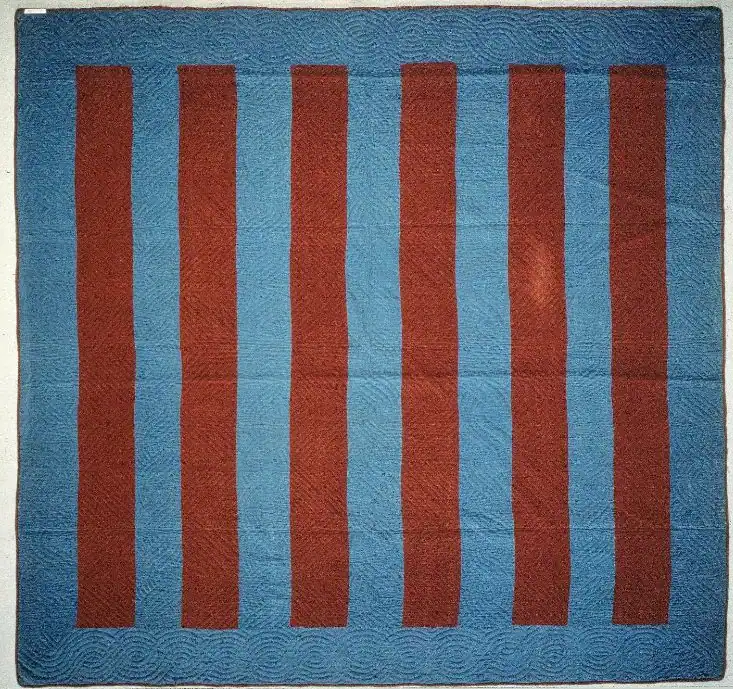
- Amish Quilts and Patterned Fabric History — A discussion of whether Old Order Amish quilters used patterned fabric before 1900, and the origin of the term “hired hand quilts.”
- A Family’s Inherited Quilt Stash — Peggy Notestine shares photos and provenance details of antique quilts discovered in a late relative’s home, prompting dating help and family-history sleuthing from the list.
- Freedom Quilts and African-American Quilting History — Members trace the historical origins of “freedom quilt” traditions and the Freedom Quilting Bee cooperative.
- Houston Quilt Festival and a New Study Program — Reports from the Houston Quilt Festival accompany an announcement of a new Quilt Studies graduate program at the University of Nebraska-Lincoln.
Date: Mon, 29 Oct 2001 04:00:45 +0000 | From: “Karen Bush” <karenbush11@>
I was quilting for a customer at the time. It was a flag quilt, and started
the weekend before. …On 9-ll, I looked at the quilting design and
there
just wasn’t enough. Through part of that week, I un-quilted and
re=quilted
it. I made an embedded eagle in the center, slanted in flight and echoed
free form stars in the stripes. It did make a Statement and just more
or
less ‘said it all’. I wrote a little ‘history’ of the quilting since
it was
going to the customer’s daughter. She now hangs it in her school hall
With
my legend on it. Made me proud a l2 year old would want to do that.
kb
http://www.karenbushquilts.com
Karen Bush
It only takes me One day to get a month behind :/
Date: Mon, 29 Oct 2001 07:34:37 EST | From: DDBSTUFF@
Bobby Aug,
Did the Amish themselves call them “Hired Hand Quilts”? My guess is
that
that is an “English” term rather than an Amish one.
Darwin
Date: Mon, 29 Oct 2001 07:43:12 EST | From: DDBSTUFF@
“Can somebody please clarify for me whether Old Order Amish ever
used
patterned fabric, particularly before 1900? I was of the
understanding that
solid was the rule of the day; somebody else is insisting that
other-than-solids were used “for quilts, decor and rugs”.
No printed fabrics were used by the nineteenth century Ohio Amish on
the
front or the back and I can pretty much guarantee that. I have seen
a few
Amish quilts from further west that used a very little printed fabric
on the
front but these were usually much later, c. 1930s or later. I have
found
that a lot of people still confuse Amish Quilts and Mennonite quilts.
Most
sects of Mennonites did use prints especially in Ohio
Darwin
Date: Mon, 29 Oct 2001 07:09:13 -0600 | From: Laura Hobby Syler <texas_quilt.co@>
Hi Cathy,
From an appraisers point of view, as well as a person who grew up
trying
to take the obligatory afternoon nap as a child under one of these
beauties…I would NOT use quilted fabric not he back. The
traditional
way to finish off a yo-yo coverlet is to indeed tack it to a backing
fabric, but only to a single piece of fabric. We had talked about
“finishing off” one of the 7 that my grandmother made for each of the
grandchildren when we graduated from highschool and she was terribly
offended that we didn’t understand that these were to be used over
the
bedspreads or blankets as additional color and decor for the bedrooms
(heck we were only teenagers – and those things were a nightmare to
try
to sleep under…particularly with our family trait of veery long
toes
<G>)
At any rate, I would not affix the coverlet to quilted fabric, only
to a
lining. Be sure to leave the outer edges free…they make nice little
scallops that you don’t have to bind <VVBG>
Laura Hobby Syler
Richardson, TX
Cathy Hooley – – Goose Tracks Quilts wrote:
>
> Hi – I’ve been asked to work on an old yo-yo quilt by one of my
customers.
> Normally I make new quilts & this is the first yo-yo quilt I’ve
worked on.
> The quilt top is unlined – it was made in the 30’s & the yo-yo’s
are
> beautiful, though a bit brittle. I’m going to put a backing on it,
am
> thinking of a quilted backing & then tacking the yo-yo’s to it.
There must
> be 500 – I haven’t counted but it’s a full size top with very small
yo-yo’s.
> Anyway, I’m interested in alternative ways to back the quilt or any
other
> techniques to finish and stabilize the top. Thanks in advance for
any
> advice.
>
> Cathy
> ^^^^^^^^^^^^^^^^^^^^^^^^^^^^^^
> Cathy Hooley
> Goose Tracks Quilts
> http://www.goosetracks.com
Date: Mon, 29 Oct 2001 13:47:38 +0000 | From: “Karen Bush” <karenbush11@>
I live about an hour from an Amish settlement/town and there are
hundreds of
quilts for sale. These are the typical Stars, etc, in the
pinks/blues,
maroons/deep greens (breaks my heart) and I asked them about these.
These
are NOT typical of their style, right??? they said ‘no, these are for
commercial purposes’. ughhh…The hand quilting on the average
‘commercial’
quilt they sell is about 3-5 stitches per inch, in black thread and
the
stitches are Not that straight. Now….for the ‘real’ quilts.
One of the lady’s was kind enough to show me HER quilts, her
personal
quilts……Yeah, not THOSE were quilts! Three were from her Dowry.
Beautiful solids/gorgeous hand quilting.
But, the others sell like crazy because they’re “Amish”…wonder
why that
is? kb
http://www.karenbushquilts.com
Karen Bush
It only takes me One day to get a month behind :/
Date: Mon, 29 Oct 2001 08:09:18 -0600 | From: “Carla Toczek” <CToczek@>
Out of lurking…….I didn’t make a 9-11 mourning quilt; I couldn’t.
My husband, an army major, called me that morning after I dropped off
the kids at school and said, “Turn on the t.v. right now.” By the
end of the day, our family life changed to full alert along with Ft.
Hood. I lived the bone deep hurt while watching the media images and while I
again faced the prospect of sending DH overseas. It may be part and
parcel of being a military spouse, but it does NOT get easier over
time. Images of quilt blocks with the twin towers and airplanes
immediately flashed through my head, but I couldn’t do it, I just couldn’t. I already have patriotic artwork, flags and doo-dads scattered over the
house. Uncle Sam has welcomed visitors into my home for several
years, along with the American Flag outside the front door. Plus, I had a red/white/blue quilt in mind for DH long before 9-11. It seemed I
would sully these proud things by recording such a heinous thing in fabric.
I had to quilt, though, and so made a quilt in two weeks, a tribute to
fall, spiderweb pattern, with bright splashes of my favorite color memories of the Hudson Valley. (it’s still green in Texas) I know
I’ll remember 9-11 now and then when I look at my autumn quilt, but it was
my way of quilting out my feelings. A mourning quilt after all.
I mean in no way to belittle or disregard the many other mourning/
9-11 quilts being made; I just had to go about mine in a different way.
Thanks for listening,
Carla Toczek, Harker Heights and Ft. Hood, TX
P.S. To make this history related, Mississippi Quilts is another
state book out recently, Mary Elizabeth Johnson led the project.
Date: Mon, 29 Oct 2001 09:52:49 EST | From: JQuilt@
please post any ideas/suggestions about yo-yo backing…i have a box
of them
that have been waiting forever to see daylight….in fact some of the
yo-yos
in the darkend box have become the tops of toadstools :))
hmmm..maybe those could be sewn together as a vest for a truffle
sniffing
piggy…
jean
Date: Mon, 29 Oct 2001 12:10:41 -0500 | From: Newbie Richardson <pastcrafts@>
Dear all,
the following is part of a workshop I give to museum volunteers. I
try to break the science down into words of one syllable so to speak.
I
find that if someone understands the why of a technique, then they
are
more respectful of that technique. Remember, this is a broadbrush
explaination. No two quilts are the same!
When determining whether to wet clean a quilt/top first find out if
it
can handle the water! Many dyes, mordants and inks cannot withstand
the
H2O.
If the object is fragile, you do have to determine if the swelling
of
the fibers caused by the water will do damage just by its self.
Remember
how you feel after a long air flight when you have been bloated by
too
much salty food, etc? Well, the historic textile feels the same way!
Then be sure that you keep the object supported. Fibers swell when
wet and the object gets HEAVY. Mishandling can cause tears – like
picking up a puppy or bunny by the ears!
The actual cleaning agents (surfactents) come in two forms: anionic
and inonic (detergent and soap). Each type attracts different types
of
soil molecules. Again, dyes, mordants, and inks can have an adverse
reaction to these.
In the late 20th c. the chemical companies have developed laundry
products designed to handle the mostly synthetic clothing that we
wear.
Therefore they include blueing agents (called brigteners) which are
designed to ATTRACT UV rays – just what we do not want!as well as
softeners and perfumes, and non-cholorinate bleaches (sodium
perborate
also the main ingredient in Hydrogen Perxoide).
The advantage of using products like Orvis (or Ivory Snow flakes –
which the chemist at Proctor and Gamble told me is the same as
Orvis),
is that they do not have any of the extra additives. Orvis is mixed
in a
suspension that is very dilute, so it rinses out more readily than
Ivory
Snow flakes. However, I have mixed a paste of Ivory Snow flakes,
brushed it on the object (upholstery in this case) and after it
dried,
vacummed and brushed it off. It definitely cleaned – with a minimum
of
water to swell the fibers. I should think that this technique might
work on a quilt for spot cleaning. But I have not tried it, as I
haven’t had one in for spot cleaning.
Ivory Snow liquid and Dreft are a simple combination of anionic and
ionic surfactents with a few enzymes thrown in. Enzymes are fine, if
the specific soil they are attracted to – blood, grass, etc – are not
present, then they sit on the sidelines, doing nothing!
Once an object has been wet cleaned, it must be throughly rinsed –
at
least 3 times! taste the water, if there is a hint of “soapiness”
rinse
again! Finally be sure that it dries in a timely fashion – YOU DO
NOT
WANT MILDEW! I lay it out on towels, blot, cover with a clean sheet
( any soils left will wick to the surface) and run a fan on low to
help
circulate the air. I rotate the object to be sure it dries evenly.
There is no one size fits all solution. but if you undeerstand the
basics of the techniques, you are perfectly capable of making an
intelligent decision – including the one to do nothing and hire me,
or
Lynn, or several other of us on this list!
Newbie – with 2 days to finish a wedding dress for a friend this
week-end – YIKES!
Date: Tue, 30 Oct 2001 08:12:02 -0500 | From: “Cathy Hooley – – Goose Tracks Quilts” <cathy@>
Laura, thanks for responding to my post – I’m glad I asked! The
quilted
back is out! I love the idea of leaving the outer edges free.
Another
question about the choice of backing fabric – I read somewhere that
if you
use a printed fabric it makes the yo-yo’s stand out. All the printed
cotton
that I have is only printed on one side. Is this OK to use –
personally I
don’t care for the way it looks, but if that’s what was done, I’ll go
with
it. Any suggestions for using printed fabric, or should I stick to
solid.
Thanks again very much for your advice.
Laura Hobby Syler wrote —–
“At any rate, I would not affix the coverlet to quilted fabric, only
to a
lining. Be sure to leave the outer edges free…they make nice little
scallops that you don’t have to bind <VVBG>”
Cathy
__________________
Cathy Hooley
Goose Tracks Quilts
http://www.goosetracks.com
Date: Tue, 30 Oct 2001 08:17:20 -0800 | From: Gail Ingram <GIngram@>
Out of lurking…….I didn’t make a 9-11 mourning quilt; I couldn’t.
My
husband, an army major, called me that morning after I dropped off
the kids
at school and said, “Turn on the t.v. right now.” By the end of the
day,
our family life changed to full alert along with Ft. Hood. I lived
the bone
deep hurt while watching the media images and while I again faced the
prospect of sending DH overseas. It may be part and parcel of being
a
military spouse, but it does NOT get easier over time. Images of
quilt
blocks with the twin towers and airplanes immediately flashed through
my
head, but I couldn’t do it, I just couldn’t. I already have
patriotic
artwork, flags and doo-dads scattered over the house. Uncle Sam has
welcomed visitors into my home for several years, along with the
American
Flag outside the front door. Plus, I had a red/white/blue quilt in
mind for
DH long before 9-11. It seemed I would sully these proud things by
recording such a heinous thing in fabric. I had to quilt, though,
Carla Toczek, Harker Heights and Ft. Hood, TX
Carla, I was like you. In fact, the first time someone on this list
mentioned recording the destroyed towers, I thought it blasphemous,
bizarre.
Like you, I was moved to think of our positivehistory. I needed that.
I kept
my eyes and heart open for something that felt right, but I did not
need
projects (What an understatement! Yet, I needed something to respond
to this
September and later.
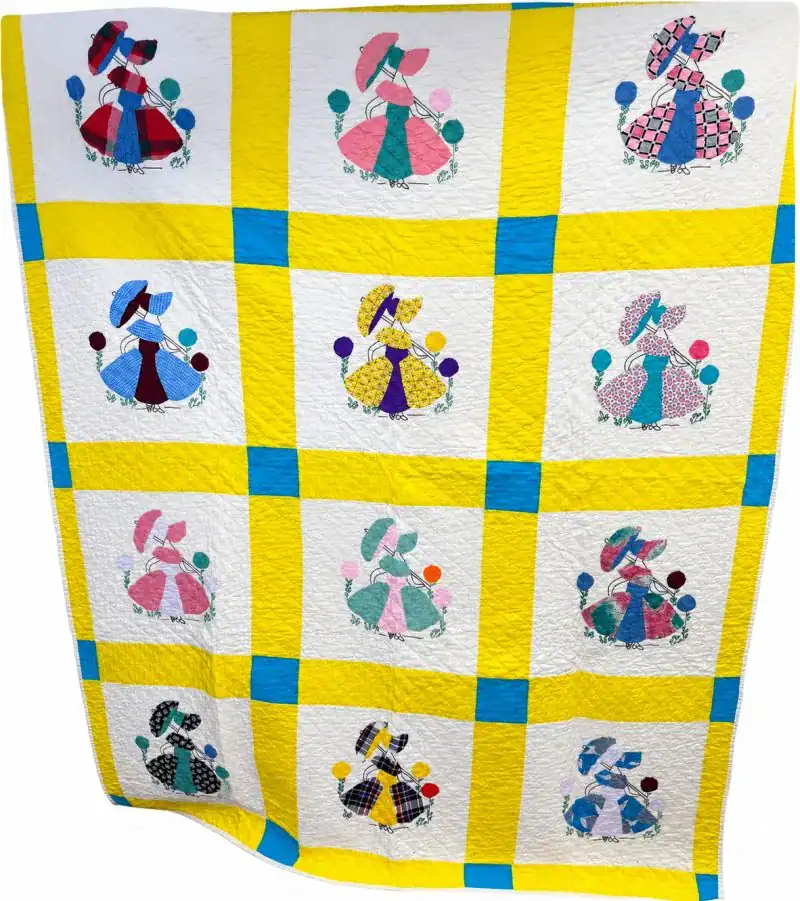
Last week, I found it: I purchased on Ebay a Sunbonnet Sue block made
before
the towers fell and made for a state exchange. There is Sue, proudly
standing (on the deck of the Staten Island Ferry, perhaps), with the
twin
towers in the background. The background is reproduced
photographically It
occurred to me: I will make that the first block in a quilt that
records my
own history with America. I will use scraps from a childhood dress
for a
block memorializing when I first learned the Pledge of Allegiance. I
will
have Sue looking at those ships at Jamestown, recording the pride and
awe I
felt when I first stood there myself and realized what 1605 meant. I
will
have a block that somehow gets Douglas McArthur, a hero of my 6 year
old
self when he was booted out in Korea. Sue will look upon the White
House as
my family did for our children’s first time one bright July day. And
so on.
But that quilt will end up by speaking of what I feel this nation
is—and I
think it is the hope of the world.
Everybody has to do what is good for herself, but I still cannot
imagine my
fingers moving over an image of those downed towers or that hole in
the
Pentagon where, 3 doors down from the last caved-in segment, one of
my
dearest former students narrowly escaped death in September.
I grew up in Central Louisiana, with Ft Polk, England Air Force Base,
etc a
fact of life. As a little girl, I learned that people die in wars but
also
that some things deserve defending. As a wife and mother of a
daughter and
son in their twenties and as a teacher of high schoolers, I fear for
the
future of my beloveds. And yet I know that like women of all times,
I have
the duty to look toward the light, to find and give hope. And that’s
what
perky little Miss Sue and I will be doing the rest of this year.
Thanks for sharing your feelings which, I think mirror many of ours.
From: “Carla Toczek” <CToczek@>
erky little Miss Sue and I will be doing the rest of this year.
Thanks for sharing your feelings which, I think mirror many of
ours.
<BLOCKQUOTE>
<B>From: </B>”Carla Toczek” <CToczek@>
Date: Tue, 30 Oct 2001 09:40:13 -0500 | From: Peggy Notestine <notestine.11@>
Hi friends,
I don’t often write in, but have faithfully read and enjoyed all your
emails on my morning digest for years. A close friend of mine
recently
brought over a large black trash bag of old quilts that were being
stored
in her mother’s basement. Her mom’s aunt had passed away and these
quilts
were from Aunt Polly’s home in Charlotte, VT. My friend brought
these over
to me to “give” them to me. You can imagine that I soon as I opened
the
bag, my jaw dropped. Inside were 9 quilts, some dated, one even
signed and
dated 1852! Some of these quilts are in perfect condition and others
have
mold, mildew, water stains, etc.
I have taken a picture and at least one detail shot of each quilt and
Kris
has very generously given me a page on her website to share these
quilts
with you. I would love for you to visit this site and give me as
much
feedback as you can about the quilts. I looked in B. Brackman’s book
for
block names, specifically for the applique quilt, and I could not
find the
match, although some were close. The website is
http://www.quilthistory.com/01264.htm The first quilt you see is the
oldest one (and also the largest) and is the one signed and dated.
There
are two very small crib/doll quilts (like 20″ x 28″) – one of these
dated
1878.
Thank you again, Kris for allowing me a venue to share these quilts
with
all the experts – I very much appreciate your effort in making the
page
look so nice!
Peggy
Columbus, OH
Editor’s note: Peggy’s photo page has been restored. See all nine quilts at Aunt Polly’s Quilts: A Trash Bag of Family Treasures from Charlotte, Vermont.
Date: Tue, 30 Oct 2001 09:57:38 -0500 | From: “Judy Kelius (judysue)” <judysue@>
Wow!! These quilts look marvelous. The stepped bricks top appears on
a
quick glance to be a “charm” quilt in which every piece of fabric is
different. The two doll quilts are especially valuable and rare,
especially
the indigo and white Ocean Waves which is dated with names – this is
one
that collectors would fight over! Machine quilting was typical on
these
small quilts, does not detract from value.
The applique quilt is also special – very unusual pattern, especially
the
way the maker used a striped fabric to create the illusion that there
are
more pieces than there really are. This is also a valuable
collector’s
quilt. I hope it does not have mildew or other problems – if it does,
this
is well worth having a professional quilt conservationist take a look
at it.
It is a miracle that these weren’t thrown out with the trash – I
always
shudder when people put quilts in dark trash bags, even just to carry
them
somewhere. I look for clear bags for this purpose – much safer!
Date: Tue, 30 Oct 2001 14:46:59 -0800 | From: “jajb” <anne_j@>
A week or so ago someone posted a link to a page that tells where all
state
quilt study organizations can be contacted plus Internet links in
cases
where they have a site. I have lost that link and want to put it on
my
quilt history site.
I am a lurker most of the time but want to let everyone know that I
love
reading this list and have learned so much and found some great
resources.
Thanks so much.
Anne Johnson
“Exploring Quilting History”
http://www.historyofquilts.com/
Date: Tue, 30 Oct 2001 18:43:20 -0500 | From: “Alan R. Kelchner” <quiltfix@>
Peggy,
You have a VERY good friend … inheriting a stash like this is
wonderful,
and so are the quilts. I’m especially interested in the appliqué,
because
you don’t typically see the flowers made from large-print floral
fabrics
like that.
<laughing> I hope you kissed her feet a coupl’a times ………
Alan
Date: Tue, 30 Oct 2001 20:12:09 -0800 | From: donbeld@
Dear Peggy, I am so excited by your find that I may have send several
messages. Congratulations! This is an unbelieveable find! These
quilts, if they are as good as they look in the pictures, need to be
in
a museum. I can’t believe you didn’t just faint dead away when you
open
the bag. Don Beld
Date: Tue, 30 Oct 2001 22:46:12 -0800 | From: “Christine Thresh” <christine@>
Who appointed Carla Toczek and Gail Ingram to be quilt policewomen
for
quilters’ expressions of concern and grief over the 911 tragedy?
I can’t believe they said things like “sully these proud things by
recording such a heinous thing in fabric,” and “I thought it
blasphemous,
bizarre” in reference to quilters’ sincere expressions of their
feelings
about the terrible event.
Quilts made in times of national upheaval are bound to have some
shocking
elements. The events were shocking.
Christine Thresh
http://www.winnowing.com
Date: Wed, 31 Oct 2001 02:47:46 -0800 | From: Gail Ingram <GIngram@>
Ms. Thresh needs to reread the two submissions, neither of which is
judgmental and neither of which contains anything like the
intemperate
rhetoric of the response they elicited.
Carla’s note and my response to it both spoke to personal responses
to the
events of September 11. Each of us found ourselves unable to commit
to the
permanence of art scenes of beloved, destroyed landmarks. That
reluctance or
inability is understandable both psychologically and aesthetically.
The mind
takes time to accept a fact so vast and grim as the one in south
Manhattan.
And art requires perspective, which requires time to digest facts,
discern
their meaning, and find an appropriate way to render that meaning in
a given
medium.
The records of responses such as ours have, I believe, a legitimate
place in
a quilt history forum. They represent one kind of response to
important
current events on the parts of people for whom quilting is a mode of
understanding and preserving meaning. Many other kinds exist. Neither
Carla
nor I suggested otherwise.
I suspect few women recorded men leaping from Wall Street windows in
October, 1929—in fact, I would be interested to know if any such
images
exist on quilts. Many other traumatic events of that era also failed
to
become icons for quilters, whose medium requires them to handle their
materials over relatively long periods of time. Quiltmakers used the
new,
“pretty” colors and prints available to them to create beauty and
bounty
they did not find in the world around them. Those West Texas women
whose
quilts Buferd and Cooper document in “The Quilters” chose not to
record the
drab colors of the landscapes in which they lived, but instead
brightened
their days and their homes with brilliant, whirling colors. And, for
that
matter, one would have been hard put to find on the streets of any
Greek
city state anyone resembling the extraordinary representations of
human
potential which the Greek sculptors left us as reminders of what we
might
be. In other words, art literally transforms reality and the
transformation
is always related to the sensibilities of the creator.
Thus, I am not at all sure that it follows that “quilts made in times
of
national upheaval are bound to have some shocking elements.” Who’s
the quilt
policeman—might that be policewoman?–now? They might have some
“shocking
elements,” but they are not “bound to.”
Since I received a similar email from Ms. Thresh and apologized for
any
misunderstanding, I am left to wonder if the source of her
concern–and her
reading–lies somewhere besides Carla’s and my well-intended entries.
She
referred me to an earlier entry, referencing a quilt she had created
in
response to September 11th and noting its “positive” message. I
confess I
missed that entry and responded solely to Carla’s touching record of
her own
response to 9/11. So moved was I by that record, in fact, that today
I
turned to the Iliad to see what kind of patterns Andromache was
weaving as
war raged outside her window and as she contemplated the fate of her
own
warrior husband.
Maybe this is putting a butterfly on a rack, and I apologize in
advance if
that is so. But I really found Carla’s remarks important historically
and
artistically, not to mention moving personally.
Yet, the more I think about it, the more I like the idea of being a
Quilt
Policewoman. Especially when I think of that big fat bag of lucious
quilts
that Peggy’s friend gave her. A bag like that might just bear taking
into
the Quilt Police Precinct for some close and long-term inspection.
And such
an officer would simply have to check out The Dating Club, would she
not?
In other words, these are tough times, and we need to be “nice” to
one
another and accept apologies and trust that each person has instincts
and
intentions as high as our own.
Gail Ingram
Date: Wed, 31 Oct 2001 14:21:23 -0800 | From: “Christine Thresh” <christine@>
Speaking of “future history” — there are some quilts for the silent
auction
at the Houston show which can be seen at:
http://www.clvquilts.com/Group1.htm
Some of the images were very disturbing. Wow.
Christine Thresh
on an island in the California Delta
http://www.winnowing.com
Date: Thu, 01 Nov 2001 04:23:41 | From: “Anne Copeland” <anneappraiser@>
It is good to celebrate such a find, but perhaps it would also be
good to
check with Lostquilts.com (Maria runs it and has many photos and
descriptions of lost and stolen quilts). I did not see the original
post,
and I do not know what state you are in, but the reason I bring this
up is
that I myself had a number of my excellent quilts stolen by a woman
who
stayed at my home (a good deed for my church, as we believed her to
be a
battered woman seeking a “new life.”) Instead, within one week, I
came home
from work, and she was gone and so were my quilts. It turned out she
was
really a drug addict. I suppose if such a person tried to sell a
bunch of
quilts for quick cash and could not do that, they could end up
getting
thrown out. I am not suggesting that these are my quilts, but just a
thought to check that site so that they do not turn out to be
someone’s lost
or stolen quilts. It would be very heartbreaking to the person who
lost
them or had them stolen. On the other hand, if it is actually a
trash find,
then you are indeed very lucky. I hope I am not spoiling the fun,
but I
have always hoped that MY stolen quilts would turn up someday. A
very dear
group of friends made one of the things, which was a top and the
bottom in
earth colors and I pieced it. It can never be replaced as one of the
women
has now passed on. Mine did not have photos, but the descriptions
are on
Maria’s site, and most others have photos. As an appraiser, I have
known of
situations where thieves stole items in a home and wrapped them with
the
quilts. Such people might have thrown quilts away.
Anyway, hate to bring this up, but as I said, all of us who have had
such
quilts lost or stolen are grieving to find our beloved quilts again.
Peace
and blessings, Annie
Date: Thu, 1 Nov 2001 10:21:43 -0500 (EST) | From: Teri Klassen <teresak@>
There is a different kind of “freedom” quilt I remember seeing in one
of
the books on African-American quilts – or perhaps it was one of the
southern state documentation books. Anyway, it was made by an
AFrican-American quilter I believe in the 1950s or 1960s and the
design,
as I remember it, consists of the word Freedom pieced in big capital
letters. Teri in Indiana where quite a few leaves still hang on the
trees and it’s in the 60s
Date: Fri, 02 Nov 2001 10:26:05 +0200 | From: Ady Hirsch <adamroni@>
Hi All,
I believe you are referring to the quilts made by the Freedom
Quilting bee,
an African-American quilting cooperative founded in 1966 in Wilcox
County,
Alabama, and still going strong in 1986. See Nancy Callahn’s
excellent
essay, “Helping the Peoples to Help Themselves'” Quilt Digest 4,
1986. The
quilts, first freely designed by the quilters, were later marketed as
Freedom quilts by stores such as Bloomingdale’s and adapted to suit
the
store’s and customer’s needs.
Ady in Israel
Date: Fri, 02 Nov 2001 07:34:37 -0600 | From: Laura Hobby Syler <texas_quilt.co@>
http://cgi.ebay.com/aw-cgi/eBayISAPI.dll?ViewItem&item=1480107795
since we had a little discussion about yo-yo quilts recently…
check out the above quilt on ebay, listed as a “square yo-yo”. Looks
more like a biscuit quilt without the “innards” to me. Comments?
Laura
(Click on the thumbnails below)
<img alt=”yoyo2.jpg (59375 bytes)” border=”2″ height=”74″ src=”images/yoyo2_small.jpg” width=”100″/>
Date: Fri, 2 Nov 2001 21:06:26 -0600 | From: “Leigh Fellner” <hcquilts@>
Funny you should ask. I emailed the seller several days ago 🙂 IMHO
this
is a biscuit quilt – oversized squares, sometimes stuffed, pleated
onto a
smaller foundation, not a “square yo-yo”.
Date: Fri, 2 Nov 2001 21:54:41 -0600 | From: “Leigh Fellner” <hcquilts@>
As long as we’re talking ebay auctions, I thought you folks might
enjoy this one:
“These quilt patches are hand pieced with the edges already turned and basted. They are approx. 16 inches in width.The pattern is Dresden Plate. Buyer pays shipping charges. If there any questions please email me prior to bidding. Thank you and good luck.”<img border=”0″ height=”216″ src=”images/i-2.jpg” width=”399″/>
And some other interesting terms I’ve run across:
Adjectives – flemsie, oscillating, irrisdescent, shinny, remet, reminet,
frailing, tinsy, eye-blistering colors
Fabric types – denium, accitate, chintez, tickling, eylett, cortaroy,
tafada, stripped, poker dots, sneaky cloth, shambrey, gimam
Of special interest to quilters – Dress Don plate, Churndish,
applicated, en
pointe, Drunderds path, scarps (not typos – appeared several times in
description), bonded, finger sewn
In the sewing room – trendle sewing machine, chester drawers
Embellishments – cross sticking, sutash
Anybody got some to add?
Date: Fri, 02 Nov 2001 19:59:33 -0800 | From: Amy Wilson <awilson@>
Leigh Fellner wrote:
> Anybody got some to add?
Well, this isn’t quilt related, but there is a sign on the mailbox
across the
street from my house that says “MISSING DOG: red/black Datsun”.
They might
have been better off just calling it a wiener dog!
—
Amy Wilson
10/0/0/142
http://www.@/alphanut_2000
http://www.@/amys_alteredbooks
Date: Sat, 3 Nov 2001 11:49:44 -0800 (PST) | From: Judy Schwender <sister3603@>
OK. I’m jealous. Lucky you!
For sure you should try to get as much background on
the quilts as possible. Notes, letters, diaries,
anything that refers to the quilts. Get as much info
about the maker(s) as possible- dates of birth and
death, where they lived, anything. Keep all this
attendant information together. The ephemera is very
important! Provenance is VERY important!
And checking the lost quilts rosters is an excellent
idea.
Judy
Date: Sun, 4 Nov 2001 07:35:43 -0500 | From: Lesters <jeanlester@>
To add to the list of “misses”, we had a woman come to our quilt show and ask if any of us had the pattern for the “Desmond Dish”. That is now one of our guild jokes. Jean
Date: Sun, 04 Nov 2001 17:12:13 | From: “Anne Copeland” <anneappraiser@>
Thank you, Peggy, for posting the letter again that I apparently missed, and I apologize if anyone was upset for me suggesting that you check with missing quilts. I guess each time I read of a trash find or someone getting a quilt from somewhere strange, my heart jumps and I somehow think that perhaps at last my quilts will be found. I am afraid, though, that they are gone forever, for quite some time has passed now. It’s funny–I have lost other things over the years through theft, etc., and always theft always feels like violation, nothing has affected me the way the loss of my quilts has. Anyway, I am very glad for you that you have such a wonderful find, and be sure to get them properly documented and photographed so that if you should ever lose yours (Heaven forbid), you can at least post them on the Lost Quilt site with photographs. I don’t think I even had photos of mine. That is most embarrassing for me, an appraiser, but somehow I never thought that in my meager little home, anything could possibly happen to them–I was clearly wrong, and am not ashamed to admit it. Peace and blessings to all, Annie
Date: Sun, 4 Nov 2001 16:12:35 -0600 | From: “quilt97” <quilt97@>
Just came across this interesting site and thought others might enjoy it. EKarenbeth “Before women had the right to vote they expressed their political sentiments in quilts. Some traditional quilt blocks used in many quilts of the 1800s are the Whig Rose, Clay’s Choice, Fifty-Four Forty or Fight, Whig’s Defeat and Presidential Rose. The Women’s Christian Temperance Union fought for temperance in alcohol, women’s rights and child labor laws. A popular pattern used to express their cause was the Drunkard’s Path. This year women across the country expressed their sentiments about the Presidential election by helping us make a quilt. 12 1/2″ (raw edge) quilt blocks using a favorite sewing technique were submitted by Feb 12, 2001. After the hand recounts are complete, we are planning on combining all the blocks into a quilt that we will exhibit around the country at quilt shows.” http://www.suzannesquilts.com/Indecision_Quilt.htm
Date: Sun, 4 Nov 2001 20:30:47 -0800 | From: “Christine Thresh” <christine@>
EKarenbeth, Thanks for posting the site for the Indecision blocks. I especially loved the Butterfly Ballot. Christine on an island in the California Delta http://www.winnowing.com
Date: Mon, 5 Nov 2001 08:58:36 EST | From: Tubeywooby@
Just back from Houston QuiltFest and a beautiful exhibit of quilts were shown of quilters expressions of Sept 11 in fabric. There were contemporary quilts of brightly colored and metallic fabrics exploding, and traditional quilts of red, white and blue, eagles, and lady liberty. The exhibit was placed through the middle aisle of the show and was in its entirety very moving. Also a lovely exhibit of quilts from Sandra Mitchell’s collection, red and greens to die for. They even had a booth with quilts from her estate being sold. Which brings me to my favorite acquisition during the show- a cheddar and muslin 16 patch quilt from her collection, beautifully machine-quilted in wreaths and feathers. In perfect condition and never been washed- I thought a bargain at $175 (with my dealer discount). I enjoyed visiting with Terry Clothier Thompson and getting her new book, which is a beautiful work with stories of her family history in quilts. The show was well attended by vendors and visitors as well. Not even warnings of terror lurking could keep quilters away. Reporting from the outskirts of Houston, Melissa Young of CrazyFolk PS … and Keepsake Quilting picked up our new book Liberty Village for their catalog!
Date: Mon, 5 Nov 2001 13:49:43 -0600 | From: pcrews@
The International Quilt Study Center and Department of Textiles, Clothing and Design at the University of Nebraska-Lincoln are pleased to announce a new graduate program in Textile History with a Quilt Studies emphasis. This program makes it possible for a student to earn a Master of Arts degree in Textile History with a Quilt Studies emphasis with only one semester in residence at the University of Nebraska-Lincoln. It is a hybrid program that combines distance delivery courses with one semester of coursework on the University of Nebraska-Lincoln campus.
If you would like to be admitted to this program, I encourage you to apply to UNL Graduate Studies, as soon as possible, but no later than January 15, 2002, to ensure a smooth transition. You may apply for admission after that date, but you may not be admitted in time to register for classes on the first day of registration in March. Application forms for graduate admission are available from the Graduate Studies Office, 402/472-2878 or they can also be found online http://www.unl.edu/gradstud. Outside the Lincoln area, call 800.742.8800, ext. 2878. General information about the UNL Textiles,
Clothing and Design Graduate Program is available online at http://textiles.unl.edu/TCDgrad.htm (No www), then click on M.A. Textile History/Quilt History (Distance Education). If you have questions, please do not hesitate to contact me by email or telephone. Sincerely, Patricia Crews Patricia Cox Crews, Ph.D. Professor and Director International Quilt Study Center Dept. of Textiles, Clothing & Design P. O. Box 830838 University of Nebraska-Lincoln Lincoln, NE 68583-0802 Phone: 402-472-6342 Fax: 402-472-0640 pcrews@ http://quiltstudy.unl.edu
Date: Mon, 5 Nov 2001 14:19:00 -0600 | From: pcrews@
Nebraska-Lincoln
We have some wonderful classes planned for 2002 for persons interested in quilt studies! Visit our website for more information at http://quiltstudy.unl.edu then click on “Education” and then on “Summer Workshops.” 2002 Summer Courses & Workshops International Quilt Study Center at the University of Nebraska “The Stitched Drawing” Workshop with Michael James June 17-19, 2002 (1 credit hour) The most open-minded view of what drawing is and can be will apply to this workshop built around the use of the stitched line as a drawing form. Working either by hand or by machine, students will respond to a suite of introductory exercises in paper, thread and fabric that will suggest avenues for individual development. Each participant will design and complete a small project building on their initial improvisations and on related discussions, readings and slide presentations.
Participants must be comfortable with both hand and machine sewing and interested in exploring the language of drawing through the fiber medium. Estimated tuition and fees: Undergraduate: Nebraska resident $200.00, nonresident $375.00 Graduate: Nebraska resident $250.00, nonresident $450.00 “Printing and Dyeing Techniques in the 18th and 19th Centuries” Seminar in Textile History with Margaret Ordonez June 24-28, 2002 (1 credit hour) Engage in a fascinating study of the increasingly sophisticated dyes and printing techniques that the 18th and 19th century printers used to pattern fabrics.
Dr. Margaret Ordonez, Associate Professor of Textiles at the University of Rhode Island and co-editor of Down by the Old Mill Stream: Quilts in Rhode Island, will lead seminar participants through discussion, extensive readings, and examination of 18th and 19th century materials and quilts from the International Quilt Study Center’s collections. Broaden your technical understanding and knowledge of the complex techniques used to dye and print fabrics prior to the advent of synthetic dyes. Learn about the multitude of factors that influenced the patterns and colors printed on pre-1850’s interior furnishing and apparel fabrics, including Indian printed and painted textiles, mechanized yarn and cloth production, textile printing innovations, and advances in dye chemistry. This seminar is designed for graduate students in textile history, quilt studies, history, and art history, and for college faculty members in those areas. Antique textile dealers and collectors also will find this course of interest.
Estimated tuition and fees: Graduate: Nebraska resident $250.00, nonresident $450.00 Noncredit participants: $150.00 Wearable Art” Workshop with Vincent Quevedo July 1-12, 2002 (2 credit hours) This workshop will help you understand special techniques in creating wearable art designs. Vince Quevedo, senior lecturer at the University of Nebraska-Lincoln, Fairfield Fashion designer, and American Quilter’s Society award winner will show you his techniques in creating a one-of-a kind wearable art garment. You will learn how to construct a garment using several techniques for creating contemporary designs. Techniques used will enable you to be proficient in marking, cutting, lining, and constructing your designs. Lectures will be geared toward assisting you in translating your ideas into reality. The computer will be used it create professional hang-tags and order sheets for marketing purposes. Estimated tuition and fees: Undergraduate: Nebraska resident $300, nonresident $675.00 Graduate: Nebraska resident $375, nonresident $795.00 Patricia Cox Crews, Ph.D. Professor and Director International Quilt Study Center Dept. of Textiles, Clothing & Design P. O. Box 830838 University of Nebraska-Lincoln Lincoln, NE 68583-0802 Phone: 402-472-6342 Fax: 402-472-0640 pcrews@ http://quiltstudy.unl.edu
Date: Wed, 5 Dec 2001 16:09:31 -0500 | From: “pepper cory” <pepcory@>
Hello all-I’m just starting to stagger after ten days in Houston. I went to work at Quilt Market (the wholesale show for quilt shops) at the stencil company I design for (StenSource) and then also did Schoolhouses (short educational presentations) for Michael Miller Fabrics and the new magazine for quilt shops called The Quilting Professional. At first frankly it was scary. Would the shop owners attend Market? Was quilting in fact on the wane? How much did 9-11 affect the American quiltmaker?
But as Market opened it became clear that nobody, leastwise a nutcase terrorist, could keep quilters down! Shop owners reported excellent sales and many were involved in fundraising projects for victims of 9-11. A huge display of quilts, most wall hanging size, about the events of 9-11, graced the main east-west aisle of the George Y. Brown Convention Center. Some were flag-waving posters, others very thoughtful artful interpretations of personal feelings. Honestly it did me good emotionally to look at them. I couldn’t have made one of those quilts–I was too stupefied by 9-11 to do anything but simplistic redwork blocks, but I was heartened and comforted by the outpouring of talent. Especially affecting were the quilts from European and Japanese quilters who in essence said, “Keep your chin up–we’re with you.” To all those quiltmakers, but especially those from countries other than the US, I humbly say, ‘Thank you.” Pepper Cory
Date: Tue, 06 Nov 2001 07:43:53 EST | From: DDBSTUFF@
I just got this from my weekly “Garden Guides” email. Some ideas never change. “Plant a Fall Container Garden If the temperatures in your area don’t drop below 20F, you can plant a winter container garden. Flower gardeners can try snapdragons, pansies and violas, and marigolds. If you prefer vegetables, try greens such as kale and spinach, radishes and carrots. Have some straw and old quilts available for unexpected dips in temperature.” Darwin
Date: Tue, 06 Nov 2001 07:47:56 -0500 | From: “Judy Kelius (judysue)” <judysue@>
I can just see all these QHL members out prowling their neighbors’ gardens at night with a flashlight!
Date: Tue, 6 Nov 2001 08:33:12 -0500 | From: “bonnie wilbur” <bonnie.wilbur@>
When I first got into quilting, I told my husband naively that maybe this would be my legacy, my semi-immortality. In almost 20 years of quilting, however, I’ve seen quilts put to a lot of destructive uses. After I joined this list, I was comforted and optimistic to see so many smart people devoted to salvaging, preserving and studying old quilts. But the garden guide reminded me of two stories I recently heard from someone measuring fabric I wanted to buy: when I said I was making a quilt for my son, she told me not to put too much time into it. She had lovingly hand pieced an elaborate quilt for her son. Then she had visited him some months later and found he had driven two nails through it to hang it over his window to darken his bedroom. Naturally, I expressed some horror and regret at this.
Her response was almost complacent; her son wasn’t as bad as her best friend’s son. The friend’s son folded his mother’s handpieced quilt to cushion the slider he laid on when he worked under his car! Now I make quilts for the pleasure of making them. I hope the people they end up with will find a happy medium between storing them in mint condition and ruining them. But I’ve decided they are kind of like children: once you give birth to them, they have their own life to lead. Bonnie Wilbur Northern Virginia
Date: Tue, 6 Nov 2001 08:50:29 EST | From: JQuilt@
********************** i can see the headlines now: Mysterious Migration of Quilters… reading further the article goes on to say… A long procession of cars with bumper stickers saying.. “Save the Quilts” was seen heading south on highway #95..heading to climates of temperatures that do not fall below20F.. when one of the cars stopped at a fabric shop..the driver was interviewed…all she would say is “i’m on a rescue mission”…then waved her little cardboard sword and mumbled something about snapdragons seedlings… this reporter will stay on the story and report any further details…. jean
Date: Tue, 06 Nov 2001 08:37:35 -0600 | From: Marcia Kaylakie <marciark@>
Hi All, Just back from Houston and recovering, which means going back to work today! GROAN!!! I know others will give updates later so I will delay. My need is this: I am researching a rattlesnake quilt which I have just acquired and there is a reference in Texas Quilts, Texas Treasures . I don’t have this book and would like to see if anyone has one that they would like to sell. Contact me privately if you do! Thanks, Marcia Kaylakie
Date: Tue, 06 Nov 2001 20:25:05 -0500 | From: “Kris Driessen, QuiltBus.com”
Here is a question that came to me, and I don’t know the answer! If anyone else does, can you answer her and copy the list? Her E-mail address is barbianswtrlls@ Thanks, Kris
>Do you know if a book exists about mourning quilts? Thenk you–I >appreciate the web site information Barb barbianswtrlls@