April 17 – 21, 2005
These restored messages come from the Quilt History List, an online forum where quilt historians, collectors, researchers, appraisers, and enthusiasts discussed antique quilts and related textiles. The archive dates from 1996 through approximately 2016 and is being restored gradually. Sign up in the form at the bottom of the page if you want to know when a new page is added. Original spelling, opinions, formatting, and inactive links may remain unchanged.
Primary topics of this QHL Digest:
- Copyright Questions for Quilt Books — A detailed discussion of how copyright law applies to photographing and publishing museum quilts in books and articles.
- A Small Museum’s Finances — Follow-up conversation on the financial pressures facing small textile museums, prompted by the Lowell closure news. (see the article on quilt museums)
- Candlewicking or Woven Bedspread? — Members help identify whether a stained textile find is hand-worked candlewicking embroidery or a woven Bolton bed cover.
- An 1820s Hexagon Quilt and English Paper Piecing — A well-preserved hexagon quilt top sparks discussion of historic English paper-piecing and whip-stitching technique. (see the article on Grandmother's Flower Garden quilts)
- Metallic-Weighted Silk and Patent History — Joan Kiplinger explains the 19th-century patent history behind damaging “weighted” silk fabric.
From: “Anne Datko” <datkoa@>
But my husband says there is no ‘w’ in Slovene. However, ‘za’ is a preposition in some Eastern European languages; means ‘between.’ AnneD
Date: Sun, 17 Apr 2005 09:19:25 -0500 | From: “Karen Musgrave” <karenmusgrave@>
While it is indeed sad to learn that Lowell is closing, it’s not just museums that are struggling for funds. The Alliance for American Quilts (www.centerforthequilt.org) doesn’t have a building but we do have a large “place” on the web. We’ve launched a membership program for the first time with special Members-Only pages in hopes of support in our mission to document, preserve and share our great quilt heritage. We only have a part time office administrative assistant and a 10 hour a week Marketing and Communications director. The rest is done by volunteers which I think is pretty amazing.
The Quilt Index already has 2,000 quilts available for research and is in the process of adding 13,000 more, thanks to a $500,000 grant from the Institute of Museum and Library Services. Quilters’ S.O.S. – Save Our Stories has gathered and posted over 400 revealing and wonderful oral histories of quiltmakers. The plan is to have 500 by the end of the year. There are also web documentaries of the extraordinary lives of our “Quilt Treasures,” people who led the revival of interest and activity in quilts. And so much more–streaming video of groundbreaking quilt films, opportunities to ask questions of quilt experts and scholars, a blog and so much more.
If you haven’t visited the site (www.centerforthequilt.org), please do. If you’ve thought about joining, please do it now. With all of these initiatives going on simultaneously, your support is critical. Thanks.
From the heart, Karen Musgrave Co-chair, Quilters’ S.O.S. – Save Our Stories The Alliance for American Quilts
If you want to learn about my quilt adventures to Georgia, Armenia and Kazakhstan, please check out http://centerforthequilt.org/webblog/index.php.
Date: Mon, 18 Apr 2005 11:04:45 +0200 | From: margareta.faust@
Hello all, The splasher on ebay Judy Kelius asked about
‘So what does this one say?’ http://cgi.ebay.com/ws/eBayISAPI.dll?ViewItem&item=7312785142
is in Hungarian
The meaning is the following: To the left: ‘It’s easier to talk than to do’ To the right: ‘It’s harder to cook than to eat’
Profound truths there, in other words! I am very curious about the first splasher in the discussion. However, the way it is transcribed does not make sense. The frequency of the ‘y’ might point to a language with a Cyrillic alphabet (Bulgarian, Ukrainian). Romanian uses Latin letters and besides, the text sounds vaguely Slavic (so that excludes Romanian and Hungarian). Is it possible to get a scan of the original? Then perhaps the combined brains of the European Unions’s translation service could make something of it.
Margareta
From: Anita Loscalzo <aloscalz@>
Dear Quilters everywhere:
The NEW ENGLAND QUILT MUSEUM in Lowell, MA, is alive and well and NOT the museum [the American Textile History Museum] rumored to be closing.
Please visit our site at
http://www.nequiltmuseum.org
for information on current and future programs, visiting, and public programs.
Feel free to contact me with any questions regarding the museum or its collections or if you are planning to visit us.
Anita
Anita B. Loscalzo, Curator New England Quilt Museum 18 Shattuck Street Lowell, MA 01852 ——– email: CuratorNEQuiltMuseum.org telephone: 978-452-4207 Ext. 11
Date: M | From: KareQuilt@
Well, no luck with the Splasher on eBay. My SIL says it’s either Hungarian, Estonian or Finnish, none of which she knows a word of.
Karen Alexander
Date: Tue, 19 Apr 2005 06:49:20 -0500 | From: Pat Kyser <patkyser@>
Thanks, Anita for your clarification. I LOVE the NE quilt Museum and was sad it was “closing.” I kept thinking, “If they’d just stuck to quilts and not branched out into all that textile and mill stuff, they’d have made it.” I used to go every time I went to New Hampshire, actually had a quilt in an exhibit there a number of years ago. It is a lovely museum in a beautiful setting, and I recommend it highly to any of you who can get there. Pat in Alabama
Date: Tue, 19 Apr 2005 08:19:48 -0400 | From: “Lynne Z. Bassett” <lzbassett@>
I think that we should all keep in mind that it is much better for the New England Quilt Museum if the American Textile History Museum remains in business. They are barely two blocks away from each other, with the National Park’s Boott Mill museum in between them. They are ALL hurting for visitors and money, and if one goes down, it bodes ill for all of them, as this critical mass of historic sites attracts visitors much better than just one or two would.
The news of the ATHM’s demise is premature. The decision is not made yet. Please let the ATHM know that you want them to stay open. Personally, I am going to pledge an annual donation to this magnificent and important museum if they will stay open. Truly, it would be a tragedy for the ATHM, for the city of Lowell, and for the other museums located nearby if they were to close.
And if you don’t feel a personal connection to the Lowell museums, please support your own local history museum. The difficulties faced by American museums these days are unprecedented, and they desperately need our help.
Best, Lynne
From: Laura Fisher
Concerning copyright designs, I am under the impression that designs can be copyright today, even if they copy old designs. The timeframe for copyright expiration is 32 years, I think, so most quilt patterns from the early to mid 20th century would be in the public domain now, correct?
Concerning the discussion about copyrighting, I get concernedknow I get my nose out of joint when someone copies a piece of mine published in a book or ad, without even so much as asking my permission. I recall once walking past a home furnishings store and seeing what had been a delightful Amish doll’s quilt I published in a book on Amish playthings–a real one in black and yellow — blown up into a crudely made quilt for sale as Amish”. It was terrific small, but all wrong as a full size quilt besides.
I own so many quilts and hooked rugs that it would not be practical to copyright each one before selling, in order to protect the image, especially of a one-of-a-kind piece. Did designers of quilts and rugs of yore copyright their pieces ?? — did Marian Cheever Whiteside Newton copyright her storybook quilt designs, or Pearl MCGown her rug patterns? And what about 19th century rug pattern entrepreneurs Edward Frost and Ebenezer Ross?
Because I did not conceptualize the designs of the antiques I buy, I thought I could not copyright them. But, if I want to reproduce anything from my collections, can I copyright them now? Some photographers who have done work for me copyright their photos of my stuff, then sell those images without asking my permission; they get the revenue from re-publication, and I don’t!!, though I may still own the stuff.
What are the issues involved in copyrighting something old to re-make it today. Is the graphic copyrightable, no matter what colors it gets made up in, or must it be the actual color-true version?
Would love feedback on this subject. Can someone clarify what can be copyright if using an old design?
thanks
Laura Fisher
From: “Nancy Gibbs”
Currently copyright is 70 years plus the lifetime of the owner. In general terms anything written/designed prior to 1923 is in the public domain. Between then and 1964 is a bit murky, depending on whether the copyright was renewed or not; since 1967, renewal is automatic, although time frames differ, depending on the particular years involved.
Here’s a useful website that capsulizes the info–it is, of course, more complicated than this!!! http://www.unc.edu/~unclng/public-d.htm
From: sue reich <suereich@>
In no way am I an expert on copyright laws, two copyright infringements on the book I helped write for our documentation project has forced me to learn something about them. One infringement was settled successfully and the other is pending. To be absolutely sure about the ins and outs of copyright laws, you need to seek counsel with a copyright attorney. The copyright laws are so convoluted that I don’t think a lay person can sort through them. There are web sites about copyrights and the actual laws can be accessed online. That said, there are a few safe guidelines to follow. The 1923 rule about public domain as stated by Nancy or the 70 years plus the lifetime of the author is safe. Most everything written in the nineteenth century is safe, unless the copyrights have been renewed. The twentieth century is not safe and you should check or get permission when going there. Anyone can reproduce quilts that you have published or personally own. Using the newly-made quilt for profit is where the problem arises. Certain things, such as patterns are timeless. Unless you can proved that the item you own was copied, you might have a hard time proving a violation. If the pattern is your original design like the Marian Cheever Whiteside Newton images than you would have a case. The timeless patterns are harder to prove. Note that the expense involved in a copyright case might be prohibitive. Usually, the only true winners in these cases are the attorneys. Regarding the photographs of your items; the image does belong to the photographer. You can write a contract in which you maintain the copyright to the images. I would suggest this for future jobs. It never quite made sense to me that you pay a photographer to take the picture, and you don’t own the image, but that’s the way it usually works. Regarding changing the color of an image or item in a remake, the derivative work laws could be argued. Hope this helps. sue reich
Date: Tue, 19 Apr 2005 22:17:34 -0400 | From: “J. G. Row” <JudyGrow@>
> Take a look at this one! > http://cgi.ebay.com/ws/eBayISAPI.dll?ViewItem&category=2221&item=7315374355
I am intrigued with this quilt. I wonder how the quilter prepared her papers for whip-stitching. Did she trace around a template made from an original drawing for each piece? Notice how all the pieces fit and there is no fudging at all. She certainly knew geometry.
I wonder if she used her needle and pricked through the original drawing to mark many papers at one time, as I do now with my sewing machine but for foundation paper piecing, not whip stitching. If we could see the papers, if any are left, even if they were cut with a scissors (as they surely had to be) we’d be able to see indications of the perforations at the edges and we’d have a clue to how it was done.
Has anyone been able to peer under the stitching to see the edges of any whipped-over-paper tops?
Judy, aka the Ringoes Kid judygrow@
Date: Tue, 19 Apr 2005 02:39:21 -0600 | From: “gingham@” <gingham@>
I’ll bet they both say about the same thing. I tried to do a website translation from slovenia to english for the 1st splasher and the second part of the phrase translated as working hard and someone else thought it said something about dinner (so working hard and eating). Then Margareta translated the second half of the 2nd splasher as harder to cook than eat, sounds similar to me and it would make sense that both splashers would have similar sentiments.
Sandra Starley
Date: Tue, 19 Apr 2005 16:34:41 -0600 | From: Kay Fair <Kaytreestump.com>
Laura,
As both a quilter and a librarian, I was intrigued by your question. In a google search using the terms “quilt design copyrights” I found several sites that I think could answer your question. The first is http://www.sew-whats-new.com/copyright.shtml, Copyright Facts for Crafters and Quilters by Sylvia Landman. She writes, “‘Any copyright existing before January 1, 1978 shall endure for 28 years from the date of registration,’ states the law.” Google Answers also deals with quilting copyright issues at http://answers.google.com/answers/threadview?id=398157. And finally, from the Southern California Council of Quilt Guilds, http://www.sccqg.org/copyright.html, there is a compilation of answers titled “Copyright Information and Issues in the Quilting World,” by Carolyn Stewart.
I included the websites rather than copy all of the answers to save space! I hope this helps.
Kay
Kay Fair, MLIS Brogden Research
Date: Wed, 20 Apr 2005 06:43:43 -0400 | From: Judy Kelius <quilts@>
My latest issue of Fons & Porter’s Love of Quilting arrived this week and whose name and photo did I find but Sue Reich! She contributed a great article on quilts and gardening showing some antique flower quilts. Way to go Sue!!
Date: Wed, 20 Apr 2005 14:37:24 +0200 | From: margareta.faust@
Hello all,
I would like to briefly describe two pieces of patchwork I bought in London recently (Camden market). They are from Uzbekistan and the interesting thing is, you can identify classical quilt blocks in them! They’re both about 1 yard square and the predominant colour is burgundy. One has a middle of squares within squares and all around it the tiniest ‘flying geese’, then an outer border of ‘nine-patches’ with the same ‘square-within-square in some. The other one has a middle (can we call it a ‘medallion construction’?) of solid squares on point, surrounded by strips of embroidery (incidently, the same ‘flying geese’, but in cross-stitch!) and the outer border has tiny stars of the Ohio star kind (a square in the middle and triangular points).
So… What I think we can deduce is that some fabric constructions may appear independently in several cultures, as there could hardly have been any influences between Soviet Uzbekistan in the 1920s-1950s and Anglo-American quilting.
I know Celia Eddy is writing a book on quilting around the world. Any comments on my finds, Celia?
The fabrics in these pieces (they are not quilted) are an interesting collection of ‘East-meets-West’: Indian solid silks and ikats and Russian printed floral silks, plus some cottons and velvets.
SO SORRY I have no pictures…. But here’s something I found on the net just to convey the idea http://www.antique-carpets.com/centasia/081kora.JPG http://www.antique-carpets.com/centasia/033kora.JPG
Incidentally, during the same weekend I saw the Royal Academy exhibition on Matisse and his textiles, which included some woven mats from the Kuba tribe in Congo. See examples found randomly on the net: http://www.adire.clara.net/kubagallery.htm
I then saw such mats at Camden market too! And not very expensive either.Some patterns looked like four- or nine-patches (OK, maybe I’m beginning to see quilt blocks everywhere!) Great place for textiles from all over the world! And in Portobello Road, I found a superb Armenian piece, indigo with intricate red embroidery, like cross-stitch but with weaving in-between. Margareta
Date: Wed, 20 Apr 2005 09:15:04 -0400 | From: “Lynne Z. Bassett” <lzbassett@>
I’m not finding a clear answer to a question I have about copyrights. Many of you know that I have been drawing whole cloth quilt designs from photographs of quilts in museum collections. All of these quilts are at least 150 years old. Some museums are sticky about my publishing my drawings and say that I even need the permission of the photographer before I can use my drawing, while others say “you can do whatever you want with it, you don’t need our permission.” I have received many requests to publish my drawings as commercial patterns. Technically, the quilt designs are in the public domain because they are more than 70-something years old, and they were never copyrighted in the first place. Also, I am not reproducing the quilt, but making my own interpretation of the quilt pattern (though it is as close to the original as I can possibly make it). Am I free to publish my drawings? Can I make them into commercial patterns?
I have consulted Marie Malaro’s _A Legal Primer on Managing Museum Collections_, but it’s focused on art museum collections for the copyright discussion, and I couldn’t understand if the information was translatable to a collection of historical artifacts.
If anyone knows a good copyright lawyer in central New England, I’d appreciate getting the contact information.
Thanks! Lynne
From: Joan Kiplinger <jkip@>
The curator oft White Homestead at Springs Industries forwarded the following to me. In light of the recent discussions on museum finances, I thought it might be of interest to all curators on this list as well as those in South Carolina. Possibly some of your institutions receive funding from NHPRC.
Subject: Budget Proposal Eliminates NHPRC
In February the President of the US released his FY2006 budget recommendations which slash or eliminate more than 150 federal programs. In that budget, the National Historical Publications and Records Commission (NHPRC) has been targeted to receive NO funding. This includes no funds for the grants program and no funds for staffing to support the NHPRC programs. In addition, the overall budget for the National Archives and Records Administration has signficant decreases in other areas of importance. The relevant section for NHPRC specifically and sparsely states:
“National Historical Publications and Records Commission Grants.–This program provides funding for grants that the Commission makes, nationwide, to preserve and publish records that document American history. The Budget proposes no new grants funding for the National Historical Publications and Records Commission in 2006.”
As you know, the NHPRC provides the funding for the SC SHRAB regrants (http://www.state.sc.us/scdah/shrab/regrantmain0406.htm) and other projects in South Carolina.
The elimination of the NHPRC will have a significant negative impact in South Carolina. The NHPRC has provided nearly $1.5 million of support over the past twenty years to our State’s historical records repositories. This has included grants to colleges and universities, historical societies, libraries, professional associations, museums, and local governments to preserve and make more accessible to the public South Carolina’s rich documentary heritage. See this link for a list of the more than one hundred South Carolina institutions and organizations that have received NHPRC funds: http://www.state.sc.us/scdah/shrab/shrabnhprcgrantinstitutions.htm
Fortunately, the new Archivist of the US, Allen Weinstein, is fully supportive of the NHPRC and at his swearing in last week made it plain that he would work hard to keep the NHPRC alive and well as the grant making branch of the National Archives and Records Administration. At this point, however, it is very important that members of Congress, especially members of House and Senate appropriations committee, be contacted and told of the importance of the NHPRC. South Carolina has only one appropriations committee member, Representative James Clyburn. Please seriously consider contacting Rep. Clyburn about the NHPRC, and/or, other House and Senate members of the SC delegation urging that your concern be made known to the chairs of the House and Senate appropriations committees. A list of the list SC delegation and contact information is available at: http://www.state.sc.us/fg1.htm
See this link for a list of SC institutions and organizations that have received NHPRC support: http://www.state.sc.us/scdah/shrab/shrabnhprcgrantinstitutions.htm
Reproduced below are guidelines for submitting public testimony regarding NHPRC to the House Appropriations Subcommittee that oversees the National Archives/NHPRC budget. As you will note, what is needed now are letters on behalf of institutions and organizations rather than individuals (which may still be sent to individual members). It would good to have letters sent not only by the professional associations, e.g., SCAA and PALMCOP, but also by the directors of institutions around the State. I hope that you can help in this important work. The deadline is April 25.
Here is a link to a website on the status of funding for the NHPRC. Additions are made to it regularly
http://www.savearchives.org/
Please feel free to forward this to anyone you feel might need to know.
Thank you.
Roy H. Tryon, Chairman SC State Historical Records Advisory Board SC Department of Archives and History 8301 Parklane Road Columbia, SC 29223 Tel. 803.896.6120 E-Mail: tryonscdah.state.sc.us FAX: 803.896.6138 http://www.state.sc.us/scdah/shrab/shrab1.htm
From: Judy Kelius <quilts@>
I think the answer is that the fabrics are silk . . . I didn’t realize this at first but the colors are so unusual for cotton and then I looked at the closeups – they certainly look like silk. The seller says nothing about fabric content. When did they start weighting silks? Silks in themselves hold up very well (just visit Winterthur sometime and see some of their 18th century silk quilts in amazing condition!) – it was the weighting process that caused them to shatter. At 1852, these fabrics probably predate that phenomenon.
From: Joan Kiplinger <jkip@>
Judy — metallic weighting, the damaging type containing tin, was developed and patented in Germany in the late 1880s and was marketed to manufacturers in the 1890s. By the mid-1930s, the US passed a labeling act setting the ceiling percentages for colored and dark silks and which had to be stated on labels and bolts. Chemical weighting using clay, barium and other non-harmful substances was the common weighting method before that. Even silk companies claiming pure dye silk used non-harmful weighting ingredients for the most part..
From: Sally Ward
The construction of this quilt, and the density of the patterning using brightly coloured silks pieced over papers, looks very familiar and English. But I have to say that the pattern itself doesn’t, really. There is a coverlet in Averil Colby’s ‘Patchwork’ which seems to have a mariner’s compass centre, but the rest of it is largely applique and linen (it is from 1790) – not a pieced over papers. The curved pattern in the background blocks isn’t very familiar either. Of course, people could design and make anything using that technique, so its impossible to be categorical about its Englishness or. Did the designer know geometry? Maybe, but it wasn’t my strong point at school and yet I loved doodling stars by simple subdivision of segments of a circle or square using a compass. I knew nothing of what angles I was using.
As for the label, I am not sure quite what that tells us. It is obviously a later addition, whoever wrote it knew what they meant, but it doesn’t help us very much. If we could see the punctuation between the second initial and England it would help, but otherwise I can think of lots of ways to interpret it.
Anyone who has a copy of the new book ‘Through the Needle’s Eye’ can see several good examples of English quilts of silks pieced over papers. One of these is a quilt made by Mrs Anne Hutton Wilson from patterns drafted by her artist husband. It is a frame quilt, and one of the borders contains blocks – every one different – which are the sort of patterns we used to make with compasses (or Spirographs, if you were lucky_. Presumably he drew them, she cut up the papers and pieced over them.
> Did she trace around a template made from an > original drawing for each piece?
It is received wisdom in most circles that templates were used, although there’s no reason why she might not have drafted each one and cut it up. Arguments for the use of templates include the fact that papers retrieved from quilts like this are often cut from many sources, and those sources were not necessarily large enough to cut an entire block from. With a template, use could be made of any little corner of paper available. The papers from really good quilts like this, or Mrs Hutton Wilson’s, are not usually available to view because the quilts are intact. Ones retrieved from damaged, simpler, hexagon quilts show fragments of books, catalogues, bills, tradesman’s papers, copy books etc., all mixed together.
Templates could have been made from cardboard by the seamstress, or from tin or other metal plate by a relative or employee, or from wood. There were a lot of skilled craftsmen making inlay wood patterns that looked very like this, they could easily have created template sets.
I think it highly unlikely that she would have had the paper, or the inclination, to mass produce her pattern by pricking paper. For these sort of endeavours time was not really of the essence, and of course mass production hadn’t really been thought about anyway. Also, paper pricked then cut would not give a smooth edge for turning the silk over. Papers removed from an old quilt might well show signs of a ‘pricked edge’, but this would likely be because the technique of whip stitching often catches the very edge of the paper in….a reason why papers were not removed from completed blocks and re-used, as they had lost their definition.
Nice quilt, though but (as they say in these parts).
Sally W
Date: Wed, 20 Apr 2005 17:05:43 +0100 | From: Sally Ward <sallytatters@>
> fabric constructions may > appear independently in several cultures,
Yes, of course, but…
as there could hardly have been > any influences between Soviet Uzbekistan in the 1920s-1950s and > Anglo-American quilting.
Why not?
Sally W, playing DEvil’s Advoctate…..
Date: Wed, 20 Apr 2005 16:18:43 +0000
Also, these layouts sound very similar to traditional Indian quilts. If the quilts were from a region near or on the Silk Road, that could certainly account for the similarities.
And to be strictly factual, the medallion/block layout for quilts, whether pieced or not, seems to have been firmly in place in *Asia* (specifically, India) no later than the 15th century and in Europe by the 1390s or possibly earlier. This is a style that appears everywhere, in just about every time period.
Karen Evans
From: Donald Beld
I was fortunate to be able to example an 1820’s hexagon quilt top and feature it in my guild’s show last year that have over 6000 pieces–all paperpieced and whip stitched, with the paper in place–I have photos and if anyone wants to see them, I can post them on the e.board.
Anyway, she basted every last piece of fabric over the paper before she put the pieces together—I suspect that was the technique then.
I also question the label and date–doesn’t look original. I suspect the date is wrong and the quilt actually dates earlier than that–I think that English paper piecing, whip stitching was passe by 1950–what do you experts think? Don Beld
From: “Candace Perry”
Found in the collection today a bedspread (presumably) of what I believe to be candlewicking, but I don’t know! It’s very heavy white cotton, with a star design. Could anyone fill me in on what candlewicking really is, and when it was popular? I’m guessing this spread is late 19th century. Any help greatly appreciated, Candace Perry Schwenkfelder Library & Heritage Center
From: Kathie Holland
Don I would love to see the pictures if you don’t mind posting them to e board or you could send them directly to me. Thanks, Kathie
From: “Lynne Z. Bassett”
Candace, can you send me a picture? It might be a woven Bolton bed cover or it might be candlewicking. And it might be earlier than you think.
Best, Lynne
From: “Candace Perry”
Lynne, I’ll see if it will photograph. Unfortuanately it is pretty stained — sad, as it’s a nice piece. Thanks, Candace
Date: Wed, 20 Apr 2005 17:09:36 -0400 | From: “Karen Evans” <charter.net>
That’s one of the big, big, big problems with photographing anything light or wholecloth. You lose *so* much detail that it’s almost not worth it. 🙁
Karen Evans
(or, why there are no photographs of my linen wholecloth quilt….)
Date: Thu, 21 Apr 2005 00:29:00 +0100 | From: Sally Ward <sallytatters@>
>I think that English paper piecing, whip stitching was passe by 1950–what do you experts think? Don Beld
Quilting and patchwork itself, never mind over papers, was passe by 1950 <G>.
One of our great modern (UK) exponents of piecing over papers, Lucy Boston, produced her last quilt in 1984 still using this method as she had begun in 1938. (recommended reading: The Patchworks of Lucy Boston, by Diana Boston, ISBN 0905899 21 0) This conversation had me dip into the book again, and interestingly, relating to the discussion on papers, it recounts that for some of her quilts she bought the papers or cards over which the patches were tacked from the catalogue of a firm in Oxford. An order placed in November 1961 was for: 1,000 1″ hexagons, 1,000 1″ long diamond cards, a set of templates to make a 16-pointed star, a set of templates to make a fine-pointed star, and 100 2″ diamond cards. It would be interesting to find out how long that firm had been producing cards and templates, and when they actually stopped.
But generally, any form of patchwork (as it would be more familiarly called in the UK) was not welcome in the new ‘clean and modern’ design ethos of the postwar years.
However, by 1978 a revival was sufficiently established for the BBC to produce a short series called ‘Discovering Patchwork’. I have a copy of the accompanying book, and it opens with the words ‘the key to accurate patchwork is the template’. It goes on to describe first of all hand sewing over papers (‘the traditional English way of making patchwork’) followed by hand sewing without papers (‘the traditional American way of sewing patches together’).
I think if you asked any woman-in-the-street what patchwork meant to them, they would still have a vague idea of piecing over papers as ‘the way to do it’. Certainly most women of a certain age would be able to drag some unfinished hexagons from the back of a cupboard somewhere <G>
Sally W
Date: Thu, 21 Apr 2005 00:38:23 +0100 | From: Sally Ward <sallytatters@>
PS For anyone who likes really hard work, try the technique used on the 1718 silk coverlet owned by the Quilters Guild of the British Isles (http://www.quiltersguild.org.uk/contents/heritage/1718silkcoverlet.htm).
When the silk was tacked over the papers, the tacking was only stitched through the excess fabric folded over the back, and the paper… not right through to the front fabric. The papers were then left in situ when the backing was added and the coverlet completed. Guild members who made the replica last year had to use this same method.
Sally W
From: Don
Hi Sally, I meant, of course, 1850’s not 1950’s. English paperpiecing as a techique in America was I think more popular before the Civil War than after.
I have posted the photos of the hexagon 1920’s quilt on the vintagepicture.eboard.com site. They are very interesting in the colors as well, very unusual fabrics, all fussy cut–the individual cells are 3/4 inch across. Best, Don
From: Sally Ward
Donald Beld wrote: > Hi Sally, I meant, of course, 1850’s not 1950’s.
Ah! The typo sent me off on an interesting train of thought though Don. I’m going to see if I can find out anything about that firm that sold papers.
I must admit I didn’t think there was much paperpiecing done in the US at all. If English immigrants were bringing in predominantly that technique, who was bringing in ordinary piecing? and how quickly were the papers abandoned? And why, do you suppose? Does anyone do it now at all, or only as reproduction work? Are there any other traditions that use papers like we did?
Sally W
Date: Thu, 21 Apr 2005 10:29:00 +0100 | From: Sally Ward <sallytatters@>
A wonderful hexagon example Don. I love the way the seamstress fussy cut and positioned her fabrics…those flowers just dance around the centres.
Sally W
Re: Candace’s question
This past weekend, I posted a new file on my website in which I discuss what candlewicking (candlewick embroidery) is. The article is about Hannah Wilson, a New Hampshire woven coverlet maker whose signature trademark was to make Bolton style coverlets (like those made in Bolton, England). These are mistakenly attributed to a candlewicking technique because they have raised bumps due to their double weft loop construction. When coverlets of this kind were loomed, there were two weft threads, one of which was pulled up to the surface to create a 3-D effect.
There is a link to the full article on the front page of my website. The fascinating details of Wilson’s life, were provided to me by Donna-Belle Garvin, the former NH Historical Society curator whoat present is in charge of the museum’s publications. Her research over the last fifteen years uncovered the mysteries surrounding this early to mid nineteenth century coverlet maker.
Wilson coverlets have shown up in museums all across the country. These institutions were unaware of what the information woven onto the back of each coverlet meant. That is, they did not know until Garvin’s research.
The article I wrote is very long, so make yourself a cup of tea, and enjoy!
Best,
Patricia Cummings Quilter’s Muse Publications, www.quiltersmuse.com
Date: Thu, 21 Apr 2005 07:06:10 -0400 | From: “Louise” <ltiemann@>
Lynn, If you take a picture of one of the museum’s quilts and use it in the book, you need their permission, since they own the quilt. If you use a photo that someone else took of a quilt – you need the photographer’s permission. Your drawings / renderings should be fine to use, however you might want to cite the inspiration for the design. These are just my 2 cents from reading copyright information – I am not a lwyer. Good luck, Louise
Date: Thu, 21 Apr 2005 07:24:58 -0400 | From: Kathie Holland <kathieholland@>
Thanks so much for sharing the pictures Don, I agree with Sally I love the way she maximized the use of the fabric design….wonderful , very inspirational to me! Kathie in NJ
>A wonderful hexagon example Don. I love the way the seamstress fussy cut >and positioned her fabrics…those flowers just dance around the centres. > > Sally W
Date: Thu, 21 Apr 2005 07:45:45 -0400 | From: “Lynne Z. Bassett” <lzbassett@>
Thanks, Louise. That’s what I thought regarding just publishing the drawings in an article or book. But what about the commercial patterns? For that, I think I’m going to have to get a licensing agreement from each of the museums. I want to do right by them–heavens, as a museum curator myself for so many years, I would hardly want to be thoughtless or unscrupulous in using museum objects! I’m just rather daunted at the thought of all that paperwork and legalese.
Thanks again!
Best, Lynne
> Lynn, If you take a picture of one of the museum’s quilts and use it in > the book, you need their permission, since they own the quilt. If you use > a photo that someone else took of a quilt – you need the photographer’s > permission. Your drawings / renderings should be fine to use, however you > might want to cite the inspiration for the design. These are just my 2 > cents from reading copyright information – I am not a lwyer. Good luck, > Louise >
Date: Thu, 21 Apr 2005 07:50:36 -0400 | From: “Lynne Z. Bassett” <lzbassett@>
For those who might be interested, there is also a wonderful essay about Hannah Wilson written by Donna-Belle Garvin published in _Textiles in Early New England: Design, Production, and Consumption, The Dubin Seminar for New England Folklife Annual Proceedings 1997_ (Boston University, 1999), pp. 29-47. The title of the essay is “The Warp and Weft of a Lifetime: The Discovery of a New Hampshire Weaver and Her Work.”
Best, Lynne
> This past weekend, I posted a new file on my website in which I discuss > what candlewicking (candlewick embroidery) is. The article is about Hannah > Wilson, a New Hampshire woven coverlet maker whose signature trademark was > to make Bolton style coverlets (like those made in Bolton, England). These > are mistakenly attributed to a candlewicking technique because they have > raised bumps due to their double weft loop construction. When coverlets of > this kind were loomed, there were two weft threads, one of which was > pulled up to the surface to create a 3-D effect. > > There is a link to the full article on the front page of my website. The > fascinating details of Wilson’s life, were provided to me by Donna-Belle > Garvin, the former NH Historical Society curator whoat present is in > charge of the museum’s publications. Her research over the last fifteen > years uncovered the mysteries surrounding this early to mid nineteenth > century coverlet maker.
Date: Thu, 21 Apr 2005 08:26:56 -0400 | From: “sue reich” <suereich@>
> There is one in Hartford. We consulted with him before we sent the > manuscript for our book. We did not want to be guilty of any copyright > infringements. I will try to find his name and email you privately. > We featured quilts from museums and historical societies in “Quilts and > Quiltmakers.” When we received the permissions to include them in our > book, each of them had a different set of rules that we had to > accommodate. This is understandable due to the nature of their business > and their own needs to benefit financially from their own collection. > Each have their own policies. You will have to jump through those same > hoops and eventually discard that institutions that are too restrictive > for your needs. > In producing a book, make your purpose for printing it abundantly clear at > the beginning of the book. If this is to encourage people to reproduce > quilts designs that you have copied from a number of collections; then you > need to make this clear to the general public and to the quilts’ owners, > right up front. Otherwise, you get into the same controversy that the > “Dear Jane” quilts are incurring. Keep all of your permissions for a > very long time. When our successfully won, copyright infringement went to > trial, we needed to produce evidence about our project and intentions that > spanned 12 years. Begin to think defensive at the very beginning. > Check the “Derivative Works Law” to see if extracting from an image and > giving your own interpretation applies here. In our case, some images > from our book were scanned and colors were altered. The offending > publishing house contended that this was a creative process, thus the > resultant image was theirs and not a violation. Wrong! > > sue reich
Date: Thu, 21 Apr 2005 10:23:40 -0400 | From: “Lynne Z. Bassett” <lzbassett@>
Thanks for the copyright information, Sue! I appreciate it!
Best, Lynne
Date: Thu, 21 Apr 2005 14:30:17 +0000
And speaking of Lynne…she was featured, along with Jane Crutchfield, in an article in today’s Springfield Republican about the Mass Quilt Documentation project. I read mine in the actual paper, but the Republican’s on-line presence is www.masslive.com.
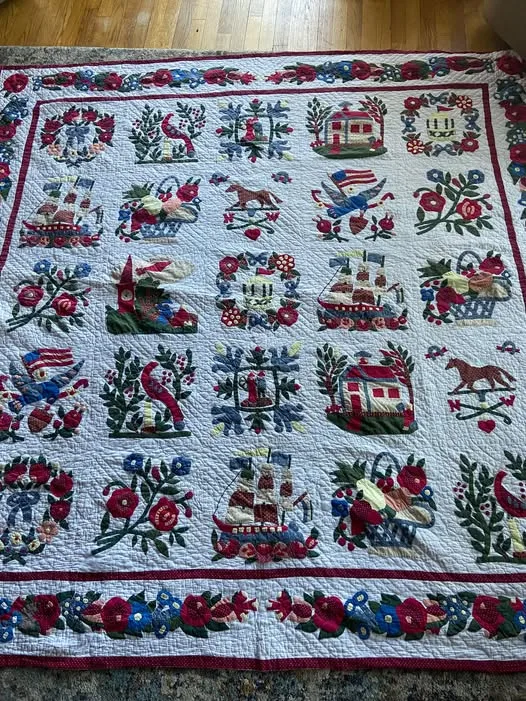
It was a decent article from what I could see, with a great color picture of Lynne, Jane, and a Baltimore-style album quilt (was it the one with the armadillo?). Nice quotes from both ladies.
Karen Evans
Date: Thu, 21 Apr 2005 10:42:07 -0400 | From: Kathie Holland <kathieholland@>
Karen can you tell us what section it is in the paper, I just went searching and not able to find it 🙁 , can you help? Thanks, Kathie —– Original Message —– From: <charter.net> To: “Quilt History List” <qhl@> Sent: Thursday, April 21, 2005 10:30 AM Subject: [qhl] Re: Fw: Copyright attorneys in lower New England
> > And speaking of Lynne…she was featured, along with Jane Crutchfield, in > an article in today’s Springfield Republican about the Mass Quilt > Documentation project. I read mine in the actual paper, but the > Republican’s on-line presence is www.masslive.com. > > It was a decent article from what I could see, with a great color picture > of Lynne, Jane, and a Baltimore-style album quilt (was it the one with the > armadillo?). Nice quotes from both ladies. > > Karen Evans > > > > — > You are currently subscribed to qhl as: kathieholland@. > To unsubscribe send a blank email to > leave-qhl-1442773V@ >