May 30 – June 6, 2005
This page contains affiliate links. If you buy through them, I may earn a small commission at no extra cost to you. As an Amazon Associate I earn from qualifying purchases. Learn more
These restored messages come from the Quilt History List, an online forum where quilt historians, collectors, researchers, appraisers, and enthusiasts discussed antique quilts and related textiles. The archive dates from 1996 through approximately 2016 and is being restored gradually. Sign up in the form at the bottom of the page if you want to know when a new page is added. Original spelling, opinions, formatting, and inactive links may remain unchanged.
Primary topics of this QHL Digest:
- Quilts to See in Los Angeles — A member planning an LA trip gets recommendations for museums and quilt collections to visit.
- Dating a Hexagon Mosaic Quilt — Members discuss dating an English-style paper-pieced hexagon mosaic quilt, touching on the history of purple/mauve synthetic dye.
- Tracking Down “The Coffin Quilt” — A member searches for the novel and quilt history behind “The Coffin Quilt,” a story tied to the Hatfield-McCoy feud.
- The Stephen Sollins “Recycled Sampler” Controversy — A heated debate breaks out over an artist’s use of cut-up antique samplers as raw material for gallery art.
- Eastern Star Quilts and the Oldest Known Quilting Stitch — Members trace Eastern Star quilt patterns and discuss the oldest known quilted object, a Siberian tomb rug.
From: Sally Ward
It *was* traditional in some houses for servants to be given a gift (‘christmas box’) which may have been large or small, monetary or otherwise. It might have been something pretty and personal, something useful, something practical to do with their work, or just as often something pretty measly and quite inappropriate. Perhaps sometimes they were given fabric, and perhaps sometimes the fabric was purple, and maybe that story was a personal one attached to this particular quilt. But it certainly wasn’t a countrywide tradition that I’ve ever heard of.
Sally W in UK
From: Kim Wulfert
<<<Madge Ziegler made the point that many women would buy a kit, make patterns from the kit and reproduce it several times in fabric of her own choosing. I had never thought of this simple explanation for the many quilts which appear to be from kits but lack the tell tale blue dots and lines. This is why we have study groups. >>
Thanks for sharing this Cinda- it’s also why we have QHL!
Kim Wulfert www.antiquequiltdating.com
I’ve not heard of this but heard something on the radio or TV the other day which stated only royalty were allowed to wear purple (and this was by law). Sorry I wasn’t paying more attention, I didn’t even take note of which king was in power. Sally Bramald 01252 812429 from within the UK 0044 1252 812429 from the rest of the world sallybramald.com http://community.webshots.com/user/sallybramald
From: “Major Maam”
Dear Marcia, I don’t know of any permanent quilt exhibits in Los Angeles. I have sent out a request to members of my guild to see if they know of any.
I did a little search and came up with these:
http://www.la.com/attractions/artsperformancevenues/californiaheritagemuseum/7420
http://collectionsonline.lacma.org/mweb/about/cost_about.asp Scroll down to bottom of page.
http://www.nhm.org/exhibitions/docentquilt/main.htm This is at the Natural History Museum
I will be glad to take you around,
Becky In the High Desert of California
From: “Marcia Kaylakie”
I find that I will be in Los Angeles in late October for 4 days. Are there any museums that I might contact and arrange to see their quilts while I am there? Thanks, Marcia Marcia Kaylakie, AQS Certified Appraiser Austin, TX www.texasquiltappraiser.com
From: Lynn Gorges
Cinda, do you have those quilts posted anywhere? Of course I am interested in looking at the teal, orange, oxblood NC quilt. Thanks, Lynn Gorges
From: “Candace Perry”
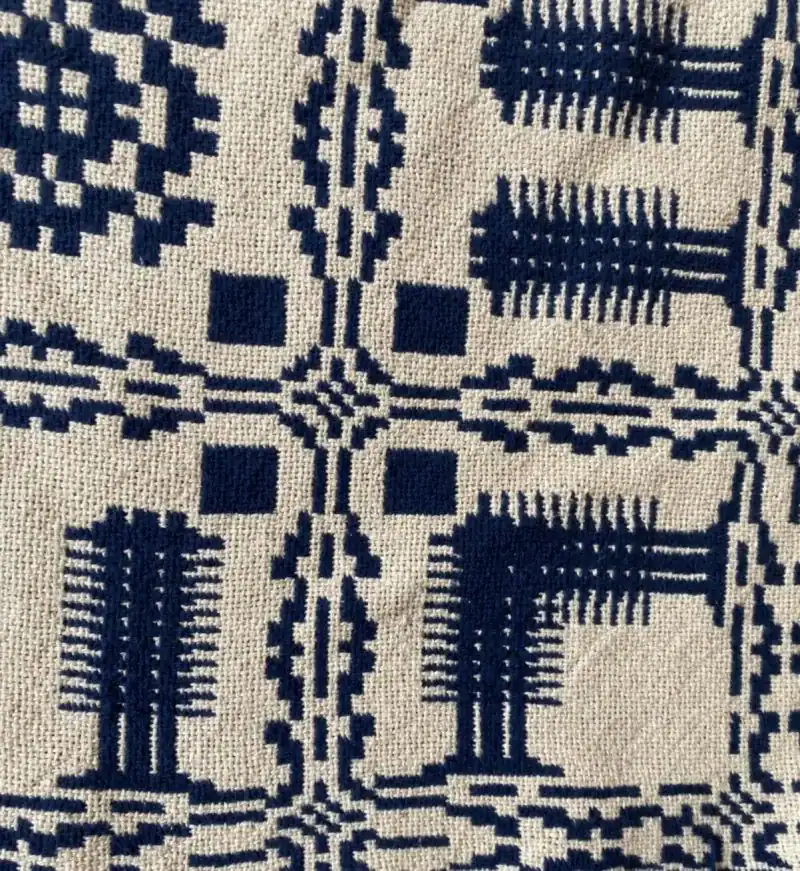
The book is available from us for $15.95 plus $4.95 shipping — it’s a great dicussion of three shaft weaving among the Pennsylvania Germans — the type of weaving used to create some utilitarian household textiles. 46 pages with b/w illustrations, softcover, also weavers’ drafts included. It’s a very significant study of overlooked domestic textiles. We accept Visa, MC, Discover and checks. Let me know if you’re interested! Candace Perry Schwenkfelder Library & Heritage Center
From: “ines barcia”
Sally wrote:
>I’ve not heard of this but heard something on the radio or TV the other day >which stated only royalty were allowed to wear purple (and this was by >law). >Sorry I wasn’t paying more attention, I didn’t even take note of which king >was in power.
Hello out there. I am new to the list and have been reading your comments back and forth. I am fascinated. I am not a specialist but a would be knowledgable quilt person. But I do know a bit on purple.
Purple dye was created using a certain shellfish. This was a very very expensive process. The resulting fabric was then sold at an incredibly forbidding price. Hence it was reserved for the rich and usually for very special occasions.
ALexander the Great, in his many travels, came across quite a bit of purple fabric, and always found it to be considered a treasure.
The chinese reserved it (ok, please do not ask for dates), in ancient times, for the sons of emperors.
SOmetime in the 4th certury, the emperor Theodosium of the Byzantium Empire established purple as the color of Royalty and if you wanted to keep your head (literally) you wouldn’t even dream of using it.
But I do know the Romans where less strict. So much so that the price in the stock market went up so high that only the very very very very rich could get hold of it.
Later on, it was the Catholic Church who got the monopoly. Purple (only now it was magenta, I think) was used for the higher heirarchies of the Church princes. (Ah, once again Royalty).
I do believe it was sometime in the 1800s that someone in England came up with a new purple artificial dye. Purple then lost its exclusivity and was commonly used in the textile industry.
ONce again, I am no expert, just an avid reader and picker upper of details.
Ines from Switzerland/
From: “Candace Perry”
There is a scrumptious little crib quilt in the group…and some others… Go to their site, go to the 6/10-11 auction, then to categories, then to textiles. Candace Perry
We have just updated our website ( www.pookandpook.com ) to include the June 10 – 11 Variety Auction featuring 1000+ lots. There is such a quantity of wonderful material that we are still adding lots and images to the website!
From: “Beth Davis”
Hello, I’ve posted a picture of the hexagon mosaic quilt on eBoard: www.vintagepictures.eboard.com_ (http://www.vintagepictures.eboard.com/)
The fabrics don’t look like any that I’ve seen before-especially the blue-green. There is also bright blue, then the more common tan, brown and purple prints.
I thought it could be English perhaps and prior to 1830. Any ideas?
Beth Davis
From: Xenia Cord
I would be cautious about assigning a date to this (or any) hexagon mosaic that appears English and is paper pieced, as this one appears to be. Because the quilts are ‘scrap bag’ accumulations, the fabrics may date over a wide time period. And if the quilt is English, their fabric choices were different and their popular colorways occurred at slightly different times than ours. That said, I have always understood that an early mosaic in paper-pieced hexagons, with a lot of pastel pink prints, is probably English.
About purple, there were a number of substances that yielded purple dye, including madder and logwood, I think (not really my area). The ‘royal purple’ discussed earlier was made from a seashell like periwinkle, which meant a huge number had to be harvested in order to get a very small amount of dye. In the mid-1850s, an English teenager experimenting with coal tars in his back garden laboratory, trying to discover a source for artificial quinine, discovered instead a brilliant purple. It was known as Perkin’s purple (he was William Perkin), or mauvine, and became all the rage for everything from clothing to umbrella silk to horse rosettes and so on. Its one failing was that it faded to tan over time.
Xenia
From: “Lucinda Cawley”
In 2001 Simon Garfield wrote a wonderful little book called Mauve about Perkin and his color. Cinda on the Eastern Shore
This is probably bad timing for your visit Marcia, but it will be interest to others in California. It’s a quilt exhibit and speaker programs happening at the Santa Barbara Historical Society, 805-966-1601. Jennifer Gilbert is one of the presenters, but unfortunately she is coming at the same time AQSG is having their conference in CO! That’s a hard pill to swallow for me. Julie Silber and Jean Ray Laury are other speakers of interest to QHs. Additions to the CA Quilt Documentation Project are being welcomed and will be added at no charge to the growing records. CA did their documentation project early on, in the later 1980s and early 1990s, publishing the results in “Ho for California” in 1993.
Kim Wulfert www.antiquequiltdating.com
“Stitches in Time” – Unique Quilt Exhibition and Lecture Series September 6, 2005 — April 16, 2006
EXHIBITIONS (admission is free):
Through August 7, 2005 Cowboy Artist: John Edward Borein 1872-1945 (friend of Remington & Russell)
September 6 through October 30, 2005 Pieces of the Past: Extraordinary 19th Century Quilts. Treasures from the Museum’s Textile Collection including a rare early 18th century “Tree of Life” quilt & other outstanding examples from private collections.
November 20, 2005 through January 22, 2006 Victorian Beauties: Crazy Quilts to “Log Cabins.” Holiday decorations include quilted tree ornaments by local quilters.
February 10 through April 16, 2006 Contemporary California Art Quilts: The Best of California Art Quilters. Guest curator Marinda Steward has assembled outstanding examples of contemporary quilt making.
PROGRAMS: September 15, 2005 Local History Lecture: “Ho for California!” An illustrated lecture by Jean Ray Laury about the California Heritage Quilt Project. A wine & delicious hors d’oeuvres reception will follow. Prepaid members $20/members paying at the door & guests $25. 5:30 p.m.
October 7, 2005 Collectors Series Program: Two illustrated lectures by Jennifer Gilbert, Director of the New England Quilt Museum, “History of Quilts” & “Artistic Origins of Contemporary Quilts,” followed by gourmet lunch in the museum courtyard. $85 members (advance reservation required.) Guests $100. 10:30 a.m.
October 13, 2005 Local History Lecture: Celebrate Family History Month with Margaret Cooper & her story of a Japanese-American family with her “bi-lingual” Crazy Quilt. A wine & delicious hors d’oeuvres reception will follow. Prepaid members $20/members paying at the door & guests $25. 5: 30 p.m.
February 11, 2006 Quilt Appraisal Fair Is there a quilt in your closet? Want to know more about it? For quilts made prior to 1950, the California Quilt Project will document your quilt free for the state archives. Julie Silber, noted quilt historian, will provide dating & verbal appraisals ($20). Written appraisals $75.
March 16, 2006 Local History Lecture: “The Contemporary Art Quilt Movement.” This illustrated program by guest curator Marinda Stewart, author & TV personality, will explore the full range of modern quilting & quilted wearables. A wine & delicious hors d’oeuvres reception will follow. Prepaid members $20/members paying at the door & guests $25. 5: 30 p.m.
From: Sally Ward
British Lists have been told about a recent theft from Chester Cathedral here in the UK. A quilt made by American artist BJ Elvgren, who has exhibited at Quilt National, appears to have been stolen to order from display in the Cathedral, a spot for which it was specifically made.
It depicts the Chester Mystery Plays, in some great detail. I think her technique involves paint and tapestry techniques as well as quilting.
It is possible that this item is already out of the country…in fact I would have thought very likely, as there are not many known quilt collectors in the UK.
Information on the theft can be read at
http://tinyurl.com/7kgpk
and a picture of the quilt itself is on the artist’s site at
http://www.home.earthlink.net/~bjelvgren/ under the ‘Chester Mysteries’ button.
We are asking everyone to pass on information about this quilt in the hopes that it may be spotted one day.
Sally Ward
From: “Lucinda Cawley” <lrcawley@>
I’m going to be in San Antonio at the end of June. I seem to have most of Tues., the 28th free. Any suggestions welcome. Cinda on the Eastern Shore
From: “Pepper Cory”
Hello all, I’m giving a talk to a group June 22 about judging standards. While I judge and know what I like and how I apply standards, would love your opinions and advice regarding judging. Any favorite books/guidelines out there? Pet peeves and wonderful things that turn you ‘on’ when judging? All comments welcome. Please reply off-list to me at pepcoryclis.com. Many thanks and have a great weekend! Pepper Cory from the steamy NC coast
From: “Lucinda Cawley”
Since all of our children live in the Finger Lakes/Central NY region we spend a lot of time there. Last week we were preening ourselves over our math-and-science-phobic-English-lit-major older daughter’s graduation from nursing school at 36. Of course, there was time for some “looking around.”
At Lorenzo, an 1805 house in Cazenovia (one of the contenders for prettiest village in New York State), I saw a truly amazing candlewick spread signed “L.F., Cazenovia, 1824.” Although it is not original to the house, it is absolutely appropriate. The central motif is a Tree of Life; it is surrounded by cornucopia, flowers, vines, etc. Many of the designs are raised an inch or more above the background. The maker of the spread is thought to have been Lucy White Freeborn (1783-1858).
The other beauty came home with me. I discovered Bouckville, a place I think of as New Oxford north, a town totally devoted to antiques. I just love wandering aimlessly; I always find something fun. I didn’t see many quilts but there was lots of great furniture and I even bought a few sewing items (a Shaker pincushion, a fly measuring tape, a handmade sewing bag). It wasn’t until I dashed into “one last shop” just before 5 o’clock that I found a circa 1880 medallion-style top. The center is a 16″ Turkey Track block in two shades of red and a blue framed by ten borders of a huge variety of browns, Perkin’s purples and occasional touches of butterscotch and green.
It is an original and I was able to track down the woman who was selling it. She believed it was made by her grandmother Della Tucker Lane who married in 1897. I think it was more likely the work of Della’s foster mother and aunt, Mrs. Rufus Neman. Both women lived in Amber, NY near Otisco Lake. I’ve been re-reading New York Beauties and looking through my books for pictures of NY quilts. I plan to get back to the Genesee Country Village exhibit before the summer is over. I’m anxious to see that catalogue. Cinda on the Eastern Shore
From: “Nancy Roberts”
Our guild meeting in Ocala, Florida, included a short presentation and appeal by Joleen Gonzalez, coordinator of a quilt exhibit which will feature 30 quilts from the collection of Jean Tyson. Jean is the former owner of Tyson Trading, an antique store in Micanopy, Florida. The store was a source of many of the vintage “Highwaymen” paintings, which were done by itinerant African-American artists and featured Florida landscape scenes. In her years in the antique business, Jean also collected quilts made by African-American women. Some of the quilts are old, but I’m not sure about all of them. Things are still in the formative stages.
They have invited Jacquelyn Hughs Mooney, artist-in-residence at Bennett College for Women in Greensboro, NC, to present a program of storytelling and peotry related to quilts. The dates are Feb. 23-Arpil 8, 2006. Joleen is appealing for help in presenting the exhibit, preparing the catalog, and volunteers to sit and quit, and discuss quilting with Gallery visitors.
Because of the timing of the event, it will likely be tied to both Black History and Women’s History months. Do you have any guidelines or suggestions for Joleen and Jean? I’ve given Joleen the website for this list, and believe she has done some research in preparation. Thanks for any additional resources or info you can provide. I’ll see that it gets to her.
Is anyone familiar with the work of Ms. Mooney? Thanks. Nancy Roberts
From: “Lori Kelly” <lklklk@>
HI!
I was searching the Internet for quilt history books and came upon a website of someone who had done the history of the coffin quilt, You know that wonderful quilt that is in some museum someplace…….Well I can’t find where I was to get the book!! AHHH Its not the book with the title ‘Coffin quilt the history of the Hatfields and McCoys! Can any of you tell me where to find what I’m looking for? thank you lori
Happiness does not depend on how much you have to enjoy…But how much you enjoy what you have
In a message dated 5/30/2005 12:07:10 A.M. Eastern Standard Time, qhl@ writes: I am curious, where and when were women allowed into the Masons? As an auxiliary of the Masons there is the Eastern Stars for couples, and women have participated but never have I heard of a woman being in the Masons. I know there is a young ladies Jacob (I think they are called) to participate in and one for young men to participate in. Just a curious mind. nita Dresner
The young ladies are called Rainbow Girls. I was a worthy advisor. The young men are Demolay ( not sure of that spelling.) We sure had a lot of fun.
Joyce at the Jersey Shore usually just reading.
From: sewsewsarah@
<<AHHH Its not the book with the title ‘Coffin quilt the history of the Hatfields and McCoys! Can any of you tell me where to find what I’m looking for?>>
It’s funny that you mentioned this book. I finished reading it the other day. My family and I were traveling to SC from WV and we stopped at the New River Gorge. There was a great gift shop with local history books. I purchased the Coffin Quilt book there. It was a good, easy read. I especially enjoyed learning about the Hatfields and McCoys story.
Does anyone know of any other historical fiction books that include quilts?
~*~Sarah in WV~*~
From: Babette Moorleghen
I’ve never posted any pictures and would like to know how to do so. A friend recently purchased a fabulous crib quilt that I “think” dates to the mid 1800’s. We’ve done some research on it but would like to have the opinion of others. Granted you might not be able to tell much about the quilt but any help would be appreciated. She purchased it at an auction locally. Thanks for the help! Babette
Lori, your computer would not accept my message to you, so I have to send it via QHL. > Hi Lori,
The coffin quilt is in the Kentucky state book, the first book that was published > about states’ documentation of their quilts.Kentucky Quilts 1800-1900 The > Kentucky Quilt Project. published 1982. Oh, they are calling it the > “graveyard quilt” The photo of the quilt is on page 53, as is the info about it.
Maybe it’s not the same one you have in mind.
Caryl Schuetz
It is my humble opinion that these “art” pieces are awful — they are made of vintage embroidery works. (These seem to be in the same category as making teddy bears out of old quilts.) http://www.briangrossfineart.com/exhibitions/ssollins05.html
Christine Thresh on an island in the California Delta http://www.@
I looked at the pieces, and can see no “art” in them at all. What was he thinking!!!???
Is this a case of “if you call it art it is art no matter how obtuse it really is” ??
In other words, I totally agree with you Christine.
Cheers, Lorraine in Oz
> It is my humble opinion that these “art” pieces are awful — they are made > of vintage embroidery works. (These seem to be in the same category as > making teddy bears out of old quilts.) > http://www.briangrossfineart.com/exhibitions/ssollins05.html > > Christine Thresh > on an island in the California Delta > http://www.@ >
Here is an excerpt from a review (calling it “fine art”):
“As Sollins removes the old design, he counts the stitches by color and then proceeds to re-embroider squares in a geometric grid with each colored square consisting of the same number of stitches per color as the original. The dominant color (by quantity) is always placed at the upper right of the grid with the square size descending from right to left. By juxtaposing the new, controlled composition and the eerie, sentimental remains of the original textile design, Sollins eulogizes the anonymous craftsperson while elevating commonplace linens to fine art.”
From: “Lucinda Cawley”
In 1995 Linda Otto Lipsett wrote “Elizabeth Roseberry Mitchell’s Graveyard Quilt.” The quilt is in the collection of the Kentucky Historical Society and is pictured on p. 53 of “Kentucky Quilts: 1800-1900,” the book of the Kentucky Quilt Project. The caption says “…Elizabeth Mitchell made this after visiting the graves of two sons who had died in Ohio. Not content with creating burial space just for them on her quilt, she provided the little burial plot in the center with spaces carefully marked out in quilting for thirteen coffins. She thoughtfully fashioned twenty-one other coffins, conveniently labeled for family members, around the edges of the quilt…One curious thing is that it (the quilt) shows a good bit of wear, and one wonders who found it warming to sleep under it. Cinda on the Eastern Shore
From: “Sally Bramald”
I don’t know if this is the quilt you’re thinking of but there is a superb quilt in the American museum near Bath, England (where incidentally their Baltimore quilt is one to the very best) could you have seen it in their book? It has coffins round the edge (the graveyard) with spaces left for other members of the family (presumably for those still alive at the time of making). http://www.americanmuseum.org/default.cfm/loadindex.1 definitely worth a visit if you come over here.
Personally, I find this quilt and Widow’s Darts equally disturbing.
Sally Bramald 0–
From: “kim baird”
Here’s one– I just finished reading Sarah’s Quilt: The Continuing Story of Sarah Agnes Prine, 1906 by Nancy E. Turner ISBN: 0312332629
Kim
From: “Barbara Vlack”
I’ve thought twice about it but am going to offer my opinion of these pieces anyway.
Re: http://www.briangrossfineart.com/exhibitions/ssollins05.html
I like them. I don’t mind calling them “fine art” with a mathematical sense to them. Sort of like Mondrian. It’s an interesting concept to count the stitches of each color and recreate the color proportions used in the design as boxes of graduated sizes. It’s a combo of right-brain and left-brain functions.
The vintage embroideries shown are stamped designs, possibly sold as kits with threads. One of them looks like one I did as a child learning to embroider in the 50s. We don’t know whether the artist picked out expert stitching in order to get his background, but I want to assume not. Because they were pre-stamped kits, there are probably more of them around than just these. Check eBay. I don’t mind archiving at least one example of these kinds of pre-stamped or transfer embroideries, but I don’t feel we have to keep for posterity every single piece ever unearthed.
I think the artist has elevated these pieces with his “defacing.” They were quite possibly pieces thrown into a drawer or an auction lot box not to be seen or cared for until the artist applied a different concept to them. The originals are not great folk art to be celebrated. They were intended for embroidery done by someone who did not design for herself. I would put them in the same category as embroidered dishtowels or pillowcases or tablecloths or napkins. There are a lot of vintage pieces out there – some are worth saving and some are worth recycling. I’ve admired jackets and vests made from embroidered dresser scarves/linens because they are pretty to look at, fascinating to study, and wonderful for taking something that was mundane and making it more useful and beautiful in this era. Most of those vintage embroidered pieces were also pre-stamped fabric pieces/kits or transfers.
I, too, would cringe at the making of teddy bears from a vintage quilt that otherwise was in good and useful shape. BUT if that vintage quilt was a cutter-upper and had very little life left in it otherwise, I don’t mind the recycling of rescued areas of a well used quilt so it can once again be admired and appreciated.
Barb Vlack cptvdeo@
From: louise-b <vlbequetmcmsys.com>
The coffin quilt you have been discussing is not shown in Linda Carlson’s book, Quilting to soothe the soul, but there is more information on mourning quilts. (Krause, 2003).
Louise — in mid-Missouri
From: Sandra G Munsey
Well, I agree that I find Stephen Sollins renderings rather “awful”. When I read the reviewer comment: “By juxtaposing the new, controlled composition and the eerie, sentimental remains of the original textile design, Sollins eulogizes the anonymous craftsperson while elevating commonplace linens to fine art”, the pieces didn’t strike me that the artist is eulogizing a passing art. Instead, I see it as strong political commentary of the uselessness of trite so-called art – the original prestamped sampler, in his juxtaposition of an equally useless exercise in craftmanship – Mr. Sollins’ picking out of the original stitches and meticulously restitching the same number of stitches – by way of emphasis.
Admittedly, this is probably provides more insight into how I react to those ubiquitous cross stitch samplers popular from the 1920s to the 1940s (and still sold today) than it does to Mr. Sollins’ intent. Or maybe not. Somewhere tucked away in my “stuff”, there are two or three similar samplers from a kit, either a birthday or Christmas present from a well-intentioned great-aunt, and started but never finished. (My first UFOs?) The vast majority of 20th C stamped cross stitch renderings need to be buried, with or without eulogy!
Or, maybe Mr. Sollins provides inspiration for a feminist commentary quilt. I’ll have to think about that. Hmmmm.
From: Dana Balsamo
I don’t like what Mr Sollins did…I am all for recycling vintage textiles that are either damaged or common, but what exactly did he do? It led me to thought that my 7 year old could do the same thing. When I showed her, she laughter and agreed…”Mommy he didn’t even follow the lines!”, boundaries are very important to 7 year olds, you know. It has led us to go shopping this afternoon. Sophia will get her first embroidery kit today. My best, Dana
Material Pleasures Affordable Antique and Vintage Quilts, Linens, Lace, Textiles, Buttons & More! www.material-pleasures.com
From: “J. G. Row”
My problem with Sollins’s work is that it is called “ART” in the first place and is put at the top of the “made by hand” heirarchy by so doing.
In his visual construction he is imitating composers of contemporary “Classical” music of the last 100 years, who took as their basis the deconstruction of historical modes (types of scales) and invented their own (12-tone), and relegated aesthetic principles of pleasure to the scrap pile. These people are all failed mathemeticians.
Visual art that needs an artist’s statement of explanation is NOT visual art at all. I haven’t been able to come up with a name for it, but it is not in the same category as pure realism that can stand on its own and has always been revered as fine ART.
To make this quilt related, I have the same problem with those who call their 3-layer textile works “Art Quilts.” Most of them are heavily involved with inventive technique and use of materials for the sake of invention, and neglect to stand back and see if their finished pieces work as good abstractions. And those who try to imitate realistic painting by putting itty bitty pieces of gradated fabrics together —- PUHLEESE!
I feel much better now.
Judy, aka the Ringoes Kid et
From: “Marilyn Maddalena Withrow”
IMHO, these pieces of “art” using precious and irreplaceable antique samplers is not art in any way, shape, or form — it is desecration of national treasures! How can this happen? How can “artists” do this and still have a conscience? Thank you for pointing these out, Christine — I’d never have discovered them, nor would I have believed it. Marilyn Maddalena Withrow Professional Quilt Appraiser, Judge, Historian, Designer and Lecturer now relocating to Beautiful Southern Oregon www.marilynquilts.com
Admittedly, this is probably provides more insight into how I react to those ubiquitous cross stitch samplers popular from the 1920s to the 1940s (and still sold today) than it does to Mr. Sollins’ intent. Or maybe not…The vast majority of 20th C stamped cross stitch renderings need to be buried, with or without eulogy!
Hi Sandra, I agree with you about calling the old linens with new interpretations “art.” I thought they looked dreadful. But I kind of disagree with you about the cross stitch samplers that you say need “to be buried,” one way or another. To me, they served a purpose to the buyers: When purchased for another, it was thought of as a nice gift for someone else to make. When purchased and finished by the buyer and then given to some one else, the saying or picture on it more than likely had some meaning to the giver that would be appreciated by the receiver…Favorite bird, saying, and so on. When purchased for one’s self, it gave the satisfaction of “making” something they liked and could be proud of. Perhaps they, themselves, were not able to “create” anything on their own, so they finished the creation of someone who could design cross stitch, BUT they could say they “made” it themselves. It’s also a great way to get a young person started on needle skills, who can see the results as a picture/sampler or whatever. It may inspire them to try to create their own later on.
Of course, in defending these old cross-stitch pieces, you just have to know that I have several (or why would I be defending them, right??? lol) One given to me was of an old fashioned gate which symbolized the joy of being neighbors for many many years (we had a gate between yards which was used often over the years). Another that I know took hours and hours of work, was made for me by DDinL, who isn’t a crafty type person, but knows I am and love things hand made. That is very special to me. Then there is the counted cross stitch one I made for my mother of her favorite flower, the violet. She loved it and thought I was very creative because she wasn’t crafty and couldn’t even sew. Then, of course, I have the clock face I made myself, but used counted cross stitch (after which my eyes were crossed, too) because I couldn’t find one I liked in the stores.
I am not a quilt historian or anyone who knows very much about old linens and textiles, but I have really learned a lot from everyone’s expertise while on this list. But speaking as a novice, to me these cross-stitched pieces have a place in my home and heart. They were made with love by someone who cared about me…and I am a sentimental ole soul, and treasure my cross-stitched pieces.
Carol Grace
From: “Kathy Moore”
I took a look. Isn’t it amazing what passes for art these days?
From: “Merry Endres”
I’m not sure what to make of these……I know that art can be a very relative thing, and being an artist myself who have had people scratch their heads over things I’ve done, I don’t know if I should venture to comment. HOWEVER, if it were me, I would much prefer the antique pieces just the way they were, in their original form. To me, it would be kind of like if someone took antique quilt tops and spray painted their designs on them and called it art. I’m sure someone might find it a pleasing juxtaposition, but it wouldn’t sit right with me. Just my two cents, though 🙂
From: “Merry Endres”
Where can I see pictures of these two quilts- I can’t find them on the link here. Thanks 🙂
–Merry —–
From: Xenia Cord
May I just point out – at the risk of losing whatever credibility I might have – that in every age there are textile designs that are looked on unfavorably. I have coincidentally just been reading Ruth Finley’s Old Patchwork Quilts an the Women Who Made Them. Near the end of the book – which was written in 1929, mind you – she spends several pages slamming late Victorian women and their decorating foibles, the sentimentalism of attaching diminutive names to their children, their ill-considered and unhealthy devotion to the 18″ waist and the S-shaped corset, and their ignorance of good manners. In the midst of all this complaint, Finley points out that realism in figural quilts was death of artistic needlework, saying:
“… such restless attempts to originate something different – somehow, anyhow – were the death-knell of American quiltmaking as a true art. For, while the making of quilts has never been entirely discontinued, especially in some rural communities, and while present-day revaluation of the work of the old-time quilt-makers has encouraged a revival of the art, no well known pattern was evolved after 1880, with the exception of “Mrs. Cleveland’s Choice”…. As a universal medium of feminine expression, quilt-making ceased to exist. It vanished in the general night, as it were, of hideousness.” (196-197)
And this was in 1929! Obviously she saw Double Wedding Ring, Dresden Plate, Grandmother’s Flower Garden, Trip Around the World, Sunbonnet Babies and Overall Sam, and of course, the realistic floral designs of Marie Webster – as objectionable, even hideous (to use her word).
Xenia
From: Judy <jroche@>
Boy, I am confused——The novel, The Coffin Quilt is by Ann Rinaldi—-about the feud between Hatfields and McCoys There is a book by Linda Otto Lipsett -Elizabeth Roseberry Mitchell’s Graveyard Quilt -the quilt is in the Kentucky Historical Society, and a graveyard quilt top in Kentucky Highlands Museum-and now someone mentioned one in American Museum! Are they all related? Or is the one in Britain a variation?
Also wanted to mention that 40-42 of my applique 19th century quilts will be on exhibit at the Vermont Quilt Festival, the end of this month. As many of you know, I try to collect applique with unusual and original designs and this will be the first time ‘out ‘ for many of them. So I hope you’ll come to see them! Judy Roche Solebury Pa
From: “paandma”
hi…… no women in the Masons…. Eastern Star is for the wives, mothers, sisters, and daughters of Masons… always with a Mason in attendance……. Rainbow for daughters or a girl sponsored by a Mason….. Jobs Daughters for daughters of Masons DeMoley for the sons I am behind on my email and have yet to understand why the Masons are receiving so much attention……. just courious.
From: “Candace Perry”
What’s equally maddening is that the dude expects to sell this stuff. Please. Don’t get me wrong — I am a huge fan of Jackson Pollock, Andy Warhol and a lot of other contemporary work that some feel disdainful toward — but this is nonsense. If he’s accomplished at stitching, perhaps he should find someway of REALLY skewing the traditional sampler — that’d I’d like to see! Gives me ideas, but a pig with a needle could probably accomplish more than I could… Candace Perry
From: “Jan Drechsler”
After all the comments, I had to look at the website for the new show of Stephen Sollins, and I was disappointed. At best, they received a ‘boring’ rating.
What was amazing was the language describing these dull pieces. The web-site press release uses cliches and trite arty language strung together to make the exhibition sound important and intellectually stimulating. Take heed so we don’t write about our favorite topic, quilts, in the same manner. Here are some of my favorites from the web description:
‘disparity between “high” and “low ” art’
‘systematically abstracting’
‘”deconstructed” embroideries’
‘reflects… ongoing dialogue’
‘systematic formulations’
‘juxtaposing the new, controlled composition’
‘eulogizes the anonymous craftsperson’
‘elevating commonplace’
Regards, Jan A critical reader
Jan Drechsler NEW E-MAIL ADDRESS: quiltdoc@
Quilt Restoration; Quilting teacher
From: Laura Fisher
I love asking the list questions, because I know someone (s) of you out there will have the answer.
Concerning the Order of the Eastern Star, I have a quilt I am intrigued by that was signed by hundreds of people — chapter members, perhaps?– but it does not have the location or chapter information anywhere.
The names are embroidered in 5-point star configurations throughout the quilt, surrounding a pieced multi-colored 5 point star.
I believe this was a pattern/kit? as I have seen other quilts with that solid pieced 5 point star in the center, but none that have all those embroidered names in stars around it.
Help! I would love the know the company that produced that pattern, and whether and how one contacts the OES to see if the names can be placed in a time frame and location.
thanks
Laura Fisher
From: “Candace Perry”
Laura, when I am faced with these sorts of puzzles sometimes I pick the more uncommon names — names that may point to a specific nationality, for example — and enter them in the search engine at www.familysearch.org. Sometimes you can get to a very narrow geographical area. Just a suggestion in lieu of other options. Candace Perry
From: “J. G. Row”
Laura,
Back in April Judy Kelius sold an Eastern Star quilt on E-Bay. The photos are not up any more but I was able capture her descriptions……………….
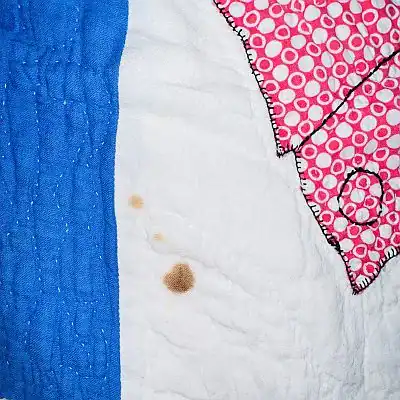
“This exceptional quilt from the 1930s is a nearly exact representation of the seal of the Order of the Eastern Star, including the colors! This was made from a pattern or kit sold by the Home Art Company, a mail-order pattern source in Des Moines founded by Herbert VerMehren (who probably designed this quilt). Patterns appeared under the names Nancy Lee, Colonial Quilts, Bettina, Hope Winslow and others in periodicals during the 1930s. The Hope Winslow catalog that I show at left is dated 1933. They also called this “The Star of the East.” This is the first opportunity that members of the Eastern Star have had to make a quilt symbolic of their own organization. The complete star measures 72 x 72 inches, whlie the four-colored border makes the completed quilt 84 x 84 inches. The five points of the star are made in their proper colors – Red, Blue, Yellow, White, and Green – while the outline and background star are made in two shades of yellow, with a cream colored center for the altar. The basic Eastern Star logo has been expanded with diamonds – the Home Art Company was known for this type of large star and sold patterns for several others, including the Star of France and Rising Sun. All the details of the logo, including the altar in the center, have been added with hand embroidery.
The quilt does not look like it was ever washed and could now use a bath to remove general light surface soiling and six small spots that are probably blood (example shown below). I am sure it would come clean with careful soaking in a product like the Restoration wash I sell in my other listings. (Since this is not mine, I have not washed it myself.) Other than that, it is in excellent condition with no wear or fading! The piecing was done by hand, and it is hand quilted at 8-9 stitches per inch. The quilt measures about 82 by 84.” All fabrics and the batting are cotton. “
From: “Rosie Werner”
Here’s something interesting from the “What Other Needleworkers Have Found Out” column in the January, 1928 NEEDLECRAFT MAGAZINE. “In regard to quilting, we have a method of doing this work which we prefer to any we have yet seen. We stamp or trace the design on the silk or other material of which the cushion or any article is to be made, pad this with a thickness of lamb’s-wool batting, covered with a layer of cheesecloth, and baste all three loosely together. The design is then worked in back-stitching from the right side, giving the appearance of machine-stitching. Stitches about one sixteenth inch long look best, the needle going back into the hole where it came out each time and being brought out the same distance in advance. Worked in this way, the design does not show between stitches as in the usual method of quilting by running-stitch. After a little practice, too, the work is rapidly done; another advantage is that the wool never packs down, but will always remain puffed. Mrs. L.A.B., California”
Has anyone ever seen an example of this type of stitching? Was it very common or just a California thing? Rosie from Minnesota, where the mosquitos are emerging.
Date: Mon, 6 Jun 2005 21:36:37 -0400 | From: “Karen Evans”
That’s actually the oldest known quilting stitch. It appears in the single oldest quilted object discovered to date, a Siberian tomb rug. It was the preferred technique for trapunto, Italian cord work, and at least some of the Marseilles boutis until well into the 18th century, and I’ve seen examples as late as the 1950s.
I’m one of very few who’s doing it now, but that doesn’t mean there aren’t others. And yes, properly done backstitch can and does look like machine stitching – I entered a backstitched piece in a show and received a judge’s comment to the effect that I needed to check the tension on my sewing machine because the *back* wasn’t even!
If you’d like more information, just let me know….
From: “Sally Bramald”
My only excuse for my mistake is that I have a raging toothache and am off my head on pain relief. I looked in my books on the American Museum in Bath and the Coffin quilt is NOT there. The Dart’s of Death aka Widow’s quilt is. This quilt is black and white and can be found in ‘Quilts’ by Judy Wentworth, 1989. In the book it said it was unusually a single sized, but I remember when seeing it on display ‘something’ along the lines that these quilts were always single sized as on widowhood you were moved down a grade of bed. The Coffin Quilt, I thought was in the same museum, I found in one of my books this morning, America’s Glorious Quilts which is the same sort of oversized book. I must have linked the 2 because of their macabre subject matter and the photo size. This coffin quilt is named in this book as ‘Graveyard’ by Elizabeth Roseberry Mitchell and is in the collection of the Kentucky Historical Society. It has a central graveyard with extra coffins round the edge to be moved into the graveyard when the person died. Only two were moved from the outside in. Somehow I still have a lingering memory of another quilt in which the graveyard was in green, but perhaps the quilt in my head does not exist in reality just an image my brain conjured up to make it a little more acceptable. My many apologies again for my confusion and for passing it along. Off to the dentist now……………………………… Sally Bramald