July 27 – August 1, 2005
These restored messages come from the Quilt History List, an online forum where quilt historians, collectors, researchers, appraisers, and enthusiasts discussed antique quilts and related textiles. The archive dates from 1996 through approximately 2016 and is being restored gradually. Sign up in the form at the bottom of the page if you want to know when a new page is added. Original spelling, opinions, formatting, and inactive links may remain unchanged.
Primary topics of this QHL Digest:
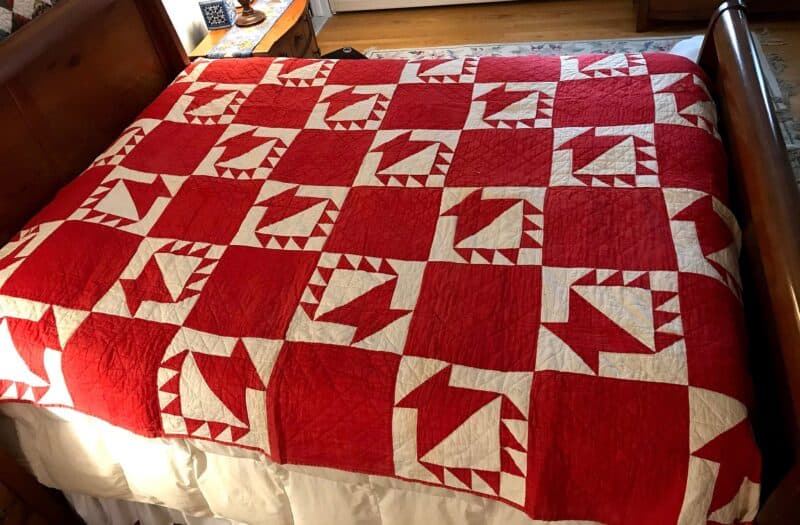
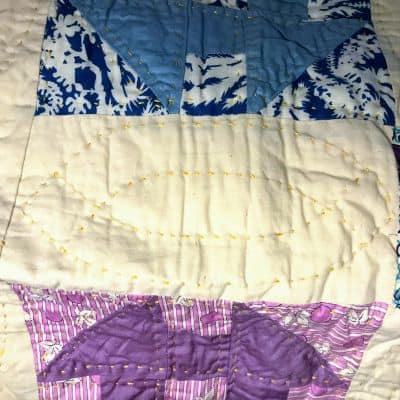
- Solving a Mystery Block — Julie Silber’s unusual pieced block design is identified with help from an eBay listing, turning out to be Letha’s Electric Fan, a Kansas City Star pattern.
- Quilt Metaphors in Political Cartoons — Members discuss how 19th-century political cartoons used “crazy quilt” imagery to describe candidates.
- New-Member Introductions — Several new subscribers introduce themselves and their quilt-history interests to the list.
- Leather and Skin-Based Quilts — A new thread opens on unusual leather-patchwork quilts spotted in museum collections.
From: Lynn and Debbie Cupp
I recently enjoyed reading this e-book.
Mary at the Farm and Book of Recipes Compiled during Her Visit among the “Pennsylvania Germans”
There are references to quilt making and patterns and use of clothing and other scraps well before the many recipes.
A charming account of her life before she married, published 1915.
Located on the web at:
http://www.gutenberg.org/dirs/1/3/5/4/13545/13545-h/13545-h.htm
Debbie Cupp
From: Judy White
That’s Letha’s Electric Fan, a Kansas City Star Pattern. I have a quilt from the same pattern hanging on my living room wall. The pattern appeared in the Star in 1938/39 when electricity was introduced to the rural areas of Missouri.
Judy White
Julie Silber <quiltcomplex@> wrote:
Hi, Julie Silber here.
I have a quilt with a design I’ve not seen before. I can not locate it in Brackman either. Maybe you guys know … ? You can see the mystery block and full quilt photos at jdemeter.mystarband.net/pinwheelvari.jpg”> and src=”http://jdemeter.mystarband.net/pinwheelvaridet.jpg”>
I can send more photos — please contact me directly for them. Thanks for any help.
From: Julie Silber <quiltcomplex@>
Hi again, Julie Silber here. I got an answer on the mystery block. An eBay watcher (quilt is currently listed) generously responded. Design is called “Letha’s Electric Fan” — Kansas City Star, 1938. [Brackman 3522.] Thanks.
From: “Ronda McAllen”
I have been following the thread concerning W.H. Harrison. I have often wondered why so many Baltimore Album Quilts have the “Tippicanoe and Tyler Too” block since many of the quilts were made between 1845 and 1855. Does anyone know of a Baltimore connection to Harrison? Any theories why quilts made 5 – 10 years after his death would still have a Harrison reference?
Ronda
From: <gingram@>
I apologize that my posting to Lynn Gorges re Southern Quilt Conference went to the entire list. I had hoped to get in touch with presenters first.
Yet, let me start over, for those who missed the posting.
We have decided to postpone by exactly one year the Southern Quilt Conference, scheduled for this Septembe 16th.
We were working under what appeared to be an insurmountable burden because of our connection to the library. We could take no reservations: it was first-come, first-seated, with no idea of how many to anticipate. As interest grew, that became an increasing concern.
Moreover, among presenters a number of unusual circumstances arose. Some had scheduling problems not anticipated a year ago. Some had to be out of town. We were all rushing papers. Two books we wished to spotlight are not yet out, though their writers’ anticipated their being out.
So, rather than present something lesser, postponement seemed the higher path. Now, we can advertise better, pursue research leds, plan some exhibits, and similar things of the sort.
We hope to take the Dallas AQSG model as ours—arrange for quilt shows beyond the main room shows, provide panels—well lots better presentation.
So please accept our apologies. And I would appreciate presenters acknowledging receipt of tis email.
Sorry to disappoint in the short run, but we know you will be better pleased in the long run.
Gail Ingram
From: “Lucinda Cawley”
Ronda McAllen wrote: I have been following the thread concerning W.H. Harrison. I have often wondered why so many Baltimore Album Quilts have the “Tippecanoe and Tyler Too” block since many of the quilts were made between 1845 and 1855. Does anyone know of a Baltimore connection to Harrison? Any theories why quilts made 5 – 10 years after his death would still have a Harrison reference?
Baltimore in the 1840s was something of a “hot bed of Whiggery.” In 1840, the year Harrison and Tyler were elected, the National Convention of Whig Young Men met in Baltimore. Support for the Whigs remained strong in Baltimore until the party dissolved in the 1850s. It makes sense that quilts made after the fact in Whig families would hark back to the triumph of the 1840 election. The Whig party was formed in 1832 to oppose Andrew Jackson and the Democrats. Besides Harrison the party elected Zachary Taylor in 1848, like Harrison he died in office and was succeeded by his vice-president the unforgettable Millard Fillmore. The party’s last candidate, in 1852, was another military hero Winfield Scott who lost to Franklin Pierce (it was Scott as general-in-chief of the US Army who offered Robert E. Lee the field command of Union forces in 1861) . The party dissolved over the issue of slavery. The northern Whigs joined the Republicans whose first presidential candidate in 1856 was John C. Fremont. The southern Whigs went back to the Democrats. Cinda on the Eastern Shore waiting for the promised cold front
Date: Wed, 27 Jul 2005 21:35:21 -0400 | From: “Beth Davis” <bethdan533@>
Hello, A friend of mine recently bought a wonderful crazy quilt, which among the usual features of fancy fabrics, embroidery, painted flowers, there were several initials which appeared at first glance to be satin stitches. Upon closer inspection, it looks like the initials are appliquéd made of a loosely knitted fabric-sort of like a very fine mesh. I should be able to photograph the quilt in a week or so-although I don’t think that I could get close enough with the camera that I own. Even with a magnifying glass it was hard to see. Is anyone familiar with this sort of technique?
Regards, Beth Davis
Date: Wed, 27 Jul 2005 09:40:20 -0400 | From: kldev@
Hi everyone, I finally found you! I am a studying to be a better quilt historian, quilt collector, aprraiser in training, quilt teacher and designer.
kld
Date: Thu, 28 Jul 2005 00:27:21 EDT | From: RAGLADY@
When Judy White was able to give the name of the block/design… I googled and found some nice pictures. It’s done in crazy quilting style here: http://www.silk-ribbon-embroidery.com/Graphics/ORWArr1/Delivered/orwarr1f.htm
The design is also in the Kansas City Star book “Roads and Curves Ahead” by Edie McGinnis. http://www.thekansascitystore.com/ProductDetail.cfm?PID=276
Gloria raglady@
Date: Thu, 28 Jul 2005 00:33:51 -0600 | From: “gingham@” <gingham@>
I’m hoping there will be more responses to the question about the color of quilting thread across 19 c. red/green applique quilts.
In my small but growing collection, I only have 2 red/green 19th c. applique quilts and both just have white thread and the quilting goes across the appliques on both. I saw another such quilt last week and it had colored applique thread but the quilting thread was white.
~~~~~~~~~~
On another note, I’d love to hear comments about why I should join AQSG (American Quilt Study Group) and attend the seminar in Colorado. Thanks.
Sandra Starley Moab, Utah
Date: Thu, 28 Jul 2005 03:44:17 -0700 (PDT) | From: Barbara Burnham <barbaraburnham@>
Beth,
I have had great results getting extreme closeups with my digital camera and a loupe. The loupe was placed on the object which magnifies it for the camera, just as it does for the eye, and the camera set for macro/closeup.
Barbara Burnham Ellicott City, MD
…I should be able to photograph the quilt in a week or so-although I don’t think that I could get close enough with the camera that I own. Even with a magnifying glass it was hard to see. Regards, Beth Davis
Date: Thu, 28 Jul 2005 06:37:42 -0600 | From: Xenia Cord <xenia@>
I have speculated on two things about mid-19th century applique quilts: the matter of the color in the quilting thread, and the stylistic decision to quilt the surface without regard for the applique design. On the first, I wonder if the ‘color change’ in the quilting thread, seen most clearly on the back, may be the result of excess dye in the applique pieces permeating the quilting thread over time and given some kinds of storage conditions? I realize cotton takes dye poorly without a mordant, but still wonder if some sort of transfer process isn’t being observed.
On the other, the quilt study group to which I belong has recognized that red/green applique quilts from southern Ohio and southern Indiana (the home states of most of us) have quilting through the design, while ‘north of 40’ (US 40, the old National Road) the quilting accents the applique. Obviously this distinction is by no means definitive geographically – we may be like the blind men trying to describe an elephant by touch. So the question is, how widespread is this observation, and can we draw any geographic, social, ethnic, or cultural conclusions from its distribution?
As for joining AQSG – oh, wow! I admit to extreme prejudice; for years I was struggling in the wilderness, so to speak, reinventing the wheel, trying to learn quilt history on my own while academe and my quilting friends ignored the field. Then I discovered AQSG – folks just like me, singing from the same page in joyful harmony – and sometimes spirited dissention<g>! Seriously, joining AQSG attracts members from across the country and world-wide who are interested in serious study of all aspects of quilt history and movements within the quilt world. Membership puts you in comfortable touch with many whose names you know from current scholarship, with people who are interested in mentoring your research ideas or just discussing shared interests, with people who just love quilt history, fabric history, you name it. And seminar is so much fun – a great mix of friendly people, good scholarship, great opportunities to see the archived quilts in the area hosting the meeting, fun activities, good food – come to Denver!
Xenia
Date: Thu, 28 Jul 2005 10:07:59 | From: Crm793@
Hi,
In response to Lynn’s mention of the leather quilt in Anchorage, I have a leather grandmother’s flower garden, lights, darks and mediums; sewn together with leather strips. Very heavy! Probably not really a quilt since there is no backing or batting. Has anyone seen something like this.
When I return home I will look at the red & green quilts and report on the color of quilting thread.
Carolyn M
From: Laura Fisher <laurafisherquilts@>
wow-what a wonderful discussion Karen Alexander contributed concerning the quilt metaphor. I love this list–it’s such a pleasure to learn something new (and at your fingertips!) each day. Just an odd p.s. to the subject, in this week’s NYTimes Science section article on the advent of a procedure to transplant faces in patients, the writer describes the candidate as having a “crazy quilt” of repairs on his face that this breakthrough surgery would correct. From the diagrams, basically it looks like reverse applique — with space for the old eyes, nose, and mouth. Amazing!!
From: <chrisa@>
<< the writer describes the candidate as having a “crazy quilt” of repairs on his face that this breakthrough surgery would correct. From the diagrams, basically it looks like reverse applique — with space for the old eyes, nose, and mouth. Amazing!!>>
Perhaps this could also be called a “well-loved quilt” face?
Out here in the west (a very very hot west these days) I have noticed a quilt metaphor used more often than ever, for about the last 6 or so months. Not so much in print as in speeches being given by community leaders and government people. It has been so often lately that I found it has stood out in my mind, It’s interesting that there is less of it in the NY Times than before. My thinking was that the increase of the metaphor- be it patchwork, fabric or quilt- to a community issue and pulling together to fix it, was due to the fact that often it is men speaking about troubling situations and the use of a soft cuddly comforting term would help him get through to the people listening and form a connection that opens things up rather than fear that could shut them down. The metaphor of fabric shows up more than the others in print lately, as well as in speeches and verbal discussions I hear on TV and news. The fabric word is used so often by so many people in authroity it reminds me of the word “awesome” that caught on like this with different age groups that I wouldn’t have expected. Personally,I don’t find that awesome.
Kim Wulfert www.antiquequiltdating.com
Date: Thu, 28 Jul 2005 14:39:48 -0500 | From: Mary Persyn <Mary.Persyn@>
In case anyone is interested, I just received a notice that the University of Alabama Press has reprinted Nancy Callahan’s book Freedom Quilting Bee: Folk Art and the Civil Rights Movement in Gee’s Bend, Alabama. pbk $20.00. ISBN: 0-8173-5247-3
Mary who is off to Alaska for two weeks starting on the 29th.
— Mary G. Persyn 219-465-7830 Associate Dean for Library Services School of Law Library Valparaiso University 656 S. Greenwich St. Valparaiso, IN 46383 Mary.Persyn@ Fax: 219-465-7917
Date: Thu, 28 Jul 2005 17:24:33 -0400 | From: sewsewsarah@
I am currently working on a whig rose quilt. I am doing a crosshatch in the background but am unsure how to quilt in the applique places?
The September issue of Quilter’s Newsletter (on pages 34-37) shows one way to quilt in the appliques. As this is a classic pattern and I have made it in classic colors, I would like to quilt it that way, as well.
Thanks,
~*~Sarah in WV~*~
Date: Thu, 28 Jul 2005 21:57:59 -0700 (PDT) | From: karenquilt@
I saw an incredible collection of leather patchwork in an ethnography museum in St. Petersburg, Russia, in 1986. When it first caught my eye I could have sworn it was patchworking quilting. However, since it was in galss cases and none of the docents could speak English, I could not find out anything about it!
Karen Alexander
Date: Fri, 29 Jul 2005 19:43:56 +1000 | From: kerrybrack@
Hi Any pics?? Kez
This message was sent through MyMail http://www.mymail.com.au
Date: Fri, 29 Jul 2005 06:35:34 EDT | From: Litwinow@
Good Morning, I’m getting ready for the Iowa/Illinois Quilt Study Group that will be meeting August 6th in Kalona, IA. The antiques in the morning are always wonderful, in the afternoon “Redwork” are the study. I would like to know when and where all the other groups meet, so I can share that information to the group. Iowa/Illinois meets the first Saturdays in April and August. Thank you. Cathy Litwinow
Date: Fri, 29 Jul 2005 05:45:29 -0500 | From: “Marcia Kaylakie” <marciark@>
HI kld, why don’t you tell us your name and where you live? Also what your particular interests might be? Marcia Kaylakie, Austin, TX
Date: Fri, 29 Jul 2005 08:44:02 -0700 (PDT) | From: catz@
I have always felt a bit outcast from most of my quilting friends – most are not terribly interested in the history of quilts and quilting while those subjects have always been my passion. I had wanted to join AQSG for a long time – but there was always “one more bill” that took precedence. I think though that my DH just enrolled me– finally! I have been so happy to know through this list that there are so many of us that thrive on the history part of quilting ! Thanks to you all for the wealth of information and thoughtful ( sometimes lively!)discussions . Marie Johansen
Date: Fri, 29 Jul 2005 14:12:27 -0400 | From: “Candace Perry” <candace@>
Just because I’m never sure who might be reading, I’m going to post this job opening — we do ALOT of textile programming, thought that isn’t the main focus…Please feel free to pass along… Museum Educator – Schwenkfelder Library and Heritage Center in Pennsburg, Montgomery Co, PA seeking industrious, self motivated individual with interest in Pennsylvania history, Pennsylvania German culture and folklife, to develop and expand educational program; part time position; bachelor’s degree in education, American history, museum studies or related fields required. Resume and cover letter via email(info@ ) or 105 Seminary St., Pennsburg, PA 18073 Candace Perry www.@
Date: Fri, 29 Jul 2005 08:47:11 -0600 | From: “Cindy Hamilton” <cvermillion2@>
Hello! Kris says to briefly introduce myself to the list, so here goes. I’ve been “listening” now for several months, thanks to Penny Tucker letting me know about QHL. I’ve been making quilts and studying quilt history since I was 17–that was back in the late 1960’s. I’ve raised 3 kids, taught junior high school and served as librarian, all the while quilting every possible moment. (I usually am up quilting by 4:00 am) Some of you may know me from my quilts in mags and shows through the years. My first public appearance was in an early 1970’s QNM where I appeared in The Meeting Place under my first married name as Cindy Davis from Glendale, CA. In my current life I am Cindy Vermillion Hamilton from Pagosa Springs, Colorado. I’ve lived quietly in a beautiful mountain town since 1974. My quilts have travelled all over and I have gone with them in spirit, because circumstances prevented me from going with them. I prefer to stay home and quilt, but now that I’m retired from teaching, I do get to go to one or two events a year, and share my passion and meet you wonderful quilt scholars who speak a language I understand. A huge, wonderful thing for me has been able to attend AQSG seminars for the past few years, even tho I had to play hooky to do it. Thanks for being there, and for providing such a stimulating, fun forum. Hope to someday meet many of you in person! Cindy Vermillion Hamilton in cool, colorful Colorado.
Date: Fri, 29 Jul 2005 11:48:11 -0500 | From: “Kay Sorensen” <kaysorensenwi.@>
I received an email from someone on this list asking me to introduce myself.
I’m happy to do this.
My name is Kay Sorensen. I live in Salem, Wisconsin in the summer and Summerfield, Florida in the winter. (I always said I didn’t like Florida and would never live there. We built a house at Del Webb’s Spruce Creek Country Club last year and I love it. Can’t wait to get back!)
I have had almost a lifelong interest in quilting. I was gifted with a cute baby quilt when I was born, made by a friend of my mother’s. I started my first quilt when I was 13. It didn’t work and I threw in in the wastebasket. I don’t remember much about the quilt but I still can vividly picture the wastebasket in my mind.
I again picked up the needle in 1959 when I was expecting my first son (like many of the rest of you). I made a quilt for him from a Lee Ward’s quilt kit that was given to me by a neighbor. With quilting information and supplies hard to find I didn’t finish it until his birthday – his 29th!
I am one of the quilters featured in Julie Silbers lecture “The Grandmother Connection.”
I didn’t realize my grandmother had made any quilts (tops) until she had passed away and we found one. Being the only family member interested in it I now have it. I had intended to hand quilt it but my fingers and writs no longer allow me to do this. A member of our quilt guild started quilting it for me but had to stop because she was having trouble with her wrist so it is about 1/3 quilted. Her quilting is exquisite so I am now looking for someone to finish the quilting.
I have a collection of antique quilts and quilt tops. Even with a 1200 square foot studio I don’t get to have them out and enjoy them like I should. Several of them were featured in Ladies Circle Patchwork Quilts when they came to WI for the WI issue.
My quilting pursuits are varied. I have made many traditional inspired quilts, have many works in progress and currently am making more “Art” quilts.
I am known for my use of color in my work. Many of my works have been featured in quilting books and magazines.
I also do a limited number of lectures and workshops (not on quilt history) for guilds, etc. Limited because my time is limited.
I have found quilting has added so much quality to my life. Quilters are the very best people. Every where I travel I feel like I have known the quilters I meet for a long time.
And I have already heard from several people from this list that I have met in REAL life.
I’m sure this is more than you really wanted to know – but this is just the tip of the iceberg!
I am so happy to have found this list.
I love the discussion. I feel the work of our foremothers has had an indelible stamp on my life as a quilter.
It has helped me find a good home for some of the quilting books in my extensive collection.
I am an inveterate collector of many things and these books, along with many of the other things I have collected are like children to me.
I’ll close for now but this is not the last time you’ll hear from me.
There’s a lot more to my quilting story and life.
Date: Fri, 29 Jul 2005 23:04:39 EDT | From: Kaytriplet@
In a message dated 7/28/05 11:04:30 PM Central Daylight Time, qhl@ writes: I’m hoping there will be more responses to the question about the color of quilting thread across 19 c. red/green applique quilts.
In my small but growing collection, I only have 2 red/green 19th c. applique quilts and both just have white thread and the quilting goes across the appliques on both. I saw another such quilt last week and it had colored applique thread but the quilting thread was white. I have a large number of red and green applique, and very few use colored quilting thread. In general I would say that most have some quilting across the applique, such as 1/4″ inside the edge, but only a few of mine have something like a grid which ignores the fact that there is applique and quilts straight across the applique. I can’t give you exact numbers, as I have lots of quilts. Don’t even know of regional differences, but can’t say that I have ever seen a Baltimore Album style quilt which didn’t honor the applique when quilting.
Kay Triplett
From: “Newbie Richardson”
I think many of you will find this interesting in view of the recent posts about the need that AQSG fills for some of us.
I have been involved with the product development of a regional cultural heritage project. They are developing reproduction museum artifacts to be made by regional artisans. The objects are based on various artifacts with known provenance and market “appeal” – as they will be offered for sale in the state’s artisan made shops. ( I am one of the ‘artisans’, making dolls dress patterns based on 2 original dresses in one of the museum’s collections) One of the artifacts is an applique quilt from c 1860 which is being interpreted as a pillow. I was unable to attend the original meeting of the planning committee where some of the artifacts were given out to the various artisans for them to create prototypes, or I might have saved some miscommunication over the quilt! The committee accepted the very gracious offer of the local quilt guild to reproduce, as pillows, the applique design of the quilt. The design is an ideosyncratic flower basket – whose quirkiness is what gives the quilt so much appeal. When we reassembeled to vet the prototypes earlier this month, the pillows did not look anything like the real thing. The wonderfully ideosyncratic applique had been “cleaned up” and “contemporized”. It was a total failure as an artisan made piece, despite the excellent quality of the sewing. I realized that what the committee had no way of knowing was that the average quilt guild is not dedicated to historic accuracy (nor should they be), but rather to the continued development of the craft for today. the guild members did not understand the purpose of the project as a whole. The end of the story is that I took home an accurate, detailed image of the quilt, took the pattern of the applique, and am sending that off to the designated artisan seamstress along with the correct period colors! The committee did actually decide to keep the more contemporary interpretation, as they felt that that might have market appeal, too. However, it does look just like one of those cheap imitations imported from China – although much better made. Newbie Richardson
Date: Sat, 30 Jul 2005 12:04:42 -0400 | From: kldev@
———-MailBlocks_8C7633787E3A4B6_71C_C3AB_MBLK-M26.sysops.@ Content-Type: text/plain; charset=”us-ascii”
I have been invited to introduce myself to the group as a new member.
My name is Karen Dever from Moorestown, NJ ( the #1 town in the US as of JUly 2005 “Money” Magazine). This past June I retired from 33 years as an elementary school teacher.
I have been involved with quilting for about 20 years but in the last 5-6 years have delved into the designing area of quilting with quilts published in McCall’s and For the Love Of Quilting. I teach quilting at a great quilt shop in Mt. Holly, NJ and have recently entered the lecture area with speaking to area guilds. I belong to several quilt guilds in the area and I am program chair for 2 of them – what a job! But I love it!
I have been collecting anitque quilts and tops for about 5 years and am constantly reading the history of quilts. Over a year ago I took the AQS appraisal class at Vermont and am always trying to learn new things to help in my education. In the past year I have been able to join a wonderful group of historians in a quilt study group from the central Jersey area, I look forward to the “candy” that we see every other month. In September I will be traveling to Terry Thompson’s Fabric Dating Camp and then also in October I will be attending my first AQSG Seminar.
Glad to join this group.
Karen Dever
Date: Sat, 30 Jul 2005 15:58:09 -0400 | From: “Ilene Brown” <ilene3@>
Hi to all, I read an article in our local newspaper that I thought some of you may find interesting. The July 26 article in the News&Observer, tells about a plan to make 464 miles along I85 running through North Carolina a textile corridor for heritage tourism. Here is a link if you would like to read the article http://www.newsobserver.com/news/durham/story/2628328p-9064952c.html I enjoyed the little stories of cotton mill life and hope to hear more in the future. Ilene in Raleigh
Ilene Brown
From: Palampore@
There is an article in the Aug. issue of Martha Stewart on taking care of quilts and how to do minor repair. Had never heard of the author of the article. Just happened to spot it when I saw a copy on a friend’s coffee table. I think this leather quilt thing could be interesting. Yes, not a true quilt because it had no batting and backing. Off to church. Lynn Lancaster Gorges New Bern, NC
From: Mary Voss <voss@>
Regarding quilting lines on red and green quilts: I just took a look at two of the ca 1860 red and green quilts I have and they are both stitched with white quilting thread. On one applique basket quilt the lines go diagonally through the applique in a grid design . The other one featuring urns, grapes and flowers has quilting motifs in the applique such as veins in the leaves and designs in the urns. Hope this helps. I can take photos if you need them. – Mary
From: “Nancy Ray” <nancy.ray@>
Dear QHL friends, In addition to collecting string quilts, books, needlework tools–pincushions, needlebooks, old sewing machines, etc., I have it for wonderful old scissors. Let me tell all–I have almost never met a pair of scissors I didn’t like. Is there anyone, anywhere who knows a good, really good, place to have scissors sharpened? You all know that a bad sharpening attempt can ruin them forever… When I came back to the States from Germany the last time, I knew I would miss the meister who sharpened and repaired scissors–but it really is a big loss! My German quilting friends from Esslingen took me to the shop in their hometown, where the owner of the cutlery store was a master knife smith. He had studied and apprenticed in his trade as long as doctors (physicians) go to school! He sharpened everything: my best sewing scissors, my kitchen knives, the treasures I found in the flea market and my Fiskers, which came home much sharper than they ever were, even when new! (They are still fabulous, and he worked on them more than eight years ago.) He also realigned blades and made other subtle adjustments that make a huge difference. Even in Germany it isn’t as easy to find this level of skill as it once was.
I still buy pretty old scissors occasionally, and I send them back to Esslingen. Herr Trittler passed away a few years ago, but his son is now a meister and as skilled as his father–but it is an imposition for friends to have to help with the mailing each time. Does anybody have a source here in CONUS (it’s an Army acronym for “continental United States”)? A month after getting back from the VT Quilt Festival, I am still enjoying the thoughts of how much fun it was (well, except for the annual heat wave!) It was great to meet some of you in person, to see so many great old quilts, to stay on Norwich University’s lovely campus, and to see a bit of Vermont. My string quilts made it home in good shape, and it was really quite wonderful to see how many people enjoyed the exhibit. I have a couple of very nice ones that didn’t make the trip for one reason or another–and those, plus thirteen from the Vermont exhibit, will hang in the Moundsville, WV Museum this winter in a special show. Hope you all are staying cool somewhere, Nancy Ray ——_NextPart_000_0007_01C59661.D9722DE0–
Date: Mon, 01 Aug 2005 07:32:09 -0400 | From: joan kiplinger <jkip@>
Nancy — know how you feel about the loss of a good sharpener. If there are none listed in your telephone directory, there are several other options: make use of the sharpener service used by your hair salon or mail scissors to their manuafacturers. Once upon a time our area was stocked with old-world knife and scissor men plus several stores offered that service. It all disappeared 10 years ago. Up until 5 years ago Joannes brought in a sharpener for a day twice a year, then that convenience was dropped. Now I take scissors to the hair salon where my favorite hair cutter sends them along with his. The charge is reasonable. For pinkers and scallopers, I have returned them to Ginghers which will sharpen all brands. It’s been quite awhile so can’t quote current charges.
Date: Mon, 01 Aug 2005 08:02:53 -0400 | From: Barb Garrett <bgarrett421@>
Back in March/April I wrote about a collection of quilts that had been sent to the Netherlands as part of the Post WWII relief effort by Mennonite Central Committee of US and Canada. These quilts are the nucleus of the exhibit and book called Passing On The Comfort, which began it’s 3 year tour last April here in PA. After spending the summer in Canada, the exhibit is now back in the US — Ohio and Indiana primarily — so if anyone is interested in seeing the exhibit — which I do recommend from a “quilts in history” standpoint — please check out the updated 2005 schedule and 2006 schedule on the following link. http://www.mcc.org/quilts/
Barb in southeastern PA
From: Laura Fisher <laurafisherquilts@>
And I thought I was the only discoverer of hippie-dippy leather quilts!! – I presumed they date from the 1960s, when patchwork leather clothing was the rage. I thought they must be experiments by sandal makers, when someone from Argentina came in and said he had a friend who manufactured pieced leather bedspreads there.
Right now I have 2 (can you believe) leather quilts in the shop!. One is a Log Cabin Barn Raising variation, with fringe yet all around like a cowboy shirt. The colors are neutrals with plenty of rust, green, ochre and cream 1/2 inch strips to enliven it. Measuring 34″ x 56″ it was probably intended as a decorative throw. The other is more like a studio couch cover, in a Broken Dishes pattern with a semi-gathered wide border that pulls down around the mattress like a fitted sheet, in various shades of cordovan and rust.
Years ago, I had a suede quilt that made it to the pages of the Quilt Engagement Calendar, Cy Nelson thought it was so intriguing. Sorry I don’t remember which year, sometime in the 1990s. The suede not the leather seemed to be the “right” side, in shades of brick, rust, indigo, and caramel in a challenging curvalinear Robbing Peter to Pay Paul design.
And, in France last summer I was shoe shopping when I spotted low multicolored leather boots in a store window. When I entered and asked in fractured French about the vert et brun chasseurs dans le fenetre, the salesgirl said “Oh you mean les patchwork…” and I said “I’ll take ’em, don’t even need to try them on.” See, this quilt metaphor is everywhere in everything!
At every 26th Street weekend flea market in NYC someone always has a scruffy patchwork leather coat or jacket pieced in India or Mexico, but I am still lamenting NOT buying the distinctive long coat pieced of small rectangles in neutral colors, not just scrap bits of leather leavings. If anyone ever sees another……
Laura Fisher
From: Laura Fisher <laurafisherquilts@>
Here are photos of the two leather quilts I mentioned in my earlier email. I am not sure how to post to the qhl site eboard–can you do it from this mailing, or send me instructions? Thanks Laura Fisher
From: “Lynne Z. Bassett” <lzbassett@>
Oh Laura, you have sent me on a trip down memory lane! I had a beautiful multi-colored patchwork leather coat when I was a teenager in the late 1970s. I’d almost forgotten about that coat…it was really pretty and fit me nicely, which is a challenge (I’m a pear). Sigh! Sure wish I still had it…
Best, Lynne
> At every 26th Street weekend flea market in NYC someone always has a > scruffy patchwork leather coat or jacket pieced in India or Mexico, but I > am still lamenting NOT buying the distinctive long coat pieced of small > rectangles in neutral colors, not just scrap bits of leather leavings. If > anyone ever sees another…… > > Laura Fisher
From: Sandra Millett <smillett@>
Also try Heritage Cutlery,Inc. Believe they will sharpen other brands. Call 800-252-8452 to verify. Their mailing adddress is: 7971 Refinery Road, Bolivar, NY 14715. Last price quote I got was $5.00, but recommend you call first. Try out their scissors, too. The microtip #VP26 (Specialty Embroidery Scissors) will clip 1.5mm stitching. They are my workhorse scissor. And the kitchen shear VP41 is a true marvel. Cuts pizza like a dream for those nights you are too busy quilting to cook, and the blades separate for washing.
Sandra Millett Quilting the Savory Garden
joan kiplinger <jkip@> wrote: Nancy — know how you feel about the loss of a good sharpener. If there are none listed in your telephone directory, there are several other options: make use of the sharpener service used by your hair salon or mail scissors to their manuafacturers. Once upon a time our area was stocked with old-world knife and scissor men plus several stores offered that service. It all disappeared 10 years ago. Up until 5 years ago Joannes brought in a sharpener for a day twice a year, then that convenience was dropped. Now I take scissors to the hair salon where my favorite hair cutter sends them along with his. The charge is reasonable. For pinkers and scallopers, I have returned them to Ginghers which will sharpen all brands. It’s been quite awhile so can’t quote current charges.