November 20 – 22, 2005
These restored messages come from the Quilt History List, an online forum where quilt historians, collectors, researchers, appraisers, and enthusiasts discussed antique quilts and related textiles. The archive dates from 1996 through approximately 2016 and is being restored gradually. Sign up in the form at the bottom of the page if you want to know when a new page is added. Original spelling, opinions, formatting, and inactive links may remain unchanged.
Primary topics of this QHL Digest:
- Tobacco Cloth and Tobacco Barns — Members discuss tobacco cloth as quilt batting and backing material, prompted by shared memories of tobacco barns and farming life in Connecticut and North Carolina.
- Centennial-Era and Harriet Powers Quilts — A discussion of 1876 Centennial-commemorative quilts leads into questions about the Harriet Powers Bible quilt and where it was made. (see the article on Centennial prints)
- Muslin vs. Percale Through History — A member explains the historical difference between muslin and percale fabrics in response to a question about when muslin first appeared in patchwork.
- Crochet, Tatting, and Lace Identification Begins — A new thread opens asking for help identifying pieces of antique crochet, tatting, and lace, kicking off what becomes a multi-day identification discussion.
Date: Sun, 20 Nov 2005 11:54:00 -0600 | From: “Karen Musgrave” <karenmusgrave@>
In one of my past lives I managed a children’s bookstore so I always browse to see what’s new and also to increase my 5 year old grandneice’s ever growing library. I always ask if there are any new books with quilts for children. Yesterday at my favorite independent bookstore, I was handed “Show Way” by Jacqueline Woodson published by Putnam for children aged 7-9. I must say Hudson Talbot’s illustrations are beautiful and the writing is rhythmically comforting and the love expressed well done, I just wish the message of journeys toward equality could have been expressed differently. I listened politely as the head of the children’s department lectured me on the importance of children understanding the UGRR and the role quilts played. I only asked if I could send her some info concerning the truth of quilts and the UGRR as I thought she did not have all the facts. I ended up taking down six people’s names and addresses as my part drew a crowd. I’ve sent them the links this list has so wonderfully provided. I can only try to do my small part and more and more I am beginning to believe it is an uphill battle.
Karen
Date: Sun, 20 Nov 2005 14:34:26 EST | From: Mitzioakes@
I also would love some more info on UGRR and the story quilts played in it. I volunteer at Shelburne Museum (VT) in their quilt displays and I have had many questions fielded to me regarding these stories ( I did find out thru google that only 1% of slaves ran to the north which surprised me! I have many books on the CW as my husband’s g-g-grandfather fought in it (north). Nice chatting with you all. Mitzi from Vermont
Date: Sun, 20 Nov 2005 17:06:15 -0500 | From: “Beth Davis” <bethdan533@>
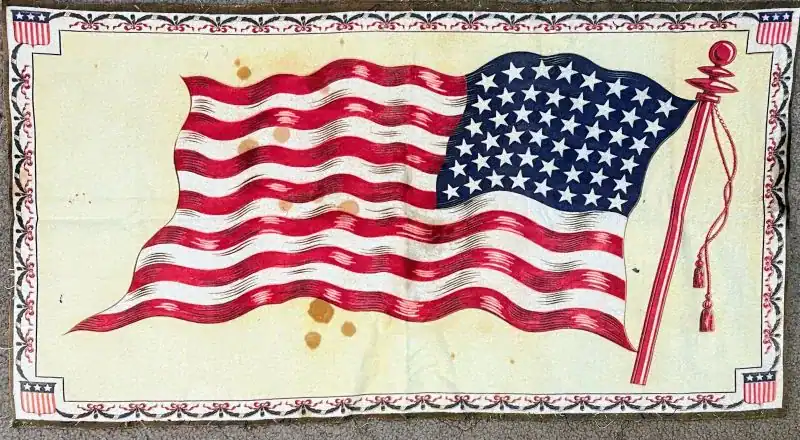
Hello, I just was asked to appraise a wholecloth quilt that has on one side, a cheater fabric with panels of the American Flag surrounded by flags of the countries of the world that participated in the 1876 Centennial Exhibition in Philadelphia. The selvage was included (perhaps on purpose?) states “International, patented Dec. 28, 1875”. And this is the backside of the quilt; the front has another ‘cheater’ print with cameos of George Washington. My question is, that there is a typed label, which was added to the quilt by the previous owner, which states that the quilt was purchased as a souvenir of the World’s Fair. I could not find any information that confirms that quilts were made for sale at the fair. Has anyone else seen anything like this before??? There is a similar quilt on Laura Fisher’s website. Regards, Beth Davis
Date: Sun, 20 Nov 2005 18:17:54 -0500 | From: “Sharon in NC” <patchworksecrets2@>
I have been looking for more references to tobacco twine… I have not had much luck there but it seems a similar twine was used to bind grain as early as mid 1800’s. Here is one reference I found.. http://www.britannica.com/eb/article-9000579
So it is entirely feasible for it to be made from twine pre-civil war. It might just be it was assumed it was tobacco twine when it was really grain twine. Sharon in NC http://community.webshots.com/user/sharonsews http://home.earthlink.net/~psquiltpatterns/ http://f1.pg.briefcase.yahoo.com/fisherfinds
Date: Sun, 20 Nov 2005 18:46:51 -0500 | From: “Sharon in NC” <patchworksecrets2@>
Another interesting article that might be worth looking into.. http://www.crowntiques.net/item.cgi?item_id=120141 This is Scientific American for October 21 1876 Strasser Tobacco Leaf Stringer Centennial Expo Awards Brambles New Inventions A Weekly Journal of Practical Information, Art, Science, Mechanics, Chemistry and Manufactures Scientific American is a much beloved journal in publication for over 125 years. Great illustrations, interesting Victorian industrial information, period ads. Size is 11″ x 15.5″ and is approximately 14 pages. Very good condition with some light edge wear, text rubbing on back cover. “
This actually shows a picture of the mechanical stringer so it is entirely possible that tobacco was hand strung prior to the civil war.. This is interesting and has me hooked so I am afraid you might be in for more info..lol..
For those of you who have not seen a tobacco barn we have a few here on our farm you can see in my down on the farm album on my webshots. They are not very old only about 100 years old..lol..(Yes concrete blocks were being used in the early 1900’s)
Sharon in NC http://community.webshots.com/user/sharonsews
Date: Sun, 20 Nov 2005 18:49:59 -0500 | From: “Sharon in NC” <patchworksecrets2@>
An interesting article on crochet
http://www.florilegium.org/files/TEXTILES/crochet-FAQ.html
Sharon in NC
Date: Sun, 20 Nov 2005 22:23:39 -0500 | From: “J. G. Row” <JudyGrow@>
Notes from the Studio Quilt Study group meeting held at J. G. Row’s home on Tuesday, November 15, 2005. Numbers refer to the photographs which will be up on the Quilt Study Group page when Kris has time to put it together.
Notes taken by Norma McAfee, annotated by J. G. Row
Everyone arrived at our new location without any problems!
Before flapping our quilts we spoke of quilt happenings in the larger world.
Barbara Garrett mentioned a quilt and textile show that is being held at the Cape May County Historical Society through the end of December. She went to the show and recommends it to all; although the quilts are folded and not hung flat out they can be seen and appreciated, it is still worth the trip.
Karen Dever reported that she attended the AQSQ seminar in Lakewood Colorado, as did Barb Garrett and Sue Reich. Karen attended the WW II study center presented by Sue and said it was wonderful. She especially enjoyed all the paper presentations, studies and talks.
Barbara Garrett reminded us that Judy Roche’s quilts, which were the special display at the Vermont Quilt Festival this past summer will be on display at the Brandywine Museum starting late January 2006.
> For the Joy of It: Appliquéd Quilts from the Judy Roche Collection > January 21 through March 19, 2006 > In a world of quilt competitions where precision and technical skills >are paramount, the creativity and passion of quilt makers are often >underappreciated. For this exhibition, guest curators Deborah E. Kraak >and Lynne Z. Bassett have selected 23 appliquéd quilts from celebrated >expert Judy Roche’s extensive collection that clearly demonstrate excellence >in design and the joy that quilt makers derive from their craft.
http://www.brandywinemuseum.org/calendar.html
* J. G. Row reported that she had recently read “The Belles of New England” by Wm. Moran and recommended it as a study of the history of the textile mills as seen from the working girls’ perspective.
* She also shared her book purchased on the internet “Andrinople, Le Rouge Magnifique,” a new French book documenting the history of Turkey red with glorious photographs in full color. Not yet translated into English and difficult to find.
1272-1273 * Judy showed an antique wood block about 12″ square, stamped “Mc Laughlan, Paisley” (Scotland), the design realized in a soft metal in a paisley stripe repeat print, used to stamp printed fabric.
Listed below are some of the quilts we shared for study.
Barb
1173 *1930’s; pieced pillow case with 6 broken dishes blocks on a pink ground.
1174-1175 *1875-1900 ; scrap quilt “double T” blocks on point, containing madder prints, with a striped double pink sashing
1176-1177 *1875-1900; A top of mourning prints and striped shirtings (mostly), in a flying geese variation block, blocks set without sashing. One indigo block among the mourning prints really stood out.
1178-1179 *1875-1900; Log Cabin top made up of unusually wide strips, set in a barn raising pattern, with pink and yellow strips as the outermost in each block.
1180-1184 *1900-1925; unfinished 16 large blocks Red Work quilt top with different designs done in pearl cotton in a perfect tiny chain stitch, but a mess of carries and long threads on the back side.
* Trudy passed around a book, “Anna Williams, Her Quilts and Their Influences” by Katherine Watts with Elizabeth Walker.
1185-1186 * Trudy showed us an Anna Williams quilt top she had purchased that she was quilting herself. We had a long discussion about the characteristics in common, if any, of African American quilts, and what has made them a hot commodity in today’s marketplace.
Judy K.
1187-1189 * c.1970 ; a quilt top of red and white 2″ squares, some polyester, arranged in a star pattern reminiscent of our beloved Bowmansville PA. star quilts, and purchased on e-bay.
1191-1192 * 1875; scrappy Evening/Ohio star quilt top; 4″ star blocks set with alternate plain blocks, centennial, faded purples, madders and dark colors typical of NY State
1193-1196 * 1875-1900; large Turkey red appliqué paper cut blocks alternated with red roosters with stars and crowns, appliquéd on white, the red abraded to almost a pink color.
* 2 New table mats or mini quilts that Judy K. made from old blocks.
1197 * 10 blocks, c. 1860 red and green flowers on white with perfectly circular red rouched flowers.
Sue
1198-1199 * C 1940 quilt of embroidered music with the title, words, and first notes of over 25 typically patriotic American songs all in patriotic flag colors.
1201-1203 * Whole cloth quilt of brown and pink and white cheater cloth, with a horseshoe and butterfly in one printed block, puss in a corner in another, arranged alternately in a stripy set, with printed picot lace at the “seam” joins.
1204-1210 * 1875-1900 tied block sampler quilt ; assorted pieced blocks, some earlier, typically New England in color and feeling.
1204A * Judy G brought out her Lebanon Pa. block sampler of approximately the same period to see how startling the difference was in color and fabric usage between the two areas of the country.
Sue
1211-1214 * a quilt in a block called “Connecticut” c. 1860, pieced blocks, predominantly two colors, typical green with black and yellow prints, and for the light, a white with green and pink flowers in brown seaweed reserves and a white with red flowers. The blocks are large and form secondary patterns around the quilt. It is quilted in parallel lines
Ellie
1215-1217 *1875-1900 quilt top of red cut work on white. 9 blocks.
1218 *1875-1900 Log cabin in barn raising set, faded, damaged, with repairs appliquéd on top of original quilt and very visible.
1219-1222 *1860 Old Maids Ramble predominantly double pink fabrics for the center squares, and many older prints including Prussian blues for the half square triangles.
Dana
1223-1224 *1920-30’s top of scrappy Schoolhouse blocks with some older fabrics, unfortunately damaged by a burning cigarette ash which fell on it while it was folded.
1225-1230 * 1860; 8 pointed stars, with octagonal appliquéd centers set with orange sashing, in a streak of lightning layout. Turkey red prints for the stars on printed backgrounds. Although the block pattern is like many NJ signature quilts we have seen, this one was not intended as a signature quilt.
Joan
1231-1233 * 1875-1900 Pink flying geese on yellow with turkey red strip set, geese flying both up and down. Colorful back strippie set of cheddar and red, typical of Berks Co. PA.
1234-1237 * 1870; 4-block , cradle quilt; yellow, rust and brown Rolling Stone blocks with pink sashing and rusty red border.
no photo * 1920 unfinished child’s dress, (size 1 or 2) black with embroidery (no photo)
Judy G
1237b * 1270 * 1950’s pieced quilt in small squares, also reminiscent of the Bowmansville quilts, with the center in a large X punctuated by orange and the outer border in a swirling pattern.
Norma
1238-1240 * 1890’s; Log cabin quilt top with design of 4 blocks sewn together darks to the center, with narrow sashing to separate the groups of 4. Some older fabrics. Typical yellow and green fabrics used in the sawtooth outer border.
1241-1244 * 1875-1900 ; Very scrappy predominantly brown prints with shirtings, very small square-in-a-square blocks, with older, larger pieced blocks sewn on 4 sides to make borders.
Karen
1245-1248 * 1875-1900 ; Crib quilt . Court House Steps blocks with small squares set 7 x 9 having narrow strips and 4 borders.
1249-1253 * 1875-1900; The prize winner of the day — if we gave a prize for anything! Heavily quilted quilt with blocks in a 5×5 patch layout, (sort of like a Devils Claw block), pieced blocks alternating with plain blocks, each with its individual wreath quilting design, and superior quilting typical of Ohio quilts. We all thought it was earlier until we saw the late 19th century prints included.
1254-1258 * 1890’s quilt of small scale “Four-patch-in-nine-patch” blocks, each of 3 colors, but scrappy thoughout the quilt. Mourning print back. All the light fabrics in the 4-patches run in the same direction and give the illusion of broken diagonals across the quilt.
Nancy K.
1259-1263 * New Baltimore Album Mary Simon reproduction quilt top she just finished, (almost – it still needs borders) with superior workmanship and use of color and specialty fabrics. Nancy is using this as a teaching tool in her applique classes. Her bird’s eyes are perfectly formed and Nancy admitted that she collects fabrics from everywhere that have even the smallest areas that can be used as a 3/16″ circular bird’s eye — needleturned!
1264-1267 * Liza Prior Lucy showed two of the quilts she made for her new book with Kaffe Fassett, “Museum Quilts, Designs Inspired by the Victoria and Albert Museum.” She had copies of this gorgeous book to sell. The quilts were just what we’ve come to expect from this talented pair of designers – usually simple designs of repeated shapes made with glorious fabrics used to greatest advantage. They lit up the room!
We shared a 3-foot long hoagie for lunch and had our choice of 2 delicious desserts provided by Trudy and Nancy G, one of 2 Nancys (out of 3) at the table. We only had 3 Judys at this meeting, and could have had 5 if all had decided to come. Wouldn’t that have been fun!
Judy, now in Flemington NJ aka The Ringoes Kid judygrow@
Date: Mon, 21 Nov 2005 0:51:11 -0500 | From: <suereich@>
There are many quilts with Centennial connections. We saw the cheater cloth flag side done as a wholecloth at FVF Seminar almost two years ago. Commonly found are the bandannas of Memorial hall and other buildings from the Centennial Exhibition in Philadelphia in 1876. They are usually the uncut lengths and were frequently used as backing fabric for quilts. If you check out “Quilts and Quiltmakers Covering Connecticut” you will find two such quilts. One with Memorial Hall in uncut lengths used as a backing fabric, the right side is a log cabin with red, white and blue centers. Another quilt has four of the major buildings of the Fair. I own a copy of the Souvenir book from Connecticut of the 40,000 attendees from our state who visited the Exhibition over a six months period. The maker of the quilt with all four buildings signed in at the Connecticut House in November, 1876. I believe that the lengths of bandannas prints must have been sold at the Exhibition. I think that people did buy these prints s souvenirs. I will be curating a quilt exhibit at the New England Quilt Museum from August to November, 2006 in honor of the 230th Birthday of our United States called “Happy Birthday, America.” You will have the opportunity to see numerous quilts like the one you discuss here. The show will go on to Paducah from November to January. Just an fyi. sue reich
Date: Sun, 20 Nov 2005 21:24:08 -0900 | From: Gloria hanrahan <gloria@>
I purchased a booklet entitled Sears Century of Progress in Quilt Making, copyright 1934. For a pattern called Autumn Leaves, it is describing for the reader that it is a “Top Quilt” or a “Lapful, as our grandmothers were wont to call it.” It is an appliqué pattern which covers the entire top, rather than blocks.
I’ve never heard the term “lapful” and was wondering if anyone is familiar with that saying.
Gloria
Date: Sun, 20 Nov 2005 18:29:01 EST | From: TEXTIQUE@
Hi, If someone has already suggested this link, forgive me. I usually can’t remember what I did 2 hours ago.
_http://nc.history.museum/nca/nca_costumes.html_
Jan Thomas
Date: Mon, 21 Nov 2005 10:15:49 -0500 | From: “Teddy Pruett” <aprayzer@>
I so enjoyed Lynn’s descriptions of the tobacco barn – exactly what I grew up with. My aunt and uncle had a 320 acre farm here in north Florida , and I remember the horrible years of “suckering” tobacco – before it was done chemically, you had to literally go out with a paring knife and cut the little branches out of the big one. I can remember that horrible feel of tobacco tar stuck all over me, and the worms – ick. ick ick. Horrible work. I was very young – maybe 8 or 10.
I also remember the smell of the tobacco barn. My favorite memory was of “Miss CHICK’ – she was a big fat hen, crippled in some way, I can’t remember exactly. But her favorite place to roost and nest was in the fireplace pit that heated the tobacco barns. She only nested when it was not in use, of course, but her eggs became dark silvery gray and shiny from the ash. We pretended they were silver and nearly pestered that poor old chicken to death every day to find our new fortune!! . Ahhh, the simple joys of youth. Thanks for bringing back the memories, Lynn. ANd I still have a huge cone of tobacco twine that I use for absolutely everything around my house.
To make this quilt related in some way, the farmers also used to use “tobacco cloth” over beds of seedlings. It was much like cheesecloth. I\ve been trying to find some old farmer around here who hasn’t thrown his away – to no avail. I’ve been wanting to get a few pieces for study in the event it ever showed up on the back of a quilt. It’s not to be found. Not yet, anyway. Teddy
Date: Mon, 21 Nov 2005 09:58:52 -0600 | From: kathymooreneb.@
Beth’s question is a good one. I’d like to know the dimensions of the quilt in question. My guess is that it wasn’t the quilt which was purchased as a souvenir, but possibly the fabrics used in the quilt. It could have been yardage or it could have been kerchiefs. If it was yardage it could have been bought from a vendor or a merchant most anywhere and then made into a keepsake.
There’s a couple of books that have good examples of yardages and kerchiefs over time in American history. If you’ll email me personally after Thanksgiving, I’ll give you some book titles. I’m away from home and my personal library right now, but I also know that there are a good many on this list who know the titles I’m talking about and they may be willing to provide them right away.
Good luck with your research. Sounds like you have a really neat commemorative.
Best wishes, Kathy Moore Lincoln, NE
Date: Mon, 21 Nov 2005 11:38:12 -0500 | From: “Pepper Cory” <pepcory@>
Hey Teddy-I’ve got a Kentucky quilt c1890 that’s got a tobacco cloth backing! Have had it for donkey’s years. When i get a better digital camera I’ll send you images- Pepper in NC
Date: Mon, 21 Nov 2005 12:21:19 -0500 | From: <suereich@>
In a message dated 11/22/2005 12:09:34 AM Eastern Standard Time, qhl@ writes:
Subject: Tobacco cloth From: <suereich@> Date: Mon, 21 Nov 2005 12:21:19 -0500 X-Message-Number: 7
I am just curious. We have Tobaaco barns here in Connecticut. Tobaccos was and still is a major agricultural product in our state. Bradley Airport and the area around around Bradley Airport is also known as Tobacco Valley. For those of you who come to AQSG next year, the approach to the airport is row upon row of tobacco barns. I’ll have to start asking some old-time quilters from there is they have these same memories. I hope this has not bee covered already but was tobacco used for dyeing? If so I wonder if we saw tobacco cloth or tobacco dyed fabrics in our documentation. sue reich
Tobacco was and still is an important cash crop here in Lancaster County. The type raised here was for use in cigars. We have tobacco drying sheds and barns–one can still see the louvered sides of the barns that were opened when the crop was drying. We do not have the covers in the fields like the Connecticut River Valley area. Tobacco for cigars was grown uncovered here.
Have never heard of tobacco twine coverlets in my research on area bedcoverings, but then we are awash with the more traditional coverlet here. The Amish still depend heavily on tobacco here as a cash crop, but is has generally dropped off in the last few years.
Trish Herr
Date: Mon, 21 Nov 2005 10:02:30 -0800 (PST) | From: Ark Quilts <quiltarkmv@>
I was recently perusing through Ebay & found multiple listings for a Smithsonian imported quilt version of the Harriet Powers Bible Quilt. See below for the 3 items. They were all the same quilt……..2 sold for $440.88 and $242.38. A third was listed at $799.00 and did not sell but it was re-listed a day or so later and sold immediately at $2,000.00 for seller, thepinkporch.
Another Smithsonian imported quilt version of a Baltimore Album Bride’s Quilt was also listed recently (see the last section). After contacting this seller with price $199-$299)/ production dates (mid-1990’s) on this item, they changed the wording of their description…….I am not sure about the “story” behind this quilt. Now they are calling it “contemporary” instead of saying it had been made in the last 30 years; and, they dropped the price to $299; and, added more information about the source—-the word “import” is not mentioned. This is one of the quilts that was supposed to have been labeled “Smithsonian” by the imported quilt mfg. I also explained to the seller that when the Smithsonian commissioned thousands of quilt pieces made exactly like this one that it is not really “rare”.
Just found all of this curious…………..do you? C. Ark in NW Ohio
PICTORIAL The Bible APPLIQUE QUILT ~ MUSEUM QUILT $440.88 winning bid GB-BEST QUILTS ~ THE SMITHSONIAN COLLECTION Item number: 7365561113 Harriet Powers Bible Quilt
HARRIET POWERS BIBLE QUILT ~ MUSEUM QUILT~ $241.38 winning bid Replica Quilt from National Museum of American History Item number: 7366503926
BIBLICAL STORY QUILT~Harriet Powers~Slave Replica 1886 $799.00 –no bids ORIGINAL in SMITHSONIAN~Applique of HER Spiritual DIARY Item number: 6225568366 Item relisted as BIBLICAL STORY QUILT~Harriet Powers~Slave Replica 1886 $2,000.00 — 1 winning bid Item number: 6228307812
Smithsonian Baltimore Applique Bride’s Quilt
RARE BALTIMORE ALBUM QUILT ANTIQUE RED WHITE & GREEN $299.00 RARE BRIDES QUILT, QUEEN SIZE, HAND EMBROIDERED, MINT! Item number: 7367565579
Previously listed by seller, redbamaboyblgwork as : RARE BALTIMORE ALBUM QUILT ANTIQUE RED WHITE & GREEN $500 RARE BRIDES QUILT, QUEEN SIZE, HAND EMBROIDERED, MINT! Item number: 7364968496
Date: Mon, 21 Nov 2005 10:04:58 -0800 (PST) | From: Ark Quilts <quiltarkmv@>
Sorry about the double posting of my email—there have been glitches in our network today…………..CArk
Date: Mon, 21 Nov 2005 14:11:33 -0500 | From: “Beth Davis” <bethdan533@>
Hello Kathy, re: Beth’s question is a good one. I’d like to know the dimensions of the quilt in question. My guess is that it wasn’t the quilt, which was purchased as a souvenir, but possibly the fabrics used in the quilt.
The dimension is 72″ x 85″. It is three panels wide (both the George Washington and Flags are the same width about 23″) It was coarsely quilted with parallel lines-which made me wonder about the possibility that it was made for sale. The owner was pretty adamant that her aunt, who typed the note on muslin, wouldn’t make up a story such as this, that she was a stickler for facts. My first thought too, that it was made of fabrics purchased perhaps at the World’s Fair, as it is not particularly fine fabric, but of the texture of handkerchiefs and the printing is not well defined, especially the Flag fabric. Each panel repeat would be 17 x 23–pretty large size for a handkerchief? There are remnants of a couple large paper labels on the fabric. There is only tiny bits left-not enough to make anything of it. Very curious. I would appreciate the titles of the books that you have in mind-and will send you a note after the holiday. Meanwhile, I do have the book “Quilts and Quiltmakers Covering Connecticut’ that Sue Reich recommends and I also will dig out the “All Flags Flying” as there might be something in that one too?? Thanks for all the information! Beth Davis
Date: Mon, 21 Nov 2005 14:12:27 -0500 | From: <suereich@>
Your absolute best source to use for research is “Threads of History.” It is out of print but can be obtain through any inter-library loan system. sue reich
Date: Mon, 21 Nov 2005 14:57:33 EST | From: Feedsackfanatic@
I wrote to GB-Best and asked where this quilt was made: Harriet Powers Bible Quilt PICTORIAL The Bible APPLIQUE QUILT ~ MUSEUM QUILT $440.88 winning bid GB-BEST QUILTS ~ THE SMITHSONIAN COLLECTION Item number: 7365561113. She replied back to me that “It’s an import quilt. From China.”
Does anybody know how much this quilt was sold for when they were on the market? Nowhere in the description is it noted that this was an Import quilt, and I imagine the buyer doesn’t know that either, since she has only a 1 rating on Ebay.
Paula
Date: Mon, 21 Nov 2005 12:14:29 -0800 | From: “ChrisA” <chrisa@>
Here’s a couple Beth-“Celebration and Remembrance, Commemorative Textiles in America, 1790-1990” from ATHM by Diane L. Fagan Affleck
“The American Bandanna. Culture on Cloth from George Washington to Elvis” by Hilary Weiss
and an exhibit catelogue from 2000 at the Brandywine River Museum, curated by Julie Powell. Book title ” The Fabric of Persuasion, Two Hundred years of Political Quilts”
Kimberly Wulfert, PhD www.antiquequiltdating.com Email: quiltdating@
Date: Mon, 21 Nov 2005 15:31:00 -0500 | From: “gb-best” <vitale@>
Paula,
I normally don’t sell import type quilts, but I did come across this quilt in my travels and they have become collectible over the years since they are no longer reproduced.
I do believe only the Smithsonian Collection has made them. They are all from China.
I didn’t try to hide anything about the quilt. I also include the 1992 date. The quilt also had a plastic wrap and label. If you will read here:
“This is a reproduction quilt made by the The Smithsonian Collection. These quilts were produced and later discontinued. This pattern has become very collectible. The quilt is dated 1992. I also have the original packaging and ad paper. This quilt hasn’t ever been used or washed. “
I did assume when you emailed me privately, you wanted to make this comment to the list, but I don’t think it was nice.
Sincerely,
Donna
Date: Mon, 21 Nov 2005 09:02:03 EST | From: Mitzioakes@
There is also a 36 block quilt recognizing the 1876 Centennial in the Shelburne Museum (VT) – it was on display this year. One personal note – while volunteering there in July, a family came thru the Museum and a father started to explain the 1876 Quilt to his children – when he read the names associated with it, he broke down – it was one of his grandmothers who was credited with the making of the quilt. He never knew about it or about quilts – it was one of those lifetime experiences not only for him but me also. Mitzi
Date: Mon, 21 Nov 2005 14:43:48 -0600 | From: Gail Ingram <gingram@>
Dear List Members,
Earlier this fall, after her lovely trip to France with Miz Roberts’ group, a friend from Texas visited and accidentally left at my home a copy of the book below. Busy back in TX, she told me to keep it a while and read it “since you can read French.” The speed with which I read French lengthened the “while,” of course, but I immediately set about seeking a copy of the book, which is lovely beyond my means to articulate.
Meanwhile, another friend came, saw the book, hopped on my computer and located what I’ve come to believe is the only one for sale in Europe and U.S.
And bought it.
For herself.
So here I am, enamored of all that gorgeous fabric and accustomed to taking the book down in tight moments and falling into its rhythms. And its language, which has been a salutary exercise.
In short, I need a copy of this book asap.
Author: JACK. Jaqueline Title: Andrinople Le Rouge Magnifique De la teinture
If anyone knows where one might be obtained, please contact me personally. I should be grateful.
Dreading the day when she will not see red, Gail Ingram
Date: Mon, 21 Nov 2005 16:06:32 -0500 | From: “gb-best” <vitale@>
I had a question about this quilt. They wanted to know if it was originally from a kit. Does anyone know?
Also, what’s the name of the pattern? I never had this pattern before so I wasn’t sure.
Thanks for your help!
Donna
Date: Mon, 21 Nov 2005 15:58:23 -0500 | From: “gb-best” <vitale@>
PS Paula ~ Did you email the seller that sold their’s for $2,000.00 and represented quite differently?
Since you’re policing Ebay, maybe that might be the better thing to do.
Date: Mon, 21 Nov 2005 16:53:52 EST | From: Feedsackfanatic@
In a message dated 11/21/2005 4:19:20 PM Eastern Standard Time, vitale@ writes:
> Did you email the seller that sold their’s for $2,000.00 and > represented quite differently? >
It doesn’t matter who else I may have written to. I do not police Ebay. I don’t have time to do that. I’m not a dealer. I’m an individual that quilts, collects feedsacks, sells feedsacks, have a home and family to take care of.
Paula
Date: Mon, 21 Nov 2005 17:06:34 EST | From: Feedsackfanatic@
I apologize to the QHL for any messages that were sent to the list re the Bible Quilt.
Paula
Date: Mon, 21 Nov 2005 17:23:55 -0600 | From: Xenia Cord <xenia@>
In Barbara Brackman’s Encyclopedia of Applique she has a very very similar design called “Honeysuckle,” #16.4, which was published as a design by Nancy Cabot in the Chicago Tribune, 1935. The center appears to have only 4 segments, diamond or kite-shaped, rather than the more piece-able 8 part figure in your quilt. In the published design, the “grapes” are scattered in a floral arrangement, one at the end of the stem and the rest in a circle of 6 around it, but not touching. Your grapes appear to have 8 circles. Since the “Honeysuckle” figure in the published design is a representation rather than a really accurate flower, it makes design sense to turn the little dots into grapes and do a grapevine border, I think.
If I am correct, then your quilt is from a published design, not a kit (with fabric etc.). It is a lovely quilt!
Xenia
Date: Mon, 21 Nov 2005 17:32:25 EST | From: TEXTIQUE@
Hi guys;
Don’t want to get in the middle of this but I can tell you that 4 out of 5 dealers probably can’t tell a Chinese Quilt from an American one especially if the tag is gone and unfortunately, many buyers can’t either. I believe it was just before the Smithsonian came out with their repros that Judy Boisson started a line made in China that were copies of her truly wonderful collection. Her website does state that they were made in China. I swore I wouldn’t ever buy one but when I saw a crib quilt copy of her Micky Mouse in western wear and chaps; I guiltily bought it (I also got it at a little over cost). I had just discovered the joys of grandma-hood and I wanted the little munchkin to have it hanging over his bed. He was an ardent Mickey Mouse fan. I still feel guilty over that one; go figure.
Several years after my son and daughter-in-law divorced, she called me to ask how much it was worth so she could put it on e-bay. I offered her 4 times what I paid for it so I could save it for my grandson who lives with my son so she decided it would sell for that very inflated price. No deal: she did post to e-bay and no mention was made that it was Chinese but no one was willing to pay her price so she maybe still has it. Two days later another one turned up on e-bay at the same price and it didn’t sell either. (I also gave her one of my great-grandmother’s quilts in an effort to make her feel part of our family and never got that back either. She tells me that she stored it in her sister’s basement and it flooded and the quilt developed mildew. I offered to buy it back, mildew and all but you guessed it; no deal. I’m heartsick over the situation.) I was just never able to do enough to help her be happy.
This same situation has occurred to samplers. My interest is in OH pieces and I can recognize them in an instant. One auction house called to verify one and was told it had been made in England before the young stitcher even arrived in the states. They described it on e-bay as a sampler from Warren County, OH (I know Warren County Samplers immediately) and I knew right away it wasn’t made there. 10 minutes of research told me she and all her family were living in England in 1843 when it was made and for several decades after. The sampler did come from Warren Co., OH, but from a dead descendant. The use of the words ‘from Warren County’ was very misleading and they knew it. It sold for several thousand dollars – and made me add a paragraph to my lectures about being a knowledgeable buyer.
I think all we can do is try to educate ourselves and others in the kindest way possible. If they don’t want to listen then to h___ with them. You can’t fix the whole world…..just my own thoughts.
Jan Thomas
Date: Tue, 22 Nov 2005 08:24:59 EST | From: RBCochran@
Sue– This is exciting news! Congratulations and thanks for letting us know. –Rachel
In a message dated 11/22/2005 12:08:31 AM Eastern Standard Time, qhl@ writes: I will be curating a quilt exhibit at the New England Quilt Museum from August to November, 2006 in honor of the 230th Birthday of our United States called “Happy Birthday, America.” You will have the opportunity to see numerous quilts like the one you discuss here. The show will go on to Paducah from November to January. Just an fyi. sue reich
Date: Tue, 22 Nov 2005 09:10:18 EST | From: JLHfw@
Good moring all, Another fiber question. When did muslin begin being used in patchwork quilts, not just as backing. It seems that looking at the IQSC listing for muslin quilts there are 702 matches with quilts as early as the 1840’s friendship/signature quilts and the Baltimore Album quilts. When I asked a well know quilt historian this question, the reply was regarding backing. Would the cream fabrics we see in these early quilts be muslin or percale? When did the term muslin become synonamous with percale if this is the case? Just musing. Janet in Fort Worth
Date: Tue, 22 Nov 2005 09:24:41 EST | From: Palampore@
In Eastern NC I see quilts often that have layers of the tobacco cloth used as the batting rather than cotton batting. Makes for a very heavy quilt, and toenail catcher size quilting stitches on top. I guess they saw this as a way to use the old cloth. The cloth was put over the tobacco beds to protect the seedlings. Tobacco seeds were extremely expensive so they did lots of things to protect the seedlings. You would ride by a field and see long rows of white fabric in the late Winter. The cloth would be rolled back once the plants got about 2 inches high and would be allowed to grow to about 4 or 5 inches tall before they would be transplanted into the fields in rows. It is interesting how farming would tie in so closely to quilt making in those days. 1) Tobacco twine for sewing the quilts together 2) Tobacco covering used as batting 3) Old quilts to wrap up tobacco going to the tobacco market in the fall Off to begin the Thanksgiving prep. Have my college boys coming in tonight.
Still no heat! Thank goodness for quartz heaters and gas logs!!! Happy Thanksgiving! I am thankful for all of you. Great tobacco museum in Kenly, NC. It is off of I 95 south of Wilson, NC. _http://www.tobaccofarmlifemuseum.org/_ (http://www.tobaccofarmlifemuseum.org/) Is worth a detour if you are ever in that area. Lynn in New Bern, NC
Date: Tue, 22 Nov 2005 09:28:29 EST | From: Palampore@
Sharon in NC, please send me your email address. Thanks, Lynn Lancaster Gorges, New Bern, NC
Date: Tue, 22 Nov 2005 00:51:40 EST | From: Mitzioakes@
Loved your email – my daughter lost all of the quilts I made her recently in NO, and her basement DID flood!!! One quilt was saved – a baby quilt I made for my grandbaby that was tied and filled with fatbat polyester! The rest all rotted after 3 weeks of flood water and sewage. But, I share your feelings of DILs – makes me feel a bit better that I am not the only one that has had bad times….. Happy Thanksgiving Day – a devoted quilter (American made). Mitzi
Date: Tue, 22 Nov 2005 17:15:14 -0500 | From: joan kiplinger <jkip@>
Janet — muslin and percale are two separate fabrics. The muslin Americans think of as muslin ends at 140 thread count; percale begins at 160 thread count, often called 80 sq. percale. Muslin is not combed; lower thread count percale is carded; usually 180 and higher is combed. Percale was introduced in America around 1850 [often referred to as American percale] to replace calico which was losing popularity due to lower manufacturing standards at the time.. The original muslin is Indian muslin, a semi-sheer and which is called muslin in the UK. Sometimes the terminology gets confused. I am not a quilter nor familiar with with what may have been used in the 1840s in regards to muslin.
Date: Tue, 22 Nov 2005 15:12:10 -0800 (PST) | From: Laura Fisher <laurafisherquilts@>
Ah–I have had soooooo many in my hands, wish I had the historical info about how they were sold at the Fair to round out their stories. Here’s what I sort of know:
Commemorative textiles were available for purchase in relation to the Centennial Exhibition held in Fairmount Park, Philadelphia in 1876. The textiles included usually square souvenir kerchiefs–some with images of the buildings at the Fair, including Memorial Hall, the Art Building, the Agriculture Building; others with portraits of various American Presidents in the center.
Other textiles available linked to the Exhibition included yardage of rerctangular kerchiefs showing the American flag surrounded by smaller flags of “the nations that exhibited at the Centennial Exhibition….”. I think with those, the intention was to sell one flag segment cut from the roll. I have seen those textiles incorporated as the centerpiece of a pieced quilt. I have also seen quilts made from, or backed, with rolls of uncut yardage repeated the same image over and over.
There were also printed textiles with patriotic themes and coloration — the dates 1776 and 1876 printed in white stars on indigo, flag-like stripes, American flags in multiples — that got used as sashing or borders in quilts that incorporated printed commemorative kerchiefs too. I have owned several, and know that some of these have been published in various books and old quilt calendars.
On my website now I think I have an American Flags quilt pieced of uncut yardage. In inventory not yet on site I have a spectacular unique quilt–one side the uncut yardage of George Washington with a patriotic striped background, the other side pieced to replicate the flags of nations that exhibited at the Fair, each one labelled as to country.
In another quilt I had the Centennial kerchief of Memorial Hall its center medallion, within a pieced “charm” quilt field of many different 1875-ish calico earthtone prints. In another I had George Washington next to his horse from the Centennial kerchief, within a Diamond-In_A-Square type pieced field of the same age calicos; this is one of three similar that I know of, one with President Cleveland (?) in the collection of the American Folk Art Museum, and one in a friend’s collection in Tucson.
With all of these iterations of Centennial Exhibition quilts, I have seen at least one other version of each, leading me to suspect that a) the material was sold with instructions on how to save and use the fabric within a pieced quilt, or b) someone made several nearly identical quilts containing such material, perhaps for family who went to the Fair, and these have gotten separated at birth and quilt historians are now trying to re=link them.
I have individual kerchiefs in stock, and I think even some uncut kerchief yardage!
Oy, now if only I could think it and it would be so–I could photo what I have and post all. If someone tells me again how to post to the eBoard, surely I have some of these in file photos stored on this computer.
Laura Fisher
So, who has the actual story of how these textiles were sold??!!
Date: Tue, 22 Nov 2005 20:27:50 -0500 | From: Paul and Nancy Hahn <phahn@>
Gail, I can’t believe that the Ringoes Kid would order the only known copy of “Andrinople, Le Rouge Magnifique,” and keep it for herself. Surely, you will find it in a holiday package on your doorstep with a postmark from NJ! I think everyone of us who trooped through customs after that textile tour of France was carrying a copy. Have you tried contacting the museum in Mulhouse? They only had 2 or 3 on their shelf until a few of us started fighting over the few copies. Then, they brought out cartons! Guess they hadn’t heard that American quilters buy books. Anyway, I would think the mueseum shop would have some and would deal with payment via VISA and send one on to you. From my high school Latin, I think it (the book) says this is from an exhibit the Musee d”Impression Sur Etoffes (the Museum of Printed Textiles in Mulhouse, France) held in 1993-94. The museum’s website is
http://www.musee-impression.com/gb/default.html
Nancy Hahn
Date: Tue, 22 Nov 2005 19:44:05 -0800 (PST) | From: Babette Moorleghen <happyquilterq@>
I’m in need of information re: pieces of crochet/tatting and lace. My husband’s grandmother was, according to family history, a “master” lacemaker in her home country of Bohemia (now Cezh rep) and immigrated here in late 1800’s early 1900’s. My dearest MIL passed away 5 years ago and I inherited a lot of “stuff” that no one else in the family wanted, which included quilts, quilt related items, fabric, and a somewhat large amount of the above mentioned pieces. I am just now getting around to going through boxes, bins, tins and trunks that have these items in them. The tatted pieces are wonderful and the crochet pieces range from very, very fine to a heavier thread (no yarn here). You can tell some of the work was attached to clothing items or linens. I have also come across some pieces that I believe might be her lace work. One piece is, or was, the top to a dress and is very fine. So, I’m wondering how to tell a hand-made piece from a machine piece? I would have loved to have found these things when Mom was still alive and could tell me about them but that’s not the case. I know this wonderful list will be able to help me find out that information! Thanks in advance and have a wonderful and blessed Thanksgiving! Babette in Illinois
Date: Tue, 22 Nov 2005 22:51:52 EST | From: Karen Evans
Tobacco is not a dye plant, at least not in any commercial sense. And Trish is absolutely right about the tobacco barns – they’re all up and down the Connecticut Valley, nearly to the Vermont border.
Karen Evans Easthampton, MA
Date: Tue, 22 Nov 2005 22:48:00 -0600 | From: Gail Ingram <gingram@>
This is not quilt related, but I had Mulhouse on my mind. Which brought up France. Which led me straight home to Louisiana and New Orleans, to be precise.
I realize it has become fashionable all over the nation to say, “Well, all those folks who stayed when Katrina hit should have gotten out. They were warned.”
Indeed, I think everybody in Louisiana had a sense that this was the Big One we’ve all talked about for so long, knowing it would overcome any defense we had in place. Many stayed who should have gotten out. The city’s churches were running buses all over the state, and at the end, many were not filled. Then, when the media turned the entire issue into a racial issue, I think many people just tired of yet another political fight and tuned out.
Central and North Louisianians have had these thoughts, too. And more—because our elected leaders in both the city and the state not only failed us (we’re used to that), but they embarrassed the state before the entire nation and, indeed, before the world.
Both CNN and PBS (Nova) have done special features this week on Katrina and the situation in New Orleans. Both were excellent. I note from the cover of my copy of TIME that the week’s issue also is devoted to the same subject.
I hope you will take time to see one or more of these, for the situation here is really beyond description. Our state budget is a wreck. Freezing hires are on in all state agencies, including universities, tuitions are rising, and cities in South Louisiana are bursting at the seams. I would imagine there is no available office space or housing right now within the city of Baton Rouge.
Worst, there are so many people—ordinary middle class people and blue-collar people and professionals of all sorts—who are without homes and who may never return to the city where their families have lived for generations. The land will not be there. Many of the poor and older residents had no insurance and no savings. Their homes were their sources of capital in an emergency and a place to live out their lives as economically as possible. They are unlikely to be able to make new lives that are meaningful and happy. There isn’t time.
What has happened in New Orleans and along the Gulf coast is really beyond comprehension, I think. I can think of no other American city that has experienced such a cataclysm. This one just keeps getting worse.
If you as individuals have the opportunity to reach out to residents of New Orleans, I hope you will do that. Here there are many local projects, and I’m sure in time there will be national projects.
I particularly ask you to consider the need to begin immediately rebuilding outr coastal wetlands. If every senator and representative knew the importance of this effort and how his or her constituents felt about it, maybe someone would at last act decisively.
As the holidays approach, I’ve thought that no one at the national level has asked the American people to tighten their economic belts this holiday and pitch in to help with what is a national problem of major importance. I understand basic economics, but I also understand it is inappropriate as well as economically unwise to act as if nothing has happened and it is the holidays as usual. A war, a city destroyed—but keep shopping, keep quibbling in Congress.
I like to think we are better than our political leaders imagine us.
So this Thanksgiving as you are expressing your gratitude for the blessings of the past year and remembering Americans everywhere who are in harm’s way so we can eat turkey and watch football games, maybe you could say a little prayer for New Orleans
Many thanks to Kris and the list for always making possible something new and interesting, Gail Ingram