March 23 – April 3 1997
These restored messages come from the Quilt History List, an online forum where quilt historians, collectors, researchers, appraisers, and enthusiasts discussed antique quilts and related textiles. The archive dates from 1996 through approximately 2016 and is being restored gradually. Sign up in the form at the bottom of the page if you want to know when a new page is added. Original spelling, opinions, formatting, and inactive links may remain unchanged.
Primary topics of this QHL Digest:
- ZIP codes as a quilt-dating clue — members debate the exact year ZIP codes were introduced, since one on a pattern envelope or feedsack can help date a piece.
- Feedsack Club momentum — growing interest in the Feedsack Club, with new members joining and paying dues ahead of the Lancaster show.
- Mystery fabrics: Cuddleskin and cigarette silks — members try to identify unfamiliar vintage materials, from a soft “Cuddleskin” backing to cigar-ribbon and cigarette-silk textiles.
- The Canadian Quilt Study Group‘s mission and policies — a detailed introduction to CQSG’s goals, membership, and publications for members unfamiliar with the group.
- WWII rationing memories — firsthand recollections of wartime rationing and how it shaped resourceful sewing and quiltmaking.
- A Bird of Paradise dye experiment — a member invites others to try dyeing fabric using Bird of Paradise plant material.
- Sunbonnet Sue and embroidered quilt blocks — discussion of vintage and reproduction Sunbonnet-style embroidery blocks.
- ANZAC explained for American members — a quick history lesson on the Australian and New Zealand Army Corps for members puzzling over the term.
- Introducing the Nova Scotia Heritage Quilt Project — a Canadian regional quilt documentation project reaches out looking for contacts.
- Note that the March 25 – March 31, 1997 digest is missing. If any member still has a copy, please contact Kris so we can update the records.
Date: Sun, 23 Mar 1997 19:18:07 -0800 (PST) | From: Diane Lockwood
Hi, I clearly remember zip codes coming into being in 1964! I was a secretary in a gov’t office and we had to use the zips altho the rest of the world did not! I even remember that we had to have 2 spaces between the fully spelled out state before typing in the zip!! AAARRRUUUHHH! Awful memories! Diane Diane Lockwood in Pollock Pines, Calif dcl [at] innercite [dot] com “What I do today is important because I am exchanging a day of my life for it.”
Date: Sun, 23 Mar 97 19:44:41 -0800 | From: beth_novak [at] om [dot] cv [dot] hp [dot] com
Item Subject: cc:Mail Text I do have a feedsack that I know is from the fifties. It has lime green stripes and green poodles on leashes on the border! Looks just like the poodle skirts from the fifties. It was never used (no stitching on the top) and came out of the mill when it closed. Beth_Novak [at] om [dot] cv [dot] hp [dot] com
Date: Sun, 23 Mar 1997 22:26:47 -0500 | From: “Jim Twigg”
Xenia – I will be attending the Lancaster show and would like to e-mail you regarding Legacy Quilts. Please contact me @ jtwigg [at] radix [dot] net Thanks ! ` Phyllis
Date: Mon, 24 Mar 97 03:23:36 -0800 | From: beth_novak [at] om [dot] cv [dot] hp [dot] com
Item Subject: cc:Mail Text I don’t know what it is about them, but I think I’m hooked! I have several of the coarse weave ones that I thought were coarse because they were older. Thanks to Joan I now know why there is so much textural difference. The green poodles and another one I have that is white but with a great wide blue floral border are of very fine fabric. The blue one looks almost like an oversized pillowcase! I started buying them to replace hopeless areas in old quilts, but I find I have a very hard time cutting one up. I have yet to overcome that hesitation!
I have a few that are already opened and washed, and I stand in front of the mirror with one wrapped around, modelling my imaginary feedsack skirt! These feedsacks were recently unknown to me. Even my parents (raised in the city and from rather well off families) don’t remember calico feedsacks. Perhaps my grandparents might but they are already departed. Feedsack clothing may have been a sign of poverty or being from the country but I bet they made great dresses for little girls! Beth_Novak [at] om [dot] cv [dot] hp [dot] com
Date: Mon, 24 Mar 97 04:32:28 -0800 | From: beth_novak [at] om [dot] cv [dot] hp [dot] com
Item Subject: cc:Mail Text I’ve just sent my dues in to the Feedsack Club, and I’m really excited about being a member! I sure wish I could attend your get together. I’m way out here in Oregon, though. If I know about it ahead of time, maybe I can attend next year. I’m going to try to get the “Drifted Snow” logo scanned so I can send a photo of this handsome blond farmer to people on this list who are interested. Beth_Novak [at] om [dot] cv [dot] hp [dot] com
Date: Mon, 24 Mar 1997 05:08:02 -0500 | From: quiltmag [at] mindspring [dot] com (Jean Ann)
so, stop it already… LOL if you guys dont stop making feed sacks sound so wonderful I will soon be out there hunting for old feed sacks to start yet ANOTHER collection! Where will I put them? I have not one itsy bitsy storage or shelf space left! I word feed and flour sack dresses when I was a little girl. Did you? Jean Ann Eitel Editor, QUILT magazine Let’s Talk Quilting: dal.net IRC – /join #quilttalk
Date: Mon, 24 Mar 1997 05:50:01 -0500 (EST) | From: Baglady111 [at] aol [dot] com
Hi Phyllis..if you are coming to LANCASTER, PLEASE STOP BY and visit with THE FEEDSACK CLUB as well..we are just one mile down the road from QHC..on the same side of the road at HO JO’S..EVERYTHING IS FREE no fee to get in, free demos, free quilt show, exhibits/show & tell..and we run from 9am til after 9pm or wheneve my crazy members decide to close it down..they’l be buying/selling/trading their feedsacks..you never know who’ll you see popping in from up the road at the big show. We’d love to meet you..Jane of THE FEEDSACK CLUB
Date: Mon, 24 Mar 1997 05:55:52 -0500 (EST) | From: Baglady111 [at] aol [dot] com
What you have were primarily used as a border skirt (like you mentioned) or for curtains..nice little print for a young girls’ window..the product was most often sugar/salt/flour..anything that would/could sift thru..the thread count was higher for that reason adn hence more like a percale..I’ll bet it is almsot as ncie as pillowcases you have on your bed now, huh?? The common sack was more coarse..thread count was lower because it probably held beans, nuts, apples, onions..larger items that did’nt sift thru..are you going to to keep it? Sell it? Collect them?? Jane I apologize if I did not explain who ANNA LUE COOK is..ANNA LUE, in my estimation, wrote the book on feedsacks..she is a noted collector/exhibitor/historian and writer in the feedsack/cotton field..a charming lady who is a wealth of info and constantly researching our subject..and my FEEDSACK CLUB can proudly claim her as one of my 700 members..if you don’t mind me asking, where are you from..we will be having several exhibits thru out the country this year..would be nice if one was near you..we fully realize feedsacks are’nt for everyone..but they are an important part of our textile history..millions of people would have had NOTHING if it had’nt been for feedsacks..theyused them for everything in your house that is made ffrom fabric, slipcovers, sheets, towels, undies, swimsuits, diapers, (kotex) mens clothing, bras, and the list goes on..if it wasn’t for feedsacks, you’d hve had millions of people NAKED!! NOT A PRETTY SITE!! Jane
Date: Mon, 24 Mar 1997 06:38:02 -0500 (EST) | From: Baglady111 [at] aol [dot] com
well, Jean Ann..we’d love to have you out there collecting/quilting..it’s great fun and FEEDSACKS ARE HOT!! My 700 members will tell you that..not bad for starting this club in ’89 with 5/6 quilters..and maybe I should explain a little about the club. this is a hobby for myself and my publisher of our newsletter..we take nothing from the club..infact sometimes my lecture fees go into the till..THE FEEDSACK CLUB is an informational group who buy/sell/trade among themselves..but we also exhibit and do ongoing research on feedsacks..an EXTREMELY IMPORTANT part of ur textile history..MILLIONS of families dressed in feedsack..the fabric is as important as regular cottons, wools, denim. velvet, dotted swiss, etc..it’s just been passed over..till NOW!! I’ll tell you how HOT!! THEY ARE..they have reproduced them..if they were’nt saleable..would they BOTHER?? hardley..we love to share the info on them..and I am so grateful for all opportunities to NOT A PROFIT organization..so when you see THE FEEDSACK CLUB..it isn”t for $$$$..so jump in with us Jean Ann..always room for one more..and if you are coming to the big show in Lancaster in April..come see us.numerous quilt mag editors drop in..
FOR BETH NOVAK..they do look like a pillowcase..except they usually measure aobut 34 or 36 x 42..depending on the size bag..there was no weights and measures back then so the bags were judged by the amount of content they held..a barrel size bag would weigh 296 lbs, a half barrel weighed 98 lbs., 48 or 49 lbs bags were equuvalent to 1/4 barrel..and so on.. People who lived deep into the country (far from town) thougght nothing at all of wearing feedsack or using it for household items..EVERYONE wore it..used it..so how would they know they were poor..BUT if you lived near town, on the edge..and had contact with the town people..then there was a stigma..is”nt that common with many things today? If a room is filled with people with blonde hair and a brunette walks in..if everyone has a classic book to read and someone is sitting there with a comic book??? yesterday they wore certain fabrics that designated ‘wealth’..today it’s labels..
Yes, they did make great dresses for little girls..,they would also have a matching scarf possibly for their head, matching panties, heire petticoat..a doll dressed just like them.matched and dolley would have a matching blanket..the girls dressed from the ‘big stores”like MONTGOMERY WARD/SEARS ROEBUCK..didnt have that touch..there were even contests like we have with FAIRFIELD today.. Beth..don’t feel bad if you can'[t bring yourself to cutting into the bag..we have plenty in our club that have already cut theirs..hundreds of members who deal in all sizes of bags and we’ll be happy to furnish you with what you need..anthing from full size sacks to squares in inches..we’ll help you out..Jane
Date: Mon, 24 Mar 1997 07:47:14 -0500 (EST) | From: Baglady111 [at] aol [dot] com
MAKE SURE you send to Anna..she is TOPS IN THE FEEDSACK INFO department..and VERY HELPFUL..she will have a month long exhibit in TN in Oct..and will be there one week-end..inturn we’ll have a small convention..(yes, another one) but this one is SOOOO extra special.. She will be an excellent source for you to work with on anything you need to know.. Did I ask you before WHERE in OR you are? I will be in CA lecturing in OCT and HOPE to get up into OR..there have also been a few inquires of doing a lecture up your way..we’re working on dates..and they’ll be FEEDSACK LECTURES/TRUNK SHOW..Jane
Date: Mon, 24 Mar 1997 09:18:30 -0500 (EST) | From: KBoxmeyer [at] aol [dot] com
What are UFO’s in relation to quilts?
Date: Mon, 24 Mar 1997 09:26:41 -0500 (EST) | From: KBoxmeyer [at] aol [dot] com
I would possibly be interested in a sack or two. I don’t know what kind of $$ I would be commited to spending though. Beginner collector Kimberly
Date: 24 Mar 97 10:13:28 EST | From: “Patricia L. Lyons” <72134.3643 [at] CompuServe [dot] COM>
Jane, ZIP Codes were implemented in 1961 – it’s one very effective way of dating something with an address on it. If it has a ZIP Code, it is 1961 or later. If it doesn’t, it’s pre-1962. Notice the slight overlap. Although the change to ZIP Codes was announced a year or so earlier, there was very fierce resistance to it – It was a “Commie plot”, that sort of thing. This resistance continued even after implementation until the Post Office made good on its threat to treat all mail without ZIP Codes as undeliverable. By 1963 use of ZIP Codes, particularly on mail, was pretty universal. I cannot overstate the resistance implementing this change encountered. The fierceness of that resistance makes is so much easier to date something with an address on it. Pat Lyons
Date: Mon, 24 Mar 1997 11:10:51 -0500 (EST) | From: Baglady111 [at] aol [dot] com
NO CHARGE for you..not for all the help you’;ve given me..I just need to know how you are going to use them..if you want to trade with others..if so..what size? etc..Jane
Date: Mon, 24 Mar 97 12:32:31 PST | From: John & Cinda Cawley
Many of the church quilting groups in this area of Northeastern PA make whole cloth quilts using “Cuddleskin,” the fabric shiny on one side and fuzzy on the other from which Barbizon robes and nightgowns are made. Is this a regionalism or do quilters in other places also use “Cuddleskin”? A friend called me this morning to say she has a source for the fabric and wondered if anyone on the net was interested. Cinda in Scranton
Date: Mon, 24 Mar 1997 15:12:40 -0500 | From: “Miklos B. Lukacs”
I remember during WW-2. Everything was rationed. Lots of people raised their own chickens, pigs and at least one cow. The material for clothing was also rationed. In order to save food stamps, clothing stamps etc. you bought the feed for the animals where they gave the best feedsacks. Now one of the mills near our town in southeast Mich. must have bought out the mill (material) in yellow feedsacks printed with white daisy looking flowers. Our neighbor had a lot of animals. She had every piece of furniture, her car seats, her husbands tractor seat, lampshades -anything you could think of covered with white on yellow material. All this talk of feedsacks has reminded me of that time. Do you believe 50 years ago!! Connie L.
Date: Mon, 24 Mar 1997 16:44:31 -0500 | From: Leo Harvill
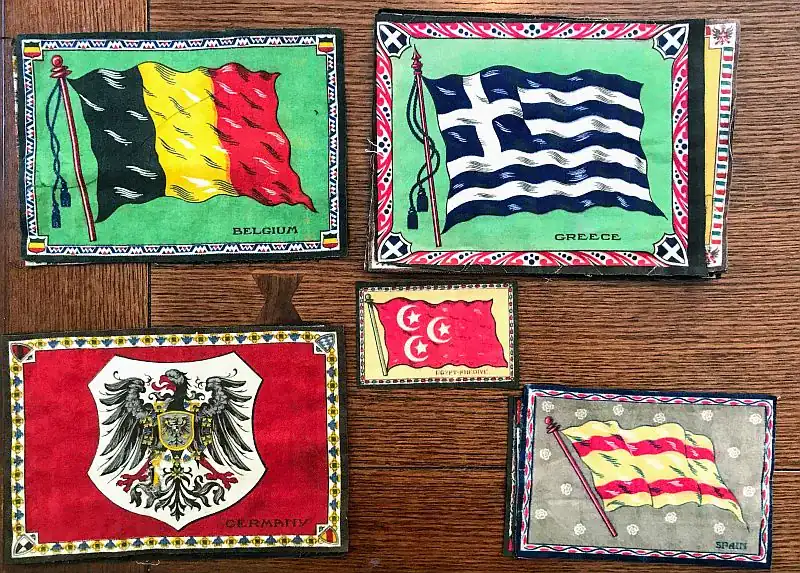
I am interested in historic information concerning cigarette silks, cigar flannels, and cigar ribbons and the quilts that contain them. I am particularly interested in quilts that contain cigar flannels with flags on them. In the context of these premiums, I am also interested in the history of tobacco marketing. Thanks in advance for any references or leads you can provide. Leo M. Harvill Johnson City, Tennessee
Date: Mon, 24 Mar 1997 17:27:17 -0800 | From: Sharon Harleman Tandy
Hello all, could “Cuddleskin” be what we’ve called brushed nylon (or acetate or whatever) here in the Northwest? Used for nighties, etc? Sharon.
Date: Mon, 24 Mar 1997 18:00:54 -0500 (EST) | From: JZgliniec [at] aol [dot] com
I have never seen or heard of “cuddleskin”…..I have not seen a quilt made from it either. I’m not up on designer robes …..mine is pretty ratty. It is not present in Southern Calf. to my knowledge. This causes me to ponder other possible “regionalisms”. With information so widely available, there are not many regional styles left. Regards, Julia..Poway, CA
Date: Mon, 24 Mar 1997 18:05:38 -0500 (EST) | From: AJSNGS [at] aol [dot] com
Hi, Have any of you heard of a book called “Voices from the Past” by Kaye England? I think it is fairly new, and I read that it was quite good. I’d like to hear more about it if anyone knows anything. Thanks, Nancy in VA
Date: Mon, 24 Mar 1997 19:28:29 -0500 (EST) | From: all (by way of Quilting Heritage ListServ
I have a question which is not strictly related to old quilts, but I know there are several experts who read this list and I’m looking for some expert advice. I have recently acquired some very nice silk thread and I’ve tried hand quilting with it. It is just wonderful! Smooth as it can be and I can do really tiny stitches with it. However, I’ve heard that silk thread should not be used to quilt cotton quilts. What do you think? Is this a real, true no no, or is this a rumor started by the quilt police? Can someone who knows about fabric and thread — cotton and silk — let me know if using this thread will result in eventual damage to my quilts? If so, how soon would deterioration set in? I’d love to use this thread, but. . . HELP and TIA, Adelaide
Date: Mon, 24 Mar 1997 19:28:33 -0500 (EST) | From: narmstr [at] ibm [dot] net (by way of Quilting Heritage ListServ <
This note is being forwarded at the request of some list members. THE CANADIAN QUILT STUDY GROUP Goals and Policies The CQSG is an organization dedicated to encourage and to advance study and research about quiltmakers, quiltmaking, and quilts. In addition, the members work for the promotion of contemporay quilts and the preservation of historical quilts through cooperative action with guilds and appropriate provincial, state, and federal institutions. The medium of communication is the quarterly, COVER STORIES. Biennial seminars are held, in conjunction with Quilt Canada, giving both members and others the opportunity to share in papers, slide presentations, and informal discussion.
The research papers are published in PATCHWORDS. (The papers presented at the 4th Biennial Seminar May 31, 1996 in Saskatoon will be published after the 5th Biennial Seminar May 29, 1998 in Vancouver.) Membership in CQSG is open to individuals, guilds, institutions, organizations, and businesses. Although CQSG is primarily concerned with Canadian quilts and quiltmakers, in harmony with the late 20th century quilt movement, interests and memberships are international. Annual benefits of membership include: the quarterly, a MEMBERSHIP ROSTER, and use of the CQSG library. GENERAL MEMBERSHIP: $15.00 Individual ($5.00 added postage to overseas addresses); Guild $50.00 PATRON MEMBERSHIP: $50.00 Supporting, $250.00 Corporate Sponsor, $500.00 Corporate Patron. All memberships of $50.00, or more, include a copy of the reasearch papers. Logo pins: $6.00 plus $1.00 p/h. Cheques to: CQSG, 1109 160A St., White Rock, BC V4A 7G9
The policy statement is a bit “dry,” but our newsletter certainly is not! It runs 26 to 28 densely packed pages (no ads) of diverse articles, member news, reports on international conferences and seminars, updates on international heritage projects, write-ups of exhibitions, AND extensive book reviews – 10 pages in the January 1996 issue. These are CRITICAL reviews, unlike the typical quilt magazines which love every book published. We receive and review copies of ALL books published by AQS, C&T, That Patchwork Place, The Quilt Digest, Quilt House Publishing, and all other trade and academic publishers’ quilt-related titles on request. The newsletter is what holds us together, for we meet in person only infrequently.
A small group of twenty-seven held our first tentative meeting May 1989, to consider forming a Canadian organization similar to the American Quilt Study Group. One year later, May 1990 we had our First Biennial Seminar with over 100 in attendance. Currently, we have 325 members representative of all 10 Canadian provinces and both territories, and a total of 10 countries world-wide. For more information about CQSG and a lovely photo of our logo, see Karen O’Dowd’s column p.15 QUILTER’S NEWSLETTER MAGAZINE June 1995, and TRADITIONAL QUILTER November 1996, pages 5-7 of “The Guilded Newsletter.” We also have a web page at
Date: Mon, 24 Mar 1997 21:04:32 -0500 (EST) | From: BBMorris [at] aol [dot] com
Yes! I wore dresses made from feed and flour sacks too. Not all of my dresses were made from them but some of them were made for me by my grandmother. I can clearly remember two of them that were my favorites when I was in the 5th grade. I still have some of my grandmother’s aprons made from them. You just can’t wear them out. Barbara in GA
Date: Mon, 24 Mar 1997 21:24:52 -0500 (EST) | From: JOCELYNM [at] delphi [dot] com
On 24-MAR-1997 13:39:06.0 KBoxmeyer said to JOCELYNM > What are UFO’s in relation to quilts? Un-Finished Objects. You know, those projects you start, and never get around to finishing…. Jocelyn
Date: Mon, 31 Mar 1997 21:32:33 -0500 (EST) | From: narmstr [at] ibm [dot] net (by way of Quilting Heritage ListServ )
Way back on Mar 27 & 29, Julia Zgliniec and Audrey Waite shared items about Pabst Blue Ribbon. In 1990 the Yakima Valley [WA] Museum had a marvellous exhibit QUILTS WEST. Unfortunately, the little catalogue has no illustrations but … how well, I remember the exhibit and the cigar silk and Pabst Blue Ribbon items. A Cigar Silk SMOKING JACKET?!?!?! Found in a trunk with bits of tobacco still clinging to the silk. Likely quilter and seamstress with Vyrona Cummins Efflinger who lived with her farmer husband south of Walla Walla.
The Pabst Blue Ribbon quilt was purchased at a flea market for … oh, no! $.25 (no, folks I have NOT put the decimal point in the wrong place). Catalogue includes explanation re: ribbons, used in bottle labelling between 1895 until about 1916 when WWI diverted their manufacture. Woven of a good quality silk, these ribbons usually survive in good condition. Ribbons 6″ long, compound folded, stitched into position by manufacturer. Beer bottle corked, cork covered with foil, ribbon glued in place over foil with printing centered in front and ends trailing about 1 inch. This silk ribbon was the forerunner of the paper neck label.
Date: Mon, 31 Mar 1997 21:53:04 -0700 | From: “Shari K. Jaster”
CC: QHL [at] cuenet [dot] com Subject: Re: QHL: Civil War Quilts by way of Quilting Heritage ListServ wrote: am giving a presentation to a group of junior high students. The topic is: How Quilts Document the Civil War era. I am particularly interested in quilts used in soldier burials, the use of quilts regarding the underground railroad and quilts made by slaves and former slaves. I am doing a research project on the above topics. I would appreciate a copy of any post you send to the above person privately. Otherwise, if you post to this list, I will retrieve it here. I was on the brink of asking these same questions on this list! TIA Shari sjaster [at] ix [dot] netcom [dot] com
Date: Mon, 31 Mar 1997 21:53:04 -0700 | From: “Shari K. Jaster”
by way of Quilting Heritage ListServ wrote: > > I am giving a presentation to a group of junior high students. The topic is: > How Quilts Document the Civil War era. I am particularly interested in > quilts used in soldier burials, the use of quilts regarding the underground > railroad and quilts made by slaves and former slaves. I am doing a research project on the above topics. I would appreciate a copy of any post you send to the above person privately. Otherwise, if you post to this list, I will retrieve it here. I was on the brink of asking these same questions on this list! TIA Shari sjaster [at] ix [dot] netcom [dot] com
Date: Tue, 1 Apr 1997 06:40:24 +0000 | From: “The Garretts”
Two posts have been sent to the list asking for information — Please send answers to the list and not privately. This second post reinforces the teacher- in- me belief that if one person asks a question, at least 5 other students in the class want/need the answer. Expanding this thinking to the list, there are probably 200 people who want to hear the answer. Please post quilt answers to the list, and please don’t ask for answers to quilt questions to be posted privately, so the list can continue to be a sharing experience. Thank you. Living near Gettysburg, and in the midst of Underground Railroad paths, I too am interested in this information. Thanks for considering my opinion and request. Barb in southeastern PA
Date: Tue, 1 Apr 1997 07:00:47 -0500 (EST) | From:
Beth, how large of a piece do you want? Large print or tiny??
Date: Tue, 1 Apr 97 08:33:31 -0500 | From: Christa Sigman
I am doing a research project on the above topics. I would appreciate a >> copy of any post you send to the above person privately. Otherwise, if >> you post to this list, I will retrieve it here. I was on the brink of >> asking these same questions on this list! TIA > >Thanks for considering my opinion and request. >Barb in southeastern PA >
~Please posts these answers to the list. Thanks Christa “Rockin Mama” Sigman Woman’s work is never done, that’s why quilting is so much FUN! —————————— >> I am doing a research project on the above topics. I would appreciate a >> copy of any post you send to the above person privately. Otherwise, if >> you post to this list, I will retrieve it here. I was on the brink of >> asking these same questions on this list! TIA > >Thanks for considering my opinion and request. >Barb in southeastern PA > ~ >> I too would appreciate seeing replies posted to the forum. Jane ——————— Forwarded message: From: sigman [at] eurekanet [dot] com (Christa Sigman) Resent-from: QHL [at] cuenet [dot] com To: bgarrett [at] fast [dot] net, QHL [at] cuenet [dot] com Date: 97-04-01 08:34:04 EST >> I am doing a research project on the above topics. I would appreciate a >> copy of any post you send to the above person privately. Otherwise, if >> you post to this list, I will retrieve it here. I was on the brink of >> asking these same questions on this list! TIA > >Thanks for considering my opinion and request. >Barb in southeastern PA >~Please posts these answers to the list. Thanks Christa “Rockin Mama” Sigman Woman’s work is never done, that’s why quilting is so much FUN!
Date: Tue, 1 Apr 1997 08:58:49 -0500 (EST) | From: Mary (by way of Quilting Heritage ListServ )
I heard you are great folks to help out! I have a quilt my grandmother made me in 1962. I has two yellow “stains” on it. These were not spills that I know of, since I have kept it packed away. I cannot wash the stains out. Any idea of what they are or how I might get them out? Other than these stains, the quilt looks brand new. Thank you for any help you may offer. Mary Pacatte Westwood, California
Date: Tue, 1 Apr 1997 08:58:49 -0500 (EST) | From:
I heard you are great folks to help out! I have a quilt my grandmother made me in 1962. I has two yellow “stains” on it. These were not spills that I know of, since I have kept it packed away. I cannot wash the stains out. Any idea of what they are or how I might get them out? Other than these stains, the quilt looks brand new. Thank you for any help you may offer. Mary Pacatte Westwood, California
Date: Tue, 1 Apr 1997 09:41:56 -0500 (EST) | From: SadieRose [at] aol [dot] com
Happy April Fool’s Day, everyone~~ Here is a forward of a message I had saved from the “early days” of QHL. (This was before the terrible fire at Terry Thompson’s apartment). Thought it might be of interest with the current thread of discussion. Karan <
Subject: Civil War Quilt Book (long) Hello from the frozen Plains! Just wanted to share with IQ’ers some tidbits from our local guild’s meeting Tuesday. IQ member Karla Menaugh was also in attendance. We had a good time even if it was about 10 degrees outside, not counting the effects of a brisk wind. Instead of the usual monthly guest expert we all shared recent projects and Christmas presents in one long show and tell. This was made especially interesting because two of our guild members, Barbara Brackman and Terry Thompson, showed all the quilts they have just had photographed for their upcoming book on Civil War Quilts.
The quilts made especially for this book are based on Civil War quilts made both in the north and south. Some of the new quilts were made by area guild members; others were made by other talented women all around the country. The new quilts were all on hand at once here in Lawrence, Kansas, because the photography for the book was done here the week before. So, lucky us, we got to see them all up close. The book will show and tell all about the various kinds of quilts made around the time of the Civil War. Included will be at least 20 projects with full instructions. All the project quilts are directly based on quilts typical of the time. Some are pieced only; some feature wonderful applique designs.
Barbara has been researching and lecturing about this subject for some time so she has a tremendous base of knowledge. There will also be a great amount of historical background about what kind of quilts were made, how they were used, the colors and fabrics, how political sentiments were often prominently featured in the design through words and art, etc. The guild has heard Barbara’s talks on the subject and the stories are fascinating so the book should be great as well. If you have ever heard Barbara lecture, you know she is as interested in telling about the people who made the quilts and their stories as she is about describing the quilts themselves. She said her copy deadline comes up right after Christmas and the book is tentatively scheduled to be published in October. I don’t know who the publisher is.
If any of you have a particular interest in this era of quilting let me know and I’ll post more details as I learn them. We were also privileged to see three very, very old quilts Terry is in the process of appraising. They are so old, in such incredibly great shape, and feature such remarkable quilting techniques that the process of appraisal will take some time. One of the quilts dates from around 1820. From a distance it looks like it has a rose-colored floral fabric border about 10 inches wide. However, Terry says the border was stamped on with the red ink and huge wooden stamps, one stamp block at a time around the outside of the quilt. The other two were probably from right after the Civil War. The intricate quilting designs (many of them trapunto-stuffed) were breath-taking. The quilts have been passed down through a family so the makers are known…isn’t that nice for a change?! I hope everyone has a wonderful holiday season! Best wishes from Julie Swords in very, very cold northeast Kansas>>
Date: Tue, 1 Apr 1997 10:03:23 -0500 (EST) | From: JZgliniec [at] aol [dot] com
Thank you for the information and background on the Blue Ribbons. I treasure every little gem of information that fills in even one small piece of the big puzzle.
Date: Tue, 1 Apr 1997 10:03:23 -0500 (EST) | From:
Thank you for the information and background on the Blue Ribbons. I treasure every little gem of information that fills in even one small piece of the big puzzle.
Date: Tue, 1 Apr 1997 10:38:15 -0500 | From: “Judy Grow”
Last night I put the last ladder stitch into the binding of the antique Bride’s Bouquet quilt top that I heavily hand quilted. I started quilting it in the beginning of October! DH wants to put it on our bed immediately! It is so spring-like! However, yesterday we had 4″ of wet, heavy snow, which weighted down the daffodills that were already bloomin, and the forsythia too. This quilt top is almost entirely BRIGHT yellow solids (two of them) and greens, with some muslin, lavender, and red/pink prints. It is so joyful it might melt the snow! Who said to use yellow in moderation! This quilt uses the brighter yellow in 3″ sashing, and the lighter yellow for the 6″ border (an afterthought, I am sure, after the piecer ran out of the original yellow).
The bouquet handles and every other leaf/petal as well as the setting squares are green. The 3 alternate petals are either lavender, pink/red print (one block has bright chrome orange petals) or print on white. Background for the blocks is muslin. Now I’ve got to get another antique top quickly basted and ready to go. Can’t be without a hand quilting project for more than a couple of days. I go into withdrawal! DH and I are off to the Brandywine Museum today to see the quilt show. Will report tomorrow. Judy in NJ judygrow [at] blast [dot] net
Date: Tue, 1 Apr 1997 11:21:25 -0600 (CST) | From: Nancy Evans
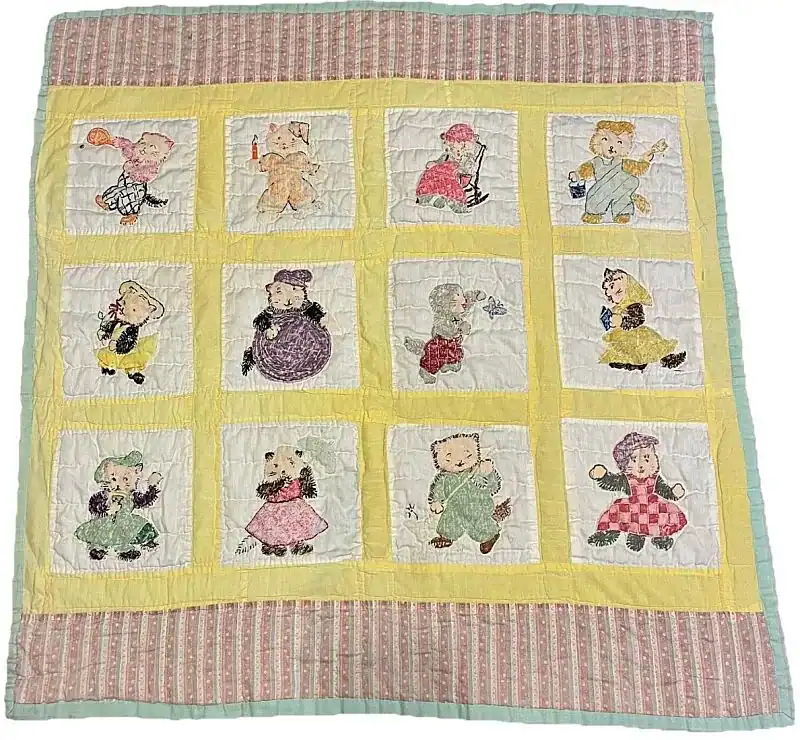
Yesterday, I purchased a set of Sunbonnet Girls embroidery quilt blocks (new, not vintage). These are unfinished, of course & I am looking for suggestions for finishing. I am leaning toward chain-stitching the entire design in black. I am attempting a look commemorating the start of Sunbonnets, which “I think” was maybe the 1920’s. So, would red or black be best? Open to suggestions! TIA! Nancy Evans – Nebraska Quilter
Date: Tue, 1 Apr 1997 15:26:16 -0500 (EST) | From: SadieRose [at] aol [dot] com
I have a book called “A Meeting of the Sunbonnet Children” by Betty J. Hagerman, self-published in 1979. Betty created a quilt that is a sampler of different types of Sunbonnet girls & Farmer boys (to use generic names). I am going to pull out a few bits of information, but if you are really interested, try to find a copy. There are approx. 40 pages of detailed info on the sunbonnet type patterns, when & where they appeared in print, with sketches of the different styles. Some full size patterns given in the second half of the book. I believe that I read that Betty Hagerman had passed away, and I don’t know if the book is still available. Her research indicated that the Sunbonnet craze is probably attributable to Bertha Corbett, an American artist who created her simple but adorable line drawings of little girls at work & play, in oversize sunbonnets, in answer to a challenge that “emotion could not be shown without faces”. Bertha Corbett was surely familiar with the similar drawings of Kate Greenaway, an English artist who illustrated children’s books in the 1880’s & ’90’s. Kate Greenaway’s drawings appear on many Victorian Crazy Quilts, with the design stitched in outline stitch (embroidery). The magazine editors were quite disgusted to find that women were only stitching the outlines- they had intended for the interiors to be filled with stitching, too. Bertha Corbett’s sunbonnet babies started as designs for Valentine & Christmas cards and notes. They were then compiled into a book. After this, Miss Corbett was asked to illustrate a new textbook for children “The Sunbonnet Babies Primer” published apprx. 1900. More Sunbonnet Babies books followed. Advertisers also sought to use these popular designs to sell their products. A second, lesser known illustrator also used the “sunbonnet babies” for post cards and posters. His name was Bernhardt Wall. The popularity of the sunbonnet babies created a demand, which in turn created what we could call “spin offs” or “knock offs” today. Bernhardt Wall chose to have 2 distinctions to make his sunbonnet babies identifiable as his work: they have a white bonnet with a ruffled brim on one end, and a high crown on the other, almost reversible, except for the flounce at the lower back. And, the dresses and coats with well-defined waistlines were a bright red. Many others also adapted these popular designs.
As mothers today turn popular “characters” into quilt motifs…mothers at the turn of the century did so with the sunbonnet babies. Marie Webster, in her 1915 book “Quilts, Their Story and How to Make Them” includes a sunbonnet quilt. Ladies Art Company, a well known pattern source, added sunbonnet patterns to their line “somewhere between 1900-1915” but they were gone from the catalog by 1923. The Sunbonnets continued to appear in pattern catalogs and newspaper patterns into the 1940s. The patterns, which were often embroidered in an outline stitch at first, now were simplified to adapt to applique. One comment was that in the older patterns, the girl’s dresses were longer, and by the 30’s, they were shorter, as fashions had changed…but I wouldn’t use that for quilt dating purposes. Hope this gives you a little background information on the Sunbonnet Girls. Karan from warm but windy Iowa
Date: Tue, 1 Apr 1997 15:37:28 -0500 | From: “Lesley”
There is a book called “Stitched From The Soul” Slave Quilts from the Ante-Bellum South by Gladys-Marie Fry. This book came out several years ago in conjunction with a quilt exhibit at the Museum of American Folk Art in NYC. The last time I was in NY, the museum’s book store still had copies. Lesley lesleyl [at] islc [dot] net
Date: Tue, 1 Apr 1997 17:46:19 -0500 (EST) | From: Quiltfix [at] aol [dot] com
This question is for the Australians on the list. Last night, when I was looking at the calendar, I noticed a holiday this month called ANZAC Day (Australia and New Zealand), I think it’s on the 25th. My mom and I figure that the first three letters stood for Aust. and N.Z., but what about the AC? Help! Alan
Date: Tue, 1 Apr 1997 18:00:23 -0500 (EST) | From: Baglady111 [at] aol [dot] com
In a message dated 97-04-01 17:52:20 EST, you write: << Last night, when I was looking at the calendar, I noticed a holiday this month called ANZAC Day (Australia and New Zealand), I think it’s on the 25th. My mom and I figure that the first three letters stood for Aust. and N.Z., but what about the AC? Help! Alan >> AIR CONDITIONING..APRIL FOOL..ANONYMOUS
Date: Tue, 01 Apr 1997 20:27:35 -0500 | From:
(EST)From: JOCELYNM [at] delphi [dot] comTo: nevans [at] nebnet [dot] net, QHL [at] cuenet [dot] com Subject: QHL: Embroidered quilts On 1-APR-1997 12:29:48.7 nevans said to JOCELYNM > Yesterday, I purchased a set of Sunbonnet Girls embroidery quilt blocks (new, not vintage). These are unfinished, of course & I am looking for suggestions for finishing. > IMO, I think stem stitch would be more authentic. My mommy, a ‘vintage’ quiltmaker of the era taught me to embroider, and to her stem or outline stitch IS embroidery (lazy daisy loops, and french knots being the other two stitches). Pastels were really important in quilting then, as was the use of a wide range of colors (think double wedding ring and Grandma’s Flower Garden). I would bet that a quilter of the era would have made each block a different color, with black and red NOT being among them, but instead paler colors. Jocelyn
Date: Tue, 01 Apr 1997 20:27:35 -0500 (EST) | From: JOCELYNM [at] delphi [dot] com
On 1-APR-1997 12:29:48.7 nevans said to JOCELYNM > Yesterday, I purchased a set of Sunbonnet Girls embroidery quilt blocks > (new, not vintage). These are unfinished, of course & I am looking for > suggestions for finishing. I am leaning toward chain-stitching the >entire design in black. I am attempting a look commemorating the start >of Sunbonnets, which “I think” was maybe the 1920’s. So, would red or >black be best? Open to suggestions!
Nancy, IMO, I think stem stitch would be more authentic. My mommy, a ‘vintage’ quiltmaker of the era taught me to embroider, and to her stem or outline stitch IS embroidery (lazy daisy loops, and french knots being the other two stitches). Pastels were really important in quilting then, as was the use of a wide range of colors (think double wedding ring and Grandma’s Flower Garden). I would bet that a quilter of the era would have made each block a different color, with black and red NOT being among them, but instead paler colors. Jocelyn
Date: Tue, 01 Apr 1997 20:27:43 -0500 (EST) | From: JOCELYNM [at] delphi [dot] com
On 1-APR-1997 18:03:51.3 Baglady111 said to JOCELYNM > looking at the calendar, I noticed a holiday this month called ANZAC >Day (Australia and New Zealand), I think it’s on the 25th. My mom and >I figure that the first three letters stood for Aust. and N.Z., but >what about the AC? > AIR CONDITIONING..APRIL FOOL..ANONYMOUS Nah, can’t be Air Conditioning. They’re in the Southern Hemisphere….it’s fall there, too cold for air conditioning. A Nonny Mouse
Date: Tue, 1 Apr 1997 21:02:56 -0500 | From:
(EST)From: bpeck (by way of Quilting Heritage ListServ) To: QHL [at] cuenet [dot] com Subject: QHL: Unidentified subject! Hello, This is the second time I have tried to get through. I am looking for any information concerning a ‘Square’s pattern’. According to an author of a play being presented in our area a ‘Rebel Square’ is referred to! Has anyone ever heard of this or anything similar to that name?I would greatly appreciate any help? Thank you Rose in Norfolk——————————– End of QHL-Digest Digest V97 Issue
Date: Tue, 1 Apr 1997 21:02:56 -0500 (EST) | From: bpeck (by way of Quilting Heritage ListServ )
Hello, This is the second time I have tried to get through. I am looking for any information concerning a ‘Square’s pattern’. According to an author of a play being presented in our area a ‘Rebel Square’ is referred to! Has anyone ever heard of this or anything similar to that name? I would greatly appreciate any help? Thank you Rose in Norfolk Date: Tue, 01 Apr 1997 22:09:22 -0600 From: LAURA SYLER To: SadieRose [at] aol [dot] com CC: QHL [at] cuenet [dot] com Subject: Re: QHL: Re: Sunbonnet girls Message-ID: <3341DBF2.3525 [at] airmail [dot] net> Content-Type: text/plain; charset=us-ascii Content-Transfer-Encoding: 7bit SadieRose [at] aol [dot] com wrote: > > I have a book called “A Meeting of the Sunbonnet Children” by Betty J. > Hagerman, self-published in 1979. Betty created a quilt that is a sampler of > different types of Sunbonnet girls & Farmer boys (to use generic names). I > am going to pull out a few bits of information, but if you are really > interested, try to find a copy. There are approx. 40 pages of detailed info > on the sunbonnet type patterns, when & where they appeared in print, with > sketches of the different styles. Some full size patterns given in the > second half of the book. I believe that I read that Betty Hagerman had > passed away, and I don’t know if the book is still available. > Her research indicated that the Sunbonnet craze is probably attributable > to Bertha Corbett, an American artist who created her simple but adorable > line drawings of little girls at work & play, in oversize sunbonnets, in > answer to a challenge that “emotion could not be shown without faces”. > Bertha Corbett was surely familiar with the similar drawings of Kate > Greenaway, an English artist who illustrated children’s books in the 1880’s & > ’90’s. Kate Greenaway’s drawings appear on many Victorian Crazy Quilts, with > the design stitched in outline stitch (embroidery). The magazine editors > were quite disgusted to find that women were only stitching the outlines- > they had intended for the interiors to be filled with stitching, too. > Bertha Corbett’s sunbonnet babies started as designs for Valentine & > Christmas cards and notes. They were then compiled into a book. After this, > Miss Corbett was asked to illustrate a new textbook for children “The > Sunbonnet Babies Primer” published apprx. 1900. More Sunbonnet Babies books > followed. Advertisers also sought to use these popular designs to sell their > products. > A second, lesser known illustrator also used the “sunbonnet babies” for > post cards and posters. His name was Bernhardt Wall. The popularity of the > sunbonnet babies created a demand, which in turn created what we could call > “spin offs” or “knock offs” today. Bernhardt Wall chose to have 2 > distinctions to make his sunbonnet babies identifiable as his work: they have > a white bonnet with a ruffled brim on one end, and a high crown on the other, > almost reversible, except for the flounce at the lower back. And, the > dresses and coats with well-defined waistlines were a bright red. Many > others also adapted these popular designs. > As mothers today turn popular “characters” into quilt motifs…mothers at > the turn of the century did so with the sunbonnet babies. Marie Webster, in > her 1915 book “Quilts, Their Story and How to Make Them” includes a > sunbonnet quilt. Ladies Art Company, a well known pattern source, added > sunbonnet patterns to their line “somewhere between 1900-1915” but they were > gone from the catalog by 1923. > The Sunbonnets continued to appear in pattern catalogs and newspaper > patterns into the 1940s. The patterns, which were often embroidered in an > outline stitch at first, now were simplified to adapt to applique. One > comment was that in the older patterns, the girl’s dresses were longer, and > by the 30’s, they were shorter, as fashions had changed…but I wouldn’t use > that for quilt dating purposes. > Hope this gives you a little background information on the Sunbonnet > Girls. > Karan from warm but windy Iowa
The book by Betty Hagerman is out of print, after her death a few years ago. A friend from the Oklahoma guild sent me a photo copy that the guild did after I told her I had loaned mine to a student and she never returned it. I do not have her phone# but you might drop her a note and see if there are any more available from the guild. Write to Kathleen M. Wallis>480 Elm Ave. Norman, OK 73069-5712. Please tell her I referred you to her. Please be advised that I am not positive that they have more copies, but it is a very informative book. Laura Hobby Syler – Richardson
Date: Tue, 01 Apr 1997 21:22:12 -0400 | From: Peter James Robson
Ellen and QHL, I am the co-convenor of the Nova Scotia Heritage Quilt Project and we would be very interested in helping you find out about your quilt and the signatures. We have had a registry day in Middleton and some of the names you mentioned should be relatively easy to trace as the Mayflower Handquilters have a chapter in that area. Please e-mail me and I will send you a documentation form. We have registered quite a few signature quilts from all over the province, as we register them we also write down all the names. we have a very good Provincial Archives here.
We are very interested in finding Nova Scotia quilts that have ended up in other corners of the world and as well we would like to share the information we have on quilts that are here “from away”. Of particular interest is a Crazy Quilt we registered from Connecticut. Does anyone know if they have done a Quilt Registry? Thanks for all your kind words on our web page and the book “Old Nova Scotian Quilts”. Barbara Robson in snowy, cold Nova Scotia