April 1 – 6, 1997
These restored messages come from the Quilt History List, an online forum where quilt historians, collectors, researchers, appraisers, and enthusiasts discussed antique quilts and related textiles. The archive dates from 1996 through approximately 2016 and is being restored gradually. Sign up in the form at the bottom of the page if you want to know when a new page is added. Original spelling, opinions, formatting, and inactive links may remain unchanged.
Primary topics of this QHL Digest
- ANZAC Day Explained — Australian and New Zealand members explain that ANZAC stands for Australian and New Zealand Army Corps, tying the term to WWI’s Gallipoli campaign.
- Sunbonnet Girls Book Follow-Up — A member shares contact information for tracking down a photocopy of Betty Hagerman’s out-of-print Sunbonnet Girls history.
- QHL List Housekeeping — The list owner reminds members about the QHL lending library and how to subscribe or unsubscribe from the list and its digest.
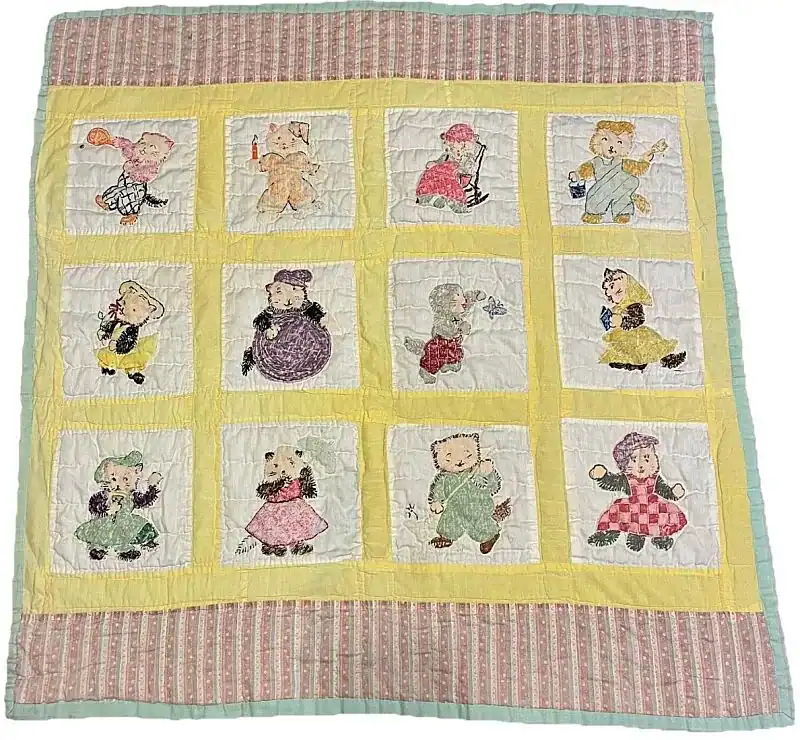
- Nursery Rhyme Newspaper Quilt Blocks — A member describes a set of nursery-rhyme quilt blocks originally distributed through the Omaha World-Herald newspaper in 1940.
- Calico and Chintz Exhibit Book — A member asks for the title of the book accompanying the Calico and Chintz exhibit at the Renwick Gallery.
- Bird of Paradise Plant Dye Experiment — A member in Australia asks for advice on extracting dye from the Bird of Paradise plant for use on muslin.
- ANZAC Biscuits and April Fools’ Follow-Up — The ANZAC Day thread turns into a running joke about “sheep biscuits” and a shared Anzac biscuit recipe.
- Golden Syrup, Orvus Paste, and Cactus Soap — Members compare notes on Golden Syrup as a corn-syrup substitute, the discontinuation of Orvus Paste, and using cactus/soap plant (amole) for cleaning.
- Washing and Caring for Quilts and Textiles — A member researching a lecture on textile care collects family recipes and old wives’ tales about washing quilts, linens, and crochet bedspreads.
- The Play “The Quilters” and Its Bible Verse — Members try to track down the Bible verse quoted in a production of the play “The Quilters.”
- Nursery Rhyme Quilt Block Newspaper Series — Further discussion identifies the Omaha World-Herald as the source of a nursery-rhyme quilt block newspaper series from the 1940s.
- Civil War Quilts and CT State Quilt Registry — Members share notes on Civil War-era quilts and discuss Connecticut’s state quilt registry project.
- New Member Introductions and a Signature Quilt — New subscribers introduce themselves, including one who shares a 1958 signature quilt top purchased in Missouri.
Date: 97-04-01 17:58:53 EST | From: lesleyl [at] islc [dot] net (Lesley)
There is a book called “Stitched From The Soul” Slave Quilts from the Ante-Bellum South by Gladys-Marie Fry. This book came out several years ago in conjunction with a quilt exhibit at the Museum of American Folk Art in NYC. The last time I was in NY, the museum’s book store still had copies.
Lesley lesleyl [at] islc [dot] net
Date: Tue, 01 Apr 1997 22:09:22 -0600 | From: LAURA SYLER
SadieRose [at] aol [dot] com wrote:
>
I have a book called “A Meeting of the Sunbonnet Children” by Betty J.
Hagerman, self-published in 1979. Betty created a quilt that is a sampler of
different types of Sunbonnet girls & Farmer boys (to use generic names). I
am going to pull out a few bits of information, but if you are really
interested, try to find a copy. There are approx. 40 pages of detailed info
on the sunbonnet type patterns, when & where they appeared in print, with
sketches of the different styles. Some full size patterns given in the
second half of the book. I believe that I read that Betty Hagerman had
passed away, and I don’t know if the book is still available.
Her research indicated that the Sunbonnet craze is probably attributable
to Bertha Corbett, an American artist who created her simple but adorable
line drawings of little girls at work & play, in oversize sunbonnets, in
answer to a challenge that “emotion could not be shown without faces”.
Bertha Corbett was surely familiar with the similar drawings of Kate
Greenaway, an English artist who illustrated children’s books in the 1880’s &
’90’s. Kate Greenaway’s drawings appear on many Victorian Crazy Quilts, with
the design stitched in outline stitch (embroidery). The magazine editors
were quite disgusted to find that women were only stitching the outlines-
they had intended for the interiors to be filled with stitching, too.
Bertha Corbett’s sunbonnet babies started as designs for Valentine &
Christmas cards and notes. They were then compiled into a book. After this,
Miss Corbett was asked to illustrate a new textbook for children “The
Sunbonnet Babies Primer” published apprx. 1900. More Sunbonnet Babies books
followed. Advertisers also sought to use these popular designs to sell their
products.
A second, lesser known illustrator also used the “sunbonnet babies” for
post cards and posters. His name was Bernhardt Wall. The popularity of the
sunbonnet babies created a demand, which in turn created what we could call
“spin offs” or “knock offs” today. Bernhardt Wall chose to have 2
distinctions to make his sunbonnet babies identifiable as his work: they have
a white bonnet with a ruffled brim on one end, and a high crown on the other,
almost reversible, except for the flounce at the lower back. And, the
dresses and coats with well-defined waistlines were a bright red. Many
others also adapted these popular designs.
As mothers today turn popular “characters” into quilt motifs…mothers at
the turn of the century did so with the sunbonnet babies. Marie Webster, in
her 1915 book “Quilts, Their Story and How to Make Them” includes a
sunbonnet quilt. Ladies Art Company, a well known pattern source, added
sunbonnet patterns to their line “somewhere between 1900-1915” but they were
gone from the catalog by 1923.
The Sunbonnets continued to appear in pattern catalogs and newspaper
patterns into the 1940s. The patterns, which were often embroidered in an
outline stitch at first, now were simplified to adapt to applique. One
comment was that in the older patterns, the girl’s dresses were longer, and
by the 30’s, they were shorter, as fashions had changed…but I wouldn’t use
that for quilt dating purposes.
Hope this gives you a little background information on the Sunbonnet
Girls.
Karan from warm but windy Iowa
The book by Betty Hagerman is out of print, after her death a few years
ago. A friend from the Oklahoma guild sent me a photo copy that the
guild did after I told her I had loaned mine to a student and she never
returned it. I do not have her phone# but you might drop her a note and
see if there are any more available from the guild. Write to Kathleen M.
Wallis>480 Elm Ave. Norman, OK 73069-5712. Please tell her I referred
you to her. Please be advised that I am not positive that they have
more copies, but it is a very informative book.
Laura Hobby Syler – Richardson
Date: Wed, 2 Apr 1997 08:28:25 0100 | From: David Lewis
In message <970401175851_-800772211 [at] emout05 [dot] mail [dot] aol [dot] com>, Baglady111 [at] aol [dot] com writes >In a message dated 97-04-01 17:52:20 EST, you write: > ><< Last night, when I was > looking at the calendar, I noticed a holiday this month called ANZAC Day > (Australia and New Zealand), I think it’s on the 25th. My mom and I figure > that the first three letters stood for Aust. and N.Z., but what about the >AC? > Help! I think it’s Army Corps. certainly it has its origins in the war.
Marie (in the UK) — David Lewis
Date: Wed, 2 Apr 1997 06:10:03 -0500 (EST) | From: Baglady111 [at] aol [dot] com
this pattern was discussed awhile back but possibly not on this digest..try qhl [at] cue [dot] net and ask Kris..also tgry ozzg.nmia.com and ask them..isn’t it from the QUILTERS play????Jane
Date: Wed, 2 Apr 1997 21:01:09 1000 | From: gsw30a [at] lisp [dot] com [dot] au (Gail Wilson)
ANZAC stands for Australian and New Zealand Army Corp. This was the primary group which fought in the Middle East against the Turks during 1914-18 War. It ceased to exist after the Battle of Galipoli fought in Turkey. The term “anzac’ is still used in Australia and NZ to signify strong ties and national dedication.
Hope this clears up the mystery.
Gail Wilson Blue Mountains NSW Australia
Date: Wed, 02 Apr 1997 09:11:24 -0500 | From: Leo Harvill
Good morning!
This is a response to Peggy Notestine concerning the nursery rhyme quilt blocks. The response is from my wife, Joyce Harvill.
The quilt blocks you referred to could have come from a newspaper. They were put in one at a time so people would continue to buy the newspaper to get the whole set.
I have a set from the Evening World-Herald: Omaha, Nebraska. The instructions say there are 21 blocks, but I have only 19. I found them among my Mother’s things after her death 12 years ago. The date on one of the blocks is November 13, 1940. The designer’s name is difficult to read, but could be Laverne Bartos.
I hope this is helpful.
Best wishes, Leo Harvill
Date: Thu, 03 Apr 1997 00:57:01 -0800 | From: nomad1 [at] ibm [dot] net
Dear Alan, Tell you what, those poor blokes sure could have done with some creature comforts out there in Gallipoli. ANZAC, stands for Australian and New Zealand Army Corps that were formed in World War 1. On April 25th the ANZACS began the campaign against the Turks in Gallipoli and were evacuated on December the 18th, 1915, after horrendouse casualties. This was the first time the Aussies and N/Zers fought under their own name and not as troops of the British. ( My G/uncle served with the Gurkha unit.) We commemorate their valour and mateship on this day. This is also how the Aussie biscuites called Anzac Biscuites came about. For they are crispy, tasty treats that did not go off quickly. These were sent to Aussie soldiers at Gallipoli by their families and elsewhere too i,m sure. Loved your Air Conditioning joke though guys, gosh think of the April Fools jokes we could have concocted. Shall start planning for next year!!! If any are interested in the receipe I will be happy to pass it on, as these are yummy,-cookies as you guys would call them. Adieu for now, Hiranya Lodor not odour! from Sydney, Australia
Date: Wed, 2 Apr 1997 09:26:44 -0500 (EST) | From: MamaBear76 [at] aol [dot] com
Peggy- This is so strange. Last Nov. when starting my first quilt, I recalled my mother-in-law passing to me an unfinished top. This was many years ago and not into quilting then, I put it away. (I never throw anything out, much to the ‘chegrin’ of my husband, who would throw everything out!) I went looking for this because my daughters had both become very interested in owning a quilt, so I began my search for this unfinished top from their ‘Meema’. Still haven’t found that piece but I did find a quilt exactly as you have described as your “Nursery Rhymes”. Not subscibing to this list then, I had it dry cleaned. (For all of you knowledgables out there, please forgive me, for ‘I knew not what I was doing’!!!) I can take photos of each square if you would like, I still have it here. I decided to make each girl a quilt instead. We decided it should be used for any future grandchildren. It seems to be in good shape still, and I am still looking for the top! I would be glad to take the photos and send them snail mail if you would like.
Liz – from NY where the snow is melting quickly on our golf course here. Just a little white instead of the 8″ we had there just yesterday.
Date: Wed, 2 Apr 1997 09:24:36 | From: “MARY PERSYN”
When I was at the Calico and Chintz exhibit at the Renwick in DC in January, the clerk in the gift shop said that they thought the book that goes along with the exhibit (not just an exhibit catalog but something more, was the way it was described), would be out around April 1. Since it’s now April 2, I’m asking if anyone has any information about its ETA.
Any information would be appreciated. The exhibit was absolutely wonderful.
Mary in “Spring-like” Valparaiso, IN
Mary G. Persyn mpersyn [at] wesemann [dot] valpo [dot] edu Law Librarian (219) 465-7838 School of Law Library FAX: (219) 465-7917 Valparaiso University Valparaiso, IN 46383
Date: Wed, 2 Apr 1997 11:16:25 -0500 (EST) | From: OhSirius [at] aol [dot] com
I believe it stands for Australia and New Zealand Army Corps. There was a movie by the same name several years ago starring Paul Hogan. (Very good flick actually) This is what the army, or a part of it was called during WWII. I have a recipe for ANZAC cookie if any one is interested. So our Aussie friends, am I right? Sara
Date: Wed, 2 Apr 1997 13:35:53 -0800 (PST) | From: Diane Lockwood
…for a while. Going with Bev to a Sulky class in Fair Oaks tonight. I’ll spend the night with Bev as I don’t drive at might. My computer has been turning itself off occassionally so if you don’t hear from me, I’ve ordered a new one and will be back shortly.
Diane
Date: Wed, 02 Apr 1997 16:20:37 -0600 | From: LAURA SYLER
Mary; If you get any information on the book posted privately would you please post to the list. I’d love a copy of the book also. Laura Hobby Syler Richardson, Tx – where its mild but about to rain
Date: Thu, 3 Apr 1997 08:12:28 0800 | From: Kath Balfour
Okay, I’m game to try the Bird of Paradise (BP) dye. Any experienced dyers amongst us? Your advice & suggestions would be appreciated, please post to the list!
We have the Crane Plant (Strelitzia Reginae), a near cousin of the much larger BP (Strelitzia Nicolai) growing prolifically in suburban Western Australian gardens. The plant family is native to South Africa.
Here is its description: Evergreen shub growing to a height of 1m (3ft); stems erect and flowering; leaves greyish green, long petioled and canna-like; flowers are royal purple, brilliant orange and termianal, resembling the head of a crested bird; propagation by division.
Any idea how to proceed in making the dye? It’s not classified as a poison in my Encyclopedia Botanica. What about cooking it in a plastic container in the microwave with a sample of unbleached muslin?
— Kath Balfour Yesteryear Quilts 37 Gibson St Hilton WA 6163 AUSTRALIA
e-mail: balfourk [at] echidna [dot] id [dot] au fax: 619-336-4230 voice: 619-335-6401
Date: Wed, 2 Apr 1997 20:07:04 -0500 (EST) | From: Baglady111 [at] aol [dot] com
In a message dated 97-04-02 10:59:06 EST, you write:
<< have done with some creature comforts out there in Gallipoli. >> what a wonderful history lesson of your great country, Hiranya..This is woderful and also that you realized the air conditioning comment was a joke because of our April Fool’s Day here..do you have it in Australia? Thanks for your sense of humor..and a friend of mine is here and enjoying your history as well..Many thanx ., yes..please do post your receipe..Jane
Date: Thu, 3 Apr 1997 12:03:30 +0800 | From: Kath Balfour
Yup, its Army Corps, ‘lest we forget’ WWI etc, and Anzac Day, like the US Veterans’ Day, is a public holiday complete with parade. See the 70s movie Gallipoli starring gorgeous Mel Gibson which will reveal how the Anzacs went off half a world away to fight the Turks on behalf of king & country & got wiped out. Australia had become an independant nation in 1901, but still gave allegiance to the Commonwealth.
I wonder if anyone ever made a commemorative quilt with reference to the Anzacs’ defeat at Gallipoli?
— Kath Balfour Yesteryear Quilts 37 Gibson St Hilton WA 6163 AUSTRALIA
e-mail: balfourk [at] echidna [dot] id [dot] au fax: +619-336-4230 voice: +619-335-6401
Date: Thu, 03 Apr 1997 20:00:55 -0800 | From: nomad1 [at] ibm [dot] net
Hellooo Jane and all, I have had quite a few emails re the receipe. So, here it is. Also Jane, Do we have April Fools Day?…… We sure do! Heh! Heh! Infact I think the whole world has fun on this day. I missed out on being naughty this year due to being too busy and remembering too late! Never mind, lots of time to plan for next year………..Hee! Hee! ANZAC BISCUITES
1/2 cup butter 1 tablespoon golden syrup 1/2 tspn bicarbonate of soda 2 tbl spns boiling water 1 cup uncooked rolled oats 3 dead sheep (Merino are the best) 1 cup desiccated coconut 1 cup plain flour 1 cup brown sugar 2 tspns ground ginger
Melt butter and golden syrup in a large pan over a low heat. Add bicarbonate of soda mixed with boiling water. Combine dry ingredients in a mixing bowl, then pour melted mixture into the centre, and mix to a moist but firm consistency. Drop slightly rounded teaspoonfulls of mixture onto a cold greased tray. Cook for about 15 mins in a moderate oven. Cool on a wire rack.
Hope you enjoy these. Best Wishes, Hiranya Loder from Sydney, Australia
� Quilting Treasures of Old � nomad1 [at] ibm [dot] net
**Date: Thu, 3 Apr 1997 07:39:02 -0500 (EST) | From: “Jim Twigg” **
Recently I’ve read notes here regarding UFO’s – unfinished objects – and
thought some of you might be interested in trying a UFO Auction with your
friends. Each fall and spring the Annapolis Quilt Guild holds a weekend
retreat. On Saturday night we auction off all the UFO’s people have
donated. The bids start off in pennies, sometimes going as high as $ 6.00
or so. We have a lot of laughs. Any quilt/sewing/fabric related work is
eligible. Last time we even had a handmade doll with an unfinished head (
as in no head). If an item doesn’t seems to be moving, we just throw in
another UFO along with it. The auctioneer actually has a gavel (to be
authentic) and the assistant describes the wonderful qualities of the UFO (
similar to the talk on the shopping channel). Sometimes we bid just to stop
her from continuing on with the embellished description. Some UFO’s go home
with a new owner but make a return visit to the next auction. The money we
raise is then donated to the camp where we hold the retreat. Its a couple
of hours of great fun and, best of all, you get rid of that project with no
guilt !
Phyllis jtwigg [at] radix [dot] net
(who is still looking for quilts/ quilt blocks related
to letters of the alphabet)
Date: Thu, 3 Apr 1997 07:39:04 -0500 (EST) | From: “Hawking Family” (by way of Quilting Heritage ListServ
Hi Alan, You were right about the Australia and New Zealand, tha AC is for Army Corps. Anzac day is held on the 25th of April every year as a reminder and to commemorate our soldiers efforts in WW1. It is the date of the landing at Galipoli and the battle which ensued, in which our forces were decimated. A mistake in landing sites was made and the forces were dropped at the wrong beach which resulted in heavy losses. Every year we remember these heroic men and all others lost so that we may still be a free country. Hope this is helpful, Michelle Down Under michtrev [at] shepparton [dot] net [dot] au
Date: Thu, 3 Apr 1997 07:43:46 -0500 (EST) | From: Quilting Heritage ListServ
I have a question about Hiranya’s recipe. I recognized bicarbonate of soda as baking soda, but what is desiccated coconut?
Kris
At 08:00 PM 4/3/97 -0800, you wrote: >>Hellooo Jane and all, >>I have had quite a few emails re the receipe. So, here it is. Also Jane, >>Do we have April Fools Day?…… We sure do! Heh! Heh! Infact I think >>the whole world has fun on this day. I missed out on being naughty this >>year due to being too busy and remembering too late! Never mind, lots of >>time to plan for next year………..Hee! Hee! >>ANZAC BISCUITES >> >>1/2 cup butter >>1 tablespoon golden syrup >>1/2 tspn bicarbonate of soda >>2 tbl spns boiling water >>1 cup uncooked rolled oats >>3 dead sheep (Merino are the best) >>1 cup desiccated coconut >>1 cup plain flour >>1 cup brown sugar >>2 tspns ground ginger >> >>Melt butter and golden syrup in a large pan over a low heat. Add >>bicarbonate of soda mixed with boiling water. >>Combine dry ingredients in a mixing bowl, then pour melted mixture into >>the centre, and mix to a moist but firm consistency. >>Drop slightly rounded teaspoonfulls of mixture onto a cold greased tray. >>Cook for about 15 mins in a moderate oven. Cool on a wire rack. >> >>Hope you enjoy these. >>Best Wishes, >>Hiranya Loder >>from Sydney, Australia >> >>” Quilting Treasures of Old ” >>nomad1 [at] ibm [dot] net >> >> >> >
Date: Thu, 3 Apr 1997 07:55:45 -0500 (EST) | From: MamaBear76 [at] aol [dot] com
I think the bicarbonate sounds realatively easy compared to the Merino sheep would be difficult. (hope you had a happy April Fools Day)
Date: Wed, 02 Apr 1997 23:38:33 -0500 (EST) | From: JOCELYNM [at] delphi [dot] com
On 2-APR-1997 08:59:00.4 nomad1 said to JOCELYNM > If any are interested in the receipe I will be happy to pass it on, as > these are yummy,-cookies as you guys would call them. Ok….I’ll try an Anzac biscuit! Jocelyn
Date: Thu, 3 Apr 1997 11:04:16 -0500 (EST) | From: KirkColl [at] aol [dot] com
The Evening New Herald of Omaha became the Omaha World-Herald. Phone is 402-444-1000. The librarian is at extension 1014. It is a fee-based service — $7 for the first article and $2 for each additional. I’ve put in a call to see if they can track down the nursery rhyme pattern.
Nancy Kirk The Kirk Collection
Date: Thu, 3 Apr 1997 11:54:40 -0500 (EST) | From: SadieRose [at] aol [dot] com
What I want to know is do you have to wash the sheep first?? (I know you are supposed to wash bananas before you peel them). And do they shrink when you dry them?? Would you want 3 Large sheep…so if they shrunk a bit, it wouldn’t spoil the recipe?? And who did come up with this, anyway, the Giggling Gourmet?? Do you have to age these biscuits til April 25th??
Really, now….what is “golden syrup”?? Karan
Date: Thu, 3 Apr 1997 11:40:22 -0500 | From: “Lesley”
Hiryana:
I need an answer quickly please. I’m in the kitchen mixing these “ANZAC Biscuites” and I do want this culinary treat to turn out right. I’ve added the sheep to the mixture and am now a bit symied as your directions are not clear on this. Does the wool get mixed into the dough or is it an embellishment after baking? I DO want to get these finished as my quilt guild meeting is tonight and I’m in charge of refreshments!!
Thanks
Lesley lesleyl [at] islc [dot] net
Date: Thu, 3 Apr 1997 16:50:57 -0500 (EST) | From: Quiltfix [at] aol [dot] com
Thanks to the Australians for the info in ANZAC day. I’m passing this info onto my mother. I didn’t realize, tho’, that it would cause a commotion! 🙂
In regards to using the bird of paradise plant to dye, don’t forget that you can by the plants at nearly any garden shop (at least here in NE FL you can). You don’t have to live down here to get one. I’m not a dyer myself, but am interested in the results. Lemme know.
Alan
Date: Fri, 4 Apr 1997 09:04:35 +1000 | From: Li Joo
I think everyone has gone a bit crazy trying to make sheep biscuits!! Still, I am getting a million laughs out of this one, so don’t stop now! Who would have thought that an innocent question about ANZAC, would end up with all of us discussing air-conditioning, war, and sheep?!!
I love you people!!!
LiJoo in rapidly cooling Melbourne, Australia.
Date: Thu, 3 Apr 1997 19:22:16 -0500 (EST) | From: CTislander [at] aol [dot] com
Kath said: >Okay, I’m game to try the Bird of Paradise (BP) dye. Any experienced dyers >amongst us? Your advice & suggestions would be appreciated, please post to >the list!
I am an experienced dyer at your service. My experience is mainly with wools, but the same principles apply. It is not a simple process and it involves hours of simmering. Cotton does not take dye in the same manner as wool. Some natural dyes that give beautiful colors on wool do absolutely nothing on cotton.
Basic supplies for dyeing 1/4 pound of fabric:
— enamel dye pot(s) which holds 2 gallons – baked-on enamel, no pits or cracks — scale for weighing fabric and mordants — large tubs for washing and rinsing — stove or outdoor fireplace — cheesecloth for straining dye — plastic measuring spoon set — a glass candy thermometer with a clip — soap or detergent — an 18-inch wooden dowel or a large wooden spoon — Alum for mordant — washing soda to use with the mordant — rubber gloves
NEVER, NEVER use the supplies for cooking again! Save them for your dye projects.
Gather your dyestuff at least three days in advance of your dyeing day. Crush, grind, or chop dyestuff. Cover with water in an enamel pot and let it stand for at least three days. Simmer the dyestuff in the pot for one hour and allow the dye to cool in the pot. Separate the dye liquor from plant material by straining it through cheesecloth.
Mordant — Natural dyeing is a chemical process. A mordant is needed to develop certain colors and to hold the colors fast so they won’t wash out or fade. The word mordant comes from the Latin word which means to bite. Alum is the easiest mordant to find. (Other mordants are Chrome, tin, Iron, and copper sulfate.) Since we do not have any idea which mordant will develop the green color from the Bird of Paradise plant, let’s try Alum. You can get this from Dharma Trading Company in San Rafael, CA, or at pool supply places, or sometimes at your grocery store.
Cut cotton cloth into 1/4 pound pieces. Wash cotton fabric for 30 minutes in hot water. Rinse many times until the water runs clear.
To dye 1/4 pound of cotton use one ounce alum, plus 1/4 ounce washing soda. Dissolve the alum and the washing soda in 1 1/2 gallons of water and immerse the cotton after it has been thoroughly wet and wrung out. Stir well, heat gradually, and simmer for one hour at 190 degrees F. Keep the fabric completely submerged throughout the process. Stir and gently turn the cotton with your wooden dowel or spoon. Remove from the heat and let it cool down to 150 degrees F.
Pour dye liquor into an enamel pot and add enough water to make 1 1/2 gallons of liquid. Heat the solution to 150 degrees F. Enter the wrung out, warm mordanted cotton and completely submerge it. Bring the temperature of the pot up to 190 degrees F. Keep temperature constant for one hour while stirring and gently turning the fabric with your wooden dowel or large wooden spoon.
Remove the pot from the heat. Allow the fabric to cool down in the pot. After it is cool, squeeze and wash fabric thoroughly. Dry. If you try ironing it, use a press cloth until you know if the dye has taken.
Please understand that you may NOT get a color on cotton. Wool is the magic fabric that loves to take dye. (If you dye wool use cream of tartar with the alum, not washing soda in the mordant bath.)
This information was taken from the book *An Introduction to Natural Dyeing* copyright 1972 by Threshold.
Christine Thresh in the California Delta
Date: Thu, 3 Apr 1997 20:59:08 -0500 (EST) | From: Quilting Heritage ListServ
X-Sender: rhoffer [at] nerds [dot] com >Date: Thu, 03 Apr 1997 10:09:42 -0500 >To: qrs [at] albany [dot] net >From: Robert Hoffer>Subject: Help > >My wife has a quilt that her great-grandmother made from the shirts of the >men in her family – it’s really lovely work. We don’t know anything about >quilts and this one is in need of restoration. We’re in Northern New Jersey >and would like to find someone who can help. > >Any suggestions? > >Robert > >
Date: Thu, 3 Apr 1997 20:59:42 -0500 (EST) | From: Elizabeth Richards (by way of Quilting Heritage ListServ
Where is Osgoods? I must have missed the location in the original mail. I don’t have a DH but have a DC (dear companion) who loves to go places that are fun and different. I think Osgoods sounds like fun – at least to me – and he’s very indulgent.
THREAD. One great things about “talking” and sharing with others is that university professors get ideas for research. Obviously the subject of thread is one that lots of people are interested in and when I saw all the comments I though “good research idea”. So when I am finished my PhD dissertation, hopefully after the summer, I will solicit ideas about thread Right now I’ve started a red file called “THREAD” which is waiting for questions/ideas. One thing that would be helpful now is if readers would documents problems they see – type of thread (cut a short length if possible and put in envelope), age of quilt, type of fabrics, specific damage. I am curious to know if the stitching damage comes with use only or if it occurs after washing. Has anyone seen stitching damage just through the hanging of a quilt/art peice.
I am just learning to use Eudora for my mail and can’t seem to find a dictionary so if anything is misspelled or if there are typing errors I’ve missed, I’m sorry. –
Date: Thu, 03 Apr 1997 20:08:33 -0600 | From: LAURA SYLER
As I was sitting here contemplating whether the sheep needed a bath before it went into the cookie dough…..Now seriously… I am working on a lecture on care and cleaning of quilts and textiles ie: quilts,old linens, crochet bedspreads and the like. I would like any family recepies, old wives tales (true and the one about the sheep)tried & true methods, contemporary methods…You know, like the lemon juice and salt, buttermilk for WHAT?? Several of my friends have expressed an interest so I think it might be of interest to most on the list. You may post to the list or to me privately if it’s way off the wall. This might not be as fun as the ANZAC stuff, but you never know. Thank to all – Laura in Dallas where it’s raining!!! texas_quilt.co [at] airmail [dot] net
Date: Thu, 03 Apr 1997 21:04:19 -0500 (EST) | From: LISA108 [at] delphi [dot] com
Agree with the previous post – don’t ever, ever, ever use dyepots for cooking unless you work exclusively with yellow substantives like turmeric or saffron. A lot of those old dyes were pretty toxic, and chrome yellow is so poisonous that one dyeing manual recommended the chrome yellow recipe only be used by an experienced chemist in a properly equipped and ventilated lab!
If bird of paradise won’t take on cotton, try silk. Silk usually dyes quite well, and mordants well with alum.
Question: when was this particular dye first known? Was it discovered in modern times, or is it an old tropical secret that simply wasn’t revealed to westerners? It’s pretty tiresome getting chartreuse all the time from overdyeing indigo with turmeric….
Date: Fri, 4 Apr 1997 07:24:11 -0500 (EST) | From: narmstr [at] ibm [dot] net (by way of Quilting Heritage ListServ )
Not an Australian, but have some comments … ANZAC Australia and New Zealand Army Corps WWI. Did everyone see the movie GALLIPOLI! Well, that is what ANZAC Day is all about. On that day, quoting my dear Australian friend Margaret Rolfe, “Australians as a nations remember the soldiers … who landed at Gallipoli … and through them, all the Australian soldiers who took part in all wars.” The wonderful exhibit catalogue COLOURS OF AUSTRALIA: DIRECTIONS IN QUILTMAKING (The Quilters’ Guild) Rushcuttters Bay, NSW: JB Fairfax, 1995 ISBN 1-86343-077-6 has a marvelous quilt by Margaret called ANZAC which is a tribute to her father-in-law Frank Rolfe. The innocnet face embroidered on the brown fabric rectangles, reminiscent of suiting samples, is based on a youthful photograph of Mr. Rolfe. The red poppy is for the 60,000 soldiers who did not return. (As Margaret’s fine and highly readable history of Australian quilts PATCHWORK QUILTS IN AUSTRALIA points out so poignantly … in 1915 the population of Australia was under 5 million. 330,000 served overseas! More than 150,000 were wounded in addition to the 60,000 killed. Truly, ANZAC Day is a most important memorial day.
Subject: QHL: Nova Scotia Heritage Quilt Project CT quilt
Yes, Connecticut has a project. The address from GATHERINGS: Connecticut Quilt Search Project, PO Box 926, New Haven, CT 06504. I have written to them just recently, to see whether they have yet gone ahead with their project publication for which they were doing fundraising last fall. If/when I hear back from them, and if they have a new address I will update this posting. (I wrote to Sue Reich, 28 Scofiled Hill, Washington Depot, CT 06794 who was the 1995-1996 CQSP President.)
Date: Fri, 4 Apr 1997 09:15:57 -0500 (EST) | From: JZgliniec [at] aol [dot] com
Dear Laura and All,
I read a wonderful “Wives Tale”. It was in one of the Pa books, by Lasansky but I don’t remember which one.
“One wash is worth 5 years wear”.
I use it frequently in my schpeal about overcleaning textiles and that a few spots are OK….life happens.
Regards, Julia
Date: Fri, 04 Apr 1997 08:43:28 -0600 | From: LAURA SYLER
JZgliniec [at] aol [dot] com wrote: > > Dear Laura and All, > > I read a wonderful “Wives Tale”. It was in one of the Pa books, by Lasansky > but I don’t remember which one. > > “One wash is worth 5 years wear”. > > I use it frequently in my schpeal about overcleaning textiles and that a few > spots are OK….life happens. > > Regards, > Julia
Julia: Thanks for the warning. I use this part of my lecture to enhance the comment by Karey Brenenhan to a quilt owner at one of the Texas Sesquecentennial Quilt Search Days back in the mid 80’s…” If you were 90+ years old you’d have spots on you, too!!” I really am interested in anything anyone has heard…from the tried & true to the absurd!!
Date: Fri, 4 Apr 1997 13:42:18 -0500 (EST) | From: AJSNGS [at] aol [dot] com
Hi all,
Hope you have all had a good week. We just got home from Disney World. I must have seen some of you there….it seemed that EVERYONE was there! Busiest week on record for Disney World.
To fellow QHLers in Boston and surrounding areas…have you shoveled out yet? I could not believe my ears when I heard about three feet of snow on April Fools Day?!?! Seems like a cruel joke to me! Hope everyone is okay.
Good to be home….I’ve eaten enough for six people, and walked enough for a month!
Nancy in VA
Date: Fri, 4 Apr 1997 17:16:03 -0500 (EST) | From: HKnight453 [at] aol [dot] com
Karen- Gold syrup is what we yanks call corn syrup. Also, I have several old embroidery pattern s which could be used for quilts or dishtowels etc from American Thread (no dates). If anyone is interested, I would trade copies for other dishtowel motifs…. Heather in sunny and melting RI
Date: Fri, 4 Apr 1997 17:22:51 -0500 (EST) | From: HKnight453 [at] aol [dot] com
Osgood’s is in Springfield MA. A long trip from the Left Coast, but only 1 hour from Boston…If you want to come east with the DH, the Basket Ball hall of Fame is nearby…. Heather in snowless RI
Date: Fri, 4 Apr 1997 17:13:37 -0500 (EST) | From: Quiltfix [at] aol [dot] com
I didn’t expect all the silliness my question brought up! I was actually LOL at the computer!
Can we please discuss the cleaning on the list? That’s something that everyone is very interested in, IMHO. Last year, at the Quilt Restoration conference, we had an impromptu cleaning lecture ( remember “that depends…..”? Most of the questions’ answers began with that phrase). It lasted quite a while and we didn’t get to all of the questions. Virginia Vis is certainly very knowledgeable and gave a lot. I’m certain that the discussion here would be just as informative, not to mention appreciated by people new to quilt restoration.
Alan
Date: Sat, 05 Apr 1997 10:57:09 -0800 | From: nomad1 [at] ibm [dot] net
Gee Whiz, I certainly did not catch you guys napping did I ?? Thanks for being such good sports, but then again us quilters are such fun, so its not surprising! Okay for those who asked, Golden Syrup is a light coloured treacle that is produced from evaporated sugar cane in the manufacture of crystalline sugar. Its used to sweeten,colour,flavour cakes,puddings,sauces etc. Warm it slightly to soften so you can measure accurately! Desiccated coconut is dry coconut that is finely shredded or flaked. Hope this helps, and that the wool did not get stuck in your teeth! Adieu for now, Hiranya Loder from Sydney , Australia nomad1 [at] ibm [dot] net Quilting Treasures of Old Tel: 61 + 2 + 9630-5839
p.s Will reply to other mail later as I am like a mad woman preparing for guests coming over, so must choof off now. Just wanted to make sure you guys got those cookies into the oven before midnight!!
Date: Fri, 4 Apr 1997 21:10:30 -0500 (EST) | From: Quiltinjil [at] aol [dot] com (by way of Quilting Heritage ListServ American Quilt Study Group (AQSG) published an excellent research paper
“Quilt Patterns and Contests of the Omaha World-Herald, 1921-1941” by Jan Stehlik along with eight other quilt historians’ research in Uncoverings 1990. Hickory Hill Antique Quilts sells this book on-line at oldquilt [at] albany [dot] net for $14.50 +shipping, or you can order if directly from AQSG.
Most of the pattern series listed in Stehlik’s paper are patterns that I collected from other newspaper syndications. If anyone is interested in copies for a small fee, please e-mail me directly. Quiltinjil [at] aol [dot] com
Date: Fri, 4 Apr 1997 21:10:37 -0500 (EST) | From: godzilla [at] sun1 [dot] uconect [dot] net (Robinson) (by way of Quilting Heritage ListServ )
Barbara:
Connecticut does have a quilt registry — The Connecticut Quilt Search Project. My guild hosted a quilt documentation day in 1995 as part of their project. They are nearly finished with phase one of the project — grass roots documentation.
Now they are beginning phase two, work on a book documenting their findings. I went to a quilt gala they put on last fall to raise money for phase two — it was great, the quilts were “to die for!”
I don’t know if anyone involved in the project is on-line, but you can get in touch with them by writing to: Sue Reich, 28 Scofield Hill Road, Washington Depot, CT 06794.
Sue Robinson
godzilla [at] uconect [dot] net
Date: Sat, 5 Apr 1997 08:01:03 -0500 (EST) | From: “Potter Family” (by way of Quilting Heritage ListServ )
Hi everyone! I am new to this list and have been lurking for a few days. I enjoy everything so far.
I have been quilting off and on since 1984 but seriously since 1993. I am one of those true traditionalist – everything by hand. Yes, I piece by hand, applique and quilt by hand. I love it! My Mom found a quilt top at a community rummage sale (large garage sale – once or twice a year) for me – she paid 25 cents (yes cents) for it. Its a double wedding ring and is badly in need of repair. Some one washed it and its all out of shape but I am slowly re pieciing some of the curved pieces. My Mom also has a stash of old old clothes with some of the same fabrics that are on this quilt top, so am using them. I have been working on it for a few years now and enjoy the work – tho it always seems to be the bottom of my pile. The most depressing part of this quilt top is the thin centers of the rings – should I replace those as well or leave them? I use alot of unbleached muslin in my quilts and am wondering if I do replace the centers, that will be what I use. Any thoughts would be welcome. Dale Anne In snow-covered central Alberta (what happened to SPRING?) bfpotter [at] telusplanet [dot] net “If life gives you scraps – make a QUILT!”
Date: Sat, 05 Apr 1997 10:48:47 -0500 (EST) | From: JOCELYNM [at] delphi [dot] com
Message-id: <01IHCDTLMY429LXGTF [at] delphi [dot] com> Content-type: TEXT/PLAIN; CHARSET=US-ASCII Content-transfer-encoding: 7BIT
On 3-APR-1997 07:44:34.4 qrs said to JOCELYNM > I have a question about Hiranya’s recipe. I recognized bicarbonate >of soda as baking soda, but what is desiccated coconut? Kris, I would guess it’s what WE call ‘coconut’. The dried stuff in a sack, as opposed to FRESHLY grated coconut. BTW…my sister has an Australian friend who was going to back for her while visiting. They tried every possible American option, but could find nothing that Corrie thought was a reasonable facsimile for ‘golden syrup’. She sent Kathy some, when she returned home, and indeed, it was like nothing sold in America. Like Vegamite. Jocelyn
Date: Sat, 05 Apr 1997 12:32:48 -0500 (EST) | From: JOCELYNM [at] delphi [dot] com
On 4-APR-1997 17:53:16.5 HKnight453 said to JOCELYNM > Karen- > Gold syrup is what we yanks call corn syrup. Also, I have several Heather, Not necessarily….my sister’s friend Corrie tried all three kinds of Karo–light(clear), medium and dark– and said none of them is like ‘gold syrup’. She mailed Kathy a bottle of it when she returned home….I don’t know if Kathy ever made anything with it, or whether Karo really IS significantly different. BUT…..just a warning to those trying it that at least in the opinion of ONE Australian cook, Karo ISN’T a satisfactory substitute.
Jocelyn
Date: Sat, 05 Apr 1997 12:33:08 -0500 (EST) | From: JOCELYNM [at] delphi [dot] com
Dale Anne, Welcome! I’m not a reconstructionist, so I really can’t give you advice on that. I like the idea of using muslin, though…I really like the look and feel of it. OTOH, several years ago, my mom rescued a quilttop that had been made by my brother-in-law’s grandmother, and quilted it. It was a Wedding ring, with a gosh-awful amount of bilious yellow in it. Mom set in curved borders to frame it and widen it up to modern-bed-size, in a country blue with a tiny dot pattern. Toned down all that awful yellow. So you may want to think about that idea, if there are colors in the quilttop that are no longer ‘nifty’. Jocelyn
Date: Sat, 05 Apr 1997 10:57:45 | From: didde [at] cyberport [dot] com
I am working on a lecture on care and cleaning of quilts and textiles >ie: quilts,old linens, crochet bedspreads and the like. I would like >any family recepies, old wives tales (true and the one about the >sheep)tried & true methods, contemporary methods…You know, like the >lemon juice and salt, buttermilk for WHAT?? Several of my friends have
I have only been reading this group a few days and have found it very interesting. I’m a Grandmother taught quilter, who has quilted for some 30 years. My Grandmother, who I lost two years ago at age 99, must have been born with a needle and was always willing to share her art and love of quilting. I’m very interested in the heritage of quilting and I’m currently working on a project following quilt patterns, names and the changes, as the western movement took place from about 1840 – 1890. Many patterns that show up in the early 1800’s show up again as the women move west, with a little twist and a name connected with their new western settlement.
I hope this information will be helpful to your lecture.
When growing up there were always two kinds of quilts in my Grandmother’s home. Finer cotton quilts use more for decoration and company, and wool quilts that were used all the time and were much heavier and warmer.
When the quilts were in need of being cleaned, they were washed in a cactus root called Amola. This cactus is very common through out the southwest. The root was dug and dried, when shaved and worked in water it would make a nice lather. Warm water would be placed in large tub, the Amola added, then the quilt placed in. The quilt would then be gently squeezed pushing the water throught it. The quilt would then be rinsed thoroughtly and laid flat to dry. Quilts were only washed when soiled. Quilts were aired out every spring, placing them over the clothes line to air all day. Cotton quilts were always aired on days that were overcast, so they did not get direct sun light. When the wool quilts were aired, they may have been lightly beaten with a wire to remove dust since they were used so much more.
Good luck in your gathering of information. I will be watching for this thread, as the care of quilts, old or new, is always of great interest.
Yvonne didde [at] cyberport [dot] com
Date: Sat, 05 Apr 1997 05:34:34 -0600 | From: LAURA SYLER
didde [at] cyberport [dot] com wrote: > > >I am working on a lecture on care and cleaning of quilts and textiles > >ie: quilts,old linens, crochet bedspreads and the like. I would like > >any family recepies, old wives tales (true and the one about the > >sheep)tried & true methods, contemporary methods…You know, like the > >lemon juice and salt, buttermilk for WHAT?? Several of my friends have > > I have only been reading this group a few days and have found it very > interesting. I’m a Grandmother taught quilter, who has quilted for some 30 > years. My Grandmother, who I lost two years ago at age 99, must have been > born with a needle and was always willing to share her art and love of > quilting. I’m very interested in the heritage of quilting and I’m currently > working on a project following quilt patterns, names and the changes, as > the western movement took place from about 1840 – 1890. Many patterns that > show up in the early 1800’s show up again as the women move west, with a > little twist and a name connected with their new western settlement. > > I hope this information will be helpful to your lecture. > > When growing up there were always two kinds of quilts in my Grandmother’s > home. Finer cotton quilts use more for decoration and company, and wool > quilts that were used all the time and were much heavier and warmer. > > When the quilts were in need of being cleaned, they were washed in a cactus > root called Amola. This cactus is very common through out the southwest. > The root was dug and dried, when shaved and worked in water it would make a > nice lather. Warm water would be placed in large tub, the Amola added, > then the quilt placed in. The quilt would then be gently squeezed pushing > the water throught it. The quilt would then be rinsed thoroughtly and laid > flat to dry. Quilts were only washed when soiled. Quilts were aired out > every spring, placing them over the clothes line to air all day. Cotton > quilts were always aired on days that were overcast, so they did not get > direct sun light. When the wool quilts were aired, they may have been > lightly beaten with a wire to remove dust since they were used so much more. > > Good luck in your gathering of information. I will be watching for this > thread, as the care of quilts, old or new, is always of great interest. > > Yvonne > didde [at] cyberport [dot] com
Yvonne: Thanks for the info. I sorta remember my grandmother talking about a wonderful cactus soap when they lived in Mexico. could be the same animal? I’ll add it ot my collection. Thanks, Laura Syler
Date: Sat, 05 Apr 1997 05:46:10 -0600 | From: LAURA SYLER
It’s interesting that I would put out a query about cleaning textiles… Last night I got a frantic call from another Dallas Guild member & quite by accident she discovered that PROCTOR & GAMBLE PLANS TO DISCONTINUE MAKING ORVIS PASTE. I know this product is one that you either swear by or swear off, but if you are an Orvis diehard you need to contact the company to let them know that we really do use the stuff. Even if it is only sold at the feed supply stores. We managed to get Alcoa to keep making freezer paper….
Please write to: Mr. Brian McRedmond Brand Manager Proctor & Gamble CPG Division #2 Proctor & Gamble Plaza Cincinatti, OH 45202
I’m not even sure that the people that repackage it as “Quilt Soap” are even aware of this decision by the company, it is that recent.
Please feel free to forward this message to any other list you may be on or to your friends. Thanks, Laura Syler texas_quilt.co [at] airmail [dot] net
Date: Sun, 06 Apr 1997 17:57:13 -0700 | From: nomad1 [at] ibm [dot] net
Hi Jocelyn, Yes, Golden syrup is made from sugar rather than corn so the taste is definitely different. I believe that there are some Aussie shops in the US so perhaps you might find it there. I would love to post you all cans full of GS, but they weigh a ton. Might hunt around for sachets, if I succeed I will send them over.
Yvonne, re washing of quilts. One that I have heard of but never used is where lemon juice is rubbed into rust stains and then salt rubbed in. Stains were supposed to come out but I hate to think what the salt would have done to the fabric. yours in quilting, Hiranya Loder in sunny, Sydney Quilting Treasures of Old nomad1 [at] ibm [dot] net
p.s Susanne, Congrats on impending Grandmotherhood. Another one to pass on the love of quilting to.
Date: Sun, 6 Apr 1997 08:36:32 -0400 (EDT) | From: aardvark [at] ime [dot] net (A.A. Harkavy)
Folks,
Had to delurk for a moment to comment on “no more Orvus paste” post.
I don’t know whether this is true or not *but* here are some facts:
Orvus paste (horse soap) is nothing more than a concentrated solution of sodium laurel sulfate, a gentle detergent.
*Any* unscented, uncolored liquid detergent from the supermarket will give you the same gentle results.
THese include Cheer Free, Arm & Hammer, and many store brands. Tide Free seems to have color, so I wouldn’t recommend that.
Enough said.
Addy aardvark [at] ime [dot] net
Date: Sat, 05 Apr 1997 17:04:07 | From: didde [at] cyberport [dot] com
Yvonne: Thanks for the info. I sorta remember my grandmother talking >about a wonderful cactus soap when they lived in Mexico. could be the >same animal? I’ll add it ot my collection. >Thanks, Laura Syler >
Laura –
I would guess that this cactus would grow throughout Mexico. I have seen it as far west as Calif. and as far north as mid. Colo.
Yvonne didde [at] cyberport [dot] com >
Date: Sun, 6 Apr 1997 15:12:38 -0400 (EDT) | From: DReyno3650 [at] aol [dot] com
There may be another amola in the SW, but in California the “Amole”, commonly called Soap Plant is a small (med potato sized) hairy bulb that latheres up, and the Indians used it as soap. Some also baked and ate it. It’s botanical name is Chlorogalum pomeridianum, pomeridianum meaning “afternoon”. It is a pretty, small plant that flowers about now, and not all that plentiful. I have this mental picture of seeing fellow quilters pushing aside the psyhcedelic mushroom hunters while out surreptiously digging bulbs. 🙂 Willa Dean Reynolds Soquel, CA At GS Day Camp my other name was “Mother Nature”.
Date: Sun, 6 Apr 1997 12:41:58 -0700 (PDT) | From: Diane Lockwood
Hi All,
With all the interest in Civil War Quilts, I asked Kris if I should post to the list the voluminous notes I had made while authenticating the old Civil War Quilt I found. Since there are so many notes, Kris suggested posting 1/2 at a time so y’all can read at your leisure. I did send out the entire bunch of notes to all who asked when I offered a few weeks ago. Those folks can just delete! .
Please, please, please share these notes with anyone not on QHL who may be interested. This is the kind of history that should not be lost! And yes, I will eventually donate this quilt to The Atlanta History Museum. I had hoped to do that this spring but family illness has prevented my return to Georgia. Maybe by this fall I can do it. When I do donate the quilt, I’d love to have a lot of quilter show up for the presentation! This old quilt deserves the attention! I’ll post to QHL when I set a date.
First set of notes:
February 11, 1995
This is a chronological account of the effort to authenticate the “Civil War
Quilt”
For several weeks I had seen an old crazy quilt hanging in the window of
Antiques, Crafts, Inc., 405 Piedmont Ave., Rockmart, GA 30152. Finally, I
couldn’t stand it any longer and went in. The note attached to the quilt read
“This crazy quilt goes back to the mid 1800s. It is lined with feed sacks
from Atlanta. Made from mens clothing it is a treasure that can not be
found today. Belong to the Crow family in Dallas, GA. Made by Hazel
Crow’s great grandmother. $125.00.” I did get the shop owner to take the
quilt out of the window so it would not fade any more than it had. The quilt
does not have a batting inside and is very roughly done. It is made from
several different weaves of brown wool and a few of grey wool. There are
two small dark blue wool pieces. The stitching is large. The pieces are held
together on the front with crude chicken track stitches. The stitching goes
all the way through. It is not a thing of beauty or skill. It seems to have
been made as a utilitarian quilt…just to keep someone warm.
The owner of the shop, Miss Pauline (Vole?) told me the following story
over the next couple of weeks as I came back to see the quilt several times:
Hazel and Sam Crow had lived in Dallas, GA. They were unable to have
children so adopted a boy, David. David was very bright and played piano
or organ as a child at church. He went on to get 2 or 3 degrees from
college. At about age 35, he brutally murdered a manager at Home Depot.
He was tried and convicted and is presently on death row in a Georgia
prison. This was about 7 years ago.
The murder and trial were too much for Hazel. She died. Sam had also
died but I don’t know when or why. Hazel was a big, husky red headed
woman. Miss Pauline claims to have been a good friend of Hazel. Miss
Pauline is helping to sell off the Crow estate so legal fees can be paid off.
She said there were about 15 or 16 quilts that have been sold. This old
crazy quilt was found in a trunk in the basement. Miss P claims that Hazel’s
great-grandmother made the quilt and had come from Chattanooga.
Hazel’s mother’s name was Pearson. Miss P said that Sam and Hazel had
lived on hwy 92, half-way to Douglasville near New Hope.
Jim negotiated the price for the quilt as I don’t like to haggle. He does.
He
got the $125 quilt for $85. We got the quilt 11-16-94. I went back to
Miss P a
few weeks later and asked for more details about the Crow family. At this
time she was stand-offish and didn’t offer anything new other than Hazel’s
sister is still living somewhere in the Dallas area. She didn’t recall the
sister’s name.
I thought I would go to the Dallas newspaper (The Dallas New Era) and look
through obituaries for the sister’s name. I called the newspaper and got
directions. 1-404-445-3379. They have bound volumes of newspapers
going back 7 years at the office. Older issues are on microfilm at the
library. We have not yet gone to the library. It is my intention to get
copies
of Hazel’s and Sam’s obituaries and of David’s trial.
Shortly after the quilt purchase, Jim and I went to Pickett’s Mill Battlefield
State Historic Site, 2640 Mt. Tabor Rd., Dallas, GA 30132, 1-404-443-1115.
Our tour guide, Karen, had been a history major and filled the tour with
incredible details. I realized that she may be a good source for information
on the quilt fabrics.
On 2-10-95, I called the park and asked Karen if it would be an imposition
for us to bring this old quilt in and ask her opinion about the fabrics. She
was excited about seeing it and mentioned that her boss, Chuck, had more
experience in textiles that she and he would like to see it too.
Chuck laid the quilt over all his work on his desk so they could examine it.
He was pretty closed-mouth about committing himself about stating that
some of the fabrics might be Confederate and Union uniform scraps until
he spotted the little patchs of dark blue wool! He said that the blue was
Union uniform fabric. He was most definite about this identification. He
and Karen got a Union uniform jacket from the museum for comparison.
The uniform was made from reproduction fabric in the same weave as the
original fabric….it is called Federal Sack twill flannel. We could see
that the
weave was the same. Our little piece in the quilt had had all its flannel
worn
off and was severely moth-damaged. They also brought in the a
Confederate jacket and pants for comparison. Our grey pieces looked
similar but the immediate recognition as with the blue was not there. Both
fabrics are twill. Chuck explained that there had been several fabric
manufacturing mills in the south so not all uniform fabrics will be identical.
Karen examined the heavier, brown “basket weave” fabric in the quilt and
said it was “shot with silk” and may have been a man’s overcoat. Both he
and Karen stated that the fabrics in the quilt were vegetable dyed.
At this time, Chuck casually mentioned that his wife, Laura, is a textile
historian and he’d like to call her to come and see the quilt. He called her.
One of the office clerks drove him home to watch the kids so his wife could
come. This action made me feel that the quilt was of historical value.
While he was gone several of the office ladies came in and examined the
quilt. I had mentioned the story of how I’d found the quilt. One of the
ladies,
Martha Jo Thompson, said that she had known Hazel though not well. She
knew who Hazel’s sister was, too. She got on the phone with someone
connected with New Hope church and came back with the information that
the sister’s name is Zephia Pierson (Pearson?) Mathews at 445-2093 and
lives on the Buchannan highway. Hazel and Zephia’s mother’s name was
Lydia Brintle Pearson who died in 1984 at age 96. Their grandmother’s
name was Millie Caroline Leveritt Brintle. She was married to Oliver Brintle.
Turns out that Martha Jo is distantly related through the Brintles! Martha
Jo also came up with a geneology written out by Zephia (?) in 1991. The
copy machine was out of toner so Martha Jo said she’d mail copies of the
geneology to us next week.
Laura arrived and could hardly contain her excitement. She thought that
the quilt could have been made from a man’s wardrobe after his death. It
could have been made by the widow of a Civil War veteran. There is fabric
from suit pants and jackets as well as from heavier garments like an outer
jacket and an overcoat. She felt strongly that the fabrics were from the
mid-1800s and whether the quilt was made then or in the late 1800s wasn’t
relevant to the historic value. Laura also felt that the binding may be
silk. It
has deteriorated badly. She speculated that the binding had been made
from the suit jacket linning. Laura thought that maybe there was no batting
because after the War, supplies of any kind were scarce.
After Laura went home, she sent back three catalogs with her husband:
Talas Conservation Materials 212-736-7744; Conservation Materials, Inc.
702-331-0582; and University Products, Inc. 800-628-1912. She had a
duplicate of the University catalog so we could keep it. We will call the
other two for catalogs. Laura said to use crepeline to protect the
disintergrating binding and patches. Until we got to the museum at a later
date (in this report) we didn’t quite understand crepeline. The University
catalog was similar to but more extensive than Light Impressions, a catalog
we make use of for archival conservation of our own photo works. We had
also ordered the acid free boxes and tissues for protection of Jim’s mom’s
quilt collection from Light Impressions.
Although the note that came with the quilt said that the quilt back was feed
sacks, it is fertilizer sacking. the most legible sacking reads: “100 lbs.,
ADAIR AND MC CARTY (these letters are open block letters in black with
the inside of each letter red.), A & M Old Reliable (this part is printed on a
flag logo), trademark, 4-8-6, Manufactured by ?.D. Adair & McCarty Bros,
Inc., Atlanta, Georgia, Mente-Savh”. The other sacking is very faded but
some info can be made out: “100 lbs. Net, Swift’s, Plant Food, 4-8-6,
Guaranteed Analysis, Nitrogen 4.00%, Acid 8.00%, Potash
6.00%, Manufactured by Swift (?) Company, Atlanta, GA, 4-8-6″. The other
Swift’s sack still has some of the logo between “Swift’s” and “Plant Food”.
It appears to be a large red bull with the words “Red ??? Br???” (my guess
is Red Bull Brand).
When I mentioned the part of Miss P’s story that the great-grandmother
(and quilt?) had come from Chattanooga, Chuck explained that eastern
Tennessee had Union loyalties that were stronger than Confederate
loyalties. That may explain why there are patches of Federal uniform in the
quilt.
=============================
Last 1/2 of notes to be posted soon.
Diane
Diane Lockwood in Pollock Pines, Calif
dcl [at] innercite [dot] com
“What I do today is important because I am exchanging a day of my life for it.”
Date: Sun, 6 Apr 1997 16:33:17 -0400 (EDT) | From: cabhoney [at] juno [dot] com (Cindy A Honeycutt) (by way of Quilting Heritage ListServ )
My name is Cindy Honeycutt and I am new to this, so bear with me and correct me if I am not using this forum right. Last summer I bought a quilt top in Halltown, missouri. It is dated 1958 and has signatures in each square of the lady who made the square. It was thought to be from around Ashgrove or Springfield. Please help if you personally know these names or families from around that area. I have listed the names below that are on the squares: Huella Robinett; Goldia Allen; Faye Becktold; Anna Reuen; Midge Brown; Glea Prewitt; Lillian McDowell; Minnie McDowell; Bea Day; Vernie Burton; Lucille Blankenship; Louise Thompson; Doris Porter; Lodemiah Bosworth. Those are all the ladies. The quilt top is very far from beautiful, but I was intrigued at why the ladies did the top or if they were in a group together, etc. Thank you for reading! Cindy Honeycutt, Norman, Oklahoma
Date: Sun, 6 Apr 97 17:30:36 +0100 | From: “Bob Mills”
Connie Writes:
I went to the switchboard and tried to locate The Evening News Herald in Omaha, Neb. It is not listed. I assume it is no longer in existance. I was going to be bold enough to ask if the Nursery Rhyme directions were still in existance. Connie L.
I just saw a vendor at the Lancaster Quilt Exhibition who had the pattern books. Maybe someone else can remember the name of the company. I didn’t see an embroidery transfer, but a book of patterns that would have to be copied.
Jan Drechsler
Date: Sun, 6 Apr 1997 19:29:38 -0400 (EDT) | From: “Linda Karppinen” (by way of Quilting Heritage ListServ )
In one of the opening scenes of a recent production of “Quilters” I attended, there was a quote from the Bible read onstage which referred to women and needlework. I wasn’t quick enough to catch the book, chapter or verse reference – is anyone on QHL familiar with the quote and do you know the reference?
Linda in sunny but cool and definitely windy Santa Barbara
Date: Sun, 6 Apr 1997 17:41:32 -0700 | From: “Robert E.Kypta”
Hello everyone!
My name is Catherine Kypta and I have been receiving the digests for about 3.5 months now and so have really been a long time “lurker”. I’ve really enjoyed all the conversation and sent kudos to Kris for starting this.
I started quilting officially back in 1975 in Albuquerque, New Mexico when my sister asked me to take an extension course at UNM in the evenings. It was great! We tore all our fabric back then and then spent hours getting rid of all the shrapnel of threads and lint! We mad two quilts in class – one was a spiderweb (string pieced) and the other was a Jacob’s ladder. So, after the class, I pieced a scrap top (king sized) of nine patches and fence rails and it took me a total of 9 years to finish hand-quilting it!! Anyway, I still have that quilt and my husband won’t let me get rid of it because it was hauled around whenever we moved.
I started collecting antique quilts in 1979 when we went to a ranch auction and I bought 3 quilts. I wanted those quilts because I liked quilts but also because I knew the family and they were very elderly and selling everything at the ranch and moving to some retirement community. I still have those quilts too. They are from the 1880-1900 era and two are in good shape but the third one is rather worse for the wear.
After that I started seriously collecting and really started quilting at a mad pace about 10 years ago. I live in Sacramento with my DH and our 19 year old cat (Chow-Chow) and a six year old rabbit. I have a full time job which I need to support my quilt habit! I collect quilts, tops, block, fabric, pincushions, feedsacks, and sewing boxes! My!!
Anyway, I need some help from some of you out there who might know where I can get some Snowy bleach. It is a dry bleach which I use to soak really soiled quilts in and it’s been around forever. It is made by Airwick, somewhere back east and for some reason I can’t find it at all anymore. Not in the whole Northern California. I would like about 12 boxes of it and would be glad to pay postage, shipping, and all that to any dear soul who has access to Snowy in their area. The local grocery store told me that since Procter&Gamble is a local company that they stock their products instead. Anyone who can help me, please e-mail me at vger [at] cwnet [dot] com or post to the list and I’ll read it.
I’m really sorry to hear about the Orvus thing! I have a large 10 lb bucket of it right now but maybe I should stock up because it might be like the Snowy bleach!
Oh yes, I also do restorations and am a member of the Quilt Restoration Society and have given lectures on antique quilts and also antique sewing boxes. I am looking forward to meeting some of you at the QRS conference in September. What fun!
Back to my ironing – sob
Catherine in windy Sacramento
Date: Sun, 6 Apr 1997 19:57:36 -0500 (CDT) | From: Nancy Evans
At 05:30 PM 4/6/97 +0100, you wrote: >Connie Writes: > >I went to the switchboard and tried to locate The Evening News Herald in >Omaha, Neb. It is not listed. I assume it is no longer in existance. >I was going to be bold enough to ask if the Nursery Rhyme directions >were still in existance. Connie L. > >I just saw a vendor at the Lancaster Quilt Exhibition who had the pattern >books. Maybe someone else can remember the name of the company. I didn’t >see an embroidery transfer, but a book of patterns that would have to be copied. > >Jan Drechsler > > > As stated earlier, the Evening News Herald is now the Omaha World Herald.
I noticed in the recently released Summer Update edition of Keepsake Quilting catalog a pattern (transfer) for 9 nursery rhyme blocks. These are probably very similar to what the lady(s) are looking for. They are rather detailed & embroidered in blue. Look on page 45.
Nancy Evans – Nebraska Quilter
Date: Sun, 6 Apr 97 21:18:00 -0400 | From: Christa Sigman
I attended, there was a quote from the Bible read onstage which referred to >women and needlework. I wasn’t quick enough to catch the >book, chapter or verse reference ~~~~~~~~~~~~~ I’ve just spent several minutes looking up different references to embroidery, needlework and tapestry in Naves Topical Bible. I have found that it is usually a concise way to look for topical scriptures.
The scripture that bears closest resemblence to your reference is
Proverbs 31:21-24. This whole chapter of proverbs is often refered to as qualities of the worthy woman.
I will continue to search for this for you and I will check the concordance which lists every word in the bible and the scripture where it is found.
sorry I couldn’t have been fo more help.
Christa “Rockin Mama” Sigman
*Woman’s work is never done, that’s why quilting is so much FUN!*