December 18 – 21, 2005
These restored messages come from the Quilt History List, an online forum where quilt historians, collectors, researchers, appraisers, and enthusiasts discussed antique quilts and related textiles. The archive dates from 1996 through approximately 2016 and is being restored gradually. Sign up in the form at the bottom of the page if you want to know when a new page is added. Original spelling, opinions, formatting, and inactive links may remain unchanged.
Primary topics of this QHL Digest:
- Velcro Damage to Antique Quilts — The Velcro conservation discussion continues in depth, with members sharing first-hand accounts of adhesive and sewn-on Velcro damaging antique quilt backs over time.
- Questioning a Reproduction Quilt on eBay — Members debate whether a quilt listed on eBay is a genuine antique or a Smithsonian-style reproduction, comparing details across two similar auction listings.
- Researching Genealogy for Friendship Quilts — A member seeks advice on researching the makers named on two friendship quilts, prompting suggestions for genealogy resources and census records.
- Dating Quilts by Zigzag Stitching — Members discuss how zigzag-attachment sewing machine stitching can help date a quilt’s construction relative to the availability of that technology. (see the article on dating quilts)
Date: Sun, 18 Dec 05 19:08:52 +0000 | From: Sally Ward <sallytatters@>
My volunteer duties have required me to sew both sleeves and velcro (on calico) to quilts for display. Few vintage quilts are perfectly square, and my observation was that quilts hung with a sleeve on one edge could be teased and coaxed and eased into hanging nicely, whereas the edge of those on velcro was immovable with the result that the rest of the quilt hung with much more ‘wave’.
Sally W
Date: Sun, 18 Dec 05 10:34:30 -0700 | From: “Kay” <Kaytreestump.com>
I like the fact that my over-stuffed office with old quilting, weaving and spinning magazines now has an excuse for existing! Perhaps one day, a treasure will spring from all of this chaos that will finance something wonderful for my children!
Kay Fair, MLIS www.finderware.com Small Library Software
—–Original Message—– From: Barbara Vlack Sent: Sunday, December 18, 05 6:50 AM To: Quilt History List Subject: [qhl] Lee Wards catalog
Bill reported finding a 1964 Lee Wards catalog on eBay. I am always impressed with what one can find on the web, and eBay is amazing. Someone actually is selling a Lee Wards catalog from 41 years ago??? Amazing.
I live in a town about 10 miles south of Elgin, and Lee Wards was very much a part of my growing up, since my mother was a crafter, and I was her assistant. There was no eBay back then or any time that Lee Wards was still in business, and I would have never thought to keep any catalogs for historical purposes. I do give myself permission NOT to be the archivist for everything, but I packrat enough. I guess some of that stuff could have been valuable information to some today. I’m glad someone else had the packrat gene and took advantage of it.
I’ve kept a few Keepsake Quilting catalogs for the pictures, especially the one with my pattern on the cover. Hmmmmmmm. I’ll have to tell my kids. 🙂
Barb Vlack cptvdeo@
Date: Sun, 18 Dec 05 14:24:32 -0500 | From: “Bill Volckening” <williamvolckening@>
Hi All,
Thank you everyone for the good advice on the velcro. Special thanks to Julie Silber. Julie has verified that the crib quilts were once part of the Esprit Collection, and when things settle down after the holidays, she and I will be corresponding about additional information she may have. (I’m excited!!)
I have already received one of the two quilts — the other one is at my parents’ home in Maine (Christmas gift). Both quilts are dark colored and not really susceptible to staining. Esprit was very careful about how the velcro was applied. It was applied in several strips, ranging from 3-5″ in length, and was stitched to the perimeter of the back. There was no adhesive on the velcro, and the soft strip (rather than the hooked strip) was used on the quilts — so the velcro is not catching on the quilt fabric when the quilt is rolled or folded.
Although I have a strong feeling the velcro has not caused (and is not causing) any damage or fabric deterioration to the quilts, I have decided to remove it. There were a few considerations in the decision:
1) conservation – although there was no adhesive and staining is not an issue, it would be very difficult to determine whether or not the velcro used was an archival product. I’m sure Esprit would have used archival velcro if it was available, but I don’t know whether or not archival velcro was available when the velcro was applied to the quilt. I think velcro is typically a stable, archival product unless it has adhesive – but I could be wrong. Better safe than sorry.
2) display – I display quilts using hanging sleeves (or channels) rather than velcro, so I don’t need the velcro for display purposes;
3) authentication – the use of velcro helped authenticate the quilts as being formerly part of the Esprit Collection. Now that the curator is in contact with me, I can gather other types authentication and documentation.
I appreciate all the helpful suggestions everyone has offered. The plan of action is to photograph the velcro on the quilts, carefully remove it, and save it with notes about what it is. I may also include notes from this discussion. Future quilt historians might get a good laugh out of the whole thing, but I think they would appreciate that we all cared about it.
Thanks again, Bill
Date: Sun, 18 Dec 05 14:48:23 -0500 | From: “Bill Volckening” <williamvolckening@>
Hi All,
I have two friendship quilts, and I’m seeking information about how to research the genealogy of the makers.
The first quilt is a Schoolhouse quilt: the blocks were made by different people for Cora B. Fitch between 1896 and 1897. In 1929, the quilt was finished and quilted by Marjorie Fitch, presumably a descendent of Cora. Each block is signed in ink with the maker’s name and hometown. Top center-right block says “Cora B. Fitch’s quilt, 1896-97.” The adjoining upper right corner block says “Marjorie M.L. Fitch, quilted 1929.
Other names and places include:
Mrs. P.H. Hyde, Richfield Spr., NY Mrs. Anson Davis, Toddsville, NY Miss Lovina Gibbs, Fly Creek, NY Mrs. John Pickens, Middlefield, NY Miss Kittie Page, Middlefield, NY Mrs. Deloss Hunt, Middlefield, NY Miss Nellie Tompson, Middlefield, NY Miss T.L. Davis, Oaksville, NY Mrs. Wm. Bliss, Toddsville, NY Mrs. W.L. Brown, Middlefield, NY Mrs. Jeanette Gibbs, Fly Creek, NY Mrs. Thos. Brice, Richfield Spr., NY Mrs. Nellie Finch, Toddsville, NY Miss Jessie Talbot, Middlefield, NY Mrs. M. S. Ottaway, Lentsville, NY Mrs. John Kane, Fly Creek, NY Mrs. Ed Talbot, Middlefield, NY Miss Flora Hunt, Middlefield, NY
The second quilt is a contained crazy block with depression/post-depression era feedsack fabrics and starburst medallions in the center of each block. Names are embroidered on the center circle of each starburst. The person who sold me the quilt said it was from the 30’s and was made in Wichita, Kansas. The center block says “School Dist. 71.” The names include:
Madge Tharp Paula + Eddie Pauline S. Mary Walker Betty Tharp Goldie Dunn Billy Grossner Willia + Betty Lee Flora Howard Dixie Lee Dunn Lottie Kohovalzky (or Konovalzky)
I have poked around on the internet to try to find information about the people whose names are on the quilt. I have also contacted local historical societies — but so far, I haven’t turned up much.
So, where else should I look?
Thanks in advance, Bill
Date: Sun, 18 Dec 05 19:30:05 -0600 | From: “kim baird” <kbaird@>
For genealogy research, check US census records, then state birth and death records.
—–Original Message—– From: Bill Volckening Sent: Sunday, December 18, 05 1:48 PM To: Quilt History List Subject: [qhl] Researching Genealogy for Friendship Quilts
Hi All,
I have two friendship quilts, and I’m seeking information about how to research the genealogy of the makers.
The first quilt is a Schoolhouse quilt: the blocks were made by different people for Cora B. Fitch between 1896 and 1897. In 1929, the quilt was finished and quilted by Marjorie Fitch, presumably a descendent of Cora. Each block is signed in ink with the maker’s name and hometown. Top center-right block says “Cora B. Fitch’s quilt, 1896-97.” The adjoining upper right corner block says “Marjorie M.L. Fitch, quilted 1929.
Other names and places include:
Mrs. P.H. Hyde, Richfield Spr., NY Mrs. Anson Davis, Toddsville, NY Miss Lovina Gibbs, Fly Creek, NY Mrs. John Pickens, Middlefield, NY Miss Kittie Page, Middlefield, NY Mrs. Deloss Hunt, Middlefield, NY Miss Nellie Tompson, Middlefield, NY Miss T.L. Davis, Oaksville, NY Mrs. Wm. Bliss, Toddsville, NY Mrs. W.L. Brown, Middlefield, NY Mrs. Jeanette Gibbs, Fly Creek, NY Mrs. Thos. Brice, Richfield Spr., NY Mrs. Nellie Finch, Toddsville, NY Miss Jessie Talbot, Middlefield, NY Mrs. M. S. Ottaway, Lentsville, NY Mrs. John Kane, Fly Creek, NY Mrs. Ed Talbot, Middlefield, NY Miss Flora Hunt, Middlefield, NY
The second quilt is a contained crazy block with depression/post-depression era feedsack fabrics and starburst medallions in the center of each block. Names are embroidered on the center circle of each starburst. The person who sold me the quilt said it was from the 30’s and was made in Wichita, Kansas. The center block says “School Dist. 71.” The names include:
Madge Tharp Paula + Eddie Pauline S. Mary Walker Betty Tharp Goldie Dunn Billy Grossner Willia + Betty Lee Flora Howard Dixie Lee Dunn Lottie Kohovalzky (or Konovalzky)
I have poked around on the internet to try to find information about the people whose names are on the quilt. I have also contacted local historical societies — but so far, I haven’t turned up much.
So, where else should I look?
From: “Lucinda Cawley”
It should be fairly easy to identify the names on the Schoolhouse quilt. Middlefield, NY is in Otsego County, as is Richfield Springs. You can rent microfilm of the 1900 census through your public library (I’m assuming you don’t have your own microfilm reader.). Start looking in Middlefield since most of the names are from there and you’ll find them pretty quickly. Cinda on the Eastern Shore
From: Barbara Burnham
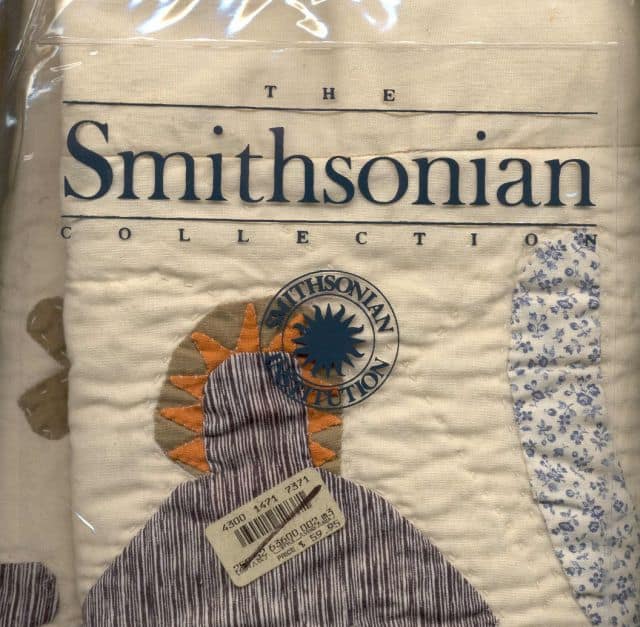
Isn’t this one of the reproductions from the Smithsonian collection that were made in China? Are these reproductions documented anywhere for reference?
ebay item 7374535908 Seller states: “~Guaranteed 100% to be Old & Original~ … 1900 Antique Baltimore Album Appliqué Quilt … NOT a Reproduction! GUARANTEED 100% to be 75+ years old! … We have been in business for over 25 years researching, buying, and selling antiques.”
Barbara Burnham Ellicott City, MD
From: Judy Kelius
At 07:47 AM 12/14/05, you wrote: >Isn’t this one of the reproductions from the Smithsonian collection >that were made in China? Are these reproductions documented anywhere >for reference? ebay item 7374535908
I agree it looks new to me! I’ll bet my house that it is no more than years old.
Did you notice the statement “It is also hand quilted with at least 10 stitches to the inch (counting the under and over stitch)”? That’s really about five stitches to the inch the way most of us define it! – In my opinion, one of the marks of an import. From what I can see, the applique is also done with large stitches but it’s hard to tell since there are no real closeups.
Another indication of an import . . . the stems are not appliqued but machine zig-zagged. (That alone kills her statement that it is guaranteed to be at least 75 years old since that hadn’t even been invented yet!)
Someone got taken, and the seller hid the bidder’s ID so you can’t even see who it was. Ugh . . . makes those who sell the real thing have to work that much harder.
From: “Lorraine Olsson”
Well, Look at this one ………….. Ebay Item number: 7376144072
“Offered for bid is one King Size quilt made in 1992 in China. This quilt was purchased in 1993 brand new for $300. It is not an American-made quilt. It is not an antique. It is just like a quilt which just sold on eBay on December 18th for $2605.00!”
Cheers, Lorraine in Oz
From: Barbara Burnham
Thanks Lorraine, that made my day! I wish I could post positive feedback for that seller’s wonderfully blatant honesty. I will keep a printed copy of that ebay auction. (I didn’t actually receive my question posted on QHL, so I thought it never went through.) But I am also wondering if there is any handy reference as to which of these quilts were licensed to SI (? or others) by the Smithsonian, and when, for mass reproduction in China. Mimi Dietrich’s book “Quilts from the Smithsonian” was published 1995 (after those reproductions appeared on the market) from other quilts in the collection. Barbara Burnham Ellicott City, MD
Lorraine Olsson <svenpnc.com.au> wrote:
Well, Look at this one ………….. Ebay Item number: 7376144072
“Offered for bid is one King Size quilt made in 1992 in China. This quilt was purchased in 1993 brand new for $300. It is not an American-made quilt. It is not an antique. It is just like a quilt which just sold on eBay on December 18th for $2605.00!”
Cheers, Lorraine in Oz
From: “Charlotte Bull” <charlou@>
A few years ago I noted a Letter to the Editor of a local newspaper. The out of state writer was asking for anyone with personal info on a list of names to write her. Although the names were not from a Friendship Quilt, but a Signature Album Notebook, which was very popular in the old days, the request might help in quilt research too.
Later the writer sent another letter thanking those who’d written and sent a photo copy of the item to them, due to the interest it had precipitated. I treasure a similar album that was my mother’s – dated 1903. Many of my relatives signed it. But I admit I wish it was a Friendship QUILT!
A friend with a quilt that was done for a minister went to the church and went through the membership list from the 19s. One of my quilts was done by a 4H Club so I started with state records of what county had a specific County Agent and the dates he was there. That helped me learn that the quilt may have ended up in MO, but it came from AR.
So we sometimes can start at specific sources, but the census records are really useful, as well as the birth, death & marriage records. I recall a lady in CA who really enjoyed a trip to VT just because she’d found a VT friendship quilt. The specific town mentioned on the quilt made a very big fuss over her and honored her with a big day at the town library with a display of the quilt.
Right now some folks in my town are researching old one room school house histories! The time seems right for similar projects. Maybe we should all make 06 a Friendship Quilt Year!!! cb in mo oz
From: “Candace Perry”
www.Familysearch.org. I find it invaluable when seeking people…it’s hit or miss, not like the census, but good for quick clues and searches. Candace Perry
From: Barb in southeastern PA
The completed auction — 7374535908
The comparison auction — 7376144072
I posted the 2 auctions on the Baltimore Album Quilt List and someone wrote back that the second auction was done by a friend of her’s because she could think of no other way to point out the inaccuracy of the first listing. Her friend says she bought her quilt at Dillards in 1994.
Barb in southeastern PA
From: Kim
Thanks Candace! That’s a source I didn’t know about and I just found some ancestors I didn’t know I had! The interesting thing is they found my father through his death record but not his birth – but it listed his twin sister’s birth record.
At 09:14 AM 12/19/05, you wrote: >www.Familysearch.org. I find it invaluable when seeking people…it’s hit >or miss, not like the census, but good for quick clues and searches. Candace >Perry
Judy wrote: “Another indication of an import . . . the stems are not appliqued but machine zig-zagged. (That alone kills her statement that it is guaranteed to be at least 75 years old since that hadn’t even been invented yet!)”
Afraid this is not true–companies made zig zag attachments for straight stitch machines. The needle didn’t move side to side, but the attachment moved the fabric side to side between stitches. I’m not sure how early this was available, but definitely more than 75 years ago.
If you ever used one of those buttonhole attachments for a straight stitch machine, you can see how it was done. (Am I dating myself?)
It’s amazing how many and how wonderful attachments were made for early sewing machines.
Kim
From: Julia Dehm Zgliniec
Dear QHL, In my spare time (haha) I am also involved in genealogy. It is another of those passions that involve the searching out of small tidbits of information and fitting them into a puzzle to make a picture. The most complete source for all things regarding genealogy is Cyndi’s List. It has so many links it. Start there. Another resource is the Family Search site by the LDS. This site is good if you have any dates associated with the names on your quilts. This helps weed out the duplicates when you do a search.
http://www.cyndislist.com/index.htm#US
Good Luck, Julia Dehm Zgliniec, Poway, CA
From: Bill
There’s a sucker born every minute.
IMHO, the issue isn’t so much whether or not the item is a reproduction. Obviously, it is.
The seller used a “private auction” function to protect himself from others pointing out to bidders that the item was a reproduction. I feel that action was an abuse of the private auction function, and I have reported it to eBay.
Bill
From: TEXTIQUE@
The seller used a “private auction” function to protect himself from others pointing out to bidders that the item was a reproduction. I feel that action was an abuse of the private auction function, and I have reported it to eBay.
Bill
I had the same experience with the “private auction” on eBay. A pre-1850 ‘Ohio’ sampler turned up one day under the protection of this function. The seller had found a sampler in OH and contacted two of us who had researched the book ( and continue to document) along with the author. Ten minutes of research told us each, separately, that it was made in England but eventually ‘moved’ to OH due to emigration of descendants. This info was forwarded to the seller and shortly thereafter it turned up on eBay in a ‘private auction’ deceptively worded as “Sampler from Warren County, OH”. It sold for more money as an OH sampler and I just cringed. My advice to buyers is always know your product and research its background. A friend once told me that the best way to learn is spending your own money on a fake.
Jan Thomas
From: “Lucinda Cawley” <lrcawley@>
“Cheap Color” is the title of the epilogue to “A Perfect Red” by Amy Butler Greenfield. The book is about cochineal. The epilogue discusses the fall from grace of red as a color of power and high status in the last half of the 19th century as the price of new, artificial dyes brought bright colors within reach of those at the bottom of the economic ladder. “The invention of factory dyes made color cheap, in every sense of the word. To many people in the upper classes, color became hopelessly vulgar. Its very ubiquity made it declasse….By 1900…people who wanted to appear respectable avoided bright color.” In the th century blue and black have become the status colors, symbols of power and wealth (black particularly). Cinda on the Eastern Shore
From: “Sharon in NC”
I asked experts in the field of sewing machines about the zigzag dating.. Here is what Graham Forsdyke ( head of ISMACS and one of the foremost leaders in sewing machine info) had to say about it.
I’ve got Singer as producing their first z-z in 1889 — a little behind the Kayser and Naumann factories
Graham F
I thought someone might want it for their info books on dating.
Sharon in NC
From: Meandle217@
Hi, everyone – I have not posted in the past, but have read with interest the various topics that this list has covered. However. I cannot keep quiet about the above-named subject.
I must confess that I (before I became hooked on quilt history) bought one of the Smithsonian reproduction quilts, Eliza Baile’s Bride’s Quilt) from the Spiegel Catalog around 1991 or early ’92. I just pulled it out of the closet (where it is hidden in case any of my quilting friends should drop by) and found that the fabrics and quilting patterns appear exactly the same as the eBay quilt which sold for $2605. I believe at the time of my purchase the catalog offered also the Bible Quilt and an American Eagle quilt and I think I paid either $299 or $399. Actually, it was not a bad investment…It is all cotton, quilted with 5-6 stitches per inch one side. The one thing that to me screams reproduction is the fact that the flower stems and vines are machine satin stitched. I have used it off and on throughout the years, washed it often, and it still looks darned good. My heart aches for the winning eBay bidder and how convenient for the seller to keep the bidders private!
Just my five cents…
Marilyn Eastman
From: Laura Fisher <laurafisherquilts@>
Bill wrote…”use of velcro helped authentic the quilts as being from the Esprit Collection……” It’s good that Julie the person was able to authentic the quilts, ’cause I would have urged caution if the seller’s provenance linking an item to Esprit was only the presence of the velcro!
Dealers handle so many quilts that were once hung, mounted using velcro, and hardly a one from Esprit. In fact, I think most dealers prefer to arrange mounting using velcro rather than sleeves. Velcro enables easy adjustments in how a quilt hangs overall; slightly raising or lowering areas at the top end can minimize any waving effect or cattywampus appearance that might result because quilts are rarely absolutely straight-edged.
With a sleeve, if the top edge is irregular, the sleeve has to be sewn on below the top end in such a way that the quilt will hang straight down; it cannot be sewn on at, say, the edge of the binding all across the end from which it will be hung. And with a sleeve, whatever is inserted makes a little bump out ridge at the top that is apparent, especially so if you use a dowel, while with velcro the whole quilt hangs down flat.
Some dealers have velcro applied in strips with a narrow separation so that when the quilt gets folded for storage, there is flexibility (a solid length of velcro is more rigid) Always apply the “eye” soft fuzzy side to the quilt, and anchor the hook side to the lath strip or the wooden stretcher. I’ve bought many quilts that have velcro (not the adhesive kind) on the back, which I have left on to reduce costs of preparing it for mounting in future!
I’ve encountered quilts that had rings and loops attached at intervals, sewn on decades ago and leaving a sagging impression; that’s always a no-no now! I”ve seen quilts with unremovable rust stains from tacks or nails, never the way to hang textiles.
The best-and most costly of course-is hanging with the weight supported from all four sides using a stretcher mount.Some framers use velcro on all four sides, others prefer sewing a width of cloth to all four sides, then stapling that around the stretcher.
Laura Fisher
From: louise-b <vlbequetmcmsys.com>
I am working my way through the new “Minnesota Quilts” and seeing many wonderful quilts. One is “Autumn Leaves” on p. 169 that was made from a Lee Wards kit in 1948. Wonderful quilt.
I have somewhere (I hope) a 1969 Herrschners catalog from one of my auction buys 4-5 years ago. It was interesting to go through it and see the quilt kits.
Louise Bequette — in mid-Missouri
From: “Barbara Vlack”
It’s sad that a seller on eBay is taking advantage of the privacy for the bidder in order to evade those who might cry out, “FAKE!” As a frequent shopper on eBay, that privacy block would be my first warning to be wary. Good grief, there were 32 bids on that fake, so there was more than one uninformed bidder.
I think putting up an identical quilt immediately on eBay might be the best warning. If I had been that deceived buyer, I would certainly have my dander up, and perhaps the second quilt could halt the deal if the buyer is paying any attention to follow-up auctions.
I also think reporting this to eBay is essential. I hope they can do something about it.
I was interested to see if the Baltimore quilt had a binding. It appears in the second auction pictures that there is a red binding. I learned from a friend that often a clue that gives away a quilt from China is that there is no binding, but rather the knife edge is used to finish the edge of the quilt (pillow case style). She had a red and white quilt that really looked like an antique to me until she pointed out the finishing technique.
I bought three of these Smithsonian repros, knowing there was some controversy, but they were going for a GREAT price at Sam’s Club, of all places, in the mid 90s. I have the Bible quilt and two of the Great Seal quilts (one for each of my sons, who earned the Boy Scout Eagle). I have them marked on the back with permanent pen that these are reproduction quilts from China and are not American heirloom quilts. The quilts came with documents for registering them with the Smithsonian, but I never did that.
These Smithsonian reproduction quilts are the best made quilts I’ve seen from China. They wash beautifully. My two Eagle quilts have been used and abused and washed and still look great. I’m not ashamed to show them as examples of the better side of the Chinese reproduction quilts, in spite of the controversy. They are marked so (hopefully) no one can deceptively offer them as anything other than what they are.
Barb Vlack cptvdeo@
From: stephanie drake
Hi Kris, enjoyed the pictures of the Capital Quilt Study Group…but I have a question…what is a “fylfots” as noted in the quilting design of one of the quilts pictured? I am not familiar w/ that term. Thanks, Stephanie in NH
From: “Beth Davis”
Hello, RE: > It’s sad that a seller on eBay is taking advantage of the privacy for the bidder in order to evade those who might cry out, “FAKE!” As a frequent shopper on eBay, that privacy block would be my first warning to be wary. Good grief, there were 32 bids on that fake, so there was more than one uninformed bidder. I also think reporting this to eBay is essential. I hope they can do something about it. Barb Vlack cptvdeo@
I’ve been watching and collecting data on the imported quilts for a few years now and find it quite amusing at times! Take for instance this very same quilt pattern was sold just recently in eBay as a Rare Baltimore Album under number 7367565579 for $299 with the following story “IN ONE OF THE BLOCKS IS WRITTEN “SWEET FLOWERS BRIGHT AS INDIAN SKY” THIS IS A VERY, VERY RARE AND HARD TO FIND PATTERN… MY MOTHER BOUGHT THIS FROM A LITTLE OLD INDIAN WOMAN THAT LIVED IN A LOG CABIN IN CHICKAMAUGA GEORGIA, RIGHT BESIDE THE CHICKAMAUGA BATTLEFIELD”
I am now trying to keep up with documenting the imported quilt tops, which are flooding in. These are very popular with the machine quilters, who can quilt these up for a relatively cheap quilt (average price around $50) and once quilted, there will not be an easy way to determine that these are indeed ‘imported’, presenting a quandary for appraisers. Granted these quilts if of a higher quality, give people the chance to enjoy quilts and without the worry of damaging their irreplaceable Grandma’s quilt.
I too have a couple imported quilts, to use in demonstrations and perhaps to throw on the bed when guests come, who may not quite understand why they can’t sit on the bed with the antique quilt laying on it.
Regards, Beth Davis
From: “BOBBIE A AUG”
Before I posted my response to the emails recently about velcro damage and this quilt collection, I double checked with Gerald Roy regarding the experience that he and Paul Pilgrim had. Here is his response:
The velcro used was NOT adhesive backed. They would have never allowed this. It was standard velcro.
The velcro was sewn to muslin and then the muslin was attached to the quilt. In addition to along the top, there were individual squares sewn in place at the two lower corners so that the quilts would hang flat against the wall. Perhaps the hook sides were adhered to the wall with adhesive – I don’t know – BUT never adhesive type on the quilts.
However, it is no longer the factor that the Velcro acids attack and deteriorate fabric because they changed the formula in the production of the materials. It is the constant pulling and pressure when pressing it together to attach it to the strip on the wall and the tearing motion used to take it down that is damaging.
Very seldom is there any careful, gentle removal. It is always a pulling or tearing motion that damages even the strongest fabric eventually. Not to mention what it does to antique fabric.
You rarely see anyone that is sensitive to what the possibilities are of this manner of hanging. The Pilgrim/Roy quilts were damaged not only by the acid in the material itself, the moisture that was trapped behind the velcro, but the violent tearing motion that does the most damage.
Mr. Roy feels that quilts should look like and hang like fabric or textiles – the gentle draping, etc. He says if you wish something to look flat like a board then exhibit paintings instead!
BA
Bobbie A. Aug Author, lecturer, teacher, AQS Certified Quilt Appraiser qwltpro@
From: “BOBBIE A AUG” <qwltpro@>
I forgot to mention that the antique quilts in question which were damaged by Velcro use, toured Japan for a year. BA
Bobbie A. Aug Author, lecturer, teacher, AQS Certified Quilt Appraiser
From: “Judy Anne”
I’m doing a little series of doll quilts and am trying do them as authentically as possible. I’m wondering how early in the 20th century did quilters began to fold their binding in half to make it so it will wear better?
Now that I’m into this project I plan to pay a lot more attention to how museum quilts are bound! I’m realizing how little notice I’ve given to bindings until now.
Judy Anne
From: “Pepper Cory”
To so many of you who made and sent quilts for the Quilts for the Coast effort, please read the report below. What an incredible effort and I am humbled to have played a small part. Quilts in time for Christmas-God bless you quiltmakers every one!
Pepper Cory
**************************** Report to the Quilters who Participated in Quilts for the Coast
You made something incredible happen this Advent season: you gave people both joy and hope. On December 9, three of us (Pepper Cory, my husband Rod & me) left Morehead City in the St. Peter’s UMC van loaded with 500+ quilts (another 230+ were shipped separately), food, toys, knit caps and other requested supplies.
Those of you who provided prayer support did well: The 16-hour drive was remarkably uneventful. We had one minor adventure when we dropped the oil cap into the engine compartment and spent about an hour trying to retrieve it. And when we had the van checked over after we got home, we learned we’d been driving with a nail in our tire for who knows how long…
On Sunday morning December 11 we saw Waveland, MS by the light of day. There are truly no words adequate to describe the devastation of my little home town. Three miles out an 18-wheel trailer was imbedded in the roof of a building. As we got closer, buildings were completely flattened as far as could be seen. I visited what was left of the house that was “home” to me for 42 years; what I saw was too personal and too painful to describe here.
We arrived at the slab that was once the Christ Episcopal Church building around 9 am. (I was confirmed at this church and my parents’ ashes were interred in their memorial gardens, which Hurricane Katrina washed completely away.) An awning tent had been erected to provide cover during the worship service. We and our gifts were greeted with great joy. Parishioners snuggled under quilts during the service to ward off the chill. After the service, people took quilts to share with their neighbors who had also lost everything. Their excitement at this task surprised me until I realized this was probably the first time since Katrina took everything that they had an opportunity to give something new and beautiful to someone else. When one small boy and his mom selected quilts to take to his first grade classmates the next day, I wept. One woman who had recently lost her cat cried as she clutched a cat quilt that came with a matching tote bag. A friend of mine, who lost her home to Katrina but has remained both in her community (in a tiny FEMA trailer) and at her job at the local hospital, took some quilts to give to patients.
People wept over these quilts, they laughed, they smiled. They especially enjoyed reading the labels you put on them. Knowing what we brought weren’t just castoffs or leftovers, but were items made “just for them” meant so much. As one lady said, “A blanket keeps you warm and that’s nice, but a quilt–well, a quilt is special.” Another woman proudly announced, “When I rebuild my house, I will keep this to hang on my wall as my first piece of art.”
We have many, many pictures we will be sharing with you as we get them on the website. Please be patient. The sight of so many people beaming as they held their quilts is one I will never forget. God bless all of you!
—Patti Brown, The Quilted Butterfly
From: CRantquilt@
Baltimore Album… just now taking a glimpse of the digest and so glad to know I wasn’t seeing things when I saw this quilt. Thought it looked like a repro, but had to take a few looks, and then to see the other one listed and I think it showed up just a few listings under under the so called “old one” in the applique search. One similarity of the 2 quilts was the double lines of quilting, that also gave it away. Too bad the bidders weren’t paying attention. I requested better close-ups of the quilt and they never replied. I hate to seeing someone buy a quilt like that when they can get a wonderful antique for much less. More education is the key for those buying antiques.. Cindy Rennels www.cindysantiquequilts.com
From: “Busy Thimble” <bsythmblctel.net>
I thought I recognized the green print used in the photos of the first “Baltimore” but when the second one was listed, I could see it better. It is a print from “colorworks” by VIP Cranston in the early 1990’s that I purchased when opening my shop. This past summer at an antique shop here in Maine I found a quilt whose label claimed “mid-century” but did not say which century!! This quilt used ALL the fabrics from that same “Colorworks” collection from 1990!! To Barb–I thought I recognized that Aunt Grace yellow too. Cyndi in Maine
From: Barb Garrett
A small, but very nice, exhibit of southeastern PA quilts is currently on view in Norristown, PA. It’s a very nice exhibit, with several very early quilts, and several with inked signatures. And of course, it’s fun to study the fabrics. End Jan 31, 2006.
Quilts of Montgomery County Historical Society of Montgomery County 1654 DeKalk St. Norristown, PA 610-272-0297 Now through Jan 31, 2006 Mon, Wed, Fri 10 to 4 Tuesday 1 to 9 Closed weekends Includes 12 quilts, 3 quilted petticoats, 4 bonnets and 2 cases filled with quilting utensils http://www.hsmcpa.org/
Barb in southeastern PA
From: Laura Robins-Morris
Did the Smithsonian reproductions, and other imports for that matter, use polyester or cotton batting? (Wish I had one of the labelled SI quilts just for historical purposes. A special collectable niche.)
From: Julie Silber <quiltcomplex@>
Hi, Sorry to ask again – could someone please e-mail me privately with instructions for posting photos for QHL to see? Thanks, Julie Silber quiltcomplex@
From: KathrynHerrmann@
Hello, I’m writing to inquire about a quilt name mentioned by my great-great grandmother, Margaret Laird McCalmont, in her diary. Margaret McCalmont lived in Walker (near Bellefonte), Centre County, PA and mentions making a blue and white Double Dozen quilt in 1861. I have been unable to find any information on this pattern name and wonder if it is a regional name for another common pattern. Have any of you run across this quilt name in your studies?
I wasn’t surprised to find she did her sewing and quilting after the noon meal, when the light was best.
Thank you.
Sincerely, Kathryn Sterling Herrmann Hendersonville, NC
Date: Wed, 21 Dec 2005 19:33:01 EST | From: TEXTIQUE@
Hi all;
I’ve been very burnt out since October but I do want to let you all know that if I have missed sending you a thank you for your Auction Donation, PLEASE e-mail me. No naughty words, ladies and gentlemen.
Jan _TEXTIQUE@_ Colorado Springs
From: Xenia Cord
There is no pattern called “Double Dozen” listed in Brackman’s Encyclopedia of Pieced Quilt Patterns. There is a good possibility that it is a regional name, and perhaps someone from PA will have heard of it.
Xenia
From: “Amy Korn” <amyokorn@>
In reference to the “Double Dozen” quilt pattern, I believe that Kaye England has a book called “Double Dozen” which features a sampler style quilt with both 6″ and 12″ blocks set together. The total number may have been 24 six inch blocks and twelve 12″ blocks or some variation of this.
Amy Korn
From: Blackeyesandysue@
Stephanie, A “fylfot” is a design seen mostly in Pennsylviania. It can be Appliqued or a quilted design. It looks like a floppy pinwheel, with four bent paddles. Often Very early. I am sure others have more information. If I can find the time to see if I can direct you to a photograph I well let you know what book to look in for an example. Polly Mello
From: Mendofleur@
I loved reading this posting and the joy that people had in receiving these quilts made especially for them. Yesterday, my husband and I had lunch with one of the executives of Nike (headquartered in Beaverton, OR) and what he told us about their efforts to offer assistance was inspiring, but concerning. They had shipped quantities of new and quality sandals for the relief effort only to find the shipments had been detained by red tape, etc. He said many companies used this opportunity to send surplus, inferior goods simply to use the effort as a way to get rid of bad stock and then write it off. Their contribution served the manufacturer not the cause. On top of that was the added burden of disposing of junk that stockpiled and only added to the masses of garbage everywhere. Sad, very disheartening, but I suppose not all that uncommon. These quilts must have been like shining jewels in a world that seemed hopeless, harsh, and often unconcerned. Thanks for all your efforts.
Phyllis de Vries
From: “JJ Anderson”
I would like to help. If you could post a detailed description of the pattern maybe I can find it in my patterns that I am building up. I will do my best to help you out. JJ