January 14 – 19, 2006
This page contains affiliate links. If you buy through them, I may earn a small commission at no extra cost to you. As an Amazon Associate I earn from qualifying purchases. Learn more
These restored messages come from the Quilt History List, an online forum where quilt historians, collectors, researchers, appraisers, and enthusiasts discussed antique quilts and related textiles. The archive dates from 1996 through approximately 2016 and is being restored gradually. Sign up in the form at the bottom of the page if you want to know when a new page is added. Original spelling, opinions, formatting, and inactive links may remain unchanged.
Primary topics of this QHL Digest:
- The “Underground Railroad Quilt Code” Debated — Members weigh in on the lack of primary-source evidence for the popular legend that quilts signaled safe houses on the Underground Railroad. (see the article on Underground Railroad quilts)
- Quilts, Culture, and How We Label Them — A discussion begins on how quilts and quiltmakers get categorized by race and ethnicity, and what those labels mean.
- Identifying an Unusual Pieced Block — A member asks for help placing a red-and-white pinwheel-style block she can’t find in any pattern reference.
From: “Kathy Moore”
Thank you, Newbie, for illustrating a very important point about the “improvisational utility” quilts we see being credited to African American quilters. I’ve seen any number of these kinds of quilts which could easily have been made by anybody, but are clearly done by and for people who needed bed covers. Aesthetics were not a primary consideration. I’ve also seen some beautifully planned and executed works of quilting art known to have been done by African American quilters.
Judging and assigning credit to specific groups of people based on observable characteristics of the artifact seems grossly unfair to everyone.
Let’s all agree to not jump to conclusions about the source on a quilt unless we can be sure of it’s provenance.
That’s my two-cent’s worth.
Kathy Moore Lincoln, NE
From: “Bill Volckening”
Kathy,
I agree.
Just to toss in a little visual for this discussion, I posted a picture in the quilt gallery of a utility quilt I bought last year. It is attributed to an African American maker, a woman named Ann Rhodes of Empire, Mississippi who made the quilt between 1935 and 1945. The labels from the men’s suiting fabric were never soaked off, and labels appear in places on the front of the quilt. The labels indicate the fabric came from the Mayfield Woolen Mills of Mayfield, KY.
The price was right, and I liked it enough to buy it regardless of whether or not it was in fact “African American.” Nevertheless, I’m planning to do some more research on Ann Rhodes’ genealogy.
Bill Volckening
From: Kim Wulfert
Somewhere along the way I came upon a self-published booklet entitled “Anecdotes of Bessie Lewises [sic] Quilts )Mrs. Fulton Lewis, I) Script by Susan Lewis Cockrell Photography by James Knox Cockrell III”
Does this mean anything to anyone? I would like to contact these people. Personal stories about how or where Besse found these quilts she prized makes up this 14 page booklet. She had a good eye
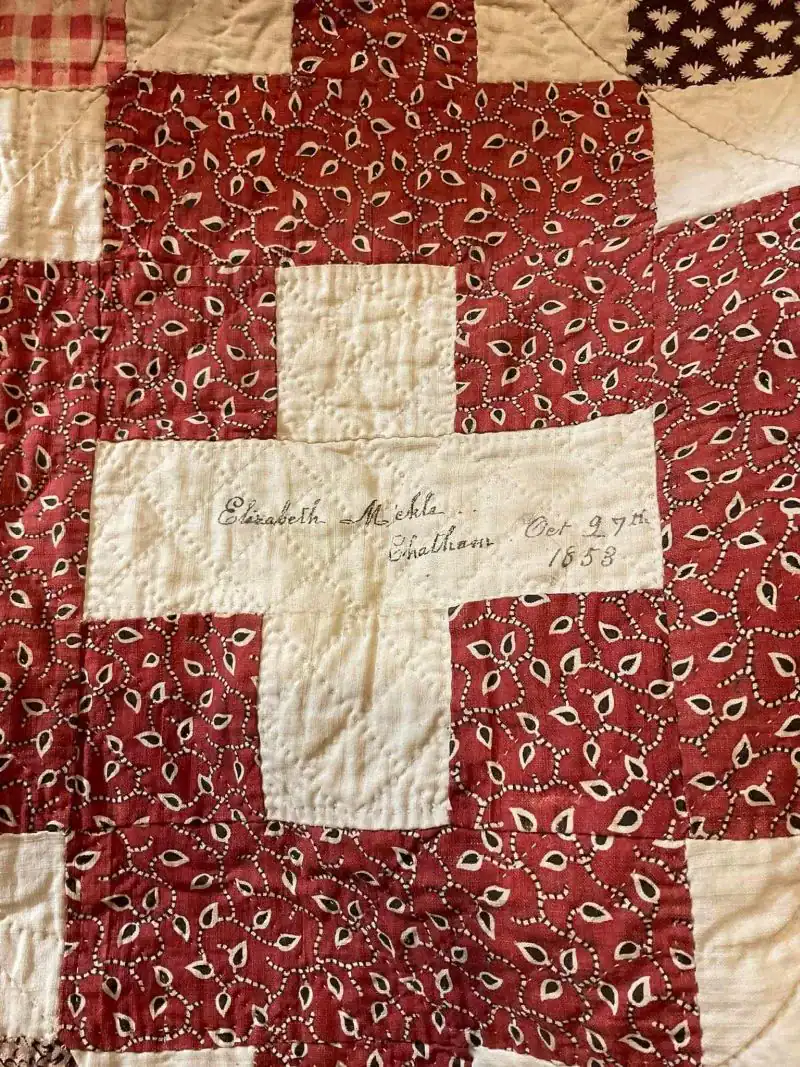
One of the patterns caught my eye, as I had seen this mysterious appliqu block quilt at the Santa Barbara Historical Museum exhibit in the fall. It looked like a Japanese ideograph, but isn’t. The museum had no name for it. Then an old QNM, No. 40, 1973 came my way and there was this appliqu block on the cover! located in the Denver Art Museum and called Kansas Pattern, it was made by Charlotte Jane Whitehill in 1937. Next I came upon the Lewis book and she shows a mid- 19th century version, that she bought. It has signatures in ink, some stamped, in the white area in the center of the appliqu blocks. One date she lists is June 8, 1847 with the name Catherine M. Ogle. The latest date is 1852. As she looks at all the names, she realizes this quilt was from her husband’s family!! Also her mother-in-laws name, Mary C. Fulton, was written in Spencerian script in the corner. Her husband was shocked to hear she paid as much as $25.00 for this quilt ,in 1932, until he found out it was made by his mother and other family members.
Since this pattern is following me and intrigued me from the start, I would like to find out more about it. There is a pretty good rendition of it in Brackman’s Appliqu Ency., #45.42 on page 127. Here, it is attributed to the Omaha World Herald in 1912, and called Conventional Scroll, and Nancy Cabot in the Chicago Trib. as Kansas pattern, and to Whitehill at the DAM. It’s the block pictured next to this one, meager shape in comparison, but a similar from indeed, that is unnamed, but taken from an album dated 1847. (#45.44)
Any thoughts, or other places, books, I can see this quilt block pictured, would be appreciated. The Lewis family lived in Maryland and Ohio.
Kim Wulfert www.antiquequiltdating.com
Date: Sat, 14 Jan 2006 12:59:43 -0800 | From: Julie Silber <quiltcomplex@>
Hi, I am trying to reach Teddy Pruett to answer her question to me. E-mails to her are coming back as undeliverable — and when I call the number I have for her, it will not accept my number – because I have blocked caller i.d.
Can someone help me contact her? E-mail privately at: quiltcomplex@
Many thanks, Julie Silber
–Boundary_(ID_azfgB4mwO1StxoRAi+12yw)–
Date: Sat, 14 Jan 2006 13:05:15 -0800 (PST) | From: Judy Schwender <sister3603@>
Hello all- For a wonderful article about why we should use caution in making assumptions relative to antique quilts and their makers, see Laurel Horton’s excellent article, “Quilts and Cultural Values: Gender, Race and Social Class” in Issue 6 of Quilt Studies, the journal of the British Quilt Study Group. To become a member of this group or order the journal, go to: http://www.quiltersguild.org.uk/contents/specialistgroups/bqsg.htm
Judy Schwender
Yahoo! Photos Ring in the New Year with Photo Calendars. Add photos, events, holidays, whatever. –0-456465775-1137272715:95837–
Date: Sat, 14 Jan 2006 15:27:04 -0600 | From: “Karan Flanscha” <SadieRose@>
Kim, A variation of this block is in “Baltimore Album Quilts: Historic Notes and Antique Patterns” by Elly Sienkiewicz. This is what I think of as book 2 in the series, and has a dark red cover with a wreath block with a bird in the middle on the cover. Pg. 42-43 for the pattern, which has an extra applique spray of leaves in each corner. Color plate 16 on what would be page 97 (color pages in the center of the book are not numbered, though). I found a black and white photo of an antique BA quilt in “Forget Me Not: A Gallery of Friendship and Album Quilts” by Jane Bentley Kolter, pg. 29. This is inscribed 1846-1847 with makers names listed in the book. This also has extra leaves, but set on the block differently. Happy Hunting!! Karan from sunny Iowa
Date: Sat, 14 Jan 2006 10:39:06 -0800 (PST) | From: “Pat Cummings” <pat@>
Kathy’s remarks (about not jumping to conclusions re: the ethnicity of a quiltmaker) bring to mind a certain quilt shop that is now out of business. The owner had bought a lot of contemporary fabrics, and offered a class in “How to Make an African (American) Quilt.”
I’m not sure that the specifications would be recognizable to anyone who is a member of that ethnic group. The memory is sketchy, but at the time, something struck me as not quite right, conceptually-speaking.
Pat Cummings, who has actually found the time to do some hand quilting today!
Date: Sat, 14 Jan 2006 19:57:01 -0600 | From: Gail Ingram <gingram@>
Kathy Moore wrote:
Thank you, Newbie, for illustrating a very important point about the “improvisational utility” quilts we see being credited to African American quilters. I’ve seen any number of these kinds of quilts which could easily have been made by anybody, but are clearly done by and for people who needed bed covers. Aesthetics were not a primary consideration.
I like the way Kathy says, “Aesthetics are not a primary consideration” in many of the quilts she so nicely labels “improvisational utility” quilts.
She does not rule out aesthetics as a consideration. I might have added “conscious” to “primary,” or somehow limited “aesthetic,” for unless they are working from a kit or have only one fabric available to them, quiltmakers are guided by an aesthetic of some sort when they assemble the pieces of fabric into a quilt top. At the most fundamental level, it grows out of their experience, what they have seen from earliest childhood onward.
In my view, an accurate description or general definition of that aesthetic is what quilt historians need to ascertain. The Southern utility quilts are a good place to start. Are there common visual choices made by Anglo- quilters in rural South Alabama in the 30’s-50’s, for instance? And what about the African-American quilts made in the same era and region? If there appears to be a large degree of commonality in each group, are there traits peculiar to each?
Granted, the extent of the quiltmakers’ experiences with quilts outside their regional and ethnic groups will turn up many quilts that look nothing like others being made by either group. The question is whether these quilts are exceptions to established aesthetic choices.
It would also be interesting to know if the aesthetic choices of either group differs in sections where sizable German populations existed.
Even if we say the quiltmaker’s choices are limited by the fabrics she chose from her scrapbag, we must acknowledge those fabrics themselves involved choice. The scraps are the remnants of clothing the quiltmaker sewed for her family and herself.
I’ve lived almost all my life in the general area where I was born, closely acquainted with quilts from both the groups mentioned by Kathy and Newbie, and privately I tell myself I can generally tell the difference in an African-American utility quilt and an Anglo-American utility quilt made before the mid-1960’s. Seldom would I put money on my choices, though, for I’ve not tested my “rubric” in any analytic way over a large body of quilts. But so far, they’ve proved pretty reliable for my purposes.
I remain unconvinced that the “improvisational utility” (I love that term, Kathy!) quilts of the South are entirely–or perhaps even mainly–the result of economic class and the choices it enforces. Willing to be convinced, but still unconvinced.
The most intriguing thing I’ve encountered on the matter of the effect of an aesthic in Anglo-American utility quilts is Fawn Valentine’s observations regarding the Scots-Irish aesthetic in West Virginia quilts. I know many on this list dismiss those observations. I simply cannot dismiss them. My eyes won’t let me. I can’t say the color organization derives from a color plan or from the manner in which the tops are constructed, but what Fawn describes, I had seen and still see. Discovering that tendency or aesthetic was one of the more enlightening experiences in my own study of Southern quilts. It helped me understand something I was seeing.
In his book “Albion’s Seeds: Four British Folkways in America,” the cultural historican David Hackett Fischer points out the tenacity of culture, of which an aesthetic is a part. He notes, for instance, the link between the colors used as school colors and in clothing at the eastern Ivies and the colors of Puritan New England and, earlier, the section of England from which this group came. Even with the diversity present at those schools today, it is hard to refute what he describes.
Assuming some proximity to the original group, it seems reasonable to me to think the cultures of African tribes accounted for many aspects of the African-American culture in the South in the period we’re discussing, just as it seem reasonable to think the culture of the Scots-Irish affect aspects of Scots-Irish descendents.
Bottom line: I think this whole subject deserves more careful attention. It really is intriguing.
An inquiring mind that would like to know,
Gail Ingram
Date: Sat, 14 Jan 2006 22:11:21 EST | From: Blackeyesandysue@
African American Quilts, The only requirement you need to make an African American Quilt is that it has to have been made by an African American. I believe they made all of the varieties of quilts that have been popular through the decades every color scheme and with wide ranges of skill levels as in any other ethnic group. Regional color preferences such as Pennsylvania quilts may have a large influence in an area; but even in different regions you can find wide varieties of quilts and color schemes according to what was popular in quilting at a given time. Economics may play a large part in what materials are available to a quilter. But, I have seen masterpieces made women that were impoverished but highly skilled needlewomen. Everyone has there own color pallet. In my quilting group I can often point out a quilt that has the usual colors preferences of each of my friends but even individuals experiment with very wide ranges of color schemes from subtle to electric. Fads come and go. So, in my view unless you know that a quilt was made by an African American you cannot say with any certainty that it was by quality of workmanship or color scheme. Another two cents worth, Polly Mello
Date: Sun, 15 Jan 2006 5:28:19 -0800 | From: <suereich@>
When we conduct and write quilt history, and if we are lucky enough to know a quilt’s provenance, a quiltmaker’s ancestry is frequently noted. Rarely if ever, have I read in a state documentation book the label, English-Amer ican, Dutch-American, or Jewish-American quiltmaker. We generally leave et hnicity at the provenance level and move on. I am second generation German-American. My grandparents did not come to the United States until the early twentieth-century. Why do I not have th e distinction amongst my fellow quiltmakers as a German-American quilter? I certainly have a German name, plus, my maiden name is even more German. My father grew up in a German-English speaking household with German food a nd furniture from the Mutterland/Vaterland. Relatives from Bavaria always came to visit us bringing gifts of German origin and dirndl dresses to wea r. As an adult, I have been to Germany on six occasions soaking up the amb ience of my ancestral roots, staying in the homes of my German relatives, v isiting shops, museums, cathedrals, and hofbraus. The moment I land on Ger man soil, I feel an immediate comfort level and connection in the German so ciety. I have tried very hard to incorporate German customs of food and Ch ristmas into the lives of my children as they grew up. My ancestral root s are far less-dissolved than those of most African-American quilters we kn ow and yet, not a single person has ever referred to me as a German-America n quiltmaker. Labeling in our society has become so tiresome and encumbering. Gail, h ow many of your school children are ADD, ADHD or some variation of a learni ng disability. We are all even labeled by a sexual preferences. Why can’t we all just be us and who we are! Regardless of our roots, we have all s ponged up so many of the influences of our society. Why do some of us stil l continue to carry labels of our ethnicity, and what exactly does this do for us and to us. Honest, if I was an African-American quiltmaker, I would probably say be done with the label. Does anyone know where and how it or iginated? Maybe it stuck because of the greater economic benefit? If so , that’s a good enough. Or is this label used for purely esthetic reasons? My grandparents and their children worked very hard to assimilate as qui ckly as possible into the stained-glass culture of America. Today, I somet imes believe that through labeling our society will no longer allow this to happen. Is that good or bad, maybe that is an answer only history can wri te. It is a blustery winter Sunday morning in Connecticut. With the wind ho wling, the snow is banked against the frosted windows, in other words, a pe rfect January day! sue reich
Date: Sun, 15 Jan 2006 10:57:23 -0500 | From: “Newbie Richardson” <pastcrafts@>
Dear list, As we go along this thread of discernable design aesthetics of individual “sub-groups” we need to factor in patterns of aculturation. The watchword of 19th and early 20th c America was “assimilation”. The Irish, Italians, and Scandinavians fleeing economic privation, the Germans and later, Eastern European Jews, and even in our own time, the Vietnamese escaping intolerable political situations – all wanted to become “American”. Certainly there were ethnic enclaves, but by and large, the children were taught to speak English, and many households discouraged the use of native languages. “We are Americans, now”. The same is true for African Americans. We have forgotten that like other folk, they too wanted to assimilate, to be a part of the mainstream. Fortunes were made in cosmetics that lightened skin or straightened hair. The broad dissemination of philosphy of separatism really only dates to W.E.B. duBois – at the turn of the century. And his philosophy was really only enactd in the urban areas such as Harlem and around Howard University in DC – until after WWII. Throughout the decorative arts, mainstream quilters – no matter what their ethnicity – made silk show quilts, and comforts with feed sacks – just like everybody else. Mid 19th through 20th century photographs of everyday African Americans show conventional fashion in both clothing and interior design. Certainly we see discernable design asthetics where there is isolation – either by choice ( Amish) or by geography – (Gee’s Bend) and some groups took longer to let go of their cultural heritage than others – the Scandinavians in the upper mid-west, and others. But, over all, I maintain that the underlining influence on the design aesthetic of the decorative arts until WWII was a desire to be mainstream. What our European counterparts call “American” style. The other influences such as economics, regionalism, the popular media, etc are secondary. Newbie
Date: Sun, 15 Jan 2006 11:50:35 -0500 | From: “Teddy Pruett” <aprayzer@>
<<<One of the quilts she paused over is a very heavy utilitaran quilt (an Ebay purchase with no provenance other than “Southern”) in strippy ninepatch ,set with red, and a yellow sashing. Her comment was that Teddy Pruett would probably call this a typical AA quilt.>>>
WHOOPS!!!!!!! I am thrilled that people are talking about me behind my back – however, I must make it PERFECTLY CLEAR THAT TEDDY PRUETT HAS NEVER, EVER, EVER, SAID ANYTHING was “a typical AA quilt.” Please forward this information to everyone on the planet, lest it be that my “impeccable” reputation as a scholar be smeared. I am certain that I screw things up on my own quite enough, so I would like to stop this unfortunate mishap before it goes further. I adore Diane, and I’m sure it was just something said in an off-hand way, never dreaming it would get broadcasted. No offense was meant, and none is taken.
Mary Sorensen once said that she would never put anything in an e-mail that she wouldn’t want posted on a billboard on I-4 in downtown Orlando. She has a pretty good idea, I’d say.
Teddy Pruett, innocent of accusations.
_________________________________________________________________ Don’t just search. Find. Check out the new MSN Search! http://search.msn.click-url.com/go/onm00200636ave/direct/01/
Date: Sun, 15 Jan 2006 14:00:35 -0500 | From: “Sondra Biacchi” <quilt@>
Any thoughts, or other places, books, I can see this quilt block pictured, would be appreciated. The Lewis family lived in Maryland and Ohio.
Kim Wulfert www.antiquequiltdating.com
Kim, although I don’t think your block is in this book it has some interesting info on the maker. A book published by the Denver Art Museum, 1974, states that the majority of applique quilts in their collection came as a gift from Mrs. Charlotte Jane Whitehill’s which she donated to the museum. in 1955. This book contains 11 of these quilts A small description of a quilt she made in 1930 named INDIANA WREATH (numbered 59 and 60 in catalog) states that the quilt was made in the second year of the donor’s quilt making career. Many of the quilts Mrs. Whitehill made were reproduced from antique quilts by her with permission from the families. She crafted these quilts using extensive drafting and remarkable ingenuity. These quilts are accompanied with documentation crediting the original pattern to the family and the date of the original quilt. These quilts have a delicate quality and very complex quilting designs. My favorite is number 65 and 66 CHERRY TREE which is a four block quilt and dates from 100 years before this version in the book was created in 1936. Each branch of the four trees has approximately 50 different pieces, which gives some indication of the intricacy involved in making this quilt. Each of the cherries was padded before being applied. You may be able to find this book if interested on ebay titled THE DENVER ART MUSEUM QUILTS AND COVERLETS. Imelda G. DeGraw was Curator of Textile and Costumes at the time of the printing.
Sondra Biacchi quilt@
From: Julie Silber <quiltcomplex@>
Hi, Julie Silber here. I have posted two quilts on the Board. One is just a block which I can not identify, and the other is a repeating Pitcher & Bowl design, blue and white, circa 1920. I’m hoping someone can identify the block – and that you will e-mail me if you have seen the Pitcher pattern before. I haven’t!
You can also get to the Pitcher quilt at this link ~ I HOPE . . .
http://jdemeter.mystarband.net/pitcher-bowl.jpg
Thanks! Julie Silber
–Boundary_(ID_prpehsjhZcFe3kQaFV2G6Q)–
From: kathie holland
Another source to buy this book is on Amazon….I just checked and it was there for 9.95… it is a wonderful book, I bought mine thru Amazon when last year someone mentioned the book and I wanted to add it to my library of quilt books 🙂 NO affiliation with Amazon, just happy to be able to buy books out of print thru them.
Kathie in NJ
. You may be able to find this book if > interested on ebay titled > THE DENVER ART MUSEUM QUILTS AND COVERLETS. > Sondra Biacchi
From: Kathie (NJ)
Kathie and Sondra-
I agree with you about the book being wonderful. I have it, but I think it’s fair to mention that it is almost completely black and white photography. Such a pity. The text is interesting about the provenance of the pieces though, which helps make up for the lack of color.
FYI-The quilt block I was searching for is not in the book.
Kim Wulfert www.antiquequiltdating.com
Another source to buy this book is on Amazon….I just checked and it was there for 9.95… it is a wonderful book, I bought mine thru Amazon when last year someone mentioned the book and I wanted to add it to my library of quilt books 🙂 NO affiliation with Amazon, just happy to be able to buy books out of print thru them.
Kathie in NJ
Date: Mon, 16 Jan 2006 07:37:35 -0600 | From: Gail Ingram <gingram@>
I refer everyone to Sue Reich’s earlier posting titled “Our society and labeling,” to which I would like to take some exceptions.
In that post, Sue writes, “Rarely if ever, have I read in a state documentation book the label, English-American, Dutch-American, or Jewish-American quiltmaker. We generally leave ethnicity at the provenance level and move on.”
A second-generation German-American, Sue has sought to preserve continuity with her Bavarian roots and to pass aspects of that culture to her children. She says, “My ancestral roots are far less-dissolved than those of most African-American quilters we know and yet, not a single person has ever referred to me as a German-American quiltmaker.”
“Labeling in our society has become so tiresome and encumbering…. Why can’t we all just be us and who we are! Regardless of our roots, we have all sponged up so many of the influences of our society. Why do some of us still continue to carry labels of our ethnicity, and what exactly does this do for us and to us.”
Sue and I are friends and part of a eyebrow-raising quartet of roomies at AQSG seminars (others include the quiet, punctual, and early-rising Barb Garrett and the not-so-quiet, not-so-punctual, and not-at-all early rising J. G. Row). Had others not made essentially the same point as Sue, I would have responded privately. The questions raised, however, are part of an ongoing list discussion. So I’m going to propose one answer to her last question.
First, I believe the reason we identify and study quiltmakers’ cultural backgrounds is the same reason we classify in any study: we classify so we can better understand a coherent body of knowledge within a yet larger body. Classification permits us to examine closely the elements in a related group–their hallmarks, generative principle(s), relationship to other groups, and their meanings. Knowledge is the object of classification in historical study.
No one questions the validity of studying Amish quilts or Mennonite quilts within their cultural context. We look at the wonderful silk quilts made by Quakers and wonder, “Why not cotton? Why so many fabrics?” We more easily discern the salient qualities of individual quilts by looking at them with a number of related quilts. Ultimately, such a study can help us identify quilts with unknown provenance, it can add to our appreciation of quiltmakers’ choices and motives, and generally it can enrich our understanding of the facts and circumstances of American quiltmaking.
Second, I question whether Sue’s ancestral roots are “less dissolved” than those of most Southern African-American quiltmakers in the first half of the 20th century. The American South has historically been a conservative society, and the African-American subgroup has been perhaps the most conservative element of that general group. In the first part of the 20th century, this subgroup was distinct. Many–perhaps most–of its practices were transmitted orally and through observation. Repetition, in quilting as in other things, was valued. The churches, always important in uniting Americans with African origins, remained powerful cohesive forces within what then could legitimately be termed an “African-American community.” Segregation, both de jure and de facto, and lack of political power further united this community and separated it from the wider culture in which it existed.
Thus, in the American South the cultural traditions and preferences brought to America by African slaves probably remained much stronger than those of many more recent immigrants who chose to come to the United States in order to better themselves. This was a people forged by fire. And the bonds were strong and tenacious. In 1974, the African-American woman who worked as my housekeeper-baby sitter refused to get in the car with me until I put a butcher knife under the driver’s seat. I was in the last trimester of pregnancy and she said the knife would “cut the pain” should I go into unforeseen labor—long enough for her to get the heck out of Dodge, anyway. This woman read every novel by William Faulkner on my shelves, all the while chastening me for having “a dirty mind.” She was highly intelligent. Yet she told me she had learned this knife trick from her great-grandmother who herself had solid evidence of its efficacy from her grandmother—and she was not about to get in a car with me unless that knife was in place. And that was 1974.
Ten years earlier Wm. Faulkner had written his final book and titled it “The Reivers,” an archaic British term for the Borderers who for generations stole cattle along the borders of Yorkshire and Scotland. These folk became the Scots-Irish. The book Faulkner wrote reveals a close familiarity with the culture of the Scots-Irish in the South. So familiar was the author with the passed-down stories and terminology of these people that the title seemed natural to him. Another evidence of the influence and tenacity of culture in an isolated group.
That a long distinct and tightly bonded cultural group like the African-Americans in the South would have preserved elements of an African aesthetic seems reasonable to me. Growing up in the South, I saw evidence of it and took it for granted, thought nothing of it. From the hats women wore to church to the colors of their dresses and the preparation of their foods, most African-American women in the South shared preferences that distinguished them from Anglo-American women, poor or otherwise. They seemed in some ways “foreign.”
Because the group was generally perceived as lesser, its tastes were also perceived as having questionable merit by the larger group.
Thus, it was predictable that someone outside the South and outside the quilting world would have been the first to note the artistic distinctiveness–and yes, peculiar beauty–of some of these quilts. Their eyes were not trained by contemporary quiltmaking preferences and were less jaundiced by considerations of class.
The first time I saw the Gee’s Bend quilts, they were not yet “The Gee’s Bend Quilts,” and I was young. Yet, even today I have in my head the dazzling “wildness” of four quilts that hung on a line waiting to go home with their makers. That moment was the visual equivalent of the first time I heard Yasha Heifez pull the strings of a bow across a Stradivarius violin. Extraordinary colors arranged in extraordinary ways. I had seen quilts made by African-Americans all my life, but I had never seen them grouped and I don’t think I had seen any quite so lively as the four I remember from that afternoon. Seeing them as a group made me aware of their commonality and awakened me to a pattern of preferences from which they had come, preferences that were not merely economic. It was like the pieces of a puzzle coming together.
Those utility quilts looked different from the utility quilts I’d seen made by very poor rural Anglo-Americans. The color choices, drawn from earlier choices of fabric purchased for clothing; the sense of design; and the quilting set them apart. They appeared not to have been consciously planned, though they also seemed enough alike to suggest some unconscious plan.
So I am heartened by classification by cultural or ethnic group as a method of expanding our knowledge about American quiltmaking. A friend is studying a group of early Jewish quilts and from them, she has come to understand something of their makers’ complex social status and motives toward assimilation. Another quilt student and I have talked past midnight on more than one occasion about the effects of the Scots-Irish culture on Southern quilts and Southern culture. Looking at rural Southern quilts in this context has helped me understand them in a far more complex way than I had known them previously.
Cultural history strikes me as a valid and promising way of studying quilt history. Such studies will necessarily cast light on cultural transmission and assimilation and thus explain many effects we otherwise might not have understood.
I sincerely hope I will not be misunderstood when I suggest something that has occurred to me as this discussion has recurred through the past several years. I’ve been struck by the passion evoked by discussions of African-American quilts, both onlist and off. The only other topic I recall which has generated such strong feelings was the quilts made in the wake of 9/11.
Could it be we sometimes unconsciously transfer our private feelings about classification for preferential political treatment (e.g., “entitlements”) to the classification of quilts by cultural or ethnic origins? Or perhaps our resentment of Political Correctness in general seeps into our discussions of groups often deferred to in PC?
OR are we judging a folk art by the standards of a more sophisticated art? Perhaps in appraisal and judging of contemporary quilts, standards exist that would leave all the Gee’s Bend collection shame-faced, for instance. But those standards would tell us little about the quilts or the reason they exist as they do.
Or do we resent that some quilts that are undistinctive or even ugly by nearly anybody’s standards are commanding unreasonable prices on eBay only because they are labeled “African-American”?
I believe it would be helpful to examine our assumptions, to ask why we object to treating another group of quilts they way we so easily treat Amish or Quaker quilts.
“Ugly” is in the eye of the beholder, and it might be salutary if each of us more consciously identified our private prejudices and preferences about quilts.
For what it’s worth, I think the melting pot metaphor has always been inaccurate. Americans are a mixture, not a compound. We’ve been enriched as a people by a variety made possible by succeeding immigrations. America is a nation united by history and a commitment to common ideals, not by a common culture. That fact made it hard to get a constitution ratified and continues to create a variety of complications in 2006, as immigration laws have brought new tides of people to this country.
Sue asked, “Why can’t we all just be us and who we are!”
I would answer thus: ethnicity and/or cultural traits are parts of who we are, both as a people and as individuals. We cannot avoid them. Ethnicity need not divide us. Historically, it has enriched us.
So yes, Virginia, I believe cultural and/or ethnic classification might offer profitable avenues into quilt study. I suspect the Southern Scots-Irish quilts differ in identifiable ways from the Southern African-American quilts. And I’m working on identifying those ways.
I think many quilts cannot be fully understood or appreciated outside their cultural contexts.
Gail Ingram
From: Maggie Malone
The label came from African-Americans. As a kid growing up in the 50’s, polite society referred to them as Negros. After the Civil Rights Movement they became Blacks. A few years after that they decided they wanted to be called African-American.
I have to agree with you on the divisiveness in our current society. I’m of Italian descent, and my ancestors strived to become part of the mainstream. While they may have adhered to native customs at home, they did learn English and American customs. That was what this country was all about, a melting pot of cultures from around the world.
African-Americans have tried to separate themselves from the mainstream and set up their own culture. A local high school, predominately black, has adopted their own National Anthem which is sung at school functions. Hispanics, also, don’t seem to be trying to blend into the overall American culture. Today, each faction in our society seems to have its own agenda for furthering their culture, but there doesn’t seem to be as much pulling together as in past eras.
Maggie Malone
From: Margaret
Saw I think the last part of “Stepmom” and Susan Saradon made a quilt of photos. Quilts on most beds, backs of chairs. Watched it to Catch the quilts.
Margaret
Date: Mon, 16 Jan 2006 09:53:10 -0500 | From: “Candace Perry” <candace@>
Hmmm…I think that Black people (I was married to one, and this was his definer of choice) are not “setting up their own culture.” It IS their culture…it is an evolution of their culture. Which, I might add, has shaped the America we know and hopefully love. I don’t think we should have a problem with that… Furthermore, we are looking at first generation Hispanics (I hate even talking about this, and I apologize, it is hurting my bleeding heart liberal self) and I guarantee you, that first generation Italians, Irish, Jews etc. etc. all had similar experiences until they did assimilate. Heck, my German ancestors came here nigh on 300 years ago, and that assimilation probably didn’t take hold for 100 years! There were complaints about the PA Germans constantly by the English in PA…there was even an effort to force assimilation via the schools in the 1750s, I think. So the point is, it was ever thus. We were all new here once, right? Sorry about the non-quilt diversion. On this of all days, Martin Luther King Day… Candace Perry
—–Original Message—– From: Maggmalone@ Sent: Monday, January 16, 2006 9:02 AM To: Quilt History List Subject: [qhl] Re: Our society and labeling.
The label came from African-Americans. As a kid growing up in the 50’s, polite society referred to them as Negros. After the Civil Rights Movement they became Blacks. A few years after that they decided they wanted to be called African-American.
I have to agree with you on the divisiveness in our current society. I’m of Italian descent, and my ancestors strived to become part of the mainstream. While they may have adhered to native customs at home, they did learn English and American customs. That was what this country was all about, a melting pot of cultures from around the world.
African-Americans have tried to separate themselves from the mainstream and set up their own culture. A local high school, predominately black, has adopted their own National Anthem which is sung at school functions. Hispanics, also, don’t seem to be trying to blend into the overall American culture. Today, each faction in our society seems to have its own agenda for furthering their culture, but there doesn’t seem to be as much pulling together as in past eras.
Maggie Malone
Date: Mon, 16 Jan 2006 09:46:22 -0500 | From: “Karen Evans”
I’m with Candace on this one…my family (German-American on the maternal side) came over in the late 19th century, and I swear my aunt (born in 1928) *still* hasn’t completely assimilated. Her accent, her attitudes, her appearance, even her taste in food – you can still see the German in her, and she’s second generation American. I can even see it in me, and I identify much more with my father’s side of the family (Welsh-American, came over in the 1750s, and so thoroughly assimilated that my dad referred to himself as “English” even though he wasn’t).
And regardless…enjoy the day off, and stay warm if you’re in the Northeast! This weather is *horrible*.
Karen Evans
Date: Mon, 16 Jan 2006 10:02:35 -0500 | From: “Karen Evans”
This really isn’t very on-topic…however, ethnic communities (many of which have their own newspapers, jargon, foods, cultural references, and so on) have always been with us. An excellent look at such a group is “The Madonna of 115th Street,” about Italian-Americans and a Catholic festival that’s been ongoing for years.
Nothing about quilts, alas….
Karen Evans
Date: Mon, 16 Jan 2006 10:26:38 -0500 | From: “Candace Perry” <candace@>
You’re right Karen. And where would we be without that? Here in southeastern PA, what is New Year’s without the Mummers? (one of the greatest annual explosions of ethnicity I can think of)
—–Original Message—– From: Karen Evans Sent: Monday, January 16, 2006 10:03 AM To: Quilt History List Subject: [qhl] Re: Our society and labeling.
This really isn’t very on-topic…however, ethnic communities (many of which have their own newspapers, jargon, foods, cultural references, and so on) have always been with us. An excellent look at such a group is “The Madonna of 115th Street,” about Italian-Americans and a Catholic festival that’s been ongoing for years.
Nothing about quilts, alas….
Karen Evans
Date: Mon, 16 Jan 2006 12:24:05 EST | From: “Karen Evans”
One final comment on Gail’s post…is there any further information Jewish quilting and quilt traditions? And how early did Jews begin to quilt? I’ve found no evidence so far of Jewish quilting in Europe prior to the late 19th/early 20th century, after Jews were granted civil rights and began assimilating into western European society. I’d love more information.
Thanks!
Karen Evans
Date: Mon, 16 Jan 2006 10:24:25 -0800 | From: <suereich@>
Gail, I had to print out your last email, and reread it again and again. I must be a little slower on the uptake these days. This is a great discussion and I feel that we have no disagreement about the importance of ethnicity and culture when writing about or understanding quiltmaking. My question is more about the reason we need to continue to assign certain ethnic quiltmakers with labels that include their ethnicity? Aren’t we all American quiltmakers! Yes, our ancestral origin is not to be ignored. All of the influences that contribute to our quiltmaking should be noted whenever possible. But just how many generations removed from our Asian, European, Canadian or African roots are needed before are recognized to be homogenized. There must be some benefit other than informational that perpetuates this continuum. Is this driven by the market place or the researcher? I have no answers, and certainly no profound statements. These are only questions. Thanks for you time, sue reich
Date: Mon, 16 Jan 2006 14:54:09 EST | From: KJB139@
Hi Margaret….I saw that movie too. I really liked the one behind her chair in her bedroom…dresden plate.
Kathy B
Date: Mon, 16 Jan 2006 18:05:57 -0600 | From: “cjsp70” <cjsp70@>
I have enjoyed this discussion but my label would certainly be large. Since I am Irish, French, Swedish, Danish and English that I know of, I guess you can call me an European- American. One of the best parts of being American is I can learn about all the other cultures and am enriched by all of them. Last summer I traveled back to the part of Ireland where my great-grandfather was born. The feeling of connection I had to this beautiful area made me want to learn more. I think we should all keep alive the roots we have and learn about the roots of others. One of the most interesting parts for me is the “crafts” and “textiles” that are a part of every heritage. Thanks for putting up with my “two cents” on this subject.
Date: Tue, 17 Jan 2006 07:49:44 -0600 | From: Gail Ingram <gingram@>
Reading the posts in the “labeling”-cultural context thread last night, I recognized something: some members are equating cultural context with ethnic context alone and are confusing what they see as “labeling” for essentially political purposes with classifying for study purposes.
Quiltmaking is part of the material culture. Thus, it is natural to study it within the context of culture.
Yet the term “culture” is far more inclusive than ethnicity.
For fuller understanding, I suggest the Smithsonian www site and Thomas Schlereth’s “Material Culture Studies in America,” a kind of easy “primer” in the discipline.
More immediately informative might be these www sites: http://www.stfx.ca/people/lstanley/Material/main.htm (“From Querns to Quilts: a Select View of the Material Culture of Antigonish, Nova Scotia,” which has some clear basic definitions and material about methodology.)
http://afsnet.org/aboutfolklore/aboutFL.cfm (Journal of American Folklore Society)
http://mcu.sagepub.com (Journal of Material Culture).
It’s raining in Louisiana, and we hardly know what to do: we’ve been in many-year drought.
Gail Ingram
Date: Tue, 17 Jan 2006 09:01:14 -0600 | From: “Kathy Moore” <kathymooreneb.@>
Thank you, Gail, for your eloquent thesis.
I agree with everything you state and I love your literary references. Haven’t heard them referred to in soooo many years.
All that being said, I would like to return to my original issue, which I may not have made clear. I merely wanted to take issue with the “rush” to assign ethnicity to a quilt or a group of quilts based on their physical characteristics without some proof of provenance. We have ample evidence of the ways in which distinctive cultural ways have been shared both directions across racial lines in this country. Why should quilts be any different than language, music, art, literature, taste in clothing style, etc., etc., etc.?
Nuff said from me!
Thanks for a very interesting conversation.
Kathy Moore Lincoln, NE
Date: Tue, 17 Jan 2006 10:47:13 -0500 | From: “Teddy Pruett” <aprayzer@>
I have two things to say about the labeling of human beings.
1. WHere would the study of material culture be without it?
2. WHen I am running around my local campus with students the age of my grandchildren, and I realize many cannot write a coherent sentence, I get puffed up and feel pretty self-righteous about my enormous IQ and my ability to push words around on paper. Then I read one of Gail’s posts, and realize I have the writing skills of a clay pot. No, I take that back – I can write. I just can’t think. Teddy
_________________________________________________________________ On the road to retirement? Check out MSN Life Events for advice on how to get there! http://lifeevents.msn.com/category.aspx?cid=Retirement
Date: Tue, 17 Jan 2006 19:55:29 +0000 | From: pkeirstead@
Isn’t “Stepmom” the movie in which Susan Sarandon is a quiltmaker? It seems to me she made two pieces in crazy quilt style–a magician’s cape for her son (I think) and something else for her daughter?
Please answer this question; don’t make me rent the movie from Netflix!
Peggy Keirstead Richardson, TX
Date: Tue, 17 Jan 2006 14:35:25 EST | From: DDBSTUFF@
Hi all,
I just posted 2 pictures of crib quilts on the eboards.
Can anyone give me the names of these patterns? click: _QHL eBoard2_ (http://www2.eboard.com/eboard/servlet/BoardServlet?ACTION=BOARD_AME=SSION_ID=lcmo zj1c5wiepz)
OR copy and paste this address into your browser.
_http://www2.eboard.com/eboard/servlet/BoardServlet?ACTION=BOARD_SHOW&SITE_NAM EÞstination&BOARD_NAME=VintagePictures&SESSION_ID=joavxs1ipafl81814_ (http://www2.eboard.com/eboard/servlet/BoardServlet?ACTION=BOARD_SHOW&SITE_NAMEÞsti nation&BOARD_NAME=VintagePictures&SESSION_ID=joavxs1ipafl81814)
Thanks,
Darwin
Date: Tue, 17 Jan 2006 16:56:53 EST | From: RAGLADY@
http://tinyurl.com/ctvkf Was a name for this pretty block ever determined? If so, I probably missed it during the Holidays.
Gloria raglady@
Date: Tue, 17 Jan 2006 16:51:26 -0600 | From: Gail Ingram <gingram@>
This is how bad things are in Louisiana in the embarrassment category: this morning my students, mere 16-18-year olds, asked me to proof their letter of protest to the mayor of New Orleans for making stupid ethnic remarks that came off as anti-white, insulting Aas, and generally shameful. Seems Mayor Nagin had once again made a fool of himself, alienating white-black-yellow human population and probably a number of pets of all colors—all caught by ABC news, of course. Just when we think it can get no worse here, it does.
I had not heard the offending remarks which they were quoting, but I told them our list was having a discussing that involved ethnicity. They implored me to post a notice stating that most (well, many) people in Louisiana are intelligent, articulate, and capable of strong leadership. They just don’t get elected to public office, generally. I think it’s the intelligence that precludes that. So, for the records, we are not our public officials.
And Kathy Moore, I understood your point and agree wholeheartedly. But I’m glad you started the discussion you started.
Gail
Date: Tue, 17 Jan 2006 23:23:22 +0000 | From: “jocelynm@” <jocelynm@>
On January 16, 2006, suereich@ wrote: > continuum. Is this driven by the market place or the researcher?=
Sue, In my experience, it’s driven by the experience of marginalization. If you look at books from the 1930s, you might conclude that all quiltmaker s were white women. The same is true of a lot of cultural or historical acc ounts: the contributions of white people are well-documented, but there’s s ilence about other groups. In that silence, it’s easy for people to conclud e that the ‘other’ (which would include African Americans, but not just the m)either didn’t create, or their creations were of such inferior quality th at no one is interested in documenting them. Marginalization happens deliberately, and it happens accidentally. For exam ple, it was several weeks after my lecture on ‘Famous Social Workers’ that I realized I had not included any non-white social workers. The textbook di dn’t include them; when I read the list, I agreed that these workers listed were important social workers, but it didn’t hit me that there were no non= -whites on the list. I didn’t deliberately exclude non-whites, but because I was focused on ‘well-known social workers’, I forgot to include those who were not so well-known because they practiced in a time when social work s ervices were segregated, and when non-whites had a very hard time gaining t he esteem and status of white colleagues.
When a group’s been marginalized, one of the ways of getting the attention of the mainstream is to create a focus on the accomplishments of that group AS a group.
I suspect that once the history of quilts created by African Americans is w ell-known, when African-Americans are winning contests and having their wor k hung in museums in the same proportion as their participation in the over all quilting population, THEN we’ll see a day when ‘African American’ quilt s becomes an obsolete title. But so long as quilting is dominated by white women, then African Americans, Asians, Latinas, and men of all ethnicities are going to say ‘We’re quilters, too!’ by setting a specific label on the work of their minority group.
Date: Tue, 17 Jan 2006 18:33:31 -0500 | From: “Bill Volckening” <williamvolckening@>
For those who enjoyed the discussion about the Esprit Quilts and velcro a few weeks back, and anyone else who enjoys Amish quilts, I have posted a couple pictures of the quilts we discussed.
Pictures are posted at:
http://www2.eboard.com/eboard/servlet/BoardServlet?ACTION=NOTE_SHOW&ACTION_ON=6573
Thank you to all who had suggestions and information. Special thanks to Julie Silber for helping to identify the quilts and their connection to Esprit.
The first quilt is a Tumbling Blocks trundle quilt, c.1940. The second is a Nine-Patch crib quilt, c.1900-1910.
Enjoy! Bill Volckening Portland, Oregon
Date: Tue, 17 Jan 2006 21:57:08 -0500 | From: “Lucinda Cawley” <lrcawley@>
Yesterday was a great day for a drive to Meyersville, MD for a meeting of Fran’s Vintage Friends. I love the landscape which reminds me of my other passion, the Civil War. Antietam is not far away, or Harper’s Ferry. After an amazing lunch we saw three mystery quilts made from wool salesman’s samples. It’s the origin of these quilts which is mysterious since they were found “in the closet” by the embarrassed owners (note how I am not mentioning their names) who have no recollection of how or when they were acquired. Each of the quilts is composed of rectangles (a different size in each quilt), tied and has an amazing back: large scale prints (think drapery fabric) in glorious vibrant colors. I brought my 4-block Eagle. At last that ghastly gap in my Pennsylvania collection has been filled! A new collector brought a circa 1840 Double Irish Chain in turkey red and blue with fabulous quilting and a tape binding. I’d say she’s off to a good start. There was a nifty collection of Lancaster County blocks, some unusual patterns in double blue, chrome orange and dark green and a 1950s-60s rayon crepe Amish Trip Around the World in five shades of blue with mauve borders and lovely feather quilting. A 1914 Redwork had some very unusual motifs. Our favorite was inscribed “True Ease in Writing Comes Not by Chance” with envelopes scattered over the block. Could this quilt have belonged to an English teacher? A Christmas trip to Vermont yielded the most interesting charm quilt (circa 1870) I’ve ever seen. It was made in Randolph and consists of Bricks organized by color into interlocking strips (browns, double pink, butterscotch yellow, shirtings). It has a strippy back. We saw a Single Irish Chain baby quilt in double pink and white (late 19th century) and a very unusual Chimney Sweep-like block of burgundy and indigo set and bordered with an intriguing blue and blue and white stripe fabric. The back was a single large piece of muslin with “Pickens Mill sheeting” printed on it. An Album Block (one of my favorite blocks) from near Rochester, NY was dated 1894-96 and embroidered with names and ages (children 5 to 13), perhaps a church group or school. The high-style prize went to a generational quilt. The top is composed of 9″ squares of an 1830s burgundy pillar print with pieced shashing of a turkey red with large yellow flowers and white. The border is flower baskets which match the pillar print (perhaps an alternating stripe). Judging from the back it was probably quilted after 1860. It’s a Lancaster quilt, probably from the city–a reminder that not all quiltmakers there worked in the German style. A quilt from Chester County was made of what I guess you’d call 36 Patch blocks (6×6) in a wonderful variety of elegant fabrics (lots of chintz) with a gray and madder brown sashing and brilliant orange polka dot squares making diagonals across the entire quilt. I loved it! A fairly large scale Tumbling Blocks quilt wasn’t terribly exciting until we saw the back which incorporates a bandana from the Centennial Exhibition. I want one! A blue work top from the Shenandoah Valley seems to have been made for a minister. Many names are embroidered in a variety of elaborate letters. The letters constitute most of the decorative elements. A baby quilt of orphan blocks had wobbly Flying Geese borders and flannel squares on the back. Julie Silber would love its “maverick” qualities. Another oddity had Scrap Baskets with double pink sashes and a string pieced Crazy Patch back. My twin-separated-at-birth Suzanne showed us a book called Stories in Stone: a Guide to Cemetery Symbolism. The author is Douglas Keister. I’m going to get a copy (I love graveyards) and serious Baltimore appliqué fans would find it very interesting. We also saw five accordion folders bought at an auction which contain the record of a woman’s Round Robin pattern collection. This is something I would love to have a couple of days to go through. Hint! Hint! You’re going to hate me when I tell you that this was just the beginning of another “Quilt Nirvana.” There are three more study group meetings in the next week. Life is good though hectic. Cinda on the Eastern Shore
Date: Wed, 18 Jan 2006 09:31:06 -0500 | From: Beth Donaldson <quiltsmuseum.@>
Darwin, According to Brackman the top quilt is #1667b, London Roads – LAC #238, the color placement is different and the pieced sashing helps disguise the block. The bottom quilt is #1647, Crow’s Nest – KC Star 1933 or Attic Window, Nancy Page. Beth
Date: Wed, 18 Jan 2006 18:16:42 +0000 | From: deedadik@
Hi all, The top picture is Chain and Hourglass, #667 in Maggie Malone’s book and the bottom picture is Cross Nest, # 729 in the same book. Hope this helps. Dee — Dee Dadik Certified Appraiser of Quilted Textiles 5689 Concord Hill Dr. Columbus, Ohio 43213 614-861-0478
Date: Wed, 18 Jan 2006 19:38:36 -0800 (PST) | From: Kris Driessen <krisdriessen@>
I’ve been resisting this, as I didn’t want to be accused of being trendy, but I do love the Frappr maps. I created one for our group at http://www.frappr.com/quilthistory
If you haven’t frappred before, you are in for a treat:-)) Go ahead and stick a pin in the map and leave your picture and/or a comment. It will be interesting to see where everyone is.
Kris
From: Margaret
In a message dated 1/18/2006 10:39:56 P.M. Eastern Standard Time, krisdriessen@ writes:
http://www.frappr.com/quilthistory
I added myself, but could not see west past Dakotas on map. How do I do it? Ole Bill’s hanging out there without a peek out his way.
Margaret
Date: Thu, 19 Jan 2006 09:24:18 -0600 (CST) | From: SadieRose@
Margaret, You can move the map with the arrow keys on the upper left, or slide the bar on the vertical ‘railroad track’ to resize the map. It is neat to see our map being “populated”!! Karan from NE Iowa
Date: Thu, 19 Jan 2006 15:19:18 -0500 | From: “J. G. Row” <JudyGrow@>
We all need to know — what is the story on that GLORIOUS quilt you are standing in front of, and what is that you are holding in your hand?
Judy, now in Flemington NJ aka The Ringoes Kid judygrow@