May 3 – 10, 2006
These restored messages come from the Quilt History List, an online forum where quilt historians, collectors, researchers, appraisers, and enthusiasts discussed antique quilts and related textiles. The archive dates from 1996 through approximately 2016 and is being restored gradually. Sign up in the form at the bottom of the page if you want to know when a new page is added. Original spelling, opinions, formatting, and inactive links may remain unchanged.
Primary topics of this QHL Digest:
- Machine Quilting Debate Continues — Members share why they machine or hand quilt, and whether a machine quilted top is worth less or more.
- The British Quilt History List — A member asks how to join, and Sally Ward explains how the list differs from the British Quilt Study Group.
- Celia Eddy’s Quilted Planet — Celia Eddy discusses the 1718 coverlet, regional style and the book Albion’s Seed.
- Books, Posters and eBay Repros — Members pass along book finds, a quilt poster auction and sellers listing Smithsonian reproductions as antiques.
- Restoration Costs — One member asks what restoration usually costs, and another points to a restorer’s website.
- Old Strip Quilting Letters — A new member asks what to do with 1974 letters on strip quilting, and gets copyright advice and archive ideas.
- Quilts at Conferences and on TV — Notices cover a first quilt paper at a medieval studies congress, a TV show on antique quilts and a museum special.
From: Judy Anne
>>The person who sold it to me said “If it was hand quilted that piece would be worth “x,” but since it is machine quilted I can’t even give it away.” <<
There is no doubt the quilt is of interest to quilt history buffs. But the dealer has to look at the general market and most people have this misguided idea that handquilting has always been considered better than machine. So she was probably right that she couldn’t sell it.
Judy Anne
Date: Wed, 3 May 2006 06:18:38 -0500 | From: Pat Kyser
Years ago, I mounted a small exhibit of early family quilts for Alabama’s Constitution Village here in Huntsville, AL. One of them was reputed to be “the first quilt made by machine in Lincoln County,TN.” Every bit of it was by machine: applique, piecing, quilting, and binding. It delighted me to think of some woman with her new machine happily pedaling like crazy to finish that quilt in as short a time as possible. It had been made in the owner’s family and had seen a lot of use and washing. It would take me hours that I do not have right now to dig up any specific info I might have on it. I’m sure the owner has passed on, for she was elderly back then. It just does show that some women machine quilted early in the era when sewing machines became popular.
Pat Kyser
Date: Wed, 3 May 2006 08:16:11 -0500 (GMT-05:00) | From: Marcia Kaylakie
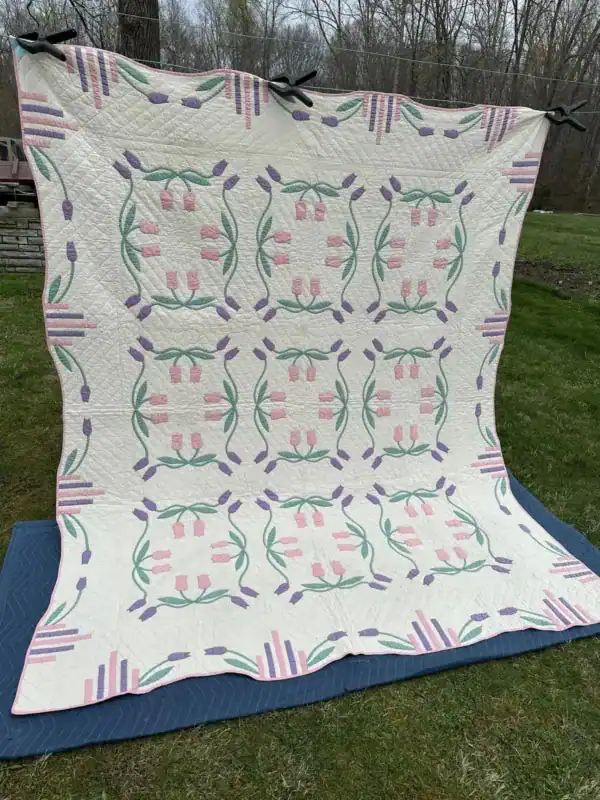
Hi All, I decided to weigh in on the Apple Blossoms quilt in discussion because I am a Mountain Mist collector and have one in my collection. The MM quilt has its blossoms sprays coming from each of the 4 corners of the quilt and is in a stem with triple blossom sprig. It is different than this quilt, so I do not think it is a MM quilt at all. I remember this being a kit from another company. If you have the Mountain Mist Catalog of Classic Quilt Patterns, you can see the MM quilt pattern on p. 47. Hope this helps clear up the issue. Marcia Kaylakie, Austin, TX
Date: Wed, 3 May 2006 09:29:52 -0500 | From: Catherine Litwinow
Good Morning from cloudy Iowa, On page 5 of History From the Heart: 2 Century Heritage of IL Quilts and Quiltmaking there is a wonderful Vase of Flowers Appliqué. Circa 1865 “For the most part…on the late 19th C., quilting was done by hand. Mrs. Horn had a sewing machine, and perhaps she wanted to show her friends and relatives the machine’s time saving capabilities…(She did the appliqué by hand with the blanket stitch and hand embroidered stems, etc.). However she chose to quilt it by machine in an allover-grid pattern. This is the earliest machine quilting in the Project.” I had a chance to sit with the current owner at the closing symposium, who brought the quilt back to Iowa. Catherine Litwinow
Date: Wed, 3 May 2006 09:47:50 -0500 | From: Karen Musgrave
The Alliance for American Quilts (www.centerforthequilt.org ) eBay auction this week has a 1981 “Quilts: An American Romance” poster from Sandra Mitchell’s estate. We have been given two posters each from years 1981 through 1985. This one is the first that we are offering. You don’t want to miss having this great piece of quilt history. You can check out our auction by going to http://search.ebay.com/_W0QQfgtpZ1QQfrppZ25QQsassZalliancequilts or search by our seller’s name- alliancequilts.Your purchases also benefit a great organization which is doing incredible things for quilts. New auctions are posted every Sunday. Happy bidding and thanks for the support.
All the best, Karen Musgrave Join us! Become a member and get advance news on our auctions AND help preserve our great quilt heritage. www.centerforthequilt.org
Date: Wed, 3 May 2006 10:04:02 -0700 (PDT) | From: Joe Cunningham
There was some reasonable discussion about machine quilting of old tops here in reply to Susan’s question about the commercial value of antique quilts quilted by machine. It used to be that those quilts had decreased market value, but since the ascendency of machine quilting those quilts have an increased value, for some collectors anyway. In any case, it was all going fine until Judy took a swipe at hand quilters by explaining how superior machine quilting is. It does not have to be one technique against the other. Gee whiz. Both techniques have their uses. I don’t mean to be thin-skinned about a passing remark, but, if Judy wants us hand quilters to admit that the machine quilters won the battle, okay. You won. Machine quilting rules the day. But that does not mean that I am spending my days at an inferior pursuit. It seems to me that to imply that the women of the 1800’s could have produced more glorious quilts if only they would have had longarm machines. I don’t agree. One more thing. Judy needs to have the courage of her convictions. If machine quilting is better than hand quilting, she should be proud of hers and say, “Yes, I quilt with a machine,” instead of saying that “the machine is my needle…” Actually, the machine is your machine. Joe the Quilter in San Francisco
Date: Wed, 3 May 2006 11:44:18 -0700 (PDT) | From: Laura Fisher
Hi all — for those of you who have the DISH network, there is a show cleverly called COLLECTIVE INTELLLIGENCE that will air its program on AMERICAN QUILTS on Saturday, May 6 at 10:00 a.m.This is the TREASURE HD channel, part of DISH network’s Voom HD Satellite service. It will air many times so check their schedule. I love the idea of an all antiques channel, just wish it were more accessible on regular cable. Where would we put a dish in my NYC apt?!
The show filmed in the quilt room and showroom of my new shop, and also at some antiques shows with a number of dealers. I’ll be curious to see how it turns out, as they were up here for hours (and how I looked, as I was soooo exhausted!) Enjoy
Laura Fisher
Date: Wed, 3 May 2006 15:59:54 -0700 (PDT) | From: karenquilt
I splurged last week and dared to visit a few book websites. What I wound up doing was my early Christmas shopping — from my husband to me. (At least this is the story to myself. My husband hasn’t yet heard the story — but don’t husbands appreciate it when we do the shopping for them, saving them all that time?) The order arrived today. All housework has now ceased at my house for the near future! (Notice that I didn’t say work for The Quilters Hall of Fame has ceased. That will increase steadily as we approach Celebration 2006. The housework can take a vacation.) I am tempted to write a Book Review a week and share this treasure trove with you. At least let me share Celia Eddy’s “Quilter Planet: A Source Book of Quilts From Around The World.” (hardback, 2005) Cover price is $40. Paid just under $26. Wonderful overview of quilting from various cultures with exciting photos and tidbits of history sprinkled throughout. It is quite probable that some of the photos of the early pieces appear in other books, but I haven’t laid eyes on many of them myself until I opened this book. Personally, the information and photos in the Introduction alone were worth the price of the book. Example: photo of mid-18th century “hunger cloth” – new term to me. According to some sources the custom of hanging a cloth in front of the altar beginning the 5th Sunday of Lent “may have begun as early as the 11th century,” and Eddy shares a superb example of such “European ceremonial patchwork.” Wow! Do more of these still exist? Anyone done further research on these? Another photo: earliest known example of dated patchwork (1718), discovered in England in 2000. I know I have heard discussion about this piece on the British quilt Study List (BQHL), and somewhere I have even read an article about it (who can help me remember where and when — QNM? Blanket Statements?) So many future block-based quilts designs to be seen in this quilt! Photo: Japanese vest from a famous ruler who lived between 1537 and 1598, “probably made from pre-quilted cotton brought from India by British trader.” Oh my, what incredible quilting on that vest!! I won’t go into all the subtopics, but he book does cover: Asia and the Far East; Japan (5 subtopics); Korea; India; England (8 subtopics); Scotland; Wales; Ireland; France (6 subtopics); The Netherlands; Scandinavia; North America (14 subtopics); Central America; Australia; New Zealand; and Africa. Granted, you get but a glimpse of each culture’s patchwork and quilting heritage, but it will definitely wet your appetite for more! Karen Alexander in the sunny San Juans
Date: Tue, 2 May 2006 10:25:21 -0700 (PDT) | From: Jean Gonzalez
hi, folks. i’m the one who posted the info abt the exhibit at the va historical society, quilts of the old dominion, quilts made in virginia before 1900. at the time i posted i hadn’t actually been to the exhibit. i’ve now been twice & have an update. first, i did not realize a book was in the works. a few readers here figured that out right away. i’ll stay on top of that & post all the ordering info when it’s available. www.vahistorical.org
interesting developments – i may have misunderstood the info table idea. the museum is having that available the day of the appraisals which is may 13. i had been calling quilt related services to let them know the table would be available but i thought it was for the length of the exhibit, til dec 3. my error. pls excuse me.
the appraisal day is now full. museum called me yesterday. i’ve been trying to get any local group to do this for years & museum offered it in conjunction w/exhibit independent of me & i went around town w/brochures to talk it up. there is a waiting list in case anyone cancels & they plan to do it again but no date has been picked. they really don’t know. i think quilt appraisal would be a good fund raiser for a community organization particularly one that supports the art form.
i don’t know what’s up with so many people calling around trying to sell grandma’s quilt, “how much can i get for it?” my concern is that once it gets seperated from the original family it will be harder in future to trace its origins. and i don’t think most of these quilts are worth a lot of $ anyway but i’m really speaking as a consumer here. most of what i’ve repaired in last few yrs i’d say is worth under a few hundred. a consignment shop i asked said the quilts she has sold have all gone for under a hundred & she takes a commission so do people really want to sell grandma’s quilt for under fifty bucks or do they think it’s worth thousands because they’ve seen unusual examples on antiques road show?
again, i go to the exhibit on sundays when the galleries are free & i will stand by at my location nearby on appraisal day in case anyone decides they want to talk repair rather than just cash in on the quilt. it’s not that i’m against $ changing hands. i’m just concerned abt how lost the quilt can get over time. i’ve been so glad to read here abt someone buying back her family quilt.
is there any organization or group that can take in orphaned quilts if the family cannot manage the care & storage & handling & repairs?
thx, jean gonzalez CRAZY QUILT Hand Sewing & Design richmondseamstress
Date: Thu, 4 May 2006 10:23:38 +0100 (BST) | From: CELIA EDDY
In her write-up about my book, Quilted Planet, for which sincere thanks, Karen mentioned the 1718 coverlet acquired by the Quilters’ Guild of the British Isles in 2000. There are indeed some articles about this in Issue 4/5 (2002/3) of Quilt Studies, the Journal of The British Quilt Studies Group. There are five articles in all, giving in-depth examination of the style, fabrics and socio-economic background of the times in which it was made.Copies can be obtained by contacting the Guild: www.quiltersguild.org.uk
Karen also mentioned, quite rightly, that Quilted Planet gives only a glimpse of each of the areas covered – inevitable, I’m afraid, when such a huge range was to be covered. My aim was, precisely. to draw attention to the many wonders of the world of quilts and then, in the Reference and Resources section, to equip readers with the information needed to follow up and find out more on any particular subject. I’m always happy to enter into correspondence with anyone who wants to discuss or get more information about any topic/s.
Ever since completing the book, I’ve become ever more conscious of how much bigger it COULD have been, and of other areas and styles which could have been covered. In fact, maybe there’s another book waiting to be written! Quilted Planet 2??
Best wishes Celia
At least let me share Celia Eddy’s “Quilter Planet: A Source Book of Quilts From Around The World.” (hardback, 2005) Cover price is $40. Paid just under $26. Wonderful overview of quilting from various cultures with exciting photos and tidbits of history sprinkled throughout. It is quite probable that some of the photos of the early pieces appear in other books, but I haven’t laid eyes on many of them myself until I opened this book. Personally, the information and photos in the Introduction alone were worth the price of the book. Example: photo of mid-18th century “hunger cloth” – new term to me. According to some sources the custom of hanging a cloth in front of the altar beginning the 5th Sunday of Lent “may have begun as early as the 11th century,” and Eddy shares a superb example of such “European ceremonial patchwork.” Wow! Do more of these still exist? Anyone done further research on these? Another photo: earliest known example of dated patchwork (1718), discovered in England in 2000. I know I have heard discussion about this piece on the British quilt Study List (BQHL), and somewhere I have even read an article about it (who can help me remember where and when — QNM? Blanket Statements?) So many future block-based quilts designs to be seen in this quilt! Photo: Japanese vest from a famous ruler who lived between 1537 and 1598, “probably made from pre-quilted cotton brought from India by British trader.” Oh my, what incredible quilting on that vest!! I won’t go into all the subtopics, but he book does cover: Asia and the Far East; Japan (5 subtopics); Korea; India; England (8 subtopics); Scotland; Wales; Ireland; France (6 subtopics); The Netherlands; Scandinavia; North America (14 subtopics); Central America; Australia; New Zealand; and Africa. Granted, you get but a glimpse of each culture’s patchwork and quilting heritage, but it will definitely wet your appetite for more! Karen Alexander in the sunny San Juans
Date: Wed, 03 May 2006 23:37:21 -0400 | From: Velia Lauerman
Another star on your forehead Joe! Being a hand quilter I can see how the sewing machine and long arms may seem to the lay person that it may be faster and more accurate? ?? Mom quilted beginning in the 20s and continued loving her hand made frames to hand quilt until 1999 when she went to Quilt Heaven at the young age of 95. She would say that machine quilted quilts looked very commercial, as in buying a store made garment. How right of you to give out the “Let’s stop the race” remark. This could go on until we reach our 100 years then what? The race goes on? Not! Beauty is in the eyes of the ….Velia, Million dollar fingers hand sewing
From: Cindy Hamilton
Re: BQHL and Joe Cunningham Karen Alexander made reference to the British Quilt History List. Karen, can you give explicit instructions about how to sign up for this? I am a member of the British Quilt Study Group, but I didn’t realize they have a list. Joe, thanks for having the guts to say what you said about hand quilting. I was thinking exactly the same thing! We really should give up arguing about which is better, because neither side can win. Let’s just keep on doing it by hand because that’s the way we love to do it. Thank you, Cindy V. Hamilton Pagosa Springs, CO
Date: Thu, 04 May 2006 09:14:46 -0400 | From: Beth Donaldson
Thanks to everyone who responded to my request about the Dogwood and/or Appleblossom Quilt.
While entering data in the Michigan Quilt Project database and looking for a pattern name, I ran across a block similar to Julie’s latest mystery block. It is Brackman #2183, “Framed Squares”. Like “Flock of Birds” that Kennalee saw in Naperville, the main difference is Brackman’s has four half square triangles on each side of the white square, where Julie’s has three. Beth
Beth Donaldson Quilt Collections Assistant Great Lakes Quilt Center at the Michigan State University Museum 201 Central Services East Lansing, Michigan 48824-1045 quilt line: 517-432-3800 quilts http://museum.msu.edu/glqc/index.html
Date: Thu, 04 May 2006 15:04:45 +0100 | From: Sally Ward
> I am a >> member of the British Quilt Study Group, but I didn’t realize they have >> a list.
They don’t! Its a common misconception because they sound similar, but there is absolutely no connection between the two.
The British Quilt Study Group is a sub-group of the Quilters Guild of the British Isles and so far as I am aware does not have a discussion list.
The British Quilt History List is an open yahoo group which can be found at http://groups.yahoo.com/group/BQHL/.
Some years ago the first British-based quilt-orientated internet list was started and named The British Quilt List (BQL). After a while, the British Quilt History List (BQHL) was formed to cater for those with a particular interest in our quilt and textile history. It now has 275 members, many being welcome contributors from overseas. In fact, this Saturday, the members of the US group currently taking the UK Textile Tour will be meeting some BQHL members for chat, quilts, and a couple of exhibitions.
BQHL’s ethos and format owes a great deal to the founder members’ experience of how welcoming and informative QHL can be – in fact we sought Kris’s approval before taking on such a similar name. It is quite a low volume list and you’d be very welcome to come along and say hello.
Sally Ward
Date: Thu, 4 May 2006 15:41:00 -0700 | From: chrisa
TELEVISION SPECIAL ON 100 YEARS OF MUSEUMS TO AIR SOON The public television series, Great Museums, has produced a one-hour program titled “Riches, Rivals and Radicals: 100 Years of Museums in America,” to coincide with AAM’s book. Hosted by National Public Radio’s Susan Stamberg, it features museums coast-to-coast and reveals the story of how America’s museums came to be. The “Riches, Rivals and Radicals” show is airing on PBS stations throughout America. Some of the California areas with stations that already have committed to carrying this special “Year of the Museum” program include: San Bernadino – KVCR/24 – Wednesday, May 31 9 p.m.; San Francisco -KQED/9 – Saturday, May 27 at 6 p.m.; and San Mateo- KCSM/60 – Friday, June 23 at Noon. Feel free to contact your local PBS station to ask them to air this program.
NEW BOOK ABOUT 100 YEARS OF MUSEUMS IN AMERICAN IS NOW AVAILABLE WITH PUBLIC BOOKSIGNINGS Riches, Rivals and Radicals: 100 Years of Museums in America by author Marjorie Schwarzer, chair of the museum studies program for the John F. Kennedy University is now available. Published by AAM to commemorate the Year of the Museum and mark AAM’s Centennial, the book traces the rise of the American museum over the past century. Riches, Rivals and Radicals is AAM’s first book published for general audiences in addition to museum professionals. It is available through the AAM Bookstore at www.aam-us.org/bookstore. There will be public booksignings with Marjorie Schwarzer at the deYoung Museum in San Francisco (June 16, 7pm) and the Magnes Museum in Berkeley (November 12)
From: Alan
I don’t know if anyone will want to answer this online, but if not please respond to me privately.. My question is this: what’s the going rate for restoration these days? I’m considering getting back into it, actually have a potential first client. I’m talking an hourly rate. Thanks.
Alan
Alan R. Kelchner Mixed Media Textiles
Date: Fri, 5 May 2006 08:47:59 -0400 | From: blackriverquilts
I machine quilt my wallhangings, small projects. Proficient, and the job gets done and the gift given away. I recently finished a Log Cabin wallhanging; my mini-group friend immediately told me I needed to hand quilt this one – it deserved it. I don’t handquilt, but I plunged in and worked that piece, day after day. At first, I was literally banging my forehead on the table, wondering WHAT I’d gotten myself into. But about two-thirds of the way into it, working the fabric in my hands, I suddenly realized the (almost)invisible ingredient one puts into a handquilted project. It is part of your Soul. I am state coordinator for Ohio’s Home of the Brave quilt project – giving quilts to bereaved Ohio military families. Most of the quilts are machinequilted by talented longarm quilters and I am SO grateful for their donation of time – and the quilts get done quickly, and beautifully. But, a small group of women in my area have handquilted some of these quilts for me. There is a definite tactile difference between a quilt that has been handquilted or machinequilted The handquilted one has a soft heft, more lightweight. An airy feel. I can see some of the quilter’s Soul in the stitches. I spoke of this at my quilt guild, referencing my recent little Log Cabin effort and mentioning the Soul – and a handquilter at the back of the room was vigorously nodding her head in agreement, big smile on her face. (she’s presently doing a quilt for Home of the Brave) I’ll continue to machinequilt. As time goes on, I might even get “good” at it and someone might say “gosh, that’s a lovely piece.” Once in a while, perhaps I’ll decide a piece is worthy of some of my “Soul” and I will pick up needle and thread, and settle in for some quiet stitching time.
Beverly Macbeth
Date: Thu, 4 May 2006 23:02:09 -0700 | From: Christine Thresh
Alan,
Judi Fibush does restoration. Go to her website: http://www.fibush.net Perhaps there is a pricelist there, or you could e-mail her and ask.
Christine Thresh
Date: Fri, 5 May 2006 10:17:00 EDT | From: Maggmalone
I have to agree with Judy on this one. Those who disparage machine quilting have no idea of the skill required to execute an elaborate design on the machine. The quilting is my least favorite part of making a quilt, and if I couldn’t do it on the machine, I would never have completed my first quilt. Maggie
Date: Fri, 5 May 2006 11:15:06 -0400 | From: J. G. Row
Beverly,
You perfectly described why hand quilted quilts will always have more value to me than machine quilted ones — and I machine quilt as well. There is that invisible ingredient which you call Soul in them. All the thoughts and remembrances of the myriad hours of the person’s life which were dedicated to making that quilt, stay with it.
When you hand quilt you have time to think “around” the quilt — you don’t need to focus directly on the work at hand. So your days and the people you met, the things you did flow into your brain and through your fingers into the quilt you are working on.
When you machine quilt, you have to be present to the task at hand both physically and mentally. Now I don’t do any fancy feathers with my machine quilting, just straight line work, but I still can’t let my mind wander. For others it may be, but for me machine quilting is not a pleasant task.
There are so many quilt ideas running around in my head that I just don’t have the time left in my life to hand quilt every one. I wouldn’t have had that time even 30 years ago. And as they say, you need to “Get ‘er done!”
Judy, now in Flemington NJ aka The Ringoes Kid judygrow
>working the fabric in my hands, I suddenly realized the (almost)invisible ingredient >one puts into a handquilted project. It is part of your Soul. There is a definite tactile >difference between a quilt that has been handquilted or machinequilted The >handquilted one has a soft heft, more lightweight. An airy feel. I can see some of the >quilter’s Soul in the stitches.
Date: Fri, 5 May 2006 09:28:01 -0700 (PDT) | From: Ark Quilts
Two people are selling the reproduction Smithsonian Bride’s Quilt on eBay this week.
One seller (americasantiques) calls it what it is, a reproduction–their item # is 7412649195. Current price is: $86.55
The other seller calls it an antique & states it is from the 1930’s (anythingoes911)–their item# is 7412515136. Current price is: $22.72
I have emailed anythingoes911 to let them know their Chinese reproduction is not an antique, BUT I didn’t give them the item number from americasantiques–let them do their own research!
Any eBayers on the list are invited to send their 2 cents worth to these sellers.
C. Ark in NW Ohio
Date: Fri, 5 May 2006 13:29:45 EDT | From: Mitzioakes
I understand what you are talking about – I don’t do many large quilts anymore (due to age and lack of anyone to share them with) so I do a lot of lap quilts and wall hangings and I love to sit and hand quilt, even if I am not a perfectionist and my stitches will never meet the required number per inch to be perfect – it is relaxing for me. But, there is no difference much anymore between hand or machine quilting when it comes to judging, and I still disagree with that. Mitzi from Vermont where Mother Nature decided to stop by at long last and give us sun and flowers.
Date: Fri, 05 May 2006 22:11:31 +0000 | From: jocelynm
First of all, I want to say that I’m not a machine quilter. I started wit h such firm (and possibly irrational) ideas about quilting traditions tha t I thought that applique quilts weren’t REAL quilts because there was no piecing… My first experience with machine quilting was pantographic. I still can’t imagine ordering it on a top I’m responsible for. Yet I have a Lone Star quilt on my bed, that I use and love because it was pantographically qui lted so I don’t have to worry about preserving it for the ages. The longer I’m in this quilting arena, the more I get to appreciate techn iques as options, not as ‘real’ or ‘not real’. Tying a quilt? Well, it’s not for every top, but there are times when it’s an effective choice. Dit to for big stitch. Yes, hand quilting puts a piece of your soul into the quilt. Your hopes a nd prayers for the recipient, and what you were doing and thinking alongs ide of making that quilt. But can we really say that a quilter who plans out a machine quilted design, who carefully positions the machine needle and manipulates it to put the stitch right where she wants it, to create the effect she wants, is not putting just as much of HER soul into her wo rk? I don’t think I’ll live long enough to become an accomplished master mach ine quilter, to make the sort of quilts I saw at Paducah last weekend, an d I cherish the relaxation and meditative qualities of hand-quilting… b ut I’ve seen an awful lot of machine quilted quilts that shown with the m aker’s soul. Let’s not be like the woman at Paducah who was loudly complaining that al l the quilts were machine-quilted…until several of us just couldn’t tak e it any more and pointed out that fully 2/3 of the quilts that were visi ble from where she was standing were hand-quilted. Well, she sniffed…th ey were all so FLAT! Apparently in her world, if it wasn’t big and poly-f luffy, it wasn’t a REAL hand-quilted quilt….
From: TEXTIQUE
Hi all;
Thanks for your messages. I got the idea for the Crazy Quilt Exhibit opening…..a Crazy Tea, from Penny’s book. I have subsequently been in touch with her and what a delightful person. She has donated all her research material, including The Ladies World magazine of June, 1890 to Lincoln. She found just that one article while researching the book.
Anyway, I think it sounds like a fun idea for a Crazy Quilt Exhibit opening….just forget the food and the lemonade:)
Jan Thomas
Date: Sat, 06 May 2006 08:00:49 -0400 | From: Jane Hall
I am a long-time hand quilter who also has run out of time to quilt all the things I need to quilt. I both hand and machine quilt, in the same piece, and feel that I am taking advantage of the best qualities of both techniques. The machine puts a stitch in every space, so it is a hard line. The hand-quilted line is softer because there are spaces between each stitch.
I see no virtue in plowing through a lot of straight lines by hand, for instance…quilting-in-the-ditch by hand is tedious and not nearly as decisive as that done by machine. A feather on the other hand, is softer and more fluid to me, done by hand. When I have a lot of short lines, and a lot of starts and stops to deal with, hand quilting is more efficient. When I have a lot of background to tie down, the machine is. So I totter on, using both techniques and I like the look I achieve. It is part of the “being in charge” that I love so about quiltmaking. Jane Hall
Date: Sat, 6 May 2006 07:02:07 -0500 | From: Susan Wildemuth
IIQSG photographs and descriptions are up on our web site from our March 31-April 1 2006 meeting.
http://www.quilthistory.com/study/apr1.htm
Thanks Kris– Sue in Illinois
Date: Sat, 06 May 2006 08:25:37 -0400 | From: Velia Lauerman
For what it’s worth!…You have it right..There are many times when loved ones ask for a quilt not knowing the time,money and planning involved. Not wanting to let them down you do you best to give part of yourself and complete a comforting quilt. Being a hand quilter mostly and loving it doesn’t remain put. I find that after the top is complete I can decide and either KNOT quilt it and get it done or take my time and relax hand quilting. KNOT quilted quilts take effort too as when you align the sandwich and knot or tie it together I save lots of time for other hand stitching. You go Girl, Velia
Date: Mon, 8 May 2006 14:18:13 +0100 (BST) | From: CELIA EDDY
During Deb Roberts’ Textile Tour in UK, one feature of last Saturday’s event was a post-lunch Show and Tell. I showed an extrmemly worn scrap quilt, which has little interest EXCEPT for the quilting pattern: chevrons, or Allover Wave pattern as we call it over here. It interested me as yet another example of the way in which patterns migrate within certain geographical areas, in this case the regions surrounding the Irish Sea.
If you’d like to find out more, there’s an article on my website titled Pattern and Place. It’s a bit long on words, and short on illustrations, for which I apologise.Go to http://www.quilt.co.uk/quilting-articles.asp?idNo27
I’m also reminded to mention a book which some of you may know, and which Barbara Brackman mentioned recently. It’s David Hackett Fischer’s Albion’s Seed. Four British Folkways in America. A very scholarly and lucid description of customs, language etc. which the British settlers took to America, together with many Tables giving precise dates for settlement of particular areas, spread of customs, and language and many other facts. Altogether a fascinating and very thought-provoking book for anyone interested in the roots of American culture. I feel convinced that it must contain many clues to quilting styles and traditions.You can buy it on the Internet: http://www.alibris.com/search/books/author/Fischer,%2avid%20Hackett
Celia
At the Show and Tell which we had after lunch
Date: Mon, 8 May 2006 7:34:34 -0700 | From: Karen Evans
I just got back from the Kalamazoo International Medieval Studies Congress, where, for the very first time, a paper was presented on quilts, by yours truly as part of the DISTAFF textiles track. The paper, on Henry VIII’s quilts, will be published as part of Medieval Clothing and Textiles IV, ed. by Robin Netherton and Gale Owen-Crocker, scheduled for 2008.
There were plenty of other interesting textile-related things, primarily on costume, but some on embroidery and embellishment such as passamenterie, embroidered manuscript repairs, and researching textile images on the Web. It was an excellent session, and I’m tentatively slotted in to present in 2008 on evidence for early patchwork in Renaissance paintings.
If anyone’s interested in the textile and costume databases, or anything else, please let me know. I’m happy to share.
Karen Evans (still on Cloud Nine)
Date: Mon, 8 May 2006 17:50:10 +0200 | From: Margareta.Faust
Hello all, Getting back on a subject that was discussed some time ago but I didn’t have the time to respond, and yesterday I was clearing out my car so I remembered I wanted to tell you about the quilt I keep there. It’s the first quilt my daughter made, vintage 1994, from mum’s various scraps, a one-patch (4 x 4 inches) with a navy blue border, ‘folksy’ (i.e. crooked) machine quilting in the seams, rather faded due to multiple washings. It got into the car when we went for a picnic a couple of years ago and has stayed there since then for two reasons: 1) in case I get stuck in a snowstorm 2) in case I need to wrap up a flea market find. Thankfully, I haven’t needed it for 1) so far, but it has been very useful for 2). During the last couple of months, I have wrapped it round a painted chest, a set of plates and a wrought-iron bench! My daughter loves the idea that this quilt (which otherwise would have been dumped somewhere) comes to such good use (she has moved on to more advanced quilting since!) and I’m happy every time I get to wrap something into it! I hope you’re not too shocked! Aren’t quilts utilitarian objects after all – well, at least for the first 50 years or so? Greetings, Margareta in Europe
From: Susan Riley
This 2006 summer there will be an exhibit that will feature the Hinghams’ Historical Society’s quilt collection. A guild friend said that when Vivien Sayre, a MA quilt appraiser viewed them, she said that this was ‘the motherlode’! Quilts date from the late 1700’s forward. (Sally-we are named for Hingham in England) I have gone to this house tour for decades now and never remember ever seeing their collection out on display. “Quilts-More Than Just Needlework” kicks off with the 82nd Tour of Historic Homes on Sunday, June 11th. (1:00-7:00 p.m.) My friend Penny helped with the determination of each quilt’s display in our Old Ordinary. Hingham is a small seacoast town 18 miles south of Boston, in case anyone will be in the area this summer. (Choose a cool day as the Old Ordinary is NOT air-conditioned!) www.hinghamhistorical.org Susan Riley Hingham (Boston)
From: Lucinda Cawley
Susan can you tell us how many quilts and dates of the exhibit? Thanks. Cinda on the Eastern Shore
From: Ark Quilts
I have been compiling lists of imported quilts that appear in the “ANTIQUES” listing on eBay. Also calculated the % they represent from the total number of quilts available on that day. So far, the average is about 7% out of every 2,000 quilts (or about 20) listed in the “ANTIQUES” group are actually imported quilts. Many times the issue of the age of the quilt is not addressed, sometimes it is indicated that the item is “new” (question: So why is it listed under “antiques”?), and the greater percentage of the listings are worded as if it were an antique–including use of the descriptor: vintage.
In the last week there were 4 of the Smithsonian reproduction quilts on sale. Only 1 was listed in “ANTIQUES” and not identified as a reproduction of a Smithsonian quilt. The listing for it was worded very carefully, but the item title state it was “museum quality” so perspective buyers would assume it was a very valuable antique. See item # 7412515136. This auction was a little weird–the ending price I found was $9.99 and prior to that, it was over $25.00. I don’t know whether or not a bid was retracted or what happened.
Another Bride’s Quilt repro was listed & sold on eBay on 4-1-06 (no kidding) for $213.49. Item # 7402213482.
The other 3 Smithsonian reproduction quilts that were on sale were listed by honest & reputable dealers who identified them for what they were. There were 2 of the Bride’s Quilt repros and 1 of the Great Seal repro (which doesn’t come up for auction very often). The Bride’s Quilt repro item #’s — 7412845015 7412649195 The Great Seal repro item # — 7412649287
The following eBay item #’s are for imported quilts that were added today under the “ANTIQUES” category : 7412649195 repeated from above 7412649287 repeated from above 7413791707 7413795607 7413540471 4461524307 7413583370 7413583930 7413526002 7413455939 7413454578 7413463518 7413597092 7413612738 7413614626 7413617663 7413620330 7413559016 7413551884 7413637992 7413730523 7413737282 7413739866 7413757746 7413759117 7413769644 7413761679 7413766710 7413766796 7412649195 repeated from above
Enjoy perusing & if you are an eBay member, feel free to contact these sellers and ask the question: This is an import…..why are you listing it under the “ANTIQUES” category? Not only has the word “vintage” been turned into an euphemism for “used bedding”, but apparently “antique” is being used for the same thing………..isn’t it misrepresentation if an item is called something it isn’t? If these sellers can’t tell old from new, they should say they just don’t know how old it is………all the grandiose & rambling descriptions they write just indicate how far the seller will go to disguise used bedding to potential buyers who just don’t know any better.
Enough already. Enjoy the info. C. Ark in NW Ohio where Spring is here and the little lambs are ambling about!
From: Pat Stewart
Hello! I’m new here, and I’ve just figured out how to post messages. I’ve been cleaning out some of my old files, and came across correspondence between McCalls pattern company and myself, where I described what is now known as strip quilting. The first letter is dated January 19, 1974. I included drawings and samples. I made three copies of the letter. One, I sent to McCalls, the second I kept, and the third I mailed to myself, which remains unopened. I’m wondering what to do with these files. Any ideas? Thanks, Pat Stewart (Grimes)
Date: Tue, 9 May 2006 11:55:56 -0700 (PDT) | From: Pat Cummings
Dear Pat,
I’m perplexed. Why do you ask? What do you want to do with the letters/files?
While we are on the topic…Sending yourself a copy of something you design is no protection under the law, as far as claiming copyright, because it is not admissible “evidence” in court. If you want to better protect your interests, file an actual copyright claim with the Library of Congress’ copyright office.
Pat Cummings www.
— Pat Stewart wrote:
> I’m wondering what to do with these files. Any > ideas?
> Thanks, > Pat Stewart (Grimes)
Date: Tue, 9 May 2006 12:05:44 -0700 | From: Pat Stewart
Hi, Pat
This is stuff from the 70’s. I have no idea what to do with these old files. They are historical documentation, showing where the idea of strip quilting first originated.
Date: Tue, 9 May 2006 12:21:10 -0700 (PDT) | From: Pat Cummings
Hi Pat,
There is a project called “Boxes Under the Bed.” I believe it is associated with the American Alliance for the Quilt. I don’t know much about the program, but perhaps they would gladly take a donation of your ephemera.
Welcome to the list.
Pat
Date: Tue, 9 May 2006 14:45:22 -0500 | From: Kim Baird
You might give them to the International Quilt Study Center or to the American Quilt Study Group. They will be preserved for future researchers.
http://www.h-net.org/~aqsg/ http://www.quiltstudy.org/
Kim
—–Original Message—– From: Pat Stewart Sent: Tuesday, May 09, 2006 1:28 PM To: Quilt History List Subject: [qhl] Quilt history documentation
Hello!
I’m new here, and I’ve just figured out how to post messages.
I’ve been cleaning out some of my old files, and came across correspondence between McCalls pattern company and myself, where I described what is now known as strip quilting. The first letter is dated January 19, 1974.
I included drawings and samples. I made three copies of the letter. One, I sent to McCalls, the second I kept, and the third I mailed to myself, which remains unopened.
I’m wondering what to do with these files. Any ideas?
Thanks, Pat Stewart (Grimes)
Date: Wed, 10 May 2006 09:42:28 -0400 | From: Newbie Richardson
Dear List, For those of you who are interested in early Virginia quilts, check out ebay # 7413180479 offered by dealer Caroline Brown. She contacted me last month to ask if I could give her any insights on the quilt. She and her husband are reputable dealers – but not quilt or textile folk – however they suspected that this was a special piece – though VERY WORN ! I confirmed their suspicions via photographs. This piece reminds me of my own central medalion, reverse applique c1800 that many of you on this list have seen in the past. I did not get paid, nor am I to benefit in any way except to see a very nice, tattered example find a happy home. Best to all Newbie in Alexandria, VA. where the peonies are at their full glory!
Date: Wed, 10 May 2006 17:22:07 -0500 | From: Andi
Hi all,
Please pardon the mass email. My internet/mail server is experiencing difficulty. I have not reliably received emails for the last week and probably longer. I especially apologize to writing and business interests and people asking about the IIQSG magazine, Pieces of Time. If you know someone who has tried to reach me, please explain and ask them to try again. And there’s always the phone, which I answer in person.
Ahhh – cyberspace. Can’t live with it, can’t live without it.
Andi
Andi Reynolds
andi0613
(641) 636-3045
Date: Wed, 10 May 2006 23:48:25 EDT | From: JLHfw
Dear Andi, I would like to subscribe to Pieces in Time. Please let me know the cost and how to subscribe. I cannot reach you through your other address. Best regards, Janet Henderson
Date: Wed, 10 May 2006 23:48:10 EDT | From: Mendofleur
Hello,
I just picked up a copy of the latest A.Digest and it has a great article on the coming exhibition at the Shelburne Musuem, “Art and Illusion: Kaleidoscope Quilts at Shelburne Museum”. Lucky for you people on the East Coast who can find your way more easily to this exhibit. The quilt on the front of the magazine is enough to draw you in! Please report if you see this exhibit.
Phyllis de Vries on the West Coast who won’t be able, most likely, to see it.