November 9 – 12, 2006
These restored messages come from the Quilt History List, an online forum where quilt historians, collectors, researchers, appraisers, and enthusiasts discussed antique quilts and related textiles. The archive dates from 1996 through approximately 2016 and is being restored gradually. Sign up in the form at the bottom of the page if you want to know when a new page is added. Original spelling, opinions, formatting, and inactive links may remain unchanged.
Primary topics of this QHL Digest:
- The Floating Quilt — Sue Reich asks what batting could make a third-quarter nineteenth-century quilt float when washed, and replies bring in wool and a debunking of the Aran sweater story.
- Museums and the Underground Railroad Story — Pat Cummings, Candace Perry, Judy Schwender and Stephen Schreurs discuss whether museums can correct the story and what a cultural anthropologist might say about folk myths. (see the article on Underground Railroad quilts)
- Did Oprah Buy the Story? — Members argue over what Oprah actually said about Hidden in Plain View, whether the list is only preaching to the choir, and how to reach the public.
- Nature’s Bounty and Honolulu Exhibits — Judy Schwender recommends the Nature’s Bounty show at the Kentucky Museum, and Loretta Woodard lists two Honolulu quilt shows.
- Egyptian Cotton and Cairo Fabric — Sarah Hough plans an Egypt trip, adi hirsh points her to the street of the tentmakers, and Mitzi and Joan Kiplinger compare Egyptian and American cotton.
- Caring for Antique Quilts and Finding Resources — A newcomer asks how to vacuum and care for a red and green appliqué quilt, Palampore explains tide marks on stuffed work quilts, and members share a newspaper database, new books and a British quilt tour.
Date: Thu, 9 Nov 2006 09:55:32 -0700 | From: Judy Anne (anne_j)
I added some structure to the UGRR article on wikipedia. Otherwise there would soon be a note there saying it needed to be wikified.
I added subsections and links to other wiki articles. I also started a resources and external links section. Please add to the links and resources or any other part of the article. For example I didn’t have the information to add the magazine articles to the resources and they should be there. I know there are more webpage articles that need to be linked as well.
I also added a link to the wiki UGRR quilt page from the wiki UGRR page.
When you go to edit just copy the ways I added these types of entrys.
Judy Anne
Date: Thu, 9 Nov 2006 10:03:47 -0600 | From: Elise (eliseroberts)
Hi all:
I’m Elise Schebler Roberts, usually lurking on the list, and this is the first opportunity I’ve had to post. My first career was in the museum field as educator and curator, and now have a second career as writer and quilter. I live in the Minneapolis area with my husband-a computer guru and machine quilter, 14-year-old son, 1-year-old daughter, dog, turtle and 2 geckos.
I’m working on a new book about the history of American quilting for Voyageur Press. Some of you have helped me out already, which I greatly appreciate. The manuscript is due at the end of the year, and I’m still looking for a few specific quilt styles to include. I’m particularly interested in quilts that haven’t appeared in a majoy publication in the last 20 years. Right now I’m looking for: an Overall Boy; two different log cabin syles-furrows and courthouse steps, a nineteenth century Jacob’s Ladder, two nineteenth or twentieth century unequal nine-patch quilts, and quilted clothing made before 1980.
The book will also include a section tentatively titled Quilter’s Dilemmas, which will address issues facing those who live a quilting life-like the UGRR issue. I know these are hot topics, and would like to talk more with some of you regarding this issue.
Please contact me off-list if you have a quilt we could include, or if you’d like to talk more about “quilter’s dilemmas” (or if you’d just like to know more about the book.) My email is eliseroberts or elise.
Thanks so much for your help! Elise
Elise Schebler Roberts
Quilted Life
16520 Jacaranda Way
Lakeville, MN 55044
952/898-3726
eliseroberts
elise
Date: Thu, 9 Nov 2006 9:03:28 -0800 | From: suereich
We are having a stretch of warm days here in Connecticut so I decided to wash one of my quilts. This 3rd quarter nineteenth-century quilt is a new purchase from New Jersey. It’s an album patch, on-point with sashing that looks like a Cocheco print and thick. You could feel the dirt in it, so, I wasn’t surprised to see the water in my tub turn that disgusting brown. Here is the issue: The quilt floats! It is saturated with water but it will not sink like most quilts I have dunked for cleanliness. Does anyone have any idea what kind of 3rd quarter nineteenth-century batting causes a quilt to float? Many thanks, in advance. sue reich
Date: Thu, 9 Nov 2006 12:22:18 EST | From: HKnight453
Wool floats well, and still insulates when damp or wet. That’s why the US Navy still wears wool on deck. The fancy Aran and Fair Isle sweaters were a way to identify the clan or island of a drowned person.
Heather
Date: Thu, 9 Nov 2006 09:44:59 -0800 (PST) | From: Kris Driessen (krisdriessen)
I am afraid the idea that certain knitting designs were developed in Ireland to help identify the body of a drowned sailor is another myth. Although the ladies of Fair Isle were knitting back in the 1800’s, the myth seems to have started about the time the patterns and the sweaters were commercialized. Not unlike another myth we are familiar with…
Kris
Date: Thu, 9 Nov 2006 10:33:39 -0800 | From: suereich
I just received my advanced copy of my new book “Quilting News of Yesteryear: 1,000 Pieces and Counting” published by Schiffer Publishing, Ltd. This is a hard cover book featuring over 300 news articles dating from 1834 to 1934. The subject is quilts made with thousands of pieces. The news articles are complimented with quilts from the same time periods. Nearly each page shows close-ups of quilts. This first book in the series of quilting news of yesteryear, provides for primary and secondary sources for quiltmaking spanning one hundred years. It will be a valuable reference for all of us studying quilt history, women’s history and textile history. Please email me privately if you would like more information. And thank you to Kris for this opportunity to tell you about this new resource. Sue Reich
From: Lynn and Debbie Cupp (Cupp5)
I had fun searching this database for quilt, calico, Singer sewing machine and other terms of interest to me. I hope you enjoy it, too.
Debbie Cupp
Through support from an IMLS grant and in collaboration with Project Perseus at Tufts University, the University of Richmond has digitized the Richmond Daily Dispatch newspaper for the Civil War years. The project is not yet complete. However the newspaper is now available for use and exploration. Please bring it to the attention of faculty who study or teach about the Civil War era at your school or college. We welcome your comments and feedback on this work in progress; just click on the survey link on the newspaper’s homepage at http://dlxs.richmond.edu/d/ddr/index.html. We hope this will be useful to a broad audience encompassing scholars, students, genealogists, Civil War buffs, re-enactors, and more. Please feel free to bring it to the attention of other librarians and interested parties.
Jim Rettig University Librarian Boatwright Memorial Library University of Richmond
Date: Thu, 9 Nov 2006 11:04:58 -0800 (PST) | From: Judy Schwender (sister3603)
Hello all, In regards to UGRR quilts and museums, consider these points. First, the topic might not come up on a regular basis, at least enough to warrent an exhibit or display of any size, even a small tabletop display. Sad, but true.
Second, yes, museums are sensitive to their public, but not always because of money. In some cases it is difficult to get African-American residents in your area to visit your museum at all. To active “stomp” on “their” myth is to invite them to never visit. If museums want to serve the public, how can they if part of their public sees the museum as hostile to African American culture? That is a very simplistic way of putting it, but in most museums if you can get visitors to read a gallery label for more than 2 minutes it is amazing. People want sound bites in everything.
Third, most museums are a part of the humanities because they tell the stories of humankind, and as such are charged with impartiality. Unless BOTH sides of an issue are presented (and in this case there ARE two sides- think of them as believers and non-believers) a museum cannot be said to present an unbiased view. When Kathy Moore and I took our Museum Administration graduate class, this issue of humanities and impartiality was addressed. Dr. Hugh Genoways and Lynn Ireland (excellent instructors- they team taught the course) pointed out that oral history IS a history of sorts. It cannot be 100% discounted. So, for instance, if a museum applied for a humanities grant for an exhibit on the myth of the UGRR quilt code, it would probably be turned down. IF the museum applied for this grant to fund an exhibit titled, say, Quilt Myths: Romance or Fact? and both sides were presented of several quilt myths, then it might receive funding. The point is to present both sides and let the individual make up his/her own mind.
Pat Cummings provided me with materials that I can, in turn, provide to others (along with other information I have) to present a viewpoint that the UGRR quilt code is a myth. I am careful how I present this material. If the inquiry is made by a person who accepts the code as fact, I present the material as something they should study and then re-evaluate the issue. I don’t just walk up to visitors in the museum and say, “Have you heard about the UGRR quilt code? Well, it’s not true.” As I said, the point is to present both sides and let the individual make up his/her own mind.
Oprah “validated” “Hidden in Plain View”. She is not a humanities educator who is required to present both sides of an issue. In many ways she and Rush Limbaugh are cut from the same cloth: they are entertainers. They can say and do whatever they please as long as they deliver viewers to an advertiser.
Museums, on the other hand, are charged with presenting both sides of a controversy. And, like it or not, because Oprah and Tobin and Dobard got there first, there are two sides.
Judy Schwender Curator of Collections / Registrar Museum of the American Quilter’s Society Paducah, KY
Date: Thu, 9 Nov 2006 11:40:24 -0800 (PST) | From: Stephen Schreurs (schreurs_ss)
It has been fascinating to read so many posts about UGRR and quilts…
I would love to see a cultural anthropologist’s take on this. It seems to me that these things tend to take on a life of their own. For whatever reason, at any given time and place, stories pop up and last a long time. Remember George Washington and the cherry tree? How about the confluence of space exporation, the atomic age, and the stories of alens among us? The thing is, people do get invested in a story, and, like so many other things they hold dear, don’t especially want to give up on it until they have a better replacement, or at least until curiosity or better sense take over. And, just because we can cite a source for the “myth” doesn’t mean it won’t run on legs of its own anyway. Seems like a culture has to have rich fertilizer to thrive – perhaps the very existence of demonstrably spurious stories are serving a function we do not completely understand – but have a place.
A wise minister, in talking about Biblical stories, once told a akeptical audience, “what you need to remember about these stories, folks, is that they really are more about truth than they are about facts.”
It’s been a lively discussion! Susan Schreurs
Date: Thu, 09 Nov 2006 22:41:11 -0500 | From: Teddy Pruett (aprayzer)
Every time I see the initials HIPV, My eyes see HIV. Interestingly, they are both nasty things that have grown exponentially. Neither shows any indication of being stoppable.
Teddy Pruett www.teddypruett.com Only a few of the lies they tell about me are true
Date: Fri, 10 Nov 2006 08:46:56 -0800 (PST) | From: Pat Cummings (pat)
The problem that I can see, in regard to museum programs, is that, most likely, the general public would believe that if a museum is presenting a speaker, the museum concurs with the message of the program.
Presenting the other side of the tale would be difficult. In the case of the UGRR/quilts issue, it is more fun, and perhaps more exciting to listeners to hear about the MYTH. Any other presenter, standing there naysaying the book, the work of two supposedly well-educated co-authors, would be perceived as a “spoiler.”
Also, I rather doubt that museum attendees would turn out for such a program.
Time has solidified the idea of a “secret quilt code,” in the minds of the public. What is rather odd is that one of the authors has waffled over whether they were talking about quilts, or quilt blocks. He has alternately suggested both, so I’m not quite sure which he really means.
I have a feeling that this topic will never be put to rest, even if the book’s authors came forth to say, “Hey, we made some miscalculations here.” Of course, reputation being all in the land of academia, that would never happen.
So, we will have to continue to put out the fires, as they keep popping up, for a very long time. While it is a great thing that those of us who care about verifying historical fact have tried to set the record straight, it will not be enough an effort until we enlist the help of every school teacher and parent in the country.
Short of someone going on the Oprah Show, as was suggested a long time ago, I am not sure how we could reach people. And since Oprah “buys” the “story,” hook, line, and sinker, I can only envision how an interview with her might go. I don’t think the grilling, nor the harassment would be pleasant.
It’s amazing how much trouble has been caused by one book.
Pat Cummings
Date: Fri, 10 Nov 2006 14:43:33 -0800 (PST) | From: Judy Schwender (sister3603)
Hello all, If you are in the Bowling Green, Kentucky area, go see the “Nature’s Bounty” quilt exhibit at the Kentucky Museum until January 28, 2007. You can see an online version of this exhibit at: http://www.wku.edu/Library/onlinexh/naturesbounty/index.html For those of you who would like to create materials for teachers to use in schools about any quilt-related topic, take a look at the Quilting Education Guide that accompanies this exhibit. As far as depth, organization, and core curriculum relevance, it is excellent, and would be a good model to follow: http://www.wku.edu/Library/onlinexh/naturesbounty/education/quilting_ed_guide.doc
The Kentucky Museum The Kentucky Building Western Kentucky University 1 Big Red Way Bowling Green, KY 42101-3576 phone: 270-745-2592 fax: 270-745-4878 for directions: http://www.wku.edu/Library/kylm/about/directions.html
After you visit this exhibit, come on over to Paducah and visit the Museum of the American Quilter’s Society! Judy Schwender
Date: Fri, 10 Nov 2006 15:14:31 -1000 | From: Loretta Woodard (Lwoodard)
Two quilt shows opening this month in Honolulu continue through the new year.
Contemporary Quilts Hawaii An Art Showing at SUB-ZERO/WOLF SHOWROOM On the corner of Piikoi Street and King Street Tuesday-Saturday 1am-6pm 808-597-1647 November 8, 2006-January 22, 2007
From Pieces to Masterpieces 28th Annual Quilt Exhibition Misison Houses Museum 553 South King Street Tuesday-Saturday 10am-4pm 808-531-0481 December 1, 2006-February 17, 2007
Date: Sat, 11 Nov 2006 00:45:38 EST | From: PatKoerner
For those who are so concerned that the “facts” presented be correct, I would like to question the statements about Oprah “buying HIPV, Hook, Line and Sinker” and assuming that there would be harrasment if you were to confront her about the issue. I am a regular viewer of Oprah and the only time I ever saw a reference to HIPV on her show was pre-publication and there was a picture of the cover shown and a brief statement about the the book. I think this was about the time that the movie “Beloved” was being released which is probably why she mentioned the book. I have no idea what Oprah might think about the book, if she in fact read it, or did any other promotion of the book. I could have missed a program when she talked more about the book so I don’t mean to imply more than I know for sure and I wish others would do the same. I for one am really tired of all the comments about this subject on the list, considering all the misinformation we are all subject to in our world everyday I think we could give this one a rest. It is not really (in my humble opinion) as serious a matter that this “myth” exists as so many make it out to be. Pat Moore
Date: Sat, 11 Nov 2006 06:52:24 -0500 | From: Karen Evans
I must respectfully disagree with Pat – this myth has become wildly popular in only a few years, to the point that it’s being perpetuated in sculpture, children’s classrooms, quilt histories, and museum exhibits in institutions owned by the federal government.
It took the quilt world literally decades to dispel the “facts” perpetuated in the works of Ruth Finley and Marie Webster, largely because no one knew better until the quilt revival of the 1970s. We *already* know that this hypothesis is not sustained by facts. Letting it go unchallenged now is an abdication of our responsibility as quilt historians.
Karen Evans
Date: Sat, 11 Nov 2006 08:47:44 EST | From: Palampore
When washing a stuffed work quilt the nature of the irregularities of the surface of the fabric tend to cause more “tide marks” than with other quilts. (Tide marks are those brown wavy lines created when an item is drying. The moisture goes toward the driest area of the fabric on its route to evaporation. In the process if there is any dirt left in at all that dirt travels to that dry area and deposits that dirt. Hence….brown wavy lines…) To lessen this problem it is best to always have a quilt sandwiched between 2 sheets when drying so that the water will wick toward the dry sheet/towel. Unfortunately it is hard to have the fabric touching all of the surface if there are stuffed areas — even using cheesecloth. Anyone had this problem and solved it???? Thanks, Lynn Lancaster Gorges
Date: Sat, 11 Nov 2006 09:41:57 -0500 | From: Louise (ltiemann)
When I saw the posting for the Nature’s Bounty quilt show, I was reminded of a quilt I made called Nature’s Bounty. It was inspired by Ruby Short McKim’s 1931 series quilt pattern called Fruit Basket. I posted it in the board for your enjoyment. Best regards, Louise
Date: Sat, 11 Nov 2006 10:19:01 EST | From: Mitzioakes
A question (from a newbie who has got herself into the UGRR/quilt controversy) just what ‘fact’s did Finley and Webster pass on? I have Finley’s Patchwork Quilts and the Women Who Made Them, 1929, but lack a lot of info on Webster’s publications. I have been asked to talk about this ever increasing topic at some groups and I need all the help I can get to make a truthful (and accepted) side. Mitzi from Vermont
Date: Sat, 11 Nov 2006 04:24:57 -0800 (PST) | From: kyra hicks (kyra262)
Good Morning.
In the current issue (Fri/Sat/Sun) of USA Today – Travel section, there’s an article titled, “10 Great Places to be Enveloped in Quilts”
http://www.usatoday.com/travel/destinations/10great/2006-11-09-quilts_x.htm
Best,
Kyra Hicks www.BlackThreads.Blogspot.com
Date: Sat, 11 Nov 2006 08:13:50 -0800 (PST) | From: Kris Driessen (krisdriessen)
I agree with Pat, sorta, we are preaching to the choir. But we need more positive information, such as the link Kyra just posted http://www.usatoday.com/travel/destinations/10great/2006-11-09-quilts_x.htm What a great reference for people SERIOUSLY interested in researching that genre?
We need to fight misinformation with information – for example, WHY couldn’t the quilt blocks named in the myth have been used? The answer that I often give people is that they didn’t carry those names back then – but…where did those names come from, anyway? If we can do more research on *actual* textile history rather than what we wish was true, we can combat all myths.
Kris
Date: Sat, 11 Nov 2006 11:19:49 -0600 | From: Kim Baird (kbaird)
There are plenty of myths associated with quilting. The UGRR code is only the most recent.
Rather than taking this myth as a personal affront to historians, I find it extremely interesting to study mythology in general, and try to learn why humans construct myths. Every culture does it–what is the reason for this?
Elizabeth Wayland Barber is an archaeologist who has written 3 books on textiles. Working with her husband, Paul T. Barber, she tackled the subject of myth in her latest book, When They Severed Earth From Sky: How the Human Mind Shapes Myth. ISBN 0-691-09986-3
I highly recommend it for an astute, convincing explanation.
Kim Baird
These are E.W. Barber’s previous books:
The Mummies of Urumchi Women’s Work Prehistoric Textiles
Date: Sat, 11 Nov 2006 17:21:35 -0600 | From: Sarah Hough (dougandsarah1)
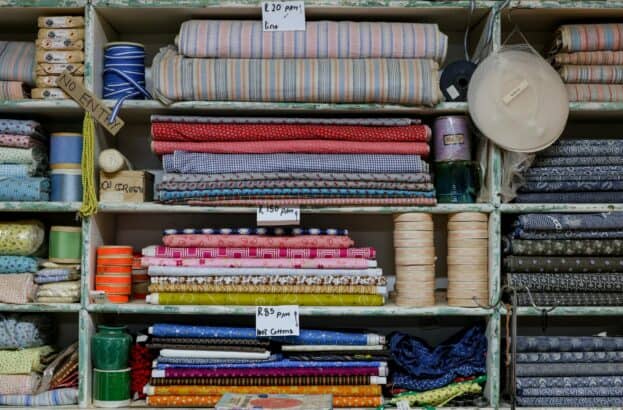
We are leaving on Nov. 24 for Egypt, pyramids, cruise on the Nile, Sphinx, Aswan, the works. Any suggestions for not-to-miss and what-to-buy? Anything textile related? This list is the best for sharing.
Sarah
Date: Sat, 11 Nov 2006 21:41:56 -0500 | From: Karen Evans
Marie Webster misdated a lot of patchwork patterns by up to 100 years. She also was one of the people who started/perpetuated the whole “patchwork started with thrifty Colonial housewives using their scrap bags” myth that is still believed by many people in the non-quilting community.
Karen Evans
Date: Sun, 12 Nov 2006 11:23:53 +0200 | From: adi hirsh (adamroni)
Definitely not to e missed – Street of the tentmakers – and in Arabic Sharee el-Khayammi – accross Ramses street from the main tourist bazaar, Khan el-Khalili. There you can see men sitting on low platfors and hand-stitching unbelievably beautiful applique wall hangings, bed covers etc. Motifs are traditional islamic – i.e. arabesques, floral and vegetal, although for the tourist trade some will produce applique copies of famous wall painting scenes from the ancient tombs. They are called tentmakers because before the advent of mass produced and cheap printed fabrics, they used to prepare the hand appliqued mourning tents used for condolence visits in Islamic funerals. Their work ia amazing and well worth taking home. The street where the tentmakers work is the main Cairo local (as opposed to touristy) market, and is fascinating by its own right.
Have a wondeful time Ady in Israel
Date: Sun, 12 Nov 2006 04:21:00 -0800 (PST) | From: Pat Cummings (pat)
Like war, taxes, and the dust in my house, the Hidden in Plain View Myth will go on and on and on, amid false claims and disgruntlements and complaints. I don’t like unpleasantness, but I also did not create this situation. The responsibility for that lies elsewhere. To lie down in the road to be run over by a ten wheeler truck of deception is a little much to ask.
As far as explaining why the secret quilt code is not feasible, in terms of quilt blocks and their names, I’ve already made a stab at doing that. The file is still online for anyone to read. If someone knows more information about those historical details, that has not been provided, please share it with us.
As a quilter and needleworker, I am a creative person, and this whole HIPV issue has been a major sidetrack. Yet, I’ve taken time from my own work to keep addressing the issue, ONLY because it keeps coming up. However, the fact remains that my words either preach to the choir, as I had said previously, or tick off those who are not in accord with my opinions and those of other serious quilt historians on this list. We have all been working hard to dispel the myth.
Today, I shall go into my studio to work on something lovely. I shall play enchanting Celtic music, and I’ll try NOT to think of this thorn-in-the-foot topic.
I shall also give a silent prayer of thanks for ALL of you. Isn’t it great that we live in a country where the voices of ALL can be heard?
The price of your personal freedom has been great and continues with the sacrifices of many!
Adiós, amigos y amigas – Make it a good day!
Patricia Cummings http://www.quiltersmuse.com
Date: Sun, 12 Nov 2006 5:23:25 -0800 | From: suereich
Bless you, Pat. You have expressed in words our situation with HGRR perfectly. Have the best day, and thanks for all of your contributions to the world of quilt history. Yesterday was Veteran’s Day. Once again, we were all reminded just how costly freedom of speech has been and will continue to be in our country’s history. Please, don’t be discouraged. You have been an inspiration and leader for many of us on this subject. Our voices can be heard but we must persevere. Like those who protect our freedoms, we must raise our guidon and carry on. Most sincerely, sue reich
Date: Sun, 12 Nov 2006 08:24:01 -0500 | From: Karen Evans
I just posted several excellent history links to the quilting community on the LiveJournal blogging site. The community is very informal and has lots of new quilters on it, so I thought that giving them links to people like Kris, Leigh Fellner, Pat Cummings, the AQSG and Judy Anne would be a good idea.
Happy Sunday, everyone!
Date: Sun, 12 Nov 2006 09:18:22 EST | From: Mitzioakes
I was very excited when my daughter moved to Cairo, Egypt a few years ago – think of all that Egyptian cotton!!!!! Wrong – all she could find for good fabric was polyester!!!!! Maybe you will be luckier – what textiles she did find, shrunk horribly! But the atmosphere and history was well worth her time there….she was there on 9/11 and was told by her superiors (in an American College) that she should not stand out as an American – well, she is almost 6′ tall and has red hair – ‘How could I not stand out, Mom?’ But she loved the country. Mitzi
Date: Sun, 12 Nov 2006 09:21:49 EST | From: Mitzioakes
Smiles and love to you – I will live by your words today – Amen! Mitzi from Vermont where it is raining cats and dogs……
Date: Sun, 12 Nov 2006 10:04:50 -0500 | From: joan kiplinger (jkip)
Mitzi — Egyptian strains of the best quality are made from American Pima strains and Brazilian Sea Island strains blended with the few quality strains Egypt grows. Egyptian cotton by itself is fair to middling, and needs imports to produce quality stuff. Come to think of it, Egyptian cotton per se as the symbol of quality is a myth that belongs in the UGRR category. LOL
Date: Sat, 11 Nov 2006 22:13:21 -0800 | From: Peggy Gelbrich (quilter)
Hello again, After some internet searching I’ve learned about vacuuming antique quilts. I will do just that. I don’t want to damage the quilt in any way. I would appreciate any input any of you have and would like to send a picture of it to anyone who’s interested.
Thank you, Peggy Gelbrich
Date: Sat, 11 Nov 2006 21:59:37 -0800 | From: Peggy Gelbrich (quilter)
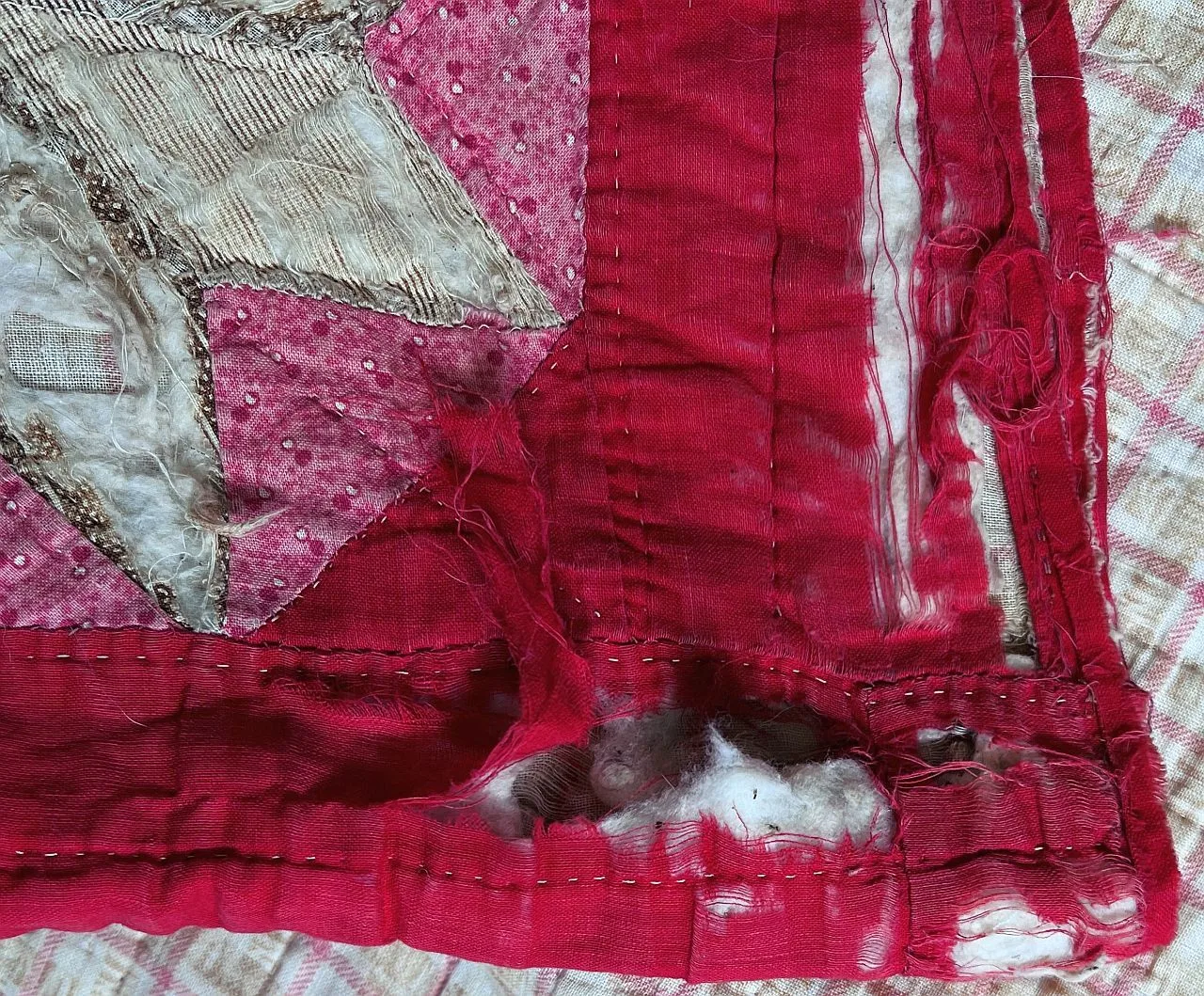
Hello, I’m a newbie to the group and I’m sure this topic has been covered. I was fortunate to find a red and green appliqué quilt today at an antique show in Southwest Washington. It’s in fairly good shape except for some spills that have faded, or bleached some of the fabrics. Some of the red fabric is quite thin. Would this be Turkey red?
It does have some staining but not extremely dirty nor does it have a bad odor. Do I wash it or leave as is. When I get an old quilt (not as old as this one) I soak in warm water with Biz until the water is clear, rinse, spin in the washer then lay out to dry. I don’t want to damage this quilt. Can you make a recommendation or direct me to a book or website that might help.
Thank you very much,
Peggy Gelbrich www.yellowhosuequilter.com
From: Merry May
Re: USA Today article
I wonder why they didn’t include the DAR Museum, or the MAQS in Paducah??? Merry May
Date: Sun, 12 Nov 2006 09:46:26 -0600 | From: Charlotte Bull (charlou)
Thanks Louise. I was really pleased to see the Bountiful Fruit Basket quilt. It is lovely. It is also historically interesting. I do wish more of you QHL folks would post pictures on eboard! cb in mo oz
Date: Sun, 12 Nov 2006 10:03:33 -0600 | From: Force Majeure Quilt Restoration (fmquilts)
De-lurking to also recommend Laurel Thatcher Ulrich’s book “The Age of Homespun.” Taking eleven objects that have been passed down in families, she dissects the stories associated with them from the actual history that can be discerned from the object. In many cases, she finds quite a disparity — a major theme of this book is that the stories about these objects reveal more about the values/desires/aspirations of the contemporary family (or society) than they do the original owner.
That certainly seems to be the case with the UGRR myth.
Date: Sun, 12 Nov 2006 10:45:57 -0600 | From: Sarah Hough (dougandsarah1)
Many thanks for your comments. Americans can’t help standing out. We just look “different” but that’s OK.
Sarah
Date: Sun, 12 Nov 2006 13:54:23 EST | From: Mitzioakes
Hey, come on! I am having enough t rouble with the UGRR/quilt myth, don’t need to have another one giving me gray hair (not to say there is any left to turn that color) Thanks for the input tho, I learn the best things every day on this list. Happy Rainy Sunday from Vermont ‘Mitzi
Date: Sun, 12 Nov 2006 14:31:55 -0500 | From: joan kiplinger (jkip)
American cotton is still the best there is. Without upland aka California cotton, our bath towels would be gerflunken as a friend used to say about anything which flunked. LOL
Mitzioakes wrote:
Hey, come on! I am having enough t rouble with the UGRR/quilt myth, don’t need to have another one giving me gray hair (not to say there is any left to turn that color) Thanks for the input tho, I learn the best things every day on this list.
Date: Sun, 12 Nov 2006 17:04:35 EST | From: QuiltEvals
So many people from QHL have asked me to email trip updates that I thought I would update the entire list. I have planned a quilt study trip to England & Wales for 2007. The 2007 tour will be somewhat different from this year’s UK trip, and will begin and end in Manchester making stops in York, London, Bath, Birmingham, and Llanybydder, Llanidloes, and the Isle of Anglesey in Wales. The trip has been planned in August, in consideration of those who have requested a summer tour and the entire itinerary is designed so that it will expose one to an insider’s view of British quilts and quiltmaking traditions which have a played an important role in the world’s quilt history. Once again, we will have access to behind-the-scenes museum archives, seeing incredible quilts and printed fabrics which are rarely available for public viewing. At the suggestion of previous travelers, next year’s itinerary will also allow participants to fly directly from their home city if they desire, which also gives them the opportunity to spend time before or after the tour on their own to explore England. For the full itinerary and registration, please refer to the website at: www.textiletour.com (http://www.textiletour.com) For a photo gallery from this year’s tour to the UK, go to: www.quiltappraiser.com/BritishQuiltImages06.htm (http://www.quiltappraiser.com/BritishQuiltImages06.htm) Related antique quilt surprises and special visits are in the works! Registration is limited to 30 people, so do sign up early to avoid disappointment. And yes, significant others are welcome! Warm Regards from So. CA, Deb Roberts
Date: Sun, 12 Nov 2006 19:32:02 -0500 | From: Teddy Pruett (aprayzer)
My local PBS channel has just begun a special on the Centennial Exhibition – it may be elsewhere if yall are interested. I am watching with one eye and writing a new lecture with the other one – I have to give this new lecture on Tuesday night. Early preparation, that’s what I’m all about!!!!
Teddy Pruett www.teddypruett.com
Date: Sun, 12 Nov 2006 19:46:00 -0500 | From: Teddy Pruett (aprayzer)
So sorry – that show isnt about the exposition at all, just about basic history of the time. That’s what I get for watching TV. It turned my brain to mush. I’ll never write again……..yeah, yeah, yeah.
BTW – I am in the market for a velvet Elvis painting. If yall come across one in a yard slae, let me know…….I hate velvet Elvis paintings, of course, but I feel a quilt coming on………..and now Teddy has left the building.
Teddy Pruett www.teddypruett.com Only a few of the lies they tell about me are true.
From: Nancy Smith
WQSG will be meeting this coming Saturday the 18th at a member’s house, Laurie MaGee.
During the morning we will be discussing the characteristics of quilts made during 1850-1880 and share any quilts we may have in our own collections from the era. Also, bring any quilt history books you have duplicates of. We will be swapping our duplicates with others.
Lunch will be at her house with a field trip to the museum afterwards. Laurie is making soup and sandwiches. (Thanks Laurie!) The museum is going to have 1850-1880 quilts available for us to study. There is a $5 fee for the field trip.
Sounds like a great day. If you are able to join us, please contact me (info below) or Laurie at the phone number above. Hope to see you on Saturday! 🙂
Nancy Kunst Smith
From: Judy Schwender
Hi all, The article was about where folks could find African American quilts, either in volume or those of note. Judy Schwender