November 4 – 11, 2003
This page contains affiliate links. If you buy through them, I may earn a small commission at no extra cost to you. As an Amazon Associate I earn from qualifying purchases. Learn more
These restored messages come from the Quilt History List, an online forum where quilt historians, collectors, researchers, appraisers, and enthusiasts discussed antique quilts and related textiles. The archive dates from 1996 through approximately 2016 and is being restored gradually. Sign up in the form at the bottom of the page if you want to know when a new page is added. Original spelling, opinions, formatting, and inactive links may remain unchanged.
Primary topics of this QHL Digest:
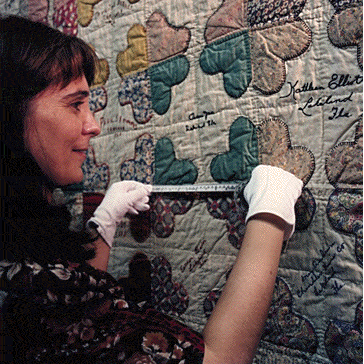
- Signature Quilt documentation project launched — Following discussion at the AQSG conference, a member announces a new project to collect and centrally document Signature Quilts by state. (see the article on state quilt documentation books)
- 19th-century quilt poetry and prose series — A recurring feature relaying newspaper accounts of Civil War-era quiltmakers and quilt-related poetry, continuing across several days.
- Blue-dyed battings, continued — The blue batting dye debate from the prior weeks continues, with more first-hand and secondhand accounts. (see the article on natural dyes)
- Studio Quilt Study Group meeting announced — Details and travel logistics for an upcoming Studio Quilt Study Group meeting at a new museum in Lititz, PA. (see the article on quilt study groups)
- Colored cotton history — A discussion of naturally colored cotton, including Sally Fox’s work developing colored cotton varieties.
- Quilts tied to historic figures and events — Members discuss quilts with documented ties to notable history, including an English Ladies’ Work Society piece and a quilt connected to John Brown.
Date: Tue, 4 Nov 2003 | From: “Jean Carlton” <jeancarlton@
Thanks Marsha and
several others who had info on crazy quilts using = fabric from high
button shoes/linings. Is there a way to see a photo of = the one at
MSU museum?=20 jean
Date: Tue, 4 Nov 2003 07:13:10 -0500 | From: Debby Kratovil <kratovil@
Connie. I think the blocks you are seeking are those done by Ruby
McKim. I have all of them in a photocopied collection: Patchwork
Parade of States, 1931. I am redrafting them, including the text so
that I can modernize them and produce them on CD. The other set,
which are embroidery, I am also digitizing. I know that Merikay
Woldvogel (she’s on the QH list) has a picture of that finished
quilt in her book, Softcovers for Hard Times (I think it’s that
book). Again, that is a set done by Ruby McKim, and I have those
patterns also. That series is called: State Flowers Quilt, 1931.
— Debby (with a “y” and not “ie”) Kratovil
http://www.quilterbydesign.com http://www.ipriority.com
Date: Tue, 4 Nov 2003 | From: “Candace Perry”
I
received a lovely invite from a lovely group — the Main Line Quilters
near Philadelphia. They are having a “Quilt Roadshow” on Nov. 22
from 9:00 to 3:00 at Berwyn United Methodist, 140 Waterloo Ave. in
Berwyn PA. They are having appraisals at $5.00 per quilt, and will
be having a “mini-quilt show” and a special display of
antique doll quilts and buttons (now that’s something I haven’t
given much thought to…buttons!). If you’re in or around the great
city of Philadelphia check it out! Candace Perry Schwenkfelder
Library & Heritage Center Pennsburg PA
Date: Tue, 4 Nov 2003 | From: Annette Gero <A.Gero@
For anyone visiting in
Australia.. May Gibbs house is just wonderful Australian
Quilt Exhibition Saturday 8th November to Sunday 14th December
2003 At Nutcote the former harbour side home of May Gibbs,
creator of Children’s books Snugglepot & Cuddlepie. A
special six-week exhibition of Australian quilts is being hosted at
Nutcote. Curated by Annette Gero, renowned quilt historian and
authority on early Australian quilts, the exhibition has a flora and
fauna theme. Dating from around the time of WWI to the present time,
the visually stunning quilts and appliqu=E9 work will provide a very
special display in historic Nutcote .In addition, dress designer of
the 1940’s, Eve Felstead’s applique clothes will be on
display. The exhibition runs from Saturday 8th November to
Sunday 14th December. Nutcote is open Wednesday to Sunday, 11am to
3pm and is situated at 5 Wallaringa Avenue, Neutral Bay, Sydney.
Nutcote is easily accessible by ferry from No. 4 Wharf Circular Quay
(alight at Hayes Street Wharf Neutral Bay – then 5 minute
walk). Admission: Adults $7.00 Concessions $5.00 Children
$3.00 Family $17.00 Phone (02) 9953 4453
Date: Tue, 4 Nov 2003 | From: Beth Donaldson
Dear Jean, I am currently putting many quilt
images on line at our website at http://museum.msu.edu/glqc/index.html.
This quilt is next in line and should be up late this week. You can
also see this quilt on the cover of Great Lakes, Great Quilts and it
is featured in American Quilts from the Michigan State University
Museum and Michigan Quilts 150 Years of a Textile Tradition. These
books can be purchased at: http://35.8.122.90/MTAPStore/category.asp?time=104029&category=QOT.
Beth
Date: Wed, 05 Nov 2003 20:13:33 -0500 | From: Palampore@
After talking with
many people at the AQSG Conference about how we could put together a file
on Signature Quilts, Nancy Hornbeck graciously offered to be the
collector of information until a better solution/storage site could be
found. Nancy does a wonderful job with research, so it is wonderful
that she is willing to do this. Many of us thought that it would be
great to have a central person who could collect information on
Signature Quilts that could then be used by genealogists, other collectors
of Signature Quilts, etc. This information would probably be filed
primarily by states. The ultimate goal is for this to end up on a quilt
site available to whomever wants to use it. We see it as something
that will be eventually become part of a quilt organization—not
our personal property. If you have a Signature Quilt that you would
like to register with Nancy please send her…. 1) Name and address
of present owner 2) Photograph (digital and hard copy if
possible—several shots–entire quilt, individual blocks, style of
signatures) 3) Names, dates, and sayings on quilt 4) Pattern name,
and colors of quilt 5) Where quilt was purchased or acquired (ie:family)
6) Diagram of the quilt, if you think it is necessary and tells more about
the quilt 7)Any history you have on the quilt—names, name of
quilter, etc. 8) Describe the quilting 9) Give measurements of
quilt, and of blocks 10) Additional information that is unique to
your quilt Please put this information on a disc, and copy on
paper, and then send both to Nancy. For consistency write all information
in Microsoft Word. If I left out anything please let me know, or
just post it to QHL and I will add it. If it seems to be a popular
idea we will devise a data sheet and make it available. Nancy
Hornbeck, nancy96@ 201 Circle Drive Wichita, KS
67218 This will be a great reason now for me to do a better job of
the documentation that I have done on my quilt collection. I hope others
will follow suit. Look forward to hearing from those who might be
interested in doing this. Lynn Lancaster Gorges Textile
Conservator Historic Textiles Studio New Bern, NC New Bern,
NC www.textilepreservation.com
Date: Wed, 5 Nov 2003 | From: “judygrow”
Since
I got your e-mail, Judy, I assume you haven’t been unsubscribed.
I get at least one of those e-mails every day from my “good
friends” in Congo, or Zimbabwe. I’ve set my “Message Rules”
to delete them from my server, using key words that seem to pop up
in sequence in all the messages, and still they get through. I’ve
got a great spam blocker and don’t get the V____a or enlargement
ads, but yet these scam artists squeeze under the fence. How do they
do it? Judy in Ringoes, NJ j
Date: Wed, 05 Nov 2003 20:40:29 -0600 | From: Gail Ingram <gingram@
Lynn, are quilts without significant provenance desired, those we
cannot trace to origins? gi
Date: Thu, 6 Nov 2003 05:50:38 -0600 | From: Carla Rowley <rowley35@>
Lynn, I read with interest your post about the proposed Signature Quilt file. Was there any discussion regarding collecting information on Signature Quilt blocks which have not been set together into a finished quilt top? I bought a set of these several years ago at the Nashville Flea Market and wish that I knew something about the women who signed and embroidered their names.
It sounds like a terrific project! Carla Rowley
Date: Thu, 6 Nov 2003 | From: DDBSTUFF@
Here is the description and a
link to the quilt: Sale 2241 Lot
102 Pieced and Appliqued Cotton Civil War Memorial Quilt,
made by Mary Bell Shawvan, c. 1863, composed of solid color and
calico printed cotton, depicting a central spreadwing eagle with
shield surrounded by meandering flowering vines and grapevines
with perching birds; the leaves, flowers, birds, and fruit,
stuffed for a three- dimensional effect, black silk accenting the
birds’ wings and tails, yellow-orange floral print ground, dark
green scalloped border quilted in a scallop pattern, off-white
muslin backing, (minor imperfections), 84 x 81 1/2
in. Provenance: By family descent. Note: According to
oral family history, the quilt was made by Mary Bell, or Polly as
she was known to her friends. in 1854 she married John Shawvan,
then began farming in Dodge county. By 1860 they had six children
and though John had substantial family obligations, he enlisted,
at 34 years of age, into the Union army October 26, 1861 and was
assigned to Company B of the 1st Wisconsin. He was later promoted
to the rank of Sargeant and was a flag bearer in many battles.
Mary assumed full responsibility for the farm, managing the
household and caring for the children. During the time he was
away she created this quilt for him to share when he returned home.
But unfortunately his company was sent to Tennessee and into the
bloody two-day battle at Chickamauga. He was wounded on the
second day of fighting and died on Sept. 22, 1863 from wounds he
received at the battle. Polly and the children were left to rely on a
Civil War widow’s pension. Included in the lot is a needlework
sampler stitched by “Polly M. Bell” age 11,” (Mary’s
nickname) with silk threads on a linen ground; also photocopies
of a few signed affidavits regarding Mary and John Shawvan,
probably helping to provide compensation to the widow and children,
including: John Shawvan’s Certificate of Service, a document
signed by the Justice of the Peace verifying he married the
couple July 14, 1844, a document signed by Sally Bell, the mother
of Mary stating that the births and birthdates of the couple’s
children entered into the family bible are correct. Also included are
some photocopied pages from the Military History of Wisconsin,
regarding the Battle of Chickamauga. In it John Shawvan is listed
as dying of wounds received in the battle.
Literature: This quilt and the family’s story is illustrated in the
book Wisconsin Quilts: Stories in the Stitches, by Ellen Cort,
Howell Press, Charlottesville, Virginia, 2001, illustrated on the
cover and on pp. 42 and 44. Estimate
$50,000-75,000
–part1_105.390a8779.2cdc7303_boundary–
Date: Thu, 06 Nov 2003 15:48:06 -0500 | From: “Velia Lauerman” <velialive@
So sorry about the caps
in my mail. will try to keep it short and sweet and not shout it
out. Went to a wonderful Quilt Show in Berrien Springs, Mich. Nov
1. The old magazines and patterns were sold in see thru baggies.
I bought a few. The treasures are priceless. The old tattered
Ladies Art Company, Quilt Pattern Book was inside but I’d like
another better copy . Does anyone have a 1922 copy for sale.? There are
so many wonderful old patterns which I find joy in collecting.
Thanks a bunch, velia
Tell a friend about this site:
Date: Fri, 7 Nov 2003 | From: mreich@
19th century quilt poetry and prose. (A Civil War Veteran quilter.)
When we documented quilts for the Connecticut Quilt Search Project, we found three male quiltmakers who had been soldiers in the Civil War. It was neat to find this accounting of a male quiltmaker/Civil War Veteran in a 1902 Pennsylvania newspaper. sue reich
New Oxford Item, New Oxford, Pennsylvania, April 11, 1904. Novel Piece of Patchwork.
John Billingsley, an inmate of the Soldier’s Home, has completed a unique patchwork quilt, upon which he has been working for two years past. The quilt is made entirely of satin and sateen, and is designed to depict the glories of the Union as they appear to an old soldier. There are 984 distinct pieces and 1,132,755 stitches in the article. The spread is a little over five feet square. In the centre is a large star, made up of small diamond-shaped pieces. In this star are set portraits of Washington, Lincoln, Grant, Garfield, and McKinley photographed upon silk. The star is surrounded by 24 badges of the army corps of the civil war and by 45 national flags representing each state. Then there are the flags of eight foreign nations with which the United States at some time or other has been engaged in war.
The quilt is bordered with parallel stripes of red, white and blue and edged with a fine gold fringe. The whole is artistically put together and reflects credit upon the workmanship of the maker. Billingsley was a member of the Eighty-first Pennsylvania when the civil war began, but later entered the service of the regular army. –Washington Post.
Date: Fri, 7 Nov 2003 | From: Xenia Cord
Is there any hope of recovering and seeing the quilts described in these accounts of quilts connected to the Civil War? Xenia
Date: Fri, 7 Nov 2003 | From: “BOBBIE A AUG” <qwltpro@>
Gail, While I do not have one with nursery rhymes, one that I have has the pattern number overstitched on each hemmed edge. It is 19th century. It is, “PAT. 18.30.4” and I don’t have others like this. I would be interested to know if others have seen similar pattern identification on theirs. Bobbie Aug
Date: Fri, 7 Nov 2003 | From: “Julia D. Zgliniec”
Good Morning Everyone, A few weeks ago, while attending a quilt show, I stopped by the show’s “Pink Frog” booth to see what I could find. After rummaging around in a box of old patterns and what not, I found a bag of old papers and catalogs for $1.50. I figured there would be at least one thing of interest – so I bought it!
Well…. one of the things in addition to an Ann Orr catalog was, Aunt Ellen’s complete Art Needlework – catalog no. 8. There is no date – so I am wondering when this might have been published by Modern Handcraft, Inc. from Kansas City. The second page has a letter from Aunt Ellen and the picture is of a factory that says “Home of Aunt Ellen’s Workbasket.” It also goes on to say “As a WORKBASKET subscriber, you are entitled to an Aunt Ellen’s Needlework Club Member discount.” Is this different than the Workbasket magazines?
The reverse of the cover page shows stamped designs for a State Bird Quilt and a State Flower Quilt. These are stamped blocks. Yet another variation on this theme?
Does anyone have any information on this catalog? Regards, Julia Zgliniec
Date: Fri, 7 Nov 2003 11:20:09 EST | From: Hazelmacc@
Perhaps this blue batting everyone has spoken of is not wool but is cotton. I have a quilt with a background that appears tinted green — when I had it washed my friend was quite surprised when the water turned green. As the quilt dried the color was less and less green and now appears tinted. Luckily we had learned from Rabbit Goody that cotton growers in the early 1900s attempted to grow cotton in colors. I have seen a quilt batting in Williamsport PA museum that is pink.
When visiting a friend in No. Carolina she gave me a sample of the cotton that growers there are trying to grow today — it is brown. Hazel Carter, No. VA
Date: Fri, 7 Nov 2003 | From: “Julia D. Zgliniec”
Good Morning Again! Here is a link to a brief page about Sally Fox who has been developing various colors of cotton since the 80s. http://www.foxfibre.com/sally_fox_story.htm
Type Sally Fox and Fox Fiber into your browser and you will get other links with information about colored cotton. Julia Zgliniec (my other hat is a spinner’s cap)
Date: Fri, 07 Nov 2003 11:49:54 -0500 | From: aol.com
Hm. It sounds from Lynne Bassett’s description as if this is a bright indigo blue, but I haven’t actually seen one. Interesting idea. I know there was a line of organic tinted cotton clothing a few years ago (pastel green, pink, yellow and beige) but wasn’t aware that they were doing it so long ago. Interesting…. Karen Evans
Date: Fri, 7 Nov 2003 | From: “Maurice Northen”
Hazel and all, When this was last discussed I did some research in the book EARLY AMERICAN WEAVING AND DYEING by J. & R. Bronson, sub-titled The Domestic Manufacturer’s Assistant and Family Directory in the Arts of Weaving and Dyeing. (Mine is a reproduction of the 1817 version) on page 159 are “the directions for an excellent Black on Woollen: to produce a superior black, you must in the first place dye the cloth a light indigo blue in the warm dye which to be done before fulling; then full and it for coloring.”
Yes indeed, in Texas we grow several colors of cotton, green and tan most common, there is a yellow, but poor. Joan of the South
Date: Fri, 7 Nov 2003 | From: “Sally Ward”
An English researcher with whom I discussed the question of dyed battings happened shortly afterwards to be visiting the Netherlands, where a contact told her that dyed battings are not unusual, and indeed that they didn’t seem to worry about putting dark battings into light coloured quilts. One suggestion was that the indigo dye was regarded as ‘hygienic’. This might tie in with the suggestion of the habit arising in the US because of the scarcity of water as a resource, and so a good cleansing hot dyebath was not to be wasted.
We still can’t find evidence of dyed battings over here, but then in the UK we don’t tend to be short of the odd swift-flowing stream or two to cleanse the fleeces. Sally W
Date: Fri, 7 Nov 2003 | From: [from unknown]
core badge star quilt
There is a picture of a cotton and silk star of Bethlehem quilt, circa 1901, with military core badges and 4 president’s pictures on it, in Sandi Fox’s recent book on California Quilts. It’s on page 104-107. I saw it in person and it’s most unique. The president’s pictures are in sepia tone on heavy cardboard, which is glued to a larger square piece of fabric, which is then appliqued to the quilt. The background color of the top is bright yellow, with all the other colors of the rainbow in the star. The core badges, from hats I believe, maybe shirts, of soldiers, were used to identify which group they were with as the head soldiers could not always remember, so the story is told. These pages are actually symbols, with a number on them too. They are also in bright colors. This quilt has flags and possible tobacco premiums around the star and in the corners of a red, white and blue border, which is surrounded by yellow fringe to finish it off. It is hand quilted and made entirely by a man, an injured soldier of the Spanish American War, it is believed, but no provenance is known. It has been in the owner’s family for many years. It measures 79-96.
For more information, if you have the spring 2003 issue of Blanket Statements, there is a blk & wh picture of a portion of it and an article I wrote with more information on it. Kim Wulfert www.antiquequiltdating.com
Date: Fri, 7 Nov 2003 | From: “judygrow”
Studio Quilt Study Group meeting coming up
The November meeting of Studio Quilt Study Group will be on Tuesday the 18th at the Pennsylvania Quilt and Textile Museum in Lititz, Pa., the brand new museum that Judy Kelius directs, and you are invited.
The museum is only open by appointment now, although Judy says it will have a grand opening probably in December. Here’s a little teaser about what we will see at the Museum in Lititz. http://members.ebay.com/aboutme/paquiltmuseum/
Judy Kelius has planned a wonderful day for us, which I am quoting below: 10 AM – Noon: On arrival, go directly to Museum. We are going to set up a large table with chairs around it so we can meet and lay out quilts that are not hanging. I thought we could start out by looking at the quilts on display. There are about 40 quilts plus many extras, so knowing this group, I don’t think they will get bored. Noon – 1 PM: Lunch. 1:00 – 1:30 or whenever: Tour of the Kready’s Country Store Museum. 1:30-3:00 or whenever: Return to the Quilt Museum and look at more quilts — our collection has around 100 now, so there are plenty more in storage to look at (actually, some of the best are currently stored). I can pull out the ones I think people will be most interested in seeing. I can also show you a notebook I put together which contains photos and descriptions of everything we own, in case you would see something you think I missed.
If you are coming from a distance, you might want to consider coming on Monday and spending the night. Judy recommends the Warwick Inn on Route 501, less than a mile from the museum. Their rate is $87 (includes continental breakfast) or $78 with an AAA or AARP membership. This is a small, fairly new place, the nicest in Lititz. The Warwick Inn number is 1-800-264-7143. A few of us have already made our reservations there. My husband, Allan, has said he wants to share the day too, so I’ve got my roommate. I think other husbands might find they actually enjoy spending the day with us, and they are most certainly welcome, as are other friends you may want to share the experience with.
If you can give me an indication of how many of you would want to come and spend Monday night I can call and see if we can get a better rate. Put your pajama parties together yourselves, or let me know if you want roommates and I can act as a clearing house to put people together.
I need to give Judy a list of all those who will be there at least a week before so that the food can be ordered and prepared, etc. So, I am going to arbitrarily set Monday, November 10th as the deadline for responding.
Directions for getting to Lititz: Take the Pennsylvania Turnpike West to Exit 21, Denver/Lancaster/Ephrata. When you come out of the toll gates, stay left and turn left on Route 222 South. Go about 6-7 miles to the second exit on 222 for Route 772. Stay right at the end of the exit ramp and take 772 into Lititz (about 6 miles). As you come into Lititz, you will go past the light at Locust Street. Then look for Water Street on the right (across from the Linden Hall School for Girls and the Moravian Church). There is no light at Water Street, but there is a sign for Brunnersville and Clay. Lititz Junction is in the first block on the right, plenty of parking in front. If the main door isn’t open (especially for latecomers), there is an intercom buzzer to ring to be let in.
There will be a flat fee of $15 per person which will include lunch and admission to the two museums. They will do a sandwich buffet lunch with beverages and dessert for the group. They usually have soup as well. Judy says she has seen what they do for other groups and it is always very nice. Judy in Ringoes, NJ
Date: Fri, 7 Nov 2003 | From: mreich@
19th century quilt poetry and prose (A memorial for Veteran’s Day)
I have read parts of this article before. I think that Virginia Gunn published the part relating to quilts in an Uncoverings paper. Here is the rest of the story. sue reich
The Coshocton Age, Coshocton, Ohio, March 11, 1865. Woman’s Sympathy for our Soldiers.
There is a touching pathos in some of the markers attached to the blankets, shirts, handkerchiefs, and the like, sent to the Sanitary Commission for the soldiers in camp and hospital. Thus on a bed quilt was pinned a card having this tender inscription: “My son is in the army; whoever is made warm by this quilt, which I worked on for six days and most all of six nights, let him remember his own mother’s love!” Who can doubt that these simple words have made some weak one strong again, filled some sad heart with joy and hope?
On a pillow sent to the commission was written: “This pillow belonged to my little boy, who died resting on it; it is a precious treasure to me, but I give it to the soldiers!” On a box of beautiful lint was this inscription: “Made in a sick room, where the sunlight has not entered for nine years, but where God has entered, and where two sons have bid their mother good-bye, as they have gone to the war.” What a spirit of sacrifice and saintly heroism shines through this little sentence; sunshine, joy, sympathy, coming out of the shadow, the camp fire and the hospital. But the tenderest of all inscriptions we have seen is this, written on some eye-shades; “Made by one who is blind. Oh! How I long to see the dear old flag you are all fighting under.”
Date: Fri, 7 Nov 2003 | From: “batwoman522 aka [Arlene Marin]”
Hi Judy, I can’t wait. I am really excited. My husband, Mahmoud Sami, will join me. He will probably do his own thing, take pictures in and around the area. Please include us in your list for overnight. Can we get together for dinner? I have AAA and AARP; see if you can do any better. Thanks, Arlene Marin
PS. There are lots of quilts to see there. Are we supposed to bring our own too? Overkill?
Date: Sat, 8 Nov 2003 13:26:44 -0500 | From: “Lynne Z. Bassett” <lzbassett@>
No, really, it’s wool–not cotton. Lynne
[Quoting Hazel Carter’s earlier post:] Perhaps this blue batting everyone has spoken of is not wool but is cotton. I have a quilt with a background that appears tinted green — when I had it washed my friend was quite surprised when the water turned green. As the quilt dried the color was less and less green and now appears tinted. Luckily we had learned from Rabbit Goody that cotton growers in the early 1900s attempted to grow cotton in colors. I have seen a quilt batting in Williamsport PA museum that is pink. Hazel Carter, No. VA
Date: Sat, 8 Nov 2003 13:56:17 -0500 | From: “Lynne Z. Bassett” <lzbassett@>
In New England, where I found the dyed quilt battings, water is definitely not scarce (witness the hundreds and hundreds of water-powered mills that popped up all over the region in the 19th century), but I certainly wouldn’t be surprised if a dyebath was used for as long as possible. I sure wouldn’t want to haul all that water for just a small project!
Sally, do you have any period references to the idea of indigo dye being considered hygienic? I find the idea surprising, considering that urine is such an intrinsic part of the indigo dyeing process, which was well known for its stench. Best, Lynne
[Quoting Sally Ward’s earlier post:] An English researcher with whom I discussed the question of dyed battings happened shortly afterwards to be visiting the Netherlands, where a contact told her that dyed battings are not unusual, and indeed that they didn’t seem to worry about putting dark battings into light coloured quilts. One suggestion was that the indigo dye was regarded as ‘hygienic’. This might tie in with the suggestion of the habit arising in the US because of the scarcity of water as a resource, and so a good cleansing hot dyebath was not to be wasted. We still can’t find evidence of dyed battings over here, but then in the UK we don’t tend to be short of the odd swift-flowing stream or two to cleanse the fleeces. Sally W
Date: Sat, 8 Nov 2003 20:21:35 -0000 | From: “Sally Ward” <sallytatters@>
Sorry Lynne, it wasn’t my suggestion…passed to me third hand but from a very reputable source. I’ll see if I can find out more. Sally
[Quoting Lynne Bassett’s earlier post:] Sally, do you have any period references to the idea of indigo dye being considered hygienic? I find the idea surprising, considering that urine is such an intrinsic part of the indigo dyeing process, which was well known for its stench.
Date: Sat, 8 Nov 2003 17:58:05 EST | From: aol.com
An indigo exhaust bath produces a faint mintish green color, not blue. I got a nice batch of green linen from one once, but the color wasn’t light fast so I didn’t do it again.
Also, an indigo exhaust bath is quite obvious. Anyone who did any dyeing at all would know instantly that the result wouldn’t be blue…. Karen Evans, Easthampton, MA
Date: Sun, 9 Nov 2003 09:13:04 -0500 | From: mreich@
19th century quilt poetry and prose
Here is another Civil War account that includes a quilt. Reading it will take you beyond sadness, however, it depicts the realities of war. sue reich
The Gettysburg Compiler, Gettysburg, PA, November 11, 1862.
A touching scene is related as transpiring in a Philadelphia hospital recently. Some benevolent ladies had distributed ice cream to the invalid soldiers, and all gladly partook of the refreshment, save one young, pale, handsome boy. His eyes were closed, and one of the ladies observing him, whispered, “the poor little fellow is asleep; we must not disturb him.” “No, ma’am, I am not asleep,” he answered, in a silvery voice, full of the sweetness of innocence and boyhood. “Well, my little fellow,” continued the lady, as she drew nearer, “are you fond of ice cream?” “Very much so,” he replied. “Didn’t you see me place this on your little table?” reaching for the plate of cream. “Oh, yes,” he answered, tremulously, “but I shut my eyes and cried to myself.” “Cried, my child? Why, what made you cry, my dear?” “Oh, madam! If you pull the quilt down a little you will see.” The lady did so, and found that he had no arms. Both of them he had lost in battle.
Date: Sun, 09 Nov 2003 21:41:04 | From: ikwlt@
just this evening i was at a party when a friend took me out to her truck to show me her “find.” the lighting was poor, but i immediately recognized the vintage aunt martha patterns that were in the box. too many and too dark to look thru tonite, but there were also some transfers that i haven’t seen before so i brought one home to see what i might find out about it. it is a vogart pattern, this one happens to be #215 which is “a flower a day for your kitchen” and has artwork depicting the designs on tea towels, an apron, placemats and napkins. on the back bottom it says “VOGART CO., INC., 275-7th Ave. N.Y., N.Y. 10001” all of the patterns appear to be unused and uncut. i’ve found references to vogart patterns on the internet, mostly e-bay auctions and websites that sell vintage items, but no real information about them. can anyone give me something concrete? thanx so much. patti in scorched san diego
Date: Mon, 10 Nov 2003 | From: jlgunter@
I am acquiring a quilt that has a connection with the English Ladies Work Society. The society orginated in Brompton Road, London and then moved to Oxforshire. That is all I know about them, and I am looking for additional information about the society. Could anyone direct me to a source of information, or provide anything else about the history of the group? Thanks.
Judi Gunter
Date: Mon, 10 Nov 2003 | From: “Julie Silber” <quiltcomplex@>
Has anyone seen another of this design. It is definitely a kit — it still has its little blue dots. But which company and when… anyone know??? Thanks Julie Silber (click on the thumbnails below)
Date: Mon, 10 Nov 2003 | From: “Celia Eddy” <celia.eddy@>
Dear Jan,
In issue 3 of Quilt Studies, the Journal of the British Quilt Study Group, published in 2001, there is an article by Bridget Long entitled A Study of a Late 19th Century Appliqué Coverlet. The coverlet was made by the Ladies Work Society and the article contains information about the Society as well as a full description of the coverlet.
I’m sure that Bridget would be happy to give you further information about the Society and if you contact me privately I will give you her details.
Please reply to me at celia.eddy@
Celia Eddy
Date: Mon, 10 Nov 2003 | From: <mreich@>
Our version of historic relic in this story about John Brown’s (a Connecticut son) death would be the quilt. Don’t you just have to wonder what became of it? sue reich
Herald and Torch Light Hagerstown, MD December 19, 1889
JOHN BROWN’S IRONS Historic Relics That Once Served Beecher for an Object Lesson.
James N. Atwood, of Livermore Center, ahs in his possession the veritable “leg irons” worn by John Brown during his imprisonment previous to being hanged. H. Atwood, Jr. (Company I, First Maine Volunteers) was at the jail shortly after John Brown’s death. The officers in charge of the buildings vouched for the identity of the irons at the time and Mr. Atwood was thoroughly satisfied with the proof. He also formed the acquaintance of the old negro and his wife who had the care of the cell where Brown was confined. On the day of the execution the old man, being afraid that he should forget which pair of irons it was, tore a strip from the key of the shackles, but the old negress, his wife, said: “Law! I didn’t forgit de whole nuttin, for it was de only pair o’ irons in de whole jail where de key turn de wrong way.” (It was a left-handed key.) Untying the dirty strip of calico from the key, Mr. Atwood went to Brown’s cell and found the torn place in the quilt, the figure of the cloth matching perfectly. Mr. Atwood tried to buy the shackles from the authorities, but they good naturedly told him they had no right to sell; then he made this proposition: “If those irons should disappear and a new pair be found hanging in their place would there be any investigation?” They answered him, “probably not.” He then paid eight dollars for a new pair and made the transfer on his own responsibility. The shackles were sent home to Mrs. H. Atwood, Jr., but the journey was interrupted several times. Rev. Henry Ward Beecher took them upon the lecture platform. They were on exhibition for a week in Portland, Me. The Portland Historical Society were very anxious to get possession of them. The society’s rooms were destroyed afterwards in the great Portland fire. For a few years previous to the death of H. Atwood, Jr., the shackles have been on exhibition in the museum in connection with the Boothbay Custom House. Mr. Atwood, after returning from his services to the war, entered the Free Will Baptist ministry. He was a brother to James N. Atwood, who now has these shackles in his possession. The present proprietor prizes them very highly, and says that they are not for sale, being almost the only souvenir he has of his departed brother.
Date: Tue, 11 Nov 2003 | From: WileneSmth@
I don’t know if this is “old news” or not, but if not, it’s an amazing piece of work by Lois Jarvis of Madison, Wisconsin.
Click on the image of the quilt repeatedly and it will zoom in and zoom in until you can see the faces of the people who perished in NYC that awful morning. Then scroll down to the bottom of the page and click on the various links for more about the quilt and its maker. –Wilene
Date: Tue, 11 Nov 2003 | From: “Celia Eddy” <celia.eddy@>
Does anyone know of any ways in which the Japanese paper folding craft is applied to quilt making today?
Thanks in advance for any information.
Celia Eddy
Date: Tue, 11 Nov 2003 | From: JBQUILTOK@
The flower gets lost in an image of a face when I look at that — it probably wasn’t a best seller!
Janet Bronston
Date: Tue, 11 Nov 2003 | From: “Carol H. Elmore” <celmoreksu.edu>
I recently learned about the following digital photo library from Indiana University through one of our library lists:
http://www.dlib.indiana.edu/collections/cushman
I typed in quilts in the search box and got several images with quilts.
It’s an interesting collection of photographs/slides that I thought some of you on the list might be interested in viewing. Probably all of your Indiana people already know about it.
Indiana University has other digital collections at this website:
http://www.dlib.indiana.edu/collections/
The Hohenberger collection also has quilt images. Maybe some others do too.
Carol Elmore Manhattan, Kansas
Carol H. Elmore Research Services Librarian Veterinary Medical Library College of Veterinary Medicine Kansas State University Manhattan, Kansas 66506
Date: Tue, 11 Nov 2003 | From: <mreich@>
No more sad stories of veterans and the Civil War. To honor those brave men and women who have sacrificed for our freedoms, this poem that is a return to Autumn is most appropriate. sue reich
New Oxford Item New Oxford, Pennsylvania November 13, 1891
WHEN THE LEAVES TURN RED
There is a purple peacefulness that covers nature’s features. Like a many-colored-bed-quilt o’er a baby’s trundle bed, Nature covers all us children, nervous, tired little creatures, Nervous, tired little children, whether Princes, popes or preachers; When the leaves turn red.
And she spreads her gaudy bed-quilt, all aglow with golden glory, For she knows ‘twill please her children and decoy them off to bed. They drift off in their gorgeous cribs, like babies in a dory. Down through misty, hazy valleys that we read about in story; When the leaves turn red,
A balm that’s full of sleepiness envelopes hill and river, An air that’s full of sweet content o’er all the earth is spread, We know we dream, and yet we pray to be awakened never, For ‘tis the prayer of every soul to dream right on forever; When the leaves turn red. – S.W. Foss, in Yankee Blade
Date: Tue, 11 Nov 2003 | From: “Pilar Donoso” <quiltpdmi.cl>
Dear Ladies:
I read everyday your notes and I try to learn something new from all of you and keep notes when I can. I am a History teacher, but before that, I am a Passionate Quilter and Teacher. Tomorrow I am taking a bus for 11 hours to go to the north of Chile to talk about Quilt History to a group of Quilters. I don´t think I am ready because every day I discovered something I didn´t know before (Thanks God for that), and I am nervous about talking in front of people I don´t know.
I would like to thank everyone of you for sharing your knowledge and the help I received from some of you in some specific subjects. I hope my brain will go along with me in this trip
I think I will open this 4 days exposition, forum and speeches with Pat Cummings letter “Para mis amigas”, with her permission of course. Thank you Pat.
Wish me luck Thanks Pilar Pilar Donoso I. Santiago, Chile quiltpdmi.cl
Date: Tue, 11 Nov 2003 | From: “judygrow” <judygrow@>
Pilar,
I am sure you will do very well! I gave my first speech in October and got some very good advice beforehand from two knowledgeable ladies on the list.
From Xenia, I was told that “an expert is someone from the next state who comes with slides.” As you are travelling 11 hours, I am sure you will be coming from far enough away to be considered from the next state.
From Judy R. I was told, “When you speak to historians concentrate on quilts, and when you speak to quilters concentrate on history!”
Both pieces of advice helped me trememdously. Good luck to you! Let us know how it all went when you get back home.
Judy in Ringoes, NJ judygrow@ —–
Date: Tue, 11 Nov 2003 17:16:06 -0800 | From: <chrisa@>
Hi Celia- This book may help you with your question. I believe this author has also written book on folding fabric and applique.
FOLDED FLOWERS : FABRIC ORIGAMI WITH A TWIST OF SILK RIBBON , Kumiko Sudo Breckling Press 2002 (Click on the title for more info)
Kim Wulfert
Date: Tue, 11 Nov 2003 | From: “Candace Perry”
Just happened upon the John Brown story. I worked for a MARVELOUS historical society in Louisville called the Filson Club (some good quilts there, unfortunately no museum curator at this time) and we had, among our oddities, a scrap identified as the a fragment of the blanket John Brown slept under…I do believe it was a brown check hand spun linen, but that was a long time ago… Incidentally, the Filson has some of the most significant Lewis and Clark collections in the country. Apparently they have a new exhibit downtown on L & C — so if you’re in Louisville it’s a must see (along with my other old stomping grounds, the KY Derby Museum). Candace Perry
Date: Wed, 12 Nov 2003 | From: “Sandra Wilcox” <sgwilcox@>
There’s a recent quilting book on exactly that topic. It’s called Quiltagami. The book covers technique rather than history. I believe Kumiko Sudo’s last 2-3 books on pieced flower designs in the Japanese style are based on origami as well. Rebecca Watt’s book Fabulous Folded Flowers (I think that’s the exact title) seems to include ideas similar to origami. Again, this is all contemporary quilting. You could also check out Jackie Robinson’s book on Three Dimensional Quilts. One shortcut to making the old bow-tie block involves an origami technique, but I don’t know where that originated. Hope this is useful. Sandy Wilcox
I was hoping that someday, one of these newspaper accounts would trigger someone’s memory of a quilt relic that was buried in a museum or historical society. It would be hard to prove without DNA analysis that it was in fact used by John Brown, however, I hope that we all keep looking and not discount these odd findings. Do you think I should send the John Brown article to the museum? sue reich
Date: Wed, 12 Nov 2003 | From: “Candace Perry”
Sue, I would love to say yes, that someone would know what this was all about, but I fear I was really the last curatorial type they had there (as far as I know!), and I was last around, in a part time capacity in 1998. I am sure they would call me up and say what the heck was I talking about? It’s almost like the blanket, or whatever it was, was cut up as relics of the great man. Candace Perry
Date: Wed, 12 Nov 2003 | From: “Laura Fisher” <laurafishernetlink1.net>
japanese quilt expert Kei Kobayashi wrote a book several years ago showing how to create any quilt pattern using origami. I think it has been translated into English. The American Folk Art Museum Library may have it.
Date: Wed, 12 Nov 2003 | From: danabalsamo@
Hi all, I apologize for the cross posting:
Went to the Newark Museum Quilt seminar last weekend…fabulous!! There was a speaker who was a textile conservationist who was very informative, albeit I wanted to question one thing she said…when conserving pieces, she stated that they would rather use fabrics stronger than those previously used, rather than a period piece. Hmmm… So in my search to trying to find her online to question her (J. G. Row, please check her bio in back of the newsletter I gave you…she’s the young one in the upper right hand corner on the back page…Kate Barker, is there any info on her?) I went to the website her newletter had on it and it is a fabulous site!
www.rap-arcc.org
Explore it all and all its links. There are all sorts of archived newletters with all sorts of info about quilts and fabric, and various texiles, folding and restoring and hanging. I need a new printer cartridge…I ran out of ink!
Check all the bibliography for the newletters Check this one out, this is where Kate Barker was affiliated:
http://www.rap-arcc.org/welcome/tcwsite2.htm
Look at all the links of the RAP members (Regional Alliance for Preservation).
Make sure the hubby is tied up, kiddies are to bed, and you have a cup of coffee…you’ll be awhile.
Enjoy, Dana
Date: Wed, 12 Nov 2003 | From: Gail Ingram <gingram@>
Several weeks ago, Lynn Gorges raised question re “quilts made up of teal/brown/cheddar fabrics in the last quarter of the 1800’s, which show up the most (but not only) in the southeastern US.”
There has been little response that I’ve seen.
Lynn’s question was two-fold, I think:
1) Is there a regional connection in these colors and if so, why?
2) Do they reflect a fashion or other, larger color trend of the late 19th century?
It would be interesting to hear from members re their own experience/knowledge about such quilts and the basis for their popularity.
As Lynn noted in her query, many of these with brown are mistakenly identified as “faded”/”fugitive” greens, when in fact, the fabric color was that dun-brown color from the outset.
From the hills of North Louisiana, where summer just keeps coming back, Gail