December 23 – 26, 2003
These restored messages come from the Quilt History List, an online forum where quilt historians, collectors, researchers, appraisers, and enthusiasts discussed antique quilts and related textiles. The archive dates from 1996 through approximately 2016 and is being restored gradually. Sign up in the form at the bottom of the page if you want to know when a new page is added. Original spelling, opinions, formatting, and inactive links may remain unchanged.
Primary topics of this QHL Digest:
- Kathryn Berenson and “Quilts of Provence” — Members help locate contact information for this French quilt historian and her book on Provençal quiltmaking.
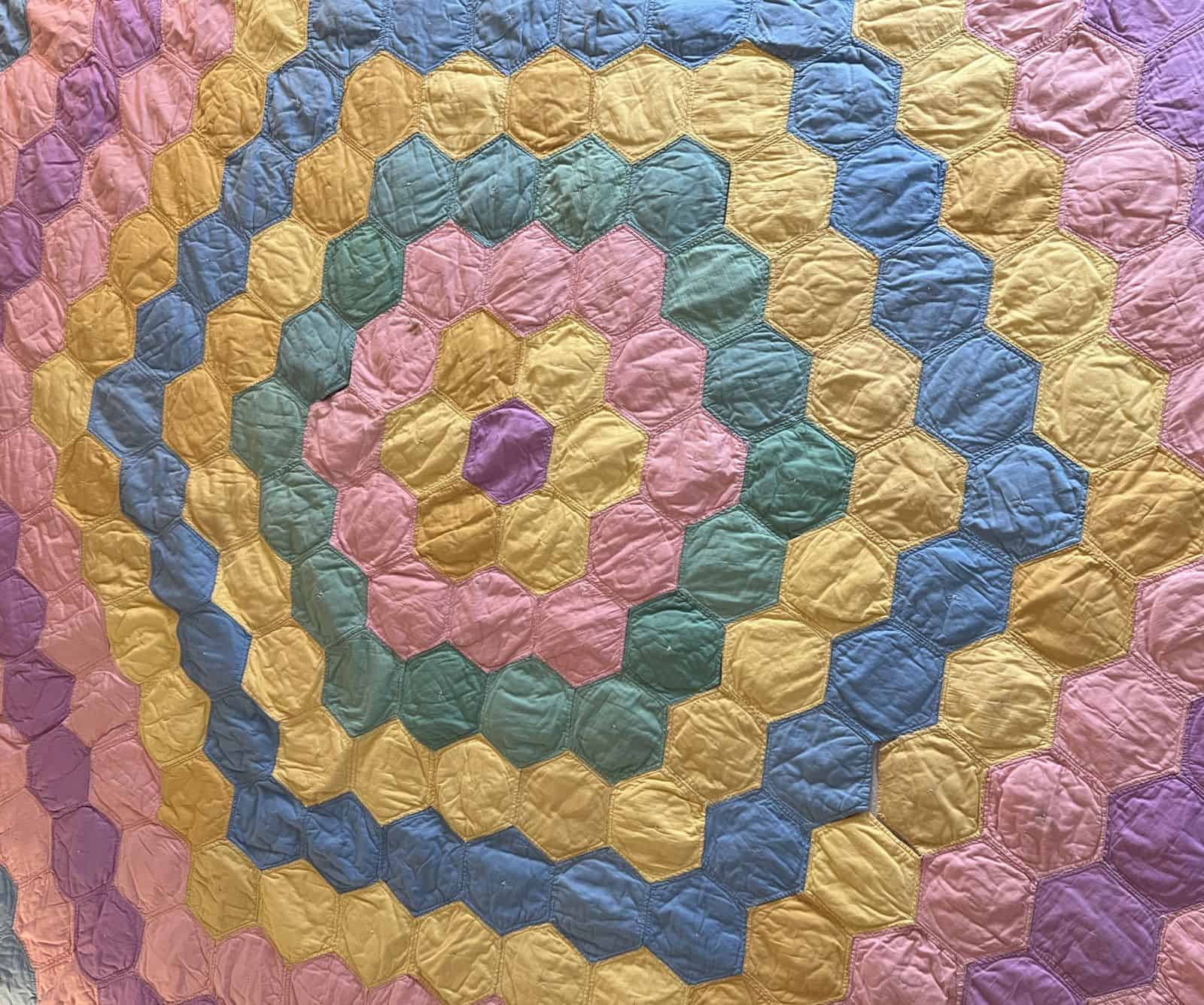
- “Fussy Cutting” vs. Hexagon/Honeycomb Piecing — A clarifying discussion distinguishes fussy-cut fabric placement from the hexagon (honeycomb) piecing technique. (see the article on Grandmother's Flower Garden quilts)
- Holiday Greetings from Around the World — Members exchange Christmas and New Year’s greetings from as far afield as Sydney and Chile.
- Sanitary Commission and Red Cross Wartime Quilts, Continued — The Civil War and WWI charitable quilt research continues with new sources on survival rates and fundraising quilts.
- A “Civil War” Quilt Sold at Skinner Auctions — Members follow up on a previously discussed quilt sale at the Skinner auction house. (see the article on a Civil War quilt)
Date: Tue, 23 Dec 2003 | From: Joan Kiplinger <jkip@>
Right on, Gaye, you echo what I always feel about despots. The journalist’s description provided a stark contrast of humankind’s ability to produce finery and beauty on one hand and on the other hand to destroy it with acts of brainless deeds.
Gaye Ingram wrote:
>As we ponder this subject, I am struck by a recurring question: do you think >the people at Lockerby or the parents of students from Syracuse U who would >be parents themselves by now or any of those who loved people on that plane >that went down in Scotland would care what the Libyan Brother Leader lives >under? but loving our neighbor does not include excusing his atrocities. I >don’t think there is enough pink chiffon in the Middle East to disguise Col >Khadafi’s crimes against humanity. > > > >
Date: Tue, 23 Dec 2003 | From: Joan Kiplinger <jkip@>
Sally — guess I am. I’d say the gent is sharp on men’s apparel but chiffon?? No way. Someone clued him in — the Fab 5 perhaps were on hand??? 😀 Alan and Don — is there any way you can post your shamiana and quilt to eboard??
Sally Ward wrote:
>Not being sexist there are you Joan? <G>. I think any man who can tell a >designer camouflage shirt from an army one, and notes when calf-length boots >are being worn under ‘slacks’ (not common parlance amongst the males in my >household), is quite likely to know chiffon when he sees it <G>. > > > >
Date: Tue, 23 Dec 2003 | From: Donald Beld <donbeld@>
So, Happy Holidays everyone–I finally decided to learn how to post to the
vintagepictures.eboard.com to show the Gunboat Ladies quilt–thanks Joan for your
help. I wasn’t sure it was appropriate as it is a raffle quilt. Anyway, as a thank you, I also posted pictures of the unbelievable 1820’s English paperpieced Hexagon quilt I have come across in my travels. You MUST look at this quilt. Every cell is fussy cut and is unbelievable. I love the snail fabric and would die for the browns. It was never made into a whole quilt–it is just the top, but that adds to its interest and you can see the basteing stitches on the cells and on the back is the paper piecing complete with faint brown writing from the paper used. I would estimate that there are approximately 8000 individual cells in this quilt. The maker was a seamstress and used a loop hemming stitch to sew the pieces together. It is in magnicent condition and belongs to a family in Long Beach California.
Family history is that it was made in New York City in the late 1820’s by an English seamstress immigrant. ENJOY! Don Beld
Date: Tue, 23 Dec 2003 | From: “Celia Eddy” <celia.eddy@>
I wonder if anyone can give me contact details for Kathryn Berenson, the author of this wonderful book?
For those who have not come across it yet, it is essential reading for anyone interested in the history of quilts and quilt making. Both text and illustrations are superb.
Thanks in advance – I feel confident that, as usual, someone on this List will come up with the necessary information -you have never let me down yet! Although I don’t often post to it , I keep a close eye on it and find it a mine of information.
Best wishes and a happy Christmas to everyone, Celia
Date: Tue, 23 Dec 2003 | From: Joan Kiplinger <jkip@>
Don — that’s some quilt! What is fussy cutting and is hexagon the same as grandma’s flower garden??
Do you all get the impression there’s no stopping Don now that he has the key to the eboard???? 😀
Date: Tue, 23 Dec 2003 | From: Xenia Cord <xenia@>
Kathryn Berenson’s book is called Quilts of Provence; The Art and Craft of French Quiltmaking. New York: Henry Holt and Company, 1996. (published in Canada by Fitzhenry & Whiteside, Ltd., Markham, Ontario.) ISBN 0-8050-4639-9.
I believe there is also a second volume, although I don’t have it.
Publishers’ addresses if you need them – you might reach her through one or the other. She divides her time between France and the Washington, DC, area, I think.
Xenia
Date: Tue, 23 Dec 2003 | From: Xenia Cord <xenia@>
Joan’s question was to Don, but in the interim may I say that “fussy cutting” is centering design elements inside the shape before it is cut, or in some other way making the figures on the fabric serve as a second layer of design (stripes, for instance, cut in hexagons, can be lined up to make hexagonal rings of stripes).
There is a lot of fabric waste in fussy cutting, something that goes against the grain (sorry!) for most traditional quilters. Hexagons especially can be cut edge to edge with no fabric waste, if they are cut without regard for fabric design.
The pattern we know of as Grandmother’s Flower Garden, composed of hexagons in a repeating set of rings, with a yellow center and then rings of coordinated print and plain fabrics and separated by rings of white hexagons, is a 20th century designation. In the 19th century the design was known as Honeycomb or Mosaic, usually pieced over papers in the English method and joined with very tiny whipped stitches (or variations thereof).
Happy Holidays! Xenia
Date: Tue, 23 Dec 2003 | From: Judy White <jawhite@>
The gunboat ladies quilt is spectacular, Don. I’m guess that it is about 144″ square. Am I anywhere close?
Judy White
Date: Tue, 23 Dec 2003 | From: Joan Kiplinger <jkip@>
Thanx for cutting across the grain to explain this, Xenia. Also, is Kathryn Berenson any relation to the famous art collector, dealer, expert and critic, Bernard Berenson and his granddaughter actress Marisa Berenson?
Date: Tue, 23 Dec 2003 | From: “Candace Perry”
Something for you all to mull over in the next few days!
These are very brief, very early thoughts on the direction of my proposed 2005 exhibit on cotton in PA German life. I would appreciate any comments or criticisms, or “you’re full of it!” Thanks, Candace Perry Schwenkfelder Library & Heritage Center Pennsburg, PA
Cotton in Pennsylvania German Life Exhibition, Programming, Publication, Online Exhibition
Introduction
By the mid 19th century, southeastern Pennsylvania German residents had nearly abandoned the use of linen spun at home and woven by custom weavers in their rural communities in favor of readily available mass-produced cotton prints for clothing and household textiles. The array of color and pattern certainly must have delighted them, in keeping with the love of color and design that is shown in their decorative arts. These prints made into clothing and domestic objects, most specifically, quilts.
Objective
The exhibition will introduce audiences to the use of mass produced cotton fabric among the Pennsylvania Germans, and place it within its historical context. Visitors will leave with a better understanding of the roots of Pennsylvania German quilting in particular, which roughly paralleled the introduction and availability of these fabrics.
Method
1. Exhibition 4/2005 through 9/30/2005 in local history/art gallery 2. Symposium 3. Related school activities 4. Possible school age exhibit – textile printing 5. Online exhibit 6. Publication
Date: Tue, 23 Dec 2003 | From: Donald Beld <donbeld@>
“you say honeycomb” “I say hexagon”–let’s call the whole thing off–to paraphrase the song.
Xenia is, of course, absolutely right. Hexagon was an 18th century quilt pattern brought over to the US by English settlers and is one of the earliest pieced patterns–remember the more complicated the pattern, the earlier it is likely to be. Grandma’s flower garden is the 20th Century version and usually is made with bigger pieces. The earlier quilts have 1/2 inch to 1 inch pieces and were very labor intense. They probably were popular as a way to show off the maker’s skill (a sign of breeding and class in the 18th and early 19th Century).
The little, as Xenia calls them, “whipped stitches” that sew the combs together are so close and small on this quilt that when I first saw them, my heart sank because I thought they were machine which would have been impossible in the 1820’s. (yes I know there were sewing machines, but none could have made a hexagon quilt.
This quilt is so vibrant and special. The fabric colors are so bright. It dispels all the dull”browns” talk about 19 Century fabrics. I am glad you all are enjoying seeing it. The woman who currently owns it saved it from brothers and sisters who were going to cut it into four pieces so everyone could have part. Thank God she was a quilter and said absolutely not! Her work is quite good also, she is a little obsessive compulsive like I am and takes great pride in her work. She does outstanding applique pieces. I am trying to get her to donate this quilt to a good museum, but they don’t want to part with it. Time will tell. Don
Date: Tue, 23 Dec 2003 | From: “Celia Eddy” <celia.eddy@>
Thanks, Xenia. I’ll try to contact Kathryn Berenson via her publishers, as you suggest.
Happy Christmas! Celia
Date: Tue, 23 Dec 2003 | From: Joan Kiplinger <jkip@>
Thanx Don for the additional description. A treasured save by owner, indeed.
My best wishes to all for the occasion you are celebrating or observing. May it be filled with family love and surrounded by friends.
Date: Tue, 23 Dec 2003 | From: “Anne Datko” <datkoa@>
As of a couple of years ago:
Kathryn Berenson PO Box 39128 Washington DC 20016 USA 202-686-346, Fax 202-686-2034 kwberenson@
3, rue Brea 75006 Paris, France tel/fax 011-331-46-34-16-21
Kathryn gives a very nice talk, by the way.
AnneD
Date: Wed, 24 Dec 2003 | From: “kerrybrack@”
it is xmas day in sydneycheerseveryone
i have this aforementioned book and it is something i have by my bedside t o look at before i go to bedwe pay a lot more for our books h ere in australiai paid $100 for itthis book is one of those forever beautiful bookskerry Original Message: —————– From: Celia Eddy celiaeddy@btinternetcom Date: Wed, 24 Dec 2003 12:35:43 -0000 To: qhl@lyrisquiltropoliscom Subject: [qhl] Re: Quilts of Provence
Thanks, Xenia I’ll try to contact Kathryn Berenson via her publishers, as you suggest
Happy Christmas! Celia
Date: Wed, 24 Dec 2003 | From: “Ruth Cattles Cottrell”
Amazon is selling this book for quite a bit less than $100. Take a look.
Ruth
Date: Wed, 24 Dec 2003 | From: “Quiltstuff” <quiltstuff@>
Don’t forget Ruth, Kerry was talking about aussie dollars. Our dollar has gone up recently or rather your has gone down or whichever.. But at the current Amazon price of $45 US plus at least $10 postage , it would have cost well over a $100 until quite recently. And we are still paying $26 for fabric!! VBG
Suzy
Thankyou for sharing a lovely poem and welcome to grandparent society. My grandchildren range from 29 to almost 3. When the last one was born I had retired and had time to visit lots. When we rocked I would sing to him. One song is one my mother sang to me. Gradually I begin to remembered the words. But now as it is Christmas I realize I’ve again forgotten many of the words. Hence I’m asking if anyone knows the song? it is Hang the baby’s stocking, I do remember some of the lines. they are [not in order Hang up the baby’s stocking be sure you don’t forget the dear little darling has never seen Christmas yet Pin Grandma’s stocking to it and fill it to the toe….. It doesn’t take much to hold the wee little toes of Babe. I know this isn’t quilt related and I should have written the words done a couple years ago,or when my mother was around to tell me . Has anyone heard this song? May the seasons blessings be with you whatever you celebrate. Martha Grandmother to 14 and greatgrandmother of 4.
Date: Wed, 24 Dec 2003 | From: “Sally Ward” <sallytatters@>
I’ve never heard this song, but tried it in Google. Follow links on this site http://memory.loc.gov/ammem/smhtml/sm1870Titles137.html (the link to the exact page is too long to paste here) and you can get to a facsimile of the sheet music, you can even turn the pages to see the words and music.
Compliments of the Season to all QHLers, and thanks for your generous friendship.
Sally W in UK
Date: Wed, 24 Dec 2003 | From: “Audrey Cameron”
Merry Christmas to all, I know I should know, but could someone post me the information on where to find quilt pictures put up by members of the list. I would most like to see Don’s hexagon one. Thanks.
Audrey Cameron in Lincolnshire, England audreycameron@
Date: Wed, 24 Dec 2003 | From: 4
Thanks Sally and Audrey for the reference to this sweet poem. I have added it to my collection. Here it is from the site Sally gave. What a Christmas treat! sue reich
Hang up the Baby’ stocking.
Be sure you don’t forget!
The dear little dimpled darling.
She ne’er saw Christmas yet;
But I’ve told her all about it,
And she opened her big blue eyes,
And I’m sure she understands it,
She look’d so funny and wise.
Dear what a tiny stocking,
It doesn’t take much to hold
Such little pink toes as baby’s
Away from the frost and cold.
But the for the baby’s christmas
It will never do at all,
Why Santa wouldn’t be looking
For any thing half so small!
I know what we’ll do for the baby-
I’ve thought of the very best plan-
I’ll borrow a stocking of Grandma,
The longest that ever I can;
And you’ll hang it by mine, dear mother,
Right here in the corner so,
And write a letter to Santa,
And fasten it on to the toe.
Write, “this is baby’s stocking
Be sure you don’t forget!
You never have seen her, Santa,
For she only came this year;
But she’s just the blessedest baby,
And now before you go,
Just cram her stocking with goodies,
From the top clear down to the toe
Chorus
Hang up the Baby’s stocking,
Be sure you don’t forget! T
he dear little dimpled darling,
She ne’er saw Christmas yet.
Date: Wed, 24 Dec 2003 | From: DDBSTUFF@
A while back there was a discussion of the “Civil War” quilt being sold at Skinner’s Auction. I had posted a picture on the Eboards. Well, I just read where it had sold for $149,000. Yes, one hundred forty-nine thousand US dollars. Gee, its nice to know some quilts are selling for real money.
By the way, I have forgotten the Eboard password. Can someone give me a reminder.
Thanks and Merry, Merry, Happy, Happy to you all;
Darwin Bearley
Date: Wed, 24 Dec 2003 | From: “Phyllis Twigg”
If you are interested in attending the Elly Sienkiewicz lecture at the Baltimore Museum of Art on Sunday afternoon, January 4th, and need a place to stay…
Or, if you want to recuperate from the Holidays, with no cooking involved…
Or, if you think your “post-Holidays” days might need an uplift…
Then, women, I have an offer for you!
The Baltimore AppliquE9 Society will be holding a retreat the weekend of January 2,3,4 about one hour south of Baltimore. It will be an easy going, rest, chat, read, or sew what you like (doesn’t have to be appliquE9) event, with five delicious meals and two nights waterfront lodging for only $99.
Please email me for additional information on how you can join us! Phyllis Twigg ptwigg@
Date: Wed, 24 Dec 2003 | From: “Jeff ‘n Sheri Lesh” <jefflesh@>
My husband were home by ourselves for the first time in 30+ years, so we went to a movie in the afternoon. I wanted to recommend it to you. It is a moving story, the battle scenes were accurate and heart rendering. As well as the situations of the Home Guard, what a horrid group of people they were. If you go, watch for the textiles too. Ada, played by Nicole Kidman wore a quilted apron that the camera pans, there was a quilted bonnet, and the details on a couple other shot of blouses and pillow slips were wonderful too. The story is not necessarily pro north or south, but more really anti-war. The dissolution of soldiers going to war with one idea, and the reality has changed them and repulsed them.
We also happened to see a show on Tuesday evening on the Discovery Channel, they did a repeat of the History Explorered on Gettysburg, then followed it with Cold Mountain Revealed, or something like that. I might not have the name exactly. I would assume they will show it again, so you might want to look for that. They talked about the book the movie is based on as well as true situations that happened that are portrayed in the movie. The historical background to the Home Guard, etc. So you might want to look for that also.
I’d be interested to know what you all come away with this movie with.
Sheri in windy, but warm Iowa I have not yet seen the movie Cold Mountain yet but thought you might want to know that most of the textiles used in it are reproductions woven at Family Heirloom Weavers, a wonderful place owned by good friends of ours, David and Carole Kline and their son Patrick. They live in Red Lion, PA and have a shop on 795 Dietz Road, York, PA 17402. The ingrain carpet, stair runners, uniform materials, bedcoverings, etc. were woven especially for this project. They make many carpet reproductions for historic houses and wonderful Jacquard, or figured and fancy weave coverlets, and shaft-woven coverlets and placemats to order. Patrick has developed a wide line yard goods many used by Civil War re-enactors for costume and daily use. They are great craftspeople and designers and have a wonderful building full of early refurbished period looms. They do have a website too <familyheirloomweavers.com>.
Date: Fri, 26 Dec 2003 | From: Judy White <jawhite@>
Darwin, here’s the address to eboard.
vintagepictures.eboard.com
Judy White
Date: Fri, 26 Dec 2003 | From: “Laura Fisher” <laurafisher@>
I just remembered I had an intriguing Sanitary Commission Quilt that I sold several years ago to the Lynn, Massachusetts Historical Society. It is documented in Jennifer Regan’s book “American Quilts and the Stories They Told” (it’s probably out of print, if someone needs further info I can probably find my copy and xerox the chapter on the quilt)
It is pieced in the Wheel of Mystery or Winding Ways pattern. Each white pie shaped segment of this red and white fundraising quilt contains cursive writing in ink that records the activities of the Boston Street Aid Society, a women’s Methodist Church group, in relation to the Sanitary Commission — making and sending shoes (the town was a center for shoe manufacturing); sending bandages, collecting money, etc.
Jennifer did research in the town archives to document the quilt for the book. When the town learned of the quilt, they undertook a fundraising campaign to acquire it. This made the quilt have the lovely distinction of raising money twice, in two centuries, for good causes!
Laura Fisher ——_
Date: Fri, 26 Dec 2003 | From: Kittencat3@
Question: how many of the original Sanitary Commission quilts are left? I read somewhere (Hearts & Hands, perhaps?) that almost none had survived the war because they were literally used until they shredded. Is this true, or do some still exist?
Then again, there’s all sorts of buried treasures in local historical societies…I’m waiting until after the holidays to check out a few in western Massachusetts. Should be fun, and a lot more stimulating than the usual “it’s January in Massachusetts so let’s all hibernate until maple sugar season” mode that everyone seems to go into on January 2nd. 🙂
And before it’s too late: Merry Christmas, Happy Solstice, Happy Channukah, Happy Kwanzaa, and a joyous, peaceful, and prosperous New Year to one and all on the list.
Lisa Evans Easthampton, Massachusetts
Date: Fri, 26 Dec 2003 | From: “Laura Fisher” <laurafisher@>
I have a fun quilt depicting the White House that I would like to get more information on if anyone on the list may have knowledge of this pattern.
It shows the familiar portico view — the semi circular bay with columns, the fountain on the lawn down in front, the trees flanking it, etc. — all done in applique in traditional 1930s style and colors.
I have seen a lot of 1930s quilts, but never this one before. I hope, but don’t know, if it is unique. Does anyone have any knowledge of it?
Thanks and happy new year to all.
I look forward to the continuous fountain of fascinating information from QHL in 2004! It is such a pleasant respite from having to straighten up my shop to be able to read about quilt and textiles thanks to the diligent efforts of the members of the list!
Date: Fri, 26 Dec 2003 | From: Donald Beld <donbeld@>
Regarding the survival of the Sanitary Commission quilts. There were two types of Sanitary Commission quilts and a few of each type survive. First was raffle quilts–frequently made of silk and used to raise funds for the Northern War cause. There are several of these still existing. They usually were raffled at the Sanitary Commission Fairs that were held around the North in major cities to raise funds and supplies for the war cause. There is the one mentioned on the list today, one at the DAR museum in Washington that is a duplicate of a quilt given to Lincoln, one in St Louis that was a presentation quilt to Sherman that he donated to a raffle (Cuesta Benberry was nice enough to tell me about that one).
The other type of Sanitary Commission quilts are the ones given to soldiers for use by them on the front or used in the military hospitals as bed covers. These are the quilts they requested to be 50 by 84 inches and were called “Long Quilts”. I know of only five of these quilts that have survived, but there are probably others in family attics and the family doesn’t know what they are. The DAR has one, a musuem in New England has one (I am not sure which one), the A.K.Smiley Library/Lincoln Shrine in Redlands, Calif has one and it is one public display, and there are two documented by Brackman as being in private hands. To the best of my knowledge the Smithsonian doesn’t have one.
The reason so few survived is that they were worn out and discarded during the war; and when soldiers died, they frequently were buried in their quilts as there was a shortage of wood coffins.
Remember that to be a genuine Sanitary Commission quilt, they must be ink stamped on the back with one of the several stamps used by the Sanitary Commission to mark donated items–they stamped everything, socks, clothes, quilts, etc.
I wrote an article in the Winter 2002 issue of American Quilters (Society) Magazine about America’s responses in times of War, and the Lincoln Shrine quilt and the delightful story that goes with it is featured in that article. The article, of course, was brillantly written by me, and although the magazine didn’t footnote my article, it did in fact have foothotes and references. I, personally, think this is wonderful area of research on our history and the contribution of American quilters. If anyone finds another real Sanitary Commission quilt I hope they let us–and especially me–know about it.
Another area of research in this area is the Red Cross quilts from WWI. I would love to come across one of those also–more of them exist in museums and private hands and I suspect more of them survived than the Sanitary Commission quilts. Don Beld
Date: Fri, 26 Dec 2003 | From: “Sally Ward” <sallytatters@>
> Another area of research in this area is the Red Cross quilts from WWI. I would love to come across one of those also–more of them exist in museums and private hands and I suspect more of them survived than the Sanitary Commission quilts. Don Beld
Hi Don
I’ve been trying to research the Red Cross quilts for several years over here, since I stumbled upon the small collection in the keeping of the Quilters Guild of the British Isles. Their story is very similar to that of the Sanitary Commission quilts – there were fund raisers, and ones to be used. Although I very recently heard the story of one which appears to have done both. This year it was returned to its place of making in Canada after the death of its elderly gentleman owner. He had kept it all his life along with his family bible. When I saw pictures of the quilt being handed over I was astounded to see that it was a signature quilt which must surely have been made as a fund-raiser and then shipped over for use in war relief. It will be going on display in Sault St Marie in the new year, and I’ll send more information then.
In all my time of seeking, and leaving my name everywhere and anywhere, I’ve managed to find and photograph about 20 of these quilts here in the UK, and own three. They have a distinct style of making and use of materials which identify them, but like the Sanitary Commission quilts they can only be regarded as authentic if they still carry their small red and white ‘Gift of the Canadian Red Cross’ label. Again like the SC quilts I am sure many were worn to extinction. A few survive with their stories, but most turn up in flea markets and a poor condition.
I’ve tried many places for documentation but there just isn’t any….my theory is that the record keepers were men who didn’t see any difference between a quilt and a blanket <G>. I can’t even find Red Cross records about organisation and methods, although I could tell you the exact specifications for boxes of bandages. The small pieces of information we do have point to the quilts having been made and shipped in many thousands. What I can tell you is that every time I have found one with an original owner they speak of how they brought colour and brightness to an existence which was very monochrome. As time wore on and manufacturing focussed on the war effort there was no paint and no new textiles to brighten homes where blackout blinds were left up all day, or windows painted or covered with brown paper so the arrival of bright fabrics on a warm covering was something which left a lasting impression. And for those who were displaced by bombing or relocation they were a godsend.
I’m sorry, I can bore for England on this subject. That’s probably enough for today <G>
Sally W in UK
Date: Fri, 26 Dec 2003 | From: <mreich@>
There are many surviving WW I, Red Cross quilts in the U.S. In addition, almost all of the 20th century, town histories and archives in Connecticut contain detailed information regarding the activities of organizations, and detailed descriptions of Red Cross chapters and their fundraising efforts for WW I. The rules for Red Cross chapters were fairly strict, (even including specific ways to dress) so much so that some organizations had to by-pass the rules to be involved in the War effort. Connecticut’s documentation book, “Quilts and Quiltmakers Covering Connecticut” has an examples of two Red Cross quilts. One is in the collection of the Connecticut Historical Society. It follows the directions given in the 1917 Modern Priscilla for the construction of a fundraising quilt. The other is on the same page. It is a photo of a Red Cross worker (dressed to look like a nurse) standing in front of another signature, fundraising quilt of a different style. At least two other documentation books have quilts that follow the Modern Priscilla design; one of them is the Arizona D-Day book. I was privileged to be able to research for the bio the Connecticut Red Cross quilt.
I found so much information throughout our state that I am convinced that this was the last great fundraising effort in our country. Organizations and Red Cross chapters set up to work in shifts – 24 hours a day. There were fundraising quilts of all sorts, signed and unsigned. There were quilts sent to the front and those that stayed at home.
I have a quilt with a WW I story. My neighbor in Ohio gave it to me nearly 30 years ago. When she first told me the quilt’s story, I balked and thought it was not true. Having researched for “Quilts and Quiltmakers,” I now believe it to be true. The quilt is a “Hole in the Barn Door” from the 3rd quarter of the nineteenth century probably from Iowa. It came to Ohio with my former neighbor’s mother when she married. During the War, my neighbor’s sister had a boyfriend who was going to the Front. He came to visit them with another soldier, also, headed for the Front. My neighbor, Bertine, and her mom and sister had to quick piece a quilt to cover the fainting couch where this young soldier was going to sleep. So they took this old quilt top, used a blanket as a bat, put on an equally old batting and tied it with the wool yarn they were using to knit socks for the War effort. I
have since found a WW I, Modern Priscilla featuring direction for knitting socks for the War. The recommended wool is exactly the same yarn used to tie the quilt. My neighbor was a teenager at the time of the War. I now believe her story about this quilt is true. I treasure this humble little quilt and give it a place of honor on my dining room table every fall. If our quilts could only talk!!! If Bertine had just given me this humble little quilt without its story, I would have never known its significance. How many more quilts have this same kind of story to tell? sue reich
Date: Fri, 26 Dec 2003 | From: “Judy Kelius (judysue)”
>The other type of Sanitary Commission quilts are the ones given to >soldiers for use by them on the front or used in the military hospitals as >bed covers. These are the quilts they requested to be 50 by 84 inches and >were called “Long Quilts”.
<img align=”left” alt=”sampler.jpg (34594 bytes)” border=”2″ height=”173″ src=”./03360_files/sampler_small.jpg” width=”100″/>If I ever read about the size of these, it didn’t sink in! Very interesting. I have had several tops that were around this size . . . I wonder if they could have been intended for the Sanitary Commission? In fact, I just sold one on eBay (http://cgi.ebay.com/ws/eBayISAPI.dll?ViewItem&item2581680627) that could easily be Civil War period – it was a sampler top, 46 by 73″, a little smaller than 50 x 84, but approximately same dimensions. It seemed like a finished design, but maybe a border was intended? I thought it was meant for one of those narrow beds under the eaves. We’ll never know, but the Sanitary Commission connection seems a definite possibility. Someone could have gathered up a few odds and ends of quilt blocks and assembled them for this purpose.
Date: Fri, 26 Dec 2003 | From: barbara s
i am a young quilter, and maybe thats why i never heard of this, but im fascinated with it and would like to thank you for sharing that info. i plan on doing some more research online, and maybe even the library may have something.
happy holidays,
barbara in indiana
Barbara S.
from Indiana
Date: Fri, 26 Dec 2003 | From: “Sally Ward”
Hellos sue!
Well, this is why I mention the RC quilts whenever I have the chance, because you never know when information will turn up. I’ve contacted all sorts of Red Cross archivists and been told there is nothing for me to look at!
We can find information about the fund-raising quilts quite easily, because they usually stayed in the US with the raffle winners and were much prized, but not about the organisation of the construction of the utility quilts that were sent over here. The quilts themselves vary between ones which we reckon must have been donated tops, because of their quality and intricacy of design and some really rough and ready examples. I’ve seen crazy quilts, blocks, even a strippy. Many have baptist fan quilting, but as many more are tied or very roughly grid quilted – they certainly look as if they were done in a frame with ladies on both sides with different quality stitches. The backing fabric is more often than not flannelette pyjama fabric, striped in blues or pinks or greens, or else plain pastel colours. The edges are almost always finished by turning the backing over to the front.
What we don’t know is how the organisation worked on the ground….if you can find the answers to these questions you will have found our pot of gold <G>
*was backing fabric centrally distributed, or was it just what was available in every home town store and recommended?
*same question about the wadding (batting) which is almost inevitably white cotton batting which has worn incredibly well (although blankets were sometimes used)
*was fabric for the tops donated by companies, bought by the red cross, or donated by the makers (we think this unlikely because of the sheer quantity)?
*the Red Cross were meticulous about directions for other projects, so did they dictate size and construction techniques, or did the makers have a freer hand?
*how were they collected, transported and shipped?
*did anyone keep central records of numbers?
Its almost too late to find anyone who actually worked on these quilts. I’ve had a few leads, but they tend to dry up without producing anything. Anything at all you can give me would be wonderful….I am gradually collecting my information, photographs and stories and will probably ultimately give it all to our Quilters Guild of the British Isles archives. May I add your quilt’s story to that file?
Sally
Date: Fri, 26 Dec 2003 | From: Xenia Cord
Apparently the Red Cross used fundraising and care package quilts effectively during the world wars; the quilts from WWI seem to have been primarily fundraising, while the quilts in WWII were donated, especially to people in England.
The instructions in Modern Priscilla in December 1917 were directed toward small groups of women, or even individuals, suggesting that they could make a difference if they completed a quilt and the fundraising as directed in the article. By soliciting names for both sides of the quilt, and by obtaining signatures of notables for the center, quiltmakers could buy an ambulance, many pounds of knitting wool, bedding for over 100 hospital beds, or quantities of bandages. There was even a sample “ticket” form to use when obtaining signatures and funds. The specific nature of the donation made the quiltmakers feel intimately involved with alleviating suffering.
There are quite a few of these quilts, with varying formats, still in museums and private hands; by their very nature, signature quilts eventually lose their public appeal as the signers become less recognized and the raison d’être less critical. Especially those quilts that were raffled or auctioned and thus passed into private hands come onto the market because their purpose and impact have become less important. The local museum in my town has one that is identical to the one shown in Modern Priscilla, and contains the names of the president, the governor, the mayor, and several other dignitaries. It was apparently never auctioned, but was given to the Red Cross chapter by the church circle that made the quilt. It was subsequently given to the historical society. I know about several others, also in museum collections.
Sally Ward has written about the other Red Cross quilts, those sent “overseas” from the US and Canada for the benefit of those more immediately affected by WWII, the Blitz, relocation, and other hardships.
Xenia
Date: Fri, 26 Dec 2003 | From: Xenia Cord <xenia@>
A Google search for “Red Cross Quilts” will turn up a number of sites, including these:
http://www.redcross.org/press/other/ot_pr/030312quilt.html http://www.redcross.org/article/0,1072,0_332_455,00.html
There are also links to the Changi quilts, which are dramatic and noteworthy in their own right, and other quilt references.
Xenia
Date: Fri, 26 Dec 2003 | From: “Sally Ward”
Two apologies: First, I was so excited by Sue’s reply that I didn’t read it properly and realise she was talking WW1, not 2, and second, because I have mail diverted to a separate folder for anything Red Cross, I thought I was replying to a private email, not a list one. I wouldn’t have gone on at such length otherwise. Can you tell its an obssession<G>
Sally W
Date: Fri, 26 Dec 2003 | From: “Pilar Donoso” <quiltpd@>
Dear Laura :
As a proud owner of a reproduction Sanitary Commission Quilt made by Don Beld, (sent it to me as a present), I would love to have any information you have about this quilts, since I pretend to put it in a show in Chile and talk about this kind of Quilts.
Any information will be welcome since I don´t have too much access to books and information from here.
Thank you, Pilar
Pilar Donoso I. The Quilt Shop Vitacura 7867 Santiago, Chile Fono/Fax 211 9877 EMail: quiltpd@