April 4 – 10, 2006
These restored messages come from the Quilt History List, an online forum where quilt historians, collectors, researchers, appraisers, and enthusiasts discussed antique quilts and related textiles. The archive dates from 1996 through approximately 2016 and is being restored gradually. Sign up in the form at the bottom of the page if you want to know when a new page is added. Original spelling, opinions, formatting, and inactive links may remain unchanged.
Primary topics of this QHL Digest:
- Is Courthouse Steps a Log Cabin Variation? — A short question about Courthouse Steps starts a long argument over what counts as a variation of Log Cabin.
- Reading an eBay Quilt Listing — Members weigh a $2,000 asking price and whether the quilt looks foreign made.
- Confederate Museum Quilts and Silk Threads — Members guess at the braided silk-like thread on Confederate quilts and crazy quilt embroidery. (see the article on quilt museums)
- Retired Husbands and the Quilt Room — A humorous side thread about retired spouses fills the middle of the digest.
- Stencils, Coverlets, and Guild News — Posts announce old Needleart Guild stencils, the new National Coverlet Museum, guild minutes, and new British quilt history articles.
- An Unrecognized Applique Pattern — A dealer posts a 20th century floral applique quilt and asks for a pattern source.
From: “Fawn Valentine”
Regarding the Confederate quilts with silk-like braided thread, it sounds like possible souache (spelling?) embroidery: a narrow tape stitched onto a background fabric, as in couching. Of course, a photo will tell the tale, hopefully. The technique suggests crazy quilts. It was during the “crazy quilt era” that the Daughters of the Confederacy raised money for the Confederate statues that mark southern towns–most notably the Monument Avenue in Richmond, Virginia. There were Confederate reunions as well, during the vogue for crazy quilts. Fawn Valentine
From: “Marcia Kaylakie”
Hi Xenia, Looks like our dinner will have to wait in Paducah. On Sunday afternoon I feel down my steps carrying a load of laundry to be washed and broke my right ankle very badly. I will be going in for sugery tomorrow to pin the whole mess back togather and then have 6-8 weeks off the ankle. So Paducah is out and a wole lot of other things besides . That will teach me to do laundry!! Seriously, it’s no picnic. The cast weighs about 10 lbs due to the scope of the fractures (4 of them) and I am just tuckered out by the end of the day. I am supposed to get a wheelchair today but my house has oodles of stairs! I guess I will see you in another place. Book is coming well, and I have other research projects on going which can now move up to the top of the list as well as my hand quilting. TTYL after the surgery, Marcia.
—
Hi Everyone,
I’ve got hundreds of the old Needleart Guild quilting stencils that were hand cut from the tag stock material on the old machine. I need to downsize my collection so I’m selling them for $.25 each or six for $1.00. I hope it’s okay to mention this on the list. I thought I’d let those of you who love the history side of quilting know about this before they went on ebay. If you who have an old catalog and would like certain numbers I’ll try and search them out for you. The lower the number, the older the design is in the collection.
I’m closing my quilt shop so if you’re near Grand Rapids you’re welcome to come and make selections yourself.
Happy Stitches,
Gay Raterink Bomers
Grand Quilt Company 5290 Alpine Ave NW Comstock Park MI 49321 (616) 647-1120
—
quilts on the show floor in the booths of vendors (including mine). And you
Tell me please, does that sale include that blue/white quilt that you brought to last fabric dating group? J
From: Laura Robins-Morris
I don’t think this was sent to the list (at least not yet for us digest folks who frequently have problems with message timing, posting before seeing important messages), and in case some members are not signed up for messages from the International Quilt Study Center, here is a notice they sent out yesterday (at bottom). Laurel’s lecture is available on the IQSC web site and it’s very interesting.
Laurel, if you’re reading this, you mentioned the young research student who was a firm believer of the ugrr quilt story. After your panel, did you sense any change, however slight, in her thoughts?
Laura
——– message from International Quilt Study Center :
You are just a few clicks away from hearing or viewing Laurel Horton’s lecture, “The Underground Railroad Quilt Controversy: Looking for the ‘Truth'”. Horton delivered the lecture on March 22, 2006, as part of her Visiting Scholar residency. It is available to you as a “podcast” which you may listen to on your iPod or other device. Or you may enjoy the lecture at your computer via streaming video.
In order to listen to podcasts you will need to first install a free podcasting program, such as iTunes, iPodder or Pubcatcher. You choose which program you wish to subscribe. (The IQSC podcasts are free.)
Click on this link for detailed instructions on how to enjoy Laurel Horton’s lecture: “The Underground Railroad Quilt Controversy”
http://www.quiltstudy.org/education/public_programs.html
—
National Coverlet Museum Is Established
BEDFORD, PENN. – “It’s a dream come true,” said Melinda Zongor, in discussing the establishment of The National Museum of the American Coverlet. “This is a banner day for coverlets and the people who love them. It is a concept whose time has come,” she said.
Laszlo and Melinda Zongor, longtime specialists in coverlets, have established the first year-round, independent museum devoted solely to woven coverlets. Several collections already pledged to the museum include geometric and figured coverlets from around the country.
“Coverlets are treated like orphans by many general interest museums because there is too often a lack of respect and/or resources for their proper display and storage. Our mission is to provide a caring, living, safe home for coverlets with a variety of displays and programs for exhibition, education, conservation and storage,” she said.
Edward Maeder, president of the museum’s board of directors, made the formal announcement at the Connecticut Spring Antiques Show, on March 12. Maeder is the director of exhibitions and curator of textiles at Historic Deerfield. In making the announcement, Maeder was joined by Sumpter Priddy III, vice president of the museum board. Priddy is a historian, author and expert in the research of material culture, history and the decorative arts. His award-winning book, American Fancy, was inspired by a coverlet.
Melinda and Laszlo Zongor, founders of the National Museum of the American Coverlet. Zongor indicated that the museum is gaining support from collectors and museum professionals alike. “Since initial talks with our major donor in October of 2005, we have been able to move very quickly because so many people agree with our concept and recognize the need for this institution,” she said. More than 500 coverlets have since been pledged to the museum including the collection of the major anonymous donor that includes a number of rare examples and a few that are one-of-a-kind.
The National Museum of the American Coverlet is to be housed in the former Bedford Common School, in the center of town and only 1 1/2 miles from the Bedford Springs Hotel. Built in 1859, the school is part of Bedford’s Historic District and is of the period of the coverlets.
Zongor described the facility as a “two-story brick building on a stone foundation” that will “retain its school room layout, and has a floor plan that will enable us to pursue all the ideas we have in mind.” Space for a welcome center, a museum shop, ample display spaces for exhibits of coverlets, weaving equipment and their history, as well as conservation are all in the planning. The auditorium/meeting space will accommodate visiting exhibits and other activities.
A planned reference library will be open to museum members and an array of seminars, workshops, children’s programs and special events will take place.
The building has been purchased for $400,000 and it will be self-sustaining with rental income from existing tenants.
Board Members for the newly formed National Museum of the American Coverlet, left to right: Jes Horwath, Edward Maeder, Douglas Schmidt, Melinda Zongor, Stephen George, Laszlo Zongor and Sumpter Priddy III. Also elected to the board of directors are Eva Burnham, a costume and textile conservator/restorer, who has 35 years of experience with textiles of all types and origins; Stephen George, a retired architect who has served on some 35 boards of major agencies and institutions in Pittsburgh and Bedford; Jes Horwath, a board member of the Colonial Coverlet Guild of America and a retired media specialist and instructor of modern German at Purdue University; Frank Miele, owner of the Frank J. Miele Gallery on Madison Avenue, New York City; and Douglas Schmidt, president of the Cumberland Cultural Foundation and overseer the C. William Gilchrist Gallery (site of the Zongors’ coverlet exhibition last June).
Jude Fera, ex-officio member of the museum board, will lead the Collectors’ Council, an adjunct group of coverlet collectors who will organize their own special events and programs as well as fundraising efforts, to supplement museum activities. Two honorary board members include the major donor, who prefers to remain anonymous, and Martha Jack.
Melinda Zongor will serve as director/curator, and a full-time conservator/registrar will be added as soon as possible.
The Zongors are members of the Antiques Council, the New Hampshire Antiques Dealers Association (NHADA), the Antiques Dealers Association (ADA) and the Colonial Coverlet Guild of America. They have presented coverlet exhibits, lectures, technical consults and general advice for collectors, the antiques trade and the print media for a number of years. They have helped build several major coverlet collections and have dedicated their lives to education and raising the public awareness of coverlets.
Unidentified Midwestern figured coverlet with an intriguing corner block, executed in blue wool and natural cotton. The Zongor coverlet collection, also donated in its entirety to the museum, was featured in Coverlets at the Gilchrist: American Coverlets 1771-1889, an exhibit catalog published in 2005. Several other collections are also pledged for eventual donation to the museum, and those coverlets will be available for exhibition and/or study in the meantime.
A viewing area for antique weaving equipment is also planned. “We hope to establish an open and sharing relationship with the nation’s general interest museums, historical societies and other institutions that presently house coverlets,” said Zongor.
The museum, with the help of friends and collectors, is working with funding sources both public and private. Charter memberships are offered at $40 for individuals and $45 for families. The museum personnel emphasize that membership support and donations are especially important now, in assisting with startup expenses. The museum is incorporated as a nonprofit institution in the Commonwealth of Pennsylvania.
A grand opening is tentatively planned for the spring of 2007. For brochures and information, call 814-356-3777, email coverlets@ or visit the website at _www.coverletmuseum.org_ (http://www.coverletmuseum.org) . The museum is at 322 South Juliana Street, Bedford PA 15522.
Antiques and the Arts Editorial Content
From: Karen Portwood
Hello all,
Below are the minutes from the March meeting. Enjoy!
Karen Portwood
*******************************
The Midwest Fabric Study Group met on Saturday, March 11th, 2006 at the Olde Richmond Inn, Richmond, Indiana. Despite torrential down pours and blustery winds a contingent of 21 intrepid women made the trip! We started our day in the downstairs dinning room with a nice lunch and a few announcements before adjourning to an upstairs room to commence our study.
The topic for the day was two color quilts led by Linda Pumphrey. After handing out an outline and packet of printouts, we began with a discussion about the definition of two color. It was decided that the “purist” definition would be white with a second fabric that was either solid or read as a solid. If more than one fabric was used it was considered a two color multi-fabric quilt.
We learned the two most favored color combinations are blue and white followed by red and white. Reason being was indigo and Turkey red were both dyes that withstood repeated washing and still remained true to color. Also, both colors were readily available.
We started our study with blue and white quilts. Blue and white quilts were popular from the 1820s to 1860s and again in the early 1900s. It is thought these quilts may have been inspired by the woven coverlets, specifically the jacquard woven coverlets, because of their geometric centers and floral borders. The white spaces in these quilts gave quilters a chance to show off their needlework skills and are usually seen with heavy quilting using fancy motifs along with close background quilting. This would be a good clue to date an earlier blue and white quilt as the later ones had more utilitarian quilting. The earlier quilts usually had only one blue fabric where as the later ones included a wider assortment of prints. A side note, the West Virginia state documentation book contains a photo of the earliest example Linda could find (see pages 40-41).
After learning some characteristics of blue and white quilts we then looked at what we had brought. We saw a couple Irish chain quilts with the most unusual done with the “chain” in white and blue as the background.
Since we were fortunate enough for our leader to also be the “keeper” of the Mountain Mist quilt archive we were treated to several very nice examples. We saw an appliquéd 30s Spring Wreath, T square, and my favorite Snowbound pattern #46. Snowbound was considered a two fabric quilt because it was done in medium and light blue. Linda told us a lot of the Mountain Mist quilts were done using solid colors so as not to “date” them when they were sent out for display!
Although not part of the Mountain Mist archive but still a Mountain Mist pattern, we saw an appliquéd Friendship Plume done in 30s blue and white that was made by one of our members’ mother-in-law in 1939. It was discovered between the mattress and springs on a bed in her home and promptly rescued!
After seeing the blue and white quilts, Linda talked about the red and white quilts. We learned that red and white quilts have many of the same design elements as the blue and white quilts. Turkey red fabric became available in the United States after the 1830s and took over blue and white quilts around 1860. Pink and white quilts are usually faded red and white quilts (but not always) and they can also be depression era versions of red and white quilts.
We looked at several drunkard’s path quilts one in red and white and two in pink and white. We saw a couple Irish chains, one single and the other double. We saw a pair made by the same maker with the same rosy red and white fabrics one a pinwheel and the other a sugar loaf. Both had similar zig zag borders!
My favorite red and white was made by an Amish woman in Kalona, Iowa. The current owner said the maker called it Botch Handle. We would call it Devil’s Claw! It was quilted with all over pumpkin seed quilting.
Next we moved on to other color combinations. We learned that the colors used were usually contrasting (think pink and yellow, blue and orange, green and yellow). We also learned that typically tree of life, pine tree, and leaf patterns are seen in green and white or brown and white. Also Hawaiian and Amish are two regionally influenced quilts that are typically done in two colors.
We saw a graphic 60s black and white multi-fabric drunkard’s path, an orange and white Jacob’s ladder, a purple and green hearts and gizzards, and a blue and orange Dutchman’s puzzle.
There were two yellow and white quilts. One was a Mountain Mist Hawaiian and the other a 1960s floral appliqué. My favorite was a chrome orange and red double Irish chain from Bellville, Illinois c. 1880-90. We learned this color combination was favored by the German population in that area.
The “gasper” quilt of the day would have to be the orange and yellow sateen quilt made in North Umbria, England. The quilting in this quilt was just stunning and the best part was it is reversible! It has a wonderful tactile feel to it too.
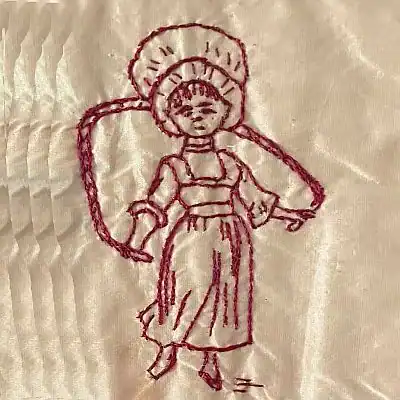
We wound up the day looking at signature quilts with a focus on embroidery. Redwork was popular in the last quarter of the 19th century with bluework following mostly after the 1910s. The motifs were usually simple lines with diverse and varied themes (think children’s motifs, flowers, buildings, and religious). An interesting note, redwork came back into favor again in the 1990s.
We saw two embroidered quilts with one being worked in red and white and the other pink and white. The redwork was a Mountain Mist pattern featuring basket and floral motifs with birds. The pinkwork was dated 1925-26 for the Talmo Primary Room. It featured cartoon like characters but nobody knew the name of the series.
We also saw two signature quilts one was donated to a church blanket drive. Someone there realized it was a significant quilt and contacted the current owner. It is a red and white diamond in a square where the red points of the squares form a secondary zig zag pattern with the signatures in the white center diamond. Preliminary research has found the quilt to be from somewhere around Philadelphia.
The second signature quilt was a yellow and white 30s-40s quilt. It had an ice cream cone border with yellow sashing. The blocks had a yellow circle appliquéd in the center with a white embroidered signature in the circle and yellow embroidered signatures radiating off of the center circle like sun’s rays. This quilt was said to originate in Wayne County, Indiana the same area where our meeting was held!
We decided this was one of our better meetings for a number of reasons. From our great attendance to the subject matter being such that everyone could participate, we felt it was a successful and very inspiring meeting! Thanks to Linda for all her information she shared and to everyone who brought quilts and/or braved the weather.
Our next meeting will be May 6th in Columbus, Ohio, at Westminster Thurber Retirement Community. We will be having a quilt dating day for residents and visitors.
From: CELIA EDDY
There are two new articles on my website which may be of use to those interested in British quilt history. One is about the Allover wave quilting pattern of the North West seaboard of UK, the other an account of a quilt restoration project. They are flagged up on the Home Page as NEW. Any comments/suggestions welcome. Go to http://www.quilt.co.uk/
I’d also like to remind anyone who hasn’t yet acquired it that the CDRom showing quilts in the Rachel Beatrice Kaye Shuttleworth collection at Gawthorpe Hall outside Preston in Lancashire, England, is still available.Go to http://www.rbks.co.uk/ to order a copy. It contains some of the best quilts in the collection, each one annotated and with Rachel’s original notes scanned in.(There’s also an article about her and her quilts on my website.)
Celia
Celia Eddy The Brown House Fleming Place Maryport Cumbria C
From: Julie Silber
Hi Again, We have another quilt in a pattern/design we don’t recognize. It is clearly a 20th century appliqué floral quilt – the colors are solid greens (2 shades), pink, blue and a bit of orange (center of each flower). 1930 – 50. I have check in Brackman’s Applique Encyclopedia and do not see it. I will post a full post as well as a detail on the eBoard (QUILTS) — and hope someone knows this one. We do not remember seeing this one before. Kit? Commercial Pattern? Newspaper/magazine pattern? Any ideas? THANKS a lot! Julie Silber
Date: Wed, 05 Apr 2006 20:58:25 +0000 | From: jocelynm@
>to know” but then I thought, “Man, this info would make for a great CSI >episode!” And further pondered: my living room, carpet, and all major
Pepper, I’m always amazed when they hit the blacklight and shout about all the human fluids around. Don’t murder victims in Las Vegas ever own cats? <g>
Date: Wed, 05 Apr 2006 19:40:28 -0400 | From: bunjorda@
Polly and Judy, If you are at Walter Reed again, try to get up to the oncology ward. The halls and patient rooms are decorated with framed art quilts based on plants used in the treatment of cancer. For those who can’t see them in person, try this website http://healingquiltsinmedicine.org/index.htm Bunnie Jordan
Date: Thu, 6 Apr 2006 09:38:14 -0700 (PDT) | From: Ark Quilts <quiltarkmv@>
Hello! I found an interesting item relisted on eBay this week.
Last week the seller offered it for $1500 and when asked, could produce no provenance for justifying the price other than their grandmother made it (item # 7399120757 & you can see the questions asked re: the history of the quilt as well as their answer). Nor could they send a larger picture of the overall view of the quilt as it was too large and too heavy to handle they replied.
It is up again this week for an even higher price of $2000 and no provenance or justification is again offered for the quilt. It appears to be an imported quilt.
This seller’s posting style is very similar to the goodies-from-grandma seller who was trying to sell the Smithsonian Bride’s Quilt reproduction from China as a mid-1800 Baltimore Album antique quilt. They made several comments about how they are a safe seller but have no feedback posting due to changing their selling name. If you have the item numbers or a printout from those auction listings, compare the style in both descriptions & listings……….the most recent posting which might still be viewable in eBay is item # 7384609856.
$1500 quilt 7399120757 goonies*never*say*die–last week $2000 quilt 7405232679 goonies*never*say*die–this week
At the end of their auction, they have half-hearted plea for charity for the James Dean Museum.
I just think this is a questionable listing…….or is my imagination working overtime?
C. Ark in NW Ohio where we hope spring has arrived.
Date: Thu, 6 Apr 2006 10:05:06 -0700 (PDT) | From: Kris Driessen <krisdriessen@>
This quilt just screams foreign made to me. I certainly could be wrong, it’s impossible to say without a picture of the overall quilt and at least one of the binding.
Anyone who spends $2K on that quilt with those pictures deserves what they get.
Kris, a bit Kranky today, wouldn’t you say?
Date: Thu, 6 Apr 2006 20:36:41 -0700 | From: “Alan”
Kris isn’t kranky. That quilt isn’t worth $1500 or $2000, old or not (probably not). And I agree, if someone buys it for that, well, they deserve to be snookered.
Alan
Date: Fri, 7 Apr 2006 11:11:58 EDT | From: Palampore@
I have tried to figure out how to make this related to quilts and I just can’t! So please forgive me….. If there is anyone in our group who lives in the Newark, NJ area or who has any knowledge about John Jelliff’s furniture designs please contact me. (He was a furniture designer/manufacturer from around 1840-1880. Very ornate!) I am trying to find out who he modeled the carved faces on his furniture after. Apparently Jenny Lind inspired one of his women carvings. Would like to know if the others are real or fictional people. Can’t find it on the Internet. Back to trying to be productive. I am off on a tangent and need to reel myself in….. Thanks, Lynn Lancaster Gorges
Date: Fri, 7 Apr 2006 08:31:25 EDT | From: DDBSTUFF@
I was recently told that a “Courthouse Steps” is not a variation of a “Log Cabin” Pattern.
I have, for 30+ years always referred to them as either a “Log Cabin Courthouse Steps” or a “Courthouse Steps Log Cabins”
What do the experts say?
Thanks,
Darwin
Date: Fri, 07 Apr 2006 08:33:16 -0400 | From: “Davina Dawn Sewing Specialties” <davinadawnsewing@>
I wouldn’t say anything about originality or it’s worth because I don’t know, but I “think” the reason the price is higher, is that she no longer has a reserve on the quilt. She wants to get at least the $2K. That is common practice for ebay sellers, if they don’t get bids the first go around, they might just ask for the amount that they desire.
Laura Davina Dawn Sewing Specialties http://www.davinadawnsewing.com
Date: Fri, 7 Apr 2006 9:26:51 -0700
I’ve always heard that Courthouse Steps is a Log Cabin version as well, and I believe it’s pictured as such in most quilt books. Who told you this?
Karen Evans
Date: Fri, 7 Apr 2006 13:25:36 EDT | From: Mitzioakes@
I always believed Courtyard Steps was a Log Cabin variation, so I am with you! Mitzi from VT (where Spring has yet to Sprung!)
Date: Fri, 7 Apr 2006 11:31:35 -0700 | From: “Major Maam” <majormaam@>
Hi everyone, I don’t post very often, and I am sorry that this has taken almost a week to write; but I just had to throw some Kudos to a member of our list— Don Beld.
I am a member of the Tehachipe Mountain Quilters, where he was guest speaker on Monday morning. His talk was the main topic of conversation during lunch (with my “click” of friends,) we throughly enjoyed the his presentation and the history lesson.
Becky In the High Desert of California
Date: Fri, 7 Apr 2006 22:18:27 EDT | From: Blackeyesandysue@
Bunnie, I went up to the 7th floor at Walter Reed tonight and saw the quilts. What a wonderful idea! I had mentioned them to my husband, he suggested we go see them after we had dinner. They are bright and beautiful and I enjoyed the written information about the quilters and the use in cancer treatment of each plant, sea shell and sea slug. There are so many and they are mounted so they will stay dust free and pristine. They will brighten the walls for a long time. We are back on the orthopedic floor. They have hung some quilts on that floor now. They are patriotic quilts. They certainly add color and cheer to a sterile environment. Quilters are so great! Polly Mello
Date: Fri, 7 Apr 2006 22:27:32 -0400 | From: “Lucinda Cawley” <lrcawley@>
Okay, it’s not a quilt history question but you guys are so smart maybe you can help. DH John (recently retired and still testing the limits of our new togetherness) was admiring my recently completed (though yet unbound) Alphabet quilt intended for one of the two new grandchildren expected in early June. He suggested that I make a Greek Alphabet quilt for the second baby. Looking at the Greek alphabet (although I do think the whole idea is a bit pretentious) it seems to me that there are way too many odd shapes to do it by any method other than paper peicing. What are the chances of find paper patterns for the Greek alphabet or is this just too bizarre? Cinda on the Eastern Shore
Date: Fri, 7 Apr 2006 23:12:40 -0700 | From: “Alan”
Courthouse steps is a log cabin block. The way the color is placed in it makes it a courthouse steps quilt.
Whoever told you that is fulla hot air.
Alan
Date: Sat, 8 Apr 2006 10:01:24 EDT | From: Mitzioakes@
How I understand the ‘new togetherness’ of retired husbands – thank goodness mine has something else to keep him interested, tho somedays….my daughter calls him my Shadow, tho I love him dearly for over 50 years, it is hard to have someone looking over your shoulder all the time. There may be pp patterns already ‘out there’ for the greek alphabet, so you may get a good response – and I agree, pp would be the way to go, other than applique (which I don’t do – I am a paper piecer from the 1980s. Mitzi from Vermont
Date: Sat, 08 Apr 2006 16:53:34 +0100 | From: Sally Ward <sallytatters@>
Mitzioakes@ wrote: > How I understand the ‘new togetherness’ of retired husbands
My DH retired early with failing eyesight. At first he followed me round half the day as if he was a five-year old, the other half of the day as if *I* was a five-year old. But as with all five year olds it gets better once you learn to be firm <G>.
Or as I once saw on a postcard…’I married my husband for better or worse, but not for lunch.’
Sally W
Date: Sat, 8 Apr 2006 15:51:34 -0400 | From: “Pepper Cory” <pepcory@>
Hello friends-I am commenting in a humorous vein about the retired spouse conundrum. I have watched many of my friends cope with it so here goes: Due to our approximate (!) age, many of us face the ‘retired partner’ dilemma. When one spouse no longer goes to the office or whatever, he/she naturally casts about for entertainment/work/a project etc. Guess whose behind now has a bulls-eye on it? If the at-home partner is a quilter, this new interest can result in rude comments such as ” Why do you need any more fabric?! You’ve got tons of the stuff! What are you going to do with it? ” etc. etc. Reforming the quilter and her spendthrift habits or sloppy work routine can become an obsession, especially if your beloved is an engineer/teacher/chemist/retired military or any of a host of occupations that require precision, organization, and the obedience of co-workers. Take heart. It will pass if you sweetly but firmly draw the line. “My stuff, my sewing room, my business…” and give him the same respect. It usually takes about two years for the retired person to find their new vocation. However, it will not pass as quickly if you accede to the new demands immediately–you’ll spend a lot of time re-writing the ‘rules of engagement.’ I have a friend who spent the first year of her husband’s retirement miserably locked in an AirStream trailer as he drove hell-for-leather for the Grand Canyon. To this day he has no idea that she contemplated running away when they stopped at a gas station in Kansas! However, he’s much happier now and is swinging a hammer for Habitat and the AirStream is up for sale. The wife of an RAF colonel told me, “We have breakfast and then we meet again for a cocktail at 6 PM.” Used to orderly directives, her husband felt free to develop his own interests and turned into a demon gardener. (He’s very English–they garden if they put up a pup tent beside the road…) When husbands retire and decide to ‘manage’ their wife’s quilt shop….ah, that’s another subject! Pepper
From: “Pepper Cory”
Hello friends-I thought you all might like to see what Quilts for the Coast did last December. This experience has proved to be far larger than a one-time donation–I still occasionally get letters from quilt recipients.Treat yourself–go to http://www.albfabrics.com/quiltedbutterfly/quilts_coast.html and read through. Feel free to sniff and tear up a bit–I certainly do. Look at all the photo montages. What we quilters can do when we put our minds to it is amazing! The clean-up’s still going on in Waveland and the rebuilding will take years. Quilts for the Coast just packed up another load of fabrics, quilting books, and several sewing machines (37 boxes!) and sent them to a quilt guild in Bay St. Louis. Now when these friends meet they’ll have fabric and patterns and can even sew again. Good deeds multiply…. Pepper Cory ——_NextPart_000_0076_01C65B26.F0A13760–
Date: Sat, 8 Apr 2006 17:54:32 -0400 | From: “Lucinda Cawley” <lrcawley@>
After telling Sally Ward I wanted the patterns handed to me and googling a la Sally Bramald I got the following from Kay Triplett in TX. http://quiltmaker.com/webextras/patt158/ Although I am applique challenged I may try to do these letters by machine. The more I think about it the more I like the idea. I’ll let you know what happens. Thank you all for the advice, planning for retirement and paper piecing. Cinda on the Eastern Shore who saw some incredible quilts and Shaker sewing items at an antique show today .
Date: Sun, 9 Apr 2006 05:09:23 -0700 (PDT) | From: Susan Riley <blackeyedsewsan@>
Good Morning-this ebay posting was forwarded by my sister this a.m. and after reading Lucinda’s message, I thought I’d alert the group. The auction is up today. It is only 1 of 3…an Amish crow pincushion; hopefully she was trowling through those postings for presents for her sister!
Item number: 6268585552
I have been dreading the retirement issue since the Blizzard of ’78! I was sewing sunsuits for my then 2 year old instead of cleaning the house…hmmm….Susan Riley, Boston
From: jeantomlester
When my husband retired, I left–OK, so I just left every morning and came home for dinner, but I tried to be gone most of every day. He eventually found he had to entertain himself and is happily building and flying airplanes–real ones. I came home and can now work safely in my own room. It took about 6 months. He still is convinced that I spent all my years gone from the house, even since I told him the truth.
Jean
—
To those of you who have, like myself always thought of the Courthouse Steps as a variation of the Log Cabin pattern, my friend has this to say about it:
“How about actually looking at the two blocks. One is made of strips separated on the diagonal half light/half dark with a usually square center in a contrasting, usually red, color. Because the block is divided in that way it can be turned to create different overall patterns, such as barn raising, straight furrow and light and dark. Courthouse steps is a block similarly built of butted strips with a central square or rectangle, but because of the way it is built visually it cannot be turned to make different overall patterns; often, as in your example, it has a rectangular rather than a square center. There is only the one overall pattern it makes, which is courthouse steps, that’s it, the only one, nada, finsihed. That’s why they are related but different blocks, and need to have distinctive names.”
I’m not convinced. I personally think it can still be called a variation. It is a construction variation at least. I guess one needs to define “variation” now…
Darwin
From: “Alan”
Well, the way I see it is from the construction side. I don’t see it as different because of color placement. You can’t expect to make different variations of the same block and not include the other. Or maybe I’m a grouch this am.
Alan
From: “Teddy Pruett”
When my great-uncle retired from the City of Macon, GA, he was amazed by the amount of time my aunt could spend in the sewing room. One day, he showed up at her side with an open Bible and simply, quietly said “I now pronounce you sewing machine and wife.”
Teddy Pruett I wanna be Superwoman when I grow up – and live in Colorado. www.teddypruett.com
From: “Sharon Stark”
> I’m not convinced. I personally think it can still be called a variation. > It is a construction variation at least. I guess one needs to define > “variation” now… > Darwin
I am not convinced either, it seems if we use such a narrow definition for a variation, then log cabin variations would not include the pineapple or windmill blades variation either. After all, if you use logs to build it, it’s a log cabin, whether it’s one story or two, four sided or eight.
Sharon
From: “Sharon in NC”
I always consider them two different blocks. While they look similar the log cabin is pieced in a circular pattern and the courthouse steps are in a horizontal to vertical placement. I realize many consider the courthouse a variation and I respect that but when I go to write a pattern or directions and the piecing doesn’t seem to be related in steps I don’t consider them variations. If the direction and manner of piecing doesn’t count and the only relationship needs to be strips added in any order, then by that definition wouldn’t a simple string pieced block just be a log cabin variation? I do consider some pineapple patterns a LC variation because if you do a traditional LC you simply add a the corners to the block as you go in the circular pattern to get the pineapple. jmho Sharon in NC Who is psychotic because she is leaving at 5 am to chaperone 120, 13-14 yr olds for four days at the beach..VBG
—
Need some advice. We are planning two trips – one leaving Wednesday for Raleigh NC with stops on the way in Birmingham AL and Atlanta. Plan to spend Easter with daughter in Raleigh. We plan to go to the history museum for the quilt exhibit. Is there anything else we need to see or do in that area.
Then the biggie. We are leaving on April 27 for Lima, Peru, a cruise on the Amazon, on to Cuzco and Macchu Piccau. Any must see, must do, must buy fabric-related in that area? This list in the greatest for knowing such.
(We aren’t retired yet – although we are both well past the age when people expect it – but I have just recently gone to work for my husband and that is a real adjustment – )
Sarah
Date: Mon, 10 Apr 06 (time truncated in source) +1000 | From: “quiltstuff” <quiltstuff@>
http://cgi.ebay.com/LOT-OF-2-NICE-APPLIQUE-QUILTS_
Nice to see a seller who is happy to say it is a Chinese quilt.. and I thought given the running of the red that it may be a good quilt for a historian to own to show in lectures about the varying quality. Just in case it may be of use to someone in the US cheers
Suzy
Date: Mon, 10 Apr 06 13:52:41 +0000 | From: jocelynm@
>etc. etc. Reforming the quilter and her spendthrift habits or sloppy wor k >routine can become an obsession, OTOH, several of the state quilt history projects turned up accounts of m en who started assisting their wives with quilting once they required. My favorite (from Montana, I believe) was of an old cowboy who commandeered the chair by the front window…so he could see his friends approaching, and have time to hide his sewing before they got out of their trucks. <G >
Date: Mon, 10 Apr 06 11:17:41 EDT | From: Mitzioakes@
It feels good to be 72 today – I can remember taking teenagers on school trips – I did survive tho – but the worst kids in the mass were usually mine!!!!! Mitzi from Vermont where the beaches are a bit unused at this time of the year – the ice just went out a week ago!