August 27 – Sept 4, 1997
This page contains affiliate links. If you buy through them, I may earn a small commission at no extra cost to you. As an Amazon Associate I earn from qualifying purchases. Learn more
These restored messages come from the Quilt History List, an online forum where quilt historians, collectors, researchers, appraisers, and enthusiasts discussed antique quilts and related textiles. The archive dates from 1996 through approximately 2016 and is being restored gradually. Sign up in the form at the bottom of the page if you want to know when a new page is added. Original spelling, opinions, formatting, and inactive links may remain unchanged.
Primary topics of this QHL Digest:
- Debunking the Red Dye Civil War Myth — Members correct the common claim that red dye was unavailable during the Civil War, pointing to period evidence of red-dyed textiles. (see the article on natural dyes)
- Amish Quilt Books and the ‘Nebraska Amish’ Name — A thread recommends books on Amish quilts and traces the surprising etymology of the ‘Nebraska Amish,’ a group that doesn’t actually live in Nebraska.
- Storing Rotary Rulers and Notions — Practical tips for organizing rotary rulers and sewing notions using pegboard and repurposed materials.
- Quilt Restoration Conference in Omaha — Members discuss plans for and details of an upcoming Quilt Restoration Conference in Omaha. (see the article on quilt restoration)
- Dating a Red-and-Black Centered Quilt — A member seeks help pinning down the date of a quilt with a distinctive red and black center medallion. (see the article on dating quilts)
- Calico and Chintz Identification — Members swap knowledge on distinguishing calico from chintz fabrics in older quilts.
Date: Wed, 27 Aug 1997 22:16:06 -0400 | From: “deb worster”
has anyone seen instructions etc for table or mantel height feather trees
or dowel trees? I saw a picture of a different style tree in the debbie
mumm book re noah but alas no instructions.
>^..^< >^..^< >^..^< >^..^< >^..^< >^..^< >^..^< >^..^< >^..^<
deb in nh
dworster [at] chi [dot] tds [dot] net
Date: Wed, 27 Aug 1997 23:47:06 0000 | From: “The Garretts”
Hi Nancy and others-
You wrote –
> I’m curious. Do the Amish have different “rules” for making quilts that they
> plan to sell commercially? Do the color rules apply only to the quilts they
> will use themselves, or would these rules apply to all quilts that they make?
> I have an Amish quilt which I purchased in an Amish shop (somewhere on Rt.
> 340) in Lancaster County several years ago. It is done all in solid fabrics,
> but definitely uses white.
I am fortunate to have been able to visit numerous quilt shops in Lancaster
County and speak with some of the shop owners. This is what I have learned
about Amish quilting and quilters in this area —
- Most quilting is done for sale to the tourists. So, fabrics and patterns
that will appeal to the customers are used. I have waited in line at Sauder’s
Fabrics while Amish ladies have bought Mumms, Hoffmans and other
“nontraditional” fabrics. Most quilts in their shops are not what we think of
as “traditional” Amish quilts. Keep in mind that traditional means before
- They also do alot of “quickie” wall hangings using the buttonhole stitch
on sewing machines.
- Spoke to one late 20s woman and asked about fabric choices. She said she
has printed pastel Dahlia design quilt on her bed. I asked if this varies from
District to District and she said yes, but very few are still using just solid
colors, and even they are not sticking to just the old dark colors. She said
her grandmother won’t use white — it gets dirty too fast. There were floral
sheets on the line and I asked about them, and she said the older women still
use solids but her mom and her friends use the flowered ones. In her district
there are no restrictions on prints in quilts in the home.
- Spoke to a 50ish woman who only quilts with solid colors, even for sale.
This is a personal choice of hers. She said the Bishop said they could use
prints for sale, but she doesn’t like using them, so restricts her specialty to
traditional colored solids, except made from poly cotton fabrics, not wools.
She kind of implied that her Bishop preferred they stick to the old ways and
use solids at home, but accepted the desire to use prints by some of the
younger women.
- I volunteer at a Mennonite Thrift Store and one of the women there pieces
tops for an Amish lady. I have seen pictures of the tops she does, and there
are all colors, patterns, prints and solids. These tops are then quilted by
Amish ladies and will be for sale in the Amish lady’s shop. This brings up the
point that everything you see in an Amish quilt shop is not necessarily made
entirely by an Amish person. I have just recently learned that the Hmong are
doing some of the applique as they can do it really fast because they are used
to do their really intricate ethnic pieces. From what I can gather, the Amish
do the quilting, but don’t mind farming out the piecing and applique.
- The most popular patterns in this area are floral appliques. These involve
a white or cream colored background and lots of printed applique pieces. On my
list of to ask questions after tourist season ends is whether they use these in
their homes.
- In one shop the 18 year old daughter showed me a quilt exactly like the one
on her bed. It was what I call Drunkards Path but she called Ocean Waves and
was done in a blue print and solid cream.
- I was fortunate to visit Holmes County, Ohio, and the Amish quilts for sale
there look exactly like the ones in Lancaster County — lots of white, florals,
log cabins. I believe pretty much anything goes in tourist quilts.
- I went to a lecture on Amish weddings and they had a quilt there that they
said was typical of the quilts given by both the bride’s and the groom’s
families to start the marriage. It was a burgandy and cream Dahlia quilt. I
asked if this truly would be used considering the print fabric and she said yes
— they no long hold to just solids.
This is not a scholarly study, just what I have learned as I talked to some of
the Amish shop owners. There are other shop owners I haven’t spoken to —
maybe someday.
The Nebraska Amish in Mifflin County are a much more isolated and conservative
group and still pretty much stick to their traditional quilting — 4 patch and
9 patch in many colors including brown, which isn’t found in Lancaster County.
One reason they can stay more conservative is that quiltmaking isn’t part of
their livelihood as it is in Lancaster County. The Amish are good businessmen
and will make what sells.
Hope this helped.
Barb in southeastern PA
<bgarrett [at] fast [dot] net>
Date: Thu, 28 Aug 1997 00:24:52 -0400 (EDT) | From: Kittencat3 [at] aol [dot] com
I still can’t quite believe this…but twenty-two years after being
disqualified from an embroidery contest because “no fourteen year old could
possibly sew so well,” I learned that one of my quilts took the blue ribbon
in the whole cloth quilt division at CraftAdventure, the screening
competition for the Eastern States Exposition (aka the Big E) in West
Springfield. It’s the one I did in the 14th century style (backstitched
linen on linen – nine months of work, including the month I had to take off
because I sprained my right thumb sewing).
I entered it as an educational tool in the hopes that someone would look at
it, read the documentation, and want to know more about the oldest European
quilting styles. I never truly imagined I’d win a first prize…and after
all these years, words can’t describe how sweet this is.
If anyone in the New England area plans to attend the Big E next month and
decides to check out the CraftAdventure winners, I’d love some feedback. I
won’t be doing much serious needlework until sometime in January (graduate
school starts in less than two weeks and I’ll be much too busy), so any
comments now would be greatly appreciated for next summer when I’ll have the
time to work on something. Thanks in advance –
[And now, back to our regularly scheduled quilt history on line seminar….]
Lisa Evans
Springfield (soon to be Easthampton), Massachusetts
Date: Thu, 28 Aug 97 06:39:16 -0500 | From: princess [at] mdn [dot] net
I am looking for the author who wrote about a “recent study…indicated that
fabric gives off certain pheromones….” This was a humorous look at how we are
just prey for the bolts of fabric…we’re helpless once inside a fabric store.
If you were the original author, would you e-mail me privately (I want your
permission to reprint in a newsletter). THANK YOU!
Anne Sturtevant
princess [at] mdn [dot] net
Midland, Michigan
Date: Thu, 28 Aug 1997 07:19:56 -0400 (EDT) | From: ROM1026 [at] aol [dot] com
In a message dated 97-08-28 06:11:49 EDT, you write:
> Merry May suggested that the final row on each
> side be “Quilters” “Heritage” “List” and “On-line”, which I think is
I like Merrys idea. That would look great>
Have a good day all!
Pat in NJ
Date: Thu, 28 Aug 1997 08:04:26 -0400 (EDT) | From: Palampore [at] aol [dot] com
The statement that red dye was not available during the Civil War is totally
incorrect. There were many types of red dye available, with madder being the
most common. Think of the number of flags that are around! They all have
red dye in them, Union and Confederate, which translates into North and
South. There are also scores of uniforms of the “Zouave” type which were
bold shades of red for most of the jackets and caps, not to mention dozens of
other items!
Date: Thu, 28 Aug 1997 13:04:01 -0400 | From: “Judy Grow”
Subject: QHL: stash storage
I am so pleased with myself, and at the same time, so dismayed that it took
me so long to figure this out. Last month we had a vendor at the guild
meeting. All her fabrics, fat quarters to yard pieces were folded, and
folded and folded again into neat little packages that stood upright in the
flat boxes she carried them in. They were all secured by little adhesive
tabs that held the price. No matter how many people dug through those
boxes and pulled fabrics out, they always looked neat. And of course you
could see every thing she had. I had been looking at this method of
displaying fabric at shows for years and years, but never thought of it for
my own storage.
I flew home and looked at my storage. Folded as it came from the store, it
was stacked in large Rubbermaid bins, or stacked in bureau drawers. I
couldn’t see what I had, and every time I went searching, everything I
touched got messed up. So, along with everything else, I now have another
project going. To refold all my fabrics into neat little packages so they
can be stored upright, not stacked.
I devised a system using my rotary rulers — 3″, 4″, 5″, and 6″. I
prefold the fabrics in the length so they are either 4 layers or 8 layers
thick; selvedge to selvedge (2 layers), fold to selvedge (now 4 layers),
double fold to selvedge (now 8 layers). I buy very few fat quarters so
I’ll deal with them at another time. I usually buy 1/4 yard, 1/2 yard or
bigger pieces. The quarter yards are folded in the length to 8 layers and
are then rolled around the 3″ ruler, making a mini-bolt, and then pinned.
The 1/2 yards are folded the same way and are rolled around the 4″ ruler.
One yard pieces are 4 layers thick and are rolled around the 5″ ruler.
Pieces over a yard are also folded a second time in the length and then are
rolled around the 6″ ruler. It is amazing how small you can roll a 5 yard
lenth of fabric. And by looking at the width of the packages I can tell
whether they are 45″ or 54″ wide fabric – like the wonderful plaids I am
now collecting.
Now I am putting these little packages of fabric in bureau drawers and the
shorter Rubbermaid containers, shoe box height, but much wider and longer.
The beauty of this method is that by looking at the package I know just how
much fabric it contains. And I am getting to know my stash again. I have
found stuff I forgot I ever had. And the smaller containers are much
easier to handle. This is so exciting!
Now when I open a drawer or a container, I can see everthing, not just the
piece on top.
I’ll use those large Rubbermaid tubs for sweater and out of season clothing
storage, as they were intended to be used.
Have I just put a bug into someone else’s head? I hope so.
Judy in NJ
judygrow [at] blast [dot] net
Judy in NJ
judygrow [at] blast [dot] net
Date: Thu, 28 Aug 1997 12:36:17 -0500 (EST) | From: Diane Krall
Two good books about Amish quilts are:
Krabill, ? A QUIET SPIRIT. (UCLA Fowler Museum, 1996). This is an
exhibition catalog of a private collection of Amish quilts. Both the
photos and text are very good.
Grannick, E.W. THE AMISH QUILT. Can’t remember the publisher information,
but this is a well-researched book, documenting styles, sources of
materials, communities, customs, and some interviews with Amish women
(some who liked to sew and some who didn’t).
Enjoy,
Diane in Indy
Date: Thu, 28 Aug 1997 13:13:46 -0500 (EST) | From: Diane Krall
Nancy, I hope this will answer your question
“The material was formed by beating the inner bark of the mulberry tree
until the individual fibers meshed into a felted sheet, from which various
garments and furnishing fabrics were made…. The inner bark from a paper
mulberry tree was pulled away, beaten, washed and rinsed. It was then
fermented for ten to twelve days before the final beating, which was done
on a beating plank with a beater. … After the bark cloth was prepared,
it was decorate using a brush made of the softened tip of a bamboo
stick.Paints were made of tree bark, roots and flowers…”
This information is from FABRICS IN CELEBRATION FROM THE COLLECTION, by
Peggy S. Gilfoy (Indianapolis Museum of Art, 1983}
Diane Krall
Indy
Date: Thu, 28 Aug 1997 19:25:29 -0400 (EDT) | From: JOCELYNM [at] delphi [dot] com
On 28-AUG-1997 08:06:23.6 Palampore said to JOCELYNM
> The statement that red dye was not available during the Civil War is
>totally incorrect. There were many types of red dye available, with
>madder being the most common. Think of the number of flags that are
Could there have been a shortage of red dye for CIVILIAN use, though?
I’m thinking about WWII. My mother was a home-ec teacher at the then-O A&M
(now Oklahoma State) and my dad was a Navy chief cook and baker on a troop
transport. Mom was furious when he came home with his cookbooks, and she
saw his recipes (chocolate cake for 8,000, among others) that were using all
sorts of ingredients she’d been teaching the girls to do without, especially
when he naively replied that of COURSE he used the recipes all the time….
He didn’t have a clue that the reason he had enough chocolate to bake cake
every week, was because the civilians hadn’t seen it for YEARS.
Jocelyn
Date: Thu, 28 Aug 1997 19:25:12 -0400 (EDT) | From: JOCELYNM [at] delphi [dot] com
On 27-AUG-1997 20:11:55.6 erroof said to JOCELYNM
> Slightly used book for sale, good passages hi-lighted, a must read (to
> believe).
Sue,
Can we set up a round-robin? I don’t exactly want to OWN this book, but
I bet there are a lot of us who would be willing to pay the cost of postage
to READ it. <G>
And maybe send a $1 back to you for the privelege, so you recoup your
costs on this thing? <G>
Jocelyn
Date: Thu, 28 Aug 1997 19:25:22 -0400 (EDT) | From: Jocelyn
On 27-AUG-1997 23:50:03.3 bgarrett said to JOCELYNM
> 6. In one shop the 18 year old daughter showed me a quilt exactly
>like the one on her bed. It was what I call Drunkards Path but she
>called Ocean Waves and was done in a blue print and solid cream.
Barb,
Sorta makes sense that an Amish young woman wouldn’t be sleeping under
a Drunkard’s Path! <G>
>part of their livelihood as it is in Lancaster County. The Amish are
>good businessmen and will make what sells.
Absolutely. I’m from Dunkard country (German Baptist). They are Plain
People, but not as plain as the Amish. They support using anything that give
them a competitive edge in business, but not for pleasure. For example, they
will listen to the radio to get farm markets and weather reports, but TV
watching for entertainment has traditionally been banned. If you want
beautiful cabinetry in your home, hire a Dunkard construction crew, and
they’ll show up with power tools. A prosperous Dunkard farmer drives an
air-conditioned tractor, because it allows him to work longer with less
ill-effect on his health. I’ve never been in a Dunkard home, but I believe
that the women are allowed to have the labor-saving devices that the rest of
us use. I can tell the women are happy about the resurgence of popularity in
quilting, because as a child I remember them dressed in dark plaids, and now
they wear the beautiful calicos being printed for quilts….. I guess it’s a
fun way for them to be traditionally dressed but not have to wear the same
old menswear plaid all the time. <G>
Thanks for this wonderful bit of documentation about Amish quilting!
Jocelyn
Date: Fri, 29 Aug 1997 09:44:51 -0500 (CDT) | From: Phil & Lee Spanner
Dear Quilters,
I want to take a moment to thank everyone who has sent inoformation
regarding my questions. I have found the Amish information so fascinating. I
am on my way to the book stores and libraries to check out some of the books
that have been referred to.
Then I am going to start my first (traditional) Amish quilt. I don’t think
any quilt collection would be complete without one.
Also, thanks to Cherry and Lorraine for the information regarding Australian
quilting, and to Laura for the information about quilts of Hawaii.
This is truly a list of wonderful people. Thanks again for all your help.
Sincerely,
Lee :^)
Date: Fri, 29 Aug 1997 10:48:27 -0500 | From: bgroelz [at] hamilton [dot] net (Brenda Groelz)
In yesterday’s QHL Digest, Barb wrote:
“The Nebraska Amish in Mifflin County are a much more isolated and
conservative
group and still pretty much stick to their traditional quilting — 4 patch
and
9 patch in many colors including brown, which isn’t found in Lancaster
County.
One reason they can stay more conservative is that quiltmaking isn’t part
of
their livelihood as it is in Lancaster County. The Amish are good
businessmen
and will make what sells.”
I’ve lived in Nebraska all my life, and have never heard of the “Nebraska
Amish”. I do remember some Amish families moving to south-east Nebraska in
the mid-1970’s, but I thought they were unhappy and left. If Barb or
anyone else could tell us more about Nebraska Amish, I’m sure there are
many of us who would be interested.
Brenda Groelz
Phillips, Nebraska
Date: Fri, 29 Aug 1997 13:34:40 -0500 (CDT) | From: celmore [at] ksu [dot] edu
I’ll have it with me at the Quilt Restoration Conference in Omaha,
Sept. 4-7, if any of you are going and want to look at it. It’s very
small and doesn’t take long to read.
Carol Elmore
Manhattan, KS
On Thu, 28 Aug 1997 JOCELYNM [at] delphi [dot] com wrote:
> On 27-AUG-1997 20:11:55.6 erroof said to JOCELYNM
> > Slightly used book for sale, good passages hi-lighted, a must read (to
> > believe).
> Sue,
> Can we set up a round-robin? I don’t exactly want to OWN this book, but
> I bet there are a lot of us who would be willing to pay the cost of postage
> to READ it. <G>
> And maybe send a $1 back to you for the privelege, so you recoup your
> costs on this thing? <G>
> Jocelyn
>
>
Date: Fri, 29 Aug 1997 12:25:28 -0700 | From: Mary (by way of Quilting Heritage ListServ)
Dear Lisa Evans,
Congratulations on the recognition of your fine needlework!!! Whoever
was responsible for your disqualification at age 14 was an utter fool as
we all know.
What about the many 14 year olds in years gone by who would have created
an entire dowry by then? We look back and admire the work of ages past
and lots of it must have been done by veritable children. How sweet
this award must be to you, sweeter because of the trespass it helps
undo.
I’ve never been to the Big E but will try as your work provides
incentive. Mary in stormy Hamden CT.
Date: Fri, 29 Aug 1997 16:56:22 0000 | From: “The Garretts”
To Brenda and others –
Sorry for the confusion. The Nebraska Amish live in Mifflin County,
Pennsylvania, and have nothing to do with the state of Nebraska. I am used to
speaking with local people who know about the conservative Amish in central PA,
and never thought to add the “PA” after Mifflin County in my last post.
There are many subdivisions of the Amish Church, of which the Nebraska Amish is
one. Others include the Beachy Amish (formerly the Peachey Amish), the Amish
Mennonite, the Swartzentruber group of Holmes County, Ohio, the Renno group
also of Mifflin County, PA, Old Order Amish, and New Order Amish. Each group
has their individual set of rules concerning dress, buggies, cars, telephones,
Sunday School, etc. I don’t know without looking it up where the Nebraska name
came from.
The Nebraska group are also called “white toppers” as their buggies have a white
top, not grey as in Lancaster County nor black as in the midwest. Their style
of dress is also different from what is found in Lancaster County. They are
considered to be a very conservative group. Brown is the predominant dark
color for men’s suits, and appears alot in quilts.
I don’t know of any Amish communities in the state of Nebraska, only in Ohio,
Indiana, Illinois, Iowa, Wisconsin and Montana. There could be other states as
well, they just aren’t communities I’ve studied.
Again, I am sorry for the confusion and will try to be more clear after this.
Barb in southeastern PA
<bgarrett [at] fast [dot] net>
Date: Fri, 29 Aug 1997 15:20:10 1000 | From: Jean Ann Eitel
To add details on the good books on Amish and their quilts suggested yesterday:
A QUIET SPIRIT is by Kraybill, Donald B. Other authors: Trish Herr and
Jonathan Holstein. Publushed 1996. Can be ordered from: UCLA- FOWLER
MUSEUM OF CULTURAL HISTORY, BOX 951549, LOS ANGELES, CA
90095-1549 ISBN 0-930741-53-6
THE AMISH QUILT by Eve Wheatcroft Granick, published1989 by Good Books,
Intercourse, PA 17534. ISBN 0-934672-72-1
Julie Silber
Date: Fri, 29 Aug 1997 22:16:42 -0400 (EDT)
From: Jean Ann Eitel <quiltmag [at] mindspring [dot] com>
To: QHL [at] cuenet [dot] com
Subject: QHL: a special quilt
Message-Id: <v03007813b02cf8e21fd9@[209.86.34.218]>
Content-Type: text/plain; charset=”us-ascii”
this sunday i am going out to one of my parishioner’s homes to help them
put a very special family quilt into my quilt frame to be quilted by the
mother and her two daughters.
the quilt was made by her great-grandmother in Nebraska about 1875. It has
big red and white diamonds, alternated. The diamonds are the same shape as
Lemoyne Star diamonds, but they are sewed together in straight rows making
a diamond checkerboard effect.
On the each of the red diamonds a large white five point star is appliqued.
on each of the white diamonds a different flower is appliqued. all of the
flowers have straight central stems with one diagonal straight stem going
out of each side with a smaller blossom, some represented unopened
blossoms. There are also some leaves appliqued.
This is a most unusual quilt, it was found about 15 years ago in a wooden
box behind an old wood stove in the maker’s house after she died. The quilt
was given to my parishioner as part of her family share of her
grandmother’s things.
When it is quilted i will photograph it. in fact, i am taking my camera out
on Sunday to get pictures of the mother and her two daughters putting it in
the frame. I will scan them and put them on the new patchwords message
board on the interent which can take pictures as well as text in the
messages. When I do this, i will send the address to everyone so you can
see it if you like.
it is really a most unusual and beautiful piece of folk art.
Jean Ann Eitel, Editor
QUILT Magazine, Harris Publications Inc, NY, NY
http://www.quiltmag.com
Date: Fri, 29 Aug 1997 20:05:54 -0700 | From: Ellene Gravelle
Hi: Does anyone know a source for the book on the Espirit Amish
Collection which toured the country recently. I understand it was a
wonderful exhibit. An Australian friend of a friend is looking for 5
copies. Ellene
Date: Fri, 29 Aug 1997 22:47:16 -0400 (EDT) | From: JOCELYNM [at] delphi [dot] com
On 29-AUG-1997 16:59:54.3 bgarrett said to JOCELYNM
> I don’t know of any Amish communities in the state of Nebraska, only
>in Ohio, Indiana, Illinois, Iowa, Wisconsin and Montana. There could
>be other states as
> well, they just aren’t communities I’ve studied.
Barb,
Jamesport, MO (NW MO) also has an Amish community.
I had an Amish friend from Western Kansas, but I never asked if there
was a ‘community’ there or not. Dunkards and Mennonites are more common.
Jocelyn
Date: Sat, 30 Aug 1997 12:50:57 -0400 | From: “Judy Grow”
Subject: QHL: Re: Stash storage
Message-Id: <199708301639.MAA12345 [at] fireball [dot] blast [dot] net>
Content-Type: text/plain; charset=ISO-8859-1
Content-Transfer-Encoding: 7bit
Dear Alice,
Rubber bands dry out and stick to the fabric. I’ve seen that happen.
Besides creasing them. I wouldn’t even use those price stickers, because
they too can leave adhesive behind. Of course the vendors that use them
hope that the price stickers will be on them for very short periods of time
— meaning sold quickly.
I am folding a little each day, and it is going to take me a long time to
get this stash reorganized, but in the meantime, I am finding stuff I
forgot I ever had, and I am handling fabric. What a wonderful feeling!
I have a question for you How and where do you store all your rotary
rulers? I am thinking of giving them one shallow dresser drawer all to
themselves, but then I’d have to go rummaging through the drawer for the
one I want. I am also thinking of getting a wastebasket type thing and
storing them in that, standing upright, out in the open. Can’t make up my
mind.
I’ve got one of those big hanging thread spool racks, and that will be up
over the sewing machine, on the wall, if DH gets his butt in gear to help
me hang it. We have real plaster walls, so it takes real tools to get a
hanger securely in the wall. One of my guild buddies bought a mini-car
parking garage in the toy department for her thread. It has a handle and
separate spaces for each spool. She says she can get 100 spools of Mettler
in it, or 50 C&C spools. Sounds interesting, but I have not seen it.
The sewing machine sits on a second hand desk with lots of drawers. I’ve
got one of those plexi portable tabletops that fits around the Pfaff to
give me a nice big sewing platform. My rotary cutters are all in eyeglass
cases in the left hand drawer, thread rippers, snippers, and scissors in
the right hand drawer.
What I don’t have is a large space in back of the machine and to the left
of the machine so I can machine quilt with comfort. Gotta figure that out
next.
Regards,
Judy in NJ
judygrow [at] blast [dot] net
> Message from: Alice Norman
> E-mail: anorman [at] pn [dot] usbr [dot] gov
>
> Oh boy, Oh boy, Oh boy! Have you ever started something!
>
> After I read your post to QHL about how long it took you to realize what
> you were seeing, I also had a “duh” moment. Gee – we see these cute
> ways of displaying fabric for sale all the time. The FQs, etc. are folded
> so we customers can SEE them, then buy them.
>
> But, your way of folding according to yardage – well, that was brilliant.
> Your method is consistent and easy. And the fabric “mini-bolts” are
> instantly recognizable.
>
> A question. Instead of pinning each “mini-bolt,” would a rubber band
> work? Umm .. maybe it would crease the fabric. I’ll just have to
> experiment.
>
> Thanks for your great idea.
>
> Alice, enjoying the beginnings of fall in Boise, Idaho.
Date: Sat, 30 Aug 1997 12:01:27 0000 | From: “SuzyQ4U/MsuzyQ”
I store my rulers and many other odds and ends on a 2 ft x 4 ft piece
of pegboard mounted on the wall in my sewing room. I get those
spindles just like in the hardware stores and it works great for all
kinds of things…hoops, patterns, packages of needles,
patterns…anything I can hang…looks neat plus I can see lots of my
goodies at a glance
Sue In Northern Illinois
Date: Sat, 30 Aug 1997 15:26:42 -0400 (EDT) | From: AJSNGS [at] aol [dot] com
Hi all,
As a last day trip before the hustle and bustle of school starts, my husband,
kids and I went to Madison, Virginia today. Each Labor Day week-end they
have a street festival called “Taste of the Mountains” and this year there
was also a quilt show put on by the local quilt guild. Our own QHLer
“Christina of the Blue Ridge” was showing some of her quilts and I got to see
them!! She does very nice work! As I told Christina, there was a very nice
selection of different quilting styles represented and it was fun for me to
see some techniques that I haven’t seen before. I especially liked some of
the 3-D effects on several of the quilts.
I don’t know if the Madison County Quilt Guild plans on doing a show again
next year, but if they do, if you live anywhere in Virginia you might
consider attending. It was a fun way to spend the day!
Nancy in Fredericksburg, Virginia
ajsngs [at] aol [dot] com
P.S. One thing I should add. Originally the Keepsake Quilting challenge
winning quilts were to have been shown at this show, however, due to the
recent UPS strike, the quilts did not arrive in time. I guess the people at
UPS are having their own quilt show this week-end!
Date: Sat, 30 Aug 1997 14:55:24 -0700 | From: Sandra Wilcox
About storing rotary rulers…if you don’t use pegboard you might
consider hanging magazine/folder racks. I bought wire racks that snap
onto the sides of the olfa baskets that are my storage drawers and
they are wide enough to support my rulers and 15″ square ruler just
laid in them. The rulers are within reach but out of the way. I’ve
seen other holders that are plastic and attach to the wall. A
variation on this might be the wire placemat holders The Container
Store carries. These hook onto the bottom of a closet shelf. They
have open sides, unlike the clip on drawers, so they also can support
long rulers easily.
Sandy Wilcox
To: QHL-Digest [at] cue [dot] com
Reply-To: QHL [at] cuenet [dot] com
Status: U
X-UIDL: 873080184.24564.apollo
Date: Sat, 30 Aug 97 22:58:27 PDT | From: John & Cinda Cawley
The Nebraska Amish don’t live in Nebraska. The Nebraska Amish are a very
conservative Amish group who live in Mifflin Co. in Central PA (west of
Lewisburg) in an area called the Big Valley. They are also called the White
Top Amish because their buggies have white tops. Eve Wheatcroft Granick
presents some very interesting info about them on pp. 88-90 of her book The
Amish Quilt. She says that quiltmaking was never as important in this group
as it was in other Amish communities; that quiltmaking was governed by even
stricter guidelines than elsewhere. Only Four- and Nine-patch variations
were allowed. The palette was limited to browns, blues, dark purple, black,
dark green, yellow, ochre, tan and some dark red.
One of the most interesting aspects of Amish society is the number of
differences between the various Amish groups. John Hostetler doesn’t write
much about quilts, but he can tell you just about everything about Amish
society. In fact start with Amish Society published by the Johns Hopkins
Univ. Press.
Cinda in Scranton
Date: Sun, 31 Aug 1997 09:02:25 -0500 (CDT) | From: celmore [at] ksu [dot] edu
I just got a letter from my friend Barb Eikmeier about a new computer screen
saver she is selling. It contains 20 high-resolution images of
tradition American quilt designs from Barb’s personal collection of
quilts. Barb is the author of the new book, Kids Can Quilt. The
screensaver is titled, Quilts!, and sells for 14.95 plus shipping and
handling and sales tax (if applicable). You can contact Barb at
eikmedb [at] toto [dot] net if you are interested. I’ll bring some of her ads to the
QRS Conference in Omaha.
Carol Elmore
Msanhattan, KS
Date: Sun, 31 Aug 1997 12:03:14 -0400 | From: Merry May
As an alternative to using rubber bands or sticky labels to bundle up your
fabric, how about “recycling” those long strips we cut when we “even up”
the ends of our yardage? They’re odd widths, but at least they’re cotton,
and won’t hurt whatever they’re “bundling!” If they’re tied with a bow,
they’re also easy to remove and replace.
Merry May (a.k.a. Inspector Cluesew and/or Jessica Four-Patch) 🙂
Schoolhouse Enterprises
gridgees [at] algorithms [dot] com
http://quilt.com/GG
Date: Sun, 31 Aug 1997 14:28:01 -0400 (EDT) | From: JOCELYNM [at] delphi [dot] com
On 31-AUG-1997 00:23:05.6 cawley said to JOCELYNM
>pp. 88-90 of her book The Amish Quilt. She says that quiltmaking was
>never as important in this group as it was in other Amish communities;
>that quiltmaking was governed by even stricter guidelines than
>elsewhere. Only Four- and Nine-patch variations were allowed. The
Cinda,
Sounds like a definite cause-and-effect!
Jocelyn
Date: Sun, 31 Aug 1997 15:12:23 -0600 | From: “Kathy Gaul”
Hello out there! A good friend recommended I get onto this service because
I am a quilt restorer, and she has been seeing lots of messages regarding
the QRS conference next week. I am going to attend the conference and
fabric camp, and I am really excited! I am hoping to meet some new friends
out there in the quilting world – anyone attending the conference? This
will be my first time attending this conference – anyone have any
suggestions? Please be patient with me if I don’t respond right away, I am
getting used to all this computer stuff!!! and I am trying to get ready to
leave!!! – Kat Quilt in Colorado
Date: Sun, 31 Aug 1997 21:11:37 -0400 (EDT) | From: QuiltCat26 [at] aol [dot] com
Kris –
My vote is also for the log cabin with black center and QHL somewhere on the
pin.
Thanks! Let us know when to SHOW ME THE MONEY.
Nancee in Grand Rapids, MI
>^,,^<
Date: Tue, 26 Aug 1997 22:48:10 -0400 | From: dympna [at] juno [dot] com (Bernadette D Snyder)
Can I be counted in for the pin?
Dympna
On Tue, 26 Aug 1997 09:13:25 -0400 debatqps [at] juno [dot] com writes:
>Kris,
>
>Count me in for a pin and I vote for the letters somewhere on it.
>
>Debbie at the Jersey Shore where it was COLD this morning!
Date: Sun, 31 Aug 1997 20:25:14 -0600 | From: “Kathy Gaul”
Wow, you guys out there are great! Thanks, Laura, Nancy, and Sharon for
your wonderful responses to my inquiry about QRS! I already feel that I
shall meet new friends in all of you! And yes, I shall look you all up! I
am arriving on Wednesday early evening, in time for the Work Day on
Thursday. I will look for that QHL sticker too!
To Nancy Evans – I have been restoring quilts for about 6 years now as an
independent “textile artist”. My degree is in Home Economics, with my
emphasis in clothing and textiles – so I am a great big mix of clothing and
quilts! I love what I do! I grew up in New England and was drenched with
history, and historical textiles always intrigued me. I guess that’s where
it all started, plus it has always been my goal to recreate my Grandmothers
early 1900’s wedding dress! (I also restore vintage clothing and the later
Victorian and Edwardian eras are my favorites.) So there’s a little bit
about me. Can’t wait to meet all of you and learn more about you. Take
care till then. – Kat Quilt
Date: Sun, 31 Aug 97 22:38:28 PDT | From: John & Cinda Cawley
Hi Arlene and anybody else who’s interested in Calico and Chintz. My
enthusiasm for that exquisite book is undimmed. You can order it from the
Renwick Gallery gift shop in Washington, D.C. I carried the phone # in my
wallet for months, but I must have thrown it away. The book is $24.95. ISBN
0-937311-34-0. If I were only going to buy one book this year (which, of
course, will never happen) this would be the one.
Cinda in Scrantn
Date: Sun, 31 Aug 97 22:49:49 PDT | From: John & Cinda Cawley
John Hostetler on p. 282 of Amish Society writes, “the name Nebraska
Amish derives from an Amish settlement in the state of Nebraska and
specifically from its bishop Yost H. Yoder who assisted a small faction
among the Mifflin Co. Amish in ordaining its leaders. Later a few
families in Nebraska moved to Mifflin Co. to join them.” This happened in
1881.
Cinda in Scranton
Date: Sun, 31 Aug 97 22:56:14 PDT | From: John & Cinda Cawley
I must share my annoyance at being ripped-off by the Rockefellers. Went to
tour Kykuit, the Rockefeller home near Tarrytown, NY. It cost $18, an
enormous amount for a house tour, but several people (whom I intend to acost
on the subject) raved about it to me. I was particularly interested in
seeing Nelson’s sculpture collection which he installed in the garden. It
seems that very recently the gardens have become a separate tour for which
they charge another $18! What we got was the house only (with views as we
stood on the veranda–so we saw a Henry Moore and a Brancusi from a
distance) which really amounts to a rather ordinary “rich man’s house.” The
Chinese porcellans are pretty impressive, but otherwise except for a Gilbert
Stuart portrait of Washington and an unfinished portrait from life of
Lincoln most of the art in the house looks like what you get when you tell
the decorator to take care of it. I’m still steaming over being stupid
enough to spend that much money on so little. To comfort myself I went to
Boscobel where I not only saw a wonderful collection of Federal era
decorative arts (a wonderfully knowledgeable woman gave the three of us a
private tour), but they gave us lemonade and cookies afterwards.
Cinda in Scranton
Date: Mon, 1 Sep 1997 00:10:39 -0400 (EDT) | From: Quilt97 [at] aol [dot] com
For anyone with an interest in teaching quilting to children in the
classroom, or at home, I just came across the following book at the Barnes &
Noble bookstore site:
I have not seen or read the book, so am not recommending it as such – this is
strictly a “for your information only” – – also have no connection with
Barnes & Noble.
Elisabeth
Quilting a Thematic Unit: Easy Cross-Curricular Projects & Activities for the
Classroom
Wendy Buchberg Pub. Price: $10.95 B&N Price: $8.76 You Save: $2.19
(20%)ISBN#: 0590965581
Publisher: Scholastic, Incorporated
Format: Paperback
Date Published: March 1997
Date: Mon, 1 Sep 1997 02:39:32 -0400 | From: “Judy Grow”
Hi , old quilt enthusiasts! I went to my favorite antique show today, held
yearly, and scored big I think! I mostly rescue tops, rarely finished
quilts, and I came home with 2 tops, and 5 yards of old material. The
material is 36″ wide, black, printed with bright red open diamonds spaced
about every inch, in striped rows. I don’t know what I’ll do with it —
yet.
One of the tops is blue striped or checked shirtings, on black-on-white
shirtings as background, in 12″ basket pattern blocks, set with two
black-on-white shirtings as 4″ wide sashing. The wonderful thing is that
the basket blocks are set every which way, with no rhyme or reason. Upside
down right side up, pointing left, or right, there is no pattern anywhere
in the way they are set. This is a big quilt, and because the backgrounds
are so light I am going to back it with white muslin, no batting, and
machine quilt it in diagonal lines, then use it as a summer spread. The
top itself is machine pieced. I paid $75.00 for it, and it is in beautiful
shape — no stains, no rips or tears, and the fabric is not brittle or
stiff.
The second quilt top presents more of a problem. Obviously designed to be
set on point and never finished, it is a two color top, red applique on
muslin with the same red as sashing. The edges were jagged, as though
setting triangles were intended, but there were not enough of the applique
blocks to complete the setting, even if there were triangle blocks. So I
have removed the shorter rows and will make it into a square set quilt, 5
blocks by 6 blocks, with 2 blocks left over. Unfortunately I will be just
short of the red sashing to complete the four corners. I will try to
match the red with contemporary solid fabric, but failing that, I guess a
close match will do. The applique on this one is perfectly beautiful, and
the sashing is hand pieced. The fabrics are just a bit brittle, but will
stand careful handling. I paid $45.00 for this one.
I just love finding and finishing old tops, and hope someone will be as
enthusiastic about the unfinished quilts I leave behind!
Judy in NJ
judygrow [at] blast [dot] net
Date: Mon, 1 Sep 1997 09:24:05 0000 | From: “SuzyQ4U/MsuzyQ”
My mom told me last week she had a partly done quilt someone had
given her to give to me because ‘I do that sort of thing’ Yesterday
we saw them and she says “oh yeah..let me get that old thing”. Well
the old thing was a completed quilt top, 85 x 103, a courthouse steps
(that’s a trip around the world that starts with a line of squares
not one square, I believe). It looks to have been made in the 40’s,
but has some 30’s prints in it. It was hand pieced and is in perfect
condition, it has apparently been store well since it was made. I’m
so thrilled to be finishing this top…now we’re working on her to
remember who gave it to her! She thought she was giving me someones
garbage….I told her it’s a treasure!
Just had to tell someone!
SuzyQuilt4u
Have a GREAT day!
suzyhmkr [at] imaxx [dot] net
🙂
http://www.quilttalk.com/chanops/quilt4u.html
Date: Mon, 01 Sep 1997 09:51:33 -0700 | From: Frank & Inge Stocklin
Hi
I know there must be some people on this service from Alaska or who could
direct me to different shops, etc. I’ll be in Fairbanks 9/11, Anchorage
9/15, followed by Seward, College Fjord, Skagway, Juneau and Ketchikan
ending up in Vancouver. Time will be tight but if there are any great
shops or museums, please e-mail me personally. Thanks, Inge
http://www.erols.com/stocklin/
Date: Tue, 2 Sep 1997 10:34:39 -0400 (EDT) | From: Palampore [at] aol [dot] com
Has anyone found a red or black centered quilt that DEFINITELY dates to the
time period of 1862-1865 or prior to that when the Underground was also
active. If not I think we should move on. I own a black centered log cabin
and it is absolutely not of the period prior to 1865. I also saw a log cabin
at the Alamance Co. Historical Soc. Museum in Alamance, NC dated 1866 and it
had a multitude of colors in the centers.
Can’t we just enjoy log cabin quilts for what they are—-pretty, interesting
quilts made in the late 1860’s to the turn of the century. I am sorry if I
sound nasty about this, but I think that there are many topics out there to
study and we are beating this topic in the ground.
I thoroughly enjoyed the exchange on Amish Quilts.
I have recently had contact with some broderie perse quilts. One fabulous
one is found in the musuem in Alamance. The entire applique is done in
buttonhole stitches. Fabulous!!!! I also came across a chintz bordered
quilt that the owner swore had to be 1820’s because it had chintz in it. It
also had a center that had solid cotton applique rose wreaths. All of the
“clues” lead me to ca. 1850. It was a perfect example of —–you can’t look
at one thing and date a quilt. As BB says in CLUES in the CALICO it has to
be done using many factors.
Lynn in NC
Date: Tue, 2 Sep 1997 10:11:01 -0400 (EDT) | From: HPQuilting [at] aol [dot] com
Friends, I need your assistance. I was fortunate enough to view a beautiful
antique quilt this weekend. It has a very unusual pattern to it. The outside
of the pattern is very typical of a Mariner’s Compass, but the center portion
is not like any Mariner’s Compass that I have ever seen. The quilt was
produced in the lower Appalachian region and I believe the blue portion of it
is a vegetable dye. The terra cotta portion is undoubtable mud dyed. The back
is homespun.
I took a picture and I would like to scan it in the computer and attach it to
personal email to anyone who might be able to identify the name of the
pattern. I know we have a few curators out there, so if you will send me your
private email address, I would be very grateful. The owner of the quilt paid
$25 for it. She is the archivist at Tannehill State Park. I believe the quilt
to be made sometime around 1840 to 1860.
Thank you,
Penny Palmer Keys(HPQuilting [at] aol [dot] com)
Date: Tue, 2 Sep 1997 08:49:44 -0500 (EST) | From: Diane Krall
On Fri, 29 Aug 1997, Ellene Gravelle wrote:
> Hi: Does anyone know a source for the book on the Espirit Amish
> Collection which toured the country recently. I understand it was a
> wonderful exhibit. An Australian friend of a friend is looking for 5
> copies. Ellene
>
>
Ellene,
Don’t know about an exhibition catalog, but there was a beautiful book to
document Doug Tompkins/Esprit collection several years ago. AMISH
QUILTS, with the text by Robert Hughes. The hardback was pretty pricey.
I have recently seen the paperback for 45 dollars.
Diane>
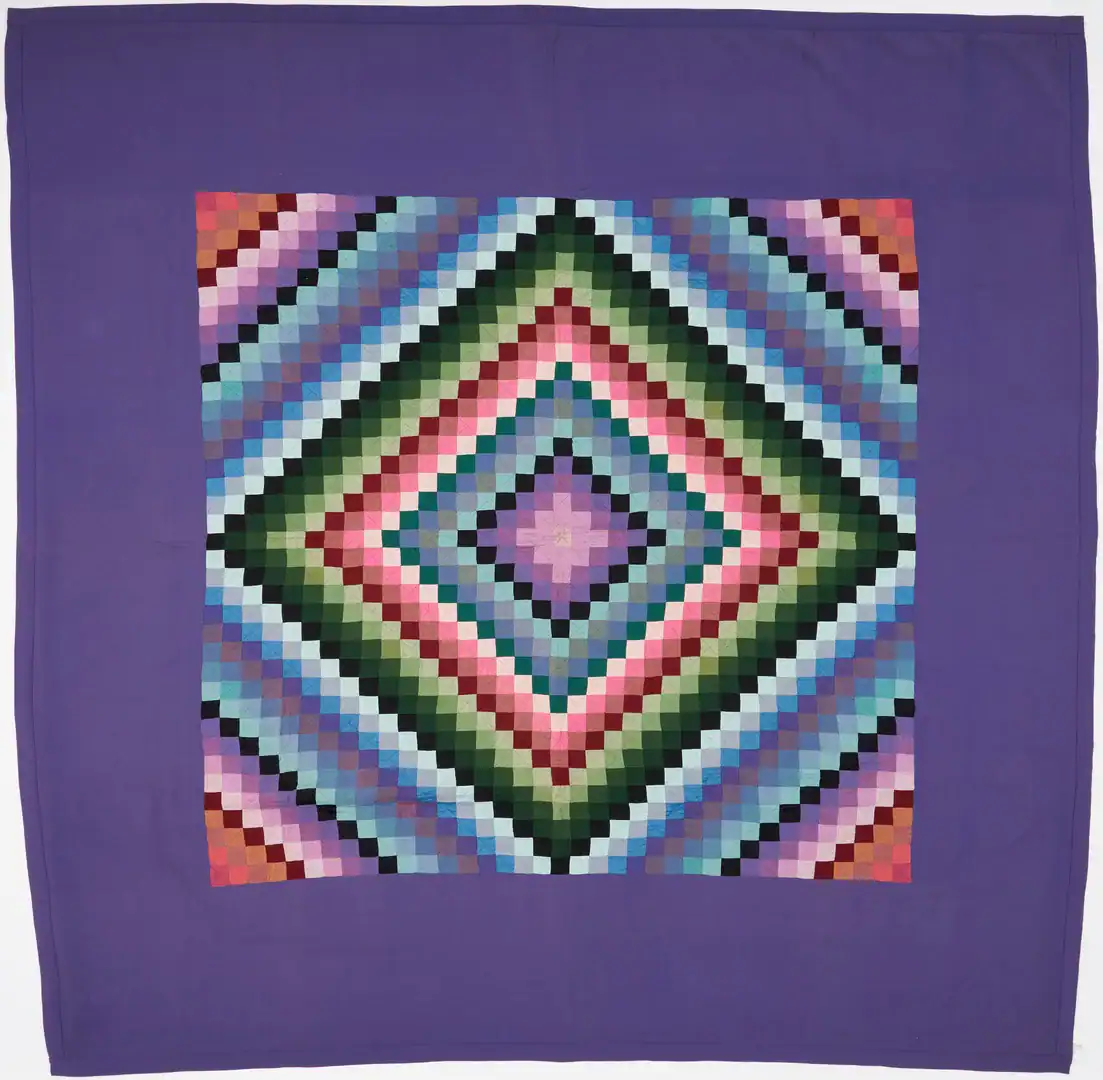
Date: Tue, 2 Sep 1997 08:28:04 -0700 (PDT) | From: Colleen Francis
I enjoy the few Amish quilts I’ve seen and want to make one using
traditional Amish colors (solids – no prints) in the diamond and the
square pattern. What I need to know is what color thread the Amish would
traditionally use to quilt with? Would they use only one color? Black?
White? the color of the background fabric? Are there traditional Amish
quilting patterns? What other block patterns would they favor? I
appreciate any help I can get on this. Thanks!
Date: Tue, 02 Sep 1997 19:37:01 -0400 | From: Ricki Maietta
Hi everyone! I found it! Or, rather, them! I knew if I looked long enough
I would find the tobacco leaf patterns I remembered. This is in reference
to whoever it was that wanted a tobacco leaf pattern a couple of weeks ago.
I had such fun flipping through stacks of magazines! I do that about once a
year – still only half way through the stacks.
Anyway, the tobacco leaf pattern I remembered best from an antique quilt is
in Quilt magazine, summer 1986 issue. It is a 15 inch appliqued block,
pattern on page 94, color picture on page 24. I like this one best.
Then, in Quilters’ Newsletter Magazine, May 1995 on pages 30 & 31 are
pictured 2 different tobacco leaf patterns. These are also applique, not as
detailed, in an article of all South Carolina blocks. Oh, & no patterns,
just pictures of the blocks.
So, whoever was looking for them – that’s where they are! If you can’t find
these mags, let me know & I’ll send you copies.
Ricki in PA
Date: Wed, 3 Sep 1997 08:17:43 -0400 | From: “Willis Muska”
To Ricky in PA:
I am the one (or one of them) looking for the tobacco leaf pattern. I
don’t have access to the magazine to which you referred and would love a
copy if you don’t mind. Will be glad to send you a fq or pay for any costs
associated with copying and sending this to me.
Thanks again,
Diane in VA
> From: QHL-Digest-request [at] cue [dot] com
> To: QHL-Digest [at] cue [dot] com
> Subject: QHL-Digest Digest V97 #231
> Date: Tuesday, September 02, 1997 9:55 PM
Date: Thu, 04 Sep 1997 12:24:02 -0600 (CST) | From: KENNEDYA [at] VAX1 [dot] Mankato [dot] MSUS [dot] EDU
When and where is the Quilt Restoration Conference? How can I
get information about it? or am I too late?
Thank you.
Mary Jo
kennedyac [at] vax1 [dot] mankato [dot] msus [dot] edu
Date: Thu, 04 Sep 1997 13:50:19 -0600 (CST) | From: KENNEDYA [at] VAX1 [dot] Mankato [dot] MSUS [dot] EDU
Susanne,
Would you mind sending out the buttermilk recipe again? I thought I
saved it but now can’t find it. Does this work on old stained feed sacks?
Thank you.
msnavigation