December 8 – 11, 2001
This page contains affiliate links. If you buy through them, I may earn a small commission at no extra cost to you. As an Amazon Associate I earn from qualifying purchases. Learn more
These restored messages come from the Quilt History List, an online forum where quilt historians, collectors, researchers, appraisers, and enthusiasts discussed antique quilts and related textiles. The archive dates from 1996 through approximately 2016 and is being restored gradually. Sign up in the form at the bottom of the page if you want to know when a new page is added. Original spelling, opinions, formatting, and inactive links may remain unchanged.
Primary topics of this QHL Digest:
- Authenticating a “Redwork Mammy” Quilt — A member asks for opinions on an eBay-listed redwork quilt and receives several replies weighing in on whether it’s an old original or made from a later kit. (see the article on redwork and outline embroidery)
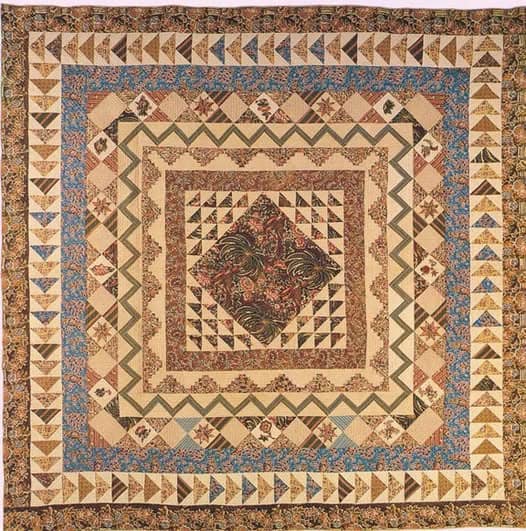
- Irish Broderie Perse Quilt’s High Bidder — Follow-up on a previously discussed eBay auction reveals the identity of the winning bidder. (see the article on early American quilts)
- Caring for a 40-Year-Old Quilt — A member asks for cleaning and preservation advice for a quilt of moderate age, and is pointed to a museum’s published quilt-cleaning guidelines.
- Dolly (Dolley) Madison Signature Quilt — Discussion of a quilt signed with the names Dolly Madison and Ida Koontz dated 1935, including a correction of the historical Dolley Madison’s name spelling.
- Quilting an Old, Unfinished Top — Members share book recommendations and a textile conservator’s perspective on whether and how a century-old unfinished quilt top should be quilted.
- Wool Batting in Historic Quilts — An extensive thread on how common wool batting was in 19th-century quilts, with several members sharing specific examples from museum and personal collections. (see the article on quilt batting)
- Alphabet Quilt on eBay — Members identify the published pattern source for an alphabet-block quilt listed on eBay and discuss related examples.
Date: Sat, 08 Dec 2001 23:30:17 -0800 | From: Chris Flynn <lovechris@>
Hello everyone…. please, if you have a moment, let me know what you think I should do about this situation. Last April I was approached by an ebay seller to purchase a wonderful redwork quilt, privately, off ebay. I paid her $500 for the quilt. I made a pattern from this quilt and have been selling it on ebay for the last seven months. Now she is listing a quilt almost identical to the one she sold me! If you have a moment, please look at her listing: and then at the pattern listing of mine…. and tell me what you think! I’m not sure where to turn. I bought it because I love Redwork and this is a pattern many people have enjoyed duplicating via the pattern I made from it. I thought I was purchasing a vintage quilt…. not I’m not sure where to turn, or what to do. If you have the time to advise…. I really appreciate it!
My listing: Redwork MAMMY quilt Pattern Book Item # 1675489963
I feel so badly for all the people who have purchased my patterns of this quilt thinking, as I did, that it was an original quilt!
Thank you for what ever feedback or advice you care to give…. Sincerely, Chris Flynn, Boulder Creek, California
Date: Sun, 09 Dec 2001 21:33:42 +1100 | From: Lorraine Olsson <sven@>
Hello All, I looked carefully at both of the items and I really think the quilt seller has a new item for sale. There is nothing in any of the pictures that tells me there is any age in this quilt. My experience buying quilts from the US has been from photographs only, and I feel I can read pictures fairly accurately now. This quilt looks NEW. I see there is at least one person on this list who placed an early bid. I would like to hear what they think.
Chris’s picture is not clear enough for me to see her quilt.
If this is a new quilt that is still being produced, Chris may have been printing and selling a copyright covered item, which brings up a whole new set of problems.
Because I am feeling cheeky tonight, I just emailed the seller to ask if she has any more like the one she is selling. I will let you know the answer.
Lorraine in Oz
Date: Sun, 09 Dec 2001 06:01:22 -0500 | From: “Judy Kelius (judysue)” <judysue@>
I have some doubts that this quilt is old but wouldn’t swear to it without being able to examine it in person . . . this seems like a more contemporary interpretation of Black Americana to me. In the 20’s or 30’s, images of blacks were more likely to be stereotyped negative images. This was changing during the 60’s, the second possible date the seller has given to the quilt, but it would be rare to find redwork done at that time. The individual images convey some of these stereotypes (like the watermelon eating), but the wording along the edge seems contemporary. I would also like to ask the seller if the “turkey work” stitching along the seamlines is by hand or machine – it looks like it may be a machine zig-zag. Makes me wonder if it is an import – I have seen new imported quilts that depict Black Americana. About a year ago someone sent me a quilt on consignment he was excited about finding – appliqued black figures with primitive stitching – I immediately returned it, pointing out to him that much of the work (which looked like handwork on a quick glance) was done by machine and there were other characteristics of imported quilts (and he paid a hefty price!). If others have opinions, please share them with the entire list, not just with Chris.
Date: Sun, 09 Dec 2001 15:35:01 +0000 | From: “Karen Bush” <karenbush11@>
Chris, this quilt might have been from a kit? and there are more out there. Could it be possible that this lady has found another one just like you bought? It’ a Very unique quilt, but, might be like the other ‘kits’ and reproduced (the quilt made several times) in the 30’s or 40’s ??? As far as your customers on your pattern, I doubt that they would question You that it’s a unique quilt pattern/design. It IS. I doubt if there is such a thing as ‘one’ quilt of any design without someone reproducing it in their own way…?? kb
http://www.karenbushquilts.com Karen Bush It only takes me One day to get a month behind :/
Date: Sun, 9 Dec 2001 15:07:40 -0600 | From: “Leigh Fellner” <hcquilts@>
The seller of the Irish broderie perse quilt tells me the high bidder is “the proprietor of Historic American Quilts……… www.historic-american.com in Illinois, USA. It will be much loved and cared for and admired and perhaps exhibited.”
🙂
Date: Sun, 09 Dec 2001 17:57:46 -0500 | From: “Kris Driessen, QuiltBus.com” <krisdriessen@>
Please respond to both her and the list.
Thanks,
Kris
> >From fadness@ Fri Dec 07 12:44:22 2001 >From: “Roger Fadness” <fadness@> > >Hi, >Hopefully someone will just know the answer or will know where to send me. >l bought a quilt and it is signed Dolly Madison and Ida Koontz 1935. >I know that Dolly was our fourth presidents wife but that was back in the >1800s. I have absolutely no history on this quilt it is a goldenrod with >pieced stars. >Anyone know where I can go for info? >Lesa Fadness >19758 Buck Canyon Rd >Bend, OR 97702 > >PS I guess I also need to know how to go about getting some of the stars >repaired? I have quilted for many years and do lots of hand work. Any >thoughts would be appreciated.. I have searched the web and the library >reference with no luck. HELP
fadness@
>
Date: Sun, 9 Dec 2001 20:20:54 EST | From: RufflesMom308@
I have a quilt that is at least 40 years old. What is the best form of preservation? Can I clean the quilt, and if so, how? What are your suggestions regarding repairing quilts?
Jan
Date: Mon, 10 Dec 2001 08:45:10 EST | From: JQuilt@
my guess is that 2 women named ida kootz and dolly madison made the quilt in 1935…dolly was a popular name/nickname for girls….many fathers called a daughter his little doll and she got nicknamed dolly… sissy was another popular nickname…derived from sister … jean
Date: Mon, 10 Dec 2001 09:09:40 EST | From: RBCochran@
Also, I believe Mrs. Madison’s first name is spelled Dolley, not Dolly. –Rachel
Date: Mon, 10 Dec 2001 09:02:32 -0600 | From: Leslie Goddard <l-goddard@>
Can anyone point me to some good sources (articles, book chapters, previous discussions) regarding the pros and cons of quilting a vintage quilt top? A friend recently acquired an 1890s hand-pieced top that she’d like to quilt. Some people are warning her against doing so. Others are telling her to go ahead since it’s only a good, not an excellent, piece. Any insights? (I tried to search the archives, but can’t seem to get in).
Leslie Goddard
Date: Mon, 10 Dec 2001 11:28:56 -0500 | From: “Jan Drechsler” <quiltdoc@>
The best instructions I have seen for cleaning quilts is at the following web site, put out by the Bishop Museum, in Hawaii.
www.bishop.hawaii.org/bishop/conservation/quilts.html
It doesn’t just tell you what to do. It tells you why you are doing it that way. And Orvus soap is what many textile experts recommend. I bought my gallon jar of Orvus cheaply at a farm store as it is used for washing horses, sheep, etc. But it is also available in smaller quantities in quilt shops.
There is no easy answer as to whether your quilt will wash well without testing it. All fabrics need to be tested to see if they will run. If the fibers are not strong they may tear with the weight of the wet quilt when moved around. Never put it in the washing machine and allow agitation. Cotton batting gets very heavy when wet.
I do quilt restoration, if you don’t want to do it yourself, we could talk.
Jan — Jan Drechsler in Vermont Quilt Restoration; Quilting teacher www.@/~bobmills
Date: Mon, 10 Dec 2001 11:58:28 -0500 | From: “Judy Kelius (judysue)” <judysue@>
There are several books that deal with quilting old tops, the newest being Heirloom Quilts from Old Tops by Pat Morris. The bulk of the book provides patterns for some of the quilts shown, but there are some good tips for working with old tops. Another book is Time-Span Quilts: New Quilts from Old Tops by Becky Hurdle (AQS book).
My personal opinion is that old tops should be quilted if possible unless they are extremely valuable as is or they are too fragile to quilt. Quilting not only gives definition to the top but also strengthens it and makes it usable. (My opinion is that an antique top should NEVER be used – as a table cover, wall hanging, etc. – because it is too weak, especially if it is pieced, to withstand this use.) A finished quilt is more likely to survive than an uncompleted top. Although it is harder to quilt through, thin cotton batting IMHO is a must in a pre-1950 quilt top. (Some quilters actually split a cotton bat in two to make it as thin as possible.) And any backing and binding should be either fabrics from the same era as the top or appropriate repros representing the same time period. Done correctly, quilting will also increase the value of the top. Done poorly or with inappropriate batting and other materials, quilting will actually decrease the piece’s value.
An 1890’s top may be fragile, especially if it contains some of the brown prints from that period where the dyes weakened the fabric. I have quilted old tops and find that these fabrics may split as you are quilting them even if they look strong enough to handle. This problem can be lessened by 1) avoiding quilting on the straight of the grain and 2) using a stab stitch (taking a stitch in two steps – push the needle through the fabric and then bring it back up) rather than a running stitch in which you make the entire stitch in one step. Some people also reinforce especially fragile fabrics with fusible interfacing, but I have never tried this. If the pieces are small enough, you can also just avoid quilting at all on the especially fragile pieces. If you choose to work with a top from the 1920’s or 1930’s, you probably won’t encounter problems with fragile fabrics, but 19th century textiles may be too fragile to work with. Then it is best just to store the top and bring it out from time to time to admire!
At 10:02 AM 12/10/01, Leslie Goddard wrote: >Can anyone point me to some good sources (articles, book chapters, >previous discussions) regarding the pros and cons of quilting a vintage >quilt top? A friend recently acquired an 1890s hand-pieced top that she’d >like to quilt. Some people are warning her against doing so. Others are >telling her to go ahead since it’s only a good, not an excellent, piece. >Any insights? (I tried to search the archives, but can’t seem to get in). > > > > > >Leslie Goddard >
Date: Mon, 10 Dec 2001 14:56:42 -0600 | From: “Leigh Fellner” <hcquilts@>
I emailed the seller of the quilt to give her a heads-up on the matter. She was dismayed, and asked me to convey her position to QHL. Her reply to me:
“Thank you so much for writing to me – I truly appreciate it. This quilt is an authentic old quilt and I purchased two of them in two different states. I sold one to Chris – and she has been selling the patterns on ebay and is quite angry that I found another quilt. I would never do anything underhanded or misrepresent something.”
She also forwarded to me a copy of the extremely professional letter she sent today to Chris which even to cynical Yours Truly sounds very sincere. The seller is, as far as I can see, a generalist in high-end vintage items,by no means a quilt dealer or textile specialist, and seems to have fully refunded when asked to do so in the past. Her auction gives three different dates people have estimated for the quilt (1920-1960), and goes on to flatly state she doesn’t know its age. It’s perfectly possible she did indeed find Chris’s quilt at the bottom of a basket in an antique shop, as Chris says that auction stated – but as we all know, where you find something is no indication of its age or value. If the previous auction text was the same as the current one, it sounds to me like this bidder made assumptions about the age and uniqueness of the quilt based on enthusiasm rather than research.
I was puzzled why, after she emailed QHL on 12/8 that “I feel so badly for all the people who have purchased my patterns of this quilt thinking, as I did, that it was an original quilt”, the next morning Chris started another auction for the same patterns – so I asked her about it. Her response to me is “so that everyone could see there was a previous quilt just like this and that it isn’t all that original” and that “when I saw her quilt, I decided to list all three of my patterns so people could look me up and see my feedback, etc..”
Date: Mon, 10 Dec 2001 15:36:52 -0600 (CST) | From: adair@
Hi, I’m a new member who has been “lurking” for a while, and would now like to ask your expertise. I’m a school librarian, and I’ve been quilting for about 20 years. I make lots of reproduction quilts, using old quilts for inspiration. Recently, I bought a wool batt, and I would like to use it to make a hand-quilted reproduction quilt. I know lots of Amish quilts had wool batts, but they’re not really very appealing to me anymore (been there, done that). What other kinds of quilts had wool batting? Have any of you found quilts from the late 1800s quilted with wool? Any help you can give me will be appreciated. Thanks! Sylvia Adair
Date: Mon, 10 Dec 2001 15:44:01 -0800 (PST) | From: Ark Quilts <quiltarkmv@>
Hi there! I have been reading the postings about the “Redwork Mammy” quilt and found them very interesting. Thought I would relate a similar duplicate quilt story as an aside to “it really happens”.
I attended an auction near Dayton 6 years ago and fell absolutely in love with an appliqued alphabet quilt for a child. It was probably made in the 1920’s or 30’s but the fabrics were dulled from use & washing. This was an antique youth quilt which sold to a dealer for around $80–too much for my pocket book. Then later in the same auction, a newer antique reproduction of that same alphabet quilt came to the block & I was fortunate enough to win it. The reproduction had been made of newer fabrics in cottons and cotton blends from about the 1960’s. Later I went up to the buyer of the antique and asked if we could “compare” the items so we had a nice chat about them. She was happy & I was happy to have the quilts we bought and enjoyed chatting about them, too.
Several weeks ago, I saw another quilt in the same pattern posted for sale (as of tonite it is still posted under # 1488516568). This one had the name of the quilter and the date made : 1930. I could have sworn it was the “other” quilt in the auction except for the brief notes I made during the auction: “made with solid colors”. The auction bill noted that the family had Amish & Mennonite ancestors & that could have influenced the use of all solid fabrics in the quilt. The quilt I bought was the newer one done in print fabrics. Even though the seller verified that the quilt had indeed come from another dealer in Ohio, I knew it was not the same antique quilt I had won and lost because it also had printed fabrics in it.
(Click on the thumbnails above)
The quilt on eBay is so very similar to the one I bought in auction, that I dug it out and compared it. The lay-out is similar & the choice of fabrics is similar, also. My conclusion is that : in 1930 there must have been a pattern available commercially or published in a magazine somewhere & it might have been published again in the 1960’s. However, since no patterns for it were found in the auction where the 2 quilts came from I cannot be sure of anything other than 2 of the same quilt patterns were made in the same family because someone had made one for a child and then later perhaps they made the same for another younger child. Could be trans-generational, the same quilter or two, birth quilts for a child and parent, etc. Who knows?
The point is that some patterns will be repeated if they are commercially available or somehow connected (same county, neighboring cities, families related, etc.)and shared. So it could be reasonable to see 2 or 3 of the same thing. The history and background of the quilt can answer a lot of questions if it is passed on with the quilt.
The discussion earlier about embroidered flower block quilts & Xenia Cord’s reply about it being a Ruby Short McKim pattern that was offered via a contest in several newsppaers during 1929-1932 might account for a large number of them appearing in the antique quilt market today. Sometimes it was just a popular pattern, but best to ask whenthe opportunity is there.
Whenever I buy a quilt in an auction or a dealer or from the quilter, I make notes about what history I can gather for it since I can’t access a lot of period magazines and commercial patterns.
Date: Mon, 10 Dec 2001 18:51:08 EST | From: Chyral@
> What other kinds of > quilts had wool batting? Have any of you found quilts from the late > 1800s quilted with wool?
Several years ago, I worked with the textile collection of the Monmouth County (NJ) Historical Association on a volunteer basis. In their collection of some 70 quilts, there are at least two with wool batts. One was an elaborately quilted c. 1790 calimanco whole cloth quilt, most notable for the bright raspberry color of the cloth. The other was also a whole cloth quilt, of a lovely glazed roller printed cotton. The fabric dated from about 1825, if I recall correctly, but since the lengths of cloth (which most likely had started their life as a set of bed curtains) had been sewn together by machine, we assigned an approximate date of 1860 to the object. The wool batt in the second quilt was very thick, and the quilting was rudimentary and simple. A third quilt, (a four- patch-on-point strippy set beauty with fabrics dating from the 1780s though the 1820s) had a very thin batting that may or may not have been wool; I can’t find my cataloguing notes to confirm my age-addled semi-remembrance. 🙁
While wool batting was atypical in the quilt collection, the costume collection included several quilted petticoats (late 18th century through the 1850s), and I’m pretty sure they all had wool batting…..
-Cheryl chyral@
Date: Mon, 10 Dec 2001 16:02:47 -0800 | From: “Julia D. Zgliniec” <rzglini1@>
Dear All, The Alphabet quilt on ebay Item# 1488516568 is pictured in Woodard, Thomas K. and Greenstein, Blanche, (1988). Twentieth Century Quilts 1900-1950. E.P. Dutton. New York page 129. It was also available in kit form from Mary McElwain’s Shop in Walworth, WI. The settings vary, some are set block to block and some have sashing like the one on ebay.The design of the Alphabet Quilt was offered as a pattern in the Nancy Page column by Publishers Syndicate, New York.
Julia
Date: Mon, 10 Dec 2001 19:17:45 -0500 | From: Barb Garrett <bgarrett@>
Hi Ark Quilts and others —
I can’t help with information about the mammy quilt, but I can help with information about the alphabet quilt at this auction site —
http://cgi.ebay.com/aw-cgi/eBayISAPI.dll?ViewItem&item=1495621397
As soon as I saw the picture at the web site, I knew I had seen that quilt and have a book with the pattern. At one of the early Lancaster Quilt Shows I found a spiral bound book by Phyllis Adkins Baxter called Alphabet Quilt — and this quilt is pictured on the front cover — different fabrics, but the same layout, even the same pieced sashing. The first page says — This book presents the applique patterns for the ALPHABET QUILT, by Florence LaGanke, published in the newspapers in 1929 and 1930 under the title of Nancy Page Quilt Club. The book contains copies of each of the newspaper articles, and the quilt on the cover is the same layout as the one in the auction. The book includes patterns in 3 different sizes — original 6″, and 4 1/2″ and 3″ drafted by the author.
Barb in southeastern PA My Historic Doll Quilt Designs can be seen at http://www.quiltbus.com/withlove.htm and on Simply Quilts, Dec 11 morning show
Date: Mon, 10 Dec 2001 20:01:46 -0500 | From: “Martha Wroolie” <mwroolie@>
With a strippy quilt in the planning stages, I’ve been thinking of using a wool batting. I’ve heard that it is great to hand quilt but can’t find anyone to ask who has actually done one…might have something to do with being in the South.
Anyone have any thoughts or advice? I’d greatly appreciate any input about advantages or pitfalls associated with using a wool batt. Also, a possible source for a good one to use?
Thanks. Martha Wroolie Atlanta, GA
Date: Mon, 10 Dec 2001 20:06:16 -0800 | From: donbeld@
Hi, It just so happens that I have an Aunt who has the flower garden quilt that was embroidered by my Great-Grandmother and my Aunts (four) in the 1930. It has the picket fence border. My grand-father supposedly designed the fence. The way he handled the corners was to run a picket up the diagonal at 45% and put a shorter picket on either side. He also put a gate on the bottom border of the quilt.
I also happen to have an early 1900’s quilt that I found in Eureka, California that has a wood batting. (Boy is it heavy). I can’t sleep under it because it is so heavy. It is done in a diamond in a diamond pattern with a Greek key border. So anything from the early 1900’s in a cold climate might have had wood batting.
Hope this all helps you guys. Don Beld
Date: Mon, 10 Dec 2001 23:56:51 -0500 | From: “Jan Drechsler” <quiltdoc@>
Leslie asks whether a 100 year old top should be quilted. The official textile conservator answer is ‘no.’ Nothing older than 50 years should be quilted. The act of pulling thread through the fabric can further weaken an age stressed textile. I would question whether quilting a piece would strengthen a quilt top given the manipulation required to quilt, the potential of thread slicing the top and the added weight stress. If that is the objective, then supporting the top with a backing only might be best.
Having said that, I have quilted only one old top from the 1880’s but I was quite certain that the fabrics were strong and not sun damaged or used. Also, I used a thin all cotton thread, not a quilting weight thread. We do have folks on the list that have quilted old tops- some were fine and some fell apart. There is no easy answer without closely examining the top.
Regards, Jan
— Jan Drechsler in Vermont Quilt Restoration; Quilting teacher www.@/~bobmills
Date: Tue, 11 Dec 2001 17:06:40 +1100 | From: “kate knight” <kateknight@>
Hello all and Lesa,
>l bought a quilt and it is signed Dolly Madison and Ida Koontz 1935. >I know that Dolly was our fourth presidents wife but that was back in the >1800s. I have absolutely no history on this quilt it is a goldenrod with >pieced stars.
There are several quilt blocks named “Dolley Madison Star” or “Dolly Madison Star”…perhaps the maker Ida Koontz was identifying the block name ? In fact one on ebay right now http://cgi.ebay.com/aw-cgi/eBayISAPI.dll?ViewItem&item=1494710892 which shows a pieced star (identified on Block Base as DM Star, President’s Block and Santa Fe) Just a thought. Kate
Date: Tue, 11 Dec 2001 11:58:50 +0000 | From: “Karen Bush” <karenbush11@>
Martha- I’ve hand quilted with it quite a bit, and it’s a DREAM !! I wish I could afford to quilt All of my quilts with it! Also, qI experimented with a large quilt and tied it instead of quilting with the wool, 4 years later, LOTS of washing, and it didn’t shred, shift,…it’s GREAT! 🙂 kb http://www.karenbushquilts.com Karen Bush It only takes me One day to get a month behind :/
Date: Tue, 11 Dec 2001 09:07:38 -0500 | From: “Cinda Cawley” <lrcawley@>
What fun to see Barb Garrett on Simply Quilts this morning with some of her amazing collection of doll quilts. Great to see the Mennonites getting some attention. Yea, Barb! Cinda on the Eastern Shore
Date: Tue, 11 Dec 2001 08:23:54 -0600 | From: “Carla Toczek” <CToczek@>
Hello,
Has anyone seen/heard reviews of the book American Quilt Classics featuring quilts in the collection of Patricia Cox? The book is published/soon to be released by That Patchwork Place and is advertised in current quilting magazines. I’m curious how it compares to the state books and the Pennsylvania books by Pat Herr? Photos only without the historical/family information?
Carla Toczek Harker Heights, TX
Date: Tue, 11 Dec 2001 11:05:25 -0500 | From: “Teddy Pruett” <Aprayzer@>
<<What other kinds of quilts had wool batting? Have any of you found quilts from the late 1800s quilted with wool? Any help you can give me will be appreciated. >>
I was surprised to find, in the process of doing many appraisals, that there were more southern quilts batted with wool than I had supposed. I have appraised several from the Mississippi/Alabama region, 1860’s through 1900, that had wool batts. The first one was a silk hexagon quilt of very small pieces, made on a plantation during the War of Secession ( also known as the Civil War to some of you – LOL!!). It was against the law to grow cotton in some areas, as all fields that had not been laid to waste by the battles were to be used for food. SO, it makes sense that wool might have been used as a batt when cotton was largely unavailable. This is not a validated study, just an observation. Teddy Pruett, Lake City, FL
Date: Thu, 10 Jan 2002 13:21:14 -0500 | From: “pepper cory” <pepcory@>
I’ve hand quilted with a wool batt and it is wonderful! However, I do strongly suggest that you buy the batt wrapped in the thin cheesecloth covering and that you keep that on the batt. It makes zip difference in your quilting stitches and it helps to keep the batt together. Just for caution’s sake, I’d test quilt a piece on wool batt, especially if you’re using dark colored fabrics. Occasionally some wool and cotton fabrics rub each other the wrong way and the batting can beard. Most wool batts are carded rather “high” because folks want the fluff factor. When hand quilting, just baste the blazes out of the sandwich before quilting, thereby flattening the batt temporarily. After quilting, loose the basting stitches and poof! All those lovely hills and valleys, almost a trapunto effect, but without the tedious work.Try the Frankenmuth Woolen Mill in Frankenmuth, Michigan. By the way, I’ve seen a number of NC quilts from the turn of the century quilted with wool batts. They’re mostly from the Piedmont area (Winston-Salem, Burlington) but that’s because sheep were raised there.
Date: Tue, 11 Dec 2001 15:15:33 -0500 | From: “laurafisher” <laurafisher@>
Hi all – In my shop now I have the same alphabet as on eBay — figures in blocks representing each letter of the alphabet – but the one I have is in a youth bed size with a wide scalloped edge border, made as a summer spread with no quilting. I have had this pattern numerous times in the past and it is forever charming and a lovely way to teach a child.
Companies sellling patterns not only reissued favorites under different names, but also “borrowed” popular patterns from one another and published them under their own names There is hardly anything new under the sun!
Laura
Date: Tue, 11 Dec 2001 15:41:55 -0600 | From: Xenia Cord <xecord@>
Many of you know that at the Houston show this year there was a moving and unprecedented outpouring of quilts commemorating the tragedy of September 11. Among the several hundred quilts sent for exhibit, only two (that I know of) were in memory of the brave passengers of United Flight 93 that crashed in Pennsylvania.
Many of the quilts were sold at silent auction, and I was fortunate to win one by Cathy Cloud called “The First Hero” – a cloud and sky image with a vapor trail that says “let’s roll” – the last words spoken on his cell phone by passenger Todd Beamer before he and others attacked the terrorists.
In memory of that incredible courage, some quilt groups (and other organizations) that I belong to have begun a campaign to do random acts of kindness. Moreover, each time a kindness is done for us, we tell the group about it and donate to a kitty. As the funds accumulate, when we hear of a person whose bravery or courage or kindness deserves recognition, we will give that person an award.
If you like this idea, start something! And remember Todd Beamer and the others on Flight 93 as you do so.
Merry Christmas – Xenia
Date: Tue, 11 Dec 2001 19:11:56 -0500 | From: Judy Grow <judygrow@>
Carla,
I bought Patricia Cox’s book at AQSG in Williamsburg back in October. It is lovely, with many gorgeous photos. But, it is nothing like the state documentation books. There is virtually no history with the quilts.
It is one person’s collection, and as such shows the bias of one person’s eye and perhaps location, and even more perhaps, one person’s pocketbook.
All the quilts are graphically very powerful! Some directions to reproduce the quilts are included. I think it is a wonderful addition to my library.
Ask for it for Christmas. You won’t be disappointed.
Judy in Ringoes, NJ judygrow@
Date: Tue, 11 Dec 2001 18:57:37 -0500 | From: Newbie Richardson <pastcrafts@>
Dear Ark Quilts (sorry, you did not sign your name!) Thank you for your post about the Alphabet quilt. I do think that we tend to get caught up in looking at quilters/needlewomen of the past with rose colored glasses. The vast majority of women from the last 3rd of the 19th c. on were not as creative and original as we would like to think! They did not have to be! Why reinvent the wheel when all those patterns were commercially available? This is not only true for quilts, but clothing as well. I can’t count the number of near duplicate long white baby dresses I have seen, catalogued, restored, appraised over the past 20 years! The same is true for surviving children’s clothes of the last third of the 19th/early 20th c. It all coincides with the Montgomery Ward/ Sears catalogs and the concept of rural mail delivery. True creativity is rare unless the artist is execeptional, or is living in a vaccume, isolated from other influences. We all know how many Gradmothers Flower Gardens and Double Wedding Rings there are out there…trust me, the “copy cat” phenomenon started a whole lot earlier! the same is true in the other decorative arts. Newbie Richardson