February 9 – 12, 2005
This page contains affiliate links. If you buy through them, I may earn a small commission at no extra cost to you. As an Amazon Associate I earn from qualifying purchases. Learn more
These restored messages come from the Quilt History List, an online forum where quilt historians, collectors, researchers, appraisers, and enthusiasts discussed antique quilts and related textiles. The archive dates from 1996 through approximately 2016 and is being restored gradually. Sign up in the form at the bottom of the page if you want to know when a new page is added. Original spelling, opinions, formatting, and inactive links may remain unchanged.
Primary topics of this QHL Digest:
- A New Televised Quilt Show, and a Health Update on Pat Campbell — Members track down details on “The American Quilter” airing on Lifetime and share news of host Pat Campbell’s recovery from a ruptured aneurysm.
- Advice on Labeling and Documenting Quilts — An author researching a modern quiltmaking book asks for labeling advice, prompting members to share how rarely 19th-century quiltmakers signed their own work and where museums find help for school programs.
- Spotting Re-Dyed Fabric, and a Trade-Journal Mystery — A conversation about recognizing re-dyed fabric in antique quilts leads to a request for background on the historical periodical Dry Goods Economist. (see the article on natural dyes)
- Reassessing Historian Ruth Finley’s Claims — Members debate where pioneering quilt historian Ruth Finley’s early-20th-century research holds up and where it doesn’t, branching into Egyptian- and Navajo-inspired fabric designs.
- Correcting a Book Title: The Quilt That Walked to Golden — A member clarifies the correct title and author of a book about a pioneer-era quilt, previously mentioned with a garbled name.
Date: Wed, 09 Feb 2005 07:03:33 -0600 | From: Xenia Cord <xenia@>
As a longtime dealer in antique quilts, I think I can say that separate labeling is a fairly new phenomenon. For several years (recently), Mountain Mist batting included a label, and one could also obtain the specially woven labels from the company, especially when they appeared at quilt shows. There are also a number of entrepreneurs who sell pre-printed labels and who teach classes in label design.
In the past, especially in the 19th century, when modesty in all things was a byword, women did not sign their work in obvious ways. It is exciting to find names or initials in tiny script, worked into the quilting, or in the case of pre-1850 quilts to find cross stitched initials in red or blue, usually on the front (but sometimes on a back corner, like a linen inventory mark). BTW, a good way to search for hidden names is to turn the work over onto the back, and look for irregularities in the quilting design.
Quilts made for others often have dedications embroidered or quilted into the work, usually in a corner. And of course signature, fundraising, and other friendship quilts, because the names are important to the purpose, are a sort of labeling. If you will be near Paducah, KY, between April 15 and June 10, I hope you will stop by MAQS and see my exhibit, “Pens and Needles: 19th and 20th Century Signature Quilts” (end commercial message <g>)
From: “Karen Evans”
Which quilt magazines accept articles on quilt history? Please reply privately. Thanks!
Karen Evans ——=_
From: Lori Hudlow <lahudlow@>
Recently while watching Simply Quilts on HGTV there have been advertising for a quilt show on Lifetime TV. Has anyone seen it or know what time of day it is on? They said it would be starting the end of January.
Sunny and Warm in Keedysville, MD, Lori
From: Judy Kelius <quilts@>
It’s the American Quilter, produced by the American Quilters Society – it is on Lifetime Real Women channel, Saturday and Sunday mornings (repeat same episode). The first two weeks are completed. There is also info on the AQS web site – http://www.americanquilter.com/television/. I saw the second episode (missed the first!) and thought it was well done. –=====================_8572828==.ALT–
Date: Wed, 9 Feb 2005 15:45:49 -0500 | From: “Candace Perry” <candace@>
Greetings All: Just wanted to pause for this commercial break: The Schwenkfelder Library & Heritage will present the exhibit “Cotton in PA German Life” opening March 20 and running through September 12. The exhibit and associated programs are sponsored by a grant from the Institute of Museum and Library Services. A catalog containing color images of most of the pieces in the exhibit will be available on or around March 20 for a low price yet to be determined (less than $10 + postage, I’m sure). An online exhibition will also be available — link to be posted later. On June 25 a symposium on the use of cotton in PA German areas and in general 19th century life will be held; details forthcoming on that one, also. I hope that when some of you visit the Lancaster quilt show you’ll come and see us…we’re about 1 1/2 hours from Lancaster, about 30 minutes south of Allentown and an hour northwest of Philadelphia. An easy ride, with good restaurants and tea rooms hereabouts. We can provide info on local accomodations and other marvelous places to go when in the area — specifically, the Mennonite Heritage Center in Harleysville, or the Goschenhoppen Historians in Green Lane (open Sundays starting in April), our good buddies. Please feel free to email me or call with any questions. And now, back to our regularly scheduled program, Candace Perry Schwenkfelder Library & Heritage Center www.@ Pennsburg, PA
Date: Wed, 9 Feb 2005 | From: Sandra Millett <smillett@>
Dear Carolyn: Also try the H mong community in Fresno, California. They have the largest H mong population in the State. I wrote a book about the H mong and have researched them extensively.
If I can help, please let me know.
Sandra Millett smillett@ First Peoples: The H mong of Southeast Asia, Lerner Publications and Times, Ltd. Singapore
Carolyn K Ducey <cduceyunlnotes.unl.edu> wrote:
Does anyone on the list know of a museum/organization that is interested in adding Hmong quilts to their collection?
Carolyn Ducey Curator International Quilt Study Center HE 234, University of Nebraska Lincoln, NE 68583-0838 402/472-6301
Date: Wed, 9 Feb 2005 19:22:05 -0600 | From: “Laura Syler” <texas_quilt.co@>
A few months ago, Pat Campbell was taped for the first show, to air on Lifetime For Women…..a new network….Not just Lifetime…..we don’t have it here on our cable network, and when I asked about it, the customer service person said she had never heard of it.
Laura Syler —–
From: Crm793@
Referring to Laura’s message mentioning Pat Campbell, I don’t recall if this has been on QHL or not. On January 1 Pat had a ruptured aneurysm and is still in the hospital. If you are interested there is information about it with a daily update on her website. Keep her in your prayers.
Carolyn
Date: Wed, 9 Feb 2005 | From: MegMaxC@
Dear fellow QHL list members: For the book on modern quilting I’m writing, I am including a sidebar on the best advice for how to both label and document quilts. I think quiltmakers today are aware that this is important, and don’t want their masterpiece quilts to be hanging somewhere decades from now marked “Maker: Anonymous.” However, they don’t always know what they should include. Could anybody share advice on this that I could quote in my book? I’m curious about what you, as historians, wish you knew about the quilts that remain mysterious. You can either address this question on the list, or contact me directly off-list. Thanks so much! Meg Cox Writing & Quilting in Princeton, NJ
Date: Thu, 10 Feb 2005 14:30:38 +1000 | From: “quiltstuff” <quiltstuff@>
Xenia wrote>> . If you will be near > Paducah, KY, between April 15 and June 10, I hope you will stop by MAQS > and see my exhibit, “Pens and Needles: 19th and 20th Century Signature > Quilts” (end commercial message <g>)
Would absolutely love to come.. but it is a tad far from Brisbane, Australia. VBG Thank you so much for the information about labels though.
Suzy
Date: Wed, 9 Feb 2005 23:53:46 EST | From: PatKoerner@
The book mentioned in an earlier posting as The Qult That Walked to Colorado is actually titled The Quilt That Walked to Golden, written by Sandra Dallas for Rocky Mountian Quilt Museum. The book includes the story of a quilt that was donated to the museum that the family had dubbed the Quilt That Walked to Golden because it contained scraps from garments that were worn on the journey west from Ohio by the Burgess family. Sandra Dallas, (author of Persian Pickle Club, Alice’s Tulips, and Chili Queen) has done extensive research (aided by Nanette Simonds) and interviews to give a comprehensive look at the pioneers as well as todays contemporary quilters in Colorado and the Rocky Mountain Region. Although I am very prejudiced, it is a wonderful book, beautifully written and photographed and I hope you will enjoy it. Pat Moore
From: Barbara Burnham
I’m told by my cable company (Comcast) that this is a digital channel. They offered to “upgrade” my service to digital, however, that channel is not yet available in my area. Waaaaaaah! Barbara Burnham Whining in Ellicott City, MD
From: Barbara
Meg,
I would not classify myself as an historian. However, I was lucky enough to acquire an 1848 appliqué (album?) quilt with very unusual designs. On 3 blocks were inked inscriptions (probably signatures) which have since disintegrated the cloth where they were inscribed. Only the edges of the ink are left to tease my imagination. Centered within a wreath, the initials “M.E.C.” and the year 1848, are cross stitched. But there was no label or documentation of any kind.
I wonder who M.E.C. was–a talented needlewoman or an honored recipient? Why, and where, was it made? What inspired the lovely designs? This quilt was made during the heyday of the Baltimore albums, but these baskets and floral arrangements use only red, green and yellow fabric. It makes me wish I had a time machine to visit the past. At least I would know what date to dial in!
I have made a reproduction of the quilt. Mine will certainly be labeled and documented. And I have wondered, too, what will be important on the label, and how best to secure it. A journal or paperwork may eventually separate from the quilt.
Barbara Burnham Ellicott City, MD
— MegMaxC@ wrote:
… quilts that remain mysterious.
Meg Cox Writing & Quilting in Princeton, NJ
Date: Thu, 10 Feb 2005 08:04:40 -0800 | From: “Laurette Carroll” <rl.carroll@>
Quilters of the past rarely put a separate label on their quilts but some did sign their work. I would estimate, from quilts in my own collection of 19th. Century quilts, that about 5% are signed, seldom enough that it is still a thrill to see a name stitched on a quilt. And yet often enough that I will search very hard for a signature, especially on certain types of quilts, just knowing that the signature is there.
The method I have seen the most often is an embroidered name, sometimes including a date and/or location, on a corner of the front or back of the quilt. Sometimes the signature is inked. At other times the signature is quilted onto the quilt, and can be very easy to overlook.
I have seen a few labels, again at the corner, usually inked on a plain square of cloth. This label will usually have the makers name and date and perhaps location. When encountering labels it is always wise to consider whether the quilt was labeled by the quiltmaker, or someone down the line who was trying to “document” the quilt, perhaps as it was about to be given to a new caretaker. In the latter case, mistakes can be made, and dates can be unreliable. However we are glad for any information regarding the family, and it does give the researcher someplace to start.
Any quilt label should contain, the maker’s name, the date and the location. Also nice would be the occasion for which the quilt was made, the recipients name, and the name of the quilt pattern. I appraised a large group of quilts for the daughter of a very prolific quilt maker. The family inherited over a hundred of this lady’s quilts, and thankfully they were all neatly labeled. The labels included the usual name date and location, but also the name of the quilt, and the reason the quilt was made. The one that stands out in my memory the most, was a small house quilt, that was labeled with the information that this had been her school house when she was young and in grade school.
Laurette Carroll Southern California
Look to the Future With Hope
> In the past, especially in the 19th century, when modesty in all things > was a byword, women did not sign their work in obvious ways. It is > exciting to find names or initials in tiny script, worked into the > quilting, or in the case of pre-1850 quilts to find cross stitched > initials in red or blue, usually on the front (but sometimes on a back > corner, like a linen inventory mark).
Date: Thu, 10 Feb 2005 10:09:14 -0800 (PST) | From: Judy Schwender <sister3603@>
I suggest that modern-day quiltmakers labels their quilts before they are quilted, and be sure the label is quilted.
The lost quilt website recommends this too:
http://www.lostquilt.com/Labeling.html
Date: Thu, 10 Feb 2005 14:28:59 -0500 | From: “Candace Perry” <candace@>
FYI on the UGRR — Found this article in the Philly Inquirer: Candace Perry
Posted on Mon, Feb. 07, 2005
Underground Railroad classic is back
By Kera Ritter
Inquirer Staff Writer
As slaves escaped north through Philadelphia in the mid-19th century, a local man named William Still carefully recorded their firsthand stories and hid the papers in a crypt for safekeeping.
After slavery was abolished, Still, the son of emancipated slaves, published the stories with letters and drawings in The Underground Rail Road. Scholars and historians believe the 1872 book is the first and most authoritative on the subject – yet it had been out of print since 1970.
But a chance encounter a few years ago between a publisher and a Still descendant resulted in a new edition, released this month and celebrated Saturday at the African American Museum in Philadelphia.
“It was a book that, when we first saw it, we knew that it needed to be in print,” said John B. Bryans, editor-in-chief and publisher at Plexus Publishing Inc. “It’s not a book you sit on the counter or shelf. It has to be read.”
About 60 people attended the celebration, and Still’s descendants signed copies. The book’s jacket includes blurbs from John Hope Franklin, professor emeritus of history at Duke University, and Bill Cosby.
Historians say Still’s work is one of the best compilations of slaves’ stories about the Underground Railroad.
“There have been some contemporary historians who have written about the Underground Railroad, but the leading work – the major, pioneering and piercing work – is the work by William Still,” said Edward Lama Wonkeryor, visiting assistant professor in African American studies at Temple University. “It’s the graphic, recorded oral history of runaway slaves.”
Still was a worker on the Underground Railroad, arranging for runaway slaves to go to safe houses and serving as the middleman between freed slaves and their relatives still in servitude.
Still recorded the stories as the former slaves stopped at the Pennsylvania Anti-Slavery Society at 107 N. Fifth St., where he worked.
Still also was a witness to events such as the escape of Henry “Box” Brown, who fled slavery from Richmond, Va., in a box two feet long and three feet wide. Brown was delivered to the Anti-Slavery office, where Still helped pry open the crate.
Most historians have heard of Still’s book even if they have never seen a copy. Sarah Smith Ducksworth, a professor of English at Kean University in New Jersey and author of the foreword in the 2005 edition, went online several years ago searching for a copy. She found a few people offering copies for $1,000. The latest edition sells for $49.50.
“The accessibility will open a lot of eyes,” Ducksworth said after the event Saturday. “Even with our students, there’s a lot of interest in the history.”
But it might not have happened without that chance meeting. William H. Still of New York, a great-great-grandnephew of the author’s, met Bryans at a community event and mentioned that the family wanted to put the book back on the market. The parties formally agreed to work together in October 2003.
Bryans said the original work was too fragile to scan. Workers had to retype the book, and Plexus added some new features, such as the foreword and a preface by Samuel C. Still III of Moorestown.
He said the family was pleased it could pass the stories on to younger generations.
“I’ve always wondered since I was a child: ‘Why isn’t it in a bookstore? Why isn’t it in the library?’ ” he said. “We have to keep this story going.”
Date: Thu, 10 Feb 2005 13:40:55 -0800 (PST) | From: Gary Parrett <gparret1@>
I received a digital camera for Christmas and have been having fun with it, discovering all kinds of uses for it. In addition to taking terrific photographs of quilts, (and this may be old information to some) I have found another use for it along these lines. Recently, the museum I volunteer at has been photographing all their quilts because they have use of a super-duper digital camera. The curator was showing us the pictures on the computer, then zooming in on all the wonderful detail, including quilting and signatures. After seeing how easy it was to read those finely scripted writings on the signature quilts, I tried to use my new digital to do the same thing on another quilt we are working with. I found that if I took a very clear picture of the block from directly over the block (not at an angle), that I could also zoom in on the photograph on my computer and read the ink-inscribed spaces easily. If only we had this technology some time ago! Sure beats bending over the quilt, using the magnifying glass and trying to decipher what was written.
Ever learning, Karen
Barbara would you have a pic to share of this beautiful quilt. kerry in sydneyx
This message was sent through MyMail http://www.mymail.com.au
Date: Thu, 10 Feb 2005 15:42:4 | From: Babette Moorleghen <happyquilterq@>
Our cable supplier “sell”s time slots to those programs that strictly advertise a product so we have found they are NOT offering the new AQS program in our area! Has anyone else found this to be the case with their cable company? As a result I have switched to DishNetwork so will see if I can ge the program on that. I also understand that Lifetime for Real Women and Lifetime are one and the same. The first day this program was “not” broadcase in our area the cable company was inundated with phone calls from quite a few quilters who were not happy! Many of my friends are writing letters to see if they can get the cable company to change their way of doing business. Hopefully it will work or they are likely to have quite a few more people switch to Dish! Hugs, Babette in Illinois
Barbara Burnham <barbaraburnham@> wrote:I’m told by my cable company (Comcast) that this is a digital channel. They offered to “upgrade” my service to digital, however, that channel is not yet available in my area. Waaaaaaah! Barbara Burnham Whining in Ellicott City, MD
Judy Kelius wrote: At 01:45 PM 2/9/2005, you wrote: >Recently while watching Simply Quilts on HGTV there have been advertising >for a quilt show on Lifetime TV. Has anyone seen it or know what time of >day it is on? They said it would be starting the end of January. > >Sunny and Warm in Keedysville, MD, >Lori
It’s the American Quilter, produced by the American Quilters Society – it is on Lifetime Real Women channel, Saturday and Sunday mornings (repeat same episode). The first two weeks are completed. There is also info on the AQS web site – http://www.americanquilter.com/television/. I saw the second episode (missed the first!) and thought it was well done.
Date: Thu, 10 Feb 2005 20:36:33 -0500 | From: “Beth Davis” <bethdan533@>
There is a new listing on eBay: OLD ANTIQUE RELIGIOUS EGYPTIAN APPLIQUE QUILT Starting bid: US $4,995.00 Item number: 3782131785
Interesting… Beth Davis
Date: Fri, 11 Feb 2005 01:38:48 +0000 | From: “Karen Evans”
That’s a very nice example of Egyptian applique. The price is on the steep side, but it looks to be in good shape (certainly better than mine, which has an ink stain from its original use as a table cover).
Anyone have more information on these?
Karen Evans
From: “quiltstuff”
That reminds me of how I used mine. I have a quilt.. circa 1910 which had a backing made of three large bags.. I could see there was printing but not what. So I took a photo, darkened the letters and then mirror imaged it.. so I could read where the bags came from.. It was The great Western Sugar Coy in Scottsdale. 100lb sacks.. which amuses me as I am a dentist and spend most of my life telling people to avoid it. Suzy
Date: Thu, 10 Feb 2005 20:27:43 -0800 | From: Alice Kinsler <alicek@>
Late last summer I queried the list about your opinions as to whether my proposed exhibit would be of interest. I received much encouragement and for that I thank you because it’s a go! “From Dust Bowl to Salad Bowl: The Quilts and Quiltmakers of the 1930s Migration to the Salinas Valley” at the National Steinbeck Center in Salinas, CA is my first exhibit! I was able to find enough quilts that fit the criteria (made for the journey, during the journey or immediately after arriving in the Salinas Valley) to make a satisfactory exhibit. Included also will be Dorothea Lange photos (Migrant Mother, etc.), ephemera of the period and ambience (music, FDR fireside chats). It’s a small gallery at the museum so I don’t have a lot of room, but I welcome any ideas about transporting visitors to circa 1935 as well as experiential activities . I’m stuck on the educational aspect, especially with regard to the museum’s elementary school outreach. Does anyone know of curricula and materials already established for this age group to learn about quiltmaking?
Alice in Carmel Valley where it’s prematurely Spring
Date: Fri, 11 Feb 2005 10:18:21 -0500 | From: “Beth Davis” <bethdan533@>
Hi Alice, re: I’m stuck on the educational aspect, especially with regard to the museum’s elementary school outreach. Does anyone know of curricula and materials already established for this age group to learn about quiltmaking?
I helped last fall put on a small program for a local museum for a group of rather rambunctious second grader’s. I can send you a copy of the handout that we gave the children, which was geared toward some of the specific quilts that were at the museum. I had also made a couple small ‘quilt sandwiches’ for the children to handle-as we did not want them to touch the quilts in the display. The ‘quilt sandwich’ was just a simple pieced block, then the batting and the backing-but were only sewn across the top edge-so that the children could see the ‘inside’ and touch the batting. We then encouraged the students to walk through the display on a ‘quilt search’ using the handouts with specific patterns listed. It seemed to go over well- geared toward the young age and with a limited amount of time.
Perhaps you could use some of these ideas! Let me know if you are interested in the handout. Beth Davis
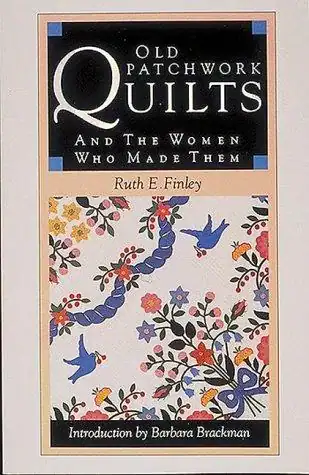
First off, thanks so much for all the wisdom that’s been shared about quilt labels. I have a much better sense of what to recommend in my book now, and will be quoting some of you who responded. My book really only touches here and there on history –mostly I’m documenting the wide range of resources for modern quilters. But I hope to be able to bring my quest for information here, when I need historical help from time to time. I want to quote from Ruth Finley’s book “Old Patchwork Quilts and the Women Who Made Them,” and there are two points that confuse me. The introduction of the book says that while Finley’s research was generally excellent, she was wrong about several points, including the section on the baker’s dozen of quilts that young betrothed women were expected to have in their dowry, the final being the “Bride’s Quilt.” Now, what I’m confused by if whether all of that is wrong, or just part. Whether the error is in saying this was accepted practice when maybe there were just some women or some parts of the country where this was done. Or, was there no such thing as a Bride’s quilt? Is there someone on the list who knows this history, or can you send me to a book, museum, expert, website, whatever, that will help me understand what the average young woman in the 19th century was expected to accomplish with re: to quilts, particularly with regard to her dowry? The second Finley question has to do with Freedom Quilts, which she says were given to young men at the age of 21, when they were free to leave off being an apprentice and assume a more independent life. I have read about Freedom Quilts in other books as well. Is this another quilt myth, or are some aspects of this story true? (I’m writing a section where I talk about how the events today’s quilters mark via quilts are sometimes closely related to those in earlier eras, and sometimes starkly different– like the woman I interviewed who made a quilt to celebrate her divorce, in all the bright colors her husband hated.) I really appreciate any help or advice. It’s great to have a forum to go to with these kinds of questions. warmly, Meg Cox Writing & Quilting in Princeton, NJ
“> In the past, especially in the 19th century, when modesty in all things > was a byword, women did not sign their work in obvious ways. It is > exciting to find names or initials in tiny script, worked into the > quilting,” I had to pop in on this thread, as last summer my aunt gave me a family heirloom quilt that she knew absolutely nothing about, except that her mother had kept it with a family heirloom Lehr coverlet. I took the coverlet to Virginia Gunn for examination, as she knows a good deal about the Lehr weavers of Wayne County, Ohio. Took along the quilt to show her, also. When she examined the quilt, she nearly immediately found two quilted-in stitched names in the corner – Maria and Elizabeth. She gave me a genealogy listing of the Lehr weaver family, and weeks later when examining the list more closely, it was discovered that my great-great-grandfather had two sisters named Maria and Elizabeth. It made sense that my grandmother would have kept her great-aunts’ quilt with her grandfather’s coverlet. !! The Lehr quilt can be seen at my Webshots site: http://community.webshots.com/user/buckeyebev It has intricate quilting, double-stitched, with acorns, tulips and hearts along the borders. I treasure it and feel grateful that my aunt has shared it with me.
Bev Macbeth
From: Joan Kiplinger <jkip@> D
From time to time, there has been interest and discussion regarding fabric in quilts which are or looks supiciously re-dyed. And it seems some of you historians collect any information on the subject for your own use or teaching. So this may be of interest to add to your notes; for some reason I could not post to the eboard. But at least it puts a name to re-dyeing. An ad in the Dry Goods Economist, Feb.13, 1904:
WE RE-DYE Dress Goods and make them equal to new. FIRTH & FOSTER CO. Dyers, PHILADELPHIA
If anyone wants a copy of this ad, let me know and I will send a scan. I will also be posting this to the Vintage Fabric list; sorry for the duplication.
From: Florence Purcell
I am on Charter Cable. They told me that if they had enough calls from people who wanted REAL WOMEN, they might include the channel in their line-up.
Florence On Friday, February 11, 2005, at 12:00 AM, Quilt History List digest wrote:
>
From: Judy Schwender <sister3603@>
Hello Joan- I would like to have a scan, please. Do you have info on where Dry Goods Economist was published? Thank you- Judy Schwender
Joan Kiplinger <jkip@> wrote: From time to time, there has been interest and discussion regarding fabric in quilts which are or looks supiciously re-dyed. And it seems some of you historians collect any information on the subject for your own use or teaching. So this may be of interest to add to your notes; for some reason I could not post to the eboard. But at least it puts a name to re-dyeing. An ad in the Dry Goods Economist, Feb.13, 1904:
WE RE-DYE Dress Goods and make them equal to new. FIRTH & FOSTER CO. Dyers, PHILADELPHIA
If anyone wants a copy of this ad, let me know and I will send a scan. I will also be posting this to the Vintage Fabric list; sorry for the duplication.
From: Joan Kiplinger <jkip@>
Judy — magazine was published by the Textile Publishing Co., 200 Greene St., NYC. Judging from many of the trade ads, Greene St. appeared [appears] to be located in the city’s textile commercial center. Will send you photo now.
Judy Schwender wrote:
>Hello Joan- >I would like to have a scan, please. >Do you have info on where Dry Goods Economist was published? >Thank you- >Judy Schwender > > > >
Date: Fri, 11 Feb 2005 14:42:45 -0500 | From: “Lynne Z. Bassett” <lzbassett@>
> …[Ruth Finely] was wrong about several points, including the section on > the baker’s dozen of > quilts that young betrothed women were expected to have in their dowry, > the > final being the “Bride’s Quilt.” Now, what I’m confused by if whether all > of that > is wrong, or just part. Whether the error is in saying this was accepted > practice when maybe there were just some women or some parts of the > country where > this was done. Or, was there no such thing as a Bride’s quilt? Is there > someone > on the list who knows this history, or can you send me to a book, museum, > expert, website, whatever, that will help me understand what the average > young > woman in the 19th century was expected to accomplish with re: to quilts, > particularly with regard to her dowry?
Dear Meg,
I have found no evidence here in New England to substantiate the claim about the “Bride’s Quilt” or the need to have a baker’s dozen quilts before a woman married. I discussed this question in my article “A Dull Business Alone: Cooperative Quilting in New England, 1750-1850” in the 1999 Proceedings of the Dublin Seminar for New England Folklife (Boston University 2001). I was reading Jeannette Lasansky’s excellent book, _In the Heart of Pennsylvania_ recently, and she also states that she found no evidence for that claim. Interestingly, Jeannette found, like I did, that quilting parties were not nearly so common as we would like to believe, either. That said, I have found in my research on early whole cloth wool quilts, that when a quilt has a particular date associated with it, either worked in the quilting or by family history, I can (so far) always document a marriage to that date. Keep in mind that far from all of these quilts have dates associated with them! But, it does lead one to suspect that these wool quilts may have been something special for a marriage in New England in the late 18th and early 19th centuries.
> The second Finley question has to do with Freedom Quilts, which she > says > were given to young men at the age of 21, when they were free to leave off > being an apprentice and assume a more independent life. I have read about > Freedom Quilts in other books as well. Is this another quilt myth, or are > some > aspects of this story true?
I have not yet come upon any evidence of Freedom quilts in New England–a Freedom Suit, yes–but Freedom Quilt, no.
Best, Lynne
Date: Fri, 11 Feb 2005 14:52:39 -0800 (PST) | From: Susan Riley <blackeyedsewsan@>
Greetings from Beantown…cold, clear, icy… When I read Beth Davis’s item on the Egyptian quilt I thought I would post a friend’s response to the Navajo fabric with mention of Egyptian fabric. Egypt is her real area of expertise and I thought the group would enjoy what Nancy(Alameda CA) had to say back in January. This is not to say anything against this current quilt posting as her reply was done in January for the Navajo fabric debate.
“Susan, I am in complete agreement with the discussion related to accuracy in fabric representations. That’s a problem I have regularly with Egyptian motif fabrics that include hieroglyphs, particularly. 9 times out of 10 the “glyphs” are either just squiggles that have no resemblance to the actual thing or they are stylized “glyphs” that sort of represent the real ones but not quite. Once in a while I’ll find accurate hieroglyphs, but they’re usually untranslatable as they’ve been selected at random. If there’s a legit representation that is actually taken from a real document it’s rare. Considering how many “real” inscriptions exist, there’s really not excuse for not using the real thing. The correspondent who noted that Navajos don’t live in tipis or wear war bonnets, is absolutely accurate. They were primarily sheep herders and small farmers, and traditionally lived in hogans, which of course are not nearly as dramatic as tipis! Anything with tipis and war bonnets is typical of the plains. Regarding Navajo blankets in fabric designs, I suspect they are not bases on real blanket designs either. Considering that there are dozens of resources available to check the accuracy of such things, you’d think the fabric designers would do so, and the manufacturers would insist on it. Nancy”
At a library database program this week, I learned about a wonderful site called tinyurl.com When sending some of these very long URL’s (ie, e-bay etc.), you copy (r.click) the URL, pull up this site, paste (l. click) the URL in the box and when you hit enter: voila a ‘mini miracle’. Have fun with it! Susan Riley
Quilt History List digest <qhl@> wrote:
QHL Digest for Thursday, February 10, 2005.
Date: Fri, 11 Feb 2005 18:55:40 -0600 | From: “Rosie Werner” <rwerner@>
In our Northfield MN Historical Society Museum (which has mostly Jesse James Gang memorabilia) there is a quilt donated by a local family. It is made of crazy quilt blocks which are signed or initialed. On the quilt is a man’s name and the words “age 30”. We were told that if a man reached the age of 30 and was not married, he received a “bachelor’s quilt”. There’s a quilt to prove it, so this one is not a myth. Don’t know about freedom quilts, but I made both of my sons freedom quilts for graduation. Trouble is, they are still at home. Rosie in MN ——_NextPart_000_002F_01C5106B.4834EBA0–
Date: Fri, 11 Feb 2005 18:06:01 -0800 | From: “Laurette Carroll” <rl.carroll@>
You might read the book ” Quilts in America“, by quilt historians Patsy (and the late)Myron Orlofsky, perhaps the most authoritative book on antique quilt history.
The book answers all of your questions re: the Brides Quilt, the Freedom Quilt and the making of a dozen quilts for the brides dowry.
Laurette Carroll Southern California
> of the book says that while Finley’s research was generally excellent, she > was wrong about several points, including the section on the baker’s dozen of > quilts that young betrothed women were expected to have in their dowry, the > final being the “Bride’s Quilt.” ….. Or, was there no such thing as a Bride’s quilt? Is there someone > on the list who knows this history, or can you send me to a book, museum, > expert, website, whatever, that will help me understand what the average young > woman in the 19th century was expected to accomplish with re: to quilts, > particularly with regard to her dowry? > The second Finley question has to do with Freedom Quilts, which she says > were given to young men at the age of 21, when they were free to leave off > being an apprentice and assume a more independent life.
Date: Fri, 11 Feb 2005 21:20:45 -0500 | From: “Sharon in NC” <patchworksecrets2@>
I would like a copy Joan. I have a quilt top that is made from tobacco pouches. It has definitely been dyed.
Sharon in NC
From: “Lynne Z. Bassett”
I have not heard of this as a general practice. Does anyone else have an example of an “age 30” quilt?
Best, Lynne
From: “Karen Evans”
It’s also about twenty years old, no? In which case it misses out on a lot of research that’s been published since then, including much of Barbara Brackman’s work on pattern dating.
I also seem to recall that the Orlofskys, even in the reprint, continued to date the Saltontall quilt at 1704 even though it’s much likelier to date from the early 1800s. Am I correct on this, or have I misremembered?
Karen Evans
Date: Sat, 12 Feb 2005 00:26:44 -0500 | From: “Lynne Z. Bassett” <lzbassett@>
> It’s also about twenty years old, no? In which case it misses out on a > lot > of research that’s been published since then, including much of Barbara > Brackman’s work on pattern dating.
It was first published in 1974, so it’s over 30 years old.
> I also seem to recall that the Orlofskys, even in the reprint, continued > to > date the Saltontall quilt at 1704 even though it’s much likelier to date > from the early 1800s. Am I correct on this, or have I misremembered?
Yes, they date the quilt to the papers used for the templates (an early Harvard catalogue), even though the silks are considerably later. (However, a new analysis of the Saltonstall quilt has concluded that it was probably begun in the mid-18th century and finished in the last quarter of the century. We’ll be writing about it in the Mass. Quilts book. The problem with the earlier analysis was that it was done by an English textile authority using photographs, not by examining the quilt in the flesh.) Another quilt that the Orlofskys point out as being from the early 1700s actually has a Greek Revival house depicted on it–a style that didn’t come into fashion until about the 1820s. They assert that the patchwork quilt was likely developed in the early colonial period out of the necessity for frugality–and we all know now that was certainly not the case. And they make blanket statements about quilting practices that were definitely not true of New England, at least. Okay, I’ll stop now.
Lynne
Date: Sat, 12 Feb 2005 00:34:08 -0500 | From: “Karen Evans”
When it comes to American quilting, I’m much more likely to go with Kiracofe.
I wasn’t aware of the new Saltonstall date – do you have a publication date for the Mass quilts book? Sounds fascinating!
Karen Evans
Date: Sat, 12 | From: “Liz Lois” <loislane@>
Hi all, One of my friends is currently in school and trying to locate a book for a paper she is doing. I am not sure that it isn’t a magazine article and not from a book? Any help on locating this would be appreciated. Here is her query The obsession continues…I am still plotting a research paper for one of my classes about Depression era quilts and quilters. When looking through MORE fabric for grandmother’s flower garden last night, I found Xerox copies from a book called Triumphs in Hard Times. Sound familiar to anyone? I can’t for the life of me remember who gave me the copies. The copies I have are the instructions for making GFG hexagons, etc. Sound familiar to anyone? Liz in sunny Wisconsin where it’s unseasonably warm..40+ degrees!!
From: Xenia Cord <xenia@>
My guess is that this book is “Soft Covers for Hard Times” by Merikay Waldvogel (1990) (ISBN 1-55853-062-2)
Xenia
Date: Sat, 12 Feb 2005 10:58:56 -0700 | From: “Judy Anne” <anne_j@>
I’m planning to write an article shortly on Hmong needlework and quilting. I have a lovely example of their reverse appliqué but need an example of Hmong story cloth. I’m frustrated with myself for not buying one at the Fresno fair last fall when we were visiting there but now it’s too late. If anyone has a picture that they could give me permission to publish on my site please let me know. It will be a small picture and doesn’t have to be anything fancy. I’m at a loss as to where to find one.
Also if anyone knows of a book about Hmong needlework I’d be very interested. I’ve found quite a bit of information on the Internet but would like to have book references as well.
It will be published in my multicultural quilters section on American’s Quilting History .http://www.womenfolk.com/historyofquilts/
Judy Anne
Date: Sat, 12 Feb 2005 20:22:30 +0200 | From: ady <adamronin@>
You wrote:
“Susan,
I am in complete agreement with the discussion related to accuracy in fabric representations. That’s a problem I have regularly with Egyptian motif fabrics that include hieroglyphs, particularly. 9 times out of 10 the “glyphs” are either just squiggles that have no resemblance to the actual thing or they are stylized “glyphs” that sort of represent the real ones but not quite. Once in a while I’ll find accurate hieroglyphs, but they’re usually untranslatable as they’ve been selected at random. If there’s a legit representation that is actually taken from a real document it’s rare. Considering how many “real” inscriptions exist, there’s really not excuse for not using the real thing.
There are two types of Egyptian appliquE9 quilts, each serving a different purpose. The kind made for the tourist trade does indeed include various representations of ancient Egyptian art, done in varying degrees of accuracy. These were made, if memory serves, from the beginning of the 20th century onwards (possibly earlier), and reached a peak of popularity in the Twenties, following the discovery of Tutankhamen’s tomb. I’ve seen some (even new ones) that were beautifully made, with exact replicas of the hieroglyphs in the original text (most scenes depicted are taken from scenes painted on walls of famous ancient Egyptian tombs).
The other kind (and the Ebay quilt is of that variety) are authentic prayer and mourning wall hangings, made in the Islamic tradition and used for mourning tents. When a person dies, the family erects a mourning tent where visitors can sit and express their condolences. These fabric “walls” of the tents are decorated with appliquE9d plant and geometric motifs (as in Islamic art representations of human figures 96 “idols” – are forbidden) and calligraphic quotes from the Koran. The calligraphy is what makes the script so beautiful, and so difficult to read if you’re not well versed in Arabic. My Arabic is far too rusty to decipher the inscription on the Ebay quilt, but it is something about praising Allah every day (I’ll ask an Arabist friend if she can translate for me). Sadly, this magnificent tradition is dying out as nowadays cheap pre-printed panels are used instead of the expensive, hand appliquE9d masterpieces.
Just my two cents’ worth
Ady in Israel
Date: Sat, 12 Feb 2005 13:36:31 EST | From: Senopera@
I stopped in Laura Fisher’s shop in New York a couple of days ago – only to find that she has suffered a devastating flood. Many of you know of her wonderful inventory of antique quilts -and so many of them now are just ruined. Including her Amish beauties –
She’s clearly still in business – but there’s much to do to get it all “dried out”.
Sue North
From: “jocelynm@”
>>>We were told that if a man reached the age of 30 and was not married, h e received a “bachelor’s quilt”. There’s a quilt to prove it, so this one is not a myth.
Rosie, Sorry, but the quilt proves that a quilt was made for a particular man who was 30 years old; it doesn’t prove that it was made BECAUSE he was 30, or t hat it was customary to make quilts for 30 year old bachelors.
Census records might be able to give you a clue as to whether this man was actually a bachelor. This might be as much of a myth as the one about Amish quiltmakers putting in a mistake deliberately.