The Grandmothers Flower Garden Quilt
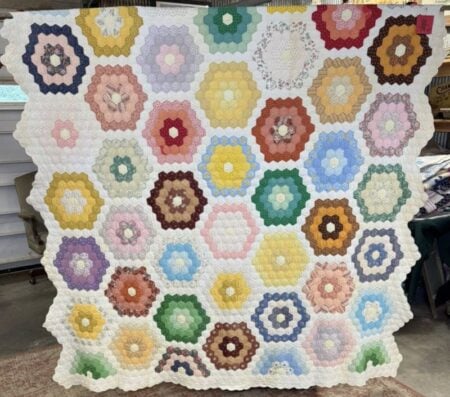
Grandmother’s Flower Garden is one of the most beloved quilt patterns in American history. Made of hexagons stitched into flower shapes, it has charmed quilters for almost 250 years. While many people think of this pattern as a product of the 1930s, its roots actually reach back much further, to 18th century England.
Where the Pattern Came From
The hexagon shape has a long history in patchwork. According to the Illinois State Museum, the oldest known hexagon template dates all the way back to 1770 and was found in England. By the late 1700s, hexagon quilts were already popular there.
The first American version of this style is believed to have been made around 1800. The first publication in the U.S. that mentioned it is believed to be in 1831 when The American Girl’s Book called it a hexagon, six-sided or honey-comb patch worked English paper piecing. In 1835, Godey’s Lady’s Book magazine published the first printed pattern in the United States. This pattern gave full instructions for this method.
What’s in a Name?
The pattern we now call Grandmother’s Flower Garden has gone by several names over the years. Early on, it was often called “Honeycomb” or “Mosaic,” names that describe the way the hexagons fit together. During the Colonial Revival period from 1880 to 1940, it was sometimes known as “Martha Washington’s Flower Garden.”
The name “Grandmother’s Flower Garden” didn’t become common until the 1920s and 1930s, even though the design itself was already over a century old by then.
How the Quilt Is Made
This pattern uses a technique called English paper piecing. Here’s how it works:
A small hexagon, usually one to three inches across, is cut from paper or thin cardboard. Fabric is wrapped around the paper and basted in place with loose stitches. Once a group of fabric-wrapped hexagons is ready, they are whipstitched together by hand. Afterward, the paper templates are removed, though sometimes makers left them inside the finished quilt.
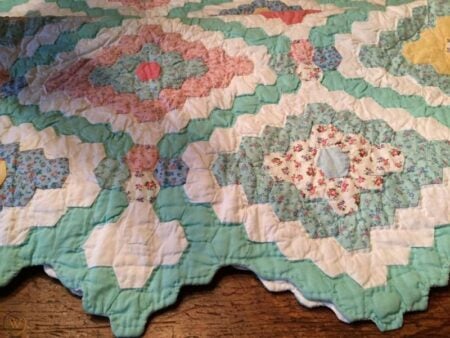
To form a “flower,” six hexagons are stitched around one center hexagon. More rings of hexagons can be added around that flower if the maker wants a bigger design. By choosing different fabric colors, quilters can turn the same hexagon shapes into flowers, diamonds, or other patterns. The edges of the quilt are sometimes left jagged, following the shape of the flowers, or they can be trimmed straight using half-hexagons.
The 1800s: A Quilt for the Wealthy
In the early 1800s, paper was expensive and not easy for working families to get. Because of this, most Grandmother’s Flower Garden quilts from this era were made by upper-class women. Templates were often cut from reused newspapers, catalogs, or old letters. According to an article by quilt historian, Barbara Brackman, a publication of the Huguenot Society of South Carolina tells of a young girl who accidentally used her grandfather’s deed to a French vineyard as quilt templates.
Wealthier quilters of this time often used roller-printed, mordant-dyed chintz fabrics. These were originally meant for curtains and upholstery, not clothing. One museum quilt from this era is made up of more than 200 different fabric prints, all from the same textile mill, making it a valuable piece for studying fabric history.
The 1930s Revival
Hexagon quilts reached their height of popularity again in the 1920s and 1930s. This is when the name “Grandmother’s Flower Garden” became widely used. Quilts from this period often have a recognizable look: yellow centers, pink petals, and green hexagons forming the “path” between flowers.
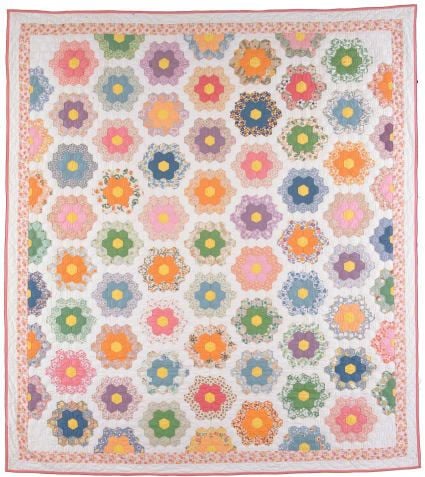
Many people assume this scrappy, mix-and-match style came only from the hardships of the Great Depression. But quilt historian Barbara Brackman points out that it was also a popular trend among wealthier women during the Colonial Revival, a time when Americans took new interest in old-fashioned crafts and traditions. Companies like Sears, Roebuck and Company even sold precut fabric kits for making Grandmother’s Flower Garden quilts.
Quilts as Gifts and Keepsakes
Throughout its history, this pattern has often been used to create meaningful gifts. The McMinn County Living Heritage Museum has several Grandmother’s Flower Garden quilts on display, ranging from 84 to 144 years old, in shades of pink, blue, green, purple, and yellow.
The oldest of these, a diamond-pattern variation from around 1880, is made of red, green, and brown fabric, much darker than the others.
One especially touching example was made in 1935 by a group of women from the Coghill and Goodsprings Baptist Churches near Etowah, Tennessee. They embroidered nearly fifty names into the centers of the flowers and gave the finished quilt to a young man named Shields Webb. According to his wife, who later donated the quilt to the museum, it was meant as a gift of “encouragement and appreciation for a struggling country boy during the Great Depression.”
A different example, made by Carrie Stelzer in Geneva, Nebraska between 1931 and 1934, was sewn for her daughter using scraps from old bonnets, aprons, and clothing, a perfect example of the resourcefulness many quilters showed during the Depression.
A Pattern That Changes Over Time
Because Grandmother’s Flower Garden quilts are made of small, separate pieces, they tend to get repaired and altered over the years. Owners might replace worn flowers, add new borders, sew on sashing strips, or straighten out scalloped edges with half-hexagons.
The hexagon design is also easy to expand or change. A quilter can add more rings to make the quilt bigger, switch up the color placement to create a different “flower” effect, or use the same hexagon shapes to form diamonds instead of flowers. On older quilts, mismatched fabrics or replaced sections often tell a story about how the quilt was used and repaired over time.
Tips for Dating an Old Quilt
If you have an old Grandmother’s Flower Garden quilt and want to learn more about its age, here are some clues to look for:
Fabric type: Darker prints, homespun cloth, and chintz fabrics often point to the mid-1800s. Pastel calicos and feedsack prints usually point to the 1920s through 1940s.
Construction: Whipstitching combined with small basting pinholes is a sign of English paper piecing, often done before 1900.
Path color: Green hexagons between flowers were especially common in the 1930s. Peach or white paths are less common and may suggest a different time period.
Backing: Quilts with no backing fabric were sometimes made as decorative spreads rather than everyday bedding, especially in the 1800s.
Papers inside: If the original paper templates were left inside the quilt, they can sometimes be dated by their printed material, such as old newspapers or letters.
A good rule of thumb is that the fabric often tells a more accurate story than the pattern name. Even though we call it “Grandmother’s Flower Garden,” the design itself is much older than that name suggests.
Hexagon Quilting Today
Grandmother’s Flower Garden quilts are still being made today, and English paper piecing remains a popular technique. Because each hexagon is finished before it’s joined to the next, this method is fairly easy for beginners and gives accurate, professional-looking results.
Whether simple or complex, hexagon quilting remains a favorite for many sewists. It’s portable, easy to pick up and put down, and many quilters find the slow, repetitive stitching to be relaxing and even meditative.
From English drawing rooms in the 1700s to Depression-era farmhouses to quilt shows today, Grandmother’s Flower Garden has remained a favorite for nearly 250 years. It has been a status symbol, a friendship gift, a memorial, and a creative outlet for countless quilters. Its simple hexagon shape continues to offer endless possibilities, proving that good design truly never goes out of style.
