How to Identify a Linsey-Woolsey Coverlet
This page contains affiliate links. If you buy through them, I may earn a small commission at no extra cost to you. As an Amazon Associate I earn from qualifying purchases. Learn more
I have a blue-and-cream bedcover in my collection that I have always thought of as an early linsey quilt, perhaps linsey-woolsey. When I pulled it out to use it in the Indigo Fabrics article and began looking closely, however, I wasn’t really sure.
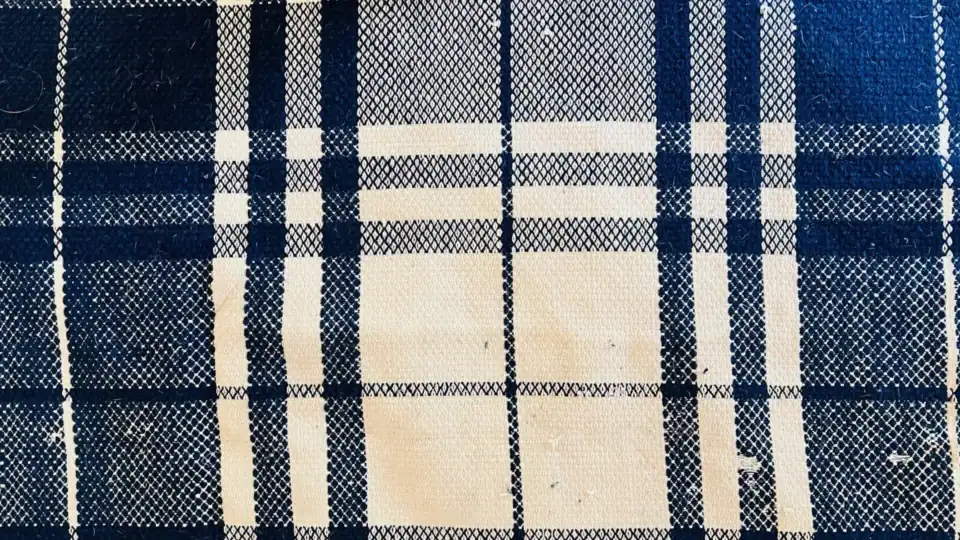
This one gave me several clues. The bold blue-and-cream plaid is woven into the cloth. I could not find pieced blocks, quilting stitches, batting, or a separate backing. That makes it a woven coverlet rather than a quilt.
It may still be made from linsey-woolsey. The difference is that coverlet tells us what the object is, while linsey-woolsey tells us what kind of cloth it may be made from.
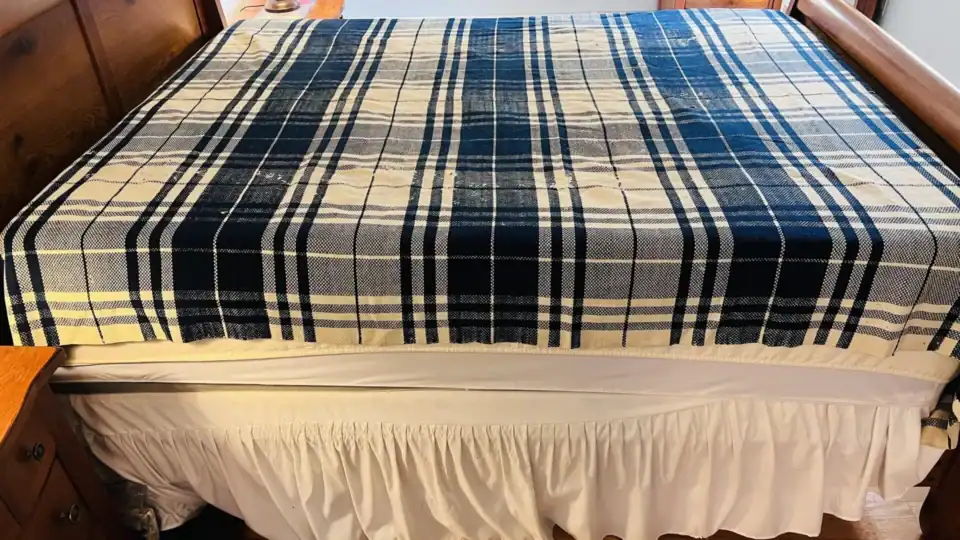
A woven coverlet is usually one substantial layer. The pattern is made on a loom as the threads cross. It does not need batting or quilting stitches to hold it together. This bedcover behaves like one heavy piece of woven cloth. The blue and cream are not separate patches. The pattern continues through the weave, and there are no quilting stitches outlining the large rectangles.
So What Is Linsey-Woolsey?
Linsey-woolsey is a sturdy cloth made by combining plant fiber with wool. Traditionally, linen threads ran in one direction (the warp) and wool threads crossed them (the weft). The linen supplied strength while the wool supplied warmth.
In early nineteenth-century America, cotton often took the place of linen. Cloth woven from cotton and wool was still commonly called linsey or linsey-woolsey. Unfortunately for anyone trying to identify an old bedcover, the name was not used with laboratory precision. Linsey-woolsey traditionally means a fabric woven with linen and wool; in nineteenth-century America, cotton-and-wool versions were also called linsey or linsey-woolsey.
Linsey was used for clothing, blankets, and household textiles. Worn clothing could also be cut up and pieced into quilts. This means you may encounter a one-layer woven linsey coverlet, a wholecloth quilt made from linsey, or a patchwork quilt made from pieces of old linsey fabric.
Why I Think This One May Be Linsey
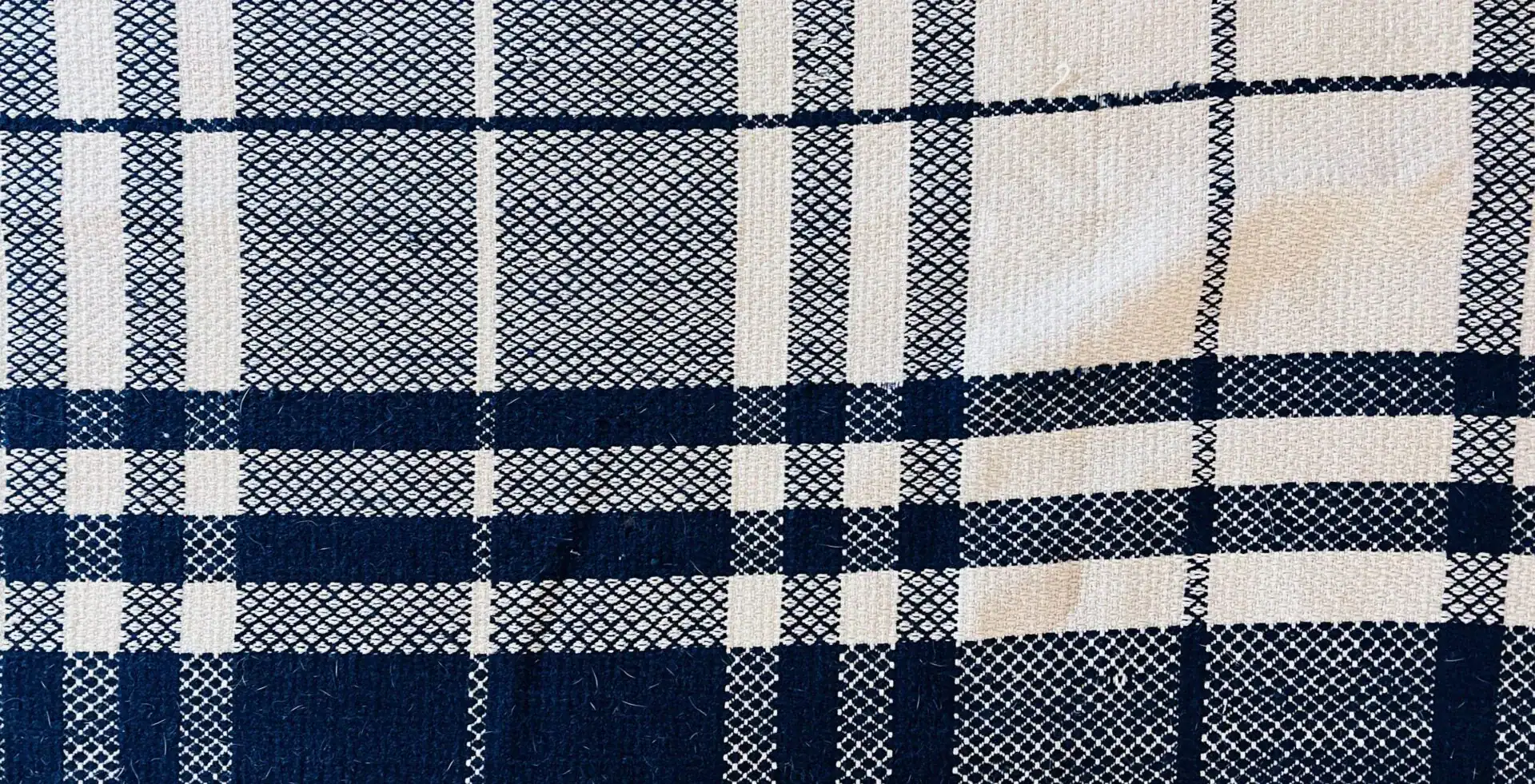
When I looked closely, I could see more than one kind of yarn. The cream-colored threads look relatively smooth, pale, and firm. They may be cotton or linen. The dark blue yarns look softer, thicker, and hairier, which is what I would expect from wool.
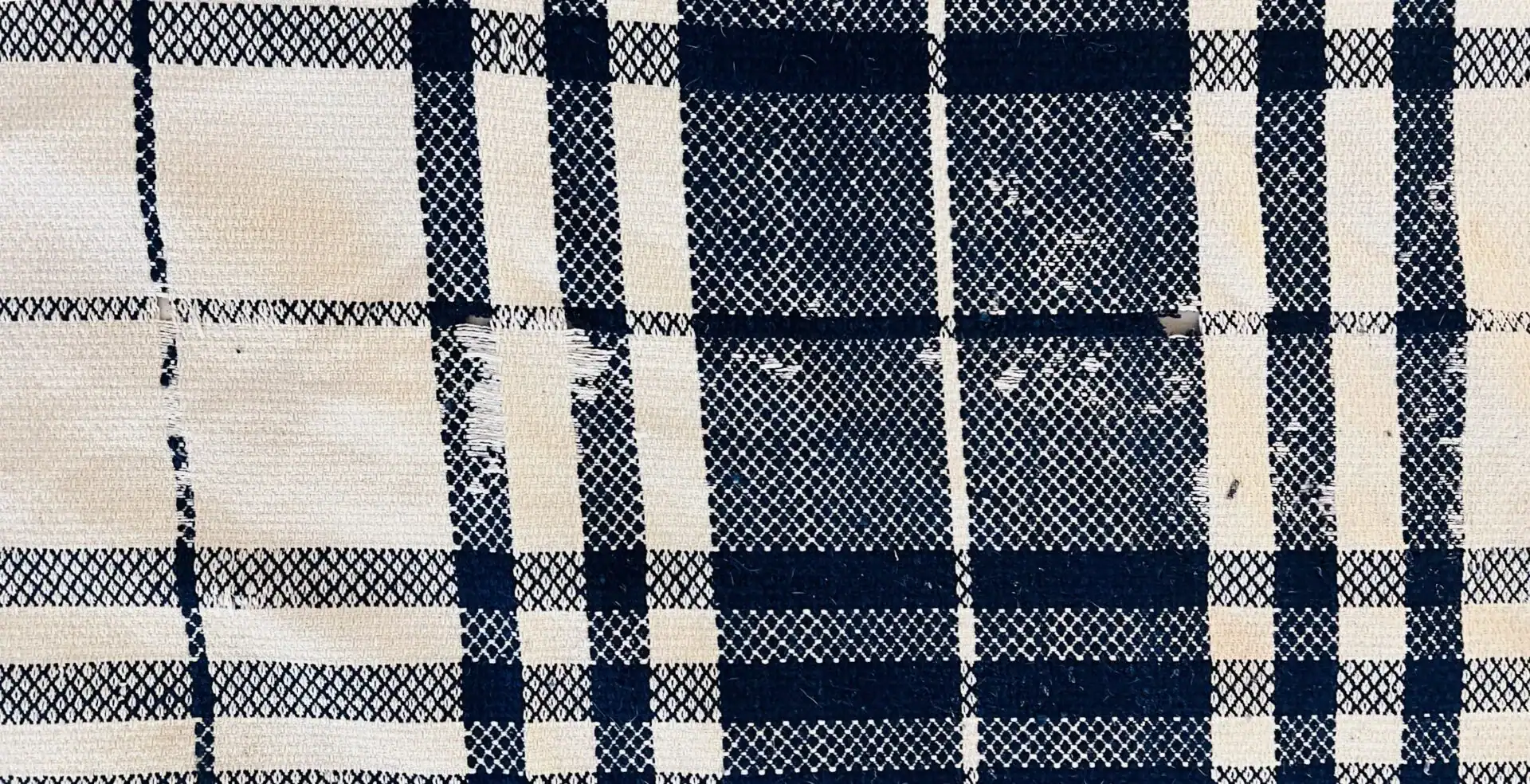
The worn places are especially helpful. In several areas, the darker yarn has broken or disappeared while pale threads remain. Wool and plant fibers react differently to wear, washing, insects, dampness, and light. It is common to see the wool fail while cotton or linen continues to hold part of the cloth together.
Damage is not something we normally celebrate, but it often lets us see how an old textile was made. This is one reason I do not automatically pass by an imperfect quilt or coverlet. Sometimes the hole is the most talkative part.
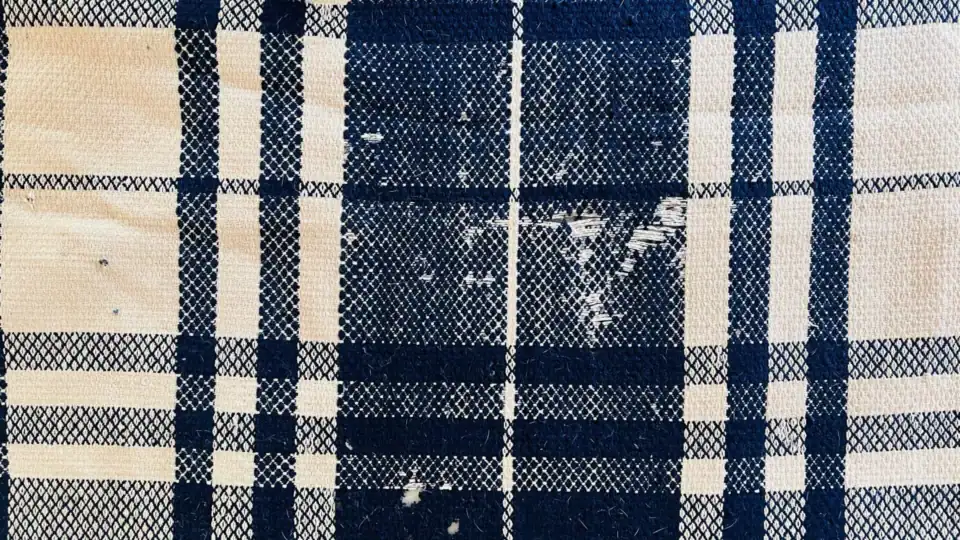
For now, I am comfortable calling it a blue-and-cream woven plaid coverlet, probably wool with linen, and possibly linsey-woolsey. That is not quite as dramatic as “rare Colonial linsey-woolsey quilt,” but it has the advantage of being honest. Old-looking fabric is not automatically eighteenth century. “Colonial” is used far too freely in the antiques market. Apparently every old bedcover arrived on the Mayflower.
Is This an Overshot Coverlet?
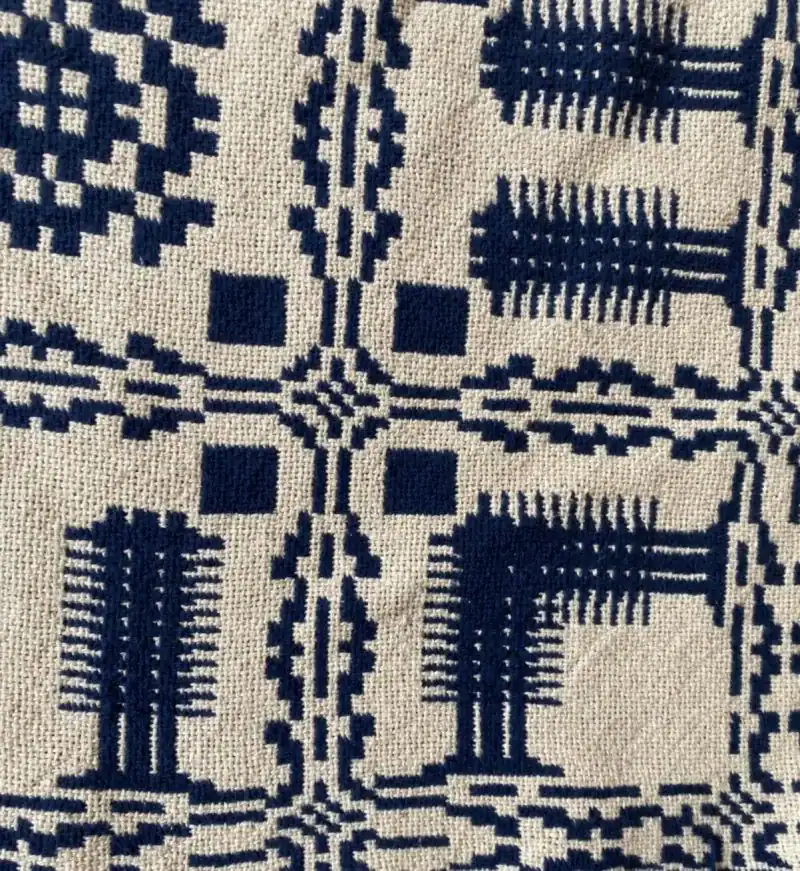
In an overshot coverlet, a heavier pattern yarn passes over, or “shoots over,” groups of threads in a finer plain-woven ground. Overshot drafts often create repeated stars, flowers, wheels, tables, or other geometric figures.
My first thought was that it might be overshot because many early American blue-and-white coverlets were woven in that style. After studying the weave of this quilt, I do not think overshot is the best description for this one.
The design in my coverlet appears to come mainly from blue and cream stripes arranged in both directions. When those stripes cross, they produce the large plaid, smaller checks, and several shades of blue and cream. It is a woven plaid or check, not simply a printed plaid.
The Center Seam Is Part of the Story
This coverlet appears to have been made from two long, matching lengths of woven cloth sewn together in the middle. The centered seam is a strong clue that the panels were woven for this purpose and joined side by side to make a coverlet wide enough for a bed.
Nineteenth-century looms commonly produced cloth only about 20 to 40 inches wide, so this construction was practical and widespread. A weaver could produce two manageable lengths instead of trying to weave the full width of a bed in one piece.
On an old coverlet, I look for the center seam, the selvages along the sides, and the treatment at both ends. On this one, the top and bottom edges appear to have rolled hems. I also check whether the woven pattern meets at the seam. A slight mismatch does not mean that the seam is later. It may simply show the challenge of weaving and joining two long pattern repeats by hand.
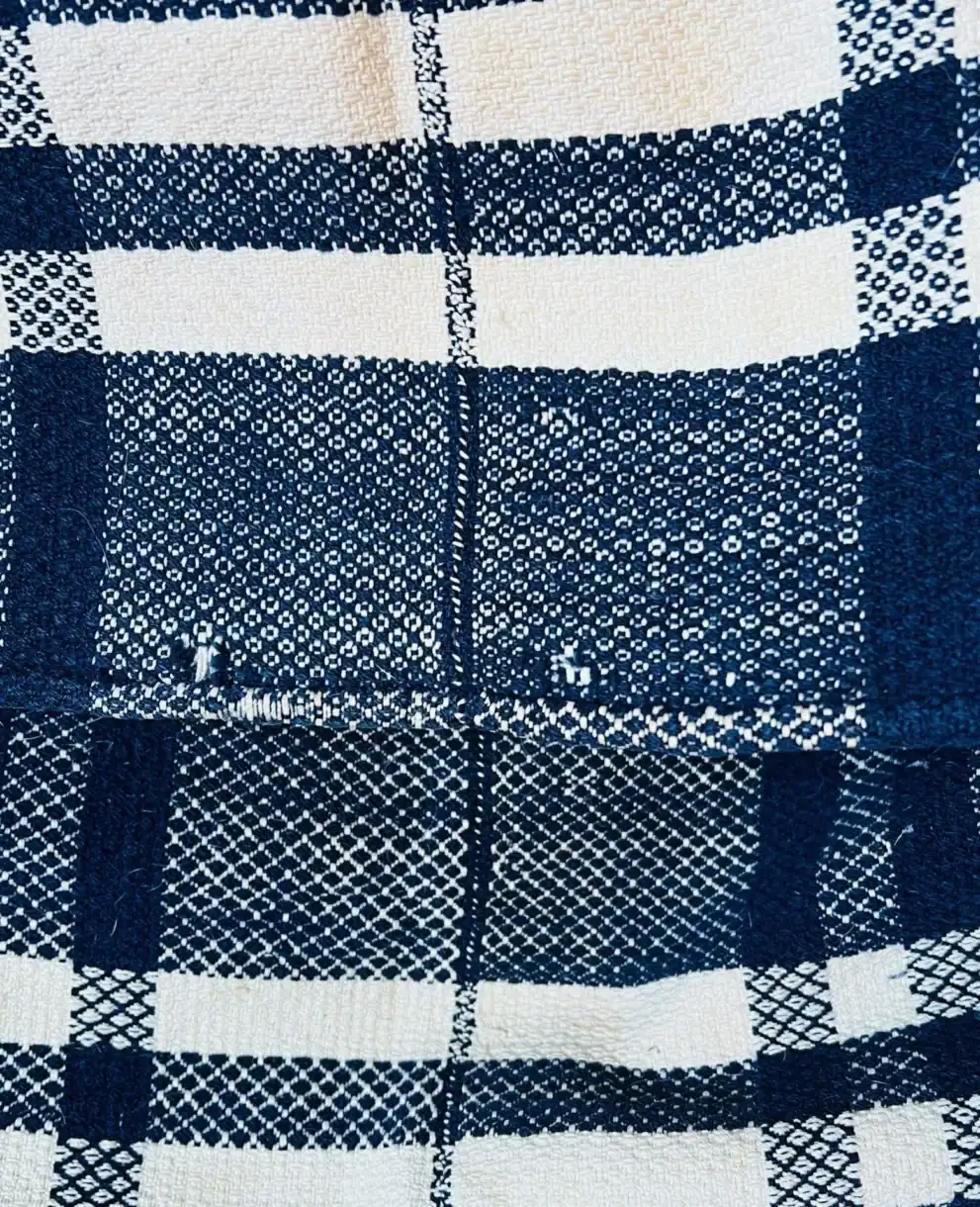
The seam can tell us something about construction, but it does not prove that the coverlet was woven at home or professionally. Professionally woven wool-and-cotton coverlets became common during the nineteenth century. Some professional weavers traveled or operated small local shops, weaving coverlets for nearby families. Based on where I bought it, I believe this is a New England piece. That is a working attribution rather than a documented origin, but its materials, construction, and general appearance fit other nineteenth-century woven bedcovers associated with the region.
How Old Is My Coverlet?
Ah, the moment of truth. Wool-and-cotton woven coverlets were particularly popular during the second quarter of the nineteenth century. Linsey cloth and other mixed-fiber textiles continued to be used after that, especially for practical household goods.
Based on the sturdy mixed-fiber appearance, dark blue color, broad plaid, construction, and wear, I think about 1840 to 1860 is a reasonable working date for this probably New England coverlet.
Is the Blue Indigo?
The dark blue certainly looks like indigo-dyed wool. Indigo was widely used for blue wool and cotton, and the deep color of this coverlet is consistent with it. Still, appearance alone cannot prove the dye. Later blue dyes can look similar, and scientific testing would be needed for certainty.
I noticed something important when I moved the coverlet: it shed blue fuzz and small fibers all over the place. It did not leave a blue stain on the bed or transfer color to another surface.
That means this is not crocking. Crocking is the transfer of dye through rubbing. What I am seeing is physical loss from the blue wool yarn itself. The wool has become friable, meaning that the fibers are weak and breaking away with handling.
This does not prove that the yarn was dyed with indigo, but it does tell me that the blue wool is unstable and the coverlet should be handled as little as possible. The color still appears consistent with indigo and will make a useful comparison in my article about indigo-dyed textiles.
Do You Have a Coverlet Like This?
If you have inherited or found a heavy old bedcover that might be linsey, begin with a few simple questions:
- Is the design woven into the cloth rather than printed or pieced?
- Can you see two different kinds of yarn? Are some threads smooth and pale while others are thicker and fuzzy?
- Has the wool-looking yarn disappeared in places while pale threads remain?
- Is there a long center seam joining narrow woven panels?
- Do you know where it came from or which family owned it?
Take full photographs and close-ups before cleaning or repairing anything. Photograph both sides, all four edges, the center seam, worn spots, and any unusual stitching. Put a ruler in at least one close photograph so the scale is clear.
Most importantly, write down the history now. A name, town, old house, auction, or family connection can disappear much faster than the fabric. Ask me how I know! All I remember about this coverlet is that I bought it from someone in Schoharie County, New York, who said it had been in his family.
Caring for an Old Wool or Linsey Bedcover
Truthfully, I wouldn’t try cleaning or repairing this coverlet. Wool, cotton, and linen respond differently to moisture and handling. If cleaning is truly necessary, consult a textile conservator first.
Support the entire bedcover when moving it rather than picking it up by one corner. Keep it away from direct sunlight, damp basements, hot attics, and active fireplaces. Watch for moths and carpet beetles. If it must be folded, pad the folds with acid-free tissue and change the fold lines periodically.
If displaying it on a bed, place a clean cotton sheet underneath and do not leave it in strong light. My coverlet looks handsome on the bed, but that does not mean it should live there full-time. Although the cat would surely like it.
The Mystery is Partially Solved
I was thinking about selling this, but I have a number of coverlets that I have purchased along the way and I think I am better off keeping it for comparison. Comparing it with my other wool quilts and woven coverlets may answer questions I have not thought to ask yet.
Plus there is still more to learn from it. A close fiber examination may tell me whether those cream threads are linen or cotton. You can purchase a small microscope from Amazon, that will answer that question. Cotton fibers look like flattened ribbons with frequent twists. Flax or linen fibers are relatively straight fibers with bamboo-like nodes. Wool has overlapping surface scales and silk has smooth, rod-like fibers. There are some really good reference pictures at Alpine Meadows Guild and Local Color Dyes.
That is one of the pleasures of owning old textiles. They do not always give up their stories at once.

