January 7 – 11, 2004
These restored messages come from the Quilt History List, an online forum where quilt historians, collectors, researchers, appraisers, and enthusiasts discussed antique quilts and related textiles. The archive dates from 1996 through approximately 2016 and is being restored gradually. Sign up in the form at the bottom of the page if you want to know when a new page is added. Original spelling, opinions, formatting, and inactive links may remain unchanged.
Primary topics of this QHL Digest:
- “Cold Mountain” and Civil War-Era Accuracy — The film “Cold Mountain” sparks a thread on how accurately it depicts Civil War-era textiles, dress, and material culture. (see the article on a Civil War quilt)
- Klan Quilts, Regional Reports — Discussion of Klan-related quilt imagery continues with a specific report on Michigan’s documented Klan quilt and related museum questions.
- 19th-Century Quilt Poetry and Prose — Sue Reich shares another installment of her recurring feature reprinting period newspaper items about quilts and sewing, this time on a dry-goods-store theft.
- Study Groups and Regional News — Notes on a Route 66-related quilt featured on Antiques Roadshow, plus general quilt-history announcements. (see the article on quilt study groups)
From: “Candace Perry”
I would say that’s as issue with the Met, also… Candace Perry
From: “Jocelyn” <jocelynm@>
> covered with old rags (a bit like scarecrows) or branches, meant to > represent Winter (compare with the Eastern European tradition of
In a town where I lived as a child, there was a town bonfire on Epiphany night. We would take our Christmas trees to the park, where they were piled on an earthen pier, which jutted out into the lake. Of course all those dried-out trees would go up in nothing flat! We would sing Christmas carols as they burned. It was always exciting when a tree would roll off the bonfire into the lake…floating away into the darkness still burning, before sinking out of sight. I’m told that the trees were good for the habitat of the lake, providing the fish places to hide. Because the bonfire was surrounded by water on three sides, there wasn’t much risk of it getting away and doing any damage, so everyone (even the firemen!) got to enjoy a good, big fire. 🙂
>From what I’ve read, northern cultures (like the Vikings) tended to have more to do with symbolic fires because of the long winters- fire, being both light and heat, would be tremendously important, and more ‘special’ than it would in, say, Tuscany. 🙂 But we have to be careful not to confuse the medium with the message- fire was used to mean a lot of different things, from a glorious entry into Valhalla, to a threat that would leave a semi-permanent reminder in the lawns of the victims.
From: “Jocelyn” <jocelynm@>
> Do you mean “morning dress” which would have been the sort of costume a > woman would wear prior to receiving visitors
I thought a morning dress was what a Southern belle wore during the day; with long sleeves to protect her skin from the sun? >
From: “ChrisA”
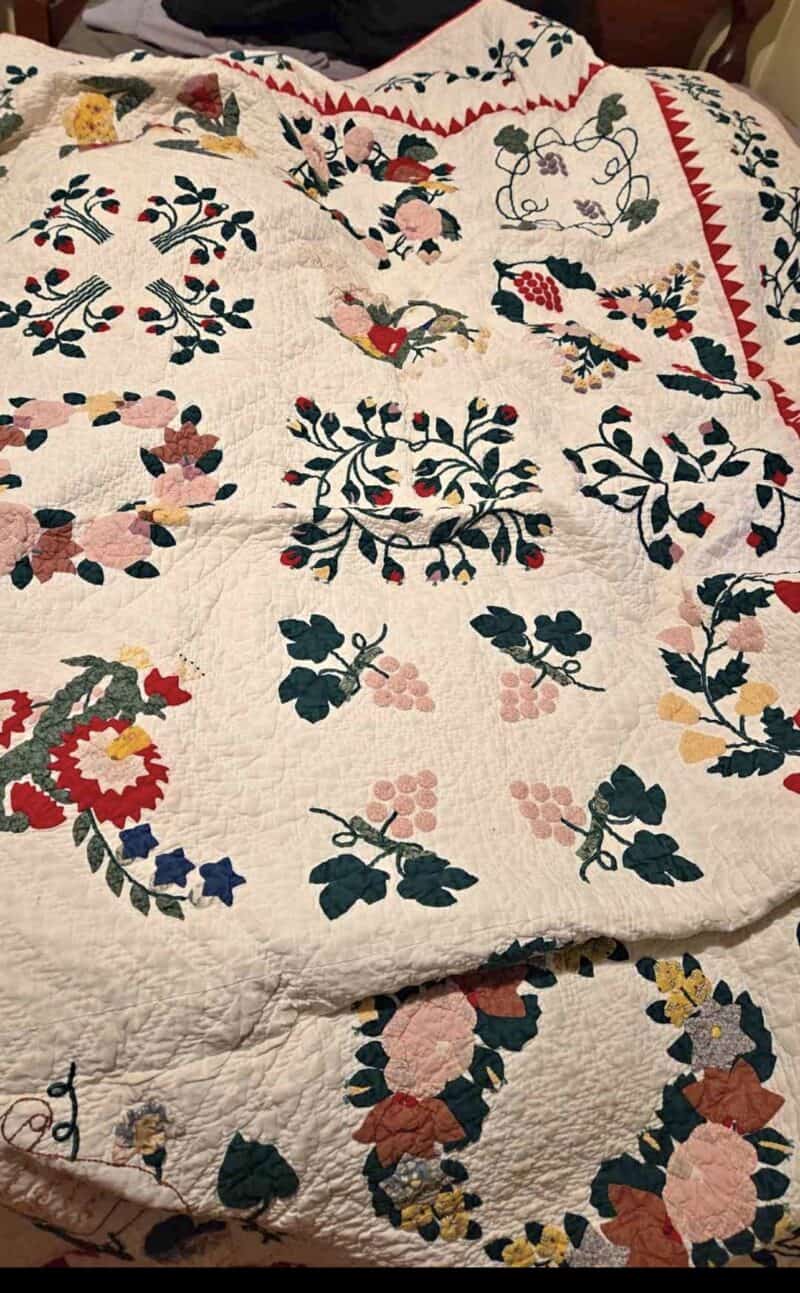
Someone on the list recently asked about when scallop edges were seen on quilts and I came across one in a new exhibit catalogue “American Quilt Classics 1880-1980” from the Mint Museum of Craft and Design that dates to c. 1850. It is a very very unusual album quilt. In a quick glance one might think it’s early th century. Each appliqué motif is different and unlike those seen in other R&G, teal, orange, and pink 1800s album quilts. Plus there are rather large red sqs. placed on point free floating across the top between the myriad of appliqués in many sizes and shapes. Obviously they are corner stones, but there is no evidence of sashing or blocks in this picture. There is no usual border either; stemmed flowers grow out of the sides like a single spring flower from the ground. The scalloped edges are bound with a dark, perhaps red, binding. The scallops are fairly small, rather then large and fit the overall size well.
This quilt is worth the entire catalogue- but it’s one of many truly unique and fabulous quilts this women collected over the years, Fleur Bresler. She recently donated them, her books and research materials to the Mint Museum and Merikay Waldvogel wrote the text. The catalogue/book is 79 pages with 36 full size quilts and many detail shots. Nearly half the quilts date pre-CW and the rest pre circa 1930s, one is 1980, hence the catalogue title.
Fleur collected 1 or 2 of many different styles such as blue-resist, chintz, stenciled, Baltimore album, 1 crib size and 1 regular :), cut-out chintz, whitework, 6 Amish, various foundation pieced types, a 1930s reproduction of the 19th century Phoebe Warner Quilt, and other appliquéd and pieced ones. Interestingly, they tend to be child size or an irregular, uncommon size. For example, the blue-resist quilt, c. 1840, is 99 1/4″ X 60 1/2″. The heavily blue on white resist fabric is surrounded by a wide indigo border on three sides. The binding is blue-resist too. These are wow quilts because they are really unusual- folk art comes to mind often.
Merikay describes the evolution of quilt history via the quilt styles and patterns. She goes into a lot of detail on each type and when they began, plus provenance and social history associated with the quilts and other aspects influencing them. It’s very informative and interesting and a fun to read catalogue. The notes section is a good research aid too. The color close-up photos are terrific and are in the text section. Although the exhibit is now over, Merikay has copies available. The book has a colorful embossed cover, it’s $.00, $3.00 S&H from Merikay, quiltalive@. There is a picture of it (item # 637) and some of the quilt exhibit too at www.mintmuseum.org.
Kimberly Wulfert, PhD www.antiquequiltdating.com Email: quiltdating@
From: “Sally Ward” <sallytatters@>
> Americans are less worried about American actors being put out of work by a > British actor playing an American, than Englishmen worry about American > actors taking a role away from Englishmen. 🙂
Do you think so? I think we worry less about nationality than we do about whether the actor is up to it. For example Cate Blanchett in ‘Elizabeth’ won critical and popular acclaim, but Mel Gibson in ‘Braveheart’ became the butt of a lot of mickey-taking. The authenticity evoked by the actor should surely have as much attention paid to it as, for example, historical costuming and set dressing (just to keep it nearly quilt history related <G>)
So far as stage productions are concerned the Actors’ Union called Equity does have rules related to foreign nationals’ work visas to protect their interests, but I’m not sure how that applies to films. Don’t English actors have to have visas to work in America?
I’m off to see Cold Mountain next week. Apart from the quilts, clothing, and set dressing, should I take this as an accurate portrayal of life at that time? I’ve just read an article about how inaccurate all those ‘cowboy and indian’ films I grew up with were…can I trust this?
Sally W in the UK
From: “Julia D. Zgliniec” <rzglini1@>
Dear Sally, You wrote: Mel Gibson in ‘Braveheart’ became the butt of a lot of mickey-taking
Please explain what you mean here – I don’t know the term and what “mickey-taking” means – I am assuming you meant he was the but of some jokes – this is such a colorful phrase!! Can you explain the origin?
I became an ardent Mel Gibson fan after I saw him in Hamlet. I thought he was excellent in this role and before that had considered him just eye candy.
Good acting is good acting – no matter the origin of the actor.
But I love those Aussies!
Julia Zgliniec
From: “Jocelyn” <jocelynm@>
> (1) Isolectin, pokeweed > Proteins isolated from the roots of the pokeweed, Phytolacca > americana, that agglutinate some erythrocytes, stimulate mitosis > and antibody synthesis in lymphocytes, and induce activation of > plasma cells.
agglutinate some erythrocytes- makes some red blood cells clump together and stimulates cell division and creation of antibodies in the white blood cells that fight disease.
> (2) mitogen (mi·to·gen) (mi¢to-j[schwa]n) a substance that > induces blast transformation; DNA, RNA, and protein synthesis; > and proliferation of lymphocytes, e.g., concanavalin A, > phytohemagglutinin, pokeweed mitogen, or lipopolysaccharide.
Makes lymphocytes (a kind of white blood cells that fight disease) reproduce, and turns them on from an inactive to an active, antibody-producing cell.
> pokeweed mitogen, a lectin isolated from pokeweed (Phytolacca > americana); it is a mitogen that stimulates both B and T > lymphocytes. Abbreviated PWM.
B and T are two types of lympocytes; one fights bacteria, the other fights viruses and cancers.
So it sounds like Granny was right- it DOES stimulate the immune system. 🙂
Date: Sun, | From: “Sally Ward” <sallytatters@>
‘Taking the mickey’ or ‘taking the mick’, means teasing or making fun of. I’ve just looked up the origin of the phrase which surprised me a bit and I’ve posted it privately to Julia. If anyone else wants to know, best ask me off list <G>
> Good acting is good acting – no matter the origin of the actor.
Hear hear.
Sally W
Date: Sun, | From: quiltstuff@
Sorry for starting a movie actor discussion that led onto language but I guess that is the joy of the internet. I know I used to always get into quite confusing discussions with visiting US Army Officers before we worked out that the phrase ” I am pissed” means different things in our countries. I meant I was drunk and they meant they were cranky. VBG
Although we don’t normally use the phrase ‘ mickey -taking-‘ , we sure do use the phrase ‘taking the mick’ or ‘taking the mickey’
It does mean making fun of someone.. and probably originates from the term ‘ taking the piss’ which also means the same. ( not that I know why it does) Anyway I checked it out on a cool web page which revealed >.
Partridge’s “Dictionary of Slang and Unconventional English” dates this expression to c. 1950, and gives its origin as rhyming slang (“Mickey Bliss”). Mickey Bliss, thought to be BBC radio personality, has never been conclusively identified.
A competing theory is that “taking the mick” was derived from the verb, “micturate” (to urinate).>>
The site has explanations for a whole host of strange expressions. Fun to read. I always wondered why we said ‘ to the bitter end’ http://www.yaelf.com/questions.shtml
Suzy > > Please explain what you mean here – I don’t know the term and what > “mickey-taking” means – I am assuming you meant he was the but of some > jokes – this is such a colorful phrase!! Can you explain the origin? > >
From: Gail Ingram
All right,
Someone else brought up the subject of language, not I. But their choice gives me an opportunity to recommend a book I was given for Christmas and which has already become my boon companion—Garrison Keillor’s “Good Poems.”
Oh my heavens and stars, if you do not have this book, trot right out to your nearest bookstore, waddle past all those diet books and Dr. Laura’s tome on how to get the bedroom rafters wobbling. You won’t need the Dr. Phils and Dr. Lauras after you lay hands on Keillor’s little anthology.
I know some of you might think you are not necessarily poetically inclined. But you are. You just don’t know it. We all are naturally inclined to love rhythmic, concrete, good-sounding language. And most of us hum so-so songs and tap our feet in cars while waiting for a train to pass because our high school Englsh teachers made us read what one of my students once called “old lady poems.” And so we just have nothing better in our heads than the so-so songs or the sound of the train wheels on the track.
This book will give everyone something better.
In his introduction, Keillor starts right out by allaying the fears of poetry that plague many readers. He writes, “This is not “Introduction to Poetry (MWF 9am Chemistry Bldg 105, 3 cr) and I am not the Maud Hill Hallowell Professor of American Lit, and your name isn’t Daphne Foxcroft.”
Terrific.
He tells readers that these are poems that have been read over the radio on a 5-minute program he did for Public Radio—in the early morning when families are eating and mamas are frying bacon and instructing children, and there is no time for falling into a poetic swoon. Read under such circumstances, K. observes, severely test the goodness of a poem. Such ‘radio” poems have to catch you right from the start. And since he only had 5 minutes, start to finish, introduction and all, they couldn’t be long. Which, as some one once said, is a good thing.
He’s upfront about his own prejudices—calls Ginsburg a “gasbag” and says reading Ginsburg strikes him about like hiking across N.D.: he just couldn’t get past Fargo. Calls Whitman in general “the Typhoid Mary of American poetry” because of all the bad, long-winded, gasping verse he encouraged; notes that T.S. Eliot needed to get out of the house more. Loves Emily Dickinson, as well he should, and says Emily would have agreed with him about his preference for Maxine Kumin, Mary Oliver, Elizabeth Bishop, Wm Stafford, and Chas. Bukoski, a poet that doesn’t get read much but should, and a lot of other modern writers as well as Shakespeare and Donne and Dickinson and Teasdale and related real classiccs.
Keillor’s choice is idiosyncratic and that makes reading this book fun, like talking with a real person, not thumbing through the choices of some pallid poetry editor in a large publishing house who, like Eliot, needs to get out more. In his introduction, Keillor says, “What makes Kumin and Sexton matter, and makes all good poems matter, is that they offer a truer account than what we’re used to getting. They surprise us with clear pictures of the familiar. the soft arc of an afternoon in a few lines.” And he observes of our language, “A cunning low tongue, English, with its rich vocabulary of slander and concupiscence and sport, its fine Latin overlay and French bric-a-brac, and when someone speaks poetry in it, it stirs our little monolingual hearts.”
Certainly the poems in this book stirred my little monolingual heart. I will give you the poem to which my own copy of the book first fell open, a poem by Linda Pastan that stirred my teacher’s heart because I see a lot of heartbreak upclose and open and am always glad to know it can end.
Weather
Because of the menace your father opened like a black umbrella and held high over your childhood blocking he light, your life now seems to you exceptional in its simplicities. You speak of this, throwing the window open on a plain spring day, dazzling after such a winter.
And then what about Tess Gallagher’s
I Stop Writing the Poem
to fold the clothes. No matter who lives or who dies, I’m stil a woman. I’ll always have plenty to do. I bring the arms of his shirt together. Nothing can sop our tenderness. I’ll get back to the oem. I’ll get back to being a woman. But for now there’s a shirt, a giant shirt in my hands, and somewhere a small girl standing next to my mother watching to see how it’s done
And this by a poet I didn’t know, Hal Sirowitz
Lending Out Books
You’re always giving, my therapist said. You have to learn how to take. Whenever you meet a woman, the first thng you do is lend her your books. You think she’ll have to see you again in order to return them. But what happens is, she doesn’t have the time to read them, & she’s afraid if she sees you again you’ll expect her to talk about them, & will want to lend her even more. So she cancels the date. You end up losing a lot of books. You should borrow hers.
There’s a wonderful poem on Vermeer by Howard Nemerov that quilters will understand especially. And Mary Oliver’s sweet “Wild Geese” ———(“You do not have to be good/You do not have to walk on your knees/ for a hundred miles through the desert, repenting/ You only have to let the soft animal of your body / love what it loves…………Whoever you are, no matter how lonely,/the world offfers itself to your imagination,/ calls to you like the wild geese, harsh and exciting—/ over and over announcing your place/in the family of things)——— and sundry things by Emily D (“Success is counted sweetest/ By those that n’er succeed” , e.g.) and a poem called “The Middle Years” by Walter McDonald that will just make you glory in gladness that you are past 45, those of you who are past 45.
Well, it’s just a book full of good poems, like its name says, and you will be blessed if you get a copy. I have rooms and shelves filled with books, many of them filled with poetry, but I’ve discovered and rediscovered so many good poems in this book that I did not exchange the second copy I rec’d ( from a former student: the book is dedicated to English teachers, you see) but placed it in my car. For when I’m stopped at traffic lights or by trains or when I’m stuck in traffic (a rarity here in Ruston, Louisiana, but a commonplace for many on this list.). And I’m thinking of getting yet another two copies—one for my bathroom and one for the guest bathroom.
Okay, kick me off the list for swerving off course.
But truth to say, I don’t think I did swerve.
Much.
Gail Ingram
DISCLAIMER:. While I listen to Prairie Home Companion religiously, I have no financial interest in its inventor’s company or in Penguin Books, and not a single close friend of mine has a poem included in this book.
From: “Jocelyn” <jocelynm@>
> Do you think so? I think we worry less about nationality than > we do about whether the actor is up to it.
Sally, I think what I wrote came out catterwhampus. 🙂 What I meant was, IF a person is going to be worried about the nationality of the actor playing a particular role, it will be about a role where the actor is of a majority group portraying a minority, because of the fairness issues to minority actors. So I’d guess that since there are fewer films made in Britain than in America, that people in Britain would be more concerned about American actors coming in and taking roles away from their countrymen. Whereas in America, there is more opportunity for a good actor to find a role, that a British actor coming in and taking a role playing an American doesn’t seem so unfair. Also, there’s the perception that British actors are especially well-trained and talented, so that people might see it as a choice between the finest actor available vs. an American who’s not as talented. <g> >> I’ve just read an article about how inaccurate all those > ‘cowboy and > indian’ films I grew up with were…can I trust this?
Oh, my. <G> Well, they weren’t very accurate. There’s an infamous movie in which the Cheyenne are all portrayed by Navajo, because the producer wanted to film cheaply, and it was easier to get Navajo who could be filmed talking away in ‘Indian’ than Cheyenne. So in the movie, you’ll see the Navajo talking away to each other, pretending to be Cheyenne. The funny part is what they’re saying….for example, they’re speculating about the lack of sexual prowess of the white heros, in one scene. <G> Just remember that history is written by the winners. The Indians had plenty of good reasons for killing the whites. OTOH, a lot of the battles are anachronisms, in that cowboys arrived in a location AFTER the native populations had been ‘resettled’ elsewhere.
From: “Jocelyn” <jocelynm@>
> > Good acting is good acting – no matter the origin of the actor. > > But I love those Aussies!
Julia, Mel Gibson was born in the USA! 🙂 In this global economy, it’s hard to find someone to cheer for, who doesn’t have ties to more than one nation!:)
From: “J. G. Row”
> If you have any signature quilts please make it a New Years Resolution to document the names on the quilt, etc. so that they can be put on file. Nancy Hornbeck and I will be glad to take the info. and move on with it. (I am preaching to myself right now.) > Lynn Lancaster Gorges Lynne,
I am really interested in this project. Please tell more about it. Where will all this information be stored? Will it be an interactive database? Wouldn’t it be great to be able to find all the signature quilts that so-and-so and thus-and-such signed? How will everyone get access to the information? What a wonderful idea. I’ve got a number of quilts that I can give to you, including those I am documenting at a local museum. Photo included?
Judy in Ringoes, NJ judygrow@
From: “Sally Ward” <sallytatters@>
> >> I’ve just read an article about how inaccurate all those > > ‘cowboy and > > indian’ films I grew up with were…can I trust this?
My turn to come out catterwhumpus (? I love this expression but haven’t a clue what it means!). What I meant to ask was whether I could trust the depiction in Cold Mountain of Civil War times. When I started to learn about American quilting I am afraid I swallowed all the myths whole and have had to re-educate myself. Well no, actually, educate myself – because my only knowledge of your history was via Hollywood.
Sally W
Date: Sun, | From: “Nancy Gibbs” <izannah1@>
Where I grew up (Iowa), cattywampus (that’s the way we spelled it) usually meant catty-corner, although sometimes it was used to mean mixed-up, as in an expression came out “cattywampus.” But the usually meaning was catty (or kitty) corner. (I love the various meanings of colloquial expressions!). Think how many quilt patterns have interesting names!! Puss in the Corner, Wild Geese, Hands All Around, etc., etc. Nancy G ——_NextPart_000_0060_01C3D83A.3970C360–
Date: Sun, 11 | From: KareQuilt@
Some background: In December 02 we had one of our discussions the Prince’s Father pattern, suggesting that a Hungarian revolutionary hero (Lajos Kossuth 1802-1894 – the “Father of Hungarian Democracy,” ) who came to American 1851/52 as an official guest of the government to seek American support for Hungarian independence and became a very popular speaker here, wore a military hat with a feather in it.
Judy Ringo then responded with: << He is remembered in many parts of the country, and the largest county in Iowa is named after him. We saw a feather quilt at a seminar in Omaha which was associated with him, and not the Prince of Wales.>> I then responded with the statement that Brackman shared with us during her induction into The Quilters Hall of Fame July 01 in one of her workshops that a four block Prince’s Feather quilt does exist that has the name “Kossuth” stitched or inked onto the quilt. I never was able to clarify if Judy and Brackman were referring to the same quilt. Now to my point. Just today in the Washington Post was an article about Jefferson Davis as Secretary of War for the Union before the Civil War. In 1855 Congress authorized him to organize and outfit the 2nd U.S. Cavalry. Their mission: to protect the settlers on the western edge of the frontier, in what today is central Texas. The writer goes on to name and discuss the “excellent” choices Davis made in men. However, he then states, “outfitting the unit left a little to be desired. Arriving in January 1856 to occupy the area, their appearance did not go unnoticed. Not to be caught in standard issue garb, their uniforms included gray trousers, short blue tunics with yellow trim and, to literally top it off, black slouch hats with the brim pulled up on the right to show off a colorful ostrich plume.” I wonderful if Kossuth in anyway influenced Davis’s choice of hats (or the person that Davis may have assigned to handle the job of selecting the uniform) or whether the hat of this division of the U.S. Cavalry in anyway influenced the quilt pattern. Does anyone know a documentable date for the earliest Prince’s Feather quilt?
Karen
Karen B. Alexander Independent Quilt Historian Press Secretary – The Quilters Hall of Fame
Date: Sun, 11 Jan 04 | From: KareQuilt@
The Antique Quilt & Fabric Dating Club of Fairfax, VA (or Northern VA Quilt Study Group – our name seems to morf from time to time) is meeting Sunday, Jan 18 from 1-4pm at the George Mason Regional Library inside the Beltway on Rt 236. Our theme for this meeting is SIGNATURE quilts but you are not limited to sharing only Signature quilts. All quilts are welcome but we do state a theme for each meeting. Email if you would like directions.
Karen B. Alexander Independent Quilt Historian Press Secretary – The Quilters Hall of Fame
Date: Sun, 11 | From: KareQuilt@
Just a quick reminder that if you get your form and $50 check in to TQHF by Jan 31 for a brick in the Marie Webster Memorial Walkway that your brick will be made and installed in the walkway in time for next summer’s Grand Opening July 04. You can find the form on our website at www.quiltershalloffame.org. I have slowly been buying a brick for each of my grandmothers, mother, MIL, aunts, daughters, sister, DIL, granddaughter etc. I think a memorial brick installed at TQHF is an especially wonderful way to remember those in my family who have been quilters, but I am not limiting my bricks to those in my family who have quilted. <g>
Karen B. Alexander Independent Quilt Historian Press Secretary – The Quilters Hall of Fame
From: “J. G. Row”
Dear friends,
January seems to be the month for study group meetings. The regularly scheduled meeting of the Studio Study Group will be held at my home in Ringoes, NJ, on Tuesday, January th. As always, those coming from a distance can find a place to stay with me, or with Nancy Kerns. We need to know beforehand however.
Asking around for a suggested theme for this meeting, Barb Garrett thought of “stars”. I think that is a wonderful theme, especially for this time of year. I can’t get out of the car after dark without gazing up at the sky, which seems especially twinkly in the cold winter. So, stars it is, pieced and appliquéd; Christmas, Bethlehem , Compass , Lemoyne, Union, Enigma, Hexagonal, Star and Stripe, Washington, Exploding , Royal, Nine-Patch , Feathered, Circle, Lonely, Sun Moon and … — you get the picture. Any kind of star quilt. So, bring your most twinkly star quilt, but bring other interesting things as well.
How apropos that the New England Quilt Museum is showing star quilts this season. We can’t all travel to the Boston area, but we can make our own little star quilt show for one day.
Our meeting starts at 10 AM, we break for lunch for an hour, and then continue until 3PM or until folks drift off towards home. We usually flap a lot of quilts out onto the table .
Our meetings are very informal, and many of our members don’t have collections of antique quilts at all. We who do are always happy and excited to share. We don’t wear white gloves (usually) but request clean hands.
Anyone needing driving directions, get in touch privately.
I would like to have all your RSVP’s at least by Sunday the 18th so I can plan how many chairs I have to clean off. We store them outside.
I can’t wait to hear from all of you , and see you again.
If we have to postpone or cancel I’ll be in touch, either by phoone or e-mail. Pray for no snow!
Judy in Ringoes, NJ judygrow@
From: Xenia Cord <xenia@>
The Midwest Fabric Study Group will wind up our study of chintz with a visit January 17th to the Speed Museum, Louisville. There we will sigh over the Smithsonian traveling exhibit of Patricia Smith’s calico and chintz quilts. We will meet in the museum lobby between 10:30 and 11, have a docent-led tour at 11, then revisit the quilts on our own. Fee is a minuscule $3 each for the docent. Lunch is also on our schedule!
Anyone in the vicinity is welcome to join us – at last count we had about 30 people coming from Indiana, Michigan, Illinois, Ohio, Kentucky, and Tennessee.
For directions, go to www.speedmuseum.org and click on “Planning A Visit.” Even if you can’t join us on the 17th, you won’t want to miss this opportunity to see such wonderful quilts.
Xenia
Here is a good winter project for the dead of winter with temps in the zero range. What is most interesting is the description of a Baby Blocks pattern. It is referred to as a diamond patch or box pattern. I wonder when the switch in names took place. Rarely, does a 19th century article come with how-to instructions. sue reich
The Chronicle Telegram Elyria, Ohio December 6, 1919
For Girls to Make. Making Your Own Bed Quilt By Carolyn Sherwin Bailey
Snow flying, frost pinching, and coal scarce! Who cares? The very best thing for your health is to sleep with your windows open, and the heat turned off. You will enjoy it if you have plenty of covers. Why not make your won bedquilt? The patched Quilt The diamond and the box patterns are most attractive to use and they will be the closest imitation of the old fashioned quilt, so scarce now and so valuable. The diamond patch is made first by cutting a paper pattern of a geometric diamond figure the size that you wish. Then cut your cloth by this pattern in patches of contrasting color. Plain blue and white or checked gingham in blue and white, and pink and white will be pretty. Sew the diamonds together on the wrong side with small over and over stitches. The box pattern is made by combining diamond patches in threes so as to make the geometric box figure. Then sew the boxes together as you did the diamonds. The quilt, plain lining first, then a layer of cotton batting, and last the patched top, is fastened to quilting frames. Then invite your girl friends to an old fashioned quilting bee, with biscuits, pie and doughnuts for supper! A Chintz Comfortable If you can use a sewing machine, you can make a soft, dainty quilt for your own room to match the curtains. Stitch chintz in a gay pattern so as to make a large, bag shaped covering the right size for your bed. Then stitch it on the machine up and down its length, leaving a space of about six inches between the rows. Gather all the soft, old material that you can find for stuffing it, cotton, old stockings, old linen, scraps of silk, or ravellings of yarn. An old sweater, ravelled is splendid. Fill the spaces in the quilt between the rows of stitching with this material, and finish it by binding the edges with plain cambric or ribbon to contrast with the colors of the chintz.
When you visit Patricia Smith’s chintz quilts, take drooling cloths. This is an “Oh, my God!” experience. All of the qhlers who attended Deerfield will understand just what that means. sue reich
From: “ChrisA” <chrisa@>
Hi Karen,
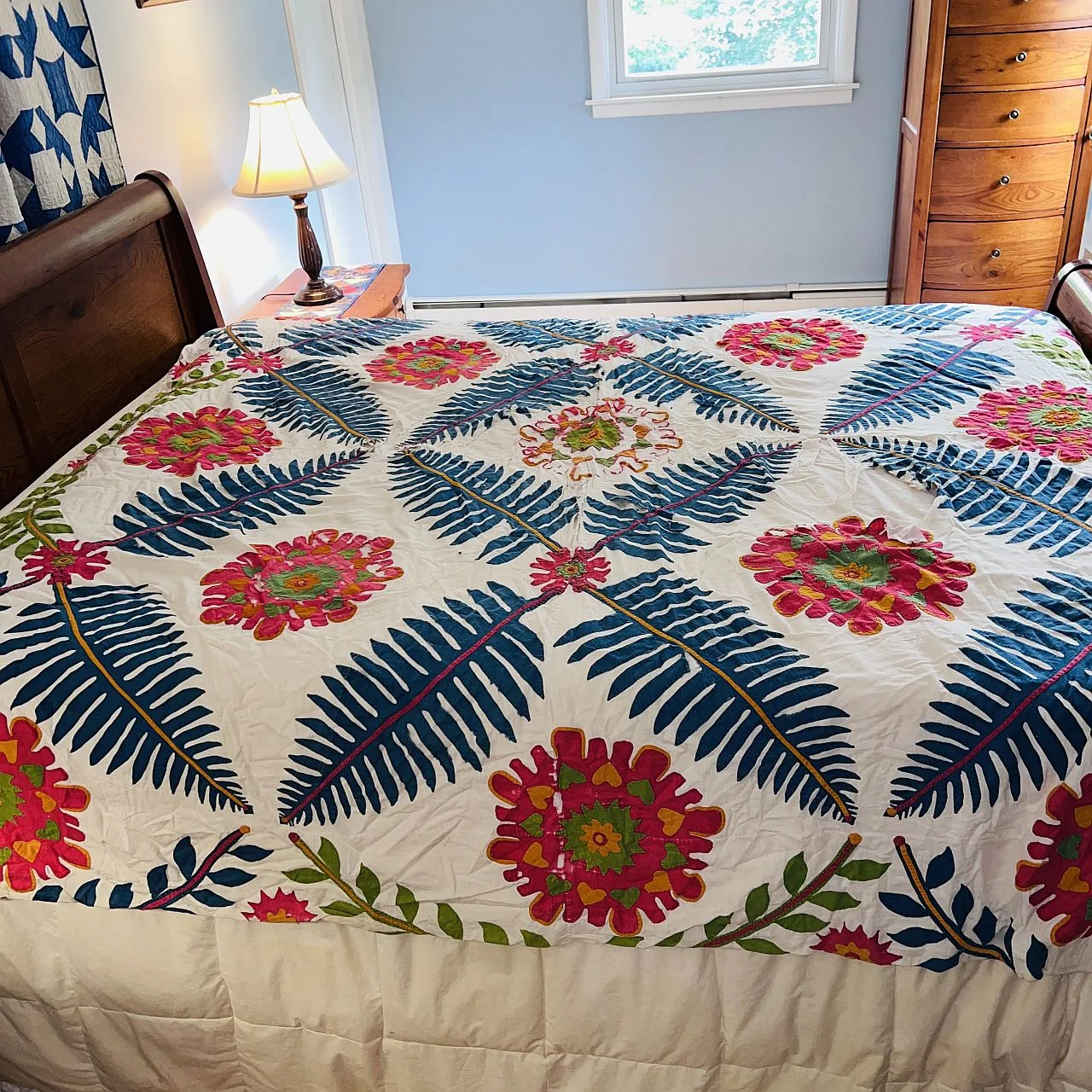
I don’t know if this is helpful, but I own an early R&G four patch Prince’s feather quilt. It has three borders. In the border are stemmed flowers with a too large single Prince’s feather as a leaf. The four large blocks are divided by a sashing of two red and one green strip with small green and white 9 patches at the intersections in the middle area, three total. The sashing does not run along the top or bottom. Each block’s Prince’s feathers total 8 that meet in the middle to an 8 pointed LeMoyne Star, of red and green. A red feather meets a red star point, and a green to green. The quilting pattern is scallops in the border area and small hanging diamonds everywhere else.
I don’t know the exact date, as the dealer didn’t know, but a credible person told me it was early, definitely preCW. I don’t have the measurements either, but on my queen bed the sashing goes to the sides and the borders hang over perfectly on the three sides.It rests at the base of the pillows.
In the Mint Museum catalogue of Fleur’s quilts, there is a crib size (36.5X35.5) Indigo “Princess Feather” dated circa 1850. It’s one large 5 feather block with corner motifs of another sort.
Kimberly Wulfert, PhD www.antiquequiltdating.com Email: quiltdating@